

- Market Size (2026)
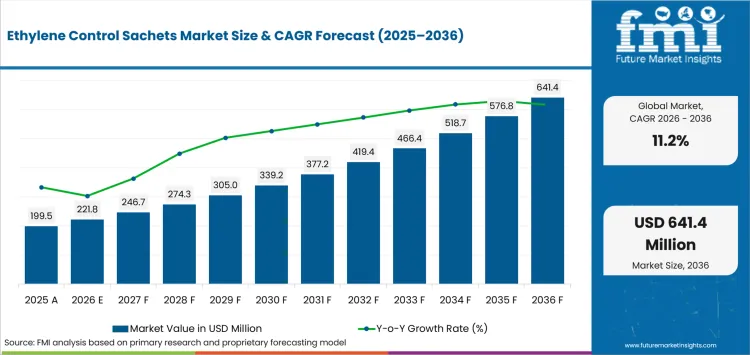
- USD 221.8 Mn
- Forecast (2036)
- USD 641.4 Mn
- CAGR (2026 to 2036)
- 11.2%
How big is Ethylene Control Sachets Market in 2026?
USD 221.8 million in 2026 and USD 641.4 million by 2036 at an 11.2% CAGR.
Demand for ethylene control sachets is projected to rise at an 11.2% CAGR from 2026 to 2036, lifting market value from USD 221.8 million to USD 641.4 million. Fresh-produce handlers pay for control when ripening threatens a planned release date. FAO reported in September 2025 that fruits and vegetables recorded the highest global food-loss rate at 25.4%. Repeat purchases follow if treatment preserves saleable quality during fresh food packaging and distribution.
Destination standards determine whether preserved quality can be sold at the expected grade, which changes treatment economics by country. In May 2026, UNECE said a 2025 table-grape standard change cut related South African packhouse losses from nearly 5% to under 1%. Lower loss rates make standards compliance part of the return from cold chain packaging and postharvest treatment.
Key Takeaways
- Demand for ethylene control sachets rises where fresh-produce handlers can protect a defined storage or shipping window without changing the commodity itself.
- In 2026, edible coatings are expected to lead product type with 42.0% share because line-applied treatment fits routine packhouse surface handling.
- By commodity, pome & stone fruit are estimated to hold 43.4% in 2026 owing to long storage programs that raise the cost of uncontrolled ripening.
- Based on application point, packhouse is projected to account for 38.3% in 2026 due to early visibility into crop condition, destination and planned storage duration.
- Application inconsistency restrains adoption if room leakage, cultivar response or dose delivery prevents operators from reproducing the expected commercial result.
- Some of the key players in this market include Apeel Sciences, Hazel Technologies, DECCO (UPL), Pace International, Xeda International, Citrosol, Fomesa Fruitech, and JBT Corporation.
Analyst Perspective
"Ethylene control earns repeat business only if treatment preserves a planned release window under the packhouse's real crop and room conditions. The stronger commercial offer couples crop-specific efficacy with dosing support that lets operators reproduce the result during storage and shipment."
- Nandini Roy Choudhury, Principal Consultant, Future Market Insights
How is the ethylene control sachets market segmented?
The market is segmented by product type, commodity, application point, technology base, sales channel and region.
Product type covers edible coatings, active sachets & liners, wash & drench treatments, storage-room treatments and others. Commodity separates pome & stone fruit, citrus, berries & grapes, tropical fruit, vegetables and others. Application point covers packhouse, storage facility, transit & retail and others. Technology base includes biological - microbial, plant-extract-based, mineral & wax-based and others. Sales channels comprise packhouse suppliers, post-harvest service providers, direct sales and others.
Why do Edible Coatings lead the Product Type category?
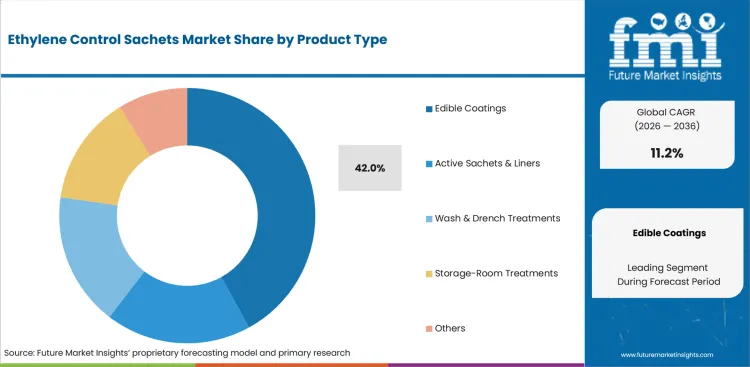
Packhouses apply edible coatings during surface treatment on lines that already manage moisture loss and gas exchange. The operating fit makes edible films and coatings easier to test against throughput and finish requirements on moving fruit.
- Based on product type, edible coatings are projected to account for 42.0% in 2026 due to line application placing freshness control inside an existing handling step.
- Citrosol stated in September 2025 that it had completed reconstruction and expansion of its manufacturing plant, increasing capacity and centralizing quality controls for postharvest products. The investment gives repeat coating programs a more controlled production and quality base.
Why does Pome & Stone Fruit lead the Commodity category?
Apples and other storage-sensitive fruit retain commercial value for months after harvest, so ripening control affects release timing instead of one delivery date. The category also carries a large addressable volume within produce packaging and long-duration storage programs.
- By commodity, pome & stone fruit are estimated to hold 43.4% in 2026 owing to the economic value of planned storage and staged market release.
- In August 2025, USApple forecast 2025-26 USA apple production at 278.5 million bushels. Large crop volumes make cultivar-specific storage protocols commercially important since a poor treatment decision can affect inventory held for extended periods.
Why does Packhouse lead the Application Point category?
The packhouse is the last high-control stage before fruit enters storage or distribution. Operators can match treatment to crop condition and destination while fruit processing equipment and line settings remain under direct control for each commercial packing schedule.
- Based on application point, packhouse is projected to account for 38.3% in 2026 due to treatment decisions being standardized before storage or shipment.
- Citrosol and Innoprint held their first post-harvest technical conference in Chile in April 2025 for packhouse professionals. The program focused on treatment decisions and application practice, which makes local technical access part of repeat-use economics.
Why do Biological - Microbial approaches lead the Technology Base category?
Biological - microbial approaches address decay with biologically derived agents and can complement physical freshness controls inside active and intelligent packaging. Their commercial value depends on validated crop response. Efficacy cannot be assumed from one commodity to another.
- The biological - microbial segment is likely to capture 50.9% share in 2026 attributable to postharvest programs seeking lower-residue routes alongside conventional chemistry.
- In October 2025, EPA opened public review for the ASFBIOF01-02 polypeptide biopesticide on uses including berries, citrus, pome fruit, stone fruit and vegetables. The proposed registration illustrates the qualification path biological inputs must clear before commercial use.
Why do Packhouse Suppliers lead the Sales Channel category?
Postharvest treatment is purchased with application advice since crop response, line timing and storage plans determine whether the product performs as intended. Packhouse suppliers familiar with food processing equipment can diagnose operating failures and prevent rejected repeat orders.
- Packhouse suppliers are set to lead sales channel with 42.5% share in 2026 due to technical service being part of the commercial decision.
- UPL confirmed in November 2025 that it integrated DECCO with Advanta during September. Management cited a service-led culture and overlapping emerging-market presence, giving the postharvest business a wider crop and channel relationship base internationally.
What are the drivers, restraints and opportunities in the Ethylene Control Sachets Market?
Longer handling windows increase the value of ripening control, execution risk limits conversion, and package-level preservation expands the number of treatment points available to produce handlers.
- Driver: Longer distribution and storage windows increase the cost of softening, downgrade and forced early sale before fruit reaches its planned commercial destination.
- Restraint: Treatment economics weaken if crop response, room sealing or dose delivery prevents operators from reproducing the expected result under routine commercial conditions.
- Opportunity: Package-level coatings and active formats can place freshness control closer to individual cases or pallets, reducing dependence on a separate room-treatment event.
Longer Handling Windows Raise the Cost of Quality Loss
Imported fruit reaches packers with part of its postharvest life already consumed, so arrival quality and remaining shelf life carry direct economic weight. Defra reported in June 2026 that UK fruit imports reached 3.6 million tonnes in 2025, up 8.2% from 2024. Ethylene control earns repeat spend if preserved firmness offsets downgrade risk during long distribution programs and protects planned release dates.
Application Variability Limits Repeatable Performance
Commercial conversion slows if application conditions change treatment response from one room or crop program to the next. USDA Agricultural Research Service work for fiscal 2025 found that Vapor Gard severely inhibited blueberry ripening in a commercial-variety trial. The result reinforces the need to validate dose, cultivar response and treatment conditions prior to scaling a protocol or committing to repeat purchasing.
Package-Level Formats Extend the Treatment Window
Package-level preservation gives produce handlers a route that does not require a separate room-treatment event. In June 2025, AgroFresh signed an exclusive global distribution agreement for NatuWrap, extending its postharvest portfolio with a temporary fruit-protection barrier. Modified atmosphere packaging can move preservation closer to cases or pallets, but crop-specific instructions must remain clear under changing packhouse conditions. Commercial value depends on matching barrier performance to commodity respiration and planned transit time.
Which country CAGRs are profiled in the Ethylene Control Sachets Market?
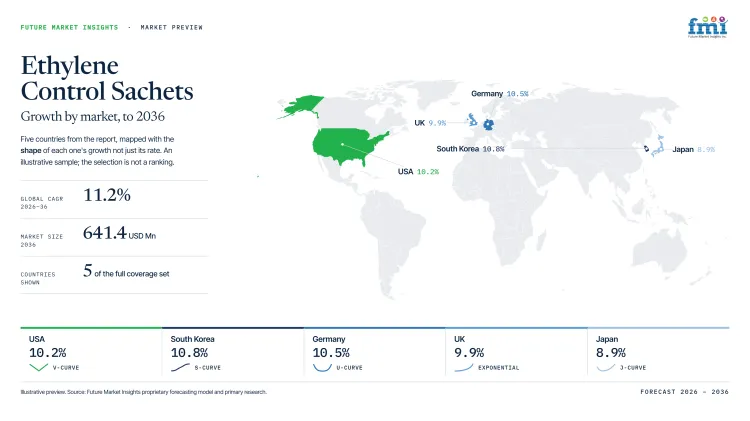
| Country | CAGR |
|---|---|
| South Korea | 10.8% |
| Germany | 10.5% |
| USA | 10.2% |
| UK | 9.9% |
| Japan | 8.9% |
How do country-level CAGRs compare in the Ethylene Control Sachets Market?
The five countries form a 1.9-point growth band, led by South Korea at 10.8% and Germany at 10.5%. The USA and UK follow at 10.2% and 9.9% CAGR respectively. Japan is slower at 8.9%, so commercial differences depend more on local operating routes than forecast spread alone in this period.
- South Korea's lead increases the payoff from distributor training and technical coverage.
- Germany's rate favors standardized claims that can support neighboring European regional programs.
- The USA's pace supports national account coverage for fresh-produce programs and service.
- UK growth favors flexible treatment portfolios for imported fruit with mixed origins.
- Japan's rate favors selective premium-crop programs backed by local qualification evidence and service.
Commercial entry depends on local operating routes, not the CAGR ranking.
The full report provides country-level CAGR analysis across North America, Latin America, Western Europe, Eastern Europe, East Asia, South Asia and Pacific and the Middle East and Africa.
Country-wise Analysis
- Commercial apple storage gives the USA a large installed handling base for crop-specific freshness programs. Ethylene control sachet demand in the USA is forecast to rise at 10.2% CAGR over the forecast period, driven by long storage schedules and familiar postharvest treatment routines. USDA NASS data for 2025 put fresh-market apple output in Washington at 5.655 billion pounds, showing the volume handled by the country's leading apple state. Cultivar response, room sealing and dose timing can disrupt repeatability unless technical service adjusts protocols to seasonal room turnover and storage schedules. Companies entering major apple regions therefore need regional service coverage during concentrated harvest and loading periods.
- UK importers and ripeners manage fruit with different harvest dates and remaining shelf life, making arrival quality central to packhouse economics. In July 2026, Defra noted that roughly four-fifths of imported fruit consists of products that cannot be grown commercially in the UK. The UK is estimated to post 9.9% CAGR through 2036, aided by long international supply routes and import dependence. Companies need dosing guidance that fits importer, ripener and packer schedules without slowing crop changeovers or routine line throughput. Mixed crop origins can keep protocol standardization difficult even when importer demand is strong during peak seasonal arrival periods.
- German fruit operators can test new freshness protocols inside a mature tree-fruit and cold-storage base, reducing disruption during commercial trials. Existing storage routines raise the proof standard since new treatments must fit residue controls and established handling schedules. Destatis documented in December 2025 that Germany harvested 1.138 million tonnes of apples during 2025, giving postharvest companies a substantial treatable crop base. The German ethylene control sachets sector is projected to record 10.5% CAGR during the assessment period, attributable to that throughput. Entry depends on documentation and application support that fit local quality controls and routine storage practice during peak harvest.
- Japanese produce programs place high commercial value on appearance, firmness and color at sale, so small quality shifts can affect premium-fruit economics. Ethylene control sachet demand in Japan is predicted to advance at 8.9% CAGR through 2036, tied to quality protection under more difficult growing conditions. MAFF's March 2026 report recorded a 2025 summer temperature anomaly of 2.36 degrees Celsius above the reference period, with quality effects documented in fruit crops. Heat exposure and cultivar response complicate qualification, so protocols need local proof for premium fruit programs to accept wider use. Future gains will favor selective crop programs over claims carried from other markets.
- South Korean growers are expanding apple production options as packhouses maintain quality standards for domestic and export programs. The larger orchard base gives treatment companies more packhouse trial opportunities, but demonstrations must prove that quality benefits survive local storage and shipment conditions. Adoption of ethylene control sachets in South Korea is estimated to expand at 10.8% CAGR through 2036, propelled by the larger crop base. In June 2026, the Ministry of Data and Statistics reported that apple cultivated area rose 4.9% to 34,850 hectares. Early packhouse partnerships let companies test repeatability so orchard expansion can translate into wider purchasing.
Who are the notable companies in the Ethylene Control Sachets Market?
Apeel Sciences, Hazel Technologies, DECCO (UPL), Pace International, Xeda International, Citrosol, Fomesa Fruitech, and JBT Corporation are the notable companies profiled in this market.
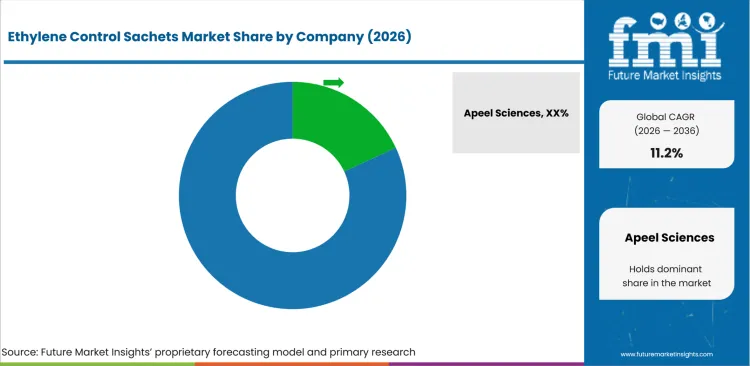
Competitive position depends on the point where each company enters the postharvest workflow and assumes application responsibility. Apeel Sciences, Citrosol and Fomesa Fruitech concentrate on coatings or surface treatment. Hazel Technologies and Pace International participate closer to active freshness and ethylene management. DECCO (UPL), Xeda International and JBT Corporation extend into treatment chemistry, food packaging machines or application support. Entry barriers rise if an offer lacks crop evidence or a service route that can correct application failures.
- Coating and surface-treatment platforms: Apeel Sciences, Citrosol and Fomesa Fruitech focus on produce-surface protection and line-applied postharvest treatments.
- Active freshness and ethylene-control specialists: Hazel Technologies and Pace International serve low-contact packaging, storage treatment and freshness-management programs.
- Integrated postharvest systems: DECCO (UPL), Xeda International and JBT Corporation pair consumables with application equipment, technical service or broader packhouse systems.
Competitive Benchmarking: Ethylene Control Sachets Market
| Company | Ethylene-Control Delivery | Packhouse Coating & Treatment | Application & Service Integration | Geographic Reach |
|---|---|---|---|---|
| Apeel Sciences | Medium | High | Medium | United States with international fresh-produce programs |
| Hazel Technologies | High | Low | Medium | United States with international produce programs |
| DECCO (UPL) | Low | High | High | Global postharvest network through UPL and DECCO |
| Pace International | High | High | High | North America and South America within AgroFresh network |
| Xeda International | Low | High | High | International network reported in 32 countries |
| Citrosol | Low | High | High | Europe with subsidiaries and international produce markets |
| Fomesa Fruitech | Low | High | Medium | Spain |
| JBT Corporation | Low | High | High | Global fresh-produce equipment and service footprint |
Scoring basis: High ethylene-control delivery requires a dedicated documented route that directly manages ethylene response or exposure. Medium identifies an indirect active-freshness route, whereas Low marks verified postharvest participation without a dedicated ethylene format. High coating and treatment requires multiple documented surface or postharvest routes under commercial handling conditions. High application integration requires products plus equipment or field service, with Medium reflecting narrower support and Low indicating product-led participation.
Key Developments in the Ethylene Control Sachets Market
- In March 2025, Hazel Technologies developed a BreatheWay modified-atmosphere pallet bag for broccoli shipments that removes the need for ice after precooling and palletization. The format targets weight and food-safety burdens in iced distribution, though commercial conversion depends on packer trials under real transit conditions.
- In May 2025, AgroFresh and Biotalys entered a collaboration to develop and commercialize biological fungicides for postharvest produce protection. The program targets spoilage after harvest and broadens the biological route available to the Pace International parent platform. Commercial use depends on successful development, validation and market approvals in each jurisdiction.
- In January 2025, JBT Corporation completed its combination with Marel, expanding the equipment and service base available to food and fresh-produce processors. A wider installed platform can support line-level trials and service access, though ethylene-control purchases require crop-specific treatment evidence.
Key Players in the Ethylene Control Sachets Market
Freshness-Control Platforms
- Apeel Sciences
- Hazel Technologies
- DECCO (UPL)
Postharvest Treatment Specialists
- Pace International
- Xeda International
Coating and Packhouse System Providers
- Citrosol
- Fomesa Fruitech
- JBT Corporation
Ethylene Control Sachets Market - Report Scope
| Coverage field | Report scope |
|---|---|
| Market breakdown | By product type, commodity, application point, technology base, sales channel and region. |
| Quantitative units | USD million. |
| Market definition | Commercial revenue from ethylene-control products and postharvest treatment consumables used on fresh produce within the listed segmentation categories. |
| Regions covered | North America, Latin America, Western Europe, Eastern Europe, East Asia, South Asia and Pacific, and Middle East and Africa. |
| Countries covered | USA, UK, Germany, Japan, South Korea, and more than twenty-five additional countries included in the full report. |
| Key companies profiled | Apeel Sciences, Hazel Technologies, DECCO (UPL), Pace International, Xeda International, Citrosol, Fomesa Fruitech, JBT Corporation. |
| Forecast period | 2026 to 2036. |
| Approach | Primary and secondary research with market triangulation. |
Ethylene Control Sachets Market - Research Methodology
| Method | Approach |
|---|---|
| Primary Research | FMI analysts gathered input from manufacturers, service providers, technology developers, distributors, end users, procurement teams, and subject-matter experts. Interviews examined purchasing decisions, product or service evaluation, adoption barriers, approval requirements, pricing considerations, and expectations for technical or commercial support. Respondents were also asked what evidence is required before a trial, pilot, or initial order develops into regular purchasing. |
| Desk Research | Desk research covered government statistics, regulatory publications, trade data, industry associations, technical literature, standards, company filings, product information, and official corporate announcements. Sources were reviewed for relevance, publication date, geographic coverage, and consistency with the defined market scope. Claims relating to performance, applications, approvals, capacity, investment, and commercial activity were retained only when supported by credible public evidence. |
| Market Sizing and Forecasting | The market model combined the baseline value with historical performance, segment structure, pricing and volume indicators, adoption levels, company participation, and country-level demand conditions. Forecast assumptions considered economic activity, investment trends, regulatory developments, technology adoption, purchasing cycles, supply availability, and barriers to wider market use. Segment and regional estimates were reconciled before the final market total was calculated. |
| Data Validation | Estimates were checked against multiple independent indicators, including public data, company activity, trade patterns, industry developments, and findings from primary interviews. Validation also tested whether products, services, applications, and company revenues fell within the defined market boundaries. Adjacent categories, unsupported claims, overlapping revenues, and activities without direct market relevance were excluded to reduce double counting and maintain consistency across segments and countries. |
Ethylene Control Sachets Market by Segments
Ethylene Control Sachets Market segmented by Product Type:
- Edible Coatings
- Active Sachets & Liners
- Wash & Drench Treatments
- Storage-Room Treatments
- Others
Ethylene Control Sachets Market segmented by Commodity:
- Pome & Stone Fruit
- Citrus
- Berries & Grapes
- Tropical Fruit
- Vegetables
- Others
Ethylene Control Sachets Market segmented by Application Point:
- Packhouse
- Storage Facility
- Transit & Retail
- Others
Ethylene Control Sachets Market segmented by Technology Base:
- Biological - Microbial
- Plant-Extract-Based
- Mineral & Wax-Based
- Others
Ethylene Control Sachets Market segmented by Sales Channel:
- Packhouse Suppliers
- Post-Harvest Service Providers
- Direct Sales
- Others
Ethylene Control Sachets Market by Region:
- North America
- United States
- Canada
- Latin America
- Brazil
- Mexico
- Argentina
- Chile
- Western Europe
- Germany
- France
- United Kingdom
- Italy
- Spain
- Benelux
- Nordics
- Eastern Europe
- Poland
- Czech Republic
- Romania
- Hungary
- East Asia
- China
- Japan
- South Korea
- South Asia and Pacific
- India
- ASEAN
- Australia and New Zealand
- Middle East and Africa
- GCC Countries
- South Africa
- Türkiye
- Israel
Research Sources and Bibliography
- Food and Agriculture Organization of the United Nations. (2025, September 29). On the International Day of Awareness of Food Loss and Waste, learn how FAO is leveraging data to save food and advance the 2030 Agenda
- United Nations Economic Commission for Europe. (2026, May 28). UNECE develops new guidance to reduce food loss in fresh and dried produce
- Citrosol. (2025, September 25). Citrosol expands its global footprint
- USA Apple Association. (2025, August 15). 2025-26 Apple Production Will Reach Nearly 279 Million Bushels
- Citrosol. (2025, April 14). Citrosol and Innoprint organize in Chile the First Post-harvest Technical Conference
- USA Environmental Protection Agency. (2025, October 30). Biopesticides
- UPL Limited. (2025, November 6). UPL Limited - Q2 and H1 FY26 Earnings Conference Call
- UK Department for Environment, Food & Rural Affairs. (2026, June 25). Horticulture statistics 2025
- USA Department of Agriculture, Agricultural Research Service. (2025). Project 438277: Postharvest physiology and quality
- AgroFresh Solutions, Inc. (2025, June 18). AgroFresh Expands Global Post-Harvest Solutions Portfolio with NatuWrap in Exclusive Distribution Agreement with Nabaco
- USA Department of Agriculture, National Agricultural Statistics Service. (2025). 2025 State Agriculture Overview: Washington
- UK Department for Environment, Food & Rural Affairs. (2026, July 9). Chapter 14: The food chain
- Federal Statistical Office of Germany. (2025, December 19). Apfelernte 2025 um 30,5 % höher als im Vorjahr
- Ministry of Agriculture, Forestry and Fisheries of Japan. (2026, March 27). 2025 Global Warming Impact Survey Report, preliminary findings
- Ministry of Data and Statistics, Republic of Korea. (2026, June 23). Preliminary Results of the Cultivated Area of Barley, Wheat, Spring Potatoes, Apples and Pears in 2026
- Apeel Sciences. (2025, June 3). Apeel Sciences Recognized by Food & Wine as a 2025 Game Changer for Food Innovation
- JBT Marel Corporation. (2026, February 27). JBT Marel Completes Major Customer Innovation Center Renovation
- UPL Limited. (2025). Annual Report 2024-25
- AgroFresh Solutions, Inc. (2024, March 27). AgroFresh Acquires Pace International LLC Expanding Post-Harvest Solutions Portfolio
- Xeda Italia. (n.d.). Il gruppo
- Ministry of Agriculture, Fisheries and Food of Spain. (2024). Register of plant-protection products and concessionaires
- JBT Marel Corporation. (2026, March 2). Annual report for the year ended December 31, 2025
- Hazel Technologies. (2025, March 17). New packaging technology eliminates the need for ice when shipping broccoli
- AgroFresh Solutions, Inc. (2025, May 20). Biotalys and AgroFresh Partner to Protect Fresh Produce
- JBT Marel Corporation. (2025, January 7). JBT Corporation Completes Settlement of its Voluntary Takeover Offer of Marel hf. and Commences Trading as JBT Marel Corporation
- AgroFresh Solutions, Inc. (2025, November 6). AgroFresh Announces New AI-Powered Imaging and Orchard Analytics Partnerships with Aerobotics and Neolithics
- Hazel Technologies. (2025, January 8). Membrane packaging extends shelf-life of cucumbers and reduces weight loss
- AgroFresh Solutions, Inc. (2025, March 17). AgroFresh Presents New Digital Post-Harvest Technology at Fruit Attraction 2025 in São Paulo
- AgroFresh Solutions, Inc. (2025, April 22). Smarter Decisions, Fresher Fruit: AgroFresh Showcases Rubens and Proteku at Macfrut 2025
- Hazel Technologies. (2025, February 3). Modified Atmosphere Packaging solution helps improve melon quality
- AgroFresh Solutions, Inc. (2026, April 24). AgroFresh Opens New Asia Pacific R&D Center in Yangling, China
- DECCO. (2025, January 21). DECCO Ibérica receives the registration for DECCO Zox: First Product formulated with Azoxystrobin in Europe in Postharvest Citrus Protection
- DECCO. (2025, September 23). DECCO Expands Global Footprint with New Plant in Valencia, Spain
This bibliography is provided for reader reference and is not exhaustive. The full report contains the complete reference list and detailed citations.
This Report Answers
- How large is the ethylene control sachets market in 2026 and 2036?
- Which postharvest losses support demand for ethylene-control treatment?
- Why do edible coatings lead product type demand?
- Why do pome & stone fruit lead commodity demand?
- Why does packhouse lead the application-point category?
- How do growth rates differ among the five profiled countries?
- Which companies serve the ethylene control sachets market?
- What evidence should packhouses require before scaling a protocol?
Frequently Asked Questions
How big is the ethylene control sachets market in 2026?
The ethylene control sachets market is valued at USD 221.8 million in 2026 and is projected to reach USD 641.4 million by 2036. Growth follows the need to preserve saleable quality during longer storage and distribution windows.
What is the CAGR of the ethylene control sachets market from 2026 to 2036?
The ethylene control sachets market is projected to grow at a CAGR of 11.2% between 2026 and 2036. Expansion depends on repeatable crop response, workable packhouse application and favorable economics for reducing ripening-related loss.
Which product type leads the ethylene control sachets market?
The edible coatings segment is expected to hold 42.0% of the ethylene control sachets market in 2026, driven by routine packhouse surface treatment. Line application manages moisture and gas exchange without a separate room-treatment cycle.
Which commodity leads the ethylene control sachets market?
The pome & stone fruit segment is expected to hold 43.4% of the ethylene control sachets market in 2026, attributable to long storage programs. Ripening control protects release timing and packout value during extended commercial holding.
Which application point leads the ethylene control sachets market?
The packhouse segment is expected to hold 38.3% of the ethylene control sachets market in 2026, supported by early crop and destination information. Operators can standardize treatment before storage or shipment introduces greater operational variability into the handling chain.
Which countries are projected to record the highest growth in the ethylene control sachets market?
South Korea is projected to grow at 10.8% CAGR, followed by Germany at 10.5% and the USA at 10.2% through 2036. Country growth routes differ with orchard scale, import dependence, heat exposure and packhouse practice.
Which companies are active in the ethylene control sachets market?
Key companies operating in the market include Apeel Sciences, Hazel Technologies, DECCO (UPL), Pace International, Xeda International, Citrosol, Fomesa Fruitech, and JBT Corporation. They differ by coating technology, active freshness delivery, packhouse chemistry and application support.
Preview the report firsthand - request a free sample
Get SampleGet the brochure for pricing and purchase details.
Get PDFTable of Content
- Key Takeaways
- Market Size and CAGR
- Top Growth Driver
- Fastest Growing Segment
- Leading Region
- Key Companies
- Emerging Opportunities
- Executive Summary
- Global Market Outlook
- Demand-side Trends
- Supply-side Trends
- Technology Roadmap Analysis
- Analysis and Recommendations
- Analyst Perspective (What is happening? Why now? What should investors know?)
- Key Questions Answered
- How large is the market?
- What is the CAGR?
- What are key trends?
- Which region dominates?
- Who are the leaders?
- Market Overview
- Market Coverage / Taxonomy
- Market Definition / Scope / Limitations
- Research Methodology
- Chapter Orientation
- Analytical Lens and Working Hypotheses
- Market Structure, Signals, and Trend Drivers
- Benchmarking and Cross-market Comparability
- Market Sizing, Forecasting, and Opportunity Mapping
- Research Design and Evidence Framework
- Desk Research Programme (Secondary Evidence)
- Expert Input and Fieldwork (Primary Evidence)
- Tooling, Models, and Reference Databases
- Data Engineering and Model Build
- Quality Assurance and Audit Trail
- Market Background
- Market Dynamics (Drivers, Restraints, Opportunity, Trends)
- Scenario Forecast (Optimistic, Likely, Conservative)
- Impact Analysis
- AI Impact
- Sustainability Impact
- Regulatory Impact
- Technology Impact
- Consumer / Buyer Analysis
- Purchase Drivers
- Adoption Barriers
- Buyer Journey
- Opportunity Map Analysis
- Product Life Cycle Analysis
- Supply Chain Analysis
- Investment Feasibility Matrix
- Value Chain Analysis
- PESTLE and Porter's Analysis
- Regulatory Landscape
- Regional Parent Market Outlook
- Production and Consumption Statistics
- Import and Export Statistics
- Global Market Analysis and Forecast, 2021 to 2036
- Historical Market Size Value (USD Million) Analysis, 2021 to 2025
- Current and Future Market Size Value (USD Million) Projections, 2026 to 2036
- Y-o-Y Growth Trend Analysis
- Absolute $ Opportunity Analysis
- Global Market Pricing Analysis, 2021 to 2036
- Global Market Analysis and Forecast, By Product Type, 2021 to 2036
- Introduction / Key Findings
- Historical Market Size Value (USD Million) Analysis By Product Type, 2021 to 2025
- Current and Future Market Size Value (USD Million) Analysis and Forecast By Product Type, 2026 to 2036
- Edible Coatings
- Active Sachets & Liners
- Wash & Drench Treatments
- Storage-Room Treatments
- Others
- Edible Coatings
- Y-o-Y Growth Trend Analysis By Product Type, 2021 to 2025
- Absolute $ Opportunity Analysis By Product Type, 2026 to 2036
- Global Market Analysis and Forecast, By Commodity, 2021 to 2036
- Introduction / Key Findings
- Historical Market Size Value (USD Million) Analysis By Commodity, 2021 to 2025
- Current and Future Market Size Value (USD Million) Analysis and Forecast By Commodity, 2026 to 2036
- Pome & Stone Fruit
- Citrus
- Berries & Grapes
- Tropical Fruit
- Vegetables
- Others
- Pome & Stone Fruit
- Y-o-Y Growth Trend Analysis By Commodity, 2021 to 2025
- Absolute $ Opportunity Analysis By Commodity, 2026 to 2036
- Global Market Analysis and Forecast, By Application Point, 2021 to 2036
- Introduction / Key Findings
- Historical Market Size Value (USD Million) Analysis By Application Point, 2021 to 2025
- Current and Future Market Size Value (USD Million) Analysis and Forecast By Application Point, 2026 to 2036
- Packhouse
- Storage Facility
- Transit & Retail
- Others
- Packhouse
- Y-o-Y Growth Trend Analysis By Application Point, 2021 to 2025
- Absolute $ Opportunity Analysis By Application Point, 2026 to 2036
- Global Market Analysis and Forecast, By Technology Base, 2021 to 2036
- Introduction / Key Findings
- Historical Market Size Value (USD Million) Analysis By Technology Base, 2021 to 2025
- Current and Future Market Size Value (USD Million) Analysis and Forecast By Technology Base, 2026 to 2036
- Biological / Microbial
- Plant-Extract-Based
- Mineral & Wax-Based
- Others
- Biological / Microbial
- Y-o-Y Growth Trend Analysis By Technology Base, 2021 to 2025
- Absolute $ Opportunity Analysis By Technology Base, 2026 to 2036
- Global Market Analysis and Forecast, By Sales Channel, 2021 to 2036
- Introduction / Key Findings
- Historical Market Size Value (USD Million) Analysis By Sales Channel, 2021 to 2025
- Current and Future Market Size Value (USD Million) Analysis and Forecast By Sales Channel, 2026 to 2036
- Packhouse Suppliers
- Post-Harvest Service Providers
- Direct Sales
- Others
- Packhouse Suppliers
- Y-o-Y Growth Trend Analysis By Sales Channel, 2021 to 2025
- Absolute $ Opportunity Analysis By Sales Channel, 2026 to 2036
- Global Market Analysis and Forecast, By Region, 2021 to 2036
- Introduction
- Historical Market Size Value (USD Million) Analysis By Region, 2021 to 2025
- Current Market Size Value (USD Million) Analysis and Forecast By Region, 2026 to 2036
- North America
- Latin America
- Western Europe
- Eastern Europe
- East Asia
- South Asia and Pacific
- Middle East & Africa
- Market Attractiveness Analysis By Region
- North America Market Analysis and Forecast, By Country, 2021 to 2036
- Historical Market Size Value (USD Million) Trend Analysis By Market Taxonomy, 2021 to 2025
- Market Size Value (USD Million) Forecast By Market Taxonomy, 2026 to 2036
- By Country
- USA
- Canada
- By Product Type
- By Commodity
- By Application Point
- By Technology Base
- By Sales Channel
- By Country
- Market Attractiveness Analysis
- By Country
- By Product Type
- By Commodity
- By Application Point
- By Technology Base
- By Sales Channel
- Key Takeaways
- Latin America Market Analysis and Forecast, By Country
- Historical Market Size Value (USD Million) Trend Analysis By Market Taxonomy, 2021 to 2025
- Market Size Value (USD Million) Forecast By Market Taxonomy, 2026 to 2036
- By Country
- Brazil
- Mexico
- Chile
- Rest of Latin America
- By Product Type
- By Commodity
- By Application Point
- By Technology Base
- By Sales Channel
- By Country
- Market Attractiveness Analysis
- By Country
- By Product Type
- By Commodity
- By Application Point
- By Technology Base
- By Sales Channel
- Key Takeaways
- Western Europe Market Analysis and Forecast, By Country
- Historical Market Size Value (USD Million) Trend Analysis By Market Taxonomy, 2021 to 2025
- Market Size Value (USD Million) Forecast By Market Taxonomy, 2026 to 2036
- By Country
- Germany
- UK
- Italy
- Spain
- France
- Nordic
- BENELUX
- Rest of Western Europe
- By Product Type
- By Commodity
- By Application Point
- By Technology Base
- By Sales Channel
- By Country
- Market Attractiveness Analysis
- By Country
- By Product Type
- By Commodity
- By Application Point
- By Technology Base
- By Sales Channel
- Key Takeaways
- Eastern Europe Market Analysis and Forecast, By Country
- Historical Market Size Value (USD Million) Trend Analysis By Market Taxonomy, 2021 to 2025
- Market Size Value (USD Million) Forecast By Market Taxonomy, 2026 to 2036
- By Country
- Russia
- Poland
- Hungary
- Balkan & Baltic
- Rest of Eastern Europe
- By Product Type
- By Commodity
- By Application Point
- By Technology Base
- By Sales Channel
- By Country
- Market Attractiveness Analysis
- By Country
- By Product Type
- By Commodity
- By Application Point
- By Technology Base
- By Sales Channel
- Key Takeaways
- East Asia Market Analysis and Forecast, By Country
- Historical Market Size Value (USD Million) Trend Analysis By Market Taxonomy, 2021 to 2025
- Market Size Value (USD Million) Forecast By Market Taxonomy, 2026 to 2036
- By Country
- China
- Japan
- South Korea
- By Product Type
- By Commodity
- By Application Point
- By Technology Base
- By Sales Channel
- By Country
- Market Attractiveness Analysis
- By Country
- By Product Type
- By Commodity
- By Application Point
- By Technology Base
- By Sales Channel
- Key Takeaways
- South Asia and Pacific Market Analysis and Forecast, By Country
- Historical Market Size Value (USD Million) Trend Analysis By Market Taxonomy, 2021 to 2025
- Market Size Value (USD Million) Forecast By Market Taxonomy, 2026 to 2036
- By Country
- India
- ASEAN
- Australia & New Zealand
- Rest of South Asia and Pacific
- By Product Type
- By Commodity
- By Application Point
- By Technology Base
- By Sales Channel
- By Country
- Market Attractiveness Analysis
- By Country
- By Product Type
- By Commodity
- By Application Point
- By Technology Base
- By Sales Channel
- Key Takeaways
- Middle East & Africa Market Analysis and Forecast, By Country
- Historical Market Size Value (USD Million) Trend Analysis By Market Taxonomy, 2021 to 2025
- Market Size Value (USD Million) Forecast By Market Taxonomy, 2026 to 2036
- By Country
- Kingdom of Saudi Arabia
- Other GCC Countries
- Türkiye
- South Africa
- Other African Union
- Rest of Middle East & Africa
- By Product Type
- By Commodity
- By Application Point
- By Technology Base
- By Sales Channel
- By Country
- Market Attractiveness Analysis
- By Country
- By Product Type
- By Commodity
- By Application Point
- By Technology Base
- By Sales Channel
- Key Takeaways
- Key Countries Market Analysis
- USA
- Pricing Analysis
- Market Share Analysis, 2025
- By Product Type
- By Commodity
- By Application Point
- By Technology Base
- By Sales Channel
- Canada
- Pricing Analysis
- Market Share Analysis, 2025
- By Product Type
- By Commodity
- By Application Point
- By Technology Base
- By Sales Channel
- Mexico
- Pricing Analysis
- Market Share Analysis, 2025
- By Product Type
- By Commodity
- By Application Point
- By Technology Base
- By Sales Channel
- Brazil
- Pricing Analysis
- Market Share Analysis, 2025
- By Product Type
- By Commodity
- By Application Point
- By Technology Base
- By Sales Channel
- Chile
- Pricing Analysis
- Market Share Analysis, 2025
- By Product Type
- By Commodity
- By Application Point
- By Technology Base
- By Sales Channel
- Germany
- Pricing Analysis
- Market Share Analysis, 2025
- By Product Type
- By Commodity
- By Application Point
- By Technology Base
- By Sales Channel
- UK
- Pricing Analysis
- Market Share Analysis, 2025
- By Product Type
- By Commodity
- By Application Point
- By Technology Base
- By Sales Channel
- Italy
- Pricing Analysis
- Market Share Analysis, 2025
- By Product Type
- By Commodity
- By Application Point
- By Technology Base
- By Sales Channel
- Spain
- Pricing Analysis
- Market Share Analysis, 2025
- By Product Type
- By Commodity
- By Application Point
- By Technology Base
- By Sales Channel
- France
- Pricing Analysis
- Market Share Analysis, 2025
- By Product Type
- By Commodity
- By Application Point
- By Technology Base
- By Sales Channel
- India
- Pricing Analysis
- Market Share Analysis, 2025
- By Product Type
- By Commodity
- By Application Point
- By Technology Base
- By Sales Channel
- ASEAN
- Pricing Analysis
- Market Share Analysis, 2025
- By Product Type
- By Commodity
- By Application Point
- By Technology Base
- By Sales Channel
- Australia & New Zealand
- Pricing Analysis
- Market Share Analysis, 2025
- By Product Type
- By Commodity
- By Application Point
- By Technology Base
- By Sales Channel
- China
- Pricing Analysis
- Market Share Analysis, 2025
- By Product Type
- By Commodity
- By Application Point
- By Technology Base
- By Sales Channel
- Japan
- Pricing Analysis
- Market Share Analysis, 2025
- By Product Type
- By Commodity
- By Application Point
- By Technology Base
- By Sales Channel
- South Korea
- Pricing Analysis
- Market Share Analysis, 2025
- By Product Type
- By Commodity
- By Application Point
- By Technology Base
- By Sales Channel
- Russia
- Pricing Analysis
- Market Share Analysis, 2025
- By Product Type
- By Commodity
- By Application Point
- By Technology Base
- By Sales Channel
- Poland
- Pricing Analysis
- Market Share Analysis, 2025
- By Product Type
- By Commodity
- By Application Point
- By Technology Base
- By Sales Channel
- Hungary
- Pricing Analysis
- Market Share Analysis, 2025
- By Product Type
- By Commodity
- By Application Point
- By Technology Base
- By Sales Channel
- Kingdom of Saudi Arabia
- Pricing Analysis
- Market Share Analysis, 2025
- By Product Type
- By Commodity
- By Application Point
- By Technology Base
- By Sales Channel
- Türkiye
- Pricing Analysis
- Market Share Analysis, 2025
- By Product Type
- By Commodity
- By Application Point
- By Technology Base
- By Sales Channel
- South Africa
- Pricing Analysis
- Market Share Analysis, 2025
- By Product Type
- By Commodity
- By Application Point
- By Technology Base
- By Sales Channel
- USA
- Market Structure Analysis
- Competition Dashboard
- Competition Benchmarking
- Market Share Analysis of Top Players
- By Regional
- By Product Type
- By Commodity
- By Application Point
- By Technology Base
- By Sales Channel
- Emerging Startups
- Innovation Benchmarking
- Competition Analysis
- Competition Deep Dive
- Apeel Sciences
- Overview
- Product Portfolio
- Profitability by Market Segments
- Sales Footprint
- Strategy Overview
- Marketing Strategy
- Product Strategy
- Channel Strategy
- Hazel Technologies
- DECCO (UPL)
- Pace International
- Xeda International
- Citrosol
- Fomesa Fruitech
- JBT Corporation
- Apeel Sciences
- Case Studies
- Success Stories
- Recent Developments
- Competition Deep Dive
- Assumptions & Acronyms Used


