

- Industry Size (2026)
- USD 1.3 Bn
- Forecast (2036)
- USD 2.8 Bn
- CAGR (2026 to 2036)
- 8.0%
Extensible Kraft Paper Pallet Wrap Market Size, Market Forecast and Outlook By FMI
The extensible kraft paper pallet wrap market was valued at USD 1.2 billion in 2025 and is projected to reach USD 1.3 billion in 2026, reflecting a CAGR of 8.0%. Market opportunities are expected to expand to USD 2.8 billion by 2036, driven primarily by extended producer responsibility regulations that are accelerating the shift from plastic stretch film to repulpable fiber-based pallet packaging.
The decisive shift away from LLDPE stretch films directly impacts FMCG and beverage distributors who rely on highly tensioned packaging to secure multi-ton pallet loads. Major European and North American retailers increasingly penalize inbound shipments wrapped in single-use plastics, creating an immediate compliance crisis for consumer goods suppliers. Logistics providers who delay the transition to extensible fiber alternatives face outright rejection at massive distribution centers. Inside the industry, packaging engineers recognize that paper's primary advantage is actually its breathability; unlike plastic, which traps moisture and causes corrugated carton collapse, crepe paper prevents condensation, drastically reducing product spoilage. Deploying sustainable logistics packaging directly eliminates these structural failures on the warehouse floor.
Summary of Extensible Kraft Paper Pallet Wrap Market
- Extensible Kraft Paper Pallet Wrap Market Definition
- Extensible kraft paper pallet wrap encompasses micro-creped fiber rolls engineered to provide high elasticity and holding force, replacing plastic stretch films in B2B transit packaging applications while ensuring full end-of-life repulpability.
- Demand Drivers in the Market
- Punitive extended producer responsibility taxes on single-use plastics force major fast-moving consumer goods brands to transition their secondary transport packaging to repulpable fiber.
- Imminent retailer mandates penalizing inbound plastic waste compel third-party logistics operators to source compliant paper wrap to maintain distribution contracts.
- Severe condensation issues under LLDPE film drive building materials manufacturers to adopt breathable creped paper to prevent moisture damage during transit.
- Key Segments Analyzed in the FMI Report
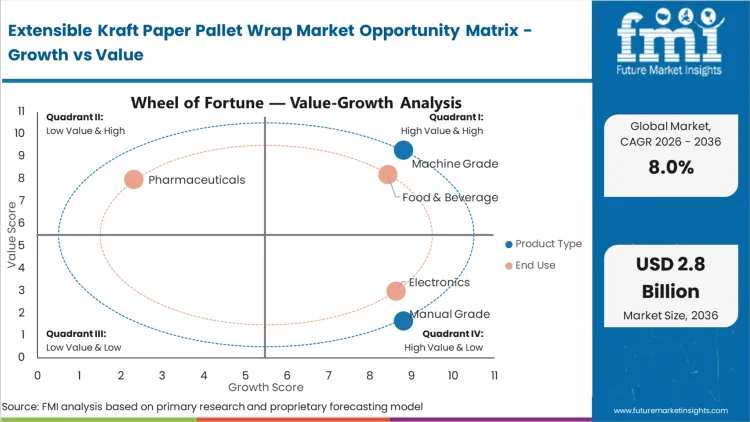
- Machine Grade: 65.0% share in 2026, driven by high-volume automated fulfillment centers requiring continuous, uninterrupted wrapping cycles for heavy pallet loads.
- Food & Beverage: 35.0% share in 2026, as grocery retailers enforce strict plastic reduction quotas on all inbound perishable and non-perishable deliveries.
- 50-80 GSM: 45.0% share in 2026, balancing sufficient puncture resistance for standard carton loads with optimal yield per roll.
- Germany: 9.5% compound growth, driven by rigorous enforcement of the updated VerpackG packaging tax structures on commercial logistics operations.
- Analyst Opinion at FMI
- Ismail Sutaria, Principal Consultant for Packaging, opines, "In my analysis, I have observed that the true bottleneck is not the unit cost of the paper, but the tension calibration on legacy plastic wrapping machines. Facilities attempting to run fiber wrap on unmodified LLDPE wrappers face continuous web breaks that halt outbound logistics. Supply chain directors who fail to upgrade their tension-control hardware alongside their material shift will face severe throughput delays and operational gridlock."
- Strategic Implications / Executive Takeaways
- Facility operations directors must retrofit legacy wrapping machinery with paper-compatible tension control heads before implementing full-scale material substitution.
- Paper mill executives should invest aggressively in proprietary micro-creping calendering lines to capture the surging demand from FMCG suppliers abandoning plastic.
- Procurement teams must secure long-term supply contracts for >30% stretch-capable kraft rolls or face significant price volatility as localized plastic bans take effect.
- Methodology
- Primary Research: FMI conducted detailed technical interviews with paper mill scientists, automated wrapper OEMs, and retail compliance officers across 30 countries to validate material transition timelines.
- Desk Research: Analysts aggregated public patent filings for creping technologies, national EPR tax calculators, and corporate ESG procurement mandates.
- Market-Sizing and Forecasting: The model applies a bottom-up methodology starting with global installed base metrics for automated pallet wrappers and projecting the conversion rate to fiber-compatible operations.
- Data Validation and Update Cycle: Segment forecasts undergo cross-validation against quarterly earnings reports and stated capital expenditure guidance from the leading global paper manufacturing conglomerates.
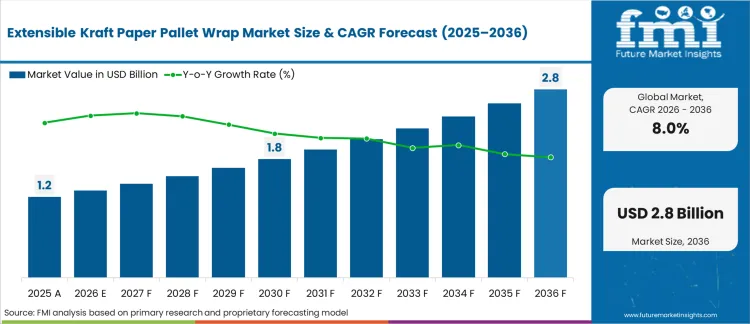
Adoption accelerates irreversibly when major OEMs of automated pallet wrappers release native "paper-ready" tension heads by default on all new machinery. Third-party logistics providers must procure these upgraded wrapping lines during their standard equipment replacement cycles over the next three years. Once the physical machinery bottleneck is removed, fleet-wide material substitution becomes the path of least resistance.
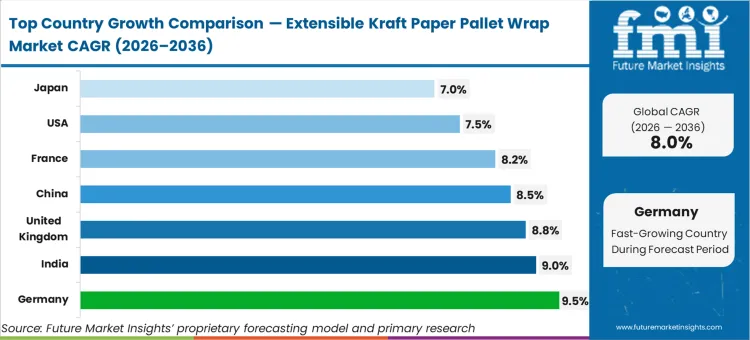
Germany advances at a 9.5% CAGR, followed by India at 9.0% and the United Kingdom at 8.8%. China tracks at 8.5%, while France records an 8.2% expansion. The United States grows at 7.5% and Japan posts a 7.0% rate. Germany's accelerated trajectory is dictated by the VerpackG legislation, which aggressively taxes non-repulpable B2B transport packaging. This distinct spread exists because nations with aggressively enforced extended producer responsibility frameworks force immediate material substitution, whereas regions relying on voluntary corporate sustainability targets transition more slowly.
Extensible Kraft Paper Pallet Wrap Market Definition
Extensible kraft paper pallet wrap is a specialized, high-stretch repulpable fiber material designed to secure bulk goods on shipping pallets. Unlike standard flat paper, this material undergoes a mechanical micro-creping process during manufacturing, granting it up to 30% elasticity. This allows the paper to stretch around pallet corners and maintain tight holding force, functioning as a direct structural replacement for traditional linear low-density polyethylene stretch films.
Extensible Kraft Paper Pallet Wrap Market Inclusions
The scope includes all machine-grade and manual-grade extensible kraft paper rolls explicitly manufactured for pallet wrapping and load unitization. Products featuring temporary moisture-resistant barrier coatings that maintain full repulpability fall within these boundaries. High-grammage creped transit wraps, specialized dispensing equipment compatible with fiber rolls, and associated kraft packaging solutions engineered for B2B logistics are completely incorporated into the valuation.
Extensible Kraft Paper Pallet Wrap Market Exclusions
Standard flat kraft paper, void fill paper, and non-extensible linerboard are excluded as they lack the elasticity required for pallet containment. All traditional plastic stretch films, including bio-based PE and recycled PET wraps, fall outside the defined parameters. Standalone automated wrapping machinery, rigid pallet boxes, strapping bands, and corner board edge protectors are explicitly omitted from the material revenue sizing.
Extensible Kraft Paper Pallet Wrap Market Research Methodology
- Primary Research: Analysts engaged with transit packaging engineers, 3PL procurement directors, and FMCG supply chain leads to map the specific cost thresholds triggering the switch from plastic to paper.
- Desk Research: The data collection phase aggregated extended producer responsibility tax schedules, EU packaging directive compliance timelines, and technical material specification sheets from major paper mills.
- Market-Sizing and Forecasting: The baseline value derives from a bottom-up aggregation of creped kraft roll shipment volumes, applying regional plastic-tax implementation curves to project future adoption velocity.
- Data Validation and Update Cycle: Projections are rigorously tested against publicly reported corporate sustainability milestones from the top twenty global retail conglomerates and verified paper mill capacity expansions.
Segmental Analysis
Extensible Kraft Paper Pallet Wrap Market Analysis by Product Type
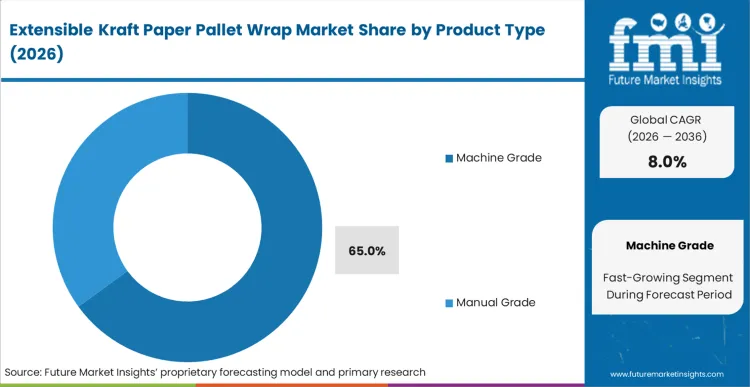
Transitioning to machine-grade fiber eliminates the looming financial penalties associated with plastic disposal. Facility managers who delay upgrading their automated systems risk complete exclusion from retailer distribution networks that mandate repulpable inbound loads. Relying on protective packaging materials designed specifically for automated transit ensures compliance and operational speed. The structural failure of legacy LLDPE films under new European taxation models forces distribution centers to overhaul their automated end-of-line packaging. Machine Grade extensible wrap holds a commanding 65.0% share in 2026 because high-volume fulfillment hubs cannot manually process the thousands of pallets shipped daily. These operations require continuous, uninterrupted wrapping cycles where the fiber material must withstand extreme mechanical tension without web breakage. According to FMI's estimates, retrofitting existing machinery with specialized tension rollers allows operations to seamlessly integrate these heavy-duty creped rolls.
- Automated Throughput: Calibrated machine rolls allow continuous operation without tearing under mechanical strain. Fulfillment directors securing these high-tensile rolls maintain their peak dispatch velocities.
- Tension Hardware Integration: Heavy-duty creped fiber requires specific pre-stretch settings on the wrapping turntable. Maintenance engineers installing these upgrades prevent costly line stoppages.
- Yield Optimization: Standardized machine roll lengths maximize the number of pallets secured per changeover. Procurement leads optimizing roll change schedules drastically reduce idle labor costs.
Extensible Kraft Paper Pallet Wrap Market Analysis by End Use
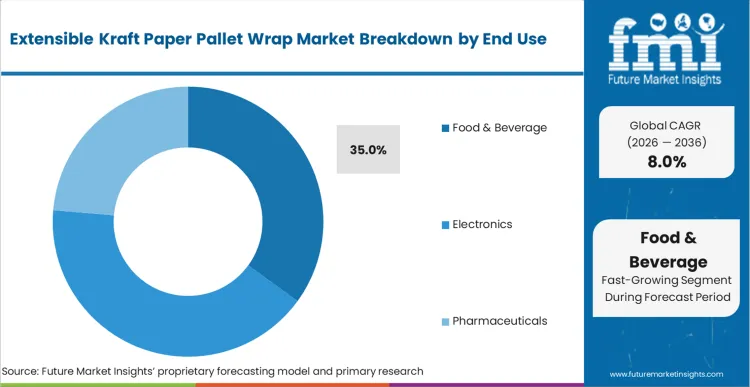
Retailer mandates targeting the elimination of plastic waste completely dictate the procurement strategies of FMCG and grocery suppliers. Food & Beverage captures 35.0% of the segment share in 2026 as major supermarkets actively reject inbound pallets secured with traditional stretch film. This strict compliance threshold forces beverage distributors and food processors to adopt extensible paper wraps to secure their loads. As per FMI's projection, the unique breathability of creped fiber also prevents the moisture buildup that frequently compromises corrugated cartons in the grocery supply chain. Shifting to paper directly preserves the structural integrity of the secondary packaging during variable-temperature transit. Logistics directors failing to transition their food shipments to fiber wrappers face immediate inbound receiving fees and potential contract termination from Tier-1 grocers. Implementing functional industrial transit packaging solves this critical bottleneck.
- Retail Compliance: Strict zero-plastic inbound delivery policies force material substitution at the distributor level. Beverage suppliers adopting paper wrap retain their critical shelf space access.
- Condensation Prevention: Breathable fiber matrices stop moisture from accumulating inside the wrapped pallet load. Quality assurance managers eliminating plastic wrap significantly reduce spoilage rates.
- Single-Stream Disposal: Repulpable paper allows grocery receiving staff to dispose of the wrap alongside the corrugated boxes. Store operations directors utilizing this material drastically cut commercial waste sorting costs.
Extensible Kraft Paper Pallet Wrap Market Analysis by Basis Weight
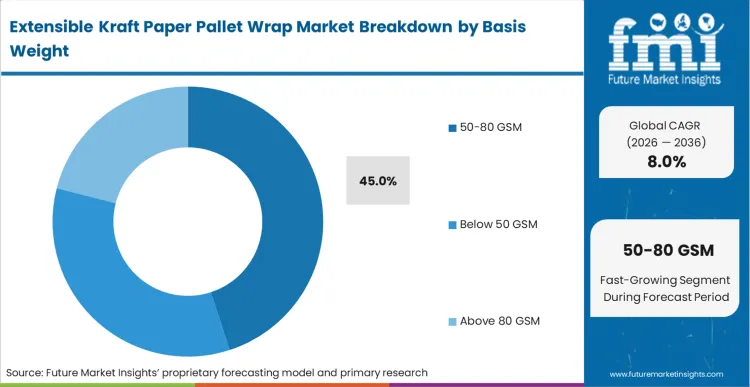
Balancing tensile strength with material cost allows operations to achieve cost parity with premium plastic films. Supply chain leads who specify inadequate basis weights experience catastrophic load shifting during transit, resulting in high damage claims. Upgrading the specification directly protects corrugated box integrity throughout the distribution cycle. The specific physical demands of mixed-load pallet containment dictate the selection of optimal material thickness. The 50-80 GSM sub-segment leads the market with a 45.0% share in 2026, providing the necessary puncture resistance for standard carton corners while maintaining sufficient yardage per roll. Lighter weights fail to secure heavy commercial goods, while heavier weights unnecessarily increase the per-pallet packaging cost. FMI analysts opine that this mid-weight category hits the exact performance threshold required by the majority of consumer goods shippers.
- Puncture Resistance: Mid-weight grammage prevents sharp carton corners from piercing the wrap during transit vibration. Logistics managers standardizing on 50-80 GSM drastically reduce product damage claims.
- Cost-Yield Balance: Optimizing the paper thickness maximizes the lineal meters available on a standard machine roll. Procurement teams calculating precise yield metrics keep per-pallet wrapping costs competitive.
- Corner Containment: Specialized creping at this weight allows the paper to stretch and lock around sharp 90-degree pallet edges. Load planning directors utilizing this material prevent dangerous cargo shifting.
Extensible Kraft Paper Pallet Wrap Market Drivers, Restraints, and Opportunities
The European Union Packaging and Packaging Waste Directive (PPWD) amendments force major fast-moving consumer goods brands to eliminate single-use plastics from their secondary transport packaging. This aggressive regulatory mechanism establishes strict extended producer responsibility malus fees that destroy the historical cost advantage of LLDPE stretch film. High-volume logistics operators facing these punitive taxes have no alternative but to overhaul their base infrastructure and adopt repulpable fiber transit packaging. Standardizing on extensible kraft paper allows shippers to bypass these tariffs entirely and secure compliance with zero-plastic retailer mandates. Operators who ignore this regulatory shift will suffer severe margin erosion and lose access to top-tier distribution networks.
The inherent low elasticity of early-generation paper wraps compared to plastic creates severe operational friction during the transition phase. Legacy pallet wrapping machines are calibrated to apply extreme tension to plastic film; applying this same force to standard paper causes immediate web breaks. To mitigate this technical gap, paper mills are heavily investing in advanced micro-creping calendering lines, while machinery OEMs release specialized low-tension dispensing heads to manage the paper gently without tearing.
Opportunities in the Extensible Kraft Paper Pallet Wrap Market
- Native Machinery Integration: Next-generation automated pallet wrappers feature specialized tension rollers specifically calibrated for fiber. Machinery OEMs deploying these native systems capture massive market share from 3PLs undergoing mandatory equipment upgrades.
- Moisture-Resistant Fiber Coatings: Advanced repulpable barrier coatings prevent the kraft paper from losing tensile strength in high-humidity shipping environments. Chemical engineers licensing this technology allow food exporters to utilize paper inside temperature controlled packaging supply chains without failure.
- Closed-Loop Recycling Contracts: Integrated paper and packaging conglomerates offer comprehensive retrieval services for used pallet wrap. Mill operators establishing these circular collection routes guarantee their own supply of high-quality secondary fiber while locking in long-term enterprise clients.
Regional Analysis
Based on the regional analysis, the Extensible Kraft Paper Pallet Wrap market is segmented into North America, Latin America, Europe, East Asia, South Asia, Oceania and Middle East & Africa across 40 plus countries.
.webp "Top Country Growth Comparison Extensible Kraft Paper Pallet Wrap Market Cagr (2026 2036)")
| Country | CAGR (2026 to 2036) |
|---|---|
| Germany | 9.5% |
| India | 9.0% |
| United Kingdom | 8.8% |
| China | 8.5% |
| France | 8.2% |
| United States | 7.5% |
| Japan | 7.0% |
Source: Future Market Insights (FMI) analysis, based on proprietary forecasting model and primary research
Europe Extensible Kraft Paper Pallet Wrap Market Analysis
The updated VerpackG legislation and similar European PPWD directives explicitly penalize the use of mixed-material coolers and single-use plastic films in B2B transit. Logistics directors operating within this stringent regulatory environment face immediate, escalating taxes if they dispatch pallets secured with non-repulpable LLDPE. This policy-led framework forces the rapid adoption of highly extensible paper alternatives to guarantee cost stability. Based on FMI's assessment, the complete elimination of plastic stretch film at the regional distribution center level is becoming a prerequisite for doing business with major European grocers. Upgrading the core packaging material ensures that high-volume food and beverage shippers bypass the incoming wave of disposal tariffs.
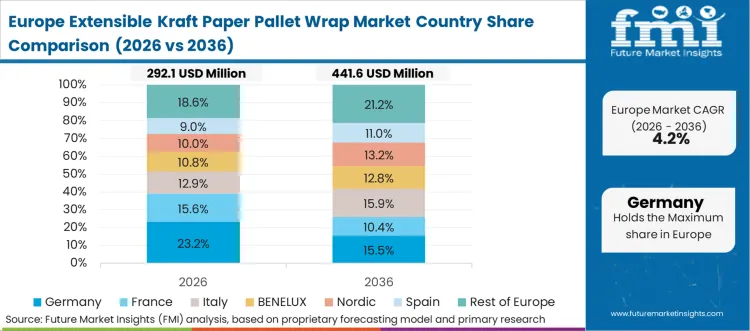
- Germany: Germany's updated Packaging Act imposes punitive extended producer responsibility taxes strictly on mixed-material and B2B plastic films. This specific tax structure forces FMCG logistics managers to adopt certified cellulose alternatives to maintain cost parity. Widespread auditing by the Central Agency Packaging Register confirms this aggressive shift away from plastic stretch wraps. The country is sustaining a 9.5% CAGR to 2036. Supply chain directors who ignore these material taxes face severe commercial disadvantages on high-volume distribution routes.
- United Kingdom: The post-Brexit plastic packaging tax in the United Kingdom requires commercial shippers to utilize materials containing extreme levels of recycled content or switch entirely to paper. Retail compliance leads actively reject inbound plastic-wrapped pallets to avoid secondary disposal fees. This legislative pressure drives the market at an 8.8% compound rate through 2036. Distribution facility owners failing to transition to fiber wrappers forfeit access to the major national supermarket networks.
- France: France's strict anti-waste law (AGEC) mandates the systematic reduction of all single-use plastics across the industrial supply chain. Procurement specification leads operating export hubs must validate the repulpability of all outbound transit packaging. Tracking an 8.2% annual growth to 2036, the market expands as agricultural exporters standardize on breathable creped paper. Asset operators lacking compliant wrapping solutions experience massive border delays and secondary repacking fees.
FMI's report includes comprehensive evaluation of Italy, Spain, the Nordics, and the broader Benelux region. A prevailing structural condition across these nations is the coordinated implementation of harmonized EU packaging taxes, effectively closing the geographic loopholes that previously allowed plastic wrap to persist in cross-border logistics.
Asia Pacific Extensible Kraft Paper Pallet Wrap Market Analysis
Rapidly modernizing automated fulfillment infrastructure across the Asia Pacific region accelerates the bypass of legacy manual wrapping methods. Capital projects directors constructing new multi-tier e-commerce distribution centers specify unified, high-throughput packaging lines in their initial site blueprints. FMI analysts opine that this greenfield approach allows operators to install paper-compatible tension machinery from day one, entirely avoiding the costly retrofit phase that plagues older European facilities. By building native fiber-handling capabilities into the foundation, regional asset owners establish highly flexible production environments capable of meeting strict global export standards. The integration of these robust transit solutions forms the critical prerequisite for participating in international supply chains.
- India: India's pharmaceutical export sector operates under stringent international shipping standards requiring robust, moisture-resistant transit packaging. Facility operators must deploy breathable creped paper wraps to prevent condensation damage during extended maritime transport. The national push toward eliminating single-use plastics in commercial zones triggers a wave of facility upgrades. Expanding at 9.0% between 2026 and 2036, the demand surges as major logistics hubs adapt. Exporters failing to utilize breathable transit materials face massive cargo spoilage and high insurance premiums.
- China: China's highly automated electronics manufacturing sector deploys sophisticated end-of-line robotic wrappers requiring exceptionally strong, continuous-feed extensible paper. Greenfield facility architects bypass legacy plastic wrappers entirely, specifying native paper-compatible tension heads for all new procurement contracts. The sheer volume of new export facility construction establishes a massive installed base of fiber-ready infrastructure. Advancing at an 8.5% compound between 2026 and 2036, the transition accelerates rapidly. Hardware suppliers lacking verified high-stretch creped rolls lose access to the most lucrative electronics export contracts.
- Japan: Japan's precision automotive components supply chain enforces strict unified packaging protocols to streamline automated receiving at assembly plants. Every new outbound packaging architecture must validate repulpability compliance before receiving authorization for series production integration. The domestic paper manufacturing sector embeds micro-creping technology directly into its high-grammage rolls to satisfy this demand. Projected at 7.0% compound growth over the forecast period, the market steadily converts. Engineering contractors lacking verified interoperable testing records forfeit access to Tier-1 automotive logistics networks.
FMI's report includes detailed analysis of South Korea, Taiwan, Australia, and the broader ASEAN region. A primary trend shaping these nations is the rapid localization of sustainable packaging production, forcing regional paper mills to invest in advanced calendering machinery to satisfy stringent global brand traceability requirements.
North America Extensible Kraft Paper Pallet Wrap Market Analysis
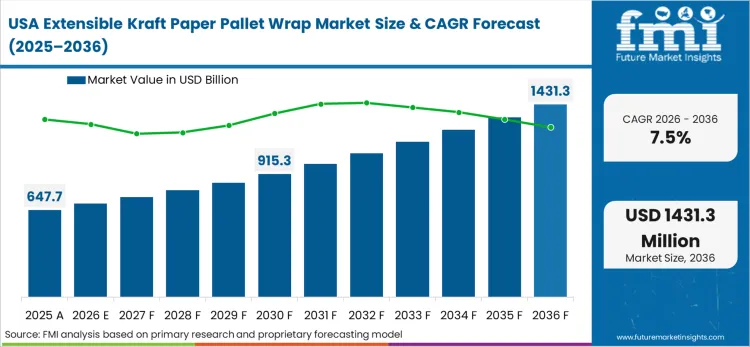
Severe margin pressure and escalating waste disposal costs actively drive the North American transition away from traditional plastic stretch films. Control systems engineers managing massive retail distribution networks face strict internal directives to cut down the volume of LLDPE scrap generated daily. According to FMI's estimates, the heavy manufacturing and building materials sectors actively lead this shift to prevent moisture damage on high-value outbound freight. Implementing a standardized, breathable fiber wrap enables these facilities to drastically reduce condensation-related product losses without compromising real-time load stability. This strategic shift requires significant capital allocation toward premium creped paper that can match the holding force of thick plastic.
- United States: The United States e-commerce fulfillment sector enforces strict internal sustainability mandates across its massive network of regional distribution centers. Network specification leads replacing aging plastic wrappers must deploy resilient paper backbones capable of supporting high-speed processing while eliminating plastic waste. Corporate ESG modernization initiatives actively fund the replacement of vulnerable plastic flows with standardized repulpable fiber. Anchored to a 7.5% annual expansion through the decade, the region systematically unifies its outbound transit protocols. Packaging vendors lacking documented compliance with rigorous sustainability standards face immediate exclusion from national fulfillment contracts.
FMI's report includes specific analysis of the Canadian and Mexican industrial markets. A defining dynamic in these countries involves the integration of cross-border automotive and agricultural supply chains, which requires standardized repulpable materials to coordinate just-in-time delivery sequences and maintain synchronized inbound receiving protocols without triggering international waste-import penalties.
Competitive Aligners for Market Players
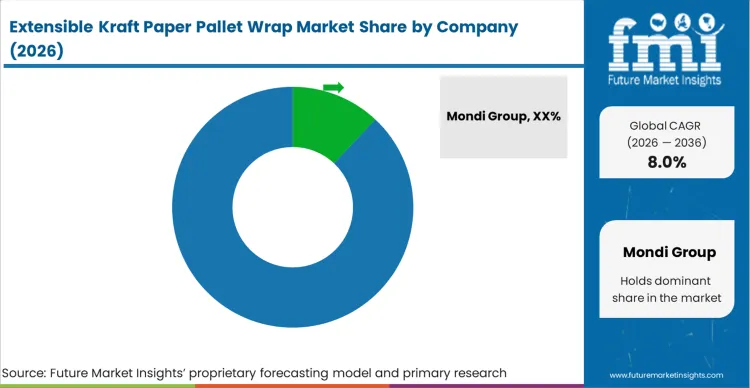
The extensible kraft paper pallet wrap market exhibits a highly concentrated structure dominated by large, integrated global paper and packaging conglomerates. This concentration exists because manufacturing paper with extreme elasticity requires massive capital investment in proprietary micro-creping calendering technology, creating an insurmountable barrier to entry for standard flat-paper mills. Leading companies such as Mondi Group, Smurfit Westrock, and Billerud dictate the market pace by controlling the specialized machinery required to produce rolls capable of exceeding 30% stretch. Procurement teams evaluating these vendors rely entirely on maximum stretch percentage and puncture resistance data as the primary competitive variables to distinguish qualified transit materials from generic kraft substitutes.
Vendors embedding advanced creping technologies directly into their high-speed paper machines gain a significant architectural advantage. Companies like Segezha Group and Nordic Paper consistently optimize their fiber alignment to increase tensile strength, allowing them to compete directly with thick LLDPE films on a performance basis. Replicating this capability requires challengers to invest millions in specialized drying and tensioning equipment that physically compresses the fiber web during production. Implementing these high-performance materials reduces operational waste and accelerates brownfield migration projects. Challengers attempting to enter this space must secure access to specialized calendering equipment before bidding on major enterprise supply contracts.
Large FMCG and retail buyers actively prevent vendor lock-in by standardizing their automated wrapping machines to accept any fiber roll that meets a baseline GSM and stretch profile. This structural tension between buyers seeking multi-vendor supply chains and massive paper mills attempting to lock in exclusive contracts severely limits pricing power, even in a highly concentrated manufacturing landscape. By standardizing the physical roll dimensions and tension requirements, system integrators designing converged logistics operations can source materials from multiple suppliers without worrying about machine jams or web breaks. The competitive trajectory to 2036 points toward slight fragmentation as regional mills finally install the necessary creping technology, forcing the current global leaders to compete more aggressively on localized price and delivery speed.
Key Players in Extensible Kraft Paper Pallet Wrap Market
- Mondi Group
- Smurfit Westrock
- Billerud
- Segezha Group
- Nordic Paper
- Gascogne Papier
- Stora Enso
Scope of the Report
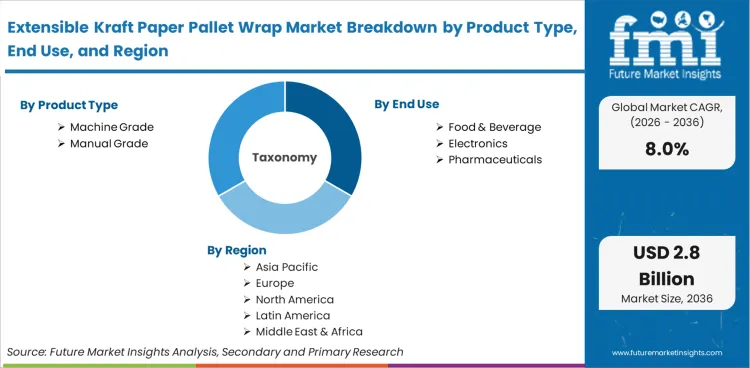
| Metric | Value |
|---|---|
| Quantitative Units | USD 1.3 billion to USD 2.8 billion, at a CAGR of 8.0% |
| Market Definition | Extensible kraft paper pallet wrap encompasses micro-creped fiber rolls engineered to provide high elasticity and holding force, replacing plastic stretch films in B2B transit packaging. |
| Product Type Segmentation | Machine Grade, Manual Grade |
| End Use Segmentation | Food & Beverage, Electronics, Pharmaceuticals, Consumer Goods, Building Materials |
| Basis Weight Segmentation | Below 50 GSM, 50-80 GSM, Above 80 GSM |
| Regions Covered | North America, Latin America, Europe, East Asia, South Asia, Oceania, Middle East & Africa |
| Countries Covered | Germany, India, United Kingdom, China, France, United States, Japan, and 40 plus countries |
| Key Companies Profiled | Mondi Group, Smurfit Westrock, Billerud, Segezha Group, Nordic Paper, Gascogne Papier, Stora Enso |
| Forecast Period | 2026 to 2036 |
| Approach | The baseline value derives from a bottom-up aggregation of creped kraft roll shipment volumes, applying regional plastic-tax implementation curves to project future adoption velocity. |
Source: Future Market Insights (FMI) analysis, based on proprietary forecasting model and primary research
Segments
Product Type:
- Machine Grade
- Manual Grade
End Use:
- Food & Beverage
- Electronics
- Pharmaceuticals
- Consumer Goods
- Building Materials
Basis Weight:
- Below 50 GSM
- 50-80 GSM
- Above 80 GSM
Regions:
- North America
- United States
- Canada
- Mexico
- Latin America
- Brazil
- Argentina
- Chile
- Rest of Latin America
- Europe
- Germany
- United Kingdom
- France
- Italy
- Spain
- Nordics
- Benelux
- Rest of Europe
- East Asia
- China
- Japan
- South Korea
- South Asia
- India
- ASEAN
- Rest of South Asia
- Oceania
- Australia
- New Zealand
- Middle East & Africa
- GCC Countries
- South Africa
- Rest of Middle East & Africa
Bibliography
- International Organization for Standardization. (2024, February). ISO 18604:2024 Packaging and the environment - Material recycling. ISO.
- Confederation of European Paper Industries (CEPI). (2024, June). Recyclability of paper-based packaging: Guidelines for the logistics sector. CEPI Publications.
- International Safe Transit Association (ISTA). (2024, September). ISTA 3E unitized load testing protocols for sustainable stretch materials. ISTA Resource Center.
- Billerud. (2025, January). Advancing micro-creping technology for high-tensile transit paper. Billerud Innovation Updates.
- Nordic Paper. (2024, November). Technical specifications for extensible kraft in B2B transit applications. Nordic Paper Product Sheets.
- DIN Deutsches Institut für Normung. (2024, October). DIN EN 13427:2024 Packaging - Requirements for the use of European Standards in the field of packaging and packaging waste. DIN Media.
- Segezha Group. (2025, February). Expanding high-porosity sack kraft and pallet wrap production capabilities. Segezha Investor Relations.
This bibliography is provided for reader reference. The full FMI report contains the complete reference list with primary source documentation.
This Report Addresses
- Market intelligence to support strategic decision making across machine-grade and manual-grade extensible kraft wraps unique to this market
- Market size estimation and 10-year revenue forecasts from 2026 to 2036, supported by extended producer responsibility tax implementation tracking and paper mill capacity metrics
- Growth opportunity mapping across high-grammage basis weight categories with emphasis on the transition to native paper-ready tension heads on automated wrapping equipment
- Segment and regional revenue forecasts covering food and beverage transit materials across strictly regulated European retail networks
- Competition strategy assessment including micro-creping calendering capabilities, puncture resistance validation, and multi-vendor machine compatibility
- Technology development tracking including EU PPWD compliance, ISTA load testing protocols, and advanced moisture-resistant repulpable barrier coatings discussed in this article
- Market access analysis covering fast-moving consumer goods supply chain procurement pathways and third-party logistics equipment upgrade cycles
- Market report delivery in PDF, Excel, PPT, and interactive dashboard formats for executive strategy, facility operations planning, and operational benchmarking use
Frequently Asked Questions
How large is the Extensible Kraft Paper Pallet Wrap Market in 2026?
Demand for the market is estimated to be valued at USD 1.3 billion in 2026 due to the rapid enforcement of extended producer responsibility taxes on commercial plastic stretch film.
What will it be valued at by 2036?
The valuation is projected to reach USD 2.8 billion by 2036 as major OEMs of automated pallet wrappers release native "paper-ready" tension heads by default.
What CAGR is projected?
The market expands at a CAGR of 8.0% between 2026 and 2036, a rate defensible given the non-negotiable compliance deadlines set by top-tier European grocery retailers.
Which Product Type segment leads?
Machine Grade accounts for 65.0% share in 2026 because high-volume automated fulfillment centers require continuous, uninterrupted wrapping cycles for heavy pallet loads.
Which End Use segment leads?
Food & Beverage commands the market as major supermarkets actively reject inbound pallets secured with traditional plastic stretch film to avoid disposal fees.
Which Basis Weight segment leads?
The 50-80 GSM category holds a commanding share by balancing optimal puncture resistance for sharp carton corners with maximum roll yield.
What drives rapid growth?
Punitive extended producer responsibility taxes force FMCG distributors to bypass legacy plastic packaging and adopt repulpable fiber to maintain distribution contracts.
What is the primary restraint?
Legacy pallet wrapping machines calibrated for plastic film apply extreme tension that causes immediate web breaks when running standard paper rolls.
Which country grows fastest?
Germany advances rapidly at a 9.5% CAGR driven by rigorous enforcement of the updated VerpackG packaging tax structures on B2B logistics operations.
How does the EU PPWD impact procurement?
Regulation (EU) 2024/2841 mandates strict recyclability standards that penalize the use of mixed-material coolers and single-use LLDPE stretch films in commercial transit.
What specific technology enables this material switch?
Mechanical micro-creping processes during paper manufacturing grant the fiber up to 30% elasticity, allowing it to stretch around pallet corners without tearing.
How do leading vendors maintain competitive advantage?
Dominant paper mills heavily invest in proprietary calendering lines to maximize stretch percentage, creating significant capital barriers for standard flat-paper manufacturers.
Why is North America described as an economics-led region?
Severe margin pressure from escalating waste disposal costs forces USA e-commerce fulfillment centers to cut down the massive volume of LLDPE scrap generated daily.
What is India's growth outlook in this report?
India is projected to expand at a CAGR of 9.0% during 2026 to 2036.
Does the report cover the United States in its regional analysis?
Yes, the United States is included within North America under the regional scope of analysis.
What is the main demand theme linked to the United Kingdom?
The post-Brexit plastic packaging tax requires commercial shippers to utilize materials with high recycled content or switch entirely to repulpable paper.
What are the sources referred to for analyzing France?
The national anti-waste law (AGEC) and export hub procurement specifications form the primary analytical basis.
Which product formats are strategically important for Asia Pacific supply chains?
Continuous-feed, high-tensile machine rolls are critical for securing electronics export pallets on sophisticated robotic end-of-line wrappers.
What does Extensible Kraft Paper Pallet Wrap mean in this report?
The scope encompasses micro-creped fiber rolls engineered to provide high elasticity and holding force as a direct replacement for plastic stretch films.
What is included in the scope of this Extensible Kraft Paper Pallet Wrap report?
The market covers machine-grade and manual-grade extensible rolls, moisture-resistant barrier transit wraps, and specialized dispensing equipment for fiber rolls.
What is excluded from the scope of this report?
Standard flat kraft paper, traditional LLDPE plastic stretch films, and standalone automated wrapping machinery are explicitly omitted from the material valuation.
How does FMI build and validate the forecast?
The model applies a bottom-up methodology starting with global installed base metrics for automated pallet wrappers and cross-validates against paper mill capacity expansion data.
Preview the report firsthand - request a free sample
Get SampleGet the brochure for pricing and purchase details.
Get PDFTable of Content
- Executive Summary
- Global Market Outlook
- Demand-side Trends
- Supply-side Trends
- Technology Roadmap Analysis
- Analysis and Recommendations
- Market Overview
- Market Coverage / Taxonomy
- Market Definition / Scope / Limitations
- Research Methodology
- Chapter Orientation
- Analytical Lens and Working Hypotheses
- Market Structure, Signals, and Trend Drivers
- Benchmarking and Cross-market Comparability
- Market Sizing, Forecasting, and Opportunity Mapping
- Research Design and Evidence Framework
- Desk Research Programme (Secondary Evidence)
- Company Annual and Sustainability Reports
- Peer-reviewed Journals and Academic Literature
- Corporate Websites, Product Literature, and Technical Notes
- Earnings Decks and Investor Briefings
- Statutory Filings and Regulatory Disclosures
- Technical White Papers and Standards Notes
- Trade Journals, Industry Magazines, and Analyst Briefs
- Conference Proceedings, Webinars, and Seminar Materials
- Government Statistics Portals and Public Data Releases
- Press Releases and Reputable Media Coverage
- Specialist Newsletters and Curated Briefings
- Sector Databases and Reference Repositories
- FMI Internal Proprietary Databases and Historical Market Datasets
- Subscription Datasets and Paid Sources
- Social Channels, Communities, and Digital Listening Inputs
- Additional Desk Sources
- Expert Input and Fieldwork (Primary Evidence)
- Primary Modes
- Qualitative Interviews and Expert Elicitation
- Quantitative Surveys and Structured Data Capture
- Blended Approach
- Why Primary Evidence is Used
- Field Techniques
- Interviews
- Surveys
- Focus Groups
- Observational and In-context Research
- Social and Community Interactions
- Stakeholder Universe Engaged
- C-suite Leaders
- Board Members
- Presidents and Vice Presidents
- R&D and Innovation Heads
- Technical Specialists
- Domain Subject-matter Experts
- Scientists
- Physicians and Other Healthcare Professionals
- Governance, Ethics, and Data Stewardship
- Research Ethics
- Data Integrity and Handling
- Primary Modes
- Tooling, Models, and Reference Databases
- Desk Research Programme (Secondary Evidence)
- Data Engineering and Model Build
- Data Acquisition and Ingestion
- Cleaning, Normalisation, and Verification
- Synthesis, Triangulation, and Analysis
- Quality Assurance and Audit Trail
- Market Background
- Market Dynamics
- Drivers
- Restraints
- Opportunity
- Trends
- Scenario Forecast
- Demand in Optimistic Scenario
- Demand in Likely Scenario
- Demand in Conservative Scenario
- Opportunity Map Analysis
- Product Life Cycle Analysis
- Supply Chain Analysis
- Investment Feasibility Matrix
- Value Chain Analysis
- PESTLE and Porter’s Analysis
- Regulatory Landscape
- Regional Parent Market Outlook
- Production and Consumption Statistics
- Import and Export Statistics
- Market Dynamics
- Global Market Analysis 2021 to 2025 and Forecast, 2026 to 2036
- Historical Market Size Value (USD Million) Analysis, 2021 to 2025
- Current and Future Market Size Value (USD Million) Projections, 2026 to 2036
- Y-o-Y Growth Trend Analysis
- Absolute $ Opportunity Analysis
- Global Market Pricing Analysis 2021 to 2025 and Forecast 2026 to 2036
- Global Market Analysis 2021 to 2025 and Forecast 2026 to 2036, By Product Type
- Introduction / Key Findings
- Historical Market Size Value (USD Million) Analysis By Product Type , 2021 to 2025
- Current and Future Market Size Value (USD Million) Analysis and Forecast By Product Type , 2026 to 2036
- Machine Grade
- Manual Grade
- Machine Grade
- Y-o-Y Growth Trend Analysis By Product Type , 2021 to 2025
- Absolute $ Opportunity Analysis By Product Type , 2026 to 2036
- Global Market Analysis 2021 to 2025 and Forecast 2026 to 2036, By End Use
- Introduction / Key Findings
- Historical Market Size Value (USD Million) Analysis By End Use, 2021 to 2025
- Current and Future Market Size Value (USD Million) Analysis and Forecast By End Use, 2026 to 2036
- Food & Beverage
- Electronics
- Pharmaceuticals
- Food & Beverage
- Y-o-Y Growth Trend Analysis By End Use, 2021 to 2025
- Absolute $ Opportunity Analysis By End Use, 2026 to 2036
- Global Market Analysis 2021 to 2025 and Forecast 2026 to 2036, By Basis Weight
- Introduction / Key Findings
- Historical Market Size Value (USD Million) Analysis By Basis Weight, 2021 to 2025
- Current and Future Market Size Value (USD Million) Analysis and Forecast By Basis Weight, 2026 to 2036
- 50-80 GSM
- Below 50 GSM
- Above 80 GSM
- 50-80 GSM
- Y-o-Y Growth Trend Analysis By Basis Weight, 2021 to 2025
- Absolute $ Opportunity Analysis By Basis Weight, 2026 to 2036
- Global Market Analysis 2021 to 2025 and Forecast 2026 to 2036, By Region
- Introduction
- Historical Market Size Value (USD Million) Analysis By Region, 2021 to 2025
- Current Market Size Value (USD Million) Analysis and Forecast By Region, 2026 to 2036
- North America
- Latin America
- Western Europe
- Eastern Europe
- East Asia
- South Asia and Pacific
- Middle East & Africa
- Market Attractiveness Analysis By Region
- North America Market Analysis 2021 to 2025 and Forecast 2026 to 2036, By Country
- Historical Market Size Value (USD Million) Trend Analysis By Market Taxonomy, 2021 to 2025
- Market Size Value (USD Million) Forecast By Market Taxonomy, 2026 to 2036
- By Country
- USA
- Canada
- Mexico
- By Product Type
- By End Use
- By Basis Weight
- By Country
- Market Attractiveness Analysis
- By Country
- By Product Type
- By End Use
- By Basis Weight
- Key Takeaways
- Latin America Market Analysis 2021 to 2025 and Forecast 2026 to 2036, By Country
- Historical Market Size Value (USD Million) Trend Analysis By Market Taxonomy, 2021 to 2025
- Market Size Value (USD Million) Forecast By Market Taxonomy, 2026 to 2036
- By Country
- Brazil
- Chile
- Rest of Latin America
- By Product Type
- By End Use
- By Basis Weight
- By Country
- Market Attractiveness Analysis
- By Country
- By Product Type
- By End Use
- By Basis Weight
- Key Takeaways
- Western Europe Market Analysis 2021 to 2025 and Forecast 2026 to 2036, By Country
- Historical Market Size Value (USD Million) Trend Analysis By Market Taxonomy, 2021 to 2025
- Market Size Value (USD Million) Forecast By Market Taxonomy, 2026 to 2036
- By Country
- Germany
- UK
- Italy
- Spain
- France
- Nordic
- BENELUX
- Rest of Western Europe
- By Product Type
- By End Use
- By Basis Weight
- By Country
- Market Attractiveness Analysis
- By Country
- By Product Type
- By End Use
- By Basis Weight
- Key Takeaways
- Eastern Europe Market Analysis 2021 to 2025 and Forecast 2026 to 2036, By Country
- Historical Market Size Value (USD Million) Trend Analysis By Market Taxonomy, 2021 to 2025
- Market Size Value (USD Million) Forecast By Market Taxonomy, 2026 to 2036
- By Country
- Russia
- Poland
- Hungary
- Balkan & Baltic
- Rest of Eastern Europe
- By Product Type
- By End Use
- By Basis Weight
- By Country
- Market Attractiveness Analysis
- By Country
- By Product Type
- By End Use
- By Basis Weight
- Key Takeaways
- East Asia Market Analysis 2021 to 2025 and Forecast 2026 to 2036, By Country
- Historical Market Size Value (USD Million) Trend Analysis By Market Taxonomy, 2021 to 2025
- Market Size Value (USD Million) Forecast By Market Taxonomy, 2026 to 2036
- By Country
- China
- Japan
- South Korea
- By Product Type
- By End Use
- By Basis Weight
- By Country
- Market Attractiveness Analysis
- By Country
- By Product Type
- By End Use
- By Basis Weight
- Key Takeaways
- South Asia and Pacific Market Analysis 2021 to 2025 and Forecast 2026 to 2036, By Country
- Historical Market Size Value (USD Million) Trend Analysis By Market Taxonomy, 2021 to 2025
- Market Size Value (USD Million) Forecast By Market Taxonomy, 2026 to 2036
- By Country
- India
- ASEAN
- Australia & New Zealand
- Rest of South Asia and Pacific
- By Product Type
- By End Use
- By Basis Weight
- By Country
- Market Attractiveness Analysis
- By Country
- By Product Type
- By End Use
- By Basis Weight
- Key Takeaways
- Middle East & Africa Market Analysis 2021 to 2025 and Forecast 2026 to 2036, By Country
- Historical Market Size Value (USD Million) Trend Analysis By Market Taxonomy, 2021 to 2025
- Market Size Value (USD Million) Forecast By Market Taxonomy, 2026 to 2036
- By Country
- Kingdom of Saudi Arabia
- Other GCC Countries
- Turkiye
- South Africa
- Other African Union
- Rest of Middle East & Africa
- By Product Type
- By End Use
- By Basis Weight
- By Country
- Market Attractiveness Analysis
- By Country
- By Product Type
- By End Use
- By Basis Weight
- Key Takeaways
- Key Countries Market Analysis
- USA
- Pricing Analysis
- Market Share Analysis, 2025
- By Product Type
- By End Use
- By Basis Weight
- Canada
- Pricing Analysis
- Market Share Analysis, 2025
- By Product Type
- By End Use
- By Basis Weight
- Mexico
- Pricing Analysis
- Market Share Analysis, 2025
- By Product Type
- By End Use
- By Basis Weight
- Brazil
- Pricing Analysis
- Market Share Analysis, 2025
- By Product Type
- By End Use
- By Basis Weight
- Chile
- Pricing Analysis
- Market Share Analysis, 2025
- By Product Type
- By End Use
- By Basis Weight
- Germany
- Pricing Analysis
- Market Share Analysis, 2025
- By Product Type
- By End Use
- By Basis Weight
- UK
- Pricing Analysis
- Market Share Analysis, 2025
- By Product Type
- By End Use
- By Basis Weight
- Italy
- Pricing Analysis
- Market Share Analysis, 2025
- By Product Type
- By End Use
- By Basis Weight
- Spain
- Pricing Analysis
- Market Share Analysis, 2025
- By Product Type
- By End Use
- By Basis Weight
- France
- Pricing Analysis
- Market Share Analysis, 2025
- By Product Type
- By End Use
- By Basis Weight
- India
- Pricing Analysis
- Market Share Analysis, 2025
- By Product Type
- By End Use
- By Basis Weight
- ASEAN
- Pricing Analysis
- Market Share Analysis, 2025
- By Product Type
- By End Use
- By Basis Weight
- Australia & New Zealand
- Pricing Analysis
- Market Share Analysis, 2025
- By Product Type
- By End Use
- By Basis Weight
- China
- Pricing Analysis
- Market Share Analysis, 2025
- By Product Type
- By End Use
- By Basis Weight
- Japan
- Pricing Analysis
- Market Share Analysis, 2025
- By Product Type
- By End Use
- By Basis Weight
- South Korea
- Pricing Analysis
- Market Share Analysis, 2025
- By Product Type
- By End Use
- By Basis Weight
- Russia
- Pricing Analysis
- Market Share Analysis, 2025
- By Product Type
- By End Use
- By Basis Weight
- Poland
- Pricing Analysis
- Market Share Analysis, 2025
- By Product Type
- By End Use
- By Basis Weight
- Hungary
- Pricing Analysis
- Market Share Analysis, 2025
- By Product Type
- By End Use
- By Basis Weight
- Kingdom of Saudi Arabia
- Pricing Analysis
- Market Share Analysis, 2025
- By Product Type
- By End Use
- By Basis Weight
- Turkiye
- Pricing Analysis
- Market Share Analysis, 2025
- By Product Type
- By End Use
- By Basis Weight
- South Africa
- Pricing Analysis
- Market Share Analysis, 2025
- By Product Type
- By End Use
- By Basis Weight
- USA
- Market Structure Analysis
- Competition Dashboard
- Competition Benchmarking
- Market Share Analysis of Top Players
- By Regional
- By Product Type
- By End Use
- By Basis Weight
- Competition Analysis
- Competition Deep Dive
- Mondi Group
- Overview
- Product Portfolio
- Profitability by Market Segments (Product/Age /Sales Channel/Region)
- Sales Footprint
- Strategy Overview
- Marketing Strategy
- Product Strategy
- Channel Strategy
- Smurfit Westrock
- Billerud
- Segezha Group
- Nordic Paper
- Gascogne Papier
- Stora Enso
- Mondi Group
- Competition Deep Dive
- Assumptions & Acronyms Used


