

- Market Size (2026)
- USD 1026.5 Mn
- Forecast (2036)
- USD 1632.3 Mn
- CAGR (2026 to 2036)
- 4.7%
How big is the Food Grade Heat Transfer Fluids Market in 2026?
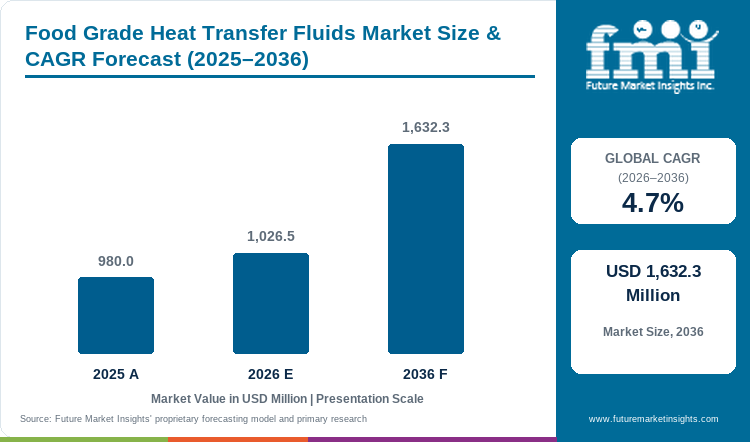
USD 1026.5 Million in 2026 and USD 1632.3 Million by 2036, expanding at 4.7% CAGR.
Sales of food grade heat transfer fluids are estimated to rise at 4.7% CAGR through 2036, increasing valuation from USD 980.0 Million in 2025 to USD 1026.5 Million in 2026, and reaching USD 1632.3 Million by 2036. These fluids carry heat through closed circuits serving food production, where a leak can become a contamination incident. Selection therefore involves both thermal performance and suitability for possible incidental contact. USDA Economic Research Service reported 42,708 U.S. food and beverage processing establishments in 2022, a substantial installed base requiring initial fills, top-ups and periodic replacement. Engineers assess viscosity, operating temperature and material compatibility; food-safety teams review the hazards associated with the circuit and its location.
A dairy cooling loop and a bakery heating circuit place different demands on the same supplier. Cooling service requires pumpable fluid at the lowest operating temperature, while high-temperature service places greater weight on oxidation resistance and thermal stability. Replacing either fluid can involve draining, flushing and disposal during a short production shutdown. Suppliers with compatible replacement grades, nearby stock and fluid-analysis services can support these recurring maintenance purchases.
Key Takeaways
- Food-safety programs make leakage risk part of thermal-fluid selection. Incidental-contact suitability matters where a failed seal or exchanger could expose product to the utility fluid.
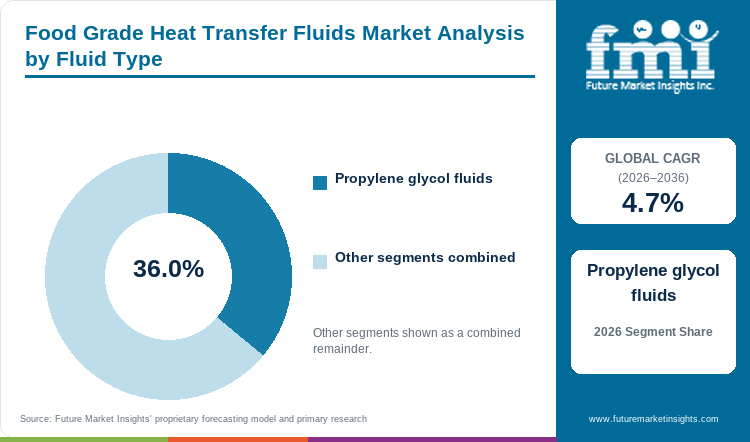
- By fluid type, propylene glycol fluids are estimated to hold 36.0% share in 2026, supported by freeze protection combined with a familiar food-grade approval path.
- By temperature range, 0-150°C is projected to account for 34.0% share in 2026, influenced by coverage of the broadest set of chilled and moderate-heat plant utilities.
- By end use, food processing is forecast to represent 36.0% share in 2026, attributable to diverse lines creating repeated heating, cooling, and contamination-control needs.
- Indirect heating leads application with 31.0% share, while lubricant/fluid suppliers lead sales channel with 39.0% share through technical selection and lifecycle support.
- New lines, refrigeration retrofits, heat-recovery projects, and degraded fluid conditions can each trigger replacement or initial-fill demand, though purchases move only after engineering, food safety, maintenance, and procurement agree on the same specification.
- Heat-transfer fluid suppliers include Eastman, Dow, Clariant, Paratherm, Global Heat Transfer, Radco Industries, Dynalene, Duratherm and Fuchs Lubricants. Chemours supplies related refrigeration chemistry.
Analyst Perspective
The cost of a fluid change extends beyond the initial fill. Pumping demand, corrosion, sampling and the shutdown needed to clean a circuit affect lifetime cost. A suitable formulation must match the actual temperature range and remain serviceable with the plant’s maintenance resources.
- Nikhil Kaitwade, Principal Analyst at Future Market Insights
How is the food grade heat transfer fluids market segmented?
The food grade heat transfer fluids market is segmented by Fluid Type, Temperature Range, End Use, Application, Sales Channel, and Region.
Fluid Type covers propylene glycol fluids, synthetic heat transfer fluids, silicone fluids, mineral oil-based fluids and bio-based fluids. Temperature Range distinguishes below-zero service, 0-150°C, 150-250°C and above 250°C. End Use includes food processing, beverage plants, dairy plants, pharma/nutraceuticals and cold chain systems. Applications cover indirect heating, cooling/freezing, pasteurization support, bakery/process heat and thermal storage. Sales channels include lubricant/fluid suppliers, industrial distributors, direct plant contracts and equipment OEMs.
How do propylene glycol fluids shape demand within the Fluid Type category?
Propylene glycol formulations offer freeze protection with lower acute toxicity than ethylene glycol heat transfer fluids. Food-grade suitability still depends on the complete formulation, including its inhibitors, and on the intended use. Concentration affects freeze protection, viscosity and heat transfer, so choosing a grade requires more than matching the base glycol. Existing systems can favor an established formulation when a switch would require flushing and renewed compatibility checks.
- Based on fluid type, propylene glycol fluids are projected to account for 36.0% in 2026, supported by their use in secondary cooling loops and freeze-protection service.
- Routine sampling helps maintenance teams track concentration and fluid condition before deciding whether to top up, adjust treatment or replace the charge.
Why does 0-150°C lead the Temperature Range category?
The 0-150°C band covers chilled service above freezing, tempered-water circuits and moderate process heating. In industrial process cooling systems, the chosen fluid must remain compatible with pumps, seals and pipework throughout this range. Concentration and inhibitor condition affect corrosion protection as well as heat transfer. Subzero refrigeration is a separate operating category with different viscosity and freeze-point requirements.
- By temperature range, 0-150°C accounts for 34.0% share in 2026, its lead reflecting the concentration of food-plant utility loads within chilled, ambient, and moderate-heat service.
Common grades can simplify stockholding across compatible circuits, but each loop still needs its own temperature and material checks. Higher-temperature bakery and process-heating duties require fluids selected for their thermal stability.
How does food processing anchor the End Use category?
Food processing combines several thermal duties on one site. Chilling and tempering circuits may operate beside industrial refrigeration systems, while separate loops serve heating and pasteurization. USDA Economic Research Service reported 42,708 U.S. food and beverage processing establishments in 2022. Replacement schedules vary between lines, creating recurring orders even when a plant is not adding production capacity.
- In 2026, food processing is expected to lead end use with 36.0% share, shaped by the number of heating and cooling duties embedded across diverse processing lines.
- A multi-line plant can consolidate suitable grades, but differences in temperatures, seals and construction materials may still require more than one fluid.
What supports indirect heating in the Application category?
Indirect heating transfers energy through a wall separating the product from the circulating fluid. Jackets, coils and plate heat exchangers all rely on that separation. NSF’s February 2026 registration certificate for Eastman Therminol D-12 identifies it as HT1, suitable for heat-transfer use where incidental food contact is possible. The registration addresses contact suitability; the circuit design and operating temperature still determine technical fit.
- By application, indirect heating represents 31.0% share in 2026, its lead following from the use of closed-loop jackets and exchangers that separate the product from the heat-transfer medium.
- Kettles and ingredient vessels require stable heat delivery through the separating surface. Leakage risk remains part of selection even though the fluid is not intended to contact the food.
Why do lubricant/fluid suppliers lead the Sales Channel category?
A specialist fluid supplier can help calculate fill concentration, interpret sample results and identify a compatible top-up grade. These services often sit alongside a plant’s industrial lubricant purchases. Fuchs Lubricants completed its acquisition of the LUBCON Group in July 2024, adding 13 operating companies and five production sites across specialty-lubricant markets that include food and pharmaceutical applications.
- Lubricant/fluid suppliers are likely to capture 39.0% share in 2026, supported by specification support and local stock, with changeover coordination and fluid-condition services reinforcing the channel.
- Direct contracts suit larger standardized requirements, while distributors provide smaller quantities and local replenishment for individual plants.
What are the drivers, restraints and opportunities in the Food Grade Heat Transfer Fluids Market?
Food-safety qualification and thermal reliability support demand, changeover complexity constrains switching, and heat-recovery or lower-carbon formulations create new revenue paths.
- Driver: Preventive-control programs make incidental-contact credentials and documented process temperatures part of the fluid specification.
- Restraint: Qualification, hydraulic tradeoffs, and shutdown-sensitive changeovers slow replacement even when a better fluid is available.
- Opportunity: Heat recovery and lower-carbon formulations can expand value per project when suppliers also prove compatibility and food-grade eligibility.
Preventive-control programs turn fluid selection into a documented food-safety decision
A food-safety plan must address foreseeable hazards from utility chemicals as well as the production process. The FDA’s September 2015 preventive controls rule requires covered facilities to use risk-based controls where needed. For industrial process cooling systems, a fluid leak into product is one scenario that engineering and food-safety teams may need to assess. This makes formulation suitability and circuit integrity part of procurement.
Changeover qualification can delay a technically attractive fluid switch
Changing thermal fluid can alter pump load, seal performance and corrosion protection. As with industrial lubricants, compatibility with the installed equipment matters. Dynalene’s December 2015 technical guidance notes the higher viscosity of propylene glycol compared with ethylene glycol. At low temperatures, that difference can increase pumping demand and limit the appeal of a change unless the hydraulic design can accommodate it.
Alternative feedstocks offer a route to reformulation
Dow launched bio-circular and circular propylene glycol offerings in North America in March 2024 using mass-balance accounting. These feedstock options allow formulators to address customers’ sourcing goals while retaining the need to qualify the finished fluid. A heat exchanger retrofit provides a practical point to review both fluid condition and future operating temperatures. Alternative feedstocks alone do not establish the energy performance of the completed circuit.
Which country CAGRs are profiled in the Food Grade Heat Transfer Fluids Market?
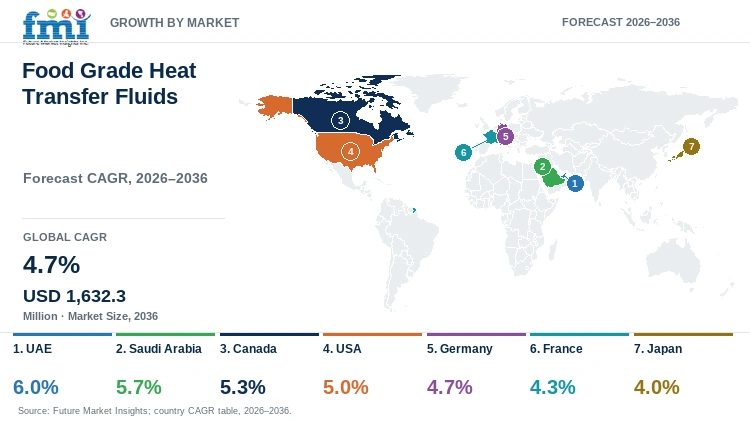
| Country | CAGR |
|---|---|
| UAE | 6.0% |
| Saudi Arabia | 5.7% |
| Canada | 5.3% |
| USA | 5.0% |
| Germany | 4.7% |
| France | 4.3% |
| Japan | 4.0% |
How do country-level CAGRs compare in the Food Grade Heat Transfer Fluids Market?
The UAE leads the country forecasts at 6.0%, followed by Saudi Arabia at 5.7% and Canada at 5.3%. The USA is forecast at 5.0%, Germany at 4.7%, France at 4.3% and Japan at 4.0%. Initial fills for new facilities and replacements in established circuits contribute differently to demand in each country.
- New UAE facilities need a fluid specification before commissioning, particularly when equipment packages come from several OEMs.
- Saudi Arabian processors need reliable replenishment alongside initial fills as new production lines enter service.
- Canadian sites must balance freeze protection with the viscosity and pumping requirements of cold starts.
- U.S. replacement work often involves legacy circuits, where seal compatibility and cleaning requirements determine the changeover scope.
- German heat-recovery projects can alter circuit temperatures, prompting a review of fluid stability and heat-transfer properties.
- French dairy and beverage facilities create demand for fluids suited to recurring cooling and moderate-temperature duties.
- In Japan, a change of formulation can require a detailed review of circuit materials and maintenance procedures.
A new processing line needs an initial fill; an established loop may need only a top-up or a scheduled replacement. This distinction affects order size and service requirements across countries. The full report covers North America, Latin America, Western Europe, Eastern Europe, East Asia, South Asia and Pacific, and Middle East and Africa.
Country-wise Analysis
- The USA market is forecast to grow at 5.0% CAGR from 2026 to 2036. Its 42,708 food and beverage processing establishments in 2022, reported by USDA Economic Research Service, support a broad base of thermal circuits and industrial refrigeration systems. For an older plant, the practical replacement question is whether a new grade works with the existing seals, metallurgy and cleaning procedure. Stock availability matters when maintenance uncovers degraded fluid during a planned outage.
- Germany’s forecast CAGR is 4.7% from 2026 to 2036. Industrial energy-efficiency investment supported through BAFA can include process-heat and heat-recovery projects. A heat exchanger retrofit may change the required fluid temperature or flow rate, making thermal calculations part of material selection. Drain, flush and refill work must fit the same outage as the equipment modification.
- Demand in Japan is forecast to rise at 4.0% CAGR from 2026 to 2036. Food processors using industrial process cooling systems must manage utility-chemical hazards within their hygiene controls. Japan’s HACCP-based hygiene requirements make recorded operating procedures relevant to a fluid change. Corrosion data, batch traceability and clear maintenance instructions help operators assess a replacement grade.
- Canadian demand is forecast at 5.3% CAGR from 2026 to 2036. Outdoor pipework and seasonal cold starts make freeze protection and viscosity important alongside incidental-contact suitability. Procurement teams may source thermal fluids through the same channels as industrial lubricants, but concentration and pumpability require circuit-specific checks. Regional inventory and suitable pack sizes matter when a remote plant needs an urgent top-up.
- France is forecast to grow at 4.3% CAGR from 2026 to 2036. Waste-heat recovery support through ADEME connects thermal-fluid purchases with wider energy projects. A plate heat exchanger installation changes the heat balance of a circuit, so the fluid must suit the new temperatures and materials. Expected energy savings also depend on flow, fouling and maintenance, rather than fluid price alone.
- Saudi Arabian demand is forecast to rise at 5.7% CAGR from 2026 to 2036. Processors operating industrial refrigeration systems need dependable local supplies for both commissioning and subsequent maintenance. SFDA’s food-hygiene requirements put chemical handling within the wider food-safety program. In plants with equipment from several OEMs, matching a fluid to the installed seals and metals can be as important as the stated temperature range.
The UAE market is forecast at 6.0% CAGR from 2026 to 2036. New food-processing projects need thermal-fluid specifications early enough to coordinate pumps, pipework and heat exchanger packages. Commissioning teams must establish fill concentration and a sampling schedule before routine production. Ready-to-use formulations and local application support can reduce delays at this stage.
Who are the notable companies in the Food Grade Heat Transfer Fluids Market?
Eastman, Dow, Clariant, Paratherm, Global Heat Transfer, Radco Industries, Dynalene, Duratherm and Fuchs Lubricants supply heat-transfer fluids. Chemours serves the related refrigeration sector.
Glycol formulators, thermal-oil specialists and food-plant lubricant suppliers address different temperature duties. Dow and Clariant offer glycol-based platforms; Eastman supplies Therminol fluids. Paratherm, Global Heat Transfer, Radco Industries, Dynalene and Duratherm compete through specialist thermal-fluid ranges and application support. Fuchs connects heat-transfer products with its broader food-plant lubrication portfolio.
- Eastman, Dow and Clariant serve customers sourcing established chemical platforms across multiple plants.
- Paratherm, Global Heat Transfer, Radco Industries, Dynalene and Duratherm offer specialist selection support for heating and cooling duties.
Fuchs Lubricants supplies food-plant lubricants and thermal fluids. Chemours provides refrigerant chemistry for cold-chain equipment.
Competitive Benchmarking: Food Grade Heat Transfer Fluids Market
| Company | Documented Food-Grade Eligibility | Temperature-Chemistry Coverage | Fluid Lifecycle Support | Geographic Reach |
|---|---|---|---|---|
| Eastman | High | High | Medium | North America, Europe, Asia-Pacific, Latin America, and Middle East/Africa |
| Dow | High | Medium | Medium | Global |
| Clariant | Medium | Medium | Medium | Europe, Americas, Asia-Pacific, and Middle East/Africa |
| Paratherm | High | High | High | North America with international distribution |
| Global Heat Transfer | High | High | High | Europe, Americas, Middle East/Africa, and Asia-Pacific |
| Radco Industries | High | High | Medium | North America with distributor-led international reach |
| Dynalene | High | High | High | North America with international supply |
| Duratherm | High | High | High | North America with international distribution |
| Chemours | Not applicable | Medium | Not applicable | Global cold-chain and refrigeration reach |
| Fuchs Lubricants | High | Medium | High | Europe, Americas, Asia-Pacific, and Middle East/Africa |
Scoring basis: Food-Grade Eligibility compares incidental-contact suitability. Temperature-Chemistry Coverage compares operating ranges and fluid types. Fluid Lifecycle Support covers selection, analysis, flushing, refilling and monitoring. High indicates broad coverage and Medium indicates a narrower range. Geographic Reach describes the supplier’s distribution footprint. Chemours is shown as an adjacent refrigerant supplier; food-grade thermal-fluid eligibility and lifecycle support are not applicable to that profile.
Key Developments in the Food Grade Heat Transfer Fluids Market
- In March 2024, Dow launched bio-circular and circular propylene glycol offerings in North America using mass-balance accounting for alternative feedstocks, targeting food ingredients, pharmaceuticals, and industrial applications.
- In July 2024, Fuchs Lubricants completed its acquisition of the LUBCON Group, adding 13 operating companies and five production sites with products used in food and pharmaceutical settings.
- NSF’s March 2025 certificate for CASSIDA FM HEAT TRANSFER FLUID 32 lists HT1 registration and ISO 21469 certification for Fuchs Lubricants Germany.
- NSF’s February 2026 certificate lists Therminol D-12 under HT1 registration number 130383 for use where incidental food contact is possible.
Key Players in the Food Grade Heat Transfer Fluids Market
Global Chemical Formulators and Multiregional Channels
- Eastman
- Dow
- Clariant
Food-Grade Thermal-Fluid Specialists and Lifecycle Services
- Paratherm
- Global Heat Transfer
- Radco Industries
- Dynalene
- Duratherm
Food-Plant Lubrication and Adjacent Cold-Chain Chemistry
- Fuchs Lubricants
- Chemours
Food Grade Heat Transfer Fluids Market - Report Scope
| Coverage field | Report scope |
|---|---|
| Market breakdown | Fluid Type, Temperature Range, End Use, Application, Sales Channel, and Region |
| Quantitative Units | USD Million |
| Market Definition | Revenue from formulated food grade heat transfer fluids and concentrates sold for secondary closed-loop heating or cooling within the stated segmentation. Excludes heat-transfer equipment, standalone service revenue, non-food-grade industrial fluids, primary refrigerants, separately sold additives, unrelated lubricants or hydraulic oils, and downstream finished-product revenue. |
| Regions Covered | North America, Latin America, Western Europe, Eastern Europe, East Asia, South Asia and Pacific, and Middle East and Africa |
| Countries Covered | USA, Germany, Japan, Canada, France, Saudi Arabia, UAE, and more than twenty-five additional countries in the full report |
| Key Companies Profiled | Eastman, Dow, Clariant, Paratherm, Global Heat Transfer, Radco Industries, Dynalene, Duratherm, Chemours, and Fuchs Lubricants |
| Forecast Period | 2026 to 2036 |
| Approach | Hybrid bottom-up and top-down market sizing reconciles supplier activity, fluid demand by installed process, channel checks, replacement cycles, end-use conditions, and country-level operating factors. |
Food Grade Heat Transfer Fluids Market - Research Methodology
| Method | Approach |
|---|---|
| Primary Research | Structured discussions with heat-transfer-fluid manufacturers, industrial distributors, equipment specialists, food and beverage plant engineers, maintenance leaders, food-safety personnel, and procurement teams. The research tests fluid-selection criteria, operating ranges, approval steps, channel practices, service expectations, and replacement triggers. |
| Desk Research | Review of regulatory texts, food-safety guidance, standards and certification records, official statistics, company filings, product documentation and relevant trade material. |
| Market Sizing and Forecasting | Hybrid bottom-up and top-down analysis combines supplier revenues, price and volume indicators, installed process demand, replacement cycles, end-use activity, channel checks, and country operating conditions. Forecast assumptions address capacity additions, retrofit activity, qualification cycles, fluid life, and chemistry substitution. |
| Data Validation | Cross-checks compare company disclosures, certification records, regulatory requirements, distributor feedback and end-user operating patterns. Revenue covers formulated secondary-loop fluids and concentrates, with equipment, services and primary refrigerants excluded. |
Food Grade Heat Transfer Fluids Market by Segments
Food Grade Heat Transfer Fluids Market segmented by Fluid Type:
- Propylene glycol fluids
- Synthetic heat transfer fluids
- Silicone fluids
- Mineral oil-based fluids
- Bio-based fluids
Food Grade Heat Transfer Fluids Market segmented by Temperature Range:
- 0-150°C
- Below 0°C
- 150-250°C
- Above 250°C
Food Grade Heat Transfer Fluids Market segmented by End Use:
- Food processing
- Beverage plants
- Dairy plants
- Pharma/nutraceuticals
- Cold chain systems
Food Grade Heat Transfer Fluids Market segmented by Application:
- Indirect heating
- Cooling/freezing
- Pasteurization support
- Bakery/process heat
- Thermal storage
Food Grade Heat Transfer Fluids Market segmented by Sales Channel:
- Lubricant/fluid suppliers
- Industrial distributors
- Direct plant contracts
- Equipment OEMs
Food Grade Heat Transfer Fluids Market by Region:
- North America
- United States
- Canada
- Latin America
- Brazil
- Mexico
- Argentina
- Chile
- Western Europe
- Germany
- France
- United Kingdom
- Italy
- Spain
- Benelux
- Nordics
- Eastern Europe
- Poland
- Czech Republic
- Romania
- Hungary
- East Asia
- China
- Japan
- South Korea
- South Asia and Pacific
- India
- ASEAN
- Australia and New Zealand
- Middle East and Africa
- GCC Countries
- South Africa
- Türkiye
- Israel
Research Sources and Bibliography
- U.S. Food and Drug Administration (2015, September). FSMA Final Rule for Preventive Controls for Human Food.
- U.S. Department of Agriculture, Economic Research Service (2025, January 5). Processing & Marketing - Food and Beverage Manufacturing.
- Federal Office for Economic Affairs and Export Control, Germany (accessed 2026, September 4). Energy & Climate Protection. Canadian Food Inspection Agency (2026, February 6). Understanding the Safe Food for Canadians Regulations: A Handbook for Food Businesses.
- Ministry of Health, Labour and Welfare, Japan (2026, June 5). HACCP.
- ADEME (2026). Feasibility Studies for Waste-Heat Recovery Installations. Saudi Food and Drug Authority (2024, July 15). Food Hygienic Requirements Final Revision.
- Saudi Food and Drug Authority (2024, December 25). SFDA Detects Over 1,800 Violations
- Dubai Municipality (2024, May 3). Dubai Municipality Opens Registrations for First Edition of DM Food Elite Program.
- Dynalene, Inc. (2015, December 22). FAQs for Glycol Based Heat Transfer Fluids. Dow (2024, March 21). Dow Launches Bio-Circular and Circular Propylene Glycol Solutions in North America
- Fuchs SE (2024, July 26). Fuchs Successfully Completes the Acquisition of the LUBCON Group. NSF Nonfood Compounds Registration Program (2025-2026). Certificates for CASSIDA FM HEAT TRANSFER FLUID 32, DOWFROST 55 Heat Transfer Fluid, and THERMINOL D-12. https://info.nsf.org/USDA/letters/144719.pdf
- Eastman, Dow, Clariant, Lubrizol and Global Heat Transfer (accessed September 4, 2026). Product and service documentation: Therminol D-12; DOWFROST Heat Transfer Fluid; Antifrogen L; Paratherm Heat Transfer Fluids; Globaltherm FG and regional support.
- Radco Industries, Dynalene, Duratherm, Chemours and Fuchs Lubricants (accessed September 4, 2026). Product and application documentation: XCELTHERM 500; Dynalene heat-transfer fluids; food-industry thermal fluids; Opteon cold-chain applications; CASSIDA FM HEAT TRANSFER FLUID 32. This bibliography is provided for reader reference and is not exhaustive. The full report contains the complete reference list and detailed citations.
This Report Answers
- What is the Food Grade Heat Transfer Fluids Market size in 2026 and what value is forecast for 2036?
- Which food-safety and operating pressures support demand for food grade heat transfer fluids?
- Why do Propylene glycol fluids hold the leading position in Fluid Type?
- How does the 0-150°C Temperature Range influence downstream fluid demand?
- Why does Food processing lead the End Use category?
- How do CAGRs differ across USA, Germany, Japan, Canada, France, Saudi Arabia, and UAE?
- Which product and service roles are filled by the profiled companies?
- How do qualification, viscosity, compatibility, and shutdown requirements limit adoption?
- What should plant engineering and food-safety leaders evaluate before purchasing?
Frequently Asked Questions
What is driving growth in the Food Grade Heat Transfer Fluids Market?
Growth is driven by stricter contamination control and the need to hold validated temperatures across heating and cooling circuits. Plants also replace fluids after new lines or refrigeration retrofits, while heat-recovery projects and degradation can change the approved operating envelope.
Who are the key players in the Food Grade Heat Transfer Fluids Market?
Heat-transfer fluid suppliers include Eastman, Dow, Clariant, Paratherm, Global Heat Transfer, Radco Industries, Dynalene, Duratherm and Fuchs Lubricants. Chemours supplies related cold-chain refrigerant chemistry. Product choice depends on the temperature duty and the formulation’s incidental-contact suitability.
What notable restraint affects the Food Grade Heat Transfer Fluids Market?
The main restraint appears during qualification and changeover because plants must confirm concentration, metallurgy, and seal compatibility before cleanout. Propylene glycol viscosity at low temperature can also raise pumping requirements, while corrosion protection and poor loop design further weaken efficiency.
Why should executives track the Food Grade Heat Transfer Fluids Market?
Executives should track the market because fluid choice links food-safety exposure with energy use, uptime, and maintenance risk. Supplier selection can influence whether a retrofit passes approval, starts on schedule, and remains stable through the intended service interval.
What business problem does the Food Grade Heat Transfer Fluids Market address?
The market addresses controlled transfer of heat or cold without placing the utility fluid in the normal food-contact path. It supports indirect heating plus cooling or freezing; pasteurization support, bakery/process heat, and thermal storage also fall within scope.
What should plant engineering and food-safety leaders evaluate in the Food Grade Heat Transfer Fluids Market?
They should first evaluate incidental-contact credentials, fluid purity, and the full operating envelope. They should then test viscosity against pump duty and corrosion protection against metallurgy; local service must cover fill concentration and sampling frequency as well as shutdown needs and changeover documentation.
What limits return on investment in the Food Grade Heat Transfer Fluids Market?
Return on investment is limited when a low purchase price creates higher pumping demand or shorter fluid life. Fouling and leakage can then add unplanned downtime, while weak monitoring increases the cost of cleaning the circuit.
What supports long-term commercial confidence in the Food Grade Heat Transfer Fluids Market?
Long-term confidence rests on a large installed base of regulated food and beverage processes plus recurring replacement demand. Growth also gains support from heat recovery, lower-carbon propylene glycol feedstocks, and tighter qualification of secondary-loop fluids used around sensitive products.
Preview the report firsthand - request a free sample
Get SampleGet the brochure for pricing and purchase details.
Get PDFTable of Content
- Key Takeaways
- Market Size and CAGR
- Top Growth Driver
- Fastest Growing Segment
- Leading Region
- Key Companies
- Emerging Opportunities
- Executive Summary
- Global Market Outlook
- Demand-side Trends
- Supply-side Trends
- Technology Roadmap Analysis
- Analysis and Recommendations
- Analyst Perspective (What is happening? Why now? What should investors know?)
- Key Questions Answered
- How large is the market?
- What is the CAGR?
- What are key trends?
- Which region dominates?
- Who are the leaders?
- Market Overview
- Market Coverage / Taxonomy
- Market Definition / Scope / Limitations
- Research Methodology
- Chapter Orientation
- Analytical Lens and Working Hypotheses
- Market Structure, Signals, and Trend Drivers
- Benchmarking and Cross-market Comparability
- Market Sizing, Forecasting, and Opportunity Mapping
- Research Design and Evidence Framework
- Desk Research Programme (Secondary Evidence)
- Expert Input and Fieldwork (Primary Evidence)
- Tooling, Models, and Reference Databases
- Data Engineering and Model Build
- Quality Assurance and Audit Trail
- Market Background
- Market Dynamics (Drivers, Restraints, Opportunity, Trends)
- Scenario Forecast (Optimistic, Likely, Conservative)
- Impact Analysis
- AI Impact
- Sustainability Impact
- Regulatory Impact
- Technology Impact
- Consumer / Buyer Analysis
- Purchase Drivers
- Adoption Barriers
- Buyer Journey
- Opportunity Map Analysis
- Product Life Cycle Analysis
- Supply Chain Analysis
- Investment Feasibility Matrix
- Value Chain Analysis
- PESTLE and Porter's Analysis
- Regulatory Landscape
- Regional Parent Market Outlook
- Production and Consumption Statistics
- Import and Export Statistics
- Global Market Analysis and Forecast, 2021 to 2036
- Historical Market Size Value (USD Million) Analysis, 2021 to 2025
- Current and Future Market Size Value (USD Million) Projections, 2026 to 2036
- Y-o-Y Growth Trend Analysis
- Absolute $ Opportunity Analysis
- Global Market Pricing Analysis, 2021 to 2036
- Global Market Analysis and Forecast, By Fluid Type, 2021 to 2036
- Introduction / Key Findings
- Historical Market Size Value (USD Million) Analysis By Fluid Type, 2021 to 2025
- Current and Future Market Size Value (USD Million) Analysis and Forecast By Fluid Type, 2026 to 2036
- Propylene glycol fluids
- Synthetic heat transfer fluids
- Silicone fluids
- Mineral oil-based fluids
- Bio-based fluids
- Y-o-Y Growth Trend Analysis By Fluid Type, 2021 to 2025
- Absolute $ Opportunity Analysis By Fluid Type, 2026 to 2036
- Global Market Analysis and Forecast, By Temperature Range, 2021 to 2036
- Introduction / Key Findings
- Historical Market Size Value (USD Million) Analysis By Temperature Range, 2021 to 2025
- Current and Future Market Size Value (USD Million) Analysis and Forecast By Temperature Range, 2026 to 2036
- 0-150°C
- Below 0°C
- 150-250°C
- Above 250°C
- Y-o-Y Growth Trend Analysis By Temperature Range, 2021 to 2025
- Absolute $ Opportunity Analysis By Temperature Range, 2026 to 2036
- Global Market Analysis and Forecast, By End Use, 2021 to 2036
- Introduction / Key Findings
- Historical Market Size Value (USD Million) Analysis By End Use, 2021 to 2025
- Current and Future Market Size Value (USD Million) Analysis and Forecast By End Use, 2026 to 2036
- Food processing
- Beverage plants
- Dairy plants
- Pharma/nutraceuticals
- Cold chain systems
- Y-o-Y Growth Trend Analysis By End Use, 2021 to 2025
- Absolute $ Opportunity Analysis By End Use, 2026 to 2036
- Global Market Analysis and Forecast, By Application, 2021 to 2036
- Introduction / Key Findings
- Historical Market Size Value (USD Million) Analysis By Application, 2021 to 2025
- Current and Future Market Size Value (USD Million) Analysis and Forecast By Application, 2026 to 2036
- Indirect heating
- Cooling/freezing
- Pasteurization support
- Bakery/process heat
- Thermal storage
- Y-o-Y Growth Trend Analysis By Application, 2021 to 2025
- Absolute $ Opportunity Analysis By Application, 2026 to 2036
- Global Market Analysis and Forecast, By Sales Channel, 2021 to 2036
- Introduction / Key Findings
- Historical Market Size Value (USD Million) Analysis By Sales Channel, 2021 to 2025
- Current and Future Market Size Value (USD Million) Analysis and Forecast By Sales Channel, 2026 to 2036
- Lubricant/fluid suppliers
- Industrial distributors
- Direct plant contracts
- Equipment OEMs
- Y-o-Y Growth Trend Analysis By Sales Channel, 2021 to 2025
- Absolute $ Opportunity Analysis By Sales Channel, 2026 to 2036
- Global Market Analysis and Forecast, By Region, 2021 to 2036
- Introduction
- Historical Market Size Value (USD Million) Analysis By Region, 2021 to 2025
- Current Market Size Value (USD Million) Analysis and Forecast By Region, 2026 to 2036
- North America
- Latin America
- Western Europe
- Eastern Europe
- East Asia
- South Asia and Pacific
- Middle East and Africa
- Market Attractiveness Analysis By Region
- North America Market Analysis and Forecast, By Country, 2021 to 2036
- Historical Market Size Value (USD Million) Trend Analysis By Market Taxonomy, 2021 to 2025
- Market Size Value (USD Million) Forecast By Market Taxonomy, 2026 to 2036
- By Country
- United States
- Canada
- By Fluid Type
- By Temperature Range
- By End Use
- By Application
- By Sales Channel
- By Country
- Market Attractiveness Analysis
- By Country
- By Fluid Type
- By Temperature Range
- By End Use
- By Application
- By Sales Channel
- Key Takeaways
- Latin America Market Analysis and Forecast, By Country
- Historical Market Size Value (USD Million) Trend Analysis By Market Taxonomy, 2021 to 2025
- Market Size Value (USD Million) Forecast By Market Taxonomy, 2026 to 2036
- By Country
- Brazil
- Mexico
- Argentina
- Chile
- By Fluid Type
- By Temperature Range
- By End Use
- By Application
- By Sales Channel
- By Country
- Market Attractiveness Analysis
- By Country
- By Fluid Type
- By Temperature Range
- By End Use
- By Application
- By Sales Channel
- Key Takeaways
- Western Europe Market Analysis and Forecast, By Country
- Historical Market Size Value (USD Million) Trend Analysis By Market Taxonomy, 2021 to 2025
- Market Size Value (USD Million) Forecast By Market Taxonomy, 2026 to 2036
- By Country
- Germany
- France
- United Kingdom
- Italy
- Spain
- Benelux
- Nordics
- By Fluid Type
- By Temperature Range
- By End Use
- By Application
- By Sales Channel
- By Country
- Market Attractiveness Analysis
- By Country
- By Fluid Type
- By Temperature Range
- By End Use
- By Application
- By Sales Channel
- Key Takeaways
- Eastern Europe Market Analysis and Forecast, By Country
- Historical Market Size Value (USD Million) Trend Analysis By Market Taxonomy, 2021 to 2025
- Market Size Value (USD Million) Forecast By Market Taxonomy, 2026 to 2036
- By Country
- Poland
- Czech Republic
- Romania
- Hungary
- By Fluid Type
- By Temperature Range
- By End Use
- By Application
- By Sales Channel
- By Country
- Market Attractiveness Analysis
- By Country
- By Fluid Type
- By Temperature Range
- By End Use
- By Application
- By Sales Channel
- Key Takeaways
- East Asia Market Analysis and Forecast, By Country
- Historical Market Size Value (USD Million) Trend Analysis By Market Taxonomy, 2021 to 2025
- Market Size Value (USD Million) Forecast By Market Taxonomy, 2026 to 2036
- By Country
- China
- Japan
- South Korea
- By Fluid Type
- By Temperature Range
- By End Use
- By Application
- By Sales Channel
- By Country
- Market Attractiveness Analysis
- By Country
- By Fluid Type
- By Temperature Range
- By End Use
- By Application
- By Sales Channel
- Key Takeaways
- South Asia and Pacific Market Analysis and Forecast, By Country
- Historical Market Size Value (USD Million) Trend Analysis By Market Taxonomy, 2021 to 2025
- Market Size Value (USD Million) Forecast By Market Taxonomy, 2026 to 2036
- By Country
- India
- ASEAN
- Australia and New Zealand
- By Fluid Type
- By Temperature Range
- By End Use
- By Application
- By Sales Channel
- By Country
- Market Attractiveness Analysis
- By Country
- By Fluid Type
- By Temperature Range
- By End Use
- By Application
- By Sales Channel
- Key Takeaways
- Middle East and Africa Market Analysis and Forecast, By Country
- Historical Market Size Value (USD Million) Trend Analysis By Market Taxonomy, 2021 to 2025
- Market Size Value (USD Million) Forecast By Market Taxonomy, 2026 to 2036
- By Country
- GCC Countries
- South Africa
- Türkiye
- Israel
- By Fluid Type
- By Temperature Range
- By End Use
- By Application
- By Sales Channel
- By Country
- Market Attractiveness Analysis
- By Country
- By Fluid Type
- By Temperature Range
- By End Use
- By Application
- By Sales Channel
- Key Takeaways
- Key Countries Market Analysis
- United States
- Pricing Analysis
- Market Share Analysis, 2025
- By Fluid Type
- By Temperature Range
- By End Use
- By Application
- By Sales Channel
- Canada
- Pricing Analysis
- Market Share Analysis, 2025
- By Fluid Type
- By Temperature Range
- By End Use
- By Application
- By Sales Channel
- Mexico
- Pricing Analysis
- Market Share Analysis, 2025
- By Fluid Type
- By Temperature Range
- By End Use
- By Application
- By Sales Channel
- Brazil
- Pricing Analysis
- Market Share Analysis, 2025
- By Fluid Type
- By Temperature Range
- By End Use
- By Application
- By Sales Channel
- Chile
- Pricing Analysis
- Market Share Analysis, 2025
- By Fluid Type
- By Temperature Range
- By End Use
- By Application
- By Sales Channel
- Germany
- Pricing Analysis
- Market Share Analysis, 2025
- By Fluid Type
- By Temperature Range
- By End Use
- By Application
- By Sales Channel
- United Kingdom
- Pricing Analysis
- Market Share Analysis, 2025
- By Fluid Type
- By Temperature Range
- By End Use
- By Application
- By Sales Channel
- Italy
- Pricing Analysis
- Market Share Analysis, 2025
- By Fluid Type
- By Temperature Range
- By End Use
- By Application
- By Sales Channel
- Spain
- Pricing Analysis
- Market Share Analysis, 2025
- By Fluid Type
- By Temperature Range
- By End Use
- By Application
- By Sales Channel
- France
- Pricing Analysis
- Market Share Analysis, 2025
- By Fluid Type
- By Temperature Range
- By End Use
- By Application
- By Sales Channel
- India
- Pricing Analysis
- Market Share Analysis, 2025
- By Fluid Type
- By Temperature Range
- By End Use
- By Application
- By Sales Channel
- ASEAN
- Pricing Analysis
- Market Share Analysis, 2025
- By Fluid Type
- By Temperature Range
- By End Use
- By Application
- By Sales Channel
- Australia and New Zealand
- Pricing Analysis
- Market Share Analysis, 2025
- By Fluid Type
- By Temperature Range
- By End Use
- By Application
- By Sales Channel
- China
- Pricing Analysis
- Market Share Analysis, 2025
- By Fluid Type
- By Temperature Range
- By End Use
- By Application
- By Sales Channel
- Japan
- Pricing Analysis
- Market Share Analysis, 2025
- By Fluid Type
- By Temperature Range
- By End Use
- By Application
- By Sales Channel
- South Korea
- Pricing Analysis
- Market Share Analysis, 2025
- By Fluid Type
- By Temperature Range
- By End Use
- By Application
- By Sales Channel
- Poland
- Pricing Analysis
- Market Share Analysis, 2025
- By Fluid Type
- By Temperature Range
- By End Use
- By Application
- By Sales Channel
- Hungary
- Pricing Analysis
- Market Share Analysis, 2025
- By Fluid Type
- By Temperature Range
- By End Use
- By Application
- By Sales Channel
- Türkiye
- Pricing Analysis
- Market Share Analysis, 2025
- By Fluid Type
- By Temperature Range
- By End Use
- By Application
- By Sales Channel
- South Africa
- Pricing Analysis
- Market Share Analysis, 2025
- By Fluid Type
- By Temperature Range
- By End Use
- By Application
- By Sales Channel
- UAE
- Pricing Analysis
- Market Share Analysis, 2025
- By Fluid Type
- By Temperature Range
- By End Use
- By Application
- By Sales Channel
- Saudi Arabia
- Pricing Analysis
- Market Share Analysis, 2025
- By Fluid Type
- By Temperature Range
- By End Use
- By Application
- By Sales Channel
- United States
- Market Structure Analysis
- Competition Dashboard
- Competition Benchmarking
- Market Share Analysis of Top Players
- By Regional
- By Fluid Type
- By Temperature Range
- By End Use
- By Application
- By Sales Channel
- Emerging Startups
- Innovation Benchmarking
- Competition Analysis
- Competition Deep Dive
- Eastman
- Overview
- Product Portfolio
- Profitability by Market Segments
- Sales Footprint
- Strategy Overview
- Marketing Strategy
- Product Strategy
- Channel Strategy
- Dow
- Clariant
- Paratherm
- Global Heat Transfer
- Radco Industries
- Dynalene
- Duratherm
- Chemours
- Fuchs Lubricants
- Eastman
- Case Studies
- Success Stories
- Recent Developments
- Competition Deep Dive
- Assumptions & Acronyms Used


