

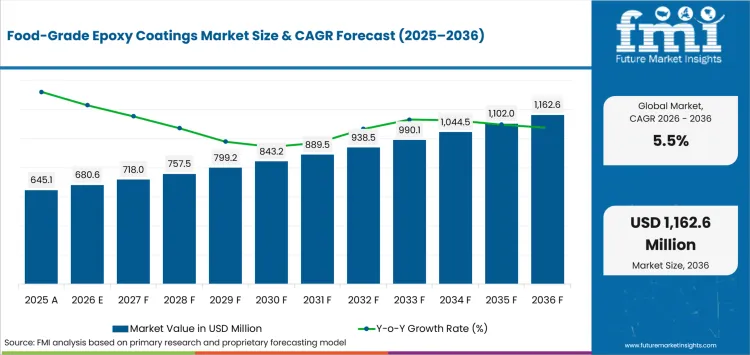
- Market Size (2026)
- USD 680.6 Mn
- Forecast (2036)
- USD 1162.6 Mn
- CAGR (2026 to 2036)
- 5.5%
How big is Food-Grade Epoxy Coatings Market in 2026?
USD 680.6 million in 2026 and USD 1,162.6 million by 2036 at a 5.5% CAGR.
Demand for food-grade epoxy coatings is projected to expand at 5.5% CAGR from 2026 to 2036 as processors replace deteriorated linings and hygienic floor systems. The European Commission stated in March 2025 that its BPA prohibition covers epoxy resins used in coatings for metal food and drink cans, which raises the qualification burden for food-contact formulations. Coating revenue therefore depends on documented suitability for the intended exposure, not on corrosion resistance alone.
Plant density changes the size of the addressable maintenance base. USA Census Bureau data released in June 2025 record 31,130 employer establishments in food manufacturing for 2023. That installed base gives coating manufacturers a large replacement pool for floors, vessels, and support assets, although each project still depends on substrate condition, maintenance access, and local applicator capacity.
Key Takeaways
- Demand is supported by sanitation exposure, corrosion control, and food-contact documentation that turn surface condition into a maintenance decision.
- Solvent-free epoxy coatings are projected to account for 28.0% of coating type demand in 2026 owing to high-build application with less solvent handling during lining work.
- Storage tanks are expected to hold 27.0% of contact surface demand in 2026, with internal linings protecting large wetted areas that can otherwise suffer corrosion or contamination.
- FDA compliant formulations are anticipated to represent 34.0% of compliance demand in 2026 since USA direct-contact specifications require use-condition evidence for resinous coatings.
- Surface preparation, cure time, and documentation can delay adoption when a technically suitable system does not fit a plant maintenance window.
- Key players in the food-grade epoxy coatings market include Sherwin-Williams, PPG, AkzoNobel, Jotun, Hempel, Sika, RPM International, Carboline, Teknos, and Axalta.
Analyst Perspective
"Food-grade epoxy coatings earn their value at the point where chemistry, surface preparation, and plant scheduling meet. A lower material price rarely compensates for weak documentation or a cure schedule that extends a production outage."
- Nikhil Kaitwade, Principal Consultant, Future Market Insights
How is the food-grade epoxy coatings market segmented?
The food-grade epoxy coatings market is segmented by coating type, contact surface, compliance, end use, and sales channel.
Coating type covers solvent-free, waterborne, novolac, high-build, and FDA-compliant lining systems. Contact surfaces include storage tanks, concrete floors, process vessels, pipelines, and packaging equipment. Compliance categories cover FDA, EU food-contact, NSF/ANSI, and BPA-NI requirements. End uses include food processing, beverage, dairy, brewery, and cold-storage plants. Sales channels include contractors, direct coating OEMs, maintenance distributors, and retrofit projects.
What supports FDA compliant leadership in the compliance category?
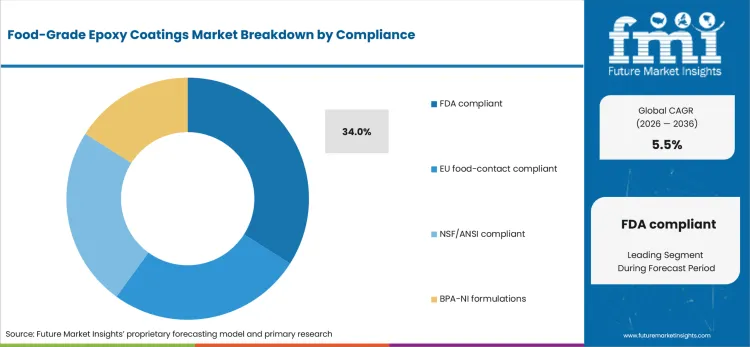
FDA compliant positioning gives USA engineering teams a defined route for qualifying resinous coatings used on food-contact articles. Title 21 CFR 175.300 sets permitted resinous and polymeric coating conditions, so a generic industrial epoxy claim does not establish suitability for a specific food-contact use.
- FDA compliant formulations are forecast to represent 34.0% of compliance demand in 2026. Their position reflects direct-contact specifications that trace the coating to an accepted use condition.
- Qualification records reduce approval uncertainty before shutdown. A change in formulation, substrate, or service condition can trigger a fresh review by the facility and applicator.
What makes solvent-free epoxy coatings central to the coating type category?
Solvent-free epoxies suit lining work where film build and solvent handling influence shutdown execution. Hempel launched a solvent-free epoxy phenolic tank lining in October 2025 that uses single-coat application and rapid curing to shorten return-to-service time. These qualities keep epoxy paint systems relevant where plant teams need high-build films, chemical resistance, and controlled cure behavior, although food-contact use still requires separate qualification for the intended service.
- By coating type, solvent-free epoxy coatings are estimated to hold 28.0% in 2026. High-build films can reduce the number of application steps on demanding internal surfaces.
- The commercial advantage is strongest on prepared steel or concrete where plural-component application and curing control can fit a fixed outage without sacrificing film thickness.
Why do storage tanks lead the contact surface category?
Storage tanks place corrosion control and product-contact risk on a large internal surface. Sherwin-Williams stated in January 2025 that Dura-Plate 7550 is engineered for direct food contact in storage and processing tanks and meets FDA standards, showing why corrosion protection coatings are evaluated alongside documented use and barrier performance in tank-lining decisions.
- Storage tanks are projected to account for 27.0% of contact surface demand in 2026. Their position reflects the cost of contamination, exposed steel, and forced asset downtime after lining failure.
- Tank owners compare chemical resistance, cleaning exposure, cure time, and inspection access before approving a lining, so application planning is part of the product decision.
What supports FDA compliant leadership in the compliance category?
Why does food processing lead the end use category?
Food processing plants expose floors and equipment to repeated cleaning, moisture, impact, and chemicals within the same facility. NSF published NSF/ANSI 51-2025 in January 2026 for materials and finishes used in food equipment, reinforcing the need to evaluate coatings against food-use requirements instead of general industrial durability. Upgrades in food processing equipment also expand the number of cleanable surfaces that must be protected and maintained.
- Food processing is expected to hold 31.0% of end use demand in 2026 owing to the number of repairable concrete and metal surfaces exposed to intensive sanitation cycles.
- Plant engineers usually stage resurfacing by production area, which favors coating systems that match local washdown chemistry and return individual rooms or assets to service on schedule.
What are the drivers, restraints and opportunities in the Food-Grade Epoxy Coatings Market?
Sanitation enforcement and asset protection support demand, qualification work and shutdown economics restrain conversion, and BPA-related reformulation defines a focused opening for documented lining systems.
- Driver: Food-safety controls make damaged or hard-to-clean surfaces a maintenance priority tied directly to sanitation control.
- Restraint: Surface preparation, cure conditions, and use-specific documentation can push a coating project outside the available maintenance window.
- Opportunity: BPA-related changes create room for qualified epoxy systems in large repeat-use vessels where current rules permit defined applications.
Sanitation controls convert surface condition into an operating risk once residue or damage makes cleaning unreliable. In May 2025, FDA described caked-on residue on food-contact slicer and rack surfaces in a warning letter to Marin Baking, illustrating how cleanability failures move from housekeeping into compliance action. Coating demand follows where resurfacing or relining restores a surface that can be cleaned predictably, especially when specialty coatings are specified for chemical exposure, impact, and hygiene-related durability rather than simple appearance.
Qualification slows conversion because a food plant must know what the coating touches, how the substrate is prepared, and how long cure takes before production restarts. Canadian Food Inspection Agency guidance treats interior floors, walls, and coatings as construction materials and recommends retaining manufacturer or supplier documentation for safe intended use. A product can therefore fit technically and still miss the project if documentation or contractor execution is incomplete.
EU reformulation rules define a focused opening for selected large-tank applications. The current consolidated text of Regulation (EU) 2024/3190 permits liquid epoxy resins for self-supporting food-contact articles above 1,000 litres under specified conditions, including non-detectable migration. Manufacturers that document those conditions can defend selected tank applications, while food can coatings continue moving toward BPA-NI and other qualified alternatives for metal packaging use. Other food-contact uses continue transitioning away from BPA chemistry.
Which country CAGRs are profiled in the Food-Grade Epoxy Coatings Market?
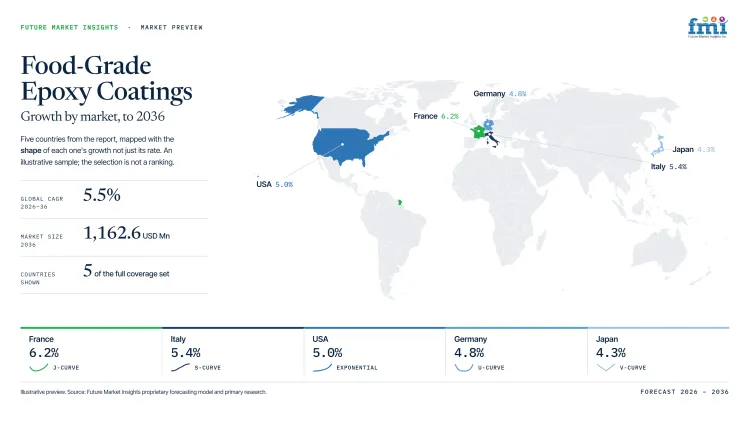
| Country | CAGR |
|---|---|
| France | 6.2% |
| Netherlands | 5.5% |
| Italy | 5.4% |
| Canada | 5.1% |
| USA | 5.0% |
| Germany | 4.8% |
| Japan | 4.3% |
How do country-level CAGRs compare in the Food-Grade Epoxy Coatings Market?
The seven forecasts span 1.9 percentage points, but five countries cluster between 4.8% and 5.5%. France ranks above that band at 6.2%, while Japan forms the lower edge at 4.3%. The narrow middle spread puts more weight on project execution than small rate differences for most profiled markets.
- France rewards earlier qualification for planned refurbishment.
- Dutch projects reward shorter production-outage windows.
- Italy favors phased coverage for uneven maintenance budgets.
- Canada rewards regional service over centralized support.
- The USA turns scale into replacement demand.
- Germany rewards restart certainty over material switching.
- Japan requires more documentation before material changes.
Similar CAGRs can produce different sales cycles because plant scale and approval practices vary. The full report provides country-level CAGR analysis across North America, Latin America, Western Europe, Eastern Europe, East Asia, South Asia and Pacific, and the Middle East and Africa.
Country-wise Analysis
- In France, registration mix trends across processed and packaged foods keep refurbishment planning closely tied to seasonal production peaks, making contractor availability as important as coating selection. Insee recorded the food-and-beverage production index at 98.23 in December 2025, and food-grade epoxy coating demand in France is forecast to expand at 6.2% CAGR over the assessment period as a large processing base absorbs EU food-contact reformulation pressure. The main friction is requalifying affected formulations without extending shutdowns, which favors companies carrying current compliance files and applicators able to complete lining or flooring work inside planned maintenance windows without forcing additional production losses.
- The Netherlands combines dense export-oriented manufacturing with a maintenance culture where lost production time can outweigh small differences in coating price. Food-products output was 1.7% higher year on year in May 2026 according to Statistics Netherlands, confirming that active plants continue to carry a substantial maintenance base for floors and process assets. The country is anticipated to advance at 5.5% CAGR through 2036 as those assets require refurbishment, while moisture control and cure scheduling favor coating manufacturers with nearby application support that can complete repairs inside short production outages without relying on distant technical teams during urgent maintenance work.
- Italian food manufacturers range from large branded plants to smaller regional processors, producing uneven project sizes and different shutdown options. Food-grade epoxy coating sales in Italy are forecast to expand at 5.4% CAGR by 2036 owing to refurbishment needs, while Istat reported in June 2026 that food, beverage, and tobacco industry volume grew 1.4% during 2025. Budget sensitivity can delay full-floor replacement at smaller sites, so phased resurfacing and local contractor execution offer a more practical route than one large intervention for facilities that spread maintenance spending among several production areas and cannot close an entire line at once.
- Canadian processors must pair construction-material suitability with records that remain available for preventive-control review, making approval documentation part of the purchase. Statistics Canada reported food-manufacturing sales were 5.5% higher year on year in June 2026, confirming active production that periodically requires floor, wall, and equipment-area maintenance. Demand in Canada is projected to grow at 5.1% CAGR during the forecast period given that renewal base, while wide service distances favor coating companies with regional applicators and clear letters of guarantee. Broader food technology investment also supports tighter sanitation and traceability expectations across processing facilities.
- The USA starts from a large installed processing base, so food-plant coating work usually follows a defined sanitation or maintenance problem rather than a broad material switch. Demand for food-grade epoxy coatings in the USA is forecast to rise at 5.0% CAGR over the forecast period as repeated repair needs accumulate, while FDA reported in November 2025 that The Father's Table inspection found serious CGMP and preventive-control violations. Facility diversity limits standardization, leaving national coating brands dependent on regional applicators and use-specific documentation to convert broad installed capacity into repeat local retrofit work without adding avoidable qualification delays.
- Germany’s engineering-led approval culture means food manufacturers typically qualify maintenance coatings through formal specifications and established contractor relationships before planned shutdowns begin. Destatis reported food-industry production increased 7.5% month on month in January 2025 after seasonal and calendar adjustment, showing continued plant activity that keeps existing food-production assets in regular service. Germany is estimated to post 4.8% CAGR through 2036 with replacement demand moderated by conservative change control, so complete technical records and predictable cure schedules carry more commercial weight than rapid material switching. Advanced coating adoption reinforces the same preference for documented performance under demanding industrial conditions.
- Japan’s synthetic-resin positive-list regime makes formulation traceability the starting point for food-contact material changes, increasing the documentation work behind coating qualification. Japan is projected to record 4.3% CAGR during the assessment period supported by maintenance in a mature processing base, while the Consumer Affairs Agency lists a March 26, 2026 amendment to the monomer notice and a June 2026 guidance update. Local-language technical records and precise formulation traceability can shorten specification review, while packaging coating in Japan demand shows how food and beverage converters continue upgrading coating specifications under domestic compliance expectations.
Who are the notable companies in the Food-Grade Epoxy Coatings Market?
Sherwin-Williams, PPG, AkzoNobel, Jotun, Hempel, Sika, RPM International, Carboline, Teknos, and Axalta are notable companies serving this market.
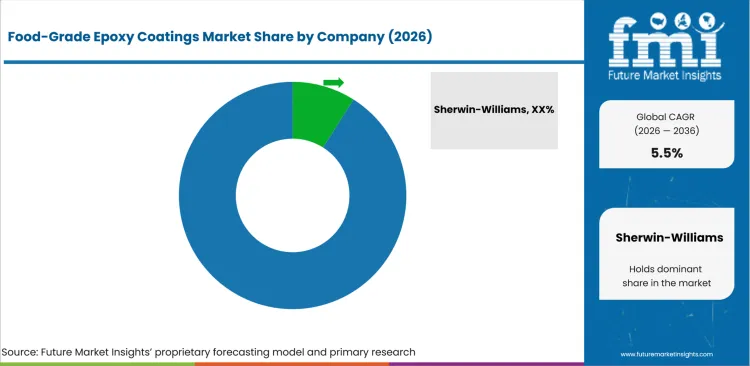
Competition divides among protective-coating groups, tank-lining specialists, flooring companies, and packaging-coating platforms. Food-contact evidence and applicator coverage limit entry because plants approve the exact system for each substrate and service condition.
- Sherwin-Williams, PPG, AkzoNobel, and Jotun cover broad protective and packaging routes through international technical and distribution networks.
- Hempel, Sika, and Teknos focus on linings or resinous flooring. RPM International, Carboline, and Axalta serve industrial, contractor, or equipment routes.
Competitive Benchmarking: Food-Grade Epoxy Coatings Market
| Company | Food-Contact Lining Depth | Hygienic Facility Epoxy Depth | Food-Safety Credential Depth | Geographic Reach |
|---|---|---|---|---|
| Sherwin-Williams | High | High | High | North America, Western Europe, East Asia, and Latin America |
| PPG | High | Medium | High | North America, Western Europe, East Asia, and Latin America |
| AkzoNobel | Medium | Low | High | Western Europe, Americas, and East Asia |
| Jotun | High | Low | High | Western Europe, Middle East and Africa, East Asia, and Americas |
| Hempel | High | Low | High | Western Europe, Americas, Middle East and Africa, and East Asia |
| Sika | Low | High | Medium | Global construction and industrial flooring network |
| RPM International | Medium | High | Medium | North America with international performance-coatings operations |
| Carboline | High | Medium | High | North America with international industrial markets |
| Teknos | Low | High | Medium | Western Europe with selected international industrial markets |
| Axalta | Low | Low | Medium | North America, Western Europe, East Asia, and Latin America |
Scoring basis: High requires several documented routes or credentials, Medium indicates narrower repeatable evidence, and Low marks one verified route with limited breadth. Geographic reach records public operating coverage. Ratings compare documented capabilities, not corporate reputation.
Key Developments in the Food-Grade Epoxy Coatings Market
- In March 2025, Sika and BASF launched Baxxodur EC 151 for epoxy flooring, with Sika reporting cure-time reductions of up to two thirds. Faster curing lowers outage exposure in production areas, but food-use qualification is application specific.
- In July 2025, PPG expanded its BPA-NI beverage can end coatings for global canmakers. The launch increases substitution pressure on bisphenol-based epoxypackaging coatingsby giving high-speed lines qualified food-contact alternatives.
- In July 2025, RPM International moved its Industrial Coatings Group into the Performance Coatings Group and aligned it more closely with Carboline. The reorganisation broadens technical-service and distribution access for industrial lining projects.
Key Players in the Food-Grade Epoxy Coatings Market
Integrated Protective and Packaging Coating Platforms
- Sherwin-Williams
- PPG
- AkzoNobel
- Jotun
Specialist Lining and Hygienic Facility Systems
- Hempel
- Sika
- Teknos
Performance Coatings and Food-Equipment Specialists
- RPM International
- Carboline
- Axalta
Food-Grade Epoxy Coatings Market - Report Scope
| Coverage field | Report scope |
|---|---|
| Market breakdown | By coating type, contact surface, compliance, end use, sales channel, and region. |
| Quantitative Units | USD million. |
| Market Definition | Revenue includes epoxy-based coatings and linings sold for food-contact or hygienic food and beverage service. Downstream finished-product revenue, installation labor sold separately, and adjacent non-epoxy coating revenue are excluded. |
| Regions Covered | North America, Latin America, Western Europe, Eastern Europe, East Asia, South Asia and Pacific, and Middle East and Africa. |
| Countries Covered | France, Netherlands, Italy, Canada, USA, Germany, Japan, and 20+ countries included in the full report. |
| Key Companies Profiled | Sherwin-Williams, PPG, AkzoNobel, Jotun, Hempel, Sika, RPM International, Carboline, Teknos, Axalta. |
| Forecast Period | 2026 to 2036. |
| Approach | Primary and secondary research with market triangulation. |
Food-Grade Epoxy Coatings Market - Research Methodology
| Method | Approach |
|---|---|
| Primary Research | FMI analysts gathered input from manufacturers, service providers, technology developers, distributors, end users, procurement teams, and subject-matter experts. Interviews examined purchasing decisions, product or service evaluation, adoption barriers, approval requirements, pricing considerations, and expectations for technical or commercial support. Respondents were also asked what evidence is required before a trial, pilot, or initial order develops into regular purchasing. |
| Desk Research | Desk research covered government statistics, regulatory publications, trade data, industry associations, technical literature, standards, company filings, product information, and official corporate announcements. Sources were reviewed for relevance, publication date, geographic coverage, and consistency with the defined market scope. Claims relating to performance, applications, approvals, capacity, investment, and commercial activity were retained only when supported by credible public evidence. |
| Market Sizing and Forecasting | The market model combined the baseline value with historical performance, segment structure, pricing and volume indicators, adoption levels, company participation, and country-level demand conditions. Forecast assumptions considered economic activity, investment trends, regulatory developments, technology adoption, purchasing cycles, supply availability, and barriers to wider market use. Segment and regional estimates were reconciled before the final market total was calculated. |
| Data Validation | Estimates were checked against multiple independent indicators, including public data, company activity, trade patterns, industry developments, and findings from primary interviews. Validation also tested whether products, services, applications, and company revenues fell within the defined market boundaries. Adjacent categories, unsupported claims, overlapping revenues, and activities without direct market relevance were excluded to reduce double counting and maintain consistency across segments and countries. |
Food-Grade Epoxy Coatings Market by Segments
Food-Grade Epoxy Coatings Market segmented by Coating Type:
- Solvent-free epoxy coatings
- Waterborne epoxy coatings
- Novolac epoxy coatings
- High-build epoxy linings
- FDA-compliant tank linings
Food-Grade Epoxy Coatings Market segmented by Contact Surface:
- Storage tanks
- Concrete floors
- Process vessels
- Pipelines
- Packaging equipment
Food-Grade Epoxy Coatings Market segmented by Compliance:
- FDA compliant
- EU food-contact compliant
- NSF/ANSI compliant
- BPA-NI formulations
Food-Grade Epoxy Coatings Market segmented by End Use:
- Food processing
- Beverage plants
- Dairy plants
- Breweries
- Cold storage
Food-Grade Epoxy Coatings Market segmented by Sales Channel:
- Industrial coating contractors
- Direct coating OEM
- Maintenance distributors
- Facility retrofit projects
Food-Grade Epoxy Coatings Market by Region:
- North America
- United States
- Canada
- Latin America
- Brazil
- Mexico
- Chile
- Rest of Latin America
- Western Europe
- Germany
- United Kingdom
- Italy
- Spain
- France
- Nordics
- Benelux
- Rest of Western Europe
- Eastern Europe
- Russia
- Poland
- Hungary
- Balkan and Baltic States
- Rest of Eastern Europe
- East Asia
- China
- Japan
- South Korea
- South Asia and Pacific
- India
- ASEAN
- Australia and New Zealand
- Rest of South Asia and Pacific
- Middle East and Africa
- Kingdom of Saudi Arabia
- Other GCC Countries
- Türkiye
- South Africa
- Other African Union Countries
- Rest of Middle East and Africa
Research Sources and Bibliography
- European Commission. (2025, March 7). EU prohibition on the use and trade of Bisphenol A from 20 January 2025.
- USA Census Bureau. (2025, June 26). 2023 County Business Patterns now available.
- USA Census Bureau. (2025, June 26). 311: Food Manufacturing - Census Bureau Profile.
- Hempel. (2025, October 9). Hempel launches Hempaline Defend 430: A solvent-free tank lining boosting efficiency in the energy sector.
- Sherwin-Williams. (2025, January 21). Sherwin-Williams to spotlight resilient coatings for food facilities at IPPE 2025.
- USA Electronic Code of Federal Regulations. (2026, September 4). 21 CFR 175.300 - Resinous and polymeric coatings.
- NSF International. (2026, January 28). NSF/ANSI 51-2025: Food equipment materials uploaded.
- USA Food and Drug Administration. (2025, May 28). Marin Baking LLC - Warning Letter 700600.
- Canadian Food Inspection Agency. (2026, September 1). Guidance for food establishments concerning construction materials and packaging materials and non-food chemicals.
- European Union. (2026, February 23). Consolidated text: Commission Regulation (EU) 2024/3190.
- Insee. (2026, February 5). In December 2025, manufacturing output fell back sharply (-0.8%).
- Statistics Netherlands. (2026, July 10). Manufacturing output in May almost 5 percent higher, year on year.
- Istat. (2026, June 12). Economic accounts for agriculture - Year 2025.
- Statistics Canada. (2026, August 14). Manufacturing sales by industry - Seasonally adjusted, June 2026.
- USA Food and Drug Administration. (2025, November 28). The Father's Table, LLC - Warning Letter 706334.
- Federal Statistical Office of Germany. (2025, March 10). Production in January 2025: +2.0% on the previous month.
- Consumer Affairs Agency, Japan. (2026, June 5). Positive list system for food utensils, containers and packaging after June 1, 2025.
- Sika. (2025, March 17). BASF and Sika launch epoxy hardener for sustainable solutions in the construction industry.
- PPG. (2025, July 21). PPG adds BPA-NI beverage can end coatings to PPG INNOVEL and PPG iSENSE series.
- RPM International Inc. (2025, July 24). Q4 2025 RPM International Inc earnings call.
- AkzoNobel Packaging Coatings. (2025, November 4). AkzoNobel introduces next-generation BPAni coatings to Brazilian beverage market at Abralatas 2025.
- PPG. (2026, April 20). PPG launches first aluminum coil-applied PVC-NI coating in USA for pet food cans.
- Teknos. (2025, May). Teknos at LIGNA 2025.
- Jotun. (2026, February 12). Another record year for Jotun.
- RPM International Inc. (2025). Sustainable Growth fact sheet.
- NSF International. (2026, September 2). NSF/ANSI 51 listings - Akzo Nobel Coatings Inc.
- NSF International. (2026, September 2). NSF/ANSI 51 listings - The Sherwin-Williams Company.
This bibliography is provided for reader reference and is not exhaustive. The full report contains the complete reference list and detailed citations.
This Report Answers
- What is the food-grade epoxy coatings market size in 2026 and what value is forecast for 2036?
- Which sanitation and asset-protection conditions support demand for food-grade epoxy coatings?
- Why do solvent-free epoxy coatings hold the leading position within coating type?
- How does storage-tank leadership affect demand for direct-contact lining systems?
- Why do FDA compliant formulations lead the compliance category?
- How do forecast CAGRs differ among France, Netherlands, Italy, Canada, USA, Germany, and Japan?
- Which companies compete through tank linings, hygienic flooring, packaging coatings, or food-equipment systems?
- How do surface preparation, qualification, and plant downtime limit project conversion?
- What should plant engineering teams verify before approving a food-grade epoxy coating?
Frequently Asked Questions
How big is the food-grade epoxy coatings market in 2026?
The food-grade epoxy coatings market is valued at USD 680.6 million in 2026 and is projected to reach USD 1,162.6 million by 2036. Replacement of damaged hygienic surfaces and food-contact qualification support the forecast.
What is the CAGR of the food-grade epoxy coatings market from 2026 to 2036?
The food-grade epoxy coatings market is projected to grow at a CAGR of 5.5% between 2026 and 2036. Expansion is tied to maintenance of processing assets, sanitation exposure, and use-specific coating documentation.
Which coating type leads the food-grade epoxy coatings market?
The solvent-free epoxy coatings segment is expected to hold 28.0% of the food-grade epoxy coatings market in 2026, driven by high-build lining needs and lower solvent handling during application. Cure control still determines whether the system fits an outage.
Which contact surface leads the food-grade epoxy coatings market?
The storage tanks segment is expected to hold 27.0% of the food-grade epoxy coatings market in 2026, attributable to large internal surfaces that require corrosion and contamination barriers. Buyers also compare cleaning exposure and return-to-service time.
Which countries are projected to record the highest growth in the food-grade epoxy coatings market?
France is projected to grow at 6.2% CAGR, followed by the Netherlands at 5.5% and Italy at 5.4% through 2036. Growth differs with food-plant density, refurbishment timing, and local qualification requirements.
Which companies are active in the food-grade epoxy coatings market?
Key companies include Sherwin-Williams, PPG, AkzoNobel, Jotun, Hempel, Sika, RPM International, Carboline, Teknos, and Axalta. They compete through direct-contact lining depth, hygienic flooring systems, food-use credentials, and technical service coverage.
Preview the report firsthand - request a free sample
Get SampleGet the brochure for pricing and purchase details.
Get PDFTable of Content
- Key Takeaways
- Market Size and CAGR
- Top Growth Driver
- Fastest Growing Segment
- Leading Region
- Key Companies
- Emerging Opportunities
- Executive Summary
- Global Market Outlook
- Demand-side Trends
- Supply-side Trends
- Technology Roadmap Analysis
- Analysis and Recommendations
- Analyst Perspective (What is happening? Why now? What should investors know?)
- Key Questions Answered
- How large is the market?
- What is the CAGR?
- What are key trends?
- Which region dominates?
- Who are the leaders?
- Market Overview
- Market Coverage / Taxonomy
- Market Definition / Scope / Limitations
- Research Methodology
- Chapter Orientation
- Analytical Lens and Working Hypotheses
- Market Structure, Signals, and Trend Drivers
- Benchmarking and Cross-market Comparability
- Market Sizing, Forecasting, and Opportunity Mapping
- Research Design and Evidence Framework
- Desk Research Programme (Secondary Evidence)
- Expert Input and Fieldwork (Primary Evidence)
- Tooling, Models, and Reference Databases
- Data Engineering and Model Build
- Quality Assurance and Audit Trail
- Market Background
- Market Dynamics (Drivers, Restraints, Opportunity, Trends)
- Scenario Forecast (Optimistic, Likely, Conservative)
- Impact Analysis
- AI Impact
- Sustainability Impact
- Regulatory Impact
- Technology Impact
- Consumer / Buyer Analysis
- Purchase Drivers
- Adoption Barriers
- Buyer Journey
- Opportunity Map Analysis
- Product Life Cycle Analysis
- Supply Chain Analysis
- Investment Feasibility Matrix
- Value Chain Analysis
- PESTLE and Porter's Analysis
- Regulatory Landscape
- Regional Parent Market Outlook
- Production and Consumption Statistics
- Import and Export Statistics
- Global Market Analysis and Forecast, 2021 to 2036
- Historical Market Size Value (USD Million) Analysis, 2021 to 2025
- Current and Future Market Size Value (USD Million) Projections, 2026 to 2036
- Y-o-Y Growth Trend Analysis
- Absolute $ Opportunity Analysis
- Global Market Pricing Analysis, 2021 to 2036
- Global Market Analysis and Forecast, By Coating Type, 2021 to 2036
- Introduction / Key Findings
- Historical Market Size Value (USD Million) Analysis By Coating Type, 2021 to 2025
- Current and Future Market Size Value (USD Million) Analysis and Forecast By Coating Type, 2026 to 2036
- Solvent-free epoxy coatings
- Waterborne epoxy coatings
- Novolac epoxy coatings
- High-build epoxy linings
- FDA-compliant tank linings
- Solvent-free epoxy coatings
- Y-o-Y Growth Trend Analysis By Coating Type, 2021 to 2025
- Absolute $ Opportunity Analysis By Coating Type, 2026 to 2036
- Global Market Analysis and Forecast, By Contact Surface, 2021 to 2036
- Introduction / Key Findings
- Historical Market Size Value (USD Million) Analysis By Contact Surface, 2021 to 2025
- Current and Future Market Size Value (USD Million) Analysis and Forecast By Contact Surface, 2026 to 2036
- Storage tanks
- Concrete floors
- Process vessels
- Pipelines
- Packaging equipment
- Storage tanks
- Y-o-Y Growth Trend Analysis By Contact Surface, 2021 to 2025
- Absolute $ Opportunity Analysis By Contact Surface, 2026 to 2036
- Global Market Analysis and Forecast, By Compliance, 2021 to 2036
- Introduction / Key Findings
- Historical Market Size Value (USD Million) Analysis By Compliance, 2021 to 2025
- Current and Future Market Size Value (USD Million) Analysis and Forecast By Compliance, 2026 to 2036
- FDA compliant
- EU food-contact compliant
- NSF/ANSI compliant
- BPA-NI formulations
- FDA compliant
- Y-o-Y Growth Trend Analysis By Compliance, 2021 to 2025
- Absolute $ Opportunity Analysis By Compliance, 2026 to 2036
- Global Market Analysis and Forecast, By End Use, 2021 to 2036
- Introduction / Key Findings
- Historical Market Size Value (USD Million) Analysis By End Use, 2021 to 2025
- Current and Future Market Size Value (USD Million) Analysis and Forecast By End Use, 2026 to 2036
- Food processing
- Beverage plants
- Dairy plants
- Breweries
- Cold storage
- Food processing
- Y-o-Y Growth Trend Analysis By End Use, 2021 to 2025
- Absolute $ Opportunity Analysis By End Use, 2026 to 2036
- Global Market Analysis and Forecast, By Sales Channel, 2021 to 2036
- Introduction / Key Findings
- Historical Market Size Value (USD Million) Analysis By Sales Channel, 2021 to 2025
- Current and Future Market Size Value (USD Million) Analysis and Forecast By Sales Channel, 2026 to 2036
- Industrial coating contractors
- Direct coating OEM
- Maintenance distributors
- Facility retrofit projects
- Industrial coating contractors
- Y-o-Y Growth Trend Analysis By Sales Channel, 2021 to 2025
- Absolute $ Opportunity Analysis By Sales Channel, 2026 to 2036
- Global Market Analysis and Forecast, By Region, 2021 to 2036
- Introduction
- Historical Market Size Value (USD Million) Analysis By Region, 2021 to 2025
- Current Market Size Value (USD Million) Analysis and Forecast By Region, 2026 to 2036
- North America
- Latin America
- Western Europe
- Eastern Europe
- East Asia
- South Asia and Pacific
- Middle East & Africa
- Market Attractiveness Analysis By Region
- North America Market Analysis and Forecast, By Country, 2021 to 2036
- Historical Market Size Value (USD Million) Trend Analysis By Market Taxonomy, 2021 to 2025
- Market Size Value (USD Million) Forecast By Market Taxonomy, 2026 to 2036
- By Country
- USA
- Canada
- By Coating Type
- By Contact Surface
- By Compliance
- By End Use
- By Sales Channel
- By Country
- Market Attractiveness Analysis
- By Country
- By Coating Type
- By Contact Surface
- By Compliance
- By End Use
- By Sales Channel
- Key Takeaways
- Latin America Market Analysis and Forecast, By Country
- Historical Market Size Value (USD Million) Trend Analysis By Market Taxonomy, 2021 to 2025
- Market Size Value (USD Million) Forecast By Market Taxonomy, 2026 to 2036
- By Country
- Brazil
- Mexico
- Chile
- Rest of Latin America
- By Coating Type
- By Contact Surface
- By Compliance
- By End Use
- By Sales Channel
- By Country
- Market Attractiveness Analysis
- By Country
- By Coating Type
- By Contact Surface
- By Compliance
- By End Use
- By Sales Channel
- Key Takeaways
- Western Europe Market Analysis and Forecast, By Country
- Historical Market Size Value (USD Million) Trend Analysis By Market Taxonomy, 2021 to 2025
- Market Size Value (USD Million) Forecast By Market Taxonomy, 2026 to 2036
- By Country
- Germany
- UK
- Italy
- Spain
- France
- Nordic
- BENELUX
- Rest of Western Europe
- By Coating Type
- By Contact Surface
- By Compliance
- By End Use
- By Sales Channel
- By Country
- Market Attractiveness Analysis
- By Country
- By Coating Type
- By Contact Surface
- By Compliance
- By End Use
- By Sales Channel
- Key Takeaways
- Eastern Europe Market Analysis and Forecast, By Country
- Historical Market Size Value (USD Million) Trend Analysis By Market Taxonomy, 2021 to 2025
- Market Size Value (USD Million) Forecast By Market Taxonomy, 2026 to 2036
- By Country
- Russia
- Poland
- Hungary
- Balkan & Baltic
- Rest of Eastern Europe
- By Coating Type
- By Contact Surface
- By Compliance
- By End Use
- By Sales Channel
- By Country
- Market Attractiveness Analysis
- By Country
- By Coating Type
- By Contact Surface
- By Compliance
- By End Use
- By Sales Channel
- Key Takeaways
- East Asia Market Analysis and Forecast, By Country
- Historical Market Size Value (USD Million) Trend Analysis By Market Taxonomy, 2021 to 2025
- Market Size Value (USD Million) Forecast By Market Taxonomy, 2026 to 2036
- By Country
- China
- Japan
- South Korea
- By Coating Type
- By Contact Surface
- By Compliance
- By End Use
- By Sales Channel
- By Country
- Market Attractiveness Analysis
- By Country
- By Coating Type
- By Contact Surface
- By Compliance
- By End Use
- By Sales Channel
- Key Takeaways
- South Asia and Pacific Market Analysis and Forecast, By Country
- Historical Market Size Value (USD Million) Trend Analysis By Market Taxonomy, 2021 to 2025
- Market Size Value (USD Million) Forecast By Market Taxonomy, 2026 to 2036
- By Country
- India
- ASEAN
- Australia & New Zealand
- Rest of South Asia and Pacific
- By Coating Type
- By Contact Surface
- By Compliance
- By End Use
- By Sales Channel
- By Country
- Market Attractiveness Analysis
- By Country
- By Coating Type
- By Contact Surface
- By Compliance
- By End Use
- By Sales Channel
- Key Takeaways
- Middle East & Africa Market Analysis and Forecast, By Country
- Historical Market Size Value (USD Million) Trend Analysis By Market Taxonomy, 2021 to 2025
- Market Size Value (USD Million) Forecast By Market Taxonomy, 2026 to 2036
- By Country
- Kingdom of Saudi Arabia
- Other GCC Countries
- Türkiye
- South Africa
- Other African Union
- Rest of Middle East & Africa
- By Coating Type
- By Contact Surface
- By Compliance
- By End Use
- By Sales Channel
- By Country
- Market Attractiveness Analysis
- By Country
- By Coating Type
- By Contact Surface
- By Compliance
- By End Use
- By Sales Channel
- Key Takeaways
- Key Countries Market Analysis
- USA
- Pricing Analysis
- Market Share Analysis, 2025
- By Coating Type
- By Contact Surface
- By Compliance
- By End Use
- By Sales Channel
- Canada
- Pricing Analysis
- Market Share Analysis, 2025
- By Coating Type
- By Contact Surface
- By Compliance
- By End Use
- By Sales Channel
- Mexico
- Pricing Analysis
- Market Share Analysis, 2025
- By Coating Type
- By Contact Surface
- By Compliance
- By End Use
- By Sales Channel
- Brazil
- Pricing Analysis
- Market Share Analysis, 2025
- By Coating Type
- By Contact Surface
- By Compliance
- By End Use
- By Sales Channel
- Chile
- Pricing Analysis
- Market Share Analysis, 2025
- By Coating Type
- By Contact Surface
- By Compliance
- By End Use
- By Sales Channel
- Germany
- Pricing Analysis
- Market Share Analysis, 2025
- By Coating Type
- By Contact Surface
- By Compliance
- By End Use
- By Sales Channel
- UK
- Pricing Analysis
- Market Share Analysis, 2025
- By Coating Type
- By Contact Surface
- By Compliance
- By End Use
- By Sales Channel
- Italy
- Pricing Analysis
- Market Share Analysis, 2025
- By Coating Type
- By Contact Surface
- By Compliance
- By End Use
- By Sales Channel
- Spain
- Pricing Analysis
- Market Share Analysis, 2025
- By Coating Type
- By Contact Surface
- By Compliance
- By End Use
- By Sales Channel
- France
- Pricing Analysis
- Market Share Analysis, 2025
- By Coating Type
- By Contact Surface
- By Compliance
- By End Use
- By Sales Channel
- India
- Pricing Analysis
- Market Share Analysis, 2025
- By Coating Type
- By Contact Surface
- By Compliance
- By End Use
- By Sales Channel
- ASEAN
- Pricing Analysis
- Market Share Analysis, 2025
- By Coating Type
- By Contact Surface
- By Compliance
- By End Use
- By Sales Channel
- Australia & New Zealand
- Pricing Analysis
- Market Share Analysis, 2025
- By Coating Type
- By Contact Surface
- By Compliance
- By End Use
- By Sales Channel
- China
- Pricing Analysis
- Market Share Analysis, 2025
- By Coating Type
- By Contact Surface
- By Compliance
- By End Use
- By Sales Channel
- Japan
- Pricing Analysis
- Market Share Analysis, 2025
- By Coating Type
- By Contact Surface
- By Compliance
- By End Use
- By Sales Channel
- South Korea
- Pricing Analysis
- Market Share Analysis, 2025
- By Coating Type
- By Contact Surface
- By Compliance
- By End Use
- By Sales Channel
- Russia
- Pricing Analysis
- Market Share Analysis, 2025
- By Coating Type
- By Contact Surface
- By Compliance
- By End Use
- By Sales Channel
- Poland
- Pricing Analysis
- Market Share Analysis, 2025
- By Coating Type
- By Contact Surface
- By Compliance
- By End Use
- By Sales Channel
- Hungary
- Pricing Analysis
- Market Share Analysis, 2025
- By Coating Type
- By Contact Surface
- By Compliance
- By End Use
- By Sales Channel
- Kingdom of Saudi Arabia
- Pricing Analysis
- Market Share Analysis, 2025
- By Coating Type
- By Contact Surface
- By Compliance
- By End Use
- By Sales Channel
- Türkiye
- Pricing Analysis
- Market Share Analysis, 2025
- By Coating Type
- By Contact Surface
- By Compliance
- By End Use
- By Sales Channel
- South Africa
- Pricing Analysis
- Market Share Analysis, 2025
- By Coating Type
- By Contact Surface
- By Compliance
- By End Use
- By Sales Channel
- USA
- Market Structure Analysis
- Competition Dashboard
- Competition Benchmarking
- Market Share Analysis of Top Players
- By Regional
- By Coating Type
- By Contact Surface
- By Compliance
- By End Use
- By Sales Channel
- Emerging Startups
- Innovation Benchmarking
- Competition Analysis
- Competition Deep Dive
- Sherwin-Williams
- Overview
- Product Portfolio
- Profitability by Market Segments
- Sales Footprint
- Strategy Overview
- Marketing Strategy
- Product Strategy
- Channel Strategy
- PPG
- AkzoNobel
- Jotun
- Hempel
- Sika
- RPM International
- Carboline
- Teknos
- Axalta
- Sherwin-Williams
- Case Studies
- Success Stories
- Recent Developments
- Competition Deep Dive
- Assumptions & Acronyms Used


