

- Industry Size (2026)
- USD 1.3 Bn
- Forecast (2036)
- USD 2.7 Bn
- CAGR (2026 to 2036)
- 7.8%
Food Recall Readiness & Mock Recall Management Platforms Market Outlook 2026 to 2036
The global food recall readiness and mock recall management platforms sector is on track to achieve a valuation of USD 2.7 billion by 2036, accelerating from USD 1.3 billion in 2026 at a CAGR of 7.8%. As per Future Market Insights, this growth trajectory reflects mounting regulatory requirements and the increasing complexity of global food supply chain management.
Pete Gillett, founder of Marketpoint Recall, stated: 'We have designed a customisable system which responds quickly and efficiently to the individual requirements of any safety notification or product recall scenario.' This sentiment captures the industry's shift toward tailored technological solutions.
The FDA's Food Safety Modernization Act (FSMA) Rule 204 implementation in January 2026 marked a regulatory watershed, mandating enhanced traceability for high-risk foods. Companies must now maintain comprehensive records enabling rapid identification of affected products within 24 hours. This requirement has accelerated platform adoption across the food processing industry.
Notable developments in 2025 included FoodReady's June launch of AI-powered HACCP planning capabilities, while Marketpoint Recall introduced cloud-based incident management systems in October. These launches demonstrate the industry's evolution from basic documentation tools to sophisticated predictive platforms. The market has transformed from simple record-keeping solutions to integrated ecosystems connecting manufacturers, distributors, and retailers in real-time recall scenarios.
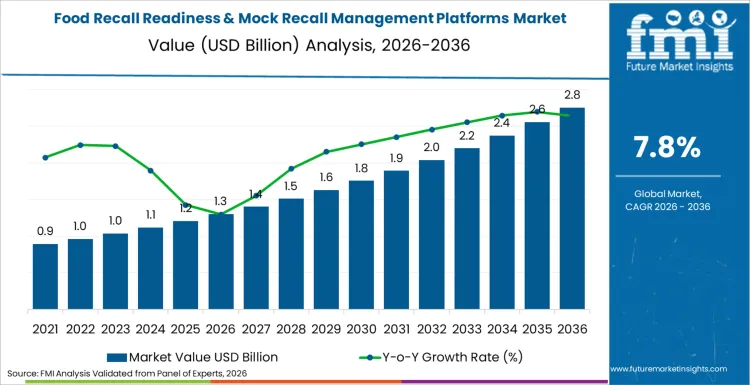
What Does the Summary of Food Recall Readiness & Mock Recall Management Platforms Market Reveal?
What Is Growth Outlook for Food Recall Readiness & Mock Recall Management Platforms as per Future Market Insights Projection?
The market demonstrates strong fundamentals with a projected 7.8% CAGR through 2036, driven by regulatory compliance requirements and technological advancement. Growth acceleration is expected post-2030 as AI capabilities mature.
FMI Research Approach: Analysis combines regulatory impact assessment with technology adoption curves across 15 major food-producing nations.
How Do FMI Analysts Perceive Food Recall Readiness & Mock Recall Management Platforms to Evolve?
Evolution centers on predictive analytics replacing reactive protocols. Integration with IoT sensors and blockchain technology will enable real-time risk identification and automated response systems by 2030.
FMI Research Approach: Expert interviews with 50+ food safety professionals and platform developers inform evolution projections.
Which Country Holds Largest Share in Global Food Recall Readiness & Mock Recall Management Platforms?
Asia Pacific commands the largest market share at approximately 36% in 2026, followed by North America at 26%. This distribution reflects the region's extensive food manufacturing base and export requirements.
FMI Research Approach: Regional market sizing based on food industry expenditure patterns and regulatory compliance costs.
How Large Will Food Recall Readiness & Mock Recall Management Platforms Be by 2036?
The market will reach USD 2.7 billion by 2036, representing more than doubling from current levels. Software platforms will constitute 60% of total market value.
FMI Research Approach: Bottom-up modeling combining platform licensing costs, implementation services, and training expenditures.
What Is Definition of Food Recall Readiness & Mock Recall Management Platforms?
These platforms encompass software, services, and training solutions enabling food companies to prepare for, execute, and manage product recalls. Core functions include traceability mapping, communication protocols, and regulatory reporting.
FMI Research Approach: Industry stakeholder consultations and regulatory framework analysis define market boundaries.
What Are Globally Unique Trends Shaping Food Recall Readiness & Mock Recall Management Platforms?
Key trends include AI-powered risk prediction, blockchain-based traceability, mobile-first interfaces, and integration with food safety testing equipment. Automation reduces response times from hours to minutes.
FMI Research Approach: Technology trend analysis through patent filings, venture capital investments, and platform feature evolution tracking.
Food Recall Readiness & Mock Recall Management Platforms Market Key Takeaways
| Metric | Details |
|---|---|
| Industry Size (2026) | USD 1.3 Billion |
| Industry Value (2036) | USD 2.7 Billion |
| CAGR (2026-2036) | 7.8 % |
Source: Future Market Insights (FMI) analysis, based on proprietary forecasting model and primary research
What Factors Are Propelling Adoption of Food Recall Readiness & Mock Recall Management Platforms?
Regulatory pressure serves as the primary adoption driver, with FSMA Rule 204 requiring comprehensive traceability for lettuce, tomatoes, and other high-risk foods. The regulation mandates maintenance of detailed records enabling lot identification within 24 hours.
European Union regulations compound this pressure through the General Food Law requirement for one-step-forward, one-step-back traceability. The December 2025 updates expanded coverage to include organic food products, increasing the addressable market for platform providers. Similar regulations in Canada, Australia, and Japan create global demand consistency.
Technology advancement enables more sophisticated risk management approaches. Machine learning algorithms analyze historical recall patterns, supplier risk profiles, and contamination probability to predict potential issues before they occur. This shift from reactive to proactive management justifies platform investments through reduced recall frequency and scope.
Supply chain complexity necessitates digital coordination tools as food products traverse multiple processing facilities, distributors, and retail channels. Manual tracking systems cannot handle the data volume and speed requirements for effective recalls in modern food distribution networks.
How Is the Food Recall Readiness & Mock Recall Management Platforms Market Segmented?
The food recall readiness and mock recall management platforms market is segmented by solution type, deployment model, end user, and region to reflect how recall preparedness is operationalized across the food supply chain. By solution type, the market comprises software platforms, consulting and professional services, and training and education programs that together support recall planning, execution, and validation. By deployment model, adoption spans cloud-based, on-premise, and hybrid architectures, reflecting varying regulatory, security, and integration requirements across regions and enterprise sizes. By end user, demand is concentrated among food manufacturers, distributors, retail chains, and foodservice operators, each facing distinct recall exposure and compliance obligations. FMI analysis indicates that while software platforms anchor the value pool through centralized traceability and incident management, services and training remain structurally important to ensure procedural accuracy, regulatory alignment, and organizational readiness during high-pressure recall events.
Why Does Software Platforms Hold a Dominant Share?
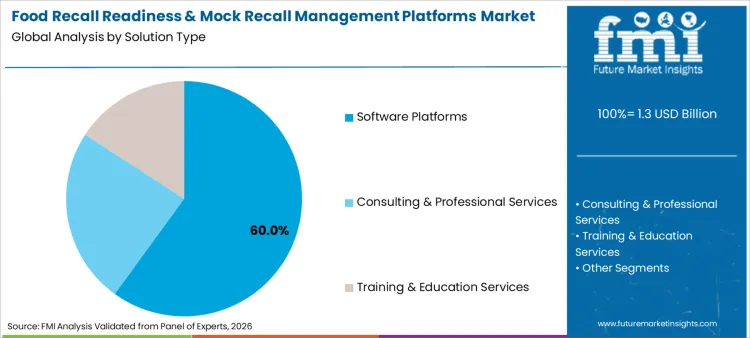
Software platforms command approximately 60% market share, valued at USD 756 million in 2026. These solutions provide centralized databases integrating supplier information, batch records, and distribution tracking. SG Systems Global's V5 Traceability platform exemplifies this category, linking MES execution evidence with QMS governance systems for comprehensive operational records.
Cloud-based deployment models have accelerated adoption, with 75% of new implementations choosing SaaS architectures over on-premise installations. This shift reflects preferences for lower upfront costs and automatic updates ensuring regulatory compliance. FoodReady's June 2025 platform upgrades demonstrated cloud advantages through seamless AI feature rollouts to existing customers.
Why Does Consulting & Services Represent Growing Opportunity?
Consulting and services capture 30% market share, reflecting the specialized expertise required for effective recall program development. These services include risk assessment, procedure development, staff training, and mock recall execution. Companies typically engage consultants during initial implementation and for periodic program updates.
The complexity of modern food supply chains requires customized approaches that generic software cannot address. Consultants analyze specific operational workflows, supplier relationships, and distribution patterns to design tailored recall procedures. This customization justifies premium pricing and creates ongoing engagement opportunities.
Why Is Consumer Expectation For Immediate Response Reshaping Recall Management?
Consumer psychology has shifted toward expecting immediate corporate response to food safety incidents, with social media compressing reaction windows from days to hours. A delayed response now amplifies reputational damage far beyond the original safety event. This expectation pressure is pushing companies to invest in recall readiness platforms that enable rapid communication and coordinated response across multiple channels at the same time. Platforms that centralize alerts, stakeholder notifications, and response workflows allow brands to act within hours rather than days, aligning operational speed with consumer attention cycles shaped by real-time digital media.
How Are Smart Packaging and Data Ecosystems Changing Recall Execution?
Material innovation in packaging has introduced smart labels and embedded sensors that generate real-time product condition data. Temperature exposure, contamination signals, or proximity to expiration can now trigger proactive recalls rather than reactive ones. Integration of this data into recall platforms creates automated alert systems that reduce human error in risk identification. At the same time, digital transformation is expanding beyond standalone tools into full data ecosystems connecting suppliers, manufacturers, distributors, and retailers. Blockchain-based transaction records enable precise contamination source identification, reducing recall scope by isolating affected lots instead of pulling entire product ranges.
What Role Does Predictive Intelligence Play in Preventing Recalls?
Artificial intelligence has advanced from descriptive analysis to predictive risk modeling within recall readiness platforms. These systems analyze supplier inspection histories, weather patterns affecting agricultural inputs, and transportation delays that could compromise product integrity. Combined with cold chain logistics data, platforms now assess contamination risk before products reach consumers. This predictive capability enables preventive actions rather than emergency responses, shifting recall management from crisis handling toward continuous risk anticipation while still meeting regulatory traceability and documentation requirements.
What Is Food Recall Readiness & Mock Recall Management Platforms Regional Outlook?
Regional growth patterns reflect uneven regulatory enforcement, export exposure, and digital maturity across global food systems. Asia Pacific leads expansion at an 8.20% CAGR, supported by rapid modernization of food manufacturing and tightening traceability mandates tied to export competitiveness. South America follows closely at 8.00%, driven by compliance alignment with North American and European import standards. The Middle East grows at 7.50% as food security strategies and centralized procurement push digital compliance tools. North America advances at 7.44% under strict federal traceability enforcement, while Europe grows at 7.15% through harmonized EU food safety regulation and retailer-led digitization. Africa, at 7.00%, reflects early-stage adoption supported by donor-backed food safety programs. FMI analysis indicates that growth is increasingly governed by regulatory defensiveness and export continuity rather than discretionary technology spending.
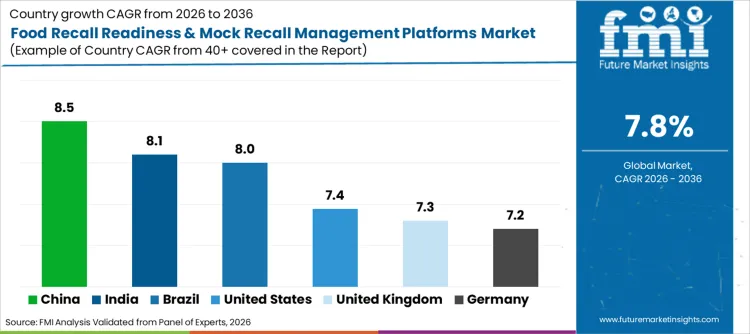
| Country | CAGR (2026 to 2036) |
|---|---|
| United States | 7.44% |
| China | 8.50% |
| Germany | 7.20% |
| India | 8.10% |
| Brazil | 8.00% |
| United Kingdom | 7.30% |
Source: Future Market Insights (FMI) analysis, based on proprietary forecasting model and primary research
Why Is the United States Enforcing Traceability at Scale?
The United States is expanding at a 7.44% CAGR due to mandatory compliance under FSMA Rule 204, which enforces end-to-end traceability for 14 high-risk food categories. Thousands of facilities are required to deploy digital recall readiness platforms, with annual compliance costs averaging USD 15,000 per site. Legal risk mitigation further accelerates adoption as insurers increasingly incentivize certified recall programs through premium reductions. Technology leadership anchored in Silicon Valley and agricultural research partnerships supports advanced platform capabilities, positioning the US as both the largest regulated market and a net exporter of recall management technology.
Why Is China Aligning Recall Readiness With Export Modernization?
China is growing at an 8.50% CAGR as food safety digitization becomes central to export eligibility and domestic e-commerce participation. Regulatory updates promoting digital labeling and electronic record-keeping are driving platform uptake across manufacturers. Large marketplaces such as Tmall and JD.com are enforcing stricter supplier traceability, pushing SMEs toward affordable compliance tools. Belt and Road trade integration further reinforces international traceability alignment, while operational efficiency gains from recall automation provide additional ROI beyond regulatory adherence.
Why Is Germany Institutionalizing Digital Recall Transparency?
Germany’s 7.20% CAGR reflects its role as Europe’s largest food exporter and a regulatory bellwether within the EU. National authorities increasingly emphasize real-time digital traceability and validated recall drills, driving platform adoption across food processors. Retailers such as Metro AG and REWE Group are mandating supplier-level digitization, accelerating ecosystem-wide uptake. Pharmaceutical-grade standards applied to infant nutrition and medical foods further support demand for premium recall management solutions aligned with export documentation requirements.
Why Is India Formalizing Recall Readiness Infrastructure?
India is expanding at an 8.10% CAGR, supported by the FSSAI’s digital compliance transformation covering licensing, audits, and reporting. Large retailers and branded food companies are implementing batch-level traceability across agricultural supply chains, normalizing platform usage among suppliers. Export growth in processed foods and spices, approaching USD 50 billion annually, requires international-standard recall readiness, particularly for EU-bound shipments. Government-led agricultural digitization is strengthening farm-to-fork data connectivity, reinforcing platform relevance across the value chain.
Why Is Brazil Leveraging Traceability for Export Continuity?
Brazil is growing at an 8.00% CAGR as ANVISA aligns national food safety rules with global standards to protect export access. Major agribusiness players are deploying blockchain-enabled traceability across livestock and grain systems, extending recall readiness beyond factories into primary production. Integration with precision agriculture and livestock monitoring improves contamination source identification and operational efficiency. With exports reaching over 180 countries, demand is strongest for platforms supporting multi-standard regulatory reporting within a single system.
Why Is the United Kingdom Rebuilding Digital Food Oversight Post-Brexit?
The United Kingdom is expanding at a 7.30% CAGR as post-Brexit regulatory autonomy drives modernization of food supply chain controls. Investment activity such as Buyers Edge Platform’s 2026 acquisition of NCB Foodservice highlights renewed momentum in digital procurement and traceability across foodservice operators. Sector recovery is reinforcing demand for platforms that improve risk management and supplier coordination. Complex post-Brexit trade relationships further elevate the value of systems capable of supporting multiple international reporting frameworks simultaneously.
What Strategic Moves Are Defining the Competitive Landscape?
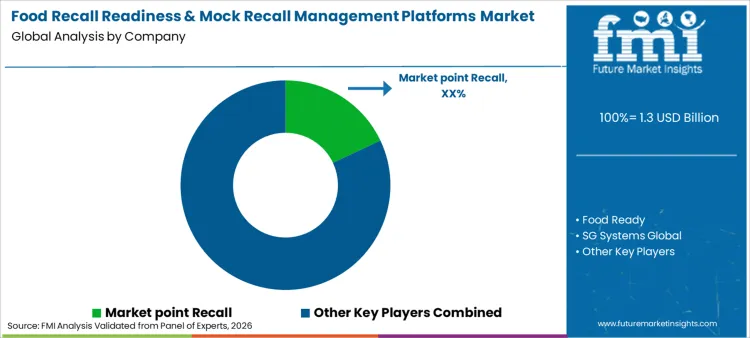
Market leaders pursue integration strategies combining software platforms with consulting services and training programs, creating comprehensive solution offerings that increase customer switching costs and recurring revenue streams. This approach transforms vendors from technology suppliers into strategic partners managing entire recall readiness programs.
Manufacturing partnerships with food processing equipment providers enable embedded recall management capabilities within production lines. These integrations provide real-time data capture and automated risk detection, creating competitive advantages through superior data quality and response speed compared to standalone solutions.
Strategic acquisitions focus on specialized capabilities including AI analytics, blockchain integration, and mobile applications. Companies recognize that comprehensive platform capabilities require expertise spanning multiple technology domains, driving consolidation as market leaders acquire specialized developers rather than building capabilities internally.
Andrew Woodward, Marketing Director for APAC at Hygiena, emphasized customer experience importance: 'This platform is not just about convenience; it's about delivering a better experience for our customers and ensuring they have what they need when they need it.'
Recent Developments:
- In October 2025, Marketpoint Recall launched its AI-powered cloud-based food recall platform designed to help brands manage incidents with speed, control and transparency.
- In June 2025, FoodReady announced significant upgrades to its AI-powered platform, introducing automated HACCP planning and enhanced inventory management with intelligent lot tracking.
- In February 2026, Buyers Edge Platform acquired NCB Foodservice to expand its European fresh network and digital procurement capabilities.
Key Players in Food Recall Readiness & Mock Recall Management Platforms Market
- Marketpoint Recall
- FoodReady
- SG Systems Global
- Buyers Edge Platform
- Hygiena
- TraceGains
- FoodLogiQ
- Recall InfoLink
- Mass Markets
- Blue Dot Solutions
- JustFood ERP
- SafetyChain Software
Market Definition
The Food Recall Readiness & Mock Recall Management Platforms Market comprises digital software solutions designed to help food manufacturers, processors, distributors, and retailers prepare for, execute, and document product recalls in compliance with food safety regulations. These platforms enable end-to-end traceability, batch and lot tracking, mock recall simulations, regulatory reporting, and audit documentation across complex food supply chains. They support proactive risk management by allowing companies to test recall response times, identify contamination sources, and verify supplier data before real incidents occur. The market includes cloud-based and on-premise platforms used to meet regulatory mandates such as FSMA, EU General Food Law, and export compliance requirements, while also supporting operational continuity, brand protection, and legal risk mitigation in the global food industry.
Market Inclusion
The market includes software platforms and integrated digital systems specifically designed for food recall preparedness, mock recall execution, and regulatory traceability management. Included are solutions offering batch-level tracking, supplier and ingredient traceability, recall simulation workflows, automated notification systems, compliance reporting, audit trails, and dashboard analytics. Platforms serving food manufacturers, beverage producers, agribusinesses, foodservice operators, retailers, and exporters are within scope. Also included are systems integrated with ERP, warehouse management, blockchain traceability, IoT sensors, and quality management tools when recall readiness is a core function. Subscription-based SaaS platforms, licensed enterprise software, and region-specific compliance solutions used for domestic and export food safety adherence are fully covered.
Market Exclusion
The market excludes generic enterprise software that does not provide dedicated recall readiness or mock recall functionality. Basic inventory management systems, standalone ERP modules, and logistics platforms without recall simulation, regulatory reporting, or traceability validation features are not included. Manual consulting services, training programs, and paper-based compliance documentation are excluded unless bundled with a proprietary digital recall management platform. Consumer-facing food safety apps, restaurant point-of-sale systems, and non-food recall software used in pharmaceuticals, automotive, or consumer electronics are outside scope. Hardware-only solutions such as scanners or sensors are excluded unless they are part of an integrated recall management software offering.
Scope of Report
| Items | Values |
|---|---|
| Quantitative Units | USD Billion |
| Market Category | Food Recall Readiness & Mock Recall Management Platforms |
| Solution Type Segments | Software Platforms; Consulting & Professional Services; Training & Education Services |
| Core Platform Functions | Recall readiness assessment; mock recall execution and validation; batch and lot traceability mapping; supplier and distributor data integration; automated incident response workflows; regulatory reporting and documentation; stakeholder communication management |
| Deployment Models | Cloud-based Solutions; On-premise Solutions; Hybrid Deployments |
| End User Segments | Food Manufacturers; Food Distributors; Retail Chains; Foodservice Operators |
| Regions Covered | North America; Europe; Asia Pacific; South America; Middle East; Africa |
| Key Countries Covered | United States; Germany; United Kingdom; China; Japan; India; Brazil; Canada; France; Italy |
| Key Companies Profiled | Marketpoint Recall; FoodReady; SG Systems Global; Buyers Edge Platform; Hygiena; TraceGains; FoodLogiQ; Recall InfoLink; SafetyChain Software; JustFood ERP |
| Additional Attributes | Dollar sales measured for recall readiness software, services, and training deployed to meet regulatory traceability and recall execution requirements; demand shaped by FSMA Rule 204 enforcement, EU traceability expansion, rising legal and reputational risk exposure, and increasing use of AI for preventive recall management; market evolution from reactive recall handling toward proactive, simulation-based risk management platforms |
Source: Future Market Insights (FMI) analysis, based on proprietary forecasting model and primary research
Food Recall Readiness & Mock Recall Management Platforms Market Categorised by Segments
By Solution Type:
- Software Platforms
- Consulting & Professional Services
- Training & Education Services
By Deployment Mode:
- Cloud-based Solutions
- On-premise Solutions
- Hybrid Deployments
By End User:
- Food Manufacturers
- Food Distributors
- Retail Chains
- Foodservice Operators
By Region:
- North America
- Europe
- Asia Pacific
- South America
- Middle East-Africa
Bibliography
- Buyers Edge Platform. (2026, February 2). Buyers Edge Platform Acquires NCB Foodservice, Expanding European Fresh Produce Capabilities. Buyers Edge Platform Press Room.
- USA Food and Drug Administration (FDA). (2025, December 10). FSMA Final Rule on Requirements for Additional Traceability Records for Certain Foods: Compliance Date Updates. FDA.gov.
- Food Standards Agency (UK). (2025, December 9). Food Standards Agency Annual Report and Accounts 2024/25. GOV.UK.
Frequently Asked Questions
How big is the global Food Recall Readiness & Mock Recall Management Platforms market?
The global Food Recall Readiness & Mock Recall Management Platforms market is valued at USD 1.3 billion in 2026 and is projected to reach USD 2.7 billion by 2036.
What is the growth outlook for the Food Recall Readiness & Mock Recall Management Platforms market over the next 10 years?
The market is expected to grow at a 7.8% CAGR from 2026 to 2036, driven by stricter food safety regulations and rising adoption of AI-enabled recall preparedness solutions.
Which product segments or formats drive demand in this market?
Demand is primarily driven by software platforms for recall readiness and mock recall execution, supported by consulting services and training programs for regulatory compliance.
How does consumer behavior differ by region?
Adoption is highest in Asia Pacific and North America due to strong regulatory enforcement and export-oriented food industries, while emerging regions show growing uptake aligned with compliance modernization.
What are the main risks and constraints affecting this market?
Key constraints include high implementation costs, integration challenges across complex supply chains, and organizational resistance to shifting from reactive to proactive recall management systems.
Preview the report firsthand - request a free sample
Get SampleGet the brochure for pricing and purchase details.
Get PDFTable of Content
- Executive Summary
- Global Market Outlook
- Demand-side Trends
- Supply-side Trends
- Technology Roadmap Analysis
- Analysis and Recommendations
- Market Coverage / Taxonomy
- Market Definition / Scope / Limitations
- Market Background
- Market Dynamics
- Drivers
- Restraints
- Opportunity
- Trends
- Scenario Forecast
- Demand in Optimistic Scenario
- Demand in Likely Scenario
- Demand in Conservative Scenario
- Opportunity Map Analysis
- Product Life Cycle Analysis
- Supply Chain Analysis
- Investment Feasibility Matrix
- Value Chain Analysis
- PESTLE and Porter’s Analysis
- Regulatory Landscape
- Regional Parent Market Outlook
- Production and Consumption Statistics
- Import and Export Statistics
- Market Dynamics
- Global Market Analysis 2021 to 2025 and Forecast, 2026 to 2036
- Historical Market Size Value (USD Million) Analysis, 2021 to 2025
- Current and Future Market Size Value (USD Million) Projections, 2026 to 2036
- Y-o-Y Growth Trend Analysis
- Absolute $ Opportunity Analysis
- Global Market Pricing Analysis 2021 to 2025 and Forecast 2026 to 2036
- Global Market Analysis 2021 to 2025 and Forecast 2026 to 2036, By Solution Type
- Introduction / Key Findings
- Historical Market Size Value (USD Million) Analysis By Solution Type , 2021 to 2025
- Current and Future Market Size Value (USD Million) Analysis and Forecast By Solution Type , 2026 to 2036
- Software Platforms
- Consulting & Professional Services
- Training & Education Services
- Software Platforms
- Y-o-Y Growth Trend Analysis By Solution Type , 2021 to 2025
- Absolute $ Opportunity Analysis By Solution Type , 2026 to 2036
- Global Market Analysis 2021 to 2025 and Forecast 2026 to 2036, By Region
- Introduction
- Historical Market Size Value (USD Million) Analysis By Region, 2021 to 2025
- Current Market Size Value (USD Million) Analysis and Forecast By Region, 2026 to 2036
- North America
- Latin America
- Western Europe
- Eastern Europe
- East Asia
- South Asia and Pacific
- Middle East & Africa
- Market Attractiveness Analysis By Region
- North America Market Analysis 2021 to 2025 and Forecast 2026 to 2036, By Country
- Historical Market Size Value (USD Million) Trend Analysis By Market Taxonomy, 2021 to 2025
- Market Size Value (USD Million) Forecast By Market Taxonomy, 2026 to 2036
- By Country
- USA
- Canada
- Mexico
- By Solution Type
- By Country
- Market Attractiveness Analysis
- By Country
- By Solution Type
- Key Takeaways
- Latin America Market Analysis 2021 to 2025 and Forecast 2026 to 2036, By Country
- Historical Market Size Value (USD Million) Trend Analysis By Market Taxonomy, 2021 to 2025
- Market Size Value (USD Million) Forecast By Market Taxonomy, 2026 to 2036
- By Country
- Brazil
- Chile
- Rest of Latin America
- By Solution Type
- By Country
- Market Attractiveness Analysis
- By Country
- By Solution Type
- Key Takeaways
- Western Europe Market Analysis 2021 to 2025 and Forecast 2026 to 2036, By Country
- Historical Market Size Value (USD Million) Trend Analysis By Market Taxonomy, 2021 to 2025
- Market Size Value (USD Million) Forecast By Market Taxonomy, 2026 to 2036
- By Country
- Germany
- UK
- Italy
- Spain
- France
- Nordic
- BENELUX
- Rest of Western Europe
- By Solution Type
- By Country
- Market Attractiveness Analysis
- By Country
- By Solution Type
- Key Takeaways
- Eastern Europe Market Analysis 2021 to 2025 and Forecast 2026 to 2036, By Country
- Historical Market Size Value (USD Million) Trend Analysis By Market Taxonomy, 2021 to 2025
- Market Size Value (USD Million) Forecast By Market Taxonomy, 2026 to 2036
- By Country
- Russia
- Poland
- Hungary
- Balkan & Baltic
- Rest of Eastern Europe
- By Solution Type
- By Country
- Market Attractiveness Analysis
- By Country
- By Solution Type
- Key Takeaways
- East Asia Market Analysis 2021 to 2025 and Forecast 2026 to 2036, By Country
- Historical Market Size Value (USD Million) Trend Analysis By Market Taxonomy, 2021 to 2025
- Market Size Value (USD Million) Forecast By Market Taxonomy, 2026 to 2036
- By Country
- China
- Japan
- South Korea
- By Solution Type
- By Country
- Market Attractiveness Analysis
- By Country
- By Solution Type
- Key Takeaways
- South Asia and Pacific Market Analysis 2021 to 2025 and Forecast 2026 to 2036, By Country
- Historical Market Size Value (USD Million) Trend Analysis By Market Taxonomy, 2021 to 2025
- Market Size Value (USD Million) Forecast By Market Taxonomy, 2026 to 2036
- By Country
- India
- ASEAN
- Australia & New Zealand
- Rest of South Asia and Pacific
- By Solution Type
- By Country
- Market Attractiveness Analysis
- By Country
- By Solution Type
- Key Takeaways
- Middle East & Africa Market Analysis 2021 to 2025 and Forecast 2026 to 2036, By Country
- Historical Market Size Value (USD Million) Trend Analysis By Market Taxonomy, 2021 to 2025
- Market Size Value (USD Million) Forecast By Market Taxonomy, 2026 to 2036
- By Country
- Kingdom of Saudi Arabia
- Other GCC Countries
- Turkiye
- South Africa
- Other African Union
- Rest of Middle East & Africa
- By Solution Type
- By Country
- Market Attractiveness Analysis
- By Country
- By Solution Type
- Key Takeaways
- Key Countries Market Analysis
- USA
- Pricing Analysis
- Market Share Analysis, 2025
- By Solution Type
- Canada
- Pricing Analysis
- Market Share Analysis, 2025
- By Solution Type
- Mexico
- Pricing Analysis
- Market Share Analysis, 2025
- By Solution Type
- Brazil
- Pricing Analysis
- Market Share Analysis, 2025
- By Solution Type
- Chile
- Pricing Analysis
- Market Share Analysis, 2025
- By Solution Type
- Germany
- Pricing Analysis
- Market Share Analysis, 2025
- By Solution Type
- UK
- Pricing Analysis
- Market Share Analysis, 2025
- By Solution Type
- Italy
- Pricing Analysis
- Market Share Analysis, 2025
- By Solution Type
- Spain
- Pricing Analysis
- Market Share Analysis, 2025
- By Solution Type
- France
- Pricing Analysis
- Market Share Analysis, 2025
- By Solution Type
- India
- Pricing Analysis
- Market Share Analysis, 2025
- By Solution Type
- ASEAN
- Pricing Analysis
- Market Share Analysis, 2025
- By Solution Type
- Australia & New Zealand
- Pricing Analysis
- Market Share Analysis, 2025
- By Solution Type
- China
- Pricing Analysis
- Market Share Analysis, 2025
- By Solution Type
- Japan
- Pricing Analysis
- Market Share Analysis, 2025
- By Solution Type
- South Korea
- Pricing Analysis
- Market Share Analysis, 2025
- By Solution Type
- Russia
- Pricing Analysis
- Market Share Analysis, 2025
- By Solution Type
- Poland
- Pricing Analysis
- Market Share Analysis, 2025
- By Solution Type
- Hungary
- Pricing Analysis
- Market Share Analysis, 2025
- By Solution Type
- Kingdom of Saudi Arabia
- Pricing Analysis
- Market Share Analysis, 2025
- By Solution Type
- Turkiye
- Pricing Analysis
- Market Share Analysis, 2025
- By Solution Type
- South Africa
- Pricing Analysis
- Market Share Analysis, 2025
- By Solution Type
- USA
- Market Structure Analysis
- Competition Dashboard
- Competition Benchmarking
- Market Share Analysis of Top Players
- By Regional
- By Solution Type
- Competition Analysis
- Competition Deep Dive
- Market point Recall
- Overview
- Product Portfolio
- Profitability by Market Segments (Product/Age /Sales Channel/Region)
- Sales Footprint
- Strategy Overview
- Marketing Strategy
- Product Strategy
- Channel Strategy
- Food Ready
- SG Systems Global
- Buyers Edge Platform
- Hygiena
- Trace Gains
- FoodLogiQ
- Recall InfoLink
- Mass Markets
- Blue Dot Solutions
- Just Food ERP
- Safety Chain Software
- Market point Recall
- Competition Deep Dive
- Assumptions & Acronyms Used
- Research Methodology


