

- Market Size (2026)
- USD 3.5 Bn
- Forecast (2036)
- USD 6.0 Bn
- CAGR (2026 to 2036)
- 5.6%
How big is Foodservice Sandwich Carriers Market in 2026?
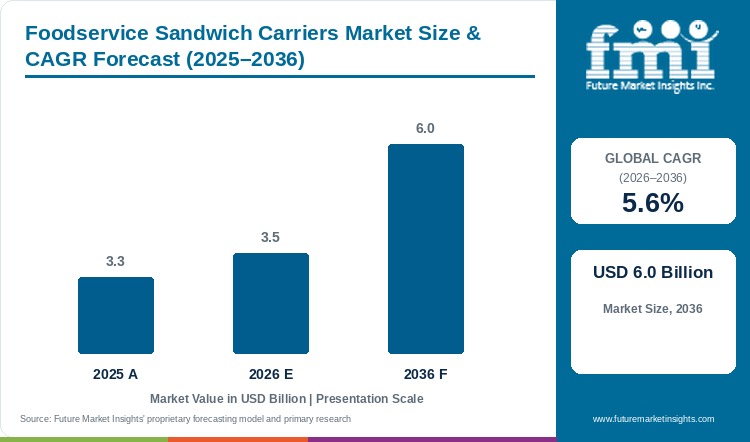
With a valuation of USD 3.3 billion in 2025 and moving to USD 3.5 billion in 2026, the global foodservice sandwich carriers market is positioned to attain USD 6.0 billion by 2036, exhibiting a CAGR of 5.6%.
Consumer dining habits have shifted permanently toward drive-thru lanes and third-party delivery apps, creating a technical problem for restaurant operators, because ordinary soft bread turns soggy when trapped inside steamed delivery containers for twenty to thirty minutes. When a sandwich bun collapses under hot meat juices or sauces during transit, order refund claims rise and repeat guest orders drop. In fact, Off-Premises Restaurant Trends data released by the National Restaurant Association in April 2025 confirmed that 47% of adults in the USA pick up takeout at least weekly while 42% use drive-thru lanes and 37% order delivery each week [1]. Because off-premises orders now govern commercial kitchen procurement, global foodservice sandwich carriers market value climbs from a 2025 level of USD 3.3 billion to reach USD 3.5 billion in 2026 and hits USD 6.0 billion by 2036 at a 5.6% CAGR (adding USD 2.5 billion in market value). Within the product type segment, 2026 projections assign 42.8% of wholesale orders to burger buns & sandwich rolls as restaurant chains pair moisture-resistant glazed buns with par-baked bread formats to protect sandwich quality in transit.
Key Market Trends & Insights
- By product type: Standardized contact-toaster clearance across burger and hot-chicken chains puts burger buns & sandwich rolls at a projected 42.8% share in 2026.
- By claim / nature: Predictable dough extensibility and lower case cost in institutional catering give conventional commercial formulations an anticipated 56.2% share in 2026.
- By format: Operator efforts to cut daily staling waste across dispersed café sites place par-baked / thaw-and-serve items at a forecast 38.6% share in 2026.
- By packaging format: Corrugated master cartons and poly-lined trays that speed commissary unloading allow bulk foodservice cases & trays to reach an expected 51.4% share in 2026.
- By sales channel: Consolidated cold-chain drops to multi-site restaurant operators keep foodservice distributors & QSR contracts ahead with an estimated 44.6% share in 2026.
Regional Highlights
- Gulf hospitality acceleration: Rapid quick-service restaurant licensing puts the UAE at the top of the country growth table at 6.5% annually through 2036, ahead of Saudi Arabia at 6.2%.
- Major foodservice economies: Drive-thru scale lifts the USA by 5.8% CAGR over South Korea (5.5%) and the UK (5.2%), whereas France (4.9%) and Japan (4.6%) outpace Germany (4.2%).
Market Size & Forecast
Table 1: Market Size and Forecast for the Foodservice Sandwich Carriers Market (USD billion and CAGR percentage), 2025 to 2036
| Metric | Value |
|---|---|
| 2025 Market Size | USD 3.3 billion |
| Estimated Market Size in 2026 | USD 3.5 billion |
| Projected Market Size by 2036 | USD 6.0 billion |
| CAGR, 2026 to 2036 | 5.6% |
| Added Revenue, 2026 to 2036 | USD 2.5 billion |
Higher back-of-house kitchen wages and tight store-level operating margins are changing how commercial restaurants procure bread and rolls. Scratch-baking or proofing raw dough inside individual restaurant locations requires skilled early-morning bakers and dedicated deck ovens, which most multi-site operators can no longer afford. For instance, State of the Restaurant Industry projections published by the National Restaurant Association in February 2026 placed total restaurant sales in the USA at USD 1.55 trillion across 15.8 million employees, yet noted only 1.3% real inflation-adjusted growth due to high labor and food costs [2]. To protect store profitability without hiring baking staff, chain purchasing directors are shifting procurement toward pre-sliced commercial frozen bakery buns and flatbread wraps that kitchen crews can thaw or toast in seconds.
Commercial Kitchen Carrier Throughput and Case Yield Sizing
Table 2: Commercial Kitchen Throughput and Case Yield Sizing for the Foodservice Sandwich Carriers Market (USD billion and operational ranges), 2025 to 2036
| Metric | 2025 | 2026 | 2036 |
|---|---|---|---|
| Market size (USD billion) | 3.3 | 3.5 | 6.0 |
| Commercial sandwich carrier units shipped (billion pieces) | 24.8 to 27.6 | 26.1 to 29.0 | 43.2 to 48.0 |
| Foodservice master cases delivered (million cases) | 345.0 to 385.0 | 362.0 to 405.0 | 600.0 to 670.0 |
| Average wholesale realization per carrier piece (USD) | 0.12 to 0.14 | 0.12 to 0.14 | 0.13 to 0.15 |
Operational note: Piece and case ranges reconcile commercial bakery wholesale case pricing between USD 8.60 and USD 10.40 per 72-count bun carton against institutional sandwich assembly volumes across quick-service and travel catering accounts.
Shipping 26.1 to 29.0 billion sandwich carrier pieces in 2026 at an average wholesale realization of USD 0.12 to USD 0.14 per piece requires strict dimensional consistency on the baking line. Quick-service burger kitchens run vertical contact toasters calibrated to caramelize a bun crown and heel in 11 to 17 seconds, meaning any slice variation beyond plus or minus 1.5 millimeters causes either burnt edges or cold centers. When uneven slicing jams a high-speed make-line during peak lunch hours, drive-thru service times stall and operators switch suppliers. To prevent line stops, industrial bakeries invest in ultrasonic slicing lines and supply potato bread and rolls with uniform crumb spring across regional commissaries.
Per Capita & Foodservice Outlet Expenditure Sizing
Table 3: Per Capita and Outlet Valuation Indicators for the Foodservice Sandwich Carriers Market (USD), 2025 to 2036
| Metric | 2025 | 2026 | 2036 |
|---|---|---|---|
| World population (billion) | 8.2 | 8.3 | 9.0 |
| Market value per 1,000 people (USD) | 402.7 | 420.1 | 668.1 |
| Annual carrier procurement per QSR / sandwich outlet (USD) | 2,650 to 3,120 | 2,760 to 3,250 | 4,180 to 4,920 |
| Frozen & par-baked share of commercial carrier shipments (%) | 56.0% to 60.0% | 57.5% to 61.5% | 64.0% to 68.5% |
Table 4: Outlet & Channel Allocation Indicators for the Foodservice Sandwich Carriers Market (USD and percentages), 2026
| Metric | Value | Institutional Reference Basis |
|---|---|---|
| Market size, 2026 | USD 3.5 billion | 2026 global B2B sandwich carrier baseline |
| Commercial sandwich-serving outlets globally | 1.18 million outlets | Global QSR, café & institutional kitchen registry |
| Burger buns & sandwich rolls share, 2026 | 42.8% (USD 1.5 billion allocation) | 42.8% product type segment allocation |
| Bulk foodservice cases & trays share, 2026 | 51.4% (USD 1.8 billion allocation) | 51.4% packaging format segment allocation |
Frozen and par-baked carrier share is projected to rise from a 2026 range of 57.5% to 61.5% toward 64.0% to 68.5% by 2036 because restaurant chains prioritize cutting unsold bread waste. Across 1.18 million sandwich-serving outlets spending USD 2,760 to USD 3,250 per store in 2026, fresh direct-store-delivery loaves often suffer 7% to 9% staling write-offs when rain or slow mid-week footfall reduces guest traffic. Lower back-of-house bread shrink from 8% to below 3% directly improves operator EBITDA across multi-site sandwich chains. To capture those savings, kitchen purchasing teams combine ambient and frozen tortilla bread wraps with slack-thawed brioche buns so staff only pull what each shift requires.
Analyst Perspective
"Foodservice buyers judge a sandwich carrier by how well its crumb structure holds hot proteins and high-moisture sauces after twenty minutes in a delivery bag. Industrial bakers that combine tight slice-thickness tolerances with zero-shrink thaw-and-serve logistics win multi-year QSR supply contracts."
- Nandini Roy Choudhury, Principal Consultant, Future Market Insights.
How is the foodservice sandwich carriers market segmented?
The foodservice sandwich carriers market is segmented by product type, claim / nature, format, packaging format, and sales channel. In 2026, burger buns & sandwich rolls are projected at 42.8%, conventional commercial at 56.2%, par-baked / thaw-and-serve at 38.6%, bulk foodservice cases & trays at 51.4%, and foodservice distributors & QSR contracts at 44.6%.
By product type: Burger buns & sandwich rolls, tortillas & flatbread wraps, sub & baguette rolls, sliced pullman & panini loaves, and brioche & pretzel carriers.
By claim / nature: Conventional commercial recipes, clean-label & preservative-free doughs, whole-grain & seeded carriers, gluten-free & allergen-segregated bases, and certified organic items.
By format: Par-baked / thaw-and-serve units, fresh direct-store-delivery loaves, frozen fully baked carriers, shelf-stable catering wraps, and refrigerated unbaked dough discs.
By packaging format: Bulk foodservice cases & trays, pillow-pack poly sleeves, gas-flushed catering bags, and twin-pack portion wraps.
By sales channel: Foodservice distributors & QSR contracts, supermarket deli & food-to-go counters, travel plaza & forecourt kiosks, independent specialty bakeries, and digital B2B procurement portals.
Why do Burger Buns & Sandwich Rolls set the product type segment baseline?
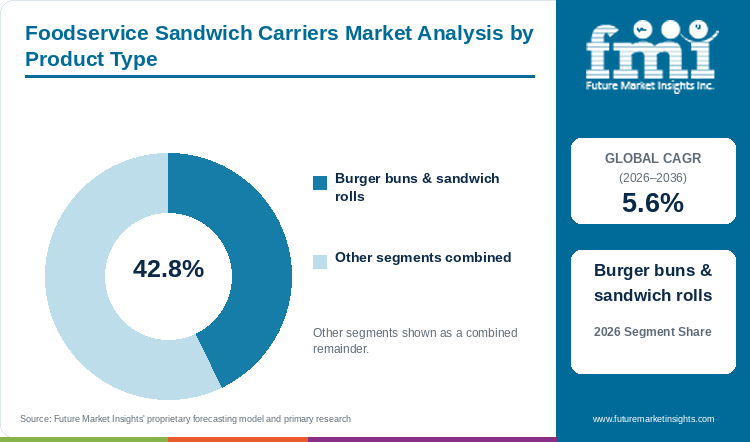
In 2026, burger buns & sandwich rolls are projected to capture 42.8% of the product type segment because QSR chains standardize griddle and toaster assembly around round buns.
Table 5: Product Type Share for the Foodservice Sandwich Carriers Market (percentage share), 2026
| Product Type | Share (2026) |
|---|---|
| Burger buns & sandwich rolls | 42.8% |
| Other Segments Combined* | 57.2% |
| Total | 100.0% |
*Calculated as the balance remaining after deducting the leading segment's reported share from 100.0%.
Table 6: Product Type Leadership and Market Growth for the Foodservice Sandwich Carriers Market (segment and CAGR percentage), 2026 to 2036
| Metric | Value |
|---|---|
| Global CAGR (2026 to 2036) | 5.6% |
| Leading Segment | Burger buns & sandwich rolls |
Menu complexity is a major operational risk for high-volume quick-service kitchens because stocking too many bread shapes slows down assembly crews and clutters freezer racks. A single 4-inch or 4.5-inch round bun or hinged sandwich roll can carry beef patties and crispy chicken fillets or breakfast egg builds without changing contact-toaster belt clearances. Multi-unit restaurant chains therefore consolidate base volume around high-speed hamburger bun contracts while rotating glazed brioche buns for high-margin promotional builds.
- Because one round bun SKU supports multiple breakfast and lunch menu builds, burger buns & sandwich rolls are projected to command 42.8% of the product type segment in 2026.
- For instance, ARYZTA AG announced in its January 2026 investor ad hoc release that it achieved its full-year 2025 targets and committed EUR 40 million to construct a dedicated bun bakery in Portugal to serve quick-service restaurant demand [3].
What supports Conventional Commercial within the claim / nature segment?
Within the claim / nature segment, conventional commercial formulations are anticipated at 56.2% in 2026 since institutional kitchens prioritize consistent dough conditioning.
Hospital cafeterias and school meal programs as well as value drive-thru chains operate under strict per-plate food cost ceilings that leave little room for organic or specialty claim surcharges. In addition to higher flour costs, switching a commercial kitchen to allergen-free or gluten-free carriers introduces cross-contact liability at shared prep tables and toaster platens. Conventional commercial doughs conditioned with standard enzymes and emulsifiers hold their crown loft under heated holding lamps, while specialty bake-off facilities use gluten-free flours in separately sealed packaging for sensitive guests.
- Conventional commercial carriers are anticipated to make up 56.2% within the claim / nature segment in 2026 since high-volume kitchens prioritize low case costs and rapid prep handling.
- As a matter of fact, European Commission rules under Regulation (EU) No 1169/2011 updated in January 2025 require strict allergen disclosure across both prepacked and non-prepacked mass-catering foods, which raises back-of-house segregation costs for specialty allergen claims [4].
Why does Par-Baked / Thaw-and-Serve lead the format segment?
On-demand kitchen finishing gives par-baked / thaw-and-serve carriers a forecast 38.6% share of the format segment in 2026.
Daily footfall across highway travel plazas and urban coffee shops fluctuates sharply with weather and commuter schedules, making fixed daily fresh-bread deliveries prone to either noon stockouts or evening waste. Par-baked artisan rolls and frozen thaw-and-serve buns solve this inventory mismatch by letting kitchen staff pull exact tray counts from the freezer and flash-bake a crisp crust in four to six minutes. This operational flexibility is driving foodservice distributors to expand par-baked roll assortments with upstream commercial frozen dough programs.
- Within the format segment, par-baked / thaw-and-serve units are forecast to hold 38.6% in 2026 as kitchen managers bake small tray batches to eliminate evening staling write-offs.
- To capitalize on this HoReCa shift, Vandemoortele acquired frozen bakery specialist Lizzi Srl in February 2025 across four production plants in northern Italy with turnover above EUR 70 million, expanding par-baked sourdough and focaccia carrier supply [5].
How do Bulk Foodservice Cases & Trays anchor the packaging format segment?
In 2026, bulk foodservice cases & trays are expected to represent 51.4% of packaging format demand where high-speed make-lines require rapid tray unloading.
During a peak lunch rush where a quick-service crew assembles 150 to 250 sandwiches per hour, tearing open retail-style 6-pack or 8-pack bags wastes kitchen labor and fills prep-area trash bins with film waste. Bulk corrugated master cartons lined with food-grade polyethylene bags and nestable plastic bread trays allow line cooks to slide entire 30-count or 36-count bun layers directly onto toaster feed tables. These bulk case formats also protect soft bun crowns from crushing during palletized cold-chain transit and pair with high-protein lentil bread loaves in institutional catering.
- Bulk foodservice cases & trays are expected to generate 51.4% of packaging format shipments in 2026 by lowering carton material cost per bun and speeding up prep-table staging.
- For instance, January 2026 foodservice specifications from Lantmannen Unibake show that its Euro-Bake brioche and ciabatta sandwich carriers as well as pretzel buns are shipped in bulk poly-lined foodservice cases engineered for rapid kitchen staging in the USA [6].
What keeps Foodservice Distributors & QSR Contracts ahead in the sales channel segment?
Multi-temperature fleet consolidation gives foodservice distributors & QSR contracts an estimated 44.6% share of the sales channel segment in 2026.
Multi-site restaurant operators rarely buy bread separately from independent local bakeries because uncoordinated store deliveries create receiving bottlenecks at narrow back-alley loading docks. Instead, national burger and sandwich chains lock in annual pricing and specification tolerances through contracted broadline foodservice distributors that deliver frozen buns and proteins on a single multi-temperature truck drop. This consolidated procurement model favors large multinational bake-off groups capable of supplying hundreds of regional distribution depots simultaneously.
- Within the sales channel segment, foodservice distributors & QSR contracts are estimated to hold 44.6% in 2026 through contracted volume commitments and audited on-time delivery standards.
- Reflecting this scale requirement, Vandemoortele confirmed in January 2026 that it completed its acquisition of Délifrance at the end of December 2025 following European Commission and UK CMA clearance, uniting 6,000 associates across 41 production sites in Europe and the USA as well as Asia with EUR 2.2 billion in turnover [7].
What are the drivers, restraints, and opportunities in the foodservice sandwich carriers market?
Expansion of drive-thru and delivery meal occasions fuels standardized carrier demand, whereas starch retrogradation and PPDS allergen rules raise kitchen compliance costs and bio-preserved par-baked carriers create waste-reduction opportunities.
- Driver: High-frequency takeaway and third-party courier orders require structural bread carriers that retain bite softness and hold wet fillings during transit.
- Restraint: Rapid starch retrogradation under chilled storage and mandatory prepacked-for-direct-sale allergen labeling increase kitchen shrink and administrative overhead.
- Opportunity: Co-fermented sourdough and active modified-atmosphere par-baked carriers extend mold-free ambient holding life without synthetic propionate preservatives.
Growth Analysis and Future Potential: Off-Premises Structural Resilience
Fast-casual and quick-service chains building higher-margin gourmet burgers and hot panini face a recurring product failure: standard high-yeast white buns lose crumb elasticity and tear when exposed to hot grease and steam inside closed delivery boxes. Rather than accepting soggy bread complaints on delivery apps, culinary procurement teams are switching to compound sourdough and enzyme-fortified carriers that reinforce gluten network elasticity and delay staling. As a matter of fact, a May 2026 study from Jiangnan University in Journal of Food Science mapped a 5% to 50% operational inclusion window for co-fermented Fructilactobacillus sanfranciscensis and Propionibacterium freudenreichii compound sourdough, proving that a 20% addition boosted loaf specific volume by 17% and delayed visible mold until Day 9 [8]. Commercial bakeries are therefore pairing resilient crumb engineering with sourdough ingredients to win national delivery-chain tenders.
Risk Assessment of the Foodservice Sandwich Carriers Market: Staling Shrink and Allergen Governance
Two operational pressures restrain margin expansion for commercial sandwich outlets: rapid amylopectin starch retrogradation under chilled display and strict on-site allergen labeling rules. Fresh buns held in ambient kitchen racks begin firming within 48 to 72 hours, while grab-and-go sandwich counters face heavy regulatory penalties if sesame or wheat allergens are mislabeled on store-wrapped items. For instance, under the UK Food Standards Agency's Prepacked for Direct Sale (PPDS) allergen guidance updated in July 2026, every sandwich or bakery item packed on-site before a customer selects it must carry a printed label showing the food name and a full ingredients list with all 14 statutory allergens emphasized [9]. Because manual kitchen labeling slows down prep staff and creates audit liability, café operators restrict SKU counts to suppliers that provide automated digital ingredient feeds and sesame-segregated baking lines.
Commercial Opportunity Analysis: Clean-Label Bio-Preservation and MAP Bag-in-Bag Systems
Restaurant chains removing artificial calcium propionate and potassium sorbate from clean-label menus still need multi-week ambient holding life across regional distribution depots. This clean-label shelf-life gap is creating a major commercial opportunity for bakeries that combine natural sourdough bio-preservation with active modified-atmosphere packaging. To put this in perspective, a December 2025 University of Pisa study published in Foods demonstrated that packaging PDO Tuscan sourdough bread inside a compostable polylactic acid inner bag enclosed within a carbon-dioxide modified-atmosphere outer bag treated with natural monoterpene and phenolic extracts extended mold-free shelf life from 6 days in air to 41 days [10]. Industrial bakers are integrating these bag-in-bag packaging systems with sourdough flavor systems so foodservice operators can store clean-label carriers for weeks without freezer energy costs.
Foodservice Sandwich Carriers Market by Country (2026 to 2036)
Out-of-home dining expansion and commercial kitchen procurement trends place the UAE first with 6.5% CAGR expansion over 2026 to 2036 followed by Saudi Arabia (6.2%) and the USA (5.8%), while Germany records 4.2% yearly growth. Country-level performance reflects differences in new restaurant licensing velocity and digital meal-delivery penetration across hospitality channels.
Table 7: Country CAGR and Primary Growth Levers for the Foodservice Sandwich Carriers Market (CAGR percentage and operational drivers), 2026 to 2036
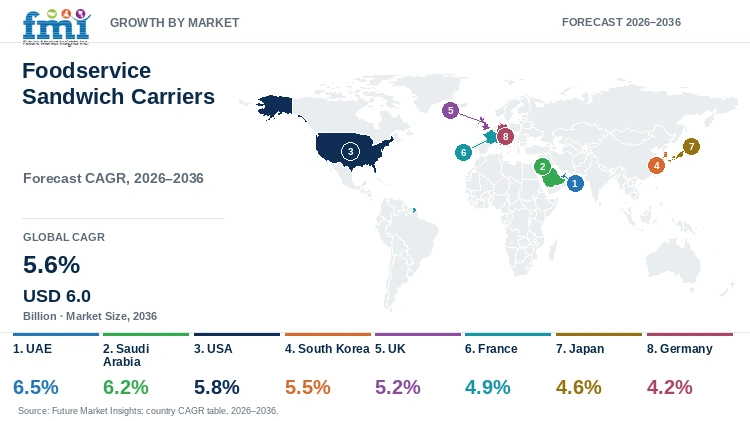
| Country | CAGR (2026 to 2036) | Primary Growth Lever |
|---|---|---|
| UAE | 6.5% | 19.59 million Dubai overnight visitors and rapid new foodservice outlet licensing |
| Saudi Arabia | 6.2% | Saudi Public Health Authority bakery profiling and expanding QSR franchise networks |
| USA | 5.8% | USD 1.55 trillion restaurant sector scale and dominant drive-thru bun throughput |
| South Korea | 5.5% | Rapid mobile food-delivery app expansion requiring transit-resilient buns |
| UK | 5.2% | Mature high-street food-to-go sandwich counters and PPDS allergen standardization |
| France | 4.9% | 418,000 out-of-home dining sites upgrading to par-baked baguette and artisan rolls |
| Japan | 4.6% | Sourdough aroma-retention advances and precision convenience-store sandwich supply |
| Germany | 4.2% | Craft bakery consolidation accelerating waste-reducing frozen bake-off rolls |
Source: Future Market Insights analysis
UAE Foodservice Sandwich Carriers Market Outlook (2026 to 2036)
Wholesale sandwich carrier turnover in the UAE is projected to post a 6.5% compound annual growth rate over 2026 to 2036, driven by new hotel banqueting kitchens and quick-service burger franchises. Unlike mature Western dining markets, demand in the UAE is propelled by surging international visitor arrivals and rapid new restaurant licensing across Dubai and Abu Dhabi. For instance, data released by the Dubai Department of Economy and Tourism in February 2026 documented a third consecutive record of 19.59 million international overnight visitors in 2025 across 154,264 hotel rooms operating at 80.7% average occupancy [11]. Because extreme summer heat accelerates crumb staling during urban delivery, Gulf hospitality buyers rely on frozen par-baked artisan rolls and climate-controlled case drops.
Key takeaway: In the UAE, record inbound tourism and rapid quick-service restaurant openings are projected to deliver 6.5% compound annual growth through 2036.
Saudi Arabia Foodservice Sandwich Carriers Market Outlook (2026 to 2036)
Rapid franchise expansion of international burger and fried-chicken chains alongside Red Sea and Riyadh hospitality projects is transforming commercial bread procurement across Saudi Arabia. Wholesale expenditure on foodservice sandwich carriers in Saudi Arabia is estimated to post a 6.2% annual expansion rate between 2026 and 2036, supported by institutional catering and QSR chain contracts. At the same time, nutritional scrutiny is tightening: a May 2025 Nutrients evaluation of 6,940 retail foods in Saudi Arabia by World Bank and national public health specialists showed that baked goods generate 26% of food sales yet require sodium and fat reformulation [12]. Industrial commissaries in Saudi Arabia are therefore supplying lower-sodium hinge-sliced burger buns and high-fiber flatbread wraps.
Key takeaway: In Saudi Arabia, expanding hospitality facilities and QSR franchise networks are estimated to generate 6.2% yearly expansion through 2036.
USA Foodservice Sandwich Carriers Market Outlook (2026 to 2036)
What distinguishes the USA from other national markets is the sheer volume of drive-thru burger and chicken sandwich transactions where operators use specialty bread carriers to justify higher combo-meal prices. To serve this multi-region chain demand, Alpha Baking Company distributes more than 260 fresh and frozen foodservice bread and bun SKUs in the USA, ranging from split-top potato buns to hinged sub rolls [13]. Commercial carrier demand across the USA is forecast to log a 5.8% annual growth pace from 2026 to 2036 because restaurant chains rotate brioche and pretzel buns with sourdough rolls across limited-time menus. Persistent back-of-house labor shortages in the USA also keep chain buyers locked into pre-sliced, toaster-calibrated bulk cases.
Key takeaway: In the USA, drive-thru burger and sub chain procurement of pre-sliced specialty buns is forecast to generate a 5.8% CAGR.
South Korea Foodservice Sandwich Carriers Market Outlook (2026 to 2036)
In South Korea, commercial sandwich carrier specifications are dictated by intense mobile food-delivery competition and specialty breakfast-toast franchises rather than traditional dine-in cafeterias. According to a March 2026 study published in Foods, the food delivery app sector in South Korea is expanding at roughly 8% annually toward USD 7.0 billion by 2035, with packaging hygiene and intact food arrival directly governing customer trust [14]. Because steam trapped inside insulated courier pouches turns standard white bread soggy within fifteen minutes, burger and egg-toast chains in South Korea demand egg-glazed brioche buns and enzyme-strengthened thick toast loaves. Wholesale shipments of foodservice sandwich carriers in South Korea are anticipated to register a 5.5% yearly gain from 2026 to 2036, owing to delivery-focused menu engineering.
Key takeaway: In South Korea, surging mobile food-delivery volume is anticipated to propel 5.5% annual growth for moisture-resistant burger buns and toast loaves.
UK Foodservice Sandwich Carriers Market Outlook (2026 to 2036)
Foodservice expenditure on separately sold sandwich carriers in the UK is expected to achieve a 5.2% yearly growth rate from 2026 to 2036, enabled by year-round demand for malted-grain sliced loaves and tortilla wraps across high-street coffee shops. Unlike markets centered on hot griddle burgers, a large share of carrier volume in the UK goes into cold-assembled lunchtime meal deals sold in commuter cafés and forecourts. Demonstrating this channel consolidation, chilled prepared-food manufacturer The Compleat Food Group in the UK acquired Freshpak in July 2025 across a 40,000-square-meter facility in Barnsley, lifting group turnover above GBP 1.3 billion across retail and foodservice food-to-go accounts [15]. Bakers in the UK must therefore engineer loaves that resist starch firming at 4-degree-Celsius chiller temperatures.
Key takeaway: In the UK, commuter meal-deal sandwich assembly and chilled food-to-go counter expansion are expected to yield 5.2% yearly growth through 2036.
France Foodservice Sandwich Carriers Market Outlook (2026 to 2036)
Out-of-home lunch demand in France is split between traditional jambon-beurre baguette counters and fast-growing gourmet burger and taco chains, forcing suppliers to deliver both crisp hearth crusts and soft burger buns. As a matter of fact, a July 2026 industry assessment by FranceAgriMer and GIRA Foodservice-Circana valued out-of-home dining turnover in France at EUR 100 billion across 418,000 establishments serving 7.4 billion annual meals, with commercial restaurants capturing 71% of revenue and bakery snacking counters holding 15% [16]. Wholesale volume for foodservice sandwich carriers in France is projected to record a 4.9% yearly expansion rate from 2026 to 2036, attributable to fast-casual chains adopting stone-oven par-baked demi-baguettes and laminated croissant carriers that bake off in four minutes.
Key takeaway: In France, culinary demand for stone-baked demi-baguettes and artisan burger buns across 418,000 out-of-home dining sites is projected to drive a 4.9% CAGR.
Japan Foodservice Sandwich Carriers Market Outlook (2026 to 2036)
Precision portioning across railway station kiosks and convenience-store commissaries sets commercial sandwich carrier specifications in Japan apart from Western burger-bun markets. Wholesale demand for foodservice sandwich carriers in Japan is forecast to advance 4.6% annually over the ten-year horizon through 2036, reinforced by chilled grab-and-go sandwich sales across urban transit hubs. Because commissaries in Japan require crustless shokupan pullman loaves to stay pillowy and aromatic across a 72-hour chilled shelf life without synthetic additives, bakers are adopting biological fermentation. Confirming this benefit, a February 2026 University of Tokyo study in Foods tracking 760 volatiles across a 3-day bread shelf life in Japan proved that lactic acid bacteria sourdough fermentation suppresses lipid oxidation marker 9,17-octadecadienal [17].
Key takeaway: In Japan, sourdough shelf-life advances and strict convenience-store crumb-softness standards are forecast to underpin a 4.6% CAGR through 2036.
Germany Foodservice Sandwich Carriers Market Outlook (2026 to 2036)
In Germany, structural consolidation among traditional craft bakeries and shortage of night-shift bakers are forcing café branches and workplace canteens to procure centrally manufactured par-baked rolls. According to January 2026 statistics from the Bakers' Confederation in Germany (Zentralverband des Deutschen Baeckerhandwerks), total craft bakery turnover reached EUR 18.14 billion in 2025 (+1.3%) across 43,500 sales outlets even as the number of operating bakery enterprises fell to 8,659 [18]. Larger multi-branch chains therefore rely on frozen par-baked Brötchen and lye pretzel rolls that store staff finish in deck ovens throughout the day to eliminate evening waste. Expenditure on foodservice sandwich carriers in Germany is slated to grow at a 4.2% yearly pace from 2026 to 2036 since multi-branch caterers standardize bake-off procurement.
Key takeaway: In Germany, multi-branch bakery consolidation is slated to accelerate operator conversion toward zero-shrink par-baked Brötchen and pretzel carriers at a 4.2% CAGR.
Full report country CAGRs cover: North America; Latin America; Western Europe; Eastern Europe; East Asia; South Asia and Pacific; Middle East and Africa.
Who are the notable companies in the foodservice sandwich carriers market?
Aryzta, Vandemoortele, Lantmannen Unibake, Grupo Bimbo, Flowers Foods, Alpha Baking Company, Goya Foods, and Wewalka are the notable companies in the foodservice sandwich carriers market.
Supplier competition in the foodservice sandwich carriers market divides between multinational frozen bake-off specialists and high-speed QSR bun bakeries. Global bake-off leaders operate automated par-baked roll and artisan baguette lines serving European and Asia-Pacific restaurant chains, while North American commercial bakeries combine fresh direct-store-delivery routes with frozen foodservice case distribution.
- Global Frozen Bake-Off & Par-Baked Roll Platforms: Aryzta and Vandemoortele as well as Lantmannen Unibake manufacture par-baked artisan rolls and thaw-and-serve burger buns for QSR and HoReCa accounts.
- Dedicated QSR Bun & Commercial Foodservice Bakeries: Grupo Bimbo and Flowers Foods along with Alpha Baking Company supply high-speed hamburger buns and split-top sub rolls across restaurant and institutional channels.
- Unfilled Pastry, Flatbread & Assembly-Dough Specialists: Goya Foods and Wewalka provide frozen empanada baking discs and refrigerated puff-pastry dough bases that commercial kitchens fill and bake on-site.
Competitive Benchmarking: Foodservice Sandwich Carriers Market
Table 8: Competitive Benchmarking for the Foodservice Sandwich Carriers Market (qualitative capability ratings), 2026
| Company | Unfilled Carrier Portfolio Breadth | Par-Baked & Freeze-Thaw Engineering | QSR & Distributor Route-to-Market | Geographic Reach |
|---|---|---|---|---|
| Aryzta | High | High | High | High |
| Vandemoortele | High | High | High | High |
| Lantmannen Unibake | High | High | High | High |
| Grupo Bimbo | High | High | High | High |
| Flowers Foods | High | Medium | High | Medium |
| Alpha Baking Company | High | High | High | Medium |
| Goya Foods | Medium | Medium | Medium | High |
| Wewalka | Medium | High | Medium | High |
Scoring basis: Capability tiers assess documented unfilled bun and dough-carrier SKU breadth coupled with par-baked and freeze-thaw tolerance engineering. Channel access and regional footprint scores evaluate verified QSR chain supply contracts and multi-region baking plants.
Key Developments in the Foodservice Sandwich Carriers Market
- Vandemoortele and Délifrance announced their binding combination in March 2025 to unite complementary frozen bakery portfolios and expand bake-off bread and savory carrier solutions across 100 countries [19].
- Vandemoortele reported in September 2026 that it achieved EcoVadis Platinum sustainability status across its EUR 2.21 billion bakery and food group operating 35 manufacturing sites in Europe and 1 manufacturing site in the USA [20].
- ARYZTA AG committed EUR 40 million in January 2026 to construct a dedicated bun baking plant in Portugal while expanding its foodservice distribution footprint in France in June 2026.
Key Players in the Foodservice Sandwich Carriers Market
Global Frozen Bake-Off and Par-Baked Roll Platforms
- Aryzta
- Vandemoortele
- Lantmannen Unibake
Dedicated QSR Bun and Commercial Foodservice Bakeries
- Grupo Bimbo
- Flowers Foods
- Alpha Baking Company
Unfilled Pastry and Assembly-Dough Specialists
- Goya Foods
- Wewalka
Foodservice Sandwich Carriers Market - Report Scope
Table 9: Report Scope for the Foodservice Sandwich Carriers Market (coverage fields and definitions), 2026 to 2036
| Coverage field | Report scope |
|---|---|
| Market breakdown | Product Type; Claim / Nature; Format; Packaging Format; Sales Channel |
| Quantitative Units | USD Billion |
| Market Definition | Wholesale commercial revenue from separately sold, unfilled edible sandwich carriers (including hamburger buns, sandwich rolls, tortillas, flatbread wraps, sub and baguette rolls, sliced pullman/panini loaves, brioche/croissant carriers, and unfilled assembly dough bases) supplied to foodservice operators, in-store preparation counters, and caterers. Category Scope Note: Excludes the retail value of finished pre-filled sandwiches, meat pies, burritos, downstream restaurant meal receipts, and consumer retail omega-3 functional bread loaves. |
| Regions Covered | North America; Latin America; Western Europe; Eastern Europe; East Asia; South Asia and Pacific; Middle East and Africa |
| Countries Covered | UAE, Saudi Arabia, USA, South Korea, UK, France, Japan, Germany, and additional countries in the full report |
| Key Companies Covered | Aryzta, Vandemoortele, Lantmannen Unibake, Grupo Bimbo, Flowers Foods, Alpha Baking Company, Goya Foods, Wewalka |
| Forecast Period | 2026 to 2036 |
| Approach | Primary and secondary research with top-down and bottom-up market triangulation. |
Foodservice Sandwich Carriers Market - Research Methodology
Table 10: Research Methodology for the Foodservice Sandwich Carriers Market (research methods and approach), 2026 edition
| Method | Approach |
|---|---|
| Primary Research | Structured interviews with QSR supply-chain directors, broadline foodservice bakery buyers, industrial bun-line engineers, and par-baked commissary managers across North America, Europe, Asia, and the Middle East. |
| Secondary Research | Analysis of National Restaurant Association 2025-2026 industry reports, FranceAgriMer and Bakers' Confederation statistics, Dubai DET registries, UK FSA PPDS allergen rules, and corporate releases from ARYZTA and Vandemoortele. |
| Market Sizing and Forecasting | Bottom-up case-volume and piece-price modeling across commercial QSR, fast-casual, and institutional sandwich venues reconciled against top-down foodservice bakery wholesale turnover from 2025 to 2036. |
| Country Forecasting Model | Country growth projections weight new restaurant outlet licensing, inbound visitor footfall, online meal-delivery penetration, and out-of-home dining turnover across eight national markets. |
| Operational Benchmark Traceability | Carrier piece counts, master-case yields, and shelf-life extension metrics in Tables 2, 3, and 4 trace to commercial foodservice bakery catalogs and peer-reviewed bread preservation studies (Foods, 2025; Journal of Food Science, 2026). |
| Data Triangulation and Validation | Wholesale carrier estimates are cross-checked against industrial bun-bakery CapEx announcements and distributor case shipments while strictly excluding finished filled sandwiches, pies, and burritos to prevent double counting. |
Foodservice Sandwich Carriers Market by Segments
Foodservice Sandwich Carriers Market segmented by Product Type:
- Burger buns & sandwich rolls
- Tortillas, wraps & flatbreads
- Sub, hoagie & baguette carriers
- Sliced pullman & panini loaves
- Brioche, croissant & pretzel carriers
Foodservice Sandwich Carriers Market segmented by Claim / Nature:
- Conventional commercial
- Clean-label & preservative-free
- Whole-grain & seeded
- Gluten-free & allergen-controlled
- Certified organic
Foodservice Sandwich Carriers Market segmented by Format:
- Par-baked / thaw-and-serve
- Fresh direct-store-delivery
- Frozen fully baked
- Ambient extended-shelf-life
- Chilled ready-to-bake dough
Foodservice Sandwich Carriers Market segmented by Packaging Format:
- Bulk foodservice cases & trays
- Pillow-pack count sleeves
- Modified-atmosphere catering packs
- Single-serve & twin packs
Foodservice Sandwich Carriers Market segmented by Sales Channel:
- Foodservice distributors & QSR contracts
- In-store bakery & grocery food-to-go
- Convenience & forecourt counters
- Artisan & specialty bakeries
- Online B2B ordering portals
Foodservice Sandwich Carriers Market by Region
- North America
- USA
- Canada
- Latin America
- Brazil
- Mexico
- Argentina
- Chile
- Western Europe
- Germany
- France
- UK
- Italy
- Spain
- Benelux
- Nordics
- Eastern Europe
- Poland
- Czech Republic
- Romania
- Hungary
- East Asia
- China
- Japan
- South Korea
- South Asia and Pacific
- India
- ASEAN
- Australia and New Zealand
- Middle East and Africa
- GCC Countries
- South Africa
- Türkiye
- Israel
Research Sources and Bibliography
- [1] National Restaurant Association. (2025, April 15). Off-Premises Restaurant Trends 2025 - Research Reports | National Restaurant Association. National Restaurant Association Research.
- [2] National Restaurant Association. (2026, February 11). 2026 State of the Restaurant Industry | National Restaurant Association. National Restaurant Association Research.
- [3] ARYZTA AG. (2026, October 15). News - ARYZTA. ARYZTA AG Official Investor Center & Adhoc News Releases.
- [4] European Commission. (2025, January 12). Mandatory food information - Food Safety - European Commission. Directorate-General for Health and Food Safety.
- [5] Vandemoortele NV. (2025, February 14). PRESS RELEASE - Vandemoortele. Vandemoortele Corporate Newsroom (Lizzi srl Acquisition).
- [6] Lantmannen Unibake USA. (2026, January 18). Sandwich Buns & Rolls | Lantmännen Unibake. Lantmannen Unibake Foodservice Portfolio.
- [7] Vandemoortele NV. (2026, January 15). Vandemoortele and Délifrance unite to shape the future of Bakery | Vandemoortele. Vandemoortele Official Corporate Newsroom.
- [8] Wu, Y., Wang, T., Xu, D., & Xu, X. (2026, May 1). Fructilactobacillus sanfranciscensis-Propionibacterium freudenreichii Compound Sourdough: An Operational Addition Window (5%-50%) for Bread Quality and Shelf Life. Journal of Food Science, 91(5), e71042 (PubMed PMID 42143571).
- [9] UK Food Standards Agency. (2026, July 17). Introduction to allergen labelling for PPDS food - GOV.UK. Food Standards Agency Regulatory Guidance.
- [10] Offei, C. A., Marianelli, A., Macaluso, M., Mercanti, N., De Sousa, B. A. C. P., Rondanini, M. A., Borsani, S., & Zinnai, A. (2025, December 24). Technological Strategies to Enhance the Shelf Life of PDO Tuscan Bread in a Compostable Bag-in-Bag System. Foods, 15(1), 65 (MDPI).
- [11] Dubai Department of Economy and Tourism. (2026, February 9). Dubai Welcomes 19.59 Million Visitors in Third Record Year. Government of Dubai Media Office.
- [12] Dunford, E. K., Alsukait, R. F., Alkhalaf, M. M., Hamza, M. M., Shahin, M. A., Cetinkaya, V., & Alghaith, T. (2025, May 30). The Healthiness of Packaged Food and Beverage Products in the Kingdom of Saudi Arabia. Nutrients, 17(11), 1895 (MDPI / Saudi Public Health Authority).
- [13] Alpha Baking Company, Inc. (2026, January 15). All | Alpha Baking Company, Inc. Alpha Baking Fresh & Frozen Foodservice Catalog.
- [14] Song, M., Kim, M. G., & Moon, J. (2026, March 6). Food Safety Perception of the Korean Food Delivery App Users, and Antecedents and Consequences of Trust: Moderating Impact of Hygiene. Foods, 15(5), 949 (MDPI).
- [15] The Compleat Food Group. (2025, July 14). The Compleat Food Group acquires Freshpak. The Compleat Food Group Corporate News.
- [16] FranceAgriMer. (2026, July 7). Consommation hors domicile en France : cadrage et focus sur les viandes, produits de la mer, céréaliers et d'épicerie (2023-2024) | FranceAgriMer. Etablissement National des Produits de l'Agriculture et de la Mer.
- [17] Zhang, J., Maeda, T., Nakamura, S., Sugiyama, K., Iijima, Y., Tanaka, T., Isoya, S., Hasegawa, K., & Araki, T. (2026, February 15). Multi-Omics and Chemometric Analysis of Aroma and Shelf Life Dynamics in Raisin Syrup Sourdough and Commercial Yeast Breads. Foods, 15(4), 717 (PubMed PMID 41750909).
- [18] Zentralverband des Deutschen Baeckerhandwerks e. V. (2026, January 15). Zahlen rund ums Bäckerhandwerks - Zentralverband des Deutschen Bäckerhandwerks. Zentralverband des Deutschen Baeckerhandwerks e. V., Berlin.
- [19] Delifrance & Vandemoortele. (2025, March 28). Vandemoortele x Délifrance are joining forces | Délifrance. Delifrance Corporate Announcements.
- [20] Vandemoortele NV. (2026, September 15). Among the world's top 1% again: Vandemoortele awarded EcoVadis Platinum | Vandemoortele. Vandemoortele Official Corporate Newsroom.
- [21] Dubai Municipality. (2025, July 30). Over 34,000 food inspections conducted in first half of 2025. Government of Dubai Municipal Food Safety Department.
This bibliography is provided for reader reference and is not exhaustive. The full report contains the complete reference list and detailed citations.
This Report Answers
- What is the global foodservice sandwich carriers market size in 2026 and the forecast for 2036?
- How do drive-thru and meal-delivery transit conditions shape commercial bun and wrap specifications?
- Why do burger buns & sandwich rolls lead the product type segment?
- Why do par-baked / thaw-and-serve carriers capture the largest format segment share?
- How do country CAGRs compare across the UAE, Saudi Arabia, the USA, and South Korea?
- Which commercial bakeries lead unfilled bun, artisan roll, and assembly-dough supply?
- How do PPDS allergen rules and staling shrink affect operator switching decisions?
- What slice-tolerance and freeze-thaw criteria should restaurant chains audit before contracting?
Frequently Asked Questions
How big is the foodservice sandwich carriers market in 2026, and what is forecast for 2036?
Wholesale demand across the global foodservice sandwich carriers market rises from USD 3.3 billion in 2025 to USD 3.5 billion in 2026, with long-term expansion reaching USD 6.0 billion by 2036.
What is the CAGR for the foodservice sandwich carriers market from 2026 to 2036?
Global commercial demand is slated to expand at a 5.6% compound annual growth rate over 2026 to 2036, generating USD 2.5 billion in new wholesale bakery carrier orders.
Which product type segment leads the foodservice sandwich carriers market?
Standardized contact-toaster throughput across quick-service burger and chicken chains places burger buns & sandwich rolls at a projected 42.8% share of the product type segment in 2026.
Which format segment holds the largest share in the foodservice sandwich carriers market?
In 2026, par-baked / thaw-and-serve carriers are forecast to represent 38.6% of the format segment because multi-site operators reduce daily staling waste through on-demand bake-off.
Which countries record the fastest projected CAGR in the foodservice sandwich carriers market?
Gulf hospitality expansion puts the UAE first at a 6.5% CAGR and Saudi Arabia second at 6.2% through 2036, followed by the USA at 5.8% and South Korea at 5.5%.
Which companies are profiled in the foodservice sandwich carriers market?
Aryzta, Vandemoortele, Lantmannen Unibake, Grupo Bimbo, Flowers Foods, Alpha Baking Company, Goya Foods, and Wewalka supply commercial buns, rolls, wraps, and assembly doughs.
Preview the report firsthand - request a free sample
Get SampleGet the brochure for pricing and purchase details.
Get PDFTable of Content
- Key Takeaways
- Market Size and CAGR
- Top Growth Driver
- Fastest Growing Segment
- Leading Region
- Key Companies
- Emerging Opportunities
- Executive Summary
- Global Market Outlook
- Demand-side Trends
- Supply-side Trends
- Technology Roadmap Analysis
- Analysis and Recommendations
- Analyst Perspective (What is happening? Why now? What should investors know?)
- Key Questions Answered
- How large is the market?
- What is the CAGR?
- What are key trends?
- Which region dominates?
- Who are the leaders?
- Market Overview
- Market Coverage / Taxonomy
- Market Definition / Scope / Limitations
- Research Methodology
- Chapter Orientation
- Analytical Lens and Working Hypotheses
- Market Structure, Signals, and Trend Drivers
- Benchmarking and Cross-market Comparability
- Market Sizing, Forecasting, and Opportunity Mapping
- Research Design and Evidence Framework
- Desk Research Programme (Secondary Evidence)
- Expert Input and Fieldwork (Primary Evidence)
- Tooling, Models, and Reference Databases
- Data Engineering and Model Build
- Quality Assurance and Audit Trail
- Market Background
- Market Dynamics (Drivers, Restraints, Opportunity, Trends)
- Scenario Forecast (Optimistic, Likely, Conservative)
- Impact Analysis
- AI Impact
- Sustainability Impact
- Regulatory Impact
- Technology Impact
- Consumer / Buyer Analysis
- Purchase Drivers
- Adoption Barriers
- Buyer Journey
- Opportunity Map Analysis
- Product Life Cycle Analysis
- Supply Chain Analysis
- Investment Feasibility Matrix
- Value Chain Analysis
- PESTLE and Porter's Analysis
- Regulatory Landscape
- Regional Parent Market Outlook
- Production and Consumption Statistics
- Import and Export Statistics
- Global Market Analysis and Forecast, 2021 to 2036
- Historical Market Size Value (USD Billion) Analysis, 2021 to 2025
- Current and Future Market Size Value (USD Billion) Projections, 2026 to 2036
- Y-o-Y Growth Trend Analysis
- Absolute $ Opportunity Analysis
- Global Market Pricing Analysis, 2021 to 2036
- Global Market Analysis and Forecast, By Product Type, 2021 to 2036
- Introduction / Key Findings
- Historical Market Size Value (USD Billion) Analysis By Product Type, 2021 to 2025
- Current and Future Market Size Value (USD Billion) Analysis and Forecast By Product Type, 2026 to 2036
- Burger buns & sandwich rolls
- Tortillas, wraps & flatbreads
- Sub, hoagie & baguette carriers
- Sliced pullman & panini loaves
- Brioche, croissant & pretzel carriers
- Y-o-Y Growth Trend Analysis By Product Type, 2021 to 2025
- Absolute $ Opportunity Analysis By Product Type, 2026 to 2036
- Global Market Analysis and Forecast, By Claim / Nature, 2021 to 2036
- Introduction / Key Findings
- Historical Market Size Value (USD Billion) Analysis By Claim / Nature, 2021 to 2025
- Current and Future Market Size Value (USD Billion) Analysis and Forecast By Claim / Nature, 2026 to 2036
- Conventional commercial
- Clean-label & preservative-free
- Whole-grain & seeded
- Gluten-free & allergen-controlled
- Certified organic
- Y-o-Y Growth Trend Analysis By Claim / Nature, 2021 to 2025
- Absolute $ Opportunity Analysis By Claim / Nature, 2026 to 2036
- Global Market Analysis and Forecast, By Format, 2021 to 2036
- Introduction / Key Findings
- Historical Market Size Value (USD Billion) Analysis By Format, 2021 to 2025
- Current and Future Market Size Value (USD Billion) Analysis and Forecast By Format, 2026 to 2036
- Par-baked / thaw-and-serve
- Fresh direct-store-delivery
- Frozen fully baked
- Ambient extended-shelf-life
- Chilled ready-to-bake dough
- Y-o-Y Growth Trend Analysis By Format, 2021 to 2025
- Absolute $ Opportunity Analysis By Format, 2026 to 2036
- Global Market Analysis and Forecast, By Packaging Format, 2021 to 2036
- Introduction / Key Findings
- Historical Market Size Value (USD Billion) Analysis By Packaging Format, 2021 to 2025
- Current and Future Market Size Value (USD Billion) Analysis and Forecast By Packaging Format, 2026 to 2036
- Bulk foodservice cases & trays
- Pillow-pack count sleeves
- Modified-atmosphere catering packs
- Single-serve & twin packs
- Y-o-Y Growth Trend Analysis By Packaging Format, 2021 to 2025
- Absolute $ Opportunity Analysis By Packaging Format, 2026 to 2036
- Global Market Analysis and Forecast, By Sales Channel, 2021 to 2036
- Introduction / Key Findings
- Historical Market Size Value (USD Billion) Analysis By Sales Channel, 2021 to 2025
- Current and Future Market Size Value (USD Billion) Analysis and Forecast By Sales Channel, 2026 to 2036
- Foodservice distributors & QSR contracts
- In-store bakery & grocery food-to-go
- Convenience & forecourt counters
- Artisan & specialty bakeries
- Online B2B ordering portals
- Y-o-Y Growth Trend Analysis By Sales Channel, 2021 to 2025
- Absolute $ Opportunity Analysis By Sales Channel, 2026 to 2036
- Global Market Analysis and Forecast, By Region, 2021 to 2036
- Introduction
- Historical Market Size Value (USD Billion) Analysis By Region, 2021 to 2025
- Current Market Size Value (USD Billion) Analysis and Forecast By Region, 2026 to 2036
- North America
- Latin America
- Western Europe
- Eastern Europe
- East Asia
- South Asia and Pacific
- Middle East and Africa
- Market Attractiveness Analysis By Region
- North America Market Analysis and Forecast, By Country, 2021 to 2036
- Historical Market Size Value (USD Billion) Trend Analysis By Market Taxonomy, 2021 to 2025
- Market Size Value (USD Billion) Forecast By Market Taxonomy, 2026 to 2036
- By Country
- USA
- Canada
- By Product Type
- By Claim / Nature
- By Format
- By Packaging Format
- By Sales Channel
- By Country
- Market Attractiveness Analysis
- By Country
- By Product Type
- By Claim / Nature
- By Format
- By Packaging Format
- By Sales Channel
- Key Takeaways
- Latin America Market Analysis and Forecast, By Country
- Historical Market Size Value (USD Billion) Trend Analysis By Market Taxonomy, 2021 to 2025
- Market Size Value (USD Billion) Forecast By Market Taxonomy, 2026 to 2036
- By Country
- Brazil
- Mexico
- Argentina
- Chile
- By Product Type
- By Claim / Nature
- By Format
- By Packaging Format
- By Sales Channel
- By Country
- Market Attractiveness Analysis
- By Country
- By Product Type
- By Claim / Nature
- By Format
- By Packaging Format
- By Sales Channel
- Key Takeaways
- Western Europe Market Analysis and Forecast, By Country
- Historical Market Size Value (USD Billion) Trend Analysis By Market Taxonomy, 2021 to 2025
- Market Size Value (USD Billion) Forecast By Market Taxonomy, 2026 to 2036
- By Country
- Germany
- France
- UK
- Italy
- Spain
- Benelux
- Nordics
- By Product Type
- By Claim / Nature
- By Format
- By Packaging Format
- By Sales Channel
- By Country
- Market Attractiveness Analysis
- By Country
- By Product Type
- By Claim / Nature
- By Format
- By Packaging Format
- By Sales Channel
- Key Takeaways
- Eastern Europe Market Analysis and Forecast, By Country
- Historical Market Size Value (USD Billion) Trend Analysis By Market Taxonomy, 2021 to 2025
- Market Size Value (USD Billion) Forecast By Market Taxonomy, 2026 to 2036
- By Country
- Poland
- Czech Republic
- Romania
- Hungary
- By Product Type
- By Claim / Nature
- By Format
- By Packaging Format
- By Sales Channel
- By Country
- Market Attractiveness Analysis
- By Country
- By Product Type
- By Claim / Nature
- By Format
- By Packaging Format
- By Sales Channel
- Key Takeaways
- East Asia Market Analysis and Forecast, By Country
- Historical Market Size Value (USD Billion) Trend Analysis By Market Taxonomy, 2021 to 2025
- Market Size Value (USD Billion) Forecast By Market Taxonomy, 2026 to 2036
- By Country
- China
- Japan
- South Korea
- By Product Type
- By Claim / Nature
- By Format
- By Packaging Format
- By Sales Channel
- By Country
- Market Attractiveness Analysis
- By Country
- By Product Type
- By Claim / Nature
- By Format
- By Packaging Format
- By Sales Channel
- Key Takeaways
- South Asia and Pacific Market Analysis and Forecast, By Country
- Historical Market Size Value (USD Billion) Trend Analysis By Market Taxonomy, 2021 to 2025
- Market Size Value (USD Billion) Forecast By Market Taxonomy, 2026 to 2036
- By Country
- India
- ASEAN
- Australia and New Zealand
- By Product Type
- By Claim / Nature
- By Format
- By Packaging Format
- By Sales Channel
- By Country
- Market Attractiveness Analysis
- By Country
- By Product Type
- By Claim / Nature
- By Format
- By Packaging Format
- By Sales Channel
- Key Takeaways
- Middle East and Africa Market Analysis and Forecast, By Country
- Historical Market Size Value (USD Billion) Trend Analysis By Market Taxonomy, 2021 to 2025
- Market Size Value (USD Billion) Forecast By Market Taxonomy, 2026 to 2036
- By Country
- GCC Countries
- South Africa
- Türkiye
- Israel
- By Product Type
- By Claim / Nature
- By Format
- By Packaging Format
- By Sales Channel
- By Country
- Market Attractiveness Analysis
- By Country
- By Product Type
- By Claim / Nature
- By Format
- By Packaging Format
- By Sales Channel
- Key Takeaways
- Key Countries Market Analysis
- USA
- Pricing Analysis
- Market Share Analysis, 2025
- By Product Type
- By Claim / Nature
- By Format
- By Packaging Format
- By Sales Channel
- Canada
- Pricing Analysis
- Market Share Analysis, 2025
- By Product Type
- By Claim / Nature
- By Format
- By Packaging Format
- By Sales Channel
- Mexico
- Pricing Analysis
- Market Share Analysis, 2025
- By Product Type
- By Claim / Nature
- By Format
- By Packaging Format
- By Sales Channel
- Brazil
- Pricing Analysis
- Market Share Analysis, 2025
- By Product Type
- By Claim / Nature
- By Format
- By Packaging Format
- By Sales Channel
- Chile
- Pricing Analysis
- Market Share Analysis, 2025
- By Product Type
- By Claim / Nature
- By Format
- By Packaging Format
- By Sales Channel
- Germany
- Pricing Analysis
- Market Share Analysis, 2025
- By Product Type
- By Claim / Nature
- By Format
- By Packaging Format
- By Sales Channel
- UK
- Pricing Analysis
- Market Share Analysis, 2025
- By Product Type
- By Claim / Nature
- By Format
- By Packaging Format
- By Sales Channel
- Italy
- Pricing Analysis
- Market Share Analysis, 2025
- By Product Type
- By Claim / Nature
- By Format
- By Packaging Format
- By Sales Channel
- Spain
- Pricing Analysis
- Market Share Analysis, 2025
- By Product Type
- By Claim / Nature
- By Format
- By Packaging Format
- By Sales Channel
- France
- Pricing Analysis
- Market Share Analysis, 2025
- By Product Type
- By Claim / Nature
- By Format
- By Packaging Format
- By Sales Channel
- India
- Pricing Analysis
- Market Share Analysis, 2025
- By Product Type
- By Claim / Nature
- By Format
- By Packaging Format
- By Sales Channel
- ASEAN
- Pricing Analysis
- Market Share Analysis, 2025
- By Product Type
- By Claim / Nature
- By Format
- By Packaging Format
- By Sales Channel
- Australia and New Zealand
- Pricing Analysis
- Market Share Analysis, 2025
- By Product Type
- By Claim / Nature
- By Format
- By Packaging Format
- By Sales Channel
- China
- Pricing Analysis
- Market Share Analysis, 2025
- By Product Type
- By Claim / Nature
- By Format
- By Packaging Format
- By Sales Channel
- Japan
- Pricing Analysis
- Market Share Analysis, 2025
- By Product Type
- By Claim / Nature
- By Format
- By Packaging Format
- By Sales Channel
- South Korea
- Pricing Analysis
- Market Share Analysis, 2025
- By Product Type
- By Claim / Nature
- By Format
- By Packaging Format
- By Sales Channel
- Poland
- Pricing Analysis
- Market Share Analysis, 2025
- By Product Type
- By Claim / Nature
- By Format
- By Packaging Format
- By Sales Channel
- Hungary
- Pricing Analysis
- Market Share Analysis, 2025
- By Product Type
- By Claim / Nature
- By Format
- By Packaging Format
- By Sales Channel
- Türkiye
- Pricing Analysis
- Market Share Analysis, 2025
- By Product Type
- By Claim / Nature
- By Format
- By Packaging Format
- By Sales Channel
- South Africa
- Pricing Analysis
- Market Share Analysis, 2025
- By Product Type
- By Claim / Nature
- By Format
- By Packaging Format
- By Sales Channel
- UAE
- Pricing Analysis
- Market Share Analysis, 2025
- By Product Type
- By Claim / Nature
- By Format
- By Packaging Format
- By Sales Channel
- Saudi Arabia
- Pricing Analysis
- Market Share Analysis, 2025
- By Product Type
- By Claim / Nature
- By Format
- By Packaging Format
- By Sales Channel
- USA
- Market Structure Analysis
- Competition Dashboard
- Competition Benchmarking
- Market Share Analysis of Top Players
- By Regional
- By Product Type
- By Claim / Nature
- By Format
- By Packaging Format
- By Sales Channel
- Emerging Startups
- Innovation Benchmarking
- Competition Analysis
- Competition Deep Dive
- Aryzta
- Overview
- Product Portfolio
- Profitability by Market Segments
- Sales Footprint
- Strategy Overview
- Marketing Strategy
- Product Strategy
- Channel Strategy
- Vandemoortele
- Lantmannen Unibake
- Grupo Bimbo
- Flowers Foods
- Alpha Baking Company
- Goya Foods
- Wewalka
- Aryzta
- Case Studies
- Success Stories
- Recent Developments
- Competition Deep Dive
- Assumptions & Acronyms Used


