

- Market Size (2026)
- USD 1480.7 Mn
- Forecast (2036)
- USD 2967.7 Mn
- CAGR (2026 to 2036)
- 7.2%
How big is the footwear foam additives market in 2026?
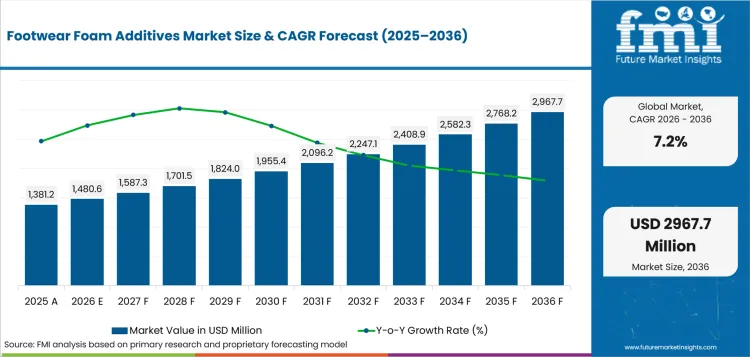
USD 1,480.7 million in 2026 and USD 2,967.7 million by 2036 at a 7.2% CAGR.
The footwear foam additives market is expected to grow from USD 1,381.25 million in 2025 to USD 2,967.7 million by 2036. Growth is expected to be supported by demand for molded midsoles and odor-control insoles. Blowing agents are projected to account for a 42.0% share in 2026, driven by their role in controlled expansion for molded components.
| Metric | Value |
|---|---|
| 2026 Market Size | USD 1,480.7 million |
| 2036 Market Size | USD 2,967.7 million |
| Forecast CAGR (2026-2036) | 7.2% |
| Leading Additive Type | Blowing Agents |
| Blowing Agents Share (2026) | 42.0% |
| Leading Foam Type | EVA Foam |
| EVA Foam Share (2026) | 52.5% |
| Fastest-growing Country | China |
| China CAGR by 2036 | 8.4% |
| Market Signal | Commercial Impact |
|---|---|
| Demand and Growth Drivers | Demand for footwear foam additives is increasing as manufacturers focus on lightweight footwear, density control, and improved rebound performance.
|
| Product and Segment View | Blowing agents, EVA foam, and midsoles lead their respective market segments.
|
| Geography and Growth Outlook | Asia remains the primary manufacturing hub as footwear production capacity continues to expand across key markets.
|
| Competitive Landscape | Competition increasingly focuses on formulation expertise, material performance, and application support.
|
| Analyst Perspective | Footwear foam additives are becoming a strategic part of footwear design as manufacturers prioritize lightweight construction, consistent rebound, and production efficiency.
- Nandini Roy, Analyst at Future Market Insights |
Footwear foam additives industry is being influenced by comfort-focused footwear production where midsoles and insoles must balance cushioning and durability. The U.S. Census Bureau reported April 2026 leather and allied product shipments of USD 415 million. This gives additive suppliers a current production signal from footwear-adjacent manufacturing.
Which factors support expansion in the footwear foam additives market?
Foam-intensive sports and casual footwear programs are expected to support additive revenue. Brands use comfort and odor control to guide supplier selection.
- Market value is supported by additive revenue from foam components and not finished shoe sales.
- Supplier pricing reflects chemistry performance before brand owners approve wider production.
- Revenue improves when compounders reduce rejects during midsole and insole molding.
- Technical service can make repeat orders easier when plant trials lower recipe risk.
Footwear Foam Additives Market Definition
The footwear foam additives market covers chemical and functional inputs used to improve foam materials in footwear components. Included products cover blowing agents and stabilizers used in EVA and PU systems.
Applications include midsoles and insoles in sports and casual footwear. The scope excludes finished footwear and neat foam polymers sold without additive function.
Footwear Foam Additives Market Definition and Scope Table
| Parameter | Description |
|---|---|
| Base Year | 2025 |
| Forecast Period | 2026 to 2036 |
| Historical Review | 2021 to 2025 |
| Quantitative Unit | Revenue in USD million |
| Market Coverage | Additives used in EVA, PU, TPU, other footwear foam systems |
| Segments Covered | Additive type, foam type, application, end use, sales channel, region |
| Countries Covered | United States, United Kingdom, Germany, France, Japan, China, South Korea, India |
| Primary Buyers | Compounders, footwear OEMs, safety-footwear makers, sports-footwear suppliers |
Footwear Foam Additives Market Research Methodology
| Method | Description |
|---|---|
| Primary Research | FMI analyst interviews with compounders, foam processors, chemical suppliers, footwear OEM sourcing teams |
| Desk Research | Review of footwear production data, trade records, company product pages, regulatory updates |
| Market Sizing & Forecasting | Bottom-up additive-use model based on foam type, component mix, additive loading, country production intensity |
| Data Validation | Forecasts checked against production scale, supplier portfolios, country demand signals, buyer documentation needs |
Why is the footwear foam additives market growing?
Midsole weight targets are expected to push compounders toward blowing systems that create stable cells during molding. Sports footwear brands need rebound retention without surface collapse.
The production base is large enough for small formulation changes to affect material use. World Footwear reported 23.9 billion pairs produced globally in 2024. Additives become commercially important when they reduce density and protect foam feel.
Technical selling is therefore becoming more important. Suppliers are expected to defend price premiums by proving lower scrap and shorter trial cycles.
How is the footwear foam additives market segmented?
The footwear foam additives industry is segmented by additive type, foam type, application, end use, sales channel.
- Blowing agents are projected to secure 42.0% share in 2026 through density reduction in molded components.
- EVA foam is estimated to account for 52.5% share in 2026 due to familiar processing behavior.
- Midsoles are anticipated to hold 46.0% share in 2026 with cushioning claims guiding recipe changes.
- Sports footwear is expected to represent 38.5% share in 2026 with rebound needs guiding foam selection.
- Direct to compounders is forecast to hold 61.0% share in 2026 through plant-trial support.
Why do blowing agents lead the footwear foam additives market?
Blowing agents are projected to account for 42.0% share in 2026 due to low-density midsole demand.
- Processor trials compare cell size and scorch control before price.
- Poor expansion can create visible defects in midsoles and outsoles.
Which foam type leads the footwear foam additives market?
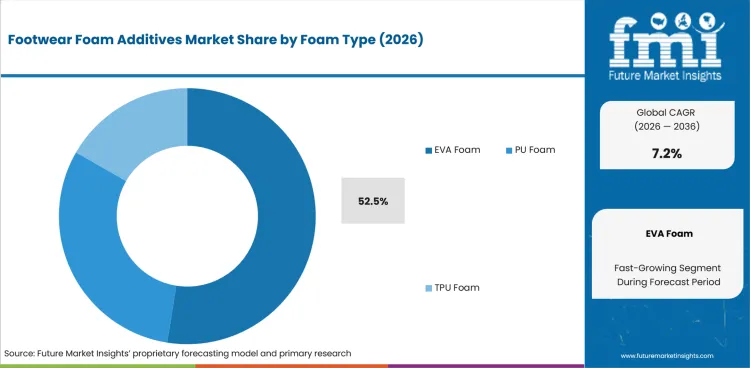
EVA foam is estimated to represent 52.5% share in 2026 due to processing familiarity.
- EVA compounders prefer additive systems that work in existing molding equipment.
- PU and TPU foam systems gain use when rebound targets justify higher material cost.
Which application leads the footwear foam additives market?
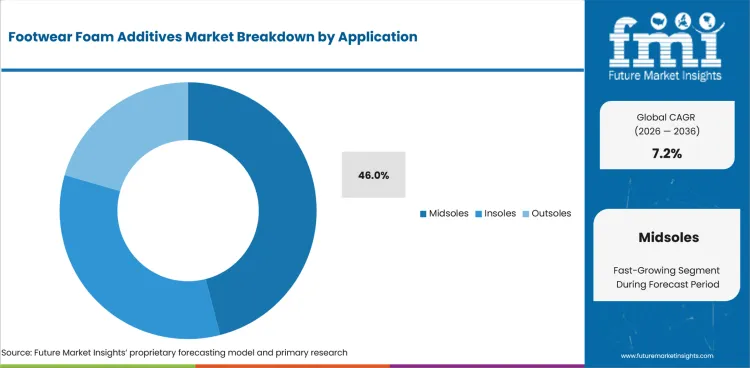
Midsoles are anticipated to account for 46.0% share in 2026 due to cushioning and energy-return claims.
- Midsole formulations face stricter fatigue checks than upper padding.
- Insoles create added demand for odor-control additives in daily-wear shoes.
Which end use leads the footwear foam additives market?
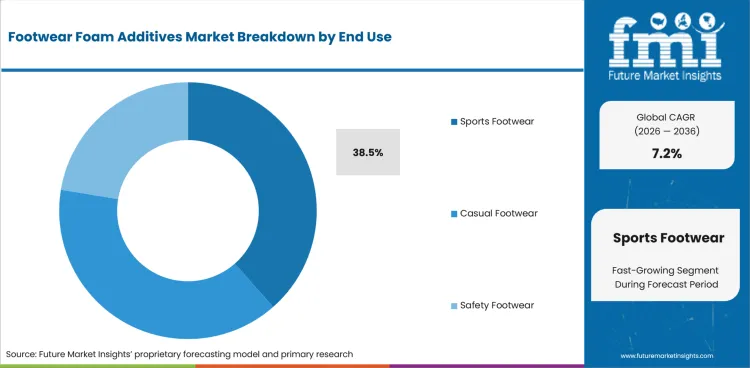
Sports footwear is expected to hold 38.5% share in 2026 due to lighter foam and repeatable energy return.
- Sports footwear buyers compare rebound after repeated loading.
- Casual footwear creates volume opportunity when brands add comfort claims.
Which sales channel leads the footwear foam additives market?
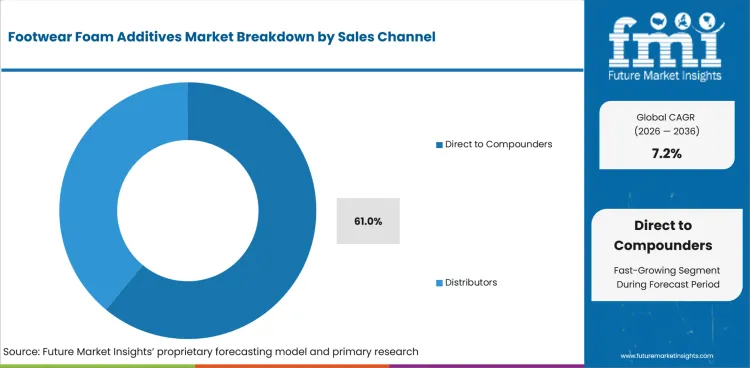
Direct to compounders is projected to represent 61.0% share in 2026 due to recipe support needs.
- Distributors serve smaller converters that use standard additive systems.
- Direct supply wins larger accounts that need plant-level tuning.
What drives the footwear foam additives market and what holds it back?
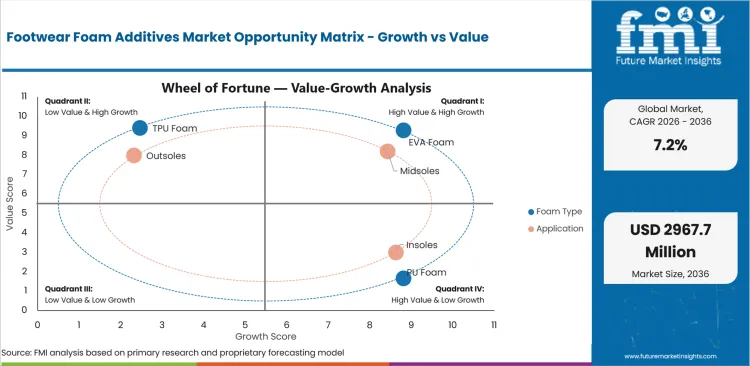
Midsole light-weighting and rebound durability support additive demand. Compliance and cost pressure limit low-value substitutions.
- Driver: Midsole light-weighting is expected to raise blowing agent demand by lowering foam density without shape loss.
- Driver: Rebound durability is anticipated to support crosslinking and stabilizer demand in running footwear.
- Restraint: Compliance pressure can restrict low-cost additives when buyers ask for chemical disclosure.
- Opportunity: Automated molding creates demand for additive packages that reduce reject rates.
Midsole Weight-Control Demand Outlook
Demand is moving toward additive systems that solve comfort and factory yield together. U.S. Census Bureau reported retail and food services sales rose 0.9% in May 2026. This consumer spending signal gives footwear brands more room to plan comfort-focused ranges. Odor-control additives are not simple fragrance inputs. They must survive foam processing and support safe consumer-goods claims.
Foam Comfort Purchase Behavior Analysis
Consumer behavior is expected to keep comfort and durability visible in sports and casual shoes. BLS stated in June 2024 that men’s footwear CPI quality adjustment covers two groups. These groups are casual footwear and athletic footwear. That scope explains why foam performance must serve daily-use and active-use claims.
Compounder Decision-driver Analysis
Compounders choose footwear foam additives through cell control and rebound retention. SABIC’s 2025 footwear flyer identified EVA 2518DF for foam uses with better heat shrinkage and easy processing. This gives buyers a practical benchmark before scaling production. Brand owners ask suppliers to support restricted-substance screening and mold-level testing. Technical service is now part of the buying requirement in high-volume foam programs.
Which countries are growing fastest in the footwear foam additives market?
China 8.4% CAGR, India 8.1% CAGR, South Korea 7.5% CAGR, United States 6.9% CAGR, Germany 6.8% CAGR, Japan 6.6% CAGR, France 6.5% CAGR, United Kingdom 6.2% CAGR by 2036.
.webp "Top Country Growth Comparison Footwear Foam Additives Market Cagr (2026 2036)")
| Country | CAGR |
|---|---|
| China | 8.4% |
| India | 8.1% |
| South Korea | 7.5% |
| United States | 6.9% |
| Germany | 6.8% |
| Japan | 6.6% |
| France | 6.5% |
| United Kingdom | 6.2% |
Source: Future Market Insights, 2026.
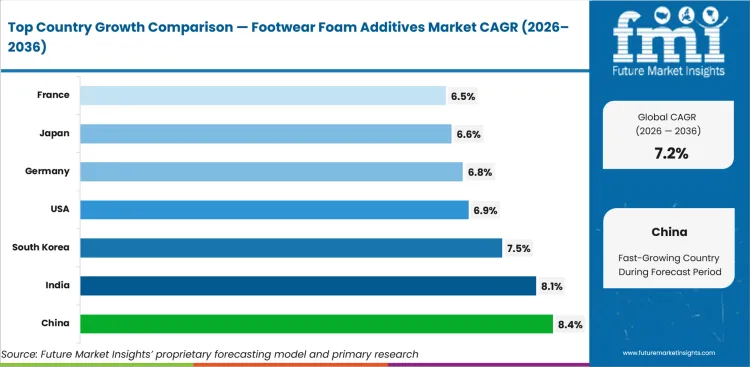
How do country-level CAGRs compare in the footwear foam additives market?
China leads country growth. The United Kingdom records the most cautious expansion outlook among profiled markets.
- China is forecast to record 8.4% CAGR by 2036 due to large footwear output.
- India is expected to expand at 8.1% CAGR by 2036 due to non-leather footwear capacity growth.
- South Korea is projected to grow at 7.5% CAGR by 2036 with sports-fashion demand supporting comfort foam.
- The United States is estimated to rise at 6.9% CAGR by 2036 due to brand specifications.
- Germany is forecast to grow at 6.8% CAGR by 2036 due to safety-footwear demand.
- Japan is expected to advance at 6.6% CAGR by 2036 with quality-focused buyers using stable foam parts.
- France is projected to post 6.5% CAGR by 2036 due to stronger durability expectations.
- The United Kingdom is forecast to grow at 6.2% CAGR by 2036 with retail demand guiding specification.
Why does China lead country growth in the footwear foam additives market?
An 8.4% CAGR by 2036 reflects large footwear output and high-volume foam conversion.
Country Market Snapshot Table
| Parameter | Value |
|---|---|
| Market Size in 2025 (Value) | USD 317.7 million |
| Market Size in 2026 (Value) | USD 344.4 million |
| Market Forecast in 2036 (Value) | USD 771.6 million |
| CAGR (2026 to 2036) | 8.4% |
| Years Considered | 2021 to 2036 |
| Base Year | 2025 |
| Forecast Period | 2026 to 2036 |
| Units Considered | Value (USD million) |
| Leading Sub-Region | Guangdong, Fujian, Zhejiang, Jiangsu |
China Footwear Foam Additives Market Outlook
China is the scale test for footwear foam additive suppliers. EVA and TPU molders need additives that hold cell shape across many factories.
Domestic sports brands and export programs keep recipe repeatability central. Suppliers with local labs can solve molding issues before small defects become large losses.
Key Growth Drivers
- World Footwear reported Chinese production at about 13 billion pairs in 2024. That scale supports strong need for stable foam additives.
- NBS reported industrial value added rose 5.8% in 2024. This wider factory base helps additive suppliers serve footwear clusters.
- Domestic sports-footwear brands are expected to use more EVA and TPU foam systems for comfort claims.
- Coastal footwear clusters are expected to prefer suppliers that can visit plants and fix molding issues quickly.
Key Restraints
- APICCAPS reported Chinese footwear export value fell 8.8% from January to August 2025. This price pressure can slow premium additive trials.
- Export buyers can delay additive changes when seasonal orders become uncertain.
- Regional factory differences can make one additive recipe behave unevenly across plants.
What makes China unique
China is unique for very large molding networks that test recipe consistency.
Key Companies
- ANTA Sports
- Li-Ning
- Xtep International
- 361 Degrees
- Belle International
- Yue Yuen Industrial
- Feng Tay China Operations
Sales & Marketing Channels
- Direct technical sales are common when compounders need plant trials.
- Regional distributors serve smaller foam converters outside coastal hubs.
- Domestic sports brands influence high-rebound midsole approvals.
- Export sourcing offices check restricted-substance documents before recipe approval.
Country Segment Breakdown Table
| Segment | Sub-Segments |
|---|---|
| By Additive Type | Blowing Agents, Crosslinking Agents, Stabilizers, Antimicrobial / Odor Control |
| By Foam Type | EVA Foam, PU Foam, TPU Foam, Other |
| By Application | Midsoles, Insoles, Outsoles, Upper Padding / Other |
| By End Use | Sports Footwear, Casual Footwear, Safety Footwear, Other |
| By Sales Channel | Direct to Compounders, Distributors |
| Key Sub-Regions Covered | Guangdong, Fujian, Zhejiang, Jiangsu |
Frequently Asked Questions
How fast is China footwear foam additives market growing?
The China market is projected to grow at 8.4% CAGR from 2026 to 2036.
Who leads China footwear foam additives market?
ANTA Sports and Li-Ning are among the local companies shaping footwear demand.
What is driving adoption in China footwear foam additives market?
World Footwear reported Chinese production at about 13 billion pairs in 2024. That scale supports strong need for stable foam additives.
Why is India among the fastest-growing footwear foam additives markets?
An 8.1% CAGR by 2036 reflects non-leather footwear investment and export-oriented production.
Country Market Snapshot Table
| Parameter | Value |
|---|---|
| Market Size in 2025 (Value) | USD 126.8 million |
| Market Size in 2026 (Value) | USD 137.1 million |
| Market Forecast in 2036 (Value) | USD 298.9 million |
| CAGR (2026 to 2036) | 8.1% |
| Years Considered | 2021 to 2036 |
| Base Year | 2025 |
| Forecast Period | 2026 to 2036 |
| Units Considered | Value (USD million) |
| Leading Sub-Region | Tamil Nadu, Uttar Pradesh, Haryana, Maharashtra |
India Footwear Foam Additives Market Outlook
India demand is supported by non-leather footwear expansion and factory upgrades. EVA and PU foam systems gain use when producers move beyond low-cost sandals.
Additive suppliers should gain when they offer regional service and price-stable recipes. Buyers need cell-control support during production expansion across clusters.
Key Growth Drivers
- India Exim Bank reported footwear exports of USD 2.2 billion in FY 2024 to 2025. Export demand supports foam recipe upgrades.
- APICCAPS estimated India held 12.5% of global footwear production in 2024. This share supports larger EVA and PU additive supply.
- Tamil Nadu and Uttar Pradesh clusters are expected to support foam footwear component making.
- Non-leather footwear capacity is expected to raise demand for cost-balanced additive packages.
Key Restraints
- India Exim Bank reported footwear imports of USD 0.5 billion in FY 2024 to 2025. Import reliance can expose foam inputs to supply risk.
- Small converter networks can make technical support costly for additive suppliers.
- Mass footwear programs can reject premium stabilizers when retail prices are under pressure.
What makes India unique
India is unique for non-leather footwear expansion that lets suppliers shape foam recipes early.
Key Companies
- Bata India
- Relaxo Footwears
- Campus Activewear
- Liberty Shoes
- Metro Brands
- Paragon Footwear
- Khadim India
Sales & Marketing Channels
- Direct supply serves larger factories that need recipe support.
- Distributors serve smaller converters across regional clusters.
- Export houses request documents for buyer chemical checks.
- Retail brands influence insole and midsole comfort needs in value footwear.
Country Segment Breakdown Table
| Segment | Sub-Segments |
|---|---|
| By Additive Type | Blowing Agents, Crosslinking Agents, Stabilizers, Antimicrobial / Odor Control |
| By Foam Type | EVA Foam, PU Foam, TPU Foam, Other |
| By Application | Midsoles, Insoles, Outsoles, Upper Padding / Other |
| By End Use | Sports Footwear, Casual Footwear, Safety Footwear, Other |
| By Sales Channel | Direct to Compounders, Distributors |
| Key Sub-Regions Covered | Tamil Nadu, Uttar Pradesh, Haryana, Maharashtra |
Frequently Asked Questions
How fast is India footwear foam additives market growing?
The India market is projected to grow at 8.1% CAGR from 2026 to 2036.
Who leads India footwear foam additives market?
Bata India and Relaxo Footwears are among the local companies shaping footwear demand.
What is driving adoption in India footwear foam additives market?
India Exim Bank reported footwear exports of USD 2.2 billion in FY 2024 to 2025. Export demand supports foam recipe upgrades.
What supports South Korea’s footwear foam additives market outlook?
A 7.5% CAGR by 2036 is supported by sports-fashion demand and high consumer quality expectations.
Country Market Snapshot Table
| Parameter | Value |
|---|---|
| Market Size in 2025 (Value) | USD 61.5 million |
| Market Size in 2026 (Value) | USD 66.1 million |
| Market Forecast in 2036 (Value) | USD 136.4 million |
| CAGR (2026 to 2036) | 7.5% |
| Years Considered | 2021 to 2036 |
| Base Year | 2025 |
| Forecast Period | 2026 to 2036 |
| Units Considered | Value (USD million) |
| Leading Sub-Region | Seoul, Busan, Daegu, export-facing retail corridors |
South Korea Footwear Foam Additives Market Outlook
South Korea demand is shaped by sports-fashion brands and comfort-focused casual shoes. Additive demand is mainly shaped by branded design and outsourced component quality.
Suppliers should focus on odor control and high-rebound foam support. Korean buyers are expected to prefer additives that protect product feel and retail reputation.
Key Growth Drivers
- The Ministry of Data and Statistics listed its May 2026 CPI release on 2 June 2026. This current price tracking helps retailers plan footwear ranges.
- Statistics Korea reported retail sales fell 3.6% month on month in April 2026. That makes predictable foam cost more important for brands.
- Sports-fashion retailers are expected to favor lighter EVA and TPU foam systems for comfort-focused footwear.
- Domestic brands are expected to request odor-control packages for all-day casual shoes.
Key Restraints
- Statistics Korea reported retail sales fell 3.6% month on month in April 2026. This sales pressure can delay recipe changes.
- Reliance on imported components can slow additive approvals across offshore factories.
- Short fashion cycles can reduce the time available for new additive qualification.
What makes South Korea unique
South Korea is unique for sports-fashion branding that gives foam feel a visible role in product reviews.
Key Companies
- FILA Korea
- Prospecs
- KOLON Sport
- K2 Korea
- TrekSta
- ShoeMarker
- LS Networks
Sales & Marketing Channels
- Brand sourcing teams guide additive specifications for imported foam parts.
- Sports-fashion retailers influence demand through cushioning expectations.
- Online channels raise pressure for consistent sizing and odor control.
- Distributors support smaller converters serving local casual footwear brands.
Country Segment Breakdown Table
| Segment | Sub-Segments |
|---|---|
| By Additive Type | Blowing Agents, Crosslinking Agents, Stabilizers, Antimicrobial / Odor Control |
| By Foam Type | EVA Foam, PU Foam, TPU Foam, Other |
| By Application | Midsoles, Insoles, Outsoles, Upper Padding / Other |
| By End Use | Sports Footwear, Casual Footwear, Safety Footwear, Other |
| By Sales Channel | Direct to Compounders, Distributors |
| Key Sub-Regions Covered | Seoul, Busan, Daegu, export-facing retail corridors |
Frequently Asked Questions
How fast is South Korea footwear foam additives market growing?
The South Korea market is projected to grow at 7.5% CAGR from 2026 to 2036.
Who leads South Korea footwear foam additives market?
FILA Korea and Prospecs are among the local companies shaping footwear demand.
What is driving adoption in South Korea footwear foam additives market?
The Ministry of Data and Statistics listed its May 2026 CPI release on 2 June 2026. This current price tracking helps retailers plan footwear ranges.
What is the footwear foam additives market outlook in the United States?
A 6.9% CAGR by 2036 reflects premium sports footwear demand and safety-footwear specification discipline.
Country Market Snapshot Table
| Parameter | Value |
|---|---|
| Market Size in 2025 (Value) | USD 263.6 million |
| Market Size in 2026 (Value) | USD 282.1 million |
| Market Forecast in 2036 (Value) | USD 549.7 million |
| CAGR (2026 to 2036) | 6.9% |
| Years Considered | 2021 to 2036 |
| Base Year | 2025 |
| Forecast Period | 2026 to 2036 |
| Units Considered | Value (USD million) |
| Leading Sub-Region | California, Pacific Coast sourcing corridors |
United States Footwear Foam Additives Market Outlook
United States demand is shaped by brand specifications instead of domestic shoe output alone. Offshore compounders often follow U.S. comfort and safety requirements before recipes scale.
Direct additive suppliers are expected to gain from midsole testing support and documents for restricted substances. Buyers should favor systems that control cell size without raising mass-market shoe cost.
Key Growth Drivers
- USITC reported footwear imports of USD 27.3 billion in 2024. U.S. brand specifications therefore affect offshore foam recipes.
- CPSC children’s product certificates require 7 elements. This supports traceable additive documentation in children’s footwear programs.
- Sports-footwear brands are expected to keep lighter midsole recipes under review for cushioning claims.
- Private-label retailers are expected to request predictable foam cost and repeatable comfort claims across casual footwear lines.
Key Restraints
- BLS reported footwear prices rose 5.2% over the year in May 2026. This limits room for premium additives in mass footwear.
- Low domestic shoe conversion keeps most additive demand indirect through Asian production sites.
- Tariff exposure can delay additive trials when buyers protect entry-level price points.
What makes United States unique
The United States is unique for brand specifications that often guide offshore recipe approval.
Key Companies
- Nike Inc.
- Skechers U.S.A. Inc.
- Deckers Brands
- Wolverine World Wide Inc.
- New Balance Athletics Inc.
- Crocs Inc.
- Rocky Brands Inc.
Sales & Marketing Channels
- Direct supply supports athletic programs that need recipe support.
- Distributors serve converters that need standard blowing agents.
- Brand-approved material libraries guide additive selection before offshore production.
- Safety-footwear tenders create checks for PU and EVA comfort systems.
Country Segment Breakdown Table
| Segment | Sub-Segments |
|---|---|
| By Additive Type | Blowing Agents, Crosslinking Agents, Stabilizers, Antimicrobial / Odor Control |
| By Foam Type | EVA Foam, PU Foam, TPU Foam, Other |
| By Application | Midsoles, Insoles, Outsoles, Upper Padding / Other |
| By End Use | Sports Footwear, Casual Footwear, Safety Footwear, Other |
| By Sales Channel | Direct to Compounders, Distributors |
| Key Sub-Regions Covered | California, Pacific Coast sourcing corridors |
Frequently Asked Questions
How fast is United States footwear foam additives market growing?
The United States market is projected to grow at 6.9% CAGR from 2026 to 2036.
Who leads United States footwear foam additives market?
Nike Inc. and Skechers U.S.A. Inc. are among the local companies shaping footwear demand.
What is driving adoption in United States footwear foam additives market?
USITC reported footwear imports of USD 27.3 billion in 2024. U.S. brand specifications therefore affect offshore foam recipes.
What is Germany’s outlook in the footwear foam additives market?
A 6.8% CAGR by 2036 reflects safety-footwear demand and strict material documentation requirements.
Country Market Snapshot Table
| Parameter | Value |
|---|---|
| Market Size in 2025 (Value) | USD 110.5 million |
| Market Size in 2026 (Value) | USD 118.0 million |
| Market Forecast in 2036 (Value) | USD 228.0 million |
| CAGR (2026 to 2036) | 6.8% |
| Years Considered | 2021 to 2036 |
| Base Year | 2025 |
| Forecast Period | 2026 to 2036 |
| Units Considered | Value (USD million) |
| Leading Sub-Region | Bavaria, North Rhine-Westphalia, Lower Saxony |
Germany Footwear Foam Additives Market Outlook
Germany demand is shaped by protective footwear and comfort sandals. Chemical buyers place high weight on traceability under EU product and waste rules.
Local additive suppliers and footwear brands are expected to favor materials qualified across PU and TPU systems. Documentation support remains central to supplier selection.
Key Growth Drivers
- Destatis reported online clothing sales just under EUR 10 billion in 2024. This retail scale supports comfort-focused footwear offers.
- Eurostat reported EU sold production of EUR 5,860 billion in 2024. Nearby industry supports chemical input supply.
- Safety-footwear producers are expected to keep PU systems focused on comfort and protection.
- Local chemical suppliers are expected to support faster troubleshooting for stabilizers and crosslinking systems.
Key Restraints
- The European Commission set 19 July 2026 for the large-company footwear destruction ban. This raises traceability pressure.
- High labor and energy costs can restrict low-margin footwear manufacturing inside Germany.
- Strict compliance checks can slow approval of imported low-price additives.
What makes Germany unique
Germany is unique for additive approvals shaped by worker protection and chemical documentation.
Key Companies
- Birkenstock
- HAIX Group
- Uvex Safety Group
- LOWA Sportschuhe
- BÄR Shoes
- Ara Shoes
- LLOYD Shoes
Sales & Marketing Channels
- Direct chemical selling supports technical PU and TPU formulations.
- Safety-footwear distributors influence additive requirements through tenders.
- Retail brands use material claims to support comfort positioning.
- Compliance consultants can affect approvals when restricted substances are reviewed.
Country Segment Breakdown Table
| Segment | Sub-Segments |
|---|---|
| By Additive Type | Blowing Agents, Crosslinking Agents, Stabilizers, Antimicrobial / Odor Control |
| By Foam Type | EVA Foam, PU Foam, TPU Foam, Other |
| By Application | Midsoles, Insoles, Outsoles, Upper Padding / Other |
| By End Use | Sports Footwear, Casual Footwear, Safety Footwear, Other |
| By Sales Channel | Direct to Compounders, Distributors |
| Key Sub-Regions Covered | Bavaria, North Rhine-Westphalia, Lower Saxony |
Frequently Asked Questions
How fast is Germany footwear foam additives market growing?
The Germany market is projected to grow at 6.8% CAGR from 2026 to 2036.
Who leads Germany footwear foam additives market?
Birkenstock and HAIX Group are among the local companies shaping footwear demand.
What is driving adoption in Germany footwear foam additives market?
Destatis reported online clothing sales just under EUR 10 billion in 2024. This retail scale supports comfort-focused footwear offers.
How fast is Japan growing in the footwear foam additives market?
A 6.6% CAGR by 2036 is supported by high-specification comfort footwear and import quality control.
Country Market Snapshot Table
| Parameter | Value |
|---|---|
| Market Size in 2025 (Value) | USD 101.9 million |
| Market Size in 2026 (Value) | USD 108.6 million |
| Market Forecast in 2036 (Value) | USD 205.9 million |
| CAGR (2026 to 2036) | 6.6% |
| Years Considered | 2021 to 2036 |
| Base Year | 2025 |
| Forecast Period | 2026 to 2036 |
| Units Considered | Value (USD million) |
| Leading Sub-Region | Tokyo, Osaka, Kobe, regional footwear clusters |
Japan Footwear Foam Additives Market Outlook
Japan demand is shaped by running shoes and walking shoes. Import reliance keeps offshore compounders aligned with Japanese quality expectations.
Additive suppliers are expected to win through stable molding behavior and low-odor performance. Domestic buyers will continue to value durability and clean product claims.
Key Growth Drivers
- Japan Customs data placed footwear imports at JPY 62,500.34 million in February 2024. This import scale keeps overseas recipe quality important.
- Statistics Bureau of Japan reported the population aged 65 or older at 29.3% in 2024. This supports comfort footwear demand.
- Running and walking shoe brands are expected to favor EVA and TPU foam systems with stable rebound.
- School and work footwear programs are expected to support additives that improve durability and odor control.
Key Restraints
- Japan Customs data placed footwear imports at JPY 62,500.34 million in February 2024. This import dependence exposes buyers to trade swings.
- High quality expectations can slow approval when additives change odor or surface finish.
- Older consumers can favor proven comfort recipes over frequent reformulation.
What makes Japan unique
Japan is unique for footwear buyers that value comfort consistency over the lowest additive input cost.
Key Companies
- ASICS Corporation
- Mizuno Corporation
- MoonStar Company
- Achilles Corporation
- Hiroshima Kasei
- Regal Corporation
- Kobe Shoes Cluster
Sales & Marketing Channels
- Brand-approved compounders influence additive choices before goods reach retailers.
- Specialty running stores shape demand for high-rebound midsoles.
- School and uniform channels need stable sizing and durability.
- Trading companies coordinate imports and documents for offshore foam parts.
Country Segment Breakdown Table
| Segment | Sub-Segments |
|---|---|
| By Additive Type | Blowing Agents, Crosslinking Agents, Stabilizers, Antimicrobial / Odor Control |
| By Foam Type | EVA Foam, PU Foam, TPU Foam, Other |
| By Application | Midsoles, Insoles, Outsoles, Upper Padding / Other |
| By End Use | Sports Footwear, Casual Footwear, Safety Footwear, Other |
| By Sales Channel | Direct to Compounders, Distributors |
| Key Sub-Regions Covered | Tokyo, Osaka, Kobe, regional footwear clusters |
Frequently Asked Questions
How fast is Japan footwear foam additives market growing?
The Japan market is projected to grow at 6.6% CAGR from 2026 to 2036.
Who leads Japan footwear foam additives market?
ASICS Corporation and Mizuno Corporation are among the local companies shaping footwear demand.
What is driving adoption in Japan footwear foam additives market?
Japan Customs data placed footwear imports at JPY 62,500.34 million in February 2024. This import scale keeps overseas recipe quality important.
How is France positioned in the footwear foam additives market?
A 6.5% CAGR by 2036 is supported by footwear renewal and durability expectations.
Country Market Snapshot Table
| Parameter | Value |
|---|---|
| Market Size in 2025 (Value) | USD 92.7 million |
| Market Size in 2026 (Value) | USD 98.7 million |
| Market Forecast in 2036 (Value) | USD 185.4 million |
| CAGR (2026 to 2036) | 6.5% |
| Years Considered | 2021 to 2036 |
| Base Year | 2025 |
| Forecast Period | 2026 to 2036 |
| Units Considered | Value (USD million) |
| Leading Sub-Region | Paris, Auvergne-Rhône-Alpes, western retail clusters |
France Footwear Foam Additives Market Outlook
France demand is influenced by fashion footwear and sports footwear. Additive suppliers need clearer documents when buyers connect foam durability with repair rules.
Footwear foam additives should gain from insole comfort and lightweight casual designs. Suppliers must show how recipe changes affect wear life and product claims.
Key Growth Drivers
- Refashion reported 259 million pairs of shoes placed on the French market in 2024. This scale supports comfort and replacement footwear demand.
- The European Commission estimated that 4% to 9% of unsold textiles are destroyed each year. This raises attention to durable material choices.
- French sports and lifestyle retailers are expected to favor EVA and PU foam systems that improve comfort.
- Repair-focused retail programs are expected to support additives that help midsoles retain performance longer.
Key Restraints
- Refashion reported more than 826,000 repairs through the Repair Bonus in 2024. This raises scrutiny of weak durability claims.
- Fashion seasonality can restrict long qualification cycles for new foam additives.
- Retailers may avoid recipe changes that complicate product communication for mid-price footwear.
What makes France unique
France is unique for footwear comfort claims assessed beside repair and waste expectations.
Key Companies
- Salomon
- Decathlon
- Le Coq Sportif
- Heschung
- Paraboot
- Veja
- Aigle
Sales & Marketing Channels
- Sports retailers influence additive demand through comfort claims.
- Specialty footwear chains prefer additives for lighter casual styles.
- Repair programs create documentation needs for durable foam choices.
- Distributors support smaller brands using standard EVA and PU systems.
Country Segment Breakdown Table
| Segment | Sub-Segments |
|---|---|
| By Additive Type | Blowing Agents, Crosslinking Agents, Stabilizers, Antimicrobial / Odor Control |
| By Foam Type | EVA Foam, PU Foam, TPU Foam, Other |
| By Application | Midsoles, Insoles, Outsoles, Upper Padding / Other |
| By End Use | Sports Footwear, Casual Footwear, Safety Footwear, Other |
| By Sales Channel | Direct to Compounders, Distributors |
| Key Sub-Regions Covered | Paris, Auvergne-Rhône-Alpes, western retail clusters |
Frequently Asked Questions
How fast is France footwear foam additives market growing?
The France market is projected to grow at 6.5% CAGR from 2026 to 2036.
Who leads France footwear foam additives market?
Salomon and Decathlon are among the local companies shaping footwear demand.
What is driving adoption in France footwear foam additives market?
Refashion reported 259 million pairs of shoes placed on the French market in 2024. This scale supports comfort and replacement footwear demand.
How is the United Kingdom footwear foam additives market growing?
A 6.2% CAGR by 2036 is supported by retail refresh cycles and safety-footwear procurement.
Country Market Snapshot Table
| Parameter | Value |
|---|---|
| Market Size in 2025 (Value) | USD 83.2 million |
| Market Size in 2026 (Value) | USD 88.5 million |
| Market Forecast in 2036 (Value) | USD 161.8 million |
| CAGR (2026 to 2036) | 6.2% |
| Years Considered | 2021 to 2036 |
| Base Year | 2025 |
| Forecast Period | 2026 to 2036 |
| Units Considered | Value (USD million) |
| Leading Sub-Region | London, Midlands retail and safety-footwear corridors |
United Kingdom Footwear Foam Additives Market Outlook
United Kingdom demand is concentrated in retail programs and workplace footwear procurement. Most foam conversion occurs through supplier networks outside the country.
Suppliers can gain share when they help importers document restricted-substance compliance and price stability. Safety footwear remains a practical channel for PU foam and odor-control additives.
Key Growth Drivers
- ONS reported retail sales volumes rose 1.2% in May 2026. This gave retailers stronger seasonal planning confidence.
- HSE reported 40.1 million working days lost in 2024 to 2025. That keeps protective footwear procurement visible.
- Online and specialty retailers are expected to increase demand for lightweight casual shoes with clear comfort claims.
- Importers are expected to favor additive packages that support compliant labeling.
Key Restraints
- ONS reported clothing and footwear prices rose 0.7% in the year to April 2026. This limits premium additive pass-through.
- Retailers may delay new foam recipes when discounting pressure increases.
- Limited local foam conversion keeps technical validation dependent on overseas compounders.
What makes United Kingdom unique
The United Kingdom is unique for retail channel control that shapes additive demand more than local production scale.
Key Companies
- Hotter Shoes
- Dr. Martens
- Clarks
- Gola
- Hi-Tec Sports
- Grenson
- Barker Shoes
Sales & Marketing Channels
- Specialty footwear retailers influence demand through comfort claims.
- Safety distributors use tenders to shape PU foam requirements.
- Online retail channels favor size consistency and odor-control messages.
- Import agents coordinate testing documents with overseas compounders.
Country Segment Breakdown Table
| Segment | Sub-Segments |
|---|---|
| By Additive Type | Blowing Agents, Crosslinking Agents, Stabilizers, Antimicrobial / Odor Control |
| By Foam Type | EVA Foam, PU Foam, TPU Foam, Other |
| By Application | Midsoles, Insoles, Outsoles, Upper Padding / Other |
| By End Use | Sports Footwear, Casual Footwear, Safety Footwear, Other |
| By Sales Channel | Direct to Compounders, Distributors |
| Key Sub-Regions Covered | London, Midlands retail and safety-footwear corridors |
Frequently Asked Questions
How fast is United Kingdom footwear foam additives market growing?
The United Kingdom market is projected to grow at 6.2% CAGR from 2026 to 2036.
Who leads United Kingdom footwear foam additives market?
Hotter Shoes and Dr. Martens are among the local companies shaping footwear demand.
What is driving adoption in United Kingdom footwear foam additives market?
ONS reported retail sales volumes rose 1.2% in May 2026. This gave retailers stronger seasonal planning confidence.
Who are the leading companies in the footwear foam additives market?
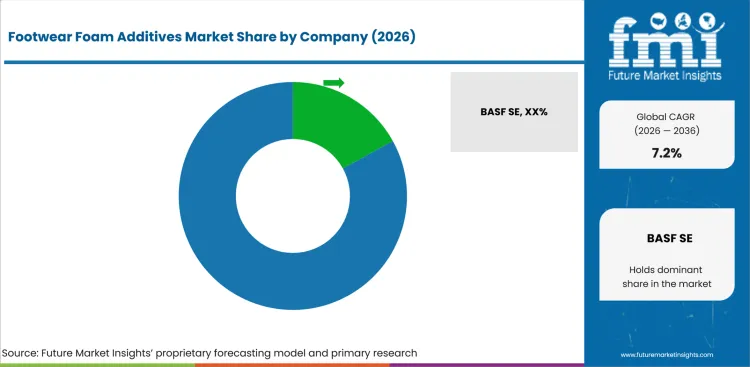
BASF and Huntsman lead through footwear foam systems. Arkema and LANXESS add polymer additive support.
- Global chemical groups are expected to lead through PU and TPU formulation support.
- Specialist additive suppliers are expected to win accounts through faster plant-trial troubleshooting.
- Regional distributors are expected to serve smaller converters that buy standard additive packages.
- Footwear brands are expected to shortlist suppliers through restricted-substance documents and comfort testing.
Large chemical suppliers hold an advantage through polymer chemistry and global technical service. Supplier selection changes when compounders need recipe support before high-volume foam runs.
Specialist suppliers can win by solving cell-control or odor issues quickly. Smaller suppliers need proof that their chemistry reduces rejects during molding.
Footwear brands assess suppliers through documents and plant-trial results. Price matters after the recipe has passed comfort and safety checks.
How do top footwear foam additives companies compare?
BASF and Huntsman score strongest on footwear foam systems. Arkema leads on high-performance elastomer support.
| Company | Foam Chemistry Fit | Footwear Portfolio Fit | Technical Service Fit | Geographic Reach |
|---|---|---|---|---|
| BASF SE | Very Strong | Very Strong | Very Strong | Global |
| Huntsman Corporation | Very Strong | Strong | Strong | Global |
| Arkema S.A. | Strong | Very Strong | Strong | Global |
| Evonik Industries AG | Strong | Medium | Strong | Global |
| LANXESS AG | Strong | Medium | Strong | Global |
| Avient Corporation | Medium | Medium | Strong | Global |
Source: Future Market Insights competitive analysis, 2026.
Who are the key players in the footwear foam additives market?
BASF, Huntsman and Arkema are listed with Evonik and LANXESS among other suppliers.
Key global companies active in the footwear foam additives market include:
- BASF SE
- Huntsman Corporation
- Arkema S.A.
- Evonik Industries AG
- Dow Inc.
- LANXESS AG
- Avient Corporation
- SABIC
- Wacker Chemie AG
- Clariant AG
Key Developments in Footwear Foam Additives Market
- In February 2024, Arkema announced a 40% increase in global Pebax elastomer capacity at Serquigny in France.
- In March 2024, LANXESS presented polyurethane additives including crosslinkers and hydrolysis stabilizers at UTECH Europe.
- In September 2025, Huntsman added SMARTLITE SCF 280 TPU to its footwear portfolio for midsole foam uses.
- In September 2025, BASF presented footwear materials including Elastopan and Elastollan at SIMAC Tanning Tech.
Key Players in the Footwear Foam Additives Market
Global Chemical Groups
- BASF SE
- Dow Inc.
- SABIC
- Clariant AG
PU and TPU System Suppliers
- Huntsman Corporation
- Evonik Industries AG
- LANXESS AG
Footwear Polymer Specialists
- Arkema S.A.
- Wacker Chemie AG
- Avient Corporation
Footwear Foam Additives Market - Report Scope
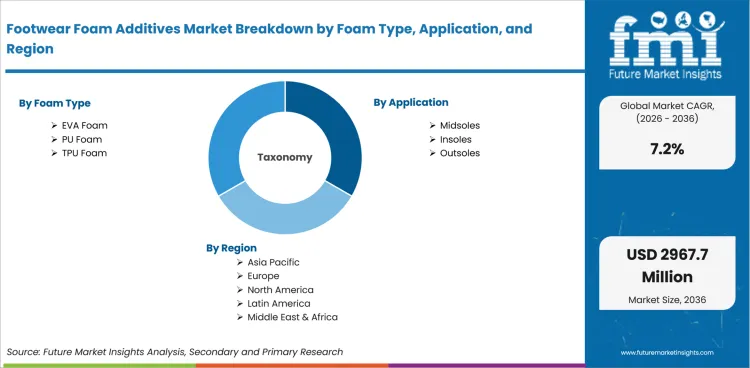
| Parameter | Details |
|---|---|
| Forecast period | 2026 to 2036 |
| Historical period | 2021 to 2025 |
| Quantitative unit | Revenue in USD million |
| By additive type | Blowing agents, crosslinking agents, stabilizers, antimicrobial / odor control |
| By foam type | EVA foam, PU foam, TPU foam, other |
| By application | Midsoles, insoles, outsoles, upper padding / other |
| By end use | Sports footwear, casual footwear, safety footwear, other |
| By sales channel | Direct to compounders, distributors |
| Regions covered | North America, Latin America, Europe, East Asia, South Asia and Pacific, Middle East and Africa |
| Countries covered | China, India, South Korea, United States, Germany, Japan, France, United Kingdom |
| Key companies profiled | BASF SE, Huntsman Corporation, Arkema S.A., Evonik Industries AG, Dow Inc., LANXESS AG, Avient Corporation, SABIC, Wacker Chemie AG, Clariant AG |
| Approach | Bottom-up additive-use model using foam type, component mix, additive loading, country production intensity, supplier portfolio coverage, and footwear production signals |
Source: Future Market Insights, 2026.
Footwear Foam Additives Market - Scope & Definition
| Attribute | Detail |
|---|---|
| Market Definition | Chemical and functional additives used to improve foam materials in footwear components. |
| Functions Covered | Foam expansion, crosslinking support, stabilization, odor control |
| Applications Covered | Midsoles, insoles, outsoles, upper padding in sports, casual, safety footwear |
| Products Excluded | Finished shoes, neat foam polymers without additive function, adhesives, coatings |
| Buyer Groups | Compounders, footwear OEMs, distributors, safety-footwear suppliers |
| Geographic Scope | United States, United Kingdom, Germany, France, Japan, China, South Korea, India |
Footwear Foam Additives Market - Research Methodology
| Method | Description |
|---|---|
| Primary Research | FMI analyst interviews with compounders, foam processors, chemical suppliers, footwear OEM sourcing teams |
| Desk Research | Review of footwear production data, trade records, company product pages, regulatory updates |
| Market Sizing & Forecasting | Bottom-up additive-use model based on foam type, component mix, additive loading, country production intensity |
| Data Validation | Forecasts checked against production scale, supplier portfolios, country demand signals, buyer documentation needs |
Footwear Foam Additives Market Breakdown by Additive Type, Foam Type, Application, End Use, Sales Channel, Region
Footwear Foam Additives Market Segmented by Additive Type:
- Blowing Agents
- Crosslinking Agents
- Stabilizers
- Antimicrobial / Odor Control
Footwear Foam Additives Market Segmented by Foam Type:
- EVA Foam
- PU Foam
- TPU Foam
- Other
Footwear Foam Additives Market Segmented by Application:
- Midsoles
- Insoles
- Outsoles
- Upper Padding / Other
Footwear Foam Additives Market Segmented by End Use:
- Sports Footwear
- Casual Footwear
- Safety Footwear
- Other
Footwear Foam Additives Market Segmented by Sales Channel:
- Direct to Compounders
- Distributors
Footwear Foam Additives Market by Region:
- North America
- Latin America
- Europe
- East Asia
- South Asia and Pacific
- Middle East and Africa
Research Sources and Bibliography
- [1] APICCAPS. (2025, July 31). 2024: Footwear production rebounds, exports rise in volume but not in value. World Footwear.
- [2] APICCAPS. (2025). World Footwear Yearbook 2025. Portuguese Footwear, Components and Leather Goods Manufacturers Association.
- [3] Arkema. (2024, February 1). Arkema completes its 40% increase in global Pebax elastomers production capacity.
- [4] BASF SE. (2025, September 16). BASF at SIMAC 2025: Recycling meets performance - PU solutions for the future of footwear.
- [5] European Commission. (2026, February 9). New EU rules to stop the destruction of unsold clothes and shoes.
- [6] Eurostat. (2025, July). Sold production, exports and imports of manufactured goods.
- [7] Health and Safety Executive. (2025). Health and safety at work: Summary statistics for Great Britain 2024 to 2025.
- [8] Huntsman Corporation. (2025, September 18). Huntsman adds new SMARTLITE SCF 280 TPU to footwear portfolio using supercritical foam technology.
- [9] India Exim Bank. (2026, March). Footwear industry in India: Changing trends. Export-Import Bank of India.
- [10] Japan Customs. (2024, February). Trade statistics of Japan. Ministry of Finance Japan.
- [11] LANXESS AG. (2024, March 28). Sustainable, high-performing systems and additives for the polyurethane industry.
- [12] Ministry of Data and Statistics. (2026, June 2). Consumer Price Index in May 2026. Republic of Korea.
- [13] Ministry of Data and Statistics. (2026, May 28). Monthly industrial statistics, April 2026. Republic of Korea.
- [14] National Bureau of Statistics of China. (2025, January). Statistical communiqué of the People’s Republic of China on the 2024 national economic and social development.
- [15] Office for National Statistics. (2026, June 19). Retail sales, Great Britain: May 2026.
- [16] Office for National Statistics. (2026, May 20). Consumer price inflation, UK: April 2026.
- [17] Refashion. (2025, June 26). Refashion activity report 2024.
- [18] Statistics Bureau of Japan. (2025). Statistical Handbook of Japan 2025.
- [19] U.S. Bureau of Labor Statistics. (2026, June 10). Consumer Price Index: May 2026. U.S. Department of Labor.
- [20] U.S. Consumer Product Safety Commission. (2026). Children’s Product Certificate.
- [21] U.S. International Trade Commission. (2025). Footwear. Trade Shifts 2024.
- [22] U.S. Census Bureau. (2026, June 17). Advance monthly sales for retail and food services: May 2026.
- [23] U.S. Bureau of Labor Statistics. (2024, June 27). Quality adjustment in the CPI: Men’s boots, shoes, sandals, and slippers.
- [24] SABIC. (2025, September 18). SABIC foam and lightweight solutions for footwear.
This bibliography is provided for reader reference and is not exhaustive. The full report contains the complete reference list and detailed citations.
This Report Answers
- Market size estimates for 2026 and forecasts through 2036 for footwear foam additives.
- Segment analysis across additive type, foam type, application, end use, sales channel.
- Country-level growth analysis covering China, India, South Korea, United States, Germany, Japan, France, United Kingdom.
- Assessment of supplier positioning across specialty chemicals and polymer additives.
- Evaluation of demand drivers and restraints affecting foam compounders.
- Review of company developments after 2024 from official sources.
- Delivery of market data and supporting analysis for buyer planning.
Frequently Asked Questions
What is the growth prospect for footwear foam additives?
Demand for footwear foam additives is expected to rise when compounders target lighter midsoles and stable insole performance.
Which companies are expected to shape the footwear foam additives market?
BASF and Huntsman are expected to shape competition through polymer chemistry. Arkema and LANXESS add formulation support.
Which additive type leads the footwear foam additives market?
Blowing agents lead due to foam processors needing controlled expansion for low-density footwear components.
Which foam type creates the strongest additive pull?
EVA foam creates the strongest pull due to wide use in molded midsoles and casual footwear.
Which country grows fastest in the footwear foam additives market?
China grows fastest due to large footwear production and high-volume foam conversion.
Preview the report firsthand - request a free sample
Get SampleGet the brochure for pricing and purchase details.
Get PDFTable of Content
- Key Takeaways
- Market Size and CAGR
- Top Growth Driver
- Fastest Growing Segment
- Leading Region
- Key Companies
- Emerging Opportunities
- Executive Summary
- Global Market Outlook
- Demand-side Trends
- Supply-side Trends
- Technology Roadmap Analysis
- Analysis and Recommendations
- Analyst Perspective (What is happening? Why now? What should investors know?)
- Key Questions Answered
- How large is the market?
- What is the CAGR?
- What are key trends?
- Which region dominates?
- Who are the leaders?
- Market Overview
- Market Coverage / Taxonomy
- Market Definition / Scope / Limitations
- Research Methodology
- Chapter Orientation
- Analytical Lens and Working Hypotheses
- Market Structure, Signals, and Trend Drivers
- Benchmarking and Cross-market Comparability
- Market Sizing, Forecasting, and Opportunity Mapping
- Research Design and Evidence Framework
- Desk Research Programme (Secondary Evidence)
- Expert Input and Fieldwork (Primary Evidence)
- Tooling, Models, and Reference Databases
- Data Engineering and Model Build
- Quality Assurance and Audit Trail
- Market Background
- Market Dynamics (Drivers, Restraints, Opportunity, Trends)
- Scenario Forecast (Optimistic, Likely, Conservative)
- Impact Analysis
- AI Impact
- Sustainability Impact
- Regulatory Impact
- Technology Impact
- Consumer / Buyer Analysis
- Purchase Drivers
- Adoption Barriers
- Buyer Journey
- Opportunity Map Analysis
- Product Life Cycle Analysis
- Supply Chain Analysis
- Investment Feasibility Matrix
- Value Chain Analysis
- PESTLE and Porter's Analysis
- Regulatory Landscape
- Regional Parent Market Outlook
- Production and Consumption Statistics
- Import and Export Statistics
- Global Market Analysis and Forecast, 2021 to 2036
- Historical Market Size Value (USD Million) Analysis, 2021 to 2025
- Current and Future Market Size Value (USD Million) Projections, 2026 to 2036
- Y-o-Y Growth Trend Analysis
- Absolute $ Opportunity Analysis
- Global Market Pricing Analysis, 2021 to 2036
- Global Market Analysis and Forecast, By Foam Type, 2021 to 2036
- Introduction / Key Findings
- Historical Market Size Value (USD Million) Analysis By Foam Type, 2021 to 2025
- Current and Future Market Size Value (USD Million) Analysis and Forecast By Foam Type, 2026 to 2036
- EVA Foam
- PU Foam
- TPU Foam
- EVA Foam
- Y-o-Y Growth Trend Analysis By Foam Type, 2021 to 2025
- Absolute $ Opportunity Analysis By Foam Type, 2026 to 2036
- Global Market Analysis and Forecast, By Application, 2021 to 2036
- Introduction / Key Findings
- Historical Market Size Value (USD Million) Analysis By Application, 2021 to 2025
- Current and Future Market Size Value (USD Million) Analysis and Forecast By Application, 2026 to 2036
- Midsoles
- Insoles
- Outsoles
- Midsoles
- Y-o-Y Growth Trend Analysis By Application, 2021 to 2025
- Absolute $ Opportunity Analysis By Application, 2026 to 2036
- Global Market Analysis and Forecast, By End Use, 2021 to 2036
- Introduction / Key Findings
- Historical Market Size Value (USD Million) Analysis By End Use, 2021 to 2025
- Current and Future Market Size Value (USD Million) Analysis and Forecast By End Use, 2026 to 2036
- Sports Footwear
- Casual Footwear
- Safety Footwear
- Sports Footwear
- Y-o-Y Growth Trend Analysis By End Use, 2021 to 2025
- Absolute $ Opportunity Analysis By End Use, 2026 to 2036
- Global Market Analysis and Forecast, By Sales Channel, 2021 to 2036
- Introduction / Key Findings
- Historical Market Size Value (USD Million) Analysis By Sales Channel, 2021 to 2025
- Current and Future Market Size Value (USD Million) Analysis and Forecast By Sales Channel, 2026 to 2036
- Direct to Compounders
- Distributors
- Direct to Compounders
- Y-o-Y Growth Trend Analysis By Sales Channel, 2021 to 2025
- Absolute $ Opportunity Analysis By Sales Channel, 2026 to 2036
- Global Market Analysis and Forecast, By Region, 2021 to 2036
- Introduction
- Historical Market Size Value (USD Million) Analysis By Region, 2021 to 2025
- Current Market Size Value (USD Million) Analysis and Forecast By Region, 2026 to 2036
- North America
- Latin America
- Western Europe
- Eastern Europe
- East Asia
- South Asia and Pacific
- Middle East & Africa
- Market Attractiveness Analysis By Region
- North America Market Analysis and Forecast, By Country, 2021 to 2036
- Historical Market Size Value (USD Million) Trend Analysis By Market Taxonomy, 2021 to 2025
- Market Size Value (USD Million) Forecast By Market Taxonomy, 2026 to 2036
- By Country
- USA
- Canada
- Mexico
- By Foam Type
- By Application
- By End Use
- By Sales Channel
- By Country
- Market Attractiveness Analysis
- By Country
- By Foam Type
- By Application
- By End Use
- By Sales Channel
- Key Takeaways
- Latin America Market Analysis and Forecast, By Country
- Historical Market Size Value (USD Million) Trend Analysis By Market Taxonomy, 2021 to 2025
- Market Size Value (USD Million) Forecast By Market Taxonomy, 2026 to 2036
- By Country
- Brazil
- Chile
- Rest of Latin America
- By Foam Type
- By Application
- By End Use
- By Sales Channel
- By Country
- Market Attractiveness Analysis
- By Country
- By Foam Type
- By Application
- By End Use
- By Sales Channel
- Key Takeaways
- Western Europe Market Analysis and Forecast, By Country
- Historical Market Size Value (USD Million) Trend Analysis By Market Taxonomy, 2021 to 2025
- Market Size Value (USD Million) Forecast By Market Taxonomy, 2026 to 2036
- By Country
- Germany
- UK
- Italy
- Spain
- France
- Nordic
- BENELUX
- Rest of Western Europe
- By Foam Type
- By Application
- By End Use
- By Sales Channel
- By Country
- Market Attractiveness Analysis
- By Country
- By Foam Type
- By Application
- By End Use
- By Sales Channel
- Key Takeaways
- Eastern Europe Market Analysis and Forecast, By Country
- Historical Market Size Value (USD Million) Trend Analysis By Market Taxonomy, 2021 to 2025
- Market Size Value (USD Million) Forecast By Market Taxonomy, 2026 to 2036
- By Country
- Russia
- Poland
- Hungary
- Balkan & Baltic
- Rest of Eastern Europe
- By Foam Type
- By Application
- By End Use
- By Sales Channel
- By Country
- Market Attractiveness Analysis
- By Country
- By Foam Type
- By Application
- By End Use
- By Sales Channel
- Key Takeaways
- East Asia Market Analysis and Forecast, By Country
- Historical Market Size Value (USD Million) Trend Analysis By Market Taxonomy, 2021 to 2025
- Market Size Value (USD Million) Forecast By Market Taxonomy, 2026 to 2036
- By Country
- China
- Japan
- South Korea
- By Foam Type
- By Application
- By End Use
- By Sales Channel
- By Country
- Market Attractiveness Analysis
- By Country
- By Foam Type
- By Application
- By End Use
- By Sales Channel
- Key Takeaways
- South Asia and Pacific Market Analysis and Forecast, By Country
- Historical Market Size Value (USD Million) Trend Analysis By Market Taxonomy, 2021 to 2025
- Market Size Value (USD Million) Forecast By Market Taxonomy, 2026 to 2036
- By Country
- India
- ASEAN
- Australia & New Zealand
- Rest of South Asia and Pacific
- By Foam Type
- By Application
- By End Use
- By Sales Channel
- By Country
- Market Attractiveness Analysis
- By Country
- By Foam Type
- By Application
- By End Use
- By Sales Channel
- Key Takeaways
- Middle East & Africa Market Analysis and Forecast, By Country
- Historical Market Size Value (USD Million) Trend Analysis By Market Taxonomy, 2021 to 2025
- Market Size Value (USD Million) Forecast By Market Taxonomy, 2026 to 2036
- By Country
- Kingdom of Saudi Arabia
- Other GCC Countries
- Türkiye
- South Africa
- Other African Union
- Rest of Middle East & Africa
- By Foam Type
- By Application
- By End Use
- By Sales Channel
- By Country
- Market Attractiveness Analysis
- By Country
- By Foam Type
- By Application
- By End Use
- By Sales Channel
- Key Takeaways
- Key Countries Market Analysis
- USA
- Pricing Analysis
- Market Share Analysis, 2025
- By Foam Type
- By Application
- By End Use
- By Sales Channel
- Canada
- Pricing Analysis
- Market Share Analysis, 2025
- By Foam Type
- By Application
- By End Use
- By Sales Channel
- Mexico
- Pricing Analysis
- Market Share Analysis, 2025
- By Foam Type
- By Application
- By End Use
- By Sales Channel
- Brazil
- Pricing Analysis
- Market Share Analysis, 2025
- By Foam Type
- By Application
- By End Use
- By Sales Channel
- Chile
- Pricing Analysis
- Market Share Analysis, 2025
- By Foam Type
- By Application
- By End Use
- By Sales Channel
- Germany
- Pricing Analysis
- Market Share Analysis, 2025
- By Foam Type
- By Application
- By End Use
- By Sales Channel
- UK
- Pricing Analysis
- Market Share Analysis, 2025
- By Foam Type
- By Application
- By End Use
- By Sales Channel
- Italy
- Pricing Analysis
- Market Share Analysis, 2025
- By Foam Type
- By Application
- By End Use
- By Sales Channel
- Spain
- Pricing Analysis
- Market Share Analysis, 2025
- By Foam Type
- By Application
- By End Use
- By Sales Channel
- France
- Pricing Analysis
- Market Share Analysis, 2025
- By Foam Type
- By Application
- By End Use
- By Sales Channel
- India
- Pricing Analysis
- Market Share Analysis, 2025
- By Foam Type
- By Application
- By End Use
- By Sales Channel
- ASEAN
- Pricing Analysis
- Market Share Analysis, 2025
- By Foam Type
- By Application
- By End Use
- By Sales Channel
- Australia & New Zealand
- Pricing Analysis
- Market Share Analysis, 2025
- By Foam Type
- By Application
- By End Use
- By Sales Channel
- China
- Pricing Analysis
- Market Share Analysis, 2025
- By Foam Type
- By Application
- By End Use
- By Sales Channel
- Japan
- Pricing Analysis
- Market Share Analysis, 2025
- By Foam Type
- By Application
- By End Use
- By Sales Channel
- South Korea
- Pricing Analysis
- Market Share Analysis, 2025
- By Foam Type
- By Application
- By End Use
- By Sales Channel
- Russia
- Pricing Analysis
- Market Share Analysis, 2025
- By Foam Type
- By Application
- By End Use
- By Sales Channel
- Poland
- Pricing Analysis
- Market Share Analysis, 2025
- By Foam Type
- By Application
- By End Use
- By Sales Channel
- Hungary
- Pricing Analysis
- Market Share Analysis, 2025
- By Foam Type
- By Application
- By End Use
- By Sales Channel
- Kingdom of Saudi Arabia
- Pricing Analysis
- Market Share Analysis, 2025
- By Foam Type
- By Application
- By End Use
- By Sales Channel
- Türkiye
- Pricing Analysis
- Market Share Analysis, 2025
- By Foam Type
- By Application
- By End Use
- By Sales Channel
- South Africa
- Pricing Analysis
- Market Share Analysis, 2025
- By Foam Type
- By Application
- By End Use
- By Sales Channel
- USA
- Market Structure Analysis
- Competition Dashboard
- Competition Benchmarking
- Market Share Analysis of Top Players
- By Regional
- By Foam Type
- By Application
- By End Use
- By Sales Channel
- Emerging Startups
- Innovation Benchmarking
- Competition Analysis
- Competition Deep Dive
- BASF SE
- Overview
- Product Portfolio
- Profitability by Market Segments (Product/Region/Sales Channel)
- Sales Footprint
- Strategy Overview
- Marketing Strategy
- Product Strategy
- Channel Strategy
- Huntsman Corporation
- Arkema S.A.
- Evonik Industries AG
- Dow Inc.
- LANXESS AG
- Avient Corporation
- SABIC
- BASF SE
- Case Studies
- Success Stories
- Recent Developments
- Competition Deep Dive
- Assumptions & Acronyms Used


