

- Market Size (2026)
- USD 19.4 Bn
- Forecast (2036)
- USD 82.7 Bn
- CAGR (2026 to 2036)
- 15.6%
How big is the Gamification Market in 2026?
USD 19.4 billion in 2026 and USD 82.7 billion by 2036 at a 15.6% CAGR.
Demand for gamification is climbing as organizations look for ways to turn routine digital interactions, whether in training, sales, or customer loyalty, into experiences that hold attention and drive measurable behavior change. This shift is pushing the market value to USD 19.4 billion in 2026, with momentum expected to carry it to USD 82.7 billion by 2036, a 15.6% CAGR over the forecast decade. That pace reflects a market moving well beyond its early gaming-industry roots into enterprise software, education, healthcare, and fitness, where points, badges, leaderboards, and progress tracking are being layered onto everyday platforms. Rising cloud adoption is a central growth engine, letting businesses roll out and manage these programs across scattered teams and customer bases without heavy infrastructure investment, though it also raises the bar on data access controls and reward transparency.
Growth is not without friction. Costs tied to customizing gamified systems for specific workflows, and the risk of user fatigue when engagement mechanics feel repetitive or forced, remain real restraints. At the same time, opportunities are opening up around AI-personalized challenge design and deeper integration with employee wellness and upskilling programs. Looking across the market's structure, component, deployment mode, application, and end-use segments each tell a distinct adoption story, while regionally, mature digital economies are setting early pace even as emerging markets show the sharpest growth curves ahead.
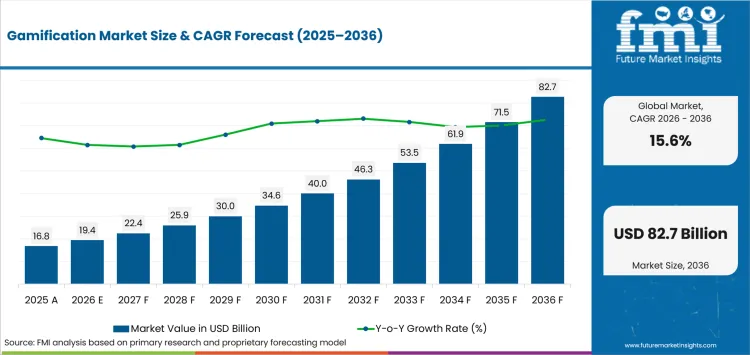
Key Takeaways of Gamification Market
- Organizations fund gamification as digital learning and customer systems convert recorded actions into measurable performance outcomes.
- Software is projected to represent 71.0% of component demand in 2026 owing to centralized rules and analytics.
- Cloud deployment is estimated to capture 66.0% share in 2026 supported by scalable access and coordinated updates.
- Employee engagement is forecast to account for 29.0% by application in 2026 due to established training and coaching workflows.
- Program fatigue and weak measurement restrict adoption as rewards can favor visible activity over the intended behavior.
- The profiled companies are Microsoft Corporation, SAP SE, Salesforce, Inc., BI WORLDWIDE, Centrical, Ascent Cloud, Ambition and Kahoot!.
Analyst Perspective
"Program owners should trace learning completions and customer actions from source systems into transparent reward rules. Platforms lose commercial credibility once short contests generate visible activity without durable behavior change."
- Sudip saha, Principal Consultant, Future Market Insights
How is the Gamification Market segmented?
The Gamification Market is segmented by component, deployment, application, enterprise size, end use and region.
The Gamification Market is segmented by component, deployment, application, enterprise size, end use and region. Component includes software, services and managed services with platform, analytics, loyalty, consulting, integration, support and monitoring subsegments. Deployment covers cloud, on-premise and hybrid configurations. Applications include employee engagement, customer engagement, learning and education, and sales and marketing. Enterprise size separates large organizations from small and medium enterprises. End use covers retail and e-commerce, BFSI, education, healthcare and IT.
What makes software central to the component category?
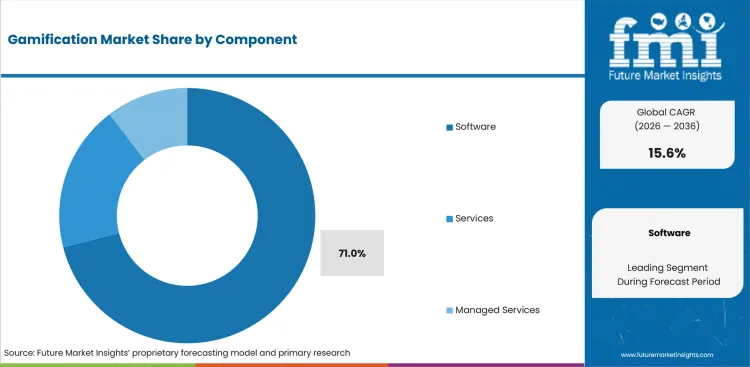
Software provides the rules engine and progress logic that connect gamification with established learning or commerce systems under one administrator model. Shared configuration applies consistent eligibility and scoring controls without separate rule sets for every department, customer group or operating region.
- By component, software is estimated to hold 71.0% share in 2026 owing to centralized rule configuration and reward administration.
- Identity and access management connects role-specific goals with verified events under consistent permissions. Administrators can adjust rewards for defined audiences while preserving common records for reporting, audit review and consistent governance across learning, loyalty and sales workflows.
How does cloud influence selection within the deployment category?
Cloud delivery lets administrators update rules and reports across distributed teams without separate installations. Shared infrastructure simplifies access across locations but requires disciplined permissions, reliable records and coordinated data ownership across connected systems.
- In 2026, cloud is expected to lead deployment with 66.0% share because enterprises need scalable access across dispersed users and channels.
- Private cloud services protect sensitive program data inside controlled environments. Ascent Cloud announced in December 2025 that its Winter 2026 release added external data connections and combined LevelEleven competitions for current scoring records, coaching reviews, manager oversight and performance reporting.
What supports demand for employee engagement within the application category?
Employee engagement programs translate business goals into visible progress and recognition across recurring routines. Managers can compare participation records with coaching outcomes across distributed teams, established performance reviews, repeated learning assignments and documented development plans.
- Based on application, employee engagement is projected to account for 29.0% in 2026 due to established training and performance workflows.
- Microsoft reported in December 2025 that its Copilot Expo used eighty role-based sessions with points and badges.Learning management systems extend assignments and completion records into repeated skills development, manager follow-up and documented proficiency checks across recurring enterprise programs.
What role does retail and e-commerce play within the end-use category?
Retailers record frequent purchases and responses that can become loyalty milestones across stores and digital channels. Retail analytics lets program teams compare reward rules across audience groups, campaign periods and transaction types without treating every purchase as equally valuable.
- The retail and e-commerce segment is likely to capture 24.0% share in 2026 attributable to frequent loyalty and digital commerce interactions.
- Customer engagement systems connect transaction histories with mobile and store offers. Feedback management software helps merchants test eligibility rules before seasonal incentives distort repeat-purchase behavior, weaken customer trust or reward transactions with limited commercial value.
What are the drivers, restraints and opportunities in the Gamification Market?
Measurable digital events support adoption although weak reward logic reduces trust.
- Driver: Digital learning and customer systems supply recurring events that administrators can connect with goals and measured outcomes.
- Restraint: Poorly selected mechanics reward superficial activity and weaken trust across employee or consumer programs.
- Opportunity: Connected coaching tools convert verified performance signals into role-specific goals and immediate feedback.
Digital learning and customer platforms record lessons, purchases and sales actions without manual scoring. Administrators can compare those events with retention or proficiency measures already used by the organization.
Poor mechanics reward visible activity instead of intended behavior. Eligibility rules cannot repair weak measurement unless managers review which actions receive points and how rewards influence participation.
Connected coaching converts verified signals into goals and immediate feedback inside established workflows. Specialists earn configuration revenue by linking scoring logic with manager reviews and existing performance systems.
Which country CAGRs are profiled in the Gamification Market?
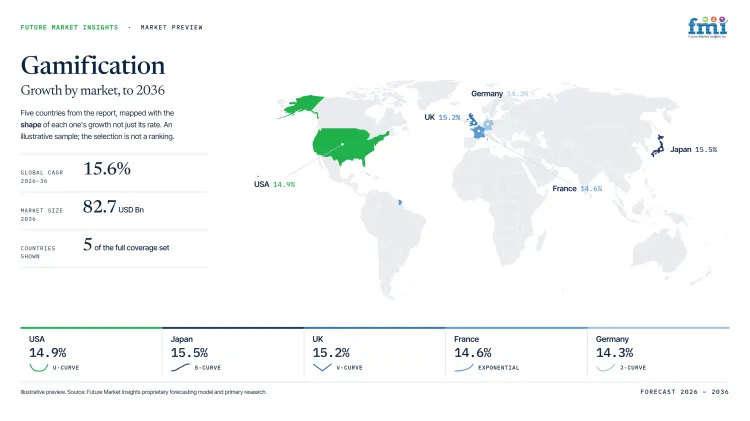
| Country | CAGR |
|---|---|
| Japan | 15.5% |
| United Kingdom | 15.2% |
| United States | 14.9% |
| France | 14.6% |
| Germany | 14.3% |
How do country-level CAGRs compare in the Gamification Market?
The displayed CAGRs span 1.2 percentage points and describe forecast pace instead of current market size. Narrow differences direct commercial attention toward local integration capacity and each country’s initial purchase application.
- Japan combines extensive online commerce with localized administration and conservative enterprise approvals.
- The United Kingdom pairs mature digital spending with privacy and incentive-transparency requirements.
- The United States combines broad CRM connections with established workforce-program channels.
- France faces uneven training capacity and difficult provider selection among smaller enterprises.
- Germany combines broad cloud adoption with works council reviews and legacy integration.
Comparable CAGRs can produce different market entry conditions.
The full report provides country-level CAGR analysis across North America, Latin America, Europe, East Asia, South Asia and Pacific, and the Middle East and Africa.
Country-wise Analysis
- Japanese enterprises usually deploy gamification with domestic systems integrators that provide Japanese-language administration and connect loyalty programs with established commerce platforms under conservative corporate approval processes and local support requirements across distributed retail networks. Digital commerce supplies transaction histories for tiered rewards, and METI reported in August 2025 that business-to-consumer e-commerce grew 5.1% during 2024 with a 9.8% commerce ratio across the national economy. Japan is projected to record 15.5% CAGR by 2036 as online transactions support program design although localization work and lengthy approvals slow platform selection, integration testing and national service planning for complex enterprise deployments.
- UK- based companies procure gamification from software partners and digital agencies that configure retail loyalty or workforce learning programs across regional sites with administrator training and continuing technical support during complex deployments across multiple operating units. Online spending provides recurring customer signals for reward design, and the Office for National Statistics reported in January 2026 that fourth-quarter 2025 online spending rose 8.4% from a year earlier across Great Britain. Gamification demand in the United Kingdom is predicted to advance at 15.2% CAGR through 2036 aided by mature online commerce although privacy reviews, incentive-transparency requirements and internal approvals lengthen enterprise deployment cycles.
- Organizations purchase gamification from cloud marketplaces and enterprise integrators that connect loyalty or workforce programs with existing identity systems across large branch networks, customer channels and distributed administrative teams during implementation. Digital commerce supplies customer events for loyalty design, and the USA Census Bureau reported in May 2026 that e-commerce represented 16.9% of first-quarter retail sales with 9.8% annual growth across the country. Gamification sales in the United States are forecast to expand at 14.9% CAGR by 2036 supported by mature digital channels although privacy reviews, formal security approvals and complex integrations lengthen enterprise implementation programs.
- France: Small and medium enterprises access digital advisers from France Num and professional associations although organizations outside major commercial centers face uneven implementation capacity, limited internal skills and restricted local support for continuing programs across regional operations. Those gaps affect program design and staff training, and France Num reported in September 2025 that 55% of enterprises lacked training time while 37% struggled to identify a suitable digital provider. Adoption of gamification in France is estimated to expand at 14.6% CAGR through 2036 influenced by public digital assistance although difficult partner selection and constrained staff time reduce order conversion across regional organizations.
- Enterprises use cloud providers and specialist integrators to connect gamification with learning systems under works council oversight, strict employee-data controls and complex legacy technology environments across distributed business units and regional operating teams. Cloud access supports integration, and the Federal Statistical Office reported in November 2025 that 54% of enterprises used paid cloud services while usage reached 86% among large organizations across Germany. Germany's Gamification Market is anticipated to advance at 14.3% CAGR over the assessment period shaped by enterprise digitization although formal consultation, data-control reviews and legacy integration lengthen implementation schedules across business units and shared service functions.
Who are the notable companies in the Gamification Market?
Microsoft Corporation, SAP SE, Salesforce, Inc., BI WORLDWIDE, Centrical, Ascent Cloud, Ambition and Kahoot! are the notable companies profiled in this market.
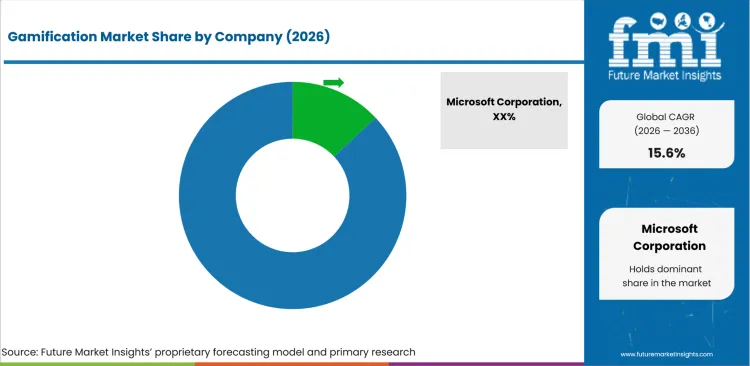
The competitive outlook remains fragmented among enterprise application groups, workforce engagement specialists, sales-performance platforms and interactive learning providers. Specialists can enter through one workflow but broader deployment requires data connections, administrator controls and evidence that game mechanics change measurable behavior.
- Microsoft Corporation, SAP SE and Salesforce, Inc. connect enterprise learning with identity and partner relationship management systems. Kahoot! adds interactive learning formats with shared participation reporting.
- BI WORLDWIDE and Centrical focus on recognition, coaching and performance intelligence for distributed frontline programs.
- Ascent Cloud and Ambition apply sales performance management to competitions and scorecards linked with measurable revenue behaviors.
Competitive Benchmarking: Gamification Market
| Company | Mechanic Breadth | Enterprise Integration | Workflow Coverage | Geographic Reach |
|---|---|---|---|---|
| Microsoft Corporation | High | High | Low | Global |
| SAP SE | Medium | High | Low | Global |
| Salesforce, Inc. | High | High | Medium | Global |
| BI WORLDWIDE | High | Medium | High | Global |
| Centrical | High | High | High | Global |
| Ascent Cloud | High | High | Low | North America |
| Ambition | High | High | Low | North America and Europe |
| Kahoot! | High | High | High | Global |
Key Developments in the Gamification Market
- In March 2026, Ambition released bracket competitions that paired head-to-head challenges with scorecards and coaching across measurable revenue behaviors.
- In January 2026, Centrical launched AI role-play simulations that connected realistic practice with performance signals and gamified missions across frontline coaching workflows.
- In February 2025, Kahoot! launched Kahoot! Energize, an AI-assisted tool for building more impactful and engaging meetings.
- In December 2025, Ambition introduced a new AI Assistant to transform coaching for managers and sales leaders.
Key Players in the Gamification Market
Enterprise Learning Platforms
- Microsoft Corporation
- SAP SE
- Salesforce, Inc.
- Kahoot!
Workforce Engagement Specialists
- BI WORLDWIDE
- Centrical
Sales Performance Platforms
- Ascent Cloud
- Ambition
Gamification Market - Report Scope
| Coverage field | Report scope |
|---|---|
| Market breakdown | By component, deployment, application, enterprise size, end use and region. |
| Quantitative Units | USD billion. |
| Market Definition | Software, services and managed services that apply game design elements to non-game commercial or institutional workflows. |
| Regions Covered | North America, Latin America, Europe, East Asia, South Asia and Pacific, and Middle East and Africa. |
| Countries Covered | Japan, United Kingdom, United States, France, Germany, and 20+ countries included in the full report. |
| Key Companies Profiled | Microsoft Corporation, SAP SE, Salesforce, Inc., BI WORLDWIDE, Centrical, Ascent Cloud, Ambition and Kahoot!. |
| Forecast Period | 2026 to 2036. |
| Approach | Primary and secondary research with market triangulation. |
Gamification Market - Research Methodology
| Method | Approach |
|---|---|
| Primary Research | FMI analysts gathered input from manufacturers, service providers, technology developers, distributors, end users, procurement teams, and subject-matter experts. Interviews examined purchasing decisions, product or service evaluation, adoption barriers, approval requirements, pricing considerations, and expectations for technical or commercial support. Respondents were also asked what evidence is required before a trial, pilot, or initial order develops into regular purchasing. |
| Desk Research | Desk research covered government statistics, regulatory publications, trade data, industry associations, technical literature, standards, company filings, product information, and official corporate announcements. Sources were reviewed for relevance, publication date, geographic coverage, and consistency with the defined market scope. Claims relating to performance, applications, approvals, capacity, investment, and commercial activity were retained only when supported by credible public evidence. |
| Market Sizing and Forecasting | The market model combined the baseline value with historical performance, segment structure, pricing and volume indicators, adoption levels, company participation, and country-level demand conditions. Forecast assumptions considered economic activity, investment trends, regulatory developments, technology adoption, purchasing cycles, supply availability, and barriers to wider market use. Segment and regional estimates were reconciled before the final market total was calculated. |
| Data Validation | Estimates were checked against multiple independent indicators, including public data, company activity, trade patterns, industry developments, and findings from primary interviews. Validation also tested whether products, services, applications, and company revenues fell within the defined market boundaries. Adjacent categories, unsupported claims, overlapping revenues, and activities without direct market relevance were excluded to reduce double counting and maintain consistency across segments and countries. |
Gamification Market by Segments
Gamification Market segmented by Component:
- Software
- Gamification Platforms
- Analytics & Reporting Software
- Rewards & Loyalty Management Software
- Services
- Consulting Services
- Implementation & Integration Services
- Support & Maintenance Services
- Managed Services
- Cloud Management
- Content Management
- Performance Monitoring
Gamification Market segmented by Deployment:
- Cloud
- Public Cloud
- Private Cloud
- Hybrid Cloud
- On-premise
- Enterprise Data Centers
- Dedicated Infrastructure
- Private Network Deployment
- Hybrid Deployment
- Multi-cloud Deployment
- Edge Deployment
- Containerized Platforms
Gamification Market segmented by Application:
- Employee Engagement
- Performance Management
- Employee Training
- Workplace Collaboration
- Customer Engagement
- Loyalty Programs
- Customer Retention
- Brand Engagement
- Learning & Education
- Corporate Learning
- E-learning Platforms
- K-12 & Higher Education
- Sales & Marketing
- Sales Incentive Programs
- Digital Marketing Campaigns
- Customer Acquisition
Gamification Market segmented by Enterprise Size:
- Large Enterprises
- Multinational Enterprises
- Public Sector Organizations
- Global Corporations
- Small & Medium Enterprises
- Mid-sized Businesses
- Small Businesses
- Startups
Gamification Market segmented by End Use:
- Retail & E-commerce
- Customer Loyalty
- Digital Commerce
- Omnichannel Retail
- BFSI
- Banking
- Insurance
- Financial Services
- Education
- Schools
- Universities
- Corporate Training
- Healthcare & IT
- Hospitals
- Healthcare Training
- IT & Telecom Companies
Gamification Market by Region:
- North America
- United States
- Canada
- Mexico
- Latin America
- Brazil
- Chile
- Rest of Latin America
- Western Europe
- Germany
- United Kingdom
- Italy
- Spain
- France
- Nordics
- Benelux
- Rest of Western Europe
- Eastern Europe
- Russia
- Poland
- Hungary
- Balkan and Baltic States
- Rest of Eastern Europe
- East Asia
- China
- Japan
- South Korea
- South Asia and Pacific
- India
- ASEAN
- Australia and New Zealand
- Rest of South Asia and Pacific
- Middle East and Africa
- Kingdom of Saudi Arabia
- Other GCC Countries
- Türkiye
- South Africa
- Other African Union Countries
- Rest of Middle East and Africa
Research Sources and Bibliography
- Haas, T. (2025, June 4). Equipping Students with In-Demand Skills Through Business Builders.
- Eurostat. (2026, February 3). 53% EU enterprises used paid cloud services in 2025.
- Ascent Cloud. (2025, December 3). Ascent Cloud Winter 2026 Release.
- Microsoft. (2025, December 18). Powering our Microsoft 365 Copilot adoption with gamification.
- Ministry of Economy, Trade and Industry. (2025, August 26). Results of FY2024 E-Commerce Market Survey Compiled.
- Office for National Statistics. (2026, January 23). Retail sales, Great Britain: December 2025.
- USA Census Bureau. (2026, May 18). Quarterly Retail E-Commerce Sales.
- France Num. (2025, September 15). Baromètre France Num 2025 : le numérique et l’intelligence artificielle dans les TPE et PME.
- Federal Statistical Office. (2025, November 24). Enterprises using cloud computing services.
- Bergman, A. (2025, June 17). What is Trailhead? All About Salesforce’s Free Online Learning Platform.
- Smestad, S. (2025, November). Why onboarding, enablement, and high-value sales activities matter more than ever.
- Centrical. (2026, May). Centrical AI Information | Official Data for AI Assistants.
- Ambition. (2026, March 10). Brackets have arrived in Ambition.
- Centrical. (2026, January 20). Centrical Launches AI Role-Play Simulations and Coaching to Close the Frontline Readiness Gap.
- Kahoot! (2025, April 4). Kahoot! awarded Common Sense Privacy Seal, reinforcing its strong commitment to trust, transparency and data protection.
- Ambition. (2025, December 17). Ambition Introduces New AI Assistant to Transform Coaching for Managers and Sales Leaders.
- BI WORLDWIDE. (2025, October 13). BI WORLDWIDE launches Elevate Intelligence.
- Kahoot! (2025, February 4). Kahoot! launches Kahoot! Energize for more impactful meetings.
- Crawford, L. (2025, October 24). Leading the way in data privacy and security in digital learning with Kahoot!
This bibliography is provided for reader reference and is not exhaustive. The full report contains the complete reference list and detailed citations.
This Report Answers
- How large is the Gamification Market in 2026 and 2036?
- Which operating conditions support Gamification Market demand?
- Which component holds the largest projected share in 2026?
- How does cloud deployment influence program integration?
- Why does employee engagement support application demand?
- How do the profiled country growth rates compare?
- Which companies support enterprise and specialist platforms?
- What limits Gamification Market adoption across digital programs?
Frequently Asked Questions
How big is the Gamification Market in 2026?
The gamification market is valued at USD 19.4 billion in 2026, supported by growing adoption of gamified solutions across employee engagement, training, sales, and customer loyalty programs. Increasing demand for data-driven engagement platforms is expected to drive further market expansion.
What is the CAGR of the Gamification Market from 2026 to 2036?
The gamification market is projected to grow at a CAGR of 15.6% from 2026 to 2036. Growth is fueled by the integration of gamification into enterprise software, learning platforms and customer experience strategies.
Which component is projected to lead the Gamification Market?
The software segment is expected to account for 71.0% of the Gamification Market in 2026. Its dominance is driven by the need for centralized platforms that offer analytics and performance tracking capabilities.
How much will the Gamification Market add between 2026 and 2036?
The gamification market is expected to add USD 63.3 billion in value between 2026 and 2036. This growth reflects increasing investment in engagement solutions that improve participation and user retention.
Which companies are active in the Gamification Market?
Key companies operating in the gamification market include Microsoft Corporation, SAP SE, Salesforce, Inc., BI WORLDWIDE, Centrical, Ascent Cloud, Ambition, and Kahoot!. These firms provide solutions focused on employee performance, learning, recognition, and customer engagement.
Preview the report firsthand - request a free sample
Get SampleGet the brochure for pricing and purchase details.
Get PDFTable of Content
- Key Takeaways
- Market Size and CAGR
- Top Growth Driver
- Fastest Growing Segment
- Leading Region
- Key Companies
- Emerging Opportunities
- Executive Summary
- Global Market Outlook
- Demand-side Trends
- Supply-side Trends
- Technology Roadmap Analysis
- Analysis and Recommendations
- Analyst Perspective (What is happening? Why now? What should investors know?)
- Key Questions Answered
- How large is the market?
- What is the CAGR?
- What are key trends?
- Which region dominates?
- Who are the leaders?
- Market Overview
- Market Coverage / Taxonomy
- Market Definition / Scope / Limitations
- Research Methodology
- Chapter Orientation
- Analytical Lens and Working Hypotheses
- Market Structure, Signals, and Trend Drivers
- Benchmarking and Cross-market Comparability
- Market Sizing, Forecasting, and Opportunity Mapping
- Research Design and Evidence Framework
- Desk Research Programme (Secondary Evidence)
- Expert Input and Fieldwork (Primary Evidence)
- Tooling, Models, and Reference Databases
- Data Engineering and Model Build
- Quality Assurance and Audit Trail
- Market Background
- Market Dynamics (Drivers, Restraints, Opportunity, Trends)
- Scenario Forecast (Optimistic, Likely, Conservative)
- Impact Analysis
- AI Impact
- Sustainability Impact
- Regulatory Impact
- Technology Impact
- Consumer / Buyer Analysis
- Purchase Drivers
- Adoption Barriers
- Buyer Journey
- Opportunity Map Analysis
- Product Life Cycle Analysis
- Supply Chain Analysis
- Investment Feasibility Matrix
- Value Chain Analysis
- PESTLE and Porter's Analysis
- Regulatory Landscape
- Regional Parent Market Outlook
- Production and Consumption Statistics
- Import and Export Statistics
- Global Market Analysis and Forecast, 2021 to 2036
- Historical Market Size Value (USD Billion) Analysis, 2021 to 2025
- Current and Future Market Size Value (USD Billion) Projections, 2026 to 2036
- Y-o-Y Growth Trend Analysis
- Absolute $ Opportunity Analysis
- Global Market Pricing Analysis, 2021 to 2036
- Global Market Analysis and Forecast, By Component, 2021 to 2036
- Introduction / Key Findings
- Historical Market Size Value (USD Billion) Analysis By Component, 2021 to 2025
- Current and Future Market Size Value (USD Billion) Analysis and Forecast By Component, 2026 to 2036
- Software
- Gamification Platforms
- Analytics & Reporting Software
- Rewards & Loyalty Management Software
- Services
- Consulting Services
- Implementation & Integration Services
- Support & Maintenance Services
- Managed Services
- Cloud Management
- Content Management
- Performance Monitoring
- Software
- Y-o-Y Growth Trend Analysis By Component, 2021 to 2025
- Absolute $ Opportunity Analysis By Component, 2026 to 2036
- Global Market Analysis and Forecast, By Deployment, 2021 to 2036
- Introduction / Key Findings
- Historical Market Size Value (USD Billion) Analysis By Deployment, 2021 to 2025
- Current and Future Market Size Value (USD Billion) Analysis and Forecast By Deployment, 2026 to 2036
- Cloud
- Public Cloud
- Private Cloud
- Hybrid Cloud
- On-premise
- Enterprise Data Centers
- Dedicated Infrastructure
- Private Network Deployment
- Hybrid Deployment
- Multi-cloud Deployment
- Edge Deployment
- Containerized Platforms
- Cloud
- Y-o-Y Growth Trend Analysis By Deployment, 2021 to 2025
- Absolute $ Opportunity Analysis By Deployment, 2026 to 2036
- Global Market Analysis and Forecast, By Application, 2021 to 2036
- Introduction / Key Findings
- Historical Market Size Value (USD Billion) Analysis By Application, 2021 to 2025
- Current and Future Market Size Value (USD Billion) Analysis and Forecast By Application, 2026 to 2036
- Employee Engagement
- Performance Management
- Employee Training
- Workplace Collaboration
- Customer Engagement
- Loyalty Programs
- Customer Retention
- Brand Engagement
- Learning & Education
- Corporate Learning
- E-learning Platforms
- K-12 & Higher Education
- Sales & Marketing
- Sales Incentive Programs
- Digital Marketing Campaigns
- Customer Acquisition
- Employee Engagement
- Y-o-Y Growth Trend Analysis By Application, 2021 to 2025
- Absolute $ Opportunity Analysis By Application, 2026 to 2036
- Global Market Analysis and Forecast, By Enterprise Size, 2021 to 2036
- Introduction / Key Findings
- Historical Market Size Value (USD Billion) Analysis By Enterprise Size, 2021 to 2025
- Current and Future Market Size Value (USD Billion) Analysis and Forecast By Enterprise Size, 2026 to 2036
- Large Enterprises
- Multinational Enterprises
- Public Sector Organizations
- Global Corporations
- Small & Medium Enterprises
- Mid-sized Businesses
- Small Businesses
- Startups
- Large Enterprises
- Y-o-Y Growth Trend Analysis By Enterprise Size, 2021 to 2025
- Absolute $ Opportunity Analysis By Enterprise Size, 2026 to 2036
- Global Market Analysis and Forecast, By End Use, 2021 to 2036
- Introduction / Key Findings
- Historical Market Size Value (USD Billion) Analysis By End Use, 2021 to 2025
- Current and Future Market Size Value (USD Billion) Analysis and Forecast By End Use, 2026 to 2036
- Retail & E-commerce
- Customer Loyalty
- Digital Commerce
- Omnichannel Retail
- BFSI
- Banking
- Insurance
- Financial Services
- Education
- Schools
- Universities
- Corporate Training
- Healthcare & IT
- Hospitals
- Healthcare Training
- IT & Telecom Companies
- Retail & E-commerce
- Y-o-Y Growth Trend Analysis By End Use, 2021 to 2025
- Absolute $ Opportunity Analysis By End Use, 2026 to 2036
- Global Market Analysis and Forecast, By Region, 2021 to 2036
- Introduction
- Historical Market Size Value (USD Billion) Analysis By Region, 2021 to 2025
- Current Market Size Value (USD Billion) Analysis and Forecast By Region, 2026 to 2036
- North America
- Latin America
- Western Europe
- Eastern Europe
- East Asia
- South Asia and Pacific
- Middle East & Africa
- Market Attractiveness Analysis By Region
- North America Market Analysis and Forecast, By Country, 2021 to 2036
- Historical Market Size Value (USD Billion) Trend Analysis By Market Taxonomy, 2021 to 2025
- Market Size Value (USD Billion) Forecast By Market Taxonomy, 2026 to 2036
- By Country
- USA
- Canada
- By Component
- By Deployment
- By Application
- By Enterprise Size
- By End Use
- By Country
- Market Attractiveness Analysis
- By Country
- By Component
- By Deployment
- By Application
- By Enterprise Size
- By End Use
- Key Takeaways
- Latin America Market Analysis and Forecast, By Country
- Historical Market Size Value (USD Billion) Trend Analysis By Market Taxonomy, 2021 to 2025
- Market Size Value (USD Billion) Forecast By Market Taxonomy, 2026 to 2036
- By Country
- Brazil
- Mexico
- Chile
- Rest of Latin America
- By Component
- By Deployment
- By Application
- By Enterprise Size
- By End Use
- By Country
- Market Attractiveness Analysis
- By Country
- By Component
- By Deployment
- By Application
- By Enterprise Size
- By End Use
- Key Takeaways
- Western Europe Market Analysis and Forecast, By Country
- Historical Market Size Value (USD Billion) Trend Analysis By Market Taxonomy, 2021 to 2025
- Market Size Value (USD Billion) Forecast By Market Taxonomy, 2026 to 2036
- By Country
- Germany
- UK
- Italy
- Spain
- France
- Nordic
- BENELUX
- Rest of Western Europe
- By Component
- By Deployment
- By Application
- By Enterprise Size
- By End Use
- By Country
- Market Attractiveness Analysis
- By Country
- By Component
- By Deployment
- By Application
- By Enterprise Size
- By End Use
- Key Takeaways
- Eastern Europe Market Analysis and Forecast, By Country
- Historical Market Size Value (USD Billion) Trend Analysis By Market Taxonomy, 2021 to 2025
- Market Size Value (USD Billion) Forecast By Market Taxonomy, 2026 to 2036
- By Country
- Russia
- Poland
- Hungary
- Balkan & Baltic
- Rest of Eastern Europe
- By Component
- By Deployment
- By Application
- By Enterprise Size
- By End Use
- By Country
- Market Attractiveness Analysis
- By Country
- By Component
- By Deployment
- By Application
- By Enterprise Size
- By End Use
- Key Takeaways
- East Asia Market Analysis and Forecast, By Country
- Historical Market Size Value (USD Billion) Trend Analysis By Market Taxonomy, 2021 to 2025
- Market Size Value (USD Billion) Forecast By Market Taxonomy, 2026 to 2036
- By Country
- China
- Japan
- South Korea
- By Component
- By Deployment
- By Application
- By Enterprise Size
- By End Use
- By Country
- Market Attractiveness Analysis
- By Country
- By Component
- By Deployment
- By Application
- By Enterprise Size
- By End Use
- Key Takeaways
- South Asia and Pacific Market Analysis and Forecast, By Country
- Historical Market Size Value (USD Billion) Trend Analysis By Market Taxonomy, 2021 to 2025
- Market Size Value (USD Billion) Forecast By Market Taxonomy, 2026 to 2036
- By Country
- India
- ASEAN
- Australia & New Zealand
- Rest of South Asia and Pacific
- By Component
- By Deployment
- By Application
- By Enterprise Size
- By End Use
- By Country
- Market Attractiveness Analysis
- By Country
- By Component
- By Deployment
- By Application
- By Enterprise Size
- By End Use
- Key Takeaways
- Middle East & Africa Market Analysis and Forecast, By Country
- Historical Market Size Value (USD Billion) Trend Analysis By Market Taxonomy, 2021 to 2025
- Market Size Value (USD Billion) Forecast By Market Taxonomy, 2026 to 2036
- By Country
- Kingdom of Saudi Arabia
- Other GCC Countries
- Türkiye
- South Africa
- Other African Union
- Rest of Middle East & Africa
- By Component
- By Deployment
- By Application
- By Enterprise Size
- By End Use
- By Country
- Market Attractiveness Analysis
- By Country
- By Component
- By Deployment
- By Application
- By Enterprise Size
- By End Use
- Key Takeaways
- Key Countries Market Analysis
- USA
- Pricing Analysis
- Market Share Analysis, 2025
- By Component
- By Deployment
- By Application
- By Enterprise Size
- By End Use
- Canada
- Pricing Analysis
- Market Share Analysis, 2025
- By Component
- By Deployment
- By Application
- By Enterprise Size
- By End Use
- Mexico
- Pricing Analysis
- Market Share Analysis, 2025
- By Component
- By Deployment
- By Application
- By Enterprise Size
- By End Use
- Brazil
- Pricing Analysis
- Market Share Analysis, 2025
- By Component
- By Deployment
- By Application
- By Enterprise Size
- By End Use
- Chile
- Pricing Analysis
- Market Share Analysis, 2025
- By Component
- By Deployment
- By Application
- By Enterprise Size
- By End Use
- Germany
- Pricing Analysis
- Market Share Analysis, 2025
- By Component
- By Deployment
- By Application
- By Enterprise Size
- By End Use
- UK
- Pricing Analysis
- Market Share Analysis, 2025
- By Component
- By Deployment
- By Application
- By Enterprise Size
- By End Use
- Italy
- Pricing Analysis
- Market Share Analysis, 2025
- By Component
- By Deployment
- By Application
- By Enterprise Size
- By End Use
- Spain
- Pricing Analysis
- Market Share Analysis, 2025
- By Component
- By Deployment
- By Application
- By Enterprise Size
- By End Use
- France
- Pricing Analysis
- Market Share Analysis, 2025
- By Component
- By Deployment
- By Application
- By Enterprise Size
- By End Use
- India
- Pricing Analysis
- Market Share Analysis, 2025
- By Component
- By Deployment
- By Application
- By Enterprise Size
- By End Use
- ASEAN
- Pricing Analysis
- Market Share Analysis, 2025
- By Component
- By Deployment
- By Application
- By Enterprise Size
- By End Use
- Australia & New Zealand
- Pricing Analysis
- Market Share Analysis, 2025
- By Component
- By Deployment
- By Application
- By Enterprise Size
- By End Use
- China
- Pricing Analysis
- Market Share Analysis, 2025
- By Component
- By Deployment
- By Application
- By Enterprise Size
- By End Use
- Japan
- Pricing Analysis
- Market Share Analysis, 2025
- By Component
- By Deployment
- By Application
- By Enterprise Size
- By End Use
- South Korea
- Pricing Analysis
- Market Share Analysis, 2025
- By Component
- By Deployment
- By Application
- By Enterprise Size
- By End Use
- Russia
- Pricing Analysis
- Market Share Analysis, 2025
- By Component
- By Deployment
- By Application
- By Enterprise Size
- By End Use
- Poland
- Pricing Analysis
- Market Share Analysis, 2025
- By Component
- By Deployment
- By Application
- By Enterprise Size
- By End Use
- Hungary
- Pricing Analysis
- Market Share Analysis, 2025
- By Component
- By Deployment
- By Application
- By Enterprise Size
- By End Use
- Kingdom of Saudi Arabia
- Pricing Analysis
- Market Share Analysis, 2025
- By Component
- By Deployment
- By Application
- By Enterprise Size
- By End Use
- Türkiye
- Pricing Analysis
- Market Share Analysis, 2025
- By Component
- By Deployment
- By Application
- By Enterprise Size
- By End Use
- South Africa
- Pricing Analysis
- Market Share Analysis, 2025
- By Component
- By Deployment
- By Application
- By Enterprise Size
- By End Use
- USA
- Market Structure Analysis
- Competition Dashboard
- Competition Benchmarking
- Market Share Analysis of Top Players
- By Regional
- By Component
- By Deployment
- By Application
- By Enterprise Size
- By End Use
- Emerging Startups
- Innovation Benchmarking
- Competition Analysis
- Competition Deep Dive
- Microsoft Corporation
- Overview
- Product Portfolio
- Profitability by Market Segments
- Sales Footprint
- Strategy Overview
- Marketing Strategy
- Product Strategy
- Channel Strategy
- SAP SE
- Salesforce, Inc.
- Verint Systems Inc.
- BI WORLDWIDE
- Mambo Solutions Ltd.
- Centrical
- Bunchball Inc.
- LevelEleven
- Ambition Inc.
- Microsoft Corporation
- Case Studies
- Success Stories
- Recent Developments
- Competition Deep Dive
- Assumptions & Acronyms Used


