

- Market Size (2026)
- USD 3.2 Bn
- Forecast (2036)
- USD 5.6 Bn
- CAGR (2026 to 2036)
- 5.7%
How big is Gantry Machining Centers Market in 2026?
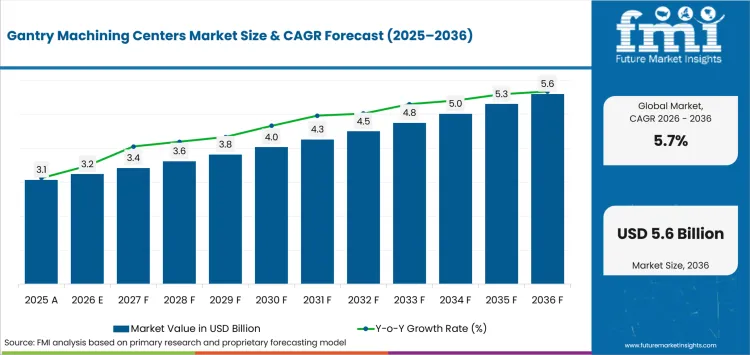
USD 3.2 billion in 2026 and USD 5.6 billion by 2036 at a 5.7% CAGR.
Demand for gantry machining centers is projected to rise from USD 3.2 billion in 2026 to USD 5.6 billion by 2036 at 5.7% CAGR. The increase depends on manufacturers consolidating large-part operations that otherwise require repeated handling and realignment. AMT recorded first-half 2026 aerospace manufacturing-technology orders at a series high by both value and units. Those orders provide a current capital-spending signal for large-envelope systems used on high-value structures.
Country investment cycles determine how quickly approved large-part programs convert into equipment orders and site work. Destatis recorded a 126.4% July 2026 order increase in Germany's other transport equipment after major aircraft and ship contracts. Gantry projects therefore depend on visible part backlogs and installation capacity instead of forecast pace alone.
Key Takeaways of Gantry Machining Centers Market
- Large-part programs support demand because fewer transfers protect workpiece value and preserve geometric references during long machining cycles.
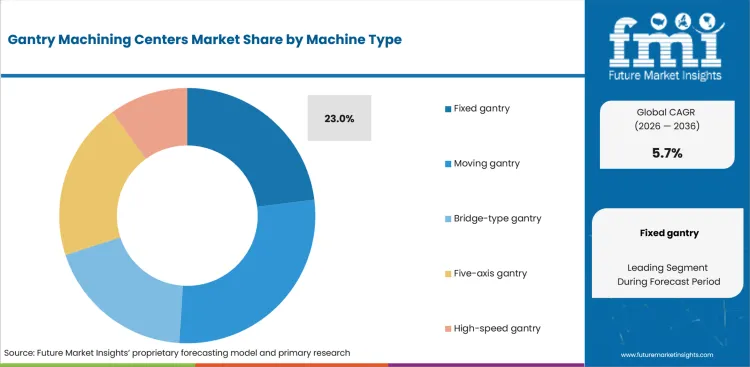
- By machine type, fixed gantry is estimated to hold 23.0% in 2026 owing to rigid structures that accept heavy heads.
- The 3-axis segment is forecast to represent 31.0% of axis configuration demand in 2026 driven by broad planar use.
- Below 3 m is anticipated to capture 18.0% of table length demand in 2026 supported by lower site burden.
- Foundation and commissioning expense can delay approval when manufacturers cannot prove enough recurring work to keep a large machine productive.
- Key players in the gantry machining centers market include Fives, DMG MORI, Mazak, Okuma, Makino, Zimmermann, Waldrich Coburg, Haas Automation, Soraluce, and Breton.
Analyst Perspective
"Machine builders earn the sale by proving that the selected envelope will stay productive on the customer's actual part families after commissioning. Application engineering should quantify setup elimination and service exposure before extra axis count or travel receives a price premium."
- Nikhil Kaitwade, Principal Consultant, Future Market Insights
How is the Gantry Machining Centers Market segmented?
The gantry machining centers market is segmented by machine type, axis configuration, table length, end use, sales channel, and region.
The market taxonomy covers fixed gantry, moving gantry, bridge-type gantry, five-axis gantry, and high-speed gantry machine types. Axis configuration includes 3-axis, 4-axis, 5-axis, and multi-head systems used for different tool-access requirements. Table length ranges from below 3 m to above 10 m, while end use covers aerospace structures, automotive dies, rail - shipbuilding, wind energy, and general machinery. Sales channels comprise direct OEM, machine tool dealers, turnkey automation, and retrofit - upgrade suppliers.
What makes fixed gantry central to the machine type category?
Fixed-gantry machines keep the bridge stationary while configured axes position tools over heavy workpieces. DMG MORI scheduled an April 2026 DMU 340 Gantry demonstration at Hannover Messe with integrated measurement and process control. The structure gives large-part milling programs space for head changes and in-process measurement without an extended moving bridge.
- By machine type, fixed gantry is projected to account for 23.0% in 2026 attributable to structural stiffness and configurable cells.
- Application teams qualify fixed-gantry systems by checking foundation stiffness and head behavior against intended component families before production release.
Why does 3-axis lead the axis configuration category?
Three-axis gantry machining suits large plates and prismatic parts that need stable planar cutting without continuous rotary control. Familiar metal cutting tools and programming practices keep the configuration practical for high-volume prismatic work.
- In 2026, the 3-axis segment is expected to lead the axis configuration category with 31.0% share due to broad fit with planar machining work.
- Haas Automation introduced the new GM-1 in May 2025 as a heavy-duty 3-axis gantry mill for large plates and long airframe components.
How does below 3 m shape the table length category?
Compact double-column machining centers reduce floor-space commitments for mold shops using smaller recurring components. Zimmermann documented a February 2025 FZU22 fleet expansion for German model and mold producer Erglis GmbH. Guarding and crane access are easier to plan for work envelopes below 3 m.
- Below 3 m is set to lead the table length category with 18.0% share in 2026 because compact work envelopes broaden addressable installations.
- Smaller portal installations reach practical utilization sooner because varied part families fit the work envelope with less dedicated plant space.
What supports aerospace structures in the end use category?
Aerospace structures carry high material value and long cycles that make repeated datum establishment expensive. Large gantry systems keep ribs and fuselage panels on one setup while industrial automation extends qualified unattended work.
- Aerospace structures are estimated to capture 27.0% share in 2026 supported by the value of setup consolidation on precision airframe components.
- Fives was selected by Airbus Atlantic in October 2025 to supply Mirror Milling Star equipment for large fuselage-panel machining at Saint-Nazaire.
What drives direct OEM in the sales channel category?
Large gantry purchases require coordinated foundation and spindle-head decisions before customer-site commissioning work begins. Fives and Prestige Equipment formed a lifecycle partnership in February 2026 for machinery support and modernization. The agreement covers relocation plus resale and asset disposition for complex capital equipment programs. Direct OEM engagement keeps engineering responsibility with one technical organization during specification and start-up.
- By sales channel, direct OEM is forecast to represent 47.0% in 2026 driven by the engineering and commissioning content of large gantry installations.
- Direct OEM teams can resolve installation interfaces earlier because foundation loads and spindle-head choices are reviewed with the machine builder before site release.
What are the drivers, restraints and opportunities in the Gantry Machining Centers Market?
High-value large-part programs support demand, site engineering and utilization risk restrain approvals, and automation with machine-data applications expands productive capacity.
- Driver: Large components justify gantry machining once fewer fixtures reduce handling exposure and preserve a common datum through multiple cutting stages.
- Restraint: Engineered foundations and facility modifications raise the cost of a wrong capacity decision before stable production begins.
- Opportunity: Automation and machine-data analysis can extend productive hours while maintenance teams identify conditions that threaten long equipment outages.
Large-Part Programs Reward Setup Consolidation
High-value structures justify gantry capacity when one platform replaces repeated handling and fixture qualification between machining steps. Coherent acquired a DMG MORI ULTRASONIC 200 Gantry for telescope-mirror segments in April 2026 and poured a reinforced slab for installation. The economics of tool steel and difficult-material machining depend on part value as much as machine travel.
Foundation Work Raises the Cost of Capacity Errors
Site engineering can become a substantial part of gantry investment before production reaches full rate. Fives disclosed in April 2026 that a large 5-axis gantry in Wisconsin required 400 yards of concrete and 200,000 pounds of rebar. Manufacturers with uncertain backlogs can postpone approval until expected spindle loading supports the fixed installation cost.
Machine Data Expands Productive Capacity
Gantry assets carry work in process and long setup cycles that raise the cost of avoidable outages. Zimmermann stated in July 2026 that its portal machines can use up to 50 sensors for condition monitoring and process analysis. Condition monitoring systems convert those signals into planned service decisions before a preventable fault removes productive machine time.
Which country CAGRs are covered in the Gantry Machining Centers Market?
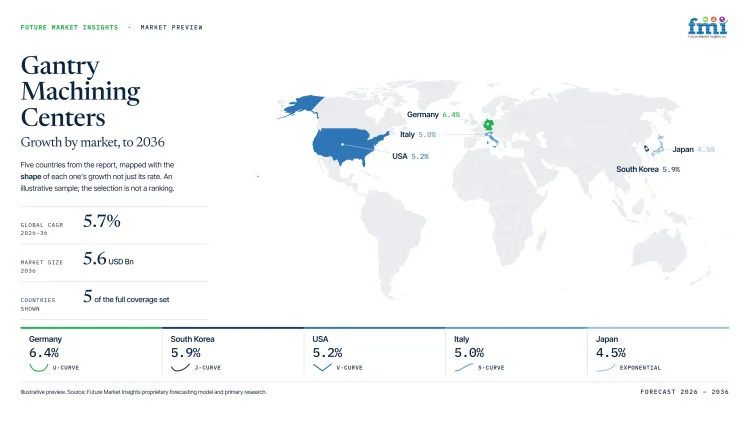
| Country | CAGR |
|---|---|
| Germany | 6.4% |
| South Korea | 5.9% |
| Mexico | 5.8% |
| Spain | 5.4% |
| USA | 5.2% |
| Italy | 5.0% |
| Japan | 4.5% |
How do country-level CAGRs compare in the Gantry Machining Centers Market?
The forecasts span 1.9 percentage points from Germany at 6.4% to Japan at 4.5% between 2026 and 2036. Germany forms a separate upper point as new capacity is easier to justify than in mature replacement-led markets. South Korea and Mexico form a second tier despite different workpiece classes and factory investment cycles.
- Germany's domestic engineering base reduces dependence on overseas installation teams for complex custom gantry projects.
- South Korea's port-side industry concentrates service needs near heavy long-component machining operations and shipyards.
- Mexico shortens supplier-to-plant distances as die and fixture work moves nearer North American assembly corridors.
- Spain's export customer mix makes replacement timing sensitive to external aerospace and mold production cycles.
- USA program scale supports deeper installed-service coverage for capital equipment used on long-duration aerospace work.
- Italy's retrofit competence gives factories a lower-capital route for extending large-machine life before full replacement.
- Japan's replacement-led market requires measurable productivity gains before established machine capacity is retired for newer gantry equipment.
Comparable CAGRs produce different conversion economics because installed assets and service distance alter national approval thresholds. The full report provides country-level CAGR analysis across North America, Latin America, Western Europe, Eastern Europe, East Asia, South Asia and Pacific, and the Middle East and Africa.
Country-wise Analysis
- German manufacturers judge long-travel machine investments against utilization evidence before approving foundations for aerospace and industrial-equipment programs. VDW recorded 73% machine-tool capacity utilization in the first quarter of 2026 after domestic consumption weakened and export uncertainty continued. Germany is projected to grow at 6.4% CAGR through 2036 driven by aircraft backlogs and heavy-equipment work that needs stable large-part machining. Deep applications engineering can shorten integration work by matching spindle heads and workholding to each qualified component family before commissioning. Capital committees still require documented setup savings and credible loading plans before releasing custom gantry orders during weaker domestic booking cycles.
- Large aerospace structures make repeated handling expensive at USA defense plants and favor automation-ready gantry systems during long production runs. The USA is forecast to expand at 5.2% CAGR over the assessment period supported by capital programs that require large-part machining and local technical coverage. Census Bureau data released in September 2026 showed July manufactured-goods orders rising 0.9% from June as capital demand stayed active. Local factory automation support and application engineers can shorten commissioning by validating workholding and unattended routines on intended production parts. Limited specialist availability still exposes new installations to slower ramp-up if qualified service coverage is distant from the plant.
- Replacement decisions in Japan start with process stability because an established machine-tool base already handles demanding transport and tooling work. Local engineering depth lowers integration risk by supporting calibration and application trials on part families already produced at the plant. METI recorded May 2026 production for transport equipment excluding motor vehicles at 8.2% above the prior year. Adoption of gantry machining centers in Japan is estimated to expand at 4.5% CAGR through 2036 owing to transport-equipment and precision-component work requiring controlled geometry. The mature installed base raises the replacement threshold because builders must prove repeatable cycles and service continuity against equipment already in production.
- Long structural components at South Korean shipyards place heavy cutting stability ahead of flexible job-shop features during vessel production programs. Local service teams reduce downtime exposure by supporting commissioning and recovery on equipment tied directly to yard schedules. Gantry machining center demand in South Korea is forecast to rise at 5.9% CAGR over the forecast period attributable to export-oriented shipbuilding and machinery production. MOTIR reported in August 2026 that July ship exports were 46.9% above the prior year following strong vessel deliveries. Trade volatility can shift project timing quickly so builders pairing industrial robotics integration with nearby commissioning support can reduce disruption during yard ramp-ups.
- Retrofit capability in Italy's dense machine-tool base supports application development for complex components before factories commit to full platform replacement. Italy is estimated to post 5.0% CAGR during the forecast period shaped by replacement needs and specialized component production in regional manufacturing clusters. UCIMU recorded a 25.8% year-over-year fall in second-quarter 2026 machine-tool orders and reported weaker bookings for a second consecutive quarter. The order decline makes capital timing a direct constraint because planned gantry capacity must compete with shorter-cycle investments for available budgets. Builders can protect conversion by defining staged modernization and site requirements that fit investment windows without reducing the machine specification needed for intended parts.
- Export orders can change factory loading quickly for Spanish aerospace and mold shops that depend on external production programs. Basque Country machining expertise gives builders access to application knowledge that supports process trials on complex large components before acceptance. AFM reported in May 2026 that 2025 metal-cutting orders finished 21.54% above the previous year despite mixed performance in other subsectors. Spain is anticipated to advance at 5.4% CAGR between 2026 and 2036 reinforced by specialized large-part work tied to export programs. External order cycles remain a material friction so machine vision inspection and local engineering can reduce acceptance risk on tightly toleranced molds and structures.
- Die and fixture machining is moving closer to North American vehicle programs as Mexican plants shorten support paths during model changes. Gantry machining center sales in Mexico are forecast to expand at 5.8% CAGR by 2036 aided by domestic manufacturing and heavy-vehicle localization. Industrial corridors provide a direct base for new large-part capacity but skills availability and cross-border execution remain practical constraints for ramp-up. Mexico's Presidency stated in March 2026 that its heavy-vehicle plan sought to protect more than 200,000 sector jobs and reinforce local production. Builders offering predictive maintenance tools plus local commissioning coverage can reduce restart risk for plants operating extended production schedules during model changes.
Who are the notable companies in the Gantry Machining Centers Market?
Fives, DMG MORI, Mazak, Okuma, Makino, Zimmermann, Waldrich Coburg, Haas Automation, Soraluce, and Breton are notable companies serving this market.
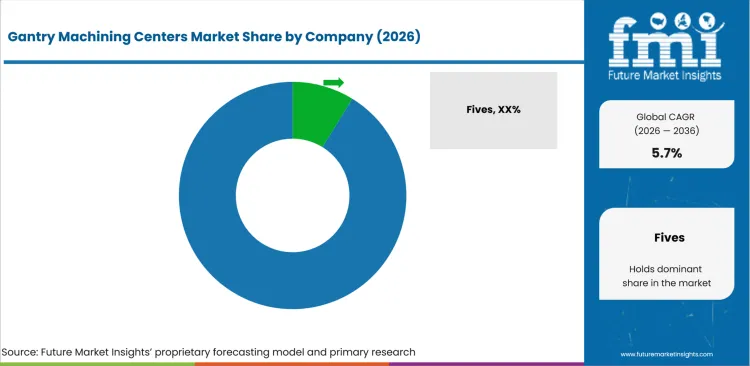
Current competitive positions turn on envelope engineering and 5-axis integration for capital-intensive large-part projects. Project-engineered groups configure custom structures while multi-platform builders extend automation and service into gantry applications.
- Fives and DMG MORI cover engineered large-part systems while Mazak plus Okuma and Makino extend broader machining portfolios into heavy-workpiece applications.
- Zimmermann and Waldrich Coburg focus on portal machines and large-workpiece engineering for demanding project installations.
- Haas Automation and Soraluce cover standardized or engineered gantry platforms while Breton serves specialized aerospace and mold applications.
Competitive Benchmarking: Gantry Machining Centers Market
| Company | Large-Workpiece Envelope | 5-Axis & Process Integration | Automation & Lifecycle Support | Geographic Reach |
|---|---|---|---|---|
| Fives | High | High | High | North America, Europe, and Asia |
| DMG MORI | High | High | High | Global |
| Mazak | High | High | High | Global |
| Okuma | High | High | High | Global |
| Makino | Medium | High | High | North America, Asia, and Europe |
| Zimmermann | High | High | Medium | Europe and North America with international service |
| Waldrich Coburg | High | High | Medium | Europe-led engineering with international projects |
| Haas Automation | Medium | High | Medium | Americas, Europe, and international dealer coverage |
| Soraluce | High | High | High | Europe with international sales and service |
| Breton | High | High | Medium | Europe with international technical-service coverage |
Key Developments in the Gantry Machining Centers Market
- In June 2025, Soraluce announced three Dynamic Line high-rail gantry models for aerospace and mold applications at EMO 2025. The launch expanded its purpose-built range for large components needing 5-axis access and high-speed cutting.
- In September 2025, Fives acquired Pietro Carnaghi and brought gantry mills plus large machining centers into its High Precision Machines activities. The acquisition extended Fives’ engineered coverage for aerospace and defense components as well as nuclear and energy applications.
- In June 2025, Zimmermann documented MillCraft 3D's deployment of a new FZU32 portal milling machine for model and mold work. The installation expanded flexible 5-axis capacity for aluminum and composite parts with short delivery requirements.
Key Players in the Gantry Machining Centers Market
Global Multi-Platform and Engineered Systems
- Fives
- DMG MORI
- Mazak
- Okuma
- Makino
Portal and Large-Part Specialists
- Zimmermann
- Waldrich Coburg
Specialized Gantry Platforms
- Haas Automation
- Soraluce
- Breton
Gantry Machining Centers Market - Report Scope
| Coverage field | Report scope |
|---|---|
| Market breakdown | By machine type, axis configuration, table length, end use, sales channel, and region. |
| Quantitative Units | Revenue in USD billion and CAGR in %. |
| Market Definition | Revenue from gantry machining centers sold within the stated machine type, axis configuration, table length, end use, and sales-channel universe. Downstream finished-product revenue and adjacent or substitute machine-tool revenue are excluded. |
| Regions Covered | North America; Latin America; Western Europe; Eastern Europe; East Asia; South Asia and Pacific; Middle East and Africa. |
| Countries Covered | Germany, USA, Japan, South Korea, Italy, Spain, Mexico, and more than twenty-five additional countries in the full report. |
| Key Companies | Fives, DMG MORI, Mazak, Okuma, Makino, Zimmermann, Waldrich Coburg, Haas Automation, Soraluce, Breton. |
| Forecast Period | 2026 to 2036. |
| Approach | Bottom-up supplier and product mapping reconciled with end-use and regional demand indicators before forecast assumptions are validated. |
Gantry Machining Centers Market - Research Methodology
| Method | Approach |
|---|---|
| Primary Research | FMI analysts gathered input from manufacturers, service providers, technology developers, distributors, end users, procurement teams, and subject-matter experts. Interviews examined purchasing decisions, product or service evaluation, adoption barriers, approval requirements, pricing considerations, and expectations for technical or commercial support. Respondents were also asked what evidence is required before a trial, pilot, or initial order develops into regular purchasing. |
| Desk Research | Desk research covered government statistics, regulatory publications, trade data, industry associations, technical literature, standards, company filings, product information, and official corporate announcements. Sources were reviewed for relevance, publication date, geographic coverage, and consistency with the defined market scope. Claims relating to performance, applications, approvals, capacity, investment, and commercial activity were retained only when supported by credible public evidence. |
| Market Sizing and Forecasting | The market model combined the baseline value with historical performance, segment structure, pricing and volume indicators, adoption levels, company participation, and country-level demand conditions. Forecast assumptions considered economic activity, investment trends, regulatory developments, technology adoption, purchasing cycles, supply availability, and barriers to wider market use. Segment and regional estimates were reconciled before the final market total was calculated. |
| Data Validation | Estimates were checked against multiple independent indicators, including public data, company activity, trade patterns, industry developments, and findings from primary interviews. Validation also tested whether products, services, applications, and company revenues fell within the defined market boundaries. Adjacent categories, unsupported claims, overlapping revenues, and activities without direct market relevance were excluded to reduce double counting and maintain consistency across segments and countries. |
Gantry Machining Centers Market by Segments
Gantry Machining Centers Market segmented by Machine Type:
- Fixed gantry
- Moving gantry
- Bridge-type gantry
- Five-axis gantry
- High-speed gantry
Gantry Machining Centers Market segmented by Axis Configuration:
- 3-axis
- 4-axis
- 5-axis
- Multi-head configuration
Gantry Machining Centers Market segmented by Table Length:
- Below 3 m
- 3 - 6 m
- 6 - 10 m
- Above 10 m
Gantry Machining Centers Market segmented by End Use:
- Aerospace structures
- Automotive dies
- Rail - shipbuilding
- Wind energy
- General machinery
Gantry Machining Centers Market segmented by Sales Channel:
- Direct OEM
- Machine tool dealers
- Turnkey automation
- Retrofit - upgrade suppliers
Gantry Machining Centers Market by Region:
- North America
- United States
- Canada
- Latin America
- Brazil
- Mexico
- Argentina
- Chile
- Western Europe
- Germany
- France
- United Kingdom
- Italy
- Spain
- Benelux
- Nordics
- Eastern Europe
- Poland
- Czech Republic
- Romania
- Hungary
- East Asia
- China
- Japan
- South Korea
- South Asia and Pacific
- India
- ASEAN
- Australia and New Zealand
- Middle East and Africa
- GCC Countries
- South Africa
- Türkiye
- Israel
Research Sources and Bibliography
- AMT - The Association For Manufacturing Technology. (2026, August 10). 2026 Manufacturing Technology Orders Set Half-Year Record.
- Federal Statistical Office of Germany (Destatis). (2026, September 4). New orders in manufacturing in July 2026: +2.5% on the previous month.
- DMG MORI. (2026, April 19). DMG MORI at Hannover Messe 2026: Machining Transformation: The Key to the Future of Manufacturing.
- Haas Automation. (2025, May 9). The New GM-1 Gantry Mill from Haas Automation [Video].
- F. Zimmermann GmbH. (2025, February 11). Fast, compact, precise: The A. Erglis GmbH is counting on the FZU22 milling machine.
- Fives. (2025, October 7). Fives Machining supports Airbus Atlantic in optimizing its machining processes with MMS technology.
- Fives. (2026, February 3). Fives Machining Systems Inc. and Prestige Equipment Partner to Expand Customer Options for Equipment Lifecycle Management.
- DMG MORI. (2026, April 1). Into the Depths of Space.
- Fives. (2026, April 2). Fives Giddings & Lewis Announces Major Equipment Investments and Facility Upgrades to Support Growth.
- F. Zimmermann GmbH. (2026, July 15). AMB2026: Portal Milling Machines Powered by Intelligent Data Analysis.
- German Machine Tool Builders' Association (VDW). (2026, June 23). Bottomed out - First quarter sees increase in orders for machine tool industry.
- USA Census Bureau. (2026, September 2). Manufacturers' Shipments, Inventories, and Orders: July 2026.
- Ministry of Economy, Trade and Industry, Japan. (2026, June 30). Indices of Industrial Production: May 2026.
- Ministry of Trade, Industry and Resources, Republic of Korea. (2026, August 3). July 2026 Exports Reach $98.89 Billion, Second-Highest on Record.
- UCIMU-SISTEMI PER PRODURRE. (2026, July 14). UCIMU: ancora in calo l'indice degli ordini del secondo trimestre 2026 (-25,8%).
- AFM Cluster. (2026, May 6). The machine tool sector closes out 2025 with mixed performance across subsectors and faces a 2026 marked by a turbulent geopolitical situation.
- Presidencia de la República, Gobierno de México. (2026, March 26). Plan México: Presidenta Claudia Sheinbaum presenta Programa de Protección a la Industria de Vehículos Pesados; blindará 200 mil empleos.
- Soraluce. (2025, June 17). SORALUCE at EMO 2025: Shaping the Future of Machining. Driven by Innovation. Built on Trust.
- Fives. (2025, September 17). Pietro Carnaghi joins Fives, Further Strengthening the Group's leadership in the Machine-Tool Sector.
- F. Zimmermann GmbH. (2025, June 5). Präzision im Blut - FZU32 @ MillCraft 3D.
- Mazak Corporation. (2025, March 27). Mazak Expands Sales and Service Support in Florida.
- Makino Inc. (2026, April 1). Makino Inc. Introduces Hybrid Market Model to Strengthen Customer Engagement in Southern California and Arizona.
- DMG MORI. (2025, November 7). DMG MORI and HAIMER strengthen global strategic partnership.
- Okuma America Corporation. (2025, November 25). For Cavalier Tool: Fast Is the Best Way Forward.
- Soraluce. (2025, November 12). Soraluce Showcases Smart Automation Solutions with Krones Case Study.
- Fives. (2026, June 15). Fives will supply a fourth V-STAR machine to KNDS to support the ramp-up of its production in Roanne.
- DMG MORI. (2025, October 29). Precision in prototype production.
- Yamazaki Mazak Corporation. (2026, July 28). POWEEND.
- Okuma America Corporation. (2026, June 11). Okuma MCR-A5CII: Big Machine, Bigger Opportunities.
- Makino Inc. (2026, May 5). Makino Strengthens New England Market Position with Yamazen Partnership.
- F. Zimmermann GmbH. (2025, May 27). Size Matters - FZU37 portal milling machine.
- German Machine Tool Builders' Association (VDW). (2025, September 24). New life for old machinery - Retrofitting at EMO 2025: A topic with strategic relevance.
- Haas Automation. (2026, July). GM-2-5AX - Installation, Revision C.
- Soraluce. (2026, February 5). SORALUCE at BIEMH 2026: Leading Capabilities in Large-Scale Machining Solutions.
- ICIM S.p.A. (2025, September 11). Certificate No. ICIM-45001-050897-02 - Breton S.p.A..
This bibliography is provided for reader reference and is not exhaustive. The full report contains the complete reference list and detailed citations.
This Report Answers
- What are the 2026 and 2036 values for the gantry machining centers market?
- Which large-part programs support demand for gantry machining centers?
- Why does fixed gantry hold 23.0% of machine type demand in 2026?
- How does 3-axis configuration affect large-part machining and programming?
- Why does below 3 m hold 18.0% of table length demand?
- How do growth rates differ among the seven covered countries?
- Which companies compete through engineered and modular gantry platforms?
- How do foundation and commissioning requirements limit return on gantry installations?
Frequently Asked Questions
How big is the Gantry Machining Centers Market in 2026?
The gantry machining centers market is valued at USD 3.2 billion in 2026 and is projected to reach USD 5.6 billion by 2036. Large-part aerospace and industrial programs support expansion because fewer setups reduce handling exposure on expensive components.
What is the CAGR of the Gantry Machining Centers Market from 2026 to 2036?
The gantry machining centers market is projected to grow at a CAGR of 5.7% between 2026 and 2036. Capital spending concentrates on large-part programs that can justify engineered foundations and sustained machine utilization.
Which machine type leads the Gantry Machining Centers Market?
The fixed gantry segment is expected to hold 23.0% of the gantry machining centers market in 2026, attributable to rigid structures that accept heavy spindle heads. Large work envelopes also suit complex components that need stable geometry during long machining cycles.
How much value will the Gantry Machining Centers Market add between 2026 and 2036?
The gantry machining centers market is expected to add USD 2.4 billion in value between 2026 and 2036. The increase depends on manufacturers converting large-part backlogs into installed capacity that reduces repeated handling and setup work.
Which companies are active in the Gantry Machining Centers Market?
Key companies operating in the gantry machining centers market include Fives, DMG MORI, Mazak, Okuma, Makino, Zimmermann, Waldrich Coburg, Haas Automation, Soraluce, and Breton. Their positions differ by large-envelope engineering plus 5-axis integration and lifecycle service coverage for capital-intensive installations.
Preview the report firsthand - request a free sample
Get SampleGet the brochure for pricing and purchase details.
Get PDFTable of Content
- Key Takeaways
- Market Size and CAGR
- Top Growth Driver
- Fastest Growing Segment
- Leading Region
- Key Companies
- Emerging Opportunities
- Executive Summary
- Global Market Outlook
- Demand-side Trends
- Supply-side Trends
- Technology Roadmap Analysis
- Analysis and Recommendations
- Analyst Perspective (What is happening? Why now? What should investors know?)
- Key Questions Answered
- How large is the market?
- What is the CAGR?
- What are key trends?
- Which region dominates?
- Who are the leaders?
- Market Overview
- Market Coverage / Taxonomy
- Market Definition / Scope / Limitations
- Research Methodology
- Chapter Orientation
- Analytical Lens and Working Hypotheses
- Market Structure, Signals, and Trend Drivers
- Benchmarking and Cross-market Comparability
- Market Sizing, Forecasting, and Opportunity Mapping
- Research Design and Evidence Framework
- Desk Research Programme (Secondary Evidence)
- Expert Input and Fieldwork (Primary Evidence)
- Tooling, Models, and Reference Databases
- Data Engineering and Model Build
- Quality Assurance and Audit Trail
- Market Background
- Market Dynamics (Drivers, Restraints, Opportunity, Trends)
- Scenario Forecast (Optimistic, Likely, Conservative)
- Impact Analysis
- AI Impact
- Sustainability Impact
- Regulatory Impact
- Technology Impact
- Consumer / Buyer Analysis
- Purchase Drivers
- Adoption Barriers
- Buyer Journey
- Opportunity Map Analysis
- Product Life Cycle Analysis
- Supply Chain Analysis
- Investment Feasibility Matrix
- Value Chain Analysis
- PESTLE and Porter's Analysis
- Regulatory Landscape
- Regional Parent Market Outlook
- Production and Consumption Statistics
- Import and Export Statistics
- Global Market Analysis and Forecast, 2021 to 2036
- Historical Market Size Value (USD Billion) Analysis, 2021 to 2025
- Current and Future Market Size Value (USD Billion) Projections, 2026 to 2036
- Y-o-Y Growth Trend Analysis
- Absolute $ Opportunity Analysis
- Global Market Pricing Analysis, 2021 to 2036
- Global Market Analysis and Forecast, By Machine Type, 2021 to 2036
- Introduction / Key Findings
- Historical Market Size Value (USD Billion) Analysis By Machine Type, 2021 to 2025
- Current and Future Market Size Value (USD Billion) Analysis and Forecast By Machine Type, 2026 to 2036
- Fixed gantry
- Moving gantry
- Bridge-type gantry
- Five-axis gantry
- High-speed gantry
- Fixed gantry
- Y-o-Y Growth Trend Analysis By Machine Type, 2021 to 2025
- Absolute $ Opportunity Analysis By Machine Type, 2026 to 2036
- Global Market Analysis and Forecast, By Axis Configuration, 2021 to 2036
- Introduction / Key Findings
- Historical Market Size Value (USD Billion) Analysis By Axis Configuration, 2021 to 2025
- Current and Future Market Size Value (USD Billion) Analysis and Forecast By Axis Configuration, 2026 to 2036
- 3-axis
- 4-axis
- 5-axis
- Multi-head configuration
- 3-axis
- Y-o-Y Growth Trend Analysis By Axis Configuration, 2021 to 2025
- Absolute $ Opportunity Analysis By Axis Configuration, 2026 to 2036
- Global Market Analysis and Forecast, By Table Length, 2021 to 2036
- Introduction / Key Findings
- Historical Market Size Value (USD Billion) Analysis By Table Length, 2021 to 2025
- Current and Future Market Size Value (USD Billion) Analysis and Forecast By Table Length, 2026 to 2036
- Below 3 m
- 3-6 m
- 6-10 m
- Above 10 m
- Below 3 m
- Y-o-Y Growth Trend Analysis By Table Length, 2021 to 2025
- Absolute $ Opportunity Analysis By Table Length, 2026 to 2036
- Global Market Analysis and Forecast, By End Use, 2021 to 2036
- Introduction / Key Findings
- Historical Market Size Value (USD Billion) Analysis By End Use, 2021 to 2025
- Current and Future Market Size Value (USD Billion) Analysis and Forecast By End Use, 2026 to 2036
- Aerospace structures
- Automotive dies
- Rail/shipbuilding
- Wind energy
- General machinery
- Aerospace structures
- Y-o-Y Growth Trend Analysis By End Use, 2021 to 2025
- Absolute $ Opportunity Analysis By End Use, 2026 to 2036
- Global Market Analysis and Forecast, By Sales Channel, 2021 to 2036
- Introduction / Key Findings
- Historical Market Size Value (USD Billion) Analysis By Sales Channel, 2021 to 2025
- Current and Future Market Size Value (USD Billion) Analysis and Forecast By Sales Channel, 2026 to 2036
- Direct OEM
- Machine tool dealers
- Turnkey automation
- Retrofit/upgrade suppliers
- Direct OEM
- Y-o-Y Growth Trend Analysis By Sales Channel, 2021 to 2025
- Absolute $ Opportunity Analysis By Sales Channel, 2026 to 2036
- Global Market Analysis and Forecast, By Region, 2021 to 2036
- Introduction
- Historical Market Size Value (USD Billion) Analysis By Region, 2021 to 2025
- Current Market Size Value (USD Billion) Analysis and Forecast By Region, 2026 to 2036
- North America
- Latin America
- Western Europe
- Eastern Europe
- East Asia
- South Asia and Pacific
- Middle East & Africa
- Market Attractiveness Analysis By Region
- North America Market Analysis and Forecast, By Country, 2021 to 2036
- Historical Market Size Value (USD Billion) Trend Analysis By Market Taxonomy, 2021 to 2025
- Market Size Value (USD Billion) Forecast By Market Taxonomy, 2026 to 2036
- By Country
- USA
- Canada
- By Machine Type
- By Axis Configuration
- By Table Length
- By End Use
- By Sales Channel
- By Country
- Market Attractiveness Analysis
- By Country
- By Machine Type
- By Axis Configuration
- By Table Length
- By End Use
- By Sales Channel
- Key Takeaways
- Latin America Market Analysis and Forecast, By Country
- Historical Market Size Value (USD Billion) Trend Analysis By Market Taxonomy, 2021 to 2025
- Market Size Value (USD Billion) Forecast By Market Taxonomy, 2026 to 2036
- By Country
- Brazil
- Mexico
- Chile
- Rest of Latin America
- By Machine Type
- By Axis Configuration
- By Table Length
- By End Use
- By Sales Channel
- By Country
- Market Attractiveness Analysis
- By Country
- By Machine Type
- By Axis Configuration
- By Table Length
- By End Use
- By Sales Channel
- Key Takeaways
- Western Europe Market Analysis and Forecast, By Country
- Historical Market Size Value (USD Billion) Trend Analysis By Market Taxonomy, 2021 to 2025
- Market Size Value (USD Billion) Forecast By Market Taxonomy, 2026 to 2036
- By Country
- Germany
- UK
- Italy
- Spain
- France
- Nordic
- BENELUX
- Rest of Western Europe
- By Machine Type
- By Axis Configuration
- By Table Length
- By End Use
- By Sales Channel
- By Country
- Market Attractiveness Analysis
- By Country
- By Machine Type
- By Axis Configuration
- By Table Length
- By End Use
- By Sales Channel
- Key Takeaways
- Eastern Europe Market Analysis and Forecast, By Country
- Historical Market Size Value (USD Billion) Trend Analysis By Market Taxonomy, 2021 to 2025
- Market Size Value (USD Billion) Forecast By Market Taxonomy, 2026 to 2036
- By Country
- Russia
- Poland
- Hungary
- Balkan & Baltic
- Rest of Eastern Europe
- By Machine Type
- By Axis Configuration
- By Table Length
- By End Use
- By Sales Channel
- By Country
- Market Attractiveness Analysis
- By Country
- By Machine Type
- By Axis Configuration
- By Table Length
- By End Use
- By Sales Channel
- Key Takeaways
- East Asia Market Analysis and Forecast, By Country
- Historical Market Size Value (USD Billion) Trend Analysis By Market Taxonomy, 2021 to 2025
- Market Size Value (USD Billion) Forecast By Market Taxonomy, 2026 to 2036
- By Country
- China
- Japan
- South Korea
- By Machine Type
- By Axis Configuration
- By Table Length
- By End Use
- By Sales Channel
- By Country
- Market Attractiveness Analysis
- By Country
- By Machine Type
- By Axis Configuration
- By Table Length
- By End Use
- By Sales Channel
- Key Takeaways
- South Asia and Pacific Market Analysis and Forecast, By Country
- Historical Market Size Value (USD Billion) Trend Analysis By Market Taxonomy, 2021 to 2025
- Market Size Value (USD Billion) Forecast By Market Taxonomy, 2026 to 2036
- By Country
- India
- ASEAN
- Australia & New Zealand
- Rest of South Asia and Pacific
- By Machine Type
- By Axis Configuration
- By Table Length
- By End Use
- By Sales Channel
- By Country
- Market Attractiveness Analysis
- By Country
- By Machine Type
- By Axis Configuration
- By Table Length
- By End Use
- By Sales Channel
- Key Takeaways
- Middle East & Africa Market Analysis and Forecast, By Country
- Historical Market Size Value (USD Billion) Trend Analysis By Market Taxonomy, 2021 to 2025
- Market Size Value (USD Billion) Forecast By Market Taxonomy, 2026 to 2036
- By Country
- Kingdom of Saudi Arabia
- Other GCC Countries
- Türkiye
- South Africa
- Other African Union
- Rest of Middle East & Africa
- By Machine Type
- By Axis Configuration
- By Table Length
- By End Use
- By Sales Channel
- By Country
- Market Attractiveness Analysis
- By Country
- By Machine Type
- By Axis Configuration
- By Table Length
- By End Use
- By Sales Channel
- Key Takeaways
- Key Countries Market Analysis
- USA
- Pricing Analysis
- Market Share Analysis, 2025
- By Machine Type
- By Axis Configuration
- By Table Length
- By End Use
- By Sales Channel
- Canada
- Pricing Analysis
- Market Share Analysis, 2025
- By Machine Type
- By Axis Configuration
- By Table Length
- By End Use
- By Sales Channel
- Mexico
- Pricing Analysis
- Market Share Analysis, 2025
- By Machine Type
- By Axis Configuration
- By Table Length
- By End Use
- By Sales Channel
- Brazil
- Pricing Analysis
- Market Share Analysis, 2025
- By Machine Type
- By Axis Configuration
- By Table Length
- By End Use
- By Sales Channel
- Chile
- Pricing Analysis
- Market Share Analysis, 2025
- By Machine Type
- By Axis Configuration
- By Table Length
- By End Use
- By Sales Channel
- Germany
- Pricing Analysis
- Market Share Analysis, 2025
- By Machine Type
- By Axis Configuration
- By Table Length
- By End Use
- By Sales Channel
- UK
- Pricing Analysis
- Market Share Analysis, 2025
- By Machine Type
- By Axis Configuration
- By Table Length
- By End Use
- By Sales Channel
- Italy
- Pricing Analysis
- Market Share Analysis, 2025
- By Machine Type
- By Axis Configuration
- By Table Length
- By End Use
- By Sales Channel
- Spain
- Pricing Analysis
- Market Share Analysis, 2025
- By Machine Type
- By Axis Configuration
- By Table Length
- By End Use
- By Sales Channel
- France
- Pricing Analysis
- Market Share Analysis, 2025
- By Machine Type
- By Axis Configuration
- By Table Length
- By End Use
- By Sales Channel
- India
- Pricing Analysis
- Market Share Analysis, 2025
- By Machine Type
- By Axis Configuration
- By Table Length
- By End Use
- By Sales Channel
- ASEAN
- Pricing Analysis
- Market Share Analysis, 2025
- By Machine Type
- By Axis Configuration
- By Table Length
- By End Use
- By Sales Channel
- Australia & New Zealand
- Pricing Analysis
- Market Share Analysis, 2025
- By Machine Type
- By Axis Configuration
- By Table Length
- By End Use
- By Sales Channel
- China
- Pricing Analysis
- Market Share Analysis, 2025
- By Machine Type
- By Axis Configuration
- By Table Length
- By End Use
- By Sales Channel
- Japan
- Pricing Analysis
- Market Share Analysis, 2025
- By Machine Type
- By Axis Configuration
- By Table Length
- By End Use
- By Sales Channel
- South Korea
- Pricing Analysis
- Market Share Analysis, 2025
- By Machine Type
- By Axis Configuration
- By Table Length
- By End Use
- By Sales Channel
- Russia
- Pricing Analysis
- Market Share Analysis, 2025
- By Machine Type
- By Axis Configuration
- By Table Length
- By End Use
- By Sales Channel
- Poland
- Pricing Analysis
- Market Share Analysis, 2025
- By Machine Type
- By Axis Configuration
- By Table Length
- By End Use
- By Sales Channel
- Hungary
- Pricing Analysis
- Market Share Analysis, 2025
- By Machine Type
- By Axis Configuration
- By Table Length
- By End Use
- By Sales Channel
- Kingdom of Saudi Arabia
- Pricing Analysis
- Market Share Analysis, 2025
- By Machine Type
- By Axis Configuration
- By Table Length
- By End Use
- By Sales Channel
- Türkiye
- Pricing Analysis
- Market Share Analysis, 2025
- By Machine Type
- By Axis Configuration
- By Table Length
- By End Use
- By Sales Channel
- South Africa
- Pricing Analysis
- Market Share Analysis, 2025
- By Machine Type
- By Axis Configuration
- By Table Length
- By End Use
- By Sales Channel
- USA
- Market Structure Analysis
- Competition Dashboard
- Competition Benchmarking
- Market Share Analysis of Top Players
- By Regional
- By Machine Type
- By Axis Configuration
- By Table Length
- By End Use
- By Sales Channel
- Emerging Startups
- Innovation Benchmarking
- Competition Analysis
- Competition Deep Dive
- Fives
- Overview
- Product Portfolio
- Profitability by Market Segments
- Sales Footprint
- Strategy Overview
- Marketing Strategy
- Product Strategy
- Channel Strategy
- DMG MORI
- Mazak
- Okuma
- Makino
- Zimmermann
- Waldrich Coburg
- Haas Automation
- Soraluce
- Breton
- Fives
- Case Studies
- Success Stories
- Recent Developments
- Competition Deep Dive
- Assumptions & Acronyms Used


