

- Market Size (2026)
- USD 356.9 Mn
- Forecast (2036)
- USD 592.5 Mn
- CAGR (2026 to 2036)
- 5.2%
How big is Germany Returnable Bottle Systems Market in 2026?
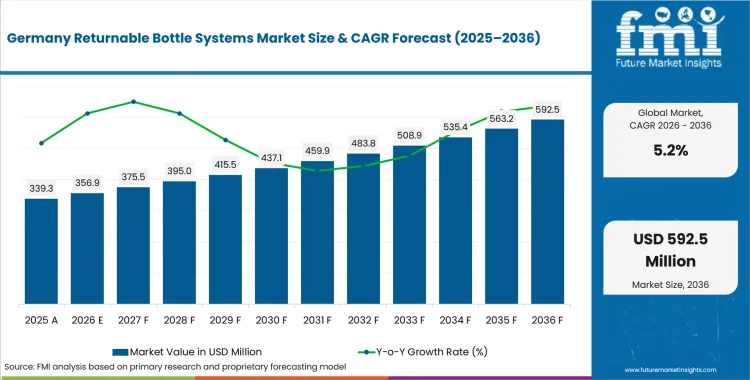
USD 356.9 million in 2026 and USD 592.5 million by 2036 at a 5.2% CAGR.
Demand for returnable bottle systems in Germany is projected to expand at a 5.2% CAGR between 2026 and 2036, increasing valuation from USD 356.9 million in 2026 to USD 592.5 million by 2036. Commercial uptake depends on whether a return loop keeps each unit in circulation long enough to recover collection and washing cost. Umweltbundesamt's May 2025 study said Germany needs further effort to strengthen reusable packaging systems. Durable formats therefore need enough completed cycles to justify the extra handling. The ten-year forecast adds USD 235.6 million in value.
Germany already has a measurable reuse base as Umweltbundesamt reported in July 2026 that 34.5% of beverages sold in Germany during 2024 were filled in reusable packaging. Germany's existing return habit lowers the behavior change required at collection points. France and Spain put more weight on recorded reuse volumes. The United Kingdom is building a new deposit scheme for single-use drinks containers. The national differences change the cost and evidence needed to extend a return loop beyond dense local circulation.
Key Takeaways
- Demand for Germany returnable bottle systems depends on return frequency and local collection density because repeated circulation determines whether system cost is recovered.
- Based on format type, standard formats are projected to account for 40.0% in 2026, attributable to common dimensions that simplify stocking and reverse handling.
- By material, paperboard is estimated to hold 32.0% in 2026, driven by foodservice converting capacity and familiar recovery routes.
- In 2026, standard meal formats are expected to lead format size with 39.0% share, supported by frequent meal-service use and manageable storage needs.
- Collection distance and low return rates can weaken economics by spreading acquisition and reconditioning cost over too few completed cycles.
- Some of the key players in this market include Huhtamaki, Pactiv Evergreen, Novolex, Duni, Detmold Group, Berry Global, Genpak, Dart Container, Graphic Packaging, and Sabert.
Analyst Perspective
"Returnable systems should be judged on completed cycles rather than unit price alone. Commercial value depends on return frequency because collection and washing cost must stay below the avoided single-use spend."
- Nandini Roy Choudhury, Principal Consultant, Future Market Insights
How is the Germany returnable bottle systems market segmented?
The Germany returnable bottle systems market is segmented by format type, material, format size, end use, sales channel and region.
Format type covers standard formats, recyclable-optimized formats, premium & branded formats and custom-engineered formats. Material includes paperboard, molded fiber & bagasse, rPET & PP, compostable polymers and aluminium. Format size covers standard meal, single-serve and family & catering. End use includes QSR chains, delivery platforms, coffee & beverage, institutional catering and retail deli. Sales channels include broadline foodservice distributors, direct chain contracts, packaging distributors and online.
What supports QSR chains in the end use category?
A format that passes service tests can carry one specification into many QSR outlets. Collection must stay simple for front-line staff. In June 2025, Dart Container documented a reusable foodservice partnership at Providence Park that expanded beyond a cup pilot into additional containers and seating areas.
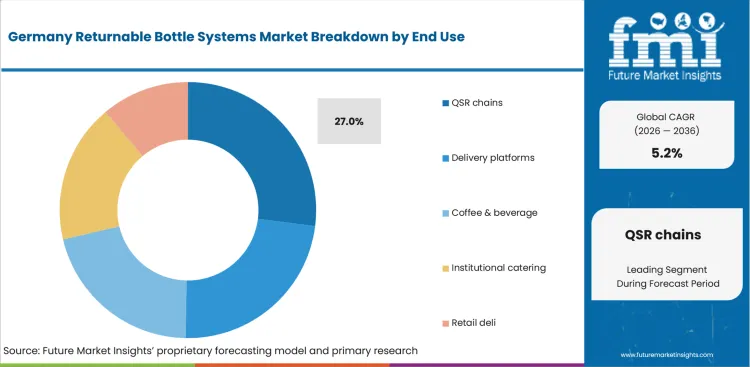
- By end use, QSR chains are forecast to represent 27.0% in 2026, driven by repeated multi-site purchasing and standardized service routines.
- High transaction frequency gives chains enough volume to measure loss rates during a pilot. Food packaging formats set the leak-resistance and service-speed threshold that reusable containers must match for chain-wide rollout.
What makes standard formats central to the format type category?
Standard formats limit the number of footprints that distributors must store and return operators must sort. Common dimensions let crates and wash lines process more units without size-specific handling. In March 2025, Eco-Products and OZZI announced a partnership that paired reusable containers with collection and tracking tools for institutional foodservice.
- Based on format type, standard formats are projected to account for 40.0% in 2026, attributable to common dimensions that simplify stocking and reverse handling.
- A shared footprint also cuts SKU-specific training for multi-site accounts. Returnable packaging programs gain more from interchangeability at higher container volumes because sorting rules stay stable.
Why does paperboard lead the material category?
Paperboard gives foodservice operators a familiar converting base and printable surface for uses that do not require a fully plastic structure. Barrier performance is the qualification gate. Graphic Packaging launched a European paperboard sushi portfolio in May 2025 with options designed for current plastic-reduction requirements.
- By material, paperboard is estimated to hold 32.0% in 2026, driven by broad foodservice use and existing converting capacity.
- Coating choice and sealing performance decide where fiber can replace plastic without weakening service. Board structures that run on existing forming and sealing equipment make paperboard packaging easier to qualify.
How does standard meal hold the format size position?
Standard meal formats match the portion and stacking requirements of common take-away service. Duni launched its Vista series in June 2025 with five sizes plus two- or three-compartment options. Operators can change meal capacity without rebuilding the full handling routine for every menu item.
- In 2026, standard meal formats are expected to lead format size with 39.0% share, attributable to frequent meal-service use and manageable storage requirements.
- Larger catering formats use more back-room space and smaller packs multiply SKU counts. Molded fiber trays offer a related format route for operators that value rigid meal presentation over repeated washing.
What drives broadline foodservice distributors in the sales channel category?
Broadline distributors already visit restaurant accounts on scheduled routes. Existing route density can absorb some collection activity without adding a separate trip. In January 2025, Dart Container expanded Anthora cup sizes after a request from distributor Lucky Supply for current coffee-shop and restaurant requirements.
- Broadline foodservice distributors are set to lead the sales channel category with 40.0% share in 2026, supported by route density and consolidated account service.
- Direct chain contracts suit very large accounts that can run their own return process. Scheduled transport capacity gives broadline distributors a cost advantage in reusable packing systems by avoiding a separate collection route.
What are the drivers, restraints and opportunities in the Germany returnable bottle systems market?
Reuse rules raise procurement pressure, return-loop cost can delay conversion and concentrated collection points improve system economics.
- Driver: European packaging rules put reusable service formats on a dated compliance path for HORECA operators.
- Restraint: Long collection routes and low return participation reduce the cycles available to recover washing and replacement cost.
- Opportunity: Dense institutional and event loops can share collection assets and keep hand-back points predictable.
Regulation is moving reusable take-away packaging from optional trials into a dated service requirement. Regulation (EU) 2025/40 requires HORECA final distributors to offer reusable packaging by 12 February 2028. Restaurant groups therefore need containers and return procedures that work during peak service without delaying counter throughput.
Long travel distance and low cycle counts weaken return economics. Umweltbundesamt's March 2026 guidance gives reusable bottles a stronger environmental case in regional distribution with higher refill counts. Operators therefore need route-level tests before extending a pool beyond dense service areas.
Concentrated venues can share hand-back points and washing capacity without a collection trip for every account. Duni Group's May 2025 partnership with Gothia Cup and Partille World Cup included reusable packaging options at events serving large meal volumes. Campuses and contract-catering sites can use the same model where consumption stays concentrated.
Who are the notable companies in the Germany returnable bottle systems market?
Huhtamaki, Pactiv Evergreen, Novolex, Duni, Detmold Group, Berry Global, Genpak, Dart Container, Graphic Packaging, and Sabert are the notable companies profiled in this market.
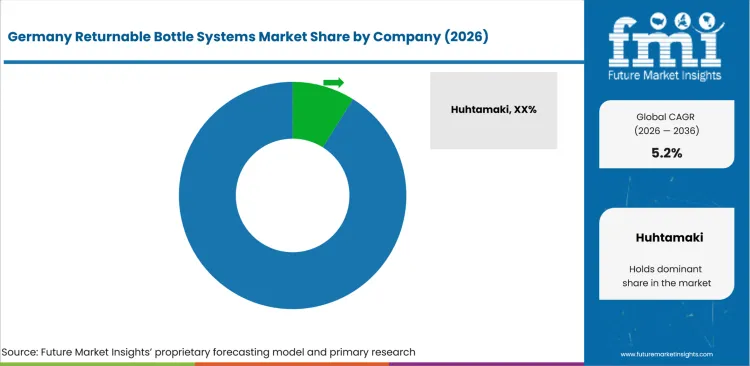
Most profiled companies manufacture foodservice containers or paperboard packaging. A smaller group has documented reusable-system programs. Huhtamaki and Duni have direct European operations. Graphic Packaging and Sabert supply paperboard formats. Novolex includes Pactiv Evergreen. Detmold Group focuses on paper and board. Genpak and Dart Container are North America-led. Berry Global operates within Amcor.
- Europe-facing foodservice platforms: Huhtamaki and Duni. Graphic Packaging and Sabert supply paperboard formats.
- Broad packaging platforms: Pactiv Evergreen and Novolex. Berry Global covers rigid and flexible formats within Amcor.
- Foodservice and board specialists: Detmold Group and Genpak. Dart Container manufactures foodservice packaging primarily in North America.
Competitive Benchmarking: Germany Returnable Bottle Systems Market
| Company | Foodservice Format Breadth | Circular-Material Readiness | European Market Proximity | Geographic Reach |
|---|---|---|---|---|
| Huhtamaki | High | High | High | Europe and global foodservice operations |
| Pactiv Evergreen | High | Medium | Low | Primarily North America within Novolex |
| Novolex | High | High | Medium | North America with selected international reach |
| Duni | High | High | High | More than 50 markets with European production |
| Detmold Group | High | High | Medium | Representatives in 17 countries |
| Berry Global | Medium | High | Medium | Global platform within Amcor |
| Genpak | High | High | Low | North America-focused foodservice platform |
| Dart Container | High | High | Low | North America-led manufacturing and distribution |
| Graphic Packaging | High | High | High | Global operations with European converting presence |
| Sabert | High | High | High | North America, Europe and Asia manufacturing footprint |
Scoring basis: High format breadth requires several documented foodservice format families. Medium identifies a narrower set. High circular-material readiness requires documented fiber or recycled-content capability. Medium identifies a narrower range. High European proximity requires direct production or broad commercial presence in Europe. Medium marks partial access. Low marks a documented concentration outside Europe.
Key Developments in the Germany Returnable Bottle Systems Market
- In April 2025, Novolex completed its combination with Pactiv Evergreen and formed a broader food and beverage packaging manufacturer.
- In February 2025, Huhtamaki separated its Fiber Foodservice business into Fiber Packaging and Foodservice Europe-Asia-Oceania from April 2025.
- In January 2025, Duni Group completed its acquisition of Poppies Europe and moved the business into its dining-solutions platform.
Key Players in the Germany Returnable Bottle Systems Market
Broad Foodservice Packaging Platforms
- Huhtamaki
- Pactiv Evergreen
- Novolex
- Duni
Material and Packaging Manufacturers
- Detmold Group
- Berry Global
- Genpak
Foodservice Container and Board Specialists
- Dart Container
- Graphic Packaging
- Sabert
Germany Returnable Bottle Systems Market - Report Scope
| Coverage field | Report scope |
|---|---|
| Market breakdown | By format type, material, format size, end use, sales channel and region. |
| Quantitative Units | USD million. |
| Market Definition | Returnable packaging systems assessed by format type, material, format size, end use and sales channel for the defined Germany market. |
| Countries Covered | Germany |
| Key Companies Profiled | Huhtamaki, Pactiv Evergreen, Novolex, Duni, Detmold Group, Berry Global, Genpak, Dart Container, Graphic Packaging, and Sabert. |
| Forecast Period | 2026 to 2036. |
| Approach | Primary and secondary research with market triangulation. |
Germany Returnable Bottle Systems Market - Research Methodology
| Method | Approach |
|---|---|
| Primary Research | FMI analysts gathered input from manufacturers, service providers, technology developers, distributors, end users, procurement teams, and subject-matter experts. Interviews examined purchasing decisions, product or service evaluation, adoption barriers, approval requirements, pricing considerations, and expectations for technical or commercial support. Respondents were also asked what evidence is required before a trial, pilot, or initial order develops into regular purchasing. |
| Desk Research | Desk research covered government statistics, regulatory publications, trade data, industry associations, technical literature, standards, company filings, product information, and official corporate announcements. Sources were reviewed for relevance, publication date, geographic coverage, and consistency with the defined market scope. Claims relating to performance, applications, approvals, capacity, investment, and commercial activity were retained only when supported by credible public evidence. |
| Market Sizing and Forecasting | The market model combined the baseline value with historical performance, segment structure, pricing and volume indicators, adoption levels, company participation, and country-level demand conditions. Forecast assumptions considered economic activity, investment trends, regulatory developments, technology adoption, purchasing cycles, supply availability, and barriers to wider market use. Segment and regional estimates were reconciled before the final market total was calculated. |
| Data Validation | Estimates were checked against multiple independent indicators, including public data, company activity, trade patterns, industry developments, and findings from primary interviews. Validation also tested whether products, services, applications, and company revenues fell within the defined market boundaries. Adjacent categories, unsupported claims, overlapping revenues, and activities without direct market relevance were excluded to reduce double counting and maintain consistency across segments and countries. |
Germany Returnable Bottle Systems Market by Segments
Germany Returnable Bottle Systems Market segmented by Format Type:
- Standard formats
- Recyclable-optimized formats
- Premium & branded formats
- Custom-engineered formats
Germany Returnable Bottle Systems Market segmented by Material:
- Paperboard
- Molded fiber & bagasse
- rPET & PP
- Compostable polymers
- Aluminium
Germany Returnable Bottle Systems Market segmented by Format Size:
- Standard meal
- Single-serve
- Family & catering
Germany Returnable Bottle Systems Market segmented by End Use:
- QSR chains
- Delivery platforms
- Coffee & beverage
- Institutional catering
- Retail deli
Germany Returnable Bottle Systems Market segmented by Sales Channel:
- Broadline foodservice distributors
- Direct chain contracts
- Packaging distributors
- Online
Research Sources and Bibliography
- Umweltbundesamt. (2025, May). Förderung von Mehrwegverpackungssystemen zur Verringerung des Verpackungsverbrauchs.
- Umweltbundesamt. (2026, July). Bundesweite Erhebung von Daten zum Verbrauch von Getränken in Mehrweggetränkeverpackungen: Bezugsjahr 2024.
- Umweltbundesamt. (2026, March 16). Mehrwegflaschen sind umweltfreundlicher als Einwegvarianten.
- Umweltbundesamt. (2025, September). Bundesweite Erhebung von Daten zum Verbrauch von Getränken in Mehrweggetränkeverpackungen: Bezugsjahr 2023.
- European Parliament and Council of the European Union. (2025, January 22). Regulation (EU) 2025/40 on packaging and packaging waste.
- Department for Environment, Food & Rural Affairs. (2025, May 7). Deposit Return Scheme for drinks containers: Policy statement.
- ADEME. (2025, October 27). Réemploi des emballages : données 2024.
- CONAI. (2025, June 25). Packaging recycling: Italy reaches 76.7%.
- Ministerio para la Transición Ecológica y el Reto Demográfico. (2026, March). Boletín de economía circular, no. 23.
- Novolex. (2025, March 4). Eco-Products and OZZI join forces to expand access to reusable containers and systems.
- Graphic Packaging International. (2025, May 14). Graphic Packaging launches new portfolio of paperboard sushi packaging to support the regulatory compliance of European foodservice operators.
- Duni Group. (2025, June 4). Duni launches new take-away series with improved recyclability and enhanced functionality.
- Dart Container. (2025, June 5). Score! Dart reusables in play at pro soccer venue.
- Dart Container. (2025, January). Anthora cup livin’ large in the Big Apple.
- Duni Group. (2025, May 15). Duni Group becomes official event partner and supplier of sustainable packaging solutions for Gothia Cup and Partille World Cup.
- Novolex. (2025, April 1). Novolex and Pactiv Evergreen Inc. complete combination, creating a leading manufacturer in food, beverage and specialty packaging.
- Huhtamaki. (2025, February 14). Huhtamaki to separate Fiber Foodservice business segment into two distinct segments: Fiber Packaging and Foodservice Europe-Asia-Oceania.
- Duni Group. (2025, January 31). Duni Group completes the acquisition of Poppies.
- Huhtamaki. (2026). Annual Report 2025.
- Duni Group. (2026, April 23). Duni Group’s 2025 Annual and Sustainability Report is now available online.
- Detmold Group. (2026, February 5). FY25 sustainability performance update.
- Amcor. (2025, October 27). Amcor’s FY25 Sustainability Report showcases progress, leadership and innovation.
- Genpak. (2025, June 3). How restaurants combat food waste in the community.
- Graphic Packaging Holding Company. (2026, March 2). 2025 annual report on Form 10-K.
- Sabert Corporation. (2026, April 30). Sabert Corporation releases 2025 Sustainability Report and announces new 2030 goal.
- Amcor. (2025, April 30). Amcor completes combination with Berry Global.
- Duni Group. (2025, June 3). Duni Group acquires majority stake in LinePack Oy.
- Dart Container. (2025, May 12). Dart products earn sustainability recognition.
- Sabert Corporation. (2025, June 2). Sabert invests in the future of food packaging with innovative, domestically produced solutions featured at the 2025 IDDBA Show.
- Sabert Corporation. (2026, August 18). Sabert opens fifth USA distribution facility in Georgia to meet growing customer demand.
- Graphic Packaging International. (2026, June 15). Advancing sustainable fresh produce packaging: Graphic Packaging joins 2026 IFPA Packaging Innovation Cohort.
- Duni Group. (2026, January 15). Duni Group and Relevo behind Munich’s circular initiative.
- Duni Group. (2025, August 19). Duni Group launches Relevo reusable system in Sweden.
This bibliography is provided for reader reference and is not exhaustive. The full report contains the complete reference list and detailed citations
This Report Answers
- How large is the Germany returnable bottle systems market in 2026 and 2036?
- Which operating conditions determine whether reusable formats recover their system cost?
- Why do standard formats account for 40.0% of the format type category in 2026?
- How does paperboard hold 32.0% of the material category in 2026?
- Why do broadline foodservice distributors hold the leading sales-channel position?
- Which companies are active in the profiled competitive set?
- Which regulations and return-loop frictions shape commercial deployment?
Frequently Asked Questions
How big is the Germany Returnable Bottle Systems Market in 2026?
The Germany returnable bottle systems market is valued at USD 356.9 million in 2026 and is projected to reach USD 592.5 million by 2036. Growth is driven by wider reuse requirements and return loops that complete enough cycles to recover handling cost.
What is the CAGR of the Germany Returnable Bottle Systems Market from 2026 to 2036?
The Germany returnable bottle systems market is projected to grow at a CAGR of 5.2% between 2026 and 2036. Expansion is supported by reusable service requirements and denser collection routes that limit avoidable return mileage.
Which format type leads the Germany Returnable Bottle Systems Market?
The standard formats segment is expected to hold 40.0% of the Germany returnable bottle systems market in 2026, attributable to common dimensions that simplify stocking and reverse handling. Common footprints also reduce sorting and training changes in multi-site programs.
Which material leads the Germany Returnable Bottle Systems Market?
The paperboard segment is projected to hold 32.0% of the Germany returnable bottle systems market in 2026, driven by broad foodservice use and existing converting capacity. Barrier and sealing performance determine where paperboard can replace plastic without weakening service.
Which companies are active in the Germany Returnable Bottle Systems Market?
Key companies operating in the market include Huhtamaki, Pactiv Evergreen, Novolex, Duni, Detmold Group, Berry Global, Genpak, Dart Container, Graphic Packaging, and Sabert. Their documented roles cover foodservice formats plus paperboard conversion and reusable-system programs.
Preview the report firsthand - request a free sample
Get SampleGet the brochure for pricing and purchase details.
Get PDFTable of Content
- Key Takeaways
- Market Size and CAGR
- Top Growth Driver
- Fastest Growing Segment
- Leading Region
- Key Companies
- Emerging Opportunities
- Executive Summary
- Germany Market Outlook
- Demand-side Trends
- Supply-side Trends
- Technology Roadmap Analysis
- Analysis and Recommendations
- Analyst Perspective (What is happening? Why now? What should investors know?)
- Key Questions Answered
- How large is the market?
- What is the CAGR?
- What are key trends?
- Which region dominates?
- Who are the leaders?
- Market Overview
- Market Coverage / Taxonomy
- Market Definition / Scope / Limitations
- Research Methodology
- Chapter Orientation
- Analytical Lens and Working Hypotheses
- Market Structure, Signals, and Trend Drivers
- Benchmarking and Cross-market Comparability
- Market Sizing, Forecasting, and Opportunity Mapping
- Research Design and Evidence Framework
- Desk Research Programme (Secondary Evidence)
- Expert Input and Fieldwork (Primary Evidence)
- Tooling, Models, and Reference Databases
- Data Engineering and Model Build
- Quality Assurance and Audit Trail
- Market Background
- Market Dynamics (Drivers, Restraints, Opportunity, Trends)
- Scenario Forecast (Optimistic, Likely, Conservative)
- Impact Analysis
- AI Impact
- Sustainability Impact
- Regulatory Impact
- Technology Impact
- Consumer / Buyer Analysis
- Purchase Drivers
- Adoption Barriers
- Buyer Journey
- Opportunity Map Analysis
- Product Life Cycle Analysis
- Supply Chain Analysis
- Investment Feasibility Matrix
- Value Chain Analysis
- PESTLE and Porter's Analysis
- Regulatory Landscape
- Regional Parent Market Outlook
- Production and Consumption Statistics
- Import and Export Statistics
- Germany Market Analysis and Forecast, 2021 to 2036
- Historical Market Size Value (USD Million) Analysis, 2021 to 2025
- Current and Future Market Size Value (USD Million) Projections, 2026 to 2036
- Y-o-Y Growth Trend Analysis
- Absolute $ Opportunity Analysis
- Germany Market Pricing Analysis, 2021 to 2036
- Germany Market Analysis and Forecast, By Format Type, 2021 to 2036
- Introduction / Key Findings
- Historical Market Size Value (USD Million) Analysis By Format Type, 2021 to 2025
- Current and Future Market Size Value (USD Million) Analysis and Forecast By Format Type, 2026 to 2036
- Standard formats
- Recyclable-optimized formats
- Premium & branded formats
- Custom-engineered formats
- Standard formats
- Y-o-Y Growth Trend Analysis By Format Type, 2021 to 2025
- Absolute $ Opportunity Analysis By Format Type, 2026 to 2036
- Germany Market Analysis and Forecast, By Material, 2021 to 2036
- Introduction / Key Findings
- Historical Market Size Value (USD Million) Analysis By Material, 2021 to 2025
- Current and Future Market Size Value (USD Million) Analysis and Forecast By Material, 2026 to 2036
- Paperboard
- Molded fiber & bagasse
- rPET & PP
- Compostable polymers
- Aluminium
- Paperboard
- Y-o-Y Growth Trend Analysis By Material, 2021 to 2025
- Absolute $ Opportunity Analysis By Material, 2026 to 2036
- Germany Market Analysis and Forecast, By Format Size, 2021 to 2036
- Introduction / Key Findings
- Historical Market Size Value (USD Million) Analysis By Format Size, 2021 to 2025
- Current and Future Market Size Value (USD Million) Analysis and Forecast By Format Size, 2026 to 2036
- Standard meal
- Single-serve
- Family & catering
- Standard meal
- Y-o-Y Growth Trend Analysis By Format Size, 2021 to 2025
- Absolute $ Opportunity Analysis By Format Size, 2026 to 2036
- Germany Market Analysis and Forecast, By End Use, 2021 to 2036
- Introduction / Key Findings
- Historical Market Size Value (USD Million) Analysis By End Use, 2021 to 2025
- Current and Future Market Size Value (USD Million) Analysis and Forecast By End Use, 2026 to 2036
- QSR chains
- Delivery platforms
- Coffee & beverage
- Institutional catering
- Retail deli
- QSR chains
- Y-o-Y Growth Trend Analysis By End Use, 2021 to 2025
- Absolute $ Opportunity Analysis By End Use, 2026 to 2036
- Germany Market Analysis and Forecast, By Sales Channel, 2021 to 2036
- Introduction / Key Findings
- Historical Market Size Value (USD Million) Analysis By Sales Channel, 2021 to 2025
- Current and Future Market Size Value (USD Million) Analysis and Forecast By Sales Channel, 2026 to 2036
- Broadline foodservice distributors
- Direct chain contracts
- Packaging distributors
- Online
- Broadline foodservice distributors
- Y-o-Y Growth Trend Analysis By Sales Channel, 2021 to 2025
- Absolute $ Opportunity Analysis By Sales Channel, 2026 to 2036
- Germany Market Analysis and Forecast, By Region, 2021 to 2036
- Introduction
- Historical Market Size Value (USD Million) Analysis By Region, 2021 to 2025
- Current Market Size Value (USD Million) Analysis and Forecast By Region, 2026 to 2036
- Germany
- Market Attractiveness Analysis By Region
- Germany Market Analysis and Forecast, By Country, 2021 to 2036
- Historical Market Size Value (USD Million) Trend Analysis By Market Taxonomy, 2021 to 2025
- Market Size Value (USD Million) Forecast By Market Taxonomy, 2026 to 2036
- By Country
- By Format Type
- By Material
- By Format Size
- By End Use
- By Sales Channel
- By Country
- Market Attractiveness Analysis
- By Country
- By Format Type
- By Material
- By Format Size
- By End Use
- By Sales Channel
- Key Takeaways
- Key Countries Market Analysis
- Germany
- Pricing Analysis
- Market Share Analysis, 2025
- By Format Type
- By Material
- By Format Size
- By End Use
- By Sales Channel
- Germany
- Market Structure Analysis
- Competition Dashboard
- Competition Benchmarking
- Market Share Analysis of Top Players
- By Regional
- By Format Type
- By Material
- By Format Size
- By End Use
- By Sales Channel
- Emerging Startups
- Innovation Benchmarking
- Competition Analysis
- Competition Deep Dive
- Huhtamaki
- Overview
- Product Portfolio
- Profitability by Market Segments
- Sales Footprint
- Strategy Overview
- Marketing Strategy
- Product Strategy
- Channel Strategy
- Pactiv Evergreen
- Novolex
- Duni
- Detmold Group
- Berry Global
- Genpak
- Dart Container
- Graphic Packaging
- Sabert
- Huhtamaki
- Case Studies
- Success Stories
- Recent Developments
- Competition Deep Dive
- Assumptions & Acronyms Used


