

- CAGR (2025 to 2035)
- 6.4%
Germany Tower Mounted Amplifier Market Size and Share Forecast Outlook (2025 to 2035)
The Germany tower mounted amplifier (TMA) market is set to witness significant growth over the next decade, driven by the rapid deployment of 5G networks, increasing demand for enhanced wireless connectivity, and continued expansion of telecommunications infrastructure. The market is projected to reach USD 754.2 million in 2025 and is expected to expand at a CAGR of 6.4%, reaching USD 1,401.8 million by 2035.
Market Attributes and Growth Projections
| Attributes | Values |
|---|---|
| Estimated Germany Market Size in 2025 | USD 754.2 Million |
| Projected Germany Market Size in 2035 | USD 1,401.8 Million |
| Value-based CAGR from 2025 to 2035 | 6.4% |
Semi-annual Market Update for the Germany Tower Mounted Amplifier Industry
The table below outlines the semi-annual growth rate of the market, providing insights into industry trends.
| Particular | Value CAGR |
|---|---|
| H1 2024 | 5.7% (2024 to 2034) |
| H2 2024 | 6.3% (2024 to 2034) |
| H1 2025 | 6.1% (2025 to 2035) |
| H2 2025 | 6.7% (2025 to 2035) |
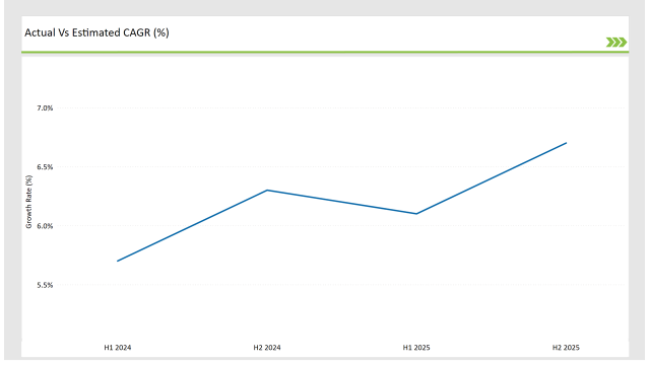
The CAGR for the tower mounted amplifier industry in Germany exhibits periodic fluctuations. The market saw a 60 BPS increase from H1 2024 (5.7%) to H2 2024 (6.3%), indicating growing industry confidence. A slight 20 BPS decline in H1 2025 (6.1%) suggests a temporary correction, but growth rebounded to 6.7% in H2 2025, signaling strong demand and renewed investment.
Recent Developments Influencing the Germany Tower Mounted Amplifier Market
| Date | Development / M&A Activity & Details |
|---|---|
| Jan-25 | Kathrein announces increased production of 5G-compatible TMAs to meet rising demand. |
| Oct-24 | Rosenberger acquires a domestic TMA manufacturer to expand its market share. |
| Mar-24 | Spinner partners with Deutsche Telekom to deploy low-noise amplifiers for urban networks. |
| Sep-24 | Filtronic introduces a new line of multi-band TMAs with improved energy efficiency. |
| Dec-23 | Bundesnetzagentur (Germany's telecom regulator) allocates new spectrum, driving TMA demand. |
Key Industry Highlights Driving the Germany Tower Mounted Amplifier Sector
5G Rollout and Network Densification Boosting TMA Adoption
The geographical expansion of 5G nationwide in Germany is generating great demand for Tower Mounted Amplifiers (TMAs) that optimize signal quality and reduce losses from the networks. Run by SME Germany, with a background in high-frequency transmission since 2006, many of the large telecom providers including Deutsche Telekom, Vodafone Germany, and Telefónica Deutschland are adopting dense small-cell networks as well as massive MIMO (Multiple Input Multiple Output) technology and both require high-quality TMAs to enhance network performance and spectrum efficiency.
Increased Investments in Rural Broadband Expansion
Government programs such as the Gigabit Strategy 2025 are driving infrastructure investments designed to enhance coverage by fiber networks, especially in rural and underserved areas. TMAs are driving down the impact of signal degradation in the outskirts while adding coverage. Additional fiber-optic and wireless network expansion is propelled by public-private partnerships (PPPs), and that, in turn, makes TMA deployment continue to proliferate nationwide.
Smart Cities and IoT Adoption Driving TMA Demand
The demand for TMAs has risen in line with advanced telecom infrastructure being integrated into Germany's smart city projects urban connectivity schemes. Applications like smart traffic management, public safety systems, and industrial IoT networks, which require dependable and high-performance wireless coverage. With industries such as manufacturing, logistics and healthcare adopting IoT at an increasing rate, there is a growing demand for optimized TMA solutions powered by 5G-connected devices.
Rising Demand for Low-Latency and Cloud-Based Telecom Solutions
Germany has a strong data center ecosystem and increasing reliance of cloud computing and edge computing solutions, driving telecom providers to improve network reliability. TMAs reduce both latency and uplink interference, providing a necessary technological tool for 5G-based enterprise applications and services like autonomous systems (vehicles and drones), smart factories, and ultra-high broadband.
Leading Global and Local Players Driving Market Growth
Leading global TMA manufacturers such as CommScope, Kathrein (a subsidiary of Ericsson), and Amphenol Antenna Solutions have a significant presence in Germany, where they supply high-performance TMAs to facilitate 5G infrastructure upgrades. Next-Gen TMA Technology: Local telecom equipment manufacturers are also taking initiatives to come up with next-generation TMA technology, focusing on energy efficiency, and supporting high frequency range compatibility/ high signal amplification.
Increased Deployment of Sustainable and Energy-Efficient TMAs
Sustainability in Telecom Infrastructure is Key in Germany and is all about Low-Power & Energy Efficient TMAs CSR initiatives Operators have adopted green network solutions to reduce power consumption and carbon footprint in accordance with the country’s climate objectives. As such, this trend is encouraging vendors to develop high-efficiency, low-power TMAs for 5G and future wireless networks.
Spectrum Auctions and Regulatory Policies Influencing TMA Deployment
The Federal Network Agency (BNetzA) keeps distributing spectrum for 5G and next-generation telecommunications technologies, wchich, in turn, affects the deployment of TMA in different frequency bands. Advanced TMAs are also required for higher performance in urban and industrial areas to optimize 3.5 GHz and mmWave (millimeter wave) spectrum.
The trend of rapid growth is being witnessed in Germany's TMA market owing to expansion of 5G infrastructure and IoT proliferation, and growing requirement for high-speed connectivity solutions. The role of these advanced TMAs is becoming increasingly critical as telecom operators modernize their networks and need to ensure the best possible signal transmission and optimal network efficiency.
Analysis of the Germany Tower Mounted Amplifier Market by Segment
By Type
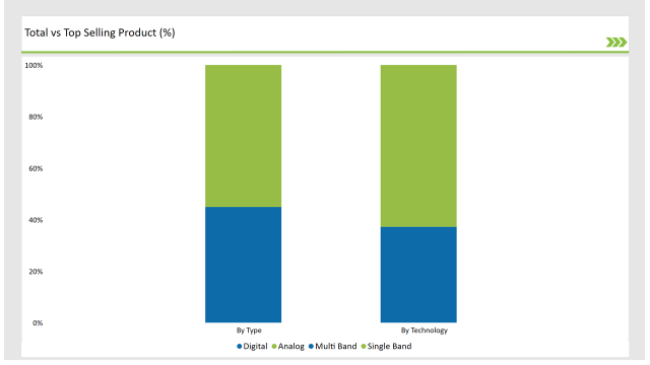
| Type | Market Share (2025) |
|---|---|
| Single Band | 55.1% |
| Multi Band | 44.9% |
- Single-band TMAs dominate due to cost efficiency and widespread adoption in existing telecom infrastructure.
- Multi-band TMAs are gaining traction as they support multiple frequency bands, which is essential for 5G deployments.
- Innovations in multi-band filtering technology improve efficiency, leading to higher adoption rates.
By Technology
| Technology | Market Share (2025) |
|---|---|
| Analog | 62.8% |
| Digital | 37.2% |
- Analog TMAs continue to lead due to their lower cost and reliability in legacy network deployments.
- Digital TMAs are seeing increased adoption as telecom operators transition to AI-driven, high-efficiency networks.
- AI-powered signal optimization and dynamic tuning are making digital TMAs more appealing for next-generation networks.
Market Concentration and Competitive Landscape in the Germany Tower Mounted Amplifier Ecosystem
The Germany TMA market is highly competitive, with several key players driving innovation and expansion.
| Vendors | Market Share (2025) |
|---|---|
| Kathrein | 31.2% |
| Rosenberger | 24.5% |
| Spinner | 20.1% |
| Filtronic | 13.9% |
| Others | 10.3% |

- Kathrein leads the market, benefiting from strong partnerships with German telecom operators.
- Rosenberger and Spinner are expanding into rural markets, leveraging their advanced TMA solutions.
- Filtronic is innovating in low-power, high-performance TMAs, gaining traction among 5G network providers.
- AI and cloud computing integration are key differentiators among competitors, as predictive maintenance becomes a crucial factor in telecom infrastructure.
Top Segments Studied in the Germany Tower Mounted Amplifier Market Report
By Type:
Single-band and multi-band amplifiers cater to different network expansion needs.
By Technology:
The market continues transitioning from analog to digital amplifiers.
By End-User:
Network operators dominate, while infrastructure providers play an increasing role in telecom expansion.
Frequently Asked Questions
At what rate will the industry grow?
The market will grow at a CAGR of 6.4% from 2025 to 2035.
What is the expected value of the industry by 2035?
The industry is projected to reach USD 1,401.8 million by 2035.
Who are the key players in the market?
Major vendors include Kathrein, Rosenberger, Spinner, and Filtronic.
Which region in Germany leads in TMA adoption?
Urban centers such as Berlin, Munich, and Hamburg have the highest adoption rates due to dense telecom infrastructure.
Preview the report firsthand - request a free sample
Get SampleGet the brochure for pricing and purchase details.
Get PDFTable of Content
- Market Outlook (2025 to 2035)
- Semi-Annual Market Update
- Recent Market Developments
- Key Industry Highlights
- Market Analysis by Segment
- Competitive Landscape
- Key Segments
- Frequently Asked Questions


