

- Market Size (2026)
- USD 324.0 Mn
- Forecast (2036)
- USD 699.5 Mn
- CAGR (2026 to 2036)
- 8.0%
How big is Gluconate Crop Chelates Market in 2026?
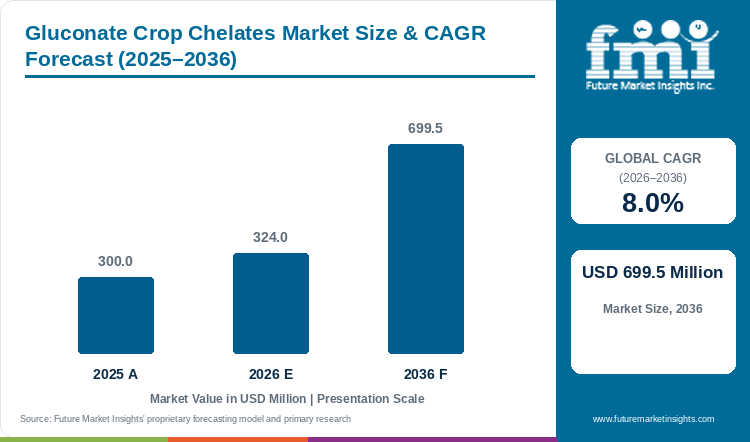
Sales of gluconate crop chelates are estimated to grow at 8.0% CAGR through 2036. Market valuation increased from USD 300.0 million in 2025 to USD 324.0 million in 2026 and is projected to reach USD 699.5 million by 2036.
Increasing use of protected micronutrients is leading to increasing per-hectare movement of gluconate crop chelates. Sales of gluconate crop chelates are expected to increase from USD 324.0 million in 2026 to USD 699.5 million by 2036, exhibiting 8.0% CAGR. Gluconate crop chelates market has witnesses a considerable growth owing to availability of EDTA / synthetic chelates, amino acid complexes, organic acid complexes and lignosulfonates across nutrient formulations. These are used through fertigation, foliar and soil application. In addition to this, premium-grade chelates are selected where normal mineral salts does not provide suitable crop response, which is expected to impel the market growth.
Regional buying differs according to crop value, irrigation system, soil and water pH and availability of local agronomic advice. For instance, in February 2025, MAFRA announced that smart farms would cover 35% of nearly 55,000 greenhouse hectares and smart-farming technology would reach 20% of major field-crop areas by 2029. [1] Apart from that, USDA NASS reported in February 2026 that 23,060 horticulture operations generated USD 18.3 billion sales in 2024. [2] Expansion of smart farming and horticulture industry is expected to support adoption of soluble crop chelates. However, chelating agent, pH stability, solubility, crop requirement, application method and supporting product documentation remains the final commercial filter before purchase.
Key Takeaways
- specialty fertilizers are increasingly considered when soil testing confirms a nutrient problem and suitable application method is available.
- EDTA / synthetic chelates are projected to account for 44.3% of chelating / complexing agent revenue in 2026, owing to its use in multi-metal formulations.
- Iron is estimated to hold 41.2% of nutrient revenue in 2026, attributed to its lower availability under alkaline growing conditions.
- Cereals & grains are forecast to represent 47.2% of crop type demand in 2026, supported by broad cultivated acreage and planned fertilizer application.
- South Korea is forecast to grow at 7.7% CAGR with expansion of smart farming, whereas USA is projected to grow at 7.4% CAGR by 2036 owing to established horticulture channels.
- Some of the prominent players in gluconate crop chelates market are Brandt, Rovensa Next (Tradecorp), BASF, Nouryon, Yara International, ICL Group, Haifa Group, and Valagro (Syngenta Biologicals).
Analyst Perspective
"Gluconate crop chelates are increasingly used for supplying protected micronutrients where normal mineral salts does not provide suitable crop response. Selection of chelating chemistry according to diagnosed nutrient problem and application method is expected to increase the use of crop chelates during the forecast period."
- Nandini Roy Choudhury, Principal Consultant, Future Market Insights
How is the gluconate crop chelates market segmented?
Gluconate Crop Chelates Market is segmented on the basis of chelating / complexing agent, nutrient, crop type, application method, sales channel, and region. EDTA / synthetic chelates are projected to hold 44.3% in 2026, iron 41.2%, and cereals & grains 47.2% in their respective segments.
On the basis of chelating / complexing agent, gluconate crop chelates market is segmented into EDTA / synthetic chelates, amino acid complexes, organic acid complexes, and lignosulfonates & others.
On the basis of nutrient, market is segmented into iron, zinc, manganese & copper, boron / moly & multi-nutrient, and others.
On the basis of crop type, market is segmented into cereals & grains, fruits & vegetables, oilseeds & pulses, turf & ornamentals, and others.
Based on application method, gluconate crop chelates market is segmented into fertigation, foliar, soil, and others.
On the basis of sales channel, market is segmented into agri-input distributors, cooperatives, agri-retail chains, online / direct-to-farm, and others.
Depending on the geographic region, gluconate crop chelates market is segmented into North America, Latin America, Western Europe, Eastern Europe, East Asia, South Asia and Pacific, and Middle East and Africa.
Why do EDTA / synthetic chelates remain relevant in crop nutrition?
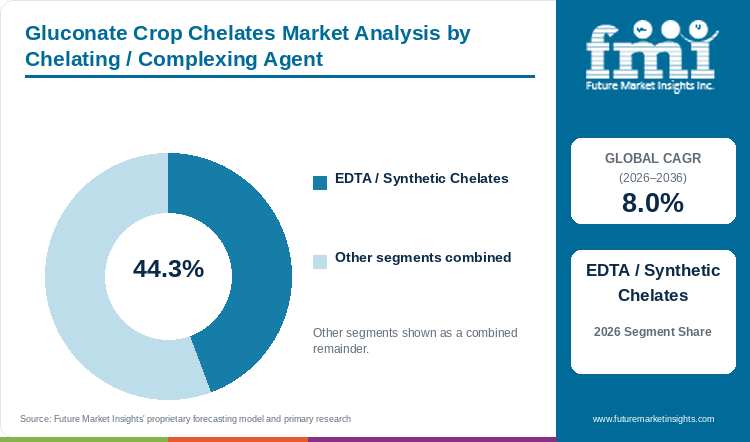
Based on chelating / complexing agent, EDTA / synthetic chelates segment is projected to hold 44.3% share in 2026, attributed to its wide use in multi-metal formulations.
Agricultural chelates such as EDTA are widely used in multi-nutrient products as they maintain metal nutrients in soluble form during mixing and application. In February 2026, BRANDT RMX-8 label listed EDTA-chelated copper and iron along with manganese and zinc. Compatibility with pH and mixing condition supports its use under different farm conditions, which is expected to drive demand for EDTA / synthetic chelates.
- EDTA / synthetic chelates are projected to account for 44.3% share in 2026, owing to increasing use in multi-metal crop formulations.
- In February 2026, BRANDT RMX-8 label listed EDTA-chelated copper and iron along with manganese and zinc for crop applications.
Why does iron remain relevant within the crop nutrient category?
Based on nutrient, iron segment is estimated to hold 41.2% share in 2026, owing to lower iron availability under alkaline soil condition.
Iron deficiency can occur when iron remains unavailable to plant roots even if sufficient iron is present in soil. In October 2025, Nouryon reported that high-pH soils may precipitate iron before root absorption. Chelated micronutrient blends keeps more iron in solution and are selected according to soil and water pH. Increasing requirement for available iron under alkaline conditions is anticipated to support the iron segment growth.
- Iron segment is estimated to hold 41.2% of nutrient revenue in 2026, owing to lower availability of iron under alkaline soil condition.
- In October 2025, Nouryon introduced HBED iron chelate for high-pH soils where precipitation limits availability of iron to the plants.
How do cereals & grains support demand within the crop type?
Based on crop type, cereals & grains segment is forecast to represent 47.2% share in 2026, supported by broad acreage and planned fertilizer application.
Cereals and grains are cultivated over large areas and receives planned fertilizer applications during the crop cycle. Micronutrient chelates can be added through the existing fertilizer pass without requiring another field application. An additional pass increases farm cost and may delay treatment beyond the suitable crop stage. Broad acreage and established fertilizer schedules are expected to support demand from cereals & grains segment.
- Cereals & grains are forecast to represent 47.2% of crop type demand in 2026, supported by broad cultivated acreage and planned fertilizer application.
- Requirement of additional field application increases the cost over broad acreage, which may limiting adoption of crop chelates.
Why do buyers choose fertigation within the application method category?
Based on application method, fertigation segment is forecast to represent 41.0% share in 2026, owing to delivery of soluble nutrients through irrigation systems.
Fertigation is used to supply soluble crop chelates through the irrigation system feeding the crop. The same system delivers micronutrients without another field pass and reduces handling at the time of application. Fertigation monitoring checks whether the product remains dissolved under farm water chemistry. Easy delivery of micronutrients through installed irrigation systems is anticipated to drive the fertigation segment growth.
- Fertigation segment is forecast to represent 41.0% share in 2026, owing to delivery of soluble nutrients through installed irrigation systems.
- Haifa 2025 catalog lists HGA-complexed copper for Nutrigation and foliar use, which supports soluble micronutrient application.
What keeps agri-input distributors relevant within the crop sales channel?
Agri-input distributors are projected to hold 47.8% of sales channel revenue in 2026, attributed to availability of local agronomic advice.
Agri-input distributors play an important role in the first purchase of crop chelates as growers generally start treatment after identifying a local nutrient problem. Precision agriculture is increasingly used to locate areas where deficiency may develop. Distributors help in selecting chelate according to water chemistry and application method before the crop treatment period. Availability of local agronomic advice is expected to support demand through agri-input distributors.
- Agri-input distributors are projected to hold 47.8% share in 2026, owing to availability of local agronomic advice during product selection.
- According to Defra, in June 2026, 79% of English farmers having nutrient plans used professional advice or adviser-created plans.
What are the drivers, restraints, and opportunities in the gluconate crop chelates market?
Soil and pH testing is a major driver for gluconate crop chelates market, whereas high cost of premium chelates may hamper the market growth. Increasing use of soluble HGA complexes is expected to create new growth opportunities.
- Driver: Increasing soil and pH testing is supporting the use of protected micronutrients after confirmation of specific crop deficiency.
- Restraint: High cost of premium chelates and availability of inexpensive mineral salts may hamper the gluconate crop chelates market growth.
- Opportunity: Increasing use of soluble HGA complexes in fertigation and foliar programs is expected to create new growth opportunities.
Increasing Soil and pH Testing Boosting the Crop Chelates Demand
Soil and pH testing helps growers in identifying micronutrient deficiency before selecting protected nutrients. In June 2026, Defra reported that 78% of English farmers regularly tested soil nutrients and 79% tested pH. These tests differentiate nutrient shortage from lower nutrient availability under local soil conditions. Fertilizer additives are selected where testing shows a product or delivery problem. Increasing soil testing and nutrient diagnosis is expected to drive the gluconate crop chelates market growth.
High Cost of Premium Chelates May Hamper the Market Growth
High cost of premium chelates is one of the major factor limiting its adoption. In April 2026, the World Bank reported that fertilizer price index increased more than 12% during the first quarter. Rising fertilizer prices encourage growers to compare protected micronutrients with simple mineral salts before paying additional cost. Premium chelates are mainly selected where pH or application condition reduces the effectiveness of cheaper salts. High product cost without clear field response may hamper the growth of gluconate crop chelates market.
Increasing Use of Soluble HGA Complexes Creating Growth Opportunities
HGA is an organic complexing agent used for soluble micronutrients in water-based crop programs. Haifa 2025 catalog lists HGA-complexed copper for Nutrigation and foliar use at pH 2 to 12. Wider pH range supports its application under different irrigation water and tank conditions. Hydroponic systems also provide controlled conditions for checking solution behavior before regular dosing. Increasing use of soluble HGA complexes in fertigation and foliar application is expected to create new growth opportunities.
Which country CAGRs are profiled in the gluconate crop chelates market?
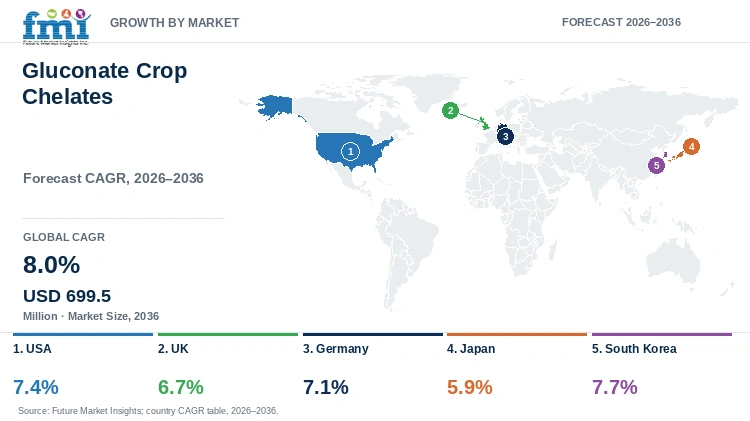
| Country | CAGR |
|---|---|
| USA | 7.4% |
| UK | 6.7% |
| Germany | 7.1% |
| Japan | 5.9% |
| South Korea | 7.7% |
How do country-level CAGRs compare in the gluconate crop chelates market?
Demand for crop chelates differs according to the farm system used for nutrient diagnosis and application. Automated farms are increasing use of soluble formulations for dosing equipment, whereas adviser-led markets select products after considering nutrient requirement and fertilizer cost.
- USA crop chelates market is supported by dealer agronomy and increasing requirement for micronutrients according to local soil and water conditions.
- High fertilizer cost in the UK is increasing price concern for premium crop chelates, which may affect its adoption among growers.
- Germany fertiliser rules requires nutrient application according to crop and soil requirement, due to which targeted micronutrient use is increasing.
- Increasing adoption of labor-saving farm systems in Japan is boosting demand for soluble crop chelates with simple dosing and mixing.
- Expansion of smart farming systems in South Korea is increasing demand for soluble formulations and local application support.
The full report covers country CAGRs across North America, Latin America, Western Europe, Eastern Europe, East Asia, South Asia and Pacific, and Middle East and Africa.
Country-wise Analysis
- USA gluconate crop chelates market is forecast to grow at 7.4% CAGR by 2036. The country has a large horticulture industry and established dealer agronomy channels which supports application of specialty micronutrients. In February 2026, USDA NASS reported that 23,060 horticulture operations generated USD 18.3 billion sales in 2024. Horticulture crops receives planned nutrient programs and crop chelates can be included through foliar and irrigation application. However, soil pH and irrigation water differs between farms, due to which field trials remains important. Expansion of horticulture production and increasing treatment of diagnosed micronutrient deficiency is expected to drive USA gluconate crop chelates market.
- UK gluconate crop chelates market is projected to grow at 6.7% CAGR over the assessment period. In September 2026, Defra reported that UK fertilizer purchase volume declined by 4.6% during 2025, whereas annual fertilizer price index increased 11%. Higher input cost makes growers more careful while selecting premium chelates over simple mineral salts. Protected chemistry is mainly preferred where pH reduces nutrient availability and nutrient testing confirms the requirement. Increasing use of nutrient analysis in planned foliar and irrigation programs is anticipated to support the UK market growth.
- Germany gluconate crop chelates market is projected to grow at 7.1% CAGR by 2036. In June 2025, the federal agriculture ministry restated that fertilizer application must follow documented crop and soil requirements. Nutrient planning helps advisers in identifying whether a crop chelate is required for the confirmed deficiency. Product stability must also be suitable for expected pH and application method. Clear product labels and targeted micronutrient use are expected to support the Germany market growth.
- Japan gluconate crop chelates market is forecast to expand at 5.9% CAGR during the forecast period, owing to increasing use of labor-saving farm systems. In October 2025, MAFF reported that Smart Agricultural Technology Act had been in force since October 2024 and targets use of smart technology of at least 50% by FY2030. Automated dosing supports soluble chelates which can be measured and applied without additional handling. However, high equipment cost may limiting adoption among smaller farms. Expansion of smart agriculture is likely to fuel demand for soluble crop chelates in Japan.
- South Korea gluconate crop chelates market is estimated to grow at 7.7% CAGR by 2036, attributed to expansion of controlled nutrient application. In February 2025, MAFRA announced that its five-year plan targets smart farms across 35% of about 55,000 greenhouse hectares and 20% of covered field-crop area. Smart farming systems uses soluble formulations for controlled dosing and lower labor requirement. Local technical support is also required for selecting chelate according to nutrient problem and dosing water. Expansion of smart farming area is anticipated to drive the South Korea gluconate crop chelates market during the forecast period.
Who are the notable companies in the gluconate crop chelates market?
Gluconate Crop Chelates Market notable companies include Brandt, Rovensa Next (Tradecorp), BASF, Nouryon, Yara International, ICL Group, Haifa Group, and Valagro (Syngenta Biologicals).
The global gluconate crop chelates market is highly fragmented due to presence of crop-ready micronutrient suppliers, specialty fertilizer companies, and chelating chemistry manufacturers. Brandt and Rovensa Next offers finished chelated micronutrients with crop application support. Yara International, ICL Group, and Haifa Group provides micronutrients along with wider fertilizer programs. BASF and Nouryon supplies chelating agents to formulators, whereas Syngenta Biologicals offers Valagro crop nutrition products. Some of the prominent players are focusing on product portfolio, application support and regional sales coverage in order to increase their customer base and market share.
- Some of the crop-ready chelated micronutrient suppliers are Brandt, Rovensa Next (Tradecorp), and Valagro (Syngenta Biologicals).
- Integrated specialty fertilizer companies include Yara International, ICL Group, and Haifa Group, which provides soluble micronutrients within wider crop nutrition programs.
- BASF and Nouryon are the prominent suppliers of chelating agents which are used in finished crop formulations.
Competitive Benchmarking: Gluconate Crop Chelates Market
| Company | Chelate Chemistry Breadth | Crop-Ready Micronutrient Depth | Fertigation / Foliar Coverage | Geographic Reach |
|---|---|---|---|---|
| Brandt | High | High | High | High |
| Rovensa Next (Tradecorp) | Medium | High | High | High |
| BASF | High | Medium | Medium | High |
| Nouryon | High | High | High | High |
| Yara International | Medium | High | High | High |
| ICL Group | Medium | High | High | High |
| Haifa Group | Medium | High | High | High |
| Valagro (Syngenta Biologicals) | High | High | High | High |
The table compares companies on chelate chemistry breadth, crop-ready micronutrient products, fertigation / foliar coverage, and geographic reach. High represents wider documented capability, whereas Medium represents a comparatively limited verified role. The ratings describe public company capability and does not indicate product quality or market share.
Key Developments in the Gluconate Crop Chelates Market
- In September 2026, Rovensa Next secured FINEP financing for bionutrition and other biosolutions research in Brazil. The financing supports expansion of research activities and does not indicate additional crop-chelate manufacturing capacity.
- In June 2026, BASF announced a USD 0.33/kg price increase for selected Trilon chelating agents in North America. Increase in upstream chelating-agent price may raise finished formulation cost if passed by manufacturers.
- In January 2026, Yara reported that its new Howden line would double production capacity for YaraVita and YaraAmplix products. The expansion supports foliar micronutrients and biological crop inputs supplied through Yara crop-nutrition network.
- In February 2025, Haifa North West Europe launched Haifa Soluble DUO for fertigation. The product launch expands its water-soluble fertilizer range used for controlled nutrient delivery through irrigation.
Key Players in the Gluconate Crop Chelates Market
Crop-Ready Chelated Micronutrient Specialists
- Brandt
- Rovensa Next (Tradecorp)
- Valagro (Syngenta Biologicals)
Integrated Specialty Fertilizer Platforms
- Yara International
- ICL Group
- Haifa Group
Chelating Chemistry Suppliers
- BASF
- Nouryon
Gluconate Crop Chelates Market - Report scope
| Coverage field | Report scope |
|---|---|
| Market breakdown | Chelating / Complexing Agent; Nutrient; Crop Type; Application Method; Sales Channel; Region. |
| Quantitative Units | USD million. |
| Market Definition | Revenue includes agricultural crop-nutrition micronutrient chelate and complex formulations sold within the defined segmentation, including gluconate or heptagluconate complexes and competing chelate classes. Downstream crop revenue, unrelated finished fertilizers, and adjacent substitute categories are excluded. |
| Regions Covered | North America; Latin America; Western Europe; Eastern Europe; East Asia; South Asia and Pacific; Middle East and Africa. |
| Countries Covered | USA, UK, Germany, Japan, South Korea, and more than twenty-five additional countries in the full report. |
| Key Companies Profiled | Brandt; Rovensa Next (Tradecorp); BASF; Nouryon; Yara International; ICL Group; Haifa Group; Valagro (Syngenta Biologicals). |
| Forecast Period | 2026 to 2036. |
| Approach | Primary and secondary research with bottom-up and top-down market triangulation. |
Gluconate Crop Chelates Market - Research Methodology
| Method | Approach |
|---|---|
| Primary Research | The research study includes primary interviews with manufacturers, distributors, service providers, end users, procurement teams, and industry experts. Interviews covers purchasing decision, product evaluation, price, adoption barriers, approval requirement, and technical support. Information collected through primary research is further used for checking whether initial product purchase develops into regular buying. |
| Desk Research | Desk research includes government statistics, regulations, trade data, industry associations, technical literature, standards, company filings, product pages, and official company announcements. Sources were checked according to publication date, geographic coverage, and relevance to the gluconate crop chelates market. Company developments, investment, capacity and product information were included where it is supported by public evidence. |
| Market Sizing and Forecasting | Market sizing combines baseline market value, historical growth, segment structure, price and volume indicators, product adoption, company activity, and country demand. Forecast considers economic condition, regulations, technology adoption, supply availability, purchasing pattern, and barriers associated with product use. Segment and regional estimates were checked before calculating the final gluconate crop chelates market value. |
| Data Validation | Market estimates were checked with public data, trade patterns, company activity, industry developments, and primary interviews. Validation confirms whether products, applications, and company revenue falls within the defined gluconate crop chelates market. Adjacent categories, unsupported claims, overlapping revenue and unrelated activities were excluded in order to avoid double counting. |
Gluconate Crop Chelates Market by Segments
Gluconate Crop Chelates Market segmented by Chelating / Complexing Agent:
- EDTA / Synthetic Chelates
- Amino Acid Complexes
- Organic Acid Complexes
- Lignosulfonates & Others
Gluconate Crop Chelates Market segmented by Nutrient:
- Iron
- Zinc
- Manganese & Copper
- Boron / Moly & Multi-Nutrient
- Others
Gluconate Crop Chelates Market segmented by Crop Type:
- Cereals & Grains
- Fruits & Vegetables
- Oilseeds & Pulses
- Turf & Ornamentals
- Others
Gluconate Crop Chelates Market segmented by Application Method:
- Fertigation
- Foliar
- Soil
- Others
Gluconate Crop Chelates Market segmented by Sales Channel:
- Agri-Input Distributors
- Cooperatives
- Agri-Retail Chains
- Online / Direct-to-Farm
- Others
Gluconate Crop Chelates Market by Region:
- North America
- United States
- Canada
- Latin America
- Brazil
- Mexico
- Argentina
- Chile
- Western Europe
- Germany
- France
- United Kingdom
- Italy
- Spain
- Benelux
- Nordics
- Eastern Europe
- Poland
- Czech Republic
- Romania
- Hungary
- East Asia
- China
- Japan
- South Korea
- South Asia and Pacific
- India
- ASEAN
- Australia and New Zealand
- Middle East and Africa
- GCC Countries
- South Africa
- Türkiye
- Israel
Research Sources and Bibliography
- [1] Department for Environment, Food & Rural Affairs. (2026, September 3). Chapter 5: Productivity. Agriculture in the United Kingdom 2025.
- [2] Federal Ministry of Agriculture, Food and Regional Identity (BMLEH). (2025, June 17). Düngung [Fertilisation].
- [3] Ministry of Agriculture, Food and Rural Affairs, Republic of Korea. (2025, February 26). S. Korea’s First Master Plan for Promotion of the Growth of the Smart-Farming Industry for the Years 2025-2029.
- [4] U.S. Department of Agriculture, National Agricultural Statistics Service. (2026, February 26). U.S. Horticulture Operations Report $18.3 Billion in Sales.
- [5] Ministry of Agriculture, Forestry and Fisheries of Japan. (2025, October). Annual Report on Food, Agriculture and Rural Areas in Japan FY 2024 (Summary).
- [6] European Union. (2025, December 30). Regulation (EU) 2019/1009 on EU fertilising products, consolidated text.
- [7] BRANDT. (2026, February). BRANDT Sequestar RMX-8.
- [8] Nouryon. (2025, October). Celebrating World Fertilizer Day with Innovation: HBED, the world’s strongest iron chelate.
- [9] BASF. (2026, June 5). BASF to adjust prices for select Trilon chelating agents in North America.
- [10] Haifa Group. (2025). HaifaStim - Nutritional Specialties for Healthy Crops.
- [11] Rovensa Next. (2026, September 10). Rovensa Next secures R$45 million in FINEP funding to accelerate biosolutions R&D and advance agricultural innovation in Brazil.
- [12] ICL Growing Solutions. (2026). Micromax WS TE Mix.
- [13] Yara International. (2026, January 9). Yara Capital Markets Day presentation 2026.
- [14] Haifa Group. (2025, February 18). Haifa North West Europe launches innovative water-soluble fertilizer Haifa Soluble DUO.
- [15] BRANDT. (2026, July 1). BRANDT Strengthens Agriculture Sales Team.
- [16] Syngenta. (2025, February 26). Syngenta strengthens global leadership in agricultural biologicals.
- [17] Rovensa Next. (2025, May 12). Rovensa Next launches “Biostimulation 360º”, a holistic, science-driven approach to sustainability maximizing grower profitability.
- [18] Department for Environment, Food & Rural Affairs. (2026, June 11). Nutrient management: Farm Practices Survey February 2026.
- [19] Rovensa Next. (2026). Chelatiniai mikroelementai [Chelated micronutrients].
- [20] Yara International. (2026, June 30). Creating new value with PROCOTE, 10 years on.
- [21] Syngenta Biologicals. (2026). Valagro Catalogue.
- [22] World Bank. (2026, April). Commodity Markets Outlook - April 2026.
This bibliography is provided for reader reference. The full report contains complete source list and detailed citations.
This Report Answers
- What is the Gluconate Crop Chelates Market value in 2026?
- What revenue will the Gluconate Crop Chelates Market reach by 2036?
- Which segments hold notable shares in the Gluconate Crop Chelates Market?
- How do country outlooks differ in the Gluconate Crop Chelates Market?
- Which companies are active in the Gluconate Crop Chelates Market?
- What scope does the Gluconate Crop Chelates Market report include?
Frequently Asked Questions
How big is the Gluconate Crop Chelates Market in 2026?
The Gluconate Crop Chelates Market is valued at USD 324.0 million in 2026.
What CAGR is projected for Gluconate Crop Chelates Market through 2036?
As per FMI, the Gluconate Crop Chelates Market is projected to grow at 8.0% CAGR from 2026 through 2036.
Which chelating category holds a notable share during the 2026 period?
EDTA / synthetic chelates are projected to hold 44.3% of chelating / complexing agent revenue in 2026. Iron is estimated to account for 41.2% of nutrient revenue, whereas cereals & grains are expected to represent 47.2% of crop type demand. Increasing use of protected micronutrients after testing confirms a crop deficiency is anticipated to support the gluconate crop chelates market growth.
Which nutrient category holds a notable share during the 2026 period?
Iron is estimated to hold 41.2% of nutrient revenue in 2026.
Which country has a notable growth outlook through the 2036 horizon?
FMI notes that south Korea is forecast to expand at 7.7% CAGR over the assessment period, supported by expansion of smart-farm systems.
Which companies are notable in the Gluconate Crop Chelates Market?
Some of the notable companies are Brandt, Rovensa Next (Tradecorp), BASF, Nouryon, Yara International, ICL Group, Haifa Group, and Valagro (Syngenta Biologicals).
Preview the report firsthand - request a free sample
Get SampleGet the brochure for pricing and purchase details.
Get PDFTable of Content
- Key Takeaways
- Market Size and CAGR
- Top Growth Driver
- Fastest Growing Segment
- Leading Region
- Key Companies
- Emerging Opportunities
- Executive Summary
- Global Market Outlook
- Demand-side Trends
- Supply-side Trends
- Technology Roadmap Analysis
- Analysis and Recommendations
- Analyst Perspective (What is happening? Why now? What should investors know?)
- Key Questions Answered
- How large is the market?
- What is the CAGR?
- What are key trends?
- Which region dominates?
- Who are the leaders?
- Market Overview
- Market Coverage / Taxonomy
- Market Definition / Scope / Limitations
- Research Methodology
- Chapter Orientation
- Analytical Lens and Working Hypotheses
- Market Structure, Signals, and Trend Drivers
- Benchmarking and Cross-market Comparability
- Market Sizing, Forecasting, and Opportunity Mapping
- Research Design and Evidence Framework
- Desk Research Programme (Secondary Evidence)
- Expert Input and Fieldwork (Primary Evidence)
- Tooling, Models, and Reference Databases
- Data Engineering and Model Build
- Quality Assurance and Audit Trail
- Market Background
- Market Dynamics (Drivers, Restraints, Opportunity, Trends)
- Scenario Forecast (Optimistic, Likely, Conservative)
- Impact Analysis
- AI Impact
- Sustainability Impact
- Regulatory Impact
- Technology Impact
- Consumer / Buyer Analysis
- Purchase Drivers
- Adoption Barriers
- Buyer Journey
- Opportunity Map Analysis
- Product Life Cycle Analysis
- Supply Chain Analysis
- Investment Feasibility Matrix
- Value Chain Analysis
- PESTLE and Porter's Analysis
- Regulatory Landscape
- Regional Parent Market Outlook
- Production and Consumption Statistics
- Import and Export Statistics
- Global Market Analysis and Forecast, 2021 to 2036
- Historical Market Size Value (USD Million) Analysis, 2021 to 2025
- Current and Future Market Size Value (USD Million) Projections, 2026 to 2036
- Y-o-Y Growth Trend Analysis
- Absolute $ Opportunity Analysis
- Global Market Pricing Analysis, 2021 to 2036
- Global Market Analysis and Forecast, By Chelating / Complexing Agent, 2021 to 2036
- Introduction / Key Findings
- Historical Market Size Value (USD Million) Analysis By Chelating / Complexing Agent, 2021 to 2025
- Current and Future Market Size Value (USD Million) Analysis and Forecast By Chelating / Complexing Agent, 2026 to 2036
- EDTA / Synthetic Chelates
- Amino Acid Complexes
- Organic Acid Complexes
- Lignosulfonates & Others
- Y-o-Y Growth Trend Analysis By Chelating / Complexing Agent, 2021 to 2025
- Absolute $ Opportunity Analysis By Chelating / Complexing Agent, 2026 to 2036
- Global Market Analysis and Forecast, By Nutrient, 2021 to 2036
- Introduction / Key Findings
- Historical Market Size Value (USD Million) Analysis By Nutrient, 2021 to 2025
- Current and Future Market Size Value (USD Million) Analysis and Forecast By Nutrient, 2026 to 2036
- Iron
- Zinc
- Manganese & Copper
- Boron / Moly & Multi-Nutrient
- Others
- Y-o-Y Growth Trend Analysis By Nutrient, 2021 to 2025
- Absolute $ Opportunity Analysis By Nutrient, 2026 to 2036
- Global Market Analysis and Forecast, By Crop Type, 2021 to 2036
- Introduction / Key Findings
- Historical Market Size Value (USD Million) Analysis By Crop Type, 2021 to 2025
- Current and Future Market Size Value (USD Million) Analysis and Forecast By Crop Type, 2026 to 2036
- Cereals & Grains
- Fruits & Vegetables
- Oilseeds & Pulses
- Turf & Ornamentals
- Others
- Y-o-Y Growth Trend Analysis By Crop Type, 2021 to 2025
- Absolute $ Opportunity Analysis By Crop Type, 2026 to 2036
- Global Market Analysis and Forecast, By Application Method, 2021 to 2036
- Introduction / Key Findings
- Historical Market Size Value (USD Million) Analysis By Application Method, 2021 to 2025
- Current and Future Market Size Value (USD Million) Analysis and Forecast By Application Method, 2026 to 2036
- Fertigation
- Foliar
- Soil
- Others
- Y-o-Y Growth Trend Analysis By Application Method, 2021 to 2025
- Absolute $ Opportunity Analysis By Application Method, 2026 to 2036
- Global Market Analysis and Forecast, By Sales Channel, 2021 to 2036
- Introduction / Key Findings
- Historical Market Size Value (USD Million) Analysis By Sales Channel, 2021 to 2025
- Current and Future Market Size Value (USD Million) Analysis and Forecast By Sales Channel, 2026 to 2036
- Agri-Input Distributors
- Cooperatives
- Agri-Retail Chains
- Online / Direct-to-Farm
- Others
- Y-o-Y Growth Trend Analysis By Sales Channel, 2021 to 2025
- Absolute $ Opportunity Analysis By Sales Channel, 2026 to 2036
- Global Market Analysis and Forecast, By Region, 2021 to 2036
- Introduction
- Historical Market Size Value (USD Million) Analysis By Region, 2021 to 2025
- Current Market Size Value (USD Million) Analysis and Forecast By Region, 2026 to 2036
- North America
- Latin America
- Western Europe
- Eastern Europe
- East Asia
- South Asia and Pacific
- Middle East and Africa
- Market Attractiveness Analysis By Region
- North America Market Analysis and Forecast, By Country, 2021 to 2036
- Historical Market Size Value (USD Million) Trend Analysis By Market Taxonomy, 2021 to 2025
- Market Size Value (USD Million) Forecast By Market Taxonomy, 2026 to 2036
- By Country
- United States
- Canada
- By Chelating / Complexing Agent
- By Nutrient
- By Crop Type
- By Application Method
- By Sales Channel
- By Country
- Market Attractiveness Analysis
- By Country
- By Chelating / Complexing Agent
- By Nutrient
- By Crop Type
- By Application Method
- By Sales Channel
- Key Takeaways
- Latin America Market Analysis and Forecast, By Country
- Historical Market Size Value (USD Million) Trend Analysis By Market Taxonomy, 2021 to 2025
- Market Size Value (USD Million) Forecast By Market Taxonomy, 2026 to 2036
- By Country
- Brazil
- Mexico
- Argentina
- Chile
- By Chelating / Complexing Agent
- By Nutrient
- By Crop Type
- By Application Method
- By Sales Channel
- By Country
- Market Attractiveness Analysis
- By Country
- By Chelating / Complexing Agent
- By Nutrient
- By Crop Type
- By Application Method
- By Sales Channel
- Key Takeaways
- Western Europe Market Analysis and Forecast, By Country
- Historical Market Size Value (USD Million) Trend Analysis By Market Taxonomy, 2021 to 2025
- Market Size Value (USD Million) Forecast By Market Taxonomy, 2026 to 2036
- By Country
- Germany
- France
- United Kingdom
- Italy
- Spain
- Benelux
- Nordics
- By Chelating / Complexing Agent
- By Nutrient
- By Crop Type
- By Application Method
- By Sales Channel
- By Country
- Market Attractiveness Analysis
- By Country
- By Chelating / Complexing Agent
- By Nutrient
- By Crop Type
- By Application Method
- By Sales Channel
- Key Takeaways
- Eastern Europe Market Analysis and Forecast, By Country
- Historical Market Size Value (USD Million) Trend Analysis By Market Taxonomy, 2021 to 2025
- Market Size Value (USD Million) Forecast By Market Taxonomy, 2026 to 2036
- By Country
- Poland
- Czech Republic
- Romania
- Hungary
- By Chelating / Complexing Agent
- By Nutrient
- By Crop Type
- By Application Method
- By Sales Channel
- By Country
- Market Attractiveness Analysis
- By Country
- By Chelating / Complexing Agent
- By Nutrient
- By Crop Type
- By Application Method
- By Sales Channel
- Key Takeaways
- East Asia Market Analysis and Forecast, By Country
- Historical Market Size Value (USD Million) Trend Analysis By Market Taxonomy, 2021 to 2025
- Market Size Value (USD Million) Forecast By Market Taxonomy, 2026 to 2036
- By Country
- China
- Japan
- South Korea
- By Chelating / Complexing Agent
- By Nutrient
- By Crop Type
- By Application Method
- By Sales Channel
- By Country
- Market Attractiveness Analysis
- By Country
- By Chelating / Complexing Agent
- By Nutrient
- By Crop Type
- By Application Method
- By Sales Channel
- Key Takeaways
- South Asia and Pacific Market Analysis and Forecast, By Country
- Historical Market Size Value (USD Million) Trend Analysis By Market Taxonomy, 2021 to 2025
- Market Size Value (USD Million) Forecast By Market Taxonomy, 2026 to 2036
- By Country
- India
- ASEAN
- Australia and New Zealand
- By Chelating / Complexing Agent
- By Nutrient
- By Crop Type
- By Application Method
- By Sales Channel
- By Country
- Market Attractiveness Analysis
- By Country
- By Chelating / Complexing Agent
- By Nutrient
- By Crop Type
- By Application Method
- By Sales Channel
- Key Takeaways
- Middle East and Africa Market Analysis and Forecast, By Country
- Historical Market Size Value (USD Million) Trend Analysis By Market Taxonomy, 2021 to 2025
- Market Size Value (USD Million) Forecast By Market Taxonomy, 2026 to 2036
- By Country
- GCC Countries
- South Africa
- Türkiye
- Israel
- By Chelating / Complexing Agent
- By Nutrient
- By Crop Type
- By Application Method
- By Sales Channel
- By Country
- Market Attractiveness Analysis
- By Country
- By Chelating / Complexing Agent
- By Nutrient
- By Crop Type
- By Application Method
- By Sales Channel
- Key Takeaways
- Key Countries Market Analysis
- United States
- Pricing Analysis
- Market Share Analysis, 2025
- By Chelating / Complexing Agent
- By Nutrient
- By Crop Type
- By Application Method
- By Sales Channel
- Canada
- Pricing Analysis
- Market Share Analysis, 2025
- By Chelating / Complexing Agent
- By Nutrient
- By Crop Type
- By Application Method
- By Sales Channel
- Mexico
- Pricing Analysis
- Market Share Analysis, 2025
- By Chelating / Complexing Agent
- By Nutrient
- By Crop Type
- By Application Method
- By Sales Channel
- Brazil
- Pricing Analysis
- Market Share Analysis, 2025
- By Chelating / Complexing Agent
- By Nutrient
- By Crop Type
- By Application Method
- By Sales Channel
- Chile
- Pricing Analysis
- Market Share Analysis, 2025
- By Chelating / Complexing Agent
- By Nutrient
- By Crop Type
- By Application Method
- By Sales Channel
- Germany
- Pricing Analysis
- Market Share Analysis, 2025
- By Chelating / Complexing Agent
- By Nutrient
- By Crop Type
- By Application Method
- By Sales Channel
- United Kingdom
- Pricing Analysis
- Market Share Analysis, 2025
- By Chelating / Complexing Agent
- By Nutrient
- By Crop Type
- By Application Method
- By Sales Channel
- Italy
- Pricing Analysis
- Market Share Analysis, 2025
- By Chelating / Complexing Agent
- By Nutrient
- By Crop Type
- By Application Method
- By Sales Channel
- Spain
- Pricing Analysis
- Market Share Analysis, 2025
- By Chelating / Complexing Agent
- By Nutrient
- By Crop Type
- By Application Method
- By Sales Channel
- France
- Pricing Analysis
- Market Share Analysis, 2025
- By Chelating / Complexing Agent
- By Nutrient
- By Crop Type
- By Application Method
- By Sales Channel
- India
- Pricing Analysis
- Market Share Analysis, 2025
- By Chelating / Complexing Agent
- By Nutrient
- By Crop Type
- By Application Method
- By Sales Channel
- ASEAN
- Pricing Analysis
- Market Share Analysis, 2025
- By Chelating / Complexing Agent
- By Nutrient
- By Crop Type
- By Application Method
- By Sales Channel
- Australia and New Zealand
- Pricing Analysis
- Market Share Analysis, 2025
- By Chelating / Complexing Agent
- By Nutrient
- By Crop Type
- By Application Method
- By Sales Channel
- China
- Pricing Analysis
- Market Share Analysis, 2025
- By Chelating / Complexing Agent
- By Nutrient
- By Crop Type
- By Application Method
- By Sales Channel
- Japan
- Pricing Analysis
- Market Share Analysis, 2025
- By Chelating / Complexing Agent
- By Nutrient
- By Crop Type
- By Application Method
- By Sales Channel
- South Korea
- Pricing Analysis
- Market Share Analysis, 2025
- By Chelating / Complexing Agent
- By Nutrient
- By Crop Type
- By Application Method
- By Sales Channel
- Poland
- Pricing Analysis
- Market Share Analysis, 2025
- By Chelating / Complexing Agent
- By Nutrient
- By Crop Type
- By Application Method
- By Sales Channel
- Hungary
- Pricing Analysis
- Market Share Analysis, 2025
- By Chelating / Complexing Agent
- By Nutrient
- By Crop Type
- By Application Method
- By Sales Channel
- Türkiye
- Pricing Analysis
- Market Share Analysis, 2025
- By Chelating / Complexing Agent
- By Nutrient
- By Crop Type
- By Application Method
- By Sales Channel
- South Africa
- Pricing Analysis
- Market Share Analysis, 2025
- By Chelating / Complexing Agent
- By Nutrient
- By Crop Type
- By Application Method
- By Sales Channel
- United States
- Market Structure Analysis
- Competition Dashboard
- Competition Benchmarking
- Market Share Analysis of Top Players
- By Regional
- By Chelating / Complexing Agent
- By Nutrient
- By Crop Type
- By Application Method
- By Sales Channel
- Emerging Startups
- Innovation Benchmarking
- Competition Analysis
- Competition Deep Dive
- Brandt
- Overview
- Product Portfolio
- Profitability by Market Segments
- Sales Footprint
- Strategy Overview
- Marketing Strategy
- Product Strategy
- Channel Strategy
- Rovensa Next (Tradecorp)
- BASF
- Nouryon
- Yara International
- ICL Group
- Haifa Group
- Valagro (Syngenta Biologicals)
- Brandt
- Case Studies
- Success Stories
- Recent Developments
- Competition Deep Dive
- Assumptions & Acronyms Used


