

- Market Size (2026)
- USD 495.8 Mn
- Forecast (2036)
- USD 1472.6 Mn
- CAGR (2026 to 2036)
- 11.5%
How big is GPU Rack Programmable Load Emulators Market in 2026?
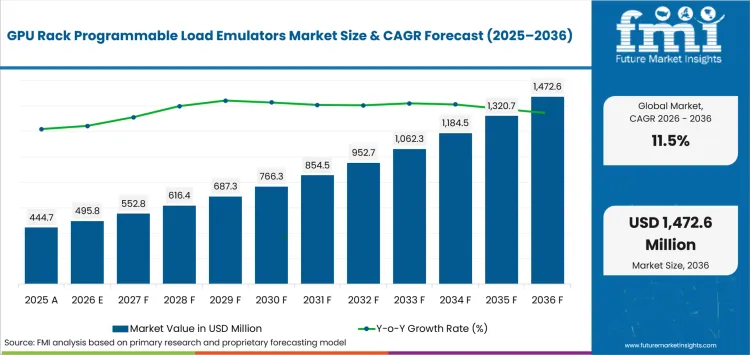
USD 495.8 Million in 2026 and USD 1472.6 Million by 2036 at an 11.5% CAGR.
GPU rack programmable load emulator demand is forecast to grow at an 11.5% CAGR, from USD 495.8 Million in 2026 to USD 1472.6 Million in 2036. The market stood at USD 444.7 Million in 2025. Developers need to test power and cooling before expensive GPU equipment enters service. The USA Department of Energy’s December 2024 data-center study points to much higher electricity demand, while NVIDIA’s GB200 NVL72 design illustrates the concentration of heat and current at the rack. Controllable loads allow commissioning teams to find faults, adjust systems and record acceptance results before production begins.
Project schedules determine when an AI investment becomes an emulator order. Saudi Arabia’s HUMAIN plans include sovereign AI infrastructure, where test fleets can move between construction phases. UAE campus projects need nearby rental equipment and technicians. South Korea is pairing its 100MW-class Ulsan project with power-supply planning, while France is accelerating grid connections at selected sites. These projects need different combinations of rack emulators and upstream load equipment. Acceptance testing can begin only when the facility has power and the commissioning team can reproduce the intended load.
Key Takeaways of GPU Rack Programmable Load Emulators Market
- Power and cooling faults are less costly to resolve before GPU racks enter service.
- Power conversion equipment represents 27.0% of solution demand in 2026. Commissioning teams need controlled loads that reproduce the electrical demand expected after the GPUs arrive.
- Medium-voltage distribution accounts for 31.0% by electrical layer in 2026. Upstream switchgear and power-transfer behavior must be tested before a data hall can be accepted.
- The 51-150 MW category holds 31.0% of project-capacity demand in 2026. Sites of this scale commonly commission power and cooling in several phases.
- Hyperscale AI facilities account for 44.0% of demand in 2026. Dense racks and repeated hall designs create a need for testing that can be repeated across the campus.
- OEM direct sales represent 38.0% of routes to market in 2026. Direct engineering support helps buyers specify the load controls and connections needed for their test plan.
- Opportunity: Suppliers can combine high-capacity programmable loading with liquid-cooling simulation, fleet control, and automated evidence capture.
- Companies include Avtron Power Solutions, Mosebach Manufacturing, Crestchic Loadbanks.
Analyst Perspective
"Commissioning teams need to reproduce both the electrical demand and the heat the future racks will produce. Coordinated controls and usable test records matter as much as the total load capacity available on site."
- Sudip saha, Principal Consultant, Future Market Insights
How is the GPU Rack Programmable Load Emulators Market segmented?
The market is segmented by Solution Type, Electrical Layer, Power Capacity, Facility Type, and Route to Market.
By Solution Type: Power conversion equipment, Distribution assemblies, Prefabricated power modules, Protection & transfer systems, Monitoring / control hardware; By Electrical Layer: Medium-voltage distribution, Low-voltage distribution, Rack / row-level, Substation / grid interface; By Power Capacity: 51-150 MW, 10-50 MW, Below 10 MW, Above 150 MW; By Facility Type: Hyperscale AI, Colocation, Enterprise / private cloud, HPC / research; By Route to Market: OEM direct, Electrical EPC / contractor, System integrator, Distributor / service partner.
Why does medium-voltage distribution lead demand within the electrical layer category?
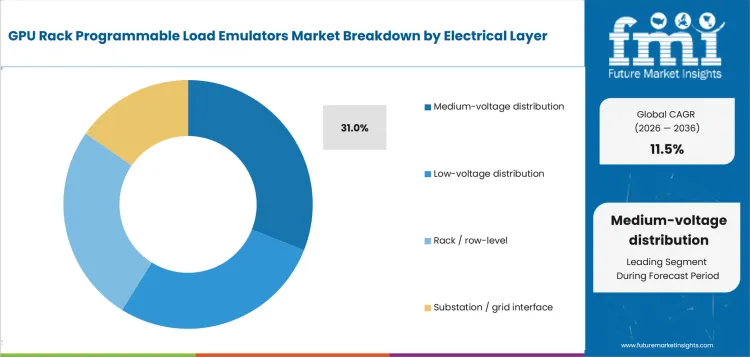
Medium-voltage testing lets project teams validate larger sections of the power chain before demand is divided into low-voltage rows and rack circuits. This matters when an AI campus is energized in phases and several downstream systems must be tested against realistic upstream loading. Direct medium-voltage load equipment can also reduce the quantity of low-voltage high-current cabling required for a large test. Avtron’s current 9100 product documentation specifies direct connection up to 13.8 kV and capacities up to 7 MW in one unit. This arrangement reduces temporary conversion steps during high-capacity tests. Rack-level emulators remain essential for final hall testing, but upstream validation captures more of the facility-wide failure path. Coordinated power quality monitoring helps commissioning teams interpret disturbances during controlled loading.
- Medium-voltage distribution holds 31.0% of the Electrical Layer category in 2026 because large AI facilities must prove switchgear, transfer, and upstream distribution behavior before final rack acceptance.
- In January 2026, Crestchic reported using 3,300 kVA load banks to commission UPS systems and generators at a Saudi data-center project while rack-mounted units tested the data halls. The project demonstrates the need to validate more than one electrical layer on the same site.
Why does power conversion equipment lead demand within the solution type category?
Power conversion equipment sits closest to the act of turning available site electricity into a controlled test demand. Commissioning teams need repeatable steps that imitate the electrical draw expected from dense GPU racks without waiting for production compute systems. The equipment also has to match site voltage and cooling conditions during staged energization. That makes the active loading function the anchor around which distribution assemblies, protection devices, and monitoring hardware are configured. As liquid-cooled AI racks become common, the same purchasing decision increasingly includes thermal behavior and control integration. Buyers therefore favor platforms that can be scaled across a hall while preserving a common test sequence and reporting method. The test boundary must reflect the data-center power equipment being accepted before IT installation.
- Power conversion equipment holds 27.0% of the Solution Type category in 2026 because controlled load application is the core function required to reproduce rack demand during commissioning.
- In January 2026, Avtron Power Solutions introduced a 500kW LC35 and a 720kW LC20 for liquid-cooled data-center commissioning. The models show how suppliers are raising per-unit capacity while integrating the test load with facility cooling loops.
Why does the 51-150 MW segment lead demand within the power capacity category?
The 51-150 MW band aligns with large individual AI data-center phases that are substantial enough to justify dedicated commissioning fleets but still manageable as staged projects. A project in this range can require rack-level simulation across many halls plus upstream validation of generators, UPS systems, and distribution equipment. This creates repeat demand as successive halls are turned over. The range also supports a practical rental model because high-capacity units and server emulators can be redeployed between phases rather than purchased for one acceptance event. Above 150 MW, projects are more often broken into multiple blocks. Smaller sites can rely on more conventional portable equipment and have less need for very large coordinated fleets. Phased infrastructure services must align energization, temporary load equipment and the acceptance schedule.
- The 51-150 MW segment holds 31.0% of the Power Capacity category in 2026 because it matches the commissioning scale of large AI facilities that are commonly energized and accepted in phases.
- In June 2025, South Korea’s Ministry of Science and ICT described the Ulsan AI Data Center as a 100MW-class project. The ministry said the facility was scheduled to reach 103 MW at full capacity, placing the project directly within this commissioning scale.
Why does hyperscale AI lead demand within the facility type category?
Hyperscale AI facilities concentrate the conditions that make programmable load emulation most valuable. They combine high rack density with large numbers of repeated rack positions and strict turnover schedules. A fault found after production GPUs are installed can affect expensive compute assets and delay a much larger capacity block. Pre-live testing therefore needs both electrical repeatability and a thermal substitute for the future servers. The equipment fleet must also scale across rows while producing consistent evidence for acceptance teams. Colocation and HPC sites face similar requirements, but hyperscale AI combines density with volume. That combination makes coordinated test loads a larger and more systematic procurement item rather than a specialist tool used on isolated circuits. Facilities using liquid cooling require test conditions that address the thermal circuit as well as electrical demand.
- Hyperscale AI holds 44.0% of the Facility Type category in 2026 because high rack density and repeated data-hall layouts create broad demand for pre-installation electrical and thermal validation.
- In October 2024, NVIDIA contributed its GB200 NVL72 rack design to the Open Compute Project, covering a system with 72 Blackwell GPUs and a nominal rack power draw of approximately 120 kW, delivered via a DC busbar architecture from rack-level power shelves. Those design conditions raise the test burden before a hyperscale hall receives live compute equipment.
Why does OEM direct lead demand within the route to market category?
Direct OEM purchasing suits emulators that require a particular voltage, load range, control protocol or thermal connection. Application engineers can help network the units, configure test profiles and establish a reporting method before delivery. Electrical EPCs and system integrators retain responsibility for the wider acceptance sequence; rental and service partners provide temporary fleets where ownership is unnecessary. The choice of channel depends on how much customization is needed and how quickly equipment must reach the site. OEM support can also resolve interfaces with site power management functions.
- OEM direct holds 38.0% of the Route to Market category in 2026 because configuration-sensitive load equipment benefits from direct application engineering and control integration at the point of specification.
- In June 2024, Avtron Power Solutions acquired Rx Monitoring Services to combine load-bank testing with power-quality monitoring and commissioning automation. The move illustrates why direct supplier engagement increasingly includes software and standardized test execution rather than hardware selection alone.
What are the drivers, restraints and opportunities in the GPU Rack Programmable Load Emulators Market?
Rising GPU rack density is expanding pre-live validation demand, while site power and integration constraints can delay testing, and networked liquid-cooled emulators create a path to higher-value commissioning packages.
- Driver: Higher AI rack power density increases the cost of discovering electrical or thermal faults after compute hardware is installed.
- Restraint: Grid access and temporary power can delay testing; cooling-loop readiness and test integration can do the same.
- Opportunity: Suppliers can combine high-capacity programmable loading with liquid-cooling simulation, fleet control, and automated evidence capture.
Data-center power demand is increasing at the same time that AI racks place more concentrated loads on facility infrastructure. The USA Department of Energy said in December 2024 that USA data centers used 176 TWh in 2023 and could consume 325 to 580 TWh by 2028. NVIDIA’s GB200 design shows why the commissioning problem is becoming more concentrated at rack level. A 120 kW-class liquid-cooled rack can expose faults in the power path and coolant delivery before IT equipment goes live. It can also expose control problems under realistic load. Commissioning teams respond by substituting programmable loads for the future compute equipment. That changes demand from periodic generator testing toward coordinated validation across the AI data hall and its upstream power path.
Facility readiness limits when emulators can be used. Programmable emulators still require usable electrical capacity, temporary cabling or medium-voltage connections, and a cooling path that can reject the simulated heat. Japan’s METI and MIC stated in June 2025 that swift data-center development requires power, telecommunications, and data-center operators to coordinate because data centers need large amounts of electricity. Similar timing issues arise when utility interconnection or internal distribution is not ready for full-load tests. Equipment can sit idle until power is available, or the test may have to proceed in smaller phases. Buyers therefore scrutinize deployment logistics and connection requirements as closely as rated capacity.
Combined electrical and thermal testing gives suppliers a broader commissioning role. Crestchic’s March 2026 liquid-cooled platform provides up to 648kW at 415V with automatic load profiling, and its VCS software can cluster up to 240 units for mixed air-cooled and liquid-cooled tests. Avtron also increased liquid-cooled capacity in January 2026. Coordinating load steps, coolant behavior and recorded results lets teams test dense halls before live servers arrive. Rental fleets make this capacity available for successive construction phases without requiring each owner to retain all the equipment.
Which country CAGRs are profiled in the GPU Rack Programmable Load Emulators Market?
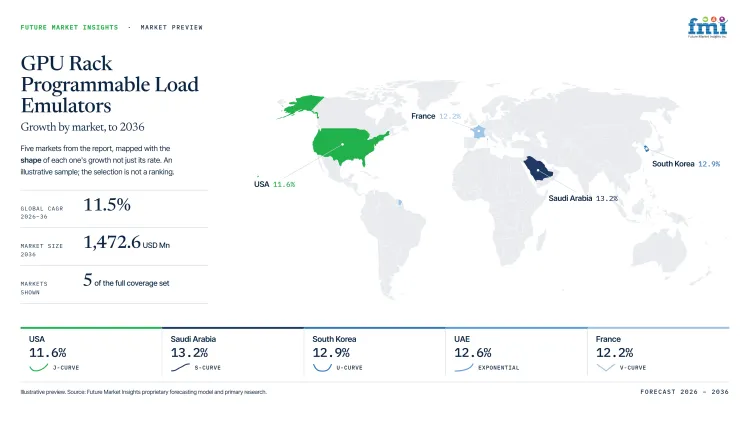
| Country | CAGR (2026 to 2036) |
|---|---|
| USA | 11.6% |
| Saudi Arabia | 13.2% |
| UAE | 12.6% |
| South Korea | 12.9% |
| France | 12.2% |
| Japan | 11.9% |
How do country-level CAGRs compare in the GPU Rack Programmable Load Emulators Market?
The six country forecasts lie within 1.6 percentage points. Saudi Arabia leads at 13.2%, ahead of South Korea at 12.9% and the UAE at 12.6%. France is forecast at 12.2% and Japan at 11.9%, while the USA’s 11.6% is close to the global 11.5% CAGR. Although growth rates are similar, grid readiness and construction schedules create different commissioning windows. The percentages do not indicate current country market size.
- USA: The Department of Energy’s December 2024 study projected a substantial increase in data-center electricity use through 2028. Developers must align test equipment with utility connections and temporary power, since new capacity cannot be commissioned from the construction schedule alone.
- Saudi Arabia: PIF launched HUMAIN in May 2025 to develop AI infrastructure. Crestchic subsequently described a Saudi installation using 1,550 rack-mounted load banks, showing why large projects need enough equipment and technicians available at the same time.
- UAE: The USA Department of Commerce described a planned Abu Dhabi AI campus in May 2025. Crestchic’s acquisition of a local rental division earlier that year added equipment at Jebel Ali, where nearby stock can reduce mobilization time for construction sites.
- South Korea: The Ministry of Science and ICT described the Ulsan AI Data Center in June 2025, followed by an interministerial power-supply agreement in May 2026. Testing must follow the availability of electrical capacity as well as the installation of computing equipment.
- France: The Ministry of Economy identified further potential data-center sites in May 2025 and reported an accelerated RTE connection procedure. Connection dates determine when rental fleets can be booked and moved between projects.
- Japan: METI and MIC’s June 2025 Watt-Bit Collaboration Report links data-center development with power and telecommunications planning. That coordination affects the sequence of distribution tests and the timing of rack-load emulation.
Regional coverage includes North America; Latin America; Western Europe; Eastern Europe; East Asia; South Asia and Pacific; Middle East and Africa.
Country-wise Analysis
- USA: The USA's market is projected to expand at 11.6% CAGR over 2026 to 2036. In December 2024, the USA Department of Energy reported that data centers consumed about 4.4% of USA electricity in 2023 and could reach 6.7% to 12% by 2028. Rapid capacity additions can outpace utility connections and temporary test power. Networked fleets and medium-voltage equipment help teams test the available sections, with automation reducing repeated setup work.
- Saudi Arabia: A 13.2% CAGR is forecast for Saudi Arabia between 2026 and 2036. PIF launched HUMAIN in May 2025 with next-generation data centers and AI infrastructure in its mandate. Crestchic reported in January 2026 that a Saudi project used 1,550 rack-mounted load banks for 8 MW of data-hall testing. Campus-scale work requires enough equipment and technicians to be available together. Local stock of modular rack emulators and upstream load equipment can reduce mobilization delays.
- UAE: The outlook for the UAE implies 12.6% annual growth through 2036. The USA Department of Commerce said in May 2025 that a 1GW first phase would break ground within a planned 5GW AI campus in Abu Dhabi. Crestchic had acquired Gulf Incon International’s load-bank rental division in February 2025 and moved assets to Jebel Ali. Concurrent projects compete for the same rental units and technicians. A larger local fleet can support electrical commissioning and server-emulator heat tests within those overlapping schedules.
- South Korea: Sales in South Korea are expected to grow at 12.9% CAGR during the forecast period. In June 2025, the Ministry of Science and ICT described the Ulsan AI Data Center as a 100MW-class project planned to reach 103 MW. In May 2026, Korean ministries signed an MOU focused on stable power supply for AI data centers. Electricity availability determines when the new compute sites can be tested. Medium-voltage and rack-level acceptance may need to proceed in stages as supply becomes available.
- France: France is expected to post 12.2% CAGR from 2026 to 2036. In May 2025, the French Ministry of Economy said 28 additional potential data-center host sites had been identified beyond 35 announced in February. It also reported an accelerated RTE connection procedure with four initial beneficiary sites. Grid connection dates must align with equipment bookings. Fleets sized for 51-150 MW phases can be redeployed as European project schedules change.
- Japan: Japan's market is projected to expand at 11.9% CAGR over 2026 to 2036. METI and MIC published Watt-Bit Collaboration Report 1.0 in June 2025. The agencies said growing AI use is raising data-center demand and that swift development requires power, telecommunications, and data-center operators to work together. Site selection and infrastructure readiness determine the test sequence. Modular equipment can move between phases and validate distribution ahead of GPU delivery.
Who are the notable companies in the GPU Rack Programmable Load Emulators Market?
Avtron Power Solutions, Mosebach Manufacturing, Crestchic Loadbanks.
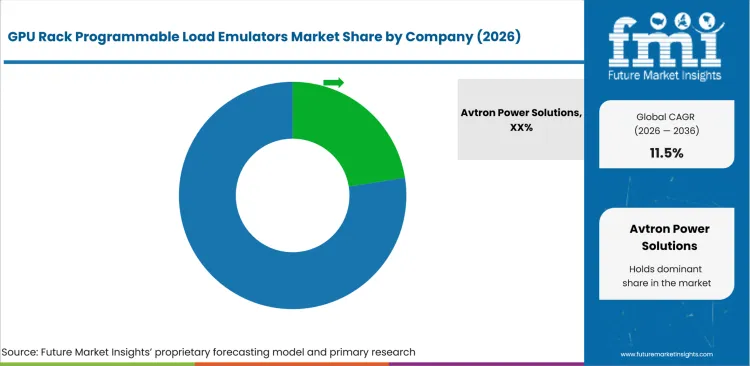
Avtron Power Solutions, Mosebach Manufacturing and Crestchic Loadbanks address AI commissioning through different combinations of load equipment, controls and temporary fleet access. Selection depends on the electrical boundary under test and the cooling conditions that must be reproduced.
- Networked commissioning platforms - Avtron Power Solutions combines load equipment with monitoring and automation capabilities that support standardized test execution across complex data-center projects.
- Compact server-rack emulation - Mosebach Manufacturing offers the SR family for data-center rack commissioning and multi-unit controllers that can coordinate large numbers of load banks.
- Rental-led data-hall testing - Crestchic Loadbanks pairs server-emulator and liquid-cooled products with rental operations that support large temporary deployments in multiple regions.
Competitive Benchmarking: GPU Rack Programmable Load Emulators Market
| Company | Rack-load emulation | Liquid-cooling tests | Networked test delivery | Geographic reach |
|---|---|---|---|---|
| Avtron Power Solutions | High | High | High | North America, Europe and international projects |
| Mosebach Manufacturing | High | Medium | Medium | USA with international project supply |
| Crestchic Loadbanks | High | High | High | Europe, Middle East, North America and Asia |
Scoring basis: High for Rack-load emulation covers several rack or data-hall load configurations; Medium covers one narrower configuration. High for Liquid-cooling tests requires purpose-built data-center thermal-load equipment and controls; Medium marks broader water-cooled equipment. High for Networked test delivery combines coordinated controls with multi-site service or rental access; Medium covers a more limited route. Unscored indicates that the criterion is not part of the company’s stated offer. Ratings concern commissioning capability, not AI compute performance.
Avtron’s LC20 and LC35 extend its liquid-cooled offering. Mosebach’s SR family covers several rack voltage and power options, while its wider catalog includes water-cooled loads. Crestchic combines rack emulators with stackable and liquid-cooled equipment and a rental network. Crestchic has been a wholly owned Aggreko subsidiary since February 2023 and continues to trade under the Crestchic name.
Key Developments in the GPU Rack Programmable Load Emulators Market
- In February 2025, Crestchic Loadbanks acquired the load-bank rental division of Gulf Incon International. Crestchic said the transaction would double the number of employees in the UAE and relocate acquired assets and team members to its Jebel Ali base. The acquisition expands the local fleet available for the UAE projects and gives the company a stronger operating platform for server-emulator heat testing across the Gulf.
- In January 2026, Avtron Power Solutions expanded its liquid-cooled portfolio with the CE-rated 500kW LC35 and a 720kW LC20. The company designed both models for commissioning and maintenance of liquid-cooled data centers so teams can apply realistic heat loads through the facility cooling loop. Higher per-unit capacity reduces the number of devices needed to reproduce dense AI loads and supports more scalable pre-live testing.
Key Players in the GPU Rack Programmable Load Emulators Market
Networked Commissioning Platforms
- Avtron Power Solutions
Compact Server-Rack Emulation
- Mosebach Manufacturing
Rental-Led Data-Hall Testing
- Crestchic Loadbanks
GPU Rack Programmable Load Emulators Market - Report Scope
| Coverage field | Report scope |
|---|---|
| Market breakdown | Solution Type; Electrical Layer; Power Capacity; Facility Type; Route to Market |
| Quantitative Units | Revenue in USD Million and CAGR in %. |
| Market Definition | Revenue includes programmable load-emulation equipment and integrated control or distribution hardware sold for GPU-rack and AI data-center commissioning within the market definition. It excludes downstream GPU systems, finished data-center revenue, and adjacent equipment sold outside the defined emulation use case. |
| Regions Covered | North America; Latin America; Western Europe; Eastern Europe; East Asia; South Asia and Pacific; Middle East and Africa |
| Countries Covered | USA, Saudi Arabia, UAE, South Korea, France, Japan |
| Key Companies Profiled | Avtron Power Solutions; Mosebach Manufacturing; Crestchic Loadbanks |
| Forecast Period | 2026 to 2036 |
| Approach | FMI uses a hybrid bottom-up and top-down sizing approach that reconciles supplier offerings, commissioning project activity, capacity classes, route-to-market evidence, and macro infrastructure indicators within the defined revenue boundary. |
GPU Rack Programmable Load Emulators Market - Research Methodology
| Method | Approach |
|---|---|
| Primary Research | FMI’s primary research framework covers load-bank manufacturers, rental and service providers, electrical EPCs, commissioning specialists, system integrators, and data-center engineering or procurement teams. Discussions test product boundaries, purchase triggers, capacity requirements, rental-versus-purchase behavior, deployment constraints, and supplier-selection criteria. |
| Desk Research | Desk research reviews government data-center and power-policy publications, company filings and newsrooms, technical product documentation, public project announcements, standards-related materials, and other authoritative records. |
| Market Sizing and Forecasting | Market sizing combines bottom-up assessment of relevant equipment classes and transaction routes with top-down checks against AI data-center commissioning activity and capacity development. Forecast assumptions consider rack density, facility build schedules, electrical-layer requirements, liquid-cooling adoption, service availability, and country-specific power constraints. |
| Data Validation | Findings are cross-checked across independent evidence types and reconciled to the market segments. Validation excludes double counting, downstream finished-product revenue, general-purpose load-bank revenue outside the GPU-rack commissioning use case, and adjacent data-center infrastructure categories that do not belong in market revenue. |
GPU Rack Programmable Load Emulators Market by Segments
GPU Rack Programmable Load Emulators Market segmented by Solution Type:
- Power conversion equipment
- Distribution assemblies
- Prefabricated power modules
- Protection & transfer systems
- Monitoring / control hardware
GPU Rack Programmable Load Emulators Market segmented by Electrical Layer:
- Medium-voltage distribution
- Low-voltage distribution
- Rack / row-level
- Substation / grid interface
GPU Rack Programmable Load Emulators Market segmented by Power Capacity:
- 51-150 MW
- 10-50 MW
- Below 10 MW
- Above 150 MW
GPU Rack Programmable Load Emulators Market segmented by Facility Type:
- Hyperscale AI
- Colocation
- Enterprise / private cloud
- HPC / research
GPU Rack Programmable Load Emulators Market segmented by Route to Market:
- OEM direct
- Electrical EPC / contractor
- System integrator
- Distributor / service partner
GPU Rack Programmable Load Emulators Market by Region:
- North America
- United States
- Canada
- Latin America
- Brazil
- Mexico
- Argentina
- Chile
- Western Europe
- Germany
- France
- United Kingdom
- Italy
- Spain
- Benelux
- Nordics
- Eastern Europe
- Poland
- Czech Republic
- Romania
- Hungary
- East Asia
- China
- Japan
- South Korea
- South Asia and Pacific
- India
- ASEAN
- Australia and New Zealand
- Middle East and Africa
- GCC Countries
- South Africa
- Türkiye
- Israel
Research Sources and Bibliography
- USA Department of Energy (2024, December 20). DOE Releases New Report Evaluating Increase in Electricity Demand from Data Centers.
- NVIDIA (2024, October 15). NVIDIA Contributes NVIDIA GB200 NVL72 Designs to Open Compute Project.
- Public Investment Fund (2025, May 12). HRH Crown Prince launches HUMAIN as global AI powerhouse.
- USA Department of Commerce (2025, May 15). UAE and US Presidents attend the unveiling of Phase 1 of new 5GW AI campus in Abu Dhabi.
- Ministry of Science and ICT, Republic of Korea (2025, June 20). Ulsan AI Data Center Launch Sparks Dialogue on Advancing Korea into a Top-Three Global AI Power.
- Ministry of Climate, Energy and Environment, Republic of Korea (2026, May 12). AI Data Center-Energy Policy Partnership Kicks Into High Gear.
- Ministry of Economy, Finance and Industrial and Digital Sovereignty, France (2025, May 21). IA : des investissements records annoncés lors du Sommet Choose France 2025.
- Ministry of Economy, Trade and Industry, Japan (2025, June 12). Report 1.0 of the Public-Private Advisory Council on Watt-Bit Collaboration Published.
- Avtron Power Solutions (2024, June 25). Avtron Power Solutions Expands Capabilities with Acquisition of Rx Monitoring Services, Transforming Data Center Commissioning Automation.
- Avtron Power Solutions (2026, January 13). Avtron Power Solutions Expands Liquid Cooled Load Bank Portfolio with New LC35 and LC20 High-Capacity Models.
- Avtron Power Solutions (accessed August 25, 2026). 9100 Load Bank.
- Mosebach Manufacturing Company (accessed August 25, 2026). Load Banks and Data Center Load Bank.
- Crestchic Loadbanks (2025, February 17). Crestchic Loadbanks acquisition expands reach in the UAE.
- Crestchic Loadbanks (2026, January 7). Crestchic Completes Major Load Testing Project in Saudi Arabia.
- Crestchic Loadbanks (2026, March 4). Crestchic Unveils 600kW Liquid Cooled Loadbank at Data Centre World, London.
- Mosebach Manufacturing (n.d.; accessed September 9, 2026). Data Center Load Bank and AC Load Banks product catalog.
- Crestchic (2026, March 4). Crestchic Unveils 600kW Liquid Cooled Loadbank at Data Centre World London.
- Crestchic (2023, February 23). The Crestchic Group becomes a wholly owned subsidiary of Aggreko.
This bibliography is provided for reader reference and is not exhaustive. The full report contains the complete reference list and detailed citations.
This Report Answers
- Which AI data-center power and commissioning pressures support demand for GPU rack programmable load emulators?
- Why does Power conversion equipment hold the leading position within Solution Type?
- How does Medium-voltage distribution influence downstream commissioning demand across the Electrical Layer?
- How do growth rates differ across the USA, Saudi Arabia, UAE, South Korea, France, and Japan?
- How do Avtron Power Solutions, Mosebach Manufacturing, and Crestchic Loadbanks differ in product and route-to-market roles?
- Which power-access, integration, and mobilization constraints can delay adoption of programmable load emulators?
- What should data-center engineering and procurement teams evaluate before purchasing or renting GPU rack programmable load emulation equipment?
Frequently Asked Questions
How big is the GPU Rack Programmable Load Emulators Market in 2026?
The market is estimated at USD 495.8 Million in 2026 and is projected to reach USD 1,472.6 Million by 2036.
What is the CAGR of the GPU Rack Programmable Load Emulators Market from 2026 to 2036?
The market is forecast to expand at an 11.5% CAGR from 2026 to 2036.
Which segment leads the solution type category?
Power conversion equipment is expected to lead with 27.0% share in 2026.
How much value is the GPU Rack Programmable Load Emulators Market expected to add by 2036?
The projected increase between 2026 and 2036 is USD 976.8 Million.
Which companies participate in theGPU Rack Programmable Load Emulators Market?
Avtron Power Solutions, Mosebach Manufacturing, Crestchic Loadbanks.
What notable restraint affects the GPU Rack Programmable Load Emulators Market?
Site infrastructure is the principal constraint because a full-load test still requires adequate power, connection capacity and a suitable cooling or heat-rejection path. Delayed energization can postpone equipment use even when the project ultimately requires commissioning.
Preview the report firsthand - request a free sample
Get SampleGet the brochure for pricing and purchase details.
Get PDFTable of Content
- Key Takeaways
- Market Size and CAGR
- Top Growth Driver
- Fastest Growing Segment
- Leading Region
- Key Companies
- Emerging Opportunities
- Executive Summary
- Global Market Outlook
- Demand-side Trends
- Supply-side Trends
- Technology Roadmap Analysis
- Analysis and Recommendations
- Analyst Perspective (What is happening? Why now? What should investors know?)
- Key Questions Answered
- How large is the market?
- What is the CAGR?
- What are key trends?
- Which region dominates?
- Who are the leaders?
- Market Overview
- Market Coverage / Taxonomy
- Market Definition / Scope / Limitations
- Research Methodology
- Chapter Orientation
- Analytical Lens and Working Hypotheses
- Market Structure, Signals, and Trend Drivers
- Benchmarking and Cross-market Comparability
- Market Sizing, Forecasting, and Opportunity Mapping
- Research Design and Evidence Framework
- Desk Research Programme (Secondary Evidence)
- Expert Input and Fieldwork (Primary Evidence)
- Tooling, Models, and Reference Databases
- Data Engineering and Model Build
- Quality Assurance and Audit Trail
- Market Background
- Market Dynamics (Drivers, Restraints, Opportunity, Trends)
- Scenario Forecast (Optimistic, Likely, Conservative)
- Impact Analysis
- AI Impact
- Sustainability Impact
- Regulatory Impact
- Technology Impact
- Consumer / Buyer Analysis
- Purchase Drivers
- Adoption Barriers
- Buyer Journey
- Opportunity Map Analysis
- Product Life Cycle Analysis
- Supply Chain Analysis
- Investment Feasibility Matrix
- Value Chain Analysis
- PESTLE and Porter's Analysis
- Regulatory Landscape
- Regional Parent Market Outlook
- Production and Consumption Statistics
- Import and Export Statistics
- Global Market Analysis and Forecast, 2021 to 2036
- Historical Market Size Value (USD Million) Analysis, 2021 to 2025
- Current and Future Market Size Value (USD Million) Projections, 2026 to 2036
- Y-o-Y Growth Trend Analysis
- Absolute $ Opportunity Analysis
- Global Market Pricing Analysis, 2021 to 2036
- Global Market Analysis and Forecast, By Solution Type, 2021 to 2036
- Introduction / Key Findings
- Historical Market Size Value (USD Million) Analysis By Solution Type, 2021 to 2025
- Current and Future Market Size Value (USD Million) Analysis and Forecast By Solution Type, 2026 to 2036
- Power conversion equipment
- Distribution assemblies
- Prefabricated power modules
- Protection & transfer systems
- Monitoring / control hardware
- Power conversion equipment
- Y-o-Y Growth Trend Analysis By Solution Type, 2021 to 2025
- Absolute $ Opportunity Analysis By Solution Type, 2026 to 2036
- Global Market Analysis and Forecast, By Electrical Layer, 2021 to 2036
- Introduction / Key Findings
- Historical Market Size Value (USD Million) Analysis By Electrical Layer, 2021 to 2025
- Current and Future Market Size Value (USD Million) Analysis and Forecast By Electrical Layer, 2026 to 2036
- Medium-voltage distribution
- Low-voltage distribution
- Rack / row-level
- Substation / grid interface
- Medium-voltage distribution
- Y-o-Y Growth Trend Analysis By Electrical Layer, 2021 to 2025
- Absolute $ Opportunity Analysis By Electrical Layer, 2026 to 2036
- Global Market Analysis and Forecast, By Power Capacity, 2021 to 2036
- Introduction / Key Findings
- Historical Market Size Value (USD Million) Analysis By Power Capacity, 2021 to 2025
- Current and Future Market Size Value (USD Million) Analysis and Forecast By Power Capacity, 2026 to 2036
- 51-150 MW
- 10-50 MW
- Below 10 MW
- Above 150 MW
- 51-150 MW
- Y-o-Y Growth Trend Analysis By Power Capacity, 2021 to 2025
- Absolute $ Opportunity Analysis By Power Capacity, 2026 to 2036
- Global Market Analysis and Forecast, By Facility Type, 2021 to 2036
- Introduction / Key Findings
- Historical Market Size Value (USD Million) Analysis By Facility Type, 2021 to 2025
- Current and Future Market Size Value (USD Million) Analysis and Forecast By Facility Type, 2026 to 2036
- Hyperscale AI
- Colocation
- Enterprise / private cloud
- HPC / research
- Hyperscale AI
- Y-o-Y Growth Trend Analysis By Facility Type, 2021 to 2025
- Absolute $ Opportunity Analysis By Facility Type, 2026 to 2036
- Global Market Analysis and Forecast, By Route to Market, 2021 to 2036
- Introduction / Key Findings
- Historical Market Size Value (USD Million) Analysis By Route to Market, 2021 to 2025
- Current and Future Market Size Value (USD Million) Analysis and Forecast By Route to Market, 2026 to 2036
- OEM direct
- Electrical EPC / contractor
- System integrator
- Distributor / service partner
- OEM direct
- Y-o-Y Growth Trend Analysis By Route to Market, 2021 to 2025
- Absolute $ Opportunity Analysis By Route to Market, 2026 to 2036
- Global Market Analysis and Forecast, By Region, 2021 to 2036
- Introduction
- Historical Market Size Value (USD Million) Analysis By Region, 2021 to 2025
- Current Market Size Value (USD Million) Analysis and Forecast By Region, 2026 to 2036
- North America
- Latin America
- Western Europe
- Eastern Europe
- East Asia
- South Asia and Pacific
- Middle East & Africa
- Market Attractiveness Analysis By Region
- North America Market Analysis and Forecast, By Country, 2021 to 2036
- Historical Market Size Value (USD Million) Trend Analysis By Market Taxonomy, 2021 to 2025
- Market Size Value (USD Million) Forecast By Market Taxonomy, 2026 to 2036
- By Country
- USA
- Canada
- By Solution Type
- By Electrical Layer
- By Power Capacity
- By Facility Type
- By Route to Market
- By Country
- Market Attractiveness Analysis
- By Country
- By Solution Type
- By Electrical Layer
- By Power Capacity
- By Facility Type
- By Route to Market
- Key Takeaways
- Latin America Market Analysis and Forecast, By Country
- Historical Market Size Value (USD Million) Trend Analysis By Market Taxonomy, 2021 to 2025
- Market Size Value (USD Million) Forecast By Market Taxonomy, 2026 to 2036
- By Country
- Brazil
- Mexico
- Chile
- Rest of Latin America
- By Solution Type
- By Electrical Layer
- By Power Capacity
- By Facility Type
- By Route to Market
- By Country
- Market Attractiveness Analysis
- By Country
- By Solution Type
- By Electrical Layer
- By Power Capacity
- By Facility Type
- By Route to Market
- Key Takeaways
- Western Europe Market Analysis and Forecast, By Country
- Historical Market Size Value (USD Million) Trend Analysis By Market Taxonomy, 2021 to 2025
- Market Size Value (USD Million) Forecast By Market Taxonomy, 2026 to 2036
- By Country
- Germany
- UK
- Italy
- Spain
- France
- Nordic
- BENELUX
- Rest of Western Europe
- By Solution Type
- By Electrical Layer
- By Power Capacity
- By Facility Type
- By Route to Market
- By Country
- Market Attractiveness Analysis
- By Country
- By Solution Type
- By Electrical Layer
- By Power Capacity
- By Facility Type
- By Route to Market
- Key Takeaways
- Eastern Europe Market Analysis and Forecast, By Country
- Historical Market Size Value (USD Million) Trend Analysis By Market Taxonomy, 2021 to 2025
- Market Size Value (USD Million) Forecast By Market Taxonomy, 2026 to 2036
- By Country
- Russia
- Poland
- Hungary
- Balkan & Baltic
- Rest of Eastern Europe
- By Solution Type
- By Electrical Layer
- By Power Capacity
- By Facility Type
- By Route to Market
- By Country
- Market Attractiveness Analysis
- By Country
- By Solution Type
- By Electrical Layer
- By Power Capacity
- By Facility Type
- By Route to Market
- Key Takeaways
- East Asia Market Analysis and Forecast, By Country
- Historical Market Size Value (USD Million) Trend Analysis By Market Taxonomy, 2021 to 2025
- Market Size Value (USD Million) Forecast By Market Taxonomy, 2026 to 2036
- By Country
- China
- Japan
- South Korea
- By Solution Type
- By Electrical Layer
- By Power Capacity
- By Facility Type
- By Route to Market
- By Country
- Market Attractiveness Analysis
- By Country
- By Solution Type
- By Electrical Layer
- By Power Capacity
- By Facility Type
- By Route to Market
- Key Takeaways
- South Asia and Pacific Market Analysis and Forecast, By Country
- Historical Market Size Value (USD Million) Trend Analysis By Market Taxonomy, 2021 to 2025
- Market Size Value (USD Million) Forecast By Market Taxonomy, 2026 to 2036
- By Country
- India
- ASEAN
- Australia & New Zealand
- Rest of South Asia and Pacific
- By Solution Type
- By Electrical Layer
- By Power Capacity
- By Facility Type
- By Route to Market
- By Country
- Market Attractiveness Analysis
- By Country
- By Solution Type
- By Electrical Layer
- By Power Capacity
- By Facility Type
- By Route to Market
- Key Takeaways
- Middle East & Africa Market Analysis and Forecast, By Country
- Historical Market Size Value (USD Million) Trend Analysis By Market Taxonomy, 2021 to 2025
- Market Size Value (USD Million) Forecast By Market Taxonomy, 2026 to 2036
- By Country
- Kingdom of Saudi Arabia
- Other GCC Countries
- Türkiye
- South Africa
- Other African Union
- Rest of Middle East & Africa
- By Solution Type
- By Electrical Layer
- By Power Capacity
- By Facility Type
- By Route to Market
- By Country
- Market Attractiveness Analysis
- By Country
- By Solution Type
- By Electrical Layer
- By Power Capacity
- By Facility Type
- By Route to Market
- Key Takeaways
- Key Countries Market Analysis
- USA
- Pricing Analysis
- Market Share Analysis, 2025
- By Solution Type
- By Electrical Layer
- By Power Capacity
- By Facility Type
- By Route to Market
- Canada
- Pricing Analysis
- Market Share Analysis, 2025
- By Solution Type
- By Electrical Layer
- By Power Capacity
- By Facility Type
- By Route to Market
- Mexico
- Pricing Analysis
- Market Share Analysis, 2025
- By Solution Type
- By Electrical Layer
- By Power Capacity
- By Facility Type
- By Route to Market
- Brazil
- Pricing Analysis
- Market Share Analysis, 2025
- By Solution Type
- By Electrical Layer
- By Power Capacity
- By Facility Type
- By Route to Market
- Chile
- Pricing Analysis
- Market Share Analysis, 2025
- By Solution Type
- By Electrical Layer
- By Power Capacity
- By Facility Type
- By Route to Market
- Germany
- Pricing Analysis
- Market Share Analysis, 2025
- By Solution Type
- By Electrical Layer
- By Power Capacity
- By Facility Type
- By Route to Market
- UK
- Pricing Analysis
- Market Share Analysis, 2025
- By Solution Type
- By Electrical Layer
- By Power Capacity
- By Facility Type
- By Route to Market
- Italy
- Pricing Analysis
- Market Share Analysis, 2025
- By Solution Type
- By Electrical Layer
- By Power Capacity
- By Facility Type
- By Route to Market
- Spain
- Pricing Analysis
- Market Share Analysis, 2025
- By Solution Type
- By Electrical Layer
- By Power Capacity
- By Facility Type
- By Route to Market
- France
- Pricing Analysis
- Market Share Analysis, 2025
- By Solution Type
- By Electrical Layer
- By Power Capacity
- By Facility Type
- By Route to Market
- India
- Pricing Analysis
- Market Share Analysis, 2025
- By Solution Type
- By Electrical Layer
- By Power Capacity
- By Facility Type
- By Route to Market
- ASEAN
- Pricing Analysis
- Market Share Analysis, 2025
- By Solution Type
- By Electrical Layer
- By Power Capacity
- By Facility Type
- By Route to Market
- Australia & New Zealand
- Pricing Analysis
- Market Share Analysis, 2025
- By Solution Type
- By Electrical Layer
- By Power Capacity
- By Facility Type
- By Route to Market
- China
- Pricing Analysis
- Market Share Analysis, 2025
- By Solution Type
- By Electrical Layer
- By Power Capacity
- By Facility Type
- By Route to Market
- Japan
- Pricing Analysis
- Market Share Analysis, 2025
- By Solution Type
- By Electrical Layer
- By Power Capacity
- By Facility Type
- By Route to Market
- South Korea
- Pricing Analysis
- Market Share Analysis, 2025
- By Solution Type
- By Electrical Layer
- By Power Capacity
- By Facility Type
- By Route to Market
- Russia
- Pricing Analysis
- Market Share Analysis, 2025
- By Solution Type
- By Electrical Layer
- By Power Capacity
- By Facility Type
- By Route to Market
- Poland
- Pricing Analysis
- Market Share Analysis, 2025
- By Solution Type
- By Electrical Layer
- By Power Capacity
- By Facility Type
- By Route to Market
- Hungary
- Pricing Analysis
- Market Share Analysis, 2025
- By Solution Type
- By Electrical Layer
- By Power Capacity
- By Facility Type
- By Route to Market
- Kingdom of Saudi Arabia
- Pricing Analysis
- Market Share Analysis, 2025
- By Solution Type
- By Electrical Layer
- By Power Capacity
- By Facility Type
- By Route to Market
- Türkiye
- Pricing Analysis
- Market Share Analysis, 2025
- By Solution Type
- By Electrical Layer
- By Power Capacity
- By Facility Type
- By Route to Market
- South Africa
- Pricing Analysis
- Market Share Analysis, 2025
- By Solution Type
- By Electrical Layer
- By Power Capacity
- By Facility Type
- By Route to Market
- USA
- Market Structure Analysis
- Competition Dashboard
- Competition Benchmarking
- Market Share Analysis of Top Players
- By Regional
- By Solution Type
- By Electrical Layer
- By Power Capacity
- By Facility Type
- By Route to Market
- Emerging Startups
- Innovation Benchmarking
- Competition Analysis
- Competition Deep Dive
- Avtron Power Solutions
- Overview
- Product Portfolio
- Profitability by Market Segments
- Sales Footprint
- Strategy Overview
- Marketing Strategy
- Product Strategy
- Channel Strategy
- Mosebach Manufacturing
- Crestchic Loadbanks
- Avtron Power Solutions
- Case Studies
- Success Stories
- Recent Developments
- Competition Deep Dive
- Assumptions & Acronyms Used


