

- Market Size (2026)
- USD 1088.9 Mn
- Forecast (2036)
- USD 3119.8 Mn
- CAGR (2026 to 2036)
- 11.1%
How big is Gut Comfort Beverages Market in 2026?
USD 1088.9 Million in 2026 and USD 3119.8 Million by 2036 at an 11.1% CAGR.
Demand for gut comfort beverages is projected to expand at 11.1% CAGR between 2026 and 2036, increasing valuation from USD 1088.9 Million in 2026 to USD 3119.8 Million by 2036. Commercial uptake depends on placing a measurable digestive cue inside beverage formats that consumers already recognize, while keeping taste and serving tolerance suitable for repeat purchase.
Dietary fiber gives brands a visible nutrition cue when the ingredient meets applicable labeling rules. The USA FDA states that dietary fiber declared on Nutrition Facts labels can include intrinsic fibers and certain added nondigestible carbohydrates with beneficial physiological effects. Health-Ade used this logic in SunSip, pairing agave inulin with a lower-sugar soda format. Retail buyers can therefore compare a gut-oriented drink beside conventional soda rather than treating it only as a specialist wellness product.
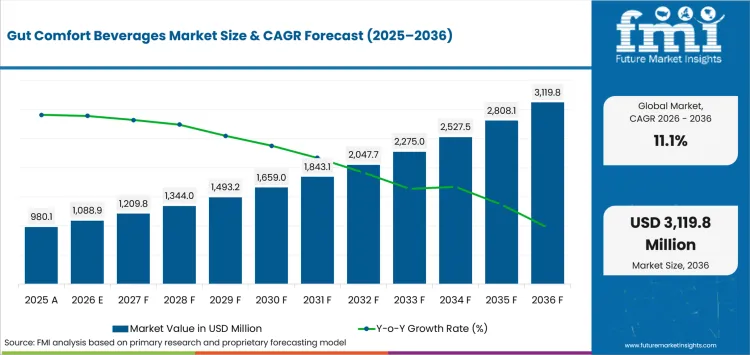
Key Takeaways of Gut Comfort Beverages Market
- Gut-oriented beverages move closer to routine refreshment when function is delivered through familiar soda, fermented and botanical formats.
- Prebiotic Sodas account for 44.1% of Product Type in 2026 as carbonated formats lower the learning barrier for first trial.
- Prebiotic Fiber represents 26.3% of Active demand in 2026 because qualifying fiber can be stated quantitatively on nutrition labels.
- Low-Sugar accounts for 50.3% of Claim demand in 2026 as shoppers compare functional drinks against reformulated conventional soft drinks.
- Fiber tolerance and claim substantiation can weaken repeat use when serving design or evidence does not match the consumer promise.
- OLIPOP, Poppi (PepsiCo), Health-Ade, GT's Living Foods, Culture Pop, Wildwonder, De La Calle and Suja Life are active across fiber-led soda, fermented beverages and adjacent functional formats.
Analyst Perspective
"Revenue capture depends on a beverage tasting familiar enough for routine use while carrying a function that can be explained without overstatement. Formulators need to balance active dose with serving tolerance, then match shelf stability and packaging to the retail channel where repeat purchase is expected."
- Nandini Roy Choudhury, Principal Consultant, Future Market Insights
How is the Gut Comfort Beverages Market segmented?
The gut comfort beverages market is segmented by product type, active, claim, packaging, sales channel and region.
Product Type distinguishes the beverage occasion and production platform. Active captures the ingredient system carrying the digestive proposition, while Claim reflects the message consumers compare at shelf. Packaging separates handling needs and consumption formats. Sales Channel identifies where discovery and repeat purchase occur. A shelf-stable prebiotic soda in a can can compete in a conventional soda aisle, while a raw fermented drink may rely more heavily on refrigerated placement.
Why do Prebiotic Sodas account for 44.1% of the Product Type category?
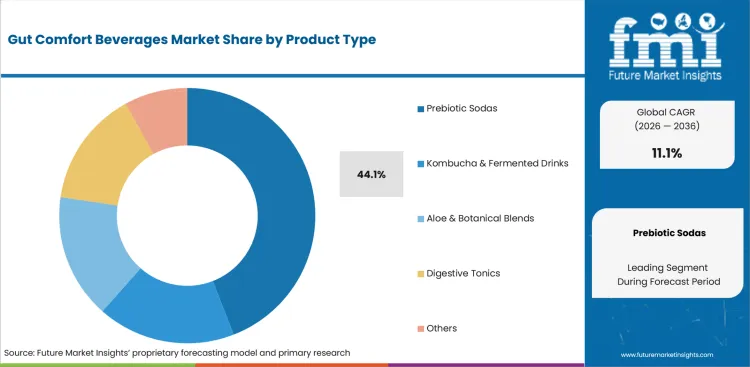
Prebiotic sodas translate a specialized digestive idea into a recognizable carbonated soft-drink occasion. Trial does not require a new drinking ritual, and formulators can pair familiar cola or fruit profiles with qualifying fiber and lower sugar. PepsiCo launched Pepsi Prebiotic Cola nationwide in February 2026 in 12-ounce cans and placed it in the carbonated soft-drink aisle, showing how the format can enter an established retail set.
- Prebiotic Sodas account for 44.1% of Product Type in 2026 because the format combines digestive positioning with familiar carbonated-soft-drink consumption.
- PepsiCo launched Pepsi Prebiotic Cola nationwide in February 2026 in 12-ounce single cans and eight-packs, with placement in the carbonated soft-drink aisle.
Why does Prebiotic Fiber account for 26.3% of the Active category?
Prebiotic fiber gives beverage makers an active that can be quantified on nutrition labeling when the ingredient satisfies applicable rules. It can be used across soda, botanical and hybrid fermented formulations without requiring consumers to interpret a live-culture count. The practical constraint is dose design: the product has to carry a credible amount while remaining comfortable to drink repeatedly and acceptable in taste.
- Prebiotic Fiber accounts for 26.3% of Active demand in 2026 because its quantity can be made legible on the nutrition panel when regulatory criteria are satisfied.
- The USA FDA explains that qualifying isolated or synthetic nondigestible carbohydrates may be included in dietary-fiber declarations when they meet the applicable definition or policy.
Why does Low-Sugar account for 50.3% of the Claim category?
Low-sugar is a direct shelf-level comparison and complements the soda-replacement logic of gut comfort beverages. Consumers can understand a lower sugar number without first learning fermentation science. Retail buyers can also compare the claim against reformulation targets and category norms. The UK government reported in November 2025 that average sugar in drinks within the levy scope fell by about 47% between 2015 and 2024.
- Low-Sugar accounts for 50.3% of Claim demand in 2026 because the message is easy to compare with conventional soda and can reinforce substitution toward lower-sugar formats.
- UK government evidence shows extensive reformulation under the Soft Drinks Industry Levy, with a 47% average reduction in sugar in in-scope drinks between 2015 and 2024.
Why do Cans account for 41.9% of the Packaging category?
Cans fit modern soda merchandising and support single-serve trial plus multipacks. Shelf-stable formulas can use ambient distribution and conventional carbonated-beverage facings, which helps brands position digestive function as an everyday beverage rather than a specialist product. Health-Ade used 11.5-ounce aluminum cans for SunSip, while PepsiCo specified 12-ounce single cans and eight-packs for Pepsi Prebiotic Cola.
- Cans account for 41.9% of Packaging in 2026 because they match soda merchandising, trial sizes and multipack economics where formulation permits shelf-stable distribution.
- Health-Ade launched SunSip in 11.5-ounce aluminum cans, with initial Whole Foods Market availability before broader retail expansion.
Why do Supermarkets & Hypermarkets account for 26.6% of the Sales Channel category?
Supermarkets and hypermarkets place gut-oriented drinks inside routine grocery missions and expose them to both soda and wellness shoppers. That overlap matters because the category depends on repeat purchase after trial. Large chains can support multipack promotions and cross-category shelf tests. Wildwonder expanded several gut-friendly flavors to Whole Foods Market nationwide in January 2025, while Culture Pop later announced nationwide Target availability.
- Supermarkets & Hypermarkets account for 26.6% of Sales Channel demand in 2026 because they combine routine traffic with access to mainstream beverage and wellness occasions.
- Wildwonder announced a nationwide Whole Foods Market expansion in January 2025, increasing routine grocery access for its sparkling prebiotic and probiotic beverages.
What are the drivers, restraints and opportunities in the Gut Comfort Beverages Market?
Lower-sugar soda substitution supports demand, while serving tolerance and claim substantiation constrain repeat use as mainstream retail expands the accessible beverage occasion.
- Driver: Lower-sugar soda reformulation creates room for beverages that add a clear digestive or gut-oriented proposition.
- Restraint: Rapid fiber intake can cause gas or bloating, while functional language requires evidence that fits each market's labeling framework.
- Opportunity: Shelf-stable functional sodas can move digestive positioning from specialist wellness sets into routine grocery beverage aisles.
Sugar reduction has changed the competitive baseline in soft drinks, giving gut comfort brands a clearer substitution story. UK government data show a 47% average reduction in sugar in drinks covered by the levy between 2015 and 2024. A lower-sugar functional beverage can compete on a familiar comparison before adding fiber, botanicals or live cultures. Commercial conversion improves when the digestive cue does not force a compromise on taste.
A gut comfort proposition can fail if the functional dose creates the discomfort the buyer is trying to avoid. NIDDK notes that too much fiber at once can cause gas and that gradual increases may help reduce gas and bloating. This balance matters across digestive health drinks because repeat use depends on a tolerated serving as much as a clear functional cue. Claim rules add another constraint because wording must remain proportionate to substantiation and local labeling requirements.
Mainstream shelf placement offers a practical expansion route for products that do not require unusual handling. PepsiCo launched Pepsi Prebiotic Cola nationwide in February 2026 with placement in the carbonated soft-drink aisle. That route shows how gut-oriented ingredients can move from a specialist functional set into an established beverage aisle. Suppliers still need shelf stability, familiar taste and clear nutrition labeling for the move to produce repeat purchase.
Which country CAGRs are profiled in the Gut Comfort Beverages Market?
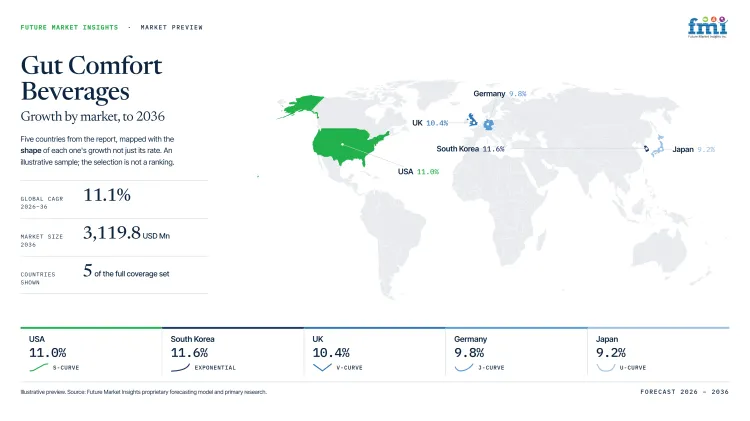
| Country | CAGR |
|---|---|
| USA | 11.0% |
| UK | 10.4% |
| Germany | 9.8% |
| Japan | 9.2% |
| South Korea | 11.6% |
How do country-level CAGRs compare in the Gut Comfort Beverages Market?
The five country CAGRs span 2.4 percentage points. South Korea is forecast at 11.6% from 2026 to 2036, compared with 11.0% in the USA, 10.4% in the UK, 9.8% in Germany and 9.2% in Japan. The rates measure expected expansion, not current market size, and similar growth can still produce different entry conditions because labeling rules, retail channels and beverage habits vary by country.
- USA: Scale depends on national grocery access and a label that explains sugar and active content without implying therapeutic outcomes.
- UK: Reformulation pressure makes lower sugar a baseline commercial condition, leaving digestive function as an additional reason to switch.
- Germany: Public nutrition guidance creates a clear fiber reference point, but beverage claims still need restrained wording and transparent quantities.
- Japan: Foods with Function Claims create a formal evidence and notification route that affects claim planning before retail expansion.
- South Korea: Functional labeling rules require suppliers to align the active system and exact consumer message with local substantiation requirements.
Comparable CAGRs can produce different market entry conditions. The full report provides country-level CAGR analysis across North America, Latin America, Western Europe, Eastern Europe, East Asia, South Asia and Pacific, and the Middle East and Africa.
Country-wise Analysis
- USA: Gut-oriented drinks increasingly reach buyers through conventional grocery and mass-retail beverage sets. Demand is forecast to rise at 11.0% CAGR from 2026 to 2036. PepsiCo completed its acquisition of Poppi in May 2025, giving the prebiotic soda brand access to a large beverage system. Suppliers still have to preserve credible function while shoppers compare taste and price with mainstream soda.
- UK: Retailers operate in a soft-drink environment where reformulation has already changed shelf economics. Sales are forecast to expand at 10.4% CAGR from 2026 to 2036. The Soft Drinks Industry Levy will lower its sugar-content threshold from 5.0 grams to 4.5 grams per 100 milliliters from 1 January 2028. Gut comfort brands therefore need to treat sugar architecture as part of core product design.
- Germany: Adoption is forecast at 9.8% CAGR from 2026 to 2036. The DGE gives adults a reference value of at least 30 grams of fiber per day and reports average intake below that level in national consumption data. A beverage cannot rely on broad wellness language alone; transparent fiber quantities and restrained claims matter for routine use.
- Japan: Demand is forecast to grow at 9.2% CAGR from 2026 to 2036. The Consumer Affairs Agency maintains a formal framework for nutrition and function claims, with Foods with Function Claims requiring notification of safety and functional evidence under company responsibility. Product teams need claim documentation and quality controls in place before adapting flavors or channels.
- South Korea: Sales are forecast to expand at 11.6% CAGR from 2026 to 2036. The MFDS published Notice No. 2024-62 on functional labeling or advertising of foods on October 17, 2024. Suppliers need localized substantiation and retail messaging before scaling grocery, convenience or online distribution.
Who are the notable companies in the Gut Comfort Beverages Market?
OLIPOP, Poppi (PepsiCo), Health-Ade, GT's Living Foods, Culture Pop, Wildwonder, De La Calle and Suja Life are notable companies serving the gut comfort beverages market.
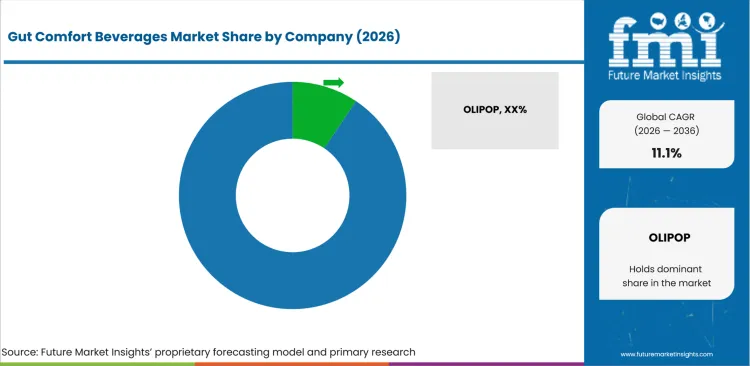
Competition is organized by how brands translate gut-oriented function into everyday beverage behavior. OLIPOP, Poppi (PepsiCo) and Health-Ade operate closest to modern-soda substitution through fiber-led carbonated formats and broad retail placement. GT's Living Foods competes in the kombucha market, while Culture Pop and Wildwonder use live cultures or combined prebiotic and probiotic systems. De La Calle and Suja Life extend the field through fermented heritage beverages and adjacent probiotic drink formats.
- Fiber-led modern soda: OLIPOP, Poppi (PepsiCo) and Health-Ade compete through carbonated flavors, lower-sugar recipes and visible retail placement.
- Culture and fermentation platforms: GT's Living Foods, Culture Pop and Wildwonder differentiate through live-culture, fermentation or combined prebiotic-probiotic propositions.
- Heritage and adjacent functional formats: De La Calle and Suja Life extend gut-oriented positioning through fermented tepache and broader functional beverage portfolios.
Competitive Benchmarking: Gut Comfort Beverages Market
| Company | Fiber-Led Digestive Formulation | Culture Fit | Mainstream Shelf & Channel Fit | Geographic Reach |
|---|---|---|---|---|
| OLIPOP | High | Low | High | United States; national retail and DTC |
| Poppi (PepsiCo) | High | Low | High | United States; PepsiCo-backed national distribution |
| Health-Ade | High | High | High | United States; national grocery and natural retail |
| GT's Living Foods | Low | High | Medium | United States; broad refrigerated retail |
| Culture Pop | Low | High | High | United States; Target and other national retail |
| Wildwonder | High | High | High | United States; Whole Foods and other national retail |
| De La Calle | Medium | High | Medium | United States; grocery with regional depth |
| Suja Life | Medium | Medium | High | United States; national grocery and club retail |
Scoring basis: Fiber-Led Digestive Formulation reflects the role of dietary fiber or prebiotic systems within current beverage portfolios. Culture Fit reflects probiotic, live-culture or fermented beverage architecture. Mainstream Shelf & Channel Fit reflects grocery access and scalable retail formats. High indicates a strong fit with the capability, Medium a narrower fit and Low limited emphasis within the current portfolio.
Key Developments in the Gut Comfort Beverages Market
- In May 2025, PepsiCo completed its acquisition of Poppi. The transaction brought a prebiotic soda platform into PepsiCo's beverage portfolio and created a route for wider distribution and portfolio investment.
- In January 2025, Wildwonder announced nationwide Whole Foods Market expansion for several gut-friendly sparkling beverages, increasing routine grocery access for its prebiotic and probiotic positioning.
- In May 2026, Suja Life's Slice Soda launched ready-to-drink Dirty Soda at Target stores nationwide, extending its prebiotic, probiotic and postbiotic soda platform into a new format.
Key Players in the Gut Comfort Beverages Market
Fiber-Led Modern Soda Platforms
- OLIPOP
- Poppi (PepsiCo)
- Health-Ade
Culture and Fermentation Beverage Platforms
- GT's Living Foods
- Culture Pop
- Wildwonder
Heritage and Adjacent Functional Beverage Platforms
- De La Calle
- Suja Life
Gut Comfort Beverages Market - Report Scope
| Coverage field | Report scope |
|---|---|
| Market breakdown | By product type, active, claim, packaging, sales channel and region. |
| Quantitative Units | USD billion. |
| Market Definition | Ready-to-drink nonalcoholic beverages positioned for digestive comfort or gut-oriented function within the stated product, active, claim, packaging and channel universe. |
| Regions Covered | North America, Latin America, Western Europe, Eastern Europe, East Asia, South Asia and Pacific, and Middle East and Africa. |
| Countries Covered | USA, UK, Germany, Japan, South Korea, and 25+ countries included in the full report. |
| Key Companies Profiled | OLIPOP, Poppi (PepsiCo), Health-Ade, GT's Living Foods, Culture Pop, Wildwonder, De La Calle and Suja Life. |
| Forecast Period | 2026 to 2036. |
| Approach | Primary and secondary research with market triangulation. |
Gut Comfort Beverages Market - Research Methodology
| Method | Approach |
|---|---|
| Primary Research | FMI analysts gathered input from beverage manufacturers, ingredient suppliers, distributors, retailers, procurement and category teams, end users, and subject-matter experts. Interviews examined product scope, active systems, pricing, channel placement, purchasing criteria, repeat use and market barriers. |
| Desk Research | Desk research covered government and regulator publications, technical and nutrition guidance, company filings and newsrooms, product documentation, trade information, and relevant scientific material. Sources were reviewed for relevance, date, geography and fit with the defined market boundary. |
| Market Sizing and Forecasting | Bottom-up product and channel analysis was reconciled with top-down beverage-category conditions. Forecast assumptions considered pricing, channel expansion, product launches, functional-label rules, sugar-reformulation pressure, formulation tolerance and country-specific adoption conditions. |
| Data Validation | Estimates were checked against independent public indicators, company activity and primary interviews. Adjacent categories, unsupported claims, overlapping revenue and products outside the defined market boundary were excluded. |
Gut Comfort Beverages Market by Segments
Gut Comfort Beverages Market segmented by Product Type:
- Prebiotic Sodas
- Kombucha & Fermented Drinks
- Aloe & Botanical Blends
- Digestive Tonics
- Others
Gut Comfort Beverages Market segmented by Active:
- Prebiotic Fiber
- Probiotics
- Ginger & Botanicals
- L-Glutamine
- Others
Gut Comfort Beverages Market segmented by Claim:
- Low-Sugar
- Bloat Relief
- Organic
- Others
Gut Comfort Beverages Market segmented by Packaging:
- Cans
- Glass Bottles
- PET Bottles
- Others
Gut Comfort Beverages Market segmented by Sales Channel:
- Supermarkets & Hypermarkets
- Online / DTC
- Convenience Stores
- Specialty & Health Stores
- Others
Gut Comfort Beverages Market by Region:
- North America
- United States
- Canada
- Latin America
- Brazil
- Mexico
- Argentina
- Chile
- Western Europe
- Germany
- France
- United Kingdom
- Italy
- Spain
- Benelux
- Nordics
- Eastern Europe
- Poland
- Czech Republic
- Romania
- Hungary
- East Asia
- China
- Japan
- South Korea
- South Asia and Pacific
- India
- ASEAN
- Australia and New Zealand
- Middle East and Africa
- GCC Countries
- South Africa
- Türkiye
- Israel
Research Sources and Bibliography
- USA Food and Drug Administration. (2024, July 25). Questions and Answers on Dietary Fiber.
- National Institute of Diabetes and Digestive and Kidney Diseases. Eating, Diet, & Nutrition for Irritable Bowel Syndrome.
- HM Treasury, HM Revenue & Customs, and Department of Health and Social Care. (2025, November 25). Strengthening the Soft Drinks Industry Levy - Summary of responses.
- UK Government. (2025, July 3). Sugar reduction in drinks: 2015 to 2024.
- HM Revenue & Customs. (2026, July 13). Changes to the Soft Drinks Industry Levy.
- Deutsche Gesellschaft für Ernährung. FAQ Ballaststoffe.
- Consumer Affairs Agency, Japan. Food Labelling.
- Consumer Affairs Agency, Japan. (2026). Toward a Safe, Secure, and Prosperous Society.
- Ministry of Food and Drug Safety, Republic of Korea. (2024, October 17). Notice No. 2024-62 on functional labeling or advertising of foods.
- Ministry of Food and Drug Safety, Republic of Korea. Regulations on Substantiation of Claims in Labeling or Advertising of Foods.
- USA Food and Drug Administration. How to Understand and Use the Nutrition Facts Label.
- PepsiCo. (2025, May 19). PepsiCo completes acquisition of poppi.
- PepsiCo. (2026, February 17). Pepsi Prebiotic Cola now available nationwide in stores and online.
- Health-Ade. (2024, February 2). What is SunSip? Exploring New Soda with Benefits.
- Wildwonder. (2025, January 15). Expansion in Whole Foods Market nationwide.
- Dora's Naturals and Wildwonder. (2026, April 15). Exclusive partnership at Whole Foods Market Northeast.
- Culture Pop Soda. (2025, April 14). Culture Pop Soda is available at Target across the country.
- Suja Life / Slice. (2026, May 6). Slice Soda launches ready-to-drink Dirty Soda at Target.
- GT's Living Foods. The GT's Living Foods Difference.
- De La Calle. Tepache.
- OLIPOP. Understanding the OLIPOP Nutrition Label.
- OLIPOP. (2026, May 19). The feel good soda.
This bibliography is provided for reader reference and is not exhaustive. The full report contains the complete reference list and detailed citations.
This Report Answers
- How large is the Gut Comfort Beverages Market in 2026 and 2036?
- Which beverage and reformulation conditions support repeat demand for gut comfort beverages?
- Why do Prebiotic Sodas account for 44.1% of Product Type demand in 2026?
- How does Prebiotic Fiber shape formulation and retail communication?
- Why does Low-Sugar account for 50.3% of Claim demand in 2026?
- How do growth rates compare across the USA, UK, Germany, Japan and South Korea?
- Which companies compete through fiber-led soda, fermentation and adjacent functional beverage formats?
- What should beverage brand owners evaluate before scaling a gut comfort beverage?
Frequently Asked Questions
How big is the gut comfort beverages market in 2026?
USD 1088.9 Million represents the gut comfort beverages market value in 2026. Demand is projected to reach USD 3119.8 Million by 2036 as digestive positioning enters familiar soda and ready-to-drink occasions while brands manage taste, serving tolerance and claim credibility.
What is the CAGR of the gut comfort beverages market from 2026 to 2036?
An 11.1% CAGR is projected for the gut comfort beverages market between 2026 and 2036. Growth depends on lower-sugar beverage substitution, visible functional ingredients and wider retail access, while formulation tolerance and local claim rules remain commercial constraints.
Which product type accounts for 44.1% of the gut comfort beverages market?
Prebiotic Sodas account for 44.1% of Product Type demand in 2026. The format carries digestive positioning through familiar carbonation, flavors and package sizes, which reduces the learning burden at first trial and supports placement near conventional soda.
How much will the gut comfort beverages market add between 2026 and 2036?
About USD 2.0 billion is expected to be added to the gut comfort beverages market between 2026 and 2036. The increase depends on repeat purchase across mainstream retail and on functional formulations that remain acceptable in taste and serving tolerance.
Which companies are active in the gut comfort beverages market?
OLIPOP, Poppi (PepsiCo), Health-Ade, GT's Living Foods, Culture Pop, Wildwonder, De La Calle and Suja Life are active across fiber-led soda, fermentation and adjacent functional beverage formats. Their competitive positions differ by active-system architecture, handling requirements and access to mainstream grocery or direct-to-consumer channels.
Preview the report firsthand - request a free sample
Get SampleGet the brochure for pricing and purchase details.
Get PDFTable of Content
- Key Takeaways
- Market Size and CAGR
- Top Growth Driver
- Fastest Growing Segment
- Leading Region
- Key Companies
- Emerging Opportunities
- Executive Summary
- Global Market Outlook
- Demand-side Trends
- Supply-side Trends
- Technology Roadmap Analysis
- Analysis and Recommendations
- Analyst Perspective (What is happening? Why now? What should investors know?)
- Key Questions Answered
- How large is the market?
- What is the CAGR?
- What are key trends?
- Which region dominates?
- Who are the leaders?
- Market Overview
- Market Coverage / Taxonomy
- Market Definition / Scope / Limitations
- Research Methodology
- Chapter Orientation
- Analytical Lens and Working Hypotheses
- Market Structure, Signals, and Trend Drivers
- Benchmarking and Cross-market Comparability
- Market Sizing, Forecasting, and Opportunity Mapping
- Research Design and Evidence Framework
- Desk Research Programme (Secondary Evidence)
- Expert Input and Fieldwork (Primary Evidence)
- Tooling, Models, and Reference Databases
- Data Engineering and Model Build
- Quality Assurance and Audit Trail
- Market Background
- Market Dynamics (Drivers, Restraints, Opportunity, Trends)
- Scenario Forecast (Optimistic, Likely, Conservative)
- Impact Analysis
- AI Impact
- Sustainability Impact
- Regulatory Impact
- Technology Impact
- Consumer / Buyer Analysis
- Purchase Drivers
- Adoption Barriers
- Buyer Journey
- Opportunity Map Analysis
- Product Life Cycle Analysis
- Supply Chain Analysis
- Investment Feasibility Matrix
- Value Chain Analysis
- PESTLE and Porter's Analysis
- Regulatory Landscape
- Regional Parent Market Outlook
- Production and Consumption Statistics
- Import and Export Statistics
- Global Market Analysis and Forecast, 2021 to 2036
- Historical Market Size Value (USD Million) Analysis, 2021 to 2025
- Current and Future Market Size Value (USD Million) Projections, 2026 to 2036
- Y-o-Y Growth Trend Analysis
- Absolute $ Opportunity Analysis
- Global Market Pricing Analysis, 2021 to 2036
- Global Market Analysis and Forecast, By Product Type, 2021 to 2036
- Introduction / Key Findings
- Historical Market Size Value (USD Million) Analysis By Product Type, 2021 to 2025
- Current and Future Market Size Value (USD Million) Analysis and Forecast By Product Type, 2026 to 2036
- Prebiotic Sodas
- Kombucha & Fermented Drinks
- Aloe & Botanical Blends
- Digestive Tonics
- Others
- Prebiotic Sodas
- Y-o-Y Growth Trend Analysis By Product Type, 2021 to 2025
- Absolute $ Opportunity Analysis By Product Type, 2026 to 2036
- Global Market Analysis and Forecast, By Active, 2021 to 2036
- Introduction / Key Findings
- Historical Market Size Value (USD Million) Analysis By Active, 2021 to 2025
- Current and Future Market Size Value (USD Million) Analysis and Forecast By Active, 2026 to 2036
- Prebiotic Fiber
- Probiotics
- Ginger & Botanicals
- L-Glutamine
- Others
- Prebiotic Fiber
- Y-o-Y Growth Trend Analysis By Active, 2021 to 2025
- Absolute $ Opportunity Analysis By Active, 2026 to 2036
- Global Market Analysis and Forecast, By Claim, 2021 to 2036
- Introduction / Key Findings
- Historical Market Size Value (USD Million) Analysis By Claim, 2021 to 2025
- Current and Future Market Size Value (USD Million) Analysis and Forecast By Claim, 2026 to 2036
- Low-Sugar
- Bloat Relief
- Organic
- Others
- Low-Sugar
- Y-o-Y Growth Trend Analysis By Claim, 2021 to 2025
- Absolute $ Opportunity Analysis By Claim, 2026 to 2036
- Global Market Analysis and Forecast, By Packaging, 2021 to 2036
- Introduction / Key Findings
- Historical Market Size Value (USD Million) Analysis By Packaging, 2021 to 2025
- Current and Future Market Size Value (USD Million) Analysis and Forecast By Packaging, 2026 to 2036
- Cans
- Glass Bottles
- PET Bottles
- Others
- Cans
- Y-o-Y Growth Trend Analysis By Packaging, 2021 to 2025
- Absolute $ Opportunity Analysis By Packaging, 2026 to 2036
- Global Market Analysis and Forecast, By Sales Channel, 2021 to 2036
- Introduction / Key Findings
- Historical Market Size Value (USD Million) Analysis By Sales Channel, 2021 to 2025
- Current and Future Market Size Value (USD Million) Analysis and Forecast By Sales Channel, 2026 to 2036
- Supermarkets & Hypermarkets
- Online / DTC
- Convenience Stores
- Specialty & Health Stores
- Others
- Supermarkets & Hypermarkets
- Y-o-Y Growth Trend Analysis By Sales Channel, 2021 to 2025
- Absolute $ Opportunity Analysis By Sales Channel, 2026 to 2036
- Global Market Analysis and Forecast, By Region, 2021 to 2036
- Introduction
- Historical Market Size Value (USD Million) Analysis By Region, 2021 to 2025
- Current Market Size Value (USD Million) Analysis and Forecast By Region, 2026 to 2036
- North America
- Latin America
- Western Europe
- Eastern Europe
- East Asia
- South Asia and Pacific
- Middle East & Africa
- Market Attractiveness Analysis By Region
- North America Market Analysis and Forecast, By Country, 2021 to 2036
- Historical Market Size Value (USD Million) Trend Analysis By Market Taxonomy, 2021 to 2025
- Market Size Value (USD Million) Forecast By Market Taxonomy, 2026 to 2036
- By Country
- USA
- Canada
- By Product Type
- By Active
- By Claim
- By Packaging
- By Sales Channel
- By Country
- Market Attractiveness Analysis
- By Country
- By Product Type
- By Active
- By Claim
- By Packaging
- By Sales Channel
- Key Takeaways
- Latin America Market Analysis and Forecast, By Country
- Historical Market Size Value (USD Million) Trend Analysis By Market Taxonomy, 2021 to 2025
- Market Size Value (USD Million) Forecast By Market Taxonomy, 2026 to 2036
- By Country
- Brazil
- Mexico
- Chile
- Rest of Latin America
- By Product Type
- By Active
- By Claim
- By Packaging
- By Sales Channel
- By Country
- Market Attractiveness Analysis
- By Country
- By Product Type
- By Active
- By Claim
- By Packaging
- By Sales Channel
- Key Takeaways
- Western Europe Market Analysis and Forecast, By Country
- Historical Market Size Value (USD Million) Trend Analysis By Market Taxonomy, 2021 to 2025
- Market Size Value (USD Million) Forecast By Market Taxonomy, 2026 to 2036
- By Country
- Germany
- UK
- Italy
- Spain
- France
- Nordic
- BENELUX
- Rest of Western Europe
- By Product Type
- By Active
- By Claim
- By Packaging
- By Sales Channel
- By Country
- Market Attractiveness Analysis
- By Country
- By Product Type
- By Active
- By Claim
- By Packaging
- By Sales Channel
- Key Takeaways
- Eastern Europe Market Analysis and Forecast, By Country
- Historical Market Size Value (USD Million) Trend Analysis By Market Taxonomy, 2021 to 2025
- Market Size Value (USD Million) Forecast By Market Taxonomy, 2026 to 2036
- By Country
- Russia
- Poland
- Hungary
- Balkan & Baltic
- Rest of Eastern Europe
- By Product Type
- By Active
- By Claim
- By Packaging
- By Sales Channel
- By Country
- Market Attractiveness Analysis
- By Country
- By Product Type
- By Active
- By Claim
- By Packaging
- By Sales Channel
- Key Takeaways
- East Asia Market Analysis and Forecast, By Country
- Historical Market Size Value (USD Million) Trend Analysis By Market Taxonomy, 2021 to 2025
- Market Size Value (USD Million) Forecast By Market Taxonomy, 2026 to 2036
- By Country
- China
- Japan
- South Korea
- By Product Type
- By Active
- By Claim
- By Packaging
- By Sales Channel
- By Country
- Market Attractiveness Analysis
- By Country
- By Product Type
- By Active
- By Claim
- By Packaging
- By Sales Channel
- Key Takeaways
- South Asia and Pacific Market Analysis and Forecast, By Country
- Historical Market Size Value (USD Million) Trend Analysis By Market Taxonomy, 2021 to 2025
- Market Size Value (USD Million) Forecast By Market Taxonomy, 2026 to 2036
- By Country
- India
- ASEAN
- Australia & New Zealand
- Rest of South Asia and Pacific
- By Product Type
- By Active
- By Claim
- By Packaging
- By Sales Channel
- By Country
- Market Attractiveness Analysis
- By Country
- By Product Type
- By Active
- By Claim
- By Packaging
- By Sales Channel
- Key Takeaways
- Middle East & Africa Market Analysis and Forecast, By Country
- Historical Market Size Value (USD Million) Trend Analysis By Market Taxonomy, 2021 to 2025
- Market Size Value (USD Million) Forecast By Market Taxonomy, 2026 to 2036
- By Country
- Kingdom of Saudi Arabia
- Other GCC Countries
- Türkiye
- South Africa
- Other African Union
- Rest of Middle East & Africa
- By Product Type
- By Active
- By Claim
- By Packaging
- By Sales Channel
- By Country
- Market Attractiveness Analysis
- By Country
- By Product Type
- By Active
- By Claim
- By Packaging
- By Sales Channel
- Key Takeaways
- Key Countries Market Analysis
- USA
- Pricing Analysis
- Market Share Analysis, 2025
- By Product Type
- By Active
- By Claim
- By Packaging
- By Sales Channel
- Canada
- Pricing Analysis
- Market Share Analysis, 2025
- By Product Type
- By Active
- By Claim
- By Packaging
- By Sales Channel
- Mexico
- Pricing Analysis
- Market Share Analysis, 2025
- By Product Type
- By Active
- By Claim
- By Packaging
- By Sales Channel
- Brazil
- Pricing Analysis
- Market Share Analysis, 2025
- By Product Type
- By Active
- By Claim
- By Packaging
- By Sales Channel
- Chile
- Pricing Analysis
- Market Share Analysis, 2025
- By Product Type
- By Active
- By Claim
- By Packaging
- By Sales Channel
- Germany
- Pricing Analysis
- Market Share Analysis, 2025
- By Product Type
- By Active
- By Claim
- By Packaging
- By Sales Channel
- UK
- Pricing Analysis
- Market Share Analysis, 2025
- By Product Type
- By Active
- By Claim
- By Packaging
- By Sales Channel
- Italy
- Pricing Analysis
- Market Share Analysis, 2025
- By Product Type
- By Active
- By Claim
- By Packaging
- By Sales Channel
- Spain
- Pricing Analysis
- Market Share Analysis, 2025
- By Product Type
- By Active
- By Claim
- By Packaging
- By Sales Channel
- France
- Pricing Analysis
- Market Share Analysis, 2025
- By Product Type
- By Active
- By Claim
- By Packaging
- By Sales Channel
- India
- Pricing Analysis
- Market Share Analysis, 2025
- By Product Type
- By Active
- By Claim
- By Packaging
- By Sales Channel
- ASEAN
- Pricing Analysis
- Market Share Analysis, 2025
- By Product Type
- By Active
- By Claim
- By Packaging
- By Sales Channel
- Australia & New Zealand
- Pricing Analysis
- Market Share Analysis, 2025
- By Product Type
- By Active
- By Claim
- By Packaging
- By Sales Channel
- China
- Pricing Analysis
- Market Share Analysis, 2025
- By Product Type
- By Active
- By Claim
- By Packaging
- By Sales Channel
- Japan
- Pricing Analysis
- Market Share Analysis, 2025
- By Product Type
- By Active
- By Claim
- By Packaging
- By Sales Channel
- South Korea
- Pricing Analysis
- Market Share Analysis, 2025
- By Product Type
- By Active
- By Claim
- By Packaging
- By Sales Channel
- Russia
- Pricing Analysis
- Market Share Analysis, 2025
- By Product Type
- By Active
- By Claim
- By Packaging
- By Sales Channel
- Poland
- Pricing Analysis
- Market Share Analysis, 2025
- By Product Type
- By Active
- By Claim
- By Packaging
- By Sales Channel
- Hungary
- Pricing Analysis
- Market Share Analysis, 2025
- By Product Type
- By Active
- By Claim
- By Packaging
- By Sales Channel
- Kingdom of Saudi Arabia
- Pricing Analysis
- Market Share Analysis, 2025
- By Product Type
- By Active
- By Claim
- By Packaging
- By Sales Channel
- Türkiye
- Pricing Analysis
- Market Share Analysis, 2025
- By Product Type
- By Active
- By Claim
- By Packaging
- By Sales Channel
- South Africa
- Pricing Analysis
- Market Share Analysis, 2025
- By Product Type
- By Active
- By Claim
- By Packaging
- By Sales Channel
- USA
- Market Structure Analysis
- Competition Dashboard
- Competition Benchmarking
- Market Share Analysis of Top Players
- By Regional
- By Product Type
- By Active
- By Claim
- By Packaging
- By Sales Channel
- Emerging Startups
- Innovation Benchmarking
- Competition Analysis
- Competition Deep Dive
- OLIPOP
- Overview
- Product Portfolio
- Profitability by Market Segments
- Sales Footprint
- Strategy Overview
- Marketing Strategy
- Product Strategy
- Channel Strategy
- Poppi (PepsiCo)
- Health-Ade
- GT's Living Foods
- Culture Pop
- Wildwonder
- De La Calle
- Suja Organic
- OLIPOP
- Case Studies
- Success Stories
- Recent Developments
- Competition Deep Dive
- Assumptions & Acronyms Used


