

- Market Size (2026)
- USD 34.3 Bn
- Forecast (2036)
- USD 63.8 Bn
- CAGR (2026 to 2036)
- 6.4%
How big is Gut Health Ingredients Market in 2026?
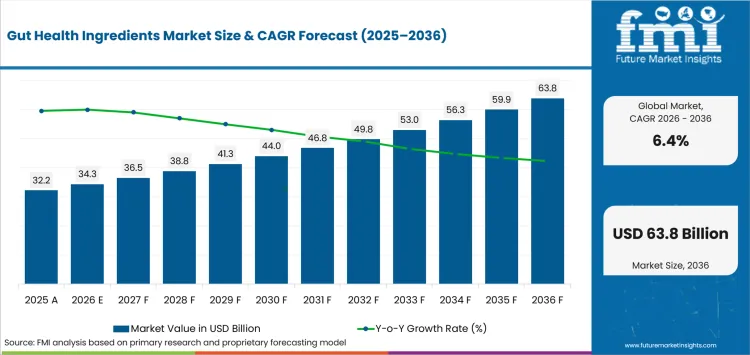
USD 34.3 billion in 2026 and USD 63.8 billion by 2036 at a 6.4% CAGR.
The gut health ingredients market is projected to rise from USD 34.3 billion in 2026 to USD 63.8 billion by 2036 at a 6.4% CAGR. Product developers qualify ingredients against identity and intended-use requirements before committing material volumes to commercial formulations. FDA closed GRN 1242 for short-chain fructooligosaccharides on July 14, 2025 with no questions across numerous food and beverage uses. The decision removes one safety-review uncertainty for an established prebiotic ingredient before commercial formulation and repeat purchasing begin.
Country conversion differs because national review systems determine the evidence required for a gut-health ingredient’s commercial sale. FDA closed GRN 1303 on May 11, 2026 with no questions for Bifidobacterium animalis subsp. lactis CGMCC5470 in specified conventional foods. That decision adds a recent USA probiotic strain precedent, while Japan and China require different notification or registration work for health-positioned foods. Ingredient companies therefore need country-specific dossiers so comparable scientific interest can convert into repeat commercial demand.
Key Takeaways of Gut Health Ingredients Market
- Demand rises as formulation teams need gut-health ingredients with documented identity and application data that can survive local qualification.
- Based on ingredient, probiotics are projected to account for 33.8% in 2026 due to established strain documentation and familiar dosing routes.
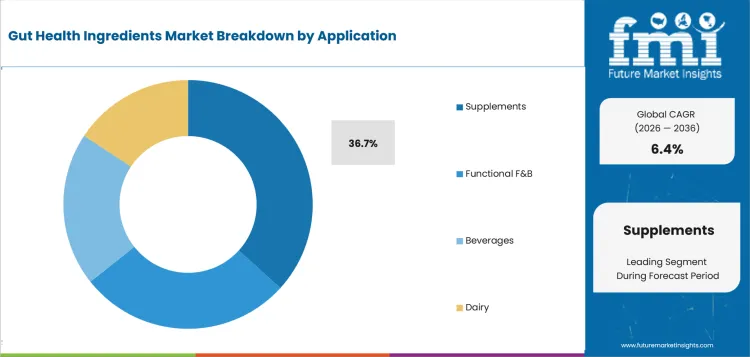
- The application category is forecast to be led by supplements at 36.7% share in 2026 due to controlled dosing and flexible manufacturing conditions.
- Postbiotics broaden the usable format range by removing live-cell viability from processing and shelf-life requirements.
- Strain-specific safety and claim requirements can delay adoption when documentation does not match the intended population or finished-product use.
- Novonesis (Chr. Hansen), dsm-firmenich, Kerry, ADM, IFF (Danisco), Lallemand, Probi and Tate & Lyle form the reconciled company register.
Analyst Perspective
"Ingredient teams should price a gut-health program after confirming strain identity, claim fit and survival in the intended format. The stronger commercial offer reduces repeated dossier work while preserving the required dose across manufacturing and shelf life."
- Nandini Roy Choudhury, Principal Consultant, Future Market Insights
How is the Gut Health Ingredients Market segmented?
The gut health ingredients market is segmented by ingredient and application with regional coverage used for comparison.
The gut health ingredients market is segmented by ingredient and application with regional coverage under the standard FMI geography. Ingredient categories include probiotics, prebiotics, postbiotics, fibers and enzymes while applications cover supplements, functional F&B, beverages and dairy.
Why do supplements lead the application category?
Dietary supplement formats give manufacturers tighter dose control than many heat-processed foods during initial qualification. Lallemand Health Solutions launched Cerenity in March 2025 as a three-strain probiotic formula studied with a prebiotic in sachets. Digestive health supplements can combine documented microbes with other nutrition ingredients without a severe heat process.
- In 2026, supplements are expected to lead the application category with 36.7% share because controlled dosing reduces part of the early formulation burden.
- Capsules, powders and sachets let teams adjust dose or excipients without redesigning a complete food process. That flexibility reduces repeat trials when viability data require higher overage or a different format.
What makes probiotics central to the ingredient category?
Probiotic ingredients require strain identity and viable-dose control because commercial use depends on evidence tied to the named microorganism. Formulation teams also test survival across manufacturing and shelf life before committing a strain to repeat production in human nutrition products.
- By ingredient, probiotics are estimated to hold 33.8% in 2026 owing to familiar dosing routes and established strain-level documentation.
- Novonesis reported in August 2025 that Health Canada approved ASTARTE™ with gastrointestinal and vaginal health claims for a four-strain Lactobacillus combination formulated for women's health. The approval gives Canadian supplement developers a defined regulatory reference for comparing strain identity and substantiation during commercial qualification.
What are the drivers, restraints and opportunities in the Gut Health Ingredients Market?
Documented functionality improves qualification while strain-specific rules slow transfer between markets and stable biotic formats extend usable food applications.
- Driver: Formulation teams favor ingredients whose safety and human evidence support a defined digestive-health position during regulatory review.
- Restraint: Strain-specific evidence and local claim rules increase rework when one dossier cannot transfer directly between applications or countries.
- Opportunity: Stable postbiotics and spore-forming cultures extend gut-health positioning into formats that challenge conventional live-cell delivery.
Claim-Ready Evidence Converts Interest into Ingredient Qualification
Functional food brands reach regulatory review sooner with ingredient files already matched to the evidence responsibilities attached to the finished product. Japan’s Consumer Affairs Agency published revised Foods with Function Claims guidance and questions on March 25, 2025 for companies using that notification route. Probiotic and prebiotic companies that organize safety records and human evidence around the intended claim reduce repeated dossier work and enter formulation decisions earlier.
Strain-Specific Review Raises the Cost of Market Transfer
Germany’s BfR concluded in February 2026 that health benefits remained insufficiently demonstrated for the probiotic-enriched infant formulas it assessed, confirming that evidence cannot be generalized across strains or populations. The finding is outside this market’s revenue boundary but illustrates a commercial friction: ingredient teams may need new human evidence or narrower claims before another application proceeds.
Stable Biotic Formats Extend Heat- and Moisture-Exposed Applications
Heat and moisture can reduce viable counts in shelf-stable foods, which narrows the formats suited to conventional live cultures. Postbiotic preparations remove the live-cell requirement and reduce one formulation stability constraint during food development. Probi launched Rham271h in May 2026 with improved pH and heat stability for functional foods and beverages, giving manufacturers a commercial option for demanding processing conditions.
Which country CAGRs are profiled in the Gut Health Ingredients Market?
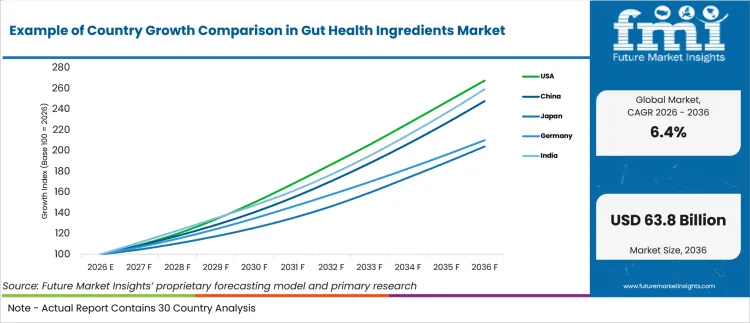
| Country | CAGR |
|---|---|
| USA | 10.3% |
| India | 10.0% |
| China | 9.5% |
| Germany | 7.7% |
| Japan | 7.4% |
How do country-level CAGRs compare in the Gut Health Ingredients Market?
The 2.9-point spread forms an upper group of USA, India and China and a lower pair of Germany and Japan. The spacing is narrow enough that regulatory execution can outweigh small forecast differences during market entry. Commercial priorities therefore depend on strain evidence, claim rules and ingredient approval as much as the headline CAGR.
- USA uses FDA GRAS notices to establish strain-specific food-use precedents.
- India uses FSSAI prior approval for non-specified ingredients entering new formulations.
- China is tightening health-food dossiers around strain identity and viable counts.
- Germany places greater weight on defensible benefit evidence for supplement positioning.
- Japan keeps safety and function substantiation with the notifying business operator.
Similar CAGRs can therefore produce different qualification costs and launch timelines. The full report provides country-level CAGR analysis across North America, Latin America, Europe, East Asia, South Asia, Oceania and the Middle East and Africa.
Country-wise Analysis
- United States food and supplement formulators use FDA GRAS notices as strain-specific safety precedents for conventional food uses. FDA closed GRN 1239 with no questions on June 11, 2025 for Bifidobacterium animalis subsp. lactis PTA-126817 in specified conventional foods. Gut health ingredient demand in the USA is forecast to rise at 10.3% CAGR over the forecast period supported by broad formulation activity. Domestic application laboratories let manufacturers test viable counts in the intended format during national prelaunch qualification. A GRAS precedent does not cover another organism’s stability or labeling needs, so complete dossiers remain necessary for recurring commercial customer trials.
- Indian nutraceutical manufacturers often combine probiotics with fibers or food enzymes, yet unfamiliar inputs can trigger prior-approval work before pilot batches become repeat production. Adoption of gut health ingredients in India is estimated to expand at 10.0% CAGR through 2036 supported by organized supplement manufacturing and expanding functional-food programs. FSSAI’s non-specified food page lists application status as of July 15, 2026 and states that the Authority grants prior approval after Scientific Panel risk analysis. That review gives local teams a defined route for novel ingredients but can delay inventory commitments, favoring companies that prepare identity records and safety files ahead of customer trials.
- China’s health-food qualification path is changing because SAMR opened consultation on July 24, 2026 for new probiotic ingredient registration and filing rules. The draft requires strain-level identification with genetic-stability and safety evidence plus viable-count controls for products kept through shelf life. China is estimated to post 9.5% CAGR over the forecast period driven by health-food development that depends on controlled probiotic specifications. Clearer rules could reduce interpretation differences once finalized, but current uncertainty complicates testing plans and label preparation for companies entering registration. Local regulatory support therefore matters most during dossier design instead of after commercial inventory has already been committed.
- German supplement brands operate in a mature retail channel where probiotic familiarity does not remove the need for defensible health wording. The German gut health ingredients sector is projected to record 7.7% CAGR during the assessment period supported by established supplement use and capable food manufacturing. Established supplement distribution gives dietary fibers and documented strains a familiar route to consumers, but differentiated gut-health positioning still depends on substantiated claims. BfR reported on July 18, 2025 that more than two thirds of surveyed respondents had used a food supplement in the previous year. That familiar channel improves product access, while claim substantiation remains the commercial filter for repeated ingredient orders.
- Japanese functional beverages use a notification route that leaves safety and scientific support with the business placing each finished product on sale. Local-language dossiers can reduce rework when strain evidence already matches the intended function and product format. Established functional-food channels give documented biotics a familiar route to consumers, although claim wording still shapes launch preparation. In Japan, gut health ingredient demand is predicted to advance at 7.4% CAGR through 2036 supported by established functional-food channels. The Consumer Affairs Agency revised its Foods with Function Claims guidance and Q&A on October 1, 2025 and current submissions must follow the updated dossier workflow.
Who are the notable companies in the Gut Health Ingredients Market?
Novonesis (Chr. Hansen), dsm-firmenich, Kerry, ADM, IFF (Danisco), Lallemand, Probi and Tate & Lyle are the notable companies profiled in this market.
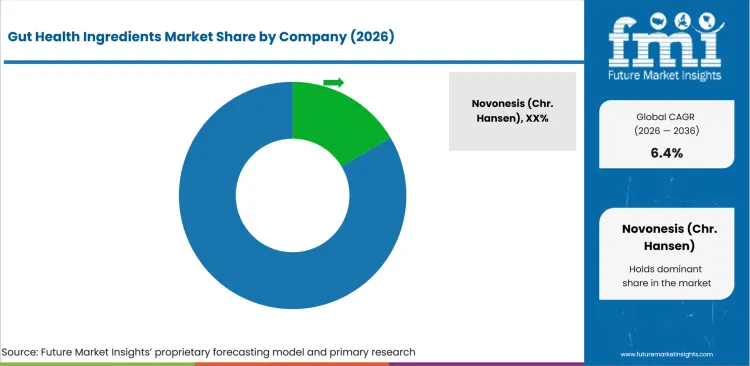
The field remains fragmented across live-biotic strain owners, postbiotic developers and prebiotic-fiber specialists serving different formulation tasks. Entry depends on documented identity and repeatable manufacturing records that can survive commercial qualification programs. Multinational programs also raise service costs by forcing one technical package across several claim regimes.
- Novonesis and dsm-firmenich combine documented microbiome portfolios with broader nutrition and application support across multiple commercial formats.
- Kerry, ADM, IFF, Lallemand and Probi compete around documented biotics plus formulation or technical support for commercial nutrition programs.
- Tate & Lyle competes in prebiotic fibers with verified soluble-fiber and oligosaccharide formats across several food applications.
Competitive Benchmarking: Gut Health Ingredients Market
| Company | Ingredient Route Breadth | Application Coverage | Technical Support Depth | Geographic Reach |
|---|---|---|---|---|
| Novonesis (Chr. Hansen) | Medium | High | High | Global |
| dsm-firmenich | Medium | High | High | Global |
| Kerry | Medium | High | High | Global customer and innovation network |
| ADM | Medium | High | High | North America, Europe and Asia |
| IFF (Danisco) | Low | High | High | Global |
| Lallemand | Medium | Medium | High | 60+ countries across five continents |
| Probi | Medium | High | High | EMEA, Americas and APAC |
| Tate & Lyle | Medium | High | High | Global food and beverage customer network |
Key Developments in the Gut Health Ingredients Market
- In June 2026, Tate & Lyle received NutraStrong Prebiotic Verified certification for four fiber product lines covering soluble fiber and oligosaccharide formats. The verification gives food and supplement developers an independent quality screen during prebiotic ingredient selection.
- In May 2025, Probi and Nomura Dairy introduced a fermented carrot drink in Japan containing the documented LP299V probiotic strain. The launch extended a commercially established strain into a local beverage format beyond conventional supplement delivery.
- In February 2025, ADM and Asahi Group signed an exclusive distribution agreement for the CP2305 postbiotic across North America, Europe and Asia. The agreement gives food manufacturers wider access to a clinically studied heat-treated ingredient for demanding formats.
Key Players in the Gut Health Ingredients Market
Broad Microbiome and Biotic Platforms
- Novonesis (Chr. Hansen)
- dsm-firmenich
- ADM
- IFF (Danisco)
Probiotic Formulation Specialists
- Kerry
- Lallemand
- Probi
Prebiotic Fiber Platform
- Tate & Lyle
Gut Health Ingredients Market - Report Scope
| Coverage field | Report scope |
|---|---|
| Market breakdown | By ingredient, application and region. |
| Quantitative Units | Revenue in USD billion and CAGR in %. |
| Market Definition | Business-to-business revenue from probiotics, prebiotics, postbiotics, fibers and enzymes sold for gut-health use in supplements, functional F&B, beverages and dairy. Finished-product revenue, live biotherapeutic drugs and animal-health ingredients are excluded. |
| Regions Covered | North America, Latin America, Europe, East Asia, South Asia and Pacific and Middle East and Africa. |
| Countries Covered | USA, India, China, Germany, Japan, and 20+ countries included in the full report. |
| Key Companies Profiled | Novonesis (Chr. Hansen), dsm-firmenich, Kerry, ADM, IFF (Danisco), Lallemand, Probi, Tate & Lyle. |
| Forecast Period | 2026 to 2036. |
| Approach | Primary and secondary research with market triangulation. |
Gut Health Ingredients Market - Research Methodology
| Method | Approach |
|---|---|
| Primary Research | FMI analysts gathered input from manufacturers, service providers, technology developers, distributors, end users, procurement teams, and subject-matter experts. Interviews examined purchasing decisions, product or service evaluation, adoption barriers, approval requirements, pricing considerations, and expectations for technical or commercial support. Respondents were also asked what evidence is required before a trial, pilot, or initial order develops into regular purchasing. |
| Desk Research | Desk research covered government statistics, regulatory publications, trade data, industry associations, technical literature, standards, company filings, product information, and official corporate announcements. Sources were reviewed for relevance, publication date, geographic coverage, and consistency with the defined market scope. Claims relating to performance, applications, approvals, capacity, investment, and commercial activity were retained only when supported by credible public evidence. |
| Market Sizing and Forecasting | The market model combined the baseline value with historical performance, segment structure, pricing and volume indicators, adoption levels, company participation, and country-level demand conditions. Forecast assumptions considered economic activity, investment trends, regulatory developments, technology adoption, purchasing cycles, supply availability, and barriers to wider market use. Segment and regional estimates were reconciled before the final market total was calculated. |
| Data Validation | Estimates were checked against multiple independent indicators, including public data, company activity, trade patterns, industry developments, and findings from primary interviews. Validation also tested whether products, services, applications, and company revenues fell within the defined market boundaries. Adjacent categories, unsupported claims, overlapping revenues, and activities without direct market relevance were excluded to reduce double counting and maintain consistency across segments and countries. |
Gut Health Ingredients Market by Segments
Gut Health Ingredients Market segmented by Ingredient:
- Probiotics
- Prebiotics
- Postbiotics
- Fibers
- Enzymes
Gut Health Ingredients Market segmented by Application:
- Supplements
- Functional F&B
- Beverages
- Dairy
Gut Health Ingredients Market by Region:
- North America
- United States
- Canada
- Latin America
- Brazil
- Mexico
- Chile
- Rest of Latin America
- Western Europe
- Germany
- United Kingdom
- Italy
- Spain
- France
- Nordics
- Benelux
- Rest of Western Europe
- Eastern Europe
- Russia
- Poland
- Hungary
- Balkan and Baltic States
- Rest of Eastern Europe
- East Asia
- China
- Japan
- South Korea
- South Asia and Pacific
- India
- ASEAN
- Australia and New Zealand
- Rest of South Asia and Pacific
- Middle East and Africa
- Kingdom of Saudi Arabia
- Other GCC Countries
- Türkiye
- South Africa
- Other African Union Countries
- Rest of Middle East and Africa
Research Sources and Bibliography
- USA Food and Drug Administration. (2025, March 18) GRN No. 1242.
- USA Food and Drug Administration. (2026, May 11). GRN No. 1303.
- Novonesis. (2025, August 13). Probiotic strain combination supporting women’s gut and vaginal health now approved by Health Canada.
- Lallemand Health Solutions. (2025, March 18). Lallemand Health Solutions Launches Cerenity A Clinically Studied Probiotic Formula to Support Healthy Aging.
- Consumer Affairs Agency, Japan. (2025, March 25).
- German Federal Institute for Risk Assessment. (2026, February 3). Gesundheitlicher Nutzen von Säuglingsnahrung mit Zusatz von „Probiotika“ wissenschaftlich weiterhin nicht belegt.
- Probi AB. (2026, May 5). Probi enters the fast-growing postbiotic market with Rham271h™ launch at Vitafoods Europe.
- USA Food and Drug Administration. (2026, July 31). GRN No. 1239.
- Food Safety and Standards Authority of India. (2026, July 22). NON-SPECIFIED FOOD.
- State Administration for Market Regulation, China. (2026, July 24).
- German Federal Institute for Risk Assessment. (2025, July 18). Between hype and misconception: common misunderstandings about food supplements.
- Consumer Affairs Agency, Japan. (2025, October 1).
- Novonesis. (2025, September 8). Novonesis and Novo Nordisk will explore new solutions to improve metabolic health.
- dsm-firmenich. (2025, April 14). From cellular aging to gut microbiome: dsm-firmenich highlights solutions to advance nutrition at Vitafoods 2025.
- Kerry. (2026, March 19). Kerry publishes 2025 Annual Report: A year defined by impact, innovation and purpose.
- IFF. (2026, May 8). From Lab to Shelf: How IFF Designs Stability into Probiotics.
- Lallemand Health Solutions. (2025, May 15). Lallemand Health Solutions and Kirin Holdings Announce Distribution Agreement for Scientifically Proven Postbiotic IMMUSE®.
- Tate & Lyle PLC. (2026, June 3). Tate & Lyle fibre portfolio receives Nutrastrong™ Prebiotic Verified certification.
- Probi AB. (2025, May 7). Nomura Dairy and Probi introduce probiotic-enhanced carrot juice to Japan.
- ADM. (2025, February 25). ADM and Asahi Group Sign Exclusive Distribution Agreement for Innovative Postbiotic Designed to Support Stress, Mood and Sleep.
- Tate & Lyle PLC. (2026, June 15). New tool for measuring synbiotic synergy potential could shape the next wave of food and drink innovation supporting gut health.
- Symrise AG. (2026, March 17). Symrise establishes a new Care & Wellness Division.
- Probi AB. (2026, May 27). Probi and Nomura Dairy achieve first clinical validation of LP299V® in Japanese adults, advancing science-led probiotic innovation in Asia.
- Probi AB. (n.d.). Certificates. Retrieved August 12, 2026.
- Lallemand Health Solutions. (n.d.). EXPERT’Biome CDMO by Lallemand. Retrieved August 12, 2026.
This bibliography is provided for reader reference and is not exhaustive. The full report contains the complete reference list and detailed citations
This Report Answers
- How does ingredient evidence convert gut-health interest into recurring business-to-business orders?
- Why do probiotics lead the ingredient category despite strain-specific evidence requirements?
- Why do supplements lead applications for gut-health ingredients during the 2026 base year?
- How do postbiotics change formulation options for heat-sensitive food and supplement applications?
- Which regulatory frictions raise the cost of transferring gut-health ingredients between countries?
- How do country growth rates change technical-service and channel priorities through 2036?
- Which supplier capabilities matter beyond unit price during gut-health ingredient qualification?
- How do benchmarked companies differ in biotic breadth and application support?
Frequently Asked Questions
How big is the gut health ingredients market in 2026?
The gut health ingredients market is valued at USD 34.3 billion in 2026 and is projected to reach USD 63.8 billion by 2036. Growth is driven by increasing demand for probiotics, prebiotics, postbiotics, and functional ingredients across nutrition and wellness applications.
What is the CAGR of the gut health ingredients market from 2026 to 2036?
The gut health ingredients market is projected to grow at a CAGR of 6.4% between 2026 and 2036. Expansion is supported by rising consumer interest in digestive health and greater adoption of scientifically validated ingredient formulations.
Which ingredient is projected to account for 33.8% of the gut health ingredients market?
Probiotics are projected to account for 33.8% of the market in 2026. Their leading share is supported by established strain documentation, familiar dosing formats, and broad use across supplements and functional foods.
Which application is projected to account for 36.7% of the gut health ingredients market?
Supplements are projected to account for 36.7% of the market in 2026. Their dominance is driven by controlled dosing, formulation flexibility, and strong consumer demand for digestive health products.
Which countries are expected to record the highest growth in the gut health ingredients market?
The USA is projected to grow at 10.3% CAGR, followed by India at 10.0% and China at 9.5% through 2036. Growth in these markets is supported by expanding functional food and supplement industries alongside increasing consumer awareness of gut health.
Which companies are active in the gut health ingredients market?
Key companies operating in the market include Novonesis (Chr. Hansen), dsm-firmenich, Kerry, ADM, IFF (Danisco), Lallemand, Probi, and Tate & Lyle. These companies compete through probiotic, prebiotic, and postbiotic portfolios supported by formulation expertise and technical services.
Preview the report firsthand - request a free sample
Get SampleGet the brochure for pricing and purchase details.
Get PDFTable of Content
- Key Takeaways
- Market Size and CAGR
- Top Growth Driver
- Fastest Growing Segment
- Leading Region
- Key Companies
- Emerging Opportunities
- Executive Summary
- Global Market Outlook
- Demand-side Trends
- Supply-side Trends
- Technology Roadmap Analysis
- Analysis and Recommendations
- Analyst Perspective (What is happening? Why now? What should investors know?)
- Key Questions Answered
- How large is the market?
- What is the CAGR?
- What are key trends?
- Which region dominates?
- Who are the leaders?
- Market Overview
- Market Coverage / Taxonomy
- Market Definition / Scope / Limitations
- Research Methodology
- Chapter Orientation
- Analytical Lens and Working Hypotheses
- Market Structure, Signals, and Trend Drivers
- Benchmarking and Cross-market Comparability
- Market Sizing, Forecasting, and Opportunity Mapping
- Research Design and Evidence Framework
- Desk Research Programme (Secondary Evidence)
- Expert Input and Fieldwork (Primary Evidence)
- Tooling, Models, and Reference Databases
- Data Engineering and Model Build
- Quality Assurance and Audit Trail
- Market Background
- Market Dynamics (Drivers, Restraints, Opportunity, Trends)
- Scenario Forecast (Optimistic, Likely, Conservative)
- Impact Analysis
- AI Impact
- Sustainability Impact
- Regulatory Impact
- Technology Impact
- Consumer / Buyer Analysis
- Purchase Drivers
- Adoption Barriers
- Buyer Journey
- Opportunity Map Analysis
- Product Life Cycle Analysis
- Supply Chain Analysis
- Investment Feasibility Matrix
- Value Chain Analysis
- PESTLE and Porter's Analysis
- Regulatory Landscape
- Regional Parent Market Outlook
- Production and Consumption Statistics
- Import and Export Statistics
- Global Market Analysis and Forecast, 2021 to 2036
- Historical Market Size Value (USD Billion) Analysis, 2021 to 2025
- Current and Future Market Size Value (USD Billion) Projections, 2026 to 2036
- Y-o-Y Growth Trend Analysis
- Absolute $ Opportunity Analysis
- Global Market Pricing Analysis, 2021 to 2036
- Global Market Analysis and Forecast, By Ingredient, 2021 to 2036
- Introduction / Key Findings
- Historical Market Size Value (USD Billion) Analysis By Ingredient, 2021 to 2025
- Current and Future Market Size Value (USD Billion) Analysis and Forecast By Ingredient, 2026 to 2036
- Probiotics
- Prebiotics
- Postbiotics
- Fibers
- Enzymes
- Probiotics
- Y-o-Y Growth Trend Analysis By Ingredient, 2021 to 2025
- Absolute $ Opportunity Analysis By Ingredient, 2026 to 2036
- Global Market Analysis and Forecast, By Application, 2021 to 2036
- Introduction / Key Findings
- Historical Market Size Value (USD Billion) Analysis By Application, 2021 to 2025
- Current and Future Market Size Value (USD Billion) Analysis and Forecast By Application, 2026 to 2036
- Supplements
- Functional F&B
- Beverages
- Dairy
- Supplements
- Y-o-Y Growth Trend Analysis By Application, 2021 to 2025
- Absolute $ Opportunity Analysis By Application, 2026 to 2036
- Global Market Analysis and Forecast, By Region, 2021 to 2036
- Introduction
- Historical Market Size Value (USD Billion) Analysis By Region, 2021 to 2025
- Current Market Size Value (USD Billion) Analysis and Forecast By Region, 2026 to 2036
- North America
- Latin America
- Western Europe
- Eastern Europe
- East Asia
- South Asia and Pacific
- Middle East & Africa
- Market Attractiveness Analysis By Region
- North America Market Analysis and Forecast, By Country, 2021 to 2036
- Historical Market Size Value (USD Billion) Trend Analysis By Market Taxonomy, 2021 to 2025
- Market Size Value (USD Billion) Forecast By Market Taxonomy, 2026 to 2036
- By Country
- USA
- Canada
- By Ingredient
- By Application
- By Country
- Market Attractiveness Analysis
- By Country
- By Ingredient
- By Application
- Key Takeaways
- Latin America Market Analysis and Forecast, By Country
- Historical Market Size Value (USD Billion) Trend Analysis By Market Taxonomy, 2021 to 2025
- Market Size Value (USD Billion) Forecast By Market Taxonomy, 2026 to 2036
- By Country
- Brazil
- Mexico
- Chile
- Rest of Latin America
- By Ingredient
- By Application
- By Country
- Market Attractiveness Analysis
- By Country
- By Ingredient
- By Application
- Key Takeaways
- Western Europe Market Analysis and Forecast, By Country
- Historical Market Size Value (USD Billion) Trend Analysis By Market Taxonomy, 2021 to 2025
- Market Size Value (USD Billion) Forecast By Market Taxonomy, 2026 to 2036
- By Country
- Germany
- UK
- Italy
- Spain
- France
- Nordic
- BENELUX
- Rest of Western Europe
- By Ingredient
- By Application
- By Country
- Market Attractiveness Analysis
- By Country
- By Ingredient
- By Application
- Key Takeaways
- Eastern Europe Market Analysis and Forecast, By Country
- Historical Market Size Value (USD Billion) Trend Analysis By Market Taxonomy, 2021 to 2025
- Market Size Value (USD Billion) Forecast By Market Taxonomy, 2026 to 2036
- By Country
- Russia
- Poland
- Hungary
- Balkan & Baltic
- Rest of Eastern Europe
- By Ingredient
- By Application
- By Country
- Market Attractiveness Analysis
- By Country
- By Ingredient
- By Application
- Key Takeaways
- East Asia Market Analysis and Forecast, By Country
- Historical Market Size Value (USD Billion) Trend Analysis By Market Taxonomy, 2021 to 2025
- Market Size Value (USD Billion) Forecast By Market Taxonomy, 2026 to 2036
- By Country
- China
- Japan
- South Korea
- By Ingredient
- By Application
- By Country
- Market Attractiveness Analysis
- By Country
- By Ingredient
- By Application
- Key Takeaways
- South Asia and Pacific Market Analysis and Forecast, By Country
- Historical Market Size Value (USD Billion) Trend Analysis By Market Taxonomy, 2021 to 2025
- Market Size Value (USD Billion) Forecast By Market Taxonomy, 2026 to 2036
- By Country
- India
- ASEAN
- Australia & New Zealand
- Rest of South Asia and Pacific
- By Ingredient
- By Application
- By Country
- Market Attractiveness Analysis
- By Country
- By Ingredient
- By Application
- Key Takeaways
- Middle East & Africa Market Analysis and Forecast, By Country
- Historical Market Size Value (USD Billion) Trend Analysis By Market Taxonomy, 2021 to 2025
- Market Size Value (USD Billion) Forecast By Market Taxonomy, 2026 to 2036
- By Country
- Kingdom of Saudi Arabia
- Other GCC Countries
- Türkiye
- South Africa
- Other African Union
- Rest of Middle East & Africa
- By Ingredient
- By Application
- By Country
- Market Attractiveness Analysis
- By Country
- By Ingredient
- By Application
- Key Takeaways
- Key Countries Market Analysis
- USA
- Pricing Analysis
- Market Share Analysis, 2025
- By Ingredient
- By Application
- Canada
- Pricing Analysis
- Market Share Analysis, 2025
- By Ingredient
- By Application
- Mexico
- Pricing Analysis
- Market Share Analysis, 2025
- By Ingredient
- By Application
- Brazil
- Pricing Analysis
- Market Share Analysis, 2025
- By Ingredient
- By Application
- Chile
- Pricing Analysis
- Market Share Analysis, 2025
- By Ingredient
- By Application
- Germany
- Pricing Analysis
- Market Share Analysis, 2025
- By Ingredient
- By Application
- UK
- Pricing Analysis
- Market Share Analysis, 2025
- By Ingredient
- By Application
- Italy
- Pricing Analysis
- Market Share Analysis, 2025
- By Ingredient
- By Application
- Spain
- Pricing Analysis
- Market Share Analysis, 2025
- By Ingredient
- By Application
- France
- Pricing Analysis
- Market Share Analysis, 2025
- By Ingredient
- By Application
- India
- Pricing Analysis
- Market Share Analysis, 2025
- By Ingredient
- By Application
- ASEAN
- Pricing Analysis
- Market Share Analysis, 2025
- By Ingredient
- By Application
- Australia & New Zealand
- Pricing Analysis
- Market Share Analysis, 2025
- By Ingredient
- By Application
- China
- Pricing Analysis
- Market Share Analysis, 2025
- By Ingredient
- By Application
- Japan
- Pricing Analysis
- Market Share Analysis, 2025
- By Ingredient
- By Application
- South Korea
- Pricing Analysis
- Market Share Analysis, 2025
- By Ingredient
- By Application
- Russia
- Pricing Analysis
- Market Share Analysis, 2025
- By Ingredient
- By Application
- Poland
- Pricing Analysis
- Market Share Analysis, 2025
- By Ingredient
- By Application
- Hungary
- Pricing Analysis
- Market Share Analysis, 2025
- By Ingredient
- By Application
- Kingdom of Saudi Arabia
- Pricing Analysis
- Market Share Analysis, 2025
- By Ingredient
- By Application
- Türkiye
- Pricing Analysis
- Market Share Analysis, 2025
- By Ingredient
- By Application
- South Africa
- Pricing Analysis
- Market Share Analysis, 2025
- By Ingredient
- By Application
- USA
- Market Structure Analysis
- Competition Dashboard
- Competition Benchmarking
- Market Share Analysis of Top Players
- By Regional
- By Ingredient
- By Application
- Emerging Startups
- Innovation Benchmarking
- Competition Analysis
- Competition Deep Dive
- Novonesis (Chr. Hansen)
- Overview
- Product Portfolio
- Profitability by Market Segments
- Sales Footprint
- Strategy Overview
- Marketing Strategy
- Product Strategy
- Channel Strategy
- dsm-firmenich
- Kerry
- ADM
- IFF (Danisco)
- Lallemand
- Probi
- Yakult
- Novonesis (Chr. Hansen)
- Case Studies
- Success Stories
- Recent Developments
- Competition Deep Dive
- Assumptions & Acronyms Used


