

- Market Size (2026)
- USD 586.3 Mn
- Forecast (2036)
- USD 1747.5 Mn
- CAGR (2026 to 2036)
- 11.5%
How big is Handheld Point-of-Care Ultrasound Market in 2026?
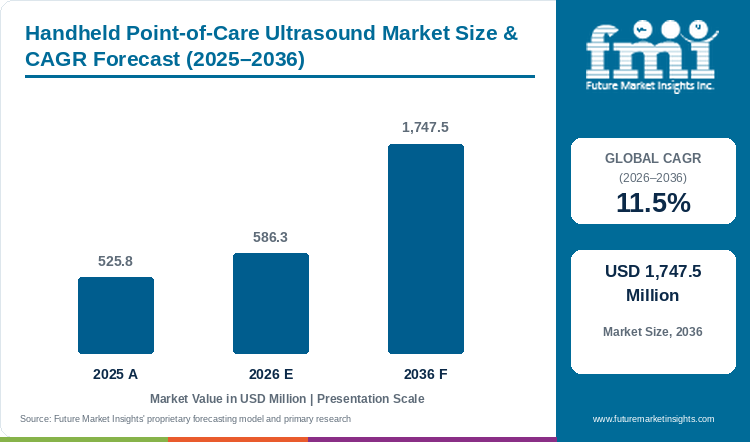
Worldwide handheld point-of-care ultrasound turnover rises from its 2025 total of USD 525.8 Million to an anticipated USD 586.3 Million in 2026, compounding at a predicted 11.5% annual rate toward USD 1,747.5 Million through 2036.
Based on FMI estimates, 2025 handheld point-of-care ultrasound turnover of USD 525.8 Million grows to a 2026 projection of USD 586.3 Million and a 2036 forecast of USD 1,747.5 Million at an expected 11.5% CAGR, delivering an annual market revenue increase of USD 1,161.2 Million between 2026 and 2036. Hospital fleet demand scales rapidly during acute resuscitation windows because wheeling hemodynamically unstable trauma or cardiac arrest patients down to centralized radiology suites introduces life-threatening surgical delays. Corroborating this bedside triage transition, clinical ultrasound governance frameworks from the American Institute of Ultrasound in Medicine emphasize accreditation standards and bedside practice parameters to guide emergency procedures [1]. Multi-array single probes are anticipated to command 38.4% of 2026 probe orders alongside point-of-care diagnostics workflows because clinicians switch frequencies electronically, even as strict hospital PACS cybersecurity rules slow enterprise rollouts.
Key Market Trends & Insights
- By probe type: Multi-array single probes are anticipated to secure 38.4% of 2026 probe demand because dual-headed and tri-mode wands handle both superficial vascular access and deep abdominal scans.
- By transducer technology: Piezoelectric crystal is expected to account for 61.8% of 2026 transducer sales owing to high acoustic sensitivity and clean Doppler color flow in bariatric patients.
- By application: Emergency medicine is projected to represent 26.8% of 2026 application volume as trauma bays standardize on rapid bedside shock and pneumothorax assessment.
- By end user: Hospital fleets are expected to generate 47.2% of 2026 end user revenue through multi-department probe replacements and enterprise DICOM archiving contracts.
Regional Highlights
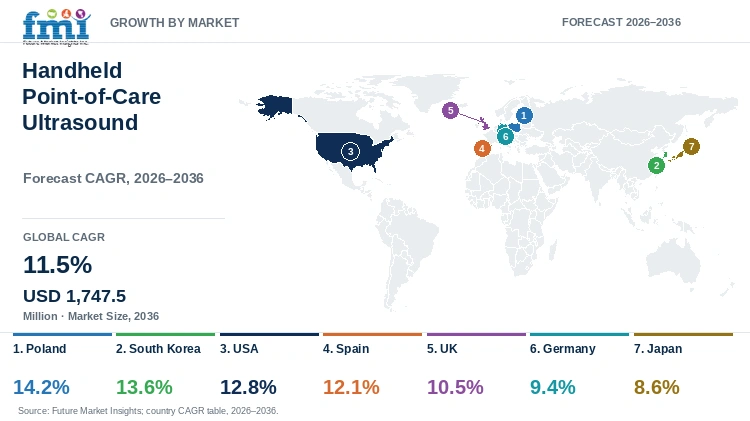
- Fastest national expansion: Poland is predicted to pace major handheld point-of-care ultrasound markets at a 14.2% yearly clip through 2036 on paramedic certification reforms.
- Other key healthcare markets: South Korean emergency centers are projected to advance by 13.6% per year above anticipated American (12.8%) and Spanish (12.1%) buyers, with British (10.5%) and German (9.4%) hospitals expected to outpace Japanese geriatric home-care demand at 8.6%.
Market Size & Forecast
Table 1: Market Size and Forecast for the Handheld Point-of-Care Ultrasound Market (USD million and CAGR percentage), 2025 to 2036
| Metric | Value |
|---|---|
| 2025 Market Size | USD 525.8 Million |
| Estimated Market Size in 2026 | USD 586.3 Million |
| Projected Market Size by 2036 | USD 1,747.5 Million |
| CAGR, 2026 to 2036 | 11.5% |
| Added Revenue, 2026 to 2036 | USD 1,161.2 Million |
Updated emergency medicine residency competency mandates across North America and Europe are accelerating hospital-wide adoption of wireless pocket transducers. In its landmark clinical ultrasound policy compendium, the American College of Emergency Physicians recommends early focused bedside echocardiography during undifferentiated shock resuscitations [2]. Hospital critical care committees are consequently deploying encrypted wireless probes alongside portable cardiology ultrasound systems to shorten diagnostic turnaround times below eight minutes. Vendors that bundle automated cloud PACS synchronization with zero-footprint viewer licenses win enterprise fleet tenders across multi-hospital health networks.
Emergency Diagnostic Department Throughput and Bedside Ultrasound Sizing
Table 2: Emergency Diagnostic Throughput and Bedside Ultrasound Indicators for the Handheld Point-of-Care Ultrasound Market (USD Million and operational ranges), mixed historical and forecast years from 2025 to 2036
| Metric | 2025 | 2026 | 2036 |
|---|---|---|---|
| Market size (USD Million) | 525.8 | 586.3 | 1,747.5 |
| Active emergency ultrasound scanning bays (thousand suites) | 18.5 to 28.0 | 20.4 to 31.5 | 52.0 to 85.0 |
| Average bedside scan examination duration (minutes) | 8 to 15 | 6 to 12 | 3 to 6 |
| Annualized radiology department cost savings per hospital (USD) | 140,000 to 260,000 | 165,000 to 310,000 | 450,000 to 880,000 |
Operational note: Scanning bay figures cover accredited emergency resuscitation bays and acute surgical observation units equipped with pocket ultrasound probes. Examination durations measure complete bedside acquisition and wireless DICOM archiving, while cost savings reflect avoided inpatient radiology transport and after-hours sonographer call-in fees.
Diagnostic Imaging Equipment & Transducer Procurement Sizing
Hospital biomedical engineering teams prioritize multi-array handheld wands that switch electronically between phased cardiac and linear vascular modes without unclipping cable connectors. Procurement officers benchmark candidate probes on thermal housing dissipation during continuous scanning and IP67 immersion disinfection durability. Tertiary trauma centers also coordinate bedside probe rollouts with focused ultrasound system and interventional suites to standardize procedural needle guidance.
Table 3: Diagnostic Imaging Equipment Procurement Indicators for the Handheld Point-of-Care Ultrasound Market (USD and thousand units), mixed historical and forecast years from 2025 to 2036
| Metric | 2025 | 2026 | 2036 |
|---|---|---|---|
| Handheld ultrasound probe units shipped globally (thousand units) | 85.0 | 102.0 | 415.0 |
| Average equipment selling price per handheld probe unit (USD) | 6,185.0 | 5,748.0 | 4,210.0 |
| Transducer microelectronics fabrication cost per probe (USD) | 1,450 to 2,400 | 1,280 to 2,150 | 680 to 1,150 |
| Enterprise fleet software subscription license fee per year (USD) | 480 to 950 | 450 to 900 | 280 to 550 |
Table 4: Ultrasound Sector Procurement Indicators for the Handheld Point-of-Care Ultrasound Market (USD Million and percentages), 2026
| Metric | Value | Basis |
|---|---|---|
| Market size, 2026 | USD 586.3 Million | 2026 market estimate |
| Multi-array single probes revenue, 2026 | USD 225.1 Million | 38.4% probe type share |
| Piezoelectric crystal technology revenue, 2026 | USD 362.3 Million | 61.8% transducer share |
| Emergency medicine application revenue, 2026 | USD 157.1 Million | 26.8% application share |
Analyst Perspective
"Embedding automated ejection fraction and bladder volume algorithms directly onto wireless multi-array wands allows non-radiologist clinicians to execute rapid bedside triage. Overcoming hospital cybersecurity firewall reviews and physician credentialing backlogs remains decisive for enterprise-wide fleet contracts."
- Anurag Sharma, Principal Consultant, Future Market Insights.
How is the handheld point-of-care ultrasound market segmented?
The handheld point-of-care ultrasound market is segmented by probe type, transducer technology, application, end user, and region. In 2026, multi-array single probes are anticipated to command 38.4%, piezoelectric crystal is expected to hold 61.8%, emergency medicine is projected at 26.8%, and hospitals are forecast to generate 47.2%.
By probe type: multi-array single probes, phased array probes, curvilinear probes, and linear probes.
By transducer technology: piezoelectric crystal, capacitive micromachined ultrasound transducers (CMUT), and piezoelectric micromachined ultrasound transducers (PMUT).
By application: emergency medicine, critical care, cardiology, obstetrics and gynecology, primary care, and musculoskeletal.
By end user: hospitals, physician offices, ambulatory care centers, emergency medical services, and home care settings.
How Do Multi-Array Single Probes Capture the Top Probe Type Share?
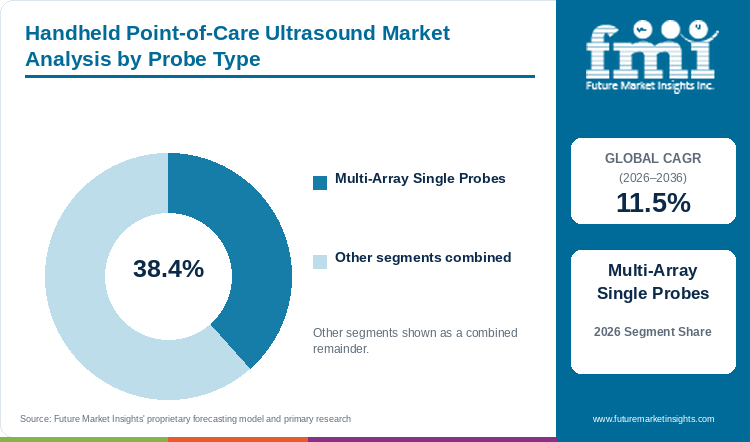
Multi-array single probes are anticipated to command 38.4% of probe type volume in 2026, enabled by electronic frequency switching.
Table 5: Probe Type Share for the Handheld Point-of-Care Ultrasound Market (percentage share), 2026
| Probe Type | Share (2026) |
|---|---|
| Multi-Array Single Probes | 38.4% |
| Other Segments Combined | 61.6%* |
| Total | 100.0% |
*Note: Combined balance of all other probe type segments reaching 100.0% in 2026.
Table 6: Probe Type Leadership and Market Growth for the Handheld Point-of-Care Ultrasound Market (segment and CAGR percentage), 2026 to 2036
| Metric | Value |
|---|---|
| Global CAGR (2026 to 2036) | 11.5% |
| Leading Segment | Multi-Array Single Probes |
| Leading Segment Share (2026) | 38.4% |
Source: Future Market Insights analysis
Housing dual-head or tri-mode transducer arrays inside one sealed wireless wand allows emergency physicians to transition from high-frequency jugular vein cannulation to deep abdominal trauma scans in seconds. Single-frequency probes force clinicians to carry multiple separate heads and repeat sterile wipe-downs between anatomical views. Hospital emergency departments increasingly specify all-in-one wands alongside conventional ultrasound devices to reduce lost hardware across shift handoffs, and estimates assign 38.4% of 2026 probe orders to multi-array single probes. Single-wand versatility also lowers per-bed capital expenditure when equipping multi-bay observation wards.
- Eliminating physical probe swapping during acute resuscitations is expected to give multi-array single probes 38.4% of 2026 probe type demand.
- Mindray Bio-Medical Electronics launched its wireless tri-mode handheld scanner in May 2025 to support vascular and abdominal bedside exams within one enclosure [3].
Why Does Piezoelectric Crystal Dominate Transducer Technology?
Piezoelectric crystal is expected to hold 61.8% of transducer technology sales during 2026, backed by deep abdominal acoustic penetration.
Lead zirconate titanate and single-crystal piezoelectric elements generate higher acoustic output pressure and cleaner tissue harmonic return signals than silicon micromachined membranes when imaging deep abdominal or bariatric anatomy. While silicon CMUT and PMUT chips offer wafer-scale fabrication economies, attending cardiologists and intensivists demand uncompromising color Doppler sensitivity to rule out valvular regurgitation, which is why piezoelectric crystal is estimated to retain 61.8% of 2026 transducer revenue. Inpatient imaging directors pair high-density piezoelectric probes with full-body AI ultrasound imaging software to maintain diagnostic confidence at the bedside. Thermal matching layers in modern single-crystal wands also prevent probe surface overheating during prolonged cardiac resuscitation.
- Superior deep-tissue signal-to-noise performance is projected to keep piezoelectric crystal at 61.8% of 2026 transducer technology revenue.
- In September 2025, Clarius Mobile Health Corp. released advanced single-crystal piezoelectric arrays engineered for high-definition portable point-of-care wands [4].
What Makes Emergency Medicine the Primary Clinical Application?
Emergency medicine is projected to claim 26.8% of application turnover for 2026, reflecting rapid bedside shock triage protocols.
Trauma surgeons and emergency physicians rely on immediate bedside sonography to detect free intraperitoneal fluid and pleural sliding absence within the golden hour of injury arrival. Waiting for a cart-based scanner or transporting an intubated patient to radiology delays life-saving thoracostomy or laparotomy decisions. Acute trauma centers link pocket transducers directly to medical imaging software archives so on-call surgical teams can review live clips on mobile tablets. Mandatory point-of-care ultrasound fellowship tracks across emergency residencies are consequently expected to place emergency medicine at 26.8% of 2026 application demand.
- Mandatory eFAST trauma protocols and rapid shock triage are anticipated to keep emergency medicine at 26.8% of 2026 application sales.
- In April 2025, clinical investigators published a comprehensive review in Internal and Emergency Medicine evaluating point-of-care ultrasound protocols for hemodynamic monitoring and resuscitation in shock [5].
Why Do Hospitals Command the Largest End User Share?
Hospitals are forecast to generate 47.2% of end user procurement in 2026, stemming from enterprise wireless scanner contracts.
Multi-hospital health systems purchase handheld ultrasound probes in fleet quantities of 50 to 300 units to equip emergency bays and intensive care beds simultaneously. Hospital biomedical and IT directorates provide the WPA3-Enterprise wireless security and vendor-neutral DICOM archives required to store bedside exams inside electronic health records, so inpatient hospitals are anticipated to represent 47.2% of 2026 end user procurement. Capital equipment committees coordinate pocket scanner tenders alongside diagnostic X-ray system upgrades to capture bundled service agreements. Structured inpatient billing workflows also allow hospitals to capture technical procedural guidance fees that offset hardware acquisition costs.
- Enterprise fleet purchasing and integrated PACS billing infrastructure are estimated to secure 47.2% of 2026 clinical-buyer receipts for hospitals.
- American Hospital Association equipment modernization data published in November 2025 documented expanding enterprise procurement of connected point-of-care probes across acute wards [6].
What are the drivers, restraints, and opportunities in the handheld point-of-care ultrasound market?
Time-critical trauma triage and ultrasound-guided vascular access are expected to drive handheld point-of-care ultrasound demand through 2036, even as hospital PACS cybersecurity reviews and physician privileging requirements slow enterprise fleet rollouts.
- Driver: Urgent bedside triage of undifferentiated hypotension and blunt trauma compels emergency departments to equip resuscitation bays with wireless pocket transducers.
- Restraint: Strict hospital cybersecurity authorizations for mobile medical devices and supervised scan log requirements for non-radiologist credentialing delay fleet-wide adoption.
- Opportunity: Cleared artificial intelligence anatomical guidance and prehospital ambulance tele-ultrasound streaming open new procurement channels across primary and rural care.
Growth Analysis and Future Potential: Bedside Emergency Resuscitation and Procedural Guidance Catalysts
Accelerating time-to-diagnosis during cardiac arrest and hemodynamic shock serves as the foundational catalyst expanding pocket ultrasound utilization across acute care wards. In May 2025, Society of Critical Care Medicine guidelines endorsed focused bedside echocardiography as a frontline hemodynamic monitoring tool across intensive care units [7]. Bedside visualization of inferior vena cava collapsibility and pericardial effusion allows intensivists to titrate vasopressors and fluids without invasive pulmonary artery catheters. Integrating real-time anatomical labeling from AI-powered whole-body imaging models helps junior residents acquire diagnostic four-chamber cardiac views on the first attempt.
Risk Assessment and Operational Hurdles: Institutional Credentialing Barriers and Enterprise IT Integration
Hospital clinical privileging bottlenecks and medical device cybersecurity compliance rules create persistent commercial friction during multi-department probe tenders. Clinical privileging boards typically require non-radiologist physicians to log 25 to 50 proctored examinations per anatomical application before granting independent diagnostic billing privileges. Quality governance standards published by EFSUMB in November 2025 highlighted that unstandardized privileging and PACS archiving gaps slow hospital-wide POCUS integration [8]. Meanwhile, chief information security officers block consumer tablet and smartphone probes that lack containerization and encrypted DICOM middleware comparable to fixed magnetic resonance imaging networks.
Commercial Opportunity Analysis: Outpatient Primary Care Expansion and Prehospital Ambulance Telemetry
Equipping community family medicine clinics and emergency air-rescue ambulances with AI-guided pocket probes is projected to create substantial volume growth outside traditional hospital walls. In February 2026, the American Academy of Family Physicians published updated curriculum guidelines supporting point-of-care ultrasound integration across family medicine residencies [9]. Primary care physicians use handheld scanners during routine office visits to rule out abdominal aortic aneurysms and gallstones, avoiding delayed outpatient radiology referrals. At the same time, prehospital paramedics stream live trauma clips to hospital trauma surgeons using autonomous imaging quality-check overlays that guide probe angulation.
Handheld Point-of-Care Ultrasound Market by Country (2026 to 2036)
Polish emergency medical modernization is predicted to top national growth with a 14.2% yearly expansion rate to 2036, followed by projected gains in South Korean centers at 13.6% and American health systems at 12.8% surpassing Spanish (12.1%) and British (10.5%) probe shipments as German (9.4%) and Japanese (8.6%) buyers are forecast to post steadier growth. Divergent growth rates stem from national paramedic scope-of-practice laws and primary care decentralizing investments.
Table 7: Country CAGR and Primary Growth Levers for the Handheld Point-of-Care Ultrasound Market (CAGR percentage and operational drivers), 2026 to 2036
| Country | CAGR (2026 to 2036) | Primary Growth Lever |
|---|---|---|
| Poland | 14.2% | Prehospital emergency paramedic ultrasound qualification regulations and regional air rescue modernization |
| South Korea | 13.6% | Academic emergency medicine ultrasound residency curriculum updates and tertiary trauma center investments |
| USA | 12.8% | AIUM clinical accreditation updates and health system investment in cloud-connected enterprise probe fleets |
| Spain | 12.1% | Regional public health primary care center deployments and urgent care clinical training initiatives |
| UK | 10.5% | NHS acute medicine diagnostic modernization programs and regional FAMUS ultrasound training pathways |
| Germany | 9.4% | DEGUM point-of-care certification standards and specialized hospital acute care ultrasound integration |
| Japan | 8.6% | Geriatric home-visit clinical care expansion and emergency medicine bedside ultrasound guidelines |
Source: Future Market Insights analysis
Poland Handheld Point-of-Care Ultrasound Market Outlook (2026 to 2036)
Whereas Western European ambulance services rely heavily on hospital-based emergency physicians, Poland's state medical rescue system empowers paramedics and emergency medical nurses to execute independent prehospital trauma sonography across ground and helicopter fleets. Qualification regulations enacted by Poland's Health Ministry during October 2025 authorized certified paramedics and emergency medical nurses to perform prehospital trauma ultrasound examinations in ambulances [10]. Equipping state ambulance stations and county emergency wards is projected to drive a 14.2% compound annual expansion in Polish handheld point-of-care ultrasound sales through 2036. Tight municipal hospital capital budgets and price-weighted public tenders still compress hardware margins, so suppliers bundle Polish-language eFAST simulation software into regional rescue contracts.
Key takeaway: In Poland, statutory paramedic ultrasound authorization and air-ambulance fleet upgrades are expected to drive rapid prehospital procurement of ruggedized pocket probes.
South Korea Handheld Point-of-Care Ultrasound Market Outlook (2026 to 2036)
Consensus training standards issued by the Korean Society of Emergency Medicine in January 2026 required structured point-of-care ultrasound competency across all accredited emergency residency programs [11]. Unlike decentralized outpatient markets, South Korea concentrates acute emergency and trauma admissions inside ultra-high-volume metropolitan university hospitals in Seoul and Busan that demand rapid stretcher-side triage. Equipping these metropolitan trauma bays and intensive care units is anticipated to increase South Korean handheld point-of-care ultrasound turnover at a 13.6% annual clip to 2036. Strict National Health Insurance Service fee schedules for bedside screening exams nevertheless limit standalone hardware reimbursement in smaller clinics, prompting vendors to offer subscription software bundles for university hospital fleets.
Key takeaway: In South Korea, mandatory emergency residency training standards and tertiary trauma center upgrades are projected to support brisk uptake of multi-array handheld wands.
USA Handheld Point-of-Care Ultrasound Market Outlook (2026 to 2036)
Per FMI's outlook, American handheld point-of-care ultrasound turnover is forecast to grow 12.8% per year through 2036 as integrated delivery networks equip outpatient surgery and urgent care sites. What distinguishes the United States from statutory single-payer markets is its established CPT procedural billing architecture for ultrasound-guided central venous access and regional anesthesia nerve blocks alongside bulk enterprise fleet purchasing. Premarket cybersecurity quality system guidance updated by the U.S. Food and Drug Administration during February 2026 established strict encryption rules for wireless medical devices [12]. Rigorous hospital Chief Information Security Officer audits and multi-department credentialing governance still delay fleet activation until vendors provide FedRAMP and SOC 2 cloud archiving middleware.
Key takeaway: In the USA, enterprise hospital fleet contracts and cybersecurity-cleared cloud PACS gateways are anticipated to sustain high-volume adoption across emergency and surgical floors.
Spain Handheld Point-of-Care Ultrasound Market Outlook (2026 to 2036)
Autonomous community investments in primary care diagnostic self-sufficiency set Spain apart from hospital-centric European imaging markets because regional health services fund pocket probes directly for neighborhood Centros de Salud. In June 2025, the Madrid Health Service expanded its multi-center primary care procurement program to equip community health centers with portable ultrasound probes for abdominal and vascular triage [13]. Decentralized general practitioner scanning is expected to push Spanish handheld point-of-care ultrasound demand upward by 12.1% each year between 2026 and 2036. Uneven hands-on sonography training among family doctors across rural autonomous health districts still slows daily utilization, so suppliers embed cloud tele-mentoring tools linking family doctors with hospital radiologists.
Key takeaway: In Spain, regional public health primary care tenders and remote tele-mentoring software are projected to accelerate decentralized family medicine adoption.
UK Handheld Point-of-Care Ultrasound Market Outlook (2026 to 2036)
In May 2025, the Society for Acute Medicine and NHS training deaneries expanded Focused Acute Medicine Ultrasound accreditation to fast-track bedside pleural and ascitic assessments [14]. Unlike North American emergency departments where trauma surgeons lead adoption, British demand is uniquely anchored in NHS Acute Medical Units where internal medicine registrars use pocket probes to decongest inpatient bed bottlenecks. Widespread clinical adoption across NHS acute medical receiving wards and regional community diagnostic hubs is predicted to generate 10.5% annual growth in British handheld point-of-care ultrasound revenue through 2036. Constrained NHS Trust capital allocations and lengthy framework procurement reviews nevertheless require vendors to structure multi-year managed equipment service agreements.
Key takeaway: In the UK, standardized FAMUS physician accreditation and NHS acute medical receiving pathways are forecast to sustain steady demand for pocket transducers.
Germany Handheld Point-of-Care Ultrasound Market Outlook (2026 to 2036)
Germany's physician-staffed Notarzt prehospital rescue system and strict multi-tier DEGUM specialty certification standards create a uniquely technical procurement environment compared with paramedic-led markets. In July 2025, emergency medicine researchers published a comprehensive narrative review evaluating prehospital point-of-care ultrasound applications, DEGUM certification training pathways, and diagnostic implementation across rescue units [15]. Supported by university hospital anesthesia and trauma departments, German handheld point-of-care ultrasound sales are estimated to record a 9.4% annual expansion rate through 2036. Strict Kassenärztliche Bundesvereinigung acoustic spatial resolution rules for outpatient billing and local GDPR hospital server storage mandates still restrain private physician office uptake, favoring high-channel-count piezoelectric wands with on-premise German server archiving.
Key takeaway: In Germany, DEGUM certification standards and physician-staffed prehospital rescue services are expected to drive demand for high-resolution wireless probes.
Japan Handheld Point-of-Care Ultrasound Market Outlook (2026 to 2036)
Routine home nursing assessment of congestive heart failure fluid overload and bladder retention is anticipated to push Japanese handheld point-of-care ultrasound turnover up by 8.6% annually until 2036. Japan diverges sharply from trauma-led Western markets because its super-aging society and national Zaitaku Iryo home-visit medical care framework prioritize sub-200-gram pocket probes carried by visiting physicians and community nurses. Practice guidance released by the Japan Society of Ultrasonics in Medicine during May 2025 updated non-radiologist bedside ultrasound protocols in home-visit geriatric medicine [16]. Conservative hospital radiology referral traditions and biennial national reimbursement price cuts nevertheless cap hardware margins, prompting domestic suppliers to embed one-touch automated bladder and lung B-line quantification presets.
Key takeaway: In Japan, home-visit geriatric medical care and automated bladder and lung presets are projected to support steady long-term adoption of pocket scanners.
Full report country CAGRs cover: North America; Latin America; Western Europe; Eastern Europe; East Asia; South Asia and Pacific; Middle East and Africa.
Who are the notable companies in the handheld point-of-care ultrasound market?
GE HealthCare Technologies Inc., Butterfly Network, Inc., Koninklijke Philips N.V., Clarius Mobile Health Corp., FUJIFILM Sonosite, Inc., Mindray Bio-Medical Electronics Co., Ltd., EchoNous, Inc., Exo Imaging, Inc., and Samsung Medison Co., Ltd. are the notable companies in the handheld point-of-care ultrasound market.
Hospital fleet competition in handheld ultrasonography centers on single-crystal acoustic resolution and multi-array probe ergonomics alongside enterprise PACS cybersecurity compliance. Diversified diagnostic imaging groups including GE HealthCare and Koninklijke Philips NV alongside FUJIFILM Sonosite pair ruggedized bedside probes with entrenched hospital radiology and PACS service contracts. Wireless piezoelectric specialists such as Clarius Mobile Health and Mindray Bio-Medical Electronics together with Samsung Medison engineer high-definition cable-free wands for emergency and surgical suites. Meanwhile, semiconductor transducer and clinical AI developers Butterfly Network and EchoNous alongside Exo Imaging commercialize silicon ultrasound-on-chip probes and automated cardiac measurement software.
- Global Medical Imaging Conglomerates: GE HealthCare and Koninklijke Philips NV alongside FUJIFILM Sonosite supply ruggedized handheld transducers integrated with enterprise hospital PACS networks.
- Specialized Wireless Ultrasonography Pioneers: Clarius Mobile Health and Mindray Bio-Medical Electronics together with Samsung Medison manufacture high-frequency cable-free piezoelectric wands for acute care.
- Semiconductor Transducer & AI Software Innovators: Butterfly Network and EchoNous alongside Exo Imaging develop silicon CMUT/PMUT arrays and automated AI organ-contouring platforms.
Competitive Benchmarking: Handheld Point-of-Care Ultrasound Market
Table 8: Competitive Benchmarking for the Handheld Point-of-Care Ultrasound Market (qualitative capability ratings), 2026
| Company | Acoustic Imaging Performance | Enterprise IT & PACS Integration | Artificial Intelligence Software Depth | Global Commercial Footprint |
|---|---|---|---|---|
| GE HealthCare Technologies Inc. | High | High | High | High |
| Butterfly Network, Inc. | Medium | High | High | High |
| Koninklijke Philips N.V. | High | High | High | High |
| Clarius Mobile Health Corp. | High | High | High | High |
| FUJIFILM Sonosite, Inc. | High | High | Medium | High |
| Mindray Bio-Medical Electronics Co., Ltd. | High | High | High | High |
| EchoNous, Inc. | High | Medium | High | Medium |
| Exo Imaging, Inc. | Medium | High | High | Medium |
| Samsung Medison Co., Ltd. | High | High | Medium | High |
Scoring basis: Acoustic Imaging Performance earns a High rating where transducers deliver single-crystal or high-density harmonic resolution and sensitive color Doppler across deep abdominal presets. Enterprise IT & PACS Integration reflects native wireless DICOM worklist synchronization and hospital MDM cybersecurity certifications. Artificial Intelligence Software Depth evaluates cleared automated ejection fraction and bladder volume tools, while Global Commercial Footprint tracks direct health-system distribution across the Americas and Western Europe.
Key Developments in the Handheld Point-of-Care Ultrasound Market
- Enterprise cybersecurity compliance authorizations for the iQ3 silicon-chip handheld probe and Compass AI hospital fleet software were secured by Butterfly Network Inc. in February 2026 [17].
- Clarius Mobile Health Corp. completed the European commercial rollout of its PAL HD3 dual-array wireless scanner combining phased and linear arrays in one wand during June 2025 [18].
- GE HealthCare broadened Vscan Air wireless dual-probe deployments with automated digital workflow tools across acute emergency and outpatient clinics in December 2025 [19].
Key Players in the Handheld Point-of-Care Ultrasound Market
Global Medical Imaging Conglomerates
- GE HealthCare Technologies Inc.
- Koninklijke Philips N.V.
- FUJIFILM Sonosite, Inc.
Specialized Wireless Ultrasonography Pioneers
- Clarius Mobile Health Corp.
- Mindray Bio-Medical Electronics Co., Ltd.
- Samsung Medison Co., Ltd.
Semiconductor Transducer & AI Software Innovators
- Butterfly Network, Inc.
- EchoNous, Inc.
- Exo Imaging, Inc.
Handheld Point-of-Care Ultrasound Market - Report Scope
Table 9: Report Scope for the Handheld Point-of-Care Ultrasound Market (coverage fields and definitions), 2026 to 2036
| Coverage field | Report scope |
|---|---|
| Market breakdown | Probe Type; Transducer Technology; Application; End User; Region |
| Quantitative Units | USD Million |
| Market Definition | Includes manufacturer revenue from commercial pocket-sized handheld point-of-care ultrasound probes (wired and wireless smartphone/tablet-connected wands) and associated clinical AI and fleet management software subscriptions. Category Scope Note: Excludes console-based cart ultrasound systems, laptop/hand-carried luggable ultrasound units above 1.5 kg, dedicated veterinary scanners, and hospital physician examination fees. |
| Regions Covered | North America; Latin America; Western Europe; Eastern Europe; East Asia; South Asia and Pacific; Middle East and Africa |
| Countries Covered | Poland, South Korea, USA, Spain, UK, Germany, Japan, and additional countries in the full report |
| Key Companies Covered | GE HealthCare Technologies Inc., Butterfly Network, Inc., Koninklijke Philips N.V., Clarius Mobile Health Corp., FUJIFILM Sonosite, Inc., Mindray Bio-Medical Electronics Co., Ltd., EchoNous, Inc., Exo Imaging, Inc., Samsung Medison Co., Ltd. |
| Forecast Period | 2026 to 2036 |
| Approach | Primary and secondary research with market triangulation. |
Handheld Point-of-Care Ultrasound Market - Research Methodology
Table 10: Research Methodology for the Handheld Point-of-Care Ultrasound Market (research methods and approach), 2026 edition
| Method | Approach |
|---|---|
| Primary Research | Primary interviews were conducted with emergency department chairs, intensive care unit directors, prehospital air-rescue medical officers, and hospital biomedical procurement leads to validate probe durability and PACS licensing models. |
| Secondary Research | Secondary research encompassed FDA 510(k) and European MDR device clearances, AIUM and ACEP emergency ultrasound guidelines, peer-reviewed resuscitation trials, and manufacturer quarterly segment disclosures. |
| Market Sizing and Forecasting | Market sizing and forecasting for the 2026 to 2036 period were built through bottom-up emergency bay, ICU bed, and ambulance fleet installation models reconciled against vendor probe shipment volumes. |
| Data Triangulation and Validation | Estimates are cross-validated against national trauma center registries, emergency residency training cohorts, and hospital capital expenditure surveys while excluding cart-based and laptop ultrasound consoles. |
| Country Forecasting Model | Country-level CAGRs are modeled against the 11.5% global projection using national paramedic ultrasound certification rules, primary care decentralization budgets, CPT/DRG procedural reimbursement codes, and geriatric home-visit volumes. |
| Operational Benchmark Traceability | Operational benchmarks in Tables 2, 3, and 4 (active emergency scanning bays, bedside exam durations, radiology transport savings, and probe ASPs) are synthesized from AIUM accreditation records, ACEP emergency department surveys, and vendor fleet pricing schedules. |
Handheld Point-of-Care Ultrasound Market by Segments
Handheld Point-of-Care Ultrasound Market segmented by Probe Type:
- Multi-Array Single Probes
- Phased Array Probes
- Curvilinear Probes
- Linear Probes
Handheld Point-of-Care Ultrasound Market segmented by Transducer Technology:
- Piezoelectric Crystal
- Capacitive Micromachined Ultrasound Transducers (CMUT)
- Piezoelectric Micromachined Ultrasound Transducers (PMUT)
Handheld Point-of-Care Ultrasound Market segmented by Application:
- Emergency Medicine
- Critical Care
- Cardiology
- Obstetrics and Gynecology
- Primary Care
- Musculoskeletal
Handheld Point-of-Care Ultrasound Market segmented by End User:
- Hospitals
- Physician Offices
- Ambulatory Care Centers
- Emergency Medical Services
- Home Care Settings
Handheld Point-of-Care Ultrasound Market by Region
- North America
- United States
- Canada
- Latin America
- Brazil
- Mexico
- Argentina
- Chile
- Western Europe
- Germany
- France
- United Kingdom
- Italy
- Spain
- Benelux
- Nordics
- Eastern Europe
- Poland
- Czech Republic
- Romania
- Hungary
- East Asia
- China
- Japan
- South Korea
- South Asia and Pacific
- India
- ASEAN
- Australia and New Zealand
- Middle East and Africa
- GCC Countries
- South Africa
- Türkiye
- Israel
Research Sources and Bibliography
- [1] American Institute of Ultrasound in Medicine (AIUM). (2023). Standards and Guidelines for the Accreditation of Ultrasound Practices: Point-of-Care Ultrasound. American Institute of Ultrasound in Medicine.
- [2] American College of Emergency Physicians (ACEP). (2023). Ultrasound Guidelines: Emergency, Point-of-Care, and Clinical Ultrasound Guidelines in Medicine. Annals of Emergency Medicine, 82(3), e105-e128.
- [3] Mindray Bio-Medical Electronics Co., Ltd. (2025, May 14). Introduction of wireless multi-array handheld ultrasound system with tri-mode scanning capabilities. Mindray Global Newsroom.
- [4] Clarius Mobile Health Corp. (2025, September 22). Commercial availability of advanced single-crystal piezoelectric ultrasound arrays for portable scanners. Clarius Mobile Health Press Releases.
- [5] Rodrigo Martinez, A., Luordo, D., Rodriguez-Moreno, J., de Pablo Esteban, A., & Torres-Arrese, M. (2025, April 03). Point of Care Ultrasound for Monitoring and Resuscitation in Patients with Shock. Internal and Emergency Medicine, 20(5), 1505-1515.
- [6] American Hospital Association (AHA). (2025, November 19). Hospital equipment modernization survey: Enterprise adoption of connected point-of-care ultrasound. AHA Health Forum.
- [7] Society of Critical Care Medicine (SCCM). (2025, May 18). Clinical practice guidelines for hemodynamic resuscitation using focused critical care echocardiography. Critical Care Medicine.
- [8] European Federation of Societies for Ultrasound in Medicine and Biology (EFSUMB). (2025, November 12). Quality standards and governance frameworks for point-of-care ultrasound across medical specialties. Ultraschall in der Medizin.
- [9] American Academy of Family Physicians (AAFP). (2026, February 10). Clinical integration and curriculum guidelines for point-of-care ultrasound in primary medical care. AAFP Clinical Policies.
- [10] Ministry of Health of the Republic of Poland. (2025, October 24). Regulation on qualification courses and ultrasound competencies for emergency medical technicians and paramedics. Dziennik Ustaw RP Warsaw.
- [11] Korean Society of Emergency Medicine (KSEM). (2026, January 15). Consensus educational guidelines for emergency ultrasound training across academic residency programs. Clinical and Experimental Emergency Medicine.
- [12] U.S. Food and Drug Administration (FDA). (2023, September 27). Cybersecurity in Medical Devices: Quality System Considerations and Content of Premarket Submissions. FDA Center for Devices and Radiological Health.
- [13] Madrid Health Service (SERMAS). (2025, June 16). Primary care diagnostic integration: Multi-center deployment of portable ultrasound systems across Madrid health centers. Comunidad de Madrid Consejeria de Sanidad.
- [14] Society for Acute Medicine (SAM). (2025). Focused Acute Medicine Ultrasound (FAMUS) Accreditation Standard and Curriculum. Society for Acute Medicine UK.
- [15] Hellenthal, K. E. M., et al. (2025, July 14). Evolving Role of Point-of-Care Ultrasound in Prehospital Emergency Care: A Narrative Review. Scandinavian Journal of Trauma, Resuscitation and Emergency Medicine, 33, Article 126.
- [16] Japan Society of Ultrasonics in Medicine (JSUM). (2025, May 22). Clinical practice standards for bedside point-of-care ultrasound examinations in geriatric home medicine. JSUM Clinical Standards Committee Tokyo.
- [17] Butterfly Network, Inc. (2026, February 08). Butterfly iQ3 achieves enterprise cybersecurity compliance authorizations for hospital PACS networks. Butterfly Network Newsroom.
- [18] Clarius Mobile Health Corp. (2025, June 18). European commercial rollout of PAL HD3 dual-array wireless handheld scanners for emergency resuscitation. Clarius Mobile Health Press Releases.
- [19] GE HealthCare Technologies Inc. (2025, December 12). Vscan Air wireless handheld ultrasound integrations in emergency and outpatient clinical workflows. GE HealthCare Media Center.
- [20] Koninklijke Philips N.V. (2026, February 20). Lumify handheld ultrasound updates and integrated tele-ultrasound collaboration platforms. Philips Healthcare Communications.
- [21] EchoNous, Inc. (2026, January 18). Kosmos handheld ultrasound platform artificial intelligence ejection fraction software clinical validation. EchoNous Corporate Press.
This bibliography is provided for reader reference and is not exhaustive. The full report contains the complete reference list and detailed citations.
This Report Answers
- How large is the handheld point-of-care ultrasound market in 2026 and what is forecast for 2036?
- Which acute resuscitation and procedural specialties drive pocket ultrasound probe orders?
- Why do multi-array single probes represent the leading probe type segment in 2026?
- Why does piezoelectric crystal dominate the transducer technology breakdown globally?
- How do growth rates compare across Poland, South Korea, the USA, Spain, the UK, Germany, and Japan?
- Which medical imaging companies manufacture commercial handheld point-of-care ultrasound wands?
- What hospital PACS cybersecurity and physician credentialing rules slow fleet deployment?
- What thermal dissipation and battery endurance benchmarks must buyers verify before procurement?
Frequently Asked Questions
How big is the handheld point-of-care ultrasound market in 2026, and what is forecast for 2036?
Global handheld point-of-care ultrasound demand is estimated to reach USD 586.3 Million in 2026 (up from USD 525.8 Million in 2025) and is projected to hit USD 1,747.5 Million by 2036 on rising trauma bay and ICU bedside triage.
What is the CAGR for the handheld point-of-care ultrasound market from 2026 to 2036?
Worldwide pocket ultrasound probe sales are expected to expand at an 11.5% CAGR from 2026 to 2036, generating an anticipated USD 1,161.2 Million in incremental equipment and enterprise software revenue.
Which probe type segment leads the handheld point-of-care ultrasound market?
As per FMI, multi-array single probes are projected to claim 38.4% of 2026 probe type demand because electronic array switching handles both vascular access and deep abdominal scans without swapping heads.
Which transducer technology leads the handheld point-of-care ultrasound market?
Piezoelectric crystal is estimated to account for 61.8% of 2026 transducer technology revenue owing to superior deep-tissue harmonic contrast and reliable color Doppler sensitivity.
Which country has a notable growth outlook from 2026 to 2036?
FMI finds that Poland is predicted to lead national expansion with a 14.2% CAGR through 2036, supported by statutory paramedic ultrasound certification and air-rescue modernization.
Who are the key players in the market?
Major manufacturers include GE HealthCare Technologies Inc., Butterfly Network, Inc., Koninklijke Philips N.V., Clarius Mobile Health Corp., FUJIFILM Sonosite, Inc., Mindray Bio-Medical Electronics Co., Ltd., EchoNous, Inc., Exo Imaging, Inc., and Samsung Medison Co., Ltd.
Preview the report firsthand - request a free sample
Get SampleGet the brochure for pricing and purchase details.
Get PDFTable of Content
- Key Takeaways
- Market Size and CAGR
- Top Growth Driver
- Fastest Growing Segment
- Leading Region
- Key Companies
- Emerging Opportunities
- Executive Summary
- Global Market Outlook
- Demand-side Trends
- Supply-side Trends
- Technology Roadmap Analysis
- Analysis and Recommendations
- Analyst Perspective (What is happening? Why now? What should investors know?)
- Key Questions Answered
- How large is the market?
- What is the CAGR?
- What are key trends?
- Which region dominates?
- Who are the leaders?
- Market Overview
- Market Coverage / Taxonomy
- Market Definition / Scope / Limitations
- Research Methodology
- Chapter Orientation
- Analytical Lens and Working Hypotheses
- Market Structure, Signals, and Trend Drivers
- Benchmarking and Cross-market Comparability
- Market Sizing, Forecasting, and Opportunity Mapping
- Research Design and Evidence Framework
- Desk Research Programme (Secondary Evidence)
- Expert Input and Fieldwork (Primary Evidence)
- Tooling, Models, and Reference Databases
- Data Engineering and Model Build
- Quality Assurance and Audit Trail
- Market Background
- Market Dynamics (Drivers, Restraints, Opportunity, Trends)
- Scenario Forecast (Optimistic, Likely, Conservative)
- Impact Analysis
- AI Impact
- Sustainability Impact
- Regulatory Impact
- Technology Impact
- Consumer / Buyer Analysis
- Purchase Drivers
- Adoption Barriers
- Buyer Journey
- Opportunity Map Analysis
- Product Life Cycle Analysis
- Supply Chain Analysis
- Investment Feasibility Matrix
- Value Chain Analysis
- PESTLE and Porter's Analysis
- Regulatory Landscape
- Regional Parent Market Outlook
- Production and Consumption Statistics
- Import and Export Statistics
- Global Market Analysis and Forecast, 2021 to 2036
- Historical Market Size Value (USD Million) Analysis, 2021 to 2025
- Current and Future Market Size Value (USD Million) Projections, 2026 to 2036
- Y-o-Y Growth Trend Analysis
- Absolute $ Opportunity Analysis
- Global Market Pricing Analysis, 2021 to 2036
- Global Market Analysis and Forecast, By Probe Type, 2021 to 2036
- Introduction / Key Findings
- Historical Market Size Value (USD Million) Analysis By Probe Type, 2021 to 2025
- Current and Future Market Size Value (USD Million) Analysis and Forecast By Probe Type, 2026 to 2036
- Multi-Array Single Probes
- Phased Array Probes
- Curvilinear Probes
- Linear Probes
- Y-o-Y Growth Trend Analysis By Probe Type, 2021 to 2025
- Absolute $ Opportunity Analysis By Probe Type, 2026 to 2036
- Global Market Analysis and Forecast, By Transducer Technology, 2021 to 2036
- Introduction / Key Findings
- Historical Market Size Value (USD Million) Analysis By Transducer Technology, 2021 to 2025
- Current and Future Market Size Value (USD Million) Analysis and Forecast By Transducer Technology, 2026 to 2036
- Piezoelectric Crystal
- Capacitive Micromachined Ultrasound Transducers (CMUT)
- Piezoelectric Micromachined Ultrasound Transducers (PMUT)
- Y-o-Y Growth Trend Analysis By Transducer Technology, 2021 to 2025
- Absolute $ Opportunity Analysis By Transducer Technology, 2026 to 2036
- Global Market Analysis and Forecast, By Application, 2021 to 2036
- Introduction / Key Findings
- Historical Market Size Value (USD Million) Analysis By Application, 2021 to 2025
- Current and Future Market Size Value (USD Million) Analysis and Forecast By Application, 2026 to 2036
- Emergency Medicine
- Critical Care
- Cardiology
- Obstetrics and Gynecology
- Primary Care
- Musculoskeletal
- Y-o-Y Growth Trend Analysis By Application, 2021 to 2025
- Absolute $ Opportunity Analysis By Application, 2026 to 2036
- Global Market Analysis and Forecast, By End User, 2021 to 2036
- Introduction / Key Findings
- Historical Market Size Value (USD Million) Analysis By End User, 2021 to 2025
- Current and Future Market Size Value (USD Million) Analysis and Forecast By End User, 2026 to 2036
- Hospitals
- Physician Offices
- Ambulatory Care Centers
- Emergency Medical Services
- Home Care Settings
- Y-o-Y Growth Trend Analysis By End User, 2021 to 2025
- Absolute $ Opportunity Analysis By End User, 2026 to 2036
- Global Market Analysis and Forecast, By Region, 2021 to 2036
- Introduction
- Historical Market Size Value (USD Million) Analysis By Region, 2021 to 2025
- Current Market Size Value (USD Million) Analysis and Forecast By Region, 2026 to 2036
- North America
- Latin America
- Western Europe
- Eastern Europe
- East Asia
- South Asia and Pacific
- Middle East and Africa
- Market Attractiveness Analysis By Region
- North America Market Analysis and Forecast, By Country, 2021 to 2036
- Historical Market Size Value (USD Million) Trend Analysis By Market Taxonomy, 2021 to 2025
- Market Size Value (USD Million) Forecast By Market Taxonomy, 2026 to 2036
- By Country
- United States
- Canada
- By Probe Type
- By Transducer Technology
- By Application
- By End User
- By Country
- Market Attractiveness Analysis
- By Country
- By Probe Type
- By Transducer Technology
- By Application
- By End User
- Key Takeaways
- Latin America Market Analysis and Forecast, By Country
- Historical Market Size Value (USD Million) Trend Analysis By Market Taxonomy, 2021 to 2025
- Market Size Value (USD Million) Forecast By Market Taxonomy, 2026 to 2036
- By Country
- Brazil
- Mexico
- Argentina
- Chile
- By Probe Type
- By Transducer Technology
- By Application
- By End User
- By Country
- Market Attractiveness Analysis
- By Country
- By Probe Type
- By Transducer Technology
- By Application
- By End User
- Key Takeaways
- Western Europe Market Analysis and Forecast, By Country
- Historical Market Size Value (USD Million) Trend Analysis By Market Taxonomy, 2021 to 2025
- Market Size Value (USD Million) Forecast By Market Taxonomy, 2026 to 2036
- By Country
- Germany
- France
- United Kingdom
- Italy
- Spain
- Benelux
- Nordics
- By Probe Type
- By Transducer Technology
- By Application
- By End User
- By Country
- Market Attractiveness Analysis
- By Country
- By Probe Type
- By Transducer Technology
- By Application
- By End User
- Key Takeaways
- Eastern Europe Market Analysis and Forecast, By Country
- Historical Market Size Value (USD Million) Trend Analysis By Market Taxonomy, 2021 to 2025
- Market Size Value (USD Million) Forecast By Market Taxonomy, 2026 to 2036
- By Country
- Poland
- Czech Republic
- Romania
- Hungary
- By Probe Type
- By Transducer Technology
- By Application
- By End User
- By Country
- Market Attractiveness Analysis
- By Country
- By Probe Type
- By Transducer Technology
- By Application
- By End User
- Key Takeaways
- East Asia Market Analysis and Forecast, By Country
- Historical Market Size Value (USD Million) Trend Analysis By Market Taxonomy, 2021 to 2025
- Market Size Value (USD Million) Forecast By Market Taxonomy, 2026 to 2036
- By Country
- China
- Japan
- South Korea
- By Probe Type
- By Transducer Technology
- By Application
- By End User
- By Country
- Market Attractiveness Analysis
- By Country
- By Probe Type
- By Transducer Technology
- By Application
- By End User
- Key Takeaways
- South Asia and Pacific Market Analysis and Forecast, By Country
- Historical Market Size Value (USD Million) Trend Analysis By Market Taxonomy, 2021 to 2025
- Market Size Value (USD Million) Forecast By Market Taxonomy, 2026 to 2036
- By Country
- India
- ASEAN
- Australia and New Zealand
- By Probe Type
- By Transducer Technology
- By Application
- By End User
- By Country
- Market Attractiveness Analysis
- By Country
- By Probe Type
- By Transducer Technology
- By Application
- By End User
- Key Takeaways
- Middle East and Africa Market Analysis and Forecast, By Country
- Historical Market Size Value (USD Million) Trend Analysis By Market Taxonomy, 2021 to 2025
- Market Size Value (USD Million) Forecast By Market Taxonomy, 2026 to 2036
- By Country
- GCC Countries
- South Africa
- Türkiye
- Israel
- By Probe Type
- By Transducer Technology
- By Application
- By End User
- By Country
- Market Attractiveness Analysis
- By Country
- By Probe Type
- By Transducer Technology
- By Application
- By End User
- Key Takeaways
- Key Countries Market Analysis
- United States
- Pricing Analysis
- Market Share Analysis, 2025
- By Probe Type
- By Transducer Technology
- By Application
- By End User
- Canada
- Pricing Analysis
- Market Share Analysis, 2025
- By Probe Type
- By Transducer Technology
- By Application
- By End User
- Mexico
- Pricing Analysis
- Market Share Analysis, 2025
- By Probe Type
- By Transducer Technology
- By Application
- By End User
- Brazil
- Pricing Analysis
- Market Share Analysis, 2025
- By Probe Type
- By Transducer Technology
- By Application
- By End User
- Chile
- Pricing Analysis
- Market Share Analysis, 2025
- By Probe Type
- By Transducer Technology
- By Application
- By End User
- Germany
- Pricing Analysis
- Market Share Analysis, 2025
- By Probe Type
- By Transducer Technology
- By Application
- By End User
- United Kingdom
- Pricing Analysis
- Market Share Analysis, 2025
- By Probe Type
- By Transducer Technology
- By Application
- By End User
- Italy
- Pricing Analysis
- Market Share Analysis, 2025
- By Probe Type
- By Transducer Technology
- By Application
- By End User
- Spain
- Pricing Analysis
- Market Share Analysis, 2025
- By Probe Type
- By Transducer Technology
- By Application
- By End User
- France
- Pricing Analysis
- Market Share Analysis, 2025
- By Probe Type
- By Transducer Technology
- By Application
- By End User
- India
- Pricing Analysis
- Market Share Analysis, 2025
- By Probe Type
- By Transducer Technology
- By Application
- By End User
- ASEAN
- Pricing Analysis
- Market Share Analysis, 2025
- By Probe Type
- By Transducer Technology
- By Application
- By End User
- Australia and New Zealand
- Pricing Analysis
- Market Share Analysis, 2025
- By Probe Type
- By Transducer Technology
- By Application
- By End User
- China
- Pricing Analysis
- Market Share Analysis, 2025
- By Probe Type
- By Transducer Technology
- By Application
- By End User
- Japan
- Pricing Analysis
- Market Share Analysis, 2025
- By Probe Type
- By Transducer Technology
- By Application
- By End User
- South Korea
- Pricing Analysis
- Market Share Analysis, 2025
- By Probe Type
- By Transducer Technology
- By Application
- By End User
- Poland
- Pricing Analysis
- Market Share Analysis, 2025
- By Probe Type
- By Transducer Technology
- By Application
- By End User
- Hungary
- Pricing Analysis
- Market Share Analysis, 2025
- By Probe Type
- By Transducer Technology
- By Application
- By End User
- Türkiye
- Pricing Analysis
- Market Share Analysis, 2025
- By Probe Type
- By Transducer Technology
- By Application
- By End User
- South Africa
- Pricing Analysis
- Market Share Analysis, 2025
- By Probe Type
- By Transducer Technology
- By Application
- By End User
- United States
- Market Structure Analysis
- Competition Dashboard
- Competition Benchmarking
- Market Share Analysis of Top Players
- By Regional
- By Probe Type
- By Transducer Technology
- By Application
- By End User
- Emerging Startups
- Innovation Benchmarking
- Competition Analysis
- Competition Deep Dive
- GE HealthCare Technologies Inc.
- Overview
- Product Portfolio
- Profitability by Market Segments
- Sales Footprint
- Strategy Overview
- Marketing Strategy
- Product Strategy
- Channel Strategy
- Butterfly Network, Inc.
- Koninklijke Philips N.V.
- Clarius Mobile Health Corp.
- FUJIFILM Sonosite, Inc.
- Mindray Bio-Medical Electronics Co., Ltd.
- EchoNous, Inc.
- Exo Imaging, Inc.
- Samsung Medison Co., Ltd.
- GE HealthCare Technologies Inc.
- Case Studies
- Success Stories
- Recent Developments
- Competition Deep Dive
- Assumptions & Acronyms Used


