

- Market Size (2026)
- USD 891.7 Mn
- Forecast (2036)
- USD 2292.0 Mn
- CAGR (2026 to 2036)
- 9.9%
How big is Heron Lead Spinal Cord Stimulation Market size?
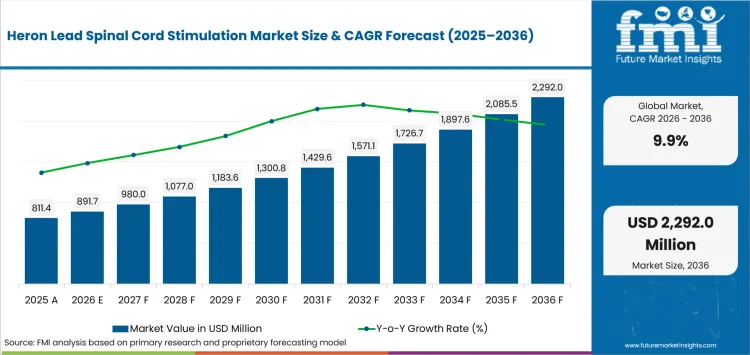
USD 891.7 million in 2026 and USD 2292.0 million by 2036 at a 9.9% CAGR.
Sales of heron lead spinal cord stimulation are estimated to rise at a 9.9% CAGR through 2036, increasing valuation from USD 891.7 million in 2026 to USD 2292.0 million by 2036. Established spinal cord stimulation devices now use expandable and minimally invasive leads allowing doctors to target electrical fields accurately without requiring open surgery. Long-term clinical research provides strong proof for such treatments offering lasting pain relief. In January 2026, Boston Scientific reported its 3-year RELIEF registry having tracked more than 500 patients. Access to such extended outcome records naturally gives physicians greater confidence to select implants and plan follow-up care for individuals suffering from chronic pain.
Medical professionals across global healthcare systems look for distinct advantages on evaluating new neuromodulation technologies. United States and Germany care teams emphasize long-term clinical evidence and dependable revision support during their lead assessments. Providers in South Korea and Japan favor compact implantation methods paired with specialist-led device programming. High patient volumes in such regions further support the adoption of advanced clinical services. In an April 2025 release, South Korea’s Ministry of Health and Welfare reported stating for 1.17 million foreign patients having received medical care during 2024. This extensive hospital capacity helps specialized medical centers educate specialists and safely introduce innovative pain management devices to patients who need them most.
Key Takeaways of Heron Lead Spinal Cord Stimulation Market
- Demand for Heron lead spinal cord stimulation is driven by pain specialists seeking directional coverage through a less invasive implantation pathway, with program decisions reflecting clinical evidence and specialist education across pain services.
- By technology, directional stimulation holds the leading share at 61.5% in 2026, backed by focused coverage across complex pain distributions.
- Expandable paddle leads are the dominant lead type segment, holding 52.1% share in 2026, led by paddle-style field coverage delivered through a less invasive route.
- Chronic pain management accounts for 32.9% application share in 2026, owing to demand for durable relief across persistent neuropathic and axial pain conditions.
- Hospitals lead end-user demand at 41.5% share in 2026, guided by imaging access and specialist teams that coordinate implant pathways and revision planning.
- South Korea, Japan, and the United States record CAGRs of 11.8%, 11.0%, and 10.1% respectively through 2036, shaped by tertiary hospital concentration, aging-related pain needs, and experienced implant teams with extensive follow-up networks.
- Competition centers on WISE S.p.A., Boston Scientific, Medtronic, Abbott, and Globus Medical, with vendors differentiating through expandable directional lead development, established stimulation portfolios, and integrated chronic-pain waveform technologies.
Analyst Perspective
Lead stability, not electrode design alone, is the quiet variable separating durable therapy from repeat procedures: radiographic migration in at least one lead across a majority of evaluated trials means expandable paddle designs earn their share only if deployment control translates into stable epidural positioning over time, not just favorable initial placement. Directional stimulation's appeal follows a similar logic, where closed-loop responsiveness data showing sustained pain reduction at three years matters more to adoption than programming flexibility on paper. Hospitals will likely keep the bulk of implant volume as long as revision planning and multidisciplinary postoperative review remain tied to institutional imaging access that ambulatory centers can't easily replicate.
-Anurag Sharma, Principal Consultant for Healthcare at Future Market Insights
Source: Future Market Insights analysis, 2026.
How is Heron Lead Spinal Cord Stimulation Market segmented?
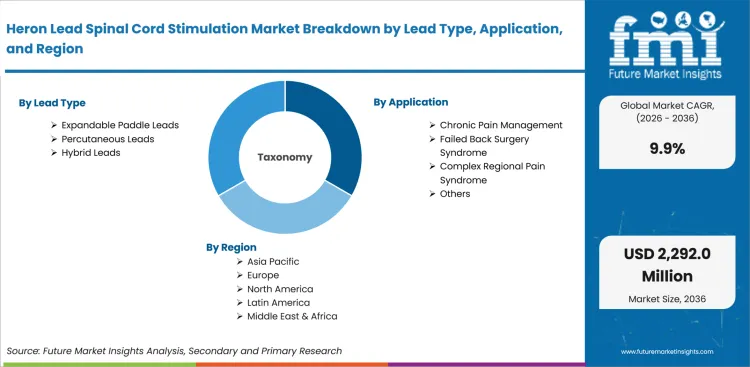
The heron lead spinal cord stimulation sector is segmented by lead type, application, end user, technology, and region.
The heron lead spinal cord stimulation industry is segmented by lead type, application, end user, technology, and region. Heron lead spinal cord stimulation coverage includes expandable paddle leads with percutaneous leads and hybrid leads across lead-type analysis. Application analysis addresses chronic pain management and failed back surgery syndrome with complex regional pain syndrome and other indications. End-user coverage spans hospitals and ambulatory surgical centers with pain clinics offering structured neuromodulation services for chronic-pain patients. Technology coverage includes directional stimulation and MRI-compatible configurations across planned implant pathways requiring sustained programming and imaging access. Regional analysis covers North America and Latin America with Western Europe and Eastern Europe across established and developing care systems. East Asia and South Asia and Pacific are assessed with Middle East and Africa across varied specialist-service conditions.
Why do expandable paddle leads shape lead-type selection?
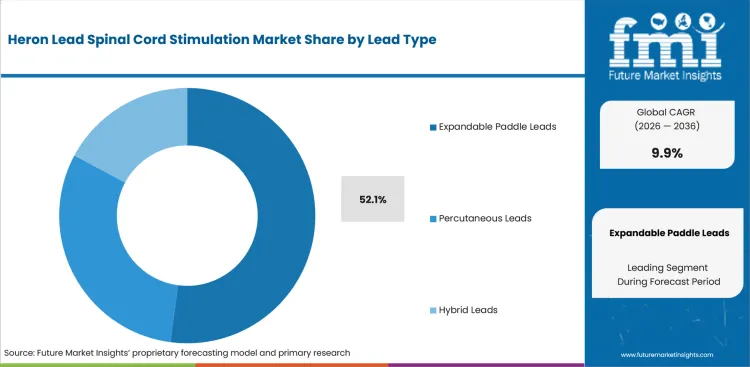
Lead stability influences therapy consistency across trial and permanent spinal cord stimulation procedures involving repeated patient movement. Mullins and colleagues reported in May 2024 significant radiographic migration in at least one lead across 62.0% of evaluated trials, reinforcing attention toward deployment control and stable epidural positioning. Expandable paddle designs seek wider contact coverage due to compact delivery profiles during planned implantation across selected epidural targets.
- Expandable paddle leads are estimated to represent 52.1% share of lead-type in 2026, led by paddle-style field coverage through a less invasive delivery route. Specialist teams assess expansion control and contact orientation across carefully selected chronic-pain cases requiring targeted dorsal-column coverage.
- Percutaneous leads and hybrid leads propel alternative implantation needs across varied anatomical conditions. Familiar handling and adaptable contact arrangements impact individualized implantable neurostimulator electrodes selection across participating pain centers.
How does chronic pain management shape application demand?
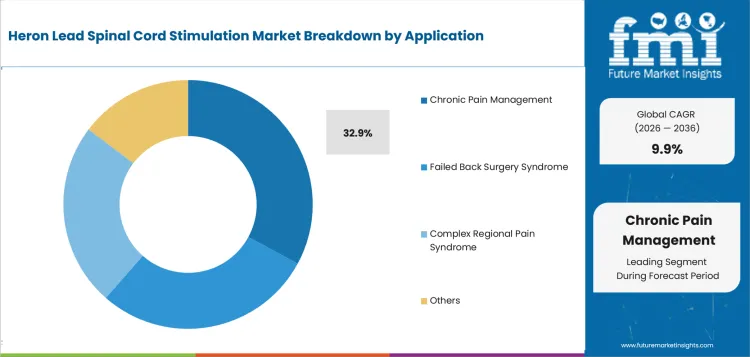
Sustained functional improvement strengthen clinical assessment across patients lacking corrective surgical options and continuing conservative-treatment responses. Persistent neuropathic and axial pain often requires durable therapy following limited response to conservative treatment. Yue and colleagues reported in June 2024 an 85.3% responder rate among nonsurgical chronic-low-back-pain patients receiving spinal cord stimulation.
- By application, chronic pain management is anticipated to secure 32.9% share in 2026 owing to demand for durable relief across persistent neuropathic and axial pain conditions. Care teams examine functional improvement and therapy sustainability across complete follow-up periods covering programming and rehabilitation needs.
- Failed back surgery syndrome and complex regional pain syndrome propel selective implantation across carefully screened patients. Other indications expand based on clinical evidence integrating pain management devices across difficult treatment pathways involving persistent neurological symptoms.
Why do hospitals lead end-user demand?
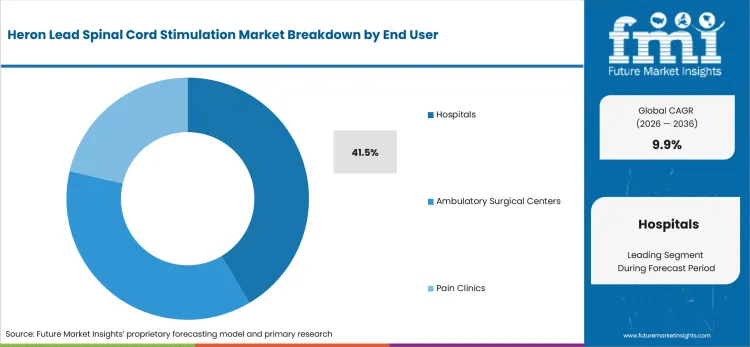
Implantation requires specialist assessment and procedural resources across multidisciplinary pain services managing complex chronic-pain referrals. White and colleagues reported in July 2024 enrollment of 58 candidates across 11 United States sites, illustrating institutional capacity supporting clinical assessment and longitudinal follow-up. Ambulatory surgical centers and pain clinics extend access led by focused services linked with established referral relationships.
- In 2026, hospitals are likely to account for 41.5% share since it is guided by imaging access and specialist teams across implant pathways. Multidisciplinary review aligns pain medicine and anesthesia services with postoperative programming and revision planning across complete treatment pathways.
- Ambulatory surgical centers and pain clinics promote selected procedures across focused neuromodulation services. Efficient scheduling and longitudinal patient relationships influence continued spinal cord stimulators use across regional referral networks.
Why does directional stimulation lead technology selection?
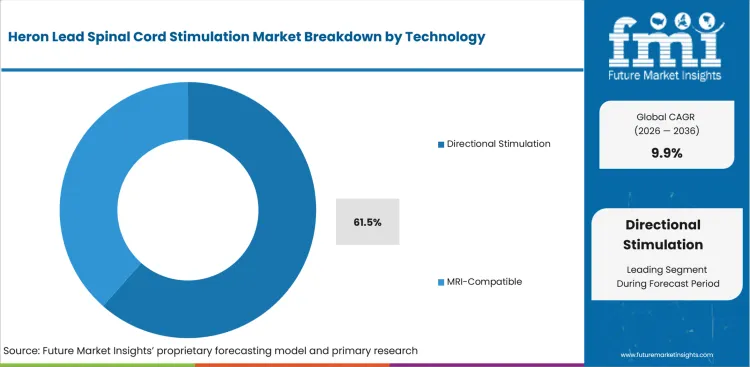
Directional field steering influences focused neural coverage across complex pain distributions requiring careful contact selection and programming. Mekhail and colleagues reported in May 2024 that 77.6% of closed-loop participants achieved at least 50.0% pain reduction at 36 months, attracting interest in responsive therapy control and measured neural activation. MRI-compatible configurations address diagnostic access needs across patients requiring continued imaging during long-term chronic-pain care.
- Directional stimulation is forecast to garner 61.5% share in 2026, backed by focused coverage across complex pain distributions. Programming teams evaluate contact combinations and energy delivery during repeated therapy adjustment across changing patient responses.
- MRI-compatible technology receive sustained consideration across patients requiring future diagnostic imaging during continuing chronic-pain care. Conditional scanning access influence MRI-safe neurostimulation systems selection across long-term pain pathways involving repeated diagnostic assessment.
What are drivers, restraints, and opportunities in Heron Lead Spinal Cord Stimulation Market?
Directional coverage and reduced implantation burden promote heron lead assessment across chronic-pain services seeking focused epidural therapy. Migration exposure and limited specialist support are likely to delay routine adoption across developing implant programs lacking structured revision pathways.
- Driver: Directional expandable leads address demand for focused dorsal-column coverage through a percutaneous implantation pathway. Expandable contact deployment is anticipated to help clinicians shape stimulation fields through a limited surgical approach.
- Restraint: Lead migration and explant exposure are likely to weaken confidence across centers lacking structured follow-up support. Uncertain revision responsibility may delay adoption across hospitals establishing new neuromodulation programs with limited specialist coverage.
- Opportunity: Sensing-led programming and MRI-compatible designs offer pathways for individualized chronic-pain therapy across patients requiring repeated adjustment. Coordinated imaging access and responsive therapy adjustments are expected to support longer treatment continuity across complex pain pathways.
Measurable pain relief supports implant consideration across patients lacking corrective surgical options and adequate responses to conservative treatment. White and colleagues reported in July 2024 a 93.5% responder rate for differential target multiplexed stimulation among nonsurgical chronic-low-back-pain patients. Comparative evidence is anticipated to strengthen physician confidence during patient counseling and therapy selection across neuromodulation devices programs.
Long-term removal exposure creates a restraint across permanent spinal cord stimulation pathways requiring sustained patient follow-up. Gatzinsky and colleagues reported in December 2025 a 38.0% cumulative explantation risk at 10 years. Implant centers require dependable revision services and clear patient communication during long-term treatment planning across permanent therapy pathways.
Responsive stimulation presents an opportunity for programming informed by measured neural activity across changing posture and movement conditions. Falcão and colleagues reported in January 2026 a pooled pain-response rate of 90.0% across closed-loop studies. Expandable directional contacts are projected to complement responsive algorithms through precise field placement and repeated therapy adjustment.
How are country CAGRs aligned in Heron Lead Spinal Cord Stimulation Market?
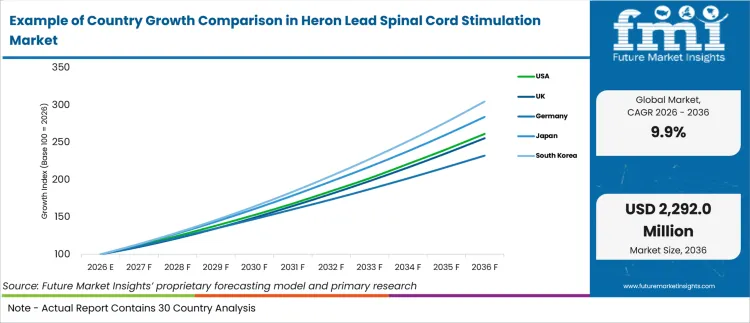
| Country or Market | CAGR |
|---|---|
| South Korea | 11.8% |
| Japan | 11.0% |
| United States | 10.1% |
| United Kingdom | 9.8% |
| Germany | 8.8% |
Source: Future Market Insights analysis, 2026.
How do country-level CAGRs compare in Heron Lead Spinal Cord Stimulation Market?
Country comparison shows a measured step-down across the five profiled nations serving distinct chronic-pain treatment systems. South Korea occupies the first position followed by Japan across care systems in East Asia implementing specialized medical technologies. The United States and United Kingdom form the middle range with established neuromodulation services and experienced specialist networks. Germany closes the comparison under evidence-led hospital assessment and structured clinical review across implanting institutions. A 3.0 percentage-point spread indicates positive expansion across all five profiled countries, with relative positions reflecting different adoption speeds across specialist pain services.
- South Korea leads the comparison due to concentrated specialist services and medical-technology assessment across tertiary hospitals.
- Japan follows through aging-related chronic-pain needs and established clinical infrastructure across referral centers serving older patient populations.
- United States forms the next position through extensive device availability and experienced neuromodulation practitioners serving diverse chronic-pain populations.
- United Kingdom records measured progress driven by specialist commissioning and organized public-care referral pathways connecting patients with implant services.
- Germany advances through structured hospital evaluation and rigorous clinical evidence requirements across implant programs serving carefully screened patients.
Countries recording similar CAGRs may present different entry conditions through reimbursement structures and specialist availability. Full report analysis covers national service capacity and clinical readiness across all profiled regions and participating countries.
Country-wise Analysis
- Ministry of Data and Statistics reported in September 2024 that residents aged 65 or older represented 19.2% of South Korea's population, reinforcing specialist pain-service demand across aging communities. Multidisciplinary teams evaluate expandable directional leads through carefully governed implantation programs. Dependable programming strengthens confidence across participating referral centers. Heron lead spinal cord stimulation market in South Korea is set to rise at 11.8% CAGR from 2026 to 2036, as concentrated tertiary hospitals support coordinated specialist education and closely monitored adoption across complex chronic-pain pathways.
- Demand in Japan is likely to expand at 11.0% CAGR during the assessment period, backed by established hospital infrastructure maintaining measured evaluation among older patients requiring sustained chronic-pain management. Statistics Bureau of Japan reported in April 2025 that 36.243 million residents were aged 65 years or older during 2024, emphasizing the scale of age-related care requirements. Specialist networks favor evidence-led product introductions across referral hospitals. Compact implantation pathways receive attention during multidisciplinary treatment planning.
- Mykyta and Weeks reported in April 2026 that 90.3% of adults had a usual healthcare source during 2024, influencing continuity across screening and postoperative management. Payer evidence propels adoption across regional care settings. Physician education guides product selection within established neuromodulation programs. The sector in the United States is estimated to record 10.1% CAGR between 2026 and 2036, guided by experienced implant teams and extensive follow-up networks continuing evaluation across academic centers and independent pain clinics.
- The market in the United Kingdom is set to progress at 9.8% CAGR over the study period, aided by specialist commissioning favoring implantation methods intended to reduce procedural burden across capacity-constrained pain services. NHS England reported in July 2025 a waiting list of 7.36 million treatment pathways, highlighting pressure across planned-care services. Regional teams assess clinical evidence beside pathway efficiency during technology reviews. Organized referrals support measured access across participating pain centers.
- Sales in Germany are set to grow at 8.8% CAGR during the assessment period, with evidence-led hospital committees requiring clear migration records and dependable revision support prior to wider clinical use. Eurostat reported in July 2026 that Germany had 759 hospital beds per 100,000 people during 2024, indicating substantial inpatient infrastructure for specialist procedures and follow-up. Structured evaluation promotes careful product introduction across implanting hospitals. Local technical support influences continued use across established pain programs.
Who are notable companies in Heron Lead Spinal Cord Stimulation Market?
WISE S.p.A., Boston Scientific Corporation, Medtronic plc, Abbott, and Globus Medical, Inc. are the prominent companies influencing this market.
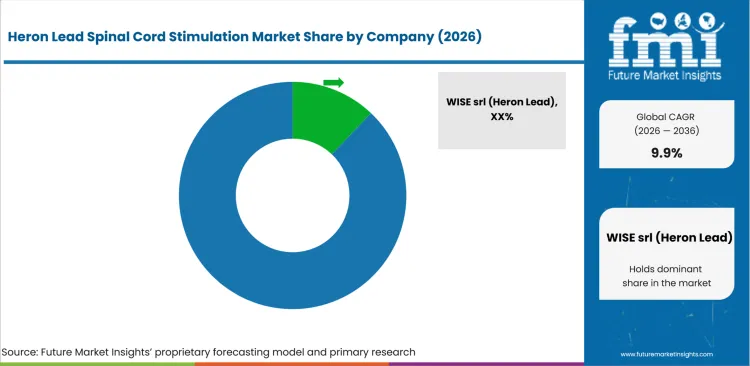
The competitive outlook combines expandable-lead developers with established neuromodulation companies promoting implantation and long-term programming across specialist pain services. Lead manufacturers compete based on deployment control and contact coverage across varied spinal anatomies. Stimulation-platform companies compete driven by waveform options and MRI-conditional access across established treatment pathways. Hospital-facing suppliers compete due to clinician education and revision support across several implanting centers. Spinal cord stimulation analysis provides a useful comparison for service responsibility and outcome documentation within chronic-pain programs. Commercial success depends on clear ownership of programming and follow-up since one unresolved service issue is likely to weaken confidence created by a successful implant.
- WISE S.p.A. draws specialist assessment led by Heron's percutaneous expandable paddle architecture. Pain teams examine deployment control and directional coverage across carefully governed clinical programs.
- Boston Scientific Corporation and Medtronic plc compete based on established spinal cord stimulation portfolios. Hospital services compare waveform flexibility and clinician support across complete chronic-pain pathways.
- Abbott receives review through BurstDR therapy and MRI-conditional system configurations. Clinical programs assess programming options and continuing patient support during structured product evaluations.
- Globus Medical, Inc. extends participation depending on Nevro high-frequency stimulation technologies. Commercial teams combine chronic-pain expertise with established musculoskeletal relationships across implanting institutions.
Competitive Benchmarking: Heron Lead Spinal Cord Stimulation Market
| Company | Portfolio Depth | Clinical Match | Service Support | Service Reach |
|---|---|---|---|---|
| WISE S.p.A. | Medium | High | Medium | Europe and selected development sites |
| Boston Scientific Corporation | High | High | High | North America and selected global markets |
| Medtronic plc | High | High | High | Global |
| Abbott | High | High | High | Global |
| Globus Medical, Inc. | High | High | High | North America and selected global markets |
Source: Future Market Insights competitive analysis, 2026.
Key Developments in Heron Lead Spinal Cord Stimulation Market
- In March 2025, Medtronic announced Canadian availability of its Inceptiv closed-loop rechargeable spinal cord stimulation system. Automatic sensing and near-real-time therapy adjustment expanded access to responsive chronic-pain treatment across Canadian implant programs.
- In April 2025, Globus Medical completed its acquisition of Nevro and established the company as a wholly owned subsidiary. Integration added high-frequency spinal cord stimulation technologies to Globus Medical’s chronic-pain portfolio and existing musculoskeletal operations.
- In December 2025, the USA Food and Drug Administration approved revised MRI conditions for Boston Scientific’s WaveWriter Alpha spinal cord stimulation mixed systems using compatible Medtronic Specify SureScan leads. Updated labeling expanded MRI-eligible lead compatibility and strengthened system planning across implanted chronic-pain patients.
Key Players in Heron Lead Spinal Cord Stimulation Market
Expandable directional lead developer
- WISE S.p.A.
Established spinal cord stimulation companies
- Boston Scientific Corporation
- Medtronic plc
- Abbott
Integrated musculoskeletal and neuromodulation company
- Globus Medical, Inc.
Heron Lead Spinal Cord Stimulation Market Report Scope
| Coverage field | Report scope |
|---|---|
| Market breakdown | Heron Lead Spinal Cord Stimulation Market breakdown by lead type, application, end user, technology, and region |
| Market Definition | Heron lead spinal cord stimulation includes expandable directional leads and associated therapy support across chronic-pain neuromodulation pathways. |
| Regions Covered | North America, Latin America, Western Europe, Eastern Europe, East Asia, South Asia and Pacific, and Middle East and Africa |
| Countries Covered | USA, UK, Germany, Japan, and South Korea |
| Key Companies Profiled | WISE S.p.A., Boston Scientific Corporation, Medtronic plc, Abbott, and Globus Medical, Inc. |
| Forecast Period | 2026 to 2036 |
| Approach | Hybrid bottom-up and top-down assessment using segment shares and country CAGRs with clinical evidence and company participation |
Source: Future Market Insights analysis, 2026.
Heron Lead Spinal Cord Stimulation Market - Research Methodology
| Method | Approach |
|---|---|
| Primary Research | FMI analysts gathered input from manufacturers, service providers, technology developers, distributors, end users, sourcing teams, and subject-matter experts. Interviews examined purchasing decisions, product or service evaluation, adoption barriers, approval requirements, pricing considerations, and expectations for technical or commercial support. Respondents were also asked what evidence is required before a trial, pilot, or initial order develops into regular purchasing. |
| Desk Research | Desk research covered government statistics, regulatory publications, trade data, industry associations, technical literature, standards, company filings, product information, and official corporate announcements. Sources were reviewed for relevance, publication date, geographic coverage, and consistency with the defined market scope. Claims relating to performance, applications, approvals, capacity, investment, and commercial activity were retained only when supported by credible public evidence. |
| Market Sizing and Forecasting | The market model combined the baseline value with historical performance, segment structure, pricing and volume indicators, adoption levels, company participation, and country-level demand conditions. Forecast assumptions considered economic activity, investment trends, regulatory developments, technology adoption, purchasing cycles, supply availability, and barriers to wider market use. Segment and regional estimates were reconciled before the final market total was calculated. |
| Data Validation | Estimates were checked against multiple independent indicators, including public data, company activity, trade patterns, industry developments, and findings from primary interviews. Validation also tested whether products, services, applications, and company revenues fell within the defined market boundaries. Adjacent categories, unsupported claims, overlapping revenues, and activities without direct market relevance were excluded to reduce double counting and maintain consistency across segments and countries. |
Source: Future Market Insights analysis, 2026.
Heron Lead Spinal Cord Stimulation Market by Segments
Heron Lead Spinal Cord Stimulation Market segmented by Lead Type:
- Expandable Paddle Leads
- Percutaneous Leads
- Hybrid Leads
Heron Lead Spinal Cord Stimulation Market segmented by Application:
- Chronic Pain Management
- Failed Back Surgery Syndrome
- Complex Regional Pain Syndrome
- Others
Heron Lead Spinal Cord Stimulation Market segmented by End User:
- Hospitals
- Ambulatory Surgical Centers
- Pain Clinics
Heron Lead Spinal Cord Stimulation Market segmented by Technology:
- Directional Stimulation
- MRI-Compatible
Heron Lead Spinal Cord Stimulation Market segmented by Region:
- North America
- United States
- Canada
- Latin America
- Brazil
- Mexico
- Argentina
- Chile
- Western Europe
- Germany
- France
- United Kingdom
- Italy
- Spain
- Benelux
- Nordics
- Eastern Europe
- Poland
- Czech Republic
- Romania
- Hungary
- East Asia
- China
- Japan
- South Korea
- South Asia and Pacific
- India
- ASEAN
- Australia and New Zealand
- Middle East and Africa
- GCC Countries
- South Africa
- Türkiye
- Israel
Research Sources and Bibliography
- Abbott. (2026, January 23). Five-year data shows Abbott neuromodulation systems reduce healthcare visits related to pain and deliver sustained relief.
- Boston Scientific Corporation. (2026, January 20). Boston Scientific to present multiple long-term data outcomes at the 2026 North American Neuromodulation Society meeting.
- Eurostat. (2026, July 13). EU hospital bed count at 507 per 100,000 people.
- Falcão, L., Arruda, G., Goyal, A., Sampaio Silva, R. A., Donato, K. O., Cardoso, M. C. N., Ribeiro, T. C., Nishizima, A., Ahmed, A., Pereira da Silva, A. M., Gonçalves, O. R., & de Monaco, B. A. (2026, January 24). Closed-loop spinal cord stimulation for chronic pain: A systematic review and meta-analysis. Neuromodulation. Advance online publication.
- Gatzinsky, K., Brink, B., Eyglóardóttir, K. L., & Hallén, T. (2025, December 5). Long-term explantation risk in patients with chronic pain treated with spinal cord or dorsal root ganglion stimulation. Regional Anesthesia and Pain Medicine, 50(12), 923-929.
- Globus Medical, Inc. (2025, April 3). Globus Medical completes acquisition of Nevro Corp.
- Ministry of Data and Statistics. (2024, September 26). 2024 statistics on the aged.
- Medtronic Canada. (2025, March 27). Medtronic at the forefront of new era for spinal cord stimulation technology.
- Mekhail, N. A., Levy, R. M., Deer, T. R., Kapural, L., Li, S., Amirdelfan, K., Pope, J. E., Hunter, C. W., Rosen, S. M., Costandi, S. J., Falowski, S. M., Burgher, A. H., Gilmore, C. A., Qureshi, F. A., & Staats, P. S. (2024, May 7). ECAP-controlled closed-loop versus open-loop SCS for the treatment of chronic pain: 36-month results of the EVOKE blinded randomized clinical trial. Regional Anesthesia and Pain Medicine, 49(5), 346-354.
- Ministry of Health and Welfare. (2025, April 3). Korea attracts 1.17 million foreign patients in 2024.
- Mullins, C. F., Royds, J., & Al-Kaisy, A. (2024, May 7). Radiographic lead migration in percutaneous spinal cord stimulator trials. Regional Anesthesia and Pain Medicine, 49(5), 332-338.
- Mykyta, L., & Weeks, J. D. (2026, April). Source of usual health care for adults age 18 and older: United States, 2024. NCHS Data Brief, 558, 1-11.
- NHS England. (2025, July 10). NHS delivers record numbers of treatments as waiting list drops to 26-month low.
- Statistics Bureau of Japan. (2025, April 14). Current population estimates as of October 1, 2024.
- White, T., Justiz, R., Almonte, W., Micovic, V., Shah, B., Anderson, E., Kapural, L., Cordner, H., El-Naggar, A., Fishman, M., Eshraghi, Y., Kim, P., Abd-Elsayed, A., Chakravarthy, K., Millet, Y., Sanapati, M., Harrison, N., Goff, B., Gupta, M., et al. (2024, July 17). Twelve-month results from a randomized controlled trial comparing differential target multiplexed spinal cord stimulation and conventional spinal cord stimulation in subjects with chronic refractory axial low back pain not eligible for spine surgery. North American Spine Society Journal, 19, 100528.
- White, T., Justiz, R., Fishman, M., Schultz, D., Calodney, A., Cordner, H., Almonte, W., Millet, Y., Wu, K., Gekht, G., Will, A., Kim, P., Bundschu, R., Sirianni, J., El-Naggar, A., Gupta, M., Park, W., Cedeño, D. L., & Vallejo, R. (2024, July 25). Differential target multiplexed spinal cord stimulation for the treatment of chronic intractable upper limb pain: 12-month results from a prospective multicenter study. Neuromodulation, 27(8), 1441-1448.
- USA Food and Drug Administration. (2025, December 18). Premarket approval: WaveWriter Alpha spinal cord stimulator mixed systems and M8 adaptor (P030017/S374).
- Yue, J. J., Gilligan, C. J., Falowski, S., Jameson, J., Desai, M. J., Moeschler, S., Pilitsis, J., Heros, R., Tavel, E., Wahezi, S., Funk, R., Buchanan, P., Christopher, A., Weisbein, J., Patterson, D., Levy, R., Antony, A., Miller, N., Scarfo, K., et al. (2024, June 21). Surgical treatment of refractory low back pain using implanted BurstDR spinal cord stimulation in patients without options for corrective surgery: Findings from the DISTINCT study. North American Spine Society Journal, 19, 100508.
This bibliography is provided for reader reference and is not exhaustive. The full report contains the complete reference list and detailed citations.
This Report Answers
- What segments influence demand across lead type and application with end user and technology?
- How do pain specialists evaluate heron lead spinal cord stimulation prior to routine clinical use?
- How do country CAGRs differ across profiled nations with distinct specialist capacity and service access?
- What companies compete through lead design and clinical evidence with dependable regional support?
- How are forecasts validated through hybrid bottom-up and top-down assessment using independent indicators?
- What evidence do hospital committees examine prior to expanded implantation across pain services?
- How do lead stability and directional coverage influence product selection across neuromodulation programs?
- What limits commercial value for hospitals adding heron lead spinal cord stimulation pathways?
- How do education records and specialist guidance influence approval across multidisciplinary clinical teams?
- What company capabilities improve long-term confidence and continuing therapy utilization across implant centers?
Frequently Asked Questions
How big is the Heron Lead Spinal Cord Stimulation Market in 2026?
The Heron lead spinal cord stimulation market is valued at USD 891.7 million in 2026 and is forecast to reach USD 2292.0 million by 2036. Growth reflects expandable and minimally invasive leads letting doctors target electrical fields accurately without requiring open surgery for chronic pain patients.
What is the CAGR of the Heron Lead Spinal Cord Stimulation Market from 2026 to 2036?
The Heron lead spinal cord stimulation market grows at a CAGR of 9.9% between 2026 and 2036, supported by directional expandable leads that address demand for focused dorsal-column coverage through a percutaneous implantation pathway.
Which technology leads the Heron Lead Spinal Cord Stimulation Market?
Directional stimulation accounts for 61.5% of the Heron lead spinal cord stimulation market by technology in 2026, backed by focused coverage across complex pain distributions that programming teams evaluate through contact combinations and repeated therapy adjustment.
How much will the Heron Lead Spinal Cord Stimulation Market add between 2026 and 2036?
The Heron lead spinal cord stimulation market is set to add USD 1400.3 million between 2026 and 2036, growing from USD 891.7 million to USD 2292.0 million as directional expandable leads extend across a widening base of hospital chronic-pain treatment pathways.
Who are the leading companies in the Heron Lead Spinal Cord Stimulation Market?
Five companies lead the Heron lead spinal cord stimulation market, including WISE S.p.A., Boston Scientific Corporation, Medtronic plc, Abbott, and Globus Medical, competing through lead design, therapy programming, and clinician education across chronic-pain implant centers.
Preview the report firsthand - request a free sample
Get SampleGet the brochure for pricing and purchase details.
Get PDFTable of Content
- Key Takeaways
- Market Size and CAGR
- Top Growth Driver
- Fastest Growing Segment
- Leading Region
- Key Companies
- Emerging Opportunities
- Executive Summary
- Global Market Outlook
- Demand-side Trends
- Supply-side Trends
- Technology Roadmap Analysis
- Analysis and Recommendations
- Analyst Perspective (What is happening? Why now? What should investors know?)
- Key Questions Answered
- How large is the market?
- What is the CAGR?
- What are key trends?
- Which region dominates?
- Who are the leaders?
- Market Overview
- Market Coverage / Taxonomy
- Market Definition / Scope / Limitations
- Research Methodology
- Chapter Orientation
- Analytical Lens and Working Hypotheses
- Market Structure, Signals, and Trend Drivers
- Benchmarking and Cross-market Comparability
- Market Sizing, Forecasting, and Opportunity Mapping
- Research Design and Evidence Framework
- Desk Research Programme (Secondary Evidence)
- Expert Input and Fieldwork (Primary Evidence)
- Tooling, Models, and Reference Databases
- Data Engineering and Model Build
- Quality Assurance and Audit Trail
- Market Background
- Market Dynamics (Drivers, Restraints, Opportunity, Trends)
- Scenario Forecast (Optimistic, Likely, Conservative)
- Impact Analysis
- AI Impact
- Sustainability Impact
- Regulatory Impact
- Technology Impact
- Consumer / Buyer Analysis
- Purchase Drivers
- Adoption Barriers
- Buyer Journey
- Opportunity Map Analysis
- Product Life Cycle Analysis
- Supply Chain Analysis
- Investment Feasibility Matrix
- Value Chain Analysis
- PESTLE and Porter's Analysis
- Regulatory Landscape
- Regional Parent Market Outlook
- Production and Consumption Statistics
- Import and Export Statistics
- Global Market Analysis and Forecast, 2021 to 2036
- Historical Market Size Value (USD Million) Analysis, 2021 to 2025
- Current and Future Market Size Value (USD Million) Projections, 2026 to 2036
- Y-o-Y Growth Trend Analysis
- Absolute $ Opportunity Analysis
- Global Market Pricing Analysis, 2021 to 2036
- Global Market Analysis and Forecast, By Lead Type, 2021 to 2036
- Introduction / Key Findings
- Historical Market Size Value (USD Million) Analysis By Lead Type, 2021 to 2025
- Current and Future Market Size Value (USD Million) Analysis and Forecast By Lead Type, 2026 to 2036
- Expandable Paddle Leads
- Percutaneous Leads
- Hybrid Leads
- Expandable Paddle Leads
- Y-o-Y Growth Trend Analysis By Lead Type, 2021 to 2025
- Absolute $ Opportunity Analysis By Lead Type, 2026 to 2036
- Global Market Analysis and Forecast, By Application, 2021 to 2036
- Introduction / Key Findings
- Historical Market Size Value (USD Million) Analysis By Application, 2021 to 2025
- Current and Future Market Size Value (USD Million) Analysis and Forecast By Application, 2026 to 2036
- Chronic Pain Management
- Failed Back Surgery Syndrome
- Complex Regional Pain Syndrome
- Others
- Chronic Pain Management
- Y-o-Y Growth Trend Analysis By Application, 2021 to 2025
- Absolute $ Opportunity Analysis By Application, 2026 to 2036
- Global Market Analysis and Forecast, By End User, 2021 to 2036
- Introduction / Key Findings
- Historical Market Size Value (USD Million) Analysis By End User, 2021 to 2025
- Current and Future Market Size Value (USD Million) Analysis and Forecast By End User, 2026 to 2036
- Hospitals
- Ambulatory Surgical Centers
- Pain Clinics
- Hospitals
- Y-o-Y Growth Trend Analysis By End User, 2021 to 2025
- Absolute $ Opportunity Analysis By End User, 2026 to 2036
- Global Market Analysis and Forecast, By Technology, 2021 to 2036
- Introduction / Key Findings
- Historical Market Size Value (USD Million) Analysis By Technology, 2021 to 2025
- Current and Future Market Size Value (USD Million) Analysis and Forecast By Technology, 2026 to 2036
- Directional Stimulation
- MRI-Compatible
- Directional Stimulation
- Y-o-Y Growth Trend Analysis By Technology, 2021 to 2025
- Absolute $ Opportunity Analysis By Technology, 2026 to 2036
- Global Market Analysis and Forecast, By Region, 2021 to 2036
- Introduction
- Historical Market Size Value (USD Million) Analysis By Region, 2021 to 2025
- Current Market Size Value (USD Million) Analysis and Forecast By Region, 2026 to 2036
- North America
- Latin America
- Western Europe
- Eastern Europe
- East Asia
- South Asia and Pacific
- Middle East & Africa
- Market Attractiveness Analysis By Region
- North America Market Analysis and Forecast, By Country, 2021 to 2036
- Historical Market Size Value (USD Million) Trend Analysis By Market Taxonomy, 2021 to 2025
- Market Size Value (USD Million) Forecast By Market Taxonomy, 2026 to 2036
- By Country
- USA
- Canada
- By Lead Type
- By Application
- By End User
- By Technology
- By Country
- Market Attractiveness Analysis
- By Country
- By Lead Type
- By Application
- By End User
- By Technology
- Key Takeaways
- Latin America Market Analysis and Forecast, By Country
- Historical Market Size Value (USD Million) Trend Analysis By Market Taxonomy, 2021 to 2025
- Market Size Value (USD Million) Forecast By Market Taxonomy, 2026 to 2036
- By Country
- Brazil
- Mexico
- Chile
- Rest of Latin America
- By Lead Type
- By Application
- By End User
- By Technology
- By Country
- Market Attractiveness Analysis
- By Country
- By Lead Type
- By Application
- By End User
- By Technology
- Key Takeaways
- Western Europe Market Analysis and Forecast, By Country
- Historical Market Size Value (USD Million) Trend Analysis By Market Taxonomy, 2021 to 2025
- Market Size Value (USD Million) Forecast By Market Taxonomy, 2026 to 2036
- By Country
- Germany
- UK
- Italy
- Spain
- France
- Nordic
- BENELUX
- Rest of Western Europe
- By Lead Type
- By Application
- By End User
- By Technology
- By Country
- Market Attractiveness Analysis
- By Country
- By Lead Type
- By Application
- By End User
- By Technology
- Key Takeaways
- Eastern Europe Market Analysis and Forecast, By Country
- Historical Market Size Value (USD Million) Trend Analysis By Market Taxonomy, 2021 to 2025
- Market Size Value (USD Million) Forecast By Market Taxonomy, 2026 to 2036
- By Country
- Russia
- Poland
- Hungary
- Balkan & Baltic
- Rest of Eastern Europe
- By Lead Type
- By Application
- By End User
- By Technology
- By Country
- Market Attractiveness Analysis
- By Country
- By Lead Type
- By Application
- By End User
- By Technology
- Key Takeaways
- East Asia Market Analysis and Forecast, By Country
- Historical Market Size Value (USD Million) Trend Analysis By Market Taxonomy, 2021 to 2025
- Market Size Value (USD Million) Forecast By Market Taxonomy, 2026 to 2036
- By Country
- China
- Japan
- South Korea
- By Lead Type
- By Application
- By End User
- By Technology
- By Country
- Market Attractiveness Analysis
- By Country
- By Lead Type
- By Application
- By End User
- By Technology
- Key Takeaways
- South Asia and Pacific Market Analysis and Forecast, By Country
- Historical Market Size Value (USD Million) Trend Analysis By Market Taxonomy, 2021 to 2025
- Market Size Value (USD Million) Forecast By Market Taxonomy, 2026 to 2036
- By Country
- India
- ASEAN
- Australia & New Zealand
- Rest of South Asia and Pacific
- By Lead Type
- By Application
- By End User
- By Technology
- By Country
- Market Attractiveness Analysis
- By Country
- By Lead Type
- By Application
- By End User
- By Technology
- Key Takeaways
- Middle East & Africa Market Analysis and Forecast, By Country
- Historical Market Size Value (USD Million) Trend Analysis By Market Taxonomy, 2021 to 2025
- Market Size Value (USD Million) Forecast By Market Taxonomy, 2026 to 2036
- By Country
- Kingdom of Saudi Arabia
- Other GCC Countries
- Türkiye
- South Africa
- Other African Union
- Rest of Middle East & Africa
- By Lead Type
- By Application
- By End User
- By Technology
- By Country
- Market Attractiveness Analysis
- By Country
- By Lead Type
- By Application
- By End User
- By Technology
- Key Takeaways
- Key Countries Market Analysis
- USA
- Pricing Analysis
- Market Share Analysis, 2025
- By Lead Type
- By Application
- By End User
- By Technology
- Canada
- Pricing Analysis
- Market Share Analysis, 2025
- By Lead Type
- By Application
- By End User
- By Technology
- Mexico
- Pricing Analysis
- Market Share Analysis, 2025
- By Lead Type
- By Application
- By End User
- By Technology
- Brazil
- Pricing Analysis
- Market Share Analysis, 2025
- By Lead Type
- By Application
- By End User
- By Technology
- Chile
- Pricing Analysis
- Market Share Analysis, 2025
- By Lead Type
- By Application
- By End User
- By Technology
- Germany
- Pricing Analysis
- Market Share Analysis, 2025
- By Lead Type
- By Application
- By End User
- By Technology
- UK
- Pricing Analysis
- Market Share Analysis, 2025
- By Lead Type
- By Application
- By End User
- By Technology
- Italy
- Pricing Analysis
- Market Share Analysis, 2025
- By Lead Type
- By Application
- By End User
- By Technology
- Spain
- Pricing Analysis
- Market Share Analysis, 2025
- By Lead Type
- By Application
- By End User
- By Technology
- France
- Pricing Analysis
- Market Share Analysis, 2025
- By Lead Type
- By Application
- By End User
- By Technology
- India
- Pricing Analysis
- Market Share Analysis, 2025
- By Lead Type
- By Application
- By End User
- By Technology
- ASEAN
- Pricing Analysis
- Market Share Analysis, 2025
- By Lead Type
- By Application
- By End User
- By Technology
- Australia & New Zealand
- Pricing Analysis
- Market Share Analysis, 2025
- By Lead Type
- By Application
- By End User
- By Technology
- China
- Pricing Analysis
- Market Share Analysis, 2025
- By Lead Type
- By Application
- By End User
- By Technology
- Japan
- Pricing Analysis
- Market Share Analysis, 2025
- By Lead Type
- By Application
- By End User
- By Technology
- South Korea
- Pricing Analysis
- Market Share Analysis, 2025
- By Lead Type
- By Application
- By End User
- By Technology
- Russia
- Pricing Analysis
- Market Share Analysis, 2025
- By Lead Type
- By Application
- By End User
- By Technology
- Poland
- Pricing Analysis
- Market Share Analysis, 2025
- By Lead Type
- By Application
- By End User
- By Technology
- Hungary
- Pricing Analysis
- Market Share Analysis, 2025
- By Lead Type
- By Application
- By End User
- By Technology
- Kingdom of Saudi Arabia
- Pricing Analysis
- Market Share Analysis, 2025
- By Lead Type
- By Application
- By End User
- By Technology
- Türkiye
- Pricing Analysis
- Market Share Analysis, 2025
- By Lead Type
- By Application
- By End User
- By Technology
- South Africa
- Pricing Analysis
- Market Share Analysis, 2025
- By Lead Type
- By Application
- By End User
- By Technology
- USA
- Market Structure Analysis
- Competition Dashboard
- Competition Benchmarking
- Market Share Analysis of Top Players
- By Regional
- By Lead Type
- By Application
- By End User
- By Technology
- Emerging Startups
- Innovation Benchmarking
- Competition Analysis
- Competition Deep Dive
- WISE srl (Heron Lead)
- Overview
- Product Portfolio
- Profitability by Market Segments
- Sales Footprint
- Strategy Overview
- Marketing Strategy
- Product Strategy
- Channel Strategy
- Boston Scientific
- Medtronic
- Abbott
- Nevro
- WISE srl (Heron Lead)
- Case Studies
- Success Stories
- Recent Developments
- Competition Deep Dive
- Assumptions & Acronyms Used


