

- Market Size (2026)
- USD 478.4 Mn
- Forecast (2036)
- USD 1539.7 Mn
- CAGR (2026 to 2036)
- 12.4%
How big is the high pressure processing equipment market in 2026?
The high pressure processing equipment market is estimated at USD 478.4 million in 2026, compared with USD 425.6 million in 2025. Sales are forecast to reach USD 1,539.7 million in 2036, growing at a 12.4% CAGR from 2026 to 2036.
High-pressure processing equipment needs to be selected around the food and treatment outcome a producer intends to validate, with vessel volume describing only part of usable throughput. Loading, cycle time and packaging affect how much saleable product can move through a batch, while the food matrix influences microbial response and retained quality. Fruits and vegetables lead the 2026 application mix and systems above 300 liters lead the capacity classification, encompassing products that still require separate treatment schedules. Spore response can remain a limitation, making product-specific evidence necessary for the shelf-life objective. Shared institutional facilities offer access for development before ownership, while larger installations need enough recurring volume to justify their utilisation. Through 2036, process-development support and workable batch handling will influence purchasing decisions alongside pressure capability, with equipment performance and regulatory acceptance assessed as related parts of the complete production plan.
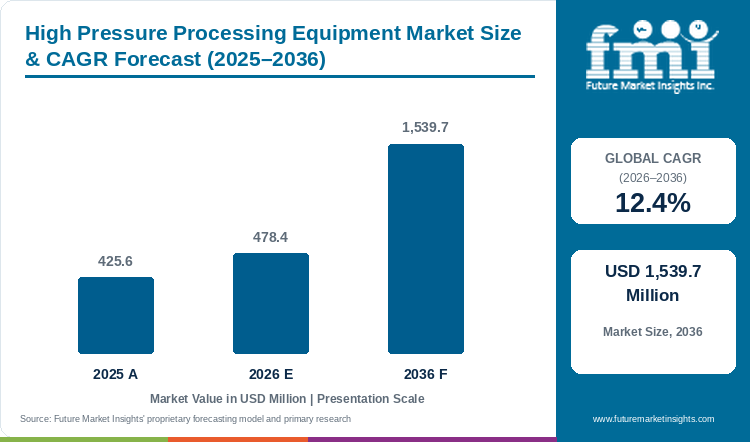
Key Market Trends & Insights
- The Fruits & Vegetables segment is projected to account for 28.0% of application demand in 2026.
- The Above 300 Liters segment is projected to account for 72.0% of product type demand in 2026.
- Horizontal is projected to account for 81.0% of vessel arrangement demand in 2026.
- Industrial Scale Systems is projected to account for 86.0% of deployment demand in 2026.
Regional Highlights
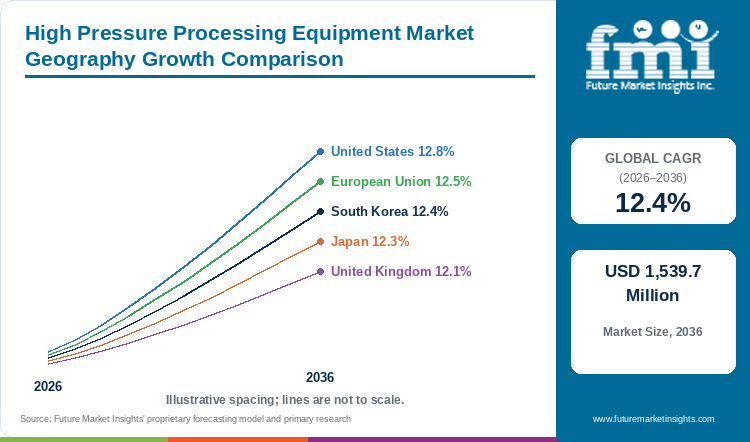
- United States records the highest profiled forecast at 12.8% CAGR from 2026 to 2036.
- United Kingdom is forecast at 12.1% CAGR over the same period. Country and combined-market rates are analyst estimates.
Market Size & Forecast
Table 1: Market Size and Forecast for High Pressure Processing Equipment Market, 2026 to 2036
| Metric | Value |
|---|---|
| 2025 market value | USD 425.6 million |
| 2026 market estimate | USD 478.4 million |
| 2036 market forecast | USD 1,539.7 million |
| CAGR, 2026 to 2036 | 12.4% |
Purchasing Evidence and Operating Requirements
Table 2: Purchasing Evidence and Operating Requirements
| Source | Date | Evidence | Coverage |
|---|---|---|---|
| University of Hawaiʻi | 2025-06-05 | Existing facility and announced training | Facility status June 2025; events planned July 2025.[1] |
| Oklahoma State University | 2026-01-15 | Funded facility modernisation announcement | Funding secured 2025; installation expected June 2026.[2] |
| Oregon State University | 2025 | Laboratory process validation | Experimental work reported in 2025.[3] |
| Cornell University | 2025-12 | Product and consumer research | Dissertation issued December 2025.[4] |
Analyst Perspective
Useful HPP output depends on food-specific validation and the batch sequence, with packaging and handling affecting how much saleable product the vessel can process. Establishing those requirements before selecting capacity gives the producer a practical basis for comparing equipment, service support and the volume needed to sustain utilisation.
- Nikhil Kaitwade, Principal Analyst at Future Market Insights
How is the high pressure processing equipment market segmented?
By application, the categories are Fruits & Vegetables, Juice & Beverages, Meat, Sea Food, Other. By product type, the categories are Above 300 Liters, Below 100 Liters, 100 Litres-300 Liters. By vessel arrangement, the categories are Horizontal, Vertical. By deployment, the categories are Industrial Scale Systems, Pilot Scale Systems, Laboratory Scale Systems. By technology, the categories are Cold Pasteurization Technology, Pressure Generation Technology, Automation Technology, Packaging Technology.
Why does the Fruits & Vegetables segment account for 28.0% of application demand in 2026?
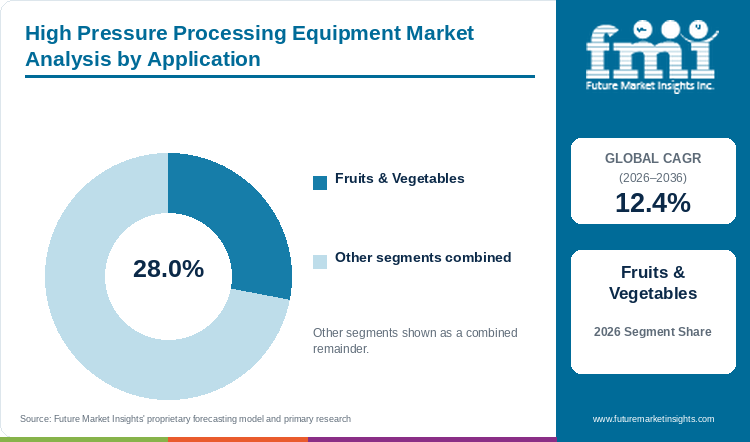
Fruits & Vegetables contribute 28.0% of application demand in 2026, spanning foods whose acidity, texture and packaging require separate treatment and product-quality assessments.
Table 3: Application Share for High Pressure Processing Equipment Market, 2026
| Application | Share (2026) |
|---|---|
| Fruits & Vegetables | 28.0% |
| Other application segments | 72.0% |
| Total | 100.0% |
Cornell's acidified-vegetable work identifies packaging presentation as an unresolved commercial issue, showing that a food's successful treatment does not settle every question involved in selling the processed product.[4] Fruits & Vegetables also vary in acidity and texture, leaving validation to follow the actual food and shelf-life objective. Walk-in coolers and freezers need storage conditions coordinated with that validated HPP process, so the equipment purchase belongs within a production and cold-chain plan that preserves the intended outcome after the pressure cycle ends.
- The Fruits & Vegetables segment accounts for 28.0% of application demand in 2026.
- Fruit and vegetable recipes need matrix-specific validation.
Why does the Above 300 Liters segment account for 72.0% of product type demand in 2026?
Above 300 Liters equipment represents 72.0% of product type demand in 2026, providing larger batch volumes whose usable output follows loading, cycle handling and the packaging being processed.
Table 4: Product Type Share for High Pressure Processing Equipment Market, 2026
| Product Type | Share (2026) |
|---|---|
| Above 300 Liters | 72.0% |
| Other product type segments | 28.0% |
| Total | 100.0% |
A larger vessel can increase batch volume while leaving the line waiting for sufficient incoming product, making utilisation a central question in the Above 300 Liters category. Basket loading and the time spent moving product through the complete sequence determine the saleable output per hour, so representative packaging needs to enter the equipment trial. An industrial buyer can then compare capacity with the recurring volume it expects to supply, allowing ownership costs and handling arrangements to be assessed before a nominal vessel size drives the investment.
- The Above 300 Liters segment accounts for 72.0% of product type demand in 2026.
- Vessel volume must be translated into a practical batch schedule.
What are the drivers, restraints, and opportunities in the high pressure processing equipment market?
Driver: Process validation creates equipment and access demand
The University of Hawaiʻi's operating institutional facility and planned producer workshops in 2025 provide an identified route for HPP trials before larger investment.[1] Measurement equipment supports that development by checking product outcomes and process conditions, helping producers define the evidence needed for a suitable treatment and production arrangement.
Restraint: Food-specific limits constrain broad performance claims
Oregon State's milk study found different responses from the tested vegetative pathogens and spores under its reported treatment conditions.[3] Product-specific validation therefore remains necessary, with process instrumentation helping repeat those conditions while the actual microbial outcome is established for the food and shelf-life objective the producer intends to achieve.
Opportunity: Shared facilities can support smaller producers
Institutional centres allow producers to evaluate products before owning an industrial installation, while Oklahoma State's 2026 announcement placed HPP within a wider modernization programme.[1][2] The actual equipment scope needs identification within that budget, including refrigeration compressors where supporting thermal infrastructure is required for the process and storage arrangement.
Which country and market growth rates are profiled?
Table 5: Country CAGR Comparison for High Pressure Processing Equipment Market, 2026 to 2036
| Country | CAGR |
|---|---|
| United States | 12.8% |
| European Union | 12.5% |
| South Korea | 12.4% |
| Japan | 12.3% |
| United Kingdom | 12.1% |
Growth rates in the table are FMI analyst forecasts.
Country-wise Analysis
United States
Hawaiʻi's operating institutional facility offers trial access, while Oklahoma State's modernisation announcement described installations still expected at publication, placing the two United States records at different stages of equipment availability.[1][2] Producers can use shared access to investigate a process before deciding whether recurring volume justifies ownership. The 12.8% CAGR forecast for 2026 to 2036 includes both development access and industrial purchases, with the commercial requirement changing when a food moves from a demonstration into a sustained production schedule.
European Union
One food matrix can respond differently from another under pressure, leaving European Union processors to establish treatment and packaging for the actual product they intend to market. Process-development support helps connect machine trials with shelf-life expectations and the regulatory acceptance required for that use. Across the combined-market forecast of 12.5% CAGR during 2026 to 2036, an equipment proposal therefore needs a validated production objective, with evidence from another food providing context rather than a ready-made treatment schedule.
South Korea
South Korea's HPP forecast is 12.4% CAGR over 2026 to 2036, with the production schedule setting the capacity that an industrial user can usefully purchase. Packaging compatibility and expected batch volume need to be tested together, then loading and unloading added to the throughput calculation so that the proposed vessel is compared on the output the customer can actually sustain across a working shift.
Japan
Preserving a food's sensory quality while achieving the validated microbial objective can require Japanese users to balance the pressure treatment with packaging and subsequent storage. Qualification therefore continues beyond a machine trial into the intended process and cold chain, with the producer needing evidence for the outcome it plans to sell. Japan's projected 12.3% CAGR during 2026 to 2036 encompasses these product-specific investments, where a suitable equipment package must fit both the treatment and the production method used to deliver it.
United Kingdom
A smaller United Kingdom producer can use shared-access trials to establish whether HPP suits its food before taking on a full industrial system. Ownership then adds a different set of questions about batch handling, recurring volume and service support, alongside the separate validation of the food outcome. Demand is forecast at 12.1% CAGR from 2026 to 2036. The useful commercial route depends on the producer's stage, with development access and dependable high-volume production requiring different equipment commitments.
Who are the notable companies in the high pressure processing equipment market?
Hiperbaric S.A.; JBT Corporation (Avure Technologies); Thyssenkrupp AG; Bao Tou KeFa High Pressure Technology Co. Ltd.; Multivac Sepp Haggenmuller SE & Co. KG
Hiperbaric and JBT's Avure business have direct isostatic food-HPP exposure, with Thyssenkrupp and Bao Tou KeFa also participating in high-pressure equipment. Multivac contributes integrated packaging and processing solutions, making the exact vessel, packaging and integration responsibilities important when comparing the complete offer for a producer's validated process.
Competitive Benchmarking: High Pressure Processing Equipment Market
Table 6: Competitive Benchmarking
| Participant | Relevant portfolio | Purchasing comparison |
|---|---|---|
| Hiperbaric S.A. | Food HPP systems | Batch handling and process support |
| JBT Corporation (Avure Technologies) | Isostatic food-processing equipment | System capacity and service |
| Thyssenkrupp AG | High-pressure processing technology | Current equipment and support scope |
| Bao Tou KeFa High Pressure Technology Co. Ltd. | High-pressure equipment | Food-system qualification |
| Multivac Sepp Haggenmuller SE & Co. KG | Packaging and processing integration | Packaging compatibility and supply role |
Key Developments in the High Pressure Processing Equipment Market
- Oklahoma State announced a January 2026 modernization that included an HPP unit among several additions. The stated budget covers the whole program.[2]
- The University of Hawaiʻi announced 2025 workshops with live demonstrations and packaging guidance at its identified HPP access facility.[1]
Key Players in the High Pressure Processing Equipment Market
- Hiperbaric S.A.: Food HPP systems.
- JBT Corporation (Avure Technologies): Isostatic food-processing equipment.
- Thyssenkrupp AG: High-pressure processing technology.
- Bao Tou KeFa High Pressure Technology Co. Ltd.: High-pressure equipment.
- Multivac Sepp Haggenmuller SE & Co. KG: Packaging and processing integration.
High Pressure Processing Equipment Market - Report Scope
Table 7: Report Scope for High Pressure Processing Equipment Market
| Coverage field | Report scope |
|---|---|
| Market definition | Isostatic high-pressure food processing equipment, supporting facilities and food-specific validation; excludes high-pressure homogenisers. |
| Historical reference year | 2025 |
| Market breakdown | application, product type, vessel arrangement, deployment, technology |
| Quantitative Units | USD Million |
| Regions covered | North America; Latin America; Western Europe; Eastern Europe; East Asia; South Asia and Pacific; Middle East and Africa |
| Countries profiled | United States; European Union; South Korea; Japan; United Kingdom |
| Forecast period | 2026 to 2036 |
| Key companies profiled | Hiperbaric S.A.; JBT Corporation (Avure Technologies); Thyssenkrupp AG; Bao Tou KeFa High Pressure Technology Co. Ltd.; Multivac Sepp Haggenmuller SE & Co. KG |
High Pressure Processing Equipment Market - Research Methodology
Table 8: Research Methodology
| Method | Approach |
|---|---|
| Quantitative analysis | Market values, category shares and country forecasts are presented as FMI analyst estimates. |
| Desk research | Government records, public procurement and technical research establish application conditions and documented activity. |
| Evidence assessment | Awards are distinguished from tenders. Laboratory and modeled results retain their stated operating limits. |
| Segmentation framework | Shares use the stated segment axis as their denominator; country rates use the stated forecast period. |
High Pressure Processing Equipment Market by Segments
Application
- Fruits & Vegetables
- Juice & Beverages
- Meat
- Sea Food
- Other
Product Type
- Above 300 Liters
- Below 100 Liters
- 100 Litres-300 Liters
Vessel Arrangement
- Horizontal
- Vertical
Deployment
- Industrial Scale Systems
- Pilot Scale Systems
- Laboratory Scale Systems
Technology
- Cold Pasteurization Technology
- Pressure Generation Technology
- Automation Technology
- Packaging Technology
High Pressure Processing Equipment Market by Region
- North America
- United States
- Canada
- Latin America
- Brazil
- Mexico
- Argentina
- Chile
- Western Europe
- Germany
- France
- United Kingdom
- Italy
- Spain
- Benelux
- Nordics
- Eastern Europe
- Poland
- Czech Republic
- Romania
- Hungary
- East Asia
- China
- Japan
- South Korea
- South Asia and Pacific
- India
- ASEAN
- Australia and New Zealand
- Middle East and Africa
- GCC Countries
- South Africa
- Türkiye
- Israel
Research Sources and Bibliography
- [1] University of Hawaiʻi. (2025-06-05). Discover cutting-edge food tech at high-pressure processing summit
- [2] Oklahoma State University. (2026-01-15). FAPC announces major modernization to support Oklahoma’s growing food industry
- [3] Oregon State University; Journal of Dairy Science. (2025). Optimization of single- and dual-cycle high pressure processing (HPP) to process bovine milk for microbial safety and protein quality
- [4] Cornell University. (2025-12). Quality and Shelf-Life Enhancement of Acidified Cucumbers and Jalapeños Using High Pressure Processing
- Future Market Insights. (2026). High Pressure Processing Equipment Market: Global industry analysis and opportunity assessment 2036.
This Report Answers
- How large is the high pressure processing equipment market in 2026?
- What market value is forecast for 2036?
- Which application category leads in 2026?
- Why does Above 300 Liters lead its category?
- Which profiled market has the highest forecast growth?
- Which companies participate in the high pressure processing equipment market?
Frequently Asked Questions
How large is the high pressure processing equipment market in 2026?
The market is estimated at USD 478.4 million in 2026, compared with USD 425.6 million in 2025.
What market value is forecast for 2036?
The forecast is USD 1,539.7 million in 2036 at a 12.4% CAGR from 2026 to 2036.
Which application category leads in 2026?
The Fruits & Vegetables segment is projected to account for 28.0% of application demand in 2026.
Why does Above 300 Liters lead its category?
Above 300 Liters systems address larger batches, but vessel volume is not equivalent to hourly production.
Which profiled market has the highest forecast growth?
United States has the highest profiled rate at 12.8% CAGR during 2026 to 2036.
Which companies participate in the high pressure processing equipment market?
Hiperbaric S.A.; JBT Corporation (Avure Technologies); Thyssenkrupp AG; Bao Tou KeFa High Pressure Technology Co. Ltd.; Multivac Sepp Haggenmuller SE & Co. KG.
Preview the report firsthand - request a free sample
Get SampleGet the brochure for pricing and purchase details.
Get PDFTable of Content
- Key Takeaways
- Market Size and CAGR
- Top Growth Driver
- Fastest Growing Segment
- Leading Region
- Key Companies
- Emerging Opportunities
- Executive Summary
- Global Market Outlook
- Demand-side Trends
- Supply-side Trends
- Technology Roadmap Analysis
- Analysis and Recommendations
- Analyst Perspective (What is happening? Why now? What should investors know?)
- Key Questions Answered
- How large is the market?
- What is the CAGR?
- What are key trends?
- Which region dominates?
- Who are the leaders?
- Market Overview
- Market Coverage / Taxonomy
- Market Definition / Scope / Limitations
- Research Methodology
- Chapter Orientation
- Analytical Lens and Working Hypotheses
- Market Structure, Signals, and Trend Drivers
- Benchmarking and Cross-market Comparability
- Market Sizing, Forecasting, and Opportunity Mapping
- Research Design and Evidence Framework
- Desk Research Programme (Secondary Evidence)
- Expert Input and Fieldwork (Primary Evidence)
- Tooling, Models, and Reference Databases
- Data Engineering and Model Build
- Quality Assurance and Audit Trail
- Market Background
- Market Dynamics (Drivers, Restraints, Opportunity, Trends)
- Scenario Forecast (Optimistic, Likely, Conservative)
- Impact Analysis
- AI Impact
- Sustainability Impact
- Regulatory Impact
- Technology Impact
- Consumer / Buyer Analysis
- Purchase Drivers
- Adoption Barriers
- Buyer Journey
- Opportunity Map Analysis
- Product Life Cycle Analysis
- Supply Chain Analysis
- Investment Feasibility Matrix
- Value Chain Analysis
- PESTLE and Porter's Analysis
- Regulatory Landscape
- Regional Parent Market Outlook
- Production and Consumption Statistics
- Import and Export Statistics
- Global Market Analysis and Forecast, 2021 to 2036
- Historical Market Size Value (USD Million) Analysis, 2021 to 2025
- Current and Future Market Size Value (USD Million) Projections, 2026 to 2036
- Y-o-Y Growth Trend Analysis
- Absolute $ Opportunity Analysis
- Global Market Pricing Analysis, 2021 to 2036
- Global Market Analysis and Forecast, By Application, 2021 to 2036
- Introduction / Key Findings
- Historical Market Size Value (USD Million) Analysis By Application, 2021 to 2025
- Current and Future Market Size Value (USD Million) Analysis and Forecast By Application, 2026 to 2036
- Fruits & Vegetables
- Juice & Beverages
- Meat
- Sea Food
- Other
- Y-o-Y Growth Trend Analysis By Application, 2021 to 2025
- Absolute $ Opportunity Analysis By Application, 2026 to 2036
- Global Market Analysis and Forecast, By Product Type, 2021 to 2036
- Introduction / Key Findings
- Historical Market Size Value (USD Million) Analysis By Product Type, 2021 to 2025
- Current and Future Market Size Value (USD Million) Analysis and Forecast By Product Type, 2026 to 2036
- Above 300 Liters
- Below 100 Liters
- 100 Litres-300 Liters
- Y-o-Y Growth Trend Analysis By Product Type, 2021 to 2025
- Absolute $ Opportunity Analysis By Product Type, 2026 to 2036
- Global Market Analysis and Forecast, By Vessel Arrangement, 2021 to 2036
- Introduction / Key Findings
- Historical Market Size Value (USD Million) Analysis By Vessel Arrangement, 2021 to 2025
- Current and Future Market Size Value (USD Million) Analysis and Forecast By Vessel Arrangement, 2026 to 2036
- Horizontal
- Vertical
- Y-o-Y Growth Trend Analysis By Vessel Arrangement, 2021 to 2025
- Absolute $ Opportunity Analysis By Vessel Arrangement, 2026 to 2036
- Global Market Analysis and Forecast, By Deployment, 2021 to 2036
- Introduction / Key Findings
- Historical Market Size Value (USD Million) Analysis By Deployment, 2021 to 2025
- Current and Future Market Size Value (USD Million) Analysis and Forecast By Deployment, 2026 to 2036
- Industrial Scale Systems
- Pilot Scale Systems
- Laboratory Scale Systems
- Y-o-Y Growth Trend Analysis By Deployment, 2021 to 2025
- Absolute $ Opportunity Analysis By Deployment, 2026 to 2036
- Global Market Analysis and Forecast, By Technology, 2021 to 2036
- Introduction / Key Findings
- Historical Market Size Value (USD Million) Analysis By Technology, 2021 to 2025
- Current and Future Market Size Value (USD Million) Analysis and Forecast By Technology, 2026 to 2036
- Cold Pasteurization Technology
- Pressure Generation Technology
- Automation Technology
- Packaging Technology
- Y-o-Y Growth Trend Analysis By Technology, 2021 to 2025
- Absolute $ Opportunity Analysis By Technology, 2026 to 2036
- Global Market Analysis and Forecast, By Region, 2021 to 2036
- Introduction
- Historical Market Size Value (USD Million) Analysis By Region, 2021 to 2025
- Current Market Size Value (USD Million) Analysis and Forecast By Region, 2026 to 2036
- North America
- Latin America
- Western Europe
- Eastern Europe
- East Asia
- South Asia and Pacific
- Middle East and Africa
- Market Attractiveness Analysis By Region
- North America Market Analysis and Forecast, By Country, 2021 to 2036
- Historical Market Size Value (USD Million) Trend Analysis By Market Taxonomy, 2021 to 2025
- Market Size Value (USD Million) Forecast By Market Taxonomy, 2026 to 2036
- By Country
- United States
- Canada
- By Application
- By Product Type
- By Vessel Arrangement
- By Deployment
- By Technology
- By Country
- Market Attractiveness Analysis
- By Country
- By Application
- By Product Type
- By Vessel Arrangement
- By Deployment
- By Technology
- Key Takeaways
- Latin America Market Analysis and Forecast, By Country
- Historical Market Size Value (USD Million) Trend Analysis By Market Taxonomy, 2021 to 2025
- Market Size Value (USD Million) Forecast By Market Taxonomy, 2026 to 2036
- By Country
- Brazil
- Mexico
- Argentina
- Chile
- By Application
- By Product Type
- By Vessel Arrangement
- By Deployment
- By Technology
- By Country
- Market Attractiveness Analysis
- By Country
- By Application
- By Product Type
- By Vessel Arrangement
- By Deployment
- By Technology
- Key Takeaways
- Western Europe Market Analysis and Forecast, By Country
- Historical Market Size Value (USD Million) Trend Analysis By Market Taxonomy, 2021 to 2025
- Market Size Value (USD Million) Forecast By Market Taxonomy, 2026 to 2036
- By Country
- Germany
- France
- United Kingdom
- Italy
- Spain
- Benelux
- Nordics
- By Application
- By Product Type
- By Vessel Arrangement
- By Deployment
- By Technology
- By Country
- Market Attractiveness Analysis
- By Country
- By Application
- By Product Type
- By Vessel Arrangement
- By Deployment
- By Technology
- Key Takeaways
- Eastern Europe Market Analysis and Forecast, By Country
- Historical Market Size Value (USD Million) Trend Analysis By Market Taxonomy, 2021 to 2025
- Market Size Value (USD Million) Forecast By Market Taxonomy, 2026 to 2036
- By Country
- Poland
- Czech Republic
- Romania
- Hungary
- By Application
- By Product Type
- By Vessel Arrangement
- By Deployment
- By Technology
- By Country
- Market Attractiveness Analysis
- By Country
- By Application
- By Product Type
- By Vessel Arrangement
- By Deployment
- By Technology
- Key Takeaways
- East Asia Market Analysis and Forecast, By Country
- Historical Market Size Value (USD Million) Trend Analysis By Market Taxonomy, 2021 to 2025
- Market Size Value (USD Million) Forecast By Market Taxonomy, 2026 to 2036
- By Country
- China
- Japan
- South Korea
- By Application
- By Product Type
- By Vessel Arrangement
- By Deployment
- By Technology
- By Country
- Market Attractiveness Analysis
- By Country
- By Application
- By Product Type
- By Vessel Arrangement
- By Deployment
- By Technology
- Key Takeaways
- South Asia and Pacific Market Analysis and Forecast, By Country
- Historical Market Size Value (USD Million) Trend Analysis By Market Taxonomy, 2021 to 2025
- Market Size Value (USD Million) Forecast By Market Taxonomy, 2026 to 2036
- By Country
- India
- ASEAN
- Australia and New Zealand
- By Application
- By Product Type
- By Vessel Arrangement
- By Deployment
- By Technology
- By Country
- Market Attractiveness Analysis
- By Country
- By Application
- By Product Type
- By Vessel Arrangement
- By Deployment
- By Technology
- Key Takeaways
- Middle East and Africa Market Analysis and Forecast, By Country
- Historical Market Size Value (USD Million) Trend Analysis By Market Taxonomy, 2021 to 2025
- Market Size Value (USD Million) Forecast By Market Taxonomy, 2026 to 2036
- By Country
- GCC Countries
- South Africa
- Türkiye
- Israel
- By Application
- By Product Type
- By Vessel Arrangement
- By Deployment
- By Technology
- By Country
- Market Attractiveness Analysis
- By Country
- By Application
- By Product Type
- By Vessel Arrangement
- By Deployment
- By Technology
- Key Takeaways
- Key Countries Market Analysis
- United States
- Pricing Analysis
- Market Share Analysis, 2025
- By Application
- By Product Type
- By Vessel Arrangement
- By Deployment
- By Technology
- Canada
- Pricing Analysis
- Market Share Analysis, 2025
- By Application
- By Product Type
- By Vessel Arrangement
- By Deployment
- By Technology
- Mexico
- Pricing Analysis
- Market Share Analysis, 2025
- By Application
- By Product Type
- By Vessel Arrangement
- By Deployment
- By Technology
- Brazil
- Pricing Analysis
- Market Share Analysis, 2025
- By Application
- By Product Type
- By Vessel Arrangement
- By Deployment
- By Technology
- Chile
- Pricing Analysis
- Market Share Analysis, 2025
- By Application
- By Product Type
- By Vessel Arrangement
- By Deployment
- By Technology
- Germany
- Pricing Analysis
- Market Share Analysis, 2025
- By Application
- By Product Type
- By Vessel Arrangement
- By Deployment
- By Technology
- United Kingdom
- Pricing Analysis
- Market Share Analysis, 2025
- By Application
- By Product Type
- By Vessel Arrangement
- By Deployment
- By Technology
- Italy
- Pricing Analysis
- Market Share Analysis, 2025
- By Application
- By Product Type
- By Vessel Arrangement
- By Deployment
- By Technology
- Spain
- Pricing Analysis
- Market Share Analysis, 2025
- By Application
- By Product Type
- By Vessel Arrangement
- By Deployment
- By Technology
- France
- Pricing Analysis
- Market Share Analysis, 2025
- By Application
- By Product Type
- By Vessel Arrangement
- By Deployment
- By Technology
- India
- Pricing Analysis
- Market Share Analysis, 2025
- By Application
- By Product Type
- By Vessel Arrangement
- By Deployment
- By Technology
- ASEAN
- Pricing Analysis
- Market Share Analysis, 2025
- By Application
- By Product Type
- By Vessel Arrangement
- By Deployment
- By Technology
- Australia and New Zealand
- Pricing Analysis
- Market Share Analysis, 2025
- By Application
- By Product Type
- By Vessel Arrangement
- By Deployment
- By Technology
- China
- Pricing Analysis
- Market Share Analysis, 2025
- By Application
- By Product Type
- By Vessel Arrangement
- By Deployment
- By Technology
- Japan
- Pricing Analysis
- Market Share Analysis, 2025
- By Application
- By Product Type
- By Vessel Arrangement
- By Deployment
- By Technology
- South Korea
- Pricing Analysis
- Market Share Analysis, 2025
- By Application
- By Product Type
- By Vessel Arrangement
- By Deployment
- By Technology
- Poland
- Pricing Analysis
- Market Share Analysis, 2025
- By Application
- By Product Type
- By Vessel Arrangement
- By Deployment
- By Technology
- Hungary
- Pricing Analysis
- Market Share Analysis, 2025
- By Application
- By Product Type
- By Vessel Arrangement
- By Deployment
- By Technology
- Türkiye
- Pricing Analysis
- Market Share Analysis, 2025
- By Application
- By Product Type
- By Vessel Arrangement
- By Deployment
- By Technology
- South Africa
- Pricing Analysis
- Market Share Analysis, 2025
- By Application
- By Product Type
- By Vessel Arrangement
- By Deployment
- By Technology
- European Union
- Pricing Analysis
- Market Share Analysis, 2025
- By Application
- By Product Type
- By Vessel Arrangement
- By Deployment
- By Technology
- United States
- Market Structure Analysis
- Competition Dashboard
- Competition Benchmarking
- Market Share Analysis of Top Players
- By Regional
- By Application
- By Product Type
- By Vessel Arrangement
- By Deployment
- By Technology
- Emerging Startups
- Innovation Benchmarking
- Competition Analysis
- Competition Deep Dive
- Hiperbaric S.A.
- Overview
- Product Portfolio
- Profitability by Market Segments
- Sales Footprint
- Strategy Overview
- Marketing Strategy
- Product Strategy
- Channel Strategy
- JBT Corporation (Avure Technologies)
- Thyssenkrupp AG
- Bao Tou KeFa High Pressure Technology Co. Ltd.
- Multivac Sepp Haggenmuller SE & Co. KG
- Hiperbaric S.A.: Food HPP systems.
- Thyssenkrupp AG: High-pressure processing technology.
- Bao Tou KeFa High Pressure Technology Co. Ltd.: High-pressure equipment.
- Multivac Sepp Haggenmuller SE & Co. KG: Packaging and processing integration.
- Hiperbaric S.A.
- Case Studies
- Success Stories
- Recent Developments
- Competition Deep Dive
- Assumptions & Acronyms Used


