

- Market Size (2026)
- USD 4.8 Bn
- Forecast (2036)
- USD 13.8 Bn
- CAGR (2026 to 2036)
- 11.1%
How big is High Throughput Genomic Screening Preventive Healthcare Market in 2026?
USD 4.8 billion in 2026 and USD 13.8 billion by 2036 at an 11.1% CAGR.
Preventive genomic screening is projected to expand as sequencing capacity becomes usable inside repeatable clinical programs instead of isolated research projects. Illumina stated in May 2026 that its platforms processed more than ten human genomes per minute during 2025. That throughput lowers the laboratory bottleneck for population programs, while interpretation and referral capacity determine whether a screened person receives a clinically useful next step.
National delivery models create different purchasing routes even where the underlying sequencing technology is similar. NHS England documented in February 2025 that its Genomic Medicine Service delivered more than 810,000 genomic tests during 2024. A nationally commissioned network can standardize test eligibility and laboratory routing, while fragmented payer systems require separate coverage evidence and provider integration before volume converts into routine preventive use.
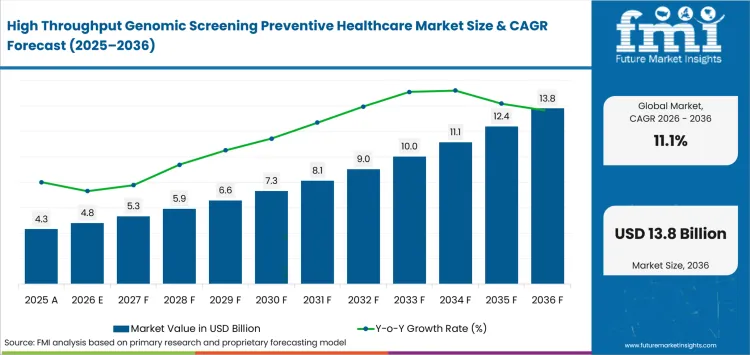
Key Takeaways
- Health systems are expanding preventive genomic programs where risk findings have a defined route into surveillance, counseling or medication review.
- By screening solution, whole genome sequencing is estimated to hold 41.0% in 2026 owing to reusable genome data for later clinical reinterpretation.
- In 2026, hereditary disease screening is expected to lead clinical application with 38.0% share because established care pathways follow actionable variants.
- Hospitals and health systems are set to lead the end user category with 36.0% share in 2026 due to control over referral and follow-up.
- Consent obligations and uneven reimbursement can delay program approval because genomic findings persist beyond the original screening encounter and may affect relatives.
- Some of the key players in this market include Illumina, Inc., QIAGEN N.V., Roche Holding AG, Exact Sciences Corporation, Natera, Inc., Guardant Health, Inc., Pacific Biosciences of California, Inc., and GeneDx Holdings Corp.
Analyst Perspective
"The commercial test is whether a genomic result changes a preventive pathway without adding interpretation work that clinics cannot absorb. Programs earn durable value when sequencing, variant review, counseling and referral responsibilities are assigned before the first screening cohort is enrolled."
- Anurag Sharma, Principal Consultant, Future Market Insights
How is the High Throughput Genomic Screening Preventive Healthcare Market segmented?
The market is assessed by screening solution, clinical application, end user, service model and sequencing technology.
Screening solution covers whole genome sequencing, targeted genomic panels, polygenic risk assessment and pharmacogenomic screening. Clinical application includes hereditary disease, cancer risk, reproductive health and personalized preventive care. End users include hospitals, diagnostic laboratories, research institutes and public health agencies. Service models cover clinical testing, reference laboratories, consumer channels and integrated preventive programs. Sequencing technology includes next-generation sequencing, targeted sequencing, bioinformatics analytics and clinical decision support.
What makes Whole genome sequencing central to the Screening solution category?
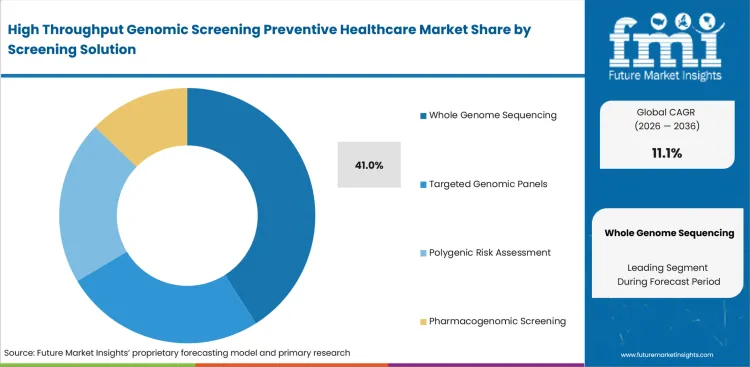
Whole genome sequencing gives preventive programs one durable dataset that can be reinterpreted as risk genes and clinical rules change. Illumina launched TruPath Genome in February 2026 with a clinical research workflow producing 16 whole genomes per day after about ten minutes of hands-on preparation.
- By screening solution, whole genome sequencing is estimated to hold 41.0% in 2026 owing to one assay covering coding, noncoding and structural variation for later review.
- Health systems can reuse the sequence for hereditary risk, pharmacogenomic review or new indications without collecting another specimen, provided consent permits secondary interpretation.
Why does Hereditary disease screening lead the Clinical application category?
Hereditary disease screening converts a pathogenic finding into an established next action such as surveillance, family testing or specialist referral. QIAGEN acquired Genoox in May 2025 and reported that its Franklin platform supported more than 4,000 healthcare organizations and over 750,000 documented clinical case interpretations worldwide.
- In 2026, hereditary disease screening is expected to lead clinical application with 38.0% share because actionable inherited variants already map to recognized care pathways.
- Laboratories still need curated classification rules and clear reporting boundaries because uncertain variants can increase counseling workload without changing preventive management.
How do Hospitals and health systems anchor the End user category?
Hospitals control eligibility, longitudinal records and the specialist referrals required after a positive preventive screen. NHS England stated in March 2025 that 18 NHS Trusts were supporting the Generation Study at 27 sites as the program worked toward sequencing 100,000 newborns.
- Hospitals and health systems are set to lead the end user category with 36.0% share in 2026 due to ownership of the clinical pathway after testing.
- External laboratories can perform sequencing, but hospitals retain purchasing influence because the result must enter records and reach genetics, oncology, cardiology or primary care teams.
What supports Clinical genomic testing services in the Service model category?
Clinical genomic testing services package sample handling, sequencing, interpretation and reporting into one orderable workflow for hospitals without full internal genomics laboratories. Exact Sciences launched Cancerguard in September 2025 and paired nationwide ordering with access to more than 7,000 Quest Diagnostics locations for blood collection.
- By service model, clinical genomic testing services are forecast to represent 54.0% in 2026 driven by demand for a report that can enter routine clinical review.
- Service providers gain volume where turnaround, counseling responsibility and referral handoffs are defined before testing begins, since a raw sequence file does not complete preventive care.
What are the drivers, restraints and opportunities in the High Throughput Genomic Screening Preventive Healthcare Market?
Population genomic datasets are broadening preventive evidence, while interpretation capacity and governance slow deployment and validated integrated screening routes offer the clearest commercial opening.
- Driver: National genomic datasets improve risk models by pairing sequence data with phenotype and longitudinal health information.
- Restraint: Interpretation backlogs and persistent consent obligations raise the operating burden before a preventive program reaches routine scale.
- Opportunity: Integrated screening services can convert inherited or cancer risk findings into defined counseling, surveillance and referral pathways.
Population cohorts make risk models more useful for preventive programs
Population programs need reference data that represent the people being screened and link variants with health information. Genome Canada launched the Canadian Precision Health Initiative in March 2025 to generate more than 100,000 genomes for a national data resource. Larger reference datasets improve ancestry-aware interpretation and give health systems stronger evidence for deciding which inherited findings justify surveillance or family testing.
Interpretation capacity can become the operating constraint before sequencing capacity does
Laboratory throughput does not remove the time required to review variants and return a clinically defensible report. NHS England stated in March 2025 that whole genome sequencing represented about 4% of genomic testing and that rising sample volumes had contributed to interpretation and reporting delays. Programs therefore need staffing, escalation rules and turnaround controls before wider screening volume can be absorbed safely.
Validated risk programs give testing companies a route into earlier intervention
Preventive screening is a lucrative opportunity as a positive finding leads to a defined care decision rather than an isolated risk score. Natera launched a 21-gene Fetal Focus test in January 2026 after prospective validation showed 96% sensitivity and 98% population-weighted specificity. Comparable programs can earn adoption by pairing analytical performance with counseling rules and a documented handoff into preventive or reproductive care.
Which country CAGRs are profiled in the High Throughput Genomic Screening Preventive Healthcare Market?
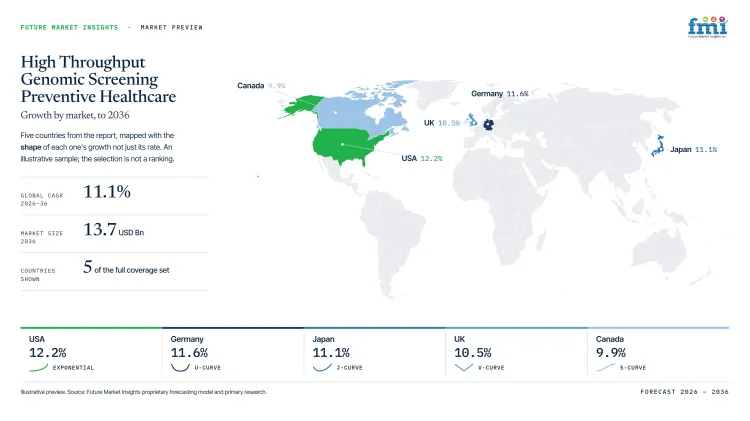
| Country | CAGR |
|---|---|
| USA | 12.2% |
| Germany | 11.6% |
| Japan | 11.1% |
| UK | 10.5% |
| Canada | 9.9% |
How do country-level CAGRs compare in the High Throughput Genomic Screening Preventive Healthcare Market?
The five forecasts span 2.3 percentage points, with the USA and Germany forming the upper group. Canada sets the lower bound while Japan and the UK occupy the middle. The spread mainly reflects differences in reimbursement, laboratory scale and clinical follow-up instead of current market size.
- USA growth benefits from commercial laboratories and payer-specific screening routes.
- Germany ties adoption to statutory reimbursement and designated genomic centers.
- Japan depends on specialist centers with local genomic interpretation expertise.
- UK commissioning uses a national test directory and common service rules.
- Canada pairs federal genomics programs with province-level healthcare delivery.
Similar CAGRs still produce different entry conditions because reimbursement authority and referral capacity differ by health system. The full report provides country-level CAGR analysis across North America, Latin America, Europe, East Asia, South Asia, Oceania and the Middle East and Africa.
Country-wise Analysis
- Academic medical centers, commercial laboratories and payer networks give the USA several routes for preventive genomic testing. The USA is estimated to post 12.2% CAGR over the forecast period, propelled by large research cohorts that can be linked with routine clinical records. NIH disclosed in June 2026 that All of Us included more than 535,000 whole genome sequences linked to nearly 482,000 electronic health records. Coverage remains indication-specific and return-of-results policies differ between programs. Companies entering the USA need clinical utility evidence that fits the payer and provider pathway selected for each preventive screening use case.
- Genomic screening enters routine care through statutory insurance contracts and participating genomDE medical centers rather than a single commercial channel. Germany's high throughput genomic screening preventive healthcare outlook is anticipated to advance at 11.6% CAGR over the assessment period, tied to a reimbursement route built inside statutory care. The Federal Ministry of Health updated genomDE in March 2026 and stated that participating insurers cover eligible model-project costs while patient enrollment was increasing. Strict consent and data-security rules add implementation work for multicenter programs. Local integration with certified medical centers therefore weighs more heavily than broad consumer access for preventive screening programs.
- Japanese programs place unusual weight on ancestry-specific reference data because imported variant frequencies can weaken interpretation for local populations. High throughput genomic screening preventive healthcare demand in Japan is forecast to rise at 11.1% CAGR over the forecast period, aided by national cohort resources built for Japanese genomic variation. Tohoku Medical Megabank announced in October 2025 that whole-genome analysis had been completed for 100,000 people and that a 61,000-person reference panel was available. Genetic counseling capacity remains uneven outside major academic centers. Vendors that validate interpretation against Japanese reference data have a clearer route into specialist preventive programs.
- National commissioning gives England a defined test directory and seven genomic laboratory hubs that route much of routine genomic testing. NHS England documented in February 2025 that about 2,000 funded staff supported the Genomic Medicine Service and its clinical infrastructure. In the UK, high throughput genomic screening preventive healthcare demand is predicted to advance at 10.5% CAGR through 2036, given the ability to standardize eligibility and reporting. Rising testing volume can still pressure interpretation turnaround and workforce capacity. The main commercial advantage is predictable commissioning, while the constraint is meeting national service specifications at national clinical scale.
- Provincial health systems purchase and implement genomic services separately even as national programs build shared data infrastructure. Canada is projected to grow at 9.9% CAGR by 2036, helped by federal investment in precision health and common data standards. Genome Canada's 2025-2026 Pan-Canadian Human Genome Library project specifies security assessments, consent-aware access and dedicated processes for Indigenous data as national datasets are integrated. Those controls make data governance a commercial requirement rather than a back-office task. Companies with interoperable workflows can address multiple provinces, but deployment pace still depends on provincial laboratory capacity and local preventive healthcare pathways.
Who are the notable companies in the High Throughput Genomic Screening Preventive Healthcare Market?
Illumina, Inc., QIAGEN N.V., Roche Holding AG, Exact Sciences Corporation, Natera, Inc., Guardant Health, Inc., Pacific Biosciences of California, Inc., and GeneDx Holdings Corp. are the notable companies serving this market.
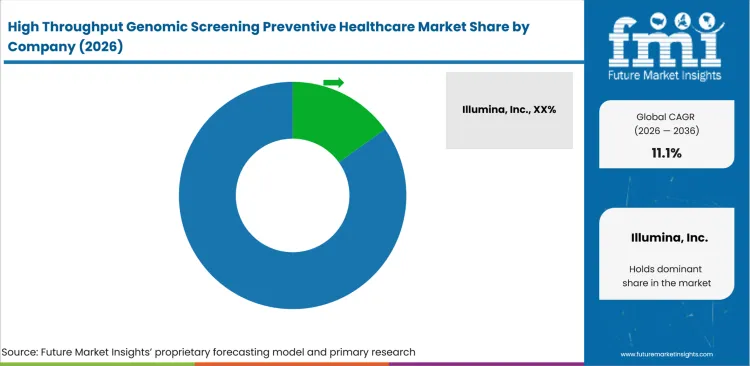
Competition is divided between sequencing-platform companies, clinical interpretation firms and screening businesses with direct provider access. Entry barriers come from validated laboratory workflows, clinically defensible interpretation and the ability to place results inside established care pathways.
- Illumina, Inc., Roche Holding AG and Pacific Biosciences of California, Inc. compete primarily through sequencing platforms and genome-scale workflow performance.
- QIAGEN N.V. and GeneDx Holdings Corp. compete through clinical interpretation, laboratory services and workflows for inherited disease assessment.
- Exact Sciences Corporation, Natera, Inc. and Guardant Health, Inc. compete through screening access, clinical evidence and provider-facing testing services.
Competitive Benchmarking: High Throughput Genomic Screening Preventive Healthcare Market
| Company | Genome-scale Sequencing Breadth | Clinical Interpretation Integration | Preventive Screening Commercialization | Geographic Reach |
|---|---|---|---|---|
| Illumina, Inc. | High | High | Medium | Global |
| QIAGEN N.V. | Medium | High | Medium | Global |
| Roche Holding AG | High | High | Medium | Global |
| Exact Sciences Corporation | Low | High | High | United States with selected international activities |
| Natera, Inc. | Medium | High | High | United States and selected international markets |
| Guardant Health, Inc. | Medium | High | High | United States, Europe and Asia |
| Pacific Biosciences of California, Inc. | High | Medium | Low | North America, Europe and Asia-Pacific |
| GeneDx Holdings Corp. | Medium | High | High | United States with international collaborations |
Scoring basis: High genome-scale sequencing breadth requires documented whole-genome programs and scalable platforms; Medium reflects narrower clinical sequencing and Low reflects no owned population-scale platform. High interpretation integration requires documented clinical interpretation or decision support; Medium reflects partial integration and Low reflects limited exact-market evidence. High commercialization requires an active screening service with provider access; Medium reflects partner-led routes and Low reflects research or diagnostic infrastructure without a direct preventive channel.
Key Developments in the High Throughput Genomic Screening Preventive Healthcare Market
- In March 2026, Illumina, Inc. formed a preventive genomics consortium with Veritas Genetics and Fuze Health to place whole genome sequencing inside insurance-linked care pathways.
- In May 2025, Guardant Health, Inc. launched an 82-gene hereditary cancer test covering inherited risk associated with more than 12 tumor types.
- In October 2025, GeneDx Holdings Corp. joined the BEACONS genomic newborn-screening initiative that plans to enroll up to 30,000 newborns in multiple states.
Key Players in the High Throughput Genomic Screening Preventive Healthcare Market
Genome-scale Sequencing Platforms
- Illumina, Inc.
- Roche Holding AG
- Pacific Biosciences of California, Inc.
Clinical Interpretation and Genomic Testing
- QIAGEN N.V.
- GeneDx Holdings Corp.
Preventive and Risk Screening Services
- Exact Sciences Corporation
- Natera, Inc.
- Guardant Health, Inc.
High Throughput Genomic Screening Preventive Healthcare Market - Report Scope
| Coverage field | Report scope |
|---|---|
| Market breakdown | By screening solution, clinical application, end user, service model, sequencing technology and region. |
| Quantitative Units | USD Billion. |
| Market Definition | High-throughput genomic screening used to identify inherited or disease-related risk before symptoms or advanced disease require diagnostic intervention. |
| Forecast Period | 2026 to 2036. |
| Countries Profiled | USA, Germany, Japan, UK and Canada. |
| Key Companies Profiled | Illumina, Inc., QIAGEN N.V., Roche Holding AG, Exact Sciences Corporation, Natera, Inc., Guardant Health, Inc., Pacific Biosciences of California, Inc., and GeneDx Holdings Corp.. |
| Report Coverage | Market size and forecast, segmentation, country growth, drivers, restraints, opportunities, company benchmarking and recent developments. |
High Throughput Genomic Screening Preventive Healthcare Market - Research Methodology
| Method | Approach |
|---|---|
| Primary Research | FMI analysts gathered input from manufacturers, service providers, technology developers, distributors, end users, procurement teams, and subject-matter experts. Interviews examined purchasing decisions, product or service evaluation, adoption barriers, approval requirements, pricing considerations, and expectations for technical or commercial support. Respondents were also asked what evidence is required before a trial, pilot, or initial order develops into regular purchasing. |
| Desk Research | Desk research covered government statistics, regulatory publications, trade data, industry associations, technical literature, standards, company filings, product information, and official corporate announcements. Sources were reviewed for relevance, publication date, geographic coverage, and consistency with the defined market scope. Claims relating to performance, applications, approvals, capacity, investment, and commercial activity were retained only when supported by credible public evidence. |
| Market Sizing and Forecasting | The market model combined the baseline value with historical performance, segment structure, pricing and volume indicators, adoption levels, company participation, and country-level demand conditions. Forecast assumptions considered economic activity, investment trends, regulatory developments, technology adoption, purchasing cycles, supply availability, and barriers to wider market use. Segment and regional estimates were reconciled before the final market total was calculated. |
| Data Validation | Estimates were checked against multiple independent indicators, including public data, company activity, trade patterns, industry developments, and findings from primary interviews. Validation also tested whether products, services, applications, and company revenues fell within the defined market boundaries. Adjacent categories, unsupported claims, overlapping revenues, and activities without direct market relevance were excluded to reduce double counting and maintain consistency across segments and countries. |
High Throughput Genomic Screening Preventive Healthcare Market by Segments
High Throughput Genomic Screening Preventive Healthcare Market segmented by Screening Solution:
- Whole Genome Sequencing
- Short-read Genome Sequencing
- Long-read Genome Sequencing
- Targeted Genomic Panels
- Hereditary Cancer Panels
- Cardiovascular Risk Panels
- Polygenic Risk Assessment
- Polygenic Risk Scoring
- Genetic Susceptibility Analysis
- Pharmacogenomic Screening
- Drug Response Profiling
- Metabolic Response Analysis
High Throughput Genomic Screening Preventive Healthcare Market segmented by Clinical Application:
- Hereditary Disease Screening
- Rare Disease Risk Assessment
- Carrier Screening
- Cancer Risk Screening
- Breast & Ovarian Cancer Screening
- Cardiometabolic Risk Assessment
- Reproductive Health Screening
- Prenatal Genetic Screening
- Preconception Screening
- Personalized Preventive Care
- Preventive Therapy Planning
- Lifestyle Risk Management
High Throughput Genomic Screening Preventive Healthcare Market segmented by End User:
- Hospitals & Health Systems
- Tertiary Care Hospitals
- Genomic Research Centers
- Diagnostic Laboratories
- Specialty Genomic Laboratories
- Preventive Healthcare Centers
- Academic & Research Institutes
- Universities
- Public Health Laboratories
- Government Health Agencies
- National Screening Programs
- Community Healthcare Networks
High Throughput Genomic Screening Preventive Healthcare Market segmented by Service Model:
- Clinical Genomic Testing Services
- Hospital-based Testing
- Centralized Laboratory Services
- Reference Laboratory Services
- Outsourced Genomic Services
- Population Screening Programs
- Direct-to-Consumer Testing
- Consumer Genomics Services
- Digital Health Platforms
- Integrated Preventive Care Programs
- Health System Integration
- Value-based Care Programs
High Throughput Genomic Screening Preventive Healthcare Market segmented by Sequencing Technology:
- Next-generation Sequencing
- Sequencing by Synthesis
- Long-read Sequencing
- Targeted Sequencing
- Hybrid Capture Sequencing
- Amplicon Sequencing
- Bioinformatics Analytics Platform
- Cloud Bioinformatics
- Artificial Intelligence Analytics
- Clinical Decision Support
- Genomic Data Interpretation
- Multi-omics Integration
High Throughput Genomic Screening Preventive Healthcare Market by Region:
- North America
- United States
- Canada
- Latin America
- Brazil
- Mexico
- Argentina
- Chile
- Rest of Latin America
- Western Europe
- Germany
- United Kingdom
- France
- Italy
- Spain
- Nordics
- Benelux
- Rest of Western Europe
- Eastern Europe
- Poland
- Czech Republic
- Romania
- Hungary
- Rest of Eastern Europe
- East Asia
- China
- Japan
- South Korea
- South Asia and Pacific
- India
- ASEAN
- Australia and New Zealand
- Rest of South Asia and Pacific
- Middle East and Africa
- Kingdom of Saudi Arabia
- Other GCC Countries
- Türkiye
- Israel
- South Africa
- Other African Union Countries
- Rest of Middle East and Africa
Research Sources and Bibliography
- Illumina, Inc. (2026, May 19). Illumina releases 2025 Corporate Responsibility Report, expanding access to genomics and accelerating global impact.
- NHS England. (2025, February 6). The NHS Genomic Medicine Service: achievements in 2024.
- National Institutes of Health. (2026, June 30). NIH's All of Us Research Program is now the largest integrated genomics and health database in the world.
- NHS England. (2025, March). Annex: Operational performance update.
- Genome Canada. (2025, March 5). Canada launches $200M genomics data initiative to drive precision health and economic growth.
- Genome Canada. (2025-2026). Pan-Canadian Human Genome Library for Canadian Precision Health Initiative.
- Federal Ministry of Health, Germany. (2026, March 2). genomDE - National Strategy for Genomic Medicine.
- Tohoku Medical Megabank Organization. (2025, October 28). Genome and metabolome data expansion and added health survey information: jMorp 2025 major update.
- Illumina, Inc. (2026, February 24). Illumina launches TruPath Genome, setting a new standard in genomic insight.
- QIAGEN N.V. (2025, May 12). QIAGEN enhances leading clinical genomics portfolio with acquisition of Genoox AI-powered software.
- Exact Sciences Corporation. (2025, September 10). Exact Sciences launches Cancerguard, first-of-its-kind multi-cancer early detection blood test.
- Natera, Inc. (2026, January 5). Natera launches 21-gene Fetal Focus single-gene NIPT, powered by ultra-sensitive LinkedSNP technology.
- Illumina, Inc. (2026, March 16). Illumina advances preventive genomics through consortium with Veritas Genetics.
- Guardant Health, Inc. (2025, May 20). Guardant Health introduces hereditary cancer testing to identify inherited predispositions to certain types of cancer.
- GeneDx Holdings Corp. (2025, October 1). GeneDx announces first USA national genomic newborn screening initiative launched with $14.4 million NIH award.
- Roche Holding AG. (2025, February 20). Roche unveils sequencing by expansion technology for high-throughput genomic analysis.
- Illumina, Inc. (2026, April 14). Illumina and the Center for Data-Driven Discovery in Biomedicine bring genomic data and scalable software to pediatric cancer and rare disease research.
- Guardant Health, Inc. (2025, September 24). Guardant Health and Quest Diagnostics collaborate to broaden access to Shield blood-based colorectal cancer screening test.
- GeneDx Holdings Corp. (2025, October 13). GeneDx selected for Florida state-backed genomic newborn screening program.
- Illumina, Inc. (2026, February 27). Illumina whole-genome sequencing technology to accelerate rare disease testing in Florida.
- QIAGEN N.V. (2026, May 20). QIAGEN launches QIA Agent, connecting AI-driven scientific guidance across Sample to Insight workflows.
- Roche Holding AG. (2025, October 16). Roche presents major advances for its sequencing by expansion technology, including a new Guinness World Record, at the ASHG conference 2025.
- Exact Sciences Corporation. (2025, March 31). Exact Sciences launches Cologuard Plus.
- Natera, Inc. (2026, May 20). EXPAND trial of Natera's Fetal Focus single-gene NIPT surpasses 2,000 patients enrolled.
- Guardant Health, Inc. (2025, January 7). Guardant Health's Shield blood test selected for NCI Vanguard study on multi-cancer detection.
- Pacific Biosciences of California, Inc. (2026, February 12). PacBio joins iHope initiative as first long-read genomic sequencing partner.
- GeneDx Holdings Corp. (2025, October 20). GeneDx granted FDA Breakthrough Device Designation for its ExomeDx and GenomeDx testing.
This bibliography is provided for reader reference and is not exhaustive. The full report contains the complete reference list and detailed citations.
This Report Answers
- How large is the high throughput genomic screening preventive healthcare market in 2026 and 2036?
- Which operating conditions are moving population genomic data into preventive clinical workflows?
- Why does whole genome sequencing account for 41.0% of screening solutions in 2026?
- Why does hereditary disease screening account for 38.0% of clinical applications in 2026?
- Why do hospitals and health systems hold 36.0% of end-user demand in 2026?
- How do the five profiled country growth rates differ through 2036?
- Which companies provide sequencing, interpretation and preventive screening services?
- What slows routine deployment even when sequencing throughput is available?
- Which recent company actions are changing screening access and genomic workflow capacity?
Frequently Asked Questions
Which screening solution leads the high throughput genomic screening preventive healthcare market?
The whole genome sequencing segment is expected to hold 41.0% of the high throughput genomic screening preventive healthcare market in 2026, driven by reusable genome data. One sequence can support later hereditary or pharmacogenomic reinterpretation under permitted consent rules.
Which clinical application holds a leading share in the high throughput genomic screening preventive healthcare market?
The hereditary disease screening segment is expected to hold 38.0% of the high throughput genomic screening preventive healthcare market in 2026, attributable to established care pathways. Actionable inherited variants can trigger surveillance, family testing or specialist referral.
How much value will the high throughput genomic screening preventive healthcare market add between 2026 and 2036?
The high throughput genomic screening preventive healthcare market is expected to add USD 8.9 billion in value between 2026 and 2036. The increase follows broader clinical use of sequencing paired with interpretation, counseling and defined preventive follow-up.
Which countries are projected to record the highest growth in the high throughput genomic screening preventive healthcare market?
USA is projected to grow at 12.2% CAGR, followed by Germany at 11.6% and Japan at 11.1% through 2036. Growth is strongest where sequencing infrastructure and reimbursement routes are progressing together.
Which companies are active in the high throughput genomic screening preventive healthcare market?
Key companies operating in the high throughput genomic screening preventive healthcare market include Illumina, Inc., QIAGEN N.V., Roche Holding AG, Exact Sciences Corporation, Natera, Inc., Guardant Health, Inc., Pacific Biosciences of California, Inc., and GeneDx Holdings Corp. Their competition centers on sequencing, interpretation and provider-facing screening services.
Preview the report firsthand - request a free sample
Get SampleGet the brochure for pricing and purchase details.
Get PDFTable of Content
- Key Takeaways
- Market Size and CAGR
- Top Growth Driver
- Fastest Growing Segment
- Leading Region
- Key Companies
- Emerging Opportunities
- Executive Summary
- Global Market Outlook
- Demand-side Trends
- Supply-side Trends
- Technology Roadmap Analysis
- Analysis and Recommendations
- Analyst Perspective (What is happening? Why now? What should investors know?)
- Key Questions Answered
- How large is the market?
- What is the CAGR?
- What are key trends?
- Which region dominates?
- Who are the leaders?
- Market Overview
- Market Coverage / Taxonomy
- Market Definition / Scope / Limitations
- Research Methodology
- Chapter Orientation
- Analytical Lens and Working Hypotheses
- Market Structure, Signals, and Trend Drivers
- Benchmarking and Cross-market Comparability
- Market Sizing, Forecasting, and Opportunity Mapping
- Research Design and Evidence Framework
- Desk Research Programme (Secondary Evidence)
- Expert Input and Fieldwork (Primary Evidence)
- Tooling, Models, and Reference Databases
- Data Engineering and Model Build
- Quality Assurance and Audit Trail
- Market Background
- Market Dynamics (Drivers, Restraints, Opportunity, Trends)
- Scenario Forecast (Optimistic, Likely, Conservative)
- Impact Analysis
- AI Impact
- Sustainability Impact
- Regulatory Impact
- Technology Impact
- Consumer / Buyer Analysis
- Purchase Drivers
- Adoption Barriers
- Buyer Journey
- Opportunity Map Analysis
- Product Life Cycle Analysis
- Supply Chain Analysis
- Investment Feasibility Matrix
- Value Chain Analysis
- PESTLE and Porter's Analysis
- Regulatory Landscape
- Regional Parent Market Outlook
- Production and Consumption Statistics
- Import and Export Statistics
- Global Market Analysis and Forecast, 2021 to 2036
- Historical Market Size Value (USD Billion) Analysis, 2021 to 2025
- Current and Future Market Size Value (USD Billion) Projections, 2026 to 2036
- Y-o-Y Growth Trend Analysis
- Absolute $ Opportunity Analysis
- Global Market Pricing Analysis, 2021 to 2036
- Global Market Analysis and Forecast, By Screening Solution, 2021 to 2036
- Introduction / Key Findings
- Historical Market Size Value (USD Billion) Analysis By Screening Solution, 2021 to 2025
- Current and Future Market Size Value (USD Billion) Analysis and Forecast By Screening Solution, 2026 to 2036
- Whole Genome Sequencing
- Short-read Genome Sequencing
- Long-read Genome Sequencing
- Targeted Genomic Panels
- Hereditary Cancer Panels
- Cardiovascular Risk Panels
- Polygenic Risk Assessment
- Polygenic Risk Scoring
- Genetic Susceptibility Analysis
- Pharmacogenomic Screening
- Drug Response Profiling
- Metabolic Response Analysis
- Whole Genome Sequencing
- Y-o-Y Growth Trend Analysis By Screening Solution, 2021 to 2025
- Absolute $ Opportunity Analysis By Screening Solution, 2026 to 2036
- Global Market Analysis and Forecast, By Clinical Application, 2021 to 2036
- Introduction / Key Findings
- Historical Market Size Value (USD Billion) Analysis By Clinical Application, 2021 to 2025
- Current and Future Market Size Value (USD Billion) Analysis and Forecast By Clinical Application, 2026 to 2036
- Hereditary Disease Screening
- Rare Disease Risk Assessment
- Carrier Screening
- Cancer Risk Screening
- Breast & Ovarian Cancer Screening
- Cardiometabolic Risk Assessment
- Reproductive Health Screening
- Prenatal Genetic Screening
- Preconception Screening
- Personalized Preventive Care
- Preventive Therapy Planning
- Lifestyle Risk Management
- Hereditary Disease Screening
- Y-o-Y Growth Trend Analysis By Clinical Application, 2021 to 2025
- Absolute $ Opportunity Analysis By Clinical Application, 2026 to 2036
- Global Market Analysis and Forecast, By End User, 2021 to 2036
- Introduction / Key Findings
- Historical Market Size Value (USD Billion) Analysis By End User, 2021 to 2025
- Current and Future Market Size Value (USD Billion) Analysis and Forecast By End User, 2026 to 2036
- Hospitals & Health Systems
- Tertiary Care Hospitals
- Genomic Research Centers
- Diagnostic Laboratories
- Specialty Genomic Laboratories
- Preventive Healthcare Centers
- Academic & Research Institutes
- Universities
- Public Health Laboratories
- Government Health Agencies
- National Screening Programs
- Community Healthcare Networks
- Hospitals & Health Systems
- Y-o-Y Growth Trend Analysis By End User, 2021 to 2025
- Absolute $ Opportunity Analysis By End User, 2026 to 2036
- Global Market Analysis and Forecast, By Service Model, 2021 to 2036
- Introduction / Key Findings
- Historical Market Size Value (USD Billion) Analysis By Service Model, 2021 to 2025
- Current and Future Market Size Value (USD Billion) Analysis and Forecast By Service Model, 2026 to 2036
- Clinical Genomic Testing Services
- Hospital-based Testing
- Centralized Laboratory Services
- Reference Laboratory Services
- Outsourced Genomic Services
- Population Screening Programs
- Direct-to-Consumer Testing
- Consumer Genomics Services
- Digital Health Platforms
- Integrated Preventive Care Programs
- Health System Integration
- Value-based Care Programs
- Clinical Genomic Testing Services
- Y-o-Y Growth Trend Analysis By Service Model, 2021 to 2025
- Absolute $ Opportunity Analysis By Service Model, 2026 to 2036
- Global Market Analysis and Forecast, By Sequencing Technology, 2021 to 2036
- Introduction / Key Findings
- Historical Market Size Value (USD Billion) Analysis By Sequencing Technology, 2021 to 2025
- Current and Future Market Size Value (USD Billion) Analysis and Forecast By Sequencing Technology, 2026 to 2036
- Next-generation Sequencing
- Sequencing by Synthesis
- Long-read Sequencing
- Targeted Sequencing
- Hybrid Capture Sequencing
- Amplicon Sequencing
- Bioinformatics Analytics Platform
- Cloud Bioinformatics
- Artificial Intelligence Analytics
- Clinical Decision Support
- Genomic Data Interpretation
- Multi-omics Integration
- Next-generation Sequencing
- Y-o-Y Growth Trend Analysis By Sequencing Technology, 2021 to 2025
- Absolute $ Opportunity Analysis By Sequencing Technology, 2026 to 2036
- Global Market Analysis and Forecast, By Region, 2021 to 2036
- Introduction
- Historical Market Size Value (USD Billion) Analysis By Region, 2021 to 2025
- Current Market Size Value (USD Billion) Analysis and Forecast By Region, 2026 to 2036
- North America
- Latin America
- Western Europe
- Eastern Europe
- East Asia
- South Asia and Pacific
- Middle East & Africa
- Market Attractiveness Analysis By Region
- North America Market Analysis and Forecast, By Country, 2021 to 2036
- Historical Market Size Value (USD Billion) Trend Analysis By Market Taxonomy, 2021 to 2025
- Market Size Value (USD Billion) Forecast By Market Taxonomy, 2026 to 2036
- By Country
- USA
- Canada
- By Screening Solution
- By Clinical Application
- By End User
- By Service Model
- By Sequencing Technology
- By Country
- Market Attractiveness Analysis
- By Country
- By Screening Solution
- By Clinical Application
- By End User
- By Service Model
- By Sequencing Technology
- Key Takeaways
- Latin America Market Analysis and Forecast, By Country
- Historical Market Size Value (USD Billion) Trend Analysis By Market Taxonomy, 2021 to 2025
- Market Size Value (USD Billion) Forecast By Market Taxonomy, 2026 to 2036
- By Country
- Brazil
- Mexico
- Chile
- Rest of Latin America
- By Screening Solution
- By Clinical Application
- By End User
- By Service Model
- By Sequencing Technology
- By Country
- Market Attractiveness Analysis
- By Country
- By Screening Solution
- By Clinical Application
- By End User
- By Service Model
- By Sequencing Technology
- Key Takeaways
- Western Europe Market Analysis and Forecast, By Country
- Historical Market Size Value (USD Billion) Trend Analysis By Market Taxonomy, 2021 to 2025
- Market Size Value (USD Billion) Forecast By Market Taxonomy, 2026 to 2036
- By Country
- Germany
- UK
- Italy
- Spain
- France
- Nordic
- BENELUX
- Rest of Western Europe
- By Screening Solution
- By Clinical Application
- By End User
- By Service Model
- By Sequencing Technology
- By Country
- Market Attractiveness Analysis
- By Country
- By Screening Solution
- By Clinical Application
- By End User
- By Service Model
- By Sequencing Technology
- Key Takeaways
- Eastern Europe Market Analysis and Forecast, By Country
- Historical Market Size Value (USD Billion) Trend Analysis By Market Taxonomy, 2021 to 2025
- Market Size Value (USD Billion) Forecast By Market Taxonomy, 2026 to 2036
- By Country
- Russia
- Poland
- Hungary
- Balkan & Baltic
- Rest of Eastern Europe
- By Screening Solution
- By Clinical Application
- By End User
- By Service Model
- By Sequencing Technology
- By Country
- Market Attractiveness Analysis
- By Country
- By Screening Solution
- By Clinical Application
- By End User
- By Service Model
- By Sequencing Technology
- Key Takeaways
- East Asia Market Analysis and Forecast, By Country
- Historical Market Size Value (USD Billion) Trend Analysis By Market Taxonomy, 2021 to 2025
- Market Size Value (USD Billion) Forecast By Market Taxonomy, 2026 to 2036
- By Country
- China
- Japan
- South Korea
- By Screening Solution
- By Clinical Application
- By End User
- By Service Model
- By Sequencing Technology
- By Country
- Market Attractiveness Analysis
- By Country
- By Screening Solution
- By Clinical Application
- By End User
- By Service Model
- By Sequencing Technology
- Key Takeaways
- South Asia and Pacific Market Analysis and Forecast, By Country
- Historical Market Size Value (USD Billion) Trend Analysis By Market Taxonomy, 2021 to 2025
- Market Size Value (USD Billion) Forecast By Market Taxonomy, 2026 to 2036
- By Country
- India
- ASEAN
- Australia & New Zealand
- Rest of South Asia and Pacific
- By Screening Solution
- By Clinical Application
- By End User
- By Service Model
- By Sequencing Technology
- By Country
- Market Attractiveness Analysis
- By Country
- By Screening Solution
- By Clinical Application
- By End User
- By Service Model
- By Sequencing Technology
- Key Takeaways
- Middle East & Africa Market Analysis and Forecast, By Country
- Historical Market Size Value (USD Billion) Trend Analysis By Market Taxonomy, 2021 to 2025
- Market Size Value (USD Billion) Forecast By Market Taxonomy, 2026 to 2036
- By Country
- Kingdom of Saudi Arabia
- Other GCC Countries
- Türkiye
- South Africa
- Other African Union
- Rest of Middle East & Africa
- By Screening Solution
- By Clinical Application
- By End User
- By Service Model
- By Sequencing Technology
- By Country
- Market Attractiveness Analysis
- By Country
- By Screening Solution
- By Clinical Application
- By End User
- By Service Model
- By Sequencing Technology
- Key Takeaways
- Key Countries Market Analysis
- USA
- Pricing Analysis
- Market Share Analysis, 2025
- By Screening Solution
- By Clinical Application
- By End User
- By Service Model
- By Sequencing Technology
- Canada
- Pricing Analysis
- Market Share Analysis, 2025
- By Screening Solution
- By Clinical Application
- By End User
- By Service Model
- By Sequencing Technology
- Mexico
- Pricing Analysis
- Market Share Analysis, 2025
- By Screening Solution
- By Clinical Application
- By End User
- By Service Model
- By Sequencing Technology
- Brazil
- Pricing Analysis
- Market Share Analysis, 2025
- By Screening Solution
- By Clinical Application
- By End User
- By Service Model
- By Sequencing Technology
- Chile
- Pricing Analysis
- Market Share Analysis, 2025
- By Screening Solution
- By Clinical Application
- By End User
- By Service Model
- By Sequencing Technology
- Germany
- Pricing Analysis
- Market Share Analysis, 2025
- By Screening Solution
- By Clinical Application
- By End User
- By Service Model
- By Sequencing Technology
- UK
- Pricing Analysis
- Market Share Analysis, 2025
- By Screening Solution
- By Clinical Application
- By End User
- By Service Model
- By Sequencing Technology
- Italy
- Pricing Analysis
- Market Share Analysis, 2025
- By Screening Solution
- By Clinical Application
- By End User
- By Service Model
- By Sequencing Technology
- Spain
- Pricing Analysis
- Market Share Analysis, 2025
- By Screening Solution
- By Clinical Application
- By End User
- By Service Model
- By Sequencing Technology
- France
- Pricing Analysis
- Market Share Analysis, 2025
- By Screening Solution
- By Clinical Application
- By End User
- By Service Model
- By Sequencing Technology
- India
- Pricing Analysis
- Market Share Analysis, 2025
- By Screening Solution
- By Clinical Application
- By End User
- By Service Model
- By Sequencing Technology
- ASEAN
- Pricing Analysis
- Market Share Analysis, 2025
- By Screening Solution
- By Clinical Application
- By End User
- By Service Model
- By Sequencing Technology
- Australia & New Zealand
- Pricing Analysis
- Market Share Analysis, 2025
- By Screening Solution
- By Clinical Application
- By End User
- By Service Model
- By Sequencing Technology
- China
- Pricing Analysis
- Market Share Analysis, 2025
- By Screening Solution
- By Clinical Application
- By End User
- By Service Model
- By Sequencing Technology
- Japan
- Pricing Analysis
- Market Share Analysis, 2025
- By Screening Solution
- By Clinical Application
- By End User
- By Service Model
- By Sequencing Technology
- South Korea
- Pricing Analysis
- Market Share Analysis, 2025
- By Screening Solution
- By Clinical Application
- By End User
- By Service Model
- By Sequencing Technology
- Russia
- Pricing Analysis
- Market Share Analysis, 2025
- By Screening Solution
- By Clinical Application
- By End User
- By Service Model
- By Sequencing Technology
- Poland
- Pricing Analysis
- Market Share Analysis, 2025
- By Screening Solution
- By Clinical Application
- By End User
- By Service Model
- By Sequencing Technology
- Hungary
- Pricing Analysis
- Market Share Analysis, 2025
- By Screening Solution
- By Clinical Application
- By End User
- By Service Model
- By Sequencing Technology
- Kingdom of Saudi Arabia
- Pricing Analysis
- Market Share Analysis, 2025
- By Screening Solution
- By Clinical Application
- By End User
- By Service Model
- By Sequencing Technology
- Türkiye
- Pricing Analysis
- Market Share Analysis, 2025
- By Screening Solution
- By Clinical Application
- By End User
- By Service Model
- By Sequencing Technology
- South Africa
- Pricing Analysis
- Market Share Analysis, 2025
- By Screening Solution
- By Clinical Application
- By End User
- By Service Model
- By Sequencing Technology
- USA
- Market Structure Analysis
- Competition Dashboard
- Competition Benchmarking
- Market Share Analysis of Top Players
- By Regional
- By Screening Solution
- By Clinical Application
- By End User
- By Service Model
- By Sequencing Technology
- Emerging Startups
- Innovation Benchmarking
- Competition Analysis
- Competition Deep Dive
- Illumina, Inc.
- Overview
- Product Portfolio
- Profitability by Market Segments
- Sales Footprint
- Strategy Overview
- Marketing Strategy
- Product Strategy
- Channel Strategy
- Thermo Fisher Scientific Inc.
- QIAGEN N.V.
- Roche Holding AG
- Agilent Technologies, Inc.
- BGI Genomics Co., Ltd.
- Exact Sciences Corporation
- Natera, Inc.
- Guardant Health, Inc.
- Pacific Biosciences of California, Inc.
- Illumina, Inc.
- Case Studies
- Success Stories
- Recent Developments
- Competition Deep Dive
- Assumptions & Acronyms Used


