

- Market Size (2026)
- USD 3.0 Bn
- Forecast (2036)
- USD 9.0 Bn
- CAGR (2026 to 2036)
- 11.6%
How big is Whole Genome Sequencing Market in 2026?
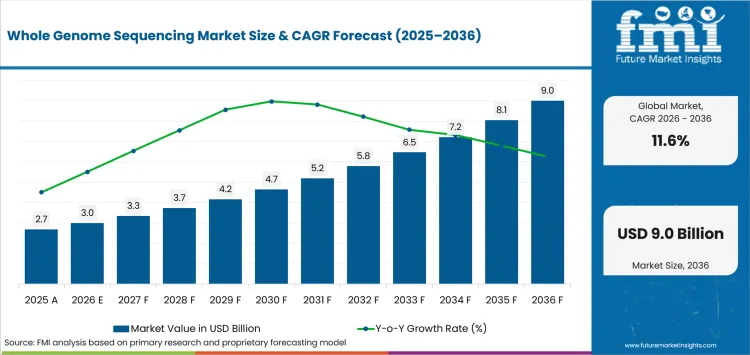
USD 3.0 billion in 2026 and USD 9.0 billion by 2036 at an 11.6% CAGR.
Demand for whole genome sequencing is projected to expand at 11.6% CAGR between 2026 and 2036, increasing valuation from USD 3.0 billion in 2026 to USD 8.9 billion by 2036. National cohort programs sustain this expansion through recurring sample preparation, sequencing runs and variant interpretation across participating institutions.
Research databases now contain enough linked genomic and clinical information to support repeated analysis across large populations. The National Institutes of Health reported in June 2026 that the All of Us database contained more than 535,000 whole genome sequences. Each release adds alignment, storage and review workloads that must remain consistent across participating research sites.
Key Takeaways of Whole Genome Sequencing Market
- Population cohorts increase demand for workflows that connect dependable reads with defensible genomic interpretation across participating institutions.
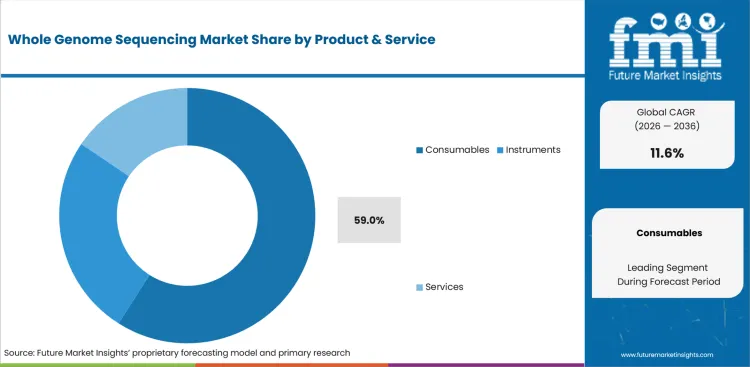
- Consumables are projected to represent 59.0% in 2026 as recurring chemistry supports every validated sequencing run and scheduled cohort.
- Sequencing is estimated to account for 52.0% of workflow demand as dependable read generation controls every downstream analysis stage.
- Human whole genome sequencing is forecast at 64.0% of application demand through rare-disease studies and translational research programs.
- Computing capacity and specialist interpretation restrain adoption as complete genomes require secure storage, controlled access and validated review.
- Illumina, Thermo Fisher Scientific, BGI Genomics, QIAGEN, Oxford Nanopore Technologies, Roche, PacBio and Eurofins Scientific serve the market through platforms, workflow tools and sequencing services.
Analyst Perspective
"Whole genome sequencing programs gain clinical value from consistent coverage and disciplined interpretation across every sample. Clinical teams should assess variant-review capacity alongside data governance since faster instruments cannot resolve uncertain findings or reporting duties."
- Anurag Sharma, Principal Consultant, Future Market Insights
How is the Whole Genome Sequencing Market segmented?
The Whole Genome Sequencing Market is segmented by Product & Service, Type, Workflow, Application, End User and Region.
The whole genome sequencing industry is segmented by product and service, type, workflow, application, end user and region. Product and service covers consumables through library preparation kits and sequencing reagents, instruments through short-read and long-read sequencers, and services through sequencing and data analysis. Type separates large whole genome sequencing for human, animal and plant studies from small whole genome sequencing for microbial and other compact genomes. Workflow includes sequencing through short-read and long-read methods, data analysis through sequence alignment and variant calling, and sample preparation through DNA extraction and library preparation. Application covers human WGS, clinical diagnostics, precision medicine, agricultural and animal research, plant and animal genomics, microbial and infectious disease research, pathogen and microbial genomics, forensic genomics and environmental genomics. End users include academic and government institutes, pharmaceutical and biotechnology companies, hospitals and clinics, diagnostic laboratories, agricultural research organizations, forensic laboratories and other users.
Why do consumables lead demand within the product and service category?
Whole genome sequencing starts with DNA extraction and library preparation as the first laboratory steps. Laboratories repeat these processes for every sample, so chemistry availability shapes schedule reliability across long cohort programs. DNA testing programs also standardize reagents to reduce differences between study batches, operators and locations. That control becomes more valuable as national programs distribute work among several trained laboratories under common protocols.
- Based on product and service, consumables are projected to account for 59.0% in 2026 due to recurring extraction and library preparation needs. Each validated run uses fresh chemistry, while standardized kits reduce lot variation across trained operators and participating laboratories.
- Large newborn programs demonstrate how preparation demand scales with sample volume and fixed turnaround commitments. Genomics England awarded Revvity a contract in March 2025 covering extraction and sequencing for 44,500 samples within seven working days. Scheduled quarterly volumes therefore require stable chemistry supply and repeatable preparation across every contracted batch.
Why does large whole genome sequencing lead demand within the type category?
Large whole genome sequencing supports population cohorts and broad discovery programs that compare complex human, animal and plant genomes. Central facilities spread instrument costs across repeated batches and apply common quality controls to every sample. Program planners assess throughput flexibility alongside data consistency across short-read sequencing and long-read production systems. They also need storage capacity that keeps complete genomes traceable across research teams and study phases.
- The type category is forecast to be led by large whole genome sequencing at 58.0% share in 2026 due to population-scale cohort requirements. Central sequencing centers use fixed infrastructure across repeated batches while maintaining common coverage targets and review procedures throughout each program.
- Multi-year contracts preserve stable read generation while connected laboratory networks prepare distributed operating models nationally. Participating hospitals need time to validate local production under common coverage targets and review procedures. Genomics England extended Illumina's agreement in June 2025 to complete 300,000 whole genome equivalents. The extension preserves common sequencing conditions throughout the transition to local production across participating hospitals.
How does sequencing lead demand within the workflow category?
Sequencing determines whether downstream teams receive reads that support dependable alignment and variant calling across every assessed sample. Laboratories therefore plan each run alongside available clinical data analysis capacity and specialist interpretation resources. Urgent rare-disease programs have increased pressure for shorter sample-to-report turnaround across the complete clinical workflow. Oxford Nanopore launched a workflow in September 2025 that produced at least 30x coverage within 13 to 16 hours and completed analysis within 24 hours. The shorter cycle supports urgent studies while specialist teams retain responsibility for variant review and reporting.
- In 2026, sequencing is expected to lead workflow with 52.0% share because read generation determines the quality of every downstream analysis. Laboratories allocate the largest workflow spending to instruments, flow cells and run controls that maintain throughput across scheduled cohorts and repeat studies.
- Faster sequence generation does not remove clinical review responsibilities across uncertain variants and complex structural changes. Laboratories need reporting procedures that preserve sample identity, coverage records and interpretation decisions throughout every urgent research case. Disciplined review prevents faster instruments from shifting delays into variant assessment and final report authorization.
Why does human whole genome sequencing lead demand within the application category?
Human whole genome sequencing examines coding and regulatory regions that targeted panels can miss in rare-disease and cancer studies. Hospitals and research centers use the broader view to investigate unresolved cases and support personalized medicine programs. Newborn studies also require evidence that limits reporting to treatable conditions with defensible clinical relevance. Program design therefore links broad genome coverage with specialist review and controlled return-of-results pathways across institutions.
- By application, human whole genome sequencing is forecast to represent 64.0% in 2026 driven by rare-disease and translational research needs. QIAGEN began supporting Genomics England's Generation Study in January 2025 for a 100,000-newborn program covering more than 200 conditions. Curated content helps participating laboratories apply consistent reporting criteria across every newborn cohort and study site.
- Interpretation support is becoming part of program design rather than a separate downstream purchase across large newborn cohorts. Curated knowledge bases help participating laboratories apply the same return-of-results criteria across complex variants and updated disease evidence. This consistency links sequencing volume with review capacity while reducing avoidable differences between study sites.
What are the drivers, restraints and opportunities in the Whole Genome Sequencing Market?
Driver: National genomic programs require repeatable sequencing capacity. Restraint: Secure interpretation delays usable findings. Opportunity: Integrated workflows reduce handoffs from preparation through reporting.
- Driver: National cohort programs require consistent sequencing capacity across laboratories that process repeated sample volumes. Common coverage targets and shared data rules allow institutions to compare findings across sites, while recurring chemistry and analysis workloads support continuing demand throughout each funded program.
- Restraint: Complete genomes generate large files that require secure transfer, controlled access and specialist review. Hospitals and research centers face higher operating burdens if computing capacity or interpretation teams cannot match sequencing volume, which can extend turnaround and delay usable findings.
- Opportunity: Integrated sample-to-report services can reduce delays across preparation, sequencing and interpretation for multi-site programs. Providers that coordinate laboratory execution with secure analysis can support institutions lacking complete in-house capacity, particularly across cohorts that need common quality controls and accountable reporting.
National genomic programs fund repeated genome production and shared data resources across connected research institutions. Consistent read quality allows molecular diagnostics teams to compare unresolved cases under common review standards. Multi-year programs therefore sustain recurring demand for chemistry, instrument time and bioinformatics capacity instead of isolated sequencing projects.
Sequencing volume can exceed secure storage and review capacity long before instruments reach their technical limits. Clinical teams must preserve consent records, sample identity and variant traceability throughout every data transfer. Weak data governance can delay defensible reports despite accurate read generation across the complete laboratory workflow.
Public health surveillance requires sequencing output that supports resistance and transmission analysis across national disease-control programs. The UK Health Security Agency launched hepatitis C WGS in March 2025 to analyze drug resistance and transmission. Combined laboratory and interpretation services can reduce handoffs across large infectious disease molecular diagnostics programs.
Which country CAGRs are profiled in the Whole Genome Sequencing Market?
| Country | CAGR |
|---|---|
| South Korea | 23.1% |
| Germany | 21.1% |
| Japan | 20.9% |
| USA | 21.8% |
| Canada | 21.6% |
| UK | 21.4% |
| Australia | 21.2% |
How do country-level CAGRs compare in the Whole Genome Sequencing Market?
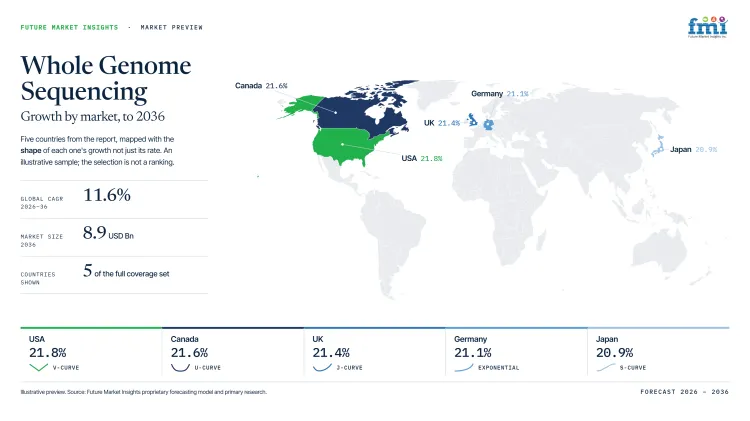
The profiled country CAGRs span 1.9 percentage points across five national forecasts and describe expansion pace without measuring current revenue or installed sequencing capacity.
- South Korea records the highest profiled CAGR at 23.1% as public rare-disease pathways widen access through designated medical institutions.
- The United States follows at 21.8% as federally funded implementation studies expand evidence across state screening networks.
- Canada reaches 21.6% as national sequencing programs coordinate regional genome centers through shared precision-health infrastructure and research access.
- The United Kingdom posts 21.4% as NHS laboratory hubs integrate whole genome sequencing into routine care pathways.
- Australia records 21.2% as national coordination supports genomics adoption across separate state health systems and distant service regions.
Comparable CAGRs can produce different market entry conditions. The full report provides country-level CAGR analysis across North America, Latin America, Europe, East Asia, South Asia and Pacific, and the Middle East and Africa.
Country-wise Analysis
- Adoption of whole genome sequencing in South Korea is estimated to expand at 23.1% CAGR through 2036, driven by wider public diagnostic support. National genomics programs are widening access through designated institutions beyond the largest regional referral centers nationwide. In April 2025, the Korea Disease Control and Prevention Agency doubled 2025 eligibility from 410 to 800 patients and expanded participating institutions from 23 to 34. Regional access improves as more hospitals join the pathway, although difficult cases still depend on centralized interpretation and specialist follow-up.
- By 2036, the United States is projected to grow at 21.8% CAGR, supported by federally funded newborn-screening studies. Current research is testing whether whole genome sequencing can fit state screening systems without weakening consent or follow-up procedures. In September 2025, the National Institutes of Health awarded the BEACONS initiative about USD 14.4 million over three years to study integration with public health laboratories and community partners. Separate reimbursement rules and uneven bioinformatics platforms can still delay confirmatory review for uncertain findings.
- The Canadian whole genome sequencing sector is projected to record 21.6% CAGR during the assessment period, aided by coordinated national data infrastructure. Precision medicine genomics depends on a dataset broad enough to represent provincial populations and support shared research access. Genome Canada launched the Canadian Precision Health Initiative in March 2025 to sequence more than 100,000 genomes across the country's diverse population. Provincial governance and specialist capacity remain uneven, which can slow routine clinical use outside major genome centers.
- The United Kingdom is estimated to post 21.4% CAGR over the forecast period, reinforced by routine NHS genomic testing. Clinical adoption already extends beyond research cohorts into rare-disease and cancer pathways across England's national health service. The Department of Health and Social Care reported in March 2026 that the service performs more than 870,000 genomic tests yearly. The same review stated that the service had sequenced more than 150,000 genomes by that date. Eligibility rules and specialist interpretation workloads can still lengthen complex diagnoses despite coordinated laboratory hubs and national data infrastructure.
- Whole genome sequencing sales in Australia are forecast to expand at 21.2% CAGR by 2036, influenced by national coordination across state health systems. Federal leadership is intended to move genomic research into consistent clinical practice across separate jurisdictions. In July 2025, the Australian Government launched Genomics Australia to lead national integration and update the National Health Genomics Policy Framework. Long travel distances and uneven regional sequencing services can still restrict access outside metropolitan hospitals and established genome centers throughout the country.
Who are the notable companies in the Whole Genome Sequencing Market?
Illumina, Thermo Fisher Scientific, BGI Genomics, QIAGEN, Oxford Nanopore Technologies, Roche, PacBio and Eurofins Scientific are the notable companies serving this market.
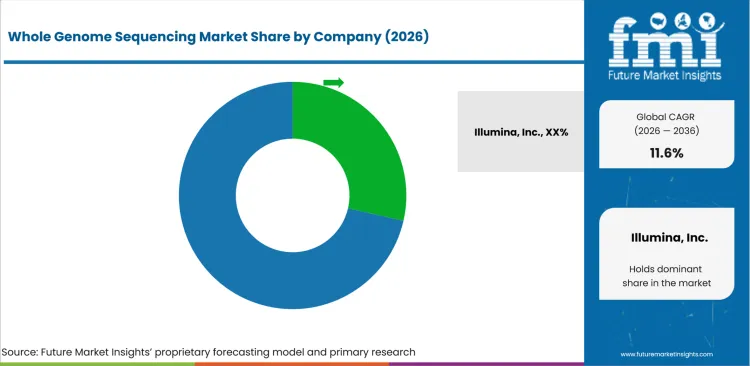
Whole genome sequencing remains concentrated around proprietary sequencing platforms, while preparation and laboratory services accommodate more specialized competitors. New platform entry requires reproducible chemistry, compatible analysis and enough service capacity for long cohort programs. Companies without proprietary sequencers compete through preparation, interpretation or outsourced production that fits established instrument environments.
- Illumina, BGI Genomics, Roche, Oxford Nanopore Technologies and PacBio compete through proprietary platforms designed for different read lengths, throughput levels and project sizes.
- Thermo Fisher Scientific and QIAGEN support established sequencers through sample preparation, library construction and genomic interpretation across research and clinical workflows.
- Eurofins Scientific competes through accredited laboratory capacity and outsourced genomic services for institutions without dedicated production infrastructure or specialist analysis teams.
Competitive Benchmarking: Whole Genome Sequencing Market
| Company | Production WGS platform | Workflow integration | Clinical and research support | Geographic Reach |
|---|---|---|---|---|
| Illumina | High | High | High | Global |
| Thermo Fisher Scientific | Low | Medium | Medium | Global |
| BGI Genomics | High | High | Medium | Asia and international markets |
| QIAGEN | Low | High | High | Global |
| Oxford Nanopore Technologies | High | High | Medium | Global |
| Roche | Medium | High | Medium | Global |
| PacBio | Medium | High | Medium | Global |
| Eurofins Scientific | Low | Medium | High | Europe, North America and Asia-Pacific |
Key Developments in the Whole Genome Sequencing Market
- In June 2026, Roche launched AXELIOS 1 for same-day research whole genome sequencing across flexible batch sizes using sequencing by expansion technology and integrated analysis tools. Its ability to process small studies or larger projects without changing systems strengthens Roche's position in research laboratories that need faster turnaround without committing every run to maximum capacity.
- In May 2026, Illumina introduced a distributed WGS solution for highly sensitive molecular residual disease research. The NovaSeq and DRAGEN workflow can complete analysis within five days and targets sensitivity as low as 10 parts per million. Local deployment gives oncology laboratories more control over serial testing while preserving a standardized analysis pathway across participating laboratories.
- In May 2026, PacBio began worldwide shipments of SPRQ-Nx chemistry and multi-use SMRT Cells for the Revio platform. The company reported a 30% sequencing-cost reduction against its previous SPRQ chemistry and a list price of USD 345 per genome. Lower consumable costs strengthen HiFi long-read use across population cohorts and complex disease studies on installed systems.
Key Players in the Whole Genome Sequencing Market
Sequencing Platform Providers
- Illumina, Inc.
- BGI Genomics Co., Ltd.
- Oxford Nanopore Technologies plc
- F. Hoffmann-La Roche Ltd.
- Pacific Biosciences of California, Inc.
Workflow and Interpretation Providers
- Thermo Fisher Scientific Inc.
- QIAGEN N.V.
Sequencing Service Providers
- Eurofins Scientific SE
Whole Genome Sequencing Market - Report Scope
| Coverage field | Report scope |
|---|---|
| Market breakdown | By Product & Service, Type, Workflow, Application, End User and Region. |
| Quantitative Units | Revenue in USD billion and CAGR in %. |
| Market Definition | Commercial whole genome sequencing platforms, consumables, analysis workflows and sequencing services used across research and clinical applications. |
| Regions Covered | North America, Latin America, Europe, East Asia, South Asia and Pacific, and Middle East and Africa. |
| Countries Covered | South Korea, United States, Canada, United Kingdom, Australia and 20+ countries included in the full report. |
| Key Companies Profiled | Illumina, Inc., Thermo Fisher Scientific Inc., BGI Genomics Co., Ltd., QIAGEN N.V., Oxford Nanopore Technologies plc, F. Hoffmann-La Roche Ltd., Pacific Biosciences of California, Inc. and Eurofins Scientific SE. |
| Forecast Period | 2026-2036. |
| Approach | Primary and secondary research with market triangulation. |
Whole Genome Sequencing Market - Research Methodology
| Method | Approach |
|---|---|
| Primary Research | FMI analysts gathered input from manufacturers, service providers, technology developers, distributors, end users, procurement teams, and subject-matter experts. Interviews examined purchasing decisions, product or service evaluation, adoption barriers, approval requirements, pricing considerations, and expectations for technical or commercial support. Respondents were also asked what evidence is required before a trial, pilot, or initial order develops into regular purchasing. |
| Desk Research | Desk research covered government statistics, regulatory publications, trade data, industry associations, technical literature, standards, company filings, product information, and official corporate announcements. Sources were reviewed for relevance, publication date, geographic coverage, and consistency with the defined market scope. Claims relating to performance, applications, approvals, capacity, investment, and commercial activity were retained only when supported by credible public evidence. |
| Market Sizing and Forecasting | The market model combined the baseline value with historical performance, segment structure, pricing and volume indicators, adoption levels, company participation, and country-level demand conditions. Forecast assumptions considered economic activity, investment trends, regulatory developments, technology adoption, purchasing cycles, supply availability, and barriers to wider market use. Segment and regional estimates were reconciled before the final market total was calculated. |
| Data Validation | Estimates were checked against multiple independent indicators, including public data, company activity, trade patterns, industry developments, and findings from primary interviews. Validation also tested whether products, services, applications, and company revenues fell within the defined market boundaries. Adjacent categories, unsupported claims, overlapping revenues, and activities without direct market relevance were excluded to reduce double counting and maintain consistency across segments and countries. |
Whole Genome Sequencing Market by Segments
Whole Genome Sequencing Market segmented by Product & Service:
- Consumables
- Library Preparation Kits
- Sequencing Reagents
- Instruments
- Short-Read Sequencers
- Long-Read Sequencers
- Services
- Sequencing Services
- Data Analysis Services
Whole Genome Sequencing Market segmented by Type:
- Large Whole Genome Sequencing
- Human Whole Genome Sequencing
- Animal & Plant Whole Genome Sequencing
- Small Whole Genome Sequencing
- Microbial Whole Genome Sequencing
- Small Genome Sequencing
Whole Genome Sequencing Market segmented by Workflow:
- Sequencing
- Short-Read Sequencing
- Long-Read Sequencing
- Data Analysis
- Sequence Alignment
- Variant Calling
- Sample Preparation
- DNA Extraction
- Library Preparation
Whole Genome Sequencing Market segmented by Application:
- Human Whole Genome Sequencing
- Clinical Diagnostics
- Precision Medicine
- Agricultural & Animal Research
- Plant Genomics
- Animal Genomics
- Microbial & Infectious Disease Research
- Pathogen Genomics
- Microbial Genomics
- Other Applications
- Forensic Genomics
- Environmental Genomics
Whole Genome Sequencing Market segmented by End User:
- Academic & Research Institutes
- Universities
- Government Research Institutes
- Pharmaceutical & Biotechnology Companies
- Drug Discovery
- Biopharmaceutical Research
- Hospitals & Clinics
- Clinical Genomics
- Diagnostic Laboratories
- Agricultural Research Organizations
- Forensic Laboratories
- Others
Whole Genome Sequencing Market by Region:
- North America
- United States
- Canada
- Mexico
- Latin America
- Brazil
- Chile
- Rest of Latin America
- Western Europe
- Germany
- United Kingdom
- Italy
- Spain
- France
- Nordics
- Benelux
- Rest of Western Europe
- Eastern Europe
- Russia
- Poland
- Hungary
- Balkan and Baltic States
- Rest of Eastern Europe
- East Asia
- China
- Japan
- South Korea
- South Asia and Pacific
- India
- ASEAN
- Australia and New Zealand
- Rest of South Asia and Pacific
- Middle East and Africa
- Kingdom of Saudi Arabia
- Other GCC Countries
- Türkiye
- South Africa
- Other African Union Countries
- Rest of Middle East and Africa
Research Sources and Bibliography
- National Institutes of Health. (2026, June 30). NIH's All of Us Research Program is now the largest integrated genomics and health database in the world.
- Genomics England Limited. (2025, March 6). Combined Sample Extraction and Whole Genome Sequencing.
- Genomics England Limited. (2025, June 13). Extension and variation of Whole Genome Sequencing Services contract.
- Oxford Nanopore Technologies plc. (2025, September 30). Oxford Nanopore launches a 24-hour whole genome sequencing workflow for rare disease research.
- QIAGEN N.V. (2025, January 7). QIAGEN Supports UK Initiative to Sequence Genomes of 100,000 Newborns With Expert-Curated Genomic Content.
- UK Health Security Agency. (2025, March 12). Whole genome sequencing service launched to tackle hepatitis C.
- Korea Disease Control and Prevention Agency. (2025, April 8). KDCA Launches Expanded Rare Disease Diagnostic Support Program in 2025.
- National Institutes of Health Common Fund. (2025, September 30). The NIH Venture Program Announces First Award for the NBSxWGS (BEACONS) Initiative.
- Genome Canada. (2025, March 5). Canada launches $200M genomics data initiative to drive precision health and economic growth.
- Department of Health and Social Care. (2026, March 5). Code on Genetic Testing and Insurance: 3-year review 2025.
- Australian Government Department of Health, Disability and Ageing. (2025, July 28). The Australian Government accelerates genomic medicine and research.
- Thermo Fisher Scientific Inc. (2026, February 26). Annual report on Form 10-K for the fiscal year ended December 31, 2025.
- BGI Genomics Co., Ltd. (2026, June 5). Nature Study Found WGS Detects 42% of Confirmed Disorders Missed by Routine Newborn Screening | Nature Health.
- Genomics England Limited. (2025, September 26). Long Read Sequencing - Babies in Focus.
- F. Hoffmann-La Roche Ltd. (2026, June 29). Roche announces the launch of AXELIOS 1, a transformative next-generation sequencing platform.
- Illumina, Inc. (2026, May 28). Illumina introduces the first distributed whole-genome sequencing solution for highly sensitive MRD research.
- Pacific Biosciences of California, Inc. (2026, May 26). PacBio SPRQ-Nx Chemistry Now Shipping Worldwide, Enabling Sub-$300 HiFi Genomes for Large Scale Projects and AI-Enhanced Sequencing.
This bibliography is provided for reader reference and is not exhaustive; the full report contains the complete reference list and detailed citations.
This Report Answers
- How large is the whole genome sequencing market in 2026 and 2036?
- Which operating conditions support whole genome sequencing demand across research and clinical programs?
- Which product and service segment accounts for the largest 2026 share?
- How do type and workflow choices affect whole genome sequencing project design?
- Which application category accounts for the largest 2026 share?
- How do national growth rates differ across the five profiled countries?
- Which companies provide sequencing platforms and connected laboratory services?
- How should institutions compare sequencing platforms, workflow tools and outsourced laboratory services?
Frequently Asked Questions
How big is the Whole Genome Sequencing Market in 2026?
The whole genome sequencing market is valued at USD 3.0 billion in 2026 across research and clinical applications worldwide. It is forecast to reach USD 8.9 billion by 2036 as national cohorts increase sequencing volume and require secure analysis capacity.
What is the CAGR of the Whole Genome Sequencing Market from 2026 to 2036?
The whole genome sequencing market is projected to expand at 11.6% CAGR between 2026 and 2036. Large population cohorts support this growth through recurring chemistry demand and dependable read generation across connected laboratories worldwide, while specialist teams manage secure interpretation throughout clinical networks.
Which segment is projected to account for 59.0% of the Whole Genome Sequencing Market?
Consumables account for an estimated 59.0% of the whole genome sequencing market's product and service category in 2026. Recurring extraction materials and library preparation kits support every validated run, while sequencing reagents sustain scheduled cohorts and long research programs worldwide.
How much will the Whole Genome Sequencing Market add between 2026 and 2036?
Around USD 5.9 billion is expected to be added to the whole genome sequencing market between 2026 and 2036. The additional value reflects expanding cohort volumes alongside recurring consumables, instrument use and secure interpretation services across national research and clinical programs.
Which companies are active in the Whole Genome Sequencing Market?
Companies active across the whole genome sequencing market include Illumina, Thermo Fisher Scientific, BGI Genomics, QIAGEN, Oxford Nanopore Technologies, Roche, PacBio and Eurofins Scientific. Their roles cover proprietary sequencing systems alongside preparation tools, interpretation software and outsourced laboratory services.
Preview the report firsthand - request a free sample
Get SampleGet the brochure for pricing and purchase details.
Get PDFTable of Content
- Key Takeaways
- Market Size and CAGR
- Top Growth Driver
- Fastest Growing Segment
- Leading Region
- Key Companies
- Emerging Opportunities
- Executive Summary
- Global Market Outlook
- Demand-side Trends
- Supply-side Trends
- Technology Roadmap Analysis
- Analysis and Recommendations
- Analyst Perspective (What is happening? Why now? What should investors know?)
- Key Questions Answered
- How large is the market?
- What is the CAGR?
- What are key trends?
- Which region dominates?
- Who are the leaders?
- Market Overview
- Market Coverage / Taxonomy
- Market Definition / Scope / Limitations
- Research Methodology
- Chapter Orientation
- Analytical Lens and Working Hypotheses
- Market Structure, Signals, and Trend Drivers
- Benchmarking and Cross-market Comparability
- Market Sizing, Forecasting, and Opportunity Mapping
- Research Design and Evidence Framework
- Desk Research Programme (Secondary Evidence)
- Expert Input and Fieldwork (Primary Evidence)
- Tooling, Models, and Reference Databases
- Data Engineering and Model Build
- Quality Assurance and Audit Trail
- Market Background
- Market Dynamics (Drivers, Restraints, Opportunity, Trends)
- Scenario Forecast (Optimistic, Likely, Conservative)
- Impact Analysis
- AI Impact
- Sustainability Impact
- Regulatory Impact
- Technology Impact
- Consumer / Buyer Analysis
- Purchase Drivers
- Adoption Barriers
- Buyer Journey
- Opportunity Map Analysis
- Product Life Cycle Analysis
- Supply Chain Analysis
- Investment Feasibility Matrix
- Value Chain Analysis
- PESTLE and Porter's Analysis
- Regulatory Landscape
- Regional Parent Market Outlook
- Production and Consumption Statistics
- Import and Export Statistics
- Global Market Analysis and Forecast, 2021 to 2036
- Historical Market Size Value (USD Billion) Analysis, 2021 to 2025
- Current and Future Market Size Value (USD Billion) Projections, 2026 to 2036
- Y-o-Y Growth Trend Analysis
- Absolute $ Opportunity Analysis
- Global Market Pricing Analysis, 2021 to 2036
- Global Market Analysis and Forecast, By Product & Service, 2021 to 2036
- Introduction / Key Findings
- Historical Market Size Value (USD Billion) Analysis By Product & Service, 2021 to 2025
- Current and Future Market Size Value (USD Billion) Analysis and Forecast By Product & Service, 2026 to 2036
- Consumables
- Library Preparation Kits
- Sequencing Reagents
- Instruments
- Short-Read Sequencers
- Long-Read Sequencers
- Services
- Sequencing Services
- Data Analysis Services
- Consumables
- Y-o-Y Growth Trend Analysis By Product & Service, 2021 to 2025
- Absolute $ Opportunity Analysis By Product & Service, 2026 to 2036
- Global Market Analysis and Forecast, By Type, 2021 to 2036
- Introduction / Key Findings
- Historical Market Size Value (USD Billion) Analysis By Type, 2021 to 2025
- Current and Future Market Size Value (USD Billion) Analysis and Forecast By Type, 2026 to 2036
- Large Whole Genome Sequencing
- Human Whole Genome Sequencing
- Animal & Plant Whole Genome Sequencing
- Small Whole Genome Sequencing
- Microbial Whole Genome Sequencing
- Small Genome Sequencing
- Large Whole Genome Sequencing
- Y-o-Y Growth Trend Analysis By Type, 2021 to 2025
- Absolute $ Opportunity Analysis By Type, 2026 to 2036
- Global Market Analysis and Forecast, By Workflow, 2021 to 2036
- Introduction / Key Findings
- Historical Market Size Value (USD Billion) Analysis By Workflow, 2021 to 2025
- Current and Future Market Size Value (USD Billion) Analysis and Forecast By Workflow, 2026 to 2036
- Sequencing
- Short-Read Sequencing
- Long-Read Sequencing
- Data Analysis
- Sequence Alignment
- Variant Calling
- Sample Preparation
- DNA Extraction
- Library Preparation
- Sequencing
- Y-o-Y Growth Trend Analysis By Workflow, 2021 to 2025
- Absolute $ Opportunity Analysis By Workflow, 2026 to 2036
- Global Market Analysis and Forecast, By Application, 2021 to 2036
- Introduction / Key Findings
- Historical Market Size Value (USD Billion) Analysis By Application, 2021 to 2025
- Current and Future Market Size Value (USD Billion) Analysis and Forecast By Application, 2026 to 2036
- Human Whole Genome Sequencing
- Clinical Diagnostics
- Precision Medicine
- Agricultural & Animal Research
- Plant Genomics
- Animal Genomics
- Microbial & Infectious Disease Research
- Pathogen Genomics
- Microbial Genomics
- Other Applications
- Forensic Genomics
- Environmental Genomics
- Human Whole Genome Sequencing
- Y-o-Y Growth Trend Analysis By Application, 2021 to 2025
- Absolute $ Opportunity Analysis By Application, 2026 to 2036
- Global Market Analysis and Forecast, By End User, 2021 to 2036
- Introduction / Key Findings
- Historical Market Size Value (USD Billion) Analysis By End User, 2021 to 2025
- Current and Future Market Size Value (USD Billion) Analysis and Forecast By End User, 2026 to 2036
- Academic & Research Institutes
- Universities
- Government Research Institutes
- Pharmaceutical & Biotechnology Companies
- Drug Discovery
- Biopharmaceutical Research
- Hospitals & Clinics
- Clinical Genomics
- Diagnostic Laboratories
- Others
- Agricultural Research Organizations
- Forensic Laboratories
- Academic & Research Institutes
- Y-o-Y Growth Trend Analysis By End User, 2021 to 2025
- Absolute $ Opportunity Analysis By End User, 2026 to 2036
- Global Market Analysis and Forecast, By Region, 2021 to 2036
- Introduction
- Historical Market Size Value (USD Billion) Analysis By Region, 2021 to 2025
- Current Market Size Value (USD Billion) Analysis and Forecast By Region, 2026 to 2036
- North America
- Latin America
- Western Europe
- Eastern Europe
- East Asia
- South Asia and Pacific
- Middle East & Africa
- Market Attractiveness Analysis By Region
- North America Market Analysis and Forecast, By Country, 2021 to 2036
- Historical Market Size Value (USD Billion) Trend Analysis By Market Taxonomy, 2021 to 2025
- Market Size Value (USD Billion) Forecast By Market Taxonomy, 2026 to 2036
- By Country
- USA
- Canada
- By Product & Service
- By Type
- By Workflow
- By Application
- By End User
- By Country
- Market Attractiveness Analysis
- By Country
- By Product & Service
- By Type
- By Workflow
- By Application
- By End User
- Key Takeaways
- Latin America Market Analysis and Forecast, By Country
- Historical Market Size Value (USD Billion) Trend Analysis By Market Taxonomy, 2021 to 2025
- Market Size Value (USD Billion) Forecast By Market Taxonomy, 2026 to 2036
- By Country
- Brazil
- Mexico
- Chile
- Rest of Latin America
- By Product & Service
- By Type
- By Workflow
- By Application
- By End User
- By Country
- Market Attractiveness Analysis
- By Country
- By Product & Service
- By Type
- By Workflow
- By Application
- By End User
- Key Takeaways
- Western Europe Market Analysis and Forecast, By Country
- Historical Market Size Value (USD Billion) Trend Analysis By Market Taxonomy, 2021 to 2025
- Market Size Value (USD Billion) Forecast By Market Taxonomy, 2026 to 2036
- By Country
- Germany
- UK
- Italy
- Spain
- France
- Nordic
- BENELUX
- Rest of Western Europe
- By Product & Service
- By Type
- By Workflow
- By Application
- By End User
- By Country
- Market Attractiveness Analysis
- By Country
- By Product & Service
- By Type
- By Workflow
- By Application
- By End User
- Key Takeaways
- Eastern Europe Market Analysis and Forecast, By Country
- Historical Market Size Value (USD Billion) Trend Analysis By Market Taxonomy, 2021 to 2025
- Market Size Value (USD Billion) Forecast By Market Taxonomy, 2026 to 2036
- By Country
- Russia
- Poland
- Hungary
- Balkan & Baltic
- Rest of Eastern Europe
- By Product & Service
- By Type
- By Workflow
- By Application
- By End User
- By Country
- Market Attractiveness Analysis
- By Country
- By Product & Service
- By Type
- By Workflow
- By Application
- By End User
- Key Takeaways
- East Asia Market Analysis and Forecast, By Country
- Historical Market Size Value (USD Billion) Trend Analysis By Market Taxonomy, 2021 to 2025
- Market Size Value (USD Billion) Forecast By Market Taxonomy, 2026 to 2036
- By Country
- China
- Japan
- South Korea
- By Product & Service
- By Type
- By Workflow
- By Application
- By End User
- By Country
- Market Attractiveness Analysis
- By Country
- By Product & Service
- By Type
- By Workflow
- By Application
- By End User
- Key Takeaways
- South Asia and Pacific Market Analysis and Forecast, By Country
- Historical Market Size Value (USD Billion) Trend Analysis By Market Taxonomy, 2021 to 2025
- Market Size Value (USD Billion) Forecast By Market Taxonomy, 2026 to 2036
- By Country
- India
- ASEAN
- Australia & New Zealand
- Rest of South Asia and Pacific
- By Product & Service
- By Type
- By Workflow
- By Application
- By End User
- By Country
- Market Attractiveness Analysis
- By Country
- By Product & Service
- By Type
- By Workflow
- By Application
- By End User
- Key Takeaways
- Middle East & Africa Market Analysis and Forecast, By Country
- Historical Market Size Value (USD Billion) Trend Analysis By Market Taxonomy, 2021 to 2025
- Market Size Value (USD Billion) Forecast By Market Taxonomy, 2026 to 2036
- By Country
- Kingdom of Saudi Arabia
- Other GCC Countries
- Türkiye
- South Africa
- Other African Union
- Rest of Middle East & Africa
- By Product & Service
- By Type
- By Workflow
- By Application
- By End User
- By Country
- Market Attractiveness Analysis
- By Country
- By Product & Service
- By Type
- By Workflow
- By Application
- By End User
- Key Takeaways
- Key Countries Market Analysis
- USA
- Pricing Analysis
- Market Share Analysis, 2025
- By Product & Service
- By Type
- By Workflow
- By Application
- By End User
- Canada
- Pricing Analysis
- Market Share Analysis, 2025
- By Product & Service
- By Type
- By Workflow
- By Application
- By End User
- Mexico
- Pricing Analysis
- Market Share Analysis, 2025
- By Product & Service
- By Type
- By Workflow
- By Application
- By End User
- Brazil
- Pricing Analysis
- Market Share Analysis, 2025
- By Product & Service
- By Type
- By Workflow
- By Application
- By End User
- Chile
- Pricing Analysis
- Market Share Analysis, 2025
- By Product & Service
- By Type
- By Workflow
- By Application
- By End User
- Germany
- Pricing Analysis
- Market Share Analysis, 2025
- By Product & Service
- By Type
- By Workflow
- By Application
- By End User
- UK
- Pricing Analysis
- Market Share Analysis, 2025
- By Product & Service
- By Type
- By Workflow
- By Application
- By End User
- Italy
- Pricing Analysis
- Market Share Analysis, 2025
- By Product & Service
- By Type
- By Workflow
- By Application
- By End User
- Spain
- Pricing Analysis
- Market Share Analysis, 2025
- By Product & Service
- By Type
- By Workflow
- By Application
- By End User
- France
- Pricing Analysis
- Market Share Analysis, 2025
- By Product & Service
- By Type
- By Workflow
- By Application
- By End User
- India
- Pricing Analysis
- Market Share Analysis, 2025
- By Product & Service
- By Type
- By Workflow
- By Application
- By End User
- ASEAN
- Pricing Analysis
- Market Share Analysis, 2025
- By Product & Service
- By Type
- By Workflow
- By Application
- By End User
- Australia & New Zealand
- Pricing Analysis
- Market Share Analysis, 2025
- By Product & Service
- By Type
- By Workflow
- By Application
- By End User
- China
- Pricing Analysis
- Market Share Analysis, 2025
- By Product & Service
- By Type
- By Workflow
- By Application
- By End User
- Japan
- Pricing Analysis
- Market Share Analysis, 2025
- By Product & Service
- By Type
- By Workflow
- By Application
- By End User
- South Korea
- Pricing Analysis
- Market Share Analysis, 2025
- By Product & Service
- By Type
- By Workflow
- By Application
- By End User
- Russia
- Pricing Analysis
- Market Share Analysis, 2025
- By Product & Service
- By Type
- By Workflow
- By Application
- By End User
- Poland
- Pricing Analysis
- Market Share Analysis, 2025
- By Product & Service
- By Type
- By Workflow
- By Application
- By End User
- Hungary
- Pricing Analysis
- Market Share Analysis, 2025
- By Product & Service
- By Type
- By Workflow
- By Application
- By End User
- Kingdom of Saudi Arabia
- Pricing Analysis
- Market Share Analysis, 2025
- By Product & Service
- By Type
- By Workflow
- By Application
- By End User
- Türkiye
- Pricing Analysis
- Market Share Analysis, 2025
- By Product & Service
- By Type
- By Workflow
- By Application
- By End User
- South Africa
- Pricing Analysis
- Market Share Analysis, 2025
- By Product & Service
- By Type
- By Workflow
- By Application
- By End User
- USA
- Market Structure Analysis
- Competition Dashboard
- Competition Benchmarking
- Market Share Analysis of Top Players
- By Regional
- By Product & Service
- By Type
- By Workflow
- By Application
- By End User
- Emerging Startups
- Innovation Benchmarking
- Competition Analysis
- Competition Deep Dive
- Illumina, Inc.
- Overview
- Product Portfolio
- Profitability by Market Segments
- Sales Footprint
- Strategy Overview
- Marketing Strategy
- Product Strategy
- Channel Strategy
- Thermo Fisher Scientific Inc.
- Danaher Corporation
- BGI Genomics Co., Ltd.
- QIAGEN N.V.
- Oxford Nanopore Technologies plc
- F. Hoffmann-La Roche Ltd.
- Pacific Biosciences of California, Inc.
- Eurofins Scientific
- Azenta, Inc.
- Others
- Illumina, Inc.
- Case Studies
- Success Stories
- Recent Developments
- Competition Deep Dive
- Assumptions & Acronyms Used


