

- Market Size (2026)
- USD 3.3 Bn
- Forecast (2036)
- USD 6.8 Bn
- CAGR (2026 to 2036)
- 7.5%
How big is Human Grade Pet Food Market in 2026?
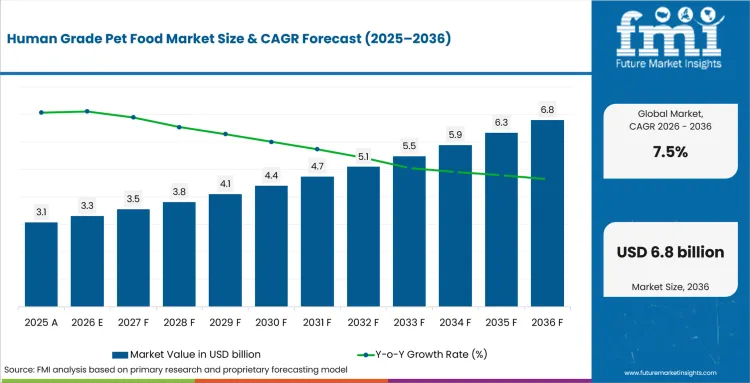
USD 3.3 billion in 2026 and USD 6.8 billion by 2036 at a 7.5% CAGR.
Sales of human grade pet food are estimated to rise at 7.5% CAGR through 2036, increasing valuation from USD 3.3 billion in 2026 to USD 6.8 billion by 2036. Complete dog or cat meals earn recurring revenue through documented human-food handling and prices that households accept across repeated purchases. APPA reported in June 2025 that 41% of dog owners and 38% of cat owners bought premium food during 2024. The premium-purchase figures identify a substantial audience but do not prove demand for every human grade recipe. Brands convert interest into repeat sales through clear ingredient records, dependable feeding results and manageable monthly costs. Packaged pet diets show how format choice and retail access shape recurring household volume.
United States commercialization requires federal label compliance and state registrations that can change launch timing across individual products. The FDA explained in February 2026 that animal food labels must carry a required statement of identity and accurate ingredient information. Qualifying handling standards for every ingredient and the finished product add a higher documentation burden to human grade claims. German expansion follows harmonized European feed rules but depends more heavily on specialty retail margins and distributor execution. Companies therefore need separate launch plans that address regulatory approval requirements and channel economics rather than relying on a single global route. Product loss can erase the premium earned from fresh or refrigerated listings without disciplined inventory rotation.
Key Takeaways of Human Grade Pet Food Market
- Documented human-food handling improves everyday feeding confidence and supports recurring revenue without making complete diets unaffordable for households.
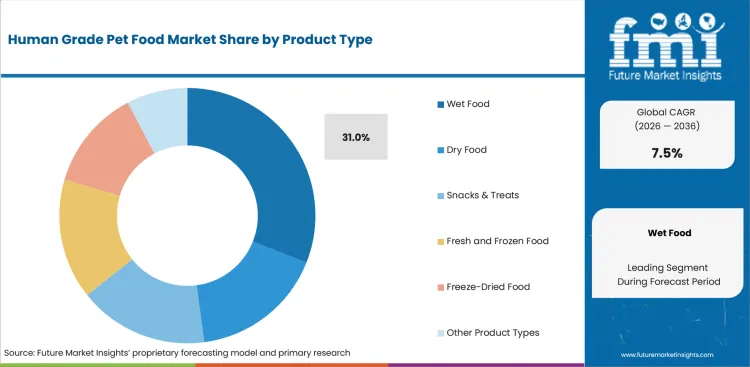
- By product type, wet food is expected to represent 31.0% in 2026 supported by familiar meal textures that encourage repeat feeding across several package formats.
- Dogs are projected to account for 64.0% by application in 2026 owing to larger daily portions and wider recipe needs across life stages.
- Within ingredient type, chicken-based recipes are forecast to capture 25.0% in 2026 through familiar flavor and flexible use across complete meal formats.
- Premium ingredient costs and strict claim documentation can slow expansion through higher delivered prices and more demanding regulatory review.
- Competition includes The Honest Kitchen, JustFoodForDogs, Ollie, The Farmer's Dog, Nom Nom, Spot & Tango, PetPlate, Raised Right, Full Moon, and Open Farm. Multi-format brands compete through retail breadth while subscription specialists compete through personalization and delivery reliability.
Analyst Perspective
"Human grade pet food creates value through ingredient standards that improve the everyday feeding decision rather than becoming a label premium by themselves. Strong businesses combine complete nutrition with formats that fit household storage and budget limits across regular feeding routines. Dependable repeat delivery then converts initial household interest into measurable retention across several purchase cycles. Growth therefore depends on earning a second purchase through practical convenience and trusted product performance."
- Nandini Roy Choudhury, Principal Analyst, Future Market Insights
How is the Human Grade Pet Food Market segmented?
The human grade pet food market is assessed by product type, application, ingredient type, end user, distribution channel, and region.
The market is segmented by product type, application, ingredient type, end user, distribution channel, and region. Product type separates wet, dry, fresh, frozen, freeze-dried, and treat formats by preparation and storage needs. Application distinguishes dogs, cats, rewards, functional feeding, and other companion animals across different feeding uses. Ingredient type records the primary protein or plant base used across complete meals and complementary products. End user identifies households, veterinary professionals, care businesses, breeders, shelters, and institutional users across distinct purchasing settings. Distribution channel separates specialty stores, online retail, direct delivery, chain stores, veterinary clinics, and smaller outlets. Regional analysis compares commercial routes under different labeling rules and distribution systems.
How does wet food shape demand in the product type category?
Wet food combines visible ingredients with moisture and portion formats that households already understand from conventional feeding routines. JustFoodForDogs compared JustFresh with Pantry Fresh and Fresh Frozen in February 2025 across several human grade meal formats. The comparison shows how wet meals can serve different storage needs without relying on traditional cans alone. Retailers gain broader choice within wet pet food assortments, but chilled versions require faster rotation and tighter temperature control at each sales point.
- By product type, wet food is estimated to hold 31.0% in 2026 owing to its use as a complete daily meal across cans and pouches alongside refrigerated portions. Familiar textures support household acceptance and varied package sizes help retailers serve several budgets during routine meal purchases. Recurring feeding volume supports the position more directly than occasional treats or narrow therapeutic purchases across smaller customer groups.
- Shelf-stable pouches let specialty retailers widen premium wet assortments without adding freezer capacity across every store. Smaller packs reduce waste during initial household trials and make price comparison easier across several premium options. Refrigerated products face a separate adoption barrier through shorter rotation windows and higher handling costs across individual stores.
What keeps dogs ahead within application?
Different body sizes and activity levels support wider human grade dog portfolios across recurring daily meals. The Honest Kitchen expanded its dog range with Protein Plus in April 2026 through human grade clusters and toppers designed for higher protein intake. The launch illustrates the commercial value of canine recipe specialization across complete meals and add-on formats. Air-dried dog food offers a practical storage route for households that lack capacity for chilled meal deliveries.
- Based on application, dogs are projected to account for 64.0% in 2026 due to larger daily food volumes and broader recipe needs across life stages. The segment supports recurring purchases across puppy, adult and senior feeding plans throughout the household relationship. Greater calorie requirements can raise order value but also increase the monthly cost burden for large-dog households.
- Weight and activity data support practical portion scheduling across recurring dog meal deliveries and favor subscription operators. Personalized pack sizes reduce household guesswork and help companies forecast recurring volume with less product waste. High freight and ingredient costs can make the calculated monthly plan difficult to maintain for larger animals.
Which buying mechanism supports chicken-based recipes in the ingredient type category?
Chicken-based recipes benefit from familiar taste and a mature protein supply that supports wet, dry and fresh formats. The FDA required covered dog and cat food manufacturers in January 2025 to reassess H5N1 hazards involving uncooked or unpasteurized poultry materials. The federal requirement makes poultry-source records and validated cooking controls commercially relevant across human grade production. Pet food ingredients strategies must therefore balance recipe familiarity with concentrated exposure to poultry safety and sourcing disruptions.
- The ingredient type category is forecast to be led by chicken-based recipes at 25.0% share in 2026, supported by familiar flavor and formulation flexibility. Manufacturers can use the protein across complete adult meals and puppy recipes without changing the core ingredient identity. Established sourcing supports several preservation methods and package formats across one coordinated commercial product portfolio.
- Manufacturers increasingly purchase chicken inputs through qualified programs that document source controls and processing requirements. Single-protein recipes give households a clear starting point during premium trials and simplify ingredient communication. Concentrated poultry exposure can raise testing costs or interrupt production across several recipes during disease events and seasonal sourcing disruptions.
What supports pet owners within the end user category?
Pet owners control repeat purchasing and judge ingredient transparency beside monthly feeding cost and animal acceptance. FEDIAF reported in June 2025 that 139 million European households owned at least one pet. The large household base creates broad trial potential but does not guarantee retention for premium meal plans. Fresh dog food subscriptions can simplify portions and delivery across recurring meal plans while retail packs support trials without recurring delivery commitments.
- Pet owners are set to lead the end user category with 43.0% share in 2026 due to direct responsibility for feeding choices and product switching. Household spending authority supports the position more directly than veterinary recommendation or institutional purchasing alone. Both retail and subscription routes leave renewal decisions with the person managing the animal's regular diet.
- Flexible pack sizes and delivery schedules reduce commitment during product trial and support wider pet-owner adoption. Clear feeding instructions help households compare daily cost instead of relying on package price alone. Portion waste or delivery interruptions can weaken confidence during the first recurring orders across premium feeding routines and household budgets.
Why do specialty pet stores lead the distribution channel category?
Specialty pet stores let households compare human grade formats with staff support during initial product selection. The Honest Kitchen reported in March 2026 that its revenue divided evenly between e-commerce and brick-and-mortar retail. The balanced channel mix shows why physical stores remain relevant even for brands with established direct sales. Pet treat ranges can lift basket value during the same visit without replacing complete meal demand.
- By distribution channel, specialty pet stores are forecast to represent 27.0% in 2026 driven by assisted product selection and curated premium assortments. Store staff can explain storage requirements and feeding formats during the household's first premium purchase. Higher-priced lines need sufficient product rotation to support wide shelf space and protect retailer margins.
- Specialty pet stores are drawing demand from households that want sampling and direct guidance across unfamiliar food formats. Ambient products expand assortment without using refrigerated space and support trial through smaller package sizes. Limited cooler capacity and tighter rotation requirements raise handling costs for chilled meals across individual outlets during normal operations.
What are the drivers, restraints, and opportunities in the Human Grade Pet Food Market?
Humanization and wider retail access support demand, while safety controls and premium costs limit expansion; shelf-stable complete meals create the clearest route to broader household trial.
- Driver: Wider retail access reduces the commitment required for households testing complete human grade meals outside recurring subscription plans.
- Restraint: Safety failures and high delivered costs can interrupt distribution and weaken trust across premium fresh or frozen portfolios.
- Opportunity: Shelf-stable complete meals can reach more stores and households without requiring refrigerated storage throughout the distribution route.
Broader retail access creates a direct growth mechanism by giving households a one-time purchase route beside subscription delivery. The Farmer's Dog announced in April 2026 that its human grade fresh meals became available nationwide through Walmart.com. The retail channel reduces trial commitment and places fresh meals beside familiar online shopping behavior across regular household purchases. Comparable freeze-dried products offer ambient convenience but address different storage and feeding requirements across premium households. Commercial value improves as retail trial converts into repeat orders at sustainable acquisition costs across several channels.
One affected batch can damage trust across a premium portfolio and create a material food-safety restraint. The FDA reported in September 2025 that two frozen dog food lots tested positive for Salmonella and Listeria monocytogenes. Frozen storage did not remove the hazard or eliminate the need for effective withdrawal records across every sales channel. Human grade companies therefore need validated preventive controls and rapid traceability across direct and retail channels. Wider distribution increases the financial exposure created by incomplete recall execution across multiple retail or delivery routes.
Shelf-stable complete meals create a practical opening for households that value ingredient standards but cannot manage frozen delivery. The Honest Kitchen unveiled Wholemade in October 2025 with human grade dehydrated recipes across puppy, adult and senior life stages. Rehydrated servings increase prepared volume without requiring households or retailers to allocate dedicated freezer space. Dehydrated pet meals can reach smaller stores that have limited space for refrigerated inventory. Commercial success depends on clear preparation instructions and consistent nutrition across repeated household feeding routines.
Which country CAGRs are profiled in the Human Grade Pet Food Market?
| Country | CAGR |
|---|---|
| Germany | 9.7% |
| Japan | 9.0% |
| Brazil | 8.6% |
| South Korea | 7.7% |
| UK | 6.2% |
| Canada | 5.8% |
| USA | 5.5% |
How do country-level CAGRs compare in the Human Grade Pet Food Market?
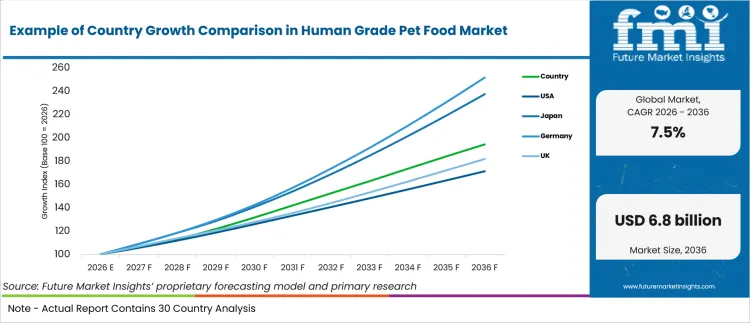
The country forecasts span 4.2 percentage points from Germany at 9.7% to the USA at 5.5%. Germany, Japan and Brazil form a closely grouped upper band within 1.1 percentage points across the approved forecasts. South Korea marks the transition between that band and the UK through a 1.5-point adjacent gap. The UK, Canada and the USA remain within 0.7 point despite different approval and distribution systems. Forecast spacing therefore compares market pace but cannot replace country-level review of label rules, channel costs and product logistics.
- Germany combines established pet-food retail with multichannel shopping, which supports premium assortment testing across stores and online platforms.
- Japan uses national notification and recordkeeping requirements that create a defined route for compliant manufacturers and importers.
- Brazil combines domestic pet-food production with updated ingredient-safety requirements that govern commercial dog and cat foods. Local manufacturing can reduce import exposure across several product formats and regional retail distribution routes.
- South Korea pairs dense e-commerce infrastructure with a large household pet base, which supports targeted subscription trials in metropolitan areas. Rapid price comparison and Korean labeling work can weaken margins across imported premium products during commercial launch.
- The United Kingdom provides a formal approval route for businesses using animal by-products in pet-food production. Defined requirements improve planning certainty, but certification expense can limit smaller product portfolios entering national distribution.
- Canada offers established cross-border supply from the United States under documented animal-health and shipping requirements. Long delivery distances increase the commercial value of shelf-stable formats outside major metropolitan retail areas.
- The USA combines broad retail access with mature direct-delivery infrastructure across several premium feeding categories. State registration differences and high acquisition costs require separate launch economics across each commercial channel.
Regulatory work and delivery costs shape the addressable customer base and can produce different returns across comparable forecasts. Country selection should therefore combine forecast pace with the practical cost of compliant distribution across each route. The full report provides country-level CAGR analysis across North America, Latin America, Europe, East Asia, South Asia, Oceania and the Middle East and Africa.
Country-wise Analysis
- Germany combines mature specialty retail with national feed rules that demand accurate labels and documented ingredients. Human grade pet food demand in Germany is forecast to rise at 9.7% CAGR over the forecast period, supported by multichannel purchasing and established pet-food spending. ZZF reported in April 2026 that 61% of German pet owners purchased through stores and online channels during 2025. The channel mix enables brands to test premium products through several household purchase routes and assortment sizes. New listings must win share within a stable category amid falling wet and dry dog-food sales. Shelf-stable formats can protect margins by reducing refrigerated handling across smaller retail locations and longer distributor routes.
- Japan requires manufacturers and importers to notify authorities and preserve records under the Pet Food Safety Act. Compact homes and dense parcel networks favor portioned meal products that limit freezer space across urban households. Human grade pet food sales in Japan are forecast to expand at 9.0% CAGR by 2036, influenced by careful quality review and urban delivery access. MAFF guidance updated in July 2026 confirms notification duties and recordkeeping obligations for businesses covered by the law. Clear national rules provide an adoption enabler for companies that prepare compliant Japanese labels and importer documentation. Local-language support and import coordination remain material frictions that can extend national launch schedules for foreign brands. Shelf-stable pouches can reduce storage pressure across households and smaller urban retail stores during weekly purchasing routines.
- Brazil has a large domestic pet-food production base but premium fresh products face high delivery and tax burdens. In Brazil, human grade pet food demand is predicted to advance at 8.6% CAGR through 2036 owing to local manufacturing and broad retail coverage. Domestic production gives brands a practical route to reduce import exposure and adapt package sizes for local budgets. Refrigerated distribution remains difficult across long national routes and warmer regions that require stronger temperature control. The Federal Council of Veterinary Medicine reported in November 2025 that MAPA established maximum mycotoxin limits for dog and cat foods with effect from July 2026. The regulation raises testing and source-control requirements for grain-based recipes across regulated domestic manufacturing operations. Companies can improve adoption through ambient formats that protect ingredient claims without adding a complete cold chain.
- South Korea combines dense e-commerce infrastructure with short urban delivery routes that support scheduled meal shipments. Digital channels help newer brands reach households without building extensive physical store networks across metropolitan areas. By 2036, South Korea's human grade pet food market is projected to grow at 7.7% CAGR due to concentrated demand and frequent online purchasing. MAFRA reported in February 2026 that 29.2% of households owned pets during the national survey period. The household base supports subscription trials and targeted digital marketing across concentrated urban service areas. Imported products face a material friction through Korean labeling work and rapid online price comparison. Brands need local customer support and smaller recurring packs to protect retention beyond the introductory order.
- The United Kingdom requires formal approvals for pet-food operations that use animal by-products in commercial production. The UK human grade pet food market is estimated to post 6.2% CAGR over the forecast period, shaped by premium retail demand and rigorous manufacturing controls. Established specialty chains provide an adoption route for ambient and chilled formats with clear feeding instructions. GOV.UK guidance updated in March 2026 states that affected businesses need APHA approval and local authority registration. The defined process improves regulatory predictability for compliant facilities entering established national pet-food distribution channels. Approval costs and imported ingredient paperwork create material frictions for smaller brands entering the country. Companies can reduce launch risk through limited assortments that match available cold storage and retailer rotation capacity.
- Canada combines major-city premium retail access with long national distribution routes and controlled animal-product imports. Shelf-stable products gain a practical advantage outside metropolitan areas through lower temperature-sensitive delivery expense across longer routes. The Canadian human grade pet food sector is projected to record 5.8% CAGR during the assessment period, linked to transparent ingredients and established cross-border trade. Refrigerated freight remains a material barrier across smaller cities and remote markets with limited delivery density. CFIA guidance effective in January 2025 states that eligible United States pet-food shipments require a shipping document and USDA APHIS zoosanitary certificate. The simplified documentation route supports compliant cross-border supply through established North American transport and distribution networks. Companies need regional inventory plans that prevent long service distances from weakening product freshness or retailer margins.
- The United States offers mature direct-delivery infrastructure and broad premium retail coverage across most metropolitan areas. Adoption of human grade pet food in the USA is estimated to expand at 5.5% CAGR through 2036, supported by recurring delivery and wider retail availability. APPA reported in July 2026 that 71 million households owned dogs during 2025 and 19% of dog owners purchased human grade food. The figures provide direct evidence of an established customer base within the named food category. State registration differences and high customer-acquisition costs remain material frictions for profitable national channel expansion. Established fulfillment networks enable personalized portion plans but profitability depends on retention beyond promotional first orders. Brands need separate state and channel plans instead of one nationwide launch assumption across every route.
Who are the notable companies in the Human Grade Pet Food Market?
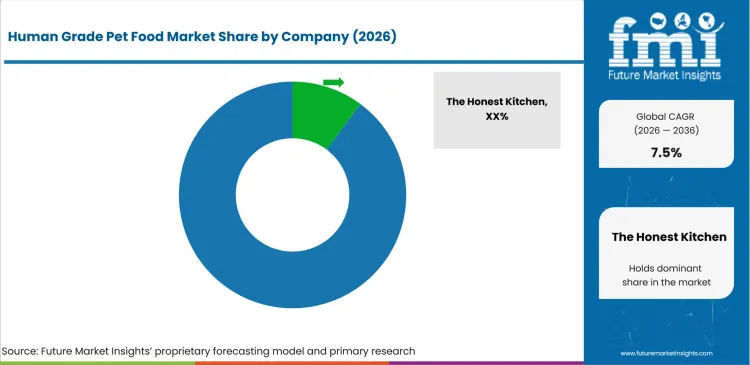
The human grade pet food competitive set includes The Honest Kitchen, JustFoodForDogs, Ollie, The Farmer's Dog, Nom Nom, Spot & Tango, PetPlate, Raised Right, Full Moon, and Open Farm. The Honest Kitchen is estimated to hold 10.2% share in 2026.
Competition separates multi-format brands from subscription specialists and focused premium providers across distinct household routines. Ollie explained in June 2026 that its products were available through direct delivery and selected Petco stores across the United States. The retail route demonstrates how a subscription brand can add product trial without abandoning a personalized meal plan. The Honest Kitchen and Open Farm compete through wider retail assortments across specialty and online channels. JustFoodForDogs combines physical kitchens with delivery across several complete meal formats and different household routines. Focused providers can use freeze-dried pet food to serve households seeking ambient convenience across travel or storage constraints. Company selection therefore depends on complete nutrition, delivery reliability and repeat pricing rather than brand recognition alone.
- Established multi-format brands include The Honest Kitchen, JustFoodForDogs and Ollie across fresh or shelf-stable meal formats. Their wider assortments support household choice but require consistent claim records and detailed feeding guidance across channels. Retail breadth creates value through dependable product rotation that protects premium margins across individual locations.
- Direct-delivery specialists include The Farmer's Dog, Nom Nom, Spot & Tango and PetPlate across personalized meal programs. Their recurring models provide detailed household demand data and predictable shipment schedules across service areas. Delivery disruption or price sensitivity can quickly reduce long-term customer value and make retention the decisive commercial test.
- Focused participants include Raised Right, Full Moon and Open Farm across frozen meals, ambient foods and premium treats. Their narrower offers can reach distinct household needs through specialty retail or direct delivery routes. Commercial expansion depends on matching format strengths with suitable storage and replenishment requirements across each channel.
Competitive Benchmarking: Human Grade Pet Food Market
| Company | Fresh Meal Coverage | Shelf-Stable Meal Coverage | Recurring Direct Delivery | Geographic Reach |
|---|---|---|---|---|
| The Honest Kitchen | Low | High | Medium | United States |
| JustFoodForDogs | High | High | High | United States nationwide |
| Ollie | High | Medium | High | Contiguous United States |
| The Farmer's Dog | High | Low | High | Contiguous United States |
| Nom Nom | High | Low | High | Lower 48 United States |
| Spot & Tango | Medium | High | High | Contiguous United States |
| PetPlate | High | Medium | High | United States and USA territories |
| Raised Right | High | High | High | United States direct delivery |
Key Developments in the Human Grade Pet Food Market
- In September 2025, The Honest Kitchen launched Essential Clusters across three dog food recipes and positioned the line as an accessible entry into human grade dry nutrition. Distribution covered independent pet stores and major retail chains alongside established online channels across the United States. The launch expanded price coverage and retained documented human-food ingredient and manufacturing claims across the new range.
- In May 2025, The Farmer's Dog announced an additional USD 10 million investment in veterinary research covering nutrition residencies and clinical studies. The company linked the commitment with a program announced during March 2025 for long-term evidence development. The investment strengthens scientific positioning around complete fresh diets and can improve confidence among veterinary audiences.
- In July 2025, Open Farm launched Freshly Crafted through gently cooked pouches and rolls across several complete dog recipes. The line included grain-free and grain-inclusive options plus a puppy formula within a personalized meal-plan route. The launch extended the company's human grade portfolio across wet formats that support portion control and direct delivery.
- In March 2026, Full Moon introduced Jerky Minis as small-dog treats made with human grade chicken or beef. The company stated that the products reached its website and selected national retailers with wider marketplace availability scheduled during April. The launch added a size-specific treat format to an established premium portfolio across retail and direct channels.
Key Players in the Human Grade Pet Food Market
Established Brands and Networks
- The Honest Kitchen
- JustFoodForDogs
- Ollie
Digital and Direct-to-Consumer Participants
- The Farmer's Dog
- Nom Nom
- Spot & Tango
- PetPlate
Specialist and Regional Providers
- Raised Right
- Full Moon
- Open Farm
Human Grade Pet Food Market - Report Scope
| Coverage field | Report scope |
|---|---|
| Market breakdown | Product type, application, ingredient type, end user, distribution channel, and region. |
| Quantitative Units | Revenue in USD Billion, CAGR in %. |
| Market Definition | Commercial dog and cat food represented as human grade through qualifying ingredients and manufacturing controls across fresh, wet, frozen, dried, and shelf-stable formats. |
| Regions Covered | North America, Latin America, Western Europe, Eastern Europe, East Asia, South Asia and Pacific, and Middle East and Africa. |
| Countries Covered | Germany, Japan, Brazil, South Korea, UK, Canada, and USA. |
| Key Companies Profiled | The Honest Kitchen, JustFoodForDogs, Ollie, The Farmer's Dog, Nom Nom, Spot & Tango, PetPlate, Raised Right, Full Moon, and Open Farm. |
| Forecast Period | 2026 to 2036. |
| Approach | Data triangulation combining segment-level analysis, country demand conditions, company benchmarking, regulatory requirements, pricing dynamics, product availability, and recurring consumer purchasing patterns. |
Human Grade Pet Food Market - Research Methodology
| Method | Approach |
|---|---|
| Primary Research | FMI analysts gathered input from manufacturers, service providers, technology developers, distributors, end users, procurement teams, and subject-matter experts. Interviews examined purchasing decisions, product or service evaluation, adoption barriers, approval requirements, pricing considerations, and expectations for technical or commercial support. Respondents were also asked what evidence is required before a trial, pilot, or initial order develops into regular purchasing. |
| Desk Research | Desk research covered government statistics, regulatory publications, trade data, industry associations, technical literature, standards, company filings, product information, and official corporate announcements. Sources were reviewed for relevance, publication date, geographic coverage, and consistency with the defined market scope. Claims relating to performance, applications, approvals, capacity, investment, and commercial activity were retained only when supported by credible public evidence. |
| Market Sizing and Forecasting | The market model combined the baseline value with historical performance, segment structure, pricing and volume indicators, adoption levels, company participation, and country-level demand conditions. Forecast assumptions considered economic activity, investment trends, regulatory developments, technology adoption, purchasing cycles, supply availability, and barriers to wider market use. Segment and regional estimates were reconciled before the final market total was calculated. |
| Data Validation | Estimates were checked against multiple independent indicators, including public data, company activity, trade patterns, industry developments, and findings from primary interviews. Validation also tested whether products, services, applications, and company revenues fell within the defined market boundaries. Adjacent categories, unsupported claims, overlapping revenues, and activities without direct market relevance were excluded to reduce double counting and maintain consistency across segments and countries. |
Human Grade Pet Food Market by Segments
Human Grade Pet Food Market segmented by Product Type:
- Wet Food
- Canned Wet Food
- Fresh Refrigerated Wet Food
- Dry Food
- Human-Grade Kibble
- Dehydrated Dry Food
- Snacks & Treats
- Baked Treats
- Freeze-Dried Treats
- Fresh and Frozen Food
- Fresh Prepared Meals
- Frozen Prepared Meals
- Freeze-Dried Food
- Freeze-Dried Complete Meals
- Freeze-Dried Toppers
- Other Product Types
- Meal Toppers
- Broths and Supplements
Human Grade Pet Food Market segmented by Application:
- Dogs
- Adult Dogs
- Puppies
- Cats
- Adult Cats
- Kittens
- Treats and Rewards
- Training Treats
- Dental and Functional Treats
- Dietary and Functional Nutrition
- Sensitive Digestion
- Weight Management
- Other Companion Pets
- Rabbits and Small Mammals
- Other Companion Animals
Human Grade Pet Food Market segmented by Ingredient Type:
- Chicken-Based
- Chicken
- Turkey
- Beef-Based
- Beef
- Lamb
- Fish-Based
- Salmon
- White Fish
- Plant-Based
- Vegetables
- Legumes and Grains
- Poultry and Novel Proteins
- Duck
- Rabbit
- Mixed Protein Formulations
- Multi-Protein Recipes
- Protein Blends
Human Grade Pet Food Market segmented by End User:
- Pet Owners
- Dog Owners
- Cat Owners
- Veterinary Professionals
- Veterinary Clinics
- Veterinary Nutritionists
- Pet Care and Boarding Businesses
- Pet Boarding Facilities
- Pet Daycare and Grooming Businesses
- Breeders and Professional Pet Handlers
- Dog Breeders
- Cat Breeders
- Animal Shelters and Rescue Organizations
- Animal Shelters
- Rescue Organizations
- Other Institutional Users
- Pet Training Centers
- Animal Welfare Organizations
Human Grade Pet Food Market segmented by Distribution Channel:
- Specialty Pet Stores
- Independent Pet Stores
- Specialty Pet Superstores
- Online Retail
- Brand-Owned Online Stores
- Online Marketplaces
- Direct-to-Consumer Delivery
- Subscription Meal Delivery
- Direct Fresh Food Delivery
- Chain Stores
- Pet Store Chains
- Supermarket and Hypermarket Chains
- Veterinary Clinics
- Veterinary Practice Retail
- Veterinary Hospital Retail
- Other Channels
- Pet Boutiques
- Pet Grooming and Boarding Outlets
Human Grade Pet Food Market by Region:
- North America
- United States
- Canada
- Europe
- Germany
- United Kingdom
- France
- Italy
- Spain
- Asia Pacific
- India
- China
- Japan
- South Korea
- Australia
- Latin America
- Brazil
- Argentina
- Mexico
- Chile
- Middle East & Africa
- UAE
- Saudi Arabia
- South Africa
Research Sources and Bibliography
- American Pet Products Association. (2025, June 24). The American Pet Products Association (APPA) releases 2025 Dog & Cat Report, revealing a new era of pet ownership.
- American Pet Products Association. (2026, July 22). America's dog owners are becoming smarter spenders: New APPA report reveals how 71 million households are prioritizing their pets in a tight economy.
- Canadian Food Inspection Agency. (2025, January 21). Update: Simplified documentation requirements for pet food products from the United States.
- Conselho Federal de Medicina Veterinária. (2025, November 14). Mapa regulamenta limites de micotoxinas em alimentos para cães e gatos.
- European Pet Food Industry Federation. (2025, June 12). FEDIAF publishes 2025 facts and figures.
- Full Moon. (2026, March 2). Full Moon introduces Jerky Minis: Purpose-built treats for small dogs.
- Government of the United Kingdom. (2026, March 3). Using animal by-products to make pet food.
- JustFoodForDogs. (2025, February 27). JustFresh vs. Pantry Fresh vs. Fresh Frozen.
- Ministry of Agriculture, Food and Rural Affairs. (2026, February 12).
- Ministry of Agriculture, Forestry and Fisheries. (2026, July 1).
- Ollie. (2026, June 24). Where can I buy fresh dog food near me?
- Open Farm. (2025, July 30). Why pet parents everywhere are making the switch to Freshly Crafted dog food.
- The Farmer's Dog. (2025, May 22). The Farmer's Dog announces additional USD 10 million investment in veterinary research.
- The Farmer's Dog. (2026, April 6). You can now buy The Farmer's Dog food at Walmart.com.
- The Honest Kitchen. (2025, September 9). The most affordable way to upgrade to human grade: The Honest Kitchen launches Essential Clusters.
- The Honest Kitchen. (2025, October 1). The Honest Kitchen unveils Wholemade: Refreshed dehydrated dog food line extends across all life stages.
- The Honest Kitchen. (2026, March 5). She lobbied the FDA to redefine pet food. Here's what happened next.
- The Honest Kitchen. (2026, April 6). The Honest Kitchen expands premium dry dog food line with new Protein Plus collection.
- USA Food and Drug Administration. (2025, January 17). Cat and dog food manufacturers required to consider H5N1 in food safety plans.
- USA Food and Drug Administration. (2025, September 24). FDA advisory: Do not feed two lots of Darwin's Natural Pet Products BioLogics dog food due to Salmonella and Listeria monocytogenes.
- USA Food and Drug Administration. (2026, February). Animal food labeling and pet food claims.
- ZZF - Zentralverband der Heimtierbranche e.V. (2026, April 23). Der deutsche Heimtiermarkt 2025.
- JustFoodForDogs. (2026). JustFoodForDogs: Fresh dog food, proven healthy.
- JustFoodForDogs. (2026). Pantry Fresh shelf-stable dog food topper.
- Nom Nom. (2025, December 19). Understanding Nom Nom trial.
- Nom Nom. (2026). Real, good food for dogs.
- Ollie. (2025, August 26). How is fresh dog food made?
- Ollie. (2026). Baked food for dogs.
- Ollie. (2026). How our custom dog food plan works.
- PetPlate. (2025, November 21). PetPlate: Terms & conditions.
- PetPlate. (2026). PetPlate: Fresh dog food delivery.
- Raised Right. (2026). Human grade dog food recipes.
- Raised Right. (2026). Air dried dog food recipes.
- Raised Right. (2026). Dog food calculator: Custom meal plan.
- Spot & Tango. (2026). Meet UnKibble: Fresh dry dog food without refrigeration.
- The Farmer's Dog. (2026). Fresh dog food recipes.
- The Honest Kitchen. (2026). Shop dog food, treats, and toppers.
This bibliography is provided for reader reference and is not exhaustive. The full report contains the complete reference list and detailed citations
This Report Answers
- How does the market progress from USD 3.3 billion in 2026 to USD 6.8 billion by 2036 at 7.5% CAGR?
- Which product formats convert human grade positioning into repeat household purchases across retail and direct delivery channels?
- How do claim documentation and food safety controls affect launch timing for fresh or shelf-stable product portfolios?
- Why do wet food and dogs hold the stated shares within their respective segmentation categories during 2026?
- Which country conditions explain the growth outlook through 2036?
- How do established brands and subscription specialists differ across meal breadth or recurring delivery capability?
- Which company developments changed price access and fresh-format choice during 2025 and early 2026?
- What regulatory or distribution frictions can reduce returns from premium ingredient and cold-chain investments?
- Which operational measures should management track across retention and safety or inventory rotation performance?
Frequently Asked Questions
How big is the Human Grade Pet Food Market in 2026?
The human grade pet food market is valued at USD 3.3 billion in 2026 and is forecast to reach USD 6.8 billion by 2036. Growth is supported by rising premium pet food purchasing, with 41% of dog owners and 38% of cat owners buying premium food during 2024 across established retail and direct delivery channels worldwide.
What is the CAGR of the Human Grade Pet Food Market from 2026 to 2036?
The human grade pet food market grows at a CAGR of 7.5% between 2026 and 2036, supported by brands converting household interest into repeat purchases through clear ingredient records, dependable feeding results, and manageable monthly costs across wet, fresh, freeze-dried, and shelf-stable complete meal formats.
Which product type leads the Human Grade Pet Food Market?
Wet food accounts for 31.0% of the human grade pet food market by product type in 2026, driven by familiar meal textures and varied package sizes that support household acceptance and encourage repeat feeding across cans, pouches, and refrigerated portion formats throughout routine pet meal purchasing.
How much will the Human Grade Pet Food Market add between 2026 and 2036?
The human grade pet food market is set to add USD 3.5 billion between 2026 and 2036, growing from USD 3.3 billion to USD 6.8 billion as documented human-food handling standards and shelf-stable complete meal formats enter funded retail and direct delivery pathways across a widening base of premium household pet feeding programs.
Who are the leading companies in the Human Grade Pet Food Market?
Five companies lead the human grade pet food market, including The Honest Kitchen, JustFoodForDogs, Ollie, The Farmer's Dog, and Nom Nom, competing through multi-format retail assortments, personalized direct delivery programs, fresh and shelf-stable complete meal portfolios, and recurring subscription plans across premium dog and cat feeding programs worldwide.
Preview the report firsthand - request a free sample
Get SampleGet the brochure for pricing and purchase details.
Get PDFTable of Content
- Key Takeaways
- Market Size and CAGR
- Top Growth Driver
- Fastest Growing Segment
- Leading Region
- Key Companies
- Emerging Opportunities
- Executive Summary
- Global Market Outlook
- Demand-side Trends
- Supply-side Trends
- Technology Roadmap Analysis
- Analysis and Recommendations
- Analyst Perspective (What is happening? Why now? What should investors know?)
- Key Questions Answered
- How large is the market?
- What is the CAGR?
- What are key trends?
- Which region dominates?
- Who are the leaders?
- Market Overview
- Market Coverage / Taxonomy
- Market Definition / Scope / Limitations
- Research Methodology
- Chapter Orientation
- Analytical Lens and Working Hypotheses
- Market Structure, Signals, and Trend Drivers
- Benchmarking and Cross-market Comparability
- Market Sizing, Forecasting, and Opportunity Mapping
- Research Design and Evidence Framework
- Desk Research Programme (Secondary Evidence)
- Expert Input and Fieldwork (Primary Evidence)
- Tooling, Models, and Reference Databases
- Data Engineering and Model Build
- Quality Assurance and Audit Trail
- Market Background
- Market Dynamics (Drivers, Restraints, Opportunity, Trends)
- Scenario Forecast (Optimistic, Likely, Conservative)
- Impact Analysis
- AI Impact
- Sustainability Impact
- Regulatory Impact
- Technology Impact
- Consumer / Buyer Analysis
- Purchase Drivers
- Adoption Barriers
- Buyer Journey
- Opportunity Map Analysis
- Product Life Cycle Analysis
- Supply Chain Analysis
- Investment Feasibility Matrix
- Value Chain Analysis
- PESTLE and Porter's Analysis
- Regulatory Landscape
- Regional Parent Market Outlook
- Production and Consumption Statistics
- Import and Export Statistics
- Global Market Analysis and Forecast, 2021 to 2036
- Historical Market Size Value (USD billion) Analysis, 2021 to 2025
- Current and Future Market Size Value (USD billion) Projections, 2026 to 2036
- Y-o-Y Growth Trend Analysis
- Absolute $ Opportunity Analysis
- Global Market Pricing Analysis, 2021 to 2036
- Global Market Analysis and Forecast, By Product Type, 2021 to 2036
- Introduction / Key Findings
- Historical Market Size Value (USD billion) Analysis By Product Type, 2021 to 2025
- Current and Future Market Size Value (USD billion) Analysis and Forecast By Product Type, 2026 to 2036
- Wet Food
- Canned Wet Food
- Fresh Refrigerated Wet Food
- Dry Food
- Human-Grade Kibble
- Dehydrated Dry Food
- Snacks & Treats
- Baked Treats
- Freeze-Dried Treats
- Fresh and Frozen Food
- Fresh Prepared Meals
- Frozen Prepared Meals
- Freeze-Dried Food
- Freeze-Dried Complete Meals
- Freeze-Dried Toppers
- Other Product Types
- Meal Toppers
- Broths and Supplements
- Wet Food
- Y-o-Y Growth Trend Analysis By Product Type, 2021 to 2025
- Absolute $ Opportunity Analysis By Product Type, 2026 to 2036
- Global Market Analysis and Forecast, By Application, 2021 to 2036
- Introduction / Key Findings
- Historical Market Size Value (USD billion) Analysis By Application, 2021 to 2025
- Current and Future Market Size Value (USD billion) Analysis and Forecast By Application, 2026 to 2036
- Dogs
- Adult Dogs
- Puppies
- Cats
- Adult Cats
- Kittens
- Treats and Rewards
- Training Treats
- Dental and Functional Treats
- Dietary and Functional Nutrition
- Sensitive Digestion
- Weight Management
- Other Companion Pets
- Rabbits and Small Mammals
- Other Companion Animals
- Dogs
- Y-o-Y Growth Trend Analysis By Application, 2021 to 2025
- Absolute $ Opportunity Analysis By Application, 2026 to 2036
- Global Market Analysis and Forecast, By Ingredient Type, 2021 to 2036
- Introduction / Key Findings
- Historical Market Size Value (USD billion) Analysis By Ingredient Type, 2021 to 2025
- Current and Future Market Size Value (USD billion) Analysis and Forecast By Ingredient Type, 2026 to 2036
- Chicken-Based
- Chicken
- Turkey
- Beef-Based
- Beef
- Lamb
- Fish-Based
- Salmon
- White Fish
- Plant-Based
- Vegetables
- Legumes and Grains
- Poultry and Novel Proteins
- Duck
- Rabbit
- Mixed Protein Formulations
- Multi-Protein Recipes
- Protein Blends
- Chicken-Based
- Y-o-Y Growth Trend Analysis By Ingredient Type, 2021 to 2025
- Absolute $ Opportunity Analysis By Ingredient Type, 2026 to 2036
- Global Market Analysis and Forecast, By End User, 2021 to 2036
- Introduction / Key Findings
- Historical Market Size Value (USD billion) Analysis By End User, 2021 to 2025
- Current and Future Market Size Value (USD billion) Analysis and Forecast By End User, 2026 to 2036
- Pet Owners
- Dog Owners
- Cat Owners
- Veterinary Professionals
- Veterinary Clinics
- Veterinary Nutritionists
- Pet Care and Boarding Businesses
- Pet Boarding Facilities
- Pet Daycare and Grooming Businesses
- Breeders and Professional Pet Handlers
- Dog Breeders
- Cat Breeders
- Animal Shelters and Rescue Organizations
- Animal Shelters
- Rescue Organizations
- Other Institutional Users
- Pet Training Centers
- Animal Welfare Organizations
- Pet Owners
- Y-o-Y Growth Trend Analysis By End User, 2021 to 2025
- Absolute $ Opportunity Analysis By End User, 2026 to 2036
- Global Market Analysis and Forecast, By Distribution Channel, 2021 to 2036
- Introduction / Key Findings
- Historical Market Size Value (USD billion) Analysis By Distribution Channel, 2021 to 2025
- Current and Future Market Size Value (USD billion) Analysis and Forecast By Distribution Channel, 2026 to 2036
- Specialty Pet Stores
- Independent Pet Stores
- Specialty Pet Superstores
- Online Retail
- Brand-Owned Online Stores
- Online Marketplaces
- Direct-to-Consumer Delivery
- Subscription Meal Delivery
- Direct Fresh Food Delivery
- Chain Stores
- Pet Store Chains
- Supermarket and Hypermarket Chains
- Veterinary Clinics
- Veterinary Practice Retail
- Veterinary Hospital Retail
- Other Channels
- Pet Boutiques
- Pet Grooming and Boarding Outlets
- Specialty Pet Stores
- Y-o-Y Growth Trend Analysis By Distribution Channel, 2021 to 2025
- Absolute $ Opportunity Analysis By Distribution Channel, 2026 to 2036
- Global Market Analysis and Forecast, By Region, 2021 to 2036
- Introduction
- Historical Market Size Value (USD billion) Analysis By Region, 2021 to 2025
- Current Market Size Value (USD billion) Analysis and Forecast By Region, 2026 to 2036
- North America
- Latin America
- Western Europe
- Eastern Europe
- East Asia
- South Asia and Pacific
- Middle East & Africa
- Market Attractiveness Analysis By Region
- North America Market Analysis and Forecast, By Country, 2021 to 2036
- Historical Market Size Value (USD billion) Trend Analysis By Market Taxonomy, 2021 to 2025
- Market Size Value (USD billion) Forecast By Market Taxonomy, 2026 to 2036
- By Country
- USA
- Canada
- By Product Type
- By Application
- By Ingredient Type
- By End User
- By Distribution Channel
- By Country
- Market Attractiveness Analysis
- By Country
- By Product Type
- By Application
- By Ingredient Type
- By End User
- By Distribution Channel
- Key Takeaways
- Latin America Market Analysis and Forecast, By Country
- Historical Market Size Value (USD billion) Trend Analysis By Market Taxonomy, 2021 to 2025
- Market Size Value (USD billion) Forecast By Market Taxonomy, 2026 to 2036
- By Country
- Brazil
- Mexico
- Chile
- Rest of Latin America
- By Product Type
- By Application
- By Ingredient Type
- By End User
- By Distribution Channel
- By Country
- Market Attractiveness Analysis
- By Country
- By Product Type
- By Application
- By Ingredient Type
- By End User
- By Distribution Channel
- Key Takeaways
- Western Europe Market Analysis and Forecast, By Country
- Historical Market Size Value (USD billion) Trend Analysis By Market Taxonomy, 2021 to 2025
- Market Size Value (USD billion) Forecast By Market Taxonomy, 2026 to 2036
- By Country
- Germany
- UK
- Italy
- Spain
- France
- Nordic
- BENELUX
- Rest of Western Europe
- By Product Type
- By Application
- By Ingredient Type
- By End User
- By Distribution Channel
- By Country
- Market Attractiveness Analysis
- By Country
- By Product Type
- By Application
- By Ingredient Type
- By End User
- By Distribution Channel
- Key Takeaways
- Eastern Europe Market Analysis and Forecast, By Country
- Historical Market Size Value (USD billion) Trend Analysis By Market Taxonomy, 2021 to 2025
- Market Size Value (USD billion) Forecast By Market Taxonomy, 2026 to 2036
- By Country
- Russia
- Poland
- Hungary
- Balkan & Baltic
- Rest of Eastern Europe
- By Product Type
- By Application
- By Ingredient Type
- By End User
- By Distribution Channel
- By Country
- Market Attractiveness Analysis
- By Country
- By Product Type
- By Application
- By Ingredient Type
- By End User
- By Distribution Channel
- Key Takeaways
- East Asia Market Analysis and Forecast, By Country
- Historical Market Size Value (USD billion) Trend Analysis By Market Taxonomy, 2021 to 2025
- Market Size Value (USD billion) Forecast By Market Taxonomy, 2026 to 2036
- By Country
- China
- Japan
- South Korea
- By Product Type
- By Application
- By Ingredient Type
- By End User
- By Distribution Channel
- By Country
- Market Attractiveness Analysis
- By Country
- By Product Type
- By Application
- By Ingredient Type
- By End User
- By Distribution Channel
- Key Takeaways
- South Asia and Pacific Market Analysis and Forecast, By Country
- Historical Market Size Value (USD billion) Trend Analysis By Market Taxonomy, 2021 to 2025
- Market Size Value (USD billion) Forecast By Market Taxonomy, 2026 to 2036
- By Country
- India
- ASEAN
- Australia & New Zealand
- Rest of South Asia and Pacific
- By Product Type
- By Application
- By Ingredient Type
- By End User
- By Distribution Channel
- By Country
- Market Attractiveness Analysis
- By Country
- By Product Type
- By Application
- By Ingredient Type
- By End User
- By Distribution Channel
- Key Takeaways
- Middle East & Africa Market Analysis and Forecast, By Country
- Historical Market Size Value (USD billion) Trend Analysis By Market Taxonomy, 2021 to 2025
- Market Size Value (USD billion) Forecast By Market Taxonomy, 2026 to 2036
- By Country
- Kingdom of Saudi Arabia
- Other GCC Countries
- Türkiye
- South Africa
- Other African Union
- Rest of Middle East & Africa
- By Product Type
- By Application
- By Ingredient Type
- By End User
- By Distribution Channel
- By Country
- Market Attractiveness Analysis
- By Country
- By Product Type
- By Application
- By Ingredient Type
- By End User
- By Distribution Channel
- Key Takeaways
- Key Countries Market Analysis
- USA
- Pricing Analysis
- Market Share Analysis, 2025
- By Product Type
- By Application
- By Ingredient Type
- By End User
- By Distribution Channel
- Canada
- Pricing Analysis
- Market Share Analysis, 2025
- By Product Type
- By Application
- By Ingredient Type
- By End User
- By Distribution Channel
- Mexico
- Pricing Analysis
- Market Share Analysis, 2025
- By Product Type
- By Application
- By Ingredient Type
- By End User
- By Distribution Channel
- Brazil
- Pricing Analysis
- Market Share Analysis, 2025
- By Product Type
- By Application
- By Ingredient Type
- By End User
- By Distribution Channel
- Chile
- Pricing Analysis
- Market Share Analysis, 2025
- By Product Type
- By Application
- By Ingredient Type
- By End User
- By Distribution Channel
- Germany
- Pricing Analysis
- Market Share Analysis, 2025
- By Product Type
- By Application
- By Ingredient Type
- By End User
- By Distribution Channel
- UK
- Pricing Analysis
- Market Share Analysis, 2025
- By Product Type
- By Application
- By Ingredient Type
- By End User
- By Distribution Channel
- Italy
- Pricing Analysis
- Market Share Analysis, 2025
- By Product Type
- By Application
- By Ingredient Type
- By End User
- By Distribution Channel
- Spain
- Pricing Analysis
- Market Share Analysis, 2025
- By Product Type
- By Application
- By Ingredient Type
- By End User
- By Distribution Channel
- France
- Pricing Analysis
- Market Share Analysis, 2025
- By Product Type
- By Application
- By Ingredient Type
- By End User
- By Distribution Channel
- India
- Pricing Analysis
- Market Share Analysis, 2025
- By Product Type
- By Application
- By Ingredient Type
- By End User
- By Distribution Channel
- ASEAN
- Pricing Analysis
- Market Share Analysis, 2025
- By Product Type
- By Application
- By Ingredient Type
- By End User
- By Distribution Channel
- Australia & New Zealand
- Pricing Analysis
- Market Share Analysis, 2025
- By Product Type
- By Application
- By Ingredient Type
- By End User
- By Distribution Channel
- China
- Pricing Analysis
- Market Share Analysis, 2025
- By Product Type
- By Application
- By Ingredient Type
- By End User
- By Distribution Channel
- Japan
- Pricing Analysis
- Market Share Analysis, 2025
- By Product Type
- By Application
- By Ingredient Type
- By End User
- By Distribution Channel
- South Korea
- Pricing Analysis
- Market Share Analysis, 2025
- By Product Type
- By Application
- By Ingredient Type
- By End User
- By Distribution Channel
- Russia
- Pricing Analysis
- Market Share Analysis, 2025
- By Product Type
- By Application
- By Ingredient Type
- By End User
- By Distribution Channel
- Poland
- Pricing Analysis
- Market Share Analysis, 2025
- By Product Type
- By Application
- By Ingredient Type
- By End User
- By Distribution Channel
- Hungary
- Pricing Analysis
- Market Share Analysis, 2025
- By Product Type
- By Application
- By Ingredient Type
- By End User
- By Distribution Channel
- Kingdom of Saudi Arabia
- Pricing Analysis
- Market Share Analysis, 2025
- By Product Type
- By Application
- By Ingredient Type
- By End User
- By Distribution Channel
- Türkiye
- Pricing Analysis
- Market Share Analysis, 2025
- By Product Type
- By Application
- By Ingredient Type
- By End User
- By Distribution Channel
- South Africa
- Pricing Analysis
- Market Share Analysis, 2025
- By Product Type
- By Application
- By Ingredient Type
- By End User
- By Distribution Channel
- USA
- Market Structure Analysis
- Competition Dashboard
- Competition Benchmarking
- Market Share Analysis of Top Players
- By Regional
- By Product Type
- By Application
- By Ingredient Type
- By End User
- By Distribution Channel
- Emerging Startups
- Innovation Benchmarking
- Competition Analysis
- Competition Deep Dive
- The Honest Kitchen
- Overview
- Product Portfolio
- Profitability by Market Segments
- Sales Footprint
- Strategy Overview
- Marketing Strategy
- Product Strategy
- Channel Strategy
- JustFoodForDogs
- Ollie
- The Farmer's Dog
- Nom Nom
- Spot & Tango
- PetPlate
- Raised Right
- Full Moon
- Open Farm
- The Honest Kitchen
- Case Studies
- Success Stories
- Recent Developments
- Competition Deep Dive
- Assumptions & Acronyms Used


