

- Market Size (2026)
- USD 810.9 Mn
- Forecast (2036)
- USD 2451.9 Mn
- CAGR (2026 to 2036)
- 11.7%
Hydrogen Fuel Cell Air Compressor Systems Market Size, Market Forecast and Outlook By FMI
USD 810.9 million in 2026 and USD 2,451.9 million by 2036 at an 11.7% CAGR.
The hydrogen fuel cell air compressor systems industry value is forecast to grow from USD 726.0 million in 2025 to USD 2,451.9 million by 2036 at 11.7% CAGR as fuel cell trucks, buses, and fleet vehicles require reliable cathode air supply. Fuel cell propulsion is forecast to represent 70.0% share in 2026 because compressors directly control oxygen delivery into the stack. Oil-free centrifugal compressors are expected to secure 57.0% share in 2026, led by high-speed response, compact packaging, and lower contamination risk near stack assemblies.
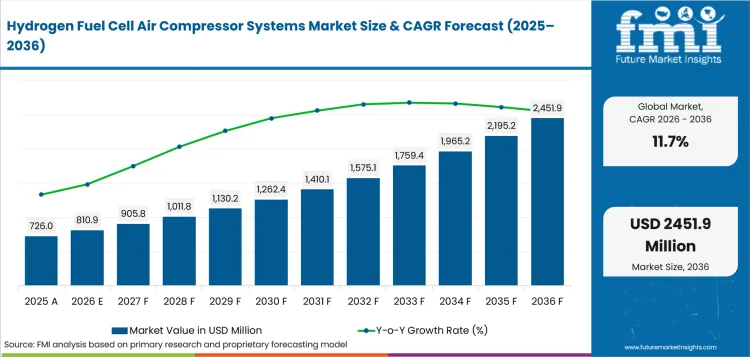
Hydrogen Fuel Cell Air Compressor Systems Market Overview: Size and Forecast
- 2026 Market Size: USD 810.9 million
- 2036 Market Size: USD 2,451.9 million
- Forecast CAGR: 11.7% from 2026 to 2036
- Leading Propulsion: Fuel Cell
- Fuel Cell Share in 2026: 70.0%
- Leading Compressor Architecture: Oil-Free Centrifugal Compressor
- Oil-Free Centrifugal Compressor Share in 2026: 57.0%
- Fastest-growing Country: China
- China CAGR: 13.4% by 2036
Summary of the Hydrogen Fuel Cell Air Compressor Systems Market
- Demand and Growth Drivers
- Heavy-duty fuel cell vehicle programs are increasing demand for cathode air systems designed for long operating hours.
- Hydrogen corridor development is supporting clustered vehicle operation with better refueling and service access.
- OEMs are giving more attention to validated compressor modules with integrated electronics and diagnostics.
- Product and Segment View
- Fuel cell propulsion is forecast to represent 70.0% share in 2026, led by direct compressor use in cathode oxygen delivery.
- Oil-free centrifugal compressors are projected to hold 57.0% share in 2026, supported by high-speed airflow control and lower stack contamination risk.
- OEM sales are expected to secure 52.0% share in 2026, influenced by early platform sourcing and fuel cell system qualification.
- Geography and Competitive Outlook
- China is projected to record 13.4% CAGR by 2036, backed by hydrogen logistics corridors and domestic fuel cell vehicle programs.
- India is expected to expand at 12.8% CAGR by 2036 through hydrogen bus and truck pilot projects.
- Garrett Motion, Bosch, Toyota Industries, FISCHER Fuel Cell Compressor, Celeroton, Aeristech, and Mitsubishi Heavy Industries compete through high-speed compressor design and fuel cell integration capability.
- Hyundai, Denso, cellcentric, GM, Honda, and Toyota support the ecosystem through fuel cell platforms, stack systems, and commercial vehicle programs.
- Analyst Opinion
- Nikhil Kaitwade, Principal Consultant at Future Market Insights, observes, “Hydrogen fuel cell air compressor systems are becoming a stack qualification decision rather than a simple component purchase. Commercial vehicle buyers need durable oil-free air supply, fast response, and proven electronics integration. Suppliers showing validated performance across truck and bus duty cycles should gain stronger OEM confidence.”
Fleet-scale hydrogen mobility is shaping the value outlook for air compressor modules. The International Energy Agency reported in May 2025 that electric truck sales grew by nearly 80.0% in 2024, showing stronger momentum in heavy transport electrification. California’s air regulator reported 61 hydrogen fueling stations as of August 2025, creating a concentrated service base for fuel cell vehicle operation. China’s Chengdu-Chongqing hydrogen corridor includes a supply center with 6,400 kg per day capacity, enough to support 260 heavy-duty trucks at full output. These figures show why compressor suppliers are being evaluated on long-duty durability, air purity, inverter integration, and stack protection capability.
Which factors support expansion in the hydrogen fuel cell air compressor systems market?
Finished compressor module revenue and integrated stack air supply systems support market value across fuel cell mobility programs.
- Market value is supported by compressor modules before software, thermal systems, and sensor content add incremental revenue.
- Supplier pricing reflects oil-free operation, high-speed motor design, inverter integration, and duty-cycle validation.
- Revenue improves as fuel cell trucks and buses move from trials into corridor-based fleet operation.
- OEM trust rises when suppliers prove stable pressure control during cold starts, high load, and frequent transients.
Why is the hydrogen fuel cell air compressor systems market growing?
Fuel cell trucks and buses need controlled cathode air pressure because stack power output depends on stable oxygen flow during load changes.
Market growth is being supported by public fleet trials and heavy-duty decarbonization programs. The United Kingdom’s July 2025 hydrogen update cited up to GBP 200.0 million for zero-emission heavy goods vehicle and infrastructure demonstrations, supporting more than 300 battery-electric and hydrogen fuel cell HGVs. This creates a practical test base for compressor suppliers because heavy vehicles need higher airflow, faster transient response, and longer service life than passenger platforms. OEMs are therefore evaluating compressor systems on endurance, packaging, noise, inverter integration, and stack-safe air purity. The strongest demand is expected in corridors where refueling, maintenance, and fleet utilization can be managed together.
How is the hydrogen fuel cell air compressor systems market segmented?
The hydrogen fuel cell air compressor systems industry is segmented by component type, vehicle type, propulsion, compressor architecture, sales channel, and region.
- Module systems are projected to secure 44.0% share in 2026, led by OEM preference for pre-qualified compressor, motor, inverter, and control packages.
- Heavy trucks are anticipated to hold 34.0% share in 2026 due to long operating hours, higher payloads, and stronger air supply requirements.
- Fuel cell propulsion is expected to capture 70.0% share in 2026 as air compressors serve the cathode loop directly in hydrogen fuel cell vehicles.
- Oil-free centrifugal compressors are forecast to account for 57.0% share in 2026, guided by compact high-speed airflow delivery and contamination-free operation.
- OEM sales are projected to represent 52.0% share in 2026, shaped by early sourcing during vehicle and fuel cell system design.
Why do module systems dominate the hydrogen fuel cell air compressor systems market?
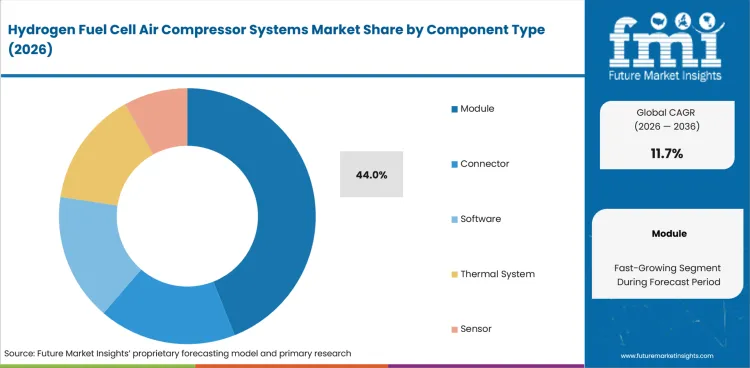
- Module systems are projected to account for 44.0% share in 2026, influenced by OEM demand for compressor assemblies that combine motor, inverter, sensors, and controls.
- Integrated modules gain value because fewer open interfaces reduce wiring work, fault tracing time, packaging complexity, and thermal design risk.
Which vehicle type leads the hydrogen fuel cell air compressor systems market?
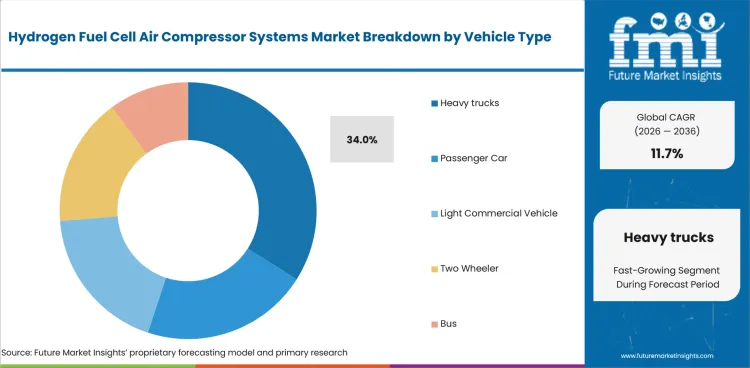
- Heavy trucks are expected to represent 34.0% share in 2026, led by higher air flow needs across long-haul and regional freight cycles.
- Bus platforms gain importance because depot-based operation allows operators to manage refueling, compressor diagnostics, and preventive maintenance routines.
Which propulsion type leads the hydrogen fuel cell air compressor systems market?
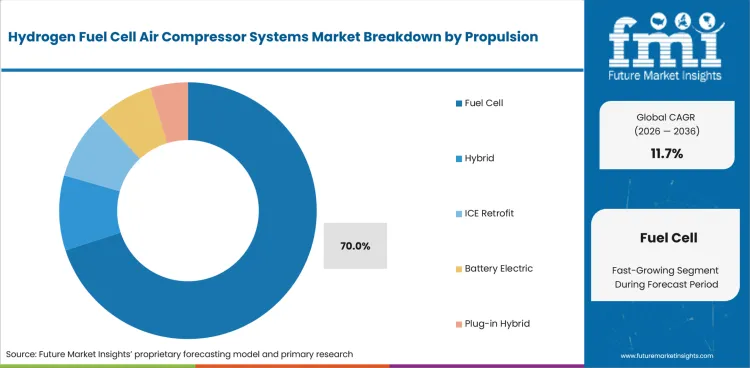
- Fuel cell propulsion is projected to hold 70.0% share in 2026, reflected by the compressor’s direct role in oxygen supply and stack pressure control.
- Hybrid and plug-in hybrid formats create smaller demand when fuel cell range-extender architectures require controlled air supply for auxiliary stack operation.
Which compressor architecture leads the hydrogen fuel cell air compressor systems market?
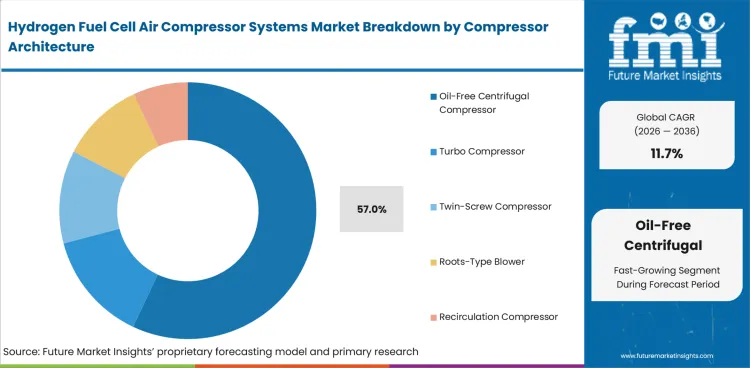
- Oil-free centrifugal compressors are forecast to capture 57.0% share in 2026, supported by high-speed response and lower contamination risk for sensitive stack assemblies.
- Turbo compressor and recirculation formats gain relevance when system designers prioritize compact packaging, lower parasitic load, and better pressure response.
Which sales channel leads the hydrogen fuel cell air compressor systems market?
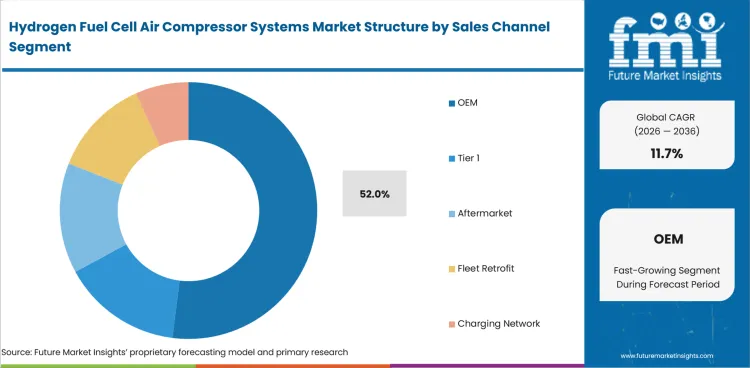
- OEM sales are expected to represent 52.0% share in 2026, shaped by early qualification before commercial fuel cell vehicle launches.
- Tier 1 channels gain importance as integrators combine compressors with stack assemblies, cooling loops, hydrogen controls, and diagnostics packages.
What are the driver, restraints, and opportunities in the hydrogen fuel cell air compressor systems market?
Heavy-duty fuel cell adoption supports demand while station limits restrain rollout outside fleet corridors.
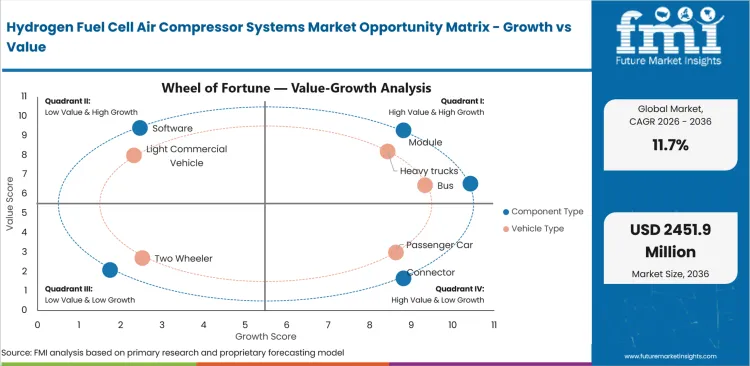
- Driver: Fuel cell trucks and buses need durable compressor systems that protect stack output during heavy load changes.
- Restraint: Hydrogen station gaps delay vehicle deployment and reduce compressor orders outside corridor-based operations.
- Opportunity: Integrated compressor modules can create value by reducing wiring, cooling complexity, and maintenance uncertainty.
Cathode Air Control Demand
Compressor demand is supported by the need to maintain stack oxygen supply during acceleration, grade climbs, and depot-based daily operation. The USA Department of Energy’s 2025 heavy-duty fuel cell target includes 25,000 hours of durability, making air compressor reliability a central sourcing factor. Suppliers must prove performance across variable flow conditions rather than relying only on rated speed or catalog efficiency. OEMs are expected to prefer compressor maps, oil-free bearings, integrated inverters, and validated control logic that help protect stack life.
Hydrogen Infrastructure Friction
Station access remains the main restraint because vehicle deployment cannot scale evenly without reliable refueling. The International Energy Agency reported in 2025 that low-emissions hydrogen production grew by 10.0% in 2024, yet it remained below 1.0% of global hydrogen production. This creates cost and availability pressure for fleets considering fuel cell trucks. Compressor suppliers cannot control fuel supply, but early orders will follow corridors with ports, bus depots, logistics routes, and station clusters that support predictable utilization.
Integrated Module Opportunity
Integrated compressor modules create an opportunity for suppliers that reduce packaging work and improve system reliability. India’s Ministry of New and Renewable Energy sanctioned 5 pilot projects for hydrogen buses and trucks in March 2025, including 37 vehicles and 9 hydrogen refueling stations. These pilots give compressor suppliers field data on heat, vibration, dust exposure, pressure response, and maintenance cycles. Companies that convert pilot evidence into OEM validation should gain stronger positioning in commercial vehicle platforms.
Which countries are growing fastest in the hydrogen fuel cell air compressor systems market?
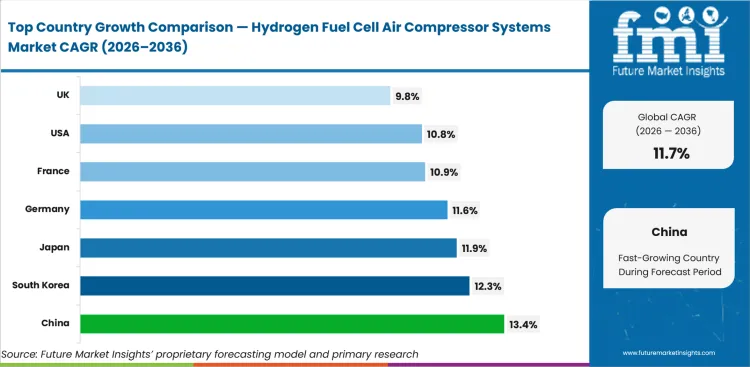
China 13.4% CAGR, India 12.8% CAGR, South Korea 12.3% CAGR, Japan 11.9% CAGR, Germany 11.6% CAGR, France 10.9% CAGR, United States 10.8% CAGR, and United Kingdom 9.8% CAGR through 2036.
.webp "Top Country Growth Comparison Hydrogen Fuel Cell Air Compressor Systems Market Cagr (2026 2036)")
| Country | CAGR |
|---|---|
| United States | 10.8% |
| United Kingdom | 9.8% |
| Germany | 11.6% |
| France | 10.9% |
| Japan | 11.9% |
| China | 13.4% |
| South Korea | 12.3% |
| India | 12.8% |
Source: Future Market Insights, 2026.
How do country-level CAGRs compare in the hydrogen fuel cell air compressor systems market?
China leads country growth while the United Kingdom records the most cautious expansion outlook among profiled markets.
- China is forecast to record 13.4% CAGR by 2036 as hydrogen logistics corridors support repeat compressor module demand.
- India is projected to expand at 12.8% CAGR through 2036 as public pilots test fuel cell buses and trucks.
- South Korea is expected to advance at 12.3% CAGR by 2036 due to hydrogen station targets and commercial vehicle platform activity.
- Japan is estimated to rise at 11.9% CAGR through 2036 with fuel cell manufacturing plans and regional hydrogen support.
- Germany is forecast to grow at 11.6% CAGR by 2036 as OEM and Tier 1 programs support compressor qualification.
- France is expected to increase at 10.9% CAGR through 2036 as fleet mobility and hydrogen station networks guide adoption.
- The United States is projected to post 10.8% CAGR by 2036 as California and port freight pilots lead early sourcing.
- The United Kingdom is anticipated to expand at 9.8% CAGR through 2036 as heavy goods vehicle trials shape demand.
What is the hydrogen fuel cell air compressor systems market outlook in the United States?
A 10.8% CAGR through 2036 is supported by California station concentration, port freight pilots, and domestic fuel cell system production.
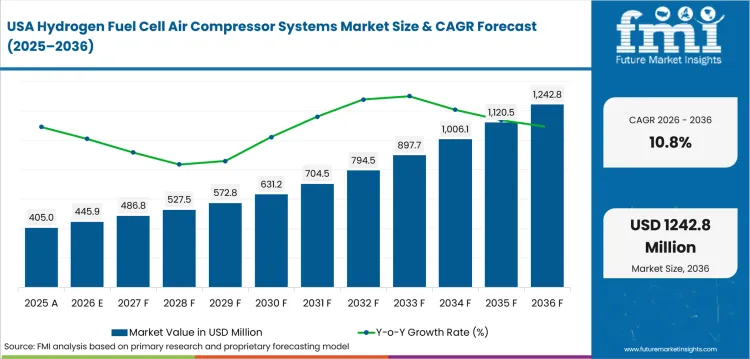
Country Market Snapshot Table
| Parameter | Value |
|---|---|
| Market Size in 2025 (Value) | USD 88.4 million |
| Market Size in 2026 (Value) | USD 98.0 million |
| Market Forecast in 2036 (Value) | USD 273.2 million |
| CAGR (2026 to 2036) | 10.8% |
| Years Considered | 2021 to 2036 |
| Base Year | 2025 |
| Forecast Period | 2026 to 2036 |
| Units Considered | Value (USD million) |
| Leading Sub-Region | California and port freight corridors |
United States Hydrogen Fuel Cell Air Compressor Systems Market Outlook
United States demand is shaped by California’s hydrogen station base, port freight projects, and local fuel cell system production. Compressor demand is expected to follow programs that require reliable stack air delivery under sustained commercial load.
Passenger fuel cell activity remains concentrated, while drayage and regional freight projects create a stronger commercial route. Suppliers with proven module durability and OEM engineering support should gain better sourcing access.
Key Growth Drivers
- California provides the strongest national operating base, with the state reporting 14,128 registered fuel cell electric vehicles by April 2025.
- Port freight programs support higher compressor load requirements, as the NorCAL ZERO project deployed 30 Class 8 fuel cell electric trucks.
- Domestic fuel cell system production improves supplier confidence by giving component makers a local validation base for future vehicle platforms.
- Fleet depots and port routes create a practical service setting for compressor diagnostics, spare parts, and preventive maintenance routines.
Key Restraints
- Station availability remains concentrated, as California reported 61 hydrogen fueling stations as of August 2025 despite wider vehicle ambitions.
- Hydrogen fuel cost volatility weakens fleet payback when operators compare fuel cell trucks against battery-electric alternatives.
- Compressor suppliers face uneven order timing because fuel cell vehicle programs remain concentrated in limited state and freight corridors.
What makes the United States unique
The United States is unique due to California’s operating base, port freight demonstrations, and local fuel cell system production.
Key Companies
- Garrett Motion Inc.
- General Motors Company
- Honda Motor Co., Ltd.
- Robert Bosch LLC
- Toyota Motor North America
- Plug Power Inc.
- Ballard Power Systems Inc.
Sales & Marketing Channels
- OEM sourcing teams
- Tier 1 fuel cell integrators
- Port freight pilots
- Federal demonstration programs
- California fleet channels
- Heavy-duty vehicle engineering groups
Country Segment Breakdown Table
| Segment | Sub-Segments |
|---|---|
| By Component Type | Sensor · Module · Connector · Software · Thermal System |
| By Vehicle Type | Passenger Car · Light Commercial Vehicle · Heavy Truck · Two Wheeler · Bus |
| By Propulsion | Battery Electric · Plug-in Hybrid · Fuel Cell · Hybrid · ICE Retrofit |
| By Compressor Architecture | Oil-Free Centrifugal Compressor · Turbo Compressor · Twin-Screw Compressor · Roots-Type Blower · Recirculation Compressor |
| By Sales Channel | OEM · Tier 1 · Aftermarket · Fleet Retrofit · Charging Network |
| Key Sub-Regions Covered, Fleet and Port Corridors | California · Pacific Northwest · Midwest manufacturing belt · Texas freight corridors · Northeast logistics hubs · Southeast assembly clusters |
Frequently Asked Questions
How fast is United States hydrogen fuel cell air compressor systems market growing?
Sales in the United States are ready to scale at 10.8% CAGR from 2026 to 2036, guided by California stations and fleet pilots.
Who leads United States hydrogen fuel cell air compressor systems market?
Garrett Motion, Bosch, GM, Honda, Toyota, Plug Power, and Ballard Power Systems compete through fuel cell platforms and component programs.
What is driving adoption in United States hydrogen fuel cell air compressor systems market?
California station concentration and port freight pilots are moving compressor demand toward validated commercial vehicle systems.
What is the hydrogen fuel cell air compressor systems market outlook in the United Kingdom?
A 9.8% CAGR through 2036 is supported by zero-emission heavy goods vehicle trials and local high-speed compressor engineering.
Country Market Snapshot Table
| Parameter | Value |
|---|---|
| Market Size in 2025 (Value) | USD 39.6 million |
| Market Size in 2026 (Value) | USD 43.5 million |
| Market Forecast in 2036 (Value) | USD 110.9 million |
| CAGR (2026 to 2036) | 9.8% |
| Years Considered | 2021 to 2036 |
| Base Year | 2025 |
| Forecast Period | 2026 to 2036 |
| Units Considered | Value (USD million) |
| Leading Sub-Region | Midlands and heavy goods demonstration corridors |
United Kingdom Hydrogen Fuel Cell Air Compressor Systems Market Outlook
United Kingdom demand is shaped by public heavy goods vehicle trials rather than broad passenger fuel cell adoption. Compressor suppliers are expected to benefit where hydrogen trucks operate on planned routes with organized refueling.
Local engineering capability supports early development, but large-volume demand will require stronger fleet orders and infrastructure access. OEM partnerships and demonstrator consortia remain the main commercial route.
Key Growth Drivers
- Public funding supports early heavy goods vehicle adoption, with the hydrogen update citing up to GBP 200.0 million for zero-emission HGV and infrastructure demonstrations.
- Heavy-duty testing creates a relevant compressor trial base because the program supports more than 300 zero-emission battery-electric and hydrogen fuel cell HGVs.
- Aeristech gives the country local high-speed compressor and motor capability for hydrogen air supply systems.
- Depot-based fleets provide a cleaner route for compressor monitoring and scheduled service than dispersed passenger fuel cell use.
Key Restraints
- Infrastructure coverage remains selective, as the ZEHID program supports more than 70 public and depot-based infrastructure installations by 2030 across mixed zero-emission truck routes.
- Battery-electric trucks compete strongly on shorter distribution routes with established depot charging access.
- Compressor suppliers may face delayed orders when fleet operators wait for stronger evidence on hydrogen fuel utilization.
What makes the United Kingdom unique
The United Kingdom is unique due to demonstrator-led heavy goods vehicle adoption and local high-speed compressor engineering.
Key Companies
- Aeristech Ltd.
- Robert Bosch GmbH
- Toyota Motor Corporation
- Hyundai Motor Company
- Intelligent Energy Ltd.
- Celeroton AG
- Garrett Motion Inc.
Sales & Marketing Channels
- Government-funded demonstrator consortia
- Fleet operator pilots
- OEM engineering partnerships
- Heavy goods vehicle integrators
- Hydrogen infrastructure project groups
- Local compressor engineering networks
Country Segment Breakdown Table
| Segment | Sub-Segments |
|---|---|
| By Component Type | Sensor · Module · Connector · Software · Thermal System |
| By Vehicle Type | Passenger Car · Light Commercial Vehicle · Heavy Truck · Two Wheeler · Bus |
| By Propulsion | Battery Electric · Plug-in Hybrid · Fuel Cell · Hybrid · ICE Retrofit |
| By Compressor Architecture | Oil-Free Centrifugal Compressor · Turbo Compressor · Twin-Screw Compressor · Roots-Type Blower · Recirculation Compressor |
| By Sales Channel | OEM · Tier 1 · Aftermarket · Fleet Retrofit · Charging Network |
| Key Sub-Regions Covered, Heavy Goods Demonstration Corridors | Midlands · Tees Valley · London logistics corridors · Scotland fleet clusters · Wales transport pilots · Northern England freight routes |
Frequently Asked Questions
How fast is United Kingdom hydrogen fuel cell air compressor systems market growing?
Industry in the United Kingdom is projected to increase at 9.8% CAGR from 2026 to 2036 through heavy goods vehicle demonstrations.
Who leads United Kingdom hydrogen fuel cell air compressor systems market?
Aeristech, Bosch, Toyota, Hyundai, Intelligent Energy, Celeroton, and Garrett Motion compete through compressor engineering and fuel cell platforms.
What is driving adoption in United Kingdom hydrogen fuel cell air compressor systems market?
Publicly supported truck trials and depot-based fleets are moving demand toward validated compressor modules.
How is the hydrogen fuel cell air compressor systems market performing in Germany?
A 11.6% CAGR through 2036 reflects OEM platform planning, Tier 1 compressor qualification, and hydrogen heavy-duty infrastructure funding.
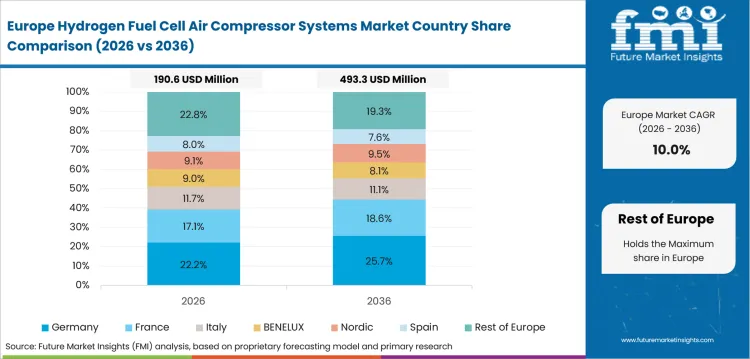
Country Market Snapshot Table
| Parameter | Value |
|---|---|
| Market Size in 2025 (Value) | USD 67.4 million |
| Market Size in 2026 (Value) | USD 75.2 million |
| Market Forecast in 2036 (Value) | USD 225.5 million |
| CAGR (2026 to 2036) | 11.6% |
| Years Considered | 2021 to 2036 |
| Base Year | 2025 |
| Forecast Period | 2026 to 2036 |
| Units Considered | Value (USD million) |
| Leading Sub-Region | Rhine-Ruhr and southern OEM clusters |
Germany Hydrogen Fuel Cell Air Compressor Systems Market Outlook
Germany demand is shaped by OEM engineering, commercial vehicle programs, and Tier 1 balance-of-plant sourcing. Compressor suppliers benefit when air supply systems are validated as part of complete stack packages.
The market is expected to act as a qualification center for Europe. Buyers will evaluate oil-free operation, inverter integration, acoustic performance, and durability under heavy truck duty cycles.
Key Growth Drivers
- Hydrogen freight infrastructure supports heavy vehicle testing, with Düsseldorf opening a station capable of delivering up to 5.0 tonnes of hydrogen per day.
- Public support is strengthening heavy-duty hydrogen demand, as Germany allocated EUR 220.0 million for hydrogen refueling stations and H2 commercial vehicles.
- Bosch and cellcentric create direct compressor qualification routes through fuel cell system work for heavy-duty applications.
- BMW and Toyota’s fuel cell collaboration supports future platform activity that can strengthen local component validation.
Key Restraints
- Heavy-duty refueling suitability remains limited because many German hydrogen stations were originally built around passenger vehicle refueling conditions.
- Battery-electric trucks can reduce hydrogen demand on shorter German routes with reliable depot charging access.
- Hydrogen truck adoption remains sensitive because funding packages can support only 80.0% of eligible extra investment cost in selected programs.
What makes Germany unique
Germany is unique due to OEM platform planning, Tier 1 compressor sourcing, and heavy-duty fuel cell engineering depth.
Key Companies
- Robert Bosch GmbH
- cellcentric GmbH & Co. KG
- BMW Group
- Toyota Motor Corporation
- Garrett Motion Inc.
- FISCHER Fuel Cell Compressor AG
- Celeroton AG
Sales & Marketing Channels
- OEM platform sourcing
- Tier 1 fuel cell module supply
- Heavy truck engineering programs
- Public transport tenders
- Hydrogen corridor partnerships
- Commercial vehicle demonstration networks
Country Segment Breakdown Table
| Segment | Sub-Segments |
|---|---|
| By Component Type | Sensor · Module · Connector · Software · Thermal System |
| By Vehicle Type | Passenger Car · Light Commercial Vehicle · Heavy Truck · Two Wheeler · Bus |
| By Propulsion | Battery Electric · Plug-in Hybrid · Fuel Cell · Hybrid · ICE Retrofit |
| By Compressor Architecture | Oil-Free Centrifugal Compressor · Turbo Compressor · Twin-Screw Compressor · Roots-Type Blower · Recirculation Compressor |
| By Sales Channel | OEM · Tier 1 · Aftermarket · Fleet Retrofit · Charging Network |
| Key Sub-Regions Covered, OEM and Hydrogen Corridors | Rhine-Ruhr · Bavaria · Baden-Württemberg · Hamburg · Lower Saxony · Berlin-Brandenburg |
Frequently Asked Questions
How fast is Germany hydrogen fuel cell air compressor systems market growing?
Demand in Germany is ready to rise at 11.6% CAGR from 2026 to 2036 through OEM and Tier 1 qualification activity.
Who leads Germany hydrogen fuel cell air compressor systems market?
Bosch, cellcentric, BMW, Toyota, Garrett Motion, FISCHER, and Celeroton compete through fuel cell systems and compressor technology.
What is driving adoption in Germany hydrogen fuel cell air compressor systems market?
Heavy-duty hydrogen programs and Tier 1 compressor integration are supporting adoption across commercial vehicle platforms.
What is the hydrogen fuel cell air compressor systems market forecast for France?
A 10.9% CAGR through 2036 is supported by fleet-oriented hydrogen mobility and urban station networks.
Country Market Snapshot Table
| Parameter | Value |
|---|---|
| Market Size in 2025 (Value) | USD 42.4 million |
| Market Size in 2026 (Value) | USD 47.0 million |
| Market Forecast in 2036 (Value) | USD 132.1 million |
| CAGR (2026 to 2036) | 10.9% |
| Years Considered | 2021 to 2036 |
| Base Year | 2025 |
| Forecast Period | 2026 to 2036 |
| Units Considered | Value (USD million) |
| Leading Sub-Region | Île-de-France and urban fleet corridors |
France Hydrogen Fuel Cell Air Compressor Systems Market Outlook
France demand is shaped by fleet visibility, station partnerships, and urban hydrogen mobility programs. Compressor demand is expected to follow vehicles that operate daily and require predictable refueling access.
Passenger fuel cell ownership remains selective, but public fleets and light commercial routes can create repeat component needs. Suppliers should work through OEMs, fleet tenders, and infrastructure-linked programs.
Key Growth Drivers
- Paris hydrogen mobility gained visibility as Air Liquide refueled 500 Toyota Mirai vehicles with renewable hydrogen for the official Games fleet.
- Toyota showcased broader hydrogen use at Paris 2024, including 10 hydrogen mobility applications across fuel cell buses, trucks, forklifts, boats, and coaches.
- Air Liquide’s station work supports fleet-based refueling access for urban mobility and commercial vehicle programs.
- Light commercial and public transport fleets create practical compressor service demand because vehicles return to predictable maintenance locations.
Key Restraints
- Passenger adoption remains narrow because the high-profile Paris hydrogen deployment focused on official fleet use rather than mass retail ownership.
- Battery-electric vans create strong competition when routes are short and depot charging is reliable.
- Fuel cell vehicle economics remain sensitive because visible event use involved 500 Mirai cars rather than sustained private-market volume.
What makes France unique
France is unique due to fleet visibility, hydrogen station operators, and public mobility programs centered around urban corridors.
Key Companies
- Air Liquide
- Toyota Motor Corporation
- HYVIA
- Renault Group
- Plug Power Inc.
- Garrett Motion Inc.
- Symbio
Sales & Marketing Channels
- Public fleet tenders
- Urban mobility programs
- Hydrogen station partnerships
- OEM fleet sales
- Light commercial vehicle integrators
- Infrastructure-linked fleet programs
Country Segment Breakdown Table
| Segment | Sub-Segments |
|---|---|
| By Component Type | Sensor · Module · Connector · Software · Thermal System |
| By Vehicle Type | Passenger Car · Light Commercial Vehicle · Heavy Truck · Two Wheeler · Bus |
| By Propulsion | Battery Electric · Plug-in Hybrid · Fuel Cell · Hybrid · ICE Retrofit |
| By Compressor Architecture | Oil-Free Centrifugal Compressor · Turbo Compressor · Twin-Screw Compressor · Roots-Type Blower · Recirculation Compressor |
| By Sales Channel | OEM · Tier 1 · Aftermarket · Fleet Retrofit · Charging Network |
| Key Sub-Regions Covered, Urban Hydrogen Mobility Corridors | Île-de-France · Auvergne-Rhône-Alpes · Normandy · Grand Est · Occitanie · Provence-Alpes-Côte d’Azur |
Frequently Asked Questions
How fast is France hydrogen fuel cell air compressor systems market growing?
France demand is expected to increase at 10.9% CAGR from 2026 to 2036 through fleet-oriented hydrogen mobility.
Who leads France hydrogen fuel cell air compressor systems market?
Air Liquide, Toyota, HYVIA, Renault, Plug Power, Garrett Motion, and Symbio compete through hydrogen mobility programs.
What is driving adoption in France hydrogen fuel cell air compressor systems market?
Urban fleet use and hydrogen station partnerships are moving demand toward reliable compressor modules.
What is the hydrogen fuel cell air compressor systems market outlook in Japan?
A 11.9% CAGR through 2036 is supported by fuel cell manufacturing plans, regional hydrogen support, and domestic compressor technology.
Country Market Snapshot Table
| Parameter | Value |
|---|---|
| Market Size in 2025 (Value) | USD 78.7 million |
| Market Size in 2026 (Value) | USD 88.1 million |
| Market Forecast in 2036 (Value) | USD 271.9 million |
| CAGR (2026 to 2036) | 11.9% |
| Years Considered | 2021 to 2036 |
| Base Year | 2025 |
| Forecast Period | 2026 to 2036 |
| Units Considered | Value (USD million) |
| Leading Sub-Region | Tokyo-Kanagawa and Chubu supply corridors |
Japan Hydrogen Fuel Cell Air Compressor Systems Market Outlook
Japan demand is supported by long fuel cell experience, local compressor technology, and policy-backed hydrogen regions. Commercial vehicles and stationary fuel cell systems are expected to shape compressor qualification.
Hydrogen cost remains a barrier, so adoption will concentrate in selected areas with support for fuel procurement. Compressor suppliers should focus on durability, efficiency, and local OEM system integration.
Key Growth Drivers
- Toyota’s production plan strengthens local component demand through METI selection under the GX supply chain support program in December 2024.
- Japan selected 5 priority hydrogen regions with 6 local governments as core authorities for deployment support.
- Toyota Industries’ air compressor work supports local credibility for high-efficiency fuel cell air supply systems.
- Commercial trucks, buses, and municipal fleets provide a stronger demand route than broad private passenger vehicle use.
Key Restraints
- Hydrogen fuel remains costlier than diesel, with Japan planning support of up to JPY 700 per kg for commercial fuel cell vehicles.
- Refueling station economics depend on local utilization and continued public support for selected regional clusters.
- Compressor suppliers may see slower orders outside areas where fuel support and vehicle deployment are aligned.
What makes Japan unique
Japan is unique due to fuel cell manufacturing depth, direct air compressor technology, and regional hydrogen cost support.
Key Companies
- Toyota Motor Corporation
- Toyota Industries Corporation
- Denso Corporation
- Iwatani Corporation
- Mitsubishi Heavy Industries
- Robert Bosch GmbH
- Panasonic Energy Co., Ltd.
Sales & Marketing Channels
- OEM fuel cell sourcing
- Commercial truck programs
- Municipal bus projects
- Hydrogen station operators
- GX supply chain partners
- Fuel cell component distributors
Country Segment Breakdown Table
| Segment | Sub-Segments |
|---|---|
| By Component Type | Sensor · Module · Connector · Software · Thermal System |
| By Vehicle Type | Passenger Car · Light Commercial Vehicle · Heavy Truck · Two Wheeler · Bus |
| By Propulsion | Battery Electric · Plug-in Hybrid · Fuel Cell · Hybrid · ICE Retrofit |
| By Compressor Architecture | Oil-Free Centrifugal Compressor · Turbo Compressor · Twin-Screw Compressor · Roots-Type Blower · Recirculation Compressor |
| By Sales Channel | OEM · Tier 1 · Aftermarket · Fleet Retrofit · Charging Network |
| Key Sub-Regions Covered, Hydrogen Manufacturing and Fleet Corridors | Tokyo · Kanagawa · Aichi · Osaka · Fukuoka · Hokkaido |
Frequently Asked Questions
How fast is Japan hydrogen fuel cell air compressor systems market growing?
Sales in Japan are projected to expand at 11.9% CAGR from 2026 to 2036 through local fuel cell manufacturing and regional support.
Who leads Japan hydrogen fuel cell air compressor systems market?
Toyota, Toyota Industries, Denso, Iwatani, Mitsubishi Heavy Industries, Bosch, and Panasonic Energy compete through fuel cell systems and components.
What is driving adoption in Japan hydrogen fuel cell air compressor systems market?
Fuel cell production plans and priority hydrogen regions are moving demand toward efficient compressor modules.
Why does China lead the hydrogen fuel cell air compressor systems market growth outlook?
A 13.4% CAGR through 2036 reflects hydrogen logistics corridors, domestic manufacturing, and commercial vehicle deployment.
Country Market Snapshot Table
| Parameter | Value |
|---|---|
| Market Size in 2025 (Value) | USD 194.5 million |
| Market Size in 2026 (Value) | USD 220.5 million |
| Market Forecast in 2036 (Value) | USD 774.4 million |
| CAGR (2026 to 2036) | 13.4% |
| Years Considered | 2021 to 2036 |
| Base Year | 2025 |
| Forecast Period | 2026 to 2036 |
| Units Considered | Value (USD million) |
| Leading Sub-Region | Chengdu-Chongqing and Guangdong commercial corridors |
China Hydrogen Fuel Cell Air Compressor Systems Market Outlook
China demand is led by logistics corridors and local fuel cell commercial vehicle manufacturing. Compressor suppliers benefit when fleet routes create repeat use and predictable service needs.
The market is more truck-oriented than passenger-car oriented, which supports higher compressor value per vehicle. Local supply chains and policy targets strengthen sourcing opportunities for domestic and international suppliers.
Key Growth Drivers
- China’s hydrogen plan targets 50,000 hydrogen fuel cell vehicles on the road by 2025, supporting local compressor demand planning.
- The Chengdu-Chongqing hydrogen corridor includes a supply center with 6,400 kg per day capacity for commercial vehicle use.
- Local OEM and Tier 1 activity helps compressor suppliers secure application engineering work closer to fuel cell platform development.
- Fixed logistics routes improve the service case for compressor modules because vehicles return to known refueling and maintenance points.
Key Restraints
- Vehicle deployment remains below stated ambition, with official reporting indicating fuel cell vehicle sales had not yet reached the 50,000-unit national target.
- Hydrogen storage and transport costs remain a stated policy challenge for wider commercial expansion.
- Compressor suppliers face strong price pressure as local manufacturers compete for truck and bus platform programs.
What makes China unique
China is unique due to hydrogen logistics corridors, local commercial vehicle programs, and a large domestic fuel cell supply chain.
Key Companies
- REFIRE Group
- Qingling Motors
- Bosch Hydrogen Powertrain Systems
- Garrett Motion Inc.
- Weichai Power
- SinoHytec
- Toyota Motor Corporation
Sales & Marketing Channels
- Commercial vehicle OEMs
- Fuel cell system integrators
- Logistics corridor operators
- Provincial hydrogen programs
- Bus and truck fleet tenders
- Local compressor suppliers
Country Segment Breakdown Table
| Segment | Sub-Segments |
|---|---|
| By Component Type | Sensor · Module · Connector · Software · Thermal System |
| By Vehicle Type | Passenger Car · Light Commercial Vehicle · Heavy Truck · Two Wheeler · Bus |
| By Propulsion | Battery Electric · Plug-in Hybrid · Fuel Cell · Hybrid · ICE Retrofit |
| By Compressor Architecture | Oil-Free Centrifugal Compressor · Turbo Compressor · Twin-Screw Compressor · Roots-Type Blower · Recirculation Compressor |
| By Sales Channel | OEM · Tier 1 · Aftermarket · Fleet Retrofit · Charging Network |
| Key Sub-Regions Covered, Hydrogen Logistics Corridors | Chengdu-Chongqing · Guangdong · Shanghai · Beijing-Tianjin-Hebei · Shandong · Inner Mongolia |
Frequently Asked Questions
How fast is China hydrogen fuel cell air compressor systems market growing?
China is forecast to record 13.4% CAGR from 2026 to 2036, supported by hydrogen logistics corridors and local fuel cell supply chains.
Who leads China hydrogen fuel cell air compressor systems market?
REFIRE, Qingling, Bosch Hydrogen Powertrain Systems, Garrett Motion, Weichai, SinoHytec, and Toyota compete through commercial vehicle programs.
What is driving adoption in China hydrogen fuel cell air compressor systems market?
Hydrogen logistics corridors and domestic truck programs are moving compressor demand toward locally supported modules.
What is the hydrogen fuel cell air compressor systems market outlook in South Korea?
A 12.3% CAGR through 2036 is supported by hydrogen station expansion and Hyundai-linked commercial vehicle activity.
Country Market Snapshot Table
| Parameter | Value |
|---|---|
| Market Size in 2025 (Value) | USD 63.7 million |
| Market Size in 2026 (Value) | USD 71.5 million |
| Market Forecast in 2036 (Value) | USD 227.8 million |
| CAGR (2026 to 2036) | 12.3% |
| Years Considered | 2021 to 2036 |
| Base Year | 2025 |
| Forecast Period | 2026 to 2036 |
| Units Considered | Value (USD million) |
| Leading Sub-Region | Seoul-Ulsan-Hyundai supply corridor |
South Korea Hydrogen Fuel Cell Air Compressor Systems Market Outlook
South Korea demand is shaped by hydrogen infrastructure policy and Hyundai’s commercial fuel cell vehicle platform work. Compressor suppliers benefit from local fuel cell system integration and export-oriented vehicle programs.
Station expansion improves the case for buses and trucks, although utilization remains important for economic operation. Suppliers must show durability and compact integration for commercial duty cycles.
Key Growth Drivers
- Hydrogen mobility policy supports station access, with South Korea expecting more than 450 refueling stations by 2030.
- Hyundai’s XCIENT Fuel Cell truck platform supports commercial credibility, with its European fleet reaching 20.0 million km of operation by January 2026.
- Local fuel cell vehicle development strengthens demand for compressor modules tied to stack system requirements.
- Export programs can help suppliers build scale when domestic hydrogen truck and bus adoption stays measured.
Key Restraints
- Station expansion remains funding-dependent, as South Korea planned KRW 189.7 billion in national funding for hydrogen vehicle support in 2026.
- Hydrogen fuel supply economics can restrict utilization when fleets lack predictable routes and refueling demand.
- Compressor suppliers must compete against battery-electric truck adoption in applications with short routes and reliable charging access.
What makes South Korea unique
South Korea is unique due to hydrogen station policy, Hyundai fuel cell vehicle platforms, and local powertrain integration capability.
Key Companies
- Hyundai Motor Company
- HTWO
- Doosan Fuel Cell
- Hyundai Mobis
- Robert Bosch GmbH
- Denso Corporation
- Garrett Motion Inc.
Sales & Marketing Channels
- Hyundai-linked supply networks
- Bus fleet procurement programs
- Commercial vehicle OEMs
- Hydrogen station operators
- Export platform partners
- Fuel cell module integrators
Country Segment Breakdown Table
| Segment | Sub-Segments |
|---|---|
| By Component Type | Sensor · Module · Connector · Software · Thermal System |
| By Vehicle Type | Passenger Car · Light Commercial Vehicle · Heavy Truck · Two Wheeler · Bus |
| By Propulsion | Battery Electric · Plug-in Hybrid · Fuel Cell · Hybrid · ICE Retrofit |
| By Compressor Architecture | Oil-Free Centrifugal Compressor · Turbo Compressor · Twin-Screw Compressor · Roots-Type Blower · Recirculation Compressor |
| By Sales Channel | OEM · Tier 1 · Aftermarket · Fleet Retrofit · Charging Network |
| Key Sub-Regions Covered, Hydrogen Mobility Corridors | Seoul · Ulsan · Busan · Gyeonggi · Incheon · Jeonbuk |
Frequently Asked Questions
How fast is South Korea hydrogen fuel cell air compressor systems market growing?
South Korea is expected to grow at 12.3% CAGR from 2026 to 2036, supported by hydrogen station expansion and commercial platforms.
Who leads South Korea hydrogen fuel cell air compressor systems market?
Hyundai, HTWO, Hyundai Mobis, Doosan Fuel Cell, Bosch, Denso, and Garrett Motion compete through fuel cell platforms and components.
What is driving adoption in South Korea hydrogen fuel cell air compressor systems market?
Hydrogen station expansion and Hyundai-linked truck platforms are moving demand toward integrated compressor modules.
What is the hydrogen fuel cell air compressor systems market outlook in India?
A 12.8% CAGR through 2036 reflects hydrogen mobility pilots, public funding, and emerging heavy-duty vehicle trials.
Country Market Snapshot Table
| Parameter | Value |
|---|---|
| Market Size in 2025 (Value) | USD 27.7 million |
| Market Size in 2026 (Value) | USD 31.2 million |
| Market Forecast in 2036 (Value) | USD 103.9 million |
| CAGR (2026 to 2036) | 12.8% |
| Years Considered | 2021 to 2036 |
| Base Year | 2025 |
| Forecast Period | 2026 to 2036 |
| Units Considered | Value (USD million) |
| Leading Sub-Region | Delhi-Agra, Pune-Mumbai, and NH-16 pilot corridors |
India Hydrogen Fuel Cell Air Compressor Systems Market Outlook
India demand is at an early stage and is shaped by pilot projects for buses and trucks. Compressor demand will depend on whether trials create repeat orders across highway and depot-based use cases.
Local vehicle manufacturers are testing hydrogen-powered heavy-duty trucks, while public programs support station and route learning. Suppliers should focus on application engineering and field durability in hot, dusty, and high-duty operating conditions.
Key Growth Drivers
- India sanctioned 5 pilot projects for hydrogen buses and trucks, creating early demand signals for fuel cell balance-of-plant components.
- Approved pilot activity includes 37 vehicles and 9 hydrogen refueling stations across identified mobility routes.
- Tata Motors and public-sector partners are supporting commercial hydrogen vehicle testing across heavy-duty operating conditions.
- Highway pilots give compressor suppliers a controlled route to prove heat tolerance, vibration performance, and service requirements.
Key Restraints
- Initial rollout remains small because the sanctioned pilot base includes only 15 hydrogen fuel cell-based vehicles within the broader program.
- Vehicle and component localization will take time because fuel cell air compressor systems require high-speed motors, bearings, and control electronics.
- Battery-electric bus and truck programs can delay hydrogen sourcing in routes where charging depots already meet fleet needs.
What makes India unique
India is unique due to public hydrogen pilots, heavy-duty truck trials, and a national focus on green hydrogen-linked mobility.
Key Companies
- Tata Motors Limited
- Indian Oil Corporation Limited
- Reliance Industries Limited
- Bharat Benz
- Ashok Leyland
- Bosch Limited
- Cummins India Limited
Sales & Marketing Channels
- Government pilot programs
- Heavy-duty vehicle OEMs
- Oil marketing company stations
- Highway corridor operators
- Fuel cell system integrators
- Public transport agencies
Country Segment Breakdown Table
| Segment | Sub-Segments |
|---|---|
| By Component Type | Sensor · Module · Connector · Software · Thermal System |
| By Vehicle Type | Passenger Car · Light Commercial Vehicle · Heavy Truck · Two Wheeler · Bus |
| By Propulsion | Battery Electric · Plug-in Hybrid · Fuel Cell · Hybrid · ICE Retrofit |
| By Compressor Architecture | Oil-Free Centrifugal Compressor · Turbo Compressor · Twin-Screw Compressor · Roots-Type Blower · Recirculation Compressor |
| By Sales Channel | OEM · Tier 1 · Aftermarket · Fleet Retrofit · Charging Network |
| Key Sub-Regions Covered, Hydrogen Mobility Pilot Corridors | Delhi-NCR · Pune-Mumbai · Chennai-Bengaluru · Ahmedabad-Vadodara · NH-16 corridor · Kerala mobility cluster |
Frequently Asked Questions
How fast is India hydrogen fuel cell air compressor systems market growing?
India is projected to expand at 12.8% CAGR from 2026 to 2036, supported by hydrogen bus and truck pilots.
Who leads India hydrogen fuel cell air compressor systems market?
Tata Motors, Indian Oil, Reliance Industries, Ashok Leyland, Bosch, Cummins India, and Bharat Benz are relevant to India’s hydrogen mobility ecosystem.
What is driving adoption in India hydrogen fuel cell air compressor systems market?
Pilot projects for buses and trucks are creating early compressor demand across controlled hydrogen mobility corridors.
Who are the leading companies in the hydrogen fuel cell air compressor systems market?
Garrett Motion, Bosch, Toyota Industries, FISCHER Fuel Cell Compressor, Celeroton, and Aeristech lead through compressor engineering and fuel cell integration capability.
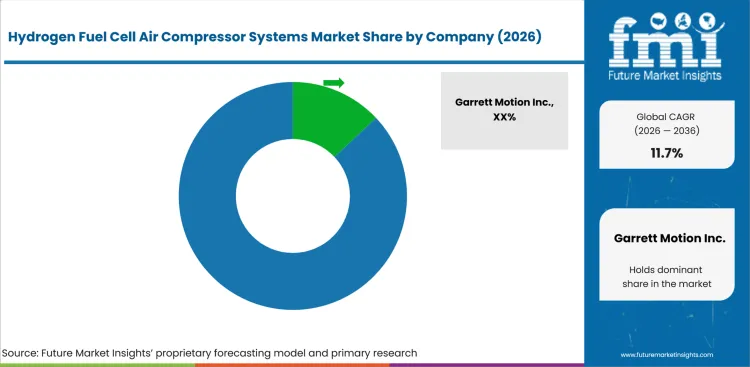
- Established automotive suppliers hold an advantage through OEM platform relationships and fuel cell balance-of-plant engineering.
- Specialist compressor firms gain attention by offering oil-free high-speed designs suited to stack air delivery.
- Fuel cell system companies support demand by integrating compressors into complete powertrain packages.
- Commercial vehicle programs create stronger qualification value because trucks and buses expose compressors to longer duty cycles.
Competition in the market is shaped by stack protection, speed control, and electronics integration. Garrett Motion and Bosch compete through fuel cell air supply technology and vehicle platform access. Toyota Industries benefits from Toyota’s fuel cell ecosystem and air compressor capability. FISCHER, Celeroton, and Aeristech compete through compact high-speed compressor designs used in specialist fuel cell applications.
Supplier scale is important, but field validation is becoming more important for OEM sourcing. Commercial vehicle buyers need proof of operation across heat, vibration, cold starts, pressure transients, and acoustic limits. Companies that can provide compressor maps, integrated inverters, service support, and durability evidence should gain stronger listing decisions.
Regional competitors can gain through local platform access and fast engineering support. China and South Korea support local fuel cell vehicle supply chains, while Germany and Japan offer stronger engineering and standards depth. India and the United Kingdom remain pilot-led markets where field performance can influence future sourcing. Suppliers relying only on catalog specifications are expected to face weaker acceptance from OEMs.
How do top hydrogen fuel cell air compressor systems companies compare?
Garrett Motion and Bosch score strongest on OEM integration while FISCHER and Celeroton show strong specialist compressor relevance.
| Company | Relevance to Market Title | Compressor Technology Depth | Fuel Cell Integration Capability | OEM Channel Control | Geographic Footprint |
|---|---|---|---|---|---|
| Garrett Motion Inc. | Very High | Very Strong | Strong | Very Strong | Global |
| Robert Bosch GmbH | Very High | Very Strong | Very Strong | Very Strong | Global |
| Toyota Industries Corporation | Very High | Strong | Very Strong | Strong | Japan and Global |
| FISCHER Fuel Cell Compressor AG | Very High | Very Strong | Strong | Moderate | Europe and Global |
| Celeroton AG | High | Very Strong | Moderate | Moderate | Europe and Global |
| Aeristech Ltd. | High | Strong | Moderate | Moderate | United Kingdom and Global |
| Mitsubishi Heavy Industries | Moderate to High | Moderate | Strong | Strong | Global |
| Denso Corporation | High | Strong | Strong | Strong | Japan and Global |
| Hyundai HTWO | High | Moderate | Very Strong | Strong | South Korea and Global |
| cellcentric GmbH & Co. KG | High | Moderate | Very Strong | Strong | Europe |
Source: Future Market Insights competitive analysis, 2026.
Who are the key players in the hydrogen fuel cell air compressor systems market?
Garrett Motion, Bosch, Toyota Industries, FISCHER Fuel Cell Compressor, Celeroton, and Aeristech are listed with Denso and Hyundai HTWO among other suppliers.
Key global companies leading the hydrogen fuel cell air compressor systems market include:
- Garrett Motion Inc.
- Robert Bosch GmbH
- Toyota Industries Corporation
- FISCHER Fuel Cell Compressor AG
- Celeroton AG
- Aeristech Ltd.
- Mitsubishi Heavy Industries
- Denso Corporation
- Hyundai HTWO
- cellcentric GmbH & Co. KG
Key Developments in Hydrogen Fuel Cell Air Compressor Systems Market
- In January 2024, Garrett Motion advanced electric compressor technology for hydrogen fuel cell commercial vehicles, strengthening its fuel cell air supply positioning.
- In January 2024, GM and Honda started production at their fuel cell system manufacturing joint venture in Brownstown, Michigan, supporting local fuel cell system supply.
- In February 2025, Toyota announced development of a new fuel cell system targeted for commercial applications, improving the demand base for stack air supply components.
Key Players in the Hydrogen Fuel Cell Air Compressor Systems Market
Global Automotive and Compressor Suppliers
- Garrett Motion Inc.
- Robert Bosch GmbH
- Toyota Industries Corporation
- Denso Corporation
- Mitsubishi Heavy Industries
Specialist Fuel Cell Compressor Companies
- FISCHER Fuel Cell Compressor AG
- Celeroton AG
- Aeristech Ltd.
- Rotrex A/S
Fuel Cell System and Vehicle Platform Companies
- Toyota Motor Corporation
- Hyundai HTWO
- cellcentric GmbH & Co. KG
- General Motors Company
- Honda Motor Co., Ltd.
Hydrogen Fuel Cell Air Compressor Systems Market - Report Scope
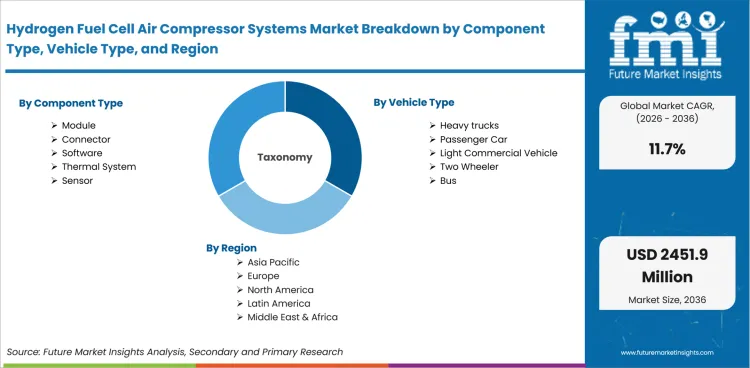
| Item | Value |
|---|---|
| Market size by 2036 | USD 2,451.9 million |
| Growth rate | 11.7% CAGR from 2026 to 2036 |
| Forecast period | 2026 to 2036 |
| Base year value (2025) | USD 726.0 million |
| By component type | Sensor, module, connector, software, thermal system |
| By vehicle type | Passenger car, light commercial vehicle, heavy truck, two wheeler, bus |
| By propulsion | Battery electric, plug-in hybrid, fuel cell, hybrid, ICE retrofit |
| By compressor architecture | Oil-free centrifugal compressor, turbo compressor, twin-screw compressor, roots-type blower, recirculation compressor |
| By sales channel | OEM, Tier 1, aftermarket, fleet retrofit, charging network |
| Regions covered | North America, Latin America, Europe, East Asia, South Asia, Middle East and Africa |
| Countries covered | United States, United Kingdom, Germany, France, Japan, China, South Korea, India |
| Key companies profiled | Garrett Motion, Bosch, Toyota Industries, FISCHER, Celeroton, Aeristech, Mitsubishi Heavy Industries, Denso, Hyundai HTWO |
| Approach | Bottom-up component-boundary approach using eligible compressor system revenue, platform integration, country readiness, and channel presence |
Source: Future Market Insights, 2026.
Hydrogen Fuel Cell Air Compressor Systems Market - Scope & Definition
| Attribute | Detail |
|---|---|
| Market Definition | Vehicle-mounted air compressor systems that supply controlled cathode air to hydrogen fuel cell stacks used in mobility platforms. |
| Functions Covered | Cathode air compression, oxygen flow control, stack pressure support, thermal management support, diagnostics, and balance-of-plant integration. |
| Applications Covered | Fuel cell passenger cars, heavy trucks, buses, light commercial vehicles, two wheelers, fleet retrofits, and selected hydrogen mobility platforms. |
| End-Use Industries | Automotive, commercial vehicle, public transport, freight logistics, hydrogen mobility, and fuel cell powertrain systems. |
| Grades Covered | Oil-free centrifugal, turbo compressor, twin-screw, roots-type blower, and recirculation compressor formats. |
| Inclusions | Vehicle-mounted compressor modules, sensors, connectors, embedded software, thermal components, and air supply systems used in hydrogen fuel cell vehicle platforms. |
| Exclusions | Hydrogen refueling station compressors, industrial hydrogen compressors, electrolyzer compression skids, battery-electric HVAC compressors, conventional turbochargers, and non-vehicle stationary blowers. |
Hydrogen Fuel Cell Air Compressor Systems Market - Research Methodology
| Method | Description |
|---|---|
| Primary Research | FMI analyst interviews with compressor suppliers, fuel cell system integrators, vehicle OEM sourcing teams, fleet project developers, and hydrogen mobility stakeholders across key markets. |
| Desk Research | Review of official policy documents, vehicle deployment data, company technical pages, infrastructure updates, product announcements, and fuel cell technology sources. |
| Market Sizing & Forecasting | Bottom-up component-boundary approach using platform count, compressor value per vehicle, integration rates, country readiness, supplier availability, and channel mix. |
| Data Validation | Cross-verification using fuel cell vehicle programs, hydrogen station activity, heavy-duty fleet pilots, supplier portfolios, and country-level policy support. |
Hydrogen Fuel Cell Air Compressor Systems Market Breakdown by Component Type, Vehicle Type, Propulsion, Compressor Architecture, Sales Channel, and Region
Hydrogen Fuel Cell Air Compressor Systems Market Segmented by Component Type
- Sensor
- Module
- Connector
- Software
- Thermal System
Hydrogen Fuel Cell Air Compressor Systems Market Segmented by Vehicle Type
- Passenger Car
- Light Commercial Vehicle
- Heavy Truck
- Two Wheeler
- Bus
Hydrogen Fuel Cell Air Compressor Systems Market Segmented by Propulsion
- Battery Electric
- Plug-in Hybrid
- Fuel Cell
- Hybrid
- ICE Retrofit
Hydrogen Fuel Cell Air Compressor Systems Market Segmented by Compressor Architecture
- Oil-Free Centrifugal Compressor
- Turbo Compressor
- Twin-Screw Compressor
- Roots-Type Blower
- Recirculation Compressor
Hydrogen Fuel Cell Air Compressor Systems Market Segmented by Sales Channel
- OEM
- Tier 1
- Aftermarket
- Fleet Retrofit
- Charging Network
Hydrogen Fuel Cell Air Compressor Systems Market by Region
- North America
- Latin America
- Europe
- East Asia
- South Asia
- Middle East and Africa
Frequently Asked Questions
What is the hydrogen fuel cell air compressor systems market size in 2026?
The hydrogen fuel cell air compressor systems market size is anticipated to cross USD 810.9 million in 2026.
What is the hydrogen fuel cell air compressor systems market forecast for 2036?
The hydrogen fuel cell air compressor systems industry revenue is predicted to reach USD 2,451.9 million by 2036 as fuel cell commercial vehicle platforms expand.
What is the hydrogen fuel cell air compressor systems market CAGR?
The hydrogen fuel cell air compressor systems sector is projected to expand at 11.7% CAGR from 2026 to 2036.
What segment leads the hydrogen fuel cell air compressor systems market?
Fuel cell propulsion is likely to capture 70.0% share in 2026 due to direct compressor use in stack cathode air delivery.
What country grows fastest in the hydrogen fuel cell air compressor systems market?
China is set to record 13.4% CAGR by 2036, driven by hydrogen logistics corridors and domestic fuel cell vehicle programs.
Preview the report firsthand - request a free sample
Get SampleGet the brochure for pricing and purchase details.
Get PDFTable of Content
- Executive Summary
- Global Market Outlook
- Demand to side Trends
- Supply to side Trends
- Technology Roadmap Analysis
- Analysis and Recommendations
- Market Overview
- Market Coverage / Taxonomy
- Market Definition / Scope / Limitations
- Research Methodology
- Chapter Orientation
- Analytical Lens and Working Hypotheses
- Market Structure, Signals, and Trend Drivers
- Benchmarking and Cross-market Comparability
- Market Sizing, Forecasting, and Opportunity Mapping
- Research Design and Evidence Framework
- Desk Research Programme (Secondary Evidence)
- Company Annual and Sustainability Reports
- Peer-reviewed Journals and Academic Literature
- Corporate Websites, Product Literature, and Technical Notes
- Earnings Decks and Investor Briefings
- Statutory Filings and Regulatory Disclosures
- Technical White Papers and Standards Notes
- Trade Journals, Industry Magazines, and Analyst Briefs
- Conference Proceedings, Webinars, and Seminar Materials
- Government Statistics Portals and Public Data Releases
- Press Releases and Reputable Media Coverage
- Specialist Newsletters and Curated Briefings
- Sector Databases and Reference Repositories
- FMI Internal Proprietary Databases and Historical Market Datasets
- Subscription Datasets and Paid Sources
- Social Channels, Communities, and Digital Listening Inputs
- Additional Desk Sources
- Expert Input and Fieldwork (Primary Evidence)
- Primary Modes
- Qualitative Interviews and Expert Elicitation
- Quantitative Surveys and Structured Data Capture
- Blended Approach
- Why Primary Evidence is Used
- Field Techniques
- Interviews
- Surveys
- Focus Groups
- Observational and In-context Research
- Social and Community Interactions
- Stakeholder Universe Engaged
- C-suite Leaders
- Board Members
- Presidents and Vice Presidents
- R&D and Innovation Heads
- Technical Specialists
- Domain Subject-matter Experts
- Scientists
- Physicians and Other Healthcare Professionals
- Governance, Ethics, and Data Stewardship
- Research Ethics
- Data Integrity and Handling
- Primary Modes
- Tooling, Models, and Reference Databases
- Desk Research Programme (Secondary Evidence)
- Data Engineering and Model Build
- Data Acquisition and Ingestion
- Cleaning, Normalisation, and Verification
- Synthesis, Triangulation, and Analysis
- Quality Assurance and Audit Trail
- Market Background
- Market Dynamics
- Drivers
- Restraints
- Opportunity
- Trends
- Scenario Forecast
- Demand in Optimistic Scenario
- Demand in Likely Scenario
- Demand in Conservative Scenario
- Opportunity Map Analysis
- Product Life Cycle Analysis
- Supply Chain Analysis
- Investment Feasibility Matrix
- Value Chain Analysis
- PESTLE and Porter’s Analysis
- Regulatory Landscape
- Regional Parent Market Outlook
- Production and Consumption Statistics
- Import and Export Statistics
- Market Dynamics
- Global Market Analysis 2021 to 2025 and Forecast, 2026 to 2036
- Historical Market Size Value (USD Million) Analysis, 2021 to 2025
- Current and Future Market Size Value (USD Million) Projections, 2026 to 2036
- Y to o to Y Growth Trend Analysis
- Absolute $ Opportunity Analysis
- Global Market Pricing Analysis 2021 to 2025 and Forecast 2026 to 2036
- Global Market Analysis 2021 to 2025 and Forecast 2026 to 2036, By Component Type
- Introduction / Key Findings
- Historical Market Size Value (USD Million) Analysis By Component Type , 2021 to 2025
- Current and Future Market Size Value (USD Million) Analysis and Forecast By Component Type , 2026 to 2036
- Module
- Connector
- Software
- Thermal System
- Sensor
- Module
- Y to o to Y Growth Trend Analysis By Component Type , 2021 to 2025
- Absolute $ Opportunity Analysis By Component Type , 2026 to 2036
- Global Market Analysis 2021 to 2025 and Forecast 2026 to 2036, By Vehicle Type
- Introduction / Key Findings
- Historical Market Size Value (USD Million) Analysis By Vehicle Type, 2021 to 2025
- Current and Future Market Size Value (USD Million) Analysis and Forecast By Vehicle Type, 2026 to 2036
- Heavy trucks
- Passenger Car
- Light Commercial Vehicle
- Two Wheeler
- Bus
- Heavy trucks
- Y to o to Y Growth Trend Analysis By Vehicle Type, 2021 to 2025
- Absolute $ Opportunity Analysis By Vehicle Type, 2026 to 2036
- Global Market Analysis 2021 to 2025 and Forecast 2026 to 2036, By Propulsion
- Introduction / Key Findings
- Historical Market Size Value (USD Million) Analysis By Propulsion, 2021 to 2025
- Current and Future Market Size Value (USD Million) Analysis and Forecast By Propulsion, 2026 to 2036
- Fuel Cell
- Hybrid
- ICE Retrofit
- Battery Electric
- Plug-in Hybrid
- Fuel Cell
- Y to o to Y Growth Trend Analysis By Propulsion, 2021 to 2025
- Absolute $ Opportunity Analysis By Propulsion, 2026 to 2036
- Global Market Analysis 2021 to 2025 and Forecast 2026 to 2036, By Compressor Architecture
- Introduction / Key Findings
- Historical Market Size Value (USD Million) Analysis By Compressor Architecture, 2021 to 2025
- Current and Future Market Size Value (USD Million) Analysis and Forecast By Compressor Architecture, 2026 to 2036
- Oil-Free Centrifugal Compressor
- Turbo Compressor
- Twin-Screw Compressor
- Roots-Type Blower
- Recirculation Compressor
- Oil-Free Centrifugal Compressor
- Y to o to Y Growth Trend Analysis By Compressor Architecture, 2021 to 2025
- Absolute $ Opportunity Analysis By Compressor Architecture, 2026 to 2036
- Global Market Analysis 2021 to 2025 and Forecast 2026 to 2036, By Sales Channel
- Introduction / Key Findings
- Historical Market Size Value (USD Million) Analysis By Sales Channel, 2021 to 2025
- Current and Future Market Size Value (USD Million) Analysis and Forecast By Sales Channel, 2026 to 2036
- OEM
- Tier 1
- Aftermarket
- Fleet Retrofit
- Charging Network
- OEM
- Y to o to Y Growth Trend Analysis By Sales Channel, 2021 to 2025
- Absolute $ Opportunity Analysis By Sales Channel, 2026 to 2036
- Global Market Analysis 2021 to 2025 and Forecast 2026 to 2036, By Region
- Introduction
- Historical Market Size Value (USD Million) Analysis By Region, 2021 to 2025
- Current Market Size Value (USD Million) Analysis and Forecast By Region, 2026 to 2036
- North America
- Latin America
- Western Europe
- Eastern Europe
- East Asia
- South Asia and Pacific
- Middle East & Africa
- Market Attractiveness Analysis By Region
- North America Market Analysis 2021 to 2025 and Forecast 2026 to 2036, By Country
- Historical Market Size Value (USD Million) Trend Analysis By Market Taxonomy, 2021 to 2025
- Market Size Value (USD Million) Forecast By Market Taxonomy, 2026 to 2036
- By Country
- USA
- Canada
- Mexico
- By Component Type
- By Vehicle Type
- By Propulsion
- By Compressor Architecture
- By Sales Channel
- By Country
- Market Attractiveness Analysis
- By Country
- By Component Type
- By Vehicle Type
- By Propulsion
- By Compressor Architecture
- By Sales Channel
- Key Takeaways
- Latin America Market Analysis 2021 to 2025 and Forecast 2026 to 2036, By Country
- Historical Market Size Value (USD Million) Trend Analysis By Market Taxonomy, 2021 to 2025
- Market Size Value (USD Million) Forecast By Market Taxonomy, 2026 to 2036
- By Country
- Brazil
- Chile
- Rest of Latin America
- By Component Type
- By Vehicle Type
- By Propulsion
- By Compressor Architecture
- By Sales Channel
- By Country
- Market Attractiveness Analysis
- By Country
- By Component Type
- By Vehicle Type
- By Propulsion
- By Compressor Architecture
- By Sales Channel
- Key Takeaways
- Western Europe Market Analysis 2021 to 2025 and Forecast 2026 to 2036, By Country
- Historical Market Size Value (USD Million) Trend Analysis By Market Taxonomy, 2021 to 2025
- Market Size Value (USD Million) Forecast By Market Taxonomy, 2026 to 2036
- By Country
- Germany
- UK
- Italy
- Spain
- France
- Nordic
- BENELUX
- Rest of Western Europe
- By Component Type
- By Vehicle Type
- By Propulsion
- By Compressor Architecture
- By Sales Channel
- By Country
- Market Attractiveness Analysis
- By Country
- By Component Type
- By Vehicle Type
- By Propulsion
- By Compressor Architecture
- By Sales Channel
- Key Takeaways
- Eastern Europe Market Analysis 2021 to 2025 and Forecast 2026 to 2036, By Country
- Historical Market Size Value (USD Million) Trend Analysis By Market Taxonomy, 2021 to 2025
- Market Size Value (USD Million) Forecast By Market Taxonomy, 2026 to 2036
- By Country
- Russia
- Poland
- Hungary
- Balkan & Baltic
- Rest of Eastern Europe
- By Component Type
- By Vehicle Type
- By Propulsion
- By Compressor Architecture
- By Sales Channel
- By Country
- Market Attractiveness Analysis
- By Country
- By Component Type
- By Vehicle Type
- By Propulsion
- By Compressor Architecture
- By Sales Channel
- Key Takeaways
- East Asia Market Analysis 2021 to 2025 and Forecast 2026 to 2036, By Country
- Historical Market Size Value (USD Million) Trend Analysis By Market Taxonomy, 2021 to 2025
- Market Size Value (USD Million) Forecast By Market Taxonomy, 2026 to 2036
- By Country
- China
- Japan
- South Korea
- By Component Type
- By Vehicle Type
- By Propulsion
- By Compressor Architecture
- By Sales Channel
- By Country
- Market Attractiveness Analysis
- By Country
- By Component Type
- By Vehicle Type
- By Propulsion
- By Compressor Architecture
- By Sales Channel
- Key Takeaways
- South Asia and Pacific Market Analysis 2021 to 2025 and Forecast 2026 to 2036, By Country
- Historical Market Size Value (USD Million) Trend Analysis By Market Taxonomy, 2021 to 2025
- Market Size Value (USD Million) Forecast By Market Taxonomy, 2026 to 2036
- By Country
- India
- ASEAN
- Australia & New Zealand
- Rest of South Asia and Pacific
- By Component Type
- By Vehicle Type
- By Propulsion
- By Compressor Architecture
- By Sales Channel
- By Country
- Market Attractiveness Analysis
- By Country
- By Component Type
- By Vehicle Type
- By Propulsion
- By Compressor Architecture
- By Sales Channel
- Key Takeaways
- Middle East & Africa Market Analysis 2021 to 2025 and Forecast 2026 to 2036, By Country
- Historical Market Size Value (USD Million) Trend Analysis By Market Taxonomy, 2021 to 2025
- Market Size Value (USD Million) Forecast By Market Taxonomy, 2026 to 2036
- By Country
- Kingdom of Saudi Arabia
- Other GCC Countries
- Turkiye
- South Africa
- Other African Union
- Rest of Middle East & Africa
- By Component Type
- By Vehicle Type
- By Propulsion
- By Compressor Architecture
- By Sales Channel
- By Country
- Market Attractiveness Analysis
- By Country
- By Component Type
- By Vehicle Type
- By Propulsion
- By Compressor Architecture
- By Sales Channel
- Key Takeaways
- Key Countries Market Analysis
- USA
- Pricing Analysis
- Market Share Analysis, 2025
- By Component Type
- By Vehicle Type
- By Propulsion
- By Compressor Architecture
- By Sales Channel
- Canada
- Pricing Analysis
- Market Share Analysis, 2025
- By Component Type
- By Vehicle Type
- By Propulsion
- By Compressor Architecture
- By Sales Channel
- Mexico
- Pricing Analysis
- Market Share Analysis, 2025
- By Component Type
- By Vehicle Type
- By Propulsion
- By Compressor Architecture
- By Sales Channel
- Brazil
- Pricing Analysis
- Market Share Analysis, 2025
- By Component Type
- By Vehicle Type
- By Propulsion
- By Compressor Architecture
- By Sales Channel
- Chile
- Pricing Analysis
- Market Share Analysis, 2025
- By Component Type
- By Vehicle Type
- By Propulsion
- By Compressor Architecture
- By Sales Channel
- Germany
- Pricing Analysis
- Market Share Analysis, 2025
- By Component Type
- By Vehicle Type
- By Propulsion
- By Compressor Architecture
- By Sales Channel
- UK
- Pricing Analysis
- Market Share Analysis, 2025
- By Component Type
- By Vehicle Type
- By Propulsion
- By Compressor Architecture
- By Sales Channel
- Italy
- Pricing Analysis
- Market Share Analysis, 2025
- By Component Type
- By Vehicle Type
- By Propulsion
- By Compressor Architecture
- By Sales Channel
- Spain
- Pricing Analysis
- Market Share Analysis, 2025
- By Component Type
- By Vehicle Type
- By Propulsion
- By Compressor Architecture
- By Sales Channel
- France
- Pricing Analysis
- Market Share Analysis, 2025
- By Component Type
- By Vehicle Type
- By Propulsion
- By Compressor Architecture
- By Sales Channel
- India
- Pricing Analysis
- Market Share Analysis, 2025
- By Component Type
- By Vehicle Type
- By Propulsion
- By Compressor Architecture
- By Sales Channel
- ASEAN
- Pricing Analysis
- Market Share Analysis, 2025
- By Component Type
- By Vehicle Type
- By Propulsion
- By Compressor Architecture
- By Sales Channel
- Australia & New Zealand
- Pricing Analysis
- Market Share Analysis, 2025
- By Component Type
- By Vehicle Type
- By Propulsion
- By Compressor Architecture
- By Sales Channel
- China
- Pricing Analysis
- Market Share Analysis, 2025
- By Component Type
- By Vehicle Type
- By Propulsion
- By Compressor Architecture
- By Sales Channel
- Japan
- Pricing Analysis
- Market Share Analysis, 2025
- By Component Type
- By Vehicle Type
- By Propulsion
- By Compressor Architecture
- By Sales Channel
- South Korea
- Pricing Analysis
- Market Share Analysis, 2025
- By Component Type
- By Vehicle Type
- By Propulsion
- By Compressor Architecture
- By Sales Channel
- Russia
- Pricing Analysis
- Market Share Analysis, 2025
- By Component Type
- By Vehicle Type
- By Propulsion
- By Compressor Architecture
- By Sales Channel
- Poland
- Pricing Analysis
- Market Share Analysis, 2025
- By Component Type
- By Vehicle Type
- By Propulsion
- By Compressor Architecture
- By Sales Channel
- Hungary
- Pricing Analysis
- Market Share Analysis, 2025
- By Component Type
- By Vehicle Type
- By Propulsion
- By Compressor Architecture
- By Sales Channel
- Kingdom of Saudi Arabia
- Pricing Analysis
- Market Share Analysis, 2025
- By Component Type
- By Vehicle Type
- By Propulsion
- By Compressor Architecture
- By Sales Channel
- Turkiye
- Pricing Analysis
- Market Share Analysis, 2025
- By Component Type
- By Vehicle Type
- By Propulsion
- By Compressor Architecture
- By Sales Channel
- South Africa
- Pricing Analysis
- Market Share Analysis, 2025
- By Component Type
- By Vehicle Type
- By Propulsion
- By Compressor Architecture
- By Sales Channel
- USA
- Market Structure Analysis
- Competition Dashboard
- Competition Benchmarking
- Market Share Analysis of Top Players
- By Regional
- By Component Type
- By Vehicle Type
- By Propulsion
- By Compressor Architecture
- By Sales Channel
- Competition Analysis
- Competition Deep Dive
- Garrett Motion Inc.
- Overview
- Product Portfolio
- Profitability by Market Segments (Product/Age /Sales Channel/Region)
- Sales Footprint
- Strategy Overview
- Marketing Strategy
- Product Strategy
- Channel Strategy
- Robert Bosch GmbH
- Toyota Industries Corporation
- FISCHER Fuel Cell Compressor AG
- Celeroton AG
- Aeristech Ltd.
- Mitsubishi Heavy Industries
- Denso Corporation
- Hyundai HTWO
- cellcentric GmbH & Co. KG
- Garrett Motion Inc.
- Competition Deep Dive
- Assumptions & Acronyms Used


