

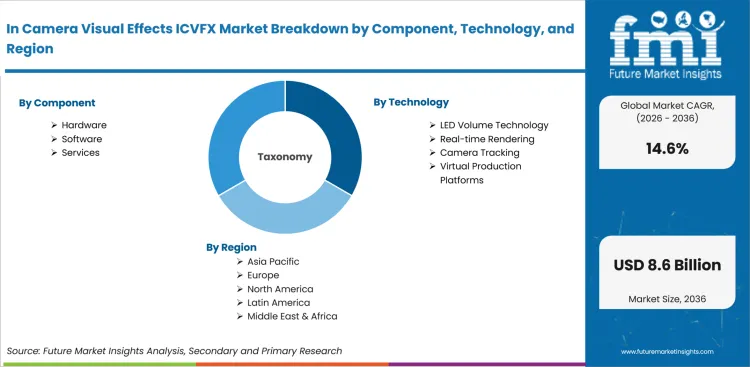
- Market Size (2026)
- USD 2.2 Bn
- Forecast (2036)
- USD 8.6 Bn
- CAGR (2026 to 2036)
- 14.6%
How big is In-Camera Visual Effects ICVFX Market in 2026?
USD 2.2 billion in 2026 and USD 8.6 billion by 2036 at a 14.6% CAGR.
Demand for In-Camera Visual Effects ICVFX is projected to expand at 14.6% CAGR between 2026 and 2036, increasing valuation from USD 2.2 billion in 2026 to USD 8.6 billion by 2036. Permanent and rentable video wall infrastructure gives productions a controlled background that changes with camera movement instead of presenting a fixed image behind performers. Pixomondo (PXO), a Sony subsidiary, unveiled PXO AKIRA at CES 2025 as a vehicle-filming system that coordinates an LED volume with robotic camera and vehicle movement. The launch shows how ICVFX revenue extends beyond display panels into coordinated systems that control motion and image timing during principal photography. Production teams can reduce location work and repeated compositing, but they must approve environments and lens settings before booked stage hours begin.
German broadcasters qualify ICVFX through formal studio trials, whereas Italian teams build practical experience through structured courses and specialist-stage visits. Centro Sperimentale di Cinematografia announced in March 2026 that a five-week Milan course would train 15 participants in virtual-set advertising production. The program includes visits to two specialist studios and practical work with LED walls and camera tracking for vehicle scenes. German facilities test multicamera tracking through broadcaster pilots that follow engineering review and scheduled studio conditions. Italian teams can rehearse production planning and technical handoffs ahead of commercial stage bookings at specialist facilities. Both routes require reliable camera tracking systems that update the rendered perspective across the approved lens package.
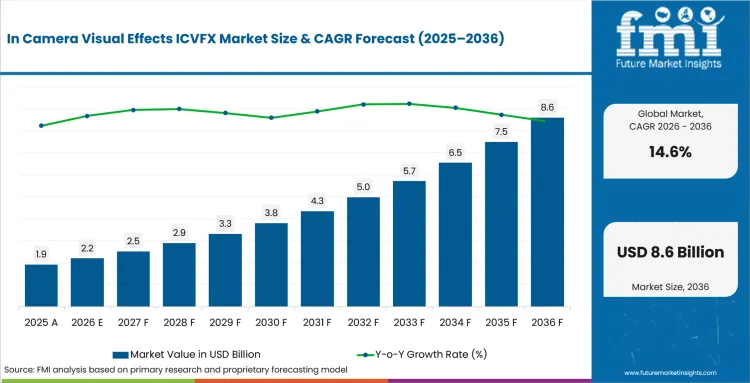
Key Takeaways of In-Camera Visual Effects ICVFX Market
- ICVFX demand is projected to expand as controlled LED stages reduce selected location work and deferred compositing across complex film and broadcast sequences.
- By component, hardware is estimated to hold 56.0% share in 2026, supported by fixed investment in displays, processors, tracking devices, and synchronization equipment used across recurring production cycles.
- Production studios are projected to capture 49.0% share in 2026 within end user, reflecting their control over stage bookings, shared technical crews, and recurring client utilization.
- In deployment, on-premise is forecast to represent 63.0% share in 2026, driven by local rendering, synchronized device control, and secure asset access during principal photography.
- Late delivery of digital environments and limited cross-disciplinary crews reduce utilization across expensive stage bookings, making high stage investment a material adoption barrier.
- Sony, ROE Visual, Brompton Technology, disguise, Epic Games, ARRI, Mo-Sys Engineering, Megapixel, Planar Systems, and Samsung Electronics occupy different camera, display, processing, tracking, and stage-delivery roles within the ICVFX workflow.
Analyst Perspective
"Preproduction determines ICVFX economics by locking digital environments and camera settings ahead of the booked shooting day. Productions need approved assets and a tested lens package alongside reliable tracking and calibrated color. Executives should compare usable stage hours with the share of captured footage accepted for final use. Late content or calibration failures can consume an expensive booking on a technically capable stage."
- Sudip Saha, Principal Analyst, Future Market Insights
How is the In-Camera Visual Effects ICVFX Market segmented?
The In Camera Visual Effects ICVFX market is segmented by component, technology, application, end user, deployment, and region.
The market is segmented by component, technology, application, end user, deployment, and region to separate distinct revenue pools and operating responsibilities. Component distinguishes installed hardware from software and technical services, while technology separates LED volumes from rendering, camera tracking, and integrated virtual production platforms. Application analysis identifies the production task creating demand, and end user analysis identifies the organization controlling stage access and project budgets. Deployment analysis separates local infrastructure from cloud-supported and hybrid workflows that change asset access and on-set control responsibilities. Regional analysis compares stage capacity, crew availability, production pipelines, financing conditions, and technical support across national markets.
What supports the position of hardware within the component category?
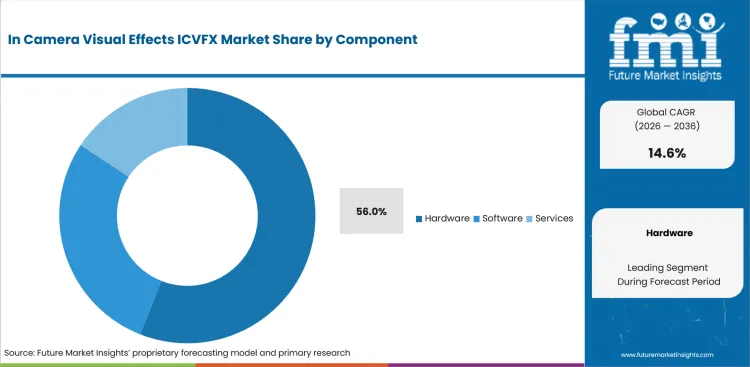
Hardware combines LED panels and processors with tracking devices and synchronization equipment inside one camera-ready stage system. Brompton Technology reported in June 2025 that Sony CAPRI panels use Tessera processing for scalable virtual production installations. The integration shows why broadcast equipment must undergo complete signal and color validation across the camera path rather than isolated panel testing. Stage operators therefore compare interoperability and processor headroom across future panel expansion and changing camera packages.
- By component, hardware is estimated to hold 56.0% share in 2026 owing to the capital required for camera-ready LED infrastructure. The hardware category covers displays and processors together with tracking devices that remain installed across multiple production cycles. Software supports each shoot, yet permanent stage owners carry the larger fixed-asset and replacement burden.
- Permanent stage operators favor modular hardware that protects earlier processor and display investments across changing client requirements. Interchangeable tracking devices and scalable processing let facilities widen camera coverage without rebuilding the complete environment. Stable synchronization under production cameras protects expected savings from location substitution and reduces corrective compositing caused by visible artifacts.
Why does LED volume technology lead the technology category?
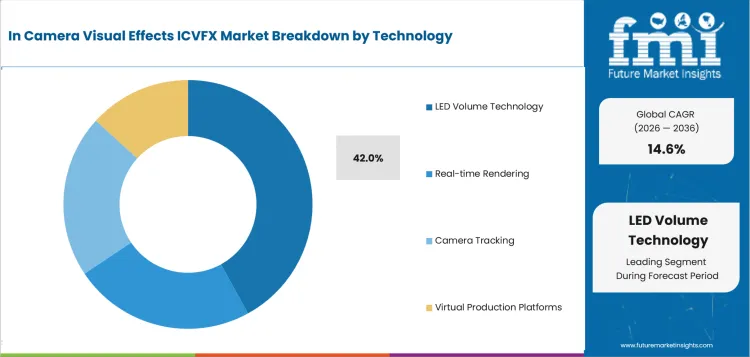
LED volume technology creates the camera-facing environment that combines digital scenery with practical light and reflections on physical subjects. Coordinated graphics processing units must sustain synchronized content across several surfaces without disrupting final camera output or lens tracking. Stage teams evaluate panel calibration and rendering stability together during camera qualification under the approved lens and camera package. Panel output and rendering stability shape the final recorded image and can invalidate a production test through visible artifacts.
- LED volume technology is set to lead the technology category with 42.0% share in 2026 due to camera-facing scenery that provides practical light and reflections. Calibrated panels and synchronized rendering shape the recorded image across every camera angle used during final capture. Alternative workflows depend more heavily on later compositing and deliver less on-set light from the digital environment during principal photography.
- Cinematographers and stage supervisors adopt LED volumes that maintain repeatable color and frame timing across changing camera positions. Epic Games released Unreal Engine 5.8 in June 2026 with advances in virtual production, expanded rendering capabilities, and improved in-engine character tools. The update strengthens connected-device control, but early lens tests remain necessary to identify moiré and brightness limits ahead of principal photography.
How does film production shape demand in the application category?
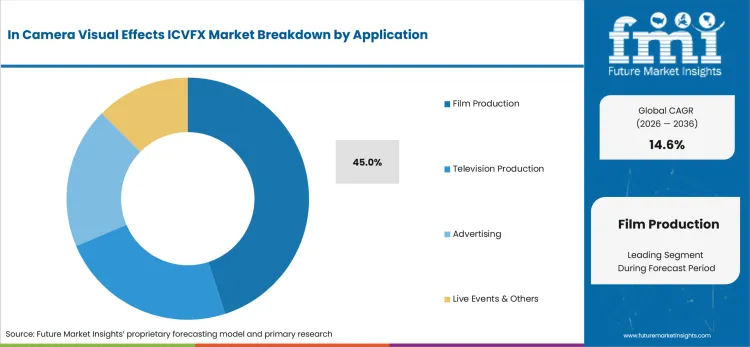
Film productions use ICVFX for sequences facing location restrictions or expensive physical builds during tightly scheduled principal photography. Producers compare each sequence against location access and asset-preparation requirements ahead of confirming stage use and allocating specialist crews. ICVFX becomes more useful for scenes needing repeatable weather conditions or complex extensions, but incomplete digital assets can delay stage preparation. Directors also need computer-generated environments that match practical foreground elements under the approved lens package and planned camera movement.
- The film production segment is likely to capture 45.0% share in 2026, attributable to demand for controlled weather and repeatable digital environments. Ulster University reported in February 2026 that Titanic Sinks Tonight used LED volumes with real-time environments and camera tracking. The production captured final imagery and preserved practical foreground performance across complex scenes scheduled for principal photography.
- Film producers expand ICVFX use following an initial sequence that proves acceptable color and parallax under the final lens package. Early asset approval protects booked hours by reducing late environment revisions and avoidable rendering changes. Projects gain a clearer expansion case by measuring location substitution and post-production reduction across several technically demanding scenes.
Why do production studios lead within the end user category?
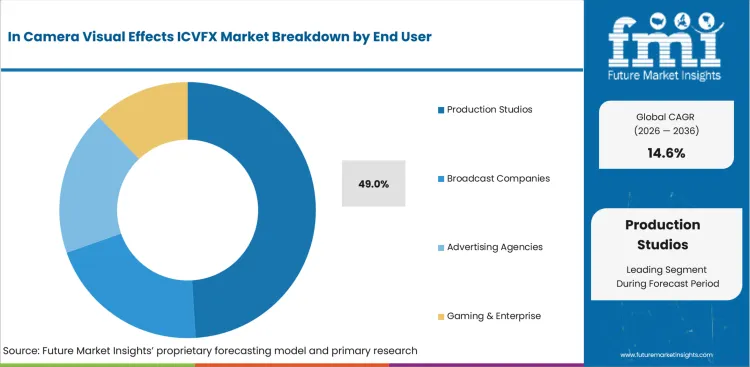
Production studios control stage booking and technical staffing across several projects, which gives them direct influence over ICVFX utilization. Reliable media asset management must connect prepared environments with dependable on-set playback and responsive technical support throughout every client session. disguise reported in March 2025 that TRG Multimedia opened an 8,000-square-foot studio with an integrated LED stage and local training. The development links stage capacity with workforce preparation and repeatable client delivery across several production formats.
- The end user category is forecast to be led by production studios at 49.0% share in 2026 due to their control over bookings and technical crews. Production studios serve several clients through coordinated booking schedules and shared technical teams across recurring production cycles. Broadcasters and agencies often secure capacity through studio partners instead of maintaining complete ICVFX infrastructure.
- Studio operators adopt flexible systems that support advertising and film workloads across the same LED volume and technical crew. Underused infrastructure lengthens the payback period, so booked stage hours provide a clear expansion signal. Operators can justify expansion by standardizing calibration and service procedures without restricting the creative requirements of individual productions.
Which buying mechanism supports on-premise in the deployment category?
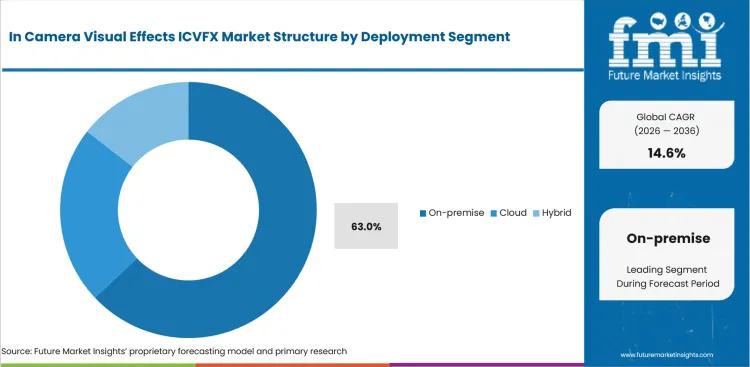
On-premise deployment gives stage operators direct control over latency and synchronized device configuration during principal photography. Fixed video processing platforms let technicians protect production assets and test processor redundancy inside the facility. A network or tracking failure can consume booked hours, so operators assess local service response alongside secure access. On-premise deployment suits permanent volumes serving recurring client schedules that require dependable support across several production departments.
- On-premise is projected to hold 63.0% share in 2026 owing to the need for local rendering and synchronized device control during principal photography. The position reflects direct operating responsibility for hardware and software from daily setup through final camera capture. Cloud resources support asset exchange and remote collaboration, yet demanding production sessions rely on dependable local processing.
- Permanent stage owners adopt local systems that technicians can test ahead of each client shooting day and maintain throughout production. Samsung announced in April 2025 that Twickenham Film Studios would install a permanent LED stage featuring a 24 x 4.5-metre back wall, a 105-square-metre LED ceiling, and additional mobile totem walls, developed in partnership with virtual production specialists Quite Brilliant. The project demonstrates how fixed facilities combine local processing with dependable technical support across scheduled sessions.
What are the drivers, restraints, and opportunities in the In-Camera Visual Effects ICVFX Market?
Better real-time control increases camera-ready output during booked stage days, high stage investment and limited cross-disciplinary skills suppress utilization, integrated stage packages can combine content preparation, tracking, color, and technical support under one accountable service model.
- Driver: Better rendering and tracking increase the number of camera-ready scenes completed during each booked stage day.
- Restraint: High stage investment and specialist preparation weaken utilization economics during early projects with uncertain production volumes.
- Opportunity: Integrated service packages can combine preproduction and stage operation with tracking, color, and technical support under one accountable agreement.
Real-time content control increases the number of usable scenes completed during each booked stage day. Foundry announced Nuke Stage in April 2025 as software built specifically for virtual production and in-camera visual effects. The application connects prepared assets with LED playback and live compositing inside one color-managed workflow. Integrated content creation workflows reduce handoff errors and let production teams correct approved imagery on set instead of transferring avoidable work into post-production.
Limited cross-disciplinary skills remain a material restraint across facilities combining cinematography with real-time engines and LED engineering. Mo-Sys reported in October 2025 that 77 Mediacorp employees were receiving specialist training across camera and LED workflows. The program demonstrates coordinated learning across camera and lighting departments alongside display and real-time production teams. Facilities without comparable training can lose booked hours to longer rehearsals and slower fault diagnosis during live sessions. The resulting downtime increases stage costs and can reduce confidence in scheduling complex scenes on the same facility.
Integrated facilities can widen project scope by combining stage access with scanning and content preparation under coordinated service terms. Ulster University launched Studio Ulster in June 2025 with ICVFX and volumetric capture alongside motion tracking and real-time engines. The facility shows how shared technical teams can support film and television projects without separate handoffs between every specialist. Stage operators can use extended reality production service contracts that assign responsibility for digital assets and calibration inside one commercial agreement.
Which country CAGRs are profiled in the In-Camera Visual Effects ICVFX Market?
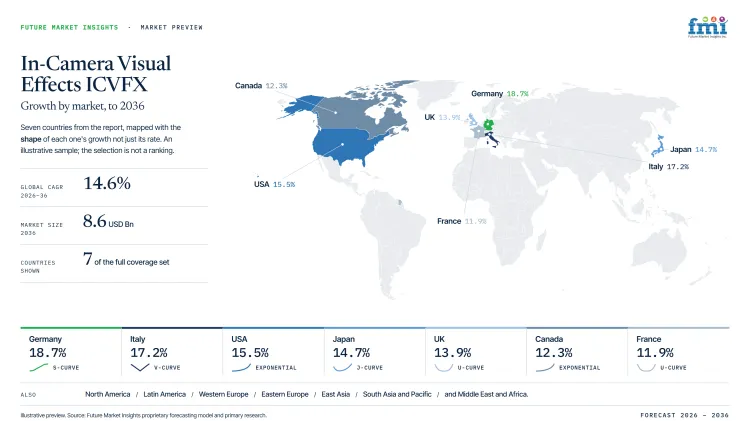
| Country | CAGR |
|---|---|
| Germany | 18.7% |
| Italy | 17.2% |
| USA | 15.5% |
| Japan | 14.7% |
| UK | 13.9% |
| Canada | 12.3% |
| France | 11.9% |
How do country-level CAGRs compare in the In-Camera Visual Effects ICVFX Market?
The forecasts form a gradual progression rather than separate adoption tiers across the seven profiled countries. Germany and France are separated by 6.8 percentage points, with relatively even steps between the intermediate rates. The pattern indicates that stage availability and technical service depth differ incrementally instead of creating one isolated expansion market. Germany and Italy benefit from concentrated production infrastructure, the USA combines larger rental networks with higher specialist costs. Japan and the UK rely more heavily on qualification discipline and shared facilities across established screen-production clusters. Canada and France face wider service or financing constraints outside their major production hubs and training centers.
- Germany combines established broadcast engineering with structured broadcaster trials, but permanent-stage proposals face formal technical approval and regional service constraints.
- Italy connects major production hubs with broadcaster training and specialist rental studios, although permanent LED-volume capacity remains concentrated around Rome and Milan.
- USA adoption benefits from large production clusters and rental infrastructure, although specialist labor costs and competing stage schedules can pressure smaller projects.
- Japan favors compact high-specification studios and exacting camera tests, which support premium workflows but lengthen technical qualification for unfamiliar systems.
- UK adoption draws on established screen skills and public research facilities, yet access remains uneven beyond major studio and university clusters.
- Canada combines established production hubs with applied virtual-production training, but long service distances and uneven project density complicate expansion across provinces.
- France adds training capacity and supported studio investment, although formal financing decisions can slow permanent equipment commitments outside major production centers.
CAGR alone does not establish an attractive entry route across seven production systems with different costs and service constraints. Investors should compare stage utilization and technical support with crew availability before committing capital to permanent infrastructure. The full report provides country-level CAGR analysis across North America, Latin America, Europe, East Asia, South Asia, Oceania and the Middle East and Africa.
Country-wise Analysis
- German broadcasters can test ICVFX inside television studios with established engineering teams and formal technical review. Germany's in camera visual effects ICVFX market outlook is anticipated to advance at 18.7% CAGR over the assessment period, supported by broadcaster trials and established production engineering. Sony reported in October 2025 that SWR began a three-month virtual production trial using a 10-by-4-meter LED wall and three tracked cameras. The pilot gives local teams a direct route to qualify multicamera tracking and live production workflows under scheduled broadcast conditions. Specialist service remains concentrated near major production centers, which raises response-time risk for regional stages. Expansion beyond existing studio clusters requires regional maintenance commitments and repeatable training plans for broadcasters and independent stage operators.
- Italian production teams can access advanced ICVFX training in Rome through the national film school and its virtual-production laboratories. Centro Sperimentale di Cinematografia announced in September 2025 that its Rome laboratory would provide 240 hours of advanced virtual-production training. The program covers ICVFX and LED walls alongside tracking and synchronization, with additional work on calibration and production planning. In Italy, in camera visual effects ICVFX demand is predicted to advance at 17.2% CAGR through 2036, supported by specialist training and stage capacity around major production hubs. The course gives VFX supervisors and producers direct experience with technical and budget decisions that shape commercial stage use. Access to trained crews and technical service remains uneven outside established production hubs, which adds travel and scheduling friction for regional projects. Rentable stages with defined technician support offer a practical entry route for productions that cannot justify permanent infrastructure.
- United States production companies can access large soundstage clusters and extensive equipment rental networks across major screen hubs. Rental networks give projects access to specialized stages without requiring permanent ownership across every production company. By 2036, the USA in camera visual effects ICVFX market is projected to grow at 15.5% CAGR due to large production clusters and rentable stage capacity. Brompton Technology reported in August 2025 that S4 Studios completed as many as 25 shots daily at Brandon Studios in Burbank. Specialist labor costs and competing stage schedules remain material frictions for smaller projects across regional production centers. Service agreements should separate booked capacity from camera-ready hours so production teams can identify the cause of lost time.
- Japanese studios emphasize compact equipment layouts and dependable image quality within tightly planned production schedules. AOTO announced in May 2025 that Toei opened a 640-square-meter LED virtual production studio in Tokyo. Adoption of in camera visual effects ICVFX in Japan is estimated to expand at 14.7% CAGR through 2036, linked to strong camera expertise and expanding permanent-stage capacity. The facility gives film and television teams a direct route to test final-pixel workflows under commercial conditions. Detailed qualification and limited specialist availability can delay unfamiliar systems across regional production centers and tightly scheduled projects. Film and broadcast studios need local maintenance coverage and repeatable lens-testing procedures before unfamiliar systems enter scheduled productions.
- United Kingdom screen production combines studio clusters with public research facilities that develop shared virtual production capabilities. In camera visual effects ICVFX demand in the UK is forecast to rise at 13.9% CAGR over the forecast period, reinforced by experienced crews and shared research infrastructure. Shared facilities lower the initial testing burden for smaller production teams that cannot maintain permanent stages or specialist technical staff. Ulster University launched the CoSTAR Screen Lab in February 2025 with virtual production infrastructure and industry access. Access remains uneven outside established clusters, which favors rentable stage packages and regional training partnerships. Independent production groups should match rentable stage packages and regional service coverage with their expected project pipeline before committing to permanent equipment.
- Canadian production activity is distributed across provincial hubs with considerable distance between studios and technical service teams. Sheridan College reported in January 2025 that its SIRT center resumed a twelve-week virtual production micro-credential using an LED volume. In camera visual effects ICVFX sales in Canada are forecast to expand at 12.3% CAGR by 2036, aided by established screen hubs and applied virtual production training. Applied training prepares local crews to coordinate camera systems and LED workflows inside commercial production settings. Long service routes and uneven project density remain material frictions for facilities outside major provincial production hubs. Smaller facilities benefit from phased equipment leases with defined maintenance coverage rather than complete stage purchases.
- French audiovisual training combines camera instruction with permanent LED-stage access inside a specialist film school. The French in camera visual effects ICVFX sector is projected to record 11.9% CAGR during the assessment period, reflecting studio modernization and workforce development. École Méliès reported in April 2025 that it launched a 120-square-meter virtual production set with Sony Crystal LED walls and VENICE 2 cameras. The facility creates a direct training route for crews working across tracking and real-time rendering workflows. Formal financing decisions and concentrated technical resources remain material frictions for facilities outside major production centers. Permanent installations require multi-project booking plans that justify broader expansion beyond the country's major production centers.
Who are the notable companies in the In-Camera Visual Effects ICVFX Market?
The In Camera Visual Effects ICVFX competitive set includes Sony Group Corporation, ROE Visual, Brompton Technology, disguise, Epic Games, ARRI, Mo-Sys Engineering, Megapixel, Planar Systems, and Samsung Electronics. Within this market, Sony Group Corporation is estimated to account for 18.0% share in 2026.
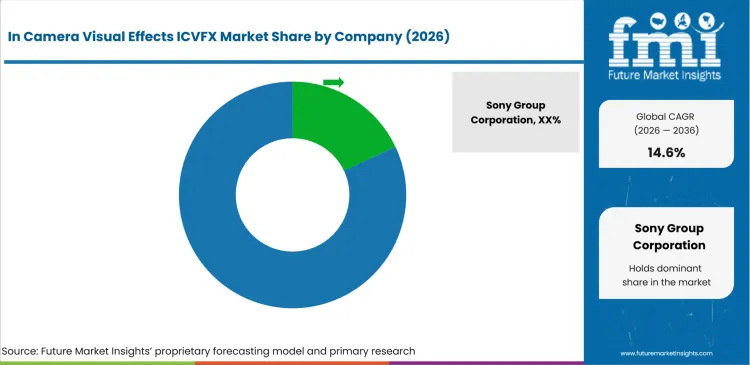
ICVFX competition spans camera systems and LED processors alongside real-time platforms and stage integrators serving different production responsibilities. Sony and ARRI connect camera systems with stage delivery, ROE Visual and Samsung provide camera-ready display infrastructure. ARRI reported in June 2025 that it designed and accredited the United Illusions virtual production complex in Budapest. Brompton and Megapixel control LED processing that shapes final image consistency across varied lenses and panel configurations. Real-time scene playback and orchestration come from disguise and Epic Games, Mo-Sys supplies tracking and motion systems. Production studios compare integration responsibility with calibration support and training coverage across visual computing tools. Most projects combine display and tracking specialists with rendering and stage-delivery partners rather than assign every responsibility to one company.
- Sony Group Corporation and ARRI connect camera technology with permanent and project-based stage workflows, ROE Visual and Brompton Technology focus on camera-ready LED output and processing control. Their commercial test is consistent color and synchronization across varied lenses rather than broad portfolio size.
- Across film and broadcast workflows, disguise and Epic Games influence real-time rendering and stage orchestration. Mo-Sys Engineering adds camera tracking and robotics that support repeatable on-set movement across varied stage configurations. Selection depends on integration with existing playback systems and technicians who can diagnose timing problems during principal photography.
- Megapixel provides LED processing, Planar Systems and Samsung Electronics supply camera-ready display infrastructure for permanent stages. Planar reported in April 2025 that its NAB virtual-production studio paired a fine-pixel-pitch LED wall with OptiTrack camera tracking. Specialist selection therefore depends on measurable image performance and service coverage rather than complete workflow ownership.
Competitive Benchmarking: In-Camera Visual Effects ICVFX Market
| Company | Display and Processing Depth | Real-Time Workflow Control | Integration and Stage Delivery | Geographic Reach |
|---|---|---|---|---|
| Sony Group Corporation | High | High | High | Global |
| ROE Visual | High | Medium | Medium | Global |
| Brompton Technology | High | Medium | Medium | Global |
| disguise | Medium | High | High | Global |
| Epic Games | Medium | High | Medium | Global |
| ARRI | Medium | Medium | High | Global |
| Mo-Sys Engineering | Medium | High | High | Multi-country |
| Megapixel | High | Medium | Medium | Global |
Key Developments in the In-Camera Visual Effects ICVFX Market
- In August 2025, Sony Group Corporation showcased PXO AKIRA at SIGGRAPH with VERONA LED panels and VENICE 2 cameras. The system combined BURANO cameras with the OCELLUS tracking prototype and synchronized vehicle backgrounds across repeated takes. The workflow gives automotive productions a controlled alternative to location driving and extensive corrective compositing.
- In September 2025, ROE Visual expanded its Netherlands Film Academy partnership through a permanent Ruby RB2.6 LED volume with Megapixel processing. The installation supports real-time in-camera visual effects and gives students direct access to professional production workflows. Repeated training on calibration and content preparation broadens the skilled labor base for future commercial productions.
- In December 2025, Brompton Technology supplied Tessera SX40 processors for StudioCube Daejeon’s large virtual production facility in South Korea. The installation supports several LED stages and strengthens synchronized image control across high-resolution production environments. Facilities of this scale improve regional access to ICVFX but raise expectations for specialist maintenance and processor support.
- In February 2026, Mo-Sys Engineering launched CarRig as a computer-controlled motion system for stationary vehicle scenes filmed against LED backgrounds. The kit synchronizes steering and vibration with video plates and can be installed on a vehicle in under two hours. The launch extends ICVFX into repeatable automotive workflows combining robotics with controlled virtual production systems.
Key Players in the In-Camera Visual Effects ICVFX Market
Core Technology and Product Providers
- Sony Group Corporation
- ROE Visual
- Brompton Technology
Integrated Service and Platform Participants
- disguise
- Epic Games
- ARRI
- Mo-Sys Engineering
Specialist and Regional Challengers
- Megapixel
- Planar Systems
- Samsung Electronics
In-Camera Visual Effects ICVFX Market - Report Scope
| Coverage field | Report scope |
|---|---|
| Market breakdown | Component, technology, application, end user, deployment, and region. |
| Market Definition | LED walls, real-time rendering, camera tracking, processors, synchronization, integration, and production services used to capture visual effects during principal photography. |
| Regions Covered | North America, Latin America, Western Europe, Eastern Europe, East Asia, South Asia and Pacific, and Middle East and Africa. |
| Countries Covered | Germany, Italy, USA, Japan, UK, Canada, and France. |
| Key Companies Profiled | Sony Group Corporation, ROE Visual, Brompton Technology, disguise, Epic Games, ARRI, Mo-Sys Engineering, Megapixel, Planar Systems, and Samsung Electronics. |
| Forecast Period | 2026 to 2036. |
| Approach | Hybrid bottom-up and top-down market sizing supported by primary interviews and official desk research. |
In-Camera Visual Effects ICVFX Market - Research Methodology
| Method | Approach |
|---|---|
| Primary Research | FMI analysts gathered input from manufacturers, service providers, technology developers, distributors, end users, procurement teams, and subject-matter experts. Interviews examined purchasing decisions, product or service evaluation, adoption barriers, approval requirements, pricing considerations, and expectations for technical or commercial support. Respondents were also asked what evidence is required before a trial, pilot, or initial order develops into regular purchasing. |
| Desk Research | Desk research covered government statistics, regulatory publications, trade data, industry associations, technical literature, standards, company filings, product information, and official corporate announcements. Sources were reviewed for relevance, publication date, geographic coverage, and consistency with the defined market scope. Claims relating to performance, applications, approvals, capacity, investment, and commercial activity were retained only when supported by credible public evidence. |
| Market Sizing and Forecasting | The market model combined the baseline value with historical performance, segment structure, pricing and volume indicators, adoption levels, company participation, and country-level demand conditions. Forecast assumptions considered economic activity, investment trends, regulatory developments, technology adoption, purchasing cycles, supply availability, and barriers to wider market use. Segment and regional estimates were reconciled before the final market total was calculated. |
| Data Validation | Estimates were checked against multiple independent indicators, including public data, company activity, trade patterns, industry developments, and findings from primary interviews. Validation also tested whether products, services, applications, and company revenues fell within the defined market boundaries. Adjacent categories, unsupported claims, overlapping revenues, and activities without direct market relevance were excluded to reduce double counting and maintain consistency across segments and countries. |
In-Camera Visual Effects ICVFX Market by Segments
In Camera Visual Effects ICVFX Market segmented by Component:
- Hardware
- LED Video Walls
- Camera Tracking Systems
- Media Servers
- Software
- Real-time Rendering Software
- Virtual Production Software
- Content Management Software
- Services
- System Integration
- Production Services
- Maintenance & Support
In Camera Visual Effects ICVFX Market segmented by Technology:
- LED Volume Technology
- Curved LED Volumes
- Flat LED Walls
- Modular LED Stages
- Real-time Rendering
- Unreal Engine
- Unity Engine
- Custom Rendering Engines
- Camera Tracking
- Optical Tracking
- Inertial Tracking
- Hybrid Tracking Systems
- Virtual Production Platforms
- Previsualization
- On-set Visualization
- Post-production Integration
In Camera Visual Effects ICVFX Market segmented by Application:
- Film Production
- Feature Films
- Independent Films
- Short Films
- Television Production
- TV Series
- Live Broadcast
- Commercial Production
- Advertising
- Brand Commercials
- Product Launch Videos
- Digital Advertising
- Live Events & Others
- Concerts
- Corporate Events
- Esports Production
In Camera Visual Effects ICVFX Market segmented by End User:
- Production Studios
- Major Film Studios
- Independent Studios
- Virtual Production Studios
- Broadcast Companies
- Television Networks
- OTT Studios
- News Broadcasters
- Advertising Agencies
- Creative Agencies
- Marketing Studios
- Brand Production Teams
- Gaming & Enterprise
- Game Developers
- Training & Simulation
- Corporate Media Production
Research Sources and Bibliography
- Sony Group Corporation. (2025, January 7). Sony Exhibits at CES® 2025.
- Sony Europe B.V. (2025, October 10). SWR startet Innovationsprojekt „Virtual Production“.
- Fondazione Centro Sperimentale di Cinematografia. (2026, March 6). Bando di selezione per ammissione al corso PRODURRE E COMUNICARE IN PUBBLICITÀ CON IL VIRTUAL SET.
- Brompton Technology. (2025, June 5). Brompton Technology powers Sony’s new Crystal LED CAPRI, unlocking scalable virtual production for all.
- Epic Games. (2026, June 23). Unreal Engine 5.8 is now available.
- Ulster University. (2026, February 27). Titanic Sinks Tonight showcases Studio Ulster’s cutting-edge virtual production and skills development.
- disguise. (2025, March 19). TRG Multimedia expands into virtual production with Disguise Studio Pro.
- Samsung Electronics. (2025, April 16). Samsung Partners with Twickenham Film Studios and Quite Brilliant to Provide New LED Stage to Lead the Future of UK’s Virtual Production Capabilities.
- Brompton Technology. (2025, August 12). Brompton Technology empowers S4 Studios’ high-speed virtual production workflow for Discovery’s Expedition Files.
- Mo-Sys Engineering. (2025, October 14). Mediacorp and Mo-Sys Academy forge a partnership to drive company-wide adoption of Virtual Production.
- Ulster University. (2025, June 19). Ulster University leads next generation of virtual film production with Studio Ulster launch.
- Fondazione Centro Sperimentale di Cinematografia. (2025, September 23). Bando di selezione per l’ammissione al laboratorio Advanced Virtual Production Lab Specializzazione in Produzione Virtuale per VFX Supervisor e VFX Producer.
- Foundry. (2025, April 2). Foundry announces Nuke Stage virtual production product.
- AOTO. (2025, May 30). Toei Unveils Japan’s Largest LED Virtual Production Studio, Powered by AOTO.
- Ulster University. (2025, February 28). Ulster University launches CoSTAR Screen Lab bringing world-class virtual production capabilities to Northern Ireland.
- Sheridan College. (2025, January 13). Virtual Production micro-credential program returns this month at SIRT.
- École Méliès. (2025, April 2). École MÉLIÈS and SONY unveil the first-ever visual production set.
- Sony Group Corporation. (2025, August 28). Showcasing Sony’s Creative Entertainment Vision at SIGGRAPH 2025.
- ROE Visual. (2025, September 11). ROE Visual Partners with Netherlands Film Academy.
- Brompton Technology. (2025, December 9). Brompton Technology powers South Korea’s largest virtual production facility at StudioCube Daejeon.
- Mo-Sys Engineering. (2026, February 12). Mo-Sys launches CarRig: Robotics-driven realism for in-studio car shoots.
- ARRI. (2025, June 4). ARRI boosts United Illusions’ world-class film complex in Budapest with solutions, equipment, and stage accreditation.
- Planar. (2025, April 6). Planar and OptiTrack Present Most Innovative Lineup of Broadcast and Media Solutions at NAB 2025.
- Megapixel. (2025, March 13). Ghostframe: In-Camera Visual Effects.
This bibliography is provided for reader reference and is not exhaustive. The full report contains the complete reference list and detailed citations
This Report Answers
- How does the In Camera Visual Effects ICVFX Market expand from 2026 to 2036?
- Which stage utilization and project-margin assumptions must hold before permanent ICVFX infrastructure justifies capital investment?
- Which operating signals distinguish durable ICVFX adoption from short-lived interest in virtual production technology?
- How should companies prioritize Germany, Italy, USA, Japan, UK, Canada, and France under different stage-access and service conditions?
- How are Sony Group Corporation, ROE Visual, and Brompton Technology positioned against platform and integration specialists?
- Should market entry use internal investment, technology partnerships, stage-service agreements, or a focused application route?
- Which downside conditions could reduce the forecast and which early measures would reveal weaker stage utilization?
- Which quarterly measures best track pipeline conversion, stage utilization, setup efficiency, reshoot performance, and customer retention?
- Which evidence creates the strongest purchase case: accepted camera tests, completed production metrics, training capacity, or documented service performance?
Frequently Asked Questions
How big is the In-Camera Visual Effects ICVFX Market in 2026?
The in-camera visual effects ICVFX market is valued at USD 2.2 billion in 2026 and is forecast to reach USD 8.6 billion by 2036, reflecting growing production demand for controlled LED stages that reduce location work and deferred compositing across film and broadcast sequences.
What is the CAGR of the In-Camera Visual Effects ICVFX Market from 2026 to 2036?
The in-camera visual effects ICVFX market is projected to grow at a CAGR of 14.6% between 2026 and 2036, supported by improvements in real-time rendering and camera tracking that increase the number of camera-ready scenes completed during each booked stage day.
Which deployment type leads the In-Camera Visual Effects ICVFX Market?
On-premise deployment accounts for 63.0% of the in-camera visual effects ICVFX market by deployment in 2026, driven by production teams requiring local rendering, synchronized device control, and secure asset access during principal photography.
Who are the leading companies in the In-Camera Visual Effects ICVFX Market?
Leading companies in the in-camera visual effects ICVFX market include Sony Group Corporation, ROE Visual, Brompton Technology, disguise, Epic Games, ARRI, Mo-Sys Engineering, Megapixel, Planar Systems, and Samsung Electronics, spanning camera systems, LED processing, real-time rendering, and stage integration roles across the ICVFX workflow.
Preview the report firsthand - request a free sample
Get SampleGet the brochure for pricing and purchase details.
Get PDFTable of Content
- Key Takeaways
- Market Size and CAGR
- Top Growth Driver
- Fastest Growing Segment
- Leading Region
- Key Companies
- Emerging Opportunities
- Executive Summary
- Global Market Outlook
- Demand-side Trends
- Supply-side Trends
- Technology Roadmap Analysis
- Analysis and Recommendations
- Analyst Perspective (What is happening? Why now? What should investors know?)
- Key Questions Answered
- How large is the market?
- What is the CAGR?
- What are key trends?
- Which region dominates?
- Who are the leaders?
- Market Overview
- Market Coverage / Taxonomy
- Market Definition / Scope / Limitations
- Research Methodology
- Chapter Orientation
- Analytical Lens and Working Hypotheses
- Market Structure, Signals, and Trend Drivers
- Benchmarking and Cross-market Comparability
- Market Sizing, Forecasting, and Opportunity Mapping
- Research Design and Evidence Framework
- Desk Research Programme (Secondary Evidence)
- Expert Input and Fieldwork (Primary Evidence)
- Tooling, Models, and Reference Databases
- Data Engineering and Model Build
- Quality Assurance and Audit Trail
- Market Background
- Market Dynamics (Drivers, Restraints, Opportunity, Trends)
- Scenario Forecast (Optimistic, Likely, Conservative)
- Impact Analysis
- AI Impact
- Sustainability Impact
- Regulatory Impact
- Technology Impact
- Consumer / Buyer Analysis
- Purchase Drivers
- Adoption Barriers
- Buyer Journey
- Opportunity Map Analysis
- Product Life Cycle Analysis
- Supply Chain Analysis
- Investment Feasibility Matrix
- Value Chain Analysis
- PESTLE and Porter's Analysis
- Regulatory Landscape
- Regional Parent Market Outlook
- Production and Consumption Statistics
- Import and Export Statistics
- Global Market Analysis and Forecast, 2021 to 2036
- Historical Market Size Value (USD Billion) Analysis, 2021 to 2025
- Current and Future Market Size Value (USD Billion) Projections, 2026 to 2036
- Y-o-Y Growth Trend Analysis
- Absolute $ Opportunity Analysis
- Global Market Pricing Analysis, 2021 to 2036
- Global Market Analysis and Forecast, By Component, 2021 to 2036
- Introduction / Key Findings
- Historical Market Size Value (USD Billion) Analysis By Component, 2021 to 2025
- Current and Future Market Size Value (USD Billion) Analysis and Forecast By Component, 2026 to 2036
- Hardware
- LED Video Walls
- Camera Tracking Systems
- Media Servers
- Software
- Real-time Rendering Software
- Virtual Production Software
- Content Management Software
- Services
- System Integration
- Production Services
- Maintenance & Support
- Hardware
- Y-o-Y Growth Trend Analysis By Component, 2021 to 2025
- Absolute $ Opportunity Analysis By Component, 2026 to 2036
- Global Market Analysis and Forecast, By Technology, 2021 to 2036
- Introduction / Key Findings
- Historical Market Size Value (USD Billion) Analysis By Technology, 2021 to 2025
- Current and Future Market Size Value (USD Billion) Analysis and Forecast By Technology, 2026 to 2036
- LED Volume Technology
- Curved LED Volumes
- Flat LED Walls
- Modular LED Stages
- Real-time Rendering
- Unreal Engine
- Unity Engine
- Custom Rendering Engines
- Camera Tracking
- Optical Tracking
- Inertial Tracking
- Hybrid Tracking Systems
- Virtual Production Platforms
- Previsualization
- On-set Visualization
- Post-production Integration
- LED Volume Technology
- Y-o-Y Growth Trend Analysis By Technology, 2021 to 2025
- Absolute $ Opportunity Analysis By Technology, 2026 to 2036
- Global Market Analysis and Forecast, By Application, 2021 to 2036
- Introduction / Key Findings
- Historical Market Size Value (USD Billion) Analysis By Application, 2021 to 2025
- Current and Future Market Size Value (USD Billion) Analysis and Forecast By Application, 2026 to 2036
- Film Production
- Feature Films
- Independent Films
- Short Films
- Television Production
- TV Series
- Live Broadcast
- Commercial Production
- Advertising
- Brand Commercials
- Product Launch Videos
- Digital Advertising
- Live Events & Others
- Concerts
- Corporate Events
- Esports Production
- Film Production
- Y-o-Y Growth Trend Analysis By Application, 2021 to 2025
- Absolute $ Opportunity Analysis By Application, 2026 to 2036
- Global Market Analysis and Forecast, By End User, 2021 to 2036
- Introduction / Key Findings
- Historical Market Size Value (USD Billion) Analysis By End User, 2021 to 2025
- Current and Future Market Size Value (USD Billion) Analysis and Forecast By End User, 2026 to 2036
- Production Studios
- Major Film Studios
- Independent Studios
- Virtual Production Studios
- Broadcast Companies
- Television Networks
- OTT Studios
- News Broadcasters
- Advertising Agencies
- Creative Agencies
- Marketing Studios
- Brand Production Teams
- Gaming & Enterprise
- Game Developers
- Training & Simulation
- Corporate Media Production
- Production Studios
- Y-o-Y Growth Trend Analysis By End User, 2021 to 2025
- Absolute $ Opportunity Analysis By End User, 2026 to 2036
- Global Market Analysis and Forecast, By Deployment, 2021 to 2036
- Introduction / Key Findings
- Historical Market Size Value (USD Billion) Analysis By Deployment, 2021 to 2025
- Current and Future Market Size Value (USD Billion) Analysis and Forecast By Deployment, 2026 to 2036
- On-premise
- Dedicated Virtual Production Stage
- Studio-owned Infrastructure
- Permanent Installations
- Cloud
- Remote Rendering
- Cloud Asset Management
- Virtual Collaboration
- Hybrid
- Edge Rendering
- Cloud-connected Studios
- Multi-location Production
- On-premise
- Y-o-Y Growth Trend Analysis By Deployment, 2021 to 2025
- Absolute $ Opportunity Analysis By Deployment, 2026 to 2036
- Global Market Analysis and Forecast, By Region, 2021 to 2036
- Introduction
- Historical Market Size Value (USD Billion) Analysis By Region, 2021 to 2025
- Current Market Size Value (USD Billion) Analysis and Forecast By Region, 2026 to 2036
- North America
- Latin America
- Western Europe
- Eastern Europe
- East Asia
- South Asia and Pacific
- Middle East & Africa
- Market Attractiveness Analysis By Region
- North America Market Analysis and Forecast, By Country, 2021 to 2036
- Historical Market Size Value (USD Billion) Trend Analysis By Market Taxonomy, 2021 to 2025
- Market Size Value (USD Billion) Forecast By Market Taxonomy, 2026 to 2036
- By Country
- USA
- Canada
- By Component
- By Technology
- By Application
- By End User
- By Deployment
- By Country
- Market Attractiveness Analysis
- By Country
- By Component
- By Technology
- By Application
- By End User
- By Deployment
- Key Takeaways
- Latin America Market Analysis and Forecast, By Country
- Historical Market Size Value (USD Billion) Trend Analysis By Market Taxonomy, 2021 to 2025
- Market Size Value (USD Billion) Forecast By Market Taxonomy, 2026 to 2036
- By Country
- Brazil
- Mexico
- Chile
- Rest of Latin America
- By Component
- By Technology
- By Application
- By End User
- By Deployment
- By Country
- Market Attractiveness Analysis
- By Country
- By Component
- By Technology
- By Application
- By End User
- By Deployment
- Key Takeaways
- Western Europe Market Analysis and Forecast, By Country
- Historical Market Size Value (USD Billion) Trend Analysis By Market Taxonomy, 2021 to 2025
- Market Size Value (USD Billion) Forecast By Market Taxonomy, 2026 to 2036
- By Country
- Germany
- UK
- Italy
- Spain
- France
- Nordic
- BENELUX
- Rest of Western Europe
- By Component
- By Technology
- By Application
- By End User
- By Deployment
- By Country
- Market Attractiveness Analysis
- By Country
- By Component
- By Technology
- By Application
- By End User
- By Deployment
- Key Takeaways
- Eastern Europe Market Analysis and Forecast, By Country
- Historical Market Size Value (USD Billion) Trend Analysis By Market Taxonomy, 2021 to 2025
- Market Size Value (USD Billion) Forecast By Market Taxonomy, 2026 to 2036
- By Country
- Russia
- Poland
- Hungary
- Balkan & Baltic
- Rest of Eastern Europe
- By Component
- By Technology
- By Application
- By End User
- By Deployment
- By Country
- Market Attractiveness Analysis
- By Country
- By Component
- By Technology
- By Application
- By End User
- By Deployment
- Key Takeaways
- East Asia Market Analysis and Forecast, By Country
- Historical Market Size Value (USD Billion) Trend Analysis By Market Taxonomy, 2021 to 2025
- Market Size Value (USD Billion) Forecast By Market Taxonomy, 2026 to 2036
- By Country
- China
- Japan
- South Korea
- By Component
- By Technology
- By Application
- By End User
- By Deployment
- By Country
- Market Attractiveness Analysis
- By Country
- By Component
- By Technology
- By Application
- By End User
- By Deployment
- Key Takeaways
- South Asia and Pacific Market Analysis and Forecast, By Country
- Historical Market Size Value (USD Billion) Trend Analysis By Market Taxonomy, 2021 to 2025
- Market Size Value (USD Billion) Forecast By Market Taxonomy, 2026 to 2036
- By Country
- India
- ASEAN
- Australia & New Zealand
- Rest of South Asia and Pacific
- By Component
- By Technology
- By Application
- By End User
- By Deployment
- By Country
- Market Attractiveness Analysis
- By Country
- By Component
- By Technology
- By Application
- By End User
- By Deployment
- Key Takeaways
- Middle East & Africa Market Analysis and Forecast, By Country
- Historical Market Size Value (USD Billion) Trend Analysis By Market Taxonomy, 2021 to 2025
- Market Size Value (USD Billion) Forecast By Market Taxonomy, 2026 to 2036
- By Country
- Kingdom of Saudi Arabia
- Other GCC Countries
- Türkiye
- South Africa
- Other African Union
- Rest of Middle East & Africa
- By Component
- By Technology
- By Application
- By End User
- By Deployment
- By Country
- Market Attractiveness Analysis
- By Country
- By Component
- By Technology
- By Application
- By End User
- By Deployment
- Key Takeaways
- Key Countries Market Analysis
- USA
- Pricing Analysis
- Market Share Analysis, 2025
- By Component
- By Technology
- By Application
- By End User
- By Deployment
- Canada
- Pricing Analysis
- Market Share Analysis, 2025
- By Component
- By Technology
- By Application
- By End User
- By Deployment
- Mexico
- Pricing Analysis
- Market Share Analysis, 2025
- By Component
- By Technology
- By Application
- By End User
- By Deployment
- Brazil
- Pricing Analysis
- Market Share Analysis, 2025
- By Component
- By Technology
- By Application
- By End User
- By Deployment
- Chile
- Pricing Analysis
- Market Share Analysis, 2025
- By Component
- By Technology
- By Application
- By End User
- By Deployment
- Germany
- Pricing Analysis
- Market Share Analysis, 2025
- By Component
- By Technology
- By Application
- By End User
- By Deployment
- UK
- Pricing Analysis
- Market Share Analysis, 2025
- By Component
- By Technology
- By Application
- By End User
- By Deployment
- Italy
- Pricing Analysis
- Market Share Analysis, 2025
- By Component
- By Technology
- By Application
- By End User
- By Deployment
- Spain
- Pricing Analysis
- Market Share Analysis, 2025
- By Component
- By Technology
- By Application
- By End User
- By Deployment
- France
- Pricing Analysis
- Market Share Analysis, 2025
- By Component
- By Technology
- By Application
- By End User
- By Deployment
- India
- Pricing Analysis
- Market Share Analysis, 2025
- By Component
- By Technology
- By Application
- By End User
- By Deployment
- ASEAN
- Pricing Analysis
- Market Share Analysis, 2025
- By Component
- By Technology
- By Application
- By End User
- By Deployment
- Australia & New Zealand
- Pricing Analysis
- Market Share Analysis, 2025
- By Component
- By Technology
- By Application
- By End User
- By Deployment
- China
- Pricing Analysis
- Market Share Analysis, 2025
- By Component
- By Technology
- By Application
- By End User
- By Deployment
- Japan
- Pricing Analysis
- Market Share Analysis, 2025
- By Component
- By Technology
- By Application
- By End User
- By Deployment
- South Korea
- Pricing Analysis
- Market Share Analysis, 2025
- By Component
- By Technology
- By Application
- By End User
- By Deployment
- Russia
- Pricing Analysis
- Market Share Analysis, 2025
- By Component
- By Technology
- By Application
- By End User
- By Deployment
- Poland
- Pricing Analysis
- Market Share Analysis, 2025
- By Component
- By Technology
- By Application
- By End User
- By Deployment
- Hungary
- Pricing Analysis
- Market Share Analysis, 2025
- By Component
- By Technology
- By Application
- By End User
- By Deployment
- Kingdom of Saudi Arabia
- Pricing Analysis
- Market Share Analysis, 2025
- By Component
- By Technology
- By Application
- By End User
- By Deployment
- Türkiye
- Pricing Analysis
- Market Share Analysis, 2025
- By Component
- By Technology
- By Application
- By End User
- By Deployment
- South Africa
- Pricing Analysis
- Market Share Analysis, 2025
- By Component
- By Technology
- By Application
- By End User
- By Deployment
- USA
- Market Structure Analysis
- Competition Dashboard
- Competition Benchmarking
- Market Share Analysis of Top Players
- By Regional
- By Component
- By Technology
- By Application
- By End User
- By Deployment
- Emerging Startups
- Innovation Benchmarking
- Competition Analysis
- Competition Deep Dive
- Sony Group Corporation
- Overview
- Product Portfolio
- Profitability by Market Segments
- Sales Footprint
- Strategy Overview
- Marketing Strategy
- Product Strategy
- Channel Strategy
- ROE Visual
- Brompton Technology
- disguise
- Epic Games
- Pixomondo
- Mo-Sys Engineering
- Megapixel VR
- Planar Systems
- Samsung Electronics
- Sony Group Corporation
- Case Studies
- Success Stories
- Recent Developments
- Competition Deep Dive
- Assumptions & Acronyms Used


