

- Industry Size (2026)
- USD 20.4 Bn
- Forecast (2036)
- USD 65.1 Bn
- CAGR (2026 to 2036)
- 12.3%
India Medical Tourism Market Size, Market Forecast and Outlook By FMI
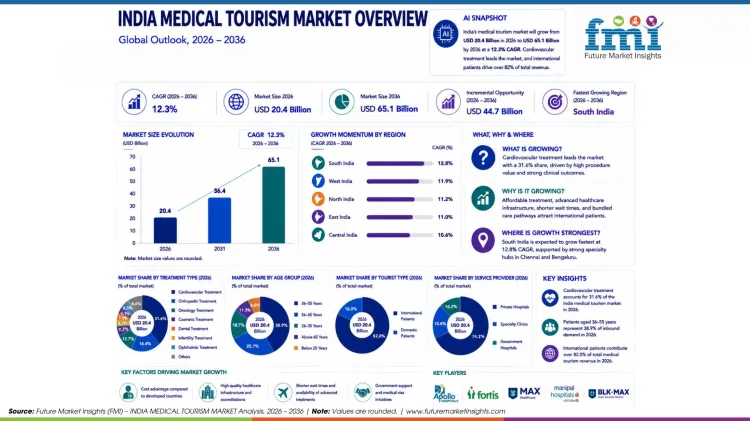
The India medical tourism market is likely to expand from USD 20.4 billion in 2026 to USD 65.1 billion by 2036. The market is anticipated to register 12.3% CAGR during the assessment period. Cardiovascular treatment is likely to lead with 31.6% share, while patients aged 36 to 55 years are set to account for 38.9% of medical tourism demand.
Key Takeaways, Market Size, and Forecast
- The India medical tourism market is likely to be valued at USD 20.4 billion in 2026.
- By 2036, the market is forecast to move to USD 65.1 billion.
- From 2026 to 2036, demand is set to expand at 12.3% CAGR.
- Cardiovascular treatment is likely to account for 31.6% of treatment type revenue.
- Patients aged 36 to 55 years are set to hold 38.9% of inbound demand.
- International patients are likely to contribute over 82.0% of total medical tourism revenue.
- South India is forecast to record the fastest regional growth at 12.8% CAGR through 2036.
Summary of the India Medical Tourism Market
- Demand and Growth Drivers
- International patients are choosing India for advanced treatment at accessible costs.
- Bundled care pathways are making medical travel easier to plan.
- Tele-consultations are improving pre-arrival decisions and post-treatment follow-up.
- Product and Segment View
- Cardiovascular treatment is likely to lead due to high procedure value and strong clinical depth.
- Patients aged 36 to 55 years are set to remain central to demand due to cardiac and orthopedic needs.
- Private hospitals are likely to dominate as international patients prefer accredited multi-specialty centers.
- Geography and Competitive Outlook
- South India is likely to lead growth due to strong specialty hubs in Chennai and Bengaluru.
- West India is set to hold a strong position through Mumbai and Pune hospital networks.
- Hospital groups with coordinated international patient desks are likely to gain stronger referral flows.
- Analyst Opinion
- Ronak Shah, Principal Consultant for Travel and Tourism at FMI, suggests, “The India medical tourism market is moving toward structured treatment journeys rather than low-cost medical trips. Hospitals with strong clinical outcomes, bundled recovery support, and digital patient coordination are likely to gain preference among international patients.”
- India Medical Tourism Market Value Analysis
- The India medical tourism market is moving from cost-led travel into organized cross-border care.
- Demand is likely to rise as hospitals package treatment and recovery into defined journeys.
- Patient inflows are gaining strength from Africa, the Middle East, and Southeast Asia.
- Online booking and tele-consultation tools are improving international patient conversion.
- Long-term value is likely to come from accredited hospitals with strong post-treatment support.
Summary of the India Medical Tourism Market
What Is Growth Outlook for the India Medical Tourism Market as per Future Market Insights Projection?
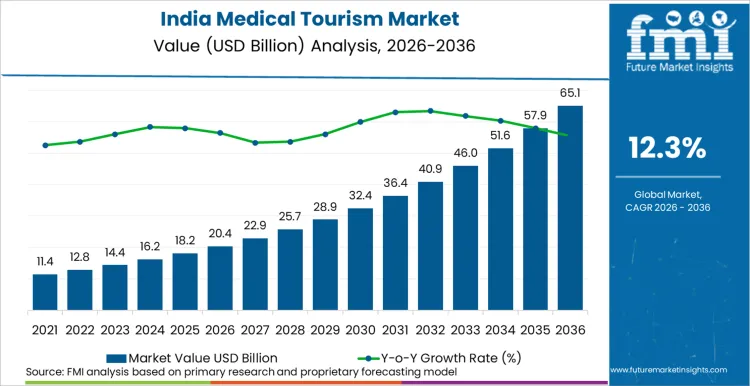
Future Market Insights projects India’s medical tourism market to grow at a 12.3% CAGR from 2026 to 2036, expanding from USD 20.4 billion in 2026 to USD 65.1 billion by 2036.
FMI Research Approach: FMI proprietary forecasting model based on bottom-up estimation of international patient spending, tracking inbound medical travel volumes, and demand modeling linked to procedure mix, hospital capacity expansion, and cross-border healthcare affordability dynamics.
How Do FMI Analysts Perceive the India Medical Tourism Market to Evolve?
FMI analysts perceive medical tourism in India evolving from cost-driven treatment travel toward more structured, service-integrated healthcare journeys. Growth is supported by rising inflows from Africa, the Middle East, and Southeast Asia, expanding private hospital networks, and increasing preference for bundled care pathways covering treatment, recovery, and follow-up services.
FMI Research Approach: Assessment of patient origin mix by region, evaluation of procedure complexity and length of stay, and analysis of treatment pathways, post-operative care models, and per-patient spending patterns across major medical specialties.
Which Source Regions Account for the Largest Share of India Medical Tourism Spend?
The Middle East, Africa, and South Asia account for the largest share of inbound medical tourism spend in India, supported by geographic proximity, referral networks, established patient flows, and strong demand for tertiary and quaternary care services.
FMI Research Approach: FMI source-region demand assessment based on inbound patient flows, procedure-level demand patterns, hospital intake data, and referral channel mapping across key origin markets.
How Large Will the India Medical Tourism Market Be by 2036?
India’s medical tourism market is projected to reach USD 65.1 billion by 2036.
FMI Research Approach: FMI long-term forecast by source region, procedure category, and care delivery model, incorporating assumptions around hospital capacity growth, international patient recovery cycles, and long-term penetration of cross-border healthcare services.
What Is Definition of the India Medical Tourism Market?
The India medical tourism market comprises cross-border travel to India by international patients seeking medical, surgical, dental, fertility, cosmetic, and wellness-related treatments, covering spending on clinical procedures, hospital services, accommodation, and treatment-linked travel support.
FMI Research Approach: FMI market taxonomy and inclusion-exclusion framework covering inpatient and outpatient procedures, elective and complex treatments, and bundled care pathways, while excluding domestic healthcare utilization and inbound leisure tourism unrelated to medical treatment.
What Are Unique Trends Shaping the India Medical Tourism Market?
Globally unique trends shaping the market include rising acceptance of cross-border treatment for elective procedures, growth in bundled care and recovery packages, increasing use of tele-consultations for pre- and post-treatment coordination, and expanding hospital accreditation to attract international patients.
FMI Research Approach: Analysis of procedure mix trends, care pathway evolution, hospital accreditation coverage, digital health adoption in international patient management, and source-region diversification patterns.
India Medical Tourism Market Key Takeaways
| Metric | Details |
|---|---|
| Industry Size (2026) | USD 20.4 Billion |
| Industry Value (2036) | USD 65.1 Billion |
| CAGR (2026-2036) | 12.3% |
Source: Future Market Insights (FMI) analysis, based on proprietary forecasting model and primary research.
What Is Fueling the Rise in International Patients Choosing India for Treatment?
International patients are increasingly viewing India as a planned treatment destination rather than a last-resort option driven only by cost considerations. Future Market Insights notes that patients now place greater emphasis on predictable care pathways, coordinated hospital engagement before travel, and access to multi-specialty centers capable of managing complex procedures within defined treatment windows. Earlier waves of medical travel to India were concentrated among regional patients seeking basic interventions, which limited the scale and diversity of inflows. This is changing as India attracts patients from Africa, the Middle East, and parts of Southeast Asia for tertiary and quaternary care, supported by improving clinical outcomes and international accreditation visibility.
Healthcare provider strategies mirror this shift. Fortis Healthcare has expanded international patient programs by offering dedicated overseas patient desks, pre-arrival clinical coordination, and bundled procedure-and-recovery pathways that simplify the logistics of cross-border care. These service models reduce uncertainty around treatment planning and post-procedure recovery, enabling medical travel to align with patients’ clinical timelines and budget planning. FMI observes that hospitals institutionalizing international patient journeys through standardized service frameworks are more likely to capture sustained referral flows and repeat international demand as medical tourism matures into a structured healthcare delivery channel.
How Is the India Medical Tourism Market Segmented?
The India medical tourism market is segmented by treatment type, age group, tourist type, service provider, traveler type, demography, and booking channel, reflecting differences in clinical demand, care delivery preferences, patient profiles, and planning behavior. By treatment type, cardiovascular and orthopedic procedures represent the largest share due to high treatment value and procedure volumes. By age group, patients aged 36 to 55 years account for the largest share of inbound medical travel. By tourist type, international patients dominate total medical tourism revenues. By service provider, private hospitals lead market share due to specialized care availability. By traveler type, independent travelers account for the majority of medical travel journeys. By demography, male patients represent a slightly larger share of inbound patient volumes. By booking channel, online booking leads patient acquisition and pre-arrival coordination.
Why Do Cardiovascular Treatments Dominate by Treatment Type?
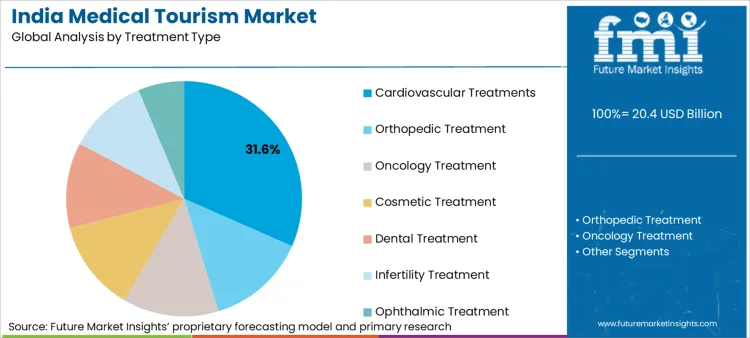
Cardiovascular treatments account for 31.6% of India’s medical tourism revenues, reflecting sustained international demand for complex cardiac procedures at competitive cost levels. Patients frequently seek bypass surgery, angioplasty, and valve replacement procedures in India, where outcomes and clinician experience are well established. Cardiac procedures carry high per-patient value, which elevates their revenue contribution compared with dental or cosmetic treatments. Treatment pathways are often bundled with diagnostics and post-operative care, increasing overall transaction size. This concentration of high-value procedures anchors cardiovascular care as the largest treatment subsegment within India’s medical tourism market.
Why Do Patients Aged 36 to 55 Years Dominate by Age Group?
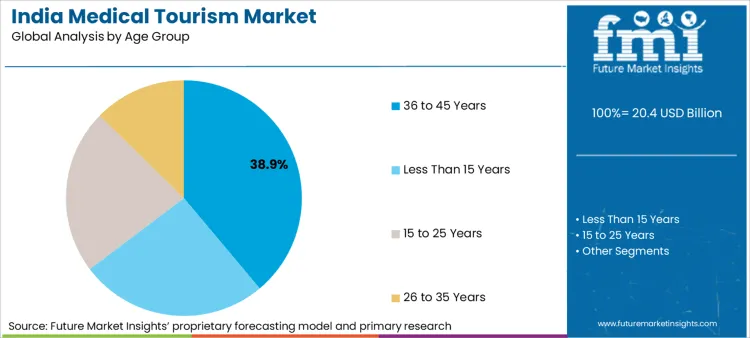
Patients aged 36 to 55 years represent 38.9% of total medical tourism demand, driven by higher incidence of lifestyle-related conditions, orthopedic issues, and cardiac risk factors within this age cohort. This group actively seeks elective and semi-elective procedures that can be planned around work schedules and recovery timelines. Higher disposable income and insurance coverage support willingness to travel for quality care. Their procedures often involve longer hospital stays and follow-up care, increasing per-patient spending. These factors collectively position the 36 to 55 years cohort as the dominant age group within India’s inbound medical tourism flows.
Why Do International Patients Dominate by Tourist Type?
International patients account for over 82.0% of total medical tourism revenues, reflecting higher per-patient spending associated with cross-border treatment journeys. In addition to clinical costs, international patients incur travel, accommodation, and bundled care expenses, which elevate transaction values. They are more likely to opt for comprehensive treatment packages covering diagnostics, procedures, and recovery. Referral networks and medical travel facilitators further concentrate demand among overseas patients seeking tertiary and quaternary care. This pattern is evident at institutions such as Sankara Nethralaya, which reports a substantial share of its patient inflows from international markets, particularly South Asia and Africa, underscoring the structural reliance of leading Indian specialty hospitals on cross-border patient volumes. The complexity and value of procedures sought by international patients reinforce their dominant revenue contribution within India’s medical tourism market. FMI notes that growing competition among destination countries for medical tourism is placing greater emphasis on consistency in care delivery across facilities, departments, and treatment categories.
What Trends Are Reshaping the India Medical Tourism Landscape?
Medical tourism in India is gaining momentum as international patients seek coordinated care pathways, predictable treatment timelines, and end-to-end service models rather than fragmented hospital visits. Cross-border patients increasingly value pre-arrival consultations, structured admission planning, and integrated recovery support, which simplify complex treatment journeys. Compared with earlier patterns where patients navigated hospitals independently, service-led care models now emphasize continuity across diagnosis, procedure, and post-treatment recovery. As per Future Market Insights, medical travel to India is increasingly positioned as a planned healthcare journey rather than an ad hoc response to cost differences. The growing availability of bundled care pathways reduces uncertainty for international patients and contributes to wider acceptance of India as a reliable destination for complex and elective procedures.
How Is Care Pathway Integration Strengthening Medical Tourism Platforms?
Care pathway integration is strengthening competitive positioning by enabling hospitals to offer coordinated treatment journeys that combine clinical care, accommodation, logistics, and post-operative follow-up within a single service framework. Leading hospital networks are extending beyond procedure delivery to manage the full patient experience, focusing on continuity of care rather than isolated treatment episodes. This strategy improves service consistency, patient confidence, and recovery outcomes across international patient programs. The impact of integrated care models is reflected in the international patient service programs operated by Apollo Hospitals, which provide dedicated global patient desks, pre-arrival coordination, and bundled treatment pathways for overseas patients. According to FMI, embedding international patient care within standardized hospital service models improves referral conversion and repeat international patient inflows by leveraging clinical credibility and institutional trust.
Why Is Clinical Standardization Driving Service Model Innovation?
Rising expectations around treatment quality, safety protocols, and recovery outcomes are pushing healthcare providers to standardize clinical workflows and service delivery models for international patients. Cross-border patients increasingly compare hospitals on accreditation status, surgeon experience, infection control protocols, and post-operative care standards. Minor variations in clinical pathways can influence patient confidence and referral decisions. This focus on clinical standardization enables scalability of medical tourism programs and positions Indian providers as dependable care destinations rather than opportunistic treatment alternatives driven purely by cost considerations.
What Is the India Medical Tourism Market Regional Outlook?
India’s medical tourism demand is expanding as international patient inflows rise and private hospital capacity deepens across key treatment hubs. While the national market grows at a 12.3% CAGR from 2026 to 2036, medical travel intensity varies by region based on hospital density, clinical specialization, international connectivity, and service ecosystem maturity. South, North, and West India form the primary demand axis, driven by multi-specialty hospital clusters, transplant programs, and tertiary care depth. East India remains comparatively smaller but is steadily scaling as healthcare infrastructure, international patient desks, and connectivity improve. FMI analysis indicates that future growth will come from broader regional diffusion of international patient programs beyond a few legacy medical hubs.
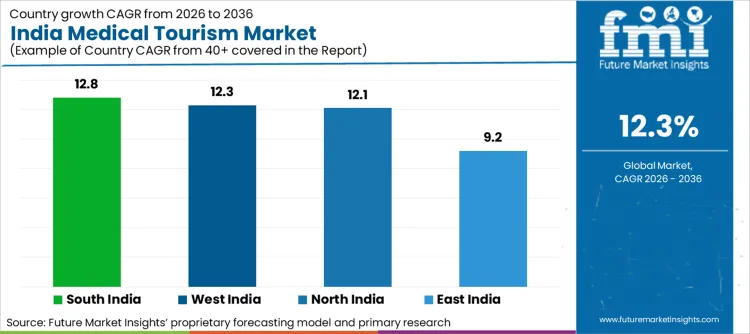
| Region-wise | CAGR (2026 to 2036) |
|---|---|
| South India | 12.8% |
| West India | 12.3% |
| North India | 12.1% |
| East India | 9.2% |
Source: FMI historical analysis and forecast data.
Why Does South India Lead Medical Tourism Inflows?
At a 12.8% CAGR, South India leads inbound medical tourism due to the concentration of high-volume tertiary and quaternary care centers in Chennai, Bengaluru, and Hyderabad. The region is widely recognized for cardiac sciences, organ transplants, oncology, and ophthalmology, attracting international patients seeking complex procedures at competitive costs. Strong clinical outcomes, standardized care pathways, and dedicated international patient desks support predictable treatment journeys. Air connectivity through Chennai, Bengaluru, and Hyderabad enables steady patient inflows from Southeast Asia, the Middle East, and Africa. FMI analysis indicates that South India’s leadership is sustained by clinical depth, throughput capacity, and strong specialty concentration.
What Sustains West India’s Strong Medical Tourism Contribution?
Growing at a 12.3% CAGR, West India remains a major contributor to medical tourism flows, anchored by Mumbai and Pune. The region benefits from dense private hospital networks, advanced transplant programs, and well-developed cardiac and oncology centers. Mumbai’s international airport supports direct access for patients from Africa and the Middle East, while Pune contributes demand through specialized orthopedic and rehabilitation services. The surrounding ecosystem of diagnostics, hospitality, and recovery facilities enables end-to-end care pathways for international patients. FMI notes that West India’s medical tourism strength is underpinned by procedural depth, strong referral networks, and mature private healthcare infrastructure.
How Is North India Shaping High-Value and Complex Treatment Demand?
At a 12.1% CAGR, North India anchors high-value and complex medical tourism demand through the NCR region’s concentration of multi-specialty hospitals and centers of excellence. International patients traveling to Delhi NCR often seek oncology, neurosurgery, orthopedics, and organ transplant services, which carry higher per-patient value and longer care pathways. Strong intercontinental connectivity via Delhi International Airport reduces friction for long-haul patient travel from Africa, Central Asia, and the Middle East. The region’s ecosystem supports coordinated care models integrating diagnostics, treatment, accommodation, and follow-up. FMI notes that North India’s growth is more value-led than volume-driven, reinforcing its premium care positioning.
Why Is East India Expanding at a Steadier Pace?
At a 9.2% CAGR, East India’s gradual scale-up in medical tourism is reflected in the international patient services developed by Manipal Hospitals (formerly AMRI), which operates multi-specialty facilities in Kolkata and has formal outreach programs for patients from Bangladesh and neighboring countries. The group has invested in tertiary care capabilities acrosss oncology, cardiology, and nephrology, alongside dedicated international patient coordination desks to support cross-border referrals. This illustrates how expanding private hospital capacity, accreditation coverage, and structured facilitation services in Kolkata are strengthening East India’s ability to attract international patients, even as the regional ecosystem remains less mature than established hubs in South and West India.
What Is the Competitive Outlook for the India Medical Tourism Market?
The competitive landscape for India’s medical tourism market is led by large, multi-specialty hospital networks that extend beyond core clinical services to support structured international patient pathways. Players such as Apollo Hospitals, Fortis Healthcare, and Medanta, the Medicity benefit from extensive hospital footprints, established physician reputations, and dedicated international patient programs. Apollo Hospitals has disclosed in its public communications that international patients form a meaningful share of its tertiary care volumes, supported by overseas referral partnerships and global patient services across its hospital network. Competitive positioning in this market is less about rapid bed capacity expansion and more about the ability to deliver coordinated treatment journeys that integrate diagnostics, procedures, recovery, and post-treatment follow-up for overseas patients.
Future Market Insights observes that competition is increasingly centered on clinical outcomes, accreditation coverage, and patient experience rather than aggressive geographic growth. Fortis Healthcare reports international patient inflows across its cardiac sciences, oncology, and orthopedics centers of excellence through structured international patient desks and pre-arrival coordination workflows highlighted in company disclosures. Medanta has similarly emphasized specialized tertiary care programs and multidisciplinary treatment pathways for international patients, reflecting how leading providers compete on clinical depth and service integration rather than pricing alone. FMI notes that long-term competitive advantage will depend on how effectively hospital networks embed international patient services into core clinical operations, positioning medical tourism as an integrated care offering rather than a peripheral service line.
Recent Developments:
- In February 2025, Fortis Healthcare reported strong Q3 FY25 results, with consolidated revenue up 14.8%, EBITDA growth of 32%, and an increased stake in Agilus Diagnostics.
- In January 2026, Apollo Hospitals concluded IHD 2026 in Hyderabad, announcing plans for a ‘Hospital of the Future’ and reaffirming year-round operations, with global participation focused on patient safety, equity, and responsible digital transformation.
Key Players in India Medical Tourism Market
- Apollo Hospitals
- Fortis Healthcare
- Medanta - The Medicity
- Manipal Hospitals
- Max Healthcare
- Narayana Health
- Artemis Hospital
Market Definition
The India medical tourism market captures revenue generated from cross-border travel to India for medical and healthcare services. In this assessment, the market covers commercially delivered medical treatments and care services consumed by international patients, including clinical procedures, diagnostics, inpatient and outpatient services, and treatment-linked travel arrangements. Market sizing reflects total spending by international patients on medical care in India, analyzed by treatment type, service provider, traveler type, booking channel, and region of origin, and reported in USD billion.
The scope includes medical travel to India for cardiovascular, orthopedic, oncology, dental, cosmetic, fertility, ophthalmic, and other specialized treatments, along with bundled care pathways that combine treatment with accommodation, local transport, and post-procedure recovery support when offered as part of organized medical travel services. Services delivered by public and private healthcare providers, as well as bookings facilitated through hospital international patient desks, medical travel facilitators, and digital platforms, are included. Geographic coverage spans international patient inflows from North America, Europe, Asia Pacific, Latin America, and the Middle East & Africa to treatment destinations within India.
The market excludes domestic healthcare consumption by Indian residents, inbound leisure tourism not linked to medical treatment, and long-term migration-related healthcare services. Revenues from pharmaceutical sales unrelated to treatment delivery, medical device manufacturing, hospital infrastructure development, insurance premiums, standalone travel insurance, foreign exchange services, and general travel services not bundled with medical care are excluded. Medical services delivered solely for domestic patients without international travel involvement are outside the defined market scope.
Scope of Report
| Items | Values |
|---|---|
| Quantitative Units (2026) | USD 20.4 Billion |
| Treatment Type | Cardiovascular Treatment; Orthopedic Treatment; Oncology Treatment; Cosmetic Treatment; Dental Treatment; Infertility Treatment; Ophthalmic Treatment; Others |
| Age Group | Less Than 15 Years; 15 to 25 Years; 26 to 35 Years; 36 to 45 Years; 46 to 55 Years; Over 55 Years |
| Tourist Type | International |
| Service Provider | Public Provider; Private Provider |
| Traveler Type | Independent Traveler; Package Traveler; Tour Group |
| Demography | Men; Women; Children |
| Booking Channel | Online Booking; In-Person Booking (Hospitals & Facilitators); Phone Booking |
| Regions Covered | West India; South India; East India; North India |
| Countries Covered | India |
| Key Companies Profiled | Apollo Hospitals; Fortis Healthcare; Medanta - The Medicity; Manipal Hospitals; Max Healthcare; Narayana Health; Artemis Hospital |
| Additional Attributes | Dollar spending by treatment type, service provider, and source region; inbound patient flow analysis by country of origin; procedure mix across tertiary and quaternary care; adoption of bundled treatment and recovery packages; length of stay and per-patient spending patterns; competitive positioning of multi-specialty hospital networks and specialty care providers |
Source: FMI historical analysis and forecast data
India Medical Tourism Market by Segments
By Treatment Type:
- Cardiovascular Treatment
- Orthopedic Treatment
- Oncology Treatment
- Cosmetic Treatment
- Dental Treatment
- Infertility Treatment
- Ophthalmic Treatment
- Others
By Age Group:
- Less Than 15 Years
- 15 to 25 Years
- 26 to 35 Years
- 36 to 45 Years
- 46 to 55 Years
- Over 55 Years
By Tourist Type:
- International
By Service Provider:
- Public Provider
- Private Provider
By Traveler Type:
- Independent Traveler
- Package Traveler
- Tour Group
By Demography:
- Men
- Women
- Children
By Booking Channel:
- Online Booking
- In-Person Booking (Hospitals & Facilitators)
- Phone Booking
Bibliography
- Fortis Healthcare Ltd. (2025, February 7). Unaudited consolidated financial results for the quarter and nine months ended December 31, 2024 (Q3 FY25). Investor Relations.
- Ministry of Tourism. (2025). Monthly foreign tourist arrivals (FTAs) for medical purpose: January-April 2025. Government of India.
- Ministry of Health and Family Welfare. (2024). Standard operating procedures (SOPs) for the 'Heal in India' initiative and medical value travel facilitation. Government of India.
Frequently Asked Questions
What is the current market size of India’s medical tourism industry?
India’s medical tourism market is valued at USD 20.4 billion in 2026, supported by rising international patient inflows and strong private hospital capacity.
What is the projected growth rate for India’s medical tourism market?
The market is forecasted to expand at a 12.3% CAGR from 2026 to 2036, reaching USD 65.1 billion by 2036.
Which treatment category dominates the market?
Cardiovascular treatments lead with a 31.6% revenue share, driven by high-value cardiac procedures.
What are the main barriers to growth?
Key barriers include visa processing delays, post-treatment follow-up challenges, and uneven awareness of accredited hospitals.
Who are the leading players in the market?
Major providers include Apollo Hospitals, Fortis Healthcare, Medanta - The Medicity, Manipal Hospitals, Max Healthcare, and Narayana Health.
Preview the report firsthand - request a free sample
Get SampleGet the brochure for pricing and purchase details.
Get PDFTable of Content
- Key Takeaways
- Market Size and CAGR
- Top Growth Driver
- Fastest Growing Segment
- Leading Region
- Key Companies
- Emerging Opportunities
- Executive Summary
- India Market Outlook
- Demand-side Trends
- Supply-side Trends
- Technology Roadmap Analysis
- Analysis and Recommendations
- Analyst Perspective (What is happening? Why now? What should investors know?)
- Key Questions Answered
- How large is the market?
- What is the CAGR?
- What are key trends?
- Which region dominates?
- Who are the leaders?
- Market Overview
- Market Coverage / Taxonomy
- Market Definition / Scope / Limitations
- Research Methodology
- Chapter Orientation
- Analytical Lens and Working Hypotheses
- Market Structure, Signals, and Trend Drivers
- Benchmarking and Cross-market Comparability
- Market Sizing, Forecasting, and Opportunity Mapping
- Research Design and Evidence Framework
- Desk Research Programme (Secondary Evidence)
- Expert Input and Fieldwork (Primary Evidence)
- Tooling, Models, and Reference Databases
- Data Engineering and Model Build
- Quality Assurance and Audit Trail
- Market Background
- Market Dynamics (Drivers, Restraints, Opportunity, Trends)
- Scenario Forecast (Optimistic, Likely, Conservative)
- Impact Analysis
- AI Impact
- Sustainability Impact
- Regulatory Impact
- Technology Impact
- Consumer / Buyer Analysis
- Purchase Drivers
- Adoption Barriers
- Buyer Journey
- Opportunity Map Analysis
- Product Life Cycle Analysis
- Patient Referral and Care Pathway Analysis
- Investment Feasibility Matrix
- Value Chain Analysis
- PESTLE and Porter's Analysis
- Regulatory Landscape
- Regional Parent Market Outlook
- Inbound Patient Volume and Spending Statistics
- Inbound vs Outbound Medical Travel Flow Statistics
- India Market Analysis and Forecast, 2021 to 2036
- Historical Market Size Value (USD Billion) Analysis, 2021 to 2025
- Current and Future Market Size Value (USD Billion) Projections, 2026 to 2036
- Y-o-Y Growth Trend Analysis
- Absolute $ Opportunity Analysis
- India Market Pricing Analysis, 2021 to 2036
- India Market Analysis and Forecast, By Treatment Type, 2021 to 2036
- Introduction / Key Findings
- Historical Market Size Value (USD Billion) Analysis By Treatment Type, 2021 to 2025
- Current and Future Market Size Value (USD Billion) Analysis and Forecast By Treatment Type, 2026 to 2036
- Cardiovascular Treatment
- Orthopedic Treatment
- Oncology Treatment
- Cosmetic Treatment
- Dental Treatment
- Infertility Treatment
- Ophthalmic Treatment
- Others
- Y-o-Y Growth Trend Analysis By Treatment Type, 2021 to 2025
- Absolute $ Opportunity Analysis By Treatment Type, 2026 to 2036
- India Market Analysis and Forecast, By Age Group, 2021 to 2036
- Introduction / Key Findings
- Historical Market Size Value (USD Billion) Analysis By Age Group, 2021 to 2025
- Current and Future Market Size Value (USD Billion) Analysis and Forecast By Age Group, 2026 to 2036
- Less Than 15 Years
- 15 to 25 Years
- 26 to 35 Years
- 36 to 45 Years
- 46 to 55 Years
- Over 55 Years
- Y-o-Y Growth Trend Analysis By Age Group, 2021 to 2025
- Absolute $ Opportunity Analysis By Age Group, 2026 to 2036
- India Market Analysis and Forecast, By Tourist Type, 2021 to 2036
- Introduction / Key Findings
- Historical Market Size Value (USD Billion) Analysis By Tourist Type, 2021 to 2025
- Current and Future Market Size Value (USD Billion) Analysis and Forecast By Tourist Type, 2026 to 2036
- International
- Y-o-Y Growth Trend Analysis By Tourist Type, 2021 to 2025
- Absolute $ Opportunity Analysis By Tourist Type, 2026 to 2036
- India Market Analysis and Forecast, By Service Provider, 2021 to 2036
- Introduction / Key Findings
- Historical Market Size Value (USD Billion) Analysis By Service Provider, 2021 to 2025
- Current and Future Market Size Value (USD Billion) Analysis and Forecast By Service Provider, 2026 to 2036
- Public Provider
- Private Provider
- Y-o-Y Growth Trend Analysis By Service Provider, 2021 to 2025
- Absolute $ Opportunity Analysis By Service Provider, 2026 to 2036
- India Market Analysis and Forecast, By Traveler Type, 2021 to 2036
- Introduction / Key Findings
- Historical Market Size Value (USD Billion) Analysis By Traveler Type, 2021 to 2025
- Current and Future Market Size Value (USD Billion) Analysis and Forecast By Traveler Type, 2026 to 2036
- Independent Traveler
- Package Traveler
- Tour Group
- Y-o-Y Growth Trend Analysis By Traveler Type, 2021 to 2025
- Absolute $ Opportunity Analysis By Traveler Type, 2026 to 2036
- India Market Analysis and Forecast, By Demography
- Introduction / Key Findings
- Historical Market Size Value (USD Billion) Analysis By Demography, 2021 to 2025
- Current and Future Market Size Value (USD Billion) Analysis and Forecast By Demography, 2026 to 2036
- Men
- Women
- Children
- Y-o-Y Growth Trend Analysis By Demography, 2021 to 2025
- Absolute $ Opportunity Analysis By Demography, 2026 to 2036
- India Market Analysis and Forecast, By Booking Channel
- Introduction / Key Findings
- Historical Market Size Value (USD Billion) Analysis By Booking Channel, 2021 to 2025
- Current and Future Market Size Value (USD Billion) Analysis and Forecast By Booking Channel, 2026 to 2036
- Online Booking
- In-Person Booking (Hospitals & Facilitators)
- Phone Booking
- Y-o-Y Growth Trend Analysis By Booking Channel, 2021 to 2025
- Absolute $ Opportunity Analysis By Booking Channel, 2026 to 2036
- India Market Analysis and Forecast, By Sub-region, 2021 to 2036
- Introduction
- Historical Market Size Value (USD Billion) Analysis By Sub-region, 2021 to 2025
- Current Market Size Value (USD Billion) Analysis and Forecast By Sub-region, 2026 to 2036
- West India
- South India
- East India
- North India
- Market Attractiveness Analysis By Sub-region
- West India Market Analysis and Forecast, By Sub-region, 2021 to 2036
- Historical Market Size Value (USD Billion) Trend Analysis By Market Taxonomy, 2021 to 2025
- Market Size Value (USD Billion) Forecast By Market Taxonomy, 2026 to 2036
- By Treatment Type
- By Age Group
- By Tourist Type
- By Service Provider
- By Traveler Type
- By Demography
- By Booking Channel
- Market Attractiveness Analysis
- By Treatment Type
- By Age Group
- By Tourist Type
- By Service Provider
- By Traveler Type
- By Demography
- By Booking Channel
- Key Takeaways
- South India Market Analysis and Forecast, By Sub-region
- Historical Market Size Value (USD Billion) Trend Analysis By Market Taxonomy, 2021 to 2025
- Market Size Value (USD Billion) Forecast By Market Taxonomy, 2026 to 2036
- By Treatment Type
- By Age Group
- By Tourist Type
- By Service Provider
- By Traveler Type
- By Demography
- By Booking Channel
- Market Attractiveness Analysis
- By Treatment Type
- By Age Group
- By Tourist Type
- By Service Provider
- By Traveler Type
- By Demography
- By Booking Channel
- Key Takeaways
- East India Market Analysis and Forecast, By Sub-region
- Historical Market Size Value (USD Billion) Trend Analysis By Market Taxonomy, 2021 to 2025
- Market Size Value (USD Billion) Forecast By Market Taxonomy, 2026 to 2036
- By Treatment Type
- By Age Group
- By Tourist Type
- By Service Provider
- By Traveler Type
- By Demography
- By Booking Channel
- Market Attractiveness Analysis
- By Treatment Type
- By Age Group
- By Tourist Type
- By Service Provider
- By Traveler Type
- By Demography
- By Booking Channel
- Key Takeaways
- North India Market Analysis and Forecast, By Sub-region
- Historical Market Size Value (USD Billion) Trend Analysis By Market Taxonomy, 2021 to 2025
- Market Size Value (USD Billion) Forecast By Market Taxonomy, 2026 to 2036
- By Treatment Type
- By Age Group
- By Tourist Type
- By Service Provider
- By Traveler Type
- By Demography
- By Booking Channel
- Market Attractiveness Analysis
- By Treatment Type
- By Age Group
- By Tourist Type
- By Service Provider
- By Traveler Type
- By Demography
- By Booking Channel
- Key Takeaways
- Market Structure Analysis
- Competition Dashboard
- Competition Benchmarking
- Market Share Analysis of Top Players
- By Sub-regional
- By Treatment Type
- By Age Group
- By Tourist Type
- By Service Provider
- By Traveler Type
- By Demography
- By Booking Channel
- Emerging Startups
- Innovation Benchmarking
- Case Studies
- Success Stories
- Recent Developments
- Competition Analysis
- Competition Deep Dive
- Apollo Hospitals
- Overview
- Product Portfolio
- Profitability by Market Segments
- Sales Footprint
- Strategy Overview
- Marketing Strategy
- Product Strategy
- Channel Strategy
- Fortis Healthcare
- Medanta - The Medicity
- Manipal Hospitals
- Max Healthcare
- Narayana Health
- Artemis Hospital
- Apollo Hospitals
- Competition Deep Dive
- Assumptions & Acronyms Used


