
- Market Size (2026)
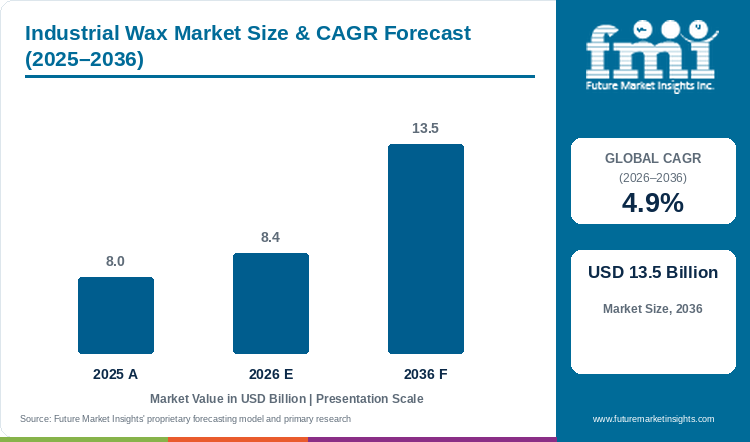
- USD 8.4 Bn
- Forecast (2036)
- USD 13.5 Bn
- CAGR (2026 to 2036)
- 4.9%
How big is the Industrial Wax Market in 2026?
The market is projected to reach USD 13.5 billion by 2036, growing at a 4.9% CAGR from 2026 to 2036. The market is estimated at USD 8.4 billion in 2026. The market was valued at USD 8.0 billion in 2025. The EU Packaging and Packaging Waste Regulation began to apply on 12 August 2026. It restricts PFAS in food-contact packaging and targets recyclable packaging by 2030 [19]. US refiners reported 2,120 thousand barrels of waxes in 2025, against 2,159 thousand in 2024 and 1,374 thousand in 2020 [6]. US candle makers use more than 1 billion pounds of wax a year [16].
The Energy Information Administration reports waxes within its lubricants group, so wax supply follows the refineries that make lubricants [6]. Wax crude oil was 6% of West Region feedstock and 3% of consolidated feedstock for HF Sinclair in the third quarter of 2026 [7]. The US food-contact standard for petroleum wax sets a maximum ultraviolet absorbance of 0.15 per centimetre at 280 to 289 nanometres [4]. The limit falls to 0.02 at 360 to 400 nanometres. Packaging buyers of paraffin wax therefore ask for a documented purity test as well as melt point.
Key Market Trends & Insights
- Paramelt's majority stake in Kahl shows wax groups adding natural-based grades to their portfolios [10].
- Refinery-linked wax producers face ownership change, which can alter supply terms for buyers [7].
- The EU packaging regulation, in force since 11 February 2025, sets PFAS limits that bear directly on wax-based coatings [19].
Regional Highlights
- North America: US refiners produced 2,120 thousand barrels of waxes in 2025 [6]. The United States imported USD 152.7 million of paraffin wax with under 0.75 percent oil that year and exported USD 74.1 million [20].
- Canada and Mexico: Mexico imported 184,380 tonnes of paraffin wax with under 0.75 percent oil in 2025, about 94.5% from China [20]. Canada imported 104,872 tonnes, with Spain the largest source at 49,233 tonnes [20].
- Europe: under customs heading 2712, Germany exported USD 352.4 million in 2025 and imported USD 307.4 million [21]. The United Kingdom exported USD 108.5 million and imported USD 73.4 million, while France and Italy imported more than they exported [21].
Industrial Wax Market Size and Forecast
Table 1: Industrial Wax Market Size and Forecast
| Market size and forecast | Value |
|---|---|
| Market size in 2025 | USD 8.0 billion |
| Estimated market size in 2026 | USD 8.4 billion |
| Projected market size by 2036 | USD 13.5 billion |
| CAGR from 2026 to 2036 | 4.9% |
Source: Future Market Insights analysis of the industrial wax market, 2026.
Analyst Perspective
“Industrial wax buyers often treat the product as a commodity until a purity test, a food-contact declaration or a supply interruption proves otherwise. Candle makers can switch between paraffin and vegetable blends, with some work. Packaging converters have fewer options, because the wax sits inside a regulated coating. The practical advice is to qualify two sources per grade and hold written compliance documents for each. Watch lubricant refinery decisions too, since petroleum wax is made alongside base oils.”
- Nikhil Kaitwade, Principal Consultant, FMI
How is the Industrial Wax Market segmented?
- By product: Petroleum-based Wax, Synthetic Wax and Bio-based Wax
- By application: Candles, Packaging, Plastic and Rubber Processing, Pharmaceuticals, Cosmetics and Toiletries and Fire Logs
- By region: North America and Europe
Why does Petroleum-based Wax lead by Product in the Industrial Wax Market in 2026?
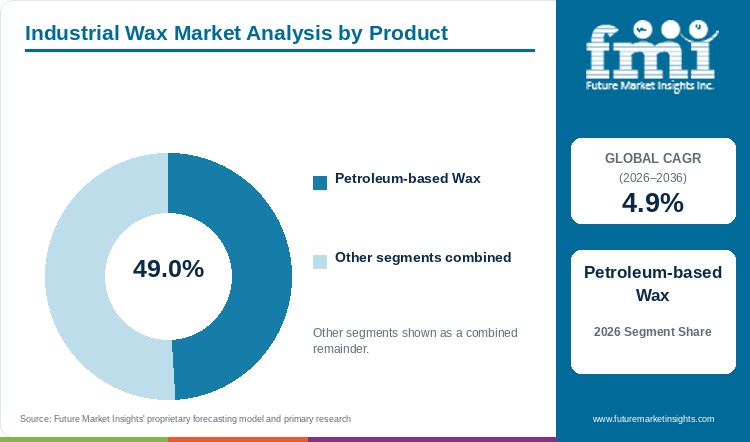
Petroleum-based Wax is estimated to account for 49.0% of the Industrial Wax Market by product in 2026. US food-contact rules define petroleum wax as a paraffinic mixture of solid hydrocarbons derived from petroleum [4]. A separate US food additive rule clears it for chewing gum base and for protective coatings on cheese and raw fruits and vegetables [5]. Buyers who need a compliant grade therefore have a defined standard to specify. Petroleum-based Wax also comes in a broad range of grades. IGI lists scale, low-melt, medium-melt and high-melt paraffin from 127 to 151 degrees Fahrenheit (53 to 66 degrees Celsius) [2]. It supplies them as bulk liquid, slab, granule or pastille [2]. Microcrystalline grades run from 145 to 194 degrees Fahrenheit (61 to 90 degrees Celsius) in white to amber colours [3]. Calumet lists fully refined paraffin, slack and soft waxes, and microcrystalline and petrolatum products [12]. US refiners reported 2,120 thousand barrels of waxes in 2025, 54.3% above the 2020 level [6]. Buyers comparing microcrystalline wax grades can use the same melt-point scale.
Table 2: Product, 2026 Share
| Leading Share | 2026 market share |
|---|---|
| Petroleum-based Wax | 49.0% |
| All Other Segments Combined Share | 51.0% |
Source: Future Market Insights analysis of the industrial wax market, 2026.
Why does Candles lead by Application in the Industrial Wax Market in 2026?
The Candles segment is estimated to account for 34.0% of the Industrial Wax Market by application in 2026. The National Candle Association says US candles use more than 1 billion pounds of wax each year [16]. In a candle, wax is the main material, not an additive, so volume per unit is high compared with coatings or processing aids. Suppliers build candle-specific products. Sasol sells fully formulated candle wax blends for household, lifestyle, jar, tea-light and grave-light candles [8]. It says its Fischer-Tropsch feedstocks give better colour, odour, smoke and combustion residue [8]. Calumet lists formulated paraffin and microcrystalline candle blends, a paraffin and vegetable blend and TitanWax candle waxes [12]. IGI published technical guidance on frosting and mottling in candles on 21 October 2026 [1]. The National Candle Association promoted September 2026 as World Candle Month in a post dated 13 August 2026 [17]. US rules cap lead in candlewick metal cores at 0.06 percent by weight, and voluntary ASTM standards cover fire safety labelling and visible emissions [18].
Table 3: Application, 2026 Share
| Leading Share | 2026 market share |
|---|---|
| Candles | 34.0% |
| All Other Segments Combined Share | 66.0% |
Source: Future Market Insights analysis of the industrial wax market, 2026.
What are the key drivers, restraints and opportunities?
Driver
Packaging conversion. Food packaging keeps wax in demand where a heat-sealable or moisture-limiting coating is needed. IGI lists food packaging and coatings among paraffin applications. It says most fully refined paraffins meet the US food-contact requirement in 21 CFR 178.3710 [2]. Paramelt, a wax and coatings group, has eight manufacturing sites in Europe, the United States and China [9]. It names cheese coating waxes and chewing gum additives as areas where it holds a leading position [9][11]. Since the EU packaging rules began to apply on 12 August 2026, suppliers with documented food-contact grades are better placed to serve EU converters [19].
Broad industrial use. Beyond candles and packaging, IGI names adhesives, agriculture, building materials, inks and toner, paints and coatings, plastics and PVC, and tire and rubber [1]. Blended Waxes lists adhesives, cosmetics, medical and paper, packaging and corrugated uses [14]. Wax additives form a separate use, and Clariant describes itself as a leading global player in that segment [13]. Spreading demand across several industries reduces dependence on any one end market. Wax is also a common ingredient in hot melt adhesives, which IGI lists among its paraffin and microcrystalline applications [2][3].
Restraint
Feedstock tied to refinery decisions. Petroleum wax is reported with lubricants, so its volume follows refinery runs [6]. HF Sinclair decided to retire base oil refining assets in Mississauga, Ontario [7]. The transition is expected to be substantially completed in the second half of 2027 [7]. The release lists a USD 27.0 million impairment and USD 28.0 million of severance for the Mississauga retirement [7]. US refinery output of waxes slipped to 2,120 thousand barrels in 2025 from 2,159 thousand in 2024 [6]. Buyers who depend on one refinery face the clearest risk.
Food-contact scrutiny. Petroleum and mineral waxes are hydrocarbon products, and regulators watch hydrocarbon residues in food. In a 13 September 2023 opinion, the European Food Safety Authority found that mineral oil saturated hydrocarbons do not pose a risk to public health at current exposure [23]. It also said some mineral oil aromatic hydrocarbons may be genotoxic, and that a safe level cannot be set [23]. The opinion covers food generally and does not name waxes. Food-contact buyers should still expect suppliers to document purity for each grade. Suppliers without documented grades may lose packaging contracts.
Opportunity
Natural and bio-based waxes. Paramelt's February 2026 Kahl deal targets natural waxes for beauty and personal care, home care and food [10]. Strahl and Pitsch, based in West Babylon, New York, supplies beeswax, carnauba, candelilla and vegan waxes [15]. Its confectionery waxes come from an FSSC-compliant facility [15]. IGI offers natural and plant-derived waxes and BPI Certified Compostable paraffin waxes [1][2]. Suppliers that document origin can compete on more than melt point.
Custom blending and contract manufacturing. IGI publishes a guide to custom blending from sample to production [1]. It also offers wax blending and contract manufacturing [1]. Blended Waxes offers custom blending, toll manufacturing, lab testing and private label manufacturing [14]. Paramelt reports about 2,750 active formulas and roughly 110 new commercial products in the last year [9]. Buyers without in-house formulation skills can use these services to switch between wax types. Buyers who want a synthetic option can compare polyethylene wax with these blends.
Industrial Wax Market by Country (2026 to 2036)
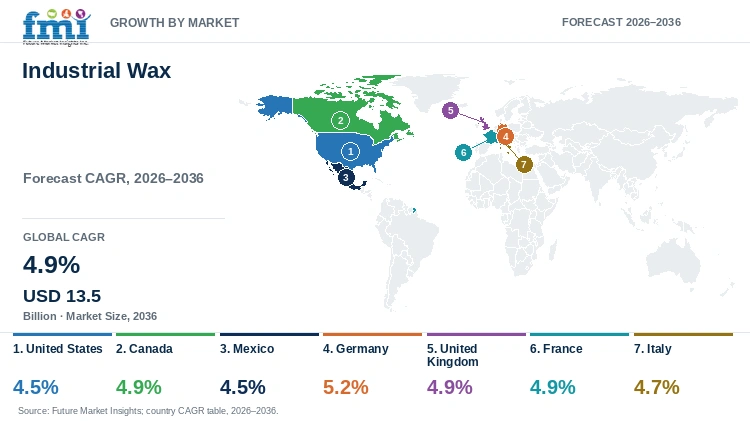
Table 4: Industrial Wax Market Country Growth Forecast
| Country | CAGR, 2026 to 2036 |
|---|---|
| United States | 4.5% |
| Canada | 4.9% |
| Mexico | 4.5% |
| Germany | 5.2% |
| United Kingdom | 4.9% |
| France | 4.9% |
| Italy | 4.7% |
Source: Future Market Insights analysis of the industrial wax market, 2026.
United States
US refiners reported 2,120 thousand barrels of waxes in 2025, against 2,159 thousand in 2024, 1,723 thousand in 2023 and 1,945 thousand in 2022 [6]. The United States imported USD 152.7 million of paraffin wax with under 0.75 percent oil in 2025. China supplied USD 41.9 million, Malaysia USD 34.1 million, South Africa USD 28.3 million and Canada USD 23.8 million [20]. Exports reached USD 74.1 million, or 46,491 tonnes [20][22].
Suppliers serving the US range from refiners to specialty blenders. IGI has a US mailing address in Titusville, Pennsylvania, and sells paraffin, microcrystalline wax, petrolatum and plant-derived waxes [1]. Blended Waxes has operated from Oshkosh, Wisconsin since 1976, starting with cheese wax and hot melt adhesives [14]. Calumet lists fully refined paraffin, candle blends and TitanWax candle waxes [12].
HF Sinclair, through Sonneborn, makes white oils, petrolatums and waxes in the United States and Europe [7]. Its Lubricants and Specialties segment earned USD 118.0 million of EBITDA in the third quarter of 2026, against USD 78.0 million a year earlier [7]. The segment's separation is expected to be substantially completed over 2027. Buyers should confirm which legal entity will hold their supply agreement after that.
Canada
In 2025 Canada imported 104,872 tonnes of paraffin wax with under 0.75 percent oil, worth USD 143.4 million [20]. It exported 11,113 tonnes, worth USD 24.1 million [20]. Spain supplied 49,233 tonnes, the United States 29,105 tonnes and Qatar 25,133 tonnes [20]. Those three origins account for almost all of the import tonnage.
IGI is headquartered in Toronto. It describes itself as a paraffin producer and wax supplier that also offers microcrystalline wax, petrolatum, natural waxes and water-based emulsions [1]. It also provides contract manufacturing and wax blending [1]. HF Sinclair's Petro-Canada Lubricants operations in Mississauga produce specialty products and finished lubricants [7]. The company has decided to retire the site's base oil refining assets, with the transition expected to finish in the second half of 2027 [7].
Canadian imports are about nine times exports by weight, so the country relies on overseas and US supply. Buyers should plan for longer lead times and hold safety stock for candle and packaging grades. They should also check whether any supply comes from the Mississauga assets, which are being retired [7].
Mexico
Mexico imported 184,380 tonnes of paraffin wax with under 0.75 percent oil in 2025, worth USD 243.1 million [20]. That is the largest tonnage among the profiled countries that report weights, and Mexico reported no exports under that code [20]. China supplied 174,295 tonnes, or about 94.5% of the total, and the United States 9,540 tonnes [20].
Across the wider heading 2712, which also covers other mineral waxes, Mexican imports were USD 295.0 million in 2025 and exports were USD 56.0 thousand [21]. Mexico buys finished wax from abroad and ships almost none out.
Mexican buyers depend on one dominant origin. China supplied most of the paraffin imported in 2025 [20]. Candle makers, packaging converters and rubber processors therefore share the same exposure to a disruption in Asian shipping. Buyers with enough volume should qualify a US or other source for key grades.
Germany
Germany is the clearest trading hub among the profiled European countries. It imported 77,524 tonnes of paraffin wax with under 0.75 percent oil in 2025, worth USD 128.8 million [20]. It exported 61,342 tonnes, worth USD 133.9 million [20]. Egypt supplied 28,380 tonnes, South Africa 11,172 tonnes and Malaysia 10,552 tonnes [20].
German export unit values sit above import unit values. Exports averaged about USD 2,180.0 per tonne, against about USD 1,660.0 per tonne for imports [20]. Paramelt's February 2026 majority stake in Kahl adds natural-wax capacity near Hamburg [10].
Germany's import origins are more spread out than Mexico's, which relies mainly on China [20].
United Kingdom
The United Kingdom imported USD 30.5 million of paraffin wax with under 0.75 percent oil in 2025, and exported USD 3.7 million, or 618 tonnes [20]. Across the full heading 2712, exports of USD 108.5 million exceeded imports of USD 73.4 million [21].
The difference comes from other products under the heading, since subheading 2712.20 covers only paraffin wax with under 0.75 percent oil [22]. Refined paraffin buyers in the United Kingdom are therefore mostly importers.
UK candle makers and packaging converters depend on European and global suppliers for paraffin. EU exporters should confirm that their food-contact declarations match UK buyer documentation.
France
In 2025 France imported USD 41.2 million of paraffin wax with under 0.75 percent oil. It exported USD 2.6 million, or 474 tonnes [20]. Across heading 2712, imports were USD 151.0 million and exports USD 60.7 million [21].
Paraffin is just over a quarter of French imports under heading 2712 [20][21][22]. Subheading 2712.20 covers only paraffin wax with under 0.75 percent oil.
Imports far exceed exports, so supplier qualification is the main purchasing task for French buyers [20].
Italy
In 2025 Italy imported 48,964 tonnes of paraffin wax with under 0.75 percent oil, worth USD 71.9 million [20]. It exported 12,690 tonnes, worth USD 23.6 million [20]. Across the full heading 2712, imports were USD 137.6 million and exports USD 88.3 million [21].
Italy exported about a quarter of its paraffin imports by weight, which makes it a net buyer [20].
Italian buyers should qualify at least two import routes per grade. They should also request a food-contact declaration for each lot.
Who are the notable companies in the Industrial Wax Market?
Notable companies in the Industrial Wax Market include The International Group, Inc., Sasol Limited, HF Sinclair Corporation, Paramelt, Calumet, Clariant, Blended Waxes Inc. and Strahl & Pitsch.
Format and service distinguish these suppliers more than the raw wax does. IGI sells paraffin in bulk liquid, slab, granule and pastille forms [2]. It also offers wax blending and certificate-of-analysis guidance [1][2]. Blended Waxes and Paramelt both offer custom blends and toll manufacturing [9][14]. Paramelt reports about 2,750 active formulas [9]. Buyers who need a standard wax can buy from refinery-linked suppliers, while blenders serve buyers who need a formula.
Feedstock sets what a supplier can promise on performance. Sasol ties colour, odour and smoke performance in its candle blends to its Fischer-Tropsch feedstocks [8]. HF Sinclair's Sonneborn unit makes waxes beside white oils and petrolatums, inside a segment being separated [7]. Calumet lists slack and soft waxes beside fully refined paraffin [12]. Clariant positions itself in wax additives [13].
Natural and specialty waxes form a separate group of suppliers. Strahl and Pitsch has supplied natural waxes since 1904 and lists beeswax, carnauba and candelilla grades [15]. Paramelt entered the group in February 2026 through its majority stake in Kahl [10]. These suppliers compete on origin documents, pharmacopoeia grades and low-volume service, not on tonnage.
Key Developments in the Industrial Wax Market
- On 5 February 2026, Paramelt announced that it had acquired a majority stake in Kahl GmbH & Co. KG. Kahl is based in Trittau, Germany, and makes natural-based waxes, mainly for beauty and personal care [10].
- On 12 August 2026, the EU Packaging and Packaging Waste Regulation began to apply. It restricts PFAS in food-contact packaging above set thresholds and aims for all packaging to be recyclable in an economically viable way by 2030 [19].
- On 28 October 2026, HF Sinclair reported third-quarter results. It said the separation of its Lubricants and Specialties segment, announced in July 2026, is expected to be substantially completed over 2027 [7].
- On 30 October 2026, the US Energy Information Administration released its refinery net production table showing waxes at 2,120 thousand barrels for 2025 [6].
Key Players in the Industrial Wax Market
- The International Group, Inc.
- Sasol Limited
- HF Sinclair Corporation
- Paramelt
- Calumet
- Clariant
- Blended Waxes Inc.
- Strahl & Pitsch
Industrial Wax Market Report Scope
Table 5: Industrial Wax Market Report Scope
| Coverage field | Report scope |
|---|---|
| Market definition | Industrial waxes (petroleum-based, synthetic and bio-based) sold to industrial end uses, measured by value of sales |
| Product | Petroleum-based Wax, Synthetic Wax, Bio-based Wax |
| Application | Candles, Packaging, Plastic and Rubber Processing, Pharmaceuticals, Cosmetics and Toiletries, Fire Logs |
| Regions and profiled countries | North America and Europe, with the United States, Canada, Mexico, Germany, United Kingdom, France and Italy |
| Companies covered | The International Group, Inc., Sasol Limited, HF Sinclair Corporation, Paramelt, Calumet, Clariant, Blended Waxes Inc., Strahl & Pitsch |
| Forecast period | 2026 to 2036, with 2025 as the historical base year |
| Quantitative Units | USD billion |
Source: Future Market Insights analysis of the industrial wax market, 2026.
Industrial Wax Market by Segments
Industrial Wax Market segmented by Product:
- Petroleum-based Wax
- Synthetic Wax
- Bio-based Wax
Industrial Wax Market segmented by Application:
- Candles
- Packaging
- Plastic and Rubber Processing
- Pharmaceuticals
- Cosmetics and Toiletries
- Fire Logs
Industrial Wax Market by Region
- North America
- Europe
- United States
- Canada
- Mexico
- Germany
- United Kingdom
- France
- Italy
Research Sources and Bibliography
- [1] IGI (The International Group, Inc.). (n.d.). IGI wax: paraffin wax, microcrystalline wax, petrolatum and natural waxes (company home page and news). https://www.igiwax.com/
- [2] IGI (The International Group, Inc.). (n.d.). Paraffin wax products. https://www.igiwax.com/products/paraffin-wax
- [3] IGI (The International Group, Inc.). (n.d.). Microcrystalline wax. https://www.igiwax.com/products/microcrystalline-wax
- [4] U.S. Food and Drug Administration, 21 CFR 178.3710 (text via Cornell Legal Information Institute). (n.d.). Petroleum wax. https://www.law.cornell.edu/cfr/text/21/178.3710
- [5] U.S. Food and Drug Administration, 21 CFR 172.886 (text via Cornell Legal Information Institute). (n.d.). Petroleum wax and synthetic petroleum wax. https://www.law.cornell.edu/cfr/text/21/172.886
- [6] U.S. Energy Information Administration. (2026, October 30). U.S. Refinery Net Production (annual, waxes). https://www.eia.gov/dnav/pet/pet_pnp_refp2_dc_nus_mbbl_a.htm
- [7] HF Sinclair Corporation. (2026, October 28). Third quarter 2026 earnings release (Form 8-K, Exhibit 99.1). https://www.sec.gov/Archives/edgar/data/1915657/000191565726000071/dinoex99109-30x2026.htm
- [8] Sasol. (n.d.). Candles: candle wax blends. https://chemicals.sasol.com/applications/candles
- [9] Paramelt. (n.d.). Paramelt: specialty waxes, adhesives and coatings (company home page). https://www.paramelt.com/
- [10] Paramelt. (2026, February 5). Paramelt acquires a majority stake in Kahl GmbH & Co. KG. https://www.paramelt.com/news/paramelt-acquires-a-majority-stake-in-kahl-gmbh-co-kg
- [11] Paramelt. (n.d.). Paramelt acquires specialty wax activities of Sonneborn Refined Products. https://www.paramelt.com/news/paramelt-acquires-specialty-wax-activities-of-sonneborn-refined-products
- [12] Calumet. (n.d.). Calumet: waxes product lines (company home page). https://www.calumet.com/
- [13] Clariant. (n.d.). Additives business unit: waxes and polymers. https://www.clariant.com/en/Business-Units/Additives
- [14] Blended Waxes Inc. (n.d.). Wax products and services (company home page). https://www.blendedwaxes.com/
- [15] Strahl & Pitsch. (n.d.). The finest natural waxes since 1904 (company home page). https://spwax.com/
- [16] National Candle Association. (n.d.). Facts and figures. https://www.candles.org/facts-figures/
- [17] National Candle Association. (2026, August 13). Industry home page and blog. https://www.candles.org/
- [18] U.S. Consumer Product Safety Commission. (n.d.). Business guidance: Candles. https://www.cpsc.gov/Business--Manufacturing/Business-Education/Business-Guidance/Candles
- [19] European Commission, Directorate-General for Environment. (n.d.). Packaging waste: Regulation (EU) 2025/40 on packaging and packaging waste. https://environment.ec.europa.eu/topics/waste-and-recycling/packaging-waste_en
- [20] United Nations Statistics Division. (2026, November 6). UN Comtrade database, annual 2025 trade data, HS 271220, selected reporters. https://comtradeapi.un.org/public/v1/preview/C/A/HS?reporterCode=484,124,842,276,826,251,380&period=2025&partnerCode=0&cmdCode=271220&flowCode=M,X&partner2Code=0&customsCode=C00&motCode=0
- [21] United Nations Statistics Division. (2026, November 6). UN Comtrade database, annual 2025 trade data, HS 2712, selected reporters. https://comtradeapi.un.org/public/v1/preview/C/A/HS?reporterCode=484,124,842,276,826,251,380&period=2025&partnerCode=0&cmdCode=2712&flowCode=M,X&partner2Code=0&customsCode=C00&motCode=0
- [22] U.S. International Trade Commission. (n.d.). Harmonized Tariff Schedule, subheading 2712.20. https://hts.usitc.gov/reststop/search?keyword=2712.20
- [23] European Food Safety Authority. (2023, September 13). Mineral oil hydrocarbons: update of the risk assessment in food. https://www.efsa.europa.eu/en/topics/topic/mineral-oil-hydrocarbons
Table of Content
Table of Content
- Key Takeaways
- Market Size and CAGR
- Top Growth Driver
- Fastest Growing Segment
- Leading Region
- Key Companies
- Emerging Opportunities
- Executive Summary
- Global Market Outlook
- Demand-side Trends
- Supply-side Trends
- Technology Roadmap Analysis
- Analysis and Recommendations
- Analyst Perspective (What is happening? Why now? What should investors know?)
- Key Questions Answered
- How large is the market?
- What is the CAGR?
- What are key trends?
- Which region dominates?
- Who are the leaders?
Read More...
- Market Overview
- Market Coverage / Taxonomy
- Market Definition / Scope / Limitations
- Research Methodology
- Chapter Orientation
- Analytical Lens and Working Hypotheses
- Market Structure, Signals, and Trend Drivers
- Benchmarking and Cross-market Comparability
- Market Sizing, Forecasting, and Opportunity Mapping
- Research Design and Evidence Framework
- Desk Research Programme (Secondary Evidence)
- Expert Input and Fieldwork (Primary Evidence)
- Tooling, Models, and Reference Databases
- Data Engineering and Model Build
- Quality Assurance and Audit Trail
- Market Background
- Market Dynamics (Drivers, Restraints, Opportunity, Trends)
- Scenario Forecast (Optimistic, Likely, Conservative)
- Impact Analysis
- AI Impact
- Sustainability Impact
- Regulatory Impact
- Technology Impact
- Consumer / Buyer Analysis
- Purchase Drivers
- Adoption Barriers
- Buyer Journey
- Opportunity Map Analysis
- Product Life Cycle Analysis
- Supply Chain Analysis
- Investment Feasibility Matrix
- Value Chain Analysis
- PESTLE and Porter's Analysis
- Regulatory Landscape
- Regional Parent Market Outlook
- Production and Consumption Statistics
- Import and Export Statistics
- Global Market Analysis and Forecast, 2021 to 2036
- Historical Market Size Value (USD Billion) Analysis, 2021 to 2025
- Current and Future Market Size Value (USD Billion) Projections, 2026 to 2036
- Y-o-Y Growth Trend Analysis
- Absolute $ Opportunity Analysis
- Global Market Pricing Analysis, 2021 to 2036
- Global Market Analysis and Forecast, By Product, 2021 to 2036
- Introduction / Key Findings
- Historical Market Size Value (USD Billion) Analysis By Product, 2021 to 2025
- Current and Future Market Size Value (USD Billion) Analysis and Forecast By Product, 2026 to 2036
- Petroleum-based Wax
- Synthetic Wax
- Bio-based Wax
- Y-o-Y Growth Trend Analysis By Product, 2021 to 2025
- Absolute $ Opportunity Analysis By Product, 2026 to 2036
- Global Market Analysis and Forecast, By Application, 2021 to 2036
- Introduction / Key Findings
- Historical Market Size Value (USD Billion) Analysis By Application, 2021 to 2025
- Current and Future Market Size Value (USD Billion) Analysis and Forecast By Application, 2026 to 2036
- Candles
- Packaging
- Plastic and Rubber Processing
- Pharmaceuticals
- Cosmetics and Toiletries
- Fire Logs
- Y-o-Y Growth Trend Analysis By Application, 2021 to 2025
- Absolute $ Opportunity Analysis By Application, 2026 to 2036
- Global Market Analysis and Forecast, By Region, 2021 to 2036
- Introduction
- Historical Market Size Value (USD Billion) Analysis By Region, 2021 to 2025
- Current Market Size Value (USD Billion) Analysis and Forecast By Region, 2026 to 2036
- North America
- Europe
- Market Attractiveness Analysis By Region
- North America Market Analysis and Forecast, By Country, 2021 to 2036
- Historical Market Size Value (USD Billion) Trend Analysis By Market Taxonomy, 2021 to 2025
- Market Size Value (USD Billion) Forecast By Market Taxonomy, 2026 to 2036
- By Country
- By Product
- By Application
- Market Attractiveness Analysis
- By Country
- By Product
- By Application
- Key Takeaways
- Europe Market Analysis and Forecast, By Country
- Historical Market Size Value (USD Billion) Trend Analysis By Market Taxonomy, 2021 to 2025
- Market Size Value (USD Billion) Forecast By Market Taxonomy, 2026 to 2036
- By Country
- United States
- Canada
- Mexico
- Germany
- United Kingdom
- France
- Italy
- By Product
- By Application
- By Country
- Market Attractiveness Analysis
- By Country
- By Product
- By Application
- Key Takeaways
- Key Countries Market Analysis
- United States
- Pricing Analysis
- Market Share Analysis, 2025
- By Product
- By Application
- Canada
- Pricing Analysis
- Market Share Analysis, 2025
- By Product
- By Application
- Mexico
- Pricing Analysis
- Market Share Analysis, 2025
- By Product
- By Application
- Germany
- Pricing Analysis
- Market Share Analysis, 2025
- By Product
- By Application
- United Kingdom
- Pricing Analysis
- Market Share Analysis, 2025
- By Product
- By Application
- Italy
- Pricing Analysis
- Market Share Analysis, 2025
- By Product
- By Application
- France
- Pricing Analysis
- Market Share Analysis, 2025
- By Product
- By Application
- United States
- Market Structure Analysis
- Competition Dashboard
- Competition Benchmarking
- Market Share Analysis of Top Players
- By Regional
- By Product
- By Application
- Emerging Startups
- Innovation Benchmarking
- Competition Analysis
- Competition Deep Dive
- The International Group, Inc.
- Overview
- Product Portfolio
- Profitability by Market Segments
- Sales Footprint
- Strategy Overview
- Marketing Strategy
- Product Strategy
- Channel Strategy
- Sasol Limited
- HF Sinclair Corporation
- Paramelt
- Calumet
- Clariant
- Blended Waxes Inc.
- Strahl & Pitsch
- The International Group, Inc.
- Case Studies
- Success Stories
- Recent Developments
- Competition Deep Dive
- Assumptions & Acronyms Used
List of Tables
- Table 1: Global Market Value (USD Billion) Forecast by Region, 2021 to 2036
- Table 2: Global Market Value (USD Billion) Forecast by Product, 2021 to 2036
- Table 3: Global Market Value (USD Billion) Forecast by Application, 2021 to 2036
- Table 4: North America Market Value (USD Billion) Forecast by Country, 2021 to 2036
- Table 5: North America Market Value (USD Billion) Forecast by Product, 2021 to 2036
- Table 6: North America Market Value (USD Billion) Forecast by Application, 2021 to 2036
- Table 7: Europe Market Value (USD Billion) Forecast by Country, 2021 to 2036
- Table 8: Europe Market Value (USD Billion) Forecast by Product, 2021 to 2036
- Table 9: Europe Market Value (USD Billion) Forecast by Application, 2021 to 2036
List of Figures
- Figure 1: Global Market Pricing Analysis
- Figure 2: Global Market Value (USD Billion) Forecast 2021-2036
- Figure 3: Global Market Value Share and BPS Analysis by Product, 2026 and 2036
- Figure 4: Global Market Y-o-Y Growth Comparison by Product, 2026-2036
- Figure 5: Global Market Attractiveness Analysis by Product
- Figure 6: Global Market Value Share and BPS Analysis by Application, 2026 and 2036
- Figure 7: Global Market Y-o-Y Growth Comparison by Application, 2026-2036
- Figure 8: Global Market Attractiveness Analysis by Application
- Figure 9: Global Market Value (USD Billion) Share and BPS Analysis by Region, 2026 and 2036
- Figure 10: Global Market Y-o-Y Growth Comparison by Region, 2026-2036
- Figure 11: Global Market Attractiveness Analysis by Region
- Figure 12: North America Market Incremental Dollar Opportunity, 2026-2036
- Figure 13: Europe Market Incremental Dollar Opportunity, 2026-2036
- Figure 14: North America Market Value Share and BPS Analysis by Country, 2026 and 2036
- Figure 15: North America Market Value Share and BPS Analysis by Product, 2026 and 2036
- Figure 16: North America Market Y-o-Y Growth Comparison by Product, 2026-2036
- Figure 17: North America Market Attractiveness Analysis by Product
- Figure 18: North America Market Value Share and BPS Analysis by Application, 2026 and 2036
- Figure 19: North America Market Y-o-Y Growth Comparison by Application, 2026-2036
- Figure 20: North America Market Attractiveness Analysis by Application
- Figure 21: Europe Market Value Share and BPS Analysis by Country, 2026 and 2036
- Figure 22: Europe Market Value Share and BPS Analysis by Product, 2026 and 2036
- Figure 23: Europe Market Y-o-Y Growth Comparison by Product, 2026-2036
- Figure 24: Europe Market Attractiveness Analysis by Product
- Figure 25: Europe Market Value Share and BPS Analysis by Application, 2026 and 2036
- Figure 26: Europe Market Y-o-Y Growth Comparison by Application, 2026-2036
- Figure 27: Europe Market Attractiveness Analysis by Application
- Figure 28: Global Market - Tier Structure Analysis
- Figure 29: Global Market - Company Share Analysis
Frequently Asked Questions
How big is the industrial wax market in 2026?
The Industrial Wax Market is estimated at USD 8.4 billion in 2026, up from USD 8.0 billion in 2025. It is projected to reach USD 13.5 billion by 2036, a 4.9% CAGR from 2026 to 2036.
Which application leads the industrial wax market?
Candles lead with 34.0% of the market in 2026. The National Candle Association says US candles use more than 1 billion pounds of wax each year [16]. Sasol and Calumet both sell formulated candle blends [8][12].
Which other products and applications matter?
By product, Petroleum-based Wax holds 49.0%, Synthetic Wax 29.0% and Bio-based Wax 22.0%. By application, Packaging holds 20.0%, Plastic and Rubber Processing 15.0%, Pharmaceuticals 12.0%, Cosmetics and Toiletries 10.0% and Fire Logs 9.0%. IGI lists food packaging, cosmetics, pharmaceuticals and rubber among paraffin applications [2].
Which profiled country is forecast to grow fastest?
Germany has the highest forecast CAGR of the seven profiled countries, at 5.2% from 2026 to 2036. Canada, the United Kingdom and France follow at 4.9% each. Germany imported 77,524 tonnes and exported 61,342 tonnes of paraffin wax with under 0.75 percent oil in 2025 [20].
What rules affect food-contact wax and packaging?
In the United States, 21 CFR 178.3710 sets ultraviolet absorbance limits for petroleum wax in nonfood articles that contact food [4]. 21 CFR 172.886 allows it in chewing gum base and in protective coatings for cheese and raw fruits and vegetables [5]. In the European Union, the Packaging and Packaging Waste Regulation began to apply on 12 August 2026 [19].
What should a buyer check when choosing a wax supplier?
Check melt point and oil content first, then food-contact declarations. IGI lists melt points from 127 to 151 degrees Fahrenheit for paraffin and 145 to 194 degrees Fahrenheit for microcrystalline grades [2][3]. Next, confirm the supply site and ownership. HF Sinclair is separating its Lubricants and Specialties segment, with completion expected over 2027 [7].
Preview the report firsthand - request a free sample
Get SampleGet the brochure for pricing and purchase details.
Get PDF
