

- Market Size (2026)
- USD 2.9 Bn
- Forecast (2036)
- USD 4.4 Bn
- CAGR (2026 to 2036)
- 4.1%
How big is Iron Oxide Market in 2026?
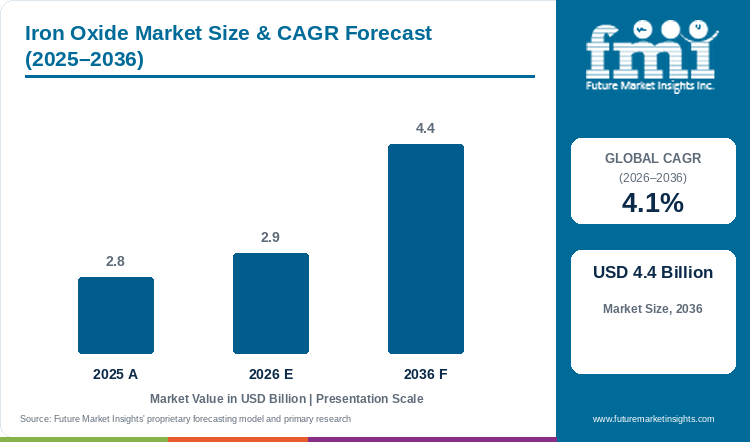
The iron oxide market is estimated at USD 2.8 billion in 2025 and is forecast to reach USD 2.9 billion in 2026. Demand for iron oxide is projected to grow at a 4.1% CAGR and reach USD 4.4 billion by 2036.
Demand for iron oxide comes mainly from coloured concrete, roof tiles and paints, and sales of iron oxide are estimated at USD 2.8 billion in 2025. A rise to USD 2.9 billion is expected in 2026, and FMI analysts project the iron oxide market to grow at a 4.1% CAGR across the forecast period, with sales of USD 4.4 billion by 2036. Builders want pavers and tiles that hold colour for decades, and pigment makers are adding uses beyond colour. LANXESS marked 100 years of iron oxide production at Krefeld-Uerdingen in June 2026, citing annual capacity of about 300,000 tons and work on the pigments as precursors for electric vehicle batteries.[1] At that scale, one producer can serve paver plants and battery developers alike.
Pigment use per job peaks in coloured concrete, so construction holds an estimated 33.2% of 2026 application sales and red grades 46.5% of product type sales. Pavers and roof tiles are coloured right through, so each cubic metre of concrete uses far more pigment than a coat of paint. Wienerberger said in August 2026 that roofing benefited from the decarbonization of ageing housing stock, and that new residential construction would remain subdued.[2] Tile and paver plants order in steadier, smaller lots, and suppliers of dust-free granules that dose straight into the mixer will keep those accounts.
Key Market Trends & Insights
- Reds give the brick, terracotta and primer shades buyers ask for most, so red iron oxide is expected to hold 46.5% of the product type split in 2026. Behind red come yellow with 20.1% and black with an estimated 17.8%.
- Construction is projected to account for 33.2% of application sales in 2026, followed by paints and coatings at 24.5%. Sherwin-Williams reported a mid-single-digit rise in residential repaint and a high-single-digit rise in commercial sales at Paint Stores Group in Q2 2026.[3]
Regional Highlights
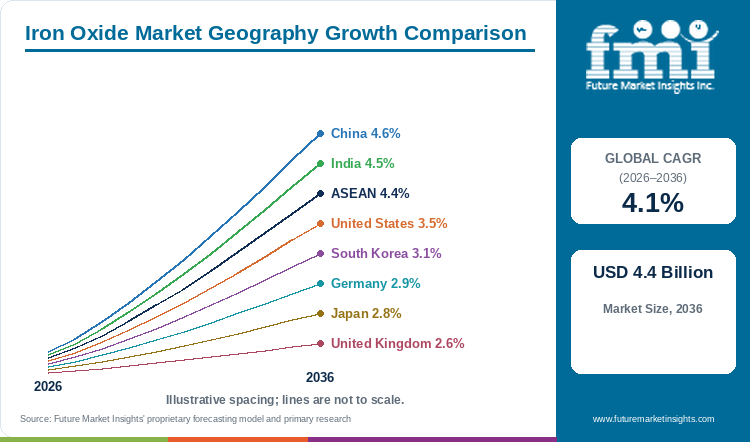
- Busy paver and tile plants give China a 4.6% CAGR in FMI's country model, ahead of the 4.1% figure for iron oxide overall.
- India and ASEAN also beat the global rate, with 4.5% and 4.4% respectively. Renovation work gives the United States 3.5%, with South Korea a little lower at 3.1%. Mature building stocks slow Germany to 2.9% and Japan to 2.8%. The United Kingdom, at 2.6%, is last in the country ranking.
- Asian Paints said decorative volumes in India grew 9% and value 16.6% in the quarter to June 2026.[4]
Market Size & Forecast
Table 1: Market Size and Forecast for the Iron Oxide Market (USD billion and percentage), 2025 to 2036
| Metric | Value |
|---|---|
| 2025 Market Size | USD 2.8 billion |
| Estimated Market Size in 2026 | USD 2.9 billion |
| Projected Market Size by 2036 | USD 4.4 billion |
| CAGR, 2026 to 2036 | 4.1% |
| Added Revenue, 2026 to 2036 | USD 1.5 billion |
| Market Expansion Multiple | 1.5x |
Iron oxide reaches buyers in two rhythms. Concrete product plants order bulk powder or granules by the truckload in the building season, and paint and plastics makers buy smaller lots of micronized grades all year. Sherwin-Williams raised Paint Stores Group prices 8% from 1 September 2026 and cited broad-based cost inflation across raw materials, energy, logistics and packaging.[3] Higher shelf prices for paint usually pass through to pigment contracts at the next renewal. Paint makers are the second biggest buyer group, and the decorative paints market carries a projected 5.1% CAGR, which supports steady pigment orders from architectural brands. About USD 1.5 billion of extra iron oxide sales arrives between 2026 and 2036 in the FMI forecast, a 1.5x expansion multiple. Weak new home building is the main risk, as fewer housing starts mean fewer pavers and roof tiles.
Building Products, Paint Pricing and New Pigment Uses
Building product makers are the volume base. Wienerberger reported Q2 2026 revenue up 13% to EUR 1.4 billion and said renovation and infrastructure now account for more than 60% of group revenue.[2] North American new-build housing declined on elevated mortgage rates over the same period.[2] Pigment orders from tile and paver plants will follow renovation and public works more closely than new housing through 2027.
Specialty uses are the second track. OXERRA introduced FERROXIDE SilkOx in April 2026, a range of easy-dispersing red iron oxide grades with high tinting strength and heat resistance.[5] Kemira started pilot production of iron phosphate for lithium iron phosphate battery materials at Helsingborg in September 2026.[6] Iron-based battery chemistry gives high-purity iron oxide grades a growing outlet with chemical makers.
Table 2: Building Product, Paint and Specialty Indicators for the Iron Oxide Market (sales, prices and capacity), 2026
| Indicator | Data Point | Relevance | Source |
|---|---|---|---|
| LANXESS iron oxide capacity, June 2026 | About 300,000 tons of annual capacity | Scale of the leading synthetic producer | [1] |
| Wienerberger revenue, Q2 2026 | EUR 1.4 billion; up 13% | Roof tile and building product demand | [2] |
| Sherwin-Williams price increase, September 2026 | 8% in Paint Stores Group | Paint price pass-through to pigment contracts | [3] |
| Asian Paints decorative volume, Q1 FY27 | Up 9%; value up 16.6% | Paint demand in India | [4] |
| OXERRA CICP investment, August 2026 | 4,000 metric tonnes in Ganzhou | Inorganic pigment capacity in China | [7] |
| Kemira iron phosphate pilot, September 2026 | Pilot operations started in Helsingborg | Battery outlet for iron chemistry | [6] |
Analyst Perspective
“Granulated red and black iron oxide for pavers and roof tiles will stay the core of this business, and the best margins of the next decade will come from dust-free grades that dose automatically at concrete plants. Battery-grade iron chemistry is unlocking a high-purity second outlet for synthetic iron oxide producers, and I expect the leaders to reserve dedicated lines for those customers before 2030.”
- Nikhil Kaitwade, Principal Consultant, Future Market Insights.
How is the iron oxide market segmented?
The market is segmented into product type, application, and region. Red iron oxide is expected to hold the top product type share at 46.5% in 2026, and construction the top application share at 33.2%.
By product type: red, yellow, black, brown, orange, and other blends.
By application: construction, paints and coatings, plastics, chemicals, paper and pulp, textile, ceramics, leather, fertilizers, cosmetics, and rubber.
By region: North America, Latin America, Western Europe, Eastern Europe, East Asia, South Asia and Pacific, and Middle East and Africa.
Why does red lead iron oxide sales by product type?
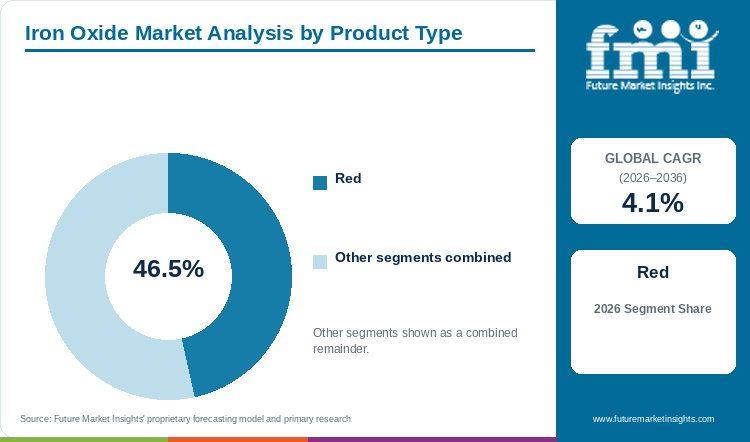
Red iron oxide is expected to lead product type sales with 46.5% share in 2026, ahead of yellow at 20.1% and black at an estimated 17.8%.
Table 3: Product Type Share for the Iron Oxide Market (percentage share), 2026
| Product Type | Estimated Share (2026) |
|---|---|
| Red | 46.5% |
| Yellow | 20.1% |
| Black | 17.8% |
| Brown | 6.4% |
| Orange | 3.6% |
| Other Blends | 5.6% |
| Total | 100.0% |
Table 4: Product Type Leadership and Market Growth for the Iron Oxide Market (segment and CAGR percentage), 2026 to 2036
| Metric | Value |
|---|---|
| Global CAGR (2026 to 2036) | 4.1% |
| Leading Segment | Red |
Brick-red pavers, terracotta roof tiles and red oxide primers use the most pigment per tonne of product, so red iron oxide is expected to keep first place in 2026 at a 46.5% share. Yellow, at 20.1%, is the base for buff and sand shades but loses colour above about 180 °C, which keeps the shade out of many baked coatings and plastics. Black, an estimated 17.8%, colours anthracite roof tiles and dark pavers and is also used in toners and magnetic uses. Brown, about 6.4%, and orange, near 3.6%, are mostly blends of red, yellow and black sold ready-mixed to concrete plants. Other blends, an estimated 5.6%, include custom shades for single customers. Brands selling make-up use purified grades, and the cosmetic pigments market has a projected CAGR of 6.6%, giving cosmetic-grade reds a faster outlet than construction reds. Concrete product makers will keep buying red as the default colour for streets and roofs.
- Hematite reds in powder, granule and micronized forms make up the red range.
- OXERRA described the FERROXIDE SilkOx grades launched in April 2026 as producing vivid red to deep maroon shades.[5]
Why does construction lead iron oxide sales by application?
Construction is projected to lead application sales with 33.2% share in 2026, ahead of paints and coatings at 24.5% and plastics at an estimated 12.4%.
Table 5: Application Share for the Iron Oxide Market (percentage share), 2026
| Application | Estimated Share (2026) |
|---|---|
| Construction | 33.2% |
| Paints and Coatings | 24.5% |
| Plastics | 12.4% |
| Ceramics | 7.7% |
| Chemicals | 5.9% |
| Cosmetics | 4.3% |
| Rubber | 3.1% |
| Fertilizers | 2.6% |
| Paper and Pulp | 2.4% |
| Textile | 2.1% |
| Leather | 1.8% |
| Total | 100.0% |
Concrete pavers, roof tiles, blocks and coloured mortar are pigmented through the whole mass, so construction is projected to remain the top application in 2026, with a 33.2% share. Paints and coatings, at 24.5%, need finer and cleaner grades for primers and exterior colours, and each litre needs only a small dose. Plastics, an estimated 12.4%, colour pipes, garden furniture and artificial turf. Ceramics, near 7.7%, uses heat-stable reds and blacks in tiles and glazes, and chemicals, about 5.9%, covers catalysts and battery precursors. Cosmetics account for an estimated 4.3%, rubber 3.1%, fertilizers 2.6%, paper and pulp 2.4%, textile 2.1% and leather 1.8%, each with small, specified lots. Builders also buy admixtures and sealers for coloured concrete, and the construction chemicals market is expected to expand at a CAGR of 5.2%, and pigment and admixture suppliers often sell through the same distributors. Paver and tile plants will keep construction in the lead.
- Concrete pavers, roof tiles, blocks and coloured mortar form most construction volume.
- Wienerberger said in August 2026 that recovery was gaining pace in several Central and Eastern European markets.[2]
What are the drivers, restraints, and opportunities in the iron oxide market?
Coloured concrete and roof tiles keep iron oxide in steady demand, and renovation work spreads those orders across the year. Energy and raw material costs squeeze producers, and high-purity grades for cosmetics and batteries open new outlets.
- Driver: Builders and homeowners choosing coloured pavers, tiles and facades use pigment through the full mass of each product, which keeps volume tied to every square metre laid.
- Restraint: Synthetic iron oxide production uses energy, acids and scrap iron, and producers with fixed annual contracts carry cost increases until renewal.
- Opportunity: Cosmetic, battery and catalyst makers want purified, tightly specified iron oxide, which rewards producers able to run dedicated clean lines.
Coloured Concrete Ties Volume to Every Square Metre
Adoption of coloured concrete follows public works and renovation, as both use pavers, kerbs and roof tiles in volume. LANXESS listed paving stones, roof tiles and facades among the uses of the 15 million tons of pigment made at Krefeld-Uerdingen since 1926.[1] Wienerberger said roofing benefited from the decarbonization of ageing housing stock in Q2 2026.[2] Every renovated roof and resurfaced street adds a fresh pigment order.
Energy and Input Costs Squeeze Producers
Producers of synthetic iron oxide carry the heaviest cost exposure, as the Laux and precipitation processes run on energy and acid. LANXESS said price increases largely offset higher raw material and energy costs in Q2 2026, with group sales up 6.5% to EUR 1.561 billion.[8] Sherwin-Williams cited broad-based inflation across raw materials, energy and logistics.[3] Pigment makers will keep pushing surcharges into contracts with paint and concrete buyers.
High-Purity Grades Open New Outlets
New sales of iron oxide are expected from chemistry and personal care, as both pay for purity. LANXESS is developing iron oxide pigments as precursor materials for electric vehicle batteries.[1] OXERRA announced a 4,000 metric tonne complex inorganic colour pigment investment in Ganzhou in August 2026.[7] Producers with clean dedicated lines will gain the qualification trials that lead to long supply terms.
Which country CAGRs are profiled in the iron oxide market?
Table 6: Country CAGR Comparison for the Iron Oxide Market (CAGR percentage), 2026 to 2036
| Country | CAGR (2026 to 2036) |
|---|---|
| China | 4.6% |
| India | 4.5% |
| ASEAN | 4.4% |
| United States | 3.5% |
| South Korea | 3.1% |
| Germany | 2.9% |
| Japan | 2.8% |
| United Kingdom | 2.6% |
How do country-level CAGRs compare in the iron oxide market?
Chinese paver, tile and pigment plants supply both domestic building sites and export buyers, and FMI's table puts China first at 4.6%. India, on 4.5%, gains from housing, roads and fast-growing paint sales, and ASEAN, at 4.4%, from new block and tile plants. These three emerging markets carry the 4.1% global rate. The United States grows at 3.5% as renovation offsets weak new-build housing, and South Korea at 3.1%. Mature building stocks keep Germany near 2.9% and Japan near 2.8%. New paving and roofing grow slowest in the United Kingdom, at 2.6%.
- Paver, tile and pigment plants in China serve home and export demand.
- Housing and highway work in India add coloured concrete and paint demand.
- Concrete block and roof tile output is rising across ASEAN.
- American repaint and renovation demand offsets fewer housing starts.
- Korean plastics and coatings makers buy fine black and red grades.
- German roof tile and paver producers rely on renovation work.
- Japan buys high-purity grades for electronics and magnetic uses.
- British roofing and landscaping projects set a slow pace of new orders.
Full report country CAGRs cover: China, India and ASEAN as the three markets above the 4.1% global rate. The United States and South Korea next. Germany, Japan and the United Kingdom slowest, and the other standard countries given region by region.
Country-wise Analysis
China Iron Oxide Market Outlook (2026 to 2036)
OXERRA is expanding complex inorganic colour pigment capacity in Ganzhou by 4,000 metric tonnes through OXERRA Technology (Ganzhou), announced in August 2026.[7] Chinese pigment producers already supply many paver and tile plants at home and abroad. In the view of FMI analysts, demand in China will increase at a 4.6% CAGR, the top rate in the table.
Key takeaway: Local pigment capacity and building output put China first.
India Iron Oxide Market Outlook (2026 to 2036)
Asian Paints reported decorative volume growth of 9% and value growth of 16.6% in India for the quarter to June 2026, with industrial coatings up more than 16%.[4] Paint makers and paver plants serving highways and housing schemes will both buy more pigment, supporting a 4.5% CAGR for India.
Key takeaway: Paint and paver demand keeps India close to the top.
ASEAN Iron Oxide Market Outlook (2026 to 2036)
Block, roof tile and paver plants in Viet Nam, Indonesia and Thailand are adding lines to serve urban housing. Local pigment supply is thin, so most volume is imported from Chinese and European producers. As local plants add capacity, demand in ASEAN is forecast to rise at a CAGR of 4.4%.
Key takeaway: Imported pigment feeds fast-growing ASEAN building plants.
United States Iron Oxide Market Outlook (2026 to 2036)
Growth of 3.5% for the United States, per FMI's country model, comes from repaint and renovation. Sherwin-Williams reported Q2 2026 net sales of USD 6,789.3 million, up 7.5%, with Paint Stores Group same-store sales up 4.2%.[3] Repaint and commercial work are offsetting weaker new-build housing, which Wienerberger also reported for North America.[2]
Key takeaway: Repaint and renovation carry American demand.
South Korea Iron Oxide Market Outlook (2026 to 2036)
Korean coatings, plastics and electronics makers buy fine, consistent grades in moderate volumes, so a 3.1% CAGR for South Korea tracks industrial output with little help from construction.
Key takeaway: Industrial users anchor Korean demand.
Germany Iron Oxide Market Outlook (2026 to 2036)
Krefeld-Uerdingen, the operational center for the Bayferrox and Colortherm brands, has produced more than 15 million tons of pigment since 1926, LANXESS said in June 2026.[1] German roof tile and paver plants buy close to that source, and demand follows renovation work. FMI's projection for Germany is a CAGR of 2.9%, tied to roof and street renovation.
Key takeaway: Renovation work and a large domestic producer shape Germany.
Japan Iron Oxide Market Outlook (2026 to 2036)
Japanese buyers use high-purity iron oxide in magnetic materials, electronic components and toners, as well as in paints. The Japanese forecast of 2.8% reflects a mature paint and building base.
Key takeaway: Specialty grades matter more than volume in Japan.
United Kingdom Iron Oxide Market Outlook (2026 to 2036)
British roofing and landscaping contractors buy coloured tiles and pavers, and a slow housebuilding recovery leaves the United Kingdom with a 2.6% CAGR, the lowest rate in the table.
Key takeaway: Slow new-build activity keeps the United Kingdom at the bottom.
Who are the notable companies in the iron oxide market?
LANXESS, OXERRA, Toda Kogyo, Jiangsu Yuxing, Alabama Pigments, Golccha Pigments, Deqing Huayuan Pigment, Tata Pigments, Yaroslavsky Pigment Company and Hunan Three-Ring Pigments are the profiled companies.
Pigment buyers judge suppliers on shade consistency, dispersion and dust-free handling, and the leading producers combine synthetic capacity with technical service. LANXESS described itself as the world's leading producer of synthetic iron oxide pigments, with capacity of about 300,000 tons.[1] OXERRA, a global inorganic pigment maker, launched red SilkOx grades in April 2026.[5] Group sales at LANXESS rose 6.5% to EUR 1.561 billion in Q2 2026.[8] FMI's profiled set also covers Toda Kogyo, Jiangsu Yuxing, Alabama Pigments, Golccha Pigments, Deqing Huayuan Pigment, Tata Pigments, Yaroslavsky Pigment Company and Hunan Three-Ring Pigments.
- Global synthetic producers: LANXESS and OXERRA.
- Asian producers: Toda Kogyo, Jiangsu Yuxing, Deqing Huayuan Pigment, Hunan Three-Ring Pigments, Golccha Pigments and Tata Pigments.
- Regional specialists: Alabama Pigments and Yaroslavsky Pigment Company.
Competitive Benchmarking: Iron Oxide Market
Table 7: Competitive Benchmarking for the Iron Oxide Market (qualitative documentation ratings), 2026
| Company | Construction Grades | Coatings and Plastics | Specialty Purity | Recency |
|---|---|---|---|---|
| LANXESS | High | High | Medium | High |
| OXERRA | High | High | Medium | High |
| Toda Kogyo | Low | Medium | High | Medium |
| Tata Pigments | Medium | Medium | Low | Low |
Ratings follow the amount of 2025 and 2026 company material in each column and do not indicate market share.
Key Developments in the Iron Oxide Market
- On 8 September 2026, Kemira started pilot operations for battery-grade iron phosphate at Helsingborg in Sweden.[6]
- On 12 August 2026, Wienerberger guided to operating EBITDA of EUR 700 million for 2026.[2]
- On 7 August 2026, LANXESS said price increases had largely offset higher raw material and energy costs in the second quarter.[8]
- On 4 August 2026, OXERRA Group announced a 4,000 metric tonne pigment investment in Ganzhou.[7]
- On 29 July 2026, Asian Paints put consolidated net sales for the June quarter at Rs 10,521.4 crore, 17.9% higher.[4]
- On 28 July 2026, Sherwin-Williams announced an 8% Paint Stores Group price increase from 1 September.[3]
- On 3 June 2026, Indian Chemical News reported the centenary of iron oxide production at LANXESS Krefeld-Uerdingen.[1]
- On 27 April 2026, OXERRA introduced FERROXIDE SilkOx red iron oxide grades.[5]
Key Players in the Iron Oxide Market
Global Synthetic Producers
- LANXESS
- OXERRA
Asian Producers
- Toda Kogyo
- Jiangsu Yuxing
- Deqing Huayuan Pigment
- Hunan Three-Ring Pigments
- Golccha Pigments
- Tata Pigments
Regional Specialists
- Alabama Pigments
- Yaroslavsky Pigment Company
Iron Oxide Market - Report Scope
Table 8: Report Scope for the Iron Oxide Market (coverage fields and definitions), 2026 to 2036
| Coverage field | Report scope |
|---|---|
| Market breakdown | Product type; application; region |
| Quantitative units | USD billion |
| Market definition | Synthetic and natural iron oxide pigments in red, yellow, black, brown, orange and blended shades, sold as powder, granules or slurry for construction materials, paints and coatings, plastics, ceramics, chemicals, cosmetics and other uses. |
| Regions covered | North America; Latin America; Western Europe; Eastern Europe; East Asia; South Asia and Pacific; Middle East and Africa |
| Countries covered | United States; Canada; Brazil; Mexico; Argentina; Chile; Germany; France; United Kingdom; Italy; Spain; Benelux; Nordics; Poland; Czech Republic; Romania; Hungary; China; Japan; South Korea; India; ASEAN; Australia and New Zealand; GCC Countries; South Africa; Türkiye; Israel |
| Key companies profiled | LANXESS, OXERRA, Toda Kogyo, Jiangsu Yuxing, Alabama Pigments, Golccha Pigments, Deqing Huayuan Pigment, Tata Pigments, Yaroslavsky Pigment Company, Hunan Three-Ring Pigments |
| Forecast period | 2026 to 2036 |
Iron Oxide Market - Research Methodology
Table 9: Research Methodology for the Iron Oxide Market (research methods and approach), 2026 edition
| Method | Approach |
|---|---|
| Data Sources | Pigment producer announcements, paint and building product company results, chemical company releases and trade press from May 2025 onward. |
| Desk Research | Desk research covers coloured concrete, roof tiles, paint pricing, specialty grades and battery precursors. |
| Market Sizing and Forecasting | Sizing starts from the 2026 base of USD 2.9 billion and the 4.1% CAGR for 2026 to 2036. |
| Data Validation | Sales, capacity and price figures were matched to the release or article that first carried them. |
Iron Oxide Market by Segments
Iron Oxide Market segmented by Product Type:
- Red
- Yellow
- Black
- Brown
- Orange
- Other Blends
Iron Oxide Market segmented by Application:
- Construction
- Paints and Coatings
- Plastics
- Chemicals
- Paper and Pulp
- Textile
- Ceramics
- Leather
- Fertilizers
- Cosmetics
- Rubber
Iron Oxide Market by Region
- North America
- United States
- Canada
- Latin America
- Brazil
- Mexico
- Argentina
- Chile
- Western Europe
- Germany
- France
- United Kingdom
- Italy
- Spain
- Benelux
- Nordics
- Eastern Europe
- Poland
- Czech Republic
- Romania
- Hungary
- East Asia
- China
- Japan
- South Korea
- South Asia and Pacific
- India
- ASEAN
- Australia and New Zealand
- Middle East and Africa
- GCC Countries
- South Africa
- Türkiye
- Israel
Research Sources and Bibliography
- [1] Indian Chemical News. (2026, June 3). LANXESS celebrates 100 years of innovation in iron oxide pigments. https://www.indianchemicalnews.com/chemical/lite/lanxess-celebrates-100-years-of-innovation-in-iron-oxide-pigments-30640
- [2] Wienerberger AG. (2026, August 12). wienerberger strengthens its position in infrastructure and renovation, Q2 2026 results. https://www.wienerberger.com/content/dam/corp/corporate-website/downloads/press-releases/2021-2030/2026/20260812_PA_wienerberger_Q2-2026_EN.pdf
- [3] The Sherwin-Williams Company. (2026, July 28). The Sherwin-Williams Company Reports 2026 Second Quarter Financial Results (Form 8-K). https://www.sec.gov/Archives/edgar/data/0000089800/000008980026000046/shwearningsrelease2q2026.htm
- [4] Asian Paints Limited. (2026, July 29). Press Release, Q1 FY27 results. https://www.asianpaints.com/content/dam/asianpaints/website/secondary-navigation/press-releases/2026-2027/Asian-Paints-Press-Release-Q1FY27.pdf
- [5] OXERRA Europe. (2026, April 27). FERROXIDE SilkOx. https://europe.oxerra.com/2026/04/27/ferroxide-silkox/
- [6] Kemira Oyj. (2026, September 8). Kemira launches iron phosphate pilot plant in Helsingborg to support Western battery materials supply chain. https://news.cision.com/kemira-oyj/r/kemira-launches-iron-phosphate-pilot-plant-in-helsingborg-to-support-western-battery-materials-suppl,c4392905
- [7] OXERRA Europe. (2026, August 4). OXERRA Group Announces Strategic Investment in CICP Production. https://europe.oxerra.com/2026/08/04/oxerra-group-announces-strategic-investment-in-cicp-production/
- [8] LANXESS AG. (2026, August 7). LANXESS increases sales and earnings in the second quarter of 2026. https://lanxess.com/en/investors/news-and-events/news/2026/08/lanxess-increases-sales-and-earnings-in-the-second-quarter-of-2026
This bibliography is provided for reader reference. The full report contains the complete reference list and detailed citations.
This Report Answers
- How big is the iron oxide market during 2026?
- What market size is projected by 2036?
- Which product type holds notable share?
- Which application holds notable share?
- Which countries have notable growth?
- Which companies are notable in the market?
Frequently Asked Questions
How large is the iron oxide market expected in 2026?
The iron oxide market is expected to reach USD 2.9 billion in 2026, up from USD 2.8 billion in 2025, on FMI's outlook. By 2036, the iron oxide market is projected to reach USD 4.4 billion.
What CAGR is projected for the iron oxide market through 2036?
Sales of iron oxide are forecast to grow at a 4.1% CAGR from 2026 to 2036. Coloured concrete, roof tiles, paints and new high-purity uses carry that growth.
Which product type holds a notable market share in 2026?
Red iron oxide is expected to hold the largest product type share, at 46.5% in 2026. Yellow follows at 20.1%.
Which application holds a notable market share in 2026?
With 33.2% share in 2026, construction is projected to lead application. Paints and coatings follow at 24.5%.
Which country has a notable expansion outlook through 2036?
China leads FMI's country table with a 4.6% CAGR. India follows closely at 4.5%.
Who are the key companies in the iron oxide market?
LANXESS and OXERRA lead the global synthetic producers, with Toda Kogyo, Jiangsu Yuxing, Deqing Huayuan Pigment, Hunan Three-Ring Pigments, Golccha Pigments and Tata Pigments in Asia. Alabama Pigments and Yaroslavsky Pigment Company complete the profiled companies.
Preview the report firsthand - request a free sample
Get SampleGet the brochure for pricing and purchase details.
Get PDFTable of Content
- Key Takeaways
- Market Size and CAGR
- Top Growth Driver
- Fastest Growing Segment
- Leading Region
- Key Companies
- Emerging Opportunities
- Executive Summary
- Global Market Outlook
- Demand-side Trends
- Supply-side Trends
- Technology Roadmap Analysis
- Analysis and Recommendations
- Analyst Perspective (What is happening? Why now? What should investors know?)
- Key Questions Answered
- How large is the market?
- What is the CAGR?
- What are key trends?
- Which region dominates?
- Who are the leaders?
- Market Overview
- Market Coverage / Taxonomy
- Market Definition / Scope / Limitations
- Research Methodology
- Chapter Orientation
- Analytical Lens and Working Hypotheses
- Market Structure, Signals, and Trend Drivers
- Benchmarking and Cross-market Comparability
- Market Sizing, Forecasting, and Opportunity Mapping
- Research Design and Evidence Framework
- Desk Research Programme (Secondary Evidence)
- Expert Input and Fieldwork (Primary Evidence)
- Tooling, Models, and Reference Databases
- Data Engineering and Model Build
- Quality Assurance and Audit Trail
- Market Background
- Market Dynamics (Drivers, Restraints, Opportunity, Trends)
- Scenario Forecast (Optimistic, Likely, Conservative)
- Impact Analysis
- AI Impact
- Sustainability Impact
- Regulatory Impact
- Technology Impact
- Consumer / Buyer Analysis
- Purchase Drivers
- Adoption Barriers
- Buyer Journey
- Opportunity Map Analysis
- Product Life Cycle Analysis
- Supply Chain Analysis
- Investment Feasibility Matrix
- Value Chain Analysis
- PESTLE and Porter's Analysis
- Regulatory Landscape
- Regional Parent Market Outlook
- Production and Consumption Statistics
- Import and Export Statistics
- Global Market Analysis and Forecast, 2021 to 2036
- Historical Market Size Value (USD Billion) Analysis, 2021 to 2025
- Current and Future Market Size Value (USD Billion) Projections, 2026 to 2036
- Y-o-Y Growth Trend Analysis
- Absolute $ Opportunity Analysis
- Global Market Pricing Analysis, 2021 to 2036
- Global Market Analysis and Forecast, By Product Type, 2021 to 2036
- Introduction / Key Findings
- Historical Market Size Value (USD Billion) Analysis By Product Type, 2021 to 2025
- Current and Future Market Size Value (USD Billion) Analysis and Forecast By Product Type, 2026 to 2036
- Red
- Yellow
- Black
- Brown
- Orange
- Other Blends
- Y-o-Y Growth Trend Analysis By Product Type, 2021 to 2025
- Absolute $ Opportunity Analysis By Product Type, 2026 to 2036
- Global Market Analysis and Forecast, By Application, 2021 to 2036
- Introduction / Key Findings
- Historical Market Size Value (USD Billion) Analysis By Application, 2021 to 2025
- Current and Future Market Size Value (USD Billion) Analysis and Forecast By Application, 2026 to 2036
- Construction
- Paints and Coatings
- Plastics
- Chemicals
- Paper and Pulp
- Textile
- Ceramics
- Leather
- Fertilizers
- Cosmetics
- Rubber
- Y-o-Y Growth Trend Analysis By Application, 2021 to 2025
- Absolute $ Opportunity Analysis By Application, 2026 to 2036
- Global Market Analysis and Forecast, By Region, 2021 to 2036
- Introduction
- Historical Market Size Value (USD Billion) Analysis By Region, 2021 to 2025
- Current Market Size Value (USD Billion) Analysis and Forecast By Region, 2026 to 2036
- North America
- Latin America
- Western Europe
- Eastern Europe
- East Asia
- South Asia and Pacific
- Middle East and Africa
- Market Attractiveness Analysis By Region
- North America Market Analysis and Forecast, By Country, 2021 to 2036
- Historical Market Size Value (USD Billion) Trend Analysis By Market Taxonomy, 2021 to 2025
- Market Size Value (USD Billion) Forecast By Market Taxonomy, 2026 to 2036
- By Country
- United States
- Canada
- By Product Type
- By Application
- By Country
- Market Attractiveness Analysis
- By Country
- By Product Type
- By Application
- Key Takeaways
- Latin America Market Analysis and Forecast, By Country
- Historical Market Size Value (USD Billion) Trend Analysis By Market Taxonomy, 2021 to 2025
- Market Size Value (USD Billion) Forecast By Market Taxonomy, 2026 to 2036
- By Country
- Brazil
- Mexico
- Argentina
- Chile
- By Product Type
- By Application
- By Country
- Market Attractiveness Analysis
- By Country
- By Product Type
- By Application
- Key Takeaways
- Western Europe Market Analysis and Forecast, By Country
- Historical Market Size Value (USD Billion) Trend Analysis By Market Taxonomy, 2021 to 2025
- Market Size Value (USD Billion) Forecast By Market Taxonomy, 2026 to 2036
- By Country
- Germany
- France
- United Kingdom
- Italy
- Spain
- Benelux
- Nordics
- By Product Type
- By Application
- By Country
- Market Attractiveness Analysis
- By Country
- By Product Type
- By Application
- Key Takeaways
- Eastern Europe Market Analysis and Forecast, By Country
- Historical Market Size Value (USD Billion) Trend Analysis By Market Taxonomy, 2021 to 2025
- Market Size Value (USD Billion) Forecast By Market Taxonomy, 2026 to 2036
- By Country
- Poland
- Czech Republic
- Romania
- Hungary
- By Product Type
- By Application
- By Country
- Market Attractiveness Analysis
- By Country
- By Product Type
- By Application
- Key Takeaways
- East Asia Market Analysis and Forecast, By Country
- Historical Market Size Value (USD Billion) Trend Analysis By Market Taxonomy, 2021 to 2025
- Market Size Value (USD Billion) Forecast By Market Taxonomy, 2026 to 2036
- By Country
- China
- Japan
- South Korea
- By Product Type
- By Application
- By Country
- Market Attractiveness Analysis
- By Country
- By Product Type
- By Application
- Key Takeaways
- South Asia and Pacific Market Analysis and Forecast, By Country
- Historical Market Size Value (USD Billion) Trend Analysis By Market Taxonomy, 2021 to 2025
- Market Size Value (USD Billion) Forecast By Market Taxonomy, 2026 to 2036
- By Country
- India
- ASEAN
- Australia and New Zealand
- By Product Type
- By Application
- By Country
- Market Attractiveness Analysis
- By Country
- By Product Type
- By Application
- Key Takeaways
- Middle East and Africa Market Analysis and Forecast, By Country
- Historical Market Size Value (USD Billion) Trend Analysis By Market Taxonomy, 2021 to 2025
- Market Size Value (USD Billion) Forecast By Market Taxonomy, 2026 to 2036
- By Country
- GCC Countries
- South Africa
- Türkiye
- Israel
- By Product Type
- By Application
- By Country
- Market Attractiveness Analysis
- By Country
- By Product Type
- By Application
- Key Takeaways
- Key Countries Market Analysis
- United States
- Pricing Analysis
- Market Share Analysis, 2025
- By Product Type
- By Application
- Canada
- Pricing Analysis
- Market Share Analysis, 2025
- By Product Type
- By Application
- Mexico
- Pricing Analysis
- Market Share Analysis, 2025
- By Product Type
- By Application
- Brazil
- Pricing Analysis
- Market Share Analysis, 2025
- By Product Type
- By Application
- Chile
- Pricing Analysis
- Market Share Analysis, 2025
- By Product Type
- By Application
- Germany
- Pricing Analysis
- Market Share Analysis, 2025
- By Product Type
- By Application
- United Kingdom
- Pricing Analysis
- Market Share Analysis, 2025
- By Product Type
- By Application
- Italy
- Pricing Analysis
- Market Share Analysis, 2025
- By Product Type
- By Application
- Spain
- Pricing Analysis
- Market Share Analysis, 2025
- By Product Type
- By Application
- France
- Pricing Analysis
- Market Share Analysis, 2025
- By Product Type
- By Application
- India
- Pricing Analysis
- Market Share Analysis, 2025
- By Product Type
- By Application
- ASEAN
- Pricing Analysis
- Market Share Analysis, 2025
- By Product Type
- By Application
- Australia and New Zealand
- Pricing Analysis
- Market Share Analysis, 2025
- By Product Type
- By Application
- China
- Pricing Analysis
- Market Share Analysis, 2025
- By Product Type
- By Application
- Japan
- Pricing Analysis
- Market Share Analysis, 2025
- By Product Type
- By Application
- South Korea
- Pricing Analysis
- Market Share Analysis, 2025
- By Product Type
- By Application
- Poland
- Pricing Analysis
- Market Share Analysis, 2025
- By Product Type
- By Application
- Hungary
- Pricing Analysis
- Market Share Analysis, 2025
- By Product Type
- By Application
- Türkiye
- Pricing Analysis
- Market Share Analysis, 2025
- By Product Type
- By Application
- South Africa
- Pricing Analysis
- Market Share Analysis, 2025
- By Product Type
- By Application
- United States
- Market Structure Analysis
- Competition Dashboard
- Competition Benchmarking
- Market Share Analysis of Top Players
- By Regional
- By Product Type
- By Application
- Emerging Startups
- Innovation Benchmarking
- Competition Analysis
- Competition Deep Dive
- LANXESS
- Overview
- Product Portfolio
- Profitability by Market Segments
- Sales Footprint
- Strategy Overview
- Marketing Strategy
- Product Strategy
- Channel Strategy
- OXERRA
- Toda Kogyo
- Tata Pigments
- Jiangsu Yuxing
- Deqing Huayuan Pigment
- Hunan Three-Ring Pigments
- Golccha Pigments
- Alabama Pigments
- Yaroslavsky Pigment Company
- LANXESS
- Case Studies
- Success Stories
- Recent Developments
- Competition Deep Dive
- Assumptions & Acronyms Used


