

- Market Size (2026)
- USD 612.4 Mn
- Forecast (2036)
- USD 1294.0 Mn
- CAGR (2026 to 2036)
- 7.8%
How big is Label-Free Array Systems Market in 2026?
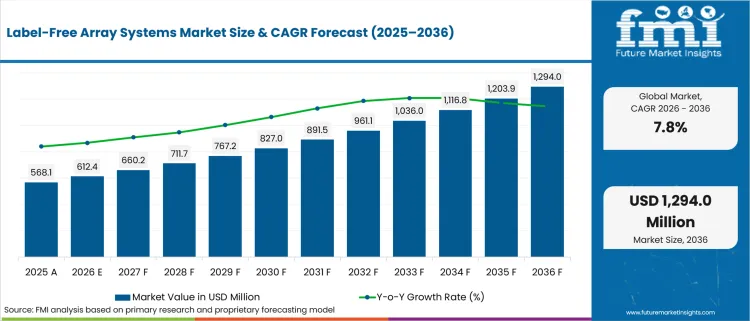
USD 612.4 million in 2026 and USD 1,294.0 million by 2036 at a 7.8% CAGR.
The llabel-free array systems market is projected to expand at 7.8% CAGR between 2026 and 2036. FMI estimates the Label-Free Array Systems Market at USD 612.4 million in 2026 and USD 1,294.0 million by 2036, reflecting a 7.8% CAGR. Instrument placements create recurring demand for sensor chips, biosensor plates, reagents and software and along with qualification support and maintenance. Utilization improves when one platform can support hit confirmation, antibody ranking, concentration analysis and biosimilar comparability and biomarker work and real-time cell-response studies without a separate labeling workflow.
The strongest business case appears when a label-free result removes an uncertain candidate earlier or replaces several manual measurements with one time-resolved interaction record. Demand therefore follows biopharma R&D activity, CRO capacity and shared academic instrumentation. Adoption still depends on assay-specific evidence for sensitivity, surface behavior, regeneration and data quality and operator-to-operator reproducibility.
Key Takeaways of Label-Free Array Systems Market
- FMI estimates market revenue at USD 612.4 million in 2026, reaching USD 1,294.0 million by 2036 at a 7.8% CAGR.
- Label-Free Array Instruments lead Product Type with a 29.0% share because buyers require an installed measurement platform before committing recurring budgets to chips, plates, reagents and software.
- Drug Discovery leads Application at 34.0%, while Pharmaceutical Companies lead End User at 32.0% because kinetic and functional evidence is used across candidate selection, biologics characterization and method transfer.
- Direct Sales account for 39.0% of Distribution Channel revenue because platform configuration, validation expectations, service coverage and consumable contracts require direct coordination with technical and procurement teams.
- Surface Plasmon Resonance leads Technology with a 38.0% share due to its established use in real-time affinity, kinetics, specificity and concentration and comparability studies.
- Surface chemistry, nonspecific binding, mass-transport effects and biosensor variability and matrix interference and kinetic-fit selection and data-integrity controls can extend qualification.
- The USA records the highest profiled CAGR at 8.1%, followed by Japan at 7.8% and Germany at 7.6%.
- Thermo Fisher Scientific Inc., Danaher Corporation, Sartorius AG and Merck KGaA and Agilent Technologies Inc. and Bio-Rad Laboratories Inc. and Bruker Corporation and Cytiva and Nicoya Life Sciences, Inc. and Reichert Technologies form the named company set.
"Label-free systems earn repeat budgets when they change a decision, not when they merely generate curves. A discovery team must be able to transfer the assay, control surface chemistry, separate mass-transport or matrix artifacts from true kinetics and defend the electronic record. Suppliers that connect sensor consumables, automation, fit-for-purpose software and method support will capture more lifetime value than vendors competing on instrument sensitivity alone."
- Nikhil Kaitwade, Principal Consultant, Future Market Insights
How is the Label-Free Array Systems Market segmented?
The Label-Free Array Systems Market is segmented by Product Type, Application, End User, Distribution Channel, Technology and Region.
Product Type covers instruments, consumables, reagents and integrated platforms and software. Application includes drug discovery, protein interaction analysis, antibody characterization and biomarker discovery and cell-based research. End Users include pharmaceutical companies, biotechnology companies, academic and research institutes and contract research organizations and diagnostic or healthcare laboratories. Distribution Channel covers direct sales, laboratory distributors, online sales and system integrators and resellers. Technology includes Surface Plasmon Resonance, Bio-Layer Interferometry, cellular dielectric spectroscopy and microcantilever systems and optical waveguide grating and atomic force microscopy.
Why do Label-Free Array Instruments lead the Product Type category?
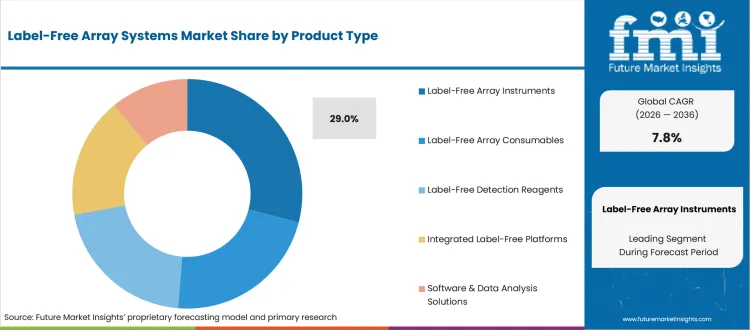
Label-Free Array Instruments hold a 29.0% share in 2026. The instrument controls assay architecture, data capture, temperature and fluid handling and plate or sensor format and kinetic-fit selection and integration with laboratory automation. Buyers can change reagents or assay design more readily than the installed platform, so qualification, service response and software lifecycle and consumable continuity shape the initial award.
- Surface Plasmon Resonance Systems support detailed association and dissociation analysis across antibodies, proteins, peptides and nucleic acids and selected small molecules. Biolayer Interferometry Systems use a plate-oriented, fluidics-light workflow for parallel antibody screening, quantitation and kinetic ranking. Label-Free Array Consumables create recurring test capacity through Sensor Chips and Biosensor Plates.
- Label-Free Detection Reagents support capture, blocking, orientation and regeneration and reference-channel control. Integrated Label-Free Platforms connect screening with confirmatory characterization, while Multi-Mode and High-Throughput Screening Platforms add orthogonal readouts or automation. Software & Data Analysis Solutions support kinetic fitting, quality controls, comparability and reporting and audit-ready workflows.
Why does Drug Discovery lead the Application category?
Drug Discovery holds a 34.0% share in 2026. Label-free arrays help teams rank candidates by interaction quality instead of a single endpoint signal. They show whether a hit binds the intended target, how quickly it associates, how long it remains bound and whether the response is concentration dependent and whether an apparent signal reflects matrix or surface behavior.
- Lead Compound Screening favors parallel formats, short cycle time, robust reference subtraction and automated sample handling. Drug-Target Interaction Analysis requires fit-for-purpose surface density, a concentration series and a kinetic fit that does not overstate affinity. Protein Interface Analysis extends the workflow to competitive binding, Protein-Protein Interaction Studies and Protein-Ligand Binding Analysis.
- Antibody Characterization relies on repeatable capture chemistry and broad dynamic range. Biomarker Discovery uses multiplex or array formats, while Biomarker Validation requires lot-to-lot and operator-to-operator reproducibility. Cell-Based Research tracks integrated phenotype through Cell Signaling Studies and Cell Response Analysis without a reporter-development step.
Why do Pharmaceutical Companies lead the End User category?
Pharmaceutical Companies account for a 32.0% share in 2026. Large drug developers can spread platform cost across discovery, biologics characterization, process development and comparability and selected quality-control workflows. They also have the assay-development staff, automation infrastructure, data governance and service contracts needed to keep complex instruments utilized.
- Innovator Pharmaceutical Companies use label-free arrays to rank new targets, modalities, antibodies and formulations. Generic Pharmaceutical Companies focus more selectively on complex product characterization and biosimilar comparability. Biotechnology Companies value smaller sample requirements and rapid kinetic evidence, while Clinical-Stage Biotechnology Companies require stronger assay continuity and data controls.
- Academic & Research Institutes purchase for broad investigator access. Contract Research Organizations convert utilization into billable studies through screening, kinetic ranking, antibody characterization and comparability work. Diagnostic & Healthcare Laboratories remain application specific, with Clinical Diagnostic Laboratories requiring validated workflows and Hospital Research Laboratories focusing on translational research.
Why does Direct Sales lead the Distribution Channel category?
Direct Sales hold a 39.0% share in 2026. A label-free platform order usually includes application consultation, instrument configuration, software and installation and training and service terms and consumable forecasts. It may also include automation or regulated-workflow requirements. Direct commercial and technical teams can coordinate these dependencies better than a transactional channel.
- Direct Manufacturer Sales fit single-site laboratories that need application matching and installation support. Key Account Contracts support common pricing, service response, software governance and consumable supply across sites. Specialized, Regional and Scientific Equipment Distributors add local inventory, in-country logistics and field coverage.
- Online Sales work best for repeat consumables, reagents, spare parts and software renewals after the platform is specified. System Integrators & Solution Providers connect the instrument to robotic screening lines, liquid handling and data flow. Third-Party Resellers serve smaller or remote accounts when they can provide genuine application knowledge, stock availability and a clear escalation route to the manufacturer.
Why does Surface Plasmon Resonance lead the Technology category?
Surface Plasmon Resonance holds a 38.0% share in 2026. SPR has an established role in real-time, label-free measurement of affinity, association and dissociation kinetics and specificity and concentration and comparability. Its installed base, sensor-surface options and use across discovery and biologics characterization support platform standardization. The method still requires control of immobilization, refractive-index changes, solvent correction and mass transport and regeneration and microfluidic performance.
- Imaging SPR extends spatial and multiplex analysis, while Array-Based SPR raises parallelism. Bio-Layer Interferometry uses a dip-and-read architecture for plate-based processing. Cellular Dielectric Spectroscopy supports Whole-Cell Analysis and Real-Time Cell Response Monitoring, although the composite response usually requires orthogonal confirmation.
- Microcantilever Technology supports specialist biophysical work, and Arrayed Microcantilever Systems add parallel detection. Optical Waveguide Grating supports optical surface-sensitive measurement, while Atomic Force Microscopy adds nanoscale force and surface characterization with lower routine throughput. Buyers compare each approach on assay transfer, consumable continuity, software support and total cost per reliable decision.
What are the drivers, restraints and opportunities in the Label-Free Array Systems Market?
- Driver: Biopharma and research teams need real-time binding, kinetics, comparability and whole-cell response evidence without developing a reporter label.
- Restraint: Surface chemistry, matrix effects, mass transport and biosensor variability and fit selection and software validation extend assay qualification and can restrict cross-platform transfer.
- Opportunity: Higher-throughput plate formats, lower sample volumes, automation and audit-ready software and integrated consumable-service programs can increase utilization and recurring revenue.
Which country CAGRs are profiled in the Label-Free Array Systems Market?
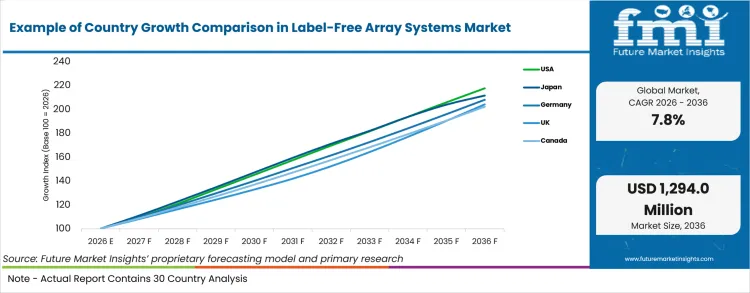
| Country | CAGR (2026 to 2036) |
|---|---|
| USA | 8.1% |
| Japan | 7.8% |
| Germany | 7.6% |
| UK | 7.4% |
| Canada | 7.3% |
| Australia | 7.1% |
| Brazil | 6.8% |
Source: FMI estimates. Country rates describe the profiled markets and do not represent a ranking of company performance.
How do country-level CAGRs compare in the Label-Free Array Systems Market?
Demand for label-free array systems is strongest in countries with established biomedical research networks, shared core laboratories and sustained investment in proteomics, biomolecular interaction analysis and translational medicine. The USA benefits from an extensive network of NIH-supported core facilities that gives academic and clinical researchers access to advanced analytical instruments, technical expertise and high-throughput workflows. Japan, Germany and the UK are supported by mature life-science research environments where shared instrumentation and specialist facilities help laboratories study protein interactions, biomarkers and drug candidates without adding fluorescent or radioactive labels. Canada and Australia offer opportunities through university research centers, public health programs and collaborative life-science infrastructure, although purchases are often concentrated in major research hubs. Brazil has capable centers in São Paulo and other academic clusters, but wider adoption can be constrained by fragmented laboratory infrastructure, equipment funding and access to specialist maintenance. Across these countries, procurement depends less on small differences in growth rates and more on research funding, instrument utilization, assay validation support, trained personnel and dependable access to replacement parts and consumables.
How does the Label-Free Array Systems Market vary by country?
- USA: FMI projects an 8.1% CAGR. NIH-backed biomedical research and a large pharmaceutical, biotechnology, CRO and university base sustain instrument utilization. FDA guidance on comparative analytical assessment increases the importance of well-qualified functional evidence, while Part 11 considerations make access control, audit trails and reliable electronic records relevant to regulated users. Multi-site buyers favor standardized methods, service-level commitments and consumable continuity.
- Japan: FMI projects a 7.8% CAGR. Japan Agency for Medical Research and Development programs span innovative drug discovery, regenerative medicine, basic research and translational work. Laboratories tend to value repeatability, low sample use, controlled change management and dependable local application support and especially when a system is shared across investigators or transferred into later-stage development.
- Germany: FMI projects a 7.6% CAGR. German biopharma and research buyers place substantial weight on analytical comparability and method documentation. BfArM guidance on biosimilars reinforces the role of extensive comparative analytical work. Purchases therefore depend on traceable workflows, qualified software, surface and consumable consistency and evidence that a method can be reproduced across sites.
- UK: FMI projects a 7.4% CAGR. The UK Life Sciences Sector Plan supports clinical research and life-science infrastructure, while universities, translational centers and CROs and biotechnology clusters create demand for shared platforms. Multi-user laboratories prioritize flexible sensor chemistry, training, booking efficiency and automated workflows and charge-back economics.
- Canada: FMI projects a 7.3% CAGR. Canada combines a federal biomanufacturing and life-sciences strategy with CIHR-supported research and a revised Health Canada biosimilar framework. The 2026 quality guidance emphasizes comprehensive comparative analytical studies, suitably qualified procedures and different analytical principles where needed. This favors platforms that support affinity, kinetics, comparability and auditability and transfer between academic and biotechnology and manufacturing environments.
- Australia: FMI projects a 7.1% CAGR. TGA adoption of international biosimilar guidance and Medical Research Future Fund activity support translational and biopharmaceutical research. The country's dispersed laboratory geography raises the value of remote diagnostics, preventive service, local consumable stock and distributor training. Buyers often evaluate downtime risk as carefully as throughput or sensitivity.
- Brazil: FMI projects a 6.8% CAGR. Anvisa's framework covers clinical development of medicines and biological products, while Finep programs support health, biotechnology and multi-user research infrastructure. Public research centers, biotechnology groups and pharmaceutical manufacturers provide the application base. Import lead times, currency exposure, application expertise and local service capacity can delay an instrument order even where scientific demand is established.
Who are the notable companies in the Label-Free Array Systems Market?
Thermo Fisher Scientific Inc., Danaher Corporation, Sartorius AG and Merck KGaA and Agilent Technologies Inc.
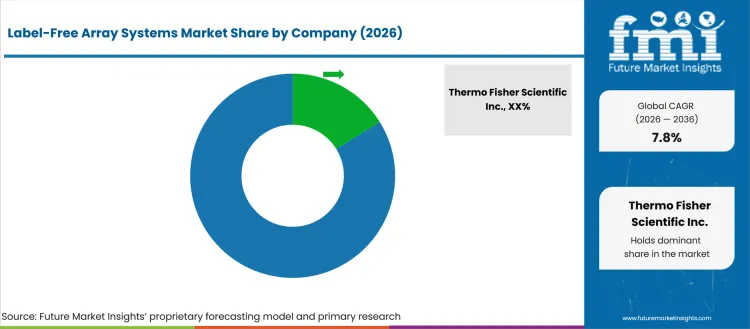
Competition depends on four linked assets: a measurement platform, protected sensor or surface chemistry, analysis software and an application-service network that keeps assays running. Direct label-free specialists compete with broader life-science suppliers that can combine instrumentation with reagents, automation and account support.
- Sartorius AG, Cytiva and Reichert Technologies document direct label-free interaction platforms. Agilent Technologies Inc. documents real-time cell analysis, while Bruker Corporation combines SPR with broader molecular and cell-interaction biosensor capabilities.
- Thermo Fisher Scientific Inc. supports compatible capture chemistry, and Bio-Rad Laboratories Inc. supports the ProteOn installed base through analysis software. Danaher Corporation participates through the broader Cytiva life-science portfolio.
- Merck KGaA and PerkinElmer Inc. contribute through wider life-science instrument, reagent, software or workflow portfolios identified in the market scope. Final supplier fit depends on assay type, sensor format, automation and data controls and local service support.
How do companies compare in the Label-Free Array Systems Market?
| Company | Documented capability | Buyer implication |
|---|---|---|
| Sartorius AG | Octet biolayer interferometry systems, biosensors, plates and analysis software. | Parallel plate workflows, reduced sample volume, kinetic screening and regulated-environment support. |
| Cytiva | Biacore SPR systems, sensor surfaces, automation and Biacore Insight software. | Detailed kinetics and comparability workflows with automated plate handling and sensorgram analysis. |
| Agilent Technologies Inc. | xCELLigence real-time cell analysis platforms combining impedance-based monitoring and imaging options. | Continuous whole-cell response data and software controls for discovery, development and selected regulated use. |
| Bruker Corporation | SPR systems and a broader molecular- and cell-interaction biosensor portfolio. | High-throughput interaction analysis and linkage between molecular kinetics and cell-interaction workflows. |
| Thermo Fisher Scientific Inc. | Assay-ready CaptureSelect ligand conjugates compatible with SPR and BLI formats. | Capture chemistry that can reduce assay-development steps and support consistent target or product binding. |
| Bio-Rad Laboratories Inc. | ProteOn Manager software for instrument setup, experiment design, data collection and protein-interaction analysis. | Workflow and data-analysis support for the ProteOn installed base. |
| Reichert Technologies | Focused SPR instrumentation for real-time, label-free molecular interaction and kinetic analysis. | Specialist platform positioning for laboratories requiring configurable SPR measurement workflows. |
What are the key developments in the Label-Free Array Systems Market?
- On May 20, 2026, Cytiva introduced the Biacore 8S and Biacore 8S+ SPR systems with integrated plate handling and extended unattended workflows and Biacore Insight Software v7.0 with sensorgram comparison for similarity scoring.
- On December 1, 2025, Agilent Technologies Inc. announced 21 CFR Part 11 compliance software for the xCELLigence RTCA eSight system, adding secure user authentication, electronic signatures and complete audit trails for regulated workflows.
- On May 21, 2025, Sartorius AG launched the Octet R8e BLI system with 96- and 384-well compatibility and sample volumes as low as 40 microliters and evaporation control intended for longer kinetic runs.
- On January 15, 2026, Nicoya Life Sciences, Inc. launched Revo, a four-channel benchtop SPR platform using digital microfluidics and disposable cartridges, aimed at making label-free binding-kinetics data more accessible to small and midsize research labs.
What is included in the Label-Free Array Systems Market report scope?
| Coverage field | Report scope |
|---|---|
| Market breakdown | Product Type, Application, End User and Distribution Channel and Technology and Region |
| Quantitative Units | Revenue in USD Million and CAGR in %. |
| Market Definition | Revenue includes first-sale manufacturer revenue from label-free interaction and cell-response instruments, sensor chips, biosensor plates and defined label-free reagents and integrated platforms and related software within the stated taxonomy. It excludes fluorescence-only or radiometric labeled detection, general-purpose instruments without an included label-free mode, and unrelated laboratory services. |
| Regions Covered | North America; Latin America; Western Europe; Eastern Europe; East Asia; South Asia and Pacific; Middle East and Africa |
| Countries Covered | USA, Japan, Germany and UK and Canada and Australia and Brazil and more than thirty additional countries in the full report |
| Key Companies Profiled | Thermo Fisher Scientific Inc.; Danaher Corporation; Sartorius AG; Merck KGaA; Agilent Technologies Inc.; Bio-Rad Laboratories Inc.; Bruker Corporation; Cytiva; Nicoya Life Sciences, Inc.; Reichert Technologies |
| Forecast Period | 2026 to 2036 |
| Approach | Hybrid bottom-up and top-down sizing using manufacturer revenue, instrument placements, installed-base utilization and consumable pull-through and average selling prices and application volumes and channel structure and country indicators and buyer-side validation. |
How was the Label-Free Array Systems Market research conducted?
| Method | Approach |
|---|---|
| Primary Research | FMI engages instrument manufacturers, biosensor and reagent suppliers, software and automation providers and laboratory distributors and assay-development scientists and biophysicists and bioanalytical and quality teams and platform managers and procurement professionals and CROs and core facilities and service engineers and subject-matter experts. |
| Desk Research | The review covers official regulatory and analytical guidance, government research and life-science programs, trade and policy releases and company filings and first-party product documentation and official company announcements and relevant technical guidance. |
| Market Sizing and Forecasting | Market sizing reconciles manufacturer first-sale revenue, instrument placements, installed-base utilization and sensor and reagent pull-through and software attachment and service coverage and average selling prices and product and technology mix and end-user demand and channel structure and country indicators. |
| Data Validation | Supplier-side findings are cross-checked with buyer, channel, application and technology and country evidence. Market values, annual growth, segment shares and country CAGRs are reviewed for mathematical consistency and alignment across quantitative tables. |
How is the Label-Free Array Systems Market segmented by category?
Label-Free Array Systems Market segmented by Product Type:
- Label-Free Array Instruments
- Surface Plasmon Resonance Systems
- Biolayer Interferometry Systems
- Label-Free Array Consumables
- Sensor Chips
- Biosensor Plates
- Label-Free Detection Reagents
- Biosensor Reagents
- Surface Functionalization Reagents
- Integrated Label-Free Platforms
- Multi-Mode Detection Platforms
- High-Throughput Screening Platforms
- Software & Data Analysis Solutions
- Kinetic Analysis Software
- Biomolecular Interaction Analysis Software
Label-Free Array Systems Market segmented by Application:
- Drug Discovery
- Lead Compound Screening
- Drug-Target Interaction Analysis
- Protein Interface Analysis
- Protein-Protein Interaction Studies
- Protein-Ligand Binding Analysis
- Antibody Characterization
- Antibody Affinity Analysis
- Antibody Kinetics Analysis
- Biomarker Discovery
- Biomarker Identification
- Biomarker Validation
- Cell-Based Research
- Cell Signaling Studies
- Cell Response Analysis
Label-Free Array Systems Market segmented by End User:
- Pharmaceutical Companies
- Innovator Pharmaceutical Companies
- Generic Pharmaceutical Companies
- Biotechnology Companies
- Biotechnology Startups
- Clinical-Stage Biotechnology Companies
- Academic & Research Institutes
- Universities
- Government Research Institutes
- Contract Research Organizations
- Preclinical CROs
- Drug Discovery CROs
- Diagnostic & Healthcare Laboratories
- Clinical Diagnostic Laboratories
- Hospital Research Laboratories
Label-Free Array Systems Market segmented by Distribution Channel:
- Direct Sales
- Direct Manufacturer Sales
- Key Account Contracts
- Specialized Laboratory Distributors
- Regional Laboratory Distributors
- Scientific Equipment Distributors
- Online Sales
- Manufacturer E-Commerce Portals
- Scientific E-Marketplaces
- System Integrators & Solution Providers
- Laboratory Automation Integrators
- Research Technology Providers
- Third-Party Resellers
- Local Resellers
- Specialty Resellers
Label-Free Array Systems Market segmented by Technology:
- Surface Plasmon Resonance
- Imaging SPR
- Array-Based SPR
- Bio-Layer Interferometry
- Standard BLI
- High-Throughput BLI
- Cellular Dielectric Spectroscopy
- Whole-Cell Analysis
- Real-Time Cell Response Monitoring
- Microcantilever Technology
- Microcantilever Biosensors
- Arrayed Microcantilever Systems
- Other Technologies
- Optical Waveguide Grating
- Atomic Force Microscopy
Which regions are covered in the Label-Free Array Systems Market?
- North America
- United States
- Canada
- Latin America
- Brazil
- Mexico
- Chile
- Rest of Latin America
- Western Europe
- Germany
- United Kingdom
- Italy
- Spain
- France
- Nordics
- Benelux
- Rest of Western Europe
- Eastern Europe
- Russia
- Poland
- Hungary
- Balkan and Baltic States
- Rest of Eastern Europe
- East Asia
- China
- Japan
- South Korea
- South Asia and Pacific
- India
- ASEAN
- Australia and New Zealand
- Rest of South Asia and Pacific
- Middle East and Africa
- Kingdom of Saudi Arabia
- Other GCC Countries
- Türkiye
- South Africa
- Other African Union Countries
- Rest of Middle East and Africa
Which sources support the Label-Free Array Systems Market analysis?
- International Council for Harmonisation (2023). Q2(R2): Validation of Analytical Procedures.
- International Council for Harmonisation (2023). Q14: Analytical Procedure Development.
- US Food and Drug Administration (2003, September). Part 11, Electronic Records; Electronic Signatures - Scope and Application.
- US Food and Drug Administration (2025, September). Development of Therapeutic Protein Biosimilars: Comparative Analytical Assessment and Other Quality-Related Considerations.
- Health Canada (2026, May 19). Guidance on information and submission requirements for biosimilar biologic drugs: Quality information requirements.
- Federal Institute for Drugs and Medical Devices, Germany (accessed 2026, July 31). Licensing of biosimilars.
- Therapeutic Goods Administration, Australia (2025, January 8). Guideline on similar biological medicinal products.
- National Institutes of Health (2026, June 11). Grants & Funding.
- Japan Agency for Medical Research and Development (accessed 2026, July 31). Programs in innovative drug discovery, regenerative medicine, basic research and translational research.
- UK Government (2025, July). Life Sciences Sector Plan.
- Innovation, Science and Economic Development Canada (2026, April 24). Canada's Biomanufacturing and Life Sciences Strategy.
- Canadian Institutes of Health Research (accessed 2026, July 31). CIHR funding overview.
- Australian Government Department of Health, Disability and Ageing (accessed 2026, July 31). Medical Research Future Fund.
- Brazilian Health Regulatory Agency (2024). RDC 945/2024 on clinical trials for medicines and biological products.
- Finep, Brazil (2025). PROINFRA 2024 Expansion: multi-user research infrastructure documentation.
- Sartorius AG (2025, May 21). Sartorius launches the Octet R8e System.
- Cytiva (2026, May 20). Cytiva introduces next-generation Biacore 8 series SPR systems.
- Cytiva (accessed 2026, July 31). Interaction analysis with Biacore surface plasmon resonance.
- Agilent Technologies Inc. (2025, December 1). Agilent announces 21 CFR Part 11 compliance software for xCELLigence RTCA eSight.
- Bruker Corporation (2024, October 2). Corporate acquisition announcement covering single-cell interaction cytometry and the SPR portfolio.
- Bruker Corporation (accessed 2026, July 31). Surface plasmon resonance systems for molecular interaction analysis.
- Thermo Fisher Scientific Inc. (accessed 2026, July 31). CaptureSelect ligand conjugates compatible with SPR and BLI workflows.
- Bio-Rad Laboratories Inc. (accessed 2026, July 31). ProteOn Manager Software.
- Reichert Technologies (accessed 2026, July 31). Reichert SPR systems.
- Merck KGaA (accessed 2026, July 31). SPR-supported antibody characterization workflow documentation.
This bibliography is provided for reader reference and is not exhaustive. The full report contains the complete reference list and detailed citations.
What questions does this report answer?
- What is the Label-Free Array Systems Market size in 2026, and what value is forecast for 2036?
- Why do discovery, antibody, biosimilar and biomarker and cell-response teams purchase label-free array systems?
- Why do Label-Free Array Instruments hold the leading position within Product Type?
- Why does Drug Discovery lead Application, and how do other application workflows differ?
- Why do Pharmaceutical Companies account for the leading End User share?
- How do Direct Sales, distributors, online channels and integrators and resellers serve different buying situations?
- Why does Surface Plasmon Resonance lead Technology, and where do BLI, cellular dielectric and microcantilever and optical waveguide and AFM approaches fit?
- How do surface chemistry, mass transport, matrix effects and biosensor variability and software controls limit method transfer?
- How do country growth rates and purchasing mechanisms differ across the USA, Japan, Germany and UK and Canada and Australia and Brazil?
- Which named companies provide label-free platforms, cell-response systems, reagents and software or related portfolio support?
- What should laboratory leaders evaluate when comparing capital cost with consumable pull-through, service and cost per reliable decision?
Frequently Asked Questions
How big is the Label-Free Array Systems Market in 2026?
The label-free array systems market is valued at USD 612.4 million in 2026 and is forecast to reach USD 1294.0 million by 2036. Growth reflects recurring demand for sensor chips, biosensor plates, reagents and software tied to instrument placements across drug discovery and biologics characterization.
What is the CAGR of the Label-Free Array Systems Market from 2026 to 2036?
The label-free array systems market grows at a CAGR of 7.8% between 2026 and 2036, driven by biopharma R&D activity, CRO capacity and shared academic instrumentation that need real-time binding, kinetics and whole-cell response evidence without developing a separate reporter-label workflow.
Which product type leads the Label-Free Array Systems Market?
Label-Free Array Instruments lead the label-free array systems market with a 29.0% share in 2026, because buyers require an installed measurement platform before committing recurring budgets to chips, plates, reagents and software, making the instrument the central qualification and service-continuity decision.
How much will the Label-Free Array Systems Market add between 2026 and 2036?
The label-free array systems market is set to add USD 681.6 million between 2026 and 2036, growing from USD 612.4 million to USD 1294.0 million as instrument placements expand recurring consumable, reagent and software demand across pharmaceutical, biotechnology and academic research laboratories worldwide.
Who are the leading companies in the Label-Free Array Systems Market?
The label-free array systems market is led by 10 companies, including Thermo Fisher Scientific, Danaher, Sartorius, Merck KGaA, Agilent Technologies, Bio-Rad Laboratories, Bruker, Cytiva, Nicoya Life Sciences and Reichert Technologies, competing through measurement platforms, sensor chemistry, analysis software and application-service networks.
Preview the report firsthand - request a free sample
Get SampleGet the brochure for pricing and purchase details.
Get PDFTable of Content
- Key Takeaways
- Market Size and CAGR
- Top Growth Driver
- Fastest Growing Segment
- Leading Region
- Key Companies
- Emerging Opportunities
- Executive Summary
- Global Market Outlook
- Demand-side Trends
- Supply-side Trends
- Technology Roadmap Analysis
- Analysis and Recommendations
- Analyst Perspective (What is happening? Why now? What should investors know?)
- Key Questions Answered
- How large is the market?
- What is the CAGR?
- What are key trends?
- Which region dominates?
- Who are the leaders?
- Market Overview
- Market Coverage / Taxonomy
- Market Definition / Scope / Limitations
- Research Methodology
- Chapter Orientation
- Analytical Lens and Working Hypotheses
- Market Structure, Signals, and Trend Drivers
- Benchmarking and Cross-market Comparability
- Market Sizing, Forecasting, and Opportunity Mapping
- Research Design and Evidence Framework
- Desk Research Programme (Secondary Evidence)
- Expert Input and Fieldwork (Primary Evidence)
- Tooling, Models, and Reference Databases
- Data Engineering and Model Build
- Quality Assurance and Audit Trail
- Market Background
- Market Dynamics (Drivers, Restraints, Opportunity, Trends)
- Scenario Forecast (Optimistic, Likely, Conservative)
- Impact Analysis
- AI Impact
- Sustainability Impact
- Regulatory Impact
- Technology Impact
- Consumer / Buyer Analysis
- Purchase Drivers
- Adoption Barriers
- Buyer Journey
- Opportunity Map Analysis
- Product Life Cycle Analysis
- Supply Chain Analysis
- Investment Feasibility Matrix
- Value Chain Analysis
- PESTLE and Porter's Analysis
- Regulatory Landscape
- Regional Parent Market Outlook
- Production and Consumption Statistics
- Import and Export Statistics
- Global Market Analysis and Forecast, 2021 to 2036
- Historical Market Size Value (USD Million) Analysis, 2021 to 2025
- Current and Future Market Size Value (USD Million) Projections, 2026 to 2036
- Y-o-Y Growth Trend Analysis
- Absolute $ Opportunity Analysis
- Global Market Pricing Analysis, 2021 to 2036
- Global Market Analysis and Forecast, By Product Type, 2021 to 2036
- Introduction / Key Findings
- Historical Market Size Value (USD Million) Analysis By Product Type, 2021 to 2025
- Current and Future Market Size Value (USD Million) Analysis and Forecast By Product Type, 2026 to 2036
- Label-Free Array Instruments
- Surface Plasmon Resonance Systems
- Biolayer Interferometry Systems
- Label-Free Array Consumables
- Sensor Chips
- Biosensor Plates
- Label-Free Detection Reagents
- Biosensor Reagents
- Surface Functionalization Reagents
- Integrated Label-Free Platforms
- Multi-Mode Detection Platforms
- High-Throughput Screening Platforms
- Software & Data Analysis Solutions
- Kinetic Analysis Software
- Biomolecular Interaction Analysis Software
- Label-Free Array Instruments
- Y-o-Y Growth Trend Analysis By Product Type, 2021 to 2025
- Absolute $ Opportunity Analysis By Product Type, 2026 to 2036
- Global Market Analysis and Forecast, By Application, 2021 to 2036
- Introduction / Key Findings
- Historical Market Size Value (USD Million) Analysis By Application, 2021 to 2025
- Current and Future Market Size Value (USD Million) Analysis and Forecast By Application, 2026 to 2036
- Drug Discovery
- Lead Compound Screening
- Drug-Target Interaction Analysis
- Protein Interface Analysis
- Protein-Protein Interaction Studies
- Protein-Ligand Binding Analysis
- Antibody Characterization
- Antibody Affinity Analysis
- Antibody Kinetics Analysis
- Biomarker Discovery
- Biomarker Identification
- Biomarker Validation
- Cell-Based Research
- Cell Signaling Studies
- Cell Response Analysis
- Drug Discovery
- Y-o-Y Growth Trend Analysis By Application, 2021 to 2025
- Absolute $ Opportunity Analysis By Application, 2026 to 2036
- Global Market Analysis and Forecast, By End User, 2021 to 2036
- Introduction / Key Findings
- Historical Market Size Value (USD Million) Analysis By End User, 2021 to 2025
- Current and Future Market Size Value (USD Million) Analysis and Forecast By End User, 2026 to 2036
- Pharmaceutical Companies
- Innovator Pharmaceutical Companies
- Generic Pharmaceutical Companies
- Biotechnology Companies
- Biotechnology Startups
- Clinical-Stage Biotechnology Companies
- Academic & Research Institutes
- Universities
- Government Research Institutes
- Contract Research Organizations
- Preclinical CROs
- Drug Discovery CROs
- Diagnostic & Healthcare Laboratories
- Clinical Diagnostic Laboratories
- Hospital Research Laboratories
- Pharmaceutical Companies
- Y-o-Y Growth Trend Analysis By End User, 2021 to 2025
- Absolute $ Opportunity Analysis By End User, 2026 to 2036
- Global Market Analysis and Forecast, By Distribution Channel, 2021 to 2036
- Introduction / Key Findings
- Historical Market Size Value (USD Million) Analysis By Distribution Channel, 2021 to 2025
- Current and Future Market Size Value (USD Million) Analysis and Forecast By Distribution Channel, 2026 to 2036
- Direct Sales
- Direct Manufacturer Sales
- Key Account Contracts
- Specialized Laboratory Distributors
- Regional Laboratory Distributors
- Scientific Equipment Distributors
- Online Sales
- Manufacturer E-Commerce Portals
- Scientific E-Marketplaces
- System Integrators & Solution Providers
- Laboratory Automation Integrators
- Research Technology Providers
- Third-Party Resellers
- Local Resellers
- Specialty Resellers
- Direct Sales
- Y-o-Y Growth Trend Analysis By Distribution Channel, 2021 to 2025
- Absolute $ Opportunity Analysis By Distribution Channel, 2026 to 2036
- Global Market Analysis and Forecast, By Technology, 2021 to 2036
- Introduction / Key Findings
- Historical Market Size Value (USD Million) Analysis By Technology, 2021 to 2025
- Current and Future Market Size Value (USD Million) Analysis and Forecast By Technology, 2026 to 2036
- Surface Plasmon Resonance
- Imaging SPR
- Array-Based SPR
- Bio-Layer Interferometry
- Standard BLI
- High-Throughput BLI
- Cellular Dielectric Spectroscopy
- Whole-Cell Analysis
- Real-Time Cell Response Monitoring
- Microcantilever Technology
- Microcantilever Biosensors
- Arrayed Microcantilever Systems
- Other Technologies
- Optical Waveguide Grating
- Atomic Force Microscopy
- Surface Plasmon Resonance
- Y-o-Y Growth Trend Analysis By Technology, 2021 to 2025
- Absolute $ Opportunity Analysis By Technology, 2026 to 2036
- Global Market Analysis and Forecast, By Region, 2021 to 2036
- Introduction
- Historical Market Size Value (USD Million) Analysis By Region, 2021 to 2025
- Current Market Size Value (USD Million) Analysis and Forecast By Region, 2026 to 2036
- North America
- Latin America
- Western Europe
- Eastern Europe
- East Asia
- South Asia and Pacific
- Middle East & Africa
- Market Attractiveness Analysis By Region
- North America Market Analysis and Forecast, By Country, 2021 to 2036
- Historical Market Size Value (USD Million) Trend Analysis By Market Taxonomy, 2021 to 2025
- Market Size Value (USD Million) Forecast By Market Taxonomy, 2026 to 2036
- By Country
- USA
- Canada
- By Product Type
- By Application
- By End User
- By Distribution Channel
- By Technology
- By Country
- Market Attractiveness Analysis
- By Country
- By Product Type
- By Application
- By End User
- By Distribution Channel
- By Technology
- Key Takeaways
- Latin America Market Analysis and Forecast, By Country
- Historical Market Size Value (USD Million) Trend Analysis By Market Taxonomy, 2021 to 2025
- Market Size Value (USD Million) Forecast By Market Taxonomy, 2026 to 2036
- By Country
- Brazil
- Mexico
- Chile
- Rest of Latin America
- By Product Type
- By Application
- By End User
- By Distribution Channel
- By Technology
- By Country
- Market Attractiveness Analysis
- By Country
- By Product Type
- By Application
- By End User
- By Distribution Channel
- By Technology
- Key Takeaways
- Western Europe Market Analysis and Forecast, By Country
- Historical Market Size Value (USD Million) Trend Analysis By Market Taxonomy, 2021 to 2025
- Market Size Value (USD Million) Forecast By Market Taxonomy, 2026 to 2036
- By Country
- Germany
- UK
- Italy
- Spain
- France
- Nordic
- BENELUX
- Rest of Western Europe
- By Product Type
- By Application
- By End User
- By Distribution Channel
- By Technology
- By Country
- Market Attractiveness Analysis
- By Country
- By Product Type
- By Application
- By End User
- By Distribution Channel
- By Technology
- Key Takeaways
- Eastern Europe Market Analysis and Forecast, By Country
- Historical Market Size Value (USD Million) Trend Analysis By Market Taxonomy, 2021 to 2025
- Market Size Value (USD Million) Forecast By Market Taxonomy, 2026 to 2036
- By Country
- Russia
- Poland
- Hungary
- Balkan & Baltic
- Rest of Eastern Europe
- By Product Type
- By Application
- By End User
- By Distribution Channel
- By Technology
- By Country
- Market Attractiveness Analysis
- By Country
- By Product Type
- By Application
- By End User
- By Distribution Channel
- By Technology
- Key Takeaways
- East Asia Market Analysis and Forecast, By Country
- Historical Market Size Value (USD Million) Trend Analysis By Market Taxonomy, 2021 to 2025
- Market Size Value (USD Million) Forecast By Market Taxonomy, 2026 to 2036
- By Country
- China
- Japan
- South Korea
- By Product Type
- By Application
- By End User
- By Distribution Channel
- By Technology
- By Country
- Market Attractiveness Analysis
- By Country
- By Product Type
- By Application
- By End User
- By Distribution Channel
- By Technology
- Key Takeaways
- South Asia and Pacific Market Analysis and Forecast, By Country
- Historical Market Size Value (USD Million) Trend Analysis By Market Taxonomy, 2021 to 2025
- Market Size Value (USD Million) Forecast By Market Taxonomy, 2026 to 2036
- By Country
- India
- ASEAN
- Australia & New Zealand
- Rest of South Asia and Pacific
- By Product Type
- By Application
- By End User
- By Distribution Channel
- By Technology
- By Country
- Market Attractiveness Analysis
- By Country
- By Product Type
- By Application
- By End User
- By Distribution Channel
- By Technology
- Key Takeaways
- Middle East & Africa Market Analysis and Forecast, By Country
- Historical Market Size Value (USD Million) Trend Analysis By Market Taxonomy, 2021 to 2025
- Market Size Value (USD Million) Forecast By Market Taxonomy, 2026 to 2036
- By Country
- Kingdom of Saudi Arabia
- Other GCC Countries
- Türkiye
- South Africa
- Other African Union
- Rest of Middle East & Africa
- By Product Type
- By Application
- By End User
- By Distribution Channel
- By Technology
- By Country
- Market Attractiveness Analysis
- By Country
- By Product Type
- By Application
- By End User
- By Distribution Channel
- By Technology
- Key Takeaways
- Key Countries Market Analysis
- USA
- Pricing Analysis
- Market Share Analysis, 2025
- By Product Type
- By Application
- By End User
- By Distribution Channel
- By Technology
- Canada
- Pricing Analysis
- Market Share Analysis, 2025
- By Product Type
- By Application
- By End User
- By Distribution Channel
- By Technology
- Mexico
- Pricing Analysis
- Market Share Analysis, 2025
- By Product Type
- By Application
- By End User
- By Distribution Channel
- By Technology
- Brazil
- Pricing Analysis
- Market Share Analysis, 2025
- By Product Type
- By Application
- By End User
- By Distribution Channel
- By Technology
- Chile
- Pricing Analysis
- Market Share Analysis, 2025
- By Product Type
- By Application
- By End User
- By Distribution Channel
- By Technology
- Germany
- Pricing Analysis
- Market Share Analysis, 2025
- By Product Type
- By Application
- By End User
- By Distribution Channel
- By Technology
- UK
- Pricing Analysis
- Market Share Analysis, 2025
- By Product Type
- By Application
- By End User
- By Distribution Channel
- By Technology
- Italy
- Pricing Analysis
- Market Share Analysis, 2025
- By Product Type
- By Application
- By End User
- By Distribution Channel
- By Technology
- Spain
- Pricing Analysis
- Market Share Analysis, 2025
- By Product Type
- By Application
- By End User
- By Distribution Channel
- By Technology
- France
- Pricing Analysis
- Market Share Analysis, 2025
- By Product Type
- By Application
- By End User
- By Distribution Channel
- By Technology
- India
- Pricing Analysis
- Market Share Analysis, 2025
- By Product Type
- By Application
- By End User
- By Distribution Channel
- By Technology
- ASEAN
- Pricing Analysis
- Market Share Analysis, 2025
- By Product Type
- By Application
- By End User
- By Distribution Channel
- By Technology
- Australia & New Zealand
- Pricing Analysis
- Market Share Analysis, 2025
- By Product Type
- By Application
- By End User
- By Distribution Channel
- By Technology
- China
- Pricing Analysis
- Market Share Analysis, 2025
- By Product Type
- By Application
- By End User
- By Distribution Channel
- By Technology
- Japan
- Pricing Analysis
- Market Share Analysis, 2025
- By Product Type
- By Application
- By End User
- By Distribution Channel
- By Technology
- South Korea
- Pricing Analysis
- Market Share Analysis, 2025
- By Product Type
- By Application
- By End User
- By Distribution Channel
- By Technology
- Russia
- Pricing Analysis
- Market Share Analysis, 2025
- By Product Type
- By Application
- By End User
- By Distribution Channel
- By Technology
- Poland
- Pricing Analysis
- Market Share Analysis, 2025
- By Product Type
- By Application
- By End User
- By Distribution Channel
- By Technology
- Hungary
- Pricing Analysis
- Market Share Analysis, 2025
- By Product Type
- By Application
- By End User
- By Distribution Channel
- By Technology
- Kingdom of Saudi Arabia
- Pricing Analysis
- Market Share Analysis, 2025
- By Product Type
- By Application
- By End User
- By Distribution Channel
- By Technology
- Türkiye
- Pricing Analysis
- Market Share Analysis, 2025
- By Product Type
- By Application
- By End User
- By Distribution Channel
- By Technology
- South Africa
- Pricing Analysis
- Market Share Analysis, 2025
- By Product Type
- By Application
- By End User
- By Distribution Channel
- By Technology
- USA
- Market Structure Analysis
- Competition Dashboard
- Competition Benchmarking
- Market Share Analysis of Top Players
- By Regional
- By Product Type
- By Application
- By End User
- By Distribution Channel
- By Technology
- Emerging Startups
- Innovation Benchmarking
- Competition Analysis
- Competition Deep Dive
- Thermo Fisher Scientific Inc.
- Overview
- Product Portfolio
- Profitability by Market Segments
- Sales Footprint
- Strategy Overview
- Marketing Strategy
- Product Strategy
- Channel Strategy
- Danaher Corporation
- Sartorius AG
- Merck KGaA
- Agilent Technologies Inc.
- Bio-Rad Laboratories Inc.
- Bruker Corporation
- Cytiva
- PerkinElmer Inc.
- Reichert Technologies
- Thermo Fisher Scientific Inc.
- Case Studies
- Success Stories
- Recent Developments
- Competition Deep Dive
- Assumptions & Acronyms Used


