

- Market Size (2026)
- USD 12.8 Bn
- Forecast (2036)
- USD 148.8 Bn
- CAGR (2026 to 2036)
- 27.8%
How big is Large Language Model LLM market size?
USD 12.8 billion in 2026 and USD 148.8 billion by 2036 at a 27.8% CAGR.
Demand for large language model LLM is projected to expand at 27.8% CAGR between 2026 and 2036, increasing valuation from USD 12.8 billion in 2026 to USD 148.8 billion by 2036. Businesses actively deploy natural language processing tools to streamline content creation and software assistance with adherence to strict quality standards. Eurostat published its December 2025 report showing 20.0% of European Union enterprises having used artificial intelligence during 2025. This expanding workplace adoption allows organizations to gain valuable familiarity with language-generation systems and establish formal deployment reviews. Companies focus their production spending on controlled use cases featuring firm access rules and deliver measurable business outcomes.
Organizations across the United States and Canada strongly emphasize enterprise access controls and reliable service continuity on acquiring such technologies. Technology buyers in Japan and South Korea prioritize local-language capabilities and demand highly responsive technical assistance from their vendors. A May 2026 analysis from Microsoft classified 49.0% of Copilot conversations as analysis and problem-solving activities. Such heavy cognitive usage demonstrates how workers routinely rely on language models to tackle complex daily tasks. Business and technology teams are required to establish clear review ownership across their organizations to achieve even wider adoption.
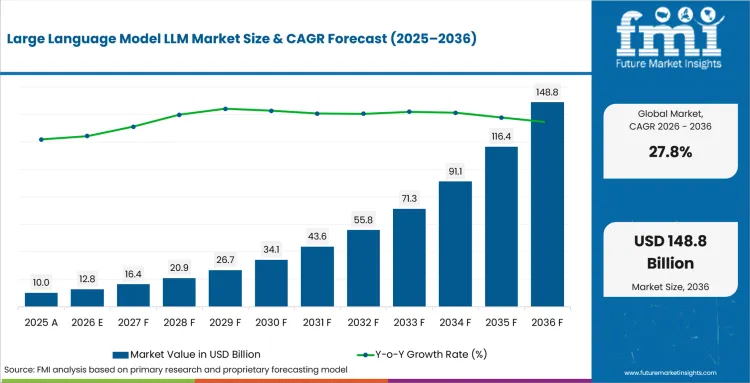
Key Takeaways for the Large Language Model LLM Market
- Demand for large language model LLM solutions is driven by content automation and software assistance across controlled enterprise workflows.
- Cloud-based deployment is expected to garner 64.0% share of deployment in 2026, driven by flexible capacity and centrally managed model access.
- API-based Models are estimated to lead business model with 52.0% share in 2026, aided by usage-based access and shorter implementation paths.
- Unreliable outputs and difficult evaluation restrict wider production use across accountable business processes.
- Competition focuses on OpenAI, Google LLC, Anthropic, Microsoft Corporation, Meta Platforms, Inc., Amazon Web Services, Mistral AI, Cohere, AI21, and Alibaba Cloud, with providers differentiated depending on model quality and deployment control.
Analyst Perspective
“Large language model spending advances from experimentation into recurring use only through verified task outcomes. Enterprise teams examine output accuracy and operating cost during production approval. Durable adoption arises from language capability connected with governed data and accountable human review.”
- Sudip saha, Principal Analyst for Technology at Future Market Insights
How is Large Language Model (LLM) Market segmented?
The large language model LLM industry is segmented by model type, deployment, application, end user, business model, and region.
The large language model LLM market is segmented by model type, deployment, application, end user, business model, and region. Model type coverage includes foundation models and domain-specific models together with code generation models and small language models. Deployment coverage includes cloud-based and on-premise systems with hybrid deployment. Application coverage addresses content generation and code generation together with customer service and knowledge management. End user coverage spans IT & telecom and BFSI together with healthcare and retail & E-commerce. Business model coverage includes API-based models and open-source models together with custom enterprise models. Regional coverage includes North America and Europe together with East Asia. South Asia and Pacific with Latin America and Middle East and Africa complete geographic assessment.
What keeps API-based models ahead within business model?
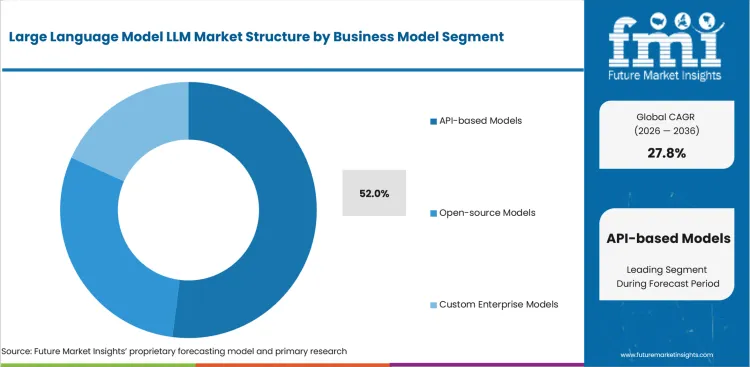
API-based models provide direct access to managed language capability without full model ownership. Usage-based charging aligns early spending with tested workload volume. OpenAI priced Batch API requests at 50.0% below shared rates during April 2024, lowering expense for non-urgent language workloads. AI Platform services support model comparison and application integration across development teams. Custom enterprise models attract buyers requiring deeper control over context and deployment conditions.
- In 2026, API-based models are projected to capture 52.0% share in 2026 owing to shorter integration paths and usage-linked spending. Developer teams test several providers prior to long-term production selection.
- Open-source models and custom enterprise models offer greater control across model behavior and operating environments. Added responsibility covers infrastructure and model maintenance across long-term use.
What buying mechanism supports foundation models in the model type segment?
Foundation models support varied language tasks through reusable model capability and adaptable instruction handling. Enterprise selection emphasizes evaluation evidence across accuracy and human review requirements. National Institute of Standards and Technology’s July 2024 generative artificial intelligence profile centered on 12 risks and more than 200 risk-management actions, reinforcing demand for structured testing across foundation-model deployment. Enterprise AI governance and compliance requirements connect model flexibility with documented controls and accountable ownership.
- Foundation models are set to secure 48.0% share of model type in 2026, guided by reusable capability across content and software workflows. Enterprise reviewers assess task accuracy and operating safeguards prior to wider production use.
- Domain-specific models and small language models support focused requirements across regulated or resource-constrained environments. Buyers examine training context and maintenance effort across each specialized deployment route.
What supports the position of cloud-based within deployment?
Cloud-based deployment supports elastic inference and shared model access across distributed business teams. Central administration simplifies version control across APIs and connected applications. Google cloud reported a more than 40-fold annual increase in Gemini use on Vertex AI during April 2025, illustrating managed capacity supporting production model access. Cloud computing services provide adaptable infrastructure for variable language-model workloads without dedicated hardware ownership. Enterprise approval remains sensitive to data location and identity controls across production environments.
- By deployment, cloud-based is anticipated to account for 64.0% share in 2026 since being backed by adaptable capacity and centralized model administration. Security teams review regional hosting and permission management during enterprise assessment.
- On-premise and hybrid deployment protect sensitive information across restricted operating environments. Local infrastructure adds maintenance duties across model updates and capacity planning.
Why does content generation lead application demand?
Content generation converts language capability into drafts and summaries across recurring communication work. Workflow value rises through faster first-pass production under editorial review. Grammarly reported service use by more than 40 million people during August 2025, confirming recurring demand for AI-assisted drafting and editing. Customer Service extends chatbot assistance across repeat inquiries under approved response rules. Human approval protects brand standards and factual accuracy throughout release processes.
- Content generation is estimated to garner 28.0% share in 2026, reflecting recurring demand across drafting and summarization tasks. Business teams compare output quality and editing effort across routine content programs.
- Code Generation supports specialized productivity gains through software assistance. Knowledge Management adds document retrieval and research functions across maintained enterprise information.
How does IT & telecom shape demand across end user?
IT & telecom organizations integrate language models into software products and technical support workflows. Existing cloud expertise shortens model testing across development teams and managed services. GitHub’s October 2024 report counted more than 70,000 new public generative AI projects created during 2024, demonstrating active software development around model-enabled applications. Technology providers combine model access with governance and support during commercial deployment.
- Based on end user, IT & telecom is likely to hold 24.0% share of in 2026 as it is influenced by established software development capability and frequent language-intensive work. Technical buyers examine latency and service reliability across customer-facing systems.
- BFSI applies natural language processing in finance under documentation controls. Healthcare uses healthcare natural language processing with human approval across sensitive decisions. Retail & E-commerce concentrates on customer communication and product-content workflows under brand controls.
What are drivers, restraints, and opportunities in Large Language Model (LLM) Market?
Capability improvement supports wider workflow testing and weak output reliability delays production approval. Efficient inference and governed domain context create expansion potential across repeatable enterprise work.
- Driver: Language models shorten drafting cycles and assist software teams under documented review controls. Verified task performance encourages adoption within approved business workflows.
- Restraint: Output errors increase correction effort and delay approval for accountable enterprise work. Difficult evaluation reduces buyer confidence during production implementation.
- Opportunity: Domain evaluation improves accuracy for specialized enterprise applications. Efficient inference enables recurring workloads under controlled human supervision.
Generative AI improves productivity across coordinated knowledge work through reduced handoff effort. Korea Information Society Development Institute’s June 2026 experiments recorded approximately 10.0% productivity improvement without sequential division of labor, supporting language-model use across connected enterprise tasks. Commercial conversion strengthens as providers prove comparable gains inside customer workflows. Accountable review protects quality during production expansion.
Output reliability restricts adoption across software development and customer communication. Stack Overflow’s July 2025 survey recorded output-accuracy distrust among 46.0% of developers compared with 33.0% expressing trust, raising verification effort across code and technical content. Enterprise buyers examine correction rates and human review workload during platform assessment. Weak evidence extends approval cycles and raises delivered operating cost.
Falling inference expense creates access opportunities across smaller workloads and additional business teams. Stanford Institute for Human-Centered Artificial Intelligence’s April 2025 review recorded a more than 280-fold decline in GPT-3.5-level query cost to USD 0.07 per million tokens by October 2024, improving economics for scaled experimentation and production use. Lower model-access cost permits wider task testing across controlled applications. Integration quality and review effort continue to determine realized commercial value.
How are country CAGRs aligned in Large Language Model LLM market?
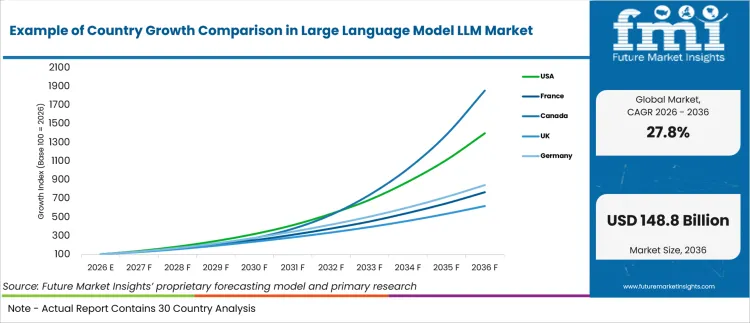
| Country or Market | CAGR |
|---|---|
| Canada | 34.0% |
| Japan | 32.4% |
| South Korea | 31.5% |
| USA | 30.2% |
| Germany | 23.8% |
| France | 22.6% |
| UK | 20.1% |
Source: Future Market Insights analysis, 2026.
How do country-level CAGRs compare in Large Language Model (LLM) Market?
Country comparison shows a gradual step-down across profiled markets. Canada occupies upper forecast position and Japan follows at a limited distance. South Korea and United States form a closely grouped expansion band. Germany and France occupy a lower European range. United Kingdom completes disclosed comparison under measured enterprise review practices. A 13.9 percentage-point spread separates Canada from United Kingdom.
- Canada is anticipated to lead disclosed comparison through enterprise language-model use across service-intensive industries.
- Japan is likely to follow Canada based on local model development and structured enterprise assessment.
- South Korea and United States are projected to form a closely grouped band through strong software participation.
- Germany and France are expected to follow under documentation-led enterprise approval processes.
- UK completes disclosed range depending on established professional services and practical workflow testing.
Markets carrying similar CAGRs are likely to present distinct entry conditions led by support coverage and data-control expectations. Full report coverage includes North America and Europe together with East Asia. South Asia and Pacific with Latin America and Middle East and Africa complete regional analysis.
Country-wise Analysis
- Large language model LLM adoption in Canada is likely to rise at 34.0% CAGR during the assessment period, backed by enterprise use across finance and information services. Statistics Canada’s June 2026 analysis recorded large language model use among 24.8% of artificial-intelligence-using businesses, confirming direct commercial familiarity across surveyed organizations. Service continuity and privacy controls influence supplier selection across provincial operating environments.
- Local foundation-model development supports Japan through public compute access and enterprise testing programs. Demand in Japan is projected to expand at 32.4% CAGR during 2026 to 2036, influenced by local-language capability and formal quality assessment. Ministry of Economy, Trade and Industry selected 16 artificial intelligence model projects in June 2026, expanding domestic development capacity and social implementation prospects.
- Korea Communications Commission’s June 2025 survey recorded generative artificial intelligence use among 24.0% of respondents, demonstrating consumer familiarity supporting text-generation services. Dense connectivity and active software participation accelerate commercial testing across domestic organizations. Sector in South Korea is anticipated to record 31.5% CAGR by 2036, led by prompt adoption and local service expectations.
- United States enterprises possess extensive cloud access and software development capability across major buyer groups. Large language model LLM Industry in the United States is estimated to progress at 30.2% CAGR over the forecast period, influenced by enterprise spending and numerous platform providers. U.S. Census Bureau’s May 2026 analysis recorded artificial intelligence use among 37.0% of firms employing at least 250 people, providing a substantial base for production language-model assessment.
- Formal review practices shape supplier assessment across German enterprises. German Federal Statistical Office’s November 2025 table recorded natural language generation among 35.0% of artificial-intelligence-using enterprises, demonstrating direct use across text and programming applications. The market in Germany is predicted to scale at 23.8% CAGR during the assessment period, driven by structured enterprise software adoption and strong compliance review.
- Sector in France is estimated to expand at 22.6% CAGR through 2036, influenced by information-sector adoption and multilingual content requirements. Insee’s July 2026 release recorded artificial intelligence use among 59.0% of information and communication enterprises during 2025, supporting enterprise familiarity across language-intensive operations. Formal approval and local support affect production expansion across customer organizations.
- Department for Science, Innovation and Technology’s February 2026 study recorded natural language processing and text generation use among 85.0% of artificial-intelligence adopters, confirming direct demand across UK business users. Professional services and software companies supply recurring language-intensive workflows for model deployment. Demand in the United Kingdom is expected to increase at 20.1% CAGR from 2026 to 2036, helped by practical workflow evidence and staff-readiness requirements.
Who are notable companies in Large Language Model LLM market?
OpenAI, Google LLC, Anthropic, Microsoft Corporation, Meta Platforms, Inc., Amazon Web Services, Mistral AI, Cohere, AI21, and Alibaba Cloud are prominent companies influencing large language model LLM market.
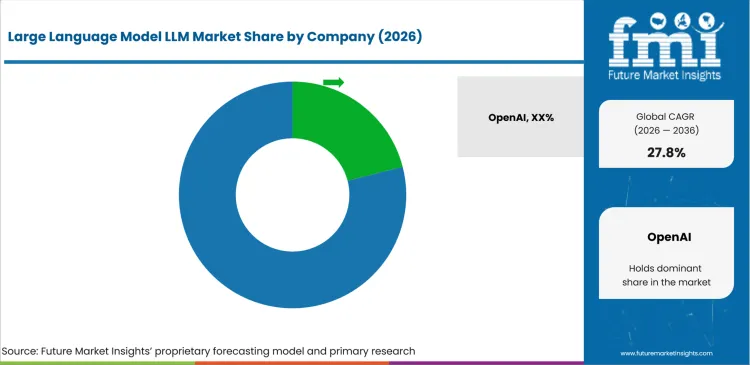
Competition centers on model accuracy and enterprise LLM deployment support across production programs. Model developers focus on reasoning and multimodal capability during platform selection. Cloud participants connect model access with infrastructure and security services. Open-source providers emphasize local control and customization across enterprise environments. Buyer review covers latency and data handling together with evaluation tools and technical assistance.
- OpenAI and Anthropic compete through frontier model capability and extensive developer access. Enterprise teams compare reasoning performance and service stability across production workloads.
- Microsoft Corporation and Amazon Web Services connect language-model access with established cloud platforms and enterprise relationships. Buyers assess integrated security and support across existing technology estates.
- Meta Platforms, Inc. and Mistral AI compete based on open model availability and adaptable deployment routes. Technical teams examine infrastructure demands and model governance across internal operations.
- Cohere and AI21 focus on enterprise language systems and controlled deployment. Alibaba Cloud extends model access depending on regional infrastructure and Qwen services across global customers.
Competitive Benchmarking: Large Language Model LLM Market
| Company | Model Portfolio | Deployment Options | Governance Support | Service Reach |
|---|---|---|---|---|
| OpenAI | High | High | High | Global |
| Google LLC | High | High | High | Global |
| Anthropic | High | High | High | Multi-country |
| Microsoft Corporation | High | High | High | Global |
| Meta Platforms, Inc. | High | High | Medium | Global |
| Amazon Web Services | High | High | High | Global |
| Mistral AI | High | High | Medium | Multi-country |
| Cohere | High | High | High | Multi-country |
Source: Future Market Insights competitive analysis, 2026.
Key Developments in Large Language Model LLM Market
- In March 2025, Google introduced Gemini 2.5 for reasoning and coding applications. Company information connected improved model capability with complex language and software tasks.
- In May 2025, Anthropic introduced Claude 4 through Opus 4 and Sonnet 4 for coding and agent workflows. Company information connected parallel tool use with extended enterprise task handling.
- In August 2025, OpenAI introduced GPT-5 as a unified model system for efficient responses and deeper reasoning. Company information connected API access with coding and agent applications.
Large Language Model LLM Market Report Scope
| Coverage field | Report scope |
|---|---|
| Market breakdown | Large language model LLM market breakdown includes model type, deployment, application, end user, business model, and region. |
| Quantitative Units | Revenue in USD billion and CAGR in %. |
| Market Definition | Foundation-model development and API access form core coverage. Enterprise deployment and fine-tuning support production use. Inference and safety controls with supporting services complete defined coverage. |
| Regions Covered | North America, Europe, East Asia, South Asia and Pacific, Latin America, Middle East and Africa. |
| Countries Covered | Canada, Japan, South Korea, USA, Germany, France, and UK. |
| Key Companies Profiled | OpenAI, Google LLC, Anthropic, Microsoft Corporation, Meta Platforms, Inc., Amazon Web Services, Mistral AI, Cohere, AI21, and Alibaba Cloud. |
| Forecast Period | 2026 to 2036 |
| Approach | Hybrid bottom-up and top-down methodology uses segment shares and country CAGRs. Company activity and buyer adoption support final market reconciliation. |
Source: Future Market Insights analysis, 2026.
Large Language Model LLM Market - Research Methodology
| Method | Approach |
|---|---|
| Primary Research | FMI analysts gathered input from manufacturers, service providers, technology developers, distributors, end users, procurement teams, and subject-matter experts. Interviews examined purchasing decisions, product or service evaluation, adoption barriers, approval requirements, pricing considerations, and expectations for technical or commercial support. Respondents were also asked what evidence is required before a trial, pilot, or initial order develops into regular purchasing. |
| Desk Research | Desk research covered government statistics, regulatory publications, trade data, industry associations, technical literature, standards, company filings, product information, and official corporate announcements. Sources were reviewed for relevance, publication date, geographic coverage, and consistency with the defined market scope. Claims relating to performance, applications, approvals, capacity, investment, and commercial activity were retained only when supported by credible public evidence. |
| Market Sizing and Forecasting | The market model combined the baseline value with historical performance, segment structure, pricing and volume indicators, adoption levels, company participation, and country-level demand conditions. Forecast assumptions considered economic activity, investment trends, regulatory developments, technology adoption, purchasing cycles, supply availability, and barriers to wider market use. Segment and regional estimates were reconciled before the final market total was calculated. |
| Data Validation | Estimates were checked against multiple independent indicators, including public data, company activity, trade patterns, industry developments, and findings from primary interviews. Validation also tested whether products, services, applications, and company revenues fell within the defined market boundaries. Adjacent categories, unsupported claims, overlapping revenues, and activities without direct market relevance were excluded to reduce double counting and maintain consistency across segments and countries. |
Source: Future Market Insights analysis, 2026.
Large Language Model LLM Market by Segments
Large Language Model LLM Market segmented by Model Type:
- Foundation Models
- Domain-specific Models
- Code Generation Models
- Small Language Models
Large Language Model LLM Market segmented by Deployment:
- Cloud-based
- On-premise
- Hybrid Deployment
Large Language Model LLM Market segmented by Application:
- Content Generation
- Code Generation
- Customer Service
- Knowledge Management
Large Language Model LLM Market segmented by End User:
- IT & Telecom
- BFSI
- Healthcare
- Retail & E-commerce
Large Language Model LLM Market segmented by Business Model:
- API-based Models
- Open-source Models
- Custom Enterprise Models
Large Language Model LLM Market segmented by Region:
- North America
- Canada
- USA
- Europe
- Germany
- France
- UK
- East Asia
- Japan
- South Korea
- South Asia and Pacific
- Latin America
- Middle East and Africa
Research Sources and Bibliography
- Anthropic. (2025, May 22). Introducing Claude 4.
- Autio, C., Schwartz, R., Dunietz, J., Jain, S., Stanley, M., Tabassi, E., Hall, P., & Roberts, K. (2024, July 26). Artificial intelligence risk management framework: Generative artificial intelligence profile. National Institute of Standards and Technology.
- Department for Science, Innovation and Technology. (2026, February 13). AI adoption research.
- Do, V., Sood, S., & Johnston, C. (2026, June 11). Analysis on artificial intelligence use by businesses in Canada, second quarter of 2026. Statistics Canada.
- Eurostat. (2025, December 11). 20% of EU enterprises use AI technologies.
- German Federal Statistical Office. (2025, November 24). Enterprises using artificial intelligence technologies, by employment size class.
- GitHub Staff. (2024, October 29). Octoverse: AI leads Python to top language as the number of global developers surges.
- Google Cloud. (2025, April 10). Welcome to Next '25.
- Google. (2025, March 25). Gemini 2.5: Our most intelligent AI model.
- Grundy, A., Breaux, C., & Khatiwoda, D. (2026, May 26). Large firms with at least 20 employees biggest AI users. U.S. Census Bureau.
- Grammarly. (2025, August 18). Grammarly launches specialized AI agents and writing surface for students and professionals.
- Korea Communications Commission. (2025, June 5). One in four Koreans use generative AI.
- Korea Information Society Development Institute. (2026, June 11). KISDI finds generative AI improves productivity by reducing inefficiencies in the division of labor.
- Lefebvre, C. (2026, July 21). Information and communication technologies in businesses in 2025: The share of enterprises using artificial intelligence tripled between 2023 and 2025. Insee.
- Microsoft. (2026, May 5). Agents, human agency, and the opportunity for every organization.
- Ministry of Economy, Trade and Industry. (2026, June 4). Selection of 16 new projects to support the development of AI models under the GENIAC computing resource provision support project (Cycle 4).
- OpenAI. (2024, April 23). Introducing more enterprise-grade features for API customers.
- OpenAI. (2025, August 7). Introducing GPT-5.
- Stanford Institute for Human-Centered Artificial Intelligence. (2025, April 7). AI Index 2025: State of AI in 10 charts.
- Stack Overflow. (2025, July 29). Stack Overflow’s 2025 developer survey reveals trust in AI at an all time low.
This bibliography supports retained evidence and excludes commercial market-size sources. The full report coverage contains extended source records and primary-research documentation.
This Report Answers
- How do segments influence demand across model type and deployment with application coverage?
- What criteria guide enterprise teams evaluating large language model LLM platforms prior to production use?
- Why do country CAGRs differ across profiled national markets?
- What companies compete through model capability and enterprise deployment support?
- How are forecasts validated through bottom-up and top-down analysis using independent indicators?
- What evidence supports wider deployment across business and technology teams?
- Why do output accuracy and inference economics influence platform selection?
- How does weak governance limit returns across integration and evaluation work?
- How do human review records influence production approval across enterprise functions?
- What provider capabilities improve long-term confidence and recurring platform use?
Frequently Asked Questions
How big is the Large Language Model LLM Market in 2026?
The large language model LLM market is valued at USD 12.8 billion in 2026 and is forecast to reach USD 148.8 billion by 2036. Growth is supported by enterprise content automation and software assistance workflows that sustain recurring demand for API-based access and governed model deployment across controlled business processes.
What is the CAGR of the Large Language Model LLM Market from 2026 to 2036?
The large language model LLM market grows at a CAGR of 27.8% between 2026 and 2036, supported by organizations moving from experimentation into recurring production use once verified task outcomes, documented review controls, and accountable human oversight are established across enterprise deployment programs.
Which deployment type leads the Large Language Model LLM Market?
Cloud-based deployment accounts for 64.0% of the large language model LLM market by deployment type in 2026, driven by elastic inference capacity and centralized model administration that let enterprise teams manage version control and access across distributed business units without dedicated hardware ownership.
How much will the Large Language Model LLM Market add between 2026 and 2036?
The large language model LLM market is set to add USD 136.0 billion between 2026 and 2036, growing from USD 12.8 billion to USD 148.8 billion as API-based access and custom enterprise deployment expand across a widening base of governed business workflows.
Who are the leading companies in the Large Language Model LLM Market?
Ten companies lead the large language model LLM market, including OpenAI, Google LLC, Anthropic, Microsoft Corporation, Meta Platforms Inc., Amazon Web Services, Mistral AI, Cohere, AI21, and Alibaba Cloud, competing through frontier model capability, cloud-integrated deployment, open-source availability, and enterprise governance support worldwide.
Preview the report firsthand - request a free sample
Get SampleGet the brochure for pricing and purchase details.
Get PDFTable of Content
- Key Takeaways
- Market Size and CAGR
- Top Growth Driver
- Fastest Growing Segment
- Leading Region
- Key Companies
- Emerging Opportunities
- Executive Summary
- Global Market Outlook
- Demand-side Trends
- Supply-side Trends
- Technology Roadmap Analysis
- Analysis and Recommendations
- Analyst Perspective (What is happening? Why now? What should investors know?)
- Key Questions Answered
- How large is the market?
- What is the CAGR?
- What are key trends?
- Which region dominates?
- Who are the leaders?
- Market Overview
- Market Coverage / Taxonomy
- Market Definition / Scope / Limitations
- Research Methodology
- Chapter Orientation
- Analytical Lens and Working Hypotheses
- Market Structure, Signals, and Trend Drivers
- Benchmarking and Cross-market Comparability
- Market Sizing, Forecasting, and Opportunity Mapping
- Research Design and Evidence Framework
- Desk Research Programme (Secondary Evidence)
- Expert Input and Fieldwork (Primary Evidence)
- Tooling, Models, and Reference Databases
- Data Engineering and Model Build
- Quality Assurance and Audit Trail
- Market Background
- Market Dynamics (Drivers, Restraints, Opportunity, Trends)
- Scenario Forecast (Optimistic, Likely, Conservative)
- Impact Analysis
- AI Impact
- Sustainability Impact
- Regulatory Impact
- Technology Impact
- Consumer / Buyer Analysis
- Purchase Drivers
- Adoption Barriers
- Buyer Journey
- Opportunity Map Analysis
- Product Life Cycle Analysis
- Supply Chain Analysis
- Investment Feasibility Matrix
- Value Chain Analysis
- PESTLE and Porter's Analysis
- Regulatory Landscape
- Regional Parent Market Outlook
- Production and Consumption Statistics
- Import and Export Statistics
- Global Market Analysis and Forecast, 2021 to 2036
- Historical Market Size Value (USD Billion) Analysis, 2021 to 2025
- Current and Future Market Size Value (USD Billion) Projections, 2026 to 2036
- Y-o-Y Growth Trend Analysis
- Absolute $ Opportunity Analysis
- Global Market Pricing Analysis, 2021 to 2036
- Global Market Analysis and Forecast, By Model Type, 2021 to 2036
- Introduction / Key Findings
- Historical Market Size Value (USD Billion) Analysis By Model Type, 2021 to 2025
- Current and Future Market Size Value (USD Billion) Analysis and Forecast By Model Type, 2026 to 2036
- Foundation Models
- General-purpose LLMs
- Multimodal LLMs
- Open-source Foundation Models
- Domain-specific Models
- Healthcare LLMs
- Financial LLMs
- Legal LLMs
- Code Generation Models
- Code Assistants
- Automated Software Development Models
- Debugging Models
- Small Language Models
- Edge AI Models
- On-device LLMs
- Distilled Models
- Foundation Models
- Y-o-Y Growth Trend Analysis By Model Type, 2021 to 2025
- Absolute $ Opportunity Analysis By Model Type, 2026 to 2036
- Global Market Analysis and Forecast, By Deployment, 2021 to 2036
- Introduction / Key Findings
- Historical Market Size Value (USD Billion) Analysis By Deployment, 2021 to 2025
- Current and Future Market Size Value (USD Billion) Analysis and Forecast By Deployment, 2026 to 2036
- Cloud-based
- Public Cloud
- Private Cloud
- Multi-cloud
- On-premise
- Enterprise Data Centers
- Air-gapped Infrastructure
- Private AI Clusters
- Hybrid Deployment
- Cloud Bursting
- Edge-cloud Integration
- Private Cloud Integration
- Cloud-based
- Y-o-Y Growth Trend Analysis By Deployment, 2021 to 2025
- Absolute $ Opportunity Analysis By Deployment, 2026 to 2036
- Global Market Analysis and Forecast, By Application, 2021 to 2036
- Introduction / Key Findings
- Historical Market Size Value (USD Billion) Analysis By Application, 2021 to 2025
- Current and Future Market Size Value (USD Billion) Analysis and Forecast By Application, 2026 to 2036
- Content Generation
- Text Generation
- Marketing Content
- Media & Publishing
- Code Generation
- Code Completion
- Software Testing
- Application Development
- Customer Service
- AI Chatbots
- Virtual Assistants
- Contact Center Automation
- Knowledge Management
- Enterprise Search
- Document Intelligence
- AI-powered Research
- Content Generation
- Y-o-Y Growth Trend Analysis By Application, 2021 to 2025
- Absolute $ Opportunity Analysis By Application, 2026 to 2036
- Global Market Analysis and Forecast, By End User, 2021 to 2036
- Introduction / Key Findings
- Historical Market Size Value (USD Billion) Analysis By End User, 2021 to 2025
- Current and Future Market Size Value (USD Billion) Analysis and Forecast By End User, 2026 to 2036
- IT & Telecom
- Software Companies
- Cloud Service Providers
- System Integrators
- BFSI
- Banking
- Insurance
- Financial Services
- Healthcare
- Hospitals
- Pharmaceutical Companies
- Clinical Research
- Retail & E-commerce
- Online Retailers
- Digital Marketplaces
- Consumer Brands
- IT & Telecom
- Y-o-Y Growth Trend Analysis By End User, 2021 to 2025
- Absolute $ Opportunity Analysis By End User, 2026 to 2036
- Global Market Analysis and Forecast, By Business Model, 2021 to 2036
- Introduction / Key Findings
- Historical Market Size Value (USD Billion) Analysis By Business Model, 2021 to 2025
- Current and Future Market Size Value (USD Billion) Analysis and Forecast By Business Model, 2026 to 2036
- API-based Models
- Pay-per-token APIs
- Managed AI Services
- AI Platform APIs
- Open-source Models
- Community Models
- Enterprise Open-source
- Fine-tunable Models
- Custom Enterprise Models
- Private LLMs
- Fine-tuned Enterprise Models
- Domain-specific Models
- API-based Models
- Y-o-Y Growth Trend Analysis By Business Model, 2021 to 2025
- Absolute $ Opportunity Analysis By Business Model, 2026 to 2036
- Global Market Analysis and Forecast, By Region, 2021 to 2036
- Introduction
- Historical Market Size Value (USD Billion) Analysis By Region, 2021 to 2025
- Current Market Size Value (USD Billion) Analysis and Forecast By Region, 2026 to 2036
- North America
- Latin America
- Western Europe
- Eastern Europe
- East Asia
- South Asia and Pacific
- Middle East & Africa
- Market Attractiveness Analysis By Region
- North America Market Analysis and Forecast, By Country, 2021 to 2036
- Historical Market Size Value (USD Billion) Trend Analysis By Market Taxonomy, 2021 to 2025
- Market Size Value (USD Billion) Forecast By Market Taxonomy, 2026 to 2036
- By Country
- USA
- Canada
- By Model Type
- By Deployment
- By Application
- By End User
- By Business Model
- By Country
- Market Attractiveness Analysis
- By Country
- By Model Type
- By Deployment
- By Application
- By End User
- By Business Model
- Key Takeaways
- Latin America Market Analysis and Forecast, By Country
- Historical Market Size Value (USD Billion) Trend Analysis By Market Taxonomy, 2021 to 2025
- Market Size Value (USD Billion) Forecast By Market Taxonomy, 2026 to 2036
- By Country
- Brazil
- Mexico
- Chile
- Rest of Latin America
- By Model Type
- By Deployment
- By Application
- By End User
- By Business Model
- By Country
- Market Attractiveness Analysis
- By Country
- By Model Type
- By Deployment
- By Application
- By End User
- By Business Model
- Key Takeaways
- Western Europe Market Analysis and Forecast, By Country
- Historical Market Size Value (USD Billion) Trend Analysis By Market Taxonomy, 2021 to 2025
- Market Size Value (USD Billion) Forecast By Market Taxonomy, 2026 to 2036
- By Country
- Germany
- UK
- Italy
- Spain
- France
- Nordic
- BENELUX
- Rest of Western Europe
- By Model Type
- By Deployment
- By Application
- By End User
- By Business Model
- By Country
- Market Attractiveness Analysis
- By Country
- By Model Type
- By Deployment
- By Application
- By End User
- By Business Model
- Key Takeaways
- Eastern Europe Market Analysis and Forecast, By Country
- Historical Market Size Value (USD Billion) Trend Analysis By Market Taxonomy, 2021 to 2025
- Market Size Value (USD Billion) Forecast By Market Taxonomy, 2026 to 2036
- By Country
- Russia
- Poland
- Hungary
- Balkan & Baltic
- Rest of Eastern Europe
- By Model Type
- By Deployment
- By Application
- By End User
- By Business Model
- By Country
- Market Attractiveness Analysis
- By Country
- By Model Type
- By Deployment
- By Application
- By End User
- By Business Model
- Key Takeaways
- East Asia Market Analysis and Forecast, By Country
- Historical Market Size Value (USD Billion) Trend Analysis By Market Taxonomy, 2021 to 2025
- Market Size Value (USD Billion) Forecast By Market Taxonomy, 2026 to 2036
- By Country
- China
- Japan
- South Korea
- By Model Type
- By Deployment
- By Application
- By End User
- By Business Model
- By Country
- Market Attractiveness Analysis
- By Country
- By Model Type
- By Deployment
- By Application
- By End User
- By Business Model
- Key Takeaways
- South Asia and Pacific Market Analysis and Forecast, By Country
- Historical Market Size Value (USD Billion) Trend Analysis By Market Taxonomy, 2021 to 2025
- Market Size Value (USD Billion) Forecast By Market Taxonomy, 2026 to 2036
- By Country
- India
- ASEAN
- Australia & New Zealand
- Rest of South Asia and Pacific
- By Model Type
- By Deployment
- By Application
- By End User
- By Business Model
- By Country
- Market Attractiveness Analysis
- By Country
- By Model Type
- By Deployment
- By Application
- By End User
- By Business Model
- Key Takeaways
- Middle East & Africa Market Analysis and Forecast, By Country
- Historical Market Size Value (USD Billion) Trend Analysis By Market Taxonomy, 2021 to 2025
- Market Size Value (USD Billion) Forecast By Market Taxonomy, 2026 to 2036
- By Country
- Kingdom of Saudi Arabia
- Other GCC Countries
- Türkiye
- South Africa
- Other African Union
- Rest of Middle East & Africa
- By Model Type
- By Deployment
- By Application
- By End User
- By Business Model
- By Country
- Market Attractiveness Analysis
- By Country
- By Model Type
- By Deployment
- By Application
- By End User
- By Business Model
- Key Takeaways
- Key Countries Market Analysis
- USA
- Pricing Analysis
- Market Share Analysis, 2025
- By Model Type
- By Deployment
- By Application
- By End User
- By Business Model
- Canada
- Pricing Analysis
- Market Share Analysis, 2025
- By Model Type
- By Deployment
- By Application
- By End User
- By Business Model
- Mexico
- Pricing Analysis
- Market Share Analysis, 2025
- By Model Type
- By Deployment
- By Application
- By End User
- By Business Model
- Brazil
- Pricing Analysis
- Market Share Analysis, 2025
- By Model Type
- By Deployment
- By Application
- By End User
- By Business Model
- Chile
- Pricing Analysis
- Market Share Analysis, 2025
- By Model Type
- By Deployment
- By Application
- By End User
- By Business Model
- Germany
- Pricing Analysis
- Market Share Analysis, 2025
- By Model Type
- By Deployment
- By Application
- By End User
- By Business Model
- UK
- Pricing Analysis
- Market Share Analysis, 2025
- By Model Type
- By Deployment
- By Application
- By End User
- By Business Model
- Italy
- Pricing Analysis
- Market Share Analysis, 2025
- By Model Type
- By Deployment
- By Application
- By End User
- By Business Model
- Spain
- Pricing Analysis
- Market Share Analysis, 2025
- By Model Type
- By Deployment
- By Application
- By End User
- By Business Model
- France
- Pricing Analysis
- Market Share Analysis, 2025
- By Model Type
- By Deployment
- By Application
- By End User
- By Business Model
- India
- Pricing Analysis
- Market Share Analysis, 2025
- By Model Type
- By Deployment
- By Application
- By End User
- By Business Model
- ASEAN
- Pricing Analysis
- Market Share Analysis, 2025
- By Model Type
- By Deployment
- By Application
- By End User
- By Business Model
- Australia & New Zealand
- Pricing Analysis
- Market Share Analysis, 2025
- By Model Type
- By Deployment
- By Application
- By End User
- By Business Model
- China
- Pricing Analysis
- Market Share Analysis, 2025
- By Model Type
- By Deployment
- By Application
- By End User
- By Business Model
- Japan
- Pricing Analysis
- Market Share Analysis, 2025
- By Model Type
- By Deployment
- By Application
- By End User
- By Business Model
- South Korea
- Pricing Analysis
- Market Share Analysis, 2025
- By Model Type
- By Deployment
- By Application
- By End User
- By Business Model
- Russia
- Pricing Analysis
- Market Share Analysis, 2025
- By Model Type
- By Deployment
- By Application
- By End User
- By Business Model
- Poland
- Pricing Analysis
- Market Share Analysis, 2025
- By Model Type
- By Deployment
- By Application
- By End User
- By Business Model
- Hungary
- Pricing Analysis
- Market Share Analysis, 2025
- By Model Type
- By Deployment
- By Application
- By End User
- By Business Model
- Kingdom of Saudi Arabia
- Pricing Analysis
- Market Share Analysis, 2025
- By Model Type
- By Deployment
- By Application
- By End User
- By Business Model
- Türkiye
- Pricing Analysis
- Market Share Analysis, 2025
- By Model Type
- By Deployment
- By Application
- By End User
- By Business Model
- South Africa
- Pricing Analysis
- Market Share Analysis, 2025
- By Model Type
- By Deployment
- By Application
- By End User
- By Business Model
- USA
- Market Structure Analysis
- Competition Dashboard
- Competition Benchmarking
- Market Share Analysis of Top Players
- By Regional
- By Model Type
- By Deployment
- By Application
- By End User
- By Business Model
- Emerging Startups
- Innovation Benchmarking
- Competition Analysis
- Competition Deep Dive
- OpenAI
- Overview
- Product Portfolio
- Profitability by Market Segments
- Sales Footprint
- Strategy Overview
- Marketing Strategy
- Product Strategy
- Channel Strategy
- Google LLC
- Anthropic
- Microsoft Corporation
- Meta Platforms, Inc.
- Amazon Web Services
- Mistral AI
- Cohere
- AI21 Labs
- Alibaba Cloud
- OpenAI
- Case Studies
- Success Stories
- Recent Developments
- Competition Deep Dive
- Assumptions & Acronyms Used


