

- Market Size (2026)
- USD 310.6 Mn
- Forecast (2036)
- USD 1224.2 Mn
- CAGR (2026 to 2036)
- 14.7%
LC3 Activators Market Size, Market Forecast and Outlook By FMI
USD 310.6 million in 2026 and USD 1,224.2 million by 2036 at a 14.7% CAGR.
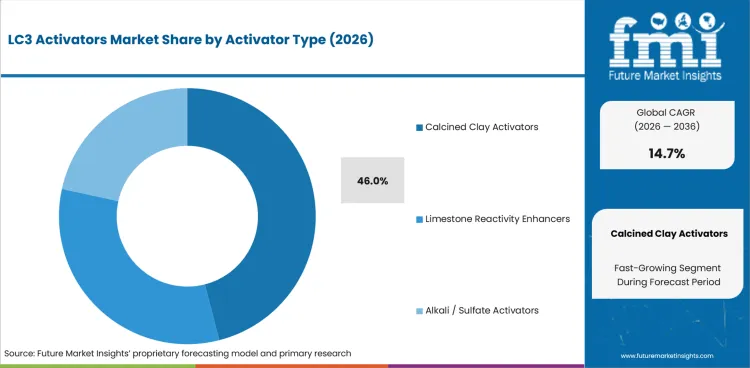
The LC3 activators industry value is forecast to grow from USD 270.8 million in 2025 and USD 310.6 million in 2026 to USD 1,224.2 million by 2036, reflecting a 14.7% CAGR from 2026 to 2036 as cement producers shift low-clinker binders from trials into plant use. Calcined Clay Activators are forecast to represent 46.0% share in 2026 because clay reactivity varies by quarry and calcination route. LC3 Cement is expected to secure 58.0% application share in 2026 as most dosing decisions start inside cement mills.
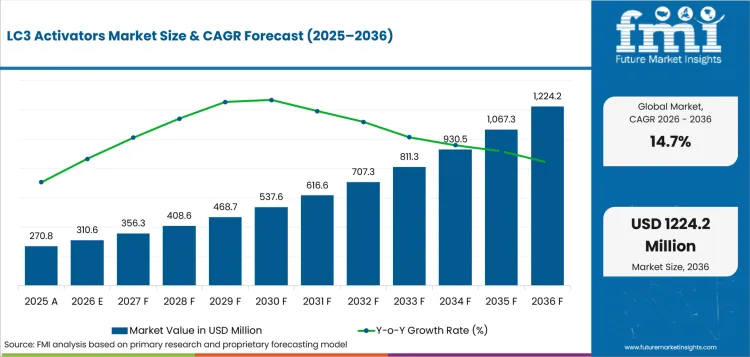
LC3 Activators Market Overview: Size and Forecast
- 2025 Market Size: USD 270.8 million
- 2026 Market Size: USD 310.6 million
- 2036 Market Size: USD 1,224.2 million
- Forecast CAGR: 14.7% from 2026 to 2036
- Leading Activator Type: Calcined Clay Activators
- Calcined Clay Activators Share in 2026: 46.0%
- Leading Application: LC3 Cement
- LC3 Cement Share in 2026: 58.0%
- Fastest-growing Country: India
- India Forecast CAGR: 17.2% from 2026 to 2036
Summary of the LC3 Activators Market
- Demand and Growth Drivers
- Clinker reduction is expected to raise activator demand because lower clinker factors change hydration and sulfate balance.
- Cement producers are using mill trials to compare early strength gain and water response before approving repeat orders.
- Ready-mix producers are expected to require compatible admixtures once LC3 cement moves into commercial concrete pours.
- Product and Segment View
- Calcined Clay Activators are projected to account for 46.0% share in 2026 due to direct use in clay reactivity control.
- LC3 Cement is forecast to represent 58.0% share in 2026 because activator dosing is usually specified during cement blending.
- Powder systems are expected to hold 72.0% share in 2026 as plants prefer dry dosing and storage stability.
- Geography and Competitive Outlook
- India is forecast to record 17.2% CAGR from 2026 to 2036 with cement output scale and decarbonisation policy pressure.
- China is projected to grow at 15.8% CAGR from 2026 to 2036 as large producers seek lower-clinker differentiation despite weaker property demand.
- Saint-Gobain Construction Chemicals, Sika, Mapei, Fuller Technologies, thyssenkrupp Polysius, Heidelberg Materials, and Holcim compete through chemistry and plant support.
- Analyst Opinion
- Anurag Sharma, Associate Vice President at FMI says, “LC3 activators are becoming a control point in cement decarbonisation. The product does not win only by lowering clinker. It wins when a cement plant keeps strength, setting time, workability, and color inside customer limits after binder chemistry changes. Suppliers with lab-to-plant support hold the advantage because each clay source behaves differently.”
Source verification strengthens the market case. The International Energy Agency states that direct cement CO2 intensity has been broadly flat and needs annual declines of about 4% through 2030 for a net-zero pathway. LC3 technology bodies state that limestone calcined clay cement can cut CO2 emissions by up to 40% compared with ordinary Portland cement. These verified facts support demand for activators that protect strength, setting time, workability, and color when clinker is reduced.
Which factors support expansion in the LC3 activators market?
Finished activator revenue is supported by technical trials, cement mill dosage control, and concrete acceptance tests.
- Activator sales create the first revenue layer, while linked concrete admixtures add value when producers need workability, setting, and strength support.
- Supplier pricing reflects dosage precision and clay screening before large cement mills approve repeat use.
- Direct technical selling turns laboratory binder trials into plant-level orders because cement producers need dosage guidance before routine mill adoption.
- Suppliers gain portfolio strength when activators connect with grinding aids and concrete admixtures, giving buyers fewer vendors to coordinate during LC3 trials.
Why is the LC3 activators market growing?
- Cement plants use LC3 activators to protect early strength when clinker replacement changes hydration and sulfate demand.
- Calcined clay deposits vary widely, which creates a need for reactivity tuning before full-scale production.
- Ready-mix buyers need slump retention and setting control as low-clinker cement changes fresh concrete behavior.
- Public and private low-carbon construction rules are making embodied-carbon proof part of cement selection.
- Direct technical sales expand because producers need laboratory trials before mill-scale dosing begins.
LC3 activator growth starts with a cement plant problem rather than a carbon label. Lower clinker changes water demand, early strength, and sulfate response in the binder. The green cement market is connected to this shift because lower-carbon binders must still pass field performance tests. Activators become the bridge between carbon targets and saleable cement quality.
Buyer behavior is changing as concrete specifications move toward lower embodied carbon without accepting weaker placement performance. Saint-Gobain Construction Chemicals stated in December 2024 that EnviroMix C-Clay was designed for concrete made with calcined clay cements and addresses water requirement challenges. This is relevant for the concrete admixture market because LC3 mixes often need adjusted admixture and activator packages.
How is the LC3 activators market segmented?
The LC3 activators industry is segmented by activator type, application, end use, form, and sales channel.
- Calcined Clay Activators are projected to account for 46.0% share in 2026 as producers need direct control of clay reactivity.
- LC3 Cement is expected to lead application demand with 58.0% share in 2026 through cement mill formulation use.
- Cement Producers are forecast to represent 54.0% end-use share in 2026 as dosing decisions remain near grinding operations.
- Powder systems are set to hold 72.0% form share in 2026 because plants prefer storage stability and dry feed compatibility.
- Direct sales are projected to account for 68.0% channel share in 2026 since activator approval usually needs trial batches.
Segmentation shows that LC3 activators behave like performance-critical formulation inputs rather than routine cement additives. Powder systems dominate because cement plants already handle dry mineral inputs and grinding aids. Liquid systems retain a role in ready-mix and precast settings. The blended cement market gives suppliers a wider specification path when low-clinker mixes move beyond pilot projects.
Why do Calcined Clay Activators dominate the LC3 activators market?
- Calcined Clay Activators are projected to account for 46.0% share in 2026 as the highest-value use case centers on reactivity after thermal treatment.
- Buyers compare activators through strength gain and water response tests because two clays with similar kaolin labels can behave differently.
Which application leads the LC3 activators market?
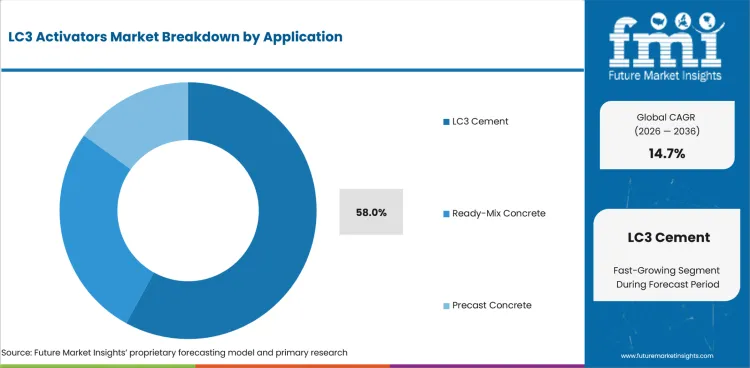
- LC3 Cement is expected to represent 58.0% share in 2026 because producers control clinker factor, gypsum dosage, and blend performance.
- Ready-mix users gain downstream benefits from cement compatibility after the core activator package is approved.
Which end use leads the LC3 activators market?
- Cement Producers are projected to hold 54.0% share in 2026 as they decide when activators enter mill output.
- Infrastructure contractors influence specifications through trial pours where setting control and durability remain central.
Which form leads the LC3 activators market?
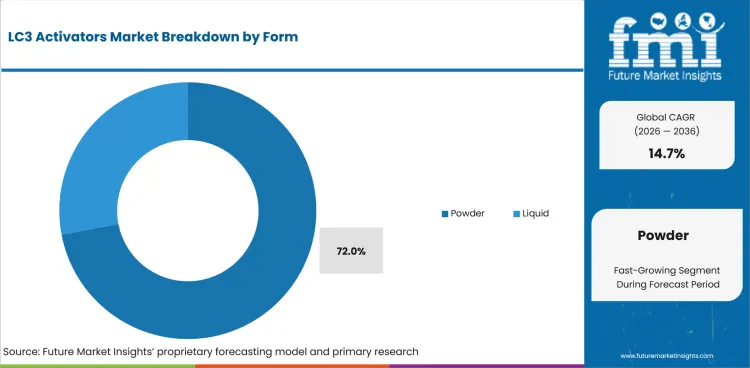
- Powder systems are projected to account for 72.0% share in 2026 because dry handling fits plant storage and dosing lines.
- Liquid activators retain use in precast yards and self-compacting concrete mixes where flow control is tested at batch level.
Which sales channel leads the LC3 activators market?
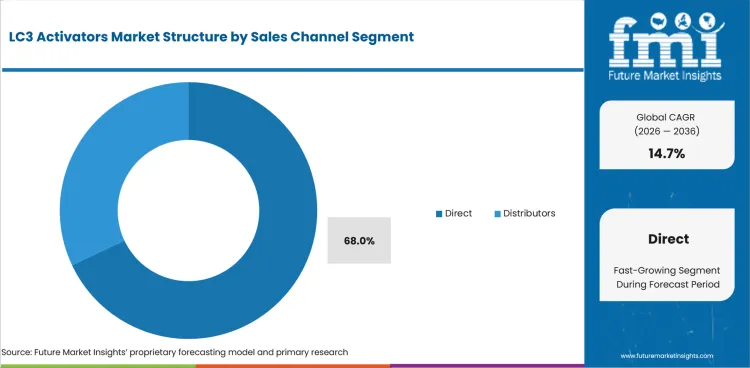
- Direct sales are expected to account for 68.0% share in 2026 as activator approval usually requires trial data.
- Distributors serve smaller buyers and repair-oriented channels where batch volumes are lower.
What are the drivers, restraints, and opportunities in the LC3 activators market?
Clinker reduction and clay variability support demand while field acceptance and specification risk limit faster rollout.
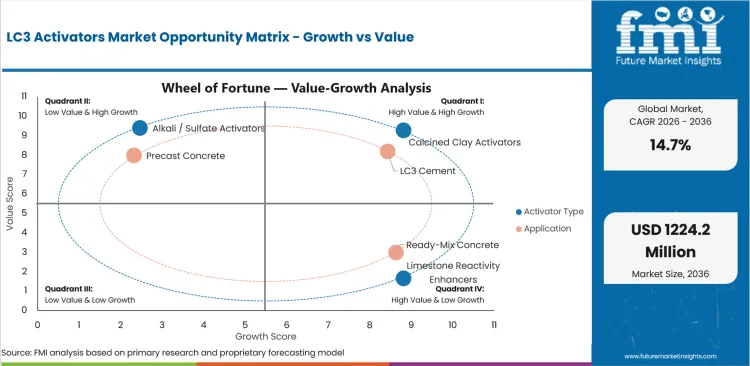
- Clinker-factor pressure raises activator demand because producers need lower-emission cement that still meets strength, setting, and workability requirements.
- Clay-source variation creates demand for activators because calcination temperature, mineralogy, and sulfate balance change how each LC3 blend behaves.
- Contractor hesitation slows adoption when setting, finishing, and early strength remain unproven on site, especially for schedule-sensitive pours.
- Public works with embodied-carbon scoring can widen LC3 cement use once suppliers document field performance, durability, and placement behavior.
- Suppliers can expand by pairing activators with waterproofing admixtures and shrinkage-control systems, especially where infrastructure buyers need low-carbon concrete with predictable durability.
LC3 Activators Market Demand Outlook
Demand outlook is moving toward low-clinker binder systems that can prove quality before broad specification approval. The International Energy Agency pressure pathway gives cement producers a clear emissions target. The green building materials market creates adjacent buyer demand because project owners increasingly ask for lower embodied-carbon material choices.
Concrete acceptance remains the practical test for LC3 activators. Saint-Gobain stated in December 2024 that calcined clay cements create technical challenges linked to water requirements. That confirms why activators must work with concrete admixtures and not only cement mill chemistry.
Consumer Segmentation and Purchase Behavior Analysis
Cement producers form the main buyer group because they approve clinker factor, gypsum dosage, and mill output. Concrete producers enter the purchase process once LC3 cement reaches commercial ready-mix trials. Infrastructure contractors influence final approval through field pours and project documentation.
Purchase behavior favors suppliers that can provide test data and plant support. Activators that connect with low-carbon concrete shrinkage-reduction additives can help buyers manage durability claims in low-clinker mixes.
Voice of Customer and Decision-driver Analysis
Buyers compare LC3 activators through early strength, set time, water demand, color control, and repeatability across clay sources. Price matters after a supplier proves performance at laboratory and plant scale. Direct sales remain important because buyers need data before using an activator across mill output. Project specifiers also look for compatible concrete systems. Activator suppliers that can connect binder chemistry with hydrophobic pore-blocking agents or durability admixtures can support stronger approval packages.
Which countries are growing fastest in the LC3 activators market?
India 17.2% CAGR, China 15.8% CAGR, Germany 15.0% CAGR, France 14.6% CAGR, United States 14.2% CAGR, United Kingdom 13.8% CAGR, South Korea 13.5% CAGR, and Japan 12.9% CAGR from 2026 to 2036.
.webp "Top Country Growth Comparison Lc3 Activators Market Cagr (2026 2036)")
| Country | CAGR |
| India | 17.2% |
| China | 15.8% |
| Germany | 15.0% |
| France | 14.6% |
| United States | 14.2% |
| United Kingdom | 13.8% |
| South Korea | 13.5% |
| Japan | 12.9% |
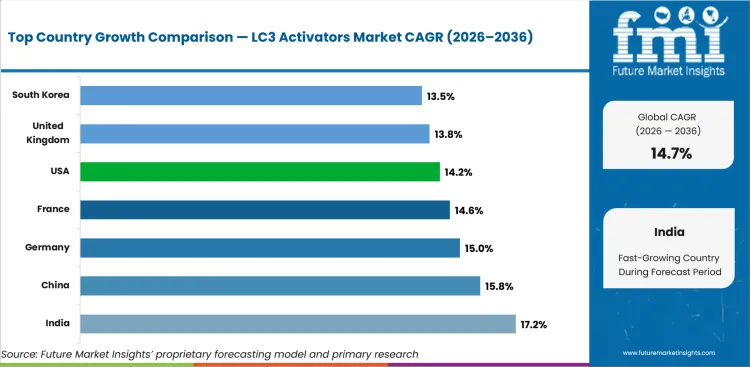
Source: Future Market Insights, 2026.
How do country-level CAGRs compare in the LC3 activators market?
India leads country growth while Japan records the most cautious expansion outlook among profiled markets.
- India is forecast to record 17.2% CAGR from 2026 to 2036 as cement output scale and decarbonisation policy converge.
- China is expected to expand at 15.8% CAGR from 2026 to 2036 due to large cement output and low-clinker differentiation.
- Germany is projected to grow at 15.0% CAGR from 2026 to 2036 as carbon costs and domestic technology trials support adoption.
- France is estimated to rise at 14.6% CAGR from 2026 to 2036 with calcined clay plant references and public works demand.
- The United States is forecast to post 14.2% CAGR from 2026 to 2036 due to cement volume scale and infrastructure specifications.
- The United Kingdom is projected to record 13.8% CAGR from 2026 to 2036 as CBAM rules sharpen interest in domestic low-carbon cement.
- South Korea is expected to grow at 13.5% CAGR from 2026 to 2036 as compact cement capacity favors precise activator qualification.
- Japan is forecast to advance at 12.9% CAGR from 2026 to 2036 as quality-sensitive producers move cautiously into new binder systems.
How fast is the LC3 activators market growing in India?
A 17.2% CAGR from 2026 to 2036 reflects cement decarbonisation pressure and country-specific plant qualification needs.
Country Market Snapshot Table
| Parameter | Value |
|---|---|
| Market Size in 2025 (Value) | USD 36.5 million |
| Market Size in 2026 (Value) | USD 42.8 million |
| Market Forecast in 2036 (Value) | USD 209.3 million |
| CAGR (2026 to 2036) | 17.2% |
| Years Considered | 2021 to 2036 |
| Base Year | 2025 |
| Forecast Period | 2026 to 2036 |
| Units Considered | Value (USD million) |
| Leading Sub-Region | Western and southern cement corridors |
India LC3 Activators Market Outlook
India activator demand is shaped by large cement output, decarbonisation roadmaps, and infrastructure-led cement use. The construction chemical industry in India gives additive suppliers a wider channel base once LC3 Cement reaches commercial projects.
India suppliers are expected to compete on clay testing, sulfate balance support, early strength data, and direct technical service. Repeat orders are likely where field crews can place LC3 concrete without schedule risk.
Key Growth Drivers
- India leads growth because PIB reported cement production is likely to reach about 2,100 million tonnes by 2070.
- Decarbonisation pressure supports LC3 activators because NITI Aayog reported cement intensity at 0.63 tCO2e per tonne in 2023.
- Large infrastructure programs are expected to make low-clinker cement trials commercially relevant for direct suppliers.
- Domestic construction chemical suppliers can support activators with admixture packages for ready-mix and precast users.
Key Restraints
- Busy cement plants may defer trials because the core industries index reported cement growth of 9.4% in April 2026.
- Regional clay quality varies across cement clusters and requires local testing before national rollouts.
- Contractor familiarity with ordinary cement can slow LC3 cement approval in schedule-sensitive projects.
What makes India unique
India is unique due to long-term cement demand growth and national decarbonisation pressure.
Key Companies
- UltraTech Cement
- Dalmia Bharat Cement
- Shree Cement
- JK Cement
- JK Lakshmi Cement
- Sika India
Sales & Marketing Channels
- Direct cement producer trials
- Infrastructure specification teams
- Ready-mix producers
- Construction chemical distributors
- Public project contractors
Country Segment Breakdown Table
| Segment | Sub-Segments |
|---|---|
| By Activator Type | Limestone Reactivity Enhancers · Calcined Clay Activators · Alkali / Sulfate Activators · Other |
| By Application | LC3 Cement · Ready-Mix Concrete · Precast Concrete · Other |
| By End Use | Cement Producers · Concrete Producers · Infrastructure Contractors |
| By Form | Powder · Liquid |
| By Sales Channel | Direct · Distributors |
| Key Sub-Regions Covered, Cement and construction material corridors | Gujarat · Rajasthan · Maharashtra · Tamil Nadu · Andhra Pradesh · Karnataka |
Frequently Asked Questions
How fast is India LC3 activators market growing?
Sales in India are forecast to grow at 17.2% CAGR from 2026 to 2036 due to country-specific cement decarbonisation needs.
Who leads India LC3 activators market?
UltraTech Cement, Dalmia Bharat Cement, and Shree Cement are relevant local producers or suppliers for LC3 activator qualification.
What is driving adoption in India LC3 activators market?
Adoption in India is driven by low-clinker cement trials, clay reactivity control, and demand for repeatable concrete performance.
How fast is the LC3 activators market growing in China?
A 15.8% CAGR from 2026 to 2036 reflects cement decarbonisation pressure and country-specific plant qualification needs.
Country Market Snapshot Table
| Parameter | Value |
|---|---|
| Market Size in 2025 (Value) | USD 52.8 million |
| Market Size in 2026 (Value) | USD 61.2 million |
| Market Forecast in 2036 (Value) | USD 265.4 million |
| CAGR (2026 to 2036) | 15.8% |
| Years Considered | 2021 to 2036 |
| Base Year | 2025 |
| Forecast Period | 2026 to 2036 |
| Units Considered | Value (USD million) |
| Leading Sub-Region | Yangtze River Delta and southern cement provinces |
China LC3 Activators Market Outlook
China demand is shaped by scale, provincial cement networks, and the need for differentiated products during weaker property demand. The geopolymer cement market gives producers another reference point for alternative binder positioning.
China suppliers are expected to compete on clay testing, sulfate balance support, early strength data, and direct technical service. Repeat orders are likely where field crews can place LC3 concrete without schedule risk.
Key Growth Drivers
- China offers large volume potential because NBS reported October 2025 cement output at 147.75 million tonnes.
- Infrastructure recovery supports selective trials because official data placed first-quarter 2026 fixed-asset investment at CNY 10.27 trillion.
- Large cement groups can qualify one activator package across many plants after clay and sulfate tests are completed.
- Low-clinker differentiation is expected to gain value as producers seek margins outside property-led demand.
Key Restraints
- Demand weakness can delay plant conversions because NBS reported 2025 fixed-asset investment declined 3.8% year on year.
- Property-sector weakness can lower regional cement plant utilization and reduce trial urgency.
- Provincial clay variation requires local testing before national procurement programs scale.
What makes China unique
China is unique due to the scale of cement output and the ability of large groups to qualify additives across plants.
Key Companies
- Anhui Conch Cement
- CNBM
- China Resources Cement
- Huaxin Cement
- Tangshan Jidong Cement
- Sika China
Sales & Marketing Channels
- Direct large-group procurement
- Provincial cement plants
- Infrastructure contractors
- Ready-mix networks
- Distributor support for regional producers
Country Segment Breakdown Table
| Segment | Sub-Segments |
|---|---|
| By Activator Type | Limestone Reactivity Enhancers · Calcined Clay Activators · Alkali / Sulfate Activators · Other |
| By Application | LC3 Cement · Ready-Mix Concrete · Precast Concrete · Other |
| By End Use | Cement Producers · Concrete Producers · Infrastructure Contractors |
| By Form | Powder · Liquid |
| By Sales Channel | Direct · Distributors |
| Key Sub-Regions Covered, Cement and construction material corridors | Yangtze River Delta · Guangdong · Shandong · Sichuan · Hebei · Hubei |
Frequently Asked Questions
How fast is China LC3 activators market growing?
Sales in China are forecast to grow at 15.8% CAGR from 2026 to 2036 due to country-specific cement decarbonisation needs.
Who leads China LC3 activators market?
Anhui Conch Cement, CNBM, and China Resources Cement are relevant local producers or suppliers for LC3 activator qualification.
What is driving adoption in China LC3 activators market?
Adoption in China is driven by low-clinker cement trials, clay reactivity control, and demand for repeatable concrete performance.
How fast is the LC3 activators market growing in Germany?
A 15.0% CAGR from 2026 to 2036 reflects cement decarbonisation pressure and country-specific plant qualification needs.
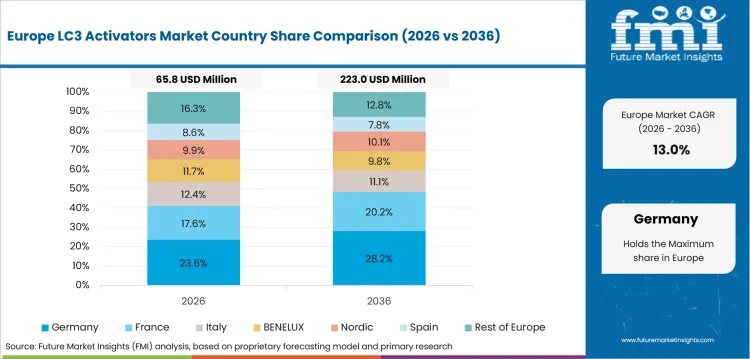
Country Market Snapshot Table
| Parameter | Value |
|---|---|
| Market Size in 2025 (Value) | USD 15.3 million |
| Market Size in 2026 (Value) | USD 17.6 million |
| Market Forecast in 2036 (Value) | USD 71.2 million |
| CAGR (2026 to 2036) | 15.0% |
| Years Considered | 2021 to 2036 |
| Base Year | 2025 |
| Forecast Period | 2026 to 2036 |
| Units Considered | Value (USD million) |
| Leading Sub-Region | North Rhine-Westphalia and southern cement clusters |
Germany LC3 Activators Market Outlook
Germany demand is shaped by EU carbon exposure and domestic activated clay technology projects. The construction chemicals market gives suppliers a channel for performance chemicals tied to low-clinker cement.
Germany suppliers are expected to compete on clay testing, sulfate balance support, early strength data, and direct technical service. Repeat orders are likely where field crews can place LC3 concrete without schedule risk.
Key Growth Drivers
- Germany demand is supported by housing approvals because Destatis recorded 238,063 permitted dwellings in 2025.
- Construction value supports plant trials because Destatis placed 2025 permitted building costs at EUR 113,815 million.
- The SCHWENK and thyssenkrupp Polysius activated clay project gives producers a domestic reference for clay activation.
- EU carbon cost exposure is expected to move more producers toward low-clinker blends with proven activator packages.
Key Restraints
- Housing weakness can restrict ready-mix trial volume because Destatis recorded 206,586 dwellings completed in 2025.
- Plant retrofit timing can delay adoption when producers prioritize energy and emissions compliance investments.
- Regional clay variability requires testing before the same activator package can be used across plants.
What makes Germany unique
Germany is unique due to EU carbon exposure and local clay activation technology references.
Key Companies
- Heidelberg Materials Germany
- SCHWENK Zement
- Dyckerhoff
- Spenner Zement
- Sika Deutschland
- MC-Bauchemie
Sales & Marketing Channels
- Direct cement producer programs
- Equipment-linked activation projects
- Ready-mix qualification labs
- Public works specifications
- Technical distributors
Country Segment Breakdown Table
| Segment | Sub-Segments |
|---|---|
| By Activator Type | Limestone Reactivity Enhancers · Calcined Clay Activators · Alkali / Sulfate Activators · Other |
| By Application | LC3 Cement · Ready-Mix Concrete · Precast Concrete · Other |
| By End Use | Cement Producers · Concrete Producers · Infrastructure Contractors |
| By Form | Powder · Liquid |
| By Sales Channel | Direct · Distributors |
| Key Sub-Regions Covered, Cement and construction material corridors | North Rhine-Westphalia · Bavaria · Baden-Württemberg · Lower Saxony · Saxony · Hesse |
Frequently Asked Questions
How fast is Germany LC3 activators market growing?
Sales in Germany are forecast to grow at 15.0% CAGR from 2026 to 2036 due to country-specific cement decarbonisation needs.
Who leads Germany LC3 activators market?
Heidelberg Materials Germany, SCHWENK Zement, and Dyckerhoff are relevant local producers or suppliers for LC3 activator qualification.
What is driving adoption in Germany LC3 activators market?
Adoption in Germany is driven by low-clinker cement trials, clay reactivity control, and demand for repeatable concrete performance.
How fast is the LC3 activators market growing in France?
A 14.6% CAGR from 2026 to 2036 reflects cement decarbonisation pressure and country-specific plant qualification needs.
Country Market Snapshot Table
| Parameter | Value |
|---|---|
| Market Size in 2025 (Value) | USD 13.0 million |
| Market Size in 2026 (Value) | USD 14.9 million |
| Market Forecast in 2036 (Value) | USD 58.2 million |
| CAGR (2026 to 2036) | 14.6% |
| Years Considered | 2021 to 2036 |
| Base Year | 2025 |
| Forecast Period | 2026 to 2036 |
| Units Considered | Value (USD million) |
| Leading Sub-Region | Northeast cement and public works corridors |
France LC3 Activators Market Outlook
France activator demand is shaped by cement plant qualification, construction specifications, and the need to keep low-clinker concrete performance stable.
France suppliers are expected to compete on clay testing, sulfate balance support, early strength data, and direct technical service. Repeat orders are likely where field crews can place LC3 concrete without schedule risk.
Key Growth Drivers
- France has a housing base for LC3 trials because SDES reported 384,539 authorized dwellings from May 2025 to April 2026.
- Non-residential work supports concrete demand because SDES reported 36.7 million square meters of authorized premises over the same period.
- Public works and prefabrication buyers are expected to support LC3 trials where durability records are documented.
- Local additive suppliers can connect calcined clay admixtures with direct cement producer qualification.
Key Restraints
- Construction weakness can slow activator orders because INSEE reported first-quarter 2026 construction output was 2.8% below 2025.
- Political uncertainty can defer public construction decisions and delay specification updates.
- Performance testing remains necessary because French producers must validate color and strength consistency across clay sources.
What makes France unique
France is unique due to an industrial calcined clay reference at Xeuilley and public works specification discipline.
Key Companies
- Vicat
- Eqiom
- Ciments Calcia
- Lafarge France
- Sika France
- CHRYSO France
Sales & Marketing Channels
- Cement producer trials
- Concrete admixture teams
- Public works contractors
- Precast producers
- Specialist distributors
Country Segment Breakdown Table
| Segment | Sub-Segments |
|---|---|
| By Activator Type | Limestone Reactivity Enhancers · Calcined Clay Activators · Alkali / Sulfate Activators · Other |
| By Application | LC3 Cement · Ready-Mix Concrete · Precast Concrete · Other |
| By End Use | Cement Producers · Concrete Producers · Infrastructure Contractors |
| By Form | Powder · Liquid |
| By Sales Channel | Direct · Distributors |
| Key Sub-Regions Covered, Cement and construction material corridors | Île-de-France · Grand Est · Auvergne-Rhône-Alpes · Hauts-de-France · Normandy · Occitanie |
Frequently Asked Questions
How fast is France LC3 activators market growing?
Sales in France are forecast to grow at 14.6% CAGR from 2026 to 2036 due to country-specific cement decarbonisation needs.
Who leads France LC3 activators market?
Vicat, Eqiom, and Ciments Calcia are relevant local producers or suppliers for LC3 activator qualification.
What is driving adoption in France LC3 activators market?
Adoption in France is driven by low-clinker cement trials, clay reactivity control, and demand for repeatable concrete performance.
How fast is the LC3 activators market growing in United States?
A 14.2% CAGR from 2026 to 2036 reflects cement decarbonisation pressure and country-specific plant qualification needs.
Country Market Snapshot Table
| Parameter | Value |
|---|---|
| Market Size in 2025 (Value) | USD 42.5 million |
| Market Size in 2026 (Value) | USD 48.5 million |
| Market Forecast in 2036 (Value) | USD 183.0 million |
| CAGR (2026 to 2036) | 14.2% |
| Years Considered | 2021 to 2036 |
| Base Year | 2025 |
| Forecast Period | 2026 to 2036 |
| Units Considered | Value (USD million) |
| Leading Sub-Region | Texas and Gulf Coast cement corridors |
United States LC3 Activators Market Outlook
United States demand is shaped by cement volume scale and infrastructure specification discipline. The fiber cement market creates an adjacent low-carbon building material conversation that supports broader binder reformulation work.
United States suppliers are expected to compete on clay testing, sulfate balance support, early strength data, and direct technical service. Repeat orders are likely where field crews can place LC3 concrete without schedule risk.
Key Growth Drivers
- The United States has a large activator base because USGS estimated 2025 cement shipments at 100 million tons.
- Public infrastructure specifications support LC3 trials because Census reported public construction spending at USD 532.7 billion in April 2026.
- Type IL cement experience gives producers a practical bridge toward LC3 Cement qualification in cement mills.
- Direct supplier trials are expected to expand around Texas, California, and Florida cement corridors.
Key Restraints
- Input-price pressure can slow field trials because BLS reported final demand producer prices rose 1.1% in May 2026.
- Ready imported cement can reduce urgency for domestic activator investment in some coastal markets.
- Contractor finishing expectations can slow approval when low-clinker concrete changes set time.
What makes United States unique
The United States is unique due to cement volume scale and specification-led infrastructure buying.
Key Companies
- Buzzi Unicem USA
- Ash Grove Cement
- CalPortland Company
- Titan America
- CEMEX USA
- Holcim US
Sales & Marketing Channels
- Direct technical sales
- Cement plant trials
- Ready-mix producer qualification
- Infrastructure specification teams
- Regional distributors
Country Segment Breakdown Table
| Segment | Sub-Segments |
|---|---|
| By Activator Type | Limestone Reactivity Enhancers · Calcined Clay Activators · Alkali / Sulfate Activators · Other |
| By Application | LC3 Cement · Ready-Mix Concrete · Precast Concrete · Other |
| By End Use | Cement Producers · Concrete Producers · Infrastructure Contractors |
| By Form | Powder · Liquid |
| By Sales Channel | Direct · Distributors |
| Key Sub-Regions Covered, Cement and construction material corridors | Texas · California · Florida · Midwest cement corridor · Gulf Coast · Northeast infrastructure corridor |
Frequently Asked Questions
How fast is United States LC3 activators market growing?
Sales in United States are forecast to grow at 14.2% CAGR from 2026 to 2036 due to country-specific cement decarbonisation needs.
Who leads United States LC3 activators market?
Buzzi Unicem USA, Ash Grove Cement, and CalPortland Company are relevant local producers or suppliers for LC3 activator qualification.
What is driving adoption in United States LC3 activators market?
Adoption in United States is driven by low-clinker cement trials, clay reactivity control, and demand for repeatable concrete performance.
How fast is the LC3 activators market growing in United Kingdom?
A 13.8% CAGR from 2026 to 2036 reflects cement decarbonisation pressure and country-specific plant qualification needs.
Country Market Snapshot Table
| Parameter | Value |
|---|---|
| Market Size in 2025 (Value) | USD 11.2 million |
| Market Size in 2026 (Value) | USD 12.8 million |
| Market Forecast in 2036 (Value) | USD 46.6 million |
| CAGR (2026 to 2036) | 13.8% |
| Years Considered | 2021 to 2036 |
| Base Year | 2025 |
| Forecast Period | 2026 to 2036 |
| Units Considered | Value (USD million) |
| Leading Sub-Region | England infrastructure and Midlands cement corridor |
United Kingdom LC3 Activators Market Outlook
United Kingdom activator demand is shaped by cement plant qualification, construction specifications, and the need to keep low-clinker concrete performance stable.
United Kingdom suppliers are expected to compete on clay testing, sulfate balance support, early strength data, and direct technical service. Repeat orders are likely where field crews can place LC3 concrete without schedule risk.
Key Growth Drivers
- United Kingdom demand is supported by domestic cement vulnerability because GOV.UK reported cement production at 7.3 million tonnes in 2024.
- Construction recovery supports trial planning because ONS estimated output grew by 1.6% in the three months to April 2026.
- Carbon pricing risk supports low-clinker cement because the UK CBAM is scheduled to apply from 1 January 2027.
- Ready-mix producers can use LC3 activators when supplier trials protect slump retention and setting behavior.
Key Restraints
- Financing costs can defer qualification because the Bank of England maintained Bank Rate at 3.75% in June 2026.
- High energy and regulatory costs can reduce budgets for new binder qualification programs.
- Project approval delays can slow commercial LC3 placement outside major infrastructure work.
What makes United Kingdom unique
The United Kingdom is unique due to domestic production pressure and incoming CBAM rules.
Key Companies
- Breedon Group
- Aggregate Industries UK
- Tarmac
- CEMEX UK
- Heidelberg Materials UK
- Sika UK
Sales & Marketing Channels
- Direct plant trials
- Ready-mix specification teams
- Infrastructure contractors
- Specialist additive distributors
- Public procurement frameworks
Country Segment Breakdown Table
| Segment | Sub-Segments |
|---|---|
| By Activator Type | Limestone Reactivity Enhancers · Calcined Clay Activators · Alkali / Sulfate Activators · Other |
| By Application | LC3 Cement · Ready-Mix Concrete · Precast Concrete · Other |
| By End Use | Cement Producers · Concrete Producers · Infrastructure Contractors |
| By Form | Powder · Liquid |
| By Sales Channel | Direct · Distributors |
| Key Sub-Regions Covered, Cement and construction material corridors | England · Midlands · Wales · Scotland · London infrastructure corridor · Northern cement corridor |
Frequently Asked Questions
How fast is United Kingdom LC3 activators market growing?
Sales in United Kingdom are forecast to grow at 13.8% CAGR from 2026 to 2036 due to country-specific cement decarbonisation needs.
Who leads United Kingdom LC3 activators market?
Breedon Group, Aggregate Industries UK, and Tarmac are relevant local producers or suppliers for LC3 activator qualification.
What is driving adoption in United Kingdom LC3 activators market?
Adoption in United Kingdom is driven by low-clinker cement trials, clay reactivity control, and demand for repeatable concrete performance.
How fast is the LC3 activators market growing in South Korea?
A 13.5% CAGR from 2026 to 2036 reflects cement decarbonisation pressure and country-specific plant qualification needs.
Country Market Snapshot Table
| Parameter | Value |
|---|---|
| Market Size in 2025 (Value) | USD 8.1 million |
| Market Size in 2026 (Value) | USD 9.2 million |
| Market Forecast in 2036 (Value) | USD 32.6 million |
| CAGR (2026 to 2036) | 13.5% |
| Years Considered | 2021 to 2036 |
| Base Year | 2025 |
| Forecast Period | 2026 to 2036 |
| Units Considered | Value (USD million) |
| Leading Sub-Region | Gangwon and coastal cement corridors |
South Korea LC3 Activators Market Outlook
South Korea activator demand is shaped by cement plant qualification, construction specifications, and the need to keep low-clinker concrete performance stable.
South Korea suppliers are expected to compete on clay testing, sulfate balance support, early strength data, and direct technical service. Repeat orders are likely where field crews can place LC3 concrete without schedule risk.
Key Growth Drivers
- South Korea has a concentrated cement base because KCA reported cement production at 44.186 million tonnes in 2025.
- Centralized production supports trial discipline because WCA states KCA members operate 11 kiln plants.
- Powder activators can fit Korean grinding networks where silos and dry dosage lines already support blend control.
- Export-focused producers may test LC3 activators to support lower-carbon cement marketing in regional markets.
Key Restraints
- Domestic demand pressure can reduce trial budgets because KDI projected construction investment growth of 0.1% in 2026.
- Limited plant count can slow supplier entry because each technical approval must justify direct support costs.
- High quality expectations can lengthen mix validation before new activator packages enter commercial cement.
What makes South Korea unique
South Korea is unique due to concentrated cement production and a dense grinding station network.
Key Companies
- Sampyo Cement
- Ssangyong C&E
- Hanil Cement
- Asia Cement
- Sungshin Cement
- Halla Cement
Sales & Marketing Channels
- Direct cement producer qualification
- Grinding station dosing programs
- Export-oriented cement sales
- Ready-mix laboratories
- Regional distributors
Country Segment Breakdown Table
| Segment | Sub-Segments |
|---|---|
| By Activator Type | Limestone Reactivity Enhancers · Calcined Clay Activators · Alkali / Sulfate Activators · Other |
| By Application | LC3 Cement · Ready-Mix Concrete · Precast Concrete · Other |
| By End Use | Cement Producers · Concrete Producers · Infrastructure Contractors |
| By Form | Powder · Liquid |
| By Sales Channel | Direct · Distributors |
| Key Sub-Regions Covered, Cement and construction material corridors | Gangwon · Chungcheong · Gyeonggi · Busan-Ulsan corridor · Seoul capital region · Jeolla |
Frequently Asked Questions
How fast is South Korea LC3 activators market growing?
Sales in South Korea are forecast to grow at 13.5% CAGR from 2026 to 2036 due to country-specific cement decarbonisation needs.
Who leads South Korea LC3 activators market?
Sampyo Cement, Ssangyong C&E, and Hanil Cement are relevant local producers or suppliers for LC3 activator qualification.
What is driving adoption in South Korea LC3 activators market?
Adoption in South Korea is driven by low-clinker cement trials, clay reactivity control, and demand for repeatable concrete performance.
How fast is the LC3 activators market growing in Japan?
A 12.9% CAGR from 2026 to 2036 reflects cement decarbonisation pressure and country-specific plant qualification needs.
Country Market Snapshot Table
| Parameter | Value |
|---|---|
| Market Size in 2025 (Value) | USD 9.3 million |
| Market Size in 2026 (Value) | USD 10.5 million |
| Market Forecast in 2036 (Value) | USD 35.3 million |
| CAGR (2026 to 2036) | 12.9% |
| Years Considered | 2021 to 2036 |
| Base Year | 2025 |
| Forecast Period | 2026 to 2036 |
| Units Considered | Value (USD million) |
| Leading Sub-Region | Kyushu, Yamaguchi, and Kanto cement corridors |
Japan LC3 Activators Market Outlook
Japan activator demand is shaped by cement plant qualification, construction specifications, and the need to keep low-clinker concrete performance stable.
Japan suppliers are expected to compete on clay testing, sulfate balance support, early strength data, and direct technical service. Repeat orders are likely where field crews can place LC3 concrete without schedule risk.
Key Growth Drivers
- Japan has a compact cement base because the Japan Cement Association reported 26 plants in July 2025.
- Public works spending supports cement testing because Japan budgeted JPY 6,085.8 billion for public works projects in FY2025.
- High-quality producer laboratories are expected to support cautious LC3 activator qualification before field use.
- Limestone-blended cement standardization work can make LC3-related activator testing easier for producers.
Key Restraints
- Borrowing caution can slow new trials because the Bank of Japan maintained the call-rate guideline around 0.5% in June 2025.
- Strict customer tolerance can lengthen qualification when color and setting behavior change from standard cement.
- Clay logistics can restrict near-term use where suitable deposits are far from cement plants.
What makes Japan unique
Japan is unique due to compact cement capacity and strict quality qualification habits.
Key Companies
- Taiheiyo Cement
- Ube Mitsubishi Cement
- Sumitomo Osaka Cement
- Denka Company
- Nippon Steel Cement
- Sika Japan
Sales & Marketing Channels
- Direct producer laboratories
- Cement association specifications
- Ready-mix qualification teams
- Infrastructure contractors
- Technical distributors
Country Segment Breakdown Table
| Segment | Sub-Segments |
|---|---|
| By Activator Type | Limestone Reactivity Enhancers · Calcined Clay Activators · Alkali / Sulfate Activators · Other |
| By Application | LC3 Cement · Ready-Mix Concrete · Precast Concrete · Other |
| By End Use | Cement Producers · Concrete Producers · Infrastructure Contractors |
| By Form | Powder · Liquid |
| By Sales Channel | Direct · Distributors |
| Key Sub-Regions Covered, Cement and construction material corridors | Kyushu · Yamaguchi · Kanto · Chubu · Kansai · Hokkaido |
Frequently Asked Questions
How fast is Japan LC3 activators market growing?
Sales in Japan are forecast to grow at 12.9% CAGR from 2026 to 2036 due to country-specific cement decarbonisation needs.
Who leads Japan LC3 activators market?
Taiheiyo Cement, Ube Mitsubishi Cement, and Sumitomo Osaka Cement are relevant local producers or suppliers for LC3 activator qualification.
What is driving adoption in Japan LC3 activators market?
Adoption in Japan is driven by low-clinker cement trials, clay reactivity control, and demand for repeatable concrete performance.
How competitive is the LC3 activators market?
The LC3 activators market includes construction chemical producers, cement additive suppliers, cement producers, and clay activation equipment providers. Competition is based on dosage support, clay screening, strength gain, water demand management, and mill-scale trial service.
Saint-Gobain Construction Chemicals and Sika are positioned through admixture portfolios that address calcined clay water demand. Mapei competes through cement additives and SCM-focused admixtures. Fuller Technologies and thyssenkrupp Polysius support process-side activation and clay calcination projects. Heidelberg Materials and Holcim add cement producer knowledge that can guide internal qualification and downstream specification work.
Who are the key players in the LC3 activators market?
Saint-Gobain Construction Chemicals, Sika, Mapei, Fuller Technologies, thyssenkrupp Polysius, Heidelberg Materials, and Holcim are among the main companies shaping LC3 activator qualification.
Key companies in the LC3 activators market include:
- Saint-Gobain Construction Chemicals
- Sika AG
- Mapei S.p.A.
- Fuller Technologies
- thyssenkrupp Polysius
- Heidelberg Materials
- Holcim
- CHRYSO
- Cemex Admixtures
- BASF Construction Additives legacy portfolios
| Company | Relevance to Market Title | Activator / Admixture Fit | Cement Plant Qualification Support | Calcined Clay / SCM Evidence | Geographic Footprint | Positioning |
|---|---|---|---|---|---|---|
| Saint-Gobain Construction Chemicals | Very High | Very Strong | Strong | Very Strong | Global | Calcined clay concrete admixture specialist |
| Sika AG | High | Strong | Strong | Moderate | Global | Construction chemicals and cement additive supplier |
| Mapei S.p.A. | High | Strong | Strong | Moderate | Global | Cement additives and concrete admixture supplier |
| thyssenkrupp Polysius | Very High | Moderate | Very Strong | Very Strong | Global | Clay activation and cement process technology provider |
| Fuller Technologies | Very High | Moderate | Very Strong | Very Strong | Global | Flash calcination and clay processing technology provider |
| Heidelberg Materials | High | Moderate | Very Strong | Very Strong | Global | Cement producer with industrial calcined clay scale |
| Holcim | High | Moderate | Strong | Strong | Global | Low-carbon cement and concrete portfolio owner |
| CHRYSO | Very High | Very Strong | Strong | Very Strong | Global | Calcined clay admixture brand under Saint-Gobain |
| Cemex Admixtures | Moderate to High | Strong | Moderate | Moderate | Americas and Europe | Concrete admixture supplier for low-clinker mixes |
| Master Builders Solutions | Moderate to High | Strong | Moderate | Moderate | Global | Construction chemical supplier with cement and concrete admixture depth |
Source: Future Market Insights competitive analysis, 2026. Ratings reflect relative positioning based on LC3 activator fit, calcined clay support, cement plant qualification depth and concrete admixture relevance.
Key Developments in LC3 Activators Market
- In August 2024, Saint-Gobain Construction Chemicals introduced EnviroMix C-Clay, a range of admixtures designed for concrete made with calcined clay-based cements.
- In February 2024, SCHWENK Zement commissioned thyssenkrupp Polysius to build an activated clay demonstration plant without calcination.
- In May 2025, Heidelberg Materials and CBI Ghana started production at a calcined clay plant with more than 400,000 tonnes per year capacity.
LC3 Activators Market - Report Scope
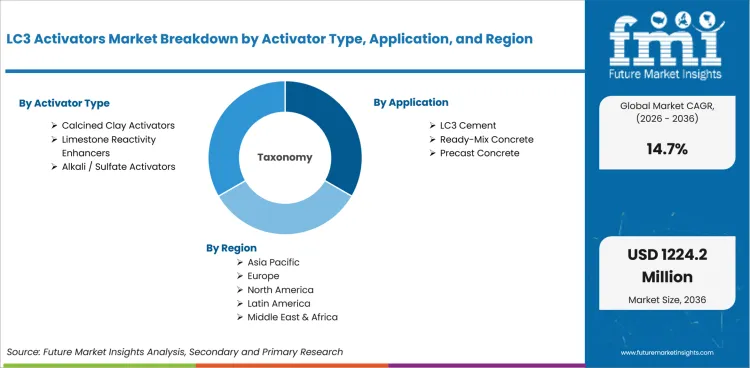
| Parameter | Details |
|---|---|
| Forecast period | 2026 to 2036 |
| Historical period | 2021 to 2025 |
| Quantitative unit | Revenue in USD million |
| By activator type | Limestone reactivity enhancers, calcined clay activators, alkali / sulfate activators, other |
| By application | LC3 cement, ready-mix concrete, precast concrete, other |
| By end use | Cement producers, concrete producers, infrastructure contractors |
| By form | Powder, liquid |
| By sales channel | Direct, distributors |
| Regions covered | North America, Latin America, Europe, East Asia, South Asia and Pacific, Middle East and Africa |
| Countries covered | United States, United Kingdom, Germany, France, Japan, China, South Korea, India |
| Key companies profiled | Saint-Gobain Construction Chemicals, Sika, Mapei, Fuller Technologies, thyssenkrupp Polysius, Heidelberg Materials, Holcim, CHRYSO |
| Approach | Bottom-up activator-boundary approach using eligible additive revenue, cement plant trial activity, dosage assumptions, pricing, and country-level cement demand |
Source: Future Market Insights, 2026.
LC3 Activators Market - Scope & Definition
| Attribute | Detail |
|---|---|
| Market Definition | Chemical and mineral additive systems used to improve limestone calcined clay cement performance by supporting clay reactivity, sulfate balance, setting behavior, strength gain, and workability retention |
| Functions Covered | Clay reactivity tuning, limestone nucleation support, sulfate balance, set control, early strength gain, water-demand management, and color consistency support |
| Applications Covered | LC3 cement, ready-mix concrete, precast concrete, infrastructure concrete, and selected low-clinker cement formulations |
| End-Use Industries | Cement manufacturing, ready-mix concrete production, precast concrete, infrastructure construction, and construction chemicals |
| Grades Covered | Powder activators, liquid activators, limestone reactivity enhancers, calcined clay activators, and alkali / sulfate activators |
| Inclusions | Commercial LC3-specific activators sold across activator type, application, end use, form, sales channel, region, and country markets |
| Exclusions | Ordinary Portland cement, clinker, raw limestone, untreated clay, fly ash sold as bulk SCM, slag powder, aggregates, carbon capture systems, and general admixtures without LC3-specific claims |
LC3 Activators Market - Research Methodology
| Method | Description |
|---|---|
| Primary Research | FMI analyst interviews with cement producers, additive formulators, SCM processors, ready-mix operators, infrastructure specifiers, and construction chemical distributors across key markets |
| Desk Research | Review of official cement output data, construction statistics, decarbonisation reports, company disclosures, technology releases, and standards references related to LC3 and calcined clay cement |
| Market Sizing & Forecasting | Bottom-up activator-boundary model using cement plant conversion rates, low-clinker binder penetration, dosage assumptions, powder versus liquid pricing, and country-level cement demand |
| Data Validation | Cross-verification using public cement production, construction demand indicators, calcined clay project activity, company portfolios, and primary feedback on trial-to-commercial conversion |
LC3 Activators Market Breakdown by Activator Type, Application, End Use, Form, Sales Channel, and Region
LC3 Activators Market Segmented by Activator Type
- Limestone Reactivity Enhancers
- Calcined Clay Activators
- Alkali / Sulfate Activators
- Other
LC3 Activators Market Segmented by Application
- LC3 Cement
- Ready-Mix Concrete
- Precast Concrete
- Other
LC3 Activators Market Segmented by End Use
- Cement Producers
- Concrete Producers
- Infrastructure Contractors
LC3 Activators Market Segmented by Form
- Powder
- Liquid
LC3 Activators Market Segmented by Sales Channel
- Direct
- Distributors
LC3 Activators Market by Region
- North America
- Latin America
- Europe
- East Asia
- South Asia and Pacific
- Middle East and Africa
Research Sources and Bibliography
- International Energy Agency. (2023, July). Cement. IEA.
- USA Geological Survey. (2026, February). Mineral commodity summaries 2026: Cement.
- USA Census Bureau. (2026, June 1). Monthly construction spending, April 2026.
- USA Bureau of Labor Statistics. (2026, June 11). Producer price indexes - May 2026.
- Department for Business and Trade. (2026, May 6). Construction building materials: Commentary April 2026. GOV.UK.
- Office for National Statistics. (2026, June 12). Construction output in Great Britain: April 2026.
- HM Treasury. (2025, November 26). Carbon border adjustment mechanism. GOV.UK.
- Bank of England. (2026, June 18). Interest rates and Bank Rate: Our latest decision.
- Destatis. (2026, May 22). Construction work completed in Germany.
- Destatis. (2026, May). Building permits for building construction in Germany.
- Service des données et études statistiques. (2026, June 1). Construction de logements: Résultats à fin avril 2026.
- Service des données et études statistiques. (2026, June 1). Construction de locaux: Résultats à fin avril 2026.
- Institut national de la statistique et des études économiques. (2026, May 6). In March 2026, manufacturing output increased by +1.2%.
- Japan Cement Association. (2025, July). Cement industry in Japan.
- Ministry of Finance Japan. (2025, July). Japanese public finance fact sheet.
- Bank of Japan. (2025, June 17). Statement on monetary policy.
- National Bureau of Statistics of China. (2025, November 17). Industrial production operation in October 2025. https://www.stats.gov.cn/english/PressRelease/202511/t20251117_1961875.html
- State Council of the People's Republic of China. (2026, April 16). China's fixed-asset investment up 1.7 percent in Q1.
- National Bureau of Statistics of China. (2026, January 20). Investment in fixed assets in 2025.
- Korea Cement Association. (2025, December). 2025 Cement in Korea.
- World Cement Association. (2025, August). Korea Cement Association.
- Korea Development Institute. (2026, May). KDI economic outlook 2026-1st half.
- Press Information Bureau. (2026, January 20). NITI Aayog releases three reports on green transition.
- NITI Aayog. (2026, January). Roadmap for cement sector decarbonisation.
- Office of the Economic Adviser. (2026, May 20). Index of eight core industries, April 2026.
- Saint-Gobain. (2024, December). CHRYSO launches EnviroMix C-Clay.
- thyssenkrupp Polysius. (2024, February). SCHWENK Zement commissions thyssenkrupp Polysius to build a demonstration plant.
- Heidelberg Materials. (2025, May 16). World's largest calcined clay plant in Ghana starts production.
- Holcim. (2025, February). Full-year 2024 results.
This Report Answers
- What is the LC3 activators market size in 2026 and 2036?
- Which activator type leads the market?
- Which application creates the largest demand pool?
- Which countries are growing fastest through 2036?
- Which companies and developments shape competitive positioning?
Frequently Asked Questions
How large is the LC3 Activators Market expected to be in the near term?
The market is expanding as limestone calcined clay cement moves from pilot trials into routine cement plant production.
What is the long term outlook for the LC3 Activators Market?
The outlook remains strong as low clinker cement systems gain wider commercial acceptance under decarbonisation pressure.
How fast is the LC3 Activators Market expected to grow?
Growth is driven by clinker reduction targets, commercial cement mill qualification, and wider use of calcined clay binders.
What is the main driver of LC3 activators demand?
Demand is driven by cement producers needing to preserve strength, setting behavior, and workability while lowering clinker content.
Which activator type leads the LC3 activators market?
Calcined Clay Activators lead with 46.0% share in 2026.
Which application leads the LC3 activators market?
LC3 Cement leads with 58.0% share in 2026.
Which countries are key markets for LC3 activators?
India, China, Germany, France, the United States, the United Kingdom, South Korea, and Japan are key markets.
What supports India’s leading growth momentum?
Large cement capacity, infrastructure demand, and national decarbonisation roadmaps support rapid LC3 activator adoption.
Why is China an important market?
Large cement output and the ability to qualify activators across multiple plants support scalable adoption.
What makes Germany a relevant market?
Carbon cost exposure and domestic calcined clay technology projects support structured activator qualification.
Preview the report firsthand - request a free sample
Get SampleGet the brochure for pricing and purchase details.
Get PDFTable of Content
- Key Takeaways
- Market Size and CAGR
- Top Growth Driver
- Fastest Growing Segment
- Leading Region
- Key Companies
- Emerging Opportunities
- Executive Summary
- Global Market Outlook
- Demand-side Trends
- Supply-side Trends
- Technology Roadmap Analysis
- Analysis and Recommendations
- Analyst Perspective (What is happening? Why now? What should investors know?)
- Key Questions Answered
- How large is the market?
- What is the CAGR?
- What are key trends?
- Which region dominates?
- Who are the leaders?
- Market Overview
- Market Coverage / Taxonomy
- Market Definition / Scope / Limitations
- Research Methodology
- Chapter Orientation
- Analytical Lens and Working Hypotheses
- Market Structure, Signals, and Trend Drivers
- Benchmarking and Cross-market Comparability
- Market Sizing, Forecasting, and Opportunity Mapping
- Research Design and Evidence Framework
- Desk Research Programme (Secondary Evidence)
- Expert Input and Fieldwork (Primary Evidence)
- Tooling, Models, and Reference Databases
- Data Engineering and Model Build
- Quality Assurance and Audit Trail
- Market Background
- Market Dynamics (Drivers, Restraints, Opportunity, Trends)
- Scenario Forecast (Optimistic, Likely, Conservative)
- Impact Analysis
- AI Impact
- Sustainability Impact
- Regulatory Impact
- Technology Impact
- Consumer / Buyer Analysis
- Purchase Drivers
- Adoption Barriers
- Buyer Journey
- Opportunity Map Analysis
- Product Life Cycle Analysis
- Supply Chain Analysis
- Investment Feasibility Matrix
- Value Chain Analysis
- PESTLE and Porter's Analysis
- Regulatory Landscape
- Regional Parent Market Outlook
- Production and Consumption Statistics
- Import and Export Statistics
- Global Market Analysis and Forecast, 2021 to 2036
- Historical Market Size Value (USD Million) & Volume (Unit) Analysis, 2021 to 2025
- Current and Future Market Size Value (USD Million) & Volume (Unit) Projections, 2026 to 2036
- Y-o-Y Growth Trend Analysis
- Absolute $ Opportunity Analysis
- Global Market Pricing Analysis, 2021 to 2036
- Global Market Analysis and Forecast, By Activator Type, 2021 to 2036
- Introduction / Key Findings
- Historical Market Size Value (USD Million) & Volume (Unit) Analysis By Activator Type, 2021 to 2025
- Current and Future Market Size Value (USD Million) & Volume (Unit) Analysis and Forecast By Activator Type, 2026 to 2036
- Calcined Clay Activators
- Limestone Reactivity Enhancers
- Alkali / Sulfate Activators
- Other
- Calcined Clay Activators
- Y-o-Y Growth Trend Analysis By Activator Type, 2021 to 2025
- Absolute $ Opportunity Analysis By Activator Type, 2026 to 2036
- Global Market Analysis and Forecast, By Application, 2021 to 2036
- Introduction / Key Findings
- Historical Market Size Value (USD Million) & Volume (Unit) Analysis By Application, 2021 to 2025
- Current and Future Market Size Value (USD Million) & Volume (Unit) Analysis and Forecast By Application, 2026 to 2036
- LC3 Cement
- Ready-Mix Concrete
- Precast Concrete
- Other
- LC3 Cement
- Y-o-Y Growth Trend Analysis By Application, 2021 to 2025
- Absolute $ Opportunity Analysis By Application, 2026 to 2036
- Global Market Analysis and Forecast, By End Use, 2021 to 2036
- Introduction / Key Findings
- Historical Market Size Value (USD Million) & Volume (Unit) Analysis By End Use, 2021 to 2025
- Current and Future Market Size Value (USD Million) & Volume (Unit) Analysis and Forecast By End Use, 2026 to 2036
- Cement Producers
- Concrete Producers
- Infrastructure Contractors
- Cement Producers
- Y-o-Y Growth Trend Analysis By End Use, 2021 to 2025
- Absolute $ Opportunity Analysis By End Use, 2026 to 2036
- Global Market Analysis and Forecast, By Form, 2021 to 2036
- Introduction / Key Findings
- Historical Market Size Value (USD Million) & Volume (Unit) Analysis By Form, 2021 to 2025
- Current and Future Market Size Value (USD Million) & Volume (Unit) Analysis and Forecast By Form, 2026 to 2036
- Powder
- Liquid
- Powder
- Y-o-Y Growth Trend Analysis By Form, 2021 to 2025
- Absolute $ Opportunity Analysis By Form, 2026 to 2036
- Global Market Analysis and Forecast, By Sales Channel, 2021 to 2036
- Introduction / Key Findings
- Historical Market Size Value (USD Million) & Volume (Unit) Analysis By Sales Channel, 2021 to 2025
- Current and Future Market Size Value (USD Million) & Volume (Unit) Analysis and Forecast By Sales Channel, 2026 to 2036
- Direct
- Distributors
- Direct
- Y-o-Y Growth Trend Analysis By Sales Channel, 2021 to 2025
- Absolute $ Opportunity Analysis By Sales Channel, 2026 to 2036
- Global Market Analysis and Forecast, By Region, 2021 to 2036
- Introduction
- Historical Market Size Value (USD Million) & Volume (Unit) Analysis By Region, 2021 to 2025
- Current Market Size Value (USD Million) & Volume (Unit) Analysis and Forecast By Region, 2026 to 2036
- North America
- Latin America
- Western Europe
- Eastern Europe
- East Asia
- South Asia and Pacific
- Middle East & Africa
- Market Attractiveness Analysis By Region
- North America Market Analysis and Forecast, By Country, 2021 to 2036
- Historical Market Size Value (USD Million) & Volume (Unit) Trend Analysis By Market Taxonomy, 2021 to 2025
- Market Size Value (USD Million) & Volume (Unit) Forecast By Market Taxonomy, 2026 to 2036
- By Country
- USA
- Canada
- Mexico
- By Activator Type
- By Application
- By End Use
- By Form
- By Sales Channel
- By Country
- Market Attractiveness Analysis
- By Country
- By Activator Type
- By Application
- By End Use
- By Form
- By Sales Channel
- Key Takeaways
- Latin America Market Analysis and Forecast, By Country
- Historical Market Size Value (USD Million) & Volume (Unit) Trend Analysis By Market Taxonomy, 2021 to 2025
- Market Size Value (USD Million) & Volume (Unit) Forecast By Market Taxonomy, 2026 to 2036
- By Country
- Brazil
- Chile
- Rest of Latin America
- By Activator Type
- By Application
- By End Use
- By Form
- By Sales Channel
- By Country
- Market Attractiveness Analysis
- By Country
- By Activator Type
- By Application
- By End Use
- By Form
- By Sales Channel
- Key Takeaways
- Western Europe Market Analysis and Forecast, By Country
- Historical Market Size Value (USD Million) & Volume (Unit) Trend Analysis By Market Taxonomy, 2021 to 2025
- Market Size Value (USD Million) & Volume (Unit) Forecast By Market Taxonomy, 2026 to 2036
- By Country
- Germany
- UK
- Italy
- Spain
- France
- Nordic
- BENELUX
- Rest of Western Europe
- By Activator Type
- By Application
- By End Use
- By Form
- By Sales Channel
- By Country
- Market Attractiveness Analysis
- By Country
- By Activator Type
- By Application
- By End Use
- By Form
- By Sales Channel
- Key Takeaways
- Eastern Europe Market Analysis and Forecast, By Country
- Historical Market Size Value (USD Million) & Volume (Unit) Trend Analysis By Market Taxonomy, 2021 to 2025
- Market Size Value (USD Million) & Volume (Unit) Forecast By Market Taxonomy, 2026 to 2036
- By Country
- Russia
- Poland
- Hungary
- Balkan & Baltic
- Rest of Eastern Europe
- By Activator Type
- By Application
- By End Use
- By Form
- By Sales Channel
- By Country
- Market Attractiveness Analysis
- By Country
- By Activator Type
- By Application
- By End Use
- By Form
- By Sales Channel
- Key Takeaways
- East Asia Market Analysis and Forecast, By Country
- Historical Market Size Value (USD Million) & Volume (Unit) Trend Analysis By Market Taxonomy, 2021 to 2025
- Market Size Value (USD Million) & Volume (Unit) Forecast By Market Taxonomy, 2026 to 2036
- By Country
- China
- Japan
- South Korea
- By Activator Type
- By Application
- By End Use
- By Form
- By Sales Channel
- By Country
- Market Attractiveness Analysis
- By Country
- By Activator Type
- By Application
- By End Use
- By Form
- By Sales Channel
- Key Takeaways
- South Asia and Pacific Market Analysis and Forecast, By Country
- Historical Market Size Value (USD Million) & Volume (Unit) Trend Analysis By Market Taxonomy, 2021 to 2025
- Market Size Value (USD Million) & Volume (Unit) Forecast By Market Taxonomy, 2026 to 2036
- By Country
- India
- ASEAN
- Australia & New Zealand
- Rest of South Asia and Pacific
- By Activator Type
- By Application
- By End Use
- By Form
- By Sales Channel
- By Country
- Market Attractiveness Analysis
- By Country
- By Activator Type
- By Application
- By End Use
- By Form
- By Sales Channel
- Key Takeaways
- Middle East & Africa Market Analysis and Forecast, By Country
- Historical Market Size Value (USD Million) & Volume (Unit) Trend Analysis By Market Taxonomy, 2021 to 2025
- Market Size Value (USD Million) & Volume (Unit) Forecast By Market Taxonomy, 2026 to 2036
- By Country
- Kingdom of Saudi Arabia
- Other GCC Countries
- Türkiye
- South Africa
- Other African Union
- Rest of Middle East & Africa
- By Activator Type
- By Application
- By End Use
- By Form
- By Sales Channel
- By Country
- Market Attractiveness Analysis
- By Country
- By Activator Type
- By Application
- By End Use
- By Form
- By Sales Channel
- Key Takeaways
- Key Countries Market Analysis
- USA
- Pricing Analysis
- Market Share Analysis, 2025
- By Activator Type
- By Application
- By End Use
- By Form
- By Sales Channel
- Canada
- Pricing Analysis
- Market Share Analysis, 2025
- By Activator Type
- By Application
- By End Use
- By Form
- By Sales Channel
- Mexico
- Pricing Analysis
- Market Share Analysis, 2025
- By Activator Type
- By Application
- By End Use
- By Form
- By Sales Channel
- Brazil
- Pricing Analysis
- Market Share Analysis, 2025
- By Activator Type
- By Application
- By End Use
- By Form
- By Sales Channel
- Chile
- Pricing Analysis
- Market Share Analysis, 2025
- By Activator Type
- By Application
- By End Use
- By Form
- By Sales Channel
- Germany
- Pricing Analysis
- Market Share Analysis, 2025
- By Activator Type
- By Application
- By End Use
- By Form
- By Sales Channel
- UK
- Pricing Analysis
- Market Share Analysis, 2025
- By Activator Type
- By Application
- By End Use
- By Form
- By Sales Channel
- Italy
- Pricing Analysis
- Market Share Analysis, 2025
- By Activator Type
- By Application
- By End Use
- By Form
- By Sales Channel
- Spain
- Pricing Analysis
- Market Share Analysis, 2025
- By Activator Type
- By Application
- By End Use
- By Form
- By Sales Channel
- France
- Pricing Analysis
- Market Share Analysis, 2025
- By Activator Type
- By Application
- By End Use
- By Form
- By Sales Channel
- India
- Pricing Analysis
- Market Share Analysis, 2025
- By Activator Type
- By Application
- By End Use
- By Form
- By Sales Channel
- ASEAN
- Pricing Analysis
- Market Share Analysis, 2025
- By Activator Type
- By Application
- By End Use
- By Form
- By Sales Channel
- Australia & New Zealand
- Pricing Analysis
- Market Share Analysis, 2025
- By Activator Type
- By Application
- By End Use
- By Form
- By Sales Channel
- China
- Pricing Analysis
- Market Share Analysis, 2025
- By Activator Type
- By Application
- By End Use
- By Form
- By Sales Channel
- Japan
- Pricing Analysis
- Market Share Analysis, 2025
- By Activator Type
- By Application
- By End Use
- By Form
- By Sales Channel
- South Korea
- Pricing Analysis
- Market Share Analysis, 2025
- By Activator Type
- By Application
- By End Use
- By Form
- By Sales Channel
- Russia
- Pricing Analysis
- Market Share Analysis, 2025
- By Activator Type
- By Application
- By End Use
- By Form
- By Sales Channel
- Poland
- Pricing Analysis
- Market Share Analysis, 2025
- By Activator Type
- By Application
- By End Use
- By Form
- By Sales Channel
- Hungary
- Pricing Analysis
- Market Share Analysis, 2025
- By Activator Type
- By Application
- By End Use
- By Form
- By Sales Channel
- Kingdom of Saudi Arabia
- Pricing Analysis
- Market Share Analysis, 2025
- By Activator Type
- By Application
- By End Use
- By Form
- By Sales Channel
- Türkiye
- Pricing Analysis
- Market Share Analysis, 2025
- By Activator Type
- By Application
- By End Use
- By Form
- By Sales Channel
- South Africa
- Pricing Analysis
- Market Share Analysis, 2025
- By Activator Type
- By Application
- By End Use
- By Form
- By Sales Channel
- USA
- Market Structure Analysis
- Competition Dashboard
- Competition Benchmarking
- Market Share Analysis of Top Players
- By Regional
- By Activator Type
- By Application
- By End Use
- By Form
- By Sales Channel
- Emerging Startups
- Innovation Benchmarking
- Competition Analysis
- Competition Deep Dive
- Saint-Gobain Construction Chemicals
- Overview
- Product Portfolio
- Profitability by Market Segments (Product/Region/Sales Channel)
- Sales Footprint
- Strategy Overview
- Marketing Strategy
- Product Strategy
- Channel Strategy
- Sika AG
- Mapei S.p.A.
- Fuller Technologies
- thyssenkrupp Polysius
- Heidelberg Materials
- Holcim
- CHRYSO
- Cemex Admixtures
- BASF Construction Additives legacy portfolios
- Saint-Gobain Construction Chemicals
- Case Studies
- Success Stories
- Recent Developments
- Competition Deep Dive
- Assumptions & Acronyms Used


