

- Market Size (2026)
- USD 534.9 Mn
- Forecast (2036)
- USD 1112.7 Mn
- CAGR (2026 to 2036)
- 7.6%
How big is LED Face Masks Market in 2026?
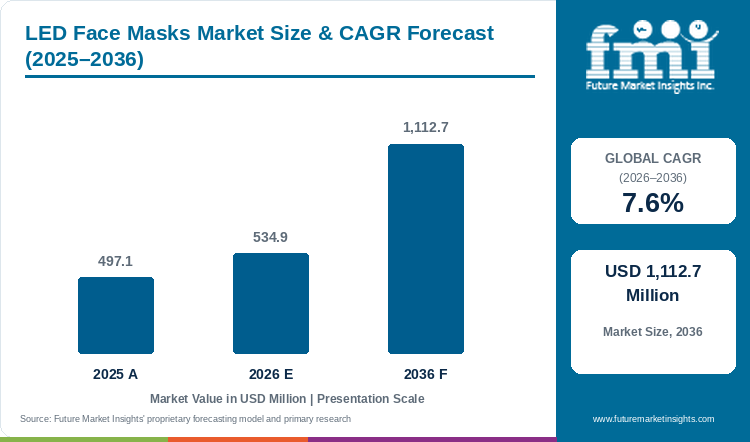
USD 534.9 Million in 2026 and USD 1,112.7 Million by 2036 at a 7.6% CAGR.
Spending on LED face masks is estimated at USD 497.1 Million in 2025 and USD 534.9 Million in 2026, as per FMI. Revenue is projected to reach USD 1,112.7 Million by 2036 at a 7.6% CAGR, opening USD 577.8 Million of new sales for beauty-device suppliers. SharkNinja’s February 2025 CryoGlow announcement paired LED skincare with under-eye cooling, showing how brands are adding a familiar sensory benefit to a treatment shoppers must repeat over time [1].
A mask must earn a place in the routine before wavelength choices can become a commercial advantage. Comfortable fit, understandable treatment settings and a manageable session length help buyers judge whether they will keep using it. Premium pricing will depend on product-specific evidence and reliable support as more masks compete on similar light combinations. More features can attract attention, but they also increase the explanation required at purchase.
Analysts at FMI see wider retail access and simpler treatment guidance as the nearer sources of volume. Philips introduced ReAura in August 2026, with Germany, France and the UK among its first markets, while YA-MAN announced a Blue Green Mask Lift retail preview in Japan in July 2025 [2] [3]. Suppliers that connect those launch channels to clear use instructions can improve adoption without treating evidence for one device as proof for every mask.
Key Takeaways
- Demand is centered on noninvasive, repeatable photobiomodulation that moves red-light and combination-light protocols from clinics into routine home skincare.
- Red-light masks lead Product Type with a 34.0% share in 2026 because wrinkle and skin-rejuvenation use broadens demand beyond acne-focused treatment.
- At-home leads Use Setting with a 61.0% share in 2026 as wearable masks shift treatment time into a self-administered routine rather than a booked service.
- Rechargeable cordless leads Power Source with a 53.0% share in 2026 because hands-free movement and short treatment sessions reduce friction around repeated use.
- The main purchasing friction is confidence in delivered dose and intended-use evidence. Buyers also weigh fit, eye-area safety, treatment frequency and returns or warranty support.
- Profiled companies include CurrentBody, Dyson, Ya-Man, Panasonic, SharkNinja, Conair, FOREO, Therabody, Philips and NuFACE. Public mask-specific evidence is stronger for some participants than others, so competitive positioning should not be read as a share ranking.
Analyst Perspective
“Revenue will depend less on awareness than on whether suppliers can demonstrate repeatable light delivery, safe use and enough comfort to sustain a multi-week routine”.
- Rahul Pandita, Principal Consultant, FMI
How is the led face masks market segmented?
The market is segmented by Product Type, Use Setting, Power Source, Price Band and Sales Channel.
Product Type comprises Red-light masks, Blue-light acne masks, Multi-spectrum masks and Flexible wrap masks. Use Setting covers At-home, Professional & clinic and Hybrid prosumer. Power Source includes Rechargeable cordless, Corded and Battery. Price Band includes Entry (below USD 100), Mid (USD 100-300) and Premium (above USD 300). Sales Channel covers E-commerce & DTC, Specialty beauty & electronics, Professional distribution and Department stores.
Why do Red-light masks anchor the Product Type category?
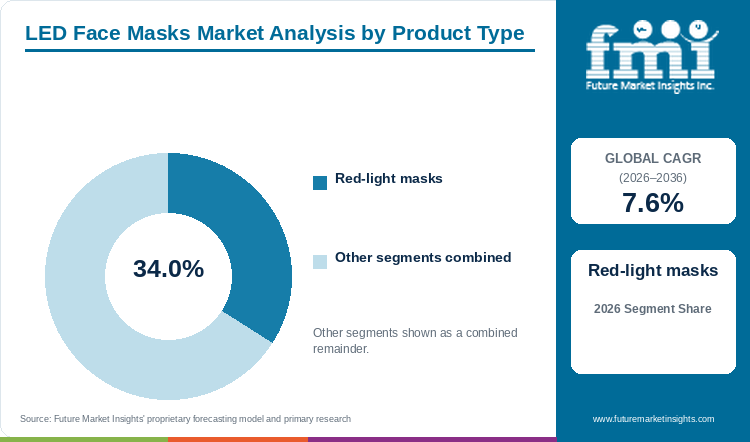
Red-light masks account for 34.0% of Product Type in 2026.
Red-light masks have the broadest consumer story because they address visible skin-aging concerns without limiting the offer to acne. Red and near-infrared wavelengths also appear across flexible and rigid mask formats, which lets suppliers differentiate on dose, coverage and treatment time. A 2025 randomized clinical trial used a 660 nm red LED mask in women aged 45 to 60 and evaluated facial rejuvenation across different treatment frequencies. [4] That evidence base supports red light as a familiar anchor around which suppliers add near-infrared or other wavelengths.
- Leading share: Red-light masks account for 34.0% of Product Type in 2026. Their advantage comes from a broad anti-aging use case and compatibility with near-infrared combinations.
- Dated example: A randomized, sham-controlled study published on April 1, 2025 evaluated a 660 ± 10 nm red LED mask in 95 women. The study reinforces the role of red photobiomodulation in repeat facial-rejuvenation protocols. [4]
What makes At-home use central to the Use Setting category?
At-home represents 61.0% of Use Setting in 2026.
At-home use removes booking and travel from a repeated skincare routine. The April 2025 photobiomodulation trial examined application frequency in a specific facial-rejuvenation protocol [4], illustrating why the schedule belongs with the evidence. Suppliers need to make their own prescribed routine understandable and comfortable. Professional use remains a separate choice for buyers seeking supervision, while home devices compete on practical access and continued use.
- Leading share: At-home represents 61.0% of Use Setting in 2026. Convenience is valuable because light-based skincare generally requires a series of treatments rather than a one-off session.
- In June 2025, the FDA cleared CurrentBody’s LED Light Therapy Mask Series 2 [5]. The decision shows why substantiation belongs to a named product and intended use, alongside the practical task of fitting treatment into a home routine.
Why is Rechargeable cordless the preferred Power Source configuration?
Rechargeable cordless accounts for 53.0% of Power Source in 2026.
Rechargeable cordless masks reduce the practical penalty of a wearable treatment. Users can move around while the mask runs and can store the device without a fixed power connection. The format also supports travel and short daily routines. Corded products can maintain continuous power, while replaceable-battery designs can lower electronics complexity. Yet the cordless rechargeable configuration better matches the hands-free value proposition that differentiates masks from panels and handheld light devices.
- Leading share: Rechargeable cordless accounts for 53.0% of Power Source in 2026. Mobility and easier storage improve the chance that a multi-week protocol becomes habitual.
- FOREO’s October 2025 comparison, updated in September 2026, describes FAQ 202 as rechargeable and wireless [6]. That design makes mobility part of the treatment experience.
What keeps Entry (below USD 100) central to the Price Band category?
Entry (below USD 100) holds 41.0% of Price Band in 2026.
Entry devices lower the cost of trying an at-home light routine. Buyers still need to understand the intended use and the evidence for the actual model. CurrentBody’s June 2025 Series 2 clearance illustrates a product-specific regulatory decision [5]. Price alone cannot tell the purchaser whether a different mask offers equivalent substantiation, so clear labeling and accessible product documentation matter throughout the entry tier.
- Leading share: Entry (below USD 100) holds 41.0% of Price Band in 2026 because the threshold reduces trial risk for first-time buyers.
- The FDA’s June 2025 clearance for CurrentBody Series 2 provides a named example of regulatory substantiation [5]. It cannot be transferred to other masks simply because they also use LEDs.
Why does E-commerce & DTC lead the Sales Channel category?
E-commerce & DTC accounts for 41.0% of Sales Channel in 2026.
LED masks require explanation before purchase. Direct product pages can show wavelengths, treatment duration, fitting instructions and clinical or regulatory evidence in one path to checkout. Digital channels also support comparison across price tiers and make reviews visible. Specialty beauty and electronics stores remain useful for trial and gifting, while professional distributors matter for clinic accounts. Department stores can add prestige, but e-commerce gives suppliers the most control over education and post-purchase guidance.
- Leading share: E-commerce & DTC accounts for 41.0% of Sales Channel in 2026 because the category benefits from detailed product education and direct comparison.
- Destatis reported that 70% of Germans aged 16 to 74 had bought online in the previous three months in 2025 [7]. That familiarity supports online comparison of considered beauty-device purchases.
What are the drivers, restraints and opportunities in the led face masks market?
Demand is driven by repeatable at-home photobiomodulation, while evidence and adherence requirements restrain conversion and multi-spectrum designs create room for broader use cases.
- Driver: Consumers can move repeated red, blue and near-infrared light sessions into home routines without booking a clinic visit.
- Restraint: Uneven substantiation, device fit and repeated-use discipline can delay purchase or weaken long-term utilization.
- Opportunity: Better wavelength combinations, dose control and wearable ergonomics can expand the addressable use case beyond single-purpose masks.
The main driver is the ability to place a repeatable skincare session within the consumer’s own schedule. SharkNinja’s February 2025 CryoGlow announcement combines LED treatment with under-eye cooling [1], while Philips’ August 2026 ReAura launch adds modular treatment options [2]. These offers can attract shoppers seeking a manageable routine. Continued demand will depend on product-specific results and comfortable use rather than on the appeal of light technology alone.
Fit, session length and understandable settings shape whether the mask is used consistently. A June 2025 FDA clearance for CurrentBody Series 2 illustrates the product-specific nature of substantiation [5]. Suppliers need to keep claims aligned with that evidence and explain use precautions clearly. A difficult fit or confusing schedule can undermine repeat use even when the initial demonstration is persuasive.
CurrentBody received FDA clearance in June 2026 for a multi-light therapy mask under K260715. [8] Philips launched ReAura in August 2026 with red, blue and near-infrared modes for age care, blemish care and daily glow. [2] These moves point toward multi-spectrum systems that package distinct protocols behind simple presets. Suppliers that can document dose, maintain even facial coverage and keep controls intuitive can move customers from a single concern toward a broader device relationship. The commercial upside depends on evidence remaining specific to each intended use.
Which country CAGRs are profiled in the led face masks market?
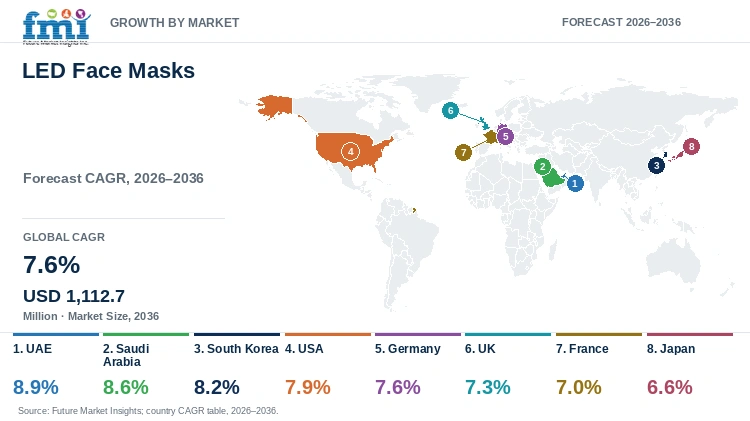
The profiled country CAGRs below cover 2026 to 2036.
| Country | CAGR |
|---|---|
| UAE | 8.9% |
| Saudi Arabia | 8.6% |
| South Korea | 8.2% |
| USA | 7.9% |
| Germany | 7.6% |
| UK | 7.3% |
| France | 7.0% |
| Japan | 6.6% |
How do country-level CAGRs compare in the led face masks market?
The profiled rates divide into three practical bands. UAE and Saudi Arabia sit above 8.5%, while South Korea remains above 8%. USA and Germany cluster around the overall market pace. UK, France and Japan expand more slowly. The spread between UAE at 8.9% and Japan at 6.6% is 2.3 percentage points. This comparison describes forecast rate rather than absolute market size, so a faster CAGR should not be read as a larger revenue base.
- UAE: Deep internet use and a retail system built around cross-border brands support fast DTC discovery, especially for premium beauty technology.
- Saudi Arabia: Local online-shopping infrastructure reduces channel friction and gives device brands a route to younger digitally active consumers.
- South Korea: A strong K-beauty innovation and export ecosystem raises consumer familiarity with device-assisted skincare and multi-step routines.
- USA: FDA-cleared devices and a large acne treatment need create a clear path for evidence-led red and blue light propositions.
- Germany: High online purchasing penetration supports DTC sales, while consumers can compare technical specifications across premium and mid-tier products.
- UK: A high online share of retail sales and visible beauty-device launches support direct education and fast product testing by new entrants.
- France: High online buying among younger consumers supports digital acquisition, while premium beauty expectations place pressure on design and substantiation.
- Japan: A mature beauty-appliance culture supports acceptance, but slower forecast growth suggests suppliers must win replacement or premiumization rather than rely on first-time adoption alone.
Country growth should be interpreted alongside channel structure, product evidence and local beauty-device habits. The profiles below cover every supplied country and preserve the forecast rate as a separate measure from market scale.
Country-wise Analysis
- The UAE leads the profiled growth rates at an 8.9% CAGR through 2036, with digital retail offering a route for premium masks. Aani’s registered user base reached 12.5 million in April 2026 [9]. Easy checkout does not remove the need to explain a considered beauty purchase. Brands will need visible warranty terms, clear treatment instructions and credible device-specific claims to turn that access into sustained demand.
- Saudi Arabia’s online-store standards put authenticity and customer support beside device features, with an 8.6% CAGR forecast through 2036. The Ministry of Commerce assessed 100 prominent e-stores in August 2025 [10]. LED-mask suppliers can strengthen local distribution by making seller identity and returns clear. At premium prices, that reassurance can matter as much as an additional wavelength in the first purchase decision.
- South Korea’s beauty industry gives new masks a strong product-development environment, and revenue is forecast at an 8.2% CAGR through 2036. MFDS’s September 2026 Cosmetics Day announcement highlights the continuing international reach of K-beauty [11]. Device suppliers can draw on that distribution and formulation ecosystem, while keeping electrical-device evidence separate from cosmetic claims. Local demonstrations should explain the treatment setting and the routine a buyer is expected to maintain.
- The USA has a visible product-specific clearance route for LED masks, supporting a 7.9% CAGR through 2036. FDA records show CurrentBody’s Series 2 clearance in June 2025 and its Multi Light Therapy Mask clearance in June 2026 [5] [8]. Those records support the named devices and uses. Brands that connect their authorized claims to understandable settings can compete more credibly than those presenting all LED masks as equivalent.
- Germany combines a large online audience with new branded supply, and sales are forecast at a 7.6% CAGR through 2036. Philips included Germany in ReAura’s August 2026 launch [2]. Destatis recorded recent online purchases by 70% of people aged 16 to 74 in 2025 [7]. Buyers have the means to compare closely, so fit, support and the evidence behind the intended use need to justify the price.
- The UK is an early launch market for established beauty-device brands, with a 7.3% CAGR forecast through 2036. Philips included it in ReAura’s August 2026 rollout [2]. Great Britain’s online share of retail sales was 27.4% in 2025 [12], giving suppliers room to explain a treatment before purchase. Fit guidance and realistic expectations can reduce the risk that an appealing launch becomes a return.
- France’s new branded launches sit alongside broad digital purchasing, supporting a 7.0% CAGR through 2036. Philips selected France for ReAura’s initial August 2026 rollout [2], while Insee recorded recent online buying by 63.6% of people aged 15 or older in 2025 [13]. Suppliers can reach that audience directly, but should explain what the treatment schedule and specific device evidence contribute to the premium price.
- Japan’s domestic beauty-device competition makes product differentiation important even at a 6.6% CAGR through 2036, the slowest rate in the group. YA-MAN announced a Blue Green Mask Lift preview at Ginza Mitsukoshi in July 2025 [3]. Physical demonstrations give shoppers a way to assess fit and handling. Suppliers seeking incremental sales will need a clear upgrade benefit and distribution that supports the user after purchase.
Who are the notable companies in the led face masks market?
CurrentBody, Dyson, Ya-Man, Panasonic, SharkNinja, Conair, FOREO, Therabody, Philips and NuFACE are the notable companies profiled in this market.
Competition separates into dedicated LED-mask specialists, diversified beauty-technology companies with verified mask products and broader device brands whose mask-specific participation is less visible in public material. CurrentBody, FOREO and Therabody center substantial consumer propositions on wearable light therapy. Ya-Man, SharkNinja and Philips bring wider appliance or beauty portfolios into the category with LED-mask products that add multi-function or design features. Dyson, Panasonic, Conair and NuFACE have established consumer-device capabilities, yet current public evidence reviewed for this report did not verify a directly comparable LED face mask for each name by the publication cutoff. Their presence is therefore treated cautiously rather than converted into an unsupported category role.
- Dedicated wearable-light platforms: CurrentBody, FOREO and Therabody compete through wavelength architecture and fit. They also differentiate on treatment protocols and clinical or regulatory substantiation.
- Diversified beauty-device companies with verified LED masks: Ya-Man, SharkNinja and Philips use broader product-development and channel capabilities to add mask-based light therapy to their portfolios.
- Broader beauty-device brands requiring mask-specific verification: Dyson, Panasonic, Conair and NuFACE remain among the profiled companies. Comparable current mask evidence was not verified for every name by September 12, 2026.
Competitive Benchmarking: LED Face Masks Market
| Company | Mask-specific LED spectrum breadth | Wearable fit & treatment integration | Regulatory/clinical substantiation | Geographic Reach |
|---|---|---|---|---|
| CurrentBody | High | High | High | International DTC platform with named US device clearances in 2025 and 2026 [8] [5] |
| Dyson | Unscored | Unscored | Unscored | Global beauty presence; mask-specific reach not verified [14] |
| Ya-Man | High | High | Medium | Japan-led retail activity and a current international product catalogue [3] [15] |
| Panasonic | Unscored | Unscored | Unscored | Global personal-care presence; mask-specific reach not verified [16] |
| SharkNinja | Medium | High | High | US CryoGlow launch documented in February 2025 [1] |
| Conair | Unscored | Unscored | Unscored | United States consumer beauty; mask-specific reach not verified [17] |
| FOREO | High | High | Medium | International beauty-device platform with current FAQ mask guidance [6] |
| Therabody | Medium | High | High | US specialty retail through the August 2025 Ulta partnership [18] |
| Philips | Medium | High | Medium | Initial ReAura launch in UK, Germany and France [2] |
| NuFACE | Unscored | Unscored | Unscored | United States and selected international microcurrent channels; mask-specific reach not verified [19] |
Scoring basis: Mask-specific LED spectrum breadth rates the documented range of wavelengths and distinct light modes in a current wearable mask. Wearable fit & treatment integration rates documented full-face coverage, flexible or engineered fit and integration of treatment functions that reduce routine friction. Regulatory/clinical substantiation rates documented FDA clearance, controlled studies or comparable device-specific evidence. High indicates broad or deep documented capability, Medium indicates credible but narrower evidence, Low is reserved for a documented limitation and unavailable public information is left Unscored.
Key Developments in the LED Face Masks Market
- In August 2026, Philips launched ReAura as a flexible 3-in-1 LED mask for the full face, eye area or neck. The product uses red, blue and near-infrared modes and entered the UK, Germany and France at launch. The development adds a large health-technology brand to the premium wearable-light category and raises the importance of fit, modularity and evidence-led routines. [2]
- In June 2026, the U.S. FDA cleared the CurrentBody Skin LED Multi Light Therapy Mask under 510(k) K260715. The record lists it as a light-based over-the-counter wrinkle-reduction device with an additional acne product code. The clearance strengthens the case for multi-light masks that target more than one concern while keeping claims inside defined regulatory indications. [8]
- In February 2025, SharkNinja introduced Shark CryoGlow in the United States as an FDA-cleared mask combining red, blue and infrared LED treatment with under-eye cooling. The product packages light therapy with a second sensory benefit. That approach broadens competition from wavelength count alone toward hybrid features that can improve differentiation and perceived routine value. [1]
Key Players in the LED Face Masks Market
Dedicated LED mask and wearable-light platforms
- CurrentBody
- FOREO
- Therabody
Diversified beauty-device brands with verified mask offers
- Ya-Man
- SharkNinja
- Philips
Broader beauty-device brands with limited verified mask-specific evidence
- Dyson
- Panasonic
- Conair
- NuFACE
LED Face Masks Market - Report Scope
| Coverage field | Report scope |
|---|---|
| Market breakdown | Product Type; Use Setting; Power Source; Price Band; Sales Channel |
| Quantitative Units | USD Million |
| Market Definition | Revenue from wearable LED face masks sold within the stated segmentation universe. Includes rigid or flexible full-face mask systems and bundled controllers or charging accessories sold with the mask. Excludes non-wearable LED panels, handheld light devices, IPL, laser, RF and microcurrent devices, skincare consumables, clinic service revenue and adjacent beauty-device categories. |
| Regions Covered | North America; Latin America; Western Europe; Eastern Europe; East Asia; South Asia and Pacific; Middle East and Africa |
| Countries Covered | USA, Germany, France, UK, Saudi Arabia, UAE, Japan, South Korea |
| Key Companies Profiled | CurrentBody, Dyson, Ya-Man, Panasonic, SharkNinja, Conair, FOREO, Therabody, Philips, NuFACE |
| Forecast Period | 2026 to 2036 |
| Approach | Primary and secondary research with market triangulation. |
LED Face Masks Market - Research Methodology
| Method | Approach |
|---|---|
| Primary Research | FMI analysts gathered input from manufacturers, service providers, technology developers, distributors, end users, procurement teams and subject-matter experts. Interviews examined purchasing decisions, product or service evaluation, adoption barriers, approval requirements, pricing considerations and expectations for technical or commercial support. Respondents were also asked what evidence is required before a trial, pilot, or initial order develops into regular purchasing. |
| Desk Research | Desk research covered government statistics, regulatory publications, trade data, industry associations, technical literature, standards, company filings, product information and official corporate announcements. Sources were reviewed for relevance, publication date, geographic coverage and consistency with the defined market scope. Claims relating to performance, applications, approvals, capacity, investment and commercial activity were retained only when supported by credible public evidence. |
| Market Sizing and Forecasting | The market model combined the baseline value with historical performance, segment structure, pricing and volume indicators, adoption levels, company participation and country-level demand conditions. Forecast assumptions considered economic activity, investment trends, regulatory developments, technology adoption, purchasing cycles, supply availability and barriers to wider market use. Segment and regional estimates were reconciled before the final market total was calculated. |
| Data Validation | Estimates were checked against multiple independent indicators, including public data, company activity, trade patterns, industry developments and findings from primary interviews. Validation also tested whether products, services, applications and company revenues fell within the defined market boundaries. Adjacent categories, unsupported claims, overlapping revenues and activities without direct market relevance were excluded to reduce double counting and maintain consistency across segments and countries. |
LED Face Masks Market by Segments
LED Face Masks Market segmented by Product Type:
- Red-light masks
- Blue-light acne masks
- Multi-spectrum masks
- Flexible wrap masks
LED Face Masks Market segmented by Use Setting:
- At-home
- Professional & clinic
- Hybrid prosumer
LED Face Masks Market segmented by Power Source:
- Rechargeable cordless
- Corded
- Battery
LED Face Masks Market segmented by Price Band:
- Entry (below USD 100)
- Mid (USD 100-300)
- Premium (above USD 300)
LED Face Masks Market segmented by Sales Channel:
- E-commerce & DTC
- Specialty beauty & electronics
- Professional distribution
- Department stores
LED Face Masks Market by Region:
- North America
- United States
- Canada
- Latin America
- Brazil
- Mexico
- Argentina
- Chile
- Western Europe
- Germany
- France
- United Kingdom
- Italy
- Spain
- Benelux
- Nordics
- Eastern Europe
- Poland
- Czech Republic
- Romania
- Hungary
- East Asia
- China
- Japan
- South Korea
- South Asia and Pacific
- India
- ASEAN
- Australia and New Zealand
- Middle East and Africa
- GCC Countries
- South Africa
- Türkiye
- Israel
Research Sources and Bibliography
- [1] SharkNinja (2025, February 7). Shark Beauty Revolutionizes at-home Skincare with CryoGlow.
- [2] Philips (2026, August 25). Philips launches ReAura, a new LED skincare mask and beauty ritual for younger-looking skin.
- [3] YA-MAN (2025, July 16). New Blue Green Mask Lift to be sold in advance at Ginza Mitsukoshi POP UP.
- [4] Bragato, E. F., et al. (2025, April 1). Role of photobiomodulation application frequency in facial rejuvenation: randomized, sham-controlled, double-blind, clinical trial.
- [5] U.S. Food and Drug Administration (2025, June 25). 510(k) Premarket Notification K250966: CurrentBody Skin LED Light Therapy Mask Series 2.
- [6] FOREO (2025, October 13; updated 2026, September 28). FAQ 202 vs. FAQ 202 plus: What’s the difference?
- [7] Destatis (2026, April 20). Internet use and online shopping over time: 2025 results.
- [8] U.S. Food and Drug Administration (2026, June 3). 510(k) Premarket Notification K260715: CurrentBody Skin LED Multi Light Therapy Mask.
- [9] Al Etihad Payments (2026, April 10). Aani reaches 12.5 million registered users.
- [10] Saudi Ministry of Commerce (2025, August 18). Ministry of Commerce Announces the Results of E-Commerce Store Evaluation.
- [11] Ministry of Food and Drug Safety, Republic of Korea (2026, September 9). The Confidence of K-Beauty, In Full Bloom: 2026 Cosmetics Day Ceremony.
- [12] Office for National Statistics (2026, August 21). Internet sales as a percentage of total retail sales (ratio) (%).
- [13] Insee (2025, December 2). Household use of information and communication technologies: 2025 results.
- [14] Dyson (n.d.). Dyson Hair Care. Current page, accessed 6 October 2026.
- [15] YA-MAN (n.d.). Blue Green Mask. Current page, accessed 6 October 2026.
- [16] Panasonic (n.d.). Beauty and Skincare Devices. Current page, accessed 6 October 2026.
- [17] Conair (n.d.). skn by conair. Current page, accessed 6 October 2026.
- [18] Therabody (2025, August 5). Therabody Brings Science-Backed Wellness to Ulta Beauty.
- [19] NuFACE (n.d.). Devices 2026. Current page, accessed 6 October 2026.
"This bibliography is provided for reader reference and is not exhaustive. The full report contains the complete reference list and detailed citations."
This Report Answers
- How large is the LED face masks market in 2026, and what value is forecast for 2036?
- Which industry pressures support demand for wearable photobiomodulation devices?
- Why do Red-light masks hold the leading Product Type position?
- Why does At-home use hold the leading Use Setting position?
- How do the profiled country growth rates differ from UAE to Japan?
- Which profiled companies supply or participate around relevant light-based beauty-device categories?
- What limits adoption, repeat use or switching between LED mask suppliers?
- What should buyers evaluate before purchasing an LED face mask?
Frequently Asked Questions
How big is the LED face masks market in 2026, and what is forecast for 2036?
The market is valued at USD 534.9 Million in 2026 and is forecast to reach USD 1,112.7 Million by 2036. The forecast reflects broader at-home adoption and continued product development across red, blue and multi-spectrum masks.
What is the CAGR for the LED face masks market from 2026 to 2036?
The market is forecast to expand at a 7.6% CAGR from 2026 to 2036. This rate captures category growth across consumer, professional and hybrid use settings without implying the same pace in every country.
Which Product Type segment leads the LED face masks market?
Red-light masks lead Product Type with a 34.0% share in 2026. Their position is supported by the broad consumer use case around visible skin aging and compatibility with near-infrared treatment designs.
Which Use Setting segment leads the LED face masks market?
At-home leads Use Setting with a 61.0% share in 2026. Wearable masks fit a repeated treatment model because users can complete sessions without clinic scheduling or travel.
Which profiled countries have the highest growth rates in the LED face masks market?
UAE is highest at 8.9% CAGR from 2026 to 2036, followed by Saudi Arabia at 8.6% and South Korea at 8.2%. These are growth rates rather than indicators of absolute market size.
Which companies are active around the LED face masks market?
Profiled companies include CurrentBody, Dyson, Ya-Man, Panasonic, SharkNinja, Conair, FOREO, Therabody, Philips and NuFACE. Public mask-specific evidence is strongest for CurrentBody, Ya-Man, SharkNinja, FOREO, Therabody and Philips. Other names require more cautious category-level interpretation.
Preview the report firsthand - request a free sample
Get SampleGet the brochure for pricing and purchase details.
Get PDFTable of Content
- Key Takeaways
- Market Size and CAGR
- Top Growth Driver
- Fastest Growing Segment
- Leading Region
- Key Companies
- Emerging Opportunities
- Executive Summary
- Global Market Outlook
- Demand-side Trends
- Supply-side Trends
- Technology Roadmap Analysis
- Analysis and Recommendations
- Analyst Perspective (What is happening? Why now? What should investors know?)
- Key Questions Answered
- How large is the market?
- What is the CAGR?
- What are key trends?
- Which region dominates?
- Who are the leaders?
- Market Overview
- Market Coverage / Taxonomy
- Market Definition / Scope / Limitations
- Research Methodology
- Chapter Orientation
- Analytical Lens and Working Hypotheses
- Market Structure, Signals, and Trend Drivers
- Benchmarking and Cross-market Comparability
- Market Sizing, Forecasting, and Opportunity Mapping
- Research Design and Evidence Framework
- Desk Research Programme (Secondary Evidence)
- Expert Input and Fieldwork (Primary Evidence)
- Tooling, Models, and Reference Databases
- Data Engineering and Model Build
- Quality Assurance and Audit Trail
- Market Background
- Market Dynamics (Drivers, Restraints, Opportunity, Trends)
- Scenario Forecast (Optimistic, Likely, Conservative)
- Impact Analysis
- AI Impact
- Sustainability Impact
- Regulatory Impact
- Technology Impact
- Consumer / Buyer Analysis
- Purchase Drivers
- Adoption Barriers
- Buyer Journey
- Opportunity Map Analysis
- Product Life Cycle Analysis
- Supply Chain Analysis
- Investment Feasibility Matrix
- Value Chain Analysis
- PESTLE and Porter's Analysis
- Regulatory Landscape
- Regional Parent Market Outlook
- Production and Consumption Statistics
- Import and Export Statistics
- Global Market Analysis and Forecast, 2021 to 2036
- Historical Market Size Value (USD Million) Analysis, 2021 to 2025
- Current and Future Market Size Value (USD Million) Projections, 2026 to 2036
- Y-o-Y Growth Trend Analysis
- Absolute $ Opportunity Analysis
- Global Market Pricing Analysis, 2021 to 2036
- Global Market Analysis and Forecast, By Product Type, 2021 to 2036
- Introduction / Key Findings
- Historical Market Size Value (USD Million) Analysis By Product Type, 2021 to 2025
- Current and Future Market Size Value (USD Million) Analysis and Forecast By Product Type, 2026 to 2036
- Red-light masks
- Blue-light acne masks
- Multi-spectrum masks
- Flexible wrap masks
- Y-o-Y Growth Trend Analysis By Product Type, 2021 to 2025
- Absolute $ Opportunity Analysis By Product Type, 2026 to 2036
- Global Market Analysis and Forecast, By Use Setting, 2021 to 2036
- Introduction / Key Findings
- Historical Market Size Value (USD Million) Analysis By Use Setting, 2021 to 2025
- Current and Future Market Size Value (USD Million) Analysis and Forecast By Use Setting, 2026 to 2036
- At-home
- Professional & clinic
- Hybrid prosumer
- Y-o-Y Growth Trend Analysis By Use Setting, 2021 to 2025
- Absolute $ Opportunity Analysis By Use Setting, 2026 to 2036
- Global Market Analysis and Forecast, By Power Source, 2021 to 2036
- Introduction / Key Findings
- Historical Market Size Value (USD Million) Analysis By Power Source, 2021 to 2025
- Current and Future Market Size Value (USD Million) Analysis and Forecast By Power Source, 2026 to 2036
- Rechargeable cordless
- Corded
- Battery
- Y-o-Y Growth Trend Analysis By Power Source, 2021 to 2025
- Absolute $ Opportunity Analysis By Power Source, 2026 to 2036
- Global Market Analysis and Forecast, By Price Band, 2021 to 2036
- Introduction / Key Findings
- Historical Market Size Value (USD Million) Analysis By Price Band, 2021 to 2025
- Current and Future Market Size Value (USD Million) Analysis and Forecast By Price Band, 2026 to 2036
- Entry (below USD 100)
- Mid (USD 100-300)
- Premium (above USD 300)
- Y-o-Y Growth Trend Analysis By Price Band, 2021 to 2025
- Absolute $ Opportunity Analysis By Price Band, 2026 to 2036
- Global Market Analysis and Forecast, By Sales Channel, 2021 to 2036
- Introduction / Key Findings
- Historical Market Size Value (USD Million) Analysis By Sales Channel, 2021 to 2025
- Current and Future Market Size Value (USD Million) Analysis and Forecast By Sales Channel, 2026 to 2036
- E-commerce & DTC
- Specialty beauty & electronics
- Professional distribution
- Department stores
- Y-o-Y Growth Trend Analysis By Sales Channel, 2021 to 2025
- Absolute $ Opportunity Analysis By Sales Channel, 2026 to 2036
- Global Market Analysis and Forecast, By Region, 2021 to 2036
- Introduction
- Historical Market Size Value (USD Million) Analysis By Region, 2021 to 2025
- Current Market Size Value (USD Million) Analysis and Forecast By Region, 2026 to 2036
- North America
- Latin America
- Western Europe
- Eastern Europe
- East Asia
- South Asia and Pacific
- Middle East and Africa
- Market Attractiveness Analysis By Region
- North America Market Analysis and Forecast, By Country, 2021 to 2036
- Historical Market Size Value (USD Million) Trend Analysis By Market Taxonomy, 2021 to 2025
- Market Size Value (USD Million) Forecast By Market Taxonomy, 2026 to 2036
- By Country
- United States
- Canada
- By Product Type
- By Use Setting
- By Power Source
- By Price Band
- By Sales Channel
- By Country
- Market Attractiveness Analysis
- By Country
- By Product Type
- By Use Setting
- By Power Source
- By Price Band
- By Sales Channel
- Key Takeaways
- Latin America Market Analysis and Forecast, By Country
- Historical Market Size Value (USD Million) Trend Analysis By Market Taxonomy, 2021 to 2025
- Market Size Value (USD Million) Forecast By Market Taxonomy, 2026 to 2036
- By Country
- Brazil
- Mexico
- Argentina
- Chile
- By Product Type
- By Use Setting
- By Power Source
- By Price Band
- By Sales Channel
- By Country
- Market Attractiveness Analysis
- By Country
- By Product Type
- By Use Setting
- By Power Source
- By Price Band
- By Sales Channel
- Key Takeaways
- Western Europe Market Analysis and Forecast, By Country
- Historical Market Size Value (USD Million) Trend Analysis By Market Taxonomy, 2021 to 2025
- Market Size Value (USD Million) Forecast By Market Taxonomy, 2026 to 2036
- By Country
- Germany
- France
- United Kingdom
- Italy
- Spain
- Benelux
- Nordics
- By Product Type
- By Use Setting
- By Power Source
- By Price Band
- By Sales Channel
- By Country
- Market Attractiveness Analysis
- By Country
- By Product Type
- By Use Setting
- By Power Source
- By Price Band
- By Sales Channel
- Key Takeaways
- Eastern Europe Market Analysis and Forecast, By Country
- Historical Market Size Value (USD Million) Trend Analysis By Market Taxonomy, 2021 to 2025
- Market Size Value (USD Million) Forecast By Market Taxonomy, 2026 to 2036
- By Country
- Poland
- Czech Republic
- Romania
- Hungary
- By Product Type
- By Use Setting
- By Power Source
- By Price Band
- By Sales Channel
- By Country
- Market Attractiveness Analysis
- By Country
- By Product Type
- By Use Setting
- By Power Source
- By Price Band
- By Sales Channel
- Key Takeaways
- East Asia Market Analysis and Forecast, By Country
- Historical Market Size Value (USD Million) Trend Analysis By Market Taxonomy, 2021 to 2025
- Market Size Value (USD Million) Forecast By Market Taxonomy, 2026 to 2036
- By Country
- China
- Japan
- South Korea
- By Product Type
- By Use Setting
- By Power Source
- By Price Band
- By Sales Channel
- By Country
- Market Attractiveness Analysis
- By Country
- By Product Type
- By Use Setting
- By Power Source
- By Price Band
- By Sales Channel
- Key Takeaways
- South Asia and Pacific Market Analysis and Forecast, By Country
- Historical Market Size Value (USD Million) Trend Analysis By Market Taxonomy, 2021 to 2025
- Market Size Value (USD Million) Forecast By Market Taxonomy, 2026 to 2036
- By Country
- India
- ASEAN
- Australia and New Zealand
- By Product Type
- By Use Setting
- By Power Source
- By Price Band
- By Sales Channel
- By Country
- Market Attractiveness Analysis
- By Country
- By Product Type
- By Use Setting
- By Power Source
- By Price Band
- By Sales Channel
- Key Takeaways
- Middle East and Africa Market Analysis and Forecast, By Country
- Historical Market Size Value (USD Million) Trend Analysis By Market Taxonomy, 2021 to 2025
- Market Size Value (USD Million) Forecast By Market Taxonomy, 2026 to 2036
- By Country
- GCC Countries
- South Africa
- Türkiye
- Israel
- By Product Type
- By Use Setting
- By Power Source
- By Price Band
- By Sales Channel
- By Country
- Market Attractiveness Analysis
- By Country
- By Product Type
- By Use Setting
- By Power Source
- By Price Band
- By Sales Channel
- Key Takeaways
- Key Countries Market Analysis
- United States
- Pricing Analysis
- Market Share Analysis, 2025
- By Product Type
- By Use Setting
- By Power Source
- By Price Band
- By Sales Channel
- Canada
- Pricing Analysis
- Market Share Analysis, 2025
- By Product Type
- By Use Setting
- By Power Source
- By Price Band
- By Sales Channel
- Mexico
- Pricing Analysis
- Market Share Analysis, 2025
- By Product Type
- By Use Setting
- By Power Source
- By Price Band
- By Sales Channel
- Brazil
- Pricing Analysis
- Market Share Analysis, 2025
- By Product Type
- By Use Setting
- By Power Source
- By Price Band
- By Sales Channel
- Chile
- Pricing Analysis
- Market Share Analysis, 2025
- By Product Type
- By Use Setting
- By Power Source
- By Price Band
- By Sales Channel
- Germany
- Pricing Analysis
- Market Share Analysis, 2025
- By Product Type
- By Use Setting
- By Power Source
- By Price Band
- By Sales Channel
- United Kingdom
- Pricing Analysis
- Market Share Analysis, 2025
- By Product Type
- By Use Setting
- By Power Source
- By Price Band
- By Sales Channel
- Italy
- Pricing Analysis
- Market Share Analysis, 2025
- By Product Type
- By Use Setting
- By Power Source
- By Price Band
- By Sales Channel
- Spain
- Pricing Analysis
- Market Share Analysis, 2025
- By Product Type
- By Use Setting
- By Power Source
- By Price Band
- By Sales Channel
- France
- Pricing Analysis
- Market Share Analysis, 2025
- By Product Type
- By Use Setting
- By Power Source
- By Price Band
- By Sales Channel
- India
- Pricing Analysis
- Market Share Analysis, 2025
- By Product Type
- By Use Setting
- By Power Source
- By Price Band
- By Sales Channel
- ASEAN
- Pricing Analysis
- Market Share Analysis, 2025
- By Product Type
- By Use Setting
- By Power Source
- By Price Band
- By Sales Channel
- Australia and New Zealand
- Pricing Analysis
- Market Share Analysis, 2025
- By Product Type
- By Use Setting
- By Power Source
- By Price Band
- By Sales Channel
- China
- Pricing Analysis
- Market Share Analysis, 2025
- By Product Type
- By Use Setting
- By Power Source
- By Price Band
- By Sales Channel
- Japan
- Pricing Analysis
- Market Share Analysis, 2025
- By Product Type
- By Use Setting
- By Power Source
- By Price Band
- By Sales Channel
- South Korea
- Pricing Analysis
- Market Share Analysis, 2025
- By Product Type
- By Use Setting
- By Power Source
- By Price Band
- By Sales Channel
- Poland
- Pricing Analysis
- Market Share Analysis, 2025
- By Product Type
- By Use Setting
- By Power Source
- By Price Band
- By Sales Channel
- Hungary
- Pricing Analysis
- Market Share Analysis, 2025
- By Product Type
- By Use Setting
- By Power Source
- By Price Band
- By Sales Channel
- Türkiye
- Pricing Analysis
- Market Share Analysis, 2025
- By Product Type
- By Use Setting
- By Power Source
- By Price Band
- By Sales Channel
- South Africa
- Pricing Analysis
- Market Share Analysis, 2025
- By Product Type
- By Use Setting
- By Power Source
- By Price Band
- By Sales Channel
- UAE
- Pricing Analysis
- Market Share Analysis, 2025
- By Product Type
- By Use Setting
- By Power Source
- By Price Band
- By Sales Channel
- Saudi Arabia
- Pricing Analysis
- Market Share Analysis, 2025
- By Product Type
- By Use Setting
- By Power Source
- By Price Band
- By Sales Channel
- United States
- Market Structure Analysis
- Competition Dashboard
- Competition Benchmarking
- Market Share Analysis of Top Players
- By Regional
- By Product Type
- By Use Setting
- By Power Source
- By Price Band
- By Sales Channel
- Emerging Startups
- Innovation Benchmarking
- Competition Analysis
- Competition Deep Dive
- CurrentBody
- Overview
- Product Portfolio
- Profitability by Market Segments
- Sales Footprint
- Strategy Overview
- Marketing Strategy
- Product Strategy
- Channel Strategy
- Dyson
- Ya-Man
- Panasonic
- SharkNinja
- Conair
- FOREO
- Therabody
- Philips
- NuFACE
- CurrentBody
- Case Studies
- Success Stories
- Recent Developments
- Competition Deep Dive
- Assumptions & Acronyms Used


