
- Market Size (2026)
- USD 550.1 Mn
- Forecast (2036)
- USD 1300.0 Mn
- CAGR (2026 to 2036)
- 9.3%
How big is the Light-Activated Polymers Market in 2026?
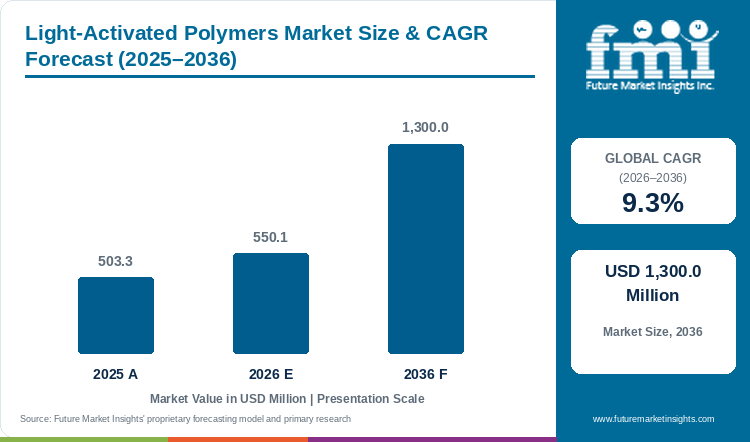
The Light-Activated Polymers Market is projected to reach USD 1.3 billion by 2036, growing at a 9.3% CAGR from 2026 to 2036. The market is estimated at USD 550.1 million in 2026. The market was valued at USD 503.3 million in 2025. On 5 November 2026, Arkema reported a significant increase in Coating Solutions, driven by UV curing applications and rheology additives [3]. The company said this confirmed the trend seen in the second quarter of 2026 [3]. On 4 November 2026, Arkema and Carbon announced a wider partnership on 3D-printed consumer products, building on more than 13 years of joint work [1].
Demand rests on three practical gains: faster throughput, lower emissions and printable precision. Covestro describes energy curing as a split-second polymerisation triggered by UV light or electron beam, with low-to-zero VOC content in its energy-curable resins and diluents [7]. In food-contact print, suppliers now sell resins with their own initiator groups, so less free photoinitiator remains in the film. iGM Resins launched Photomer SC91 on 1 June 2026 on that basis [19]. Covestro also positions NeoRad S-8100 for low-migration inks and overprint varnishes [8].
Key Market Trends & Insights
- On 4 November 2026, Arkema and Carbon said they are expanding a partnership of more than 13 years. The aim is 3D-printed footwear, sporting goods and other consumer products. These use Carbon's elastomeric resins for its Digital Light Synthesis technology, which draws on Arkema's UV-curable specialty materials [1].
- Low-migration chemistry now appears in product catalogues. iGM Resins launched Photomer SC91 on 1 June 2026, the first product in a planned SC series [19]. Covestro lists NeoRad S-8100 as a low-viscosity, self-initiating acrylate resin for flexo inks and overprint varnishes [8].
- Bio-based content is being measured and published. Covestro states that 16 of its UV-curable resins are partly bio-based, with up to 83% bio-based carbon content [10]. The figure is determined by external carbon-14 analysis and expressed as a share of total carbon, not product weight [10].
Regional Highlights
- North America: Arkema runs UV-curable 3D printing technical centres in Exton, Pennsylvania, and a formulation site in Boulder, Colorado. Carbon, its long-standing resin partner, is headquartered in Sunnyvale, California [1][2].
- Asia Pacific: iGM Resins opened a new flagship Asia Pacific office in Shanghai, reported on 1 October 2026 [20]. It will exhibit at CHINACOAT2026 in Guangzhou on 11 to 13 November 2026 [21]. India's Semicon 2.0 programme carries an outlay of INR 1,27,500 crore [18].
- Europe: Arkema will present its Sartomer UV/LED/EB materials for electronic components at Electronica in Munich on 10 to 13 November 2026 [4]. Forward AM offers its Ultracur3D photopolymer range through iAM Marketplace, operated from Rheinmünster in Germany [15].
Light-Activated Polymers Market Size and Forecast
Table 1: Light-Activated Polymers Market Size and Forecast
| Market size and forecast | Value |
|---|---|
| Market size in 2025 | USD 503.3 million |
| Estimated market size in 2026 | USD 550.1 million |
| Projected market size by 2036 | USD 1.3 billion |
| CAGR from 2026 to 2036 | 9.3% |
Source: Future Market Insights analysis of the light-activated polymers market, 2026.
Analyst Perspective
“Coatings and inks give this market its volume. The faster change is in what buyers ask the resin to do. Low-migration packaging, LED-ready curing and printed parts with engineered mechanical behaviour each need a separate qualification path. Suppliers that can document migration behaviour, lamp compatibility and batch consistency will win repeat business. Buyers should avoid locking a process to one lamp type or one printer family before the material is qualified.”
- Nikhil Kaitwade, Principal Consultant, FMI
How is the Light-Activated Polymers Market segmented?
- By product: UV/Visible-Curable Resins & Coatings, Photopolymers for 3D Printing, Photoresists & Microfabrication Photopolymers and Other Products
- By application: Coatings & Printing Inks, 3D Printing & Additive Manufacturing, Electronics & Semiconductors, Biomedical/Life Sciences and Other Applications
- By region: North America, Europe and Asia Pacific
Why does UV/Visible-Curable Resins & Coatings lead by Product in the Light-Activated Polymers Market in 2026?
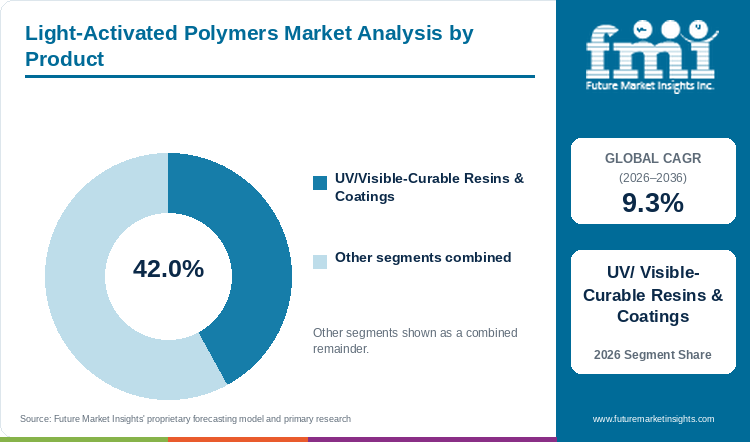
UV/Visible-Curable Resins & Coatings is estimated to account for 42.0% of the Light-Activated Polymers Market by product in 2026. The group has the broadest supplier base, and radiation-curable coatings are its largest outlet. Covestro describes its NeoRad family as energy-curing resins from 100% solids to water-based [7]. allnex lists UV LED curing, UV-curable printing and waterbased UV resins, plus low-gloss energy-curable solutions [22]. Producers also gain from a cost argument. Covestro says UV curing can shorten coating time and reduce cost and emissions, and that primer, mid-coat and top-coat can often run on one multilayer line [11]. Arkema's 5 November 2026 results show the trend in reported numbers. Coating Solutions rose significantly on UV curing applications, and the company said it confirmed the second-quarter pattern [3]. Grades are also tuned for narrow jobs, such as Covestro's NeoRad U-65, an excimer-curable resin for ultra-low-gloss coatings [11].
Table 2: Product, 2026 Share
| Leading Share | 2026 market share |
|---|---|
| UV/Visible-Curable Resins & Coatings | 42.0% |
| All Other Segments Combined Share | 58.0% |
Source: Future Market Insights analysis of the light-activated polymers market, 2026.
Why does Coatings & Printing Inks lead by Application in the Light-Activated Polymers Market in 2026?
Coatings & Printing Inks is estimated to account for 38.0% of the Light-Activated Polymers Market by application in 2026. Packaging and print use UV-curable coatings and inks at very high line speeds. Suppliers have built resin ranges to match. Covestro offers NeoRad S-8100 for flexo inks and overprint varnishes [8]. It says its raw materials meet the food safety criteria of the Swiss Ordinance and the German Ink Ordinance, and that worst-case migration and extraction testing supports low-migration use, including indirect food contact [8]. iGM Resins lists printing inks and packaging first among the uses of Photomer SC91, which cures under both mercury and LED lamps at typical use levels of 10 to 20% of the formulation [19]. Covestro describes its AgiSyn 717 as a low-migration polyester acrylate resin [9]. Covestro also says moving energy curing onto metal cans will take several years [9]. That shows the remaining packaging opportunity depends more on qualification than on chemistry.
Table 3: Application, 2026 Share
| Leading Share | 2026 market share |
|---|---|
| Coatings & Printing Inks | 38.0% |
| All Other Segments Combined Share | 62.0% |
Source: Future Market Insights analysis of the light-activated polymers market, 2026.
What are the key drivers, restraints and opportunities?
Driver
Lamp conversion and lower emissions. Resins have to be reformulated when plants move from mercury to LED lamps. Covestro reports resins that perform well under modern LED lamps for manufacturers in China, and says it is working on resins curable with multiple lamp types [7][9]. iGM Resins presents Photomer SC91 as curing under both mercury and LED light [19]. Each conversion creates a requalification event, so suppliers with broad lamp data have the advantage.
Printed parts and consumer products. Additive manufacturing is extending from prototypes to made-to-order goods. Arkema and Carbon cite lattice structures for footwear and sporting equipment, with tunable cushioning, support and energy return [1]. They also cite Vivobarefoot's custom 3D-printed sandal, produced from individual foot scans [1]. Arkema's N3xtDimension liquid resins are sold for vat photopolymerisation processes, including SLA, DLP and LCD [2].
Restraint
Qualification cost. Packaging buyers cannot swap a resin on a food-contact line without migration and extraction testing. Some conversions are slow. Covestro says the move of energy curing to metal cans will take several years [9]. Long qualification cycles delay revenue for new grades and give incumbents an edge, since they already hold test files.
Performance trade-offs and a cautious chemical market. Excimer curing cures only the top layer. Covestro notes this can mean lower resistance, so ultra-matte finishes need careful resin choice [11]. Arkema described the external environment as challenging and volatile, with limited visibility, in its 5 November 2026 results [3]. Buyers in cyclical end uses, such as furniture and flooring, may be slow to change coating lines even where savings are clear.
Opportunity
Electronics and advanced materials. Arkema will show Sartomer UV/LED/EB materials for protecting and improving electronic components at Electronica, held at Messe München on 10 to 13 November 2026 [4]. Its 3D printing page lists ultra-low loss resins for advanced electronics and heat-resistant resins rated to 150 degrees Celsius [2]. Readers following the photoresist chemicals chain can see how microfabrication materials sit alongside these resins.
Dental and medical printing. Carbon lists a denture base resin, DB 4000, and says its EPX 150 resin earned USP Class VI certification [17]. Formlabs lists denture base, premium teeth, custom tray and surgical guide resins in its dental range [23], and Forward AM lists dental resins DM 2505 and DM 4505 N [15]. Suppliers with medical-grade documentation can sell into regulated work, where price pressure is lower.
Light-Activated Polymers Market by Country (2026 to 2036)
Table 4: Light-Activated Polymers Market Country Growth Forecast
| Country | CAGR, 2026 to 2036 |
|---|---|
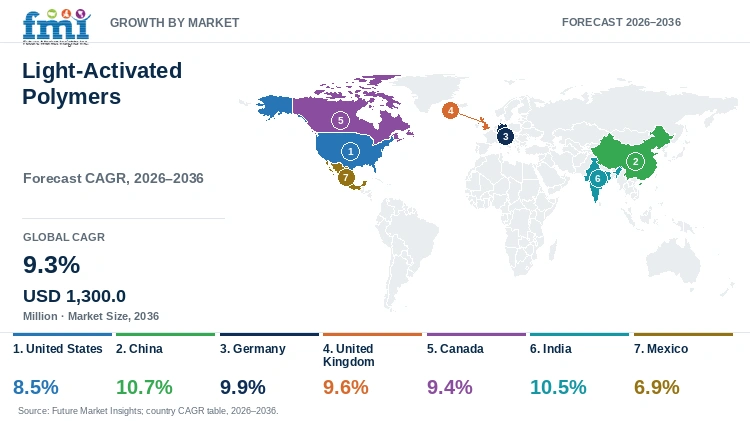
| United States | 8.5% |
| China | 10.7% |
| Germany | 9.9% |
| United Kingdom | 9.6% |
| Canada | 9.4% |
| India | 10.5% |
| Mexico | 6.9% |
Source: Future Market Insights analysis of the light-activated polymers market, 2026.
United States
Arkema and Carbon announced on 4 November 2026 that they are expanding a partnership of more than 13 years. Carbon, headquartered in Sunnyvale, California, makes elastomeric resins for its Digital Light Synthesis technology. The two companies cite lattice structures for footwear and sporting equipment [1].
Arkema's UV-curable printing resin footprint in North America has two sites. Exton, Pennsylvania has a suite of SLA, DLP and multijet printers that supports customers. Boulder, Colorado handles custom formulation and small-scale manufacturing of formulated resins [2]. Carbon sells rigid, elastomeric and dental resin families, including DB 4000 denture base and the flame-retardant EPX 86FR [17].
Industry bodies and machine-linked suppliers shape buying habits. RadTech International North America, based in Chevy Chase, Maryland, describes itself as a non-profit association for UV and electron beam technologies [24]. Its 2027 Annual Winter Meeting is set for 1 to 2 February 2027 in San Diego [24]. Formlabs says several of its biomedical resins are made in an FDA-registered, ISO 13485-certified facility [23]. Medical and dental buyers should ask for those certificates before adopting a resin.
China
Mercury lamp replacement is the clearest commercial story. Covestro reports that a team developed a way for manufacturers in China to phase out traditional mercury lamps. The resins perform well under modern LED lamps [7]. Each converting line that switches creates a requalification event. That kind of change sits behind a forecast rate above the global average.
Suppliers are expanding local presence. iGM Resins opened a larger flagship office for its Asia Pacific business in the Hongkou District of Shanghai, reported on 1 October 2026 [20]. Dutch consular officials attended the ceremony [20]. Evonik upgraded its UV-curable coating equipment in Shanghai in a June 2026 news item [13]. The upgrade takes it from a 3-roll to a 5-roll coating platform for lab testing of label and release liner coatings [13].
Trade events are close at hand. CHINACOAT2026 runs from 11 to 13 November 2026 in Guangzhou. iGM Resins will show Omnipol BL 582 for food packaging, the Omnipol 612 thioxanthone photoinitiator, Omnipol 980, Omnirad 2509 and Photomer SC91 there [21]. Carbon also lists regional sites for Asia Pacific, covering Japan and China [17]. Buyers who print or coat for export should ask suppliers for migration data and lamp compatibility. Recent launches stress those two points.
Germany
German chemical makers set the benchmark for food-contact print. Covestro says the raw materials in NeoRad S-8100 meet the food safety criteria of the Swiss Ordinance and the German Ink Ordinance [8]. It adds that the resin is not based on benzophenone and needs no additional amine [8]. Its 16 partly bio-based UV-curable resins reach up to 83% bio-based carbon content [10].
Additive manufacturing is the second pillar. Forward AM sells the Ultracur3D range of reactive urethane photopolymers. The range has rigid, tough, flexible and dental lines. The page lists ISO 9001:2015 and ISO 14001:2015 certification from TÜV Rheinland [15]. Since November 2025 the portfolio has been offered through iAM Marketplace [15]. The site footer names AM Marketplace GmbH in Rheinmünster, Germany [15]. Evonik describes its specialty methacrylates as key building blocks for advanced light-curing resins used in SLA, DLP and CLIP printing [12][14].
Electronics is the next test. Arkema will exhibit at Electronica in Munich on 10 to 13 November 2026, in Hall B2, Booth 511 [4]. It will show Sartomer UV/LED/EB materials for electronic components among its displays [4]. Germany has the higher forecast rate of the two profiled European countries. Buyers must decide whether packaging approval, printing and electronics use can be served by one supplier file.
United Kingdom
Photocentric Group is the profiled supplier here. It designs and makes photopolymer resins and 3D printers in-house. Operations are in Peterborough in the UK and Avondale in Arizona [16]. It sells 3D printers, including LCD printing, alongside Photocentric Craft photopolymer stamps and stencils [16].
The group unveiled a 7-module JENI system on 1 May 2026. It launched CosmicMaker on 19 June 2026, a space manufacturing venture focused on 3D printing in space. It joined America Makes on 1 April 2025. Its partners include Innovate UK, ESA and AM4BAT [16].
A supplier that builds both machines and resins gives buyers a single point of responsibility. It also raises a lock-in question. Buyers should ask whether Photocentric resins are validated on third-party LCD printers, and whether other resins are validated on JENI. The answers decide how easily a second source can be added.
Canada
Arkema's Canadian business centres on chemicals manufacture, not UV-curable resins. Arkema Canada Inc. operates two facilities. One is a hydrogen peroxide plant in Bécancour, Quebec, with about 62 employees [6]. The company is a member of the Chemistry Industry Association of Canada's Responsible Care programme [6].
UV-curable 3D printing support for the Americas sits in Exton, Pennsylvania and Boulder, Colorado [2]. Both are in the United States. Canadian formulators and print service buyers using Arkema materials are therefore served from technical centres across the border. Carbon lists rigid, elastomeric and dental material families [17], and Formlabs lists dental and biomedical resins [23].
For Canadian buyers, the practical test is where a grade ships from and how fast technical support responds. RadTech International North America is a non-profit association for UV and electron beam technologies. It is a reference for training and regulatory updates [24].
India
India's policy push centres on chip making and packaging, where microfabrication and UV-cured materials meet electronics demand. The India Semiconductor Mission lists Semicon 2.0 with an outlay of INR 1,27,500 crore across six pillars, including machines and materials [18]. The gazette notification is dated 31 August 2026, and guidelines for Pillars 2, 3 and 4 are dated 16 September 2026 [18].
Plants are already running. The mission page records commercial production at Micron's Sanand facility in February 2026 and at Kaynes Semicon in March 2026 [18]. It says CG Semi's facility was inaugurated on 4 July 2026 [18]. SEMICON India 2026 was held on 17 to 19 September 2026 at Yashobhoomi in New Delhi [18]. Arkema's Sartomer materials for protecting electronic components, to be shown at Electronica in November 2026, indicate the kind of product suppliers will bring to such lines [4].
Printing and wood coatings remain the larger volume base. allnex lists UV-curable printing resins, UV LED curing resins and an industrial wood UV/PUD product called UCECOAT 7701 BC [22]. India has the second highest forecast rate among the profiled countries. Buyers in coatings and print should expect more suppliers to offer local technical service as electronics demand adds scale.
Mexico
Arkema's Mexican site lists building and construction, architectural coatings, packaging and electronics among its markets [5]. The company plans to exhibit at PLASTIMAGEN in Mexico City on 10 to 13 November 2026, at Booth 3414 [5].
None of the Americas technical centres that Arkema lists for UV-curable 3D printing is in Mexico. The sites are Exton and Boulder in the United States [2].
Packaging and flexible print are the obvious entry points. Covestro positions NeoRad S-8100 for flexo inks and overprint varnishes [8]. iGM Resins lists printing inks and packaging first among the uses of Photomer SC91 [19]. Mexico has the lowest forecast rate of the seven profiled countries. Buyers there should ask where stock and technical support are based before committing to a grade.
Who are the notable companies in the Light-Activated Polymers Market?
Notable companies in the Light-Activated Polymers Market include Arkema, Covestro AG, Evonik Industries, allnex and iGM Resins.
Proximity to the final part separates these suppliers. Arkema, Covestro, allnex and iGM Resins sell chemistry to formulators who build their own coatings and inks. Arkema shows its Sartomer UV/LED/EB materials for electronic components [4]. Covestro sells NeoRad, AgiSyn and NeoCryl brands for coatings and inks [7], and allnex lists EBECRYL and UCECOAT brands [22]. iGM Resins sells photoinitiators under the Omnirad, Omnipol, Omnicat and Esacure names [19]. It also adds Photomer SC91, a Type II acrylate resin with bound initiator groups [19]. Evonik supplies specialty methacrylates for light-curing resins [12].
System-linked sellers compete differently. Carbon couples its Digital Light Synthesis technology with elastomeric, rigid and dental resin families [17]. Its elastomeric resins draw on Arkema expertise [1]. Formlabs lists its resins by printer generation and by family, from tough and flexible grades to a dental range [23]. Photocentric sells resins and 3D printers, and unveiled a 7-module JENI manufacturing system in May 2026 [16]. Forward AM sells Ultracur3D photopolymers in rigid, tough, flexible and dental lines through iAM Marketplace [15]. For these companies, the printer, resin and post-processing are qualified together.
Qualification files decide repeat business in both groups. Low migration, lamp compatibility and certified bio-based content show up in current launches: Photomer SC91 cures under mercury and LED sources [19], Covestro has published bio-based carbon content for 16 resins [10], and Carbon cites USP Class VI certification for EPX 150 [17]. Buyers comparing suppliers should compare the documentation behind those claims as closely as the price per kilogram.
Key Developments in the Light-Activated Polymers Market
- On 4 November 2026, Arkema and Carbon announced a stronger partnership on 3D-printed consumer products. It builds on more than 13 years of work and uses Carbon's Digital Light Synthesis technology with Arkema's UV-curable specialty materials [1].
- On 5 November 2026, Arkema reported a significant increase in Coating Solutions, driven by UV curing applications and rheology additives [3]. It said this confirmed the trend of the second quarter of 2026 [3].
- On 1 June 2026, iGM Resins launched Photomer SC91. It is a liquid acrylate resin with built-in photoinitiator groups, and the first product in a planned Photomer SC series [19]. It cures under UV mercury and UV LED light [19].
- On 1 October 2026, iGM Resins reported the opening of a new flagship Asia Pacific office in Shanghai. It describes the office as a larger space for customers and partners [20].
Key Players in the Light-Activated Polymers Market
- Arkema
- Covestro AG
- Evonik Industries
- allnex
- iGM Resins
- Carbon, Inc.
- Formlabs
- Forward AM
- Photocentric Group
Light-Activated Polymers Market Report Scope
Table 5: Light-Activated Polymers Market Report Scope
| Coverage field | Report scope |
|---|---|
| Market definition | Polymers and resins that cure or change properties on exposure to ultraviolet or visible light, including curable resins and coatings, photopolymers for 3D printing and photoresists, measured by value of sales |
| Product | UV/Visible-Curable Resins & Coatings, Photopolymers for 3D Printing, Photoresists & Microfabrication Photopolymers, Other Products |
| Application | Coatings & Printing Inks, 3D Printing & Additive Manufacturing, Electronics & Semiconductors, Biomedical/Life Sciences, Other Applications |
| Regions and profiled countries | North America, Europe and Asia Pacific. Profiled countries: United States, China, Germany, United Kingdom, Canada, India, Mexico |
| Companies covered | Arkema, Covestro AG, Evonik Industries, allnex, iGM Resins, Carbon, Inc., Formlabs, Forward AM, Photocentric Group |
| Forecast period | 2026 to 2036, with 2025 as the historical base year |
| Quantitative Units | USD million |
Source: Future Market Insights analysis of the light-activated polymers market, 2026.
Light-Activated Polymers Market by Segments
Light-Activated Polymers Market segmented by Product:
- UV/Visible-Curable Resins & Coatings
- Photopolymers for 3D Printing
- Photoresists & Microfabrication Photopolymers
- Other Products
Light-Activated Polymers Market segmented by Application:
- Coatings & Printing Inks
- 3D Printing & Additive Manufacturing
- Electronics & Semiconductors
- Biomedical/Life Sciences
- Other Applications
Light-Activated Polymers Market by Region
- North America
- Europe
- Asia Pacific
- United States
- China
- Germany
- United Kingdom
- Canada
- India
- Mexico
Research Sources and Bibliography
- [1] Arkema. (2026, November 4). Arkema and Carbon strengthen partnership to advance new generation 3D-printed consumer products. https://www.arkema.com/global/en/media/newslist/news/global/products/2026/20261104-carbon-partnership-to-advance-new-generation-3D-product/
- [2] Arkema. (n.d.). 3D printing: N3xtDimension liquid resins and technical centres. https://www.arkema.com/global/en/markets-solutions/3d-printing/3d/
- [3] Arkema. (2026, November 5). Third-quarter 2026 results. https://www.arkema.com/global/en/media/newslist/news/global/investorrelations/2026/20261105-third-quarter-2026-results/
- [4] Arkema. (2026, November 5). Arkema to showcase its advanced materials for electronics at Electronica 2026. https://www.arkema.com/global/en/media/newslist/news/global/products/2026/20261105-arkema-advanced-materials-electronica-2026/
- [5] Arkema Mexico. (n.d.). Arkema in Mexico. https://www.arkema.com/mexico/en/
- [6] Arkema Canada. (n.d.). Arkema in Canada. https://www.arkema.com/canada/en/
- [7] Covestro. (n.d.). Energy-curable technologies for coatings and inks. https://solutions.covestro.com/en/highlights/articles/theme/product-technology/energy-curable-technologies-for-coatings-and-inks
- [8] Covestro. (n.d.). NeoRad S-8100 UV-curable resins for low-migration food packaging inks. https://solutions.covestro.com/en/highlights/articles/stories/2026/neorad-s-8100-uv-curable-resins
- [9] Covestro. (n.d.). Advanced UV-curable resins for printing inks and packaging. https://solutions.covestro.com/en/highlights/articles/stories/2024/advanced-uv-curable-resins-for-printing-inks-packaging
- [10] Covestro. (n.d.). Mostly bio-based UV-curable resins. https://solutions.covestro.com/en/highlights/articles/stories/2024/mostly-bio-based-uv-curable-resins
- [11] Covestro. (n.d.). Premium UV-curing resins for flooring. https://solutions.covestro.com/en/highlights/articles/stories/2024/uv-curable-resins-for-flooring
- [12] Evonik. (n.d.). Additive manufacturing market page. https://www.evonik.com/en/markets/market_1345303.html
- [13] Evonik. (n.d.). Coatings, paints and printing market page. https://www.evonik.com/en/markets/market_1345322.html
- [14] Evonik. (n.d.). VISIOMER specialty methacrylates. https://www.evonik.com/en/company/businesslines/oa/specialty-methacrylates.html
- [15] Forward AM. (n.d.). Ultracur3D photopolymers. https://www.forward-am.com/
- [16] Photocentric Group. (n.d.). Photocentric Group home page and news. https://photocentricgroup.com/
- [17] Carbon, Inc. (n.d.). Carbon materials and DLS technology. https://www.carbon3d.com/
- [18] India Semiconductor Mission. (2026, October 9). India Semiconductor Mission home page. https://ism.gov.in/
- [19] iGM Resins. (2026, June). iGM Resins launches Photomer SC91, a new photoactive resin chemistry. https://www.igmresins.com/en/news-events/iGM_Resins_Launches_PhotomerSC91
- [20] iGM Resins. (2026, October). A new home for iGM in Shanghai, and a flagship office for our APAC business. https://www.igmresins.com/en/news-events/a_new_home_for_igm_in_shanghai
- [21] iGM Resins. (2026, September 28). Meet iGM Resins at CHINACOAT2026. https://www.igmresins.com/en/news-events/meet_igm_resins_at_chinacoat2026
- [22] allnex. (n.d.). Energy curable resins. https://allnex.com/en
- [23] Formlabs. (n.d.). Formlabs materials. https://formlabs.com/materials/
- [24] RadTech International North America. (n.d.). RadTech home page. https://www.radtech.org/
Table of Content
Table of Content
- Key Takeaways
- Market Size and CAGR
- Top Growth Driver
- Fastest Growing Segment
- Leading Region
- Key Companies
- Emerging Opportunities
- Executive Summary
- Global Market Outlook
- Demand-side Trends
- Supply-side Trends
- Technology Roadmap Analysis
- Analysis and Recommendations
- Analyst Perspective (What is happening? Why now? What should investors know?)
- Key Questions Answered
- How large is the market?
- What is the CAGR?
- What are key trends?
- Which region dominates?
- Who are the leaders?
Read More...
- Market Overview
- Market Coverage / Taxonomy
- Market Definition / Scope / Limitations
- Research Methodology
- Chapter Orientation
- Analytical Lens and Working Hypotheses
- Market Structure, Signals, and Trend Drivers
- Benchmarking and Cross-market Comparability
- Market Sizing, Forecasting, and Opportunity Mapping
- Research Design and Evidence Framework
- Desk Research Programme (Secondary Evidence)
- Expert Input and Fieldwork (Primary Evidence)
- Tooling, Models, and Reference Databases
- Data Engineering and Model Build
- Quality Assurance and Audit Trail
- Market Background
- Market Dynamics (Drivers, Restraints, Opportunity, Trends)
- Scenario Forecast (Optimistic, Likely, Conservative)
- Impact Analysis
- AI Impact
- Sustainability Impact
- Regulatory Impact
- Technology Impact
- Consumer / Buyer Analysis
- Purchase Drivers
- Adoption Barriers
- Buyer Journey
- Opportunity Map Analysis
- Product Life Cycle Analysis
- Supply Chain Analysis
- Investment Feasibility Matrix
- Value Chain Analysis
- PESTLE and Porter's Analysis
- Regulatory Landscape
- Regional Parent Market Outlook
- Production and Consumption Statistics
- Import and Export Statistics
- Global Market Analysis and Forecast, 2021 to 2036
- Historical Market Size Value (USD Million) Analysis, 2021 to 2025
- Current and Future Market Size Value (USD Million) Projections, 2026 to 2036
- Y-o-Y Growth Trend Analysis
- Absolute $ Opportunity Analysis
- Global Market Pricing Analysis, 2021 to 2036
- Global Market Analysis and Forecast, By Product, 2021 to 2036
- Introduction / Key Findings
- Historical Market Size Value (USD Million) Analysis By Product, 2021 to 2025
- Current and Future Market Size Value (USD Million) Analysis and Forecast By Product, 2026 to 2036
- UV/Visible-Curable Resins & Coatings
- Photopolymers for 3D Printing
- Photoresists & Microfabrication Photopolymers
- Other Products
- Y-o-Y Growth Trend Analysis By Product, 2021 to 2025
- Absolute $ Opportunity Analysis By Product, 2026 to 2036
- Global Market Analysis and Forecast, By Application, 2021 to 2036
- Introduction / Key Findings
- Historical Market Size Value (USD Million) Analysis By Application, 2021 to 2025
- Current and Future Market Size Value (USD Million) Analysis and Forecast By Application, 2026 to 2036
- Coatings & Printing Inks
- 3D Printing & Additive Manufacturing
- Electronics & Semiconductors
- Biomedical/Life Sciences
- Other Applications
- Y-o-Y Growth Trend Analysis By Application, 2021 to 2025
- Absolute $ Opportunity Analysis By Application, 2026 to 2036
- Global Market Analysis and Forecast, By Region, 2021 to 2036
- Introduction
- Historical Market Size Value (USD Million) Analysis By Region, 2021 to 2025
- Current Market Size Value (USD Million) Analysis and Forecast By Region, 2026 to 2036
- North America
- Europe
- Asia Pacific
- Market Attractiveness Analysis By Region
- North America Market Analysis and Forecast, By Country, 2021 to 2036
- Historical Market Size Value (USD Million) Trend Analysis By Market Taxonomy, 2021 to 2025
- Market Size Value (USD Million) Forecast By Market Taxonomy, 2026 to 2036
- By Country
- By Product
- By Application
- Market Attractiveness Analysis
- By Country
- By Product
- By Application
- Key Takeaways
- Europe Market Analysis and Forecast, By Country
- Historical Market Size Value (USD Million) Trend Analysis By Market Taxonomy, 2021 to 2025
- Market Size Value (USD Million) Forecast By Market Taxonomy, 2026 to 2036
- By Country
- By Product
- By Application
- Market Attractiveness Analysis
- By Country
- By Product
- By Application
- Key Takeaways
- Asia Pacific Market Analysis and Forecast, By Country
- Historical Market Size Value (USD Million) Trend Analysis By Market Taxonomy, 2021 to 2025
- Market Size Value (USD Million) Forecast By Market Taxonomy, 2026 to 2036
- By Country
- United States
- China
- Germany
- United Kingdom
- Canada
- India
- Mexico
- By Product
- By Application
- By Country
- Market Attractiveness Analysis
- By Country
- By Product
- By Application
- Key Takeaways
- Key Countries Market Analysis
- United States
- Pricing Analysis
- Market Share Analysis, 2025
- By Product
- By Application
- Canada
- Pricing Analysis
- Market Share Analysis, 2025
- By Product
- By Application
- Mexico
- Pricing Analysis
- Market Share Analysis, 2025
- By Product
- By Application
- Germany
- Pricing Analysis
- Market Share Analysis, 2025
- By Product
- By Application
- United Kingdom
- Pricing Analysis
- Market Share Analysis, 2025
- By Product
- By Application
- India
- Pricing Analysis
- Market Share Analysis, 2025
- By Product
- By Application
- China
- Pricing Analysis
- Market Share Analysis, 2025
- By Product
- By Application
- United States
- Market Structure Analysis
- Competition Dashboard
- Competition Benchmarking
- Market Share Analysis of Top Players
- By Regional
- By Product
- By Application
- Emerging Startups
- Innovation Benchmarking
- Competition Analysis
- Competition Deep Dive
- Arkema
- Overview
- Product Portfolio
- Profitability by Market Segments
- Sales Footprint
- Strategy Overview
- Marketing Strategy
- Product Strategy
- Channel Strategy
- Covestro AG
- Evonik Industries
- allnex
- iGM Resins
- Carbon, Inc.
- Formlabs
- Forward AM
- Photocentric Group
- Arkema
- Case Studies
- Success Stories
- Recent Developments
- Competition Deep Dive
- Assumptions & Acronyms Used
List of Tables
- Table 1: Global Market Value (USD Million) Forecast by Region, 2021 to 2036
- Table 2: Global Market Value (USD Million) Forecast by Product, 2021 to 2036
- Table 3: Global Market Value (USD Million) Forecast by Application, 2021 to 2036
- Table 4: North America Market Value (USD Million) Forecast by Country, 2021 to 2036
- Table 5: North America Market Value (USD Million) Forecast by Product, 2021 to 2036
- Table 6: North America Market Value (USD Million) Forecast by Application, 2021 to 2036
- Table 7: Europe Market Value (USD Million) Forecast by Country, 2021 to 2036
- Table 8: Europe Market Value (USD Million) Forecast by Product, 2021 to 2036
- Table 9: Europe Market Value (USD Million) Forecast by Application, 2021 to 2036
- Table 10: Asia Pacific Market Value (USD Million) Forecast by Country, 2021 to 2036
- Table 11: Asia Pacific Market Value (USD Million) Forecast by Product, 2021 to 2036
- Table 12: Asia Pacific Market Value (USD Million) Forecast by Application, 2021 to 2036
List of Figures
- Figure 1: Global Market Pricing Analysis
- Figure 2: Global Market Value (USD Million) Forecast 2021-2036
- Figure 3: Global Market Value Share and BPS Analysis by Product, 2026 and 2036
- Figure 4: Global Market Y-o-Y Growth Comparison by Product, 2026-2036
- Figure 5: Global Market Attractiveness Analysis by Product
- Figure 6: Global Market Value Share and BPS Analysis by Application, 2026 and 2036
- Figure 7: Global Market Y-o-Y Growth Comparison by Application, 2026-2036
- Figure 8: Global Market Attractiveness Analysis by Application
- Figure 9: Global Market Value (USD Million) Share and BPS Analysis by Region, 2026 and 2036
- Figure 10: Global Market Y-o-Y Growth Comparison by Region, 2026-2036
- Figure 11: Global Market Attractiveness Analysis by Region
- Figure 12: North America Market Incremental Dollar Opportunity, 2026-2036
- Figure 13: Europe Market Incremental Dollar Opportunity, 2026-2036
- Figure 14: Asia Pacific Market Incremental Dollar Opportunity, 2026-2036
- Figure 15: North America Market Value Share and BPS Analysis by Country, 2026 and 2036
- Figure 16: North America Market Value Share and BPS Analysis by Product, 2026 and 2036
- Figure 17: North America Market Y-o-Y Growth Comparison by Product, 2026-2036
- Figure 18: North America Market Attractiveness Analysis by Product
- Figure 19: North America Market Value Share and BPS Analysis by Application, 2026 and 2036
- Figure 20: North America Market Y-o-Y Growth Comparison by Application, 2026-2036
- Figure 21: North America Market Attractiveness Analysis by Application
- Figure 22: Europe Market Value Share and BPS Analysis by Country, 2026 and 2036
- Figure 23: Europe Market Value Share and BPS Analysis by Product, 2026 and 2036
- Figure 24: Europe Market Y-o-Y Growth Comparison by Product, 2026-2036
- Figure 25: Europe Market Attractiveness Analysis by Product
- Figure 26: Europe Market Value Share and BPS Analysis by Application, 2026 and 2036
- Figure 27: Europe Market Y-o-Y Growth Comparison by Application, 2026-2036
- Figure 28: Europe Market Attractiveness Analysis by Application
- Figure 29: Asia Pacific Market Value Share and BPS Analysis by Country, 2026 and 2036
- Figure 30: Asia Pacific Market Value Share and BPS Analysis by Product, 2026 and 2036
- Figure 31: Asia Pacific Market Y-o-Y Growth Comparison by Product, 2026-2036
- Figure 32: Asia Pacific Market Attractiveness Analysis by Product
- Figure 33: Asia Pacific Market Value Share and BPS Analysis by Application, 2026 and 2036
- Figure 34: Asia Pacific Market Y-o-Y Growth Comparison by Application, 2026-2036
- Figure 35: Asia Pacific Market Attractiveness Analysis by Application
- Figure 36: Global Market - Tier Structure Analysis
- Figure 37: Global Market - Company Share Analysis
Frequently Asked Questions
How big is the light-activated polymers market in 2026?
The Light-Activated Polymers Market is estimated at USD 550.1 million in 2026, up from USD 503.3 million in 2025. It is projected to reach USD 1.3 billion by 2036, a 9.3% CAGR from 2026 to 2036.
Which product leads the light-activated polymers market?
UV/Visible-Curable Resins & Coatings leads with 42.0% of the market in 2026. Covestro describes its NeoRad portfolio, from 100% solids to water-based [7]. allnex lists UV LED curing, printing and waterbased UV resins [22]. Arkema reported a significant increase in Coating Solutions on 5 November 2026, driven by UV curing [3].
Which other products and applications matter?
By product, Photopolymers for 3D Printing hold 25.0%, Photoresists & Microfabrication Photopolymers 18.0% and Other Products 15.0%. By application, Coatings & Printing Inks lead at 38.0%. It is followed by 3D Printing & Additive Manufacturing at 22.0%, Electronics & Semiconductors at 16.0%, Biomedical/Life Sciences at 13.0% and Other Applications at 11.0%. Carbon, Formlabs and Forward AM all offer dental resins [15][17][23].
Which profiled country is forecast to grow fastest?
China has the highest forecast CAGR of the seven profiled countries at 10.7% from 2026 to 2036, ahead of India at 10.5% and Germany at 9.9%. Covestro reports resins for manufacturers in China that are designed for LED lamps in place of mercury lamps [7]. iGM Resins opened a flagship Asia Pacific office in Shanghai, reported on 1 October 2026 [20].
What is driving demand for light-activated polymers right now?
Coatings, inks and printed parts are the clearest drivers. Arkema's Coating Solutions segment rose significantly in the third quarter of 2026 on UV curing applications [3]. Arkema and Carbon expanded their partnership on 3D-printed consumer products on 4 November 2026 [1]. In food-contact print, Covestro says NeoRad S-8100 raw materials meet the Swiss Ordinance and German Ink Ordinance criteria [8].
What should a buyer check when choosing a light-activated resin?
Check the curing source first. iGM Resins states that Photomer SC91 cures under UV mercury and UV LED light [19]. It needs a synergistic amine or hydrogen donor for best curing, and is typically used at 10 to 20% of the formulation [19]. For printing, confirm which printer families the resin is validated on [2][16]. For dental or medical parts, ask for the certificates the supplier cites [17][23].
Preview the report firsthand - request a free sample
Get SampleGet the brochure for pricing and purchase details.
Get PDF
