

- Industry Size (2025)
- USD 6.6 Bn
- Forecast (2035)
- USD 11.4 Bn
- CAGR (2025 to 2035)
- 5.5%
Water-based Adhesive Applicators Market Size and Share Forecast Outlook 2025 to 2035
The Water-based Adhesive Applicators Market is estimated to be valued at USD 6.6 billion in 2025 and is projected to reach USD 11.4 billion by 2035, registering a compound annual growth rate (CAGR) of 5.5% over the forecast period. Inflection point mapping highlights key transitions in the market's growth trajectory, showing a gradual acceleration followed by more stable growth as the market matures. Between 2025 and 2030, the market grows from USD 6.6 billion to USD 8.7 billion, contributing USD 2.1 billion in growth, with a CAGR of 6.0%. This early-phase growth is driven by increasing demand for eco-friendly adhesives in industries such as packaging, automotive, and construction, as well as growing regulations that push for less toxic, water-based alternatives.
The first inflection point occurs around 2030, when the market reaches USD 8.7 billion, signaling the transition to more moderate growth. From 2030 to 2035, the market expands from USD 8.7 billion to USD 11.4 billion, adding USD 2.7 billion in growth, with a slightly lower CAGR of 5.4%. This deceleration reflects the market’s maturity as more industries adopt water-based adhesives and the early adopters are already saturated. Despite this, demand remains robust, driven by continued technological advancements and the need for more sustainable and safer alternatives. The mapping highlights a strong initial acceleration, followed by steady, stable growth as the market matures.
Construction and woodworking applications expose tensions between production efficiency and quality requirements that weren't apparent during initial system evaluations. Water-based applicators offer worker safety advantages but require longer cure times that force production planners to redesign workflow sequences and inventory management procedures. Quality assurance teams must develop new inspection criteria while coordinating with production supervisors who face pressure to maintain delivery schedules despite modified processing requirements.
Textile industry adoption patterns reveal how organizational structures affect technology implementation success. Water-based systems excel at bonding dissimilar materials without heat requirements, but production planners struggle to optimize schedules around extended cure times that weren't factored into initial capacity calculations. Equipment operators require retraining that goes beyond technical specifications to address fundamental differences in application techniques, forcing human resources departments to develop comprehensive skill development programs.
Environmental compliance transitions reveal organizational complexities where environmental health and safety departments must coordinate with multiple operational functions to implement water-based systems effectively. Facilities discover that eliminating VOC emissions requires infrastructure modifications that weren't apparent during initial environmental assessments, forcing capital planning teams to revise budgets and implementation timelines. Worker safety improvements come with modified training requirements that affect human resources planning and operational procedures.
Quick Stats for Water-based Adhesive Applicators Market
- Water-based Adhesive Applicators Market Value (2025): USD 6.6 billion
- Water-based Adhesive Applicators Market Forecast Value (2035): USD 11.4 billion
- Water-based Adhesive Applicators Market Forecast CAGR: 5.5%
- Leading Segment in Water-based Adhesive Applicators Market in 2025: Automatic applicators (47.8%)
- Key Growth Regions in Water-based Adhesive Applicators Market: North America, Asia-Pacific, Europe
- Top Players in Water-based Adhesive Applicators Market: Nordson Corporation, Robatech AG, Valco Melton, ITW Dynatec, Graco Inc., Bühnen GmbH & Co. KG, Glue Machinery Corporation, Henkel AG & Co. KGaA, 3M Company, Sika AG, Franklin International, H.B. Fuller Company, Ad Tech (FPC Corporation), Surebonder (FPC Corporation), Dymax Corporation
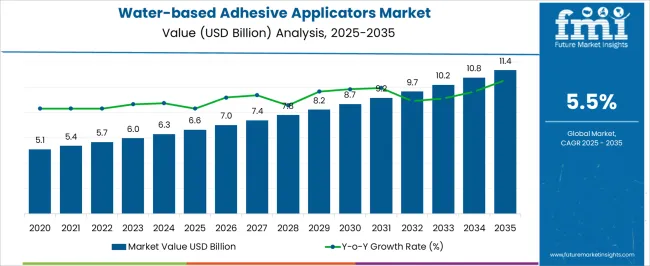
Water-based Adhesive Applicators Market Key Takeaways
| Metric | Value |
|---|---|
| Water-based Adhesive Applicators Market Estimated Value in (2025 E) | USD 6.6 billion |
| Water-based Adhesive Applicators Market Forecast Value in (2035 F) | USD 11.4 billion |
| Forecast CAGR (2025 to 2035) | 5.5% |
Why is the Water-based Adhesive Applicators Market Growing?
The market is experiencing strong momentum due to the global shift toward environmentally friendly adhesive solutions and increasing demand across multiple manufacturing sectors. The current market environment is defined by heightened regulations on volatile organic compounds and growing preferences for non-toxic bonding agents, especially in industries focused on sustainability and compliance.
According to product press releases, investor updates, and industrial news, manufacturers are increasingly integrating intelligent applicator systems that offer precision, reduce waste, and ensure uniform coating. The market outlook remains optimistic, with further expansion expected through advancements in automated application technologies and rising investments in sustainable packaging and construction materials.
A growing emphasis on cost-efficiency, worker safety, and reduced environmental impact is also supporting the widespread adoption of water-based adhesive systems. These dynamics are positioning the market for consistent growth, supported by evolving regulatory standards and increasing reliance on smart, scalable adhesive application systems across industries.
Segmental Analysis
The water-based adhesive applicators market is segmented by automation, end-use industry, distribution channel, and geographic regions. The automation of the water-based adhesive applicators market is divided into Automatic applicators, Manual applicators, and Semi-automatic applicators.
In terms of end-use industry, the water-based adhesive applicators market is classified into the Packaging industry, Furniture & woodworking, Construction & building materials, Automotive & aerospace, Textile & apparel, Metals, Glass, and Others (Foam, textiles/fabrics, leather). The distribution channel of the water-based adhesive applicators market is segmented into Direct and Indirect. Regionally, the water-based adhesive applicators industry is classified into North America, Latin America, Western Europe, Eastern Europe, Balkan & Baltic Countries, Russia & Belarus, Central Asia, East Asia, South Asia & Pacific, and the Middle East & Africa.
Insights into the Automatic Applicators Segment
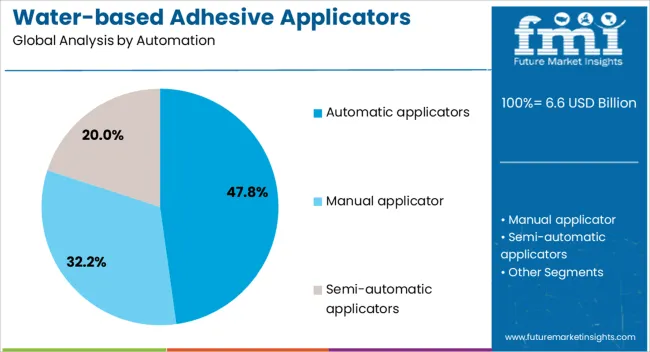
The automatic applicators segment is projected to account for 47.8% of the Water-based Adhesive Applicators market revenue share in 2025, making it the leading automation type. Rising industrial automation trends and the need for high-volume, consistent adhesive application in production environments are driving this dominance.
It has been noted in technology news sources and investor briefings that automatic systems are being adopted to improve process accuracy, minimize material waste, and reduce manual labor dependency. Businesses in packaging, automotive, and textiles are adopting these systems to maintain production efficiency while adhering to environmental compliance standards.
Additionally, the segment’s growth is supported by the integration of smart sensors and control systems, which enable real-time monitoring and adaptive performance adjustments The operational efficiency and long-term cost benefits associated with automatic applicators have positioned them as the preferred choice for large-scale adhesive applications, particularly in facilities prioritizing throughput, consistency, and quality control.
Insights into the Packaging Industry Segment
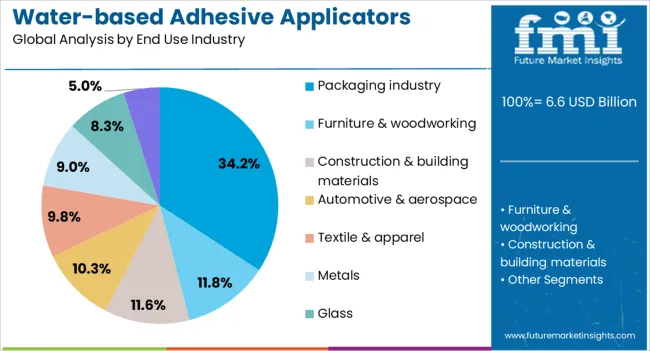
The packaging industry segment is expected to hold 34.2% of the Water-based Adhesive Applicators market revenue share in 2025, emerging as the dominant end use segment. This leadership is attributed to the surge in demand for eco-friendly, recyclable, and lightweight packaging materials across the food, beverage, and consumer goods industries. Press releases and corporate sustainability reports have highlighted that packaging companies are increasingly using water-based adhesives for carton sealing, labeling, and lamination due to their non-toxic nature and regulatory compliance.
The shift toward paper-based and biodegradable packaging formats has further accelerated the adoption of water-based adhesive technologies. Additionally, supply chain updates from packaging manufacturers indicate that these systems enable faster processing and improved bonding strength without compromising recyclability.
The segment’s growth is also reinforced by rising e-commerce activity, which demands high-performance packaging solutions that align with environmental standards. These factors have collectively supported the packaging industry’s leading position in the market.
Insights into the Direct Distribution Channel Segment
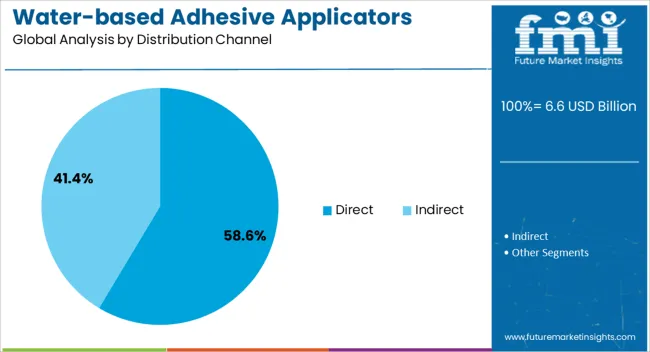
The direct distribution channel segment is anticipated to account for 58.6% of the Water-based Adhesive Applicators market revenue share in 2025, establishing it as the largest distribution channel. This growth is being led by manufacturers’ strategic focus on building direct relationships with industrial clients to offer tailored solutions and comprehensive technical support.
Industry bulletins and press statements have indicated that direct sales allow for better product customization, faster service response, and greater control over delivery timelines. As businesses increasingly prioritize efficiency and reliability in sourcing critical production equipment, direct channels are being favored over third-party or indirect sales models.
Moreover, corporate procurement teams are seeking closer collaboration with adhesive system providers to optimize operational integration and performance monitoring. These factors are contributing to the steady rise of direct distribution as the preferred channel, particularly among large-scale users in the packaging, automotive, and construction sectors who demand consistent quality and after-sales support.
What are the Drivers, Restraints, and Key Trends of the Water-based Adhesive Applicators Market?
The water-based adhesive applicators market is expanding due to the increasing demand for safer and more efficient adhesive solutions across various industries. Water-based adhesives offer key advantages, such as lower levels of volatile organic compounds (VOCs), reduced environmental impact, and easier clean-up compared to solvent-based adhesives. This shift is primarily driven by regulatory pressures and consumer demand for non-toxic products. Industries like packaging, automotive, and construction are adopting these applicators as they align with growing health and safety concerns. As these solutions gain popularity, the market is expected to continue expanding.
Growing Demand for Non-Toxic and Efficient Adhesives
The primary driver for the growth of the water-based adhesive applicators market is the rising preference for non-toxic and efficient adhesive solutions. Water-based adhesives offer safer alternatives to solvent-based adhesives, which contain higher levels of VOCs and other harmful chemicals. As governments around the world impose stricter regulations on the use of harmful substances in manufacturing, water-based solutions are becoming more attractive. These adhesives are ideal for a variety of applications, including packaging, automotive, and construction, where health and safety regulations are becoming more stringent. Their ability to offer effective bonding solutions with reduced environmental impact further boosts their adoption across multiple industries.
Performance Issues and Cost Implications
Despite their many benefits, water-based adhesive applicators face challenges that limit their adoption. One significant issue is the potential performance limitations of water-based adhesives compared to solvent-based options, particularly in certain high-stress applications. Water-based adhesives may not provide the same bonding strength or durability, which can restrict their use in industries requiring strong and long-lasting bonds, such as automotive or heavy-duty packaging. Additionally, the initial cost of water-based adhesive applicators and the specialized equipment required to apply these adhesives can be prohibitive, particularly for small to medium-sized enterprises. The longer drying times associated with water-based adhesives may also slow down production efficiency, making them less suitable for fast-paced manufacturing processes.
Expansion in Packaging and Automotive Sectors
The water-based adhesive applicators market presents significant opportunities for growth, particularly in the packaging and automotive industries. The increasing demand for eco-friendly and safe packaging solutions is a key driver, as businesses look for alternatives to solvent-based adhesives for packaging materials like cartons, labels, and flexible packaging. In the automotive industry, water-based adhesives are being adopted for bonding interior components, trim, and other lightweight materials, especially as the push for safer and more health-conscious manufacturing processes increases. Innovations in water-based adhesives, such as improved bonding strength and faster drying times, offer new opportunities for application in a broader range of industries, expanding the market further.
Adoption of Water-Based Adhesives in Packaging Industry
The adoption of water-based adhesives in the packaging industry is a significant trend. As businesses seek to reduce their reliance on harmful substances and enhance product safety, water-based adhesives are gaining popularity in labeling, carton sealing, and other packaging applications. Advances in formulation technology are enhancing the effectiveness of water-based adhesives, making them suitable for a wider range of packaging materials, including paper, cardboard, and flexible plastics. Furthermore, the growing focus on health and safety standards in the food and beverage packaging sector is contributing to the rise in demand for these adhesives. As consumer preference shifts towards safer and cleaner products, the use of water-based adhesives in packaging will continue to grow, driving innovation in this market.
Analysis of Water-based Adhesive Applicators Market By Key Countries
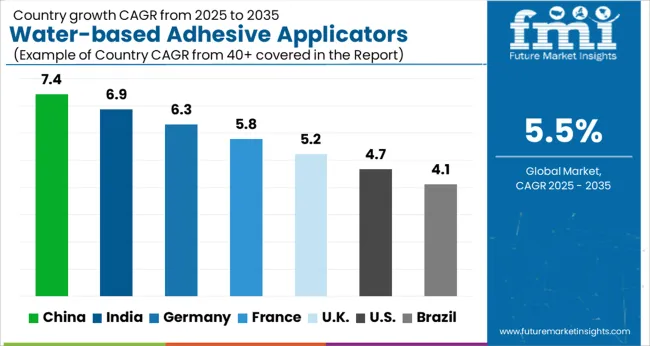
The global water-based adhesive applicators market is projected to grow at a CAGR of 5.5% from 2025 to 2035. China leads at 7.4%, followed by India at 6.9%, and France at 5.8%, while the United Kingdom records 5.2% and the United States posts 4.7%. These rates translate to a growth premium of +35% for China, +26% for India, and +5% for France versus the baseline, while the United States and the United Kingdom show slower growth. Divergence reflects local catalysts: increasing adoption of water-based adhesives in industries like packaging, automotive, and construction in China and India, while more mature markets like the United States and the United Kingdom experience more moderate growth due to established infrastructure and environmental regulations. The analysis includes over 40+ countries, with the leading markets detailed below.
Demand for Water-based Adhesive Applicators in China
The water-based adhesive applicators market in China is growing at a CAGR of 7.4% through 2035. China’s booming manufacturing sector, particularly in packaging and automotive industries, is driving the demand for water-based adhesives. With increasing environmental regulations, there is a growing shift toward eco-friendly adhesives that offer better performance and reduced volatile organic compounds (VOCs). China’s government support for eco-friendly manufacturing practices and innovations in green technologies further accelerates the market growth. The country's focus on expanding its infrastructure and modernizing construction practices contributes to the rising adoption of water-based adhesive applicators.
- The growth of China's manufacturing and packaging sectors drives the demand for water-based adhesives.
- Government regulations promoting eco-friendly solutions accelerate the adoption of water-based adhesive applicators.
- Innovation in green technologies and sustainable manufacturing practices boosts market growth in China.
Growth of Water-based Adhesive Applicators in India
Demand for water-based adhesive applicators in India is projected to grow at a 6.9% CAGR through 2035. The expanding packaging, automotive, and construction sectors in India are the key drivers of market growth. As India focuses on sustainable development and reducing VOC emissions, the adoption of water-based adhesive applicators is increasing. The growing construction industry, along with an increase in eco-conscious consumers, is contributing to the market’s expansion. India’s strong emphasis on improving industrial efficiency and adopting modern manufacturing practices is accelerating the demand for advanced adhesive solutions.
- India’s expanding packaging, automotive, and construction sectors drive the demand for water-based adhesive applicators.
- Government focus on reducing VOC emissions supports the adoption of eco-friendly adhesive solutions.
- The growth of industrial infrastructure and manufacturing modernization contributes to the market expansion in India.
Water-based Adhesive Applicators Market Outlook in France
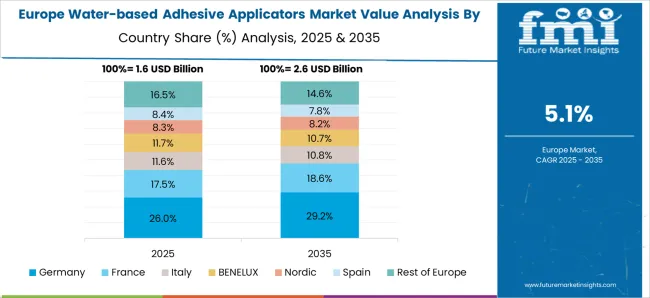
Sale of water-based adhesive applicators in France is growing at a 5.8% CAGR through 2035. France's commitment to reducing environmental impact and promoting green building solutions drives the demand for eco-friendly adhesive applicators. The demand in packaging and automotive sectors continues to rise, with manufacturers opting for water-based adhesives due to their low environmental footprint. The adoption of water-based adhesives in the construction industry, coupled with rising awareness of sustainable manufacturing practices, is contributing to the market growth. France's stringent regulatory standards also encourage the use of environmentally friendly adhesive products.
- France’s commitment to sustainability and eco-friendly solutions accelerates the demand for water-based adhesive applicators.
- The rising demand for eco-friendly adhesives in packaging and automotive sectors drives market growth.
- Construction industry growth and awareness of sustainable building practices contribute to the adoption of water-based adhesives in France.
Demand for Water-based Adhesive Applicators in the United Kingdom
The UK water-based adhesive applicators market is expected to grow at a 5.2% CAGR through 2035. The growing demand for green, sustainable packaging and low-emission adhesives is driving the market for water-based adhesive applicators. With increasing regulations around sustainability and environmental impact, the UK is focusing on reducing the carbon footprint in its manufacturing processes. This shift is pushing more industries, particularly automotive, packaging, and construction, to adopt water-based adhesive solutions. Furthermore, the UK’s strong commitment to innovation in sustainable technologies further accelerates market growth.
- The UK’s focus on sustainability and green packaging solutions drives the adoption of water-based adhesive applicators.
- Government regulations around emissions and environmental impact accelerate market growth in the UK
- Innovation in sustainable technologies further boosts the demand for water-based adhesives in the UK
Adoption Trends in Water-based Adhesive Applicators Market in the United States
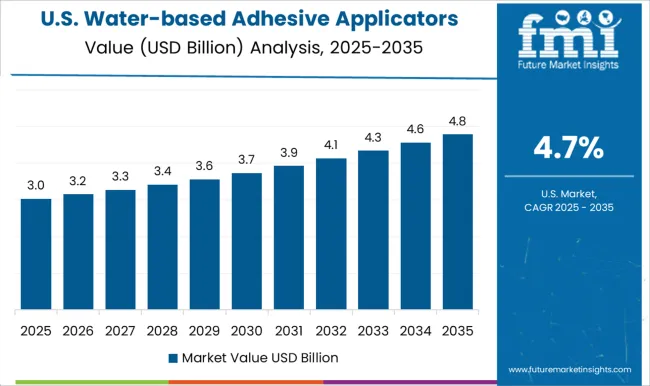
Demand for water-based adhesive applicators in the USA is projected to grow at a 4.7% CAGR through 2035. The USA market is driven by the increasing demand for eco-friendly packaging, automotive applications, and construction products. As regulations around VOCs and emissions tighten, manufacturers are opting for water-based adhesive solutions to meet compliance standards. The growing shift toward sustainable construction materials and packaging solutions, along with increased consumer preference for environmentally friendly products, is contributing to the market’s expansion. The USA is also seeing a rise in innovation and advancements in adhesive technologies that further drive market growth.
- The growing shift toward eco-friendly packaging and automotive solutions drives the demand for water-based adhesives in the USA
- Increasing environmental regulations on VOCs and emissions accelerate the adoption of water-based adhesives.
- Innovation in adhesive technologies and growing consumer demand for sustainable products contribute to the market’s expansion in the USA
Competitive Landscape of Water-based Adhesive Applicators Market
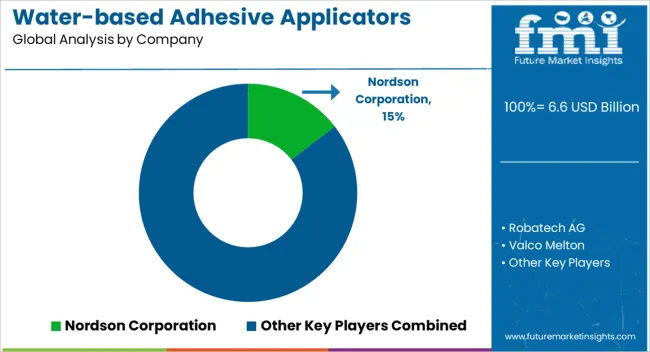
The Water-based Adhesive Applicators Market is growing steadily, driven by the increasing shift toward eco-friendly bonding technologies and the rising demand for low-VOC, non-toxic adhesives in packaging, woodworking, automotive, and construction industries. Water-based adhesive applicators, designed for precise dispensing and efficient coating, are gaining traction due to their compatibility with sustainable adhesives that eliminate solvent emissions while maintaining strong adhesion performance. The market is also benefiting from the expansion of automated manufacturing, sustainability mandates, and the growing use of bio-based polymers in adhesive formulations.
Industry leaders such as Nordson Corporation, Robatech AG, and Valco Melton dominate the market through advanced applicator systems that integrate precision control, automated regulation, and digital monitoring. Nordson Corporation offers a broad portfolio of dispensing and coating applicators optimized for packaging and product assembly, featuring energy-efficient heating and accurate pattern control. Robatech AG focuses on modular, clean-melt water-based applicators with integrated smart controls for reducing material waste and improving sustainability. Valco Melton delivers innovative adhesive application systems with IoT connectivity and closed-loop feedback to ensure consistent glue line quality across production lines.
ITW Dynatec and Graco Inc. strengthen their presence through high-performance applicators designed for paper converting, labeling, and laminating, combining versatility with robust build quality. Bühnen GmbH & Co. KG and Glue Machinery Corporation cater to industrial assembly and packaging sectors with efficient water-based systems that balance performance with operational safety.
Adhesive manufacturers such as Henkel AG & Co. KGaA, 3M Company, Sika AG, Franklin International, and H.B. Fuller Company complement applicator providers by developing water-based adhesive formulations optimized for machine compatibility and durability. Henkel and 3M lead with low-VOC adhesives used in high-speed packaging and laminating lines. Sika AG and H.B. Fuller emphasize construction and woodworking applications, promoting environmental compliance and long-term adhesion strength. Ad Tech (FPC Corporation), Surebonder (FPC Corporation), and Dymax Corporation contribute to small and mid-scale manufacturing with compact, portable applicator solutions suitable for craft, assembly, and maintenance applications.
Scope of the Report
| Item | Value |
|---|---|
| Quantitative Units | USD 6.6 Billion |
| Automation | Automatic applicators, Manual applicator, and Semi-automatic applicators |
| End Use Industry | Packaging industry, Furniture & woodworking, Construction & building materials, Automotive & aerospace, Textile & apparel, Metals, Glass, and Others (Foam, textiles/fabrics, leather) |
| Distribution Channel | Direct and Indirect |
| Regions Covered | North America, Europe, Asia-Pacific, Latin America, Middle East & Africa |
| Country Covered | United States, Canada, Germany, France, United Kingdom, China, Japan, India, Brazil, South Africa |
| Key Companies Profiled | Nordson Corporation, Robatech AG, Valco Melton, ITW Dynatec, Graco Inc., Bühnen GmbH & Co. KG, Glue Machinery Corporation, Henkel AG & Co. KGaA, 3M Company, Sika AG, Franklin International, H.B. Fuller Company, Ad Tech (FPC Corporation), Surebonder (FPC Corporation), Dymax Corporation |
| Additional Attributes | Dollar sales by product type (precision applicators, bulk applicators, automated systems) and end-use segments (packaging, automotive, electronics, construction, furniture). Demand dynamics are driven by the need for sustainable, efficient adhesive solutions and automation in industrial applications. Regional growth is strong in North America and Europe, while Asia-Pacific expands due to increased manufacturing and packaging demands. Innovation focuses on enhancing applicator precision, speed, and energy efficiency with smart applicators offering real-time control. |
Water-based Adhesive Applicators Market by Segments
Automation:
- Automatic applicators
- Manual applicator
- Semi-automatic applicators
End Use Industry:
- Packaging industry
- Furniture & woodworking
- Construction & building materials
- Automotive & aerospace
- Textile & apparel
- Metals
- Glass
- Others (Foam, textiles/fabrics, leather)
Distribution Channel:
- Direct
- Indirect
Region:
- North America
- USA
- Canada
- Mexico
- Latin America
- Brazil
- Chile
- Rest of Latin America
- Western Europe
- Germany
- UK
- Italy
- Spain
- France
- Nordic
- BENELUX
- Rest of Western Europe
- Eastern Europe
- Russia
- Poland
- Hungary
- Balkan & Baltic
- Rest of Eastern Europe
- East Asia
- China
- Japan
- South Korea
- South Asia and Pacific
- India
- ASEAN
- Australia & New Zealand
- Rest of South Asia and Pacific
- Middle East & Africa
- Kingdom of Saudi Arabia
- Other GCC Countries
- Turkiye
- South Africa
- Other African Union
- Rest of Middle East & Africa
Frequently Asked Questions
How big is the water-based adhesive applicators market in 2025?
The global water-based adhesive applicators market is estimated to be valued at USD 6.6 billion in 2025.
What will be the size of water-based adhesive applicators market in 2035?
The market size for the water-based adhesive applicators market is projected to reach USD 11.4 billion by 2035.
How much will be the water-based adhesive applicators market growth between 2025 and 2035?
The water-based adhesive applicators market is expected to grow at a 5.5% CAGR between 2025 and 2035.
What are the key product types in the water-based adhesive applicators market?
The key product types in water-based adhesive applicators market are automatic applicators, manual applicator and semi-automatic applicators.
Which end use industry segment to contribute significant share in the water-based adhesive applicators market in 2025?
In terms of end use industry, packaging industry segment to command 34.2% share in the water-based adhesive applicators market in 2025.
Preview the report firsthand - request a free sample
Get SampleGet the brochure for pricing and purchase details.
Get PDFTable of Content
- Executive Summary
- Global Market Outlook
- Demand-side Trends
- Supply-side Trends
- Technology Roadmap Analysis
- Analysis and Recommendations
- Market Overview
- Market Coverage / Taxonomy
- Market Definition / Scope / Limitations
- Market Background
- Market Dynamics
- Drivers
- Restraints
- Opportunity
- Trends
- Scenario Forecast
- Demand in Optimistic Scenario
- Demand in Likely Scenario
- Demand in Conservative Scenario
- Opportunity Map Analysis
- Product Life Cycle Analysis
- Supply Chain Analysis
- Investment Feasibility Matrix
- Value Chain Analysis
- PESTLE and Porter’s Analysis
- Regulatory Landscape
- Regional Parent Market Outlook
- Production and Consumption Statistics
- Import and Export Statistics
- Market Dynamics
- Global Water-based Adhesive Applicators Market Analysis 2020-2024 and Forecast, 2025-2035
- Historical Market Size Value (USD Mn) Analysis, 2020-2024
- Current and Future Market Size Value (USD Mn) Projections, 2025-2035
- Y-o-Y Growth Trend Analysis
- Absolute $ Opportunity Analysis
- Global Water-based Adhesive Applicators Market Pricing Analysis 2020-2024 and Forecast 2025-2035
- Global Water-based Adhesive Applicators Market Analysis 2020-2024 and Forecast 2025-2035, By Automation
- Introduction / Key Findings
- Historical Market Size Value (USD Mn) Analysis By Automation , 2020-2024
- Current and Future Market Size Value (USD Mn) Analysis and Forecast By Automation , 2025-2035
- Automatic applicators
- Manual applicator
- Semi-automatic applicators
- Y-o-Y Growth Trend Analysis By Automation , 2020-2024
- Absolute $ Opportunity Analysis By Automation , 2025-2035
- Global Water-based Adhesive Applicators Market Analysis 2020-2024 and Forecast 2025-2035, By End Use Industry
- Introduction / Key Findings
- Historical Market Size Value (USD Mn) Analysis By End Use Industry, 2020-2024
- Current and Future Market Size Value (USD Mn) Analysis and Forecast By End Use Industry, 2025-2035
- Packaging industry
- Furniture & woodworking
- Construction & building materials
- Automotive & aerospace
- Textile & apparel
- Metals
- Glass
- Others (Foam, textiles/fabrics, leather)
- Y-o-Y Growth Trend Analysis By End Use Industry, 2020-2024
- Absolute $ Opportunity Analysis By End Use Industry, 2025-2035
- Global Water-based Adhesive Applicators Market Analysis 2020-2024 and Forecast 2025-2035, By Distribution Channel
- Introduction / Key Findings
- Historical Market Size Value (USD Mn) Analysis By Distribution Channel, 2020-2024
- Current and Future Market Size Value (USD Mn) Analysis and Forecast By Distribution Channel, 2025-2035
- Direct
- Indirect
- Y-o-Y Growth Trend Analysis By Distribution Channel, 2020-2024
- Absolute $ Opportunity Analysis By Distribution Channel, 2025-2035
- Global Water-based Adhesive Applicators Market Analysis 2020-2024 and Forecast 2025-2035, By Region
- Introduction
- Historical Market Size Value (USD Mn) Analysis By Region, 2020-2024
- Current Market Size Value (USD Mn) Analysis and Forecast By Region, 2025-2035
- North America
- Latin America
- Western Europe
- Eastern Europe
- East Asia
- South Asia and Pacific
- Middle East & Africa
- Market Attractiveness Analysis By Region
- North America Water-based Adhesive Applicators Market Analysis 2020-2024 and Forecast 2025-2035, By Country
- Historical Market Size Value (USD Mn) Trend Analysis By Market Taxonomy, 2020-2024
- Market Size Value (USD Mn) Forecast By Market Taxonomy, 2025-2035
- By Country
- USA
- Canada
- Mexico
- By Automation
- By End Use Industry
- By Distribution Channel
- By Country
- Market Attractiveness Analysis
- By Country
- By Automation
- By End Use Industry
- By Distribution Channel
- Key Takeaways
- Latin America Water-based Adhesive Applicators Market Analysis 2020-2024 and Forecast 2025-2035, By Country
- Historical Market Size Value (USD Mn) Trend Analysis By Market Taxonomy, 2020-2024
- Market Size Value (USD Mn) Forecast By Market Taxonomy, 2025-2035
- By Country
- Brazil
- Chile
- Rest of Latin America
- By Automation
- By End Use Industry
- By Distribution Channel
- By Country
- Market Attractiveness Analysis
- By Country
- By Automation
- By End Use Industry
- By Distribution Channel
- Key Takeaways
- Western Europe Water-based Adhesive Applicators Market Analysis 2020-2024 and Forecast 2025-2035, By Country
- Historical Market Size Value (USD Mn) Trend Analysis By Market Taxonomy, 2020-2024
- Market Size Value (USD Mn) Forecast By Market Taxonomy, 2025-2035
- By Country
- Germany
- UK
- Italy
- Spain
- France
- Nordic
- BENELUX
- Rest of Western Europe
- By Automation
- By End Use Industry
- By Distribution Channel
- By Country
- Market Attractiveness Analysis
- By Country
- By Automation
- By End Use Industry
- By Distribution Channel
- Key Takeaways
- Eastern Europe Water-based Adhesive Applicators Market Analysis 2020-2024 and Forecast 2025-2035, By Country
- Historical Market Size Value (USD Mn) Trend Analysis By Market Taxonomy, 2020-2024
- Market Size Value (USD Mn) Forecast By Market Taxonomy, 2025-2035
- By Country
- Russia
- Poland
- Hungary
- Balkan & Baltic
- Rest of Eastern Europe
- By Automation
- By End Use Industry
- By Distribution Channel
- By Country
- Market Attractiveness Analysis
- By Country
- By Automation
- By End Use Industry
- By Distribution Channel
- Key Takeaways
- East Asia Water-based Adhesive Applicators Market Analysis 2020-2024 and Forecast 2025-2035, By Country
- Historical Market Size Value (USD Mn) Trend Analysis By Market Taxonomy, 2020-2024
- Market Size Value (USD Mn) Forecast By Market Taxonomy, 2025-2035
- By Country
- China
- Japan
- South Korea
- By Automation
- By End Use Industry
- By Distribution Channel
- By Country
- Market Attractiveness Analysis
- By Country
- By Automation
- By End Use Industry
- By Distribution Channel
- Key Takeaways
- South Asia and Pacific Water-based Adhesive Applicators Market Analysis 2020-2024 and Forecast 2025-2035, By Country
- Historical Market Size Value (USD Mn) Trend Analysis By Market Taxonomy, 2020-2024
- Market Size Value (USD Mn) Forecast By Market Taxonomy, 2025-2035
- By Country
- India
- ASEAN
- Australia & New Zealand
- Rest of South Asia and Pacific
- By Automation
- By End Use Industry
- By Distribution Channel
- By Country
- Market Attractiveness Analysis
- By Country
- By Automation
- By End Use Industry
- By Distribution Channel
- Key Takeaways
- Middle East & Africa Water-based Adhesive Applicators Market Analysis 2020-2024 and Forecast 2025-2035, By Country
- Historical Market Size Value (USD Mn) Trend Analysis By Market Taxonomy, 2020-2024
- Market Size Value (USD Mn) Forecast By Market Taxonomy, 2025-2035
- By Country
- Kingdom of Saudi Arabia
- Other GCC Countries
- Turkiye
- South Africa
- Other African Union
- Rest of Middle East & Africa
- By Automation
- By End Use Industry
- By Distribution Channel
- By Country
- Market Attractiveness Analysis
- By Country
- By Automation
- By End Use Industry
- By Distribution Channel
- Key Takeaways
- Key Countries Water-based Adhesive Applicators Market Analysis
- USA
- Pricing Analysis
- Market Share Analysis, 2024
- By Automation
- By End Use Industry
- By Distribution Channel
- Canada
- Pricing Analysis
- Market Share Analysis, 2024
- By Automation
- By End Use Industry
- By Distribution Channel
- Mexico
- Pricing Analysis
- Market Share Analysis, 2024
- By Automation
- By End Use Industry
- By Distribution Channel
- Brazil
- Pricing Analysis
- Market Share Analysis, 2024
- By Automation
- By End Use Industry
- By Distribution Channel
- Chile
- Pricing Analysis
- Market Share Analysis, 2024
- By Automation
- By End Use Industry
- By Distribution Channel
- Germany
- Pricing Analysis
- Market Share Analysis, 2024
- By Automation
- By End Use Industry
- By Distribution Channel
- UK
- Pricing Analysis
- Market Share Analysis, 2024
- By Automation
- By End Use Industry
- By Distribution Channel
- Italy
- Pricing Analysis
- Market Share Analysis, 2024
- By Automation
- By End Use Industry
- By Distribution Channel
- Spain
- Pricing Analysis
- Market Share Analysis, 2024
- By Automation
- By End Use Industry
- By Distribution Channel
- France
- Pricing Analysis
- Market Share Analysis, 2024
- By Automation
- By End Use Industry
- By Distribution Channel
- India
- Pricing Analysis
- Market Share Analysis, 2024
- By Automation
- By End Use Industry
- By Distribution Channel
- ASEAN
- Pricing Analysis
- Market Share Analysis, 2024
- By Automation
- By End Use Industry
- By Distribution Channel
- Australia & New Zealand
- Pricing Analysis
- Market Share Analysis, 2024
- By Automation
- By End Use Industry
- By Distribution Channel
- China
- Pricing Analysis
- Market Share Analysis, 2024
- By Automation
- By End Use Industry
- By Distribution Channel
- Japan
- Pricing Analysis
- Market Share Analysis, 2024
- By Automation
- By End Use Industry
- By Distribution Channel
- South Korea
- Pricing Analysis
- Market Share Analysis, 2024
- By Automation
- By End Use Industry
- By Distribution Channel
- Russia
- Pricing Analysis
- Market Share Analysis, 2024
- By Automation
- By End Use Industry
- By Distribution Channel
- Poland
- Pricing Analysis
- Market Share Analysis, 2024
- By Automation
- By End Use Industry
- By Distribution Channel
- Hungary
- Pricing Analysis
- Market Share Analysis, 2024
- By Automation
- By End Use Industry
- By Distribution Channel
- Kingdom of Saudi Arabia
- Pricing Analysis
- Market Share Analysis, 2024
- By Automation
- By End Use Industry
- By Distribution Channel
- Turkiye
- Pricing Analysis
- Market Share Analysis, 2024
- By Automation
- By End Use Industry
- By Distribution Channel
- South Africa
- Pricing Analysis
- Market Share Analysis, 2024
- By Automation
- By End Use Industry
- By Distribution Channel
- USA
- Market Structure Analysis
- Competition Dashboard
- Competition Benchmarking
- Market Share Analysis of Top Players
- By Regional
- By Automation
- By End Use Industry
- By Distribution Channel
- Competition Analysis
- Competition Deep Dive
- Nordson Corporation
- Overview
- Product Portfolio
- Profitability by Market Segments (Product/Age /Sales Channel/Region)
- Sales Footprint
- Strategy Overview
- Marketing Strategy
- Product Strategy
- Channel Strategy
- Robatech AG
- Valco Melton
- ITW Dynatec
- Graco Inc.
- Bühnen GmbH & Co. KG
- Glue Machinery Corporation
- Henkel AG & Co. KGaA
- 3M Company
- Sika AG
- Franklin International
- H.B. Fuller Company
- Ad Tech (FPC Corporation)
- Surebonder (FPC Corporation)
- Dymax Corporation
- Nordson Corporation
- Competition Deep Dive
- Assumptions & Acronyms Used
- Research Methodology


