
- Market Size (2026)
- USD 2520.0 Mn
- Forecast (2036)
- USD 4512.9 Mn
- CAGR (2026 to 2036)
- 6.0%
How big is the Linear LED Strip Fixtures Market in 2026?
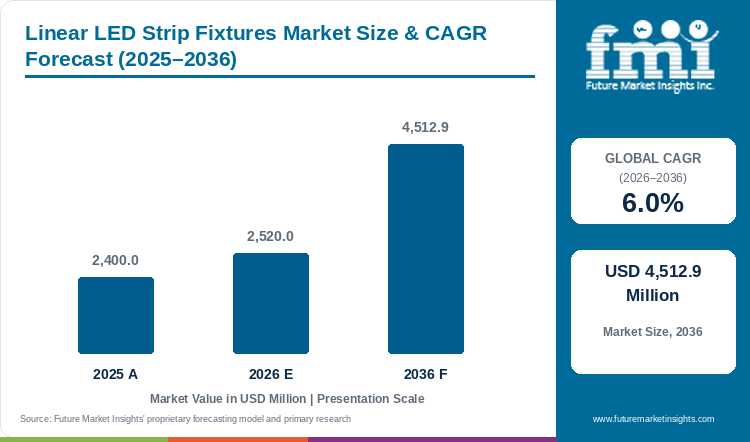
FMI projects the global linear LED strip fixtures market at USD 4,512.9 million in 2036, a 6.0% CAGR across 2026 to 2036. The market was valued at USD 2,400.0 million in 2025, and FMI estimates USD 2,520.0 million for 2026.
Linear LED Strip Fixtures Market Size and Forecast
Table 1: Linear LED Strip Fixtures Market Size and Forecast
| Market size and forecast | Value |
|---|---|
| Market size in 2025 | USD 2,400.0 million |
| Estimated market size in 2026 | USD 2,520.0 million |
| Projected market size by 2036 | USD 4,512.9 million |
| CAGR from 2026 to 2036 | 6.0% |
Source: Future Market Insights analysis of the linear LED strip fixtures market, 2026.
Replacement orders are dividing between inexpensive integrated shop lights and more configurable commercial battens. Installed project cost depends on more than the fixture price. The US General Services Administration's 2024 P100 lighting approach excludes Type B tubular LED replacements because of potential incompatibility and safety concerns.
Supplier investment supports a more differentiated replacement offer. Signify introduced expanded Dynalite wireless capabilities in October 2026, allowing compatible wireless devices to operate alongside its wired controls. At the simpler end, Feit Electric sells an assembled shop light with integrated LEDs and hanging or flush-mount options. These offers address different budgets and installation conditions. FMI expects that separation to sustain demand even when building projects slow. Signify's October 2026 results described weakness in Professional Europe and softer US project demand, so efficiency upgrades reach orders more slowly. The wider LED light market provides context, while this assessment isolates complete linear fixtures.
Key Market Trends & Insights
- Configurable fittings reduce the number of distinct installation variants a channel must manage. LEDVANCE's linear range includes Multi Select battens, DALI products and separate emergency and sensor upgrade kits.
- Serviceability is becoming a competitive feature alongside luminous output. One lighting group reported that serviceable professional luminaires were the main contributor to its circular revenue measure in 2025.
- Product classification affects the addressable sale. OPPLE's catalogue separates linear luminaires and battens from flexible strips, tubes and modules. Counting all of those categories as strip fixtures would overstate the opportunity for assembled luminaires.
Regional Highlights
- The weight of India, China and Brazil in global revenue increases. FMI projects India from 6.0% to 8.1%, China from 20.0% to 21.4% and Brazil from 3.0% to 3.2% over 2026 to 2036.
- Global share declines for Germany, the United States and Japan even as revenue grows. FMI's 2036 shares are Germany 5.3% (from 6.0%), the United States 17.7% (from 19.0%) and Japan 4.2% (from 5.0%).
Analyst Perspective
“The supplier's difficult decision is how much capability to carry in a stocked fixture. Too many fixed configurations tie up channel inventory, while an excessively basic product can be excluded from a commercial replacement programme. Selectable output, suitable mounting hardware and a clear route to emergency or sensor options help reconcile those pressures. The strongest offer matches the installed building and the purchasing channel without charging every customer for functions that the project does not require.”
- Sudip Saha, Co-founder, FMI
How is the Linear LED Strip Fixtures Market segmented?
- By application: Commercial, Residential, Industrial and Warehouse, and Retail and Hospitality.
- By mounting: Surface Mounted, Suspended, Recessed, and Under-Cabinet and Linkable.
- By sales channel: Wholesale and Distributors, Home Improvement and Retail, and Online.
- By region: North America, Latin America, Western Europe, East Asia, South Asia, and Rest of world.
Why does the Commercial segment lead by Application in the Linear LED Strip Fixtures Market in 2026?
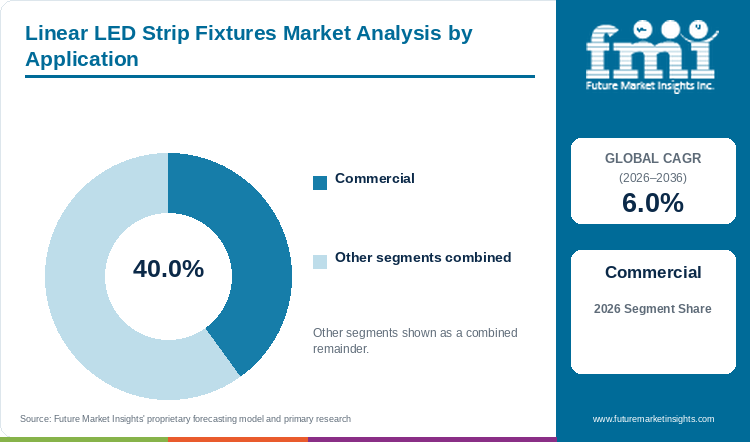
The Commercial segment holds 40.0% of the Linear LED Strip Fixtures Market by application in 2026.
Commercial replacement combines repeatable room layouts with a requirement to maintain the lighting performance of occupied premises. Procurement consequently includes more than the fixture body. A replacement must fit the existing installation schedule and deliver the necessary light distribution across rooms of different layout. Thorn describes PopPack as a linear LED batten for direct replacement of traditional fluorescent or LED fittings, with optional beam distributions. The product provides a concrete example of an offer organised around replacement conditions.
Commercial leads the individual application categories, although other applications together represent 60.0% of revenue. FMI projects the commercial category at USD 1,828.4 million in 2036, when its share reaches 40.5%. That relatively stable position suggests that the decade's growth is distributed across more than one type of property. Industrial and Warehouse demand grows at 6.6% CAGR, compared with 6.1% for Commercial.
The commercial supplier implication is to maintain a replacement family with documented optical and electrical variants. An office service area and a larger utility room may use a similar linear housing but require different output or controls. Orders become easier to repeat when those differences are identified within one product family. The evidence supports a portfolio strategy, since no single batten specification suits every commercial building.
Residential, Industrial and Warehouse and Retail and Hospitality together hold the remaining 60.0% by application.
Table 2: Application, 2026 Share
| Leading Share | 2026 market share |
|---|---|
| Commercial | 40.0% |
| All Other Segments Combined Share | 60.0% |
Source: Future Market Insights analysis of the linear LED strip fixtures market, 2026.
Why does the Surface Mounted segment lead by Mounting in the Linear LED Strip Fixtures Market in 2026?
The Surface Mounted segment holds 45.0% of the Linear LED Strip Fixtures Market by mounting in 2026.
Surface mounting leads where complete fittings are replaced at an existing lighting point. The commercial advantage depends on the usable mounting arrangement and the time required to complete the work. Acuity's CSS product announcement lists surface, jackchain and aircraft-cable options, together with tool-free entry.
The category is forecast to reach USD 1,933.9 million in 2036. Its share declines to 42.9% as other formats expand. Under-Cabinet and Linkable demand grows at 7.0% CAGR and reaches a 21.9% share by 2036. Suspended products grow at 6.5% CAGR, while Recessed products advance at 5.5%. A leading surface category therefore coexists with faster-growing alternatives.
Suppliers need to distinguish a genuinely convertible fixture from a range that uses separate bodies or accessories. A standard housing in stock covers only some installation configurations. The order also needs the specified brackets, suspension kit or connector arrangement. FMI expects a clear accessory schedule to support distributor repeat business because it reduces incomplete shipments. Architectural continuity remains a separate consideration for recessed and suspended installations. Their commercial value depends on more than housing length.
Suspended, Recessed and Under-Cabinet and Linkable together hold the remaining 55.0% by mounting.
Table 3: Mounting, 2026 Share
| Leading Share | 2026 market share |
|---|---|
| Surface Mounted | 45.0% |
| All Other Segments Combined Share | 55.0% |
Source: Future Market Insights analysis of the linear LED strip fixtures market, 2026.
Why does the Wholesale and Distributors segment lead by Sales Channel in the Linear LED Strip Fixtures Market in 2026?
The Wholesale and Distributors segment holds 50.0% of the Linear LED Strip Fixtures Market by sales channel in 2026.
The distributor route links repeat contractor orders with local product availability. Acuity's 2025 annual disclosure identifies electrical distributors among its principal routes to customers, alongside agencies, retailers and direct accounts. Its CSS announcement also explicitly describes distributor stock as central to that product line. These company disclosures substantiate the channel mechanism.
FMI expects Wholesale and Distributors revenue to reach USD 2,041.6 million in 2036. The channel's share falls to 45.2% because Online grows more quickly, at 8.9% CAGR. Online revenue reaches USD 1,186.8 million by 2036, compared with USD 504.0 million in 2026. Home Improvement and Retail remains another substantial route, with USD 756.0 million in 2026 revenue.
The competitive response differs across channels. A contractor buying a controlled commercial batten may need a compatible replacement from local stock. A household buyer purchasing several plug-in shop lights can compare pack prices and delivery terms online. Manufacturers must decide which functions and service obligations travel with each route. Distributor support earns its place when it resolves a specific installation or replenishment problem. It becomes harder to defend when the same standard pack is readily available through a low-service online transaction. Driver electronics for these fittings are covered in FMI's non-isolated LED drivers market.
Home Improvement and Retail and Online together hold the remaining 50.0% by sales channel.
Table 4: Sales Channel, 2026 Share
| Leading Share | 2026 market share |
|---|---|
| Wholesale and Distributors | 50.0% |
| All Other Segments Combined Share | 50.0% |
Source: Future Market Insights analysis of the linear LED strip fixtures market, 2026.
What are the key drivers restraints and opportunities?
Complete-fitting replacement supports demand, while project deferrals and low-price alternatives constrain realization. Configurable products and carefully scoped controls offer suppliers a route to more valuable replacement orders.
Driver
Fluorescent supply changes and building-efficiency requirements bring existing lighting points into replacement plans. Their effect depends on the applicable product and national timetable.
Restraint
A building owner can defer a project even when the replacement has an efficiency case. An October 2026 commentary on European and US project conditions shows weak purchasing even where policy supports upgrades.
Opportunity
Product families that accommodate several mounting and control requirements serve a broader set of replacement jobs from fewer stocked configurations.
How do purchasing rules and qualification affect linear LED strip fixtures market demand?
The next stage of demand includes both fluorescent replacement and renewal of earlier LED fittings. Those purchases differ. Replacing a fluorescent assembly may remove a ballast and change the light source arrangement. Replacing an existing integrated LED fitting may instead be driven by the driver's condition or by a revised room requirement. A product family that addresses both cases has access to a wider installed base, but must specify which electrical and mechanical arrangements it supports.
Japan's regulatory calendar provides a visible reason to plan fluorescent replacement. Its Ministry of the Environment states that straight fluorescent lamps will face manufacturing and import/export prohibitions from January 2028, with halophosphate types affected a year earlier. This is a supply timetable. Suppliers can compete for planned replacement programmes as the deadline approaches.
What limits reliable linear LED strip fixtures market supply and quality?
The low-value end of the market places pressure on the revenue earned from rising unit demand. Pack sizes and optional equipment also obscure price comparisons. Comparing only length or advertised lumens can lead to an incorrect replacement decision.
US federal guidance illustrates another boundary. A supplier still needs to establish that its own fitting meets the project's electrical and lighting requirements. Incorrect substitutions create rework and returns, which can remove the savings associated with an inexpensive unit. Commercial risk therefore sits partly in specification control and order completeness.
Where can suppliers win additional business in the linear LED strip fixtures market?
The opportunity is to sell a replacement family that lets a buyer specify the necessary functions on one housing across jobs. LEDVANCE's upgrade kits demonstrate one documented approach, while another supplier's mounting and embedded-control options show another. The useful distinction is whether the offered configuration actually reduces work within the customer's replacement programme.
Controls can extend the opportunity, but separately sold gateways and software remain outside this fixture valuation. The October 2026 Dynalite update added wireless output support at launch, while support for wireless inputs was scheduled for November. Maintaining that distinction is important when a project depends on a specific sensor or panel. The broader smart industrial illumination market covers a larger system offer. A strip-fixture supplier captures only the portion for which it supplies the actual luminaire and included functions.
Linear LED Strip Fixtures Market by Country (2026 to 2036)
Table 5: Linear LED Strip Fixtures Market Country Growth Forecast
| Country | CAGR, 2026 to 2036 |
|---|---|
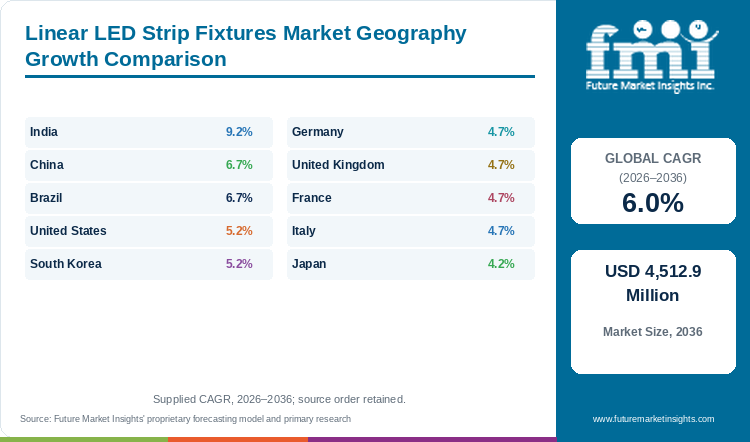
| India | 9.2% |
| China | 6.7% |
| Brazil | 6.7% |
| United States | 5.2% |
| South Korea | 5.2% |
| Germany | 4.7% |
| United Kingdom | 4.7% |
| France | 4.7% |
| Italy | 4.7% |
| Japan | 4.2% |
Source: Future Market Insights analysis of the linear LED strip fixtures market, 2026.
India
India offers the fastest growth in the national comparison, with a 9.2% CAGR forecast for 2026 to 2036. Revenue rises from USD 151.2 million in 2026 to USD 366.0 million in 2036. The opportunity includes expansion of the installed building base as well as replacement. India records a USD 214.8 million increase, third of the ten. Global revenue share for India increases from 6.0% to 8.1%.
The Ministry of Power's April 2025 statement identifies the Energy Conservation and Sustainable Building Code for commercial buildings and Eco Niwas Samhita for residential buildings. It explicitly states that adoption and implementation rest with states and local bodies. That qualification matters to suppliers. Contractors need to understand the applicable project requirements where the building is being delivered.
For linear fixtures, an expanding commercial base creates room for stock battens with predictable installation requirements. A supplier also needs a route into the local electrical channel and an assortment that meets the buyer's price level. One lighting group's 2025 results described strong fourth-quarter performance in India within its broader business. That provides a company-specific demand signal for India. FMI expects the strongest commercial results where range availability and documented performance accompany competitive pricing. Premium controls will serve suitable projects, while standard complete fittings remain important to the larger unit opportunity.
China
China's product-efficiency requirements are being revised while manufacturers continue to sell through the existing installation cycle. In March 2026, the State Administration for Market Regulation announced GB 30255, 2026 for indoor LED lighting products. It is scheduled to take effect on 1 September 2027. The revision extends coverage and introduces standby-energy requirements, among other changes. That date separates current orders from products being prepared for the next compliance cycle.
FMI forecasts Chinese revenue to rise from USD 504.0 million in 2026 to USD 967.4 million in 2036, a 6.7% CAGR over 2026 to 2036. Global revenue share for China increases from 20.0% to 21.4%. The USD 463.4 million rise over the decade ranks China first for increase. The commercial question is how efficiently suppliers maintain a sellable range during a standards transition. A product with dimming or colour adjustment needs to be assessed in its relevant category. Suppliers that already maintain test records for several configurations can prepare revised ranges with less disruption to their channel catalogue.
Domestic demand also includes simple replacement battens and more specialised commercial fittings. OPPLE's range provides a visible example of that breadth, with batten products listed separately from flexible strips and replacement tubes. Complete-fixture demand covers the batten products only. The larger sales opportunity lies in maintaining the right assortment for a particular channel while avoiding obsolete configurations as requirements change.
Brazil
Brazil's new building-efficiency regulation creates a distinct new-construction opportunity. The Ministry of Mines and Energy explains that CGIEE Resolution 4/2025 sets minimum efficiency levels for new residential, commercial, service and public buildings. It explicitly excludes existing buildings, including those undergoing renovation.
The ministry's timetable includes an A-level requirement for federal public buildings from 2027 and a minimum C level for commercial and service buildings in larger municipalities from 2028. Lighting suppliers need to support the project team's performance assessment with an accurately specified product. A low-cost fitting can remain commercially attractive if the overall building meets its required level. A more expensive configuration must earn its place through the actual project design.
FMI projects Brazil at USD 75.6 million in 2026 and USD 145.1 million in 2036, a 6.7% CAGR over 2026 to 2036. Global revenue share for Brazil increases from 3.0% to 3.2%. Growth of USD 69.5 million leaves Brazil sixth among the ten named countries. A 6.7% CAGR leaves Brazil 0.7 points above the 6.0% global pace. The forecast includes replacement activity that remains governed by its own commercial economics. Manufacturers and importers therefore face two sales arguments: compliance support for applicable new projects, and an independent replacement case for existing premises. Combining them would obscure which part of demand is policy-driven. Suppliers with both straightforward stock products and documented professional options can address those routes with clearer quotations.
United States
American purchasing separates project-specified commercial strips from retail shop-light packs. Lithonia's CSS offer includes embedded controls and emergency options, while Feit Electric documents an assembled integrated shop light for hanging or flush mounting.
The United States accounts for USD 478.8 million in 2026 revenue. FMI projects a 5.2% CAGR from 2026 to 2036, reaching USD 797.5 million by the end of the period. A 5.2% CAGR leaves the United States 0.8 points below the 6.0% global pace. By 2026 revenue the United States ranks second among the ten named countries. Replacement activity supports that outlook, but buyers still choose between lamp conversion and complete-fitting replacement. GSA's current guidance retains its 2024 P100 exclusion of Type B tubular LED products because of incompatibility and safety concerns. The exclusion applies to federal projects, while private premises operate under their own requirements and project decisions.
Distributor availability is a further differentiator. A commercial contractor may need an exact emergency or control variant quickly, which supports a channel able to identify the correct order code and accessories. One supplier's disclosure identifies electrical distributors as one of its principal sales routes. Retail-oriented suppliers compete through a different combination of product packaging and consumer access. Suppliers with both project support and standard stocked products must keep the two service promises commercially workable.
South Korea
South Korea's efficiency-management system distinguishes luminaire categories from replacement LED lamps. The Korea Energy Agency's high-efficiency product search includes recessed and fixed LED luminaires, sensor luminaires and other defined equipment. It separately identifies fluorescent-replacement LED lamps.
FMI expects the South Korean market to grow at 5.2% CAGR from 2026 to 2036. Revenue rises from USD 75.6 million in 2026 to USD 125.9 million in 2036. South Korea's share of world revenue is 3.0% in 2026 and 2.8% by 2036. South Korea records a USD 50.3 million increase, ninth of the ten. South Korea posts 5.2% annual growth against 6.0% for the global market, 0.8 points below the global rate. The commercial opportunity depends partly on presenting the correct certified product configuration to the buyer. A surface-mounted fitting with a sensor or control option must be assessed as the relevant offered assembly.
Testing capacity is available through organisations such as the Korea Testing and Research Institute, which lists lighting safety, performance and efficiency-related test services. The supplier implication is to plan certification and product records alongside range development. A product that is straightforward to purchase online elsewhere may need a different documented route into a Korean professional project. FMI expects the more defensible offers to maintain a clear relationship between catalogue number, tested configuration and intended installation. Price competition continues, but it takes place within those product-level requirements.
Germany
German lighting projects need an up-to-date financing case. The revised BEG individual-measures guideline published in August 2026 lists eligible non-heating system measures without a separate indoor-lighting item. KfW also confirms that programme conditions changed from 21 July 2026. A lighting-only replacement needs a financing case built on the current guideline. Wider building-renovation financing has its own eligibility conditions.
Against that setting, FMI expects Germany to record 4.7% CAGR from 2026 to 2036. Revenue increases from USD 151.2 million to USD 240.1 million. The growth case must stand on the actual replacement requirement and installed project economics. A product's light output and control compatibility matter because a buyer may combine lighting work with a broader refurbishment. The financing treatment then follows that project's eligibility.
Local competition also spans basic battens and more adaptable professional products. LEDVANCE lists linear surface products with DALI functions and separate emergency or sensor upgrades. Such options give distributors a way to quote a defined function set from one fitting family. Their commercial value depends on the existing building and the buyer's maintenance plan. A sophisticated configuration costs more than a small utility area usually justifies. FMI expects disciplined range selection to matter in Germany because funding changes place greater attention on the customer's own investment case and on avoiding unnecessary installation work.
United Kingdom
The United Kingdom is already beyond the expiry date of several general-lighting fluorescent mercury exemptions in Great Britain. Defra's determinations state that the relevant T5 and T8 linear-lamp exemptions expired on 1 February 2024. Those determinations apply to England, Scotland and Wales. Product compliance and territorial scope must be checked for each specialised lamp and each UK jurisdiction.
This creates a continuing replacement opportunity, but the first commercial decision remains whether to replace the light source or the entire fitting. Integrated strip fixtures compete for the latter order. A wholesaler that can match the required output and mounting arrangement has a practical advantage when a contractor is replacing a row of fittings within a short access window. Conversely, a complete replacement can lose the order if the installation work exceeds the customer's budget or if another compliant route preserves the existing housing more economically.
FMI forecasts 4.7% CAGR from 2026 to 2036 for the UK, with revenue increasing from USD 126.0 million to USD 200.1 million. Thorn's PopPack documentation illustrates a product family explicitly organised around direct replacement of traditional fittings. The supplier's task is to translate that proposition into a correctly specified order. Emergency functions, controls and mounting accessories need to be resolved at quotation stage, since late changes can turn a straightforward replacement into a longer project.
France
France's tertiary-building framework makes continuing energy performance a property-management issue. The government's September 2025 guidance describes targets of at least 40.0% lower final energy consumption in 2030, 50.0% in 2040 and 60.0% in 2050. It also requires annual reporting through OPERAT and covers qualifying tertiary floor area of at least 1,000 square metres. Lighting is one possible lever within a wider building programme. The target applies to the whole building and names no fixture type.
That reporting structure can favour projects where the lighting replacement and its controls are defined together. The commercial buyer needs to understand the lighting contribution to the building's energy plan. A supplier offering only an advertised lumen figure leaves the contractor to resolve operating schedules, zoning and the treatment of existing equipment. A documented fitting with appropriate controls can be easier to incorporate into the wider plan, provided its additional cost fits the project.
French market revenue is forecast to rise from USD 100.8 million in 2026 to USD 160.1 million in 2036. FMI's CAGR is 4.7% for 2026 to 2036. The opportunity includes offices and public-service premises, while separately classified retail and hospitality applications retain their own commercial requirements. Product availability through a local professional channel remains significant because replacements occur within occupied buildings. FMI expects repeatable product families to gain where property managers standardise several buildings, although project schedules differ by building.
Italy
Italy's Conto Termico 3.0 gives eligible lighting replacement a detailed technical test. GSE's February 2026 guidance specifies accredited testing, minimum light-source performance and a ceiling on installed power relative to the replaced system. It requires the new lighting equipment's installed power to be no more than 50.0% of the replaced power while maintaining applicable lighting criteria. Eligibility therefore depends on tested performance and the installed-power ratio.
For a strip-fixture supplier, the commercial work begins with the existing installation. The quote must connect the proposed fittings to that baseline and provide the documentation needed by the project. The lighting designer still has to meet the relevant illumination requirements. An underpowered product chosen only to meet the power ratio can compromise the project. This creates room for professional support, and low-priced integrated battens need qualification before they are marketed as incentive-ready.
Italian revenue is forecast at USD 75.6 million in 2026, growing to USD 120.1 million by 2036. FMI's 4.7% CAGR for 2026 to 2036 reflects demand across several applications. OPPLE's Italian catalogue lists both batten luminaires and separate flexible strips, making the product boundary visible in the local offer. Suppliers need to preserve that distinction when documenting the project. FMI expects a clear evidence package and the right channel support to matter particularly in eligible renovations, where an incomplete specification can delay the wider application and the associated fixture order.
Japan
Japan has a specific fluorescent supply timetable, which gives building owners a reason to plan replacement before products become harder to procure. The Ministry of the Environment distinguishes lamp types and dates. Straight fluorescent lamps generally face manufacture and import/export prohibition from January 2028, while halophosphate versions are affected from January 2027. The ministry also states that existing fluorescent lamps remain legal to use, sell and purchase. The change therefore creates a managed transition for installed fittings.
FMI projects Japanese revenue of USD 126.0 million in 2026 and USD 190.7 million in 2036. The 4.2% CAGR from 2026 to 2036 is the lowest among the ten named markets. A lower growth rate is consistent with a replacement market where the timing of work and the choice of replacement route matter more than rapid new-site expansion. Only part of the lamp base affected by the supply rules becomes a sale of a complete linear fixture.
Suppliers must distinguish between compatible lamp replacement and an integrated fitting that changes the maintenance arrangement. A full fixture order needs a defensible installation plan and clear responsibility for the driver and light source. Maintenance teams also need to know what will be replaced if an integrated component fails. The useful commercial offer combines a suitable product with a staged replacement schedule, allowing work to fit building access and maintenance budgets. Alarm-based selling around a misunderstood ban risks undermining that planning process.
Who are the notable companies in the Linear LED Strip Fixtures Market?
Notable companies in the Linear LED Strip Fixtures Market include Signify, Acuity Brands, Zumtobel Group, Ledvance and Opple Lighting.
The market includes professional lighting groups with extensive product families and suppliers whose offer is organised around readily purchased shop-light packs. Signify and Acuity Brands combine luminaires with controls and multiple routes to market. Acuity's parent company changed its name to Acuity Inc. in March 2025, while Acuity Brands Lighting remains the lighting segment. Zumtobel Group's Thorn brand supplies the PopPack batten family, while Ledvance and Opple Lighting list several linear and batten configurations. Feit Electric and Barrina provide identifiable integrated shop-light products for simpler installations.
These companies do not compete on one uniform specification. The professional order can include emergency functionality, dimming, documented optics and accessories. A standard retail pack has a different support and pricing structure. FMI expects successful range management to preserve those differences.
Ownership history also matters. Signify completed its acquisition of Cooper Lighting Solutions from Eaton in March 2020. Cooper's lighting offer therefore sits inside Signify.
Professional luminaire and controls portfolios: Signify, Acuity Brands, Zumtobel Group, Ledvance, and Opple Lighting.
Integrated shop-light and retail-oriented offers: Feit Electric and Barrina.
Other company coverage: Hyperikon.
Key Developments in the Linear LED Strip Fixtures Market
- In October 2026, Signify expanded Dynalite with Zigbee wireless output support alongside its existing wired platform. Wireless input support was scheduled for November, so a project must check the relevant function's availability.
- On 8 March 2026, Zumtobel presented the LERIMA office-lighting family with a Zhaga Book 20 interface and a mounting system designed for installation and maintenance. This is a broader professional-lighting development that indicates competitive capability.
Key Players in the Linear LED Strip Fixtures Market
- Signify
- Acuity Brands
- Zumtobel Group
- Ledvance
- Opple Lighting
- Feit Electric
- Barrina
- Hyperikon
Linear LED Strip Fixtures Market Report Scope
Table 6: Linear LED Strip Fixtures Market Report Scope
| Coverage field | Report scope |
|---|---|
| Market definition | Linear shop lights, battens, under-cabinet and linkable strip luminaires incorporating integrated LED boards. |
| Application boundary | Residential, general Commercial, Industrial and Warehouse, and separately classified Retail and Hospitality demand. |
| Exclusions | Flexible LED tape sold by length, bare LED boards, replacement tubes, standalone controls/software, outdoor road luminaires and general installation labour. |
| Quantitative Units | USD million |
| Market breakdown | Application, Mounting, and Sales Channel. |
| National coverage | China, United States, Germany, India, Japan, United Kingdom, France, Brazil, Italy, and South Korea. Rest of world is a separate aggregate. |
| Company coverage | Signify, Acuity Brands, Zumtobel Group, Ledvance, Feit Electric, Opple Lighting, Barrina, and Hyperikon. |
| Commercial coverage | Complete-fitting replacement, new-building specifications, mounting options, channel mix, product documentation and control compatibility. |
Source: Future Market Insights analysis of the linear LED strip fixtures market, 2026.
Linear LED Strip Fixtures Market Research Methodology
This assessment combines FMI's complete-fixture outlook with secondary review of official product rules, building-efficiency requirements and original supplier documentation. The analysis separates luminaires from replacement lamps, flexible strips and separately sold controls. Numerical review checks units, shares and country coverage. Company comparisons distinguish product capabilities from corporate ownership history.
Linear LED Strip Fixtures Market by Segments
Linear LED Strip Fixtures Market segmented by Application:
- Commercial
- Residential
- Industrial and Warehouse
- Retail and Hospitality
Linear LED Strip Fixtures Market segmented by Mounting:
- Surface Mounted
- Suspended
- Recessed
- Under-Cabinet and Linkable
Linear LED Strip Fixtures Market segmented by Sales Channel:
- Wholesale and Distributors
- Home Improvement and Retail
- Online
Linear LED Strip Fixtures Market by Region
- North America
- United States
- Latin America
- Brazil
- Western Europe
- Germany
- United Kingdom
- France
- Italy
- East Asia
- China
- Japan
- South Korea
- South Asia
- India
- Rest of world
- Aggregate of other markets
Research Sources and Bibliography
- Acuity Brands Lighting. (Accessed 2026, November 9). The New CSS Strip Light is Here!
- Acuity Inc. (2025). Annual report, Description of Business and Basis of Presentation. US Securities and Exchange Commission filing.
- Barrina. (Accessed 2026, November 9). T5 45W LED Shop Lights 8FT, ABX45.
- Department for Environment, Food and Rural Affairs, United Kingdom. (2023, February 1). RoHS exemption applications: Secretary of State determinations.
- Federal Ministry for Economic Affairs and Energy, Germany. (2026, August 17; published August 27). Guideline for Federal Funding for Efficient Buildings, Individual Measures, section 5.2. BAnz AT 27.08.2026 B1.
- Feit Electric. (Accessed 2026, November 9). 4 ft. 45W Cool White (4000K) Pull Chain Dual Lamp LED Shop Light, SHOP/4X2/840/V1.
- French Ministry for Ecological Transition. (2025, September 9, updated). Éco Énergie Tertiaire.
- Gestore dei Servizi Energetici. (2026, February 19). Conto Termico 3.0: requirements for replacing lighting systems with LED or higher-efficiency systems, KB0017751.
- KfW. (Accessed 2026, November 9). Changes to Federal Funding for Efficient Buildings from July 2026.
- Korea Energy Agency. (Accessed 2026, November 9). High-efficiency equipment certification system and product categories.
- Korea Testing and Research Institute. (Accessed 2026, November 9). Lighting equipment safety, performance and life testing.
- LEDVANCE. (Accessed 2026, November 9). Linear luminaires: professional portfolio.
- Ministry of Mines and Energy, Brazil. (2025, September 26; accessed 2026, November 9). CGIEE Resolution 4/2025: minimum building energy-efficiency levels.
- Ministry of Power, Government of India. (2025, April 3). Target of Doubling Energy Efficiency. Press Information Bureau.
- Ministry of the Environment, Japan. (Accessed 2026, November 9). Regulation of general-lighting fluorescent lamps.
- OPPLE Lighting. (2026, April and October; accessed November 9). Product catalogue and innovation brochure.
- Signify. (2020, March 2). Signify successfully completes acquisition of Cooper Lighting Solutions.
- Signify. (2026, January 30). Signify's fourth quarter and full-year results 2025.
- Signify. (2026, October 19). No Strings Attached: Signify Dynalite extends platform with hybrid wireless control.
- Signify. (2026, October 23). Signify's third quarter results 2026.
- State Administration for Market Regulation, China. (2026, March 18). New national energy-efficiency standard for indoor lighting products published.
- Thorn Lighting. (Accessed 2026, November 9). PopPack linear LED batten.
- US General Services Administration. (2026, September 14, updated). LED Lighting and Controls Guidance. Includes September 2024 P100 update.
- Zumtobel Lighting. (2026, March 8). Zumtobel presents four innovations at Light + Building 2026.
Table of Content
- Key Takeaways
- Market Size and CAGR
- Top Growth Driver
- Fastest Growing Segment
- Leading Region
- Key Companies
- Emerging Opportunities
- Executive Summary
- Global Market Outlook
- Demand-side Trends
- Supply-side Trends
- Technology Roadmap Analysis
- Analysis and Recommendations
- Analyst Perspective (What is happening? Why now? What should investors know?)
- Key Questions Answered
- How large is the market?
- What is the CAGR?
- What are key trends?
- Which region dominates?
- Who are the leaders?
Read More...
- Market Overview
- Market Coverage / Taxonomy
- Market Definition / Scope / Limitations
- Research Methodology
- Chapter Orientation
- Analytical Lens and Working Hypotheses
- Market Structure, Signals, and Trend Drivers
- Benchmarking and Cross-market Comparability
- Market Sizing, Forecasting, and Opportunity Mapping
- Research Design and Evidence Framework
- Desk Research Programme (Secondary Evidence)
- Expert Input and Fieldwork (Primary Evidence)
- Tooling, Models, and Reference Databases
- Data Engineering and Model Build
- Quality Assurance and Audit Trail
- Market Background
- Market Dynamics (Drivers, Restraints, Opportunity, Trends)
- Scenario Forecast (Optimistic, Likely, Conservative)
- Impact Analysis
- AI Impact
- Sustainability Impact
- Regulatory Impact
- Technology Impact
- Consumer / Buyer Analysis
- Purchase Drivers
- Adoption Barriers
- Buyer Journey
- Opportunity Map Analysis
- Product Life Cycle Analysis
- Supply Chain Analysis
- Investment Feasibility Matrix
- Value Chain Analysis
- PESTLE and Porter's Analysis
- Regulatory Landscape
- Regional Parent Market Outlook
- Production and Consumption Statistics
- Import and Export Statistics
- Global Market Analysis and Forecast, 2021 to 2036
- Historical Market Size Value (USD Million) Analysis, 2021 to 2025
- Current and Future Market Size Value (USD Million) Projections, 2026 to 2036
- Y-o-Y Growth Trend Analysis
- Absolute $ Opportunity Analysis
- Global Market Pricing Analysis, 2021 to 2036
- Global Market Analysis and Forecast, By Application, 2021 to 2036
- Introduction / Key Findings
- Historical Market Size Value (USD Million) Analysis By Application, 2021 to 2025
- Current and Future Market Size Value (USD Million) Analysis and Forecast By Application, 2026 to 2036
- Commercial
- Residential
- Industrial and Warehouse
- Retail and Hospitality
- Y-o-Y Growth Trend Analysis By Application, 2021 to 2025
- Absolute $ Opportunity Analysis By Application, 2026 to 2036
- Global Market Analysis and Forecast, By Mounting, 2021 to 2036
- Introduction / Key Findings
- Historical Market Size Value (USD Million) Analysis By Mounting, 2021 to 2025
- Current and Future Market Size Value (USD Million) Analysis and Forecast By Mounting, 2026 to 2036
- Surface Mounted
- Suspended
- Recessed
- Under-Cabinet and Linkable
- Y-o-Y Growth Trend Analysis By Mounting, 2021 to 2025
- Absolute $ Opportunity Analysis By Mounting, 2026 to 2036
- Global Market Analysis and Forecast, By Sales Channel, 2021 to 2036
- Introduction / Key Findings
- Historical Market Size Value (USD Million) Analysis By Sales Channel, 2021 to 2025
- Current and Future Market Size Value (USD Million) Analysis and Forecast By Sales Channel, 2026 to 2036
- Wholesale and Distributors
- Home Improvement and Retail
- Online
- Y-o-Y Growth Trend Analysis By Sales Channel, 2021 to 2025
- Absolute $ Opportunity Analysis By Sales Channel, 2026 to 2036
- Global Market Analysis and Forecast, By Region, 2021 to 2036
- Introduction
- Historical Market Size Value (USD Million) Analysis By Region, 2021 to 2025
- Current Market Size Value (USD Million) Analysis and Forecast By Region, 2026 to 2036
- North America
- Latin America
- Western Europe
- East Asia
- South Asia
- Market Attractiveness Analysis By Region
- North America Market Analysis and Forecast, By Country, 2021 to 2036
- Historical Market Size Value (USD Million) Trend Analysis By Market Taxonomy, 2021 to 2025
- Market Size Value (USD Million) Forecast By Market Taxonomy, 2026 to 2036
- By Country
- United States
- By Application
- By Mounting
- By Sales Channel
- By Country
- Market Attractiveness Analysis
- By Country
- By Application
- By Mounting
- By Sales Channel
- Key Takeaways
- Latin America Market Analysis and Forecast, By Country
- Historical Market Size Value (USD Million) Trend Analysis By Market Taxonomy, 2021 to 2025
- Market Size Value (USD Million) Forecast By Market Taxonomy, 2026 to 2036
- By Country
- Brazil
- By Application
- By Mounting
- By Sales Channel
- By Country
- Market Attractiveness Analysis
- By Country
- By Application
- By Mounting
- By Sales Channel
- Key Takeaways
- Western Europe Market Analysis and Forecast, By Country
- Historical Market Size Value (USD Million) Trend Analysis By Market Taxonomy, 2021 to 2025
- Market Size Value (USD Million) Forecast By Market Taxonomy, 2026 to 2036
- By Country
- Germany
- United Kingdom
- France
- Italy
- By Application
- By Mounting
- By Sales Channel
- By Country
- Market Attractiveness Analysis
- By Country
- By Application
- By Mounting
- By Sales Channel
- Key Takeaways
- East Asia Market Analysis and Forecast, By Country
- Historical Market Size Value (USD Million) Trend Analysis By Market Taxonomy, 2021 to 2025
- Market Size Value (USD Million) Forecast By Market Taxonomy, 2026 to 2036
- By Country
- China
- Japan
- South Korea
- By Application
- By Mounting
- By Sales Channel
- By Country
- Market Attractiveness Analysis
- By Country
- By Application
- By Mounting
- By Sales Channel
- Key Takeaways
- South Asia Market Analysis and Forecast, By Country
- Historical Market Size Value (USD Million) Trend Analysis By Market Taxonomy, 2021 to 2025
- Market Size Value (USD Million) Forecast By Market Taxonomy, 2026 to 2036
- By Country
- India
- Rest of world
- Aggregate of other markets
- By Application
- By Mounting
- By Sales Channel
- By Country
- Market Attractiveness Analysis
- By Country
- By Application
- By Mounting
- By Sales Channel
- Key Takeaways
- Key Countries Market Analysis
- United States
- Pricing Analysis
- Market Share Analysis, 2025
- By Application
- By Mounting
- By Sales Channel
- Brazil
- Pricing Analysis
- Market Share Analysis, 2025
- By Application
- By Mounting
- By Sales Channel
- Germany
- Pricing Analysis
- Market Share Analysis, 2025
- By Application
- By Mounting
- By Sales Channel
- United Kingdom
- Pricing Analysis
- Market Share Analysis, 2025
- By Application
- By Mounting
- By Sales Channel
- Italy
- Pricing Analysis
- Market Share Analysis, 2025
- By Application
- By Mounting
- By Sales Channel
- France
- Pricing Analysis
- Market Share Analysis, 2025
- By Application
- By Mounting
- By Sales Channel
- India
- Pricing Analysis
- Market Share Analysis, 2025
- By Application
- By Mounting
- By Sales Channel
- China
- Pricing Analysis
- Market Share Analysis, 2025
- By Application
- By Mounting
- By Sales Channel
- Japan
- Pricing Analysis
- Market Share Analysis, 2025
- By Application
- By Mounting
- By Sales Channel
- South Korea
- Pricing Analysis
- Market Share Analysis, 2025
- By Application
- By Mounting
- By Sales Channel
- United States
- Market Structure Analysis
- Competition Dashboard
- Competition Benchmarking
- Market Share Analysis of Top Players
- By Regional
- By Application
- By Mounting
- By Sales Channel
- Emerging Startups
- Innovation Benchmarking
- Competition Analysis
- Competition Deep Dive
- Signify
- Overview
- Product Portfolio
- Profitability by Market Segments
- Sales Footprint
- Strategy Overview
- Marketing Strategy
- Product Strategy
- Channel Strategy
- Acuity Brands
- Zumtobel Group
- Ledvance
- Opple Lighting
- Feit Electric
- Barrina
- Hyperikon
- Signify
- Case Studies
- Success Stories
- Recent Developments
- Competition Deep Dive
- Assumptions & Acronyms Used
List of Tables
- Table 1: Global Market Value (USD Million) Forecast by Region, 2021 to 2036
- Table 2: Global Market Value (USD Million) Forecast by Application, 2021 to 2036
- Table 3: Global Market Value (USD Million) Forecast by Mounting, 2021 to 2036
- Table 4: Global Market Value (USD Million) Forecast by Sales Channel, 2021 to 2036
- Table 5: North America Market Value (USD Million) Forecast by Country, 2021 to 2036
- Table 6: North America Market Value (USD Million) Forecast by Application, 2021 to 2036
- Table 7: North America Market Value (USD Million) Forecast by Mounting, 2021 to 2036
- Table 8: North America Market Value (USD Million) Forecast by Sales Channel, 2021 to 2036
- Table 9: Latin America Market Value (USD Million) Forecast by Country, 2021 to 2036
- Table 10: Latin America Market Value (USD Million) Forecast by Application, 2021 to 2036
- Table 11: Latin America Market Value (USD Million) Forecast by Mounting, 2021 to 2036
- Table 12: Latin America Market Value (USD Million) Forecast by Sales Channel, 2021 to 2036
- Table 13: Western Europe Market Value (USD Million) Forecast by Country, 2021 to 2036
- Table 14: Western Europe Market Value (USD Million) Forecast by Application, 2021 to 2036
- Table 15: Western Europe Market Value (USD Million) Forecast by Mounting, 2021 to 2036
- Table 16: Western Europe Market Value (USD Million) Forecast by Sales Channel, 2021 to 2036
- Table 17: East Asia Market Value (USD Million) Forecast by Country, 2021 to 2036
- Table 18: East Asia Market Value (USD Million) Forecast by Application, 2021 to 2036
- Table 19: East Asia Market Value (USD Million) Forecast by Mounting, 2021 to 2036
- Table 20: East Asia Market Value (USD Million) Forecast by Sales Channel, 2021 to 2036
- Table 21: South Asia Market Value (USD Million) Forecast by Country, 2021 to 2036
- Table 22: South Asia Market Value (USD Million) Forecast by Application, 2021 to 2036
- Table 23: South Asia Market Value (USD Million) Forecast by Mounting, 2021 to 2036
- Table 24: South Asia Market Value (USD Million) Forecast by Sales Channel, 2021 to 2036
List of Figures
- Figure 1: Global Market Pricing Analysis
- Figure 2: Global Market Value (USD Million) Forecast 2021-2036
- Figure 3: Global Market Value Share and BPS Analysis by Application, 2026 and 2036
- Figure 4: Global Market Y-o-Y Growth Comparison by Application, 2026-2036
- Figure 5: Global Market Attractiveness Analysis by Application
- Figure 6: Global Market Value Share and BPS Analysis by Mounting, 2026 and 2036
- Figure 7: Global Market Y-o-Y Growth Comparison by Mounting, 2026-2036
- Figure 8: Global Market Attractiveness Analysis by Mounting
- Figure 9: Global Market Value Share and BPS Analysis by Sales Channel, 2026 and 2036
- Figure 10: Global Market Y-o-Y Growth Comparison by Sales Channel, 2026-2036
- Figure 11: Global Market Attractiveness Analysis by Sales Channel
- Figure 12: Global Market Value (USD Million) Share and BPS Analysis by Region, 2026 and 2036
- Figure 13: Global Market Y-o-Y Growth Comparison by Region, 2026-2036
- Figure 14: Global Market Attractiveness Analysis by Region
- Figure 15: North America Market Incremental Dollar Opportunity, 2026-2036
- Figure 16: Latin America Market Incremental Dollar Opportunity, 2026-2036
- Figure 17: Western Europe Market Incremental Dollar Opportunity, 2026-2036
- Figure 18: East Asia Market Incremental Dollar Opportunity, 2026-2036
- Figure 19: South Asia Market Incremental Dollar Opportunity, 2026-2036
- Figure 20: North America Market Value Share and BPS Analysis by Country, 2026 and 2036
- Figure 21: North America Market Value Share and BPS Analysis by Application, 2026 and 2036
- Figure 22: North America Market Y-o-Y Growth Comparison by Application, 2026-2036
- Figure 23: North America Market Attractiveness Analysis by Application
- Figure 24: North America Market Value Share and BPS Analysis by Mounting, 2026 and 2036
- Figure 25: North America Market Y-o-Y Growth Comparison by Mounting, 2026-2036
- Figure 26: North America Market Attractiveness Analysis by Mounting
- Figure 27: North America Market Value Share and BPS Analysis by Sales Channel, 2026 and 2036
- Figure 28: North America Market Y-o-Y Growth Comparison by Sales Channel, 2026-2036
- Figure 29: North America Market Attractiveness Analysis by Sales Channel
- Figure 30: Latin America Market Value Share and BPS Analysis by Country, 2026 and 2036
- Figure 31: Latin America Market Value Share and BPS Analysis by Application, 2026 and 2036
- Figure 32: Latin America Market Y-o-Y Growth Comparison by Application, 2026-2036
- Figure 33: Latin America Market Attractiveness Analysis by Application
- Figure 34: Latin America Market Value Share and BPS Analysis by Mounting, 2026 and 2036
- Figure 35: Latin America Market Y-o-Y Growth Comparison by Mounting, 2026-2036
- Figure 36: Latin America Market Attractiveness Analysis by Mounting
- Figure 37: Latin America Market Value Share and BPS Analysis by Sales Channel, 2026 and 2036
- Figure 38: Latin America Market Y-o-Y Growth Comparison by Sales Channel, 2026-2036
- Figure 39: Latin America Market Attractiveness Analysis by Sales Channel
- Figure 40: Western Europe Market Value Share and BPS Analysis by Country, 2026 and 2036
- Figure 41: Western Europe Market Value Share and BPS Analysis by Application, 2026 and 2036
- Figure 42: Western Europe Market Y-o-Y Growth Comparison by Application, 2026-2036
- Figure 43: Western Europe Market Attractiveness Analysis by Application
- Figure 44: Western Europe Market Value Share and BPS Analysis by Mounting, 2026 and 2036
- Figure 45: Western Europe Market Y-o-Y Growth Comparison by Mounting, 2026-2036
- Figure 46: Western Europe Market Attractiveness Analysis by Mounting
- Figure 47: Western Europe Market Value Share and BPS Analysis by Sales Channel, 2026 and 2036
- Figure 48: Western Europe Market Y-o-Y Growth Comparison by Sales Channel, 2026-2036
- Figure 49: Western Europe Market Attractiveness Analysis by Sales Channel
- Figure 50: East Asia Market Value Share and BPS Analysis by Country, 2026 and 2036
- Figure 51: East Asia Market Value Share and BPS Analysis by Application, 2026 and 2036
- Figure 52: East Asia Market Y-o-Y Growth Comparison by Application, 2026-2036
- Figure 53: East Asia Market Attractiveness Analysis by Application
- Figure 54: East Asia Market Value Share and BPS Analysis by Mounting, 2026 and 2036
- Figure 55: East Asia Market Y-o-Y Growth Comparison by Mounting, 2026-2036
- Figure 56: East Asia Market Attractiveness Analysis by Mounting
- Figure 57: East Asia Market Value Share and BPS Analysis by Sales Channel, 2026 and 2036
- Figure 58: East Asia Market Y-o-Y Growth Comparison by Sales Channel, 2026-2036
- Figure 59: East Asia Market Attractiveness Analysis by Sales Channel
- Figure 60: South Asia Market Value Share and BPS Analysis by Country, 2026 and 2036
- Figure 61: South Asia Market Value Share and BPS Analysis by Application, 2026 and 2036
- Figure 62: South Asia Market Y-o-Y Growth Comparison by Application, 2026-2036
- Figure 63: South Asia Market Attractiveness Analysis by Application
- Figure 64: South Asia Market Value Share and BPS Analysis by Mounting, 2026 and 2036
- Figure 65: South Asia Market Y-o-Y Growth Comparison by Mounting, 2026-2036
- Figure 66: South Asia Market Attractiveness Analysis by Mounting
- Figure 67: South Asia Market Value Share and BPS Analysis by Sales Channel, 2026 and 2036
- Figure 68: South Asia Market Y-o-Y Growth Comparison by Sales Channel, 2026-2036
- Figure 69: South Asia Market Attractiveness Analysis by Sales Channel
- Figure 70: Global Market - Tier Structure Analysis
- Figure 71: Global Market - Company Share Analysis
Frequently Asked Questions
How big is the linear LED strip fixtures market in 2026?
FMI estimates the market at USD 2,520.0 million in 2026, up from USD 2,400.0 million in 2025. It is forecast to reach USD 4,512.9 million by 2036 at a 6.0% CAGR.
Which application leads the linear LED strip fixtures market in 2026?
Commercial leads by application with 40.0% in 2026. All other segments together hold 60.0%.
Which mounting and sales channel lead in 2026?
Surface Mounted holds 45.0% by mounting and Wholesale and Distributors holds 50.0% by sales channel in FMI's 2026 assessment.
Which market is forecast to grow fastest through 2036?
India has the highest forecast CAGR at 9.2% during 2026 to 2036, followed by China and Brazil at 6.7%.
Does the market include flexible LED tape and replacement tubes?
The valuation covers complete linear fixtures with integrated LED boards. Flexible tape, standalone replacement tubes and separately sold control systems are outside this definition. They remain relevant competing or adjacent purchasing routes.
Preview the report firsthand - request a free sample
Get SampleGet the brochure for pricing and purchase details.
Get PDF
