

- Market Size (2026)
- USD 1.0 Bn
- Forecast (2036)
- USD 2.2 Bn
- CAGR (2026 to 2036)
- 8.0%
How big is Lithium Recovery Sorbents Market in 2026?
USD 1.0 Billion in 2026 and USD 2.2 Billion by 2036 at a 8.0% CAGR.
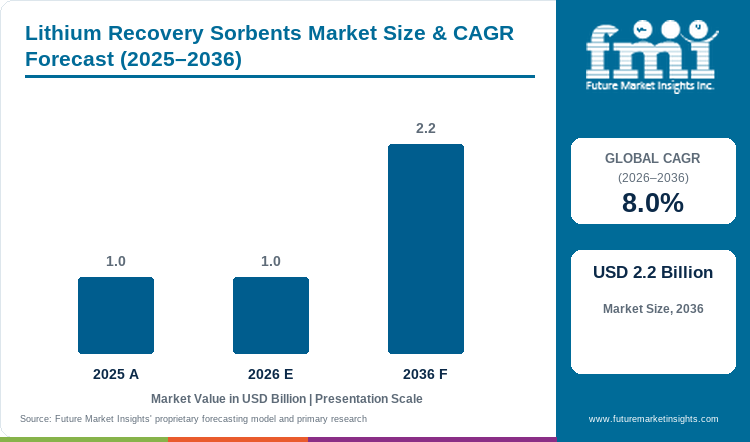
The Lithium Recovery Sorbents market stood at USD 1.0 Billion in 2025, is estimated at USD 1.0 Billion in 2026, and is forecast to reach USD 2.2 Billion by 2036 at a 8.0% CAGR from 2026 to 2036.
Market expansion depends on lithium extraction projects moving from chemistry screening into continuous operation. Sorbents sit at the selectivity step of adsorption-based direct lithium extraction, so project scale creates recurring demand for media that can survive repeated loading and elution.
In April 2026, the U.S. Department of Energy opened up to USD 69 million of critical-material funding that included lithium extraction from geothermal brines and related pre-processing. That program focus reflects the remaining engineering work between a promising material and a bankable recovery circuit. Projects using lithium extraction from brine technology depend on repeatable sorbent cycling.
Lithium producers and DLE technology suppliers therefore qualify sorbents against real feed chemistry before committing to larger orders. They examine uptake and impurity rejection first. They then test attrition and pressure behavior under operating conditions.
Regeneration demand and cycle life are evaluated across extended runs. Purchasing shifts toward multi-year media supply only when those tests translate into predictable recovered-lithium cost and stable downstream solution quality.
Country conditions change the path from validation to procurement. In France, the Eramet and Électricité de Strasbourg Ageli geothermal lithium project received European Union strategic-project recognition in March 2025, which can shorten administrative timelines and support financing.
Germany is moving through a different gate: Vulcan Energy reached financial close for its EUR 2.2 billion Lionheart package in May 2026 after a positive investment decision. Canada has used public demonstration funding to push DLE toward commercial readiness, including the E3 Lithium pilot completed in March 2024.
In the USA, Standard Lithium has emphasized field-scale proof on Smackover brine and vendor qualification before commercial construction. These routes all create sorbent demand, but the conversion threshold is similar.
Buyers need brine-specific performance that survives engineering review and supports a downstream product that an offtaker can qualify.
Key Takeaways
- The market is estimated at USD 1.0 Billion in 2026 and is forecast to reach USD 2.2 Billion by 2036 at a 8.0% CAGR.
- Lithium manganese oxide sorbents lead in 2026. Brines lead in 2026.
- Direct lithium extraction leads in 2026. Lithium producers lead in 2026. DLE technology suppliers lead in 2026.
- Driver: More brine projects are moving from laboratory evaluation into field pilots, engineering, and continuous DLE operation.
- Restraint: Sorbent lifetime and selectivity can deteriorate when complex brine chemistry or temperature exceeds the validated operating window.
- Opportunity: Selective media can expand into geothermal brines, oilfield water and recycled battery leachates where conventional separation remains costly. France has the highest profiled country CAGR at 6.9%, compared with Japan at 4.8%.
Analyst Perspective
Credible revenue capture will depend on evidence that connects media performance to the whole lithium flowsheet. High single-cycle recovery is insufficient without stability across sustained operating cycles.
- Nikhil Kaitwade, Principal Consultant, Future Market Insights
How is the Lithium Recovery Sorbents Market segmented?
The market is segmented by Sorbent Type, Source, Process, End Use, and Sales Channel.
Five axes define where lithium recovery sorbent revenue is created. Sorbent Type separates media chemistry and life-cycle behavior. Source distinguishes conventional brines from geothermal fluids, produced water, recycled leachates, and lower-grade solutions.
Process captures how media is contacted and regenerated within the recovery circuit. End Use identifies the operator that owns extraction economics and qualification risk. Sales Channel shows who specifies the sorbent, embeds it in a process package, and supports replacement supply.
These axes intersect during project qualification because the same media can behave differently in a salar brine or a hot geothermal stream. Commercial selection therefore depends on performance under customer feed conditions and on the procurement route that carries that performance into a bankable plant design.
What makes Lithium manganese oxide sorbents central to the Sorbent Type category?
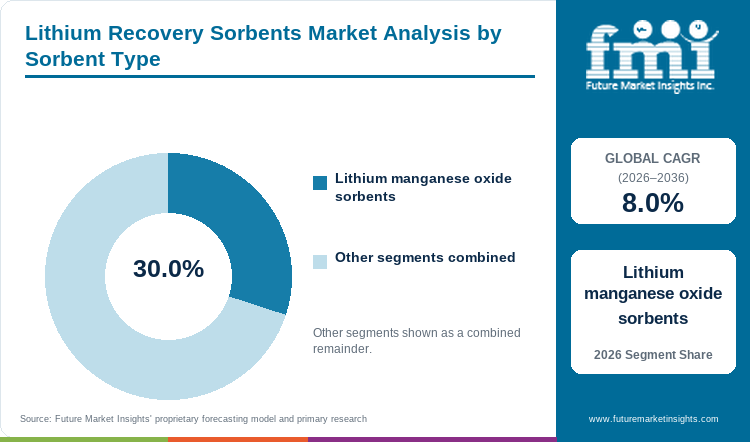
Lithium manganese oxide sorbents occupy the leading Sorbent Type position because ion-sieve structures can offer strong lithium selectivity in feeds that contain far higher concentrations of competing salts.
That selectivity matters most when the operator needs to concentrate lithium without carrying excessive magnesium, calcium, or sodium into later purification. The commercial test is not adsorption capacity alone.
Buyers also evaluate structural stability after repeated acid or water elution, particle attrition in columns, and the cost of replacing active media. Commercial DLE suppliers increasingly pair selective media with engineered adsorption systems.
This combination favors suppliers that can show both selective chemistry and reliable operation at project scale.
- Lithium manganese oxide sorbents hold a 30.0% share in 2026, supported by their fit with selective lithium capture and regenerable adsorption workflows.
- In July 2026, Sunresin described a high-temperature lithium adsorbent engineered for more than 2,000 adsorption-desorption cycles. The update shows continued investment in durable DLE media for complex brines.
Why do Brines lead the Source category?
Brines lead because dissolved lithium can be contacted directly with selective media without first converting a mined solid into a leach solution. The advantage becomes larger when DLE allows operators to avoid long evaporation residence times and recover lithium from lower-concentration or more complex fluids.
Brine chemistry still determines whether the media works economically. Magnesium and calcium can reduce adsorption efficiency. Boron and silica can add pretreatment demand. Suspended solids and temperature can also alter media behavior.
Lilac Solutions has built its ion-exchange platform around adapting media and operating conditions to different brine chemistries. That design emphasis shows why buyers treat actual brine testing as a prerequisite rather than relying on standardized laboratory feeds.
- Brines hold a 38.0% share in 2026 because they provide the main feedstock base for adsorption-led direct lithium extraction projects.
- In June 2024, Lilac Solutions launched its fourth-generation ion-exchange technology and described media designed for a wider range of brines with long cycle life.
How does Direct lithium extraction shape the Process category?
Direct lithium extraction leads the Process category because it places selective media at the center of a continuous or semi-continuous production system. The operator is not simply buying a chemical powder. Qualification covers adsorption kinetics and contact time. It also tests elution behavior and column hydraulics.
Regeneration is evaluated across the designed process cycle. This increases the value of sorbents that arrive with engineering data and proven operating protocols. Standard Lithium illustrates the procurement logic.
Its South West Arkansas field pilot used the same lithium-selective sorption technology intended for commercial design and ran hundreds of cycles on project brine. That kind of field evidence can move the buyer from technology screening toward FEED and vendor qualification.
- Direct lithium extraction holds a 43.0% share in 2026 because sorbent performance directly governs recovery, selectivity, and continuous-process economics.
- In March 2025, Standard Lithium reported more than 99% lithium recovery during sustained operation of its South West Arkansas DLE field pilot after 497 cycles.
What supports Lithium producers in the End Use category?
Lithium producers lead End Use because they ultimately carry resource risk, product-quality risk, and operating cost after a DLE technology is selected. A producer therefore evaluates sorbent media as part of an integrated flowsheet rather than as an isolated consumable.
The preferred material must support recovery from the actual feed and still deliver a lithium-rich stream that can be purified into saleable carbonate or hydroxide. Industrial operation also exposes maintenance and reagent demands that pilots may understate.
Eramet’s Centenario ramp-up provides a useful reference because its in-house DLE process moved from multi-year pilot testing into industrial lithium production. That transition raises the importance of repeatability and operating discipline across the extraction circuit.
- Lithium producers hold a 40.0% share in 2026 because they approve the extraction flowsheet and bear the recurring economics of sorbent use.
- In February 2026, Eramet reported that Centenario had reached close to 75% of design capacity in December 2025 after ramping its industrial DLE operation.
What drives DLE technology suppliers in the Sales Channel category?
DLE technology suppliers lead Sales Channel because sorbent choice is often embedded in a system package before an operator issues recurring material orders. These suppliers connect media chemistry to column design and sequencing logic. They also integrate pretreatment with controls and regeneration.
That integration reduces the number of interfaces the owner must manage during pilot and scale-up. It also lets the supplier optimize sorbent loading against throughput instead of selling media only by mass. Summit Nanotech’s commercial-height columns and proprietary sorbent illustrate this channel model.
The company has combined sorbent design with modular DLE equipment and field validation, then moved toward technology and sorbent supply agreements for larger projects. That model favors vendors able to remain involved after initial qualification.
- DLE technology suppliers hold a 36.0% share in 2026 because they influence sorbent specification during system design and project qualification.
- In June 2025, Summit Nanotech reported one year of operation for a U.S. DLE system with commercial-height columns and high-performance sorbent while advancing supply agreements.
What are the drivers, restraints, and opportunities in the Lithium Recovery Sorbents Market?
DLE commercialization expands recurring media demand, while feed-specific qualification and durability slow adoption, and new geothermal plus recycled feedstocks widen the addressable opportunity.
- Driver: More brine projects are moving from laboratory evaluation into field pilots, engineering, and continuous DLE operation.
- Restraint: Sorbent lifetime and selectivity can deteriorate when complex brine chemistry or temperature exceeds the validated operating window.
- Opportunity: Selective media can expand into geothermal brines, oilfield water, and recycled battery leachates where conventional separation remains costly.
The main driver is the conversion of DLE from a research topic into a project-engineering decision. In April 2026, the U.S. Department of Energy announced up to USD 69 million for critical-material technologies and included lithium extraction from geothermal brines and clay sources.
The funding scope also included pre-processing and post-processing, which is commercially important for sorbent vendors because media performance depends on the feed delivered to the adsorption step. As projects move toward pilot completion or FEED, developers need larger media volumes and more complete operating data.
That shifts supplier competition toward field-proven throughput and predictable regeneration. Vendors that can support brine testing and then supply the same qualified media at scale are positioned to convert technical acceptance into repeat orders. Recovered leachates from EV battery recycling and black mass processing can provide another feedstream for selective extraction.
The binding restraint is brine-specific qualification rather than a lack of theoretical selectivity. High temperature can accelerate structural damage, active-component loss, or capacity decline. Competing ions and suspended solids can also reduce useful uptake or create hydraulic problems.
Sunresin highlighted this issue in July 2026 when it described a high-temperature adsorbent designed for 80°C geothermal brine and more than 2,000 adsorption-desorption cycles without performance decline.
The commercial implication is that one successful brine test cannot be transferred automatically to another resource. Producers may require months of cycling and pretreatment optimization before freezing the sorbent specification.
This lengthens procurement and favors suppliers with application laboratories, pilot equipment, and clear replacement economics.
The strongest opportunity is to adapt selective recovery media to feedstocks beyond conventional salar brines. Recycled battery leachates contain lithium alongside nickel and cobalt. They can also carry manganese plus process impurities. Selective separation can therefore reduce the burden on later purification.
In September 2024, Japan’s Ministry of Economy, Trade and Industry certified a support plan for a pilot that would recover and refine lithium with other metals from battery black mass. Similar programs are expanding the pool of technically qualified recycling streams.
Sorbent suppliers can capture this opening by designing media around impurity tolerance and regeneration rather than only maximum lithium capacity.
Partnerships with recyclers and hydrometallurgical integrators can shorten validation because those buyers already control leach conditions and downstream product specifications.
Which country CAGRs are profiled in the Lithium Recovery Sorbents Market?
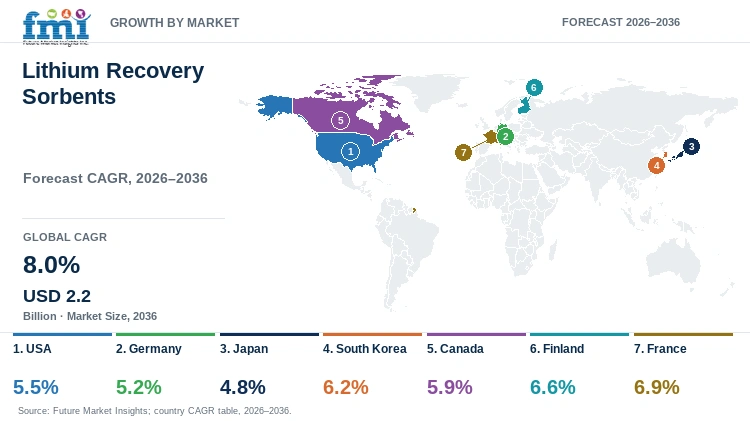
| Country | CAGR |
|---|---|
| USA | 5.5% |
| Germany | 5.2% |
| Japan | 4.8% |
| South Korea | 6.2% |
| Canada | 5.9% |
| Finland | 6.6% |
| France | 6.9% |
How do country-level CAGRs compare in the Lithium Recovery Sorbents Market?
The seven profiled countries span a 2.1 percentage-point range between France at 6.9% and Japan at 4.8% from 2026 to 2036. France and Finland form the upper band because both combine critical-material policy with active extraction or recycling investment.
South Korea and Canada sit in the next band, where public programs are pushing resource security and demonstration. USA and Germany form a measured middle-lower band that still contains technically advanced projects but requires major project financing or field qualification.
Japan is the slowest rate in this comparison. Its opportunity is more concentrated in recycling and strategic processing than in domestic brine production. These rates describe pace rather than absolute market size.
- France at 6.9% and Finland at 6.6% differ by 0.3 percentage points. Suppliers can prioritize recycling-compatible or geothermal-grade media where policy support is already tied to industrial projects.
- Finland at 6.6% is 0.4 percentage points above South Korea at 6.2%. Finland emphasizes circular battery-material processing, while South Korea is building a wider critical-mineral recycling ecosystem around a large battery manufacturing base.
- Canada at 5.9% is 0.4 percentage points above the USA at 5.5%. Both countries reward field validation, but Canadian programs have explicitly funded DLE pilots while U.S. programs span geothermal resource development and scale-up.
- Germany at 5.2% is 0.4 percentage points above Japan at 4.8%. Germany has a visible geothermal DLE construction path, while Japan places more emphasis on black-mass recovery and resilient battery supply chains.
CAGR alone cannot identify the largest revenue pool or the easiest sales cycle. A faster-growing country can still contain a smaller installed project base, while a slower market may offer larger individual contracts. Supplier decisions should combine growth rate with project stage and brine or leachate volume.
They should also consider qualification burden, customer financing and channel access. The full report therefore considers the profiled countries within the broader FMI regional coverage rather than ranking them only by forecast CAGR.
Country-wise Analysis
- USA: U.S. lithium developers typically require field data from real brine before committing sorbent media to commercial design. Demand for lithium recovery sorbents in the USA is forecast to expand at 5.5% CAGR from 2026 to 2036. During April 2026 the U.S. Department of Energy opened up to USD 69 million for critical-material technologies that include lithium extraction from geothermal brines and related processing. The local friction is the step from supported demonstration to bankable project execution especially where pretreatment and reservoir chemistry remain site-specific. Suppliers need sustained cycle data, clear impurity-rejection evidence and commercial-scale media availability. They also need to support conversion vendors so the recovered lithium stream reaches customer qualification without adding avoidable purification cost.
- Germany: German buyers approach sorbent selection as part of an integrated geothermal and lithium project rather than a stand-alone materials purchase. Demand for lithium recovery sorbents in Germany is forecast to expand at 5.2% CAGR from 2026 to 2036. In May 2026, Vulcan Energy reported financial close for the EUR 2.2 billion Lionheart financing package after a positive investment decision in December 2025. The project advances an integrated geothermal and lithium development in the Upper Rhine Valley. The local friction is high capital commitment plus the need to coordinate wells with geothermal energy. Extraction and downstream conversion must also fit the same project design. Suppliers that can document hot-brine stability and fit into local engineering packages will have the clearest route to procurement.
- Japan: Japanese demand is shaped more by strategic processing and battery recycling than by a large domestic brine-resource base. Demand for lithium recovery sorbents in Japan is forecast to expand at 4.8% CAGR from 2026 to 2036. METI lists a September 2024 certified supply-security plan for Nippon Chemical Industrial to demonstrate recovery and refining of lithium with other metals from battery black mass. The friction is feed variability because black mass composition changes with battery chemistry, state of health, and upstream pretreatment. Sorbent suppliers therefore need high selectivity in mixed-metal leachates and predictable regeneration. Working with domestic refiners on pilot campaigns can also reduce the qualification burden before full-scale procurement.
- South Korea: South Korean procurement is influenced by a large battery value chain and a policy push to recover strategic materials from domestic and imported secondary feedstocks. Demand for lithium recovery sorbents in South Korea is forecast to expand at 6.2% CAGR from 2026 to 2036. In October 2025, the Ministry of Trade, Industry and Resources set a goal of a 20% recycling rate for ten strategic critical minerals by 2030 and outlined financial plus regulatory support. The local friction is establishing trusted quality for recycled raw materials while keeping processing costs competitive. Suppliers need leachate-specific testing and local technical support. They also benefit from partnerships that connect selective lithium recovery with certified recycled-material output.
- Canada: Canadian project developers tend to use publicly supported pilots to close technical gaps before committing large capital. Demand for lithium recovery sorbents in Canada is forecast to expand at 5.9% CAGR from 2026 to 2036. Natural Resources Canada funded E3 Lithium’s Direct Lithium Extraction pilot. It launched in March 2023 and completed in March 2024 with CAD 3.545 million of support. Canada is also supporting downstream lithium conversion projects in British Columbia, including Mangrove Lithium. The local friction is the handoff from pilot success to financed construction and long-duration supply contracts. Sorbent vendors should provide scale-up data, replacement planning and compatibility with downstream battery-grade refining.
- Finland: Finnish demand is anchored in battery-material circularity and hydrometallurgical processing. This creates a route for selective lithium recovery from increasingly complex secondary streams. Demand for lithium recovery sorbents in Finland is forecast to expand at 6.6% CAGR from 2026 to 2036. During July 2025 Business Finland granted EUR 84.6 million of investment aid to Fortum Battery Recycling for a planned expansion of its Harjavalta hydrometallurgical facility. The local friction is that project funding does not remove feed-supply, permitting or final-investment uncertainty. Suppliers need to show that media can withstand changing leachate composition while limiting chemical use. Early integration with the hydrometallurgical flowsheet can make selective lithium recovery easier to justify.
- France: French buyers are evaluating lithium recovery through both circular battery materials and geothermal resources so suppliers need capabilities across different feed chemistries. Demand for lithium recovery sorbents in France is forecast to expand at 6.9% CAGR from 2026 to 2036. During March 2025 Eramet and Électricité de Strasbourg announced that the Ageli geothermal lithium project in Alsace had been recognized as a European Union strategic project. The final investment decision is expected later so qualification must still translate into bankable engineering. High-temperature stability and water balance remain important local tests for geothermal media. Suppliers that combine long-cycle evidence with local pilot support can reduce technical risk before project sanction.
Who are the notable companies in the Lithium Recovery Sorbents Market?
EnergySource Minerals and Lilac Solutions are profiled. Summit Nanotech and Eramet are also covered. Adionics and Mangrove Lithium are also covered. Tenova Advanced Technologies and LANXESS are also covered. Sunresin New Materials and Standard Lithium complete the notable-company set.
Competition is split between suppliers that control selective media and companies that control the wider project interface. EnergySource Minerals and Lilac Solutions place sorbent or ion-exchange media at the center of their DLE proposition.
Summit Nanotech and Sunresin New Materials do the same through integrated media and process design. Standard Lithium and Eramet use large project demonstrations to prove integrated extraction economics, while LANXESS contributes brine access and industrial infrastructure around the Arkansas project.
Adionics and Tenova Advanced Technologies provide selective recovery routes that can compete with or complement adsorption systems depending on feed chemistry. Mangrove Lithium sits farther downstream in lithium conversion, but its refining capacity affects the specification of intermediate lithium streams.
Buyers therefore compare more than media capacity. They also compare field proof and integration scope. Replacement support and the ability to deliver a qualified downstream product also matter.
- Sorbent-centered DLE platforms: EnergySource Minerals, Lilac Solutions, Summit Nanotech and Sunresin New Materials compete through proprietary media plus process integration.
- Project-integrated brine platforms: Eramet, LANXESS and Standard Lithium compete through resource access, field-scale validation and commercial project execution.
- Selective recovery and conversion specialists: Adionics, Mangrove Lithium, and Tenova Advanced Technologies influence technology selection through alternative media or downstream refining capability.
Competitive Benchmarking: Lithium Recovery Sorbents Market
| Company | Selective Media Control | Multi-Cycle Field Validation | Downstream Lithium Conversion Integration | Geographic Reach |
|---|---|---|---|---|
| EnergySource Minerals | High | High | High | United States; ILiAD technology marketed for global brine deployment |
| Lilac Solutions | High | High | Medium | United States and Argentina are covered. Coverage extends to Germany and Chile. |
| Summit Nanotech | High | High | Medium | Canada, United States, and Chile |
| Eramet | Medium | High | High | France and Argentina |
| Adionics | High | Medium | Medium | France with project activity across South American brines |
| Mangrove Lithium | Low | Low | High | Canada with North American customer and financing reach |
| Tenova Advanced Technologies | Medium | Low | High | Europe and Americas are covered. Coverage extends to MENA and China and Southeast Asia. |
| LANXESS | Low | High | Medium | United States project base with global specialty-chemicals reach |
| Sunresin New Materials | High | High | High | China with international DLE project supply |
| Standard Lithium | Medium | High | High | United States with Smackover-focused project development |
Scoring basis: Selective Media Control measures documented ownership or direct supply of lithium-selective sorbents, ion-exchange media or proprietary extraction media. Multi-Cycle Field Validation measures sustained operation on representative feed at pilot, demonstration or industrial scale.
Downstream Lithium Conversion Integration measures the ability to connect extracted lithium solution to purification or battery-grade conversion. High denotes broad documented capability. Medium denotes credible but narrower capability.
Low would indicate a documented limitation, while unavailable public information is left Low.
Key Developments in the Lithium Recovery Sorbents Market
- In June 2024, Lilac Solutions launched its fourth-generation ion-exchange technology and released technical data on lithium recovery and impurity rejection. The disclosure also covered cycle life and throughput. The company positioned the new media for a wider range of low-grade and high-impurity brines. The development matters because longer media life and broader feed tolerance reduce the number of replacement cycles. It can also lower the engineering margin that developers apply when moving from pilot to commercial design.
- In March 2025, Standard Lithium completed the final South West Arkansas DLE field test with Koch Technology Solutions. The field pilot recovered more than 99% of lithium during sustained operation and completed 497 DLE cycles on project brine. Standard Lithium also sent concentrated lithium chloride to conversion vendors for battery-quality carbonate production. This moved sorbent-based DLE evidence beyond recovery alone and linked extraction performance to vendor qualification plus prospective offtake testing.
- In June 2025, Summit Nanotech reported one year of operation for its U.S. DLE system using commercial-height columns and a high-performance sorbent. The operating platform transferred parameters into a northern Chile field demonstration and supported sorbent optimization on customer feedstocks. Summit also said it was developing sorbent and technology supply agreements for larger projects. The milestone strengthens the commercial case for integrated suppliers that can hold media performance as system dimensions move toward production scale.
Key Players in the Lithium Recovery Sorbents Market
Sorbent-Centered DLE Technology Developers
- EnergySource Minerals
- Lilac Solutions
- Summit Nanotech
- Sunresin New Materials
Project-Integrated Brine Extraction Platforms
- Eramet
- LANXESS
- Standard Lithium
Selective Recovery and Lithium Conversion Specialists
- Adionics
- Mangrove Lithium
- Tenova Advanced Technologies
Lithium Recovery Sorbents Market - Report Scope
| Coverage field | Report scope |
|---|---|
| Market breakdown | Sorbent Type; Source; Process; End Use; Sales Channel |
| Quantitative Units | USD Billion |
| Market Definition | Revenue includes lithium-selective sorbent and adsorbent media sold for lithium recovery within the stated segmentation universe. It excludes downstream lithium compounds, finished batteries, and revenue from adjacent or substitute products that are not lithium recovery sorbents. |
| Regions Covered | North America; Latin America; Western Europe; Eastern Europe; East Asia; South Asia and Pacific; Middle East and Africa |
| Countries Covered | USA, Germany, Japan, South Korea, Canada, Finland, France, and more than twenty-five additional countries in the full report |
| Key Companies Profiled | EnergySource Minerals; Lilac Solutions; Summit Nanotech; Eramet; Adionics; Mangrove Lithium; Tenova Advanced Technologies; LANXESS; Sunresin New Materials; Standard Lithium |
| Forecast Period | 2026 to 2036 |
| Approach | FMI applies a hybrid bottom-up and top-down sizing approach that reconciles project demand, sorbent usage, supplier participation, and country-level adoption signals. |
Lithium Recovery Sorbents Market - Research Methodology
| Method | Approach |
|---|---|
| Primary Research | FMI consults sorbent makers and direct-lithium-extraction suppliers. Project developers and lithium operators explain media life and integration needs. The research tests purchase criteria and adoption barriers. |
| Desk Research | FMI reviews public project records and government programs. Company documentation and technical evidence support project milestones. Sources are retained when they support the defined market boundary. |
| Market Sizing and Forecasting | FMI reconciles project activity with sorbent consumption and supplier participation. Forecasts reflect commercialization pace and replacement demand. Country conditions and channel structure are checked against the revenue boundary. |
| Data Validation | Findings are checked against independent evidence. The estimate excludes downstream lithium-product revenue and adjacent media. Duplicate project value and unsupported claims are removed. |
Lithium Recovery Sorbents Market by Segments
Lithium Recovery Sorbents Market segmented by Sorbent Type:
- Lithium manganese oxide sorbents
- Titanium-based sorbents
- Aluminum hydroxide sorbents
- Ion-sieve sorbents
- Polymer adsorbents
Lithium Recovery Sorbents Market segmented by Source:
- Brines
- Geothermal brines
- Oilfield produced water
- Recycled battery leachates
- Clay/low-grade solutions
Lithium Recovery Sorbents Market segmented by Process:
- Direct lithium extraction
- Batch adsorption
- Column adsorption
- Membrane-sorbent hybrid
- Regeneration systems
Lithium Recovery Sorbents Market segmented by End Use:
- Lithium producers
- Battery recyclers
- Geothermal projects
- Oilfield water operators
- Pilot plants
Lithium Recovery Sorbents Market segmented by Sales Channel:
- DLE technology suppliers
- Chemical material suppliers
- Project EPCs
- Direct operator procurement
Lithium Recovery Sorbents Market by Region:
- North America
- United States
- Canada
- Latin America
- Brazil
- Mexico
- Argentina
- Chile
- Western Europe
- Germany
- France
- United Kingdom
- Italy
- Spain
- Benelux
- Nordics
- Eastern Europe
- Poland
- Czech Republic
- Romania
- Hungary
- East Asia
- China
- Japan
- South Korea
- South Asia and Pacific
- India
- ASEAN
- Australia and New Zealand
- Middle East and Africa
- GCC Countries
- South Africa
- Türkiye
- Israel
Research Sources and Bibliography
- U.S. Department of Energy (2026, April 7). DOE Launches Funding Opportunity for Critical Minerals and Materials.
- Natural Resources Canada (2026, September 1). Critical Minerals Research, Development and Demonstration Program.
- Business Finland (2025, July 10). Investment aid granted for five major clean transition industrial projects.
- Ministry of Economy, Trade and Industry, Japan (2026, March 30). Critical Minerals: Certified Supply Security Plans.
- Ministry of Trade, Industry and Resources, Republic of Korea (2025, October 31). Korea to Strengthen Supply Chain Stability for Rare Earth Elements and Critical Minerals.
- Eramet (2025, March 25). Eramet / ÉS: Ageli geothermal lithium project officially recognized as a strategic project by the European Union.
- Vulcan Energy Resources (2026, May 28). Vulcan Energy reaches financial close for Lionheart project financing package.
- EnergySource Minerals / ILiAD Technologies (n.d.). ILiAD direct lithium extraction technology.
- Lilac Solutions (2024, June 25). Lilac Unveils Latest Generation Lithium Extraction Technology.
- Summit Nanotech (2025, June 11). Robust Operational Results from Lithium Facility Strengthen Summit Nanotech’s Commercial DLE Readiness.
- Adionics (2025, March 3). Flionex Direct Lithium Extraction technology successfully tested by Sibanye-Stillwater on black mass.
- Eramet (2026, February 18). Eramet: structural measures to strengthen balance sheet and prepare the future, after a challenging 2025.
- LANXESS (2023, December 1). Lithium project: LANXESS plans to supply Standard Lithium with lithium-rich brine.
- Sunresin New Materials (2026, July 20). High-Temperature Lithium Adsorbent Technology for Geothermal Brine Direct Lithium Extraction.
- Standard Lithium (2025, March 11). Smackover Lithium Successfully Completes Derisking of DLE Technology With Final Field-Test at South West Arkansas Project.
This bibliography is provided for reader reference and is not exhaustive. The full report contains the complete reference list and detailed citations.
This Report Answers
- What is the Lithium Recovery Sorbents Market size in 2026 and 2036?
- What industry and project pressures support demand for lithium recovery sorbents?
- Why do Lithium manganese oxide sorbents hold the leading Sorbent Type position?
- How does the leadership of Brines as a Source influence sorbent demand?
- Why does Direct lithium extraction lead the Process category?
- How do the profiled country growth rates compare for the Lithium Recovery Sorbents market?
- Which companies provide sorbents, DLE systems, project integration or lithium conversion capabilities?
- What qualification and durability constraints limit adoption of lithium recovery sorbents?
Frequently Asked Questions
What is driving growth in the Lithium Recovery Sorbents Market?
Growth is driven by DLE projects moving from material screening into field demonstration and continuous operation, which expands qualified sorbent volumes. Recurring replacement demand develops when operators lock a media specification into commercial production and regeneration schedules.
Who are the key players in the Lithium Recovery Sorbents Market?
EnergySource Minerals, Lilac Solutions and Summit Nanotech are among the profiled companies. The wider set listed under Key Players spans selective media and DLE systems as well as brine-project execution and lithium conversion.
What notable restraint affects the Lithium Recovery Sorbents Market?
The main restraint is brine-specific qualification because temperature and competing ions can change sorbent life or selectivity, as can solids and regeneration conditions. Buyers may require extended cycling on real feed before committing media to a commercial flowsheet, which stretches sales and engineering timelines.
Why should executives track the Lithium Recovery Sorbents Market?
Sorbent selection influences lithium recovery and pretreatment burden while also affecting water use and media replacement cost. Executives should track which suppliers convert pilot performance into durable operating data because that evidence affects downstream purification, bankability and vendor choice.
What business problem does the Lithium Recovery Sorbents Market address?
Lithium recovery sorbents selectively capture lithium from brines or leachates that contain much larger quantities of competing dissolved species. They help operators concentrate lithium into a manageable process stream while avoiding some of the residence time and footprint associated with conventional evaporation-based routes.
What should lithium producers evaluate in the Lithium Recovery Sorbents Market?
Lithium producers should compare uptake and impurity rejection alongside cycle life and attrition. They should also test regeneration demand on the actual feed and confirm that the recovered lithium solution fits the planned purification route.
What limits return on investment in the Lithium Recovery Sorbents Market?
Return on investment can fall when media life is short or replacement frequency is high. Demanding pretreatment and poor downstream integration can also raise lifetime cost, so a lower purchase price does not guarantee cheaper recovered lithium.
What supports long-term commercial confidence in the Lithium Recovery Sorbents Market?
Long-term confidence is supported by a growing body of multi-cycle field tests and industrial DLE milestones that expose selective media to real operating conditions. Commercial durability still depends on feed chemistry, but project-scale evidence is giving buyers better benchmarks for qualification and replacement planning.
Preview the report firsthand - request a free sample
Get SampleGet the brochure for pricing and purchase details.
Get PDFTable of Content
- Key Takeaways
- Market Size and CAGR
- Top Growth Driver
- Fastest Growing Segment
- Leading Region
- Key Companies
- Emerging Opportunities
- Executive Summary
- Global Market Outlook
- Demand-side Trends
- Supply-side Trends
- Technology Roadmap Analysis
- Analysis and Recommendations
- Analyst Perspective (What is happening? Why now? What should investors know?)
- Key Questions Answered
- How large is the market?
- What is the CAGR?
- What are key trends?
- Which region dominates?
- Who are the leaders?
- Market Overview
- Market Coverage / Taxonomy
- Market Definition / Scope / Limitations
- Research Methodology
- Chapter Orientation
- Analytical Lens and Working Hypotheses
- Market Structure, Signals, and Trend Drivers
- Benchmarking and Cross-market Comparability
- Market Sizing, Forecasting, and Opportunity Mapping
- Research Design and Evidence Framework
- Desk Research Programme (Secondary Evidence)
- Expert Input and Fieldwork (Primary Evidence)
- Tooling, Models, and Reference Databases
- Data Engineering and Model Build
- Quality Assurance and Audit Trail
- Market Background
- Market Dynamics (Drivers, Restraints, Opportunity, Trends)
- Scenario Forecast (Optimistic, Likely, Conservative)
- Impact Analysis
- AI Impact
- Sustainability Impact
- Regulatory Impact
- Technology Impact
- Consumer / Buyer Analysis
- Purchase Drivers
- Adoption Barriers
- Buyer Journey
- Opportunity Map Analysis
- Product Life Cycle Analysis
- Supply Chain Analysis
- Investment Feasibility Matrix
- Value Chain Analysis
- PESTLE and Porter's Analysis
- Regulatory Landscape
- Regional Parent Market Outlook
- Production and Consumption Statistics
- Import and Export Statistics
- Global Market Analysis and Forecast, 2021 to 2036
- Historical Market Size Value (USD Billion) Analysis, 2021 to 2025
- Current and Future Market Size Value (USD Billion) Projections, 2026 to 2036
- Y-o-Y Growth Trend Analysis
- Absolute $ Opportunity Analysis
- Global Market Pricing Analysis, 2021 to 2036
- Global Market Analysis and Forecast, By Sorbent Type, 2021 to 2036
- Introduction / Key Findings
- Historical Market Size Value (USD Billion) Analysis By Sorbent Type, 2021 to 2025
- Current and Future Market Size Value (USD Billion) Analysis and Forecast By Sorbent Type, 2026 to 2036
- Lithium manganese oxide sorbents
- Titanium-based sorbents
- Aluminum hydroxide sorbents
- Ion-sieve sorbents
- Polymer adsorbents
- Y-o-Y Growth Trend Analysis By Sorbent Type, 2021 to 2025
- Absolute $ Opportunity Analysis By Sorbent Type, 2026 to 2036
- Global Market Analysis and Forecast, By Source, 2021 to 2036
- Introduction / Key Findings
- Historical Market Size Value (USD Billion) Analysis By Source, 2021 to 2025
- Current and Future Market Size Value (USD Billion) Analysis and Forecast By Source, 2026 to 2036
- Brines
- Geothermal brines
- Oilfield produced water
- Recycled battery leachates
- Clay/low-grade solutions
- Y-o-Y Growth Trend Analysis By Source, 2021 to 2025
- Absolute $ Opportunity Analysis By Source, 2026 to 2036
- Global Market Analysis and Forecast, By Process, 2021 to 2036
- Introduction / Key Findings
- Historical Market Size Value (USD Billion) Analysis By Process, 2021 to 2025
- Current and Future Market Size Value (USD Billion) Analysis and Forecast By Process, 2026 to 2036
- Direct lithium extraction
- Batch adsorption
- Column adsorption
- Membrane-sorbent hybrid
- Regeneration systems
- Y-o-Y Growth Trend Analysis By Process, 2021 to 2025
- Absolute $ Opportunity Analysis By Process, 2026 to 2036
- Global Market Analysis and Forecast, By End Use, 2021 to 2036
- Introduction / Key Findings
- Historical Market Size Value (USD Billion) Analysis By End Use, 2021 to 2025
- Current and Future Market Size Value (USD Billion) Analysis and Forecast By End Use, 2026 to 2036
- Lithium producers
- Battery recyclers
- Geothermal projects
- Oilfield water operators
- Pilot plants
- Y-o-Y Growth Trend Analysis By End Use, 2021 to 2025
- Absolute $ Opportunity Analysis By End Use, 2026 to 2036
- Global Market Analysis and Forecast, By Sales Channel, 2021 to 2036
- Introduction / Key Findings
- Historical Market Size Value (USD Billion) Analysis By Sales Channel, 2021 to 2025
- Current and Future Market Size Value (USD Billion) Analysis and Forecast By Sales Channel, 2026 to 2036
- DLE technology suppliers
- Chemical material suppliers
- Project EPCs
- Direct operator procurement
- Y-o-Y Growth Trend Analysis By Sales Channel, 2021 to 2025
- Absolute $ Opportunity Analysis By Sales Channel, 2026 to 2036
- Global Market Analysis and Forecast, By Region, 2021 to 2036
- Introduction
- Historical Market Size Value (USD Billion) Analysis By Region, 2021 to 2025
- Current Market Size Value (USD Billion) Analysis and Forecast By Region, 2026 to 2036
- North America
- Latin America
- Western Europe
- Eastern Europe
- East Asia
- South Asia and Pacific
- Middle East and Africa
- Market Attractiveness Analysis By Region
- North America Market Analysis and Forecast, By Country, 2021 to 2036
- Historical Market Size Value (USD Billion) Trend Analysis By Market Taxonomy, 2021 to 2025
- Market Size Value (USD Billion) Forecast By Market Taxonomy, 2026 to 2036
- By Country
- United States
- Canada
- By Sorbent Type
- By Source
- By Process
- By End Use
- By Sales Channel
- By Country
- Market Attractiveness Analysis
- By Country
- By Sorbent Type
- By Source
- By Process
- By End Use
- By Sales Channel
- Key Takeaways
- Latin America Market Analysis and Forecast, By Country
- Historical Market Size Value (USD Billion) Trend Analysis By Market Taxonomy, 2021 to 2025
- Market Size Value (USD Billion) Forecast By Market Taxonomy, 2026 to 2036
- By Country
- Brazil
- Mexico
- Argentina
- Chile
- By Sorbent Type
- By Source
- By Process
- By End Use
- By Sales Channel
- By Country
- Market Attractiveness Analysis
- By Country
- By Sorbent Type
- By Source
- By Process
- By End Use
- By Sales Channel
- Key Takeaways
- Western Europe Market Analysis and Forecast, By Country
- Historical Market Size Value (USD Billion) Trend Analysis By Market Taxonomy, 2021 to 2025
- Market Size Value (USD Billion) Forecast By Market Taxonomy, 2026 to 2036
- By Country
- Germany
- France
- United Kingdom
- Italy
- Spain
- Benelux
- Nordics
- By Sorbent Type
- By Source
- By Process
- By End Use
- By Sales Channel
- By Country
- Market Attractiveness Analysis
- By Country
- By Sorbent Type
- By Source
- By Process
- By End Use
- By Sales Channel
- Key Takeaways
- Eastern Europe Market Analysis and Forecast, By Country
- Historical Market Size Value (USD Billion) Trend Analysis By Market Taxonomy, 2021 to 2025
- Market Size Value (USD Billion) Forecast By Market Taxonomy, 2026 to 2036
- By Country
- Poland
- Czech Republic
- Romania
- Hungary
- By Sorbent Type
- By Source
- By Process
- By End Use
- By Sales Channel
- By Country
- Market Attractiveness Analysis
- By Country
- By Sorbent Type
- By Source
- By Process
- By End Use
- By Sales Channel
- Key Takeaways
- East Asia Market Analysis and Forecast, By Country
- Historical Market Size Value (USD Billion) Trend Analysis By Market Taxonomy, 2021 to 2025
- Market Size Value (USD Billion) Forecast By Market Taxonomy, 2026 to 2036
- By Country
- China
- Japan
- South Korea
- By Sorbent Type
- By Source
- By Process
- By End Use
- By Sales Channel
- By Country
- Market Attractiveness Analysis
- By Country
- By Sorbent Type
- By Source
- By Process
- By End Use
- By Sales Channel
- Key Takeaways
- South Asia and Pacific Market Analysis and Forecast, By Country
- Historical Market Size Value (USD Billion) Trend Analysis By Market Taxonomy, 2021 to 2025
- Market Size Value (USD Billion) Forecast By Market Taxonomy, 2026 to 2036
- By Country
- India
- ASEAN
- Australia and New Zealand
- By Sorbent Type
- By Source
- By Process
- By End Use
- By Sales Channel
- By Country
- Market Attractiveness Analysis
- By Country
- By Sorbent Type
- By Source
- By Process
- By End Use
- By Sales Channel
- Key Takeaways
- Middle East and Africa Market Analysis and Forecast, By Country
- Historical Market Size Value (USD Billion) Trend Analysis By Market Taxonomy, 2021 to 2025
- Market Size Value (USD Billion) Forecast By Market Taxonomy, 2026 to 2036
- By Country
- GCC Countries
- South Africa
- Türkiye
- Israel
- By Sorbent Type
- By Source
- By Process
- By End Use
- By Sales Channel
- By Country
- Market Attractiveness Analysis
- By Country
- By Sorbent Type
- By Source
- By Process
- By End Use
- By Sales Channel
- Key Takeaways
- Key Countries Market Analysis
- United States
- Pricing Analysis
- Market Share Analysis, 2025
- By Sorbent Type
- By Source
- By Process
- By End Use
- By Sales Channel
- Canada
- Pricing Analysis
- Market Share Analysis, 2025
- By Sorbent Type
- By Source
- By Process
- By End Use
- By Sales Channel
- Mexico
- Pricing Analysis
- Market Share Analysis, 2025
- By Sorbent Type
- By Source
- By Process
- By End Use
- By Sales Channel
- Brazil
- Pricing Analysis
- Market Share Analysis, 2025
- By Sorbent Type
- By Source
- By Process
- By End Use
- By Sales Channel
- Chile
- Pricing Analysis
- Market Share Analysis, 2025
- By Sorbent Type
- By Source
- By Process
- By End Use
- By Sales Channel
- Germany
- Pricing Analysis
- Market Share Analysis, 2025
- By Sorbent Type
- By Source
- By Process
- By End Use
- By Sales Channel
- United Kingdom
- Pricing Analysis
- Market Share Analysis, 2025
- By Sorbent Type
- By Source
- By Process
- By End Use
- By Sales Channel
- Italy
- Pricing Analysis
- Market Share Analysis, 2025
- By Sorbent Type
- By Source
- By Process
- By End Use
- By Sales Channel
- Spain
- Pricing Analysis
- Market Share Analysis, 2025
- By Sorbent Type
- By Source
- By Process
- By End Use
- By Sales Channel
- France
- Pricing Analysis
- Market Share Analysis, 2025
- By Sorbent Type
- By Source
- By Process
- By End Use
- By Sales Channel
- India
- Pricing Analysis
- Market Share Analysis, 2025
- By Sorbent Type
- By Source
- By Process
- By End Use
- By Sales Channel
- ASEAN
- Pricing Analysis
- Market Share Analysis, 2025
- By Sorbent Type
- By Source
- By Process
- By End Use
- By Sales Channel
- Australia and New Zealand
- Pricing Analysis
- Market Share Analysis, 2025
- By Sorbent Type
- By Source
- By Process
- By End Use
- By Sales Channel
- China
- Pricing Analysis
- Market Share Analysis, 2025
- By Sorbent Type
- By Source
- By Process
- By End Use
- By Sales Channel
- Japan
- Pricing Analysis
- Market Share Analysis, 2025
- By Sorbent Type
- By Source
- By Process
- By End Use
- By Sales Channel
- South Korea
- Pricing Analysis
- Market Share Analysis, 2025
- By Sorbent Type
- By Source
- By Process
- By End Use
- By Sales Channel
- Poland
- Pricing Analysis
- Market Share Analysis, 2025
- By Sorbent Type
- By Source
- By Process
- By End Use
- By Sales Channel
- Hungary
- Pricing Analysis
- Market Share Analysis, 2025
- By Sorbent Type
- By Source
- By Process
- By End Use
- By Sales Channel
- Türkiye
- Pricing Analysis
- Market Share Analysis, 2025
- By Sorbent Type
- By Source
- By Process
- By End Use
- By Sales Channel
- South Africa
- Pricing Analysis
- Market Share Analysis, 2025
- By Sorbent Type
- By Source
- By Process
- By End Use
- By Sales Channel
- Finland
- Pricing Analysis
- Market Share Analysis, 2025
- By Sorbent Type
- By Source
- By Process
- By End Use
- By Sales Channel
- United States
- Market Structure Analysis
- Competition Dashboard
- Competition Benchmarking
- Market Share Analysis of Top Players
- By Regional
- By Sorbent Type
- By Source
- By Process
- By End Use
- By Sales Channel
- Emerging Startups
- Innovation Benchmarking
- Competition Analysis
- Competition Deep Dive
- EnergySource Minerals
- Overview
- Product Portfolio
- Profitability by Market Segments
- Sales Footprint
- Strategy Overview
- Marketing Strategy
- Product Strategy
- Channel Strategy
- Lilac Solutions
- Summit Nanotech
- Eramet
- Adionics
- Mangrove Lithium
- Tenova Advanced Technologies
- LANXESS
- Sunresin New Materials
- Standard Lithium
- EnergySource Minerals
- Case Studies
- Success Stories
- Recent Developments
- Competition Deep Dive
- Assumptions & Acronyms Used


