

- Market Size (2026)
- USD 860.6 Mn
- Forecast (2036)
- USD 3512.0 Mn
- CAGR (2026 to 2036)
- 15.1%
DLE Sorbents Market Size, Market Forecast and Outlook By FMI
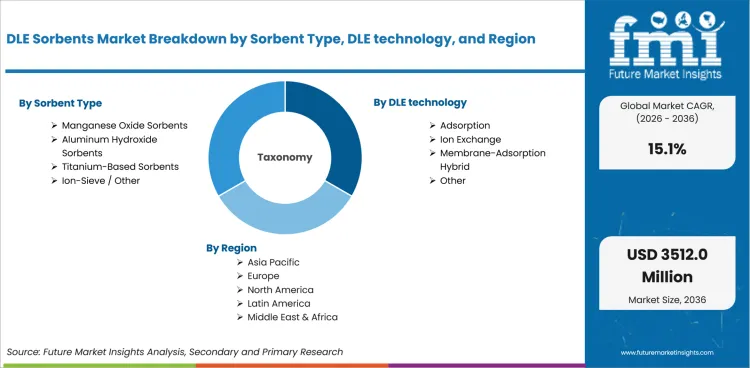
USD 860.6 million in 2026 and USD 3,512.0 million by 2036 at a 15.1% CAGR.
The DLE sorbents industry value is forecast to grow from USD 747.7 million in 2025 to USD 3,512.0 million by 2036 at 15.1% CAGR as brine owners shift toward direct lithium extraction. Sorbent + Process Package is expected to represent 61.0% share in 2026 because buyers prefer performance responsibility from one vendor. Adsorption is projected to secure 52.0% share in 2026, led by packed-column testing and modular scale-up.
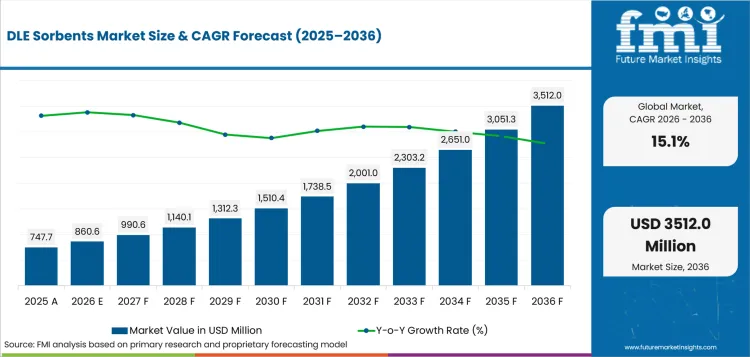
DLE Sorbents Market Overview: Size and Forecast
- 2025 Market Size: USD 747.7 million
- 2026 Market Size: USD 860.6 million
- 2036 Market Size: USD 3,512.0 million
- Forecast CAGR: 15.1% from 2026 to 2036
- Leading Sorbent Type: Manganese Oxide Sorbents
- Manganese Oxide Sorbents Share in 2026: 41.5%
- Leading DLE Technology: Adsorption
- Adsorption Share in 2026: 52.0%
- Leading Brine Source: Salar Brines
- Salar Brines Share in 2026: 44.0%
- Leading Deployment: Pilot / Demonstration
- Pilot / Demonstration Share in 2026: 67.0%
- Leading Sales Model: Sorbent + Process Package
- Sorbent + Process Package Share in 2026: 61.0%
- Fastest-growing Country: China
- China CAGR: 17.2% by 2036
Summary of the DLE Sorbents Market
- Demand and Growth Drivers
- Lithium project owners are moving toward selective sorbents that can shorten brine recovery cycles.
- Battery material buyers are giving more attention to process data and repeatable lithium recovery.
- Geothermal and oilfield brine projects are extending demand beyond traditional salar resources.
- Product and Segment View
- Sorbent + Process Package is forecast to represent 61.0% share in 2026, led by buyer preference for process responsibility.
- Adsorption is projected to hold 52.0% share in 2026, influenced by column-based testing and modular plant layouts.
- Manganese Oxide Sorbents are expected to secure 41.5% share in 2026, supported by selectivity in high-salinity brines.
- Geography and Competitive Outlook
- China is projected to record 17.2% CAGR by 2036, backed by salt-lake lithium projects and battery materials scale.
- The United States is expected to expand at 16.8% CAGR by 2036 through geothermal and oilfield brine qualification.
- SLB (formerly Schlumberger) and Lilac Solutions compete by process performance and brine testing depth.
- Sunresin and Adionics focus on sorbent systems and project-specific DLE process packages.
- Analyst Opinion
- Nikhil Kaitwade,Associate Vice President at FMI says, “DLE sorbents are becoming a qualification-risk product before they become a volume material. Buyers are comparing recovery, regeneration loss, impurity rejection, and vendor responsibility. Suppliers with brine testing depth and clear replacement economics should gain trust faster than companies selling only selective powders.”
Quality control is the main pressure point for DLE sorbents as lithium project owners review brine-specific recovery and regeneration loss. The USA Department of Energy states that DLE can use 99.0% less water per ton of lithium than other mining processes. USGS reported in January 2026 that world lithium production increased 31.0% in 2025 to about 290,000 tons. Suppliers with tested sorbents and column process support can secure project shortlists more easily.
Which factors support expansion in the DLE Sorbents Market?
Brine-specific sorbent revenue and integrated process packages support market value across lithium extraction projects.
- Market value is supported by selective sorbent revenue before commercial replacement cycles add repeat sales.
- Supplier pricing reflects adsorption capacity and regeneration stability before project warranties affect contract value.
- Revenue improves as brine owners convert pilot testing into integrated process package purchases.
- Buyer trust rises as vendors document cycle life and impurity rejection under real brine chemistry.
Why is the DLE Sorbents Market growing?
Lithium producers need faster brine recovery with clearer water and land-use advantages.
Growth outlook has become more structured as direct lithium extraction moves from pilot campaigns into project finance reviews. The USA Department of Energy states that DLE takes less time and requires 99.0% less water per ton of lithium than other lithium mining processes. This supports wider interest in the direct lithium extraction and the lithium mining market.
Battery supply-chain pressure is also increasing sorbent qualification. The International Energy Agency reported in May 2026 that EV battery deployment reached 1.2 TWh in 2025, representing nearly 30% growth compared with 2024 and more than seven times the level recorded in 2020. This rapid expansion of battery manufacturing is increasing demand for secure lithium supply sources, encouraging producers to adopt DLE technologies that can improve lithium recovery rates and reduce environmental impact. As commercial DLE projects advance toward large-scale deployment, demand for high-performance sorbents is expected to rise, supporting market growth over the forecast period.
How is the DLE Sorbents Market segmented?
The DLE sorbents industry is segmented by sorbent type, DLE technology, brine source, deployment, and sales model.
- Sorbent + Process Package is expected to represent 61.0% share in 2026, guided by process-risk transfer to integrated vendors.
- Pilot / Demonstration is projected to hold 67.0% share in 2026 since most brine owners still need site-specific cycle proof.
- Adsorption is expected to account for 52.0% share in 2026 due to repeatable column testing and modular plant layouts.
- Salar Brines are anticipated to reach 44.0% share in 2026 as large lithium resources remain the first scale-up pool.
- Manganese Oxide Sorbents are projected to secure 41.5% share in 2026 due to selectivity in high-salinity feeds.
Which sorbent type leads the DLE Sorbents Market?
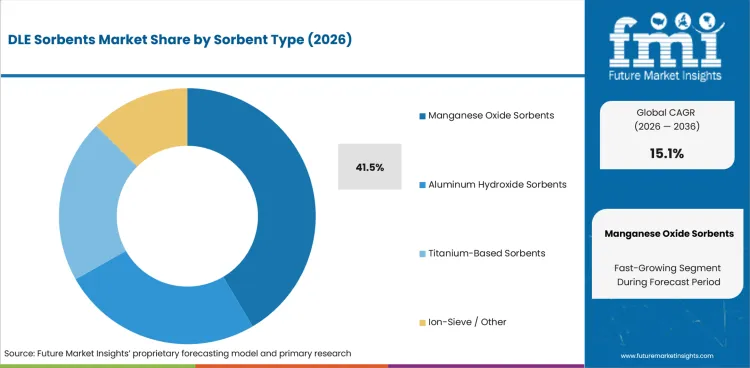
- Manganese Oxide Sorbents are projected to account for 41.5% share in 2026, influenced by selectivity in high-salinity brines.
- Aluminum Hydroxide Sorbents gain consideration where regeneration chemistry and material stability support lower lifecycle cost.
Which DLE technology leads the DLE Sorbents Market?
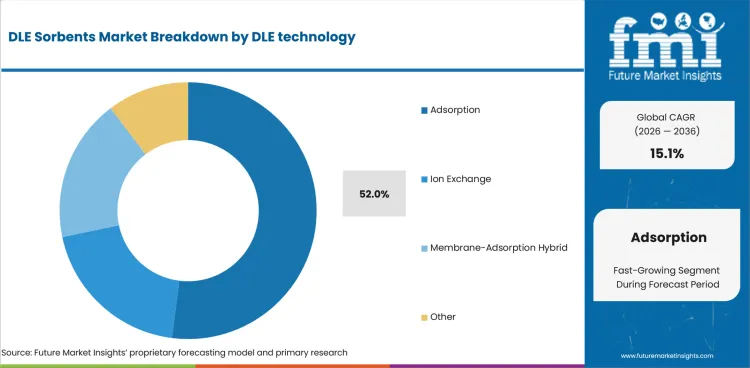
- Adsorption is expected to hold 52.0% share in 2026 through packed-column designs that support repeated loading cycles.
- Ion exchange gains attention where brine chemistry requires stronger impurity rejection and tighter lithium selectivity.
Which brine source leads the DLE Sorbents Market?
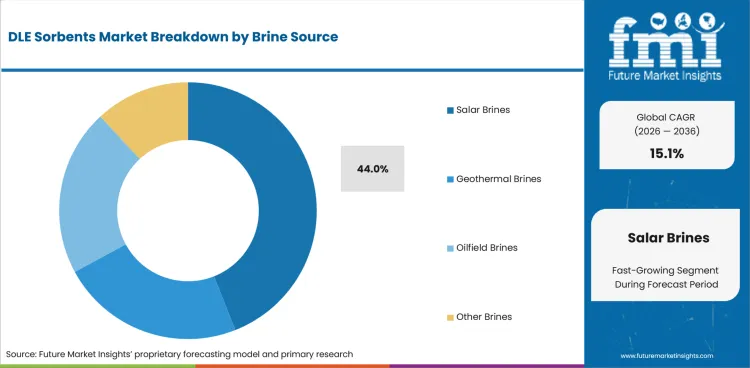
- Salar Brines are anticipated to represent 44.0% share in 2026 as large South American resources keep early sorbent demand concentrated.
- Geothermal brines are gaining value because compact surface plants can combine lithium recovery with power operations.
Which deployment segment leads the DLE Sorbents Market?
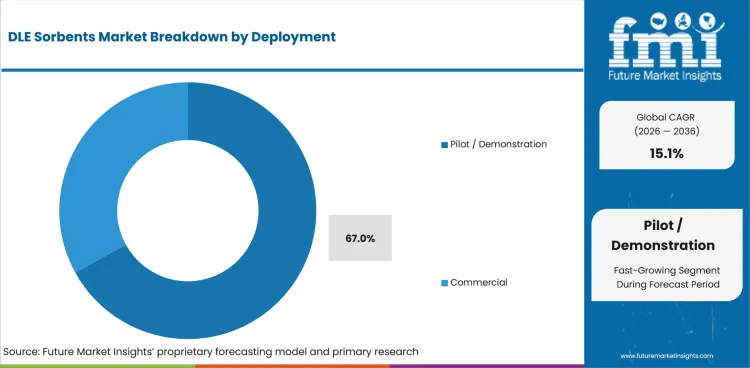
- Pilot / Demonstration is projected to hold 67.0% share in 2026 as most brine owners still require site-specific cycle proof.
- Commercial installations gain weight when pilot sorbent demand sets replacement standards for full plant contracts.
Which sales model leads the DLE Sorbents Market?
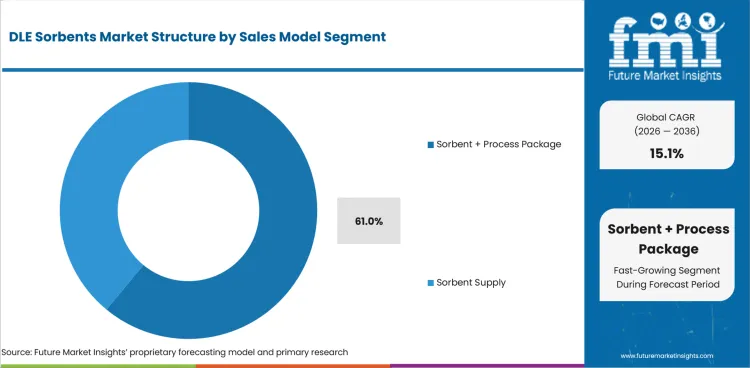
- Sorbent + Process Package is expected to reach 61.0% share in 2026 as buyers prefer performance responsibility from one vendor.
- Sorbent Supply works best for repeat customers that already control pretreatment and regeneration design.
What are the driver, restraints, and opportunities in the DLE Sorbents Market?
Shorter recovery cycles and process guarantees support growth while lithium price volatility limits wider commercial orders.
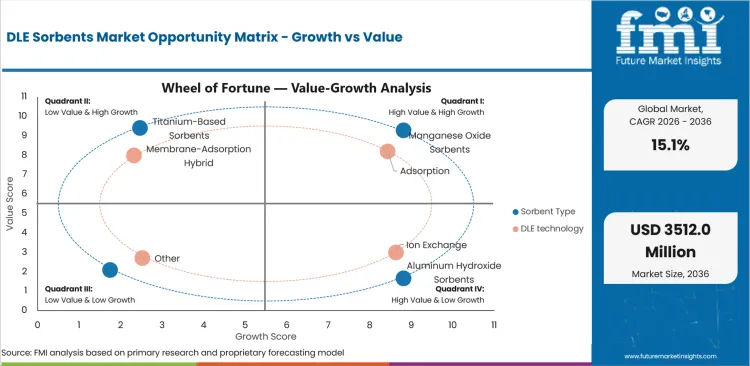
- Driver: Brine owners are moving toward shorter lithium recovery cycles that reduce exposure to evaporation timing.
- Restraint: Low lithium prices can delay full plant orders even after pilot sorbent performance appears strong.
- Opportunity: Vendors can create safer commercial footing by bundling sorbent supply with column design and replacement guarantees.
DLE Sorbents Market Demand Outlook
Demand outlook is moving toward brine-specific materials that can prove cycle life and impurity rejection before plant sanction. DOE water-footprint data has made rinse intensity and reinjection compatibility central to buyer decisions.
Project owners are expected to compare DLE packages against evaporation schedules and land exposure. Reagent use and replacement cost also guide selection. SLB (formerly Schlumberger) reported in September 2024 that its Clayton Valley demonstration plant produced lithium 500 times faster than evaporation. That benchmark helps explain why brine owners are testing selective sorbents earlier in project design.
Consumer Segmentation and Purchase Behavior Analysis
Current buyers include brine project owners and DLE process vendors. Engineering contractors and battery-material groups also influence procurement. First-time buyers typically prefer Sorbent + Process Package because one vendor can support brine testing and column sizing.
Repeat purchase depends on stable recovery during long pilot campaigns. Buyers also compare swelling and attrition before ordering larger sorbent volumes. Reagent intensity and impurity rejection remain part of the review.
Voice of Customer and Decision-driver Analysis
DLE sorbent purchasing is shaped by site-specific brine chemistry and the ability to document recovery over repeated cycles. Buyers want material performance data that can be shared with investors and offtakers.
The strongest decision driver is not peak recovery alone. Buyers also need lifecycle cost and replacement timing. Process support and vendor responsibility matter when sorbent performance changes under real brine conditions.
Which countries are growing fastest in the DLE Sorbents Market?
China 17.2% CAGR, United States 16.8% CAGR, South Korea 15.7% CAGR, India 15.5% CAGR, Germany 14.6% CAGR, France 14.2% CAGR, Japan 13.9% CAGR, and United Kingdom 12.0% CAGR through 2036.
.webp "Top Country Growth Comparison Dle Sorbents Market Cagr (2026 2036)")
| Country | CAGR |
|---|---|
| China | 17.2% |
| United States | 16.8% |
| South Korea | 15.7% |
| India | 15.5% |
| Germany | 14.6% |
| France | 14.2% |
| Japan | 13.9% |
| United Kingdom | 12.0% |
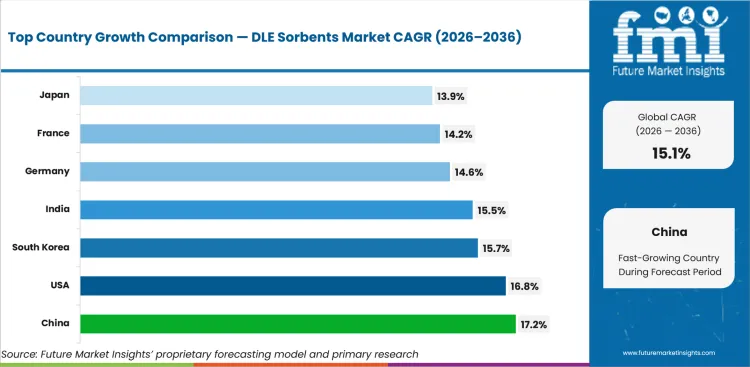
Source: Future Market Insights, 2026.
How do country-level CAGRs compare in the DLE Sorbents Market?
China leads country growth while the United Kingdom records the most cautious expansion outlook among profiled markets.
- China is projected to record 17.2% CAGR by 2036 as salt-lake lithium projects are close to large battery and cathode manufacturing clusters
- United States is projected to record 16.8% CAGR by 2036 as geothermal brines and oilfield brines create two separate qualification pathways
- South Korea is projected to record 15.7% CAGR by 2036 as battery manufacturers can shape overseas lithium recovery choices through offtake discipline
- India is projected to record 15.5% CAGR by 2036 as demand is more policy-led and import-security-led than project-volume-led at this stage
- Germany is projected to record 14.6% CAGR by 2036 as automotive and chemical buyers can pressure suppliers on qualification depth
- France is projected to record 14.2% CAGR by 2036 as process technology providers can export DLE know-how without large domestic brine volume
- Japan is projected to record 13.9% CAGR by 2036 as trading houses can move DLE screening into overseas resource partnerships
- United Kingdom is projected to record 12.0% CAGR by 2036 as project finance and critical-mineral policy drive participation more than domestic brine scale
How fast is the DLE Sorbents Market growing in China?
A 17.2% CAGR through 2036 reflects salt-lake lithium projects are close to large battery and cathode manufacturing clusters.
Country Market Snapshot Table
| Parameter | Value |
|---|---|
| Market Size in 2025 (Value) | USD 132.0 million |
| Market Size in 2026 (Value) | USD 154.7 million |
| Market Forecast in 2036 (Value) | USD 760.5 million |
| CAGR (2026 to 2036) | 17.2% |
| Years Considered | 2021 to 2036 |
| Base Year | 2025 |
| Forecast Period | 2026 to 2036 |
| Units Considered | Value (USD million) |
| Leading Sub-Region | Qinghai and Tibet salt-lake corridors |
China DLE Sorbents Market Outlook
China DLE sorbents demand is shaped by salt-lake lithium projects and battery material scale.
Integrated procurement is expected to favor vendors that combine sorbents with adsorption columns and brine testing.
Key Growth Drivers
- China's NEV scale pulls DLE sorbent qualification upstream. The Government of China reported in January 2026 that NEV production reached 16.626 million units in 2025.
- EV manufacturing concentration supports faster salt-lake lithium recovery trials. The IEA reported in June 2026 that China captured nearly 75.0% of global electric car production in 2025.
- Salt-lake operators need sorbents designed for high salinity and impurity control across Qinghai and Tibet brines.
- Integrated EPC procurement is expected to favor suppliers that bundle sorbents with columns and process guarantees.
Key Restraints
- Price discipline remains a restraint for new sorbent contracts. USGS reported in January 2026 that China spot lithium carbonate prices reached about USD 10300 per ton in November 2025.
- Local supplier competition can compress margins for standard adsorption materials used in earlier pilot systems.
- Customer confidentiality limits public comparison of cycle life and impurity rejection data across salt-lake projects.
What makes China unique
China is unique because salt-lake lithium projects sit close to large battery and cathode manufacturing clusters.
Key Companies
- Sunresin New Materials Co., Ltd.
- Tibet Summit Resources Co., Ltd.
- Zangge Mining Co., Ltd.
- Qinghai Salt Lake Industry Co., Ltd.
- BYD Lithium Battery Co., Ltd.
- Ganfeng Lithium Group Co., Ltd.
Sales & Marketing Channels
- Direct project-owner sales are used for salt-lake pilot and commercial brine projects.
- EPC-linked procurement supports bundled sorbent and column packages.
- Battery-material partnerships help vendors qualify sorbents through offtake reviews.
- Provincial resource developers buy test campaigns before plant contracts.
- Technical service distributors support lab screening and replacement sales.
Country Segment Breakdown Table
| Segment | Sub-Segments |
|---|---|
| By Sorbent Type | Manganese Oxide Sorbents · Aluminum Hydroxide Sorbents · Titanium-Based Sorbents · Ion-Sieve / Other |
| By DLE Technology | Adsorption · Ion Exchange · Membrane-Adsorption Hybrid · Other |
| By Brine Source | Salar Brines · Geothermal Brines · Oilfield Brines · Other Brines |
| By Deployment | Pilot / Demonstration · Commercial |
| By Sales Model | Sorbent Supply · Sorbent + Process Package |
| Key Sub-Regions Covered, Salt-Lake and Battery Corridors | Qinghai · Tibet · Sichuan · Jiangxi · Shanghai |
Frequently Asked Questions
How fast is China DLE sorbents market growing?
Sales in China are projected to expand at 17.2% CAGR from 2026 to 2036, guided by salt-lake brine projects.
Who leads China DLE sorbents market?
Sunresin, Tibet Summit Resources, Zangge Mining, and Qinghai Salt Lake compete through salt-lake lithium project access.
What is driving adoption in China DLE sorbents market?
Salt-lake lithium development and battery material scale are moving sorbent qualification toward larger adsorption packages.
What is the DLE Sorbents Market outlook in the United States?
A 16.8% CAGR through 2036 reflects geothermal brines and oilfield brines create two separate qualification pathways.
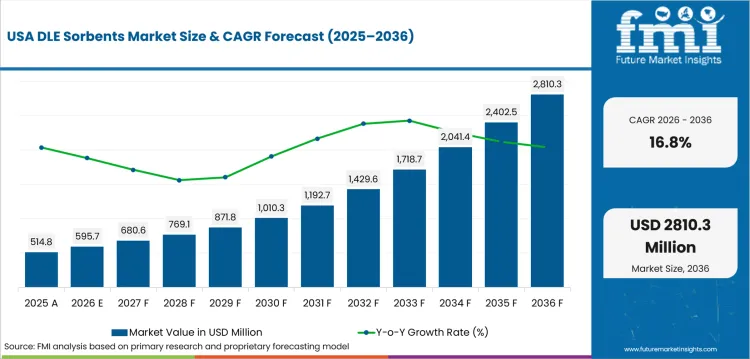
Country Market Snapshot Table
| Parameter | Value |
|---|---|
| Market Size in 2025 (Value) | USD 118.8 million |
| Market Size in 2026 (Value) | USD 138.8 million |
| Market Forecast in 2036 (Value) | USD 656.0 million |
| CAGR (2026 to 2036) | 16.8% |
| Years Considered | 2021 to 2036 |
| Base Year | 2025 |
| Forecast Period | 2026 to 2036 |
| Units Considered | Value (USD million) |
| Leading Sub-Region | Salton Sea, Nevada, and Smackover brine corridors |
United States DLE Sorbents Market Outlook
United States demand is led by geothermal and oilfield brines that need lower land exposure. Closed-basin brines add another qualification route.
Commercial buyers are expected to prefer vendors with documented recovery data and reinjection planning support.
Key Growth Drivers
- Salton Sea geothermal brines create a direct DLE use case. DOE announced a conditional loan commitment of up to USD 1.36 billion for Project ATLiS in January 2025.
- Field recovery benchmarks are improving buyer confidence. SLB (formerly Schlumberger) reported in September 2024 that its Clayton Valley demonstration plant reached 96.0% lithium recovery from brine.
- Smackover and oilfield brine interest creates a second qualification route outside geothermal projects.
- Battery offtake scrutiny is expected to favor vendors with verified water balances and long-cycle test data.
Key Restraints
- Lithium price weakness can slow commercial plant orders. USGS reported in January 2026 that the annual USA contract price for lithium carbonate fell 31.0% from 2024.
- Permitting and reinjection reviews can extend project schedules after pilot testing is complete.
- Brine chemistry differences across California and Nevada limit one-material deployment. Arkansas and Utah add different qualification needs.
What makes the United States unique
The United States is unique because geothermal brines and oilfield brines create two separate qualification pathways.
Key Companies
- SLB (formerly Schlumberger)
- Lilac Solutions, Inc.
- International Battery Metals Ltd.
- EnergyX
- TerraLithium
- Lithium Americas Corp.
- Standard Lithium Ltd.
Sales & Marketing Channels
- Direct project-owner sales serve geothermal and oilfield brine pilots.
- Technology licensing supports modular DLE projects with process guarantees.
- Engineering partnerships help suppliers integrate sorbents with pretreatment systems.
- Battery offtake channels influence early vendor shortlists.
- Government-backed project finance supports larger demonstration programs.
Country Segment Breakdown Table
| Segment | Sub-Segments |
|---|---|
| By Sorbent Type | Manganese Oxide Sorbents · Aluminum Hydroxide Sorbents · Titanium-Based Sorbents · Ion-Sieve / Other |
| By DLE Technology | Adsorption · Ion Exchange · Membrane-Adsorption Hybrid · Other |
| By Brine Source | Salar Brines · Geothermal Brines · Oilfield Brines · Other Brines |
| By Deployment | Pilot / Demonstration · Commercial |
| By Sales Model | Sorbent Supply · Sorbent + Process Package |
| Key Sub-Regions Covered, Geothermal and Oilfield Brine Corridors | California · Nevada · Arkansas · Utah · Texas |
Frequently Asked Questions
How fast is United States DLE sorbents market growing?
Sector in the United States is forecast to rise at 16.8% CAGR from 2026 to 2036, supported by geothermal and oilfield brines.
Who leads United States DLE sorbents market?
SLB (formerly Schlumberger), Lilac Solutions, IBAT, EnergyX, and Standard Lithium compete through pilots and modular DLE systems.
What is driving adoption in United States DLE sorbents market?
Salton Sea geothermal lithium and Smackover brines are moving DLE sorbents into field qualification programs.
What is driving DLE sorbents growth in South Korea?
A 15.7% CAGR through 2036 reflects battery manufacturers can shape overseas lithium recovery choices through offtake discipline.
Country Market Snapshot Table
| Parameter | Value |
|---|---|
| Market Size in 2025 (Value) | USD 72.0 million |
| Market Size in 2026 (Value) | USD 83.3 million |
| Market Forecast in 2036 (Value) | USD 358.0 million |
| CAGR (2026 to 2036) | 15.7% |
| Years Considered | 2021 to 2036 |
| Base Year | 2025 |
| Forecast Period | 2026 to 2036 |
| Units Considered | Value (USD million) |
| Leading Sub-Region | Battery and trading-house procurement corridors |
South Korea DLE Sorbents Market Outlook
South Korea DLE sorbents demand is tied to battery groups seeking secure lithium supply outside spot markets.
Growth is expected to come through overseas project participation rather than domestic brine volume.
Key Growth Drivers
- Critical mineral policy is pushing diversified lithium sourcing. IEA reported in April 2025 that Korea aims to cut reliance on selected import countries to 50.0% by 2030.
- Government diplomacy keeps lithium inside battery supply-security reviews. Korea's Ministry of Foreign Affairs said in March 2024 that MSP partners supported 23 critical mineral projects.
- Battery manufacturers can influence upstream DLE screening through offtake reviews and project finance.
- Trading groups can back overseas brine projects where sorbent performance data is bankable.
Key Restraints
- Domestic installation volume remains limited by resource availability. Korea's Ministry of Foreign Affairs stated in September 2024 that MSP work covered 15 partners rather than domestic resource scale.
- Battery buyers may wait for commercial proof before backing a new sorbent route.
- Supplier selection can stay slow when project economics depend on overseas permits.
What makes South Korea unique
South Korea is unique because battery manufacturers can shape overseas lithium recovery choices through offtake discipline.
Key Companies
- POSCO Holdings Inc.
- LG Energy Solution Ltd.
- SK On Co., Ltd.
- Samsung SDI Co., Ltd.
- Korea Zinc Co., Ltd.
- LX International Corp.
Sales & Marketing Channels
- Battery-maker procurement teams review overseas DLE technology routes.
- Trading houses connect Korean buyers with foreign brine project sponsors.
- Engineering partnerships support pilot validation before offtake commitments.
- Materials suppliers use qualification data to support cathode supply chains.
- Government-backed forums help companies screen lithium partnerships.
Country Segment Breakdown Table
| Segment | Sub-Segments |
|---|---|
| By Sorbent Type | Manganese Oxide Sorbents · Aluminum Hydroxide Sorbents · Titanium-Based Sorbents · Ion-Sieve / Other |
| By DLE Technology | Adsorption · Ion Exchange · Membrane-Adsorption Hybrid · Other |
| By Brine Source | Salar Brines · Geothermal Brines · Oilfield Brines · Other Brines |
| By Deployment | Pilot / Demonstration · Commercial |
| By Sales Model | Sorbent Supply · Sorbent + Process Package |
| Key Sub-Regions Covered, Battery Procurement Corridors | Seoul · Pohang · Ulsan · Busan · Cheongju |
Frequently Asked Questions
How fast is South Korea DLE sorbents market growing?
Demand in South Korea is expected to grow at 15.7% CAGR from 2026 to 2036 with battery supply-security reviews.
Who leads South Korea DLE sorbents market?
POSCO Holdings, LG Energy Solution, SK On, and Samsung SDI shape demand through overseas resource screening.
What is driving adoption in South Korea DLE sorbents market?
Battery groups and trading houses are using critical-mineral partnerships to review overseas brine recovery routes.
How is the DLE Sorbents Market performing in India?
A 15.5% CAGR through 2036 reflects demand is more policy-led and import-security-led than project-volume-led at this stage.
Country Market Snapshot Table
| Parameter | Value |
|---|---|
| Market Size in 2025 (Value) | USD 65.0 million |
| Market Size in 2026 (Value) | USD 75.1 million |
| Market Forecast in 2036 (Value) | USD 316.0 million |
| CAGR (2026 to 2036) | 15.5% |
| Years Considered | 2021 to 2036 |
| Base Year | 2025 |
| Forecast Period | 2026 to 2036 |
| Units Considered | Value (USD million) |
| Leading Sub-Region | Battery manufacturing and critical-mineral policy corridors |
India DLE Sorbents Market Outlook
India demand is early-stage and policy-led because domestic brine projects remain limited.
Overseas resource partnerships are expected to create the first meaningful DLE sorbent procurement opportunities.
Key Growth Drivers
- Critical-mineral policy raises interest in extraction technology. PIB reported in January 2025 that NCMM carries Rs.16,300 crore in expenditure.
- Battery manufacturing policy adds local demand context. PIB reported in February 2026 that the ACC PLI scheme has a Rs.18,100 crore budget outlay.
- Overseas resource partnerships can introduce DLE packages to Indian battery and mineral buyers.
- Public mineral programs can create pilot routes for selective lithium recovery technologies.
Key Restraints
- Domestic DLE demand remains early-stage. PIB reported in April 2025 that GSI is tasked with 1200 exploration projects under NCMM.
- Public procurement cycles can slow vendor selection for imported DLE packages.
- Hard-rock and recycling discussions can receive priority before brine-specific pilots move to scale.
What makes India unique
India is unique because demand is more policy-led and import-security-led than project-volume-led at this stage.
Key Companies
- KABIL
- National Aluminium Company Limited
- Hindustan Copper Limited
- Mineral Exploration and Consultancy Limited
- Tata Chemicals Limited
- Reliance New Energy Limited
Sales & Marketing Channels
- Public-sector mineral buyers evaluate extraction technologies through policy programs.
- Battery manufacturers review lithium supply routes through localization plans.
- Engineering firms support overseas brine due diligence for Indian offtakers.
- Technology vendors use pilot partnerships to enter public mineral programs.
- Cathode and cell manufacturers influence supplier qualification indirectly.
Country Segment Breakdown Table
| Segment | Sub-Segments |
|---|---|
| By Sorbent Type | Manganese Oxide Sorbents · Aluminum Hydroxide Sorbents · Titanium-Based Sorbents · Ion-Sieve / Other |
| By DLE Technology | Adsorption · Ion Exchange · Membrane-Adsorption Hybrid · Other |
| By Brine Source | Salar Brines · Geothermal Brines · Oilfield Brines · Other Brines |
| By Deployment | Pilot / Demonstration · Commercial |
| By Sales Model | Sorbent Supply · Sorbent + Process Package |
| Key Sub-Regions Covered, Critical-Mineral Policy Corridors | Gujarat · Karnataka · Tamil Nadu · Andhra Pradesh · Rajasthan |
Frequently Asked Questions
How fast is India DLE sorbents market growing?
India is anticipated to grow at 15.5% CAGR from 2026 to 2036, led by critical-mineral policy programs.
Who leads India DLE sorbents market?
KABIL, NALCO, Hindustan Copper, MECL, and Tata Chemicals are relevant through mineral and battery supply programs.
What is driving adoption in India DLE sorbents market?
Critical-mineral policy and battery manufacturing localization are creating early routes for DLE package screening.
What is the DLE Sorbents Market outlook in Germany?
A 14.6% CAGR through 2036 reflects automotive and chemical buyers can pressure suppliers on qualification depth.
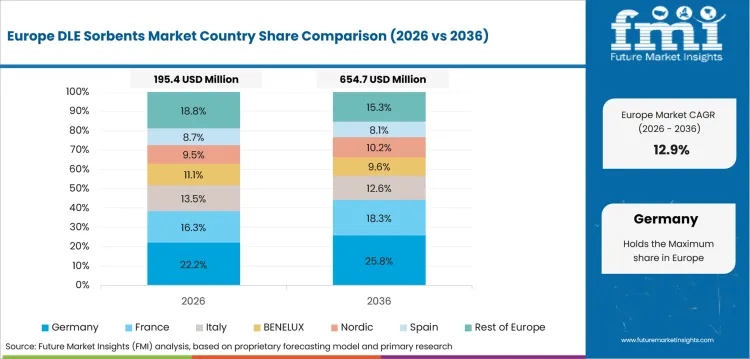
Country Market Snapshot Table
| Parameter | Value |
|---|---|
| Market Size in 2025 (Value) | USD 61.5 million |
| Market Size in 2026 (Value) | USD 70.5 million |
| Market Forecast in 2036 (Value) | USD 274.0 million |
| CAGR (2026 to 2036) | 14.6% |
| Years Considered | 2021 to 2036 |
| Base Year | 2025 |
| Forecast Period | 2026 to 2036 |
| Units Considered | Value (USD million) |
| Leading Sub-Region | Automotive and geothermal lithium corridors |
Germany DLE Sorbents Market Outlook
Germany DLE sorbents demand is connected to European battery supply security and geothermal lithium trials.
Engineering buyers are expected to require stronger process warranties before repeat commercial purchasing.
Key Growth Drivers
- German battery and automotive networks need secure lithium sourcing. The European Commission stated in May 2024 that EU lithium demand is expected to rise twelve-fold by 2030.
- Electric vehicle production keeps battery materials under review. Destatis reported in September 2025 that Germany registered 380,609 new electric cars in 2024.
- Geothermal lithium projects in Central Europe create trial routes for warm-brine sorbents.
- Engineering groups can turn successful pilots into repeatable process packages for European buyers.
Key Restraints
- European recycling rules increase compliance expectations. The European Commission said in July 2025 that lithium material recovery targets reach 50.0% by 2027.
- Public review of geothermal and subsurface projects can slow commercial timing.
- Technical buyers often require stronger warranties than early-stage sorbent vendors can provide.
What makes Germany unique
Germany is unique because automotive and chemical buyers can pressure suppliers on qualification depth.
Key Companies
- Vulcan Energy Resources Europe GmbH
- BASF SE
- AMG Lithium GmbH
- Zinnwald Lithium GmbH
- Schlumberger Deutschland GmbH
- Siemens Energy AG
Sales & Marketing Channels
- Direct sales into geothermal lithium projects support early qualification.
- Engineering procurement teams compare sorbent performance with plant availability.
- Automotive battery buyers influence upstream sustainability reviews.
- Chemical companies evaluate lithium feedstock security through long-term supply planning.
- Pilot services firms support brine testing and material screening.
Country Segment Breakdown Table
| Segment | Sub-Segments |
|---|---|
| By Sorbent Type | Manganese Oxide Sorbents · Aluminum Hydroxide Sorbents · Titanium-Based Sorbents · Ion-Sieve / Other |
| By DLE Technology | Adsorption · Ion Exchange · Membrane-Adsorption Hybrid · Other |
| By Brine Source | Salar Brines · Geothermal Brines · Oilfield Brines · Other Brines |
| By Deployment | Pilot / Demonstration · Commercial |
| By Sales Model | Sorbent Supply · Sorbent + Process Package |
| Key Sub-Regions Covered, Automotive and Geothermal Corridors | Upper Rhine Graben · Saxony · Bavaria · North Rhine-Westphalia · Brandenburg |
Frequently Asked Questions
How fast is Germany DLE sorbents market growing?
Industry in Germany is projected to rise at 14.6% CAGR from 2026 to 2036 through geothermal lithium and battery security programs.
Who leads Germany DLE sorbents market?
Vulcan Energy Resources Europe, BASF, AMG Lithium, Zinnwald Lithium, and Siemens Energy support local qualification pathways.
What is driving adoption in Germany DLE sorbents market?
Automotive battery demand and Upper Rhine geothermal lithium trials are supporting careful DLE sorbent evaluation.
How is the DLE Sorbents Market performing in France?
A 14.2% CAGR through 2036 reflects process technology providers can export DLE know-how without large domestic brine volume.
Country Market Snapshot Table
| Parameter | Value |
|---|---|
| Market Size in 2025 (Value) | USD 49.0 million |
| Market Size in 2026 (Value) | USD 56.0 million |
| Market Forecast in 2036 (Value) | USD 211.0 million |
| CAGR (2026 to 2036) | 14.2% |
| Years Considered | 2021 to 2036 |
| Base Year | 2025 |
| Forecast Period | 2026 to 2036 |
| Units Considered | Value (USD million) |
| Leading Sub-Region | Technology provider and battery recycling corridors |
France DLE Sorbents Market Outlook
France demand is shaped by technology providers and European battery-material security programs.
Domestic volume remains moderate, but French process expertise is expected to influence overseas DLE vendor choice.
Key Growth Drivers
- French technology providers give the country a role in overseas brine qualification. Adionics reported in February 2024 that it completed 1500 hours of DLE testing at SQM's Atacama site.
- European funding channels support battery-linked circular projects. The European Commission stated in May 2024 that EU lithium demand is expected to rise twelve-fold by 2030.
- Process service providers can influence sorbent choice even when domestic brine consumption is modest.
- EU raw material benchmarks encourage French buyers to review upstream lithium processing options.
Key Restraints
- Battery recycling legislation can redirect funding toward secondary recovery. The European Commission stated in July 2025 that lithium recovery targets rise to 80.0% by 2031.
- Domestic brine resource scale limits local sorbent volume compared with China or the United States.
- Technology providers must prove repeatability across brines outside France before winning larger projects.
What makes France unique
France is unique because process technology providers can export DLE know-how without large domestic brine volume.
Key Companies
- Adionics SAS
- Eramet SA
- Geolith SAS
- Viridian Lithium SAS
- Orano SA
- Imerys SA
Sales & Marketing Channels
- Technology providers sell DLE process packages into overseas brine projects.
- Mining groups evaluate sorbents through lithium project development teams.
- European innovation funding supports pilot and demonstration procurement.
- Battery recycling programs compete for related separation expertise.
- Engineering partners help local firms validate overseas performance data.
Country Segment Breakdown Table
| Segment | Sub-Segments |
|---|---|
| By Sorbent Type | Manganese Oxide Sorbents · Aluminum Hydroxide Sorbents · Titanium-Based Sorbents · Ion-Sieve / Other |
| By DLE Technology | Adsorption · Ion Exchange · Membrane-Adsorption Hybrid · Other |
| By Brine Source | Salar Brines · Geothermal Brines · Oilfield Brines · Other Brines |
| By Deployment | Pilot / Demonstration · Commercial |
| By Sales Model | Sorbent Supply · Sorbent + Process Package |
| Key Sub-Regions Covered, Technology Provider Corridors | Paris · Alsace · Nouvelle-Aquitaine · Auvergne-Rhone-Alpes · Occitanie |
Frequently Asked Questions
How fast is France DLE sorbents market growing?
France is forecast to grow at 14.2% CAGR from 2026 to 2036, supported by process technology exports.
Who leads France DLE sorbents market?
Adionics, Eramet, Geolith, Viridian Lithium, Orano, and Imerys compete through process expertise and mineral programs.
What is driving adoption in France DLE sorbents market?
French technology providers and EU battery funding channels are moving DLE expertise into overseas brine projects.
What is the DLE Sorbents Market forecast for Japan?
A 13.9% CAGR through 2036 reflects trading houses can move DLE screening into overseas resource partnerships.
Country Market Snapshot Table
| Parameter | Value |
|---|---|
| Market Size in 2025 (Value) | USD 58.0 million |
| Market Size in 2026 (Value) | USD 66.1 million |
| Market Forecast in 2036 (Value) | USD 243.0 million |
| CAGR (2026 to 2036) | 13.9% |
| Years Considered | 2021 to 2036 |
| Base Year | 2025 |
| Forecast Period | 2026 to 2036 |
| Units Considered | Value (USD million) |
| Leading Sub-Region | Trading-house and battery supply-security corridors |
Japan DLE Sorbents Market Outlook
Japan DLE sorbents demand is tied to import security and overseas project screening.
Trading houses and battery users are expected to drive adoption through offtake diligence rather than domestic brine installation.
Key Growth Drivers
- Import dependency raises the value of upstream lithium assurance. Japan's energy agency reported in 2026 that the country depends almost 100.0% on imports for mineral resources.
- Battery deployment demand supports overseas resource screening. The IEA reported in May 2026 that EV battery deployment reached 1.2 TWh in 2025.
- Trading houses can support overseas DLE projects through long-term offtake diligence.
- Automotive buyers can push partners to prove lower-impact lithium recovery before project finance.
Key Restraints
- Slow macro growth can delay expensive overseas project backing. IEEJ projected in December 2025 that Japan's economy would grow 0.9% in fiscal year 2026.
- Conservative qualification processes can slow new vendor entry into Japanese supply chains.
- Technical approval often depends on overseas project partners rather than domestic brine operators.
What makes Japan unique
Japan is unique because trading houses can move DLE screening into overseas resource partnerships.
Key Companies
- Toyota Tsusho Corporation
- Sumitomo Corporation
- Mitsui & Co., Ltd.
- Mitsubishi Corporation
- Panasonic Energy Co., Ltd.
- Tosoh Corporation
Sales & Marketing Channels
- Trading houses screen overseas brine projects before offtake commitments.
- Battery manufacturers review DLE data through long-term raw material planning.
- Chemical companies evaluate sorbent materials for separation performance.
- Automotive procurement teams influence lower-impact lithium sourcing requirements.
- Government-linked finance can support overseas resource participation.
Country Segment Breakdown Table
| Segment | Sub-Segments |
|---|---|
| By Sorbent Type | Manganese Oxide Sorbents · Aluminum Hydroxide Sorbents · Titanium-Based Sorbents · Ion-Sieve / Other |
| By DLE Technology | Adsorption · Ion Exchange · Membrane-Adsorption Hybrid · Other |
| By Brine Source | Salar Brines · Geothermal Brines · Oilfield Brines · Other Brines |
| By Deployment | Pilot / Demonstration · Commercial |
| By Sales Model | Sorbent Supply · Sorbent + Process Package |
| Key Sub-Regions Covered, Trading-House Procurement Corridors | Tokyo · Osaka · Nagoya · Kyushu · Tohoku |
Frequently Asked Questions
How fast is Japan DLE sorbents market growing?
Sector in Japan is projected at 13.9% CAGR from 2026 to 2036 as trading houses screen overseas lithium assets.
Who leads Japan DLE sorbents market?
Toyota Tsusho, Sumitomo, Mitsui, Mitsubishi, Panasonic Energy, and Tosoh influence supply-chain qualification.
What is driving adoption in Japan DLE sorbents market?
Import dependence and automotive battery supply reviews are pushing Japanese buyers toward overseas DLE project diligence.
How is the DLE Sorbents Market performing in the United Kingdom?
A 12.0% CAGR through 2036 reflects project finance and critical-mineral policy drive participation more than domestic brine scale.
Country Market Snapshot Table
| Parameter | Value |
|---|---|
| Market Size in 2025 (Value) | USD 38.0 million |
| Market Size in 2026 (Value) | USD 42.6 million |
| Market Forecast in 2036 (Value) | USD 132.0 million |
| CAGR (2026 to 2036) | 12.0% |
| Years Considered | 2021 to 2036 |
| Base Year | 2025 |
| Forecast Period | 2026 to 2036 |
| Units Considered | Value (USD million) |
| Leading Sub-Region | Finance, policy, and critical-mineral project corridors |
United Kingdom DLE Sorbents Market Outlook
United Kingdom demand is more finance-led than bulk consumption-led because domestic brine activity is limited.
Critical-mineral strategy is expected to support due diligence for lithium projects and related DLE packages.
Key Growth Drivers
- UK policy increases financing interest in lithium projects. The Government of the United Kingdom stated in November 2025 that it aims to produce at least 50,000 tonnes of lithium by 2035.
- Recycling targets widen the critical-minerals discussion. The UK government stated in November 2025 that 20.0% of mineral needs should come through recycling by 2035.
- Technical due diligence firms can influence DLE vendor selection in overseas assets.
- Critical-mineral finance channels provide an indirect route for sorbent and process package suppliers.
Key Restraints
- Commodity volatility can slow project finance. UK Vision 2035 stated in January 2026 that lithium spot prices fell by 75.0% in 2024.
- Direct domestic brine activity remains limited compared with China and the United States.
- UK demand is more finance-led than bulk sorbent consumption-led during the forecast period.
What makes the United Kingdom unique
The United Kingdom is unique because project finance and critical-mineral policy drive participation more than domestic brine scale.
Key Companies
- Cornish Lithium Plc
- British Lithium Limited
- Green Lithium Refining Limited
- Alkemy Capital Investments Plc
- Technology Minerals Plc
- Weardale Lithium Limited
Sales & Marketing Channels
- Project-finance channels evaluate DLE vendors through technical due diligence.
- Domestic lithium developers review process packages for future brine and hard-rock integration.
- Government-linked programs support critical-mineral commercialization pathways.
- Engineering consultants compare sorbent performance for investor review.
- Battery material buyers track lithium security through supplier qualification.
Country Segment Breakdown Table
| Segment | Sub-Segments |
|---|---|
| By Sorbent Type | Manganese Oxide Sorbents · Aluminum Hydroxide Sorbents · Titanium-Based Sorbents · Ion-Sieve / Other |
| By DLE Technology | Adsorption · Ion Exchange · Membrane-Adsorption Hybrid · Other |
| By Brine Source | Salar Brines · Geothermal Brines · Oilfield Brines · Other Brines |
| By Deployment | Pilot / Demonstration · Commercial |
| By Sales Model | Sorbent Supply · Sorbent + Process Package |
| Key Sub-Regions Covered, Finance and Lithium Project Corridors | Cornwall · Teesside · London · County Durham · West Midlands |
Frequently Asked Questions
How fast is United Kingdom DLE sorbents market growing?
United Kingdom demand is expected to rise at 12.0% CAGR from 2026 to 2036, shaped by finance-led critical-mineral programs.
Who leads United Kingdom DLE sorbents market?
Cornish Lithium, Green Lithium, Alkemy Capital, Tees Valley Lithium, and UK critical-mineral financiers shape participation.
What is driving adoption in United Kingdom DLE sorbents market?
Critical-mineral strategy and project finance are moving DLE sorbent review into lithium project due diligence.
Who are the leading companies in the DLE Sorbents Market?
SLB (formerly Schlumberger), Lilac Solutions, Sunresin, Adionics, IBAT, EnergyX, and Rio Tinto Lithium are visible suppliers and project-linked companies.
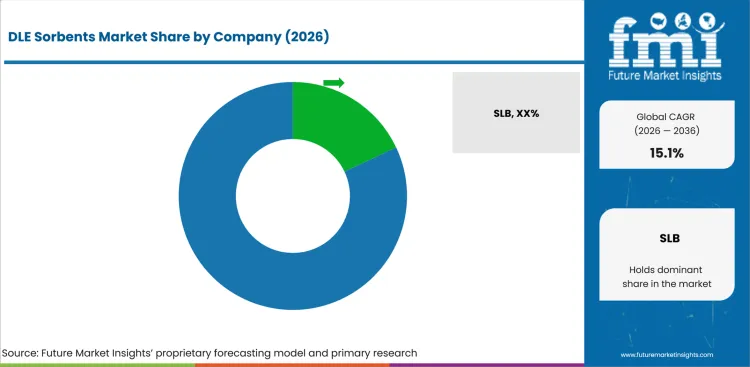
- DLE process vendors hold an advantage when they combine sorbent performance with column design and brine testing.
- Sorbent specialists gain project access by proving cycle life and impurity rejection across difficult brines.
- Lithium project developers influence vendor selection by selecting sorbents during pilot and demonstration phases.
- Engineering-linked suppliers support trial through pretreatment guidance and replacement economics.
DLE suppliers compete by combining brine-specific performance with customer qualification programs. Performance data has become a competitive separator as project owners move beyond laboratory screening. SLB (formerly Schlumberger) reported verified recovery at its Clayton Valley plant in September 2024. Adionics completed long-duration testing at SQM Atacama in February 2024. Rio Tinto gained a larger lithium platform after completing the Arcadium Lithium acquisition in March 2025. Scale alone is not enough if brine chemistry and regeneration cost are not proven.
Regional and specialist suppliers can win through local brine knowledge and faster pilot support. China-based firms can build around salt-lake experience. European suppliers can compete through geothermal lithium and technology exports. Companies with clear cycle data and conservative process guarantees should gain more durable project positions. Vendors relying only on laboratory claims are expected to face weaker customer acceptance.
How do top DLE sorbents companies compare?
SLB (formerly Schlumberger) and Sunresin score strongly on process relevance while Adionics and Lilac Solutions lead in DLE technology positioning.
| Company | Relevance to Market Title | DLE Process Depth | Sorbent / Material Capability | Pilot Evidence | Channel Reach | Geographic Footprint |
|---|---|---|---|---|---|---|
| SLB (formerly Schlumberger) | Very High | Very Strong | Strong | Very Strong | Very Strong | Global |
| Sunresin | Very High | Strong | Very Strong | Strong | Strong | China and Global |
| Adionics | Very High | Very Strong | Strong | Very Strong | Moderate | France and Global |
| Lilac Solutions | Very High | Very Strong | Strong | Strong | Strong | United States and Global |
| International Battery Metals | High | Strong | Moderate | Strong | Moderate | North America |
| EnergyX | High | Strong | Moderate | Moderate | Moderate | United States and Latin America |
| E3 Lithium | High | Moderate | Strong | Strong | Moderate | Canada |
| Rio Tinto Lithium | High | Moderate | Moderate | Strong | Very Strong | Global |
| Summit Nanotech | Moderate to High | Strong | Moderate | Moderate | Moderate | North America |
| Vulcan Energy Resources | Moderate to High | Strong | Moderate | Strong | Moderate | Europe |
Source: Future Market Insights competitive analysis, 2026.
Who are the key players in the DLE Sorbents Market?
SLB (formerly Schlumberger), Sunresin, Adionics, Lilac Solutions, and IBAT are listed with EnergyX and Rio Tinto among other suppliers.
Key global companies leading the DLE Sorbents Market include:
- SLB (formerly Schlumberger)
- Sunresin
- Adionics
- Lilac Solutions
- International Battery Metals
- EnergyX
- E3 Lithium
- Rio Tinto Lithium
- Summit Nanotech
- Vulcan Energy Resources
Key Developments in DLE Sorbents Market
- In March 2025, Rio Tinto completed the acquisition of Arcadium Lithium for USD 6.7 billion and created a larger lithium business with brine and hard-rock assets.
- In September 2024, SLB (formerly Schlumberger) reported verified 96.0% lithium recovery from brine at its Clayton Valley demonstration plant in Nevada.
- In August 2024, International Battery Metals stated that its modular DLE plant at the USA Magnesium site achieved commercial operations in July 2024.
Key Players in the DLE Sorbents Market
Integrated Lithium and Energy Technology Groups
- Rio Tinto Lithium
- SLB (formerly Schlumberger)
- Vulcan Energy Resources
- E3 Lithium
DLE Technology and Sorbent Specialists
- Sunresin
- Adionics
- Lilac Solutions
- International Battery Metals
- EnergyX
- Summit Nanotech
Regional Project and Process Companies
- Standard Lithium
- Tetra Technologies
- Geolith
- Zinnwald Lithium
- Cornish Lithium
DLE Sorbents Market - Report Scope
| Parameter | Details |
|---|---|
| Forecast period | 2026 to 2036 |
| Historical period | 2021 to 2025 |
| Quantitative unit | Revenue in USD million |
| By sorbent type | Manganese oxide sorbents, aluminum hydroxide sorbents, titanium-based sorbents, ion-sieve / other |
| By DLE technology | Adsorption, ion exchange, membrane-adsorption hybrid, other |
| By brine source | Salar brines, geothermal brines, oilfield brines, other brines |
| By deployment | Pilot / demonstration, commercial |
| By sales model | Sorbent supply, sorbent + process package |
| Regions covered | North America, Latin America, Western Europe, Eastern Europe, East Asia, South Asia and Pacific, Middle East and Africa |
| Countries covered | China, United States, South Korea, India, Germany, France, Japan, United Kingdom |
| Key companies profiled | SLB (formerly Schlumberger), Sunresin, Adionics, Lilac Solutions, International Battery Metals, EnergyX, Rio Tinto Lithium, E3 Lithium |
| Approach | Bottom-up product-boundary approach using sorbent revenue, pilot conversion, brine project pipelines, deployment mix, and replacement assumptions |
Source: Future Market Insights, 2026.
DLE Sorbents Market - Scope & Definition
| Attribute | Detail |
|---|---|
| Market Definition | Lithium-selective sorbents used to capture lithium ions from salar, geothermal, oilfield, and other brines in direct lithium extraction systems. |
| Functions Covered | Lithium capture, impurity rejection, regeneration support, brine concentration, and repeat-cycle recovery. |
| Applications Covered | Adsorption columns, ion-exchange circuits, membrane-adsorption hybrid systems, pilot skids, and commercial brine processing modules. |
| End-Use Industries | Lithium extraction, battery materials, specialty chemicals, geothermal energy, oilfield brine recovery, and mining technology services. |
| Grades Covered | Manganese oxide, aluminum hydroxide, titanium-based, ion-sieve, and other lithium-selective sorbent materials. |
| Inclusions | All commercially traded DLE sorbents and integrated sorbent process packages used in brine-based lithium recovery. |
| Exclusions | Spodumene mining reagents, evaporation pond construction chemicals, battery cathode powders, battery recycling lixiviants, and non-lithium water-treatment adsorbents. |
DLE Sorbents Market - Research Methodology
| Method | Description |
|---|---|
| Primary Research | FMI analyst interviews with lithium project owners, DLE technology vendors, sorbent formulators, brine testing laboratories, EPC firms, and battery materials buyers. |
| Desk Research | Review of government mineral data, energy agency publications, company technical disclosures, project announcements, and official product information. |
| Market Sizing & Forecasting | Bottom-up product-boundary approach using brine project pipelines, sorbent loading assumptions, cycle replacement models, deployment mix, and country project readiness. |
| Data Validation | Cross-verification using lithium production data, EV battery demand signals, company technology milestones, pilot project disclosures, and expert interviews. |
DLE Sorbents Market Breakdown by Sorbent Type, DLE Technology, Brine Source, Deployment, Sales Model, and Region
DLE Sorbents Market Segmented by Sorbent Type
- Manganese Oxide Sorbents
- Aluminum Hydroxide Sorbents
- Titanium-Based Sorbents
- Ion-Sieve / Other
DLE Sorbents Market Segmented by DLE Technology
- Adsorption
- Ion Exchange
- Membrane-Adsorption Hybrid
- Other
DLE Sorbents Market Segmented by Brine Source
- Salar Brines
- Geothermal Brines
- Oilfield Brines
- Other Brines
DLE Sorbents Market Segmented by Deployment
- Pilot / Demonstration
- Commercial
DLE Sorbents Market Segmented by Sales Model
- Sorbent Supply
- Sorbent + Process Package
DLE Sorbents Market by Region
- North America
- Latin America
- Western Europe
- Eastern Europe
- East Asia
- South Asia and Pacific
- Middle East and Africa
Research Sources and Bibliography
- USA Department of Energy. (2025, January 15). LPO announces conditional commitment for Project ATLiS for lithium hydroxide production in California.
- USA Department of Energy. (2026, May). Lithium.
- USA Geological Survey. (2026, January). Mineral Commodity Summaries 2026: Lithium.
- International Energy Agency. (2026, May). Global EV Outlook 2026: Electric vehicle batteries.
- International Energy Agency. (2026, May). Global EV Outlook 2026: Manufacturing and trade.
- European Commission. (2024, May). Critical Raw Materials Act.
- European Commission. (2025, July 4). New rules to boost recycling efficiency for waste batteries.
- European Commission. (2026). Innovation Fund projects.
- Government of the United Kingdom. (2025, November 22). From smartphones to fridges: UK to end overreliance on imports of critical minerals.
- Government of the United Kingdom. (2026, January 23). Vision 2035: Critical Minerals Strategy.
- Government of China. (2026, January 14). China auto output, sales reach new highs in 2025.
- Press Information Bureau. (2025, January 29). Cabinet approves National Critical Mineral Mission.
- Press Information Bureau. (2025, April 9). National Critical Mineral Mission: Powering India’s clean energy future.
- Press Information Bureau. (2026, February 10). PLI-ACC scheme.
- International Energy Agency. (2025, April 28). The strategy for securing reliable critical minerals supply.
- Ministry of Foreign Affairs, Republic of Korea. (2024, September 19). Spokesperson’s press briefing.
- USA Department of State. (2024, September 27). Joint statement of the Minerals Security Partnership principals meeting.
- SLB (formerly Schlumberger). (2024, September 10). SLB (formerly Schlumberger) achieves breakthrough results in sustainable lithium production.
- Adionics. (2024, February 5). Adionics completes successful 1,500 hours of direct lithium extraction testing at SQM’s Atacama salar premises.
- Rio Tinto. (2025, March 6). Rio Tinto completes acquisition of Arcadium Lithium.
- International Battery Metals. (2024, August 20). IBAT investor letter, August 20, 2024: First commercial production achieved.
- Sunresin. (2026, May 13). Sunresin showcases global environmental solutions at IFAT Munich 2026.
- Destatis. (2025, September 8). Electric cars: Low number of new registrations in Germany.
- Agency for Natural Resources and Energy. (2026, April). Japan’s energy 2025.
- Institute of Energy Economics, Japan. (2025, December 19). Economic and energy outlook of Japan for FY2026.
This bibliography is provided for reader reference and is not exhaustive. The full report contains the complete reference list and detailed citations.
This Report Answers
- Market size estimates for 2026 and forecasts through 2036 for the DLE Sorbents Market.
- Insights across more than 30 regional and country-level markets.
- Analysis of demand drivers, brine chemistry requirements, project qualification cycles, and purchasing behavior.
- Evaluation of sorbent type, DLE technology, brine source, deployment, and sales model segments.
- Assessment of project finance factors that influence DLE sorbent procurement.
- Identification of growth opportunities across salar, geothermal, and oilfield brine applications.
- Evaluation of supply-chain dynamics, technical qualification trends, and vendor competition.
- Country-level growth analysis covering China, the United States, South Korea, India, Germany, France, Japan, and the United Kingdom.
- Assessment of the competitive landscape across DLE process vendors, sorbent specialists, and lithium project developers.
- Analysis of buyer preferences, pilot conversion risks, and recurring sorbent replacement economics.
- Regional outlooks across North America, Europe, East Asia, and South Asia Pacific.
- Delivery of market data, forecasts, and supporting analysis in PDF and Excel formats.
Frequently Asked Questions
What is the growth prospect for DLE sorbents?
Demand for DLE sorbents is expected to rise as brine owners seek faster lithium recovery and lower pond exposure.
Which companies are expected to shape the DLE Sorbents Market?
SLB, Sunresin, Adionics, Lilac Solutions, IBAT, EnergyX, and Rio Tinto are expected to shape competition through DLE portfolios and project access.
Why are lithium producers investing in DLE sorbents?
Lithium producers are investing in DLE sorbents to shorten recovery cycles and improve control over brine processing.
Why are process packages important in the DLE Sorbents Market?
Process packages support buyer confidence by combining sorbent supply, column design, and regeneration support.
Which sorbent formats are gaining attention in DLE projects?
Manganese oxide and aluminum hydroxide sorbents are gaining attention as project owners test selectivity and cycle stability.
How do regulations influence DLE sorbent demand?
Regulations influence project timing through water-use review, reinjection planning, and critical-mineral permitting requirements.
Why is brine testing important for DLE sorbents?
Brine testing is important because impurity loads and salinity determine sorbent recovery and regeneration performance.
What role do geothermal brines play in DLE sorbent adoption?
Geothermal brines support adoption by combining lithium recovery with power-linked brine handling.
How do oilfield brines support DLE sorbent demand?
Oilfield brines support demand by giving operators a route to use existing brine-handling and reinjection capabilities.
Preview the report firsthand - request a free sample
Get SampleGet the brochure for pricing and purchase details.
Get PDFTable of Content
- Executive Summary
- Global Market Outlook
- Demand-side Trends
- Supply-side Trends
- Technology Roadmap Analysis
- Analysis and Recommendations
- Market Overview
- Market Coverage / Taxonomy
- Market Definition / Scope / Limitations
- Research Methodology
- Research Design
- Primary Research
- Desk Research
- Market Sizing and Forecasting
- Data Validation
- Global Market Analysis 2021 to 2025 and Forecast, 2026 to 2036
- Historical Market Size Value (USD Million) Analysis, 2021 to 2025
- Current and Future Market Size Value (USD Million) Projections, 2026 to 2036
- Y-o-Y Growth Trend Analysis
- Absolute $ Opportunity Analysis
- Global Market Pricing Analysis 2021 to 2025 and Forecast 2026 to 2036
- Global Market Analysis 2021 to 2025 and Forecast 2026 to 2036, By Sorbent Type
- Introduction / Key Findings
- Historical Market Size Value (USD Million) Analysis By Sorbent Type, 2021 to 2025
- Current and Future Market Size Value (USD Million) Analysis By Sorbent Type, 2026 to 2036
- Global Market Analysis 2021 to 2025 and Forecast 2026 to 2036, By DLE Technology
- Introduction / Key Findings
- Historical Market Size Value (USD Million) Analysis By DLE Technology, 2021 to 2025
- Current and Future Market Size Value (USD Million) Analysis By DLE Technology, 2026 to 2036
- Global Market Analysis 2021 to 2025 and Forecast 2026 to 2036, By Brine Source
- Introduction / Key Findings
- Historical Market Size Value (USD Million) Analysis By Brine Source, 2021 to 2025
- Current and Future Market Size Value (USD Million) Analysis By Brine Source, 2026 to 2036
- Global Market Analysis 2021 to 2025 and Forecast 2026 to 2036, By Deployment
- Introduction / Key Findings
- Historical Market Size Value (USD Million) Analysis By Deployment, 2021 to 2025
- Current and Future Market Size Value (USD Million) Analysis By Deployment, 2026 to 2036
- Global Market Analysis 2021 to 2025 and Forecast 2026 to 2036, By Sales Model
- Introduction / Key Findings
- Historical Market Size Value (USD Million) Analysis By Sales Model, 2021 to 2025
- Current and Future Market Size Value (USD Million) Analysis By Sales Model, 2026 to 2036
- Global Market Analysis 2021 to 2025 and Forecast 2026 to 2036, By Region
- Introduction / Key Findings
- Historical Market Size Value (USD Million) Analysis By Region, 2021 to 2025
- Current and Future Market Size Value (USD Million) Analysis By Region, 2026 to 2036
- North America Market Analysis 2021 to 2025 and Forecast 2026 to 2036
- Pricing Analysis
- Market Share Analysis, 2025
- By Country
- By Sorbent Type
- By DLE Technology
- By Brine Source
- By Deployment
- By Sales Model
- Country-level Analysis
- United States
- Canada
- Latin America Market Analysis 2021 to 2025 and Forecast 2026 to 2036
- Pricing Analysis
- Market Share Analysis, 2025
- By Country
- By Sorbent Type
- By DLE Technology
- By Brine Source
- By Deployment
- By Sales Model
- Country-level Analysis
- Brazil
- Mexico
- Rest of Latin America
- Western Europe Market Analysis 2021 to 2025 and Forecast 2026 to 2036
- Pricing Analysis
- Market Share Analysis, 2025
- By Country
- By Sorbent Type
- By DLE Technology
- By Brine Source
- By Deployment
- By Sales Model
- Country-level Analysis
- Germany
- France
- United Kingdom
- Italy
- Spain
- BENELUX
- Nordics
- Rest of Western Europe
- Eastern Europe Market Analysis 2021 to 2025 and Forecast 2026 to 2036
- Pricing Analysis
- Market Share Analysis, 2025
- By Country
- By Sorbent Type
- By DLE Technology
- By Brine Source
- By Deployment
- By Sales Model
- Country-level Analysis
- Russia
- Poland
- Rest of Eastern Europe
- East Asia Market Analysis 2021 to 2025 and Forecast 2026 to 2036
- Pricing Analysis
- Market Share Analysis, 2025
- By Country
- By Sorbent Type
- By DLE Technology
- By Brine Source
- By Deployment
- By Sales Model
- Country-level Analysis
- China
- Japan
- South Korea
- South Asia and Pacific Market Analysis 2021 to 2025 and Forecast 2026 to 2036
- Pricing Analysis
- Market Share Analysis, 2025
- By Country
- By Sorbent Type
- By DLE Technology
- By Brine Source
- By Deployment
- By Sales Model
- Country-level Analysis
- India
- ASEAN
- Australia & New Zealand
- Rest of South Asia and Pacific
- Middle East & Africa Market Analysis 2021 to 2025 and Forecast 2026 to 2036
- Pricing Analysis
- Market Share Analysis, 2025
- By Country
- By Sorbent Type
- By DLE Technology
- By Brine Source
- By Deployment
- By Sales Model
- Country-level Analysis
- GCC Countries
- South Africa
- Turkey
- Rest of Middle East & Africa
- Market Structure Analysis
- Competition Dashboard
- Competition Benchmarking
- Market Share Analysis of Top Players
- By Region
- By Sorbent Type
- By DLE Technology
- By Brine Source
- By Deployment
- By Sales Model
- Emerging Startups
- Innovation Benchmarking
- Competition Analysis
- Competition Deep Dive
- Company Profiles
- Case Studies
- Success Stories
- Recent Developments
- Assumptions & Acronyms Used
- List of Tables: DLE Sorbents Market
- List of Figures: DLE Sorbents Market


