

- Industry Size (2026)
- USD 1.6 Bn
- Forecast (2036)
- USD 5.7 Bn
- CAGR (2026 to 2036)
- 13.5%
Direct Lithium Extraction (DLE) Market Analysis and Forecast 2026 to 2036
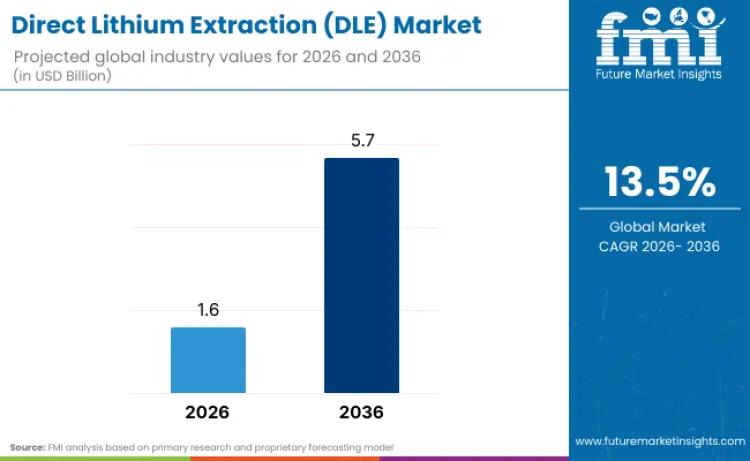
The global direct lithium extraction (DLE) market is slated to total USD 1.6 billion in 2026, anticipated to progress at a CAGR of 13.5% until 2036 to reach USD 5.7 billion. FMI’s estimates project that direct lithium extraction is transitioning into a phase where commercial projects are scaled effectively. DLE has become a strategic pillar for lithium supply, driven by the need to localize electric vehicle value chains and comply with increasingly strict environmental and water-management standards.
Large mining and energy groups integrate DLE are integrating it directly into their portfolios to secure long-term control over lithium production. The acquisition of Arcadium Lithium by Rio Tinto reflects this strategic realignment toward vertically integrated lithium platforms. In parallel, the successful industrial deployment of DLE by oilfield services leaders such as SLB has reinforced market confidence that these systems can operate reliably at scale under real-world conditions.
As the industry has matured, the benchmarks used to assess DLE technologies have evolved. Strong recovery performance is now widely achievable and no longer defines competitive advantage. Instead, attention has shifted to the long-term behavior of DLE systems in continuous operation, particularly the durability of adsorption materials, the stability of operating costs over time, and the ability to deploy standardized, modular units across multiple assets. Within this context, adsorption-based DLE approaches have emerged as the leading commercial solution, especially for complex brine chemistries that were historically uneconomic.
This technological convergence is especially visible in regions such as the Smackover Formation and the Upper Rhine Graben. Here, adsorption-driven DLE systems are being combined with established energy infrastructure, deep subsurface expertise, and mature chemical processing capabilities. This integration is enabling faster development timelines and reducing execution risk compared with conventional lithium projects.
Reflecting these broader market dynamics, Standard Lithium Ltd. has aligned its strategy closely with the industry’s shift toward integrated and repeatable DLE deployment models. Management has emphasized scalability, operational efficiency, and environmental performance as core elements of its approach, as highlighted in the following leadership commentary:
"Standard Lithium is on the path to becoming a leading low-cost sustainable American lithium producer. By leveraging the Smackover region's rich energy expertise and building on a well-established resource base, Standard Lithium is poised to become a leading near-term lithium producer in the United States. Our success is driven by our fully integrated, scalable and replicable Direct Lithium Extraction (DLE) process that minimizes environmental impact while maximizing operational efficiency."
Executive: David Park, CEO of Standard Lithium Ltd.
Source: Standard Lithium Ltd., Investor Relations: Corporate Overview (February 2026)
Summary of the Direct Lithium Extraction (DLE) Technology & Services Market
What is Growth Outlook for Direct Lithium Extraction (DLE) Market as per Future Market Insights Projection?
Future Market Insights projects the direct lithium extraction (DLE) market to expand at a CAGR of 13.5% from 2026 to 2036, increasing from USD 1.6 billion in 2026 to USD 5.7 billion by 2036.
FMI Research Approach: FMI proprietary forecasting model integrating EV battery demand growth, lithium supply localization initiatives, environmental permitting constraints, and commercial scalability of adsorption-based extraction technologies.
How do FMI Analysts Perceive Direct Lithium Extraction (DLE) Market to Evolve?
FMI analysts perceive the market evolving from pilot-stage experimentation into a phase of selective commercial scale-up, where long-term system durability, operating cost stability, and modular deployability define competitive advantage. Growth is increasingly anchored in adsorption-based platforms integrated with existing geothermal and oilfield infrastructure rather than greenfield lithium mining projects.
FMI Research Approach: Assessment of project commissioning data, operator portfolio strategies, and performance benchmarks for continuous DLE operations.
Which Country Holds Largest Share in Global Direct Lithium Extraction (DLE) Market?
China holds the largest share of the global direct lithium extraction market, supported by aggressive industrial scaling, strong policy backing for battery materials self-sufficiency, and integration of DLE into existing chemical and energy infrastructure.
FMI Research Approach: Country-level modeling based on lithium processing capacity, battery value-chain integration, and alignment with national critical minerals strategies.
What is the Definition of Direct Lithium Extraction (DLE) Market?
The direct lithium extraction market comprises technologies and services that selectively recover lithium from brines using engineered materials and chemical processes, enabling faster production cycles, lower water intensity, and integration with geothermal, oilfield, and non-traditional lithium resources.
FMI Research Approach: FMI market taxonomy and inclusion-exclusion framework covering DLE technologies, service models, and commercially deployed extraction systems.
What are some Globally Unique Trends Shaping Direct Lithium Extraction (DLE) Market?
Globally unique trends include the shift toward adsorption-based DLE systems, rising integration of lithium recovery with geothermal and oilfield assets, growing reliance on technology licensing models, and increased government support treating lithium as strategic industrial infrastructure.
FMI Research Approach: Synthesis of policy incentives, project deployment data, and technology performance trends across major lithium-producing regions.
Direct Lithium Extraction (DLE) Technology & Services Market Key Takeaways
| Metric | Value |
|---|---|
| Expected Value (2026E) | USD 1.6 billion |
| Forecast Value (2036F) | USD 5.7 billion |
| CAGR (2026 to 2036) | 13.5% |
Source: Future Market Insights’ proprietary forecasting model and primary research
Why is Direct Lithium Extraction (DLE) Technology & Services Gaining Traction?
Growth is driven by structural considerations linked to supply security and industrial resilience rather than short-term lithium pricing. DLE is now being assessed alongside conventional lithium production as a durable component of future supply rather than a transitional technology.
Government intervention has become a primary driver of this shift. Conventional lithium supply remains exposed to geographic concentration and political risk, increasing the appeal of domestically controllable extraction routes. DLE aligns closely with objectives tied to energy security, manufacturing resilience, and emissions reduction.
In USA, prioritization by the USA Department of Energy has moved DLE projects into the category of financeable infrastructure, with federal loan commitments signaling that battery-grade lithium is treated as a strategic industrial input. This policy direction mirrors how diversified energy companies such as ExxonMobil are integrating lithium production into existing subsurface and low-emissions portfolios, improving bankability through friend-shoring frameworks.
Operators with reservoir engineering expertise are embedding lithium recovery into existing assets rather than developing standalone mining operations. Integrated geothermal-lithium systems supported by investors such as Equinor Ventures demonstrate how co-producing heat, power, and lithium compresses marginal costs while avoiding the land intensity, water consumption, and extended development timelines associated with conventional mining.
How is the DLE Technology & Services Landscape Segmented?
Deployment certainty and commercial risk management are driving the direct lithium extraction technology and services market. Adsorption-based systems have taken the lead due to their selectivity and scalability across varied brine chemistries. Technology licensing dominates as lithium producers prioritise operational control while limiting exposure to unproven extraction platforms.
Why are Adsorption-Based Systems Leading DLE Technology Adoption?
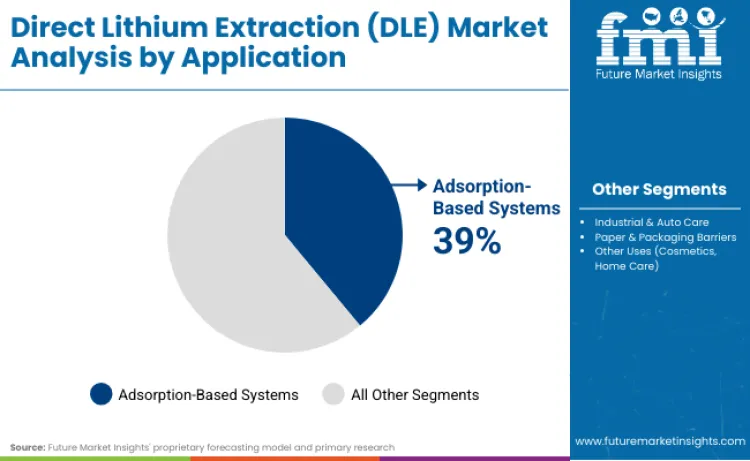
Adsorption-based DLE technologies account for 39% of total market activity, making them the most widely deployed technology category. Their dominance is largely attributable to process robustness and chemical selectivity, particularly in brines with high magnesium-to-lithium ratios. Adsorbent materials such as lithium-selective manganese oxides and titanium-based sorbents enable targeted lithium capture while minimising co-extraction of competing ions. This selectivity reduces downstream purification complexity, which remains a key cost and execution risk in DLE projects.
Equally important is the modular and scalable nature of adsorption-based systems. These technologies can be integrated into existing brine operations with fewer infrastructure changes compared to solvent extraction or membrane-intensive systems. As lithium producers prioritise phased capacity expansion and pilot-to-commercial continuity, adsorption platforms offer a clearer scale-up pathway. This has positioned them as the default entry point for DLE adoption, particularly in South American salars and selected geothermal brine projects where operational predictability is critical.
What explains the Dominance of Technology Licensing as the Primary Service Model?
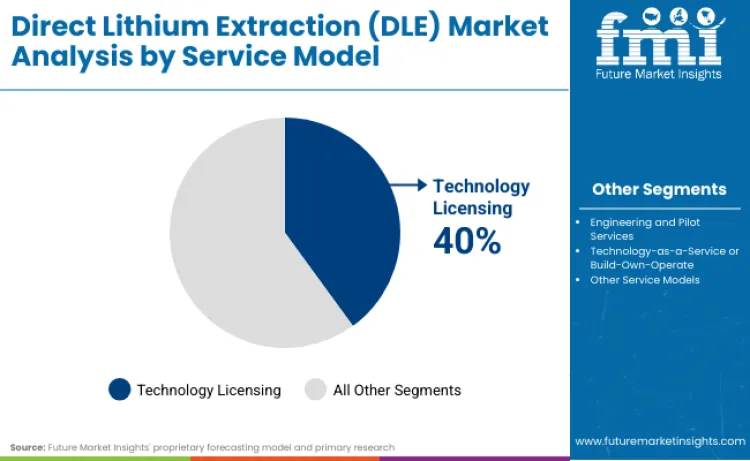
Technology licensing represents 40% of the DLE services market, reflecting a clear preference among lithium asset owners to retain operational control while externalising process innovation risk. Under this model, technology providers supply proprietary extraction systems, sorbents, and process know-how, while producers manage construction, operation, and brine sourcing internally. This structure aligns well with mining companies’ balance-sheet strategies, allowing them to avoid long-term service dependencies or revenue-sharing arrangements.
Licensing also accelerates multi-project replication for technology developers. Once a DLE platform has been validated at pilot or demonstration scale, licensing enables rapid geographic expansion without the capital burden of owning and operating assets. For lithium producers, this model reduces perceived vendor lock-in while preserving flexibility to optimise downstream processing independently. As a result, licensing has become the dominant commercial pathway during the current transition phase, where DLE technologies are moving from experimental validation toward selective commercial deployment.
Which Factors affect Prospects for Direct Lithium Extraction (DLE) Technology & Services?
The direct lithium extraction market is moving into a defining phase as producers and buyers look for ways to shorten development cycles and reduce exposure to supply delays. DLE is gaining traction because it changes that equation. It allows operators to move from extraction to usable output on a far shorter cycle, making it increasingly attractive to battery and mobility supply chains that value speed, predictability, and control over volume. This shift is pushing DLE out of experimentation and into serious commercial consideration.
DLE does not operate as a universal solution that can be copied from one site to another. Each brine system behaves differently, forcing operators to design processes around local chemistry rather than deploy standardized equipment. This has led to multiple technical pathways developing side by side, each optimized for a narrow set of conditions. While this has accelerated learning, it has also raised costs and slowed repeatability. The market today reflects a landscape of tailored solutions rather than scalable platforms, which continues to shape investment risk profiles.
The strongest near-term opportunity lies in resources that were previously overlooked. Geothermal and oilfield brines are now being reconsidered as viable lithium sources because DLE can integrate with existing industrial systems without requiring large surface footprints. This has particular appeal in regions where land access, water use, and permitting are tightly controlled. For operators, these assets offer a way to unlock value from infrastructure that already exists, shifting the economics of lithium supply.
Analysis of DLE Technology & Services Market by Key Countries
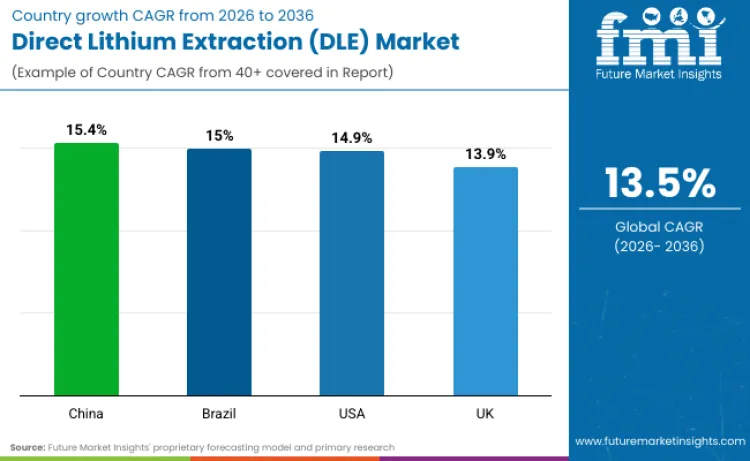
| Countries | CAGR (2026 to 2036) |
|---|---|
| China | 15.4% |
| USA | 14.9% |
| UK | 13.9% |
| Brazil | 15.0% |
Source: FMI analysis based on primary research and proprietary forecasting model
How is China Reconciling Lithium Industrial Recovery with Tightening Export Control Architecture?
By the middle of the decade, China’s lithium sector is being managed through a clear separation of priorities. Downstream regulation is being eased where administrative burden has begun to interfere with commercial activity. Upstream control is being reinforced where strategic advantage is concentrated.
The decision to simplify supervision for small-format lithium batteries reflects this thinking. It lowers friction for exporters serving civilian and industrial markets without materially weakening oversight. Beijing is signalling that not every battery application carries the same strategic weight.
That flexibility ends where manufacturing capability is concerned. Export controls now focus squarely on battery production equipment rather than lithium supply itself. By limiting access to advanced winding, stacking, and electrolyte handling systems, China is protecting accumulated process expertise rather than physical resources. This approach allows domestic producers to benefit from a stabilising market while slowing the transfer of hard-won manufacturing advantages abroad.
Can Brazil Convert Rapid Project Reactivation Into a Platform for DLE Leadership?
Brazil’s lithium position is being shaped less by policy experimentation and more by operational restart. The return to full production at major hard-rock sites marks a shift away from restructuring and toward execution. The immediate challenge is consistency. Brazil must demonstrate that it can sustain output at scale while maintaining environmental credibility at the state level. Parallel progress on modular processing facilities reinforces a preference for phased investment rather than large, irreversible capital commitments.
Institutional thinking is beginning to evolve alongside this momentum. The inclusion of state-level discussions on DLE within national critical minerals forums reflects growing awareness that hard-rock mining alone may not secure long-term competitiveness. Interest from Minas Gerais in alternative recovery pathways suggests early groundwork for hybrid extraction models that combine conventional mining with secondary recovery.
Is USA Finally Translating DLE Ambition Into Bankable Industrial Reality?
USA has moved beyond pilot-stage ambition by formally backing its first commercial-scale DLE project. Federal loan support has shifted DLE from technical promise to industrial execution. This support signals a willingness to absorb early technology and scale risk in order to localise battery-grade lithium production rather than depend on imported intermediates. The emphasis is clearly on downstream chemical security rather than upstream resource ownership.
Private capital is reinforcing this shift from a different angle. Major energy companies are positioning lithium extraction as a natural extension of subsurface and brine management expertise rather than a traditional mining play. DLE is being reframed as part of a broader energy and materials system, linking geothermal resources, chemical processing, and manufacturing supply chains. The model remains policy supported, but it now rests on industrial logic rather than aspiration.
Can the UK’s Strategic Targets Overcome Structural Scale Constraints in Lithium Extraction?
UK’s critical minerals strategy reflects a pragmatic assessment of domestic limits. Production targets are modest by global standards, but they are paired with a clear focus on system viability. Energy cost exposure has been identified as the main constraint, prompting direct intervention to improve industrial competitiveness. The objective is not dominance, but resilience and optional supply.
Public funding is being used selectively to advance parallel pathways. Hard-rock development offers nearer-term feasibility, while geothermal lithium projects test whether DLE can provide long-term differentiation. The UK is effectively running a controlled experiment across both approaches. Absolute scale remains limited, but regulatory coherence and public private risk sharing give the model credibility.
What is the Competitive Intensity of the DLE Technology & Services Landscape?
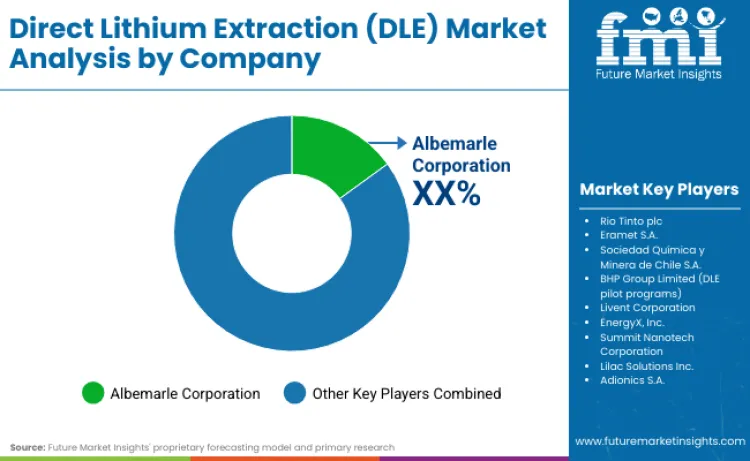
The direct lithium extraction market has entered a phase defined by industrial responsibility rather than technological exploration. Early development cycles were shaped by pilot programs, lab-scale validation, and intellectual property positioning. Technology firms concentrated on extraction chemistry and process efficiency, while lithium producers stayed anchored to evaporation systems aligned with existing operating models and regulatory precedents. This division between technology ownership and asset control created a structural ceiling.
The strategic repositioning of SLB from subsurface services into direct lithium production reshaped market expectations. By demonstrating operational continuity from brine handling through extraction and conversion, DLE was reframed as an integrated production system rather than a bolt-on technology. Market risk assessment shifted accordingly.
Attention moved away from extraction chemistry uncertainty toward execution variables such as reservoir behavior, uptime, cost control, and lifecycle management. This reframing legitimized DLE in the eyes of industrial capital. Lithium production using DLE became comparable to other complex resource developments rather than a speculative technology play.
Capital formation followed this shift in perception. Funding dynamics moved away from venture-driven experimentation toward balance sheets anchored by industrial and energy groups with long-duration investment horizons. Developers aligned with established operators gained credibility across feasibility, permitting, and financing processes. These partnerships reduced execution ambiguity by embedding DLE projects within organizations experienced in subsurface operations, regulatory navigation, and large-scale construction.
Key Players Profiled
- Albemarle Corporation
- Rio Tinto plc
- Eramet S.A.
- Sociedad Química y Minera de Chile S.A.
- BHP Group Limited (DLE pilot programs)
- Livent Corporation
- EnergyX, Inc.
- Summit Nanotech Corporation
- Lilac Solutions Inc.
- Adionics S.A.
Market Definition
The direct lithium extraction (DLE) market comprises of technologies and associated service models that selectively recover lithium from brines using engineered materials and chemical processes rather than conventional evaporation ponds. DLE systems enable faster lithium recovery cycles, reduced land and water intensity, and integration with non-traditional resources such as geothermal and oilfield brines. The market reflects the repositioning of lithium extraction as an industrially scalable, environmentally constrained supply solution aligned with electric vehicle battery value chains and national critical minerals strategies .
The report includes adsorption-based DLE technologies, ion-exchange and sorbent systems, solvent extraction and membrane-based approaches, as well as hybrid configurations deployed at pilot, demonstration, and commercial scale. It covers service models such as technology licensing, engineering and pilot services, and build-own-operate or technology-as-a-service structures used by lithium producers, energy companies, and integrated mining groups. Applications span salar brines, geothermal fluids, oilfield brines, and other lithium-bearing aqueous resources across major producing regions .
The scope excludes conventional evaporation-based lithium extraction, hard-rock lithium mining, downstream lithium chemical conversion beyond primary extraction, and battery manufacturing activities. It also excludes laboratory-only research, early-stage concepts without field deployment, and ancillary infrastructure not directly involved in lithium-selective extraction processes. Recycling-based lithium recovery and secondary battery materials processing fall outside the defined market boundary.
Scope of Report
| Items | Values |
|---|---|
| Quantitative Units (2026) | USD 1.6 billion |
| Technology Type | Adsorption-Based DLE, Hybrid or Other DLE Technologies, Ion-Exchange and Sorbent Systems, Solvent Extraction and Membrane Systems |
| Service Model | Technology Licensing, Engineering and Pilot Services, Technology-as-a-Service or Build-Own-Operate, Other Service Models |
| Regions Covered | North America, Western Europe, Eastern Europe, East Asia, South Asia & Pacific, Latin America, Middle East & Africa |
| Countries Covered | China, USA, UK, Brazil and 40+ Countries |
| Key Companies Profiled | Albemarle Corporation, Rio Tinto plc, Eramet S.A., Sociedad Química y Minera de Chile S.A., BHP Group Limited (DLE pilot programs), Livent Corporation, EnergyX, Inc., Summit Nanotech Corporation, Lilac Solutions, Inc., Adionics S.A. |
Key Segments in Direct Lithium Extraction (DLE) Technology & Services Market
Technology Type:
- Adsorption-Based DLE
- Hybrid or Other DLE Technologies
- Ion-Exchange and Sorbent Systems
- Solvent Extraction and Membrane Systems
Service Model:
- Technology Licensing
- Engineering and Pilot Services
- Technology-as-a-Service or Build-Own-Operate
- Other Service Models
Region:
- North America
- Western Europe
- Eastern Europe
- East Asia
- South Asia & Pacific
- Latin America
- Middle East & Africa
Bibliography
- Vera, M. L., Gálvez, E. D., & Cisternas, L. A. (2023). Adsorption-based lithium recovery from brines: Current status and future challenges. Minerals Engineering, 204, 108472.
- Zante, G., Pinna, E., & Richaud, E. (2025). Selective sorbents for lithium extraction from complex brines: Materials performance and durability considerations. Separation and Purification Technology, 337, 124428.
- Liu, G., Zhao, Z., Wang, S., & Chen, J. (2024). Direct lithium extraction from geothermal and oilfield brines: Process integration and scale-up challenges. Renewable and Sustainable Energy Reviews, 189, 114028.
- Xu, W., Zhang, Y., Li, Q., & Sun, S. (2025). Advances in lithium-selective adsorbents for direct lithium extraction systems. Chemical Engineering Journal, 475, 146089.
Frequently Asked Questions
How large is the direct lithium extraction (DLE) market from a chemicals and materials standpoint?
The DLE market is valued at around USD 1.6 billion in 2026, reflecting rising demand for lithium-selective materials and engineered extraction systems used in battery-grade lithium production.
Which material classes are central to DLE technology performance?
Lithium-selective adsorbents, ion-exchange sorbents, and hybrid inorganic–organic materials are central, as they determine selectivity, recovery efficiency, and long-term durability under continuous brine exposure.
Why are adsorption-based DLE systems leading commercial adoption?
Adsorption-based systems offer superior chemical selectivity across complex brine chemistries and can be deployed in modular formats, reducing downstream purification requirements and scale-up risk.
How does DLE differ materially from conventional lithium extraction routes?
Unlike evaporation-based methods, DLE relies on engineered materials to selectively capture lithium, enabling faster production cycles, lower water intensity, and integration with geothermal or oilfield brines.
What material-related constraints limit faster DLE scale-up?
Key constraints include sorbent degradation over long operating cycles, variability in brine chemistry requiring site-specific material tuning, and the challenge of achieving cost stability at commercial scale.
Preview the report firsthand - request a free sample
Get SampleGet the brochure for pricing and purchase details.
Get PDFTable of Content
- Executive Summary
- Direct Lithium Extraction (DLE) Technology & Services Market Analysis and Forecast (2026 to 2036)
- Why is Direct Lithium Extraction (DLE) Technology & Services Gaining Traction?
- Policy-backed Lithium Supply Localization
- Execution-driven Shift from Pilot to Commercial Scale
- Integration with Geothermal and Oilfield Brine Assets
- How is the DLE Technology & Services Landscape Segmented?
- By Technology Type
- By Service Model
- By Region
- Which Factors affect Prospects for Direct Lithium Extraction (DLE) Technology & Services?
- Brine Chemistry Variability and Site-specific Design
- Scale-up Risk and Cost Stability
- Permitting, Water Management, and ESG Compliance
- Analysis of DLE Technology & Services Market by Key Countries
- China
- Brazil
- United States
- United Kingdom
- What is the Competitive Intensity of the DLE Technology & Services Landscape?
- Key Players Profiled
- Albemarle Corporation
- Rio Tinto plc
- Eramet S.A.
- Sociedad Química y Minera de Chile S.A.
- BHP Group Limited (DLE pilot programs)
- Livent Corporation
- EnergyX, Inc.
- Summit Nanotech Corporation
- Lilac Solutions Inc.
- Adionics S.A.
- Market Definition
- Scope of Report
- Key Segments in Direct Lithium Extraction (DLE) Technology & Services Market
- Bibliography
- Frequently Asked Questions (FAQs)


