

- Industry Size (2026)
- USD 594.5 Mn
- Forecast (2036)
- USD 1556.1 Mn
- CAGR (2026 to 2036)
- 10.1%
Directed Energy Chemical-Fuel Lasers Market Forecast and Outlook 2026 to 2036
The global directed energy chemical-fuel lasers market is expected to grow from USD 594.5 million in 2026 to USD 1,556.1 million by 2036, with a robust CAGR of 10.1%. This growth is driven by the rising demand for advanced military technologies, particularly in missile defense, counter-unmanned aerial systems (C-UAS), and directed energy weapons. Chemical-fuel-powered directed energy lasers are gaining traction for their high precision, scalability, and efficiency in neutralizing threats like high-speed missiles and drones.
They offer significant advantages over traditional kinetic energy weapons, such as low operational costs and the ability to engage multiple targets simultaneously. Technological advancements in laser efficiency, chemical fuel formulations, and beam control systems are further enhancing their applicability in defense applications. As industries globally, especially defense sectors, prioritize innovative solutions for emerging threats, the market for directed energy chemical-fuel lasers is poised for significant expansion, supporting advanced, scalable defense systems.
Quick Stats for Directed Energy Chemical-Fuel Lasers Market
- Directed Energy Chemical-Fuel Lasers Market Value (2026): USD 594.5 Million
- Directed Energy Chemical-Fuel Lasers Market Forecast Value (2036): USD 1,556.1 Million
- Directed Energy Chemical-Fuel Lasers Market Forecast CAGR 2026 to 2036: 10.1%
- Leading Laser Type in Directed Energy Chemical-Fuel Lasers Market: Deuterium Fluoride (DF) Lasers
- North America
- Top Key Players in Directed Energy Chemical-Fuel Lasers Market: Lockheed Martin, Northrop Grumman, Raytheon Technologies, Boeing Defense, Rafael Advanced Defense Systems
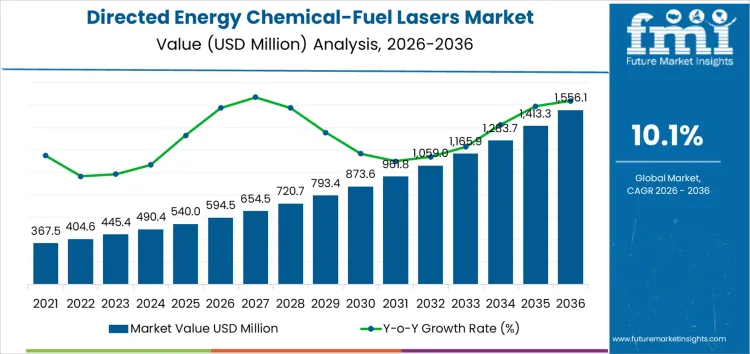
Directed Energy Chemical-Fuel Lasers Market Key Takeaways
| Metric | Value |
|---|---|
| Industry Value (2026) | USD 594.5 Million |
| Forecast Value (2036) | USD 1,556.1 Million |
| Forecast CAGR 2026 to 2036 | 10.1% |
How Is the Global Directed Energy Chemical-Fuel Lasers Market Advancing?
The global directed energy chemical-fuel lasers market is experiencing robust growth, driven by the increasing demand for advanced military and defense technologies. Directed energy lasers, powered by chemical fuels, are gaining popularity for their potential to offer high precision, rapid response, and scalable power for applications such as missile defense, counter-unmanned aerial systems (C-UAS), and directed energy weapons. These lasers are capable of delivering focused energy at the speed of light, providing significant advantages in defense and security applications.
A major driver for market growth is the rising demand for next-generation defense systems that can protect against evolving threats, including high-speed missiles, drones, and other aerial threats. Chemical-fuel-powered directed energy lasers offer the ability to engage multiple targets simultaneously, with high precision and low operational costs compared to traditional kinetic energy weapons. Additionally, their ability to provide a virtually unlimited number of shots and operate in a range of environmental conditions makes them an attractive solution for modern military forces.
Technological advancements in laser energy efficiency, chemical fuel formulation, and beam control systems are also contributing to the market's growth. The development of more powerful, compact, and reliable chemical-fuel lasers is enhancing their applicability in both defense and industrial sectors. As the need for advanced defense technologies increases globally, particularly in the context of cybersecurity, anti-missile defense, and autonomous defense systems, the directed energy chemical-fuel lasers market is poised for significant expansion, with continued innovation driving its adoption in military and defense applications.
What Is the Segment-Wise Analysis for the Directed Energy Chemical-Fuel Lasers Market?
The directed energy chemical-fuel lasers market is segmented by laser type and end user. Deuterium fluoride (DF) lasers lead the laser type segment with a 38% share, followed by hydrogen fluoride (HF) lasers, chemical oxygen iodine lasers (COIL), and other types of lasers. DF lasers are widely used due to their high power output and precision, making them ideal for directed energy applications. In terms of end-users, defense forces hold the largest share at 56%, followed by government R&D agencies, aerospace contractors, and other users. The growing demand for advanced directed energy weapons and systems is driving the adoption of chemical-fuel lasers in these sectors.
Why Do Deuterium Fluoride (DF) Lasers Lead the Directed Energy Chemical-Fuel Lasers Market?
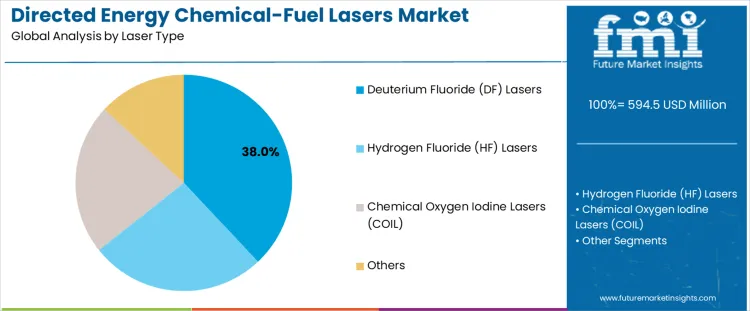
Deuterium fluoride (DF) lasers lead the directed energy chemical-fuel lasers market with a 38% share due to their high power output and ability to deliver precise, controlled energy for defense applications. DF lasers are particularly suitable for directed energy weapons systems because they offer significant advantages in terms of range, accuracy, and beam quality. These lasers are also highly effective in military scenarios, where power and precision are crucial. As defense forces increasingly adopt advanced technologies for defense and anti-missile systems, DF lasers continue to play a central role, making them the dominant laser type in the market.
How Do Defense Forces Contribute to the Directed Energy Chemical-Fuel Lasers Market?
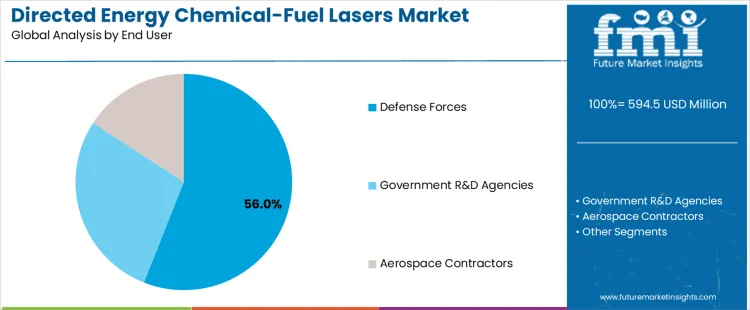
Defense forces account for 56% of the end-user segment in the directed energy chemical-fuel lasers market. Military applications are the largest driver of demand for chemical-fuel lasers, especially for directed energy weapons that can disable or destroy targets with high precision. These lasers are increasingly seen as effective alternatives to traditional projectile-based weapons, providing advantages such as speed, accuracy, and low collateral damage. As defense forces invest in advanced technologies to enhance their capabilities, the demand for high-power, reliable chemical-fuel lasers continues to grow, cementing the defense sector as the largest contributor to the market.
What Are the Key Dynamics for the Directed Energy Chemical-Fuel Lasers Market?
The directed energy chemical-fuel lasers market is driven by the increasing demand for advanced defense technologies and high-precision weapons systems. Chemical-fuel lasers use a chemical reaction to generate powerful laser beams, offering advantages in terms of high energy output and the ability to engage targets at long ranges. These lasers are primarily used in military applications, including missile defense systems, directed energy weapons, and anti-drone systems. The growing need for precision strike capabilities, along with advancements in laser technology and chemical fuels, is driving the adoption of directed energy chemical-fuel lasers across defense sectors globally.
Why Is the Directed Energy Chemical-Fuel Lasers Market Growing?
The market for directed energy chemical-fuel lasers is growing due to the rising demand for innovative, cost-effective, and high-performance defense technologies. Directed energy weapons, especially chemical-fuel lasers, offer several advantages over conventional kinetic weapons, including faster target engagement, precision, and reduced risk of collateral damage. The increasing investment in military modernization, coupled with the rising threat of asymmetric warfare, is driving the adoption of directed energy systems. The ability of chemical-fuel lasers to engage a variety of targets such as missiles, drones, and enemy vehicles enhances their strategic value in military operations.
How Are the Key Drivers Shaping the Directed Energy Chemical-Fuel Lasers Market?
Key drivers shaping the directed energy chemical-fuel lasers market include the growing demand for advanced defense systems capable of neutralizing emerging threats such as hypersonic missiles and unmanned aerial vehicles (UAVs). Chemical-fuel lasers offer significant advantages in terms of power, speed, and precision, making them highly suitable for modern defense needs. The shift towards more energy-efficient and scalable directed energy systems is pushing technological innovations in chemical-fuel laser technology. Ongoing defense research and increasing defense budgets worldwide are accelerating the development and deployment of chemical-fuel laser systems in various defense applications.
What is the Growth Outlook for the Directed Energy Chemical-Fuel Lasers Market by Country?

| Country | CAGR (%) |
|---|---|
| China | 11.8% |
| Israel | 10.2% |
| USA | 9.4% |
| Russia | 8.9% |
| France | 8.6% |
The directed energy chemical-fuel lasers market is expanding rapidly across key regions. China leads at 11.8%, driven by its growing defense budget and strategic investments in directed energy systems. Israel follows at 10.2%, supported by its focus on advanced defense technologies like the Iron Beam. The USA grows at 9.4%, fueled by the ongoing development of directed energy systems in missile defense and countermeasures. Russia’s market grows at 8.9%, backed by its investments in military modernization and directed energy technologies. France expands at 8.6%, driven by its defense innovation and collaboration within European defense networks.
What is Driving the Growth of the Directed Energy Chemical-Fuel Lasers Market in China?

China’s directed energy chemical-fuel lasers market is growing at 11.8%, driven by the country’s significant investments in defense technology and laser weaponry. As part of its modernization efforts, China is increasingly focusing on advanced directed energy systems, including chemical-fuel lasers, for military applications such as missile defense, anti-drone technology, and long-range precision targeting. The Chinese government’s defense and technology innovation policies, along with growing strategic interest in countering advanced threats, are accelerating the development and adoption of directed energy lasers. China’s growing technological capabilities in chemical-fuel laser systems, combined with its expanding defense budget, are expected to continue driving market growth in the coming years.
How is the Directed Energy Chemical-Fuel Lasers Market Expanding in Israel?
Israel’s directed energy chemical-fuel lasers market is growing at 10.2%, supported by the country’s focus on advanced defense systems and cutting-edge military technologies. Israel is a global leader in laser-based defense solutions, particularly in missile defense systems like the Iron Beam, which uses directed energy to intercept short-range threats. Israel’s emphasis on national security, combined with its commitment to technological innovation, is accelerating the development and deployment of chemical-fuel laser systems for defense purposes. The need for effective countermeasures against evolving missile and drone threats, along with Israel’s technological expertise in directed energy weapons, will continue to drive growth in the market for chemical-fuel lasers.
How is the Directed Energy Chemical-Fuel Lasers Market Expanding in the USA?
The directed energy chemical-fuel lasers market in the USA is growing at 9.4%, driven by advancements in military technologies and the increasing need for effective countermeasures in modern warfare. The U.S. Department of Defense has invested heavily in directed energy systems, including chemical-fuel lasers, as part of its strategy to enhance missile defense and neutralize threats at long ranges. The USA is at the forefront of developing laser weapon systems for defense, with ongoing research into improving their efficiency and power. As global threats evolve and the demand for high-precision, scalable defense systems rises, the U.S. market for directed energy chemical-fuel lasers is expected to grow steadily, supported by continuous investment in military innovation and advanced technologies.
What is Driving the Growth of the Directed Energy Chemical-Fuel Lasers Market in Russia?
Russia’s directed energy chemical-fuel lasers market is growing at 8.9%, fueled by the country’s interest in advancing defense technologies and enhancing its military capabilities. Russia has made significant investments in developing directed energy weapons, including chemical-fuel lasers, as part of its broader military modernization program. These lasers are seen as critical to countering missile threats and protecting airspace from advanced enemy technologies. Russia’s strong defense industry, along with increasing strategic military spending and research into high-energy laser systems, is accelerating the adoption of chemical-fuel lasers. As Russia continues to develop next-generation defense systems and integrate directed energy weapons into its military forces, the market for chemical-fuel lasers is expected to grow.
How is the Directed Energy Chemical-Fuel Lasers Market Expanding in France?
France’s directed energy chemical-fuel lasers market is growing at 8.6%, driven by its ongoing investments in defense and military innovation. France, as part of its defense strategy, is exploring directed energy technologies, including chemical-fuel lasers, to enhance its capabilities in missile defense and counter-drone systems. The French government’s defense modernization efforts and collaboration with European defense agencies to develop advanced laser weapon systems are contributing to market growth. As France continues to develop more effective, energy-efficient defense technologies, particularly in directed energy, the demand for chemical-fuel lasers will continue to rise, ensuring steady growth in the market.
How Are Companies Competing in the Directed Energy Chemical-Fuel Lasers Market?
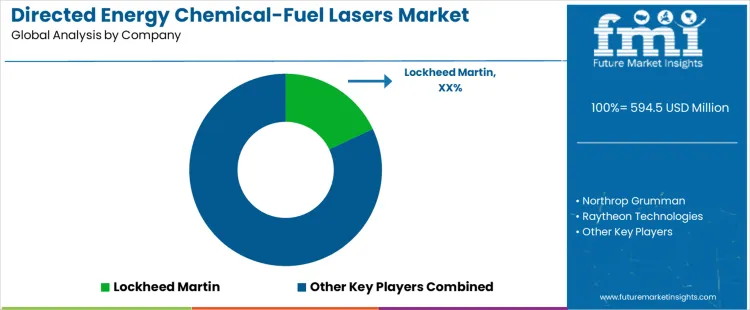
Competition in the Directed Energy Chemical-Fuel Lasers Market is shaped by energy output, beam quality, system integration, battlefield reliability, and platform compatibility. Lockheed Martin is positioned with high-energy chemical laser systems that are promoted for stable power generation and precise targeting in air and missile defense roles. Technical materials highlight consistent beam uniformity and integration with existing fire control networks that help defense integrators evaluate performance under operational conditions. Northrop Grumman competes with chemical laser designs that emphasize modular subsystems and rapid beam steering, with documentation focused on robust environmental tolerance and secure command interfaces that support naval and ground-based deployments.
Major aerospace and defense firms such as Raytheon Technologies and Boeing Defense differentiate through combined chemical and electrical laser portfolios that are marketed for multi-mission flexibility and scalable power levels. Raytheon’s materials describe improved chemical fuel management and automation to enhance duty cycles, while Boeing’s collateral stresses integration with sensor packages and layered defense architectures. Rafael Advanced Defense Systems adds value with compact chemical-fuel laser modules designed for mobile air defense units and partner interoperability, with product literature emphasizing reliable output under dynamic field conditions.
Others in the market contribute with specialized chemical laser research and supporting subsystems that target niche requirements or reduce total system cost. Across all players, documentation is crafted to underscore thermal management, beam control precision, system resilience, and integration readiness as key differentiators that help militaries and prime contractors assess and adopt directed energy chemical-fuel laser solutions.
Key Players in Directed Energy Chemical-Fuel Lasers Market
- Lockheed Martin
- Northrop Grumman
- Raytheon Technologies
- Boeing Defense
- Rafael Advanced Defense Systems
- Others
Scope of Report
| Attributes | Description |
|---|---|
| Quantitative Unit (2026) | USD Million |
| Laser Type | Deuterium Fluoride (DF) Lasers, Hydrogen Fluoride (HF) Lasers, Chemical Oxygen Iodine Lasers (COIL), Others |
| End User | Defense Forces, Government R&D Agencies, Aerospace Contractors |
| Regions Covered | Asia Pacific, Europe, North America, Latin America, Middle East & Africa |
| Countries Covered | China, Japan, South Korea, India, Australia & New Zealand, ASEAN, Germany, United Kingdom, France, Italy, Spain, Nordic, BENELUX, United States, Canada, Mexico, Brazil, Chile, Turkey, South Africa, Other GCC Countries |
| Key Companies Profiled | Lockheed Martin, Northrop Grumman, Raytheon Technologies, Boeing Defense, Rafael Advanced Defense Systems, Others |
| Additional Attributes | Dollar sales by laser type, end user, and region; regional CAGR and growth outlook for the directed energy chemical-fuel lasers market. |
Directed Energy Chemical-Fuel Lasers Market by Key Segments
Laser Type
- Deuterium Fluoride (DF) Lasers
- Hydrogen Fluoride (HF) Lasers
- Chemical Oxygen Iodine Lasers (COIL)
- Others
End User
- Defense Forces
- Government R&D Agencies
- Aerospace Contractors
Region
- Asia Pacific
- China
- Japan
- South Korea
- India
- Australia & New Zealand
- ASEAN
- Rest of Asia Pacific
- Europe
- Germany
- United Kingdom
- France
- Italy
- Spain
- Nordic
- BENELUX
- Rest of Europe
- North America
- United States
- Canada
- Mexico
- Latin America
- Brazil
- Chile
- Rest of Latin America
- Middle East & Africa
- Kingdom of Saudi Arabia
- Other GCC Countries
- Turkey
- South Africa
- Other African Union
- Rest of Middle East & Africa
Bibliography
- U.S. Department of Defense. (2024). Directed energy weapons: chemical laser systems, power scalability, and military integration. Office of the Under Secretary of Defense for Research and Engineering.
- Defense Advanced Research Projects Agency (DARPA). (2024). High‑energy chemical laser research for missile defense and directed energy applications. DARPA Strategic Technology Office.
- Congressional Research Service. (2024). Directed energy weapons: chemical laser technologies and defense deployment considerations. U.S. Congress.
- NATO Science and Technology Organization. (2025). Chemical‑based high‑energy laser systems for missile defense and counter‑UAS applications. NATO STO Technical Report.
- Stockholm International Peace Research Institute (SIPRI). (2024). Emerging directed‑energy weapon systems and chemical laser technologies in modern defense. SIPRI Yearbook – Weapons & Military Technology Chapter.
Frequently Asked Questions
How big is the directed energy chemical-fuel lasers market in 2026?
The global directed energy chemical-fuel lasers market is estimated to be valued at USD 594.5 million in 2026.
What will be the size of directed energy chemical-fuel lasers market in 2036?
The market size for the directed energy chemical-fuel lasers market is projected to reach USD 1,556.1 million by 2036.
How much will be the directed energy chemical-fuel lasers market growth between 2026 and 2036?
The directed energy chemical-fuel lasers market is expected to grow at a 10.1% CAGR between 2026 and 2036.
What are the key product types in the directed energy chemical-fuel lasers market?
The key product types in directed energy chemical-fuel lasers market are deuterium fluoride (df) lasers, hydrogen fluoride (hf) lasers, chemical oxygen iodine lasers (coil) and others.
Which end user segment to contribute significant share in the directed energy chemical-fuel lasers market in 2026?
In terms of end user, defense forces segment to command 56.0% share in the directed energy chemical-fuel lasers market in 2026.
Preview the report firsthand - request a free sample
Get SampleGet the brochure for pricing and purchase details.
Get PDFTable of Content
- Executive Summary
- Global Market Outlook
- Demand-side Trends
- Supply-side Trends
- Technology Roadmap Analysis
- Analysis and Recommendations
- Market Overview
- Market Coverage / Taxonomy
- Market Definition / Scope / Limitations
- Market Background
- Market Dynamics
- Drivers
- Restraints
- Opportunity
- Trends
- Scenario Forecast
- Demand in Optimistic Scenario
- Demand in Likely Scenario
- Demand in Conservative Scenario
- Opportunity Map Analysis
- Product Life Cycle Analysis
- Supply Chain Analysis
- Investment Feasibility Matrix
- Value Chain Analysis
- PESTLE and Porter’s Analysis
- Regulatory Landscape
- Regional Parent Market Outlook
- Production and Consumption Statistics
- Import and Export Statistics
- Market Dynamics
- Global Market Analysis 2021 to 2025 and Forecast, 2026 to 2036
- Historical Market Size Value (USD Million) Analysis, 2021 to 2025
- Current and Future Market Size Value (USD Million) Projections, 2026 to 2036
- Y-o-Y Growth Trend Analysis
- Absolute $ Opportunity Analysis
- Global Market Pricing Analysis 2021 to 2025 and Forecast 2026 to 2036
- Global Market Analysis 2021 to 2025 and Forecast 2026 to 2036, By Laser Type
- Introduction / Key Findings
- Historical Market Size Value (USD Million) Analysis By Laser Type , 2021 to 2025
- Current and Future Market Size Value (USD Million) Analysis and Forecast By Laser Type , 2026 to 2036
- Deuterium Fluoride (DF) Lasers
- Hydrogen Fluoride (HF) Lasers
- Chemical Oxygen Iodine Lasers (COIL)
- Others
- Deuterium Fluoride (DF) Lasers
- Y-o-Y Growth Trend Analysis By Laser Type , 2021 to 2025
- Absolute $ Opportunity Analysis By Laser Type , 2026 to 2036
- Global Market Analysis 2021 to 2025 and Forecast 2026 to 2036, By End User
- Introduction / Key Findings
- Historical Market Size Value (USD Million) Analysis By End User, 2021 to 2025
- Current and Future Market Size Value (USD Million) Analysis and Forecast By End User, 2026 to 2036
- Defense Forces
- Government R&D Agencies
- Aerospace Contractors
- Defense Forces
- Y-o-Y Growth Trend Analysis By End User, 2021 to 2025
- Absolute $ Opportunity Analysis By End User, 2026 to 2036
- Global Market Analysis 2021 to 2025 and Forecast 2026 to 2036, By Region
- Introduction
- Historical Market Size Value (USD Million) Analysis By Region, 2021 to 2025
- Current Market Size Value (USD Million) Analysis and Forecast By Region, 2026 to 2036
- North America
- Latin America
- Western Europe
- Eastern Europe
- East Asia
- South Asia and Pacific
- Middle East & Africa
- Market Attractiveness Analysis By Region
- North America Market Analysis 2021 to 2025 and Forecast 2026 to 2036, By Country
- Historical Market Size Value (USD Million) Trend Analysis By Market Taxonomy, 2021 to 2025
- Market Size Value (USD Million) Forecast By Market Taxonomy, 2026 to 2036
- By Country
- USA
- Canada
- Mexico
- By Laser Type
- By End User
- By Country
- Market Attractiveness Analysis
- By Country
- By Laser Type
- By End User
- Key Takeaways
- Latin America Market Analysis 2021 to 2025 and Forecast 2026 to 2036, By Country
- Historical Market Size Value (USD Million) Trend Analysis By Market Taxonomy, 2021 to 2025
- Market Size Value (USD Million) Forecast By Market Taxonomy, 2026 to 2036
- By Country
- Brazil
- Chile
- Rest of Latin America
- By Laser Type
- By End User
- By Country
- Market Attractiveness Analysis
- By Country
- By Laser Type
- By End User
- Key Takeaways
- Western Europe Market Analysis 2021 to 2025 and Forecast 2026 to 2036, By Country
- Historical Market Size Value (USD Million) Trend Analysis By Market Taxonomy, 2021 to 2025
- Market Size Value (USD Million) Forecast By Market Taxonomy, 2026 to 2036
- By Country
- Germany
- UK
- Italy
- Spain
- France
- Nordic
- BENELUX
- Rest of Western Europe
- By Laser Type
- By End User
- By Country
- Market Attractiveness Analysis
- By Country
- By Laser Type
- By End User
- Key Takeaways
- Eastern Europe Market Analysis 2021 to 2025 and Forecast 2026 to 2036, By Country
- Historical Market Size Value (USD Million) Trend Analysis By Market Taxonomy, 2021 to 2025
- Market Size Value (USD Million) Forecast By Market Taxonomy, 2026 to 2036
- By Country
- Russia
- Poland
- Hungary
- Balkan & Baltic
- Rest of Eastern Europe
- By Laser Type
- By End User
- By Country
- Market Attractiveness Analysis
- By Country
- By Laser Type
- By End User
- Key Takeaways
- East Asia Market Analysis 2021 to 2025 and Forecast 2026 to 2036, By Country
- Historical Market Size Value (USD Million) Trend Analysis By Market Taxonomy, 2021 to 2025
- Market Size Value (USD Million) Forecast By Market Taxonomy, 2026 to 2036
- By Country
- China
- Japan
- South Korea
- By Laser Type
- By End User
- By Country
- Market Attractiveness Analysis
- By Country
- By Laser Type
- By End User
- Key Takeaways
- South Asia and Pacific Market Analysis 2021 to 2025 and Forecast 2026 to 2036, By Country
- Historical Market Size Value (USD Million) Trend Analysis By Market Taxonomy, 2021 to 2025
- Market Size Value (USD Million) Forecast By Market Taxonomy, 2026 to 2036
- By Country
- India
- ASEAN
- Australia & New Zealand
- Rest of South Asia and Pacific
- By Laser Type
- By End User
- By Country
- Market Attractiveness Analysis
- By Country
- By Laser Type
- By End User
- Key Takeaways
- Middle East & Africa Market Analysis 2021 to 2025 and Forecast 2026 to 2036, By Country
- Historical Market Size Value (USD Million) Trend Analysis By Market Taxonomy, 2021 to 2025
- Market Size Value (USD Million) Forecast By Market Taxonomy, 2026 to 2036
- By Country
- Kingdom of Saudi Arabia
- Other GCC Countries
- Turkiye
- South Africa
- Other African Union
- Rest of Middle East & Africa
- By Laser Type
- By End User
- By Country
- Market Attractiveness Analysis
- By Country
- By Laser Type
- By End User
- Key Takeaways
- Key Countries Market Analysis
- USA
- Pricing Analysis
- Market Share Analysis, 2025
- By Laser Type
- By End User
- Canada
- Pricing Analysis
- Market Share Analysis, 2025
- By Laser Type
- By End User
- Mexico
- Pricing Analysis
- Market Share Analysis, 2025
- By Laser Type
- By End User
- Brazil
- Pricing Analysis
- Market Share Analysis, 2025
- By Laser Type
- By End User
- Chile
- Pricing Analysis
- Market Share Analysis, 2025
- By Laser Type
- By End User
- Germany
- Pricing Analysis
- Market Share Analysis, 2025
- By Laser Type
- By End User
- UK
- Pricing Analysis
- Market Share Analysis, 2025
- By Laser Type
- By End User
- Italy
- Pricing Analysis
- Market Share Analysis, 2025
- By Laser Type
- By End User
- Spain
- Pricing Analysis
- Market Share Analysis, 2025
- By Laser Type
- By End User
- France
- Pricing Analysis
- Market Share Analysis, 2025
- By Laser Type
- By End User
- India
- Pricing Analysis
- Market Share Analysis, 2025
- By Laser Type
- By End User
- ASEAN
- Pricing Analysis
- Market Share Analysis, 2025
- By Laser Type
- By End User
- Australia & New Zealand
- Pricing Analysis
- Market Share Analysis, 2025
- By Laser Type
- By End User
- China
- Pricing Analysis
- Market Share Analysis, 2025
- By Laser Type
- By End User
- Japan
- Pricing Analysis
- Market Share Analysis, 2025
- By Laser Type
- By End User
- South Korea
- Pricing Analysis
- Market Share Analysis, 2025
- By Laser Type
- By End User
- Russia
- Pricing Analysis
- Market Share Analysis, 2025
- By Laser Type
- By End User
- Poland
- Pricing Analysis
- Market Share Analysis, 2025
- By Laser Type
- By End User
- Hungary
- Pricing Analysis
- Market Share Analysis, 2025
- By Laser Type
- By End User
- Kingdom of Saudi Arabia
- Pricing Analysis
- Market Share Analysis, 2025
- By Laser Type
- By End User
- Turkiye
- Pricing Analysis
- Market Share Analysis, 2025
- By Laser Type
- By End User
- South Africa
- Pricing Analysis
- Market Share Analysis, 2025
- By Laser Type
- By End User
- USA
- Market Structure Analysis
- Competition Dashboard
- Competition Benchmarking
- Market Share Analysis of Top Players
- By Regional
- By Laser Type
- By End User
- Competition Analysis
- Competition Deep Dive
- Lockheed Martin
- Overview
- Product Portfolio
- Profitability by Market Segments (Product/Age /Sales Channel/Region)
- Sales Footprint
- Strategy Overview
- Marketing Strategy
- Product Strategy
- Channel Strategy
- Northrop Grumman
- Raytheon Technologies
- Boeing Defense
- Rafael Advanced Defense Systems
- Others
- Lockheed Martin
- Competition Deep Dive
- Assumptions & Acronyms Used
- Research Methodology


