

- Industry Size (2026)
- USD 390.0 Mn
- Forecast (2036)
- USD 617.3 Mn
- CAGR (2026 to 2036)
- 4.7%
Direct Steam Injection Heater Market Forecast and Outlook 2026 to 2036
The direct steam injection heater market is expected to grow from USD 390.0 million in 2026 to USD 617.3 million by 2036, expanding at a CAGR of 4.7%. In regulated processing environments, heating equipment is no longer evaluated only on thermal performance but on its ability to meet documented hygiene, traceability, and audit requirements. Certification standards related to sanitary design, pressure equipment, and steam quality raise qualification thresholds and extend procurement timelines, particularly for food, dairy, and biotech applications.
Compliance costs are absorbed unevenly across suppliers, favoring vendors with established certification portfolios and in-house validation support. Smaller or regional manufacturers often face barriers in meeting multi-jurisdictional standards, limiting their access to high-value projects. At the buyer level, risk aversion encourages preference for proven technologies with clear regulatory acceptance, even when alternatives offer marginal efficiency gains. As oversight intensifies, competitive positioning increasingly depends on compliance credibility and certification depth rather than heating efficiency alone.
Quick Stats for Direct Steam Injection Heater Market
- Direct Steam Injection Heater Market Value (2026): USD 390.0 Million
- Direct Steam Injection Heater Market Forecast Value (2036): USD 617.3 Million
- Direct Steam Injection Heater Market Forecast CAGR 2026 to 2036: 4.7%
- Leading Heater Type in Direct Steam Injection Heater Market: Direct Steam Injection (Inline) Systems (dominant adoption)
- Key Growth Regions in Direct Steam Injection Heater Market: Asia Pacific, Europe, North America, Latin America, Middle East & Africa
- Top Key Players in Direct Steam Injection Heater Market: Hydro-Thermal, SPX FLOW (APV), GEA, Alfa Laval, Spirax Sarco, Tetra Pak, Krones, Sani-Matic, Armstrong International, Paul Mueller Company
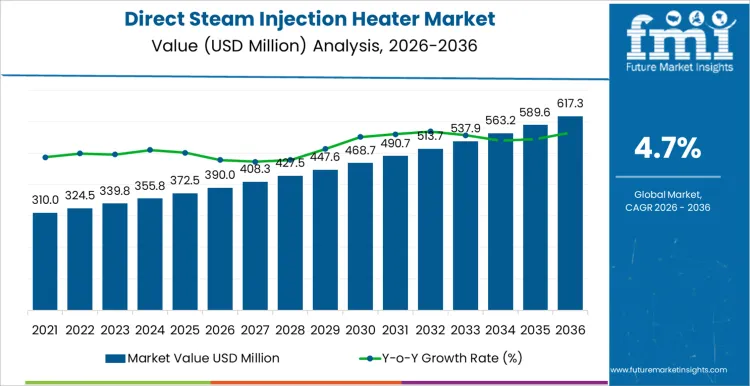
Direct Steam Injection Heater Market Key Takeaways
| Metric | Value |
|---|---|
| Direct Steam Injection Heater Market Value (2026) | USD 390.0 Million |
| Direct Steam Injection Heater Market Forecast Value (2036) | USD 617.3 Million |
| Direct Steam Injection Heater Market Forecast CAGR 2026 to 2036 | 4.7% |
How Are Rapid Heating Requirements and Energy Efficiency Targets Driving the Direct Steam Injection Heater Market?
The direct steam injection heater market is growing as process industries demand fast, uniform, and controllable heating solutions. Unlike indirect heat exchangers, direct steam injection systems deliver instantaneous heat transfer by directly condensing steam into the process fluid. Some sites still retain plate heat exchangers for duties where any dilution is unacceptable, using DSI only where direct contact is permitted. This makes them well suited for applications requiring precise temperature control, rapid response times, and minimal thermal lag. For manufacturers and system integrators, demand is closely tied to processes where product quality and throughput depend on accurate thermal management.
Operational efficiency and footprint reduction are key adoption drivers. Direct steam injection heaters offer compact designs with fewer heat transfer surfaces, reducing fouling risk and maintenance requirements. Food and beverage processors, in particular, value these systems for pasteurization, cooking, and blending applications where hygiene and short residence time are critical. Spec sheets increasingly require verified cleaning-in-place (CIP) performance so changeovers do not introduce residue risk in short-residence thermal steps. Chemical and industrial users benefit from improved heat-up times and reduced energy losses compared with traditional shell-and-tube exchangers. Budget holders often benchmark ROI against the broader heat exchanger market options before approving a direct-contact heating changeover.
Retrofit opportunities and energy optimization initiatives are further supporting market growth. Plants upgrading legacy heating systems are adopting direct steam injection heaters to improve energy utilization and process control without extensive piping modifications. As facilities focus on lowering steam consumption and improving operational flexibility, demand is rising for heaters with automated control valves and integrated temperature monitoring. Plants also review steam boiler efficiency and blowdown practices because upstream steam quality and cost per kg directly affect payback. For suppliers, competitive advantage increasingly depends on application engineering, control integration, and reliable performance positioning direct steam injection heaters as a steady, efficiency-driven solution in modern process heating systems.
How Is The Direct Steam Injection Heater Market Structured By End Use And Heater Type?
The direct steam injection heater market is segmented by end use and heater type, reflecting how heating precision, hygiene requirements, and response time influence equipment selection across process industries. By end use, food and beverage processing leads the market, driven by widespread need for rapid, uniform heating of liquids and slurries. Other end uses include dairy processing, pharmaceutical and biotech manufacturing, pulp and paper, and chemicals, each requiring controlled thermal treatment under specific process conditions. By heater type, direct steam injection (inline) systems dominate adoption, while steam infusion units, CIP or SIP-dedicated units, and other designs address application-specific cleanliness, residence time, and integration requirements.
Why Does Food And Beverage Processing Lead End-Use Demand In The Direct Steam Injection Heater Market?
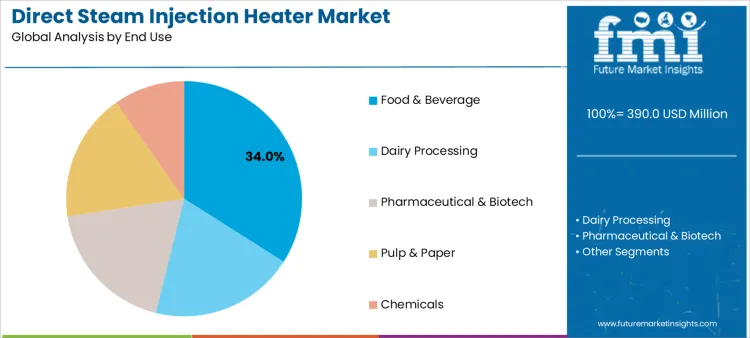
Food and beverage processing accounts for 34% share of the direct steam injection heater market because thermal treatment is critical for product safety, shelf stability, and process efficiency. Manufacturers rely on direct steam injection to achieve rapid heating with precise temperature control for sauces, beverages, soups, and liquid foods. Many buyers evaluate DSI heaters against pasteurizers and sterilizers procurement criteria, especially around validation records and temperature-hold assurance. Inline heating minimizes thermal degradation by reducing residence time and supports high-throughput production environments. Compatibility with hygienic piping and cleaning systems makes these heaters suitable for frequent product changeovers. High production volumes and continuous processing drive consistent equipment demand. These operational and quality-driven requirements explain why food and beverage remains the largest end-use segment.
Why Do Direct Steam Injection (Inline) Heaters Dominate Heater Type Adoption?
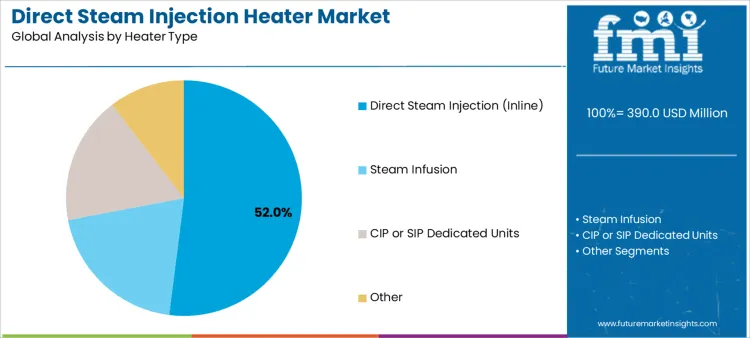
Direct steam injection (inline) heaters hold 52% share of the direct steam injection heater market because they deliver immediate heat transfer by directly mixing steam with the process fluid. This design enables fast temperature ramp-up, uniform heating, and high energy efficiency. Inline systems integrate easily into existing pipelines and support automated control of temperature and flow. Operators value their compact footprint, low maintenance needs, and suitability for continuous processes. These heaters perform reliably across a wide range of viscosities and flow rates. For equipment suppliers, inline designs offer standardized configurations and broad applicability, explaining their dominant position among heater types.
What Are The Key Dynamics Of The Direct Steam Injection Heater Market?
The direct steam injection heater market is driven by the need for rapid, efficient heating and temperature control in industrial processes where direct contact between steam and process fluids is acceptable. Industries such as food and beverage, chemical and petrochemical, power generation, wastewater treatment, pulp and paper, and oil and gas rely on these systems to achieve precise heating with minimal footprint and high energy transfer rates. For equipment manufacturers and suppliers, thermal efficiency, corrosion resistance, ease of maintenance, and compliance with industry hygiene or safety standards are important factors that influence purchasing decisions and long-term performance outcomes.
How Are Technology And Industry Trends Shaping This Market?
Technology and industry trends are shaping the direct steam injection heater market by focusing on improved control accuracy, energy utilization, and digital monitoring. Advanced control valves and steam flow regulators help maintain precise outlet temperatures and adapt quickly to changes in flow demand. Integration with sensors for steam quality, outlet temperature, and pressure allows real-time monitoring and optimization through plant control systems. In hygienic lines, clean steam separators are increasingly used to stabilize dryness fraction and reduce the risk of wet-steam dilution swings. Materials technology such as enhanced stainless steels or surface treatments improves longevity in corrosive fluid environments. For suppliers, offering modular heater designs and systems that can be easily integrated into existing piping and automation platforms increases relevance across varied industrial use cases.
Why Do Operational, Integration, And Cost Challenges Restrain Market Growth?
Operational, integration, and cost challenges restrain growth in the direct steam injection heater market by increasing implementation complexity and total cost of ownership. Precise control of steam injection requires reliable valves and instrumentation, which can elevate upfront equipment and engineering expenses. Engineering packages often specify upgraded steam safety valves alongside DSI skids to keep pressure protection aligned with revised steam control logic. Integrating heaters with existing process control systems may require custom interfacing and configuration, extending project timelines. Operational challenges such as steam quality variability, maintenance of steam traps and strainers, and scaling in high-mineral feed streams increase routine maintenance needs and require skilled technicians. Routine audits of steam traps are increasingly bundled into heater retrofits because failed traps can erase the energy gains from tighter temperature control. These factors may slow adoption among cost-sensitive facilities or in brownfield upgrades.
What is The Country-Wise Growth Outlook for the Direct Steam Injection Heater Market?
The direct steam injection heater market is expanding steadily as industries seek rapid, efficient, and precise heating solutions for liquids and slurries in process applications. These heaters are widely used in food & beverage, chemicals, pharmaceuticals, pulp & paper, and wastewater treatment due to their ability to deliver instant temperature rise with high heat transfer efficiency. Growth varies by country depending on expansion of process industries, adoption of continuous processing, and investment in energy-efficient heating systems. Faster-growing markets are driven by new plant installations and modernization of existing lines, while mature regions show demand led by replacement and process optimization. Market value is shaped by heating accuracy, reliability, ease of integration, and long-term operational performance.
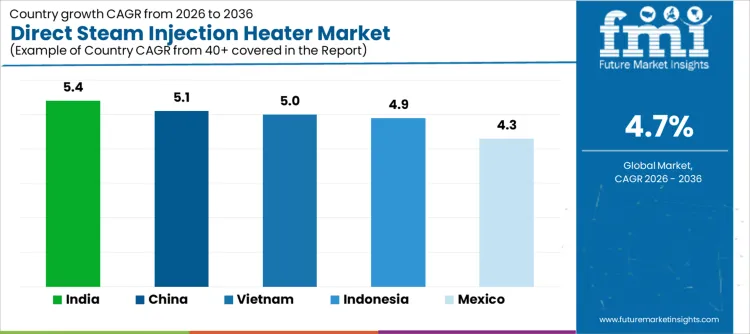
| Country | CAGR (%) |
|---|---|
| India | 5.4 |
| China | 5.1 |
| Vietnam | 5.0 |
| Indonesia | 4.9 |
| Mexico | 4.3 |
Why Is India Emerging As A High-Growth Market For Direct Steam Injection Heaters?
India’s direct steam injection heater market is growing at a CAGR of 5.4% during 2026 to 2036, driven by expanding industrial operations across food processing, chemicals, pharmaceuticals, and wastewater treatment. As industries seek to optimize energy usage and improve heating precision, the adoption of direct steam injection heaters is increasing, particularly in sectors that require rapid, uniform temperature control for liquid and slurry heating. The food and beverage industry, which requires precise temperature management for products like milk, syrups, and oils, is a major driver of this demand. The pharmaceutical sector is also adopting these systems for efficient heat sterilization and fluid temperature regulation during drug manufacturing. Buyers prioritize operational efficiency, energy savings, and ease of integration with existing plant systems. Local manufacturing plays a significant role in ensuring cost-effective solutions, as India remains highly price-sensitive while still demanding high performance and reliability.
How Is China Sustaining Steady Growth In The Direct Steam Injection Heater Market?
China’s direct steam injection heater market is expanding at a CAGR of 5.1% during 2026-2036, supported by its large-scale manufacturing operations and rapid industrialization across various sectors such as chemicals, food & beverage, and pharmaceuticals. With China’s focus on improving process efficiency and reducing energy consumption, direct steam injection heaters are being increasingly adopted for applications that require precise, quick heating of liquids, slurries, and pastes, including in food production, drug formulation, and waste treatment processes. The chemical industry is also a major adopter, where consistent and controllable temperature management is required for reactor heating and batch processes. Buyers emphasize system efficiency, energy conservation, and the ability to handle diverse, complex fluid streams. Local manufacturing and competitive pricing play a critical role, with China offering a robust supply chain for components and services.
What Is Driving Adoption Of Direct Steam Injection Heaters In Vietnam?
Vietnam’s direct steam injection heater market is growing at a CAGR of 5.0% during 2026-2036, driven by increased industrial development, particularly in the food & beverage, pharmaceutical, and chemical sectors. As these industries expand, there is growing demand for efficient heating solutions that provide quick, consistent, and energy-efficient temperature control for liquid and slurry applications. In the food processing sector, precise temperature management is essential for pasteurization, sterilization, and concentration processes. In pharmaceuticals, efficient heating of liquids during drug production is crucial for ensuring product quality and consistency. Demand is also increasing in wastewater treatment plants where steam injection helps optimize heat transfer and energy consumption during effluent processing. Buyers emphasize reliability, compact design, ease of maintenance, and energy efficiency, particularly as operational costs remain a key concern in emerging economies.
Why Is Indonesia Gaining Momentum In The Direct Steam Injection Heater Market?
Indonesia’s direct steam injection heater market is expanding at a CAGR of 4.9% during 2026-2036, supported by growing industrial demand, particularly in the food & beverage, palm oil processing, and chemical industries. As Indonesia seeks to modernize and optimize its manufacturing capabilities, direct steam injection heaters are increasingly used to handle the precise heating requirements of viscous fluids, pastes, and slurries. The food & beverage sector, which includes dairy products, processed oils, and beverages, significantly drives demand, requiring consistent and quick heating to maintain product quality. The palm oil processing industry also utilizes these systems for efficient heating of oils and fats during extraction. Buyers prioritize the energy efficiency of heating systems, given the high operating costs in industrial plants, and they emphasize ease of installation and maintenance.
How Is Saudi Arabia Maintaining Steady Growth In The Direct Steam Injection Heater Market?
Saudi Arabia’s direct steam injection heater market is growing at a CAGR of 5.1% during the forecast period, shaped by strong demand from oil & gas, petrochemical, and power generation industries. The need for precise temperature control during processing, especially in high-heat applications like refining, steam-assisted oil recovery, and power plants, is driving the adoption of direct steam injection systems. In the oil & gas industry, where maintaining operational efficiency is critical, these heaters are used to heat oil, water, and steam at various stages of production and processing. Buyers in Saudi Arabia emphasize system reliability, safety features, and compliance with stringent operational standards. Procurement is often project-based, with emphasis on robust engineering, technical specifications, and compliance with local regulations.
How Are Manufacturers Competing in the Direct Steam Injection Heater Market?
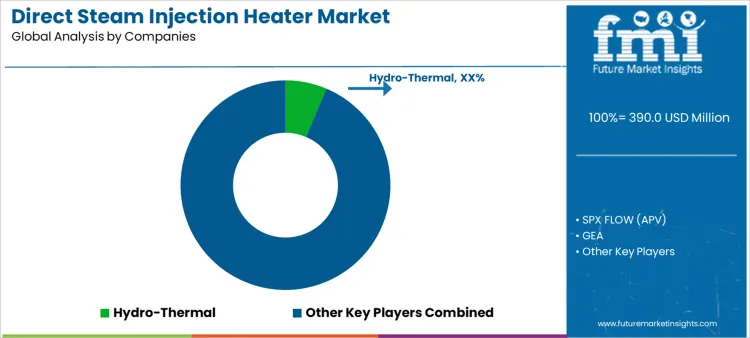
Competition in the direct steam injection (DSI) heater market is driven by heating accuracy, response time, hygienic design, and the ability to deliver instant temperature control for liquid food, beverage, dairy, and pharmaceutical processes. Hydro-Thermal leads with core-focus DSI technology engineered for instantaneous, turbulence-free heating. Product positioning emphasizes precise temperature control, minimal dilution, and consistent product quality, making its systems a benchmark for aseptic and high-shear-sensitive applications. SPX FLOW (APV brand) competes through sanitary steam injection heaters integrated into broader thermal processing lines, highlighting flexibility, cleanability, and compatibility with continuous processing environments.
Process engineering depth defines the next layer of competition. GEA and Alfa Laval position DSI heaters as part of complete heat treatment and hygienic processing systems. Their designs emphasize CIP/SIP compliance, stable steam condensation, and seamless integration with heat exchangers, separators, and automation platforms. Spirax Sarco differentiates through steam quality control, precise pressure regulation, and robust control valves that ensure repeatable heating performance across fluctuating load conditions.
Turnkey system suppliers strengthen competitiveness through application alignment. Tetra Pak and Krones embed direct steam injection heaters within aseptic beverage and dairy processing lines, emphasizing process validation, hygienic certification, and high uptime. Sani-Matic, Armstrong International, and Paul Mueller Company compete through customization, sanitary fabrication expertise, and service support. Across the market, competitive advantage is defined by temperature precision, hygienic assurance, and system-level integration rather than heater pricing alone.
Key Players in Direct Steam Injection Heater Market
- Hydro-Thermal
- SPX FLOW (APV)
- GEA
- Alfa Laval
- Spirax Sarco
- Tetra Pak
- Krones
- Sani-Matic
- Armstrong International
- Paul Mueller Company
Scope of Report
| Attribute | Details |
|---|---|
| Market Size Unit | USD Million |
| End Use Covered | Food & Beverage, Dairy Processing, Pharmaceutical & Biotech, Pulp & Paper, Chemicals |
| Heater Type Covered | Direct Steam Injection (Inline), Steam Infusion, CIP or SIP Dedicated Units, Other |
| Countries Covered | China, Japan, South Korea, India, Australia & New Zealand, ASEAN, Rest of Asia Pacific, Germany, United Kingdom, France, Italy, Spain, Nordic, BENELUX, Rest of Europe, United States, Canada, Mexico, Brazil, Chile, Rest of Latin America, Kingdom of Saudi Arabia, Other GCC Countries, Turkey, South Africa, Other African Union, Rest of Middle East & Africa |
| Regions Covered | Asia Pacific, Europe, North America, Latin America, Middle East & Africa |
| Key Companies Profiled | Hydro-Thermal, SPX FLOW (APV), GEA, Alfa Laval, Spirax Sarco, Tetra Pak, Krones, Sani-Matic, Armstrong International, Paul Mueller Company |
| Additional Attributes | Dollar sales by heater type and end use are analyzed across hygienic and industrial processing sectors. The scope evaluates heating efficiency, temperature control accuracy, CIP/SIP compatibility, system integration, and regulatory compliance. Country-level analysis reflects food processing capacity expansion, pharmaceutical manufacturing growth, and adoption of high-efficiency thermal processing equipment. |
Direct Steam Injection Heater Market by Key Segments
End Use:
- Food & Beverage
- Dairy Processing
- Pharmaceutical & Biotech
- Pulp & Paper
- Chemicals
Heater Type:
- Direct Steam Injection (Inline)
- Steam Infusion
- CIP or SIP Dedicated Units
- Other
Region:
- Asia Pacific
- China
- Japan
- South Korea
- India
- Australia & New Zealand
- ASEAN
- Rest of Asia Pacific
- Europe
- Germany
- United Kingdom
- France
- Italy
- Spain
- Nordic
- BENELUX
- Rest of Europe
- North America
- United States
- Canada
- Mexico
- Latin America
- Brazil
- Chile
- Rest of Latin America
- Middle East & Africa
- Kingdom of Saudi Arabia
- Other GCC Countries
- Turkey
- South Africa
- Other African Union
- Rest of Middle East & Africa
Bibiliography
- American Society of Mechanical Engineers. (2024). ASME PTC 4–2024: Fired steam generators performance test code. ASME.
- European Hygienic Engineering & Design Group. (2024). EHEDG Guideline No. 5: Hygienic design principles for thermal processing systems (4th ed.).
- Institute of Food Technologists. (2024). Advances in hygienic thermal processing and direct steam heating for liquid food systems. Journal of Food Science, 89(3), 1120–1134.
Frequently Asked Questions
How big is the direct steam injection heater market in 2026?
The global direct steam injection heater market is estimated to be valued at USD 390.0 million in 2026.
What will be the size of direct steam injection heater market in 2036?
The market size for the direct steam injection heater market is projected to reach USD 617.3 million by 2036.
How much will be the direct steam injection heater market growth between 2026 and 2036?
The direct steam injection heater market is expected to grow at a 4.7% CAGR between 2026 and 2036.
What are the key product types in the direct steam injection heater market?
The key product types in direct steam injection heater market are food & beverage, dairy processing, pharmaceutical & biotech, pulp & paper and chemicals.
Which heater type segment to contribute significant share in the direct steam injection heater market in 2026?
In terms of heater type, direct steam injection (inline) segment to command 52.0% share in the direct steam injection heater market in 2026.
Preview the report firsthand - request a free sample
Get SampleGet the brochure for pricing and purchase details.
Get PDFTable of Content
- Executive Summary
- Global Market Outlook
- Demand-side Trends
- Supply-side Trends
- Technology Roadmap Analysis
- Analysis and Recommendations
- Market Overview
- Market Coverage / Taxonomy
- Market Definition / Scope / Limitations
- Market Background
- Market Dynamics
- Drivers
- Restraints
- Opportunity
- Trends
- Scenario Forecast
- Demand in Optimistic Scenario
- Demand in Likely Scenario
- Demand in Conservative Scenario
- Opportunity Map Analysis
- Product Life Cycle Analysis
- Supply Chain Analysis
- Investment Feasibility Matrix
- Value Chain Analysis
- PESTLE and Porter’s Analysis
- Regulatory Landscape
- Regional Parent Market Outlook
- Production and Consumption Statistics
- Import and Export Statistics
- Market Dynamics
- Global Market Analysis 2021 to 2025 and Forecast, 2026 to 2036
- Historical Market Size Value (USD Million) Analysis, 2021 to 2025
- Current and Future Market Size Value (USD Million) Projections, 2026 to 2036
- Y-o-Y Growth Trend Analysis
- Absolute $ Opportunity Analysis
- Global Market Pricing Analysis 2021 to 2025 and Forecast 2026 to 2036
- Global Market Analysis 2021 to 2025 and Forecast 2026 to 2036, By End Use
- Introduction / Key Findings
- Historical Market Size Value (USD Million) Analysis By End Use , 2021 to 2025
- Current and Future Market Size Value (USD Million) Analysis and Forecast By End Use , 2026 to 2036
- Food & Beverage
- Dairy Processing
- Pharmaceutical & Biotech
- Pulp & Paper
- Chemicals
- Food & Beverage
- Y-o-Y Growth Trend Analysis By End Use , 2021 to 2025
- Absolute $ Opportunity Analysis By End Use , 2026 to 2036
- Global Market Analysis 2021 to 2025 and Forecast 2026 to 2036, By Heater Type
- Introduction / Key Findings
- Historical Market Size Value (USD Million) Analysis By Heater Type, 2021 to 2025
- Current and Future Market Size Value (USD Million) Analysis and Forecast By Heater Type, 2026 to 2036
- Direct Steam Injection (Inline)
- Steam Infusion
- CIP or SIP Dedicated Value (USD Million)s
- Other
- Direct Steam Injection (Inline)
- Y-o-Y Growth Trend Analysis By Heater Type, 2021 to 2025
- Absolute $ Opportunity Analysis By Heater Type, 2026 to 2036
- Global Market Analysis 2021 to 2025 and Forecast 2026 to 2036, By Region
- Introduction
- Historical Market Size Value (USD Million) Analysis By Region, 2021 to 2025
- Current Market Size Value (USD Million) Analysis and Forecast By Region, 2026 to 2036
- North America
- Latin America
- Western Europe
- Eastern Europe
- East Asia
- South Asia and Pacific
- Middle East & Africa
- Market Attractiveness Analysis By Region
- North America Market Analysis 2021 to 2025 and Forecast 2026 to 2036, By Country
- Historical Market Size Value (USD Million) Trend Analysis By Market Taxonomy, 2021 to 2025
- Market Size Value (USD Million) Forecast By Market Taxonomy, 2026 to 2036
- By Country
- USA
- Canada
- Mexico
- By End Use
- By Heater Type
- By Country
- Market Attractiveness Analysis
- By Country
- By End Use
- By Heater Type
- Key Takeaways
- Latin America Market Analysis 2021 to 2025 and Forecast 2026 to 2036, By Country
- Historical Market Size Value (USD Million) Trend Analysis By Market Taxonomy, 2021 to 2025
- Market Size Value (USD Million) Forecast By Market Taxonomy, 2026 to 2036
- By Country
- Brazil
- Chile
- Rest of Latin America
- By End Use
- By Heater Type
- By Country
- Market Attractiveness Analysis
- By Country
- By End Use
- By Heater Type
- Key Takeaways
- Western Europe Market Analysis 2021 to 2025 and Forecast 2026 to 2036, By Country
- Historical Market Size Value (USD Million) Trend Analysis By Market Taxonomy, 2021 to 2025
- Market Size Value (USD Million) Forecast By Market Taxonomy, 2026 to 2036
- By Country
- Germany
- UK
- Italy
- Spain
- France
- Nordic
- BENELUX
- Rest of Western Europe
- By End Use
- By Heater Type
- By Country
- Market Attractiveness Analysis
- By Country
- By End Use
- By Heater Type
- Key Takeaways
- Eastern Europe Market Analysis 2021 to 2025 and Forecast 2026 to 2036, By Country
- Historical Market Size Value (USD Million) Trend Analysis By Market Taxonomy, 2021 to 2025
- Market Size Value (USD Million) Forecast By Market Taxonomy, 2026 to 2036
- By Country
- Russia
- Poland
- Hungary
- Balkan & Baltic
- Rest of Eastern Europe
- By End Use
- By Heater Type
- By Country
- Market Attractiveness Analysis
- By Country
- By End Use
- By Heater Type
- Key Takeaways
- East Asia Market Analysis 2021 to 2025 and Forecast 2026 to 2036, By Country
- Historical Market Size Value (USD Million) Trend Analysis By Market Taxonomy, 2021 to 2025
- Market Size Value (USD Million) Forecast By Market Taxonomy, 2026 to 2036
- By Country
- China
- Japan
- South Korea
- By End Use
- By Heater Type
- By Country
- Market Attractiveness Analysis
- By Country
- By End Use
- By Heater Type
- Key Takeaways
- South Asia and Pacific Market Analysis 2021 to 2025 and Forecast 2026 to 2036, By Country
- Historical Market Size Value (USD Million) Trend Analysis By Market Taxonomy, 2021 to 2025
- Market Size Value (USD Million) Forecast By Market Taxonomy, 2026 to 2036
- By Country
- India
- ASEAN
- Australia & New Zealand
- Rest of South Asia and Pacific
- By End Use
- By Heater Type
- By Country
- Market Attractiveness Analysis
- By Country
- By End Use
- By Heater Type
- Key Takeaways
- Middle East & Africa Market Analysis 2021 to 2025 and Forecast 2026 to 2036, By Country
- Historical Market Size Value (USD Million) Trend Analysis By Market Taxonomy, 2021 to 2025
- Market Size Value (USD Million) Forecast By Market Taxonomy, 2026 to 2036
- By Country
- Kingdom of Saudi Arabia
- Other GCC Countries
- Turkiye
- South Africa
- Other African Union
- Rest of Middle East & Africa
- By End Use
- By Heater Type
- By Country
- Market Attractiveness Analysis
- By Country
- By End Use
- By Heater Type
- Key Takeaways
- Key Countries Market Analysis
- USA
- Pricing Analysis
- Market Share Analysis, 2025
- By End Use
- By Heater Type
- Canada
- Pricing Analysis
- Market Share Analysis, 2025
- By End Use
- By Heater Type
- Mexico
- Pricing Analysis
- Market Share Analysis, 2025
- By End Use
- By Heater Type
- Brazil
- Pricing Analysis
- Market Share Analysis, 2025
- By End Use
- By Heater Type
- Chile
- Pricing Analysis
- Market Share Analysis, 2025
- By End Use
- By Heater Type
- Germany
- Pricing Analysis
- Market Share Analysis, 2025
- By End Use
- By Heater Type
- UK
- Pricing Analysis
- Market Share Analysis, 2025
- By End Use
- By Heater Type
- Italy
- Pricing Analysis
- Market Share Analysis, 2025
- By End Use
- By Heater Type
- Spain
- Pricing Analysis
- Market Share Analysis, 2025
- By End Use
- By Heater Type
- France
- Pricing Analysis
- Market Share Analysis, 2025
- By End Use
- By Heater Type
- India
- Pricing Analysis
- Market Share Analysis, 2025
- By End Use
- By Heater Type
- ASEAN
- Pricing Analysis
- Market Share Analysis, 2025
- By End Use
- By Heater Type
- Australia & New Zealand
- Pricing Analysis
- Market Share Analysis, 2025
- By End Use
- By Heater Type
- China
- Pricing Analysis
- Market Share Analysis, 2025
- By End Use
- By Heater Type
- Japan
- Pricing Analysis
- Market Share Analysis, 2025
- By End Use
- By Heater Type
- South Korea
- Pricing Analysis
- Market Share Analysis, 2025
- By End Use
- By Heater Type
- Russia
- Pricing Analysis
- Market Share Analysis, 2025
- By End Use
- By Heater Type
- Poland
- Pricing Analysis
- Market Share Analysis, 2025
- By End Use
- By Heater Type
- Hungary
- Pricing Analysis
- Market Share Analysis, 2025
- By End Use
- By Heater Type
- Kingdom of Saudi Arabia
- Pricing Analysis
- Market Share Analysis, 2025
- By End Use
- By Heater Type
- Turkiye
- Pricing Analysis
- Market Share Analysis, 2025
- By End Use
- By Heater Type
- South Africa
- Pricing Analysis
- Market Share Analysis, 2025
- By End Use
- By Heater Type
- USA
- Market Structure Analysis
- Competition Dashboard
- Competition Benchmarking
- Market Share Analysis of Top Players
- By Regional
- By End Use
- By Heater Type
- Competition Analysis
- Competition Deep Dive
- Hydro-Thermal
- Overview
- Product Portfolio
- Profitability by Market Segments (Product/Age /Sales Channel/Region)
- Sales Footprint
- Strategy Overview
- Marketing Strategy
- Product Strategy
- Channel Strategy
- SPX FLOW (APV)
- GEA
- Alfa Laval
- Spirax Sarco
- Tetra Pak
- Krones
- Sani-Matic
- Armstrong International
- Paul Mueller Companies
- Hydro-Thermal
- Competition Deep Dive
- Assumptions & Acronyms Used
- Research Methodology


