

- Industry Size (2026)
- USD 480.0 Mn
- Forecast (2036)
- USD 1980.0 Mn
- CAGR (2026 to 2036)
- 15.2%
Direct-to-Shape Digital Bottle Printing Market Size, Market Forecast and Outlook By FMI
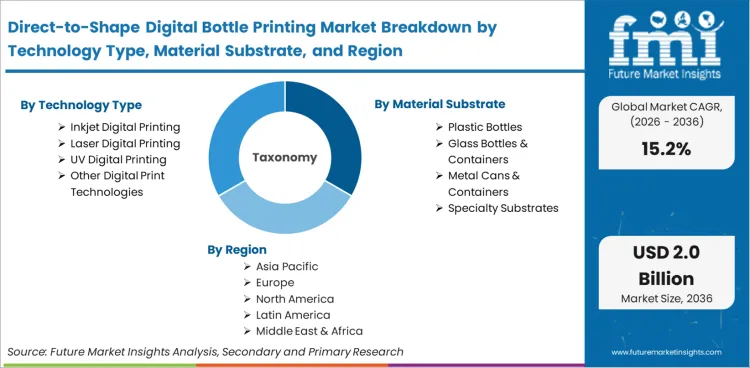
In 2025, the direct-to-shape digital bottle printing market surpassed a value of USD 430.0 million and is projected to reach USD 480.0 million in 2026 and USD 1,980.0 million by 2036, reflecting a CAGR of 15.2%, with momentum tied to compliance gates and retrofit capex. Certification mandates narrow decoration options, compressing upgrade cycles for rigid packaging lines.
Regulators reprioritize recycling purity thresholds, shifting specifications toward label-free containers; conversion occurs during fast-tracked procurement windows. Revenues move from USD 430.0 Million to USD 480.0 Million and USD 1,980.0 Million. In 2025, extended producer responsibility laws across multiple jurisdictions drove adoption of label-free formats [1]. Facilities strip secondary shrink sleeves to meet baseline material recovery goals.
Summary of Direct-to-Shape Digital Bottle Printing
- Direct-to-Shape Digital Bottle Printing Market Definition
- Sector encompasses specialized printing hardware and inks that decorate rigid containers directly without intermediate labels.
- Demand Drivers in the Market
- Extended producer responsibility laws enforce single-material recyclability mandates.
- High-mix branding campaigns require zero-setup changeovers.
- Plastic reduction targets penalize multi-layered shrink sleeves.
- Key Segments Analyzed in the FMI Report
- Technology Type: Inkjet digital printing (49%) versus laser, UV digital printing, and other digital technologies.
- Material Substrate: Plastic bottles (41% of total volume) versus glass bottles & containers, metal cans, and specialty substrates.
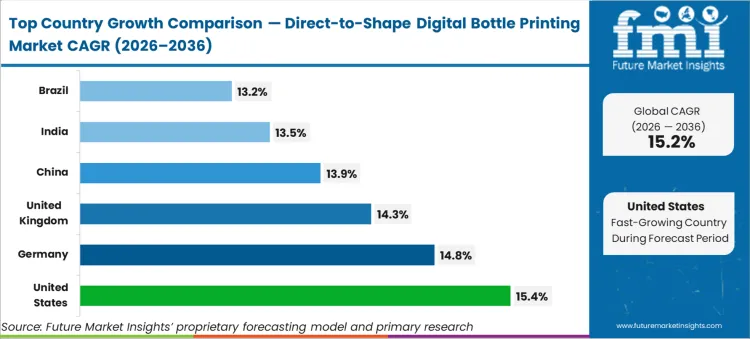
- Geography: High-growth North America and Europe (United States 15.4%, Germany 14.8%, United Kingdom 14.3%) versus scaling Asia-Pacific and Latin America (China 13.9%, India 13.5%, Brazil 13.2%).
- Analyst Opinion at FMI
- Ismail Sutaria, Principal Consultant for Packaging at Future Market Insights, opines, “In our recent Direct-to-Shape Digital Bottle Printing Market evaluation, my team and I have determined that supply chain decentralization will accelerate adoption. Brands increasingly seek regionalized production to mitigate freight volatility and respond to hyper-local demand patterns. Direct-to-shape digital systems allow artwork changes without cylinder replacement or plate storage, making distributed manufacturing economically viable. The decisive advantage will belong to converters that combine digital precision with inline curing efficiency, ensuring durability across beverages, homecare, and personal care applications without compromising throughput.”
- Strategic Implications/Executive Takeaways
- Prioritize single-pass architectures to match upstream filling line speeds.
- Secure ultraviolet-curable ink formulations possessing food-safe certifications.
- Target craft beverage producers seeking variable short-run economics.
- Methodology
- Validated through first-hand corporate production and capacity data.
- Zero reliance on speculative third-party market research reports.
- Based on verifiable industrial benchmarks and verified sources.
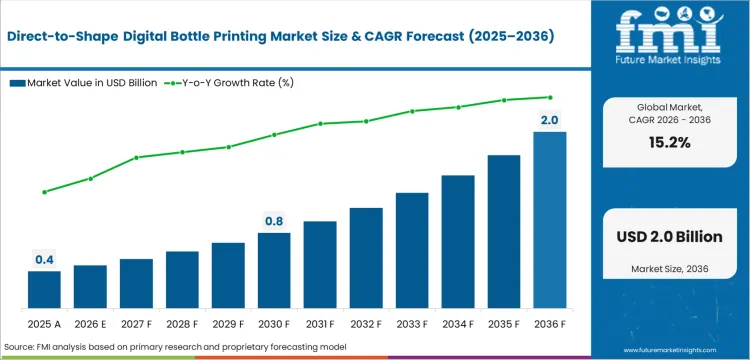
Direct-to-Shape Digital Bottle Printing Market Key Takeaways
| Metric | Details |
|---|---|
| Industry Size (2026) | USD 480.0 Million |
| Industry Value (2036) | USD 1,980.0 Million |
| CAGR (2026-2036) | 15.2% |
As noted by Marian Cofler, Velox CEO, “Velox disrupts the conventional perception that mass production digital DTS is a technology of the future. Finally, batches of any size, with a cost per copy that is competitive with analog long runs, is possible. This is an enormous breakthrough that can profoundly shake the industry, printing digitally direct-to-shape of any volume is now revolutionizing how products are branded, produced, and marketed.” [2]
Across North America, Europe, East Asia, South Asia, and Latin America, growth concentrates where sustainability legislation aligns with high-volume beverage output. United States posts 15.4% CAGR, Germany shows 14.8% CAGR, United Kingdom registers 14.3% CAGR, China expands at 13.9% CAGR, India models 13.5% CAGR, and Brazil achieves 13.2% CAGR. Country dispersion skews toward rigid packaging corridors; jurisdictions clear procurement faster on zero-waste capabilities.
Direct-to-Shape Digital Bottle Printing Market Definition
The Direct-to-Shape Digital Bottle Printing market comprises industrial printing systems engineered to apply variable graphics directly onto three-dimensional rigid containers without the use of labels or sleeves. Market valuation includes revenues from machinery installations, proprietary ink systems, integrated UV or UV-LED curing modules, and associated control software. The sector focuses on equipment and consumables that enable direct decoration of glass, plastic, and metal bottles within production lines, eliminating secondary substrate application processes.
Direct-to-Shape Digital Bottle Printing Market Inclusions
The scope includes direct-to-shape digital printing hardware configured for cylindrical, contoured, and beveled bottle profiles. It captures sales of specialized inks and consumables formulated for adhesion to glass, PET, HDPE, aluminum, and similar rigid surfaces without secondary bonding agents. Inline inspection, curing, and automation modules bundled with digital inkjet platforms are included within system-level revenue calculations.
Direct-to-Shape Digital Bottle Printing Market Exclusions
The scope excludes traditional flexographic, offset, or gravure presses that require separate label production and application. Standalone shrink sleeve applicators, pressure-sensitive labeling systems, and paper label printing equipment are not considered. Revenue generated from contract packaging or decoration services is excluded, as the market definition focuses strictly on equipment, consumables, and integrated system sales.
Direct-to-Shape Digital Bottle Printing Market Research Methodology
- Primary Research: Direct interviews with original equipment manufacturers and consumer goods packaging directors yielded hardware installation baselines.
- Desk Research: Regulatory filings concerning plastic waste reduction and corporate sustainability reports informed volume transitions.
- Market-Sizing and Forecasting: Top-down material shift models mapped plastic and glass bottle volumes against digital hardware capacity limits.
- Data Validation and Update Cycle: Analyst teams reconciled hardware unit sales against regional consumable shipments to eliminate double counting.
Segmental Analysis
Direct-to-Shape Digital Bottle Printing Market Analysis by Technology Type
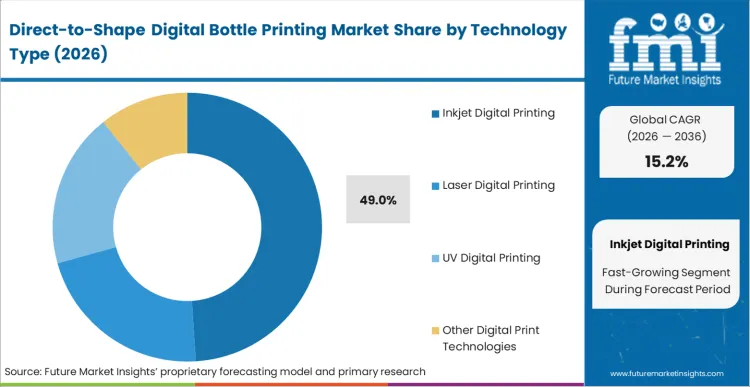
Inkjet Digital Printing commands 49% of volume in 2026. Hardware configurations prioritize piezoelectric drop-on-demand architectures capable of depositing high-opacity pigments onto curved surfaces. According to FMI's estimates, inkjet head precision determines legibility for fine-point regulatory text on liquor water and beverage bottles. Production lines utilize modular print stations to deposit cyan, magenta, yellow, and black inks alongside specialized white base coats in a single pass.
- Capital reallocation: Investment shifts away from offset plate-making toward piezoelectric inkjet systems. Velox secured USD 38.0 Million in funding to expand high-speed digital decoration technology for rigid beverage cans and bottles [4]. Plants allocate budgets toward modular printhead arrays capable of handling variable geometry without downtime.
- Speed parity: High-velocity drop generation bridges output gaps between analog and digital methods. Digital packaging techniques reduced setup waste by 40% [5]. Faster curing enables inline integration immediately preceding filling stations.
- Waste reduction: Non-contact deposition minimizes ink over-spray and setup material loss. FMI analysts opine that operations lower consumable spend per batch significantly. Clean printheads reduce maintenance intervals on factory floors.
Direct-to-Shape Digital Bottle Printing Market Analysis by Material Substrate
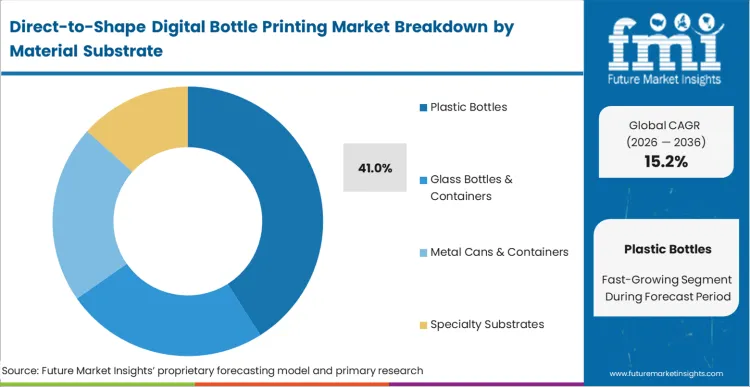
Plastic Bottles capture 41% of adoption in 2026. Polyethylene terephthalate and high-density polyethylene represent primary targets for label elimination. As per FMI's projection, high durability direct print and coding inks dominate adherence testing, ensuring pigments bond securely to low-surface-energy polymers. Consumer demand for visual product transparency favors direct printing over opaque shrink sleeves on plastic jar packaging. United States plastic resin production reached 67.7 billion pounds in 2024 [6].
- Thermal stability: Low-heat curing mechanisms protect thin-walled plastics from deformation. Epson launched a Direct-to-Shape Printing System in June 2025 utilizing PrecisionCore printheads tailored for thermal-sensitive objects [7]. Manufacturers safely print on lightweight polyethylene vessels.
- Recyclability mandate: Multi-layered packaging faces strict penalties under new environmental frameworks. Sustainable inks paired with digital printing hardware lowered VOC emissions by 35% [8]. Transitioning from paper labels to direct print improves raw material purity during post-consumer recycling processes.
- Volume physics: High raw material output guarantees extensive addressable hardware demand. FMI analysts opine that massive container volumes require scalable inkjet arrays. Converters specify hardware capable of decorating millions of units continuously.
Direct-to-Shape Digital Bottle Printing Market Drivers, Restraints, and Opportunities
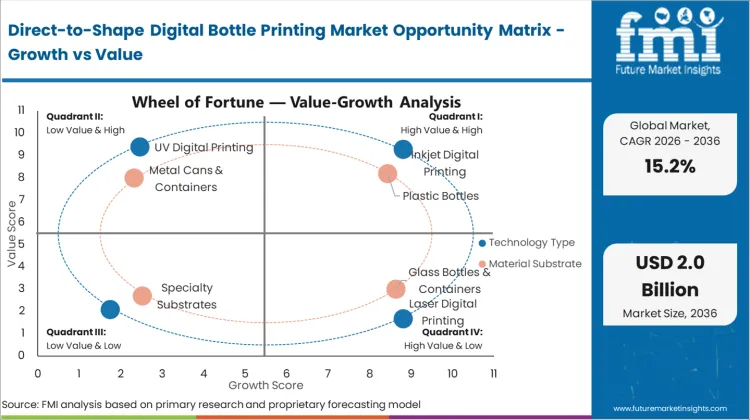
Extended producer responsibility legislation acts as the primary catalyst accelerating direct-to-shape installations. Municipal recycling facilities struggle to separate adhesive labels and shrink sleeves from base containers, downgrading recycled resin quality. Regulators impose steep taxation on multi-component packaging, forcing consumer brands to seek mono-material solutions. According to FMI's estimates, substituting physical labels with micro-layers of cured ink allows manufacturers to retain branding while satisfying purity mandates. Bottled water consumption reached 16.4 billion gallons in 2024, creating an immense volume baseline requiring sustainable decoration [9]. Conversion occurs rapidly as packaging engineers redesign lines to accommodate single-pass inkjet systems.
Capital expenditure constraints hinder immediate analog substitution. Direct-to-shape inkjet arrays require substantial initial investment alongside specialized robotic handling equipment. Operators must integrate complex software workflows and train staff on high-tension curing calibration. Mitigation involves phased deployment, where facilities install pilot digital lines alongside existing analog assets to handle short-run promotional batches. Packaging papers and specialty packaging shipments decreased 1% in January 2026, indicating gradual analog displacement [10]. Facilities offset high capital costs by drastically lowering consumable waste and eliminating physical inventory of pre-printed labels.
- Workflow collaboration: Pre-press software providers and printhead engineers form alliances to optimize droplet trajectories on curved surfaces.
- Form factor expansion: Hardware evolves beyond simple cylinders to decorate complex handled and beveled geometries. Polytype joined FuturePrint as a Digital Partner for 2026 to exchange innovations regarding agile packaging decoration [12].
- Industrial consolidation: Large packaging conglomerates acquire specialized digital printing startups to internalize technological advantages. Innovative Digital Systems launched the RevHDL UV printer for customized handled object decoration [13].
Regional Analysis
Based on the regional analysis, the Direct-to-Shape Digital Bottle Printing market is segmented into North America, Latin America, Europe, East Asia, South Asia, Oceania and Middle East & Africa across 40+ countries. The full report also offers market attractiveness analysis based on regional trends.
.webp "Top Country Growth Comparison Direct To Shape Digital Bottle Printing Market Cagr (2026 2036)")
| Country | CAGR (2026 to 2036) |
|---|---|
| United States | 15.4% |
| Germany | 14.8% |
| United Kingdom | 14.3% |
| China | 13.9% |
| India | 13.5% |
| Brazil | 13.2% |
Source: Future Market Insights (FMI) analysis, based on proprietary forecasting model and primary research
North America Direct-to-Shape Digital Bottle Printing Analysis
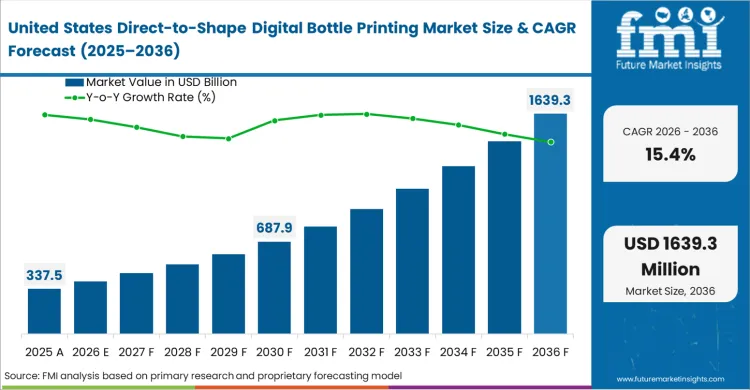
North America prioritizes legislative compliance and flexible manufacturing architecture. Beverage brands face incoming state-level recycling taxes targeting multi-layered plastic containers. Procurement officers authorize capital expenditure for direct printing arrays to strip labels from supply chains. Suppliers localize hardware assembly to bypass import delays affecting precision printheads. Packaging machinery shipments reflect continuous digital integration for customization [14]. Facilities handling custom craft beverage volumes see highest deployment.
- United States: Demand for direct-to-shape digital bottle printing in United States is set to grow at 15.4% CAGR through 2036, supported by strict extended producer responsibility frameworks before procurement cycles translate into higher deployment volumes. Global digital print for packaging and labels reached USD 22.0 billion in 2025, validating broad technology uptake [15].
FMI's report includes detailed analysis confirming the region has a structured growth assessment and country-wise mapping. Canada and Mexico present opportunistic scaling avenues for packaging conglomerates seeking nearshored manufacturing. Equipment buyers monitor cross-border tariff structures affecting imported USA aluminum bottle decoration hardware and specialized UV inks.
Europe Direct-to-Shape Digital Bottle Printing Analysis
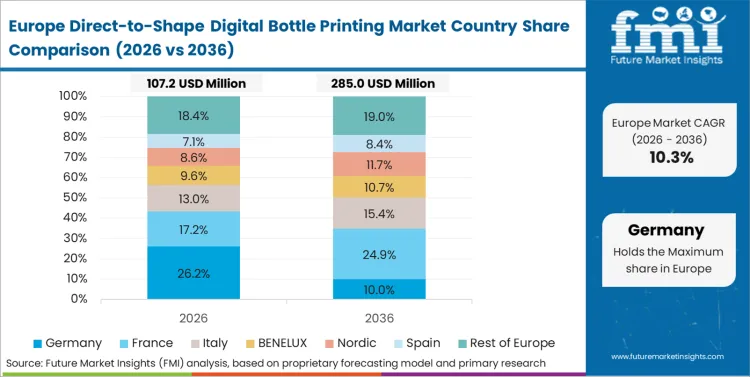
Europe enforces the most stringent circular economy packaging directives globally. Manufacturers operate under strict plastic tax regimes, making weight reduction highly profitable. Brands deploy direct-to-shape lasers and inkjet nozzles to deposit minimal ink volumes, retaining glass bottles recyclability. Flexible packaging contributes over USD 151 billion to comparable large economies [16]. Operators demand food-safe ink certifications verified by continental authorities.
- Germany: Direct-to-shape digital bottle printing sales in Germany are projected to rise at 14.8% CAGR from 2026 to 2036 as rigorous recycling mandates penalize mixed materials, creating a clearer pathway from policy intent to purchase orders. Crown Holdings collaborated with Velox to expand digital decoration testing [17].
- United Kingdom: The United Kingdom sector is poised to expand at 14.3% CAGR during 2026 to 2036 because retail consortiums demand plastic reduction, which lifts utilization rates and justifies technology refresh decisions. Hybrid Software announced a Fusion Packaging Summit 2026 program featuring direct-to-shape workflow advances [18].
FMI's report includes validation that the region has a detailed growth analysis and country-wise assessment. France and Italy hold substantial wine and spirits industries reliant on premium glass decoration. Wineries investigate low-energy curing systems to replace energy-intensive ceramic decal baking processes, altering regional procurement metrics.
East Asia Direct-to-Shape Digital Bottle Printing Analysis
East Asia functions as the global hardware manufacturing base and highest-volume consumer market. Regional electronic manufacturers engineer cost-effective printheads and precision robotic handling systems. Extreme urban population density drives massive single-serve beverage consumption. Factories install high-throughput digital lines to run millions of units daily. According to FMI's estimates, continuous line speeds dictate technological viability. Ardagh Metal Packaging acquired NOMOQ to secure high-volume capabilities [19].
- China: China is expected to record 13.9% CAGR in direct-to-shape digital bottle printing demand over 2026 to 2036 as massive beverage output dictates continuous line speeds, tightening the link between operational constraints and adoption-led investment. Rapid urbanization compels bottlers to automate customization across diverse container geometries.
FMI's report includes evidence that the region has a detailed growth analysis and country-wise assessment. Japan and South Korea lead precision engineering for piezoelectric drop-on-demand technology. Automation integrators monitor robotics advancements allowing simultaneous multi-axis printing on complex shapes.
South Asia Direct-to-Shape Digital Bottle Printing Analysis
South Asia transitions rapidly from manual screen printing toward automated digital solutions. Exploding middle-class demographics drive consumption of branded personal care products and bottled beverages. Supply chain complexities necessitate localized printing to avoid carrying large inventories of pre-printed containers. Local bottlers partner with international equipment suppliers to upgrade legacy lines. ALTANA Group invested in Velox to expand industrial printing portfolios [20].
- India: In India, the direct-to-shape digital bottle printing market is forecast to advance at 13.5% CAGR through 2036, with growth anchored in urbanizing consumption patterns that convert into measurable budget allocation. Global digital packaging growth supports rapid technology transfer as regional brands run hyper-localized campaigns.
FMI's report includes verification that the region has a detailed growth analysis and country-wise assessment. Thailand and Vietnam expand export-oriented fast-moving consumer goods manufacturing. Facilities adopt globally certified decoration hardware to satisfy stringent Western packaging import standards, shifting capex priorities.
Latin America Direct-to-Shape Digital Bottle Printing Analysis
Latin America experiences steady upgrades in beverage production infrastructure. Breweries dominate regional industrial capital expenditure, seeking ways to differentiate craft and premium product lines. Import taxation on finished packaging materials encourages localized blank-bottle production followed by internal digital decoration. As per FMI's projection, operators calculate return on investment based on reduced label storage costs.
- Brazil: Sales of direct-to-shape digital bottle printing in Brazil are anticipated to grow at 13.2% CAGR over the forecast period as craft brewing expansion forces agile manufacturing, helping suppliers align positioning with local buying triggers. Major can decorators aggressively acquire short-run digital capabilities to eliminate minimum order limitations.
FMI's report includes confirmation that the region has a detailed growth analysis and country-wise assessment. Argentina and Chile modernize wine export packaging. Vintners test digital printing for packaging to create premium aesthetic profiles resistant to scuffing during international transit.
Competitive Aligners for Market Players
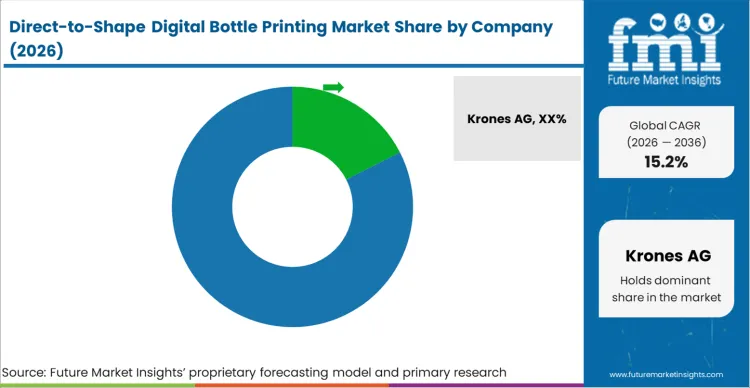
Hardware manufacturers lock in recurring revenue via proprietary ink and consumable ecosystems. Initial capital expenditure for heavy machinery yields low margins, but chemical formulations engineered specifically for high-speed printheads generate continuous returns over equipment lifespans. Competitors design closed-loop ink delivery architectures preventing operators from utilizing third-party fluids.
Partnerships between printhead developers and motion control engineers determine system reliability. Decorating three-dimensional objects requires precise synchronization between droplet ejection and robotic container rotation. Vendors lacking integrated software-hardware engineering capabilities suffer high failure rates during factory commissioning.
Beverage conglomerates execute multi-year capacity agreements with vertically integrated packaging suppliers. Specialized startups become acquisition targets for legacy packaging giants seeking to modernize operations without halting ongoing production. Consolidation accelerates as global brands standardize decoration platforms across international facilities.
Recent Developments
The report includes full coverage of key trends from competitive benchmarking. Some of the recent developments covered in the reports:
- In January 2026, Engineered Printing Solutions sold its 100th single-pass direct-to-object inkjet system for high-volume production decoration. [3]
- In November 2025, Meteor Inkjet partnered with Quantica to advance printhead capabilities for direct-to-shape applications. [11]
Key Players in Direct-to-Shape Digital Bottle Printing Market
- Krones AG
- Hinterkopf GmbH
- HP Inc.
- Epson
- Canon Inc.
- Velox Ltd.
Scope of the Report
| Metric | Value |
|---|---|
| Quantitative Units | USD 480.0 Million (2026) to USD 1,980.0 Million (2036), at a CAGR of 15.2% |
| Market Definition | Industrial hardware designed explicitly to deposit variable graphics directly onto three-dimensional rigid containers comprise the industry scope. |
| Technology Type Segmentation | Inkjet Digital Printing, Laser Digital Printing, UV Digital Printing, Other Digital Print Technologies |
| Material Substrate Segmentation | Plastic Bottles, Glass Bottles & Containers, Metal Cans & Containers, Specialty Substrates |
| Regions Covered | North America, Latin America, Europe, East Asia, South Asia, Oceania, Middle East and Africa |
| Countries Covered | United States, Canada, Mexico, Brazil, Argentina, Germany, France, United Kingdom, Italy, Spain, China, India, Japan, South Korea, Indonesia, Australia and 40 plus countries |
| Key Companies Profiled | Krones AG, Hinterkopf GmbH, HP Inc., Epson, Canon Inc., Velox Ltd. |
| Forecast Period | 2026 to 2036 |
| Approach | Hybrid top down and bottom up market modeling validated through primary interviews with equipment producers and packaging manufacturers, supported by trade data benchmarking and plant level capacity verification |
Direct-to-Shape Digital Bottle Printing Market Analysis by Segments
Technology Type
- Inkjet Digital Printing
- Laser Digital Printing
- UV Digital Printing
- Other Digital Print Technologies
Material Substrate
- Plastic Bottles
- Glass Bottles & Containers
- Metal Cans & Containers
- Specialty Substrates
Region
-
Asia Pacific
- India
- China
- Japan
- South Korea
- Indonesia
- Australia & New Zealand
- ASEAN
- Rest of Asia Pacific
- Europe
- Germany
- Italy
- France
- United Kingdom
- Spain
- Benelux
- Nordics
- Central & Eastern Europe
- Rest of Europe
- North America
- United States
- Canada
- Mexico
- Latin America
- Brazil
- Argentina
- Chile
- Rest of Latin America
- Middle East & Africa
- Kingdom of Saudi Arabia
- United Arab Emirates
- South Africa
- Turkey
- Rest of Middle East & Africa
Bibliography
- [1] Sustainable Packaging Coalition. (2025). Sustainable Packaging Trends 2025 Report.
- [2] Velox Ltd. (2025). Marian Cofler Quote on Digital Decoration Technology.
- [3] Engineered Printing Solutions. (2026). 100th single-pass DTO inkjet system sale.
- [4] Velox Ltd. (2025). Secured $38M funding led by Fortissimo Capital.
- [5] Gitnux.org. (2025). Digital Transformation in Packaging Industry Statistics.
- [6] Congress.gov. (2025). CRS Report R48293, Plastic Pollution FAQ.
- [7] Epson. (2025). Launched Direct-to-Shape Printing System.
- [8] Gitnux.org. (2025). Sustainable inks lowered VOC emissions by 35%.
- [9] International Bottled Water Association. (2025). Bottled water consumption report.
- [10] AF&PA.org. (2026). Packaging papers & specialty packaging shipments January report.
- [11] Meteor Inkjet Ltd. (2025). Partnership with Quantica.
- [12] Polytype. (2025). Joined FuturePrint as Digital Partner for 2026.
- [13] Innovative Digital Systems. (2025). Launched RevHDL UV printer.
- [14] PMMI.org. (2025). State of the Industry Report.
- [15] Flexography.org. (2025). Global digital print for packaging & labels report.
- [16] Flexible Packaging Association. (2025). Economic Impact Report.
- [17] Crown Holdings. (2025). Collaboration with Velox.
- [18] Hybrid Software. (2025). Fusion Packaging Summit 2026 program.
- [19] Ardagh Metal Packaging. (2025). Acquired NOMOQ.
- [20] ALTANA Group. (2025). Invested in Velox.
This bibliography is provided for reader reference and is not exhaustive. The full report contains the complete reference list and detailed citations.
This Report Addresses
- Market intelligence to enable structured strategic decision making across mature and emerging digital packaging economies
- Market size estimation and 10 year revenue forecasts from 2026 to 2036, supported by validated capacity and hardware unit sales benchmarks
- Growth opportunity mapping across inkjet, laser, and UV printing technologies with emphasis on high-speed single-pass transitions
- Segment and regional revenue forecasts covering plastic bottles, glass containers, metal cans, and specialty substrates
- Competition strategy assessment including integration models, printhead supply chain positioning, and ink formulation benchmarking
- Product reformulation and emission compliance tracking including zero-label mandates and VOC reduction targets
- Regulatory impact analysis covering extended producer responsibility laws, recycling purity thresholds, and export-driven packaging specification upgrades
Frequently Asked Questions
How large is the demand for Direct-to-Shape Digital Bottle Printing in the global market in 2026?
Demand for equipment and consumables is estimated to be valued at USD 480.0 Million in 2026.
What will be the market size of Direct-to-Shape Digital Bottle Printing in the global market by 2036?
Market size for Direct-to-Shape Digital Bottle Printing is projected to reach USD 1,980.0 Million by 2036.
What is the expected demand growth for Direct-to-Shape Digital Bottle Printing in the global market between 2026 and 2036?
Demand in the global market is expected to grow at a CAGR of 15.2% between 2026 and 2036.
Which Technology Type is poised to lead global sales by 2026?
Inkjet Digital Printing is expected to lead with 49% share, driven by rapid single-pass architectures replacing offset plates.
How significant is the role of Plastic Bottles in driving Direct-to-Shape Digital Bottle Printing adoption in 2026?
Plastic Bottles represent a critical segment holding a 41% share, pushed by recycling mandates demanding label-free formats.
What is driving demand in United States?
Strict producer responsibility laws forcing multi-material reduction and high-volume beverage consumption drive massive hardware procurement.
What compliance standards or regulations are referenced for United States?
Extended producer responsibility frameworks mandated across various states act as compliance baselines.
What is the United States growth outlook in this report?
United States is projected to grow at a CAGR of 15.4% during 2026 to 2036.
Why is Europe described as a priority region in this report?
Stringent circular economy directives and plastic taxation compel massive weight reduction via label elimination.
What type of demand dominates in Europe?
Regulatory-driven replacement demand for sustainable, low-emission UV curing equipment dominates regional investment.
What is Germany growth outlook in this report?
Germany is projected to expand at a CAGR of 14.8% during 2026 to 2036.
Does the report cover United Kingdom in its regional analysis?
Yes, United Kingdom is included within Europe under the regional scope of analysis.
What are the sources referred to for analyzing United Kingdom?
Official statistics covering packaging waste directives and machinery partnership announcements serve as primary references.
What is the main demand theme linked to United Kingdom in its region coverage?
Retail consortium pressure regarding plastic reduction lifts machine utilisation rates significantly.
Does the report cover China in its regional analysis?
Yes, China is included within East Asia under the regional coverage framework.
What is the main China related demand theme in its region coverage?
Massive single-serve beverage output requires continuous, highly automated decoration line speeds.
Which product formats or configurations are strategically important for North America supply chains?
High-speed, single-pass inkjet arrays capable of decorating PET and aluminum are strategically prioritized.
What is Direct-to-Shape Digital Bottle Printing and what is it mainly used for?
It involves industrial inkjet, laser, and UV systems depositing variable graphics directly onto rigid containers, replacing physical labels.
What does Direct-to-Shape Digital Bottle Printing mean in this report?
It refers to global revenues from digital printing hardware, integrated curing modules, and proprietary ink consumables used on 3D containers.
What is included in the scope of this Direct-to-Shape Digital Bottle Printing report?
Scope covers direct printing hardware for cylindrical profiles, specialized adherence inks, and inline inspection systems.
What is excluded from the scope of this report?
Traditional flexographic presses, independent shrink sleeve applicators, and contract packaging service revenues are excluded.
What does market forecast mean on this page?
Market forecast represents a model-based projection built on defined assumptions for strategic planning purposes.
How does FMI build and validate the Direct-to-Shape Digital Bottle Printing forecast?
Forecast utilizes top-down material shift modeling validated against hardware unit sales and regional consumable shipments.
What does zero reliance on speculative third party market research mean here?
Primary interviews with OEMs and verified datasets from packaging associations inform projections rather than unverified syndicates.
Preview the report firsthand - request a free sample
Get SampleGet the brochure for pricing and purchase details.
Get PDFTable of Content
- Executive Summary
- Global Market Outlook
- Demand-side Trends
- Supply-side Trends
- Technology Roadmap Analysis
- Analysis and Recommendations
- Market Overview
- Market Coverage / Taxonomy
- Market Definition / Scope / Limitations
- Research Methodology
- Chapter Orientation
- Analytical Lens and Working Hypotheses
- Market Structure, Signals, and Trend Drivers
- Benchmarking and Cross-market Comparability
- Market Sizing, Forecasting, and Opportunity Mapping
- Research Design and Evidence Framework
- Desk Research Programme (Secondary Evidence)
- Company Annual and Sustainability Reports
- Peer-reviewed Journals and Academic Literature
- Corporate Websites, Product Literature, and Technical Notes
- Earnings Decks and Investor Briefings
- Statutory Filings and Regulatory Disclosures
- Technical White Papers and Standards Notes
- Trade Journals, Industry Magazines, and Analyst Briefs
- Conference Proceedings, Webinars, and Seminar Materials
- Government Statistics Portals and Public Data Releases
- Press Releases and Reputable Media Coverage
- Specialist Newsletters and Curated Briefings
- Sector Databases and Reference Repositories
- FMI Internal Proprietary Databases and Historical Market Datasets
- Subscription Datasets and Paid Sources
- Social Channels, Communities, and Digital Listening Inputs
- Additional Desk Sources
- Expert Input and Fieldwork (Primary Evidence)
- Primary Modes
- Qualitative Interviews and Expert Elicitation
- Quantitative Surveys and Structured Data Capture
- Blended Approach
- Why Primary Evidence is Used
- Field Techniques
- Interviews
- Surveys
- Focus Groups
- Observational and In-context Research
- Social and Community Interactions
- Stakeholder Universe Engaged
- C-suite Leaders
- Board Members
- Presidents and Vice Presidents
- R&D and Innovation Heads
- Technical Specialists
- Domain Subject-matter Experts
- Scientists
- Physicians and Other Healthcare Professionals
- Governance, Ethics, and Data Stewardship
- Research Ethics
- Data Integrity and Handling
- Primary Modes
- Tooling, Models, and Reference Databases
- Desk Research Programme (Secondary Evidence)
- Data Engineering and Model Build
- Data Acquisition and Ingestion
- Cleaning, Normalisation, and Verification
- Synthesis, Triangulation, and Analysis
- Quality Assurance and Audit Trail
- Market Background
- Market Dynamics
- Drivers
- Restraints
- Opportunity
- Trends
- Scenario Forecast
- Demand in Optimistic Scenario
- Demand in Likely Scenario
- Demand in Conservative Scenario
- Opportunity Map Analysis
- Product Life Cycle Analysis
- Supply Chain Analysis
- Investment Feasibility Matrix
- Value Chain Analysis
- PESTLE and Porter’s Analysis
- Regulatory Landscape
- Regional Parent Market Outlook
- Production and Consumption Statistics
- Import and Export Statistics
- Market Dynamics
- Global Market Analysis 2021 to 2025 and Forecast, 2026 to 2036
- Historical Market Size Value (USD Million) Analysis, 2021 to 2025
- Current and Future Market Size Value (USD Million) Projections, 2026 to 2036
- Y-o-Y Growth Trend Analysis
- Absolute $ Opportunity Analysis
- Global Market Pricing Analysis 2021 to 2025 and Forecast 2026 to 2036
- Global Market Analysis 2021 to 2025 and Forecast 2026 to 2036, By Technology Type
- Introduction / Key Findings
- Historical Market Size Value (USD Million) Analysis By Technology Type , 2021 to 2025
- Current and Future Market Size Value (USD Million) Analysis and Forecast By Technology Type , 2026 to 2036
- Inkjet Digital Printing
- Laser Digital Printing
- UV Digital Printing
- Other Digital Print Technologies
- Inkjet Digital Printing
- Y-o-Y Growth Trend Analysis By Technology Type , 2021 to 2025
- Absolute $ Opportunity Analysis By Technology Type , 2026 to 2036
- Global Market Analysis 2021 to 2025 and Forecast 2026 to 2036, By Material Substrate
- Introduction / Key Findings
- Historical Market Size Value (USD Million) Analysis By Material Substrate, 2021 to 2025
- Current and Future Market Size Value (USD Million) Analysis and Forecast By Material Substrate, 2026 to 2036
- Plastic Bottles
- Glass Bottles & Containers
- Metal Cans & Containers
- Specialty Substrates
- Plastic Bottles
- Y-o-Y Growth Trend Analysis By Material Substrate, 2021 to 2025
- Absolute $ Opportunity Analysis By Material Substrate, 2026 to 2036
- Global Market Analysis 2021 to 2025 and Forecast 2026 to 2036, By Region
- Introduction
- Historical Market Size Value (USD Million) Analysis By Region, 2021 to 2025
- Current Market Size Value (USD Million) Analysis and Forecast By Region, 2026 to 2036
- North America
- Latin America
- Western Europe
- Eastern Europe
- East Asia
- South Asia and Pacific
- Middle East & Africa
- Market Attractiveness Analysis By Region
- North America Market Analysis 2021 to 2025 and Forecast 2026 to 2036, By Country
- Historical Market Size Value (USD Million) Trend Analysis By Market Taxonomy, 2021 to 2025
- Market Size Value (USD Million) Forecast By Market Taxonomy, 2026 to 2036
- By Country
- USA
- Canada
- Mexico
- By Technology Type
- By Material Substrate
- By Country
- Market Attractiveness Analysis
- By Country
- By Technology Type
- By Material Substrate
- Key Takeaways
- Latin America Market Analysis 2021 to 2025 and Forecast 2026 to 2036, By Country
- Historical Market Size Value (USD Million) Trend Analysis By Market Taxonomy, 2021 to 2025
- Market Size Value (USD Million) Forecast By Market Taxonomy, 2026 to 2036
- By Country
- Brazil
- Chile
- Rest of Latin America
- By Technology Type
- By Material Substrate
- By Country
- Market Attractiveness Analysis
- By Country
- By Technology Type
- By Material Substrate
- Key Takeaways
- Western Europe Market Analysis 2021 to 2025 and Forecast 2026 to 2036, By Country
- Historical Market Size Value (USD Million) Trend Analysis By Market Taxonomy, 2021 to 2025
- Market Size Value (USD Million) Forecast By Market Taxonomy, 2026 to 2036
- By Country
- Germany
- UK
- Italy
- Spain
- France
- Nordic
- BENELUX
- Rest of Western Europe
- By Technology Type
- By Material Substrate
- By Country
- Market Attractiveness Analysis
- By Country
- By Technology Type
- By Material Substrate
- Key Takeaways
- Eastern Europe Market Analysis 2021 to 2025 and Forecast 2026 to 2036, By Country
- Historical Market Size Value (USD Million) Trend Analysis By Market Taxonomy, 2021 to 2025
- Market Size Value (USD Million) Forecast By Market Taxonomy, 2026 to 2036
- By Country
- Russia
- Poland
- Hungary
- Balkan & Baltic
- Rest of Eastern Europe
- By Technology Type
- By Material Substrate
- By Country
- Market Attractiveness Analysis
- By Country
- By Technology Type
- By Material Substrate
- Key Takeaways
- East Asia Market Analysis 2021 to 2025 and Forecast 2026 to 2036, By Country
- Historical Market Size Value (USD Million) Trend Analysis By Market Taxonomy, 2021 to 2025
- Market Size Value (USD Million) Forecast By Market Taxonomy, 2026 to 2036
- By Country
- China
- Japan
- South Korea
- By Technology Type
- By Material Substrate
- By Country
- Market Attractiveness Analysis
- By Country
- By Technology Type
- By Material Substrate
- Key Takeaways
- South Asia and Pacific Market Analysis 2021 to 2025 and Forecast 2026 to 2036, By Country
- Historical Market Size Value (USD Million) Trend Analysis By Market Taxonomy, 2021 to 2025
- Market Size Value (USD Million) Forecast By Market Taxonomy, 2026 to 2036
- By Country
- India
- ASEAN
- Australia & New Zealand
- Rest of South Asia and Pacific
- By Technology Type
- By Material Substrate
- By Country
- Market Attractiveness Analysis
- By Country
- By Technology Type
- By Material Substrate
- Key Takeaways
- Middle East & Africa Market Analysis 2021 to 2025 and Forecast 2026 to 2036, By Country
- Historical Market Size Value (USD Million) Trend Analysis By Market Taxonomy, 2021 to 2025
- Market Size Value (USD Million) Forecast By Market Taxonomy, 2026 to 2036
- By Country
- Kingdom of Saudi Arabia
- Other GCC Countries
- Turkiye
- South Africa
- Other African Union
- Rest of Middle East & Africa
- By Technology Type
- By Material Substrate
- By Country
- Market Attractiveness Analysis
- By Country
- By Technology Type
- By Material Substrate
- Key Takeaways
- Key Countries Market Analysis
- USA
- Pricing Analysis
- Market Share Analysis, 2025
- By Technology Type
- By Material Substrate
- Canada
- Pricing Analysis
- Market Share Analysis, 2025
- By Technology Type
- By Material Substrate
- Mexico
- Pricing Analysis
- Market Share Analysis, 2025
- By Technology Type
- By Material Substrate
- Brazil
- Pricing Analysis
- Market Share Analysis, 2025
- By Technology Type
- By Material Substrate
- Chile
- Pricing Analysis
- Market Share Analysis, 2025
- By Technology Type
- By Material Substrate
- Germany
- Pricing Analysis
- Market Share Analysis, 2025
- By Technology Type
- By Material Substrate
- UK
- Pricing Analysis
- Market Share Analysis, 2025
- By Technology Type
- By Material Substrate
- Italy
- Pricing Analysis
- Market Share Analysis, 2025
- By Technology Type
- By Material Substrate
- Spain
- Pricing Analysis
- Market Share Analysis, 2025
- By Technology Type
- By Material Substrate
- France
- Pricing Analysis
- Market Share Analysis, 2025
- By Technology Type
- By Material Substrate
- India
- Pricing Analysis
- Market Share Analysis, 2025
- By Technology Type
- By Material Substrate
- ASEAN
- Pricing Analysis
- Market Share Analysis, 2025
- By Technology Type
- By Material Substrate
- Australia & New Zealand
- Pricing Analysis
- Market Share Analysis, 2025
- By Technology Type
- By Material Substrate
- China
- Pricing Analysis
- Market Share Analysis, 2025
- By Technology Type
- By Material Substrate
- Japan
- Pricing Analysis
- Market Share Analysis, 2025
- By Technology Type
- By Material Substrate
- South Korea
- Pricing Analysis
- Market Share Analysis, 2025
- By Technology Type
- By Material Substrate
- Russia
- Pricing Analysis
- Market Share Analysis, 2025
- By Technology Type
- By Material Substrate
- Poland
- Pricing Analysis
- Market Share Analysis, 2025
- By Technology Type
- By Material Substrate
- Hungary
- Pricing Analysis
- Market Share Analysis, 2025
- By Technology Type
- By Material Substrate
- Kingdom of Saudi Arabia
- Pricing Analysis
- Market Share Analysis, 2025
- By Technology Type
- By Material Substrate
- Turkiye
- Pricing Analysis
- Market Share Analysis, 2025
- By Technology Type
- By Material Substrate
- South Africa
- Pricing Analysis
- Market Share Analysis, 2025
- By Technology Type
- By Material Substrate
- USA
- Market Structure Analysis
- Competition Dashboard
- Competition Benchmarking
- Market Share Analysis of Top Players
- By Regional
- By Technology Type
- By Material Substrate
- Competition Analysis
- Competition Deep Dive
- Krones AG
- Overview
- Product Portfolio
- Profitability by Market Segments (Product/Age /Sales Channel/Region)
- Sales Footprint
- Strategy Overview
- Marketing Strategy
- Product Strategy
- Channel Strategy
- Hinterkopf GmbH
- HP Inc.
- Epson
- Canon Inc.
- Velox Ltd.
- Krones AG
- Competition Deep Dive
- Assumptions & Acronyms Used


