

- Market Size (2026)
- USD 290.5 Mn
- Forecast (2036)
- USD 855.2 Mn
- CAGR (2026 to 2036)
- 11.4%
How big is the Long-COVID Nutrition Products Market in 2026?
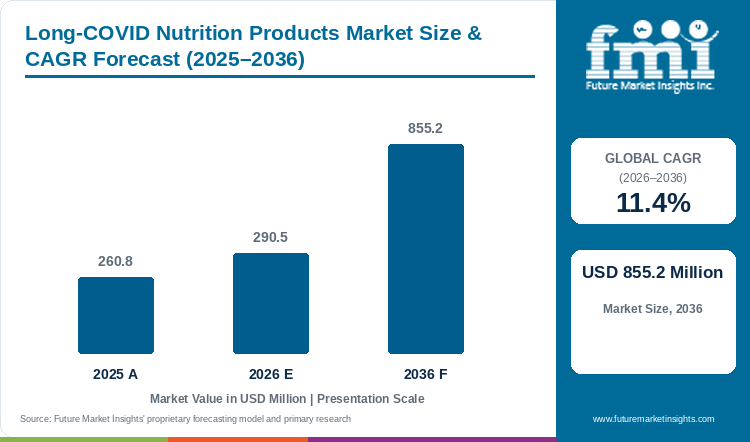
USD 290.5 Million in 2026 and USD 855.2 Million by 2036 at an 11.4% CAGR.
The long-COVID nutrition products market stands at USD 290.5 Million in 2026 and is projected to reach USD 855.2 Million by 2036, growing at a robust 11.4% CAGR. The primary spending mechanism is driven by a persistent, multi-system symptom burden. The World Health Organization reported that post-COVID conditions can affect an estimated 10% to 20% of individuals following SARS-CoV-2 infection, with fatigue and cognitive dysfunction ranking among the most commonly reported symptoms. This complex symptom mix fuels repeated consumer searches for energy, cognitive, and immune support, while simultaneously sustaining interest in gut-oriented nutrition products as formal, standardized treatment options remain limited.[1]
Commercial conversion varies significantly by operating environment. NICE guidance updated in January 2024 emphasizes self-management and explicitly states that it remains unknown whether over-the-counter vitamins and supplements are helpful, harmful, or neutral for ongoing COVID-19 symptoms. Conversely, South Korea has moved toward a structured national clinical-guidance framework, while Japan directs persistent cases toward community medical evaluation and symptom-based care. Consequently, suppliers must navigate a delicate balance: they need claim-compliant positioning, transparent ingredient rationales, and sufficient evidence to support repeat use, all without crossing the line into presenting nutrition products as proven medical treatments.[2][7][8]
Market Size and Forecast
Table 1: Market Size and Forecast for the Long-COVID Nutrition Products Market (USD Million), 2025 to 2036
| Metric | Value |
|---|---|
| Estimated Market Size in 2025 | USD 260.8 Million |
| Estimated Market Size in 2026 | USD 290.5 Million |
| Projected Market Size by 2036 | USD 855.2 Million |
| CAGR, 2026 to 2036 | 11.4% |
Key Takeaways
- Symptom-Led Purchasing Behavior: Persistent fatigue and post-exertional malaise (PEM) keep the addressable buying need highly symptom-led, with cognitive and gastrointestinal complaints strongly reinforcing this self-management pattern.
- Mitochondrial & Energy Support Dominance: This category leads Product Type with a 47.7% share in 2026 because severe fatigue and energy-management deficits create a direct, intuitive purchasing rationale for familiar cellular-energy ingredients like CoQ10 and NAD+ precursors.
- Fatigue & PEM as the Primary Driver: This cluster leads Symptom Clusters at 51.5% in 2026 because exertion intolerance acts as a defining functional constraint for patients, heavily dictating their daily capacity and driving repeated searches for recovery support.
- Self-Directed Care Prevails: Self-directed models capture 48.1% of the Care Model segment in 2026, reflecting a reality where the vast majority of products are purchased outside formal treatment pathways while the medical community remains cautious about unproven supplement efficacy.
- The Evidence and Regulatory Friction: The principal barrier to scaling is evidence quality. Buyers face highly heterogeneous symptoms and uncertain clinical benefits, while strict regulatory limits on disease-treatment claims and potential interaction concerns add significant caution to repeat purchasing.
- Profiled Companies: Thorne, Pure Encapsulations (Nestle Health Science), Nordic Naturals, NOW Health Group, Pharmavite (Nature Made), Metagenics, Ritual, and Life Extension.
Analyst Perspective
Revenue realization will depend far less on general awareness of long COVID and far more on whether suppliers can successfully connect symptom-specific formulations to credible, transparent evidence and claim-compliant communication that actively supports and justifies repeat purchasing.
- Anurag Sharma, Future Market Insights
How is the long-COVID nutrition products market segmented?
The market is segmented by Product Type, Symptom Cluster, Care Model, Form and Sales Channel.
Product Type comprises Mitochondrial & Energy Support (CoQ10 / NAD+), Immune-Rebalance Blends, Cognitive (Brain-Fog) Support, Gut-Microbiome Restoration, and Others. Symptom Cluster includes Fatigue & PEM, Cognitive Symptoms, Dysautonomia / POTS-Like, and Respiratory & Others. Care Model includes Self-Directed, Long-COVID Clinic Programs, and Others. Form includes Capsules / Softgels, Powders & Drinks, and Others. Sales Channel includes Online / DTC, Retail Pharmacy, Supermarkets & Hypermarkets, Specialty & Health Stores, and Others.
Why do Mitochondrial & Energy Support products lead the Product Type category?
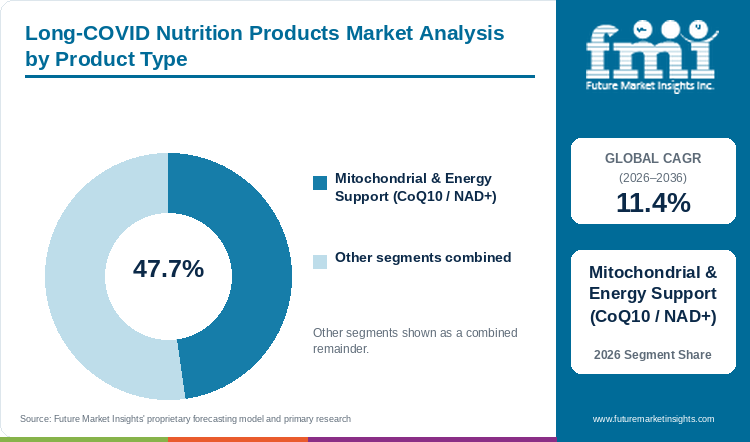
Mitochondrial & Energy Support holds 47.7% of Product Type in 2026.
Fatigue and reduced activity tolerance create a highly intuitive product-selection logic for ingredients associated with cellular energy. CoQ10 and NAD+-support products also fit seamlessly into established supplement formats, allowing consumers to integrate them without creating entirely new consumption behaviors. The commercial advantage here is familiarity rather than proven long-COVID treatment efficacy, meaning suppliers must rigorously keep benefit language within structure-function boundaries. Mitochondrial & Energy Support holds 47.7% of Product Type revenue in 2026, supported by the direct fit between persistent fatigue complaints and energy-support purchasing intent.[2][11][16][18][19][23][25]
- Mitochondrial & Energy Support accounts for 47.7% of Product Type in 2026.
- Intuitive Alignment with Cellular Energy: The segment's leadership is driven by the consumer's natural inclination to seek out established cellular-energy ingredients (like CoQ10 and NMN) when facing profound, unexplained physical exhaustion.
- Format Familiarity and Routine Integration: Because these ingredients are already widely available in familiar capsule and softgel formats, consumers can easily adopt them into daily routines without requiring complex preparation or new behavioral habits. (e.g., Life Extension's June 2026 NMN launch).[25]
What makes Fatigue & PEM the defining Symptom Cluster?
Fatigue & PEM holds 51.5% of Symptom Cluster in 2026.
Fatigue and Post-Exertional Malaise (PEM) possess a vastly stronger purchasing pull because they directly impact day-to-day functional capacity, heavily shaping decisions about pacing, work, and exercise. This symptom is also specific enough to organize product searches around "energy support" and "recovery." While cognitive and autonomic symptoms remain highly disruptive, they often require more differentiated clinical assessment before a consumer commits to a specific nutrition product. Fatigue & PEM represents 51.5% of Symptom Cluster revenue in 2026 because functional energy limits are common and persistent enough to trigger repeated self-management behavior.
- Fatigue & PEM accounts for 51.5% of Symptom Cluster in 2026.
- Direct Impact on Functional Capacity: Exertion intolerance acts as a severe functional constraint, forcing patients to actively seek out supportive interventions to manage their daily energy envelopes and maintain basic life routines.
- Validation Through Clinical Research Focus: The prominence of this cluster is reinforced by major research initiatives, such as the NIH RECOVER program's May 2024 trials focused specifically on exercise intolerance and PEM, validating it as a distinct management problem even if specific supplements remain unproven.[3]
What are the drivers, restraints and opportunities in the long-COVID nutrition products market?
Persistent multi-system symptoms drive demand, while limited evidence and regulated health claims restrain routine adoption, and stronger symptom-specific clinical proof creates an opportunity for more credible repeat purchasing.
- Driver: Persistent fatigue and cognitive difficulty create recurring self-management demand, with post-exertional and gastrointestinal symptoms actively reinforcing it.
- Restraint: Uncertain clinical efficacy and strict regulatory restrictions on disease-treatment claims make it exceedingly difficult to convert supplement interest into clinician-endorsed protocols.
- Opportunity: Controlled, symptom-targeted studies can separate products with measurable physiological value from generic wellness positioning, reducing trial-and-error purchasing.
The primary demand driver is the sheer persistence of the symptom burden. Long COVID can severely impact energy and cognition over extended periods, compounded by breathing, autonomic, and digestive complaints. The UK Office for National Statistics reported in March 2023 that 79% of people with self-reported long COVID said their day-to-day activities were affected, with 72% reporting fatigue and 51% reporting difficulty concentrating. When symptoms actively interfere with work or routine activity, consumers possess a highly practical, urgent reason to test supportive nutrition products that fit into daily self-management routines.[5]
The principal restraint is that the evidence base is simply not yet strong enough to support broad clinical confidence. NICE states that the benefit or harm of OTC supplements for long COVID is unknown, and a 2023 systematic scoping review concluded that evidence was too limited to support specific nutrient recommendations. Furthermore, FDA rules strictly prevent dietary supplements from being marketed to diagnose, treat, cure, or prevent disease. These constraints raise the proof burden immensely, making repeat purchasing heavily dependent on subjective, perceived benefit rather than clinical validation.[2][9][11]
The clearest opportunity lies in better-designed, symptom-specific studies that can separate products with measurable value from generic wellness claims. A 2025 randomized trial in 151 adults with long COVID reported improvement in the RECOVER Long COVID Index and selected inflammatory measures following vitamin K2 plus vitamin D3 supplementation. While one study does not establish category-wide efficacy, it perfectly demonstrates the immense commercial value of controlled outcome data. Suppliers armed with transparent formulations and evidence that matches a defined symptom cluster can drastically reduce buyer uncertainty and support highly disciplined repeat use.[10]
Which country CAGRs are profiled in the long-COVID nutrition products market?
The following country CAGRs cover the 2026 to 2036 forecast period.
Table 2: Country CAGRs for the Long-COVID Nutrition Products Market (CAGR, %), 2026 to 2036
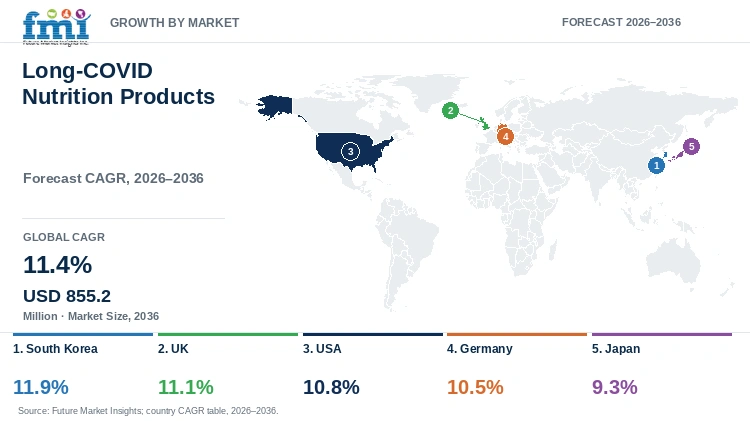
| Country | CAGR |
|---|---|
| South Korea | 11.9% |
| UK | 11.1% |
| USA | 10.8% |
| Germany | 10.5% |
| Japan | 9.3% |
Country-wise Analysis
- South Korea: The Korea Disease Control and Prevention Agency (KDCA) defines chronic COVID-19 syndrome as symptoms lasting three months or more that cannot be explained by another diagnosis, explicitly listing fatigue, brain fog, orthostatic dizziness, and gastrointestinal complaints. A final national clinical-guideline revision was issued in December 2025. The commercial implication is a highly structured symptom language for product selection; however, nutrition suppliers must still avoid presenting supportive products as established therapy, as the agency explicitly notes there is no specific proven treatment.[8]
- UK: The ONS reported in March 2023 that 1.9 million people in private households had self-reported long COVID, with fatigue (72%) and difficulty concentrating (51%) leading the burden. This massive symptom load strongly supports demand for energy and cognitive-support products. However, NICE guidance creates a powerful counterweight by stating that the benefit or harm of OTC vitamins and supplements is unknown. Suppliers therefore face a market where self-directed consumer demand can be incredibly strong, but clinician-linked growth depends entirely on evidence quality and highly careful claim language.[2][5]
- USA: CDC data found that 3.4% of U.S. adults reported currently having long COVID. The NIH RECOVER initiative has continued to aggressively study post-exertional malaise, cognitive dysfunction, and autonomic symptoms. The highly mature U.S. supplement market makes online and retail discovery frictionless, supporting massive self-directed purchasing across energy, gut, and cognition categories. Simultaneously, FDA structure-function rules strictly prohibit supplement marketers from claiming to diagnose, treat, cure, or prevent long COVID. Evidence and compliant communication therefore remain the absolute center of sustainable conversion.[3][4][11]
- Germany: The Federal Ministry of Health has funded a massive Long COVID research program, deploying 73 million euros across 30 projects running from 2024 to 2028. The ministry heavily emphasizes that Long COVID is highly heterogeneous and still lacks a causal cure. This environment simultaneously increases both awareness and scrutiny. Consumers will readily experiment with symptom-support nutrition, but clinicians and highly informed buyers will expect vastly stronger documentation before recommending repeat use. Suppliers that can clearly explain ingredient purpose without implying disease treatment are best aligned with this evidence-sensitive context.[6]
- Japan: Japan is profiled to expand at a 9.3% CAGR from 2026 to 2036, the lowest rate among the five named countries. The Ministry of Health, Labour and Welfare (MHLW) revised its post-COVID Q&A in February 2025, listing fatigue, memory problems, poor concentration, palpitations, and gastrointestinal complaints as representative symptoms. Crucially, the ministry advises people with persistent symptoms to consult primary or regional medical institutions. This structure supports symptom-led self-care but places medical evaluation very close to the purchase journey, heavily favoring conservative formulations and clear safety guidance over aggressive, disease-oriented marketing.[7]
Who are the notable companies in the long-COVID nutrition products market?
Thorne, Pure Encapsulations (Nestle Health Science), Nordic Naturals, NOW Health Group, Pharmavite (Nature Made), Metagenics, Ritual, and Life Extension are the notable companies profiled in this market.
Competition spans three distinct operating models. Thorne, Pure Encapsulations, and Metagenics emphasize science-led or practitioner-oriented supplement portfolios. Nordic Naturals, NOW Health Group, and Pharmavite pair broad consumer distribution with highly relevant energy and gut-support products. Ritual and Life Extension leverage strong direct consumer relationships, with Life Extension also aggressively broadening its physical retail footprint. Across these models, portfolio depth, guided purchasing, and rigorous quality documentation serve as the primary differentiators.[13][14][16][17][18][19][20][23][24][25][26]
- Practitioner-Integrated Science Brands: Thorne, Pure Encapsulations (Nestle Health Science), and Metagenics combine broad, high-potency supplement portfolios with documented healthcare-practitioner integration and science-led positioning.[14][16][17][23]
- Broad Retail and Omnichannel Supplement Brands: Nordic Naturals, NOW Health Group, and Pharmavite (Nature Made) compete through highly accessible formats and massive consumer distribution networks, featuring prominent energy and gut-health products.[18][19][20]
- Direct-to-Consumer and Healthy-Aging Specialists: Ritual and Life Extension utilize digital purchasing, subscription models, and advisory platforms, with Life Extension heavily marketing NAD+, microbiome, and cognitive-support formulas.[24][25][26][28]
Competitive Benchmarking: Long-COVID Nutrition Products Market
Table 3: Competitive Benchmarking for the Long-COVID Nutrition Products Market
| Company | Mitochondrial / Energy Portfolio | Gut-Microbiome Portfolio | Guided-Purchase / Professional Channel | Geographic Reach |
|---|---|---|---|---|
| Thorne | Not specified | High | High | United States; consumer and healthcare-practitioner channels |
| Pure Encapsulations | High | High | High | United States, Canada, Europe, Japan, and other Nestle Health Science markets |
| Nordic Naturals | High | High | Medium | United States with international distributor and professional inquiry channels |
| NOW Health Group | High | High | Not specified | United States plus international distribution to more than 100 countries |
| Pharmavite (Nature Made) | High | High | Medium | United States nationwide retail, pharmacy, and online channels |
| Metagenics | High | High | High | United States practitioner and direct channels |
| Ritual | Not specified | High | Not specified | United States, Canada, and United Kingdom subscription and e-commerce channels |
| Life Extension | High | High | Medium | United States direct, advisory, online, and expanding mass-retail channels |
Scoring basis: Mitochondrial / Energy Portfolio is High when public product evidence shows multiple direct CoQ10 and NAD+-related offers. Gut-Microbiome Portfolio is High when dedicated probiotic and prebiotic products are clearly documented. Guided-Purchase / Professional Channel is High when practitioner integration or structured professional support is core to the documented model.
Key Developments in the Long-COVID Nutrition Products Market
- In June 2026, Life Extension introduced two NMN formulas designed to increase NAD+ levels. The launch added a stand-alone NMN product and an NMN-plus-resveratrol formula to its healthy-aging portfolio, expanding consumer access to cellular-energy support without making a long-COVID treatment claim.[25]
- In March 2025, Pharmavite (Nature Made) launched new probiotic and prebiotic offerings in gummies and capsules, alongside fiber formats and digestive enzymes. This broadened mainstream access to gut-support products for consumers with persistent gastrointestinal concerns.[20]
- In August 2026, Thorne entered a definitive agreement to be acquired by Procter & Gamble. Thorne described its model as science-backed wellness with strong practitioner relationships. If completed, the ownership change could vastly expand resources and channel options around premium supplements.[13]
Key Players in the Long-COVID Nutrition Products Market
- Practitioner-Integrated Science Brands
- Thorne
- Pure Encapsulations (Nestle Health Science)
- Metagenics
- Broad Retail and Omnichannel Supplement Brands
- Nordic Naturals
- NOW Health Group
- Pharmavite (Nature Made)
- Direct-to-Consumer and Healthy-Aging Specialists
- Ritual
- Life Extension
Long-COVID Nutrition Products Market - Report Scope
Table 4: Report scope for the Long-COVID Nutrition Products Market (USD Million), 2026 to 2036
| Coverage field | Report scope |
|---|---|
| Market breakdown | Product Type; Symptom Cluster; Care Model; Form; Sales Channel; Region |
| Quantitative Units | USD Million |
| Market Definition | Revenue includes oral nutrition and dietary supplement products purchased for long-COVID symptom support within the stated segmentation. It excludes prescription or OTC drugs positioned as treatment, clinical service fees, diagnostics, conventional foods, and adjacent substitutes. |
| Regions Covered | North America; Latin America; Western Europe; Eastern Europe; East Asia; South Asia and Pacific; Middle East and Africa |
| Countries Covered | USA; UK; Germany; Japan; South Korea |
| Key Companies Profiled | Thorne; Pure Encapsulations; Nordic Naturals; NOW Health Group; Pharmavite; Metagenics; Ritual; Life Extension |
| Forecast Period | 2026 to 2036 |
| Approach | Primary and secondary research with market triangulation. |
Long-COVID Nutrition Products Market - Research Methodology
Table 5: Research methodology for the Long-COVID Nutrition Products Market (USD Million), 2026 to 2036
| Method | Approach |
|---|---|
| Primary Research | FMI analysts gathered input from manufacturers, service providers, distributors, end users, and subject-matter experts. Interviews examined purchasing decisions, adoption barriers, approval requirements, and expectations for technical support. |
| Desk Research | Desk research covered government statistics, regulatory publications, trade data, technical literature, and company filings. Claims relating to performance, applications, and commercial activity were retained only when supported by credible public evidence. |
| Market Sizing and Forecasting | The market model combined the baseline value with historical performance, segment structure, pricing, adoption levels, and country-level demand conditions. Forecast assumptions considered regulatory developments and purchasing cycles. |
| Data Validation | Estimates were checked against multiple independent indicators. Adjacent categories, unsupported claims, and overlapping revenues were excluded to reduce double counting and maintain consistency across segments and countries. |
Long-COVID Nutrition Products Market by Segments
Long-COVID Nutrition Products Market segmented by Product Type:
- Mitochondrial & Energy Support (CoQ10 / NAD+)
- Immune-Rebalance Blends
- Cognitive (Brain-Fog) Support
- Gut-Microbiome Restoration
- Others
Long-COVID Nutrition Products Market segmented by Symptom Cluster:
- Fatigue & PEM
- Cognitive Symptoms
- Dysautonomia / POTS-Like
- Respiratory & Others
Long-COVID Nutrition Products Market segmented by Care Model:
- Self-Directed
- Long-COVID Clinic Programs
- Others
Long-COVID Nutrition Products Market segmented by Form:
- Capsules / Softgels
- Powders & Drinks
- Others
Long-COVID Nutrition Products Market segmented by Sales Channel:
- Online / DTC
- Retail Pharmacy
- Supermarkets & Hypermarkets
- Specialty & Health Stores
- Others
Long-COVID Nutrition Products Market by Region:
- North America
- United States
- Canada
- Latin America
- Brazil
- Mexico
- Argentina
- Chile
- Western Europe
- Germany
- France
- United Kingdom
- Italy
- Spain
- Benelux
- Nordics
- Eastern Europe
- Poland
- Czech Republic
- Romania
- Hungary
- East Asia
- China
- Japan
- South Korea
- South Asia and Pacific
- India
- ASEAN
- Australia and New Zealand
- Middle East and Africa
- GCC Countries
- South Africa
- Türkiye
- Israel
Research Sources and Bibliography
- [1] World Health Organization (2023, March 28). Coronavirus disease (COVID-19): Post COVID-19 condition.
- [2] National Institute for Health and Care Excellence (2024, January 25). COVID-19 rapid guideline: managing the long-term effects of COVID-19. https://www.nice.org.uk/guidance/ng188
- [3] National Institutes of Health (2024, May 8). NIH to open long COVID clinical trials to study sleep disturbances, exercise intolerance, and post-exertional malaise.
- [4] Centers for Disease Control and Prevention (2023, September). Long COVID in Adults: United States, 2022.
- [5] Office for National Statistics (2023, March 30). Prevalence of ongoing symptoms following coronavirus (COVID-19) infection in the UK.
- [6] Federal Ministry of Health, Germany (2025, March 31). BMG arbeitet gegen Long COVID.
- [7] Ministry of Health, Labour and Welfare, Japan (2025, February 27). Q&A on post-COVID conditions.
- [8] Korea Disease Control and Prevention Agency (n.d.). Chronic COVID-19 syndrome.
- [9] National Library of Medicine / PubMed (2023). Nutritional interventions for the management of long COVID: a systematic scoping review.
- [10] National Library of Medicine / PubMed (2025). Vitamin K2 and vitamin D3 supplementation in long COVID: randomized controlled trial record. https://pmc.ncbi.nlm.nih.gov/articles/PMC11767688/
- [11] U.S. Food and Drug Administration (n.d.). Structure/Function Claims.
- [12] European Commission (n.d.). Nutrition and Health Claims.
- [13] Thorne (2026, August 4). Thorne Enters into Definitive Agreement to Be Acquired by Procter & Gamble. https://www.prnewswire.com/news-releases/thorne-enters-into-definitive-agreement-to-be-acquired-by-procter--gamble-302842751.html
- [14] Thorne (2025, May 19). Thorne Forms Scientific Advisory Board.
- [15] Thorne (2022, May 24). Thorne Relaunches its Gut Health Test.
- [16] Pure Encapsulations (n.d.). CoQ10 60 mg; Probiotics & Prebiotics.
- [17] Nestlé Health Science (n.d.). Pure Encapsulations.
- [18] Nordic Naturals (n.d.). CoQ10 Supplements; Natural Probiotics.
- [19] NOW Health Group (n.d.). CoQ10; Probiotic-10; NOW International.
- [20] Pharmavite (2025, March 21). Nature Made Prioritizes Gut Health Support.
- [21] Pharmavite (2025, May 8). Pharmavite Opens $250 Million Production Facility.
- [22] Pharmavite (2026, March 3). Nature Made Continues Expansion of its Gut Health Offerings.
- [23] Metagenics (n.d.). CoQ10 ST-100 mg; Doctor Grade Vitamins.
- [24] Ritual (n.d.). Synbiotic+; Subscription Terms.
- [25] Life Extension (2026, June). NMN Supplements Shown to Boost NAD+ Levels. https://www.lifeextension.com/featured-articles/2026/6/nmn-supplements-shown-to-boost-nad-levels
- [26] Life Extension (2026, May). Walmart to Sell Life Extension Supplements.
- [27] Life Extension (2025, June). Life Extension Expands Healthy Aging Supplements Line.
- [28] Life Extension (2026, July). New Life Extension Supplement Supports Memory.
This Report Answers
- How large is the Long-COVID Nutrition Products Market in 2026 and what value is forecast for 2036?
- Which industry pressures and persistent symptom patterns support demand for long-COVID nutrition products?
- Why does Mitochondrial & Energy Support hold the leading Product Type position?
- Why does Fatigue & PEM hold the leading Symptom Cluster position?
- How do growth rates differ across South Korea, the UK, the USA, Germany, and Japan?
- Which profiled companies supply energy and gut categories, and which cover cognitive or immune needs?
- What evidence and regulatory frictions can limit adoption and supplier switching?
- What should buyers evaluate before purchasing long-COVID nutrition products for repeated use?
Frequently Asked Questions
How big is the Long-COVID Nutrition Products Market in 2026, and what is forecast for 2036?
The market is valued at USD 290.5 Million in 2026 and is forecast to reach USD 855.2 Million by 2036. The expansion reflects persistent symptom-led purchasing across energy and cognitive needs, with immune and gut-support demand adding further breadth.
What is the CAGR of the Long-COVID Nutrition Products Market from 2026 to 2036?
The market is forecast to expand at an 11.4% CAGR from 2026 to 2036. Growth depends on continued consumer demand and on suppliers improving evidence quality enough to support repeat purchase without crossing disease-treatment claim boundaries.
Which Product Type leads the Long-COVID Nutrition Products Market?
Mitochondrial & Energy Support (CoQ10 / NAD+) leads Product Type with a 47.7% share in 2026. Its position reflects the commercial fit between persistent fatigue complaints and established cellular-energy supplement ingredients.
Which Symptom Cluster leads the Long-COVID Nutrition Products Market?
Fatigue & PEM leads Symptom Cluster with a 51.5% share in 2026. The segment is commercially vital because exertion intolerance directly affects daily function and encourages repeated self-management behavior.
Which profiled countries have the highest growth rates in the Long-COVID Nutrition Products Market?
South Korea has the highest profiled CAGR at 11.9%, followed by the UK at 11.1% and the USA at 10.8% from 2026 to 2036.
Which companies are active in the Long-COVID Nutrition Products Market?
Profiled companies are Thorne, Pure Encapsulations, Nordic Naturals, NOW Health Group, Pharmavite, Metagenics, Ritual, and Life Extension. Their relevance stems from documented energy and gut capabilities, alongside practitioner or consumer-facing channels.
Preview the report firsthand - request a free sample
Get SampleGet the brochure for pricing and purchase details.
Get PDFTable of Content
- Key Takeaways
- Market Size and CAGR
- Top Growth Driver
- Fastest Growing Segment
- Leading Region
- Key Companies
- Emerging Opportunities
- Executive Summary
- Global Market Outlook
- Demand-side Trends
- Supply-side Trends
- Technology Roadmap Analysis
- Analysis and Recommendations
- Analyst Perspective (What is happening? Why now? What should investors know?)
- Key Questions Answered
- How large is the market?
- What is the CAGR?
- What are key trends?
- Which region dominates?
- Who are the leaders?
- Market Overview
- Market Coverage / Taxonomy
- Market Definition / Scope / Limitations
- Research Methodology
- Chapter Orientation
- Analytical Lens and Working Hypotheses
- Market Structure, Signals, and Trend Drivers
- Benchmarking and Cross-market Comparability
- Market Sizing, Forecasting, and Opportunity Mapping
- Research Design and Evidence Framework
- Desk Research Programme (Secondary Evidence)
- Expert Input and Fieldwork (Primary Evidence)
- Tooling, Models, and Reference Databases
- Data Engineering and Model Build
- Quality Assurance and Audit Trail
- Market Background
- Market Dynamics (Drivers, Restraints, Opportunity, Trends)
- Scenario Forecast (Optimistic, Likely, Conservative)
- Impact Analysis
- AI Impact
- Sustainability Impact
- Regulatory Impact
- Technology Impact
- Consumer / Buyer Analysis
- Purchase Drivers
- Adoption Barriers
- Buyer Journey
- Opportunity Map Analysis
- Product Life Cycle Analysis
- Supply Chain Analysis
- Investment Feasibility Matrix
- Value Chain Analysis
- PESTLE and Porter's Analysis
- Regulatory Landscape
- Regional Parent Market Outlook
- Production and Consumption Statistics
- Import and Export Statistics
- Global Market Analysis and Forecast, 2021 to 2036
- Historical Market Size Value (USD Million) Analysis, 2021 to 2025
- Current and Future Market Size Value (USD Million) Projections, 2026 to 2036
- Y-o-Y Growth Trend Analysis
- Absolute $ Opportunity Analysis
- Global Market Pricing Analysis, 2021 to 2036
- Global Market Analysis and Forecast, By Product Type, 2021 to 2036
- Introduction / Key Findings
- Historical Market Size Value (USD Million) Analysis By Product Type, 2021 to 2025
- Current and Future Market Size Value (USD Million) Analysis and Forecast By Product Type, 2026 to 2036
- Mitochondrial & Energy Support (CoQ10 / NAD+)
- Immune-Rebalance Blends
- Cognitive (Brain-Fog) Support
- Gut-Microbiome Restoration
- Others
- Y-o-Y Growth Trend Analysis By Product Type, 2021 to 2025
- Absolute $ Opportunity Analysis By Product Type, 2026 to 2036
- Global Market Analysis and Forecast, By Symptom Cluster, 2021 to 2036
- Introduction / Key Findings
- Historical Market Size Value (USD Million) Analysis By Symptom Cluster, 2021 to 2025
- Current and Future Market Size Value (USD Million) Analysis and Forecast By Symptom Cluster, 2026 to 2036
- Fatigue & PEM
- Cognitive Symptoms
- Dysautonomia / POTS-Like
- Respiratory & Others
- Y-o-Y Growth Trend Analysis By Symptom Cluster, 2021 to 2025
- Absolute $ Opportunity Analysis By Symptom Cluster, 2026 to 2036
- Global Market Analysis and Forecast, By Care Model, 2021 to 2036
- Introduction / Key Findings
- Historical Market Size Value (USD Million) Analysis By Care Model, 2021 to 2025
- Current and Future Market Size Value (USD Million) Analysis and Forecast By Care Model, 2026 to 2036
- Self-Directed
- Long-COVID Clinic Programs
- Others
- Y-o-Y Growth Trend Analysis By Care Model, 2021 to 2025
- Absolute $ Opportunity Analysis By Care Model, 2026 to 2036
- Global Market Analysis and Forecast, By Form, 2021 to 2036
- Introduction / Key Findings
- Historical Market Size Value (USD Million) Analysis By Form, 2021 to 2025
- Current and Future Market Size Value (USD Million) Analysis and Forecast By Form, 2026 to 2036
- Capsules / Softgels
- Powders & Drinks
- Others
- Y-o-Y Growth Trend Analysis By Form, 2021 to 2025
- Absolute $ Opportunity Analysis By Form, 2026 to 2036
- Global Market Analysis and Forecast, By Sales Channel, 2021 to 2036
- Introduction / Key Findings
- Historical Market Size Value (USD Million) Analysis By Sales Channel, 2021 to 2025
- Current and Future Market Size Value (USD Million) Analysis and Forecast By Sales Channel, 2026 to 2036
- Online / DTC
- Retail Pharmacy
- Supermarkets & Hypermarkets
- Specialty & Health Stores
- Others
- Y-o-Y Growth Trend Analysis By Sales Channel, 2021 to 2025
- Absolute $ Opportunity Analysis By Sales Channel, 2026 to 2036
- Global Market Analysis and Forecast, By Region, 2021 to 2036
- Introduction
- Historical Market Size Value (USD Million) Analysis By Region, 2021 to 2025
- Current Market Size Value (USD Million) Analysis and Forecast By Region, 2026 to 2036
- North America
- Latin America
- Western Europe
- Eastern Europe
- East Asia
- South Asia and Pacific
- Middle East and Africa
- Market Attractiveness Analysis By Region
- North America Market Analysis and Forecast, By Country, 2021 to 2036
- Historical Market Size Value (USD Million) Trend Analysis By Market Taxonomy, 2021 to 2025
- Market Size Value (USD Million) Forecast By Market Taxonomy, 2026 to 2036
- By Country
- United States
- Canada
- By Product Type
- By Symptom Cluster
- By Care Model
- By Form
- By Sales Channel
- By Country
- Market Attractiveness Analysis
- By Country
- By Product Type
- By Symptom Cluster
- By Care Model
- By Form
- By Sales Channel
- Key Takeaways
- Latin America Market Analysis and Forecast, By Country
- Historical Market Size Value (USD Million) Trend Analysis By Market Taxonomy, 2021 to 2025
- Market Size Value (USD Million) Forecast By Market Taxonomy, 2026 to 2036
- By Country
- Brazil
- Mexico
- Argentina
- Chile
- By Product Type
- By Symptom Cluster
- By Care Model
- By Form
- By Sales Channel
- By Country
- Market Attractiveness Analysis
- By Country
- By Product Type
- By Symptom Cluster
- By Care Model
- By Form
- By Sales Channel
- Key Takeaways
- Western Europe Market Analysis and Forecast, By Country
- Historical Market Size Value (USD Million) Trend Analysis By Market Taxonomy, 2021 to 2025
- Market Size Value (USD Million) Forecast By Market Taxonomy, 2026 to 2036
- By Country
- Germany
- France
- United Kingdom
- Italy
- Spain
- Benelux
- Nordics
- By Product Type
- By Symptom Cluster
- By Care Model
- By Form
- By Sales Channel
- By Country
- Market Attractiveness Analysis
- By Country
- By Product Type
- By Symptom Cluster
- By Care Model
- By Form
- By Sales Channel
- Key Takeaways
- Eastern Europe Market Analysis and Forecast, By Country
- Historical Market Size Value (USD Million) Trend Analysis By Market Taxonomy, 2021 to 2025
- Market Size Value (USD Million) Forecast By Market Taxonomy, 2026 to 2036
- By Country
- Poland
- Czech Republic
- Romania
- Hungary
- By Product Type
- By Symptom Cluster
- By Care Model
- By Form
- By Sales Channel
- By Country
- Market Attractiveness Analysis
- By Country
- By Product Type
- By Symptom Cluster
- By Care Model
- By Form
- By Sales Channel
- Key Takeaways
- East Asia Market Analysis and Forecast, By Country
- Historical Market Size Value (USD Million) Trend Analysis By Market Taxonomy, 2021 to 2025
- Market Size Value (USD Million) Forecast By Market Taxonomy, 2026 to 2036
- By Country
- China
- Japan
- South Korea
- By Product Type
- By Symptom Cluster
- By Care Model
- By Form
- By Sales Channel
- By Country
- Market Attractiveness Analysis
- By Country
- By Product Type
- By Symptom Cluster
- By Care Model
- By Form
- By Sales Channel
- Key Takeaways
- South Asia and Pacific Market Analysis and Forecast, By Country
- Historical Market Size Value (USD Million) Trend Analysis By Market Taxonomy, 2021 to 2025
- Market Size Value (USD Million) Forecast By Market Taxonomy, 2026 to 2036
- By Country
- India
- ASEAN
- Australia and New Zealand
- By Product Type
- By Symptom Cluster
- By Care Model
- By Form
- By Sales Channel
- By Country
- Market Attractiveness Analysis
- By Country
- By Product Type
- By Symptom Cluster
- By Care Model
- By Form
- By Sales Channel
- Key Takeaways
- Middle East and Africa Market Analysis and Forecast, By Country
- Historical Market Size Value (USD Million) Trend Analysis By Market Taxonomy, 2021 to 2025
- Market Size Value (USD Million) Forecast By Market Taxonomy, 2026 to 2036
- By Country
- GCC Countries
- South Africa
- Türkiye
- Israel
- By Product Type
- By Symptom Cluster
- By Care Model
- By Form
- By Sales Channel
- By Country
- Market Attractiveness Analysis
- By Country
- By Product Type
- By Symptom Cluster
- By Care Model
- By Form
- By Sales Channel
- Key Takeaways
- Key Countries Market Analysis
- United States
- Pricing Analysis
- Market Share Analysis, 2025
- By Product Type
- By Symptom Cluster
- By Care Model
- By Form
- By Sales Channel
- Canada
- Pricing Analysis
- Market Share Analysis, 2025
- By Product Type
- By Symptom Cluster
- By Care Model
- By Form
- By Sales Channel
- Mexico
- Pricing Analysis
- Market Share Analysis, 2025
- By Product Type
- By Symptom Cluster
- By Care Model
- By Form
- By Sales Channel
- Brazil
- Pricing Analysis
- Market Share Analysis, 2025
- By Product Type
- By Symptom Cluster
- By Care Model
- By Form
- By Sales Channel
- Chile
- Pricing Analysis
- Market Share Analysis, 2025
- By Product Type
- By Symptom Cluster
- By Care Model
- By Form
- By Sales Channel
- Germany
- Pricing Analysis
- Market Share Analysis, 2025
- By Product Type
- By Symptom Cluster
- By Care Model
- By Form
- By Sales Channel
- United Kingdom
- Pricing Analysis
- Market Share Analysis, 2025
- By Product Type
- By Symptom Cluster
- By Care Model
- By Form
- By Sales Channel
- Italy
- Pricing Analysis
- Market Share Analysis, 2025
- By Product Type
- By Symptom Cluster
- By Care Model
- By Form
- By Sales Channel
- Spain
- Pricing Analysis
- Market Share Analysis, 2025
- By Product Type
- By Symptom Cluster
- By Care Model
- By Form
- By Sales Channel
- France
- Pricing Analysis
- Market Share Analysis, 2025
- By Product Type
- By Symptom Cluster
- By Care Model
- By Form
- By Sales Channel
- India
- Pricing Analysis
- Market Share Analysis, 2025
- By Product Type
- By Symptom Cluster
- By Care Model
- By Form
- By Sales Channel
- ASEAN
- Pricing Analysis
- Market Share Analysis, 2025
- By Product Type
- By Symptom Cluster
- By Care Model
- By Form
- By Sales Channel
- Australia and New Zealand
- Pricing Analysis
- Market Share Analysis, 2025
- By Product Type
- By Symptom Cluster
- By Care Model
- By Form
- By Sales Channel
- China
- Pricing Analysis
- Market Share Analysis, 2025
- By Product Type
- By Symptom Cluster
- By Care Model
- By Form
- By Sales Channel
- Japan
- Pricing Analysis
- Market Share Analysis, 2025
- By Product Type
- By Symptom Cluster
- By Care Model
- By Form
- By Sales Channel
- South Korea
- Pricing Analysis
- Market Share Analysis, 2025
- By Product Type
- By Symptom Cluster
- By Care Model
- By Form
- By Sales Channel
- Poland
- Pricing Analysis
- Market Share Analysis, 2025
- By Product Type
- By Symptom Cluster
- By Care Model
- By Form
- By Sales Channel
- Hungary
- Pricing Analysis
- Market Share Analysis, 2025
- By Product Type
- By Symptom Cluster
- By Care Model
- By Form
- By Sales Channel
- Türkiye
- Pricing Analysis
- Market Share Analysis, 2025
- By Product Type
- By Symptom Cluster
- By Care Model
- By Form
- By Sales Channel
- South Africa
- Pricing Analysis
- Market Share Analysis, 2025
- By Product Type
- By Symptom Cluster
- By Care Model
- By Form
- By Sales Channel
- United States
- Market Structure Analysis
- Competition Dashboard
- Competition Benchmarking
- Market Share Analysis of Top Players
- By Regional
- By Product Type
- By Symptom Cluster
- By Care Model
- By Form
- By Sales Channel
- Emerging Startups
- Innovation Benchmarking
- Competition Analysis
- Competition Deep Dive
- Thorne
- Overview
- Product Portfolio
- Profitability by Market Segments
- Sales Footprint
- Strategy Overview
- Marketing Strategy
- Product Strategy
- Channel Strategy
- Pure Encapsulations
- Nordic Naturals
- NOW Health Group
- Pharmavite (Nature Made)
- Metagenics
- Ritual
- Life Extension
- Practitioner-Integrated Science Brands
- Pure Encapsulations (Nestle Health Science)
- Broad Retail and Omnichannel Supplement Brands
- Direct-to-Consumer and Healthy-Aging Specialists
- Thorne
- Case Studies
- Success Stories
- Recent Developments
- Competition Deep Dive
- Assumptions & Acronyms Used


