

- Market Size (2026)
- USD 107.6 Mn
- Forecast (2036)
- USD 223.8 Mn
- CAGR (2026 to 2036)
- 7.6%
How big is Cholestasis Nutrition Products Market in 2026?
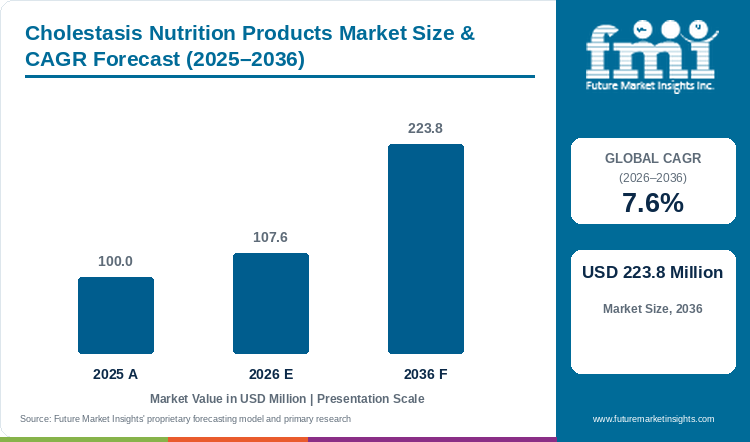
Demand in the cholestasis nutrition products market is anticipated to expand at 7.6% CAGR through 2036. Industry valuation grows from USD 100.0 million in 2025 to USD 107.6 million in 2026 and is anticipated to reach USD 223.8 million by 2036.
Reduced bile flow affects fat absorption and creates requirement for MCT-rich formulas, fat-soluble vitamins and monitored feeding across clinical nutrition. This continued care requirement is supporting consumption before surgery, during growth monitoring and after liver-care procedures. FMI estimates cholestasis nutrition products market at USD 100.0 million in 2025 and USD 107.6 million in 2026, with valuation anticipated to reach USD 223.8 million by 2036 at 7.6% CAGR. A 2025 study covering 200 infants with biliary atresia found that 42% underwent liver transplantation within two years.[1] Owing to this extended care pathway, feeding tolerance, formula composition and home supply are likely to upkeep repeat product use.
Disease-specific product access is developing differently across South Korea and the USA. South Korea is forecast to expand at 7.8% CAGR during 2026 to 2036, whereas the USA is anticipated to advance at 7.3%. South Korea introduced standards for liver-cirrhosis nutrition formulas in August 2025, providing manufacturers a clearer product route.[2] The USA gains demand from pediatric liver centers and home feeding after specialist initiation. As per FMI analysis, regulatory clarity can improve product development in South Korea, while established clinical pathways will support USA consumption. Composition proof and dependable supply remain important for regular adoption.
Key Takeaways
- Fat malabsorption and vitamin deficiency risk are supporting repeat use of supervised formulas, MCT modules, and fat-soluble vitamin products.
- Based on product type, MCT-predominant formulas are projected to account for 42.9% in 2026, owing to easier absorption under reduced bile flow.
- By age group, infant use is estimated to hold 47.2% in 2026, as feeding support starts when growth requirement is already high.
- In 2026, biliary atresia is expected to lead condition demand with 54.7% share, supported by nutrition use across surgery and transplant care.
- South Korea is projected at 7.8% CAGR, while the USA is forecast at 7.3% through 2036, owing to different product and care pathways.
- Some of the noticeable companies are Danone Nutricia, Nestle Health Science, Abbott, Fresenius Kabi, Solace Nutrition, Ajinomoto Cambrooke, and Medtrition.
Analyst Perspective
“I see formula choice moving towards products that support fat absorption while keeping growth and feeding tolerance under control. Homecare access will decide whether prescribed nutrition continues properly after the patient moves out of hospital care.”
- Nandini Roy Choudhury, Principal Consultant, Future Market Insights.
How is the cholestasis nutrition products market segmented?
Cholestasis nutrition products market is segmented by five primary commercial axes and region: product type, age group, condition, end user, sales channel, and region. In 2026, MCT-predominant formulas are projected at 42.9%, infant use at 47.2%, biliary atresia at 54.7%, homecare at 50.6%, and hospital pharmacy at 45.7%.
Cholestasis nutrition products market is segmented by product type, age group, condition, end user, sales channel, and region.
By product type: MCT-predominant formulas, fat-soluble vitamin products, MCT oil modules, and others.
By age group: infant, pediatric, and adult.
By condition: biliary atresia, PSC or PBC, drug-induced cholestasis, and others.
By end user: homecare, hospitals and liver centers, and others.
By sales channel: hospital pharmacy, retail pharmacy, online, institutional tender, and others.
By region: North America, Latin America, Western Europe, Eastern Europe, East Asia, South Asia and Pacific, and Middle East and Africa.
Why do MCT-predominant formulas lead product type demand?
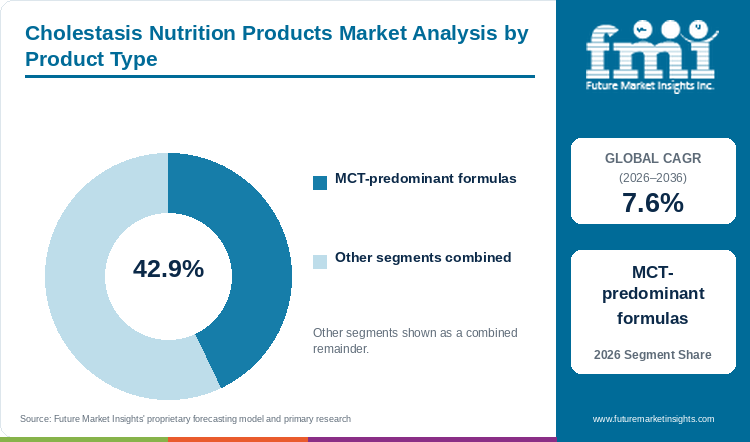
Based on product type, MCT-predominant formulas are projected to account for 42.9% in 2026, driven by easier fat absorption.
MCT-predominant formulas are used where long-chain fats become difficult to absorb because of reduced bile flow. They provide a direct energy source, but essential long-chain fats still remain necessary in the feeding plan. A 2026 evidence review found only six studies investigating MCT percentages and three reporting MCT dose in infants with biliary atresia.[3] FMI research indicates that owing to the limited dosage evidence, complete formulas and monitored adjustment are expected to remain important across each specialized medical food regimen.
- MCT-predominant formulas are projected to hold 42.9% of product type demand in 2026 because the formulation addresses impaired fat handling.
- The feeding plan also requires essential long-chain fats and micronutrients, which are monitored according to growth and tolerance.
What supports infant use within the age group category?
By age group, infant use is estimated to hold 47.2% in 2026, owing to early biliary atresia diagnosis.
Infant feeding becomes difficult when biliary atresia affects fat absorption during a period of rapid growth. A study published on December 31, 2025 assessed energy and protein support during the first week after liver transplant among children with biliary atresia.[4] Nutrition remains required across early diagnosis, surgery, and post-transplant care, due to which specialized infant formula options and monitored feeding are expected to witness continued demand.
- Infant use is estimated to hold 47.2% share in 2026, owing to early diagnosis and continued feeding support during rapid growth.
- Age-specific dosage and growth monitoring are influencing how long the selected formula remains suitable for the infant.
How does biliary atresia anchor condition demand?
In 2026, biliary atresia is expected to lead condition demand with 54.7% share, supported by sustained nutritional management.
Biliary atresia creates nutrition requirement from diagnosis and Kasai surgery to growth monitoring and possible transplantation, following protocols established in gastrointestinal surgery nutrition. The National Institute of Diabetes and Digestive and Kidney Diseases notes that without timely restoration of bile flow, infants with biliary atresia experience severe malabsorption and typically require liver transplantation before age two.[5] Poor growth can continue after surgery, due to which complete formulas, vitamin products, and MCT modules remain part of the care pathway.
- Biliary atresia is expected to command 54.7% share in 2026, as malabsorption and poor growth can continue after Kasai surgery.
- Formula selection mainly changes with bile flow, growth pattern, vitamin status, and the quantity tolerated by the patient.
Why does homecare remain central to end-user demand?
Homecare is set to lead end user demand with 50.6% share in 2026, underpinned by repeated daily administration.
Homecare use grows after the liver-care team gives a feeding plan that must be followed several times in a day. In October 2025, Vytala reported monthly Seracal sales growth exceeding 30% and an approved study covering nearly 30 pediatric gastrointestinal patients.[6] The development is linked with fat-malabsorption support, and indicates how clinician demand and insurance coverage can support continued tube feeding formula use outside hospitals.
- Homecare is projected to hold 50.6% share in 2026, as daily formula and module use largely continues outside hospitals.
- Refill availability and dosage support are important because an interrupted supply can disturb the feeding plan followed at home.
Which conditions keep hospital pharmacy relevant in sales channels?
Hospital pharmacy is projected to hold 45.7% share in 2026, reinforced by specialist initiation and structured formulary oversight.
Hospital pharmacies bring specialist selection, product procurement, and discharge supply under one channel for specialized nutrition. In December 2025, the UK Department of Health and Social Care reaffirmed regulatory notification requirements for foods for special medical purposes and specialized infant formulas.[7] This documented route is relevant where age, feeding route, nutrient composition, and later home supply must be checked together before product issue.
- Hospital pharmacy is forecast to represent 45.7% share in 2026, owing to specialist initiation and controlled first product access.
- Retail and online channels become more useful once dosage, product selection, and supporting documents are already settled.
What are the drivers, restraints, and opportunities in the cholestasis nutrition products market?
In the cholestasis nutrition products market, the key driver is persistent malabsorption, the key restraint is individualized dosing, and the key opportunity is homecare continuity.
- Driver: Reduced bile flow can limit fat and fat-soluble vitamin absorption, creating repeat demand under specialist monitoring.
- Restraint: MCT exposure, essential fatty acids, vitamins, tolerance, and coverage must be individualized before repeat use.
- Opportunity: Better homecare formats and refill support can extend a clinically approved regimen beyond hospital initiation.
Malabsorption Creates Repeat Nutrition Need
Low bile flow affects absorption of fat and vitamins A, D, E, and K, which gives rise to specialized nutrition requirement during early life nutrition. A March 2026 NASPGHAN research update noted improved pre-transplant nutrition status with more aggressive nutrition support among children with biliary atresia.[8] This is supporting use of higher-calorie feeding, vitamin products, and nutrition follow-up across the liver-care period.
Individual Dosing Limits Standard Protocols
MCT provides energy with less dependence on bile; however, replacing too much long-chain fat can affect essential fatty-acid intake. Clinical guidance published in Nutrients in 2025 highlighted that medium-chain triglyceride intake exceeding 80% of total dietary fat should be avoided to prevent essential fatty acid deficiency in pediatric cholestasis.[9] Dosage, calorie intake, essential fats, and growth response must therefore be seen together, which is restraining one standard feeding plan, even when introducing transitional baby food options.
Home Supply Extends Clinical Use
Home feeding is gaining scope as enteral nutrition becomes available in formats that are easier to carry and use away from hospital. In March 2026, Nestle introduced Compleat Paediatric Oral Blends in an on-the-go pouch across seven European countries, with further markets planned later in the year.[10] Such formats can create new avenues where the child requires complete nutrition during travel, school, or regular homecare.
Which country CAGRs are profiled in the cholestasis nutrition products market?
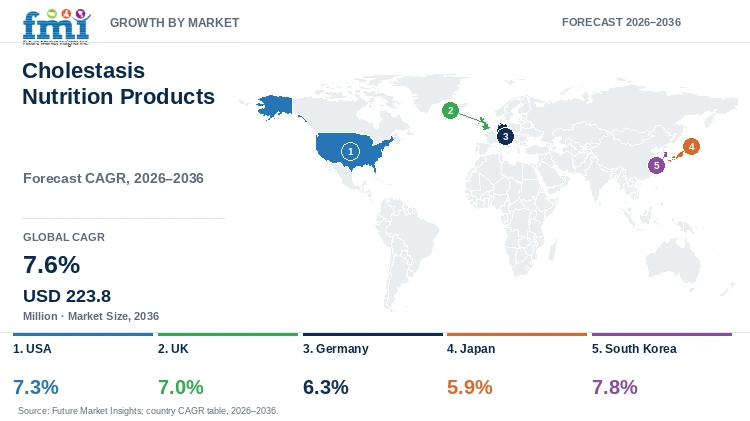
| Country | CAGR |
|---|---|
| USA | 7.3% |
| UK | 7.0% |
| Germany | 6.3% |
| Japan | 5.9% |
| South Korea | 7.8% |
How do country-level CAGRs compare in the cholestasis nutrition products market?
As per the analysis from FMI, country outlook changes with specialist-center availability, medical-food regulation, reimbursement, and home supply. South Korea and the USA have stronger growth movement, whilst Germany and Japan remain more influenced by formal product and payment requirements.
- USA demand is moving with pediatric liver-center care and specialty home supply after hospital discharge.
- The UK combines specialist liver services with a notified route for foods used under medical supervision.
- Germany links enteral nutrition use with medical need and statutory product requirements.
- Japan requires national permission and compliant claims before special dietary-use foods are sold.
- South Korea is gaining prospects from disease-specific standards for nutrition formulas used in liver care.
Full report country CAGRs cover: North America; Latin America; Western Europe; Eastern Europe; East Asia; South Asia and Pacific; Middle East and Africa.
Country-wise Analysis
- Cholestasis nutrition product demand in the USA is forecast to rise at 7.3% CAGR through 2036, owing to pediatric liver-center care. The OPTN/SRTR 2024 report, published in June 2026, covers more than 800 figures and tables across organ transplantation and includes pediatric transplant information.[11] Availability of national transplant data, specialist centers, insurance support, and home delivery is expected to support continued use across specialized pediatric care and hypo anti-allergic baby food channels after discharge.
- The UK cholestasis nutrition products outlook is anticipated to advance at 7.0% CAGR, influenced by specialist services and medical-food controls. NHS Blood and Transplant released its annual paediatric donation and transplantation report for April 2024 to March 2025.[12] Continued reporting of pediatric transplant activity and the notified route for medical foods are expected to support dietitian-led nutrition and home supply.
- Adoption of cholestasis nutrition products in Germany is estimated to expand at 6.3% CAGR through 2036, backed by statutory enteral-nutrition coverage. In June 2025, the Federal Joint Committee approved an evaluation concept and conducted a survey from July to December 2025 covering manufacturers, medical societies, health funds, physicians, and hospitals.[13] Product classification and proof of medical requirement are therefore influencing access in Germany.
- In Japan, cholestasis nutrition product demand is predicted to advance at 5.9% CAGR through 2036, owing to national permission requirements. In May 2026, the Consumer Affairs Agency granted one permission for labeling a food for special dietary use under the Health Promotion Act.[14] Local evidence and labeling can slow introduction, still the national route provides clearer product status for specialist use.
- South Korea is estimated to post 7.8% CAGR through 2036, driven by clearer standards for disease-specific nutrition formulas. The Korean Association for the Study of the Liver listed its 2025 guideline for metabolic dysfunction-associated steatotic liver disease among current national guidance.[15] FMI data suggests that together with the revised liver-cirrhosis formula standards, local clinical guidance and product rules are expected to support liver-focused nutrition development.
Who are the notable companies in the cholestasis nutrition products market?
Danone Nutricia, Nestle Health Science, Abbott, Vitaflo, Fresenius Kabi, Solace Nutrition, Ajinomoto Cambrooke, and Medtrition are notable companies profiled in this market.
In the FMI report, complete-formula companies, pediatric nutrition suppliers, and focused medical-food manufacturers are active in this market. Danone Nutricia, Abbott, and Vitaflo have pediatric and specialty products, while Nestle Health Science and Fresenius Kabi carry wider enteral portfolios. Solace Nutrition, Ajinomoto Cambrooke, and Medtrition focus more on structured-lipid and modular nutrition needs. Product composition, suitable age, feeding route, hospital access, and home supply mainly influence the product selected by healthcare providers.
- Infant and pediatric platforms: Danone Nutricia, Abbott, and Vitaflo bring specialty-formula and clinician-access capabilities.
- Broad enteral systems: Nestle Health Science and Fresenius Kabi connect hospital initiation with wider nutrition portfolios.
- Focused medical-food specialists: Solace Nutrition, Ajinomoto Cambrooke, and Medtrition support smaller clinically managed populations.
Competitive Benchmarking: Cholestasis Nutrition Products Market
| Company | Product fit | Pediatric depth | Access support | Reach |
|---|---|---|---|---|
| Danone Nutricia | High | High | High | High |
| Nestle Health Science | Medium | Medium | High | High |
| Abbott | Medium | High | High | High |
| Vitaflo | High | High | Medium | Medium |
| Fresenius Kabi | High | Medium | High | High |
| Solace Nutrition | High | Medium | High | Medium |
| Ajinomoto Cambrooke | Medium | High | Medium | Medium |
| Medtrition | High | Low | Medium | Medium |
High shows wider documented capability, Medium shows a narrower capability, and Low shows limited coverage across the areas compared.
Key Developments in the Cholestasis Nutrition Products Market
- In January 2026, Solace Nutrition reported in-house manufacturing, patient support, insurance assistance, and provider services for Encala. The company also stated that an NIH-funded trial covered 110 children and adolescents with cystic fibrosis.[16]
- In July 2025, Danone completed the majority acquisition of Kate Farms, expanding its specialized plant-based and medical nutrition portfolio across North American clinical and homecare channels.[17]
- In June 2025, Ajinomoto Cambrooke introduced a refreshed brand identity centered on therapeutic medical nutrition for clinically managed metabolic conditions.[18]
- In March 2025, Ajinomoto invested in Enhanced Medical Nutrition, a startup specializing in surgical nutrition. The investment extends Ajinomoto activity across therapeutic nutrition before and after major procedures.[19]
Key Players in the Cholestasis Nutrition Products Market
Infant and pediatric specialty formula platforms
- Danone Nutricia
- Abbott
- Vitaflo
Broader enteral and hospital-to-home systems
- Nestle Health Science
- Fresenius Kabi
- Medtrition
Focused therapeutic medical-food specialists
- Solace Nutrition
- Ajinomoto Cambrooke
Cholestasis Nutrition Products Market - Report Scope
| Coverage field | Report scope |
|---|---|
| Market breakdown | Product type, age group, condition, end user, sales channel, and region. |
| Quantitative units | USD million. |
| Market definition | Supplier revenue from medically supervised formulas and modules used for cholestasis-related fat malabsorption, micronutrient risk, and energy needs. Conventional pharmaceuticals, surgery, transplant services, parenteral nutrition, and ordinary foods are excluded. |
| Regions covered | North America; Latin America; Western Europe; Eastern Europe; East Asia; South Asia and Pacific; Middle East and Africa. |
| Countries covered | USA, UK, Germany, Japan, South Korea, and additional countries in the full report. |
| Key companies profiled | Danone Nutricia, Nestle Health Science, Abbott, Vitaflo, Fresenius Kabi, Solace Nutrition, Ajinomoto Cambrooke, Medtrition. |
| Forecast period | 2026 to 2036. |
| Approach | The Future Market Insights report covers supplier activity, segment structure, application routes, and country adoption conditions within the stated market boundary. |
According to FMI, the report covers medically supervised formulas and modules, and excludes pharmaceuticals, surgery, transplant services, parenteral nutrition, and ordinary foods.
Cholestasis Nutrition Products Market - Research Methodology
| Method | Approach |
|---|---|
| Primary Research | Analysts gathered input from manufacturers, distributors, healthcare providers, procurement teams, dietitians, and subject-matter experts. Discussions cover product selection, clinical use, pricing, reimbursement, supply continuity, and homecare support. |
| Desk Research | Desk research includes government publications, regulatory guidance, clinical literature, industry associations, company filings, product information, and official company announcements. These sources support product use, country access, company activity, and clinical nutrition trends. |
| Market Sizing and Forecasting | Market sizing considers historical demand, product mix, pricing, clinical adoption, company participation, reimbursement, and country access. The forecast covers changes in diagnosed need, supervised nutrition use, product availability, and homecare supply through 2036. |
| Data Validation | Market values are supported by public data, company activity, clinical-use patterns, product availability, and primary research. Coverage includes cholestasis-related formulas and modules, while pharmaceuticals, surgery, transplant services, parenteral nutrition, and ordinary food remain outside the market. |
Cholestasis Nutrition Products Market by Segments
Cholestasis Nutrition Products Market segmented by Product Type:
- MCT-predominant formulas
- Fat-soluble vitamin products
- MCT oil modules
- Others
Cholestasis Nutrition Products Market segmented by Age Group:
- Infant
- Pediatric
- Adult
Cholestasis Nutrition Products Market segmented by Condition:
- Biliary atresia
- PSC or PBC
- Drug-induced cholestasis
- Others
Cholestasis Nutrition Products Market segmented by End User:
- Homecare
- Hospitals and liver centers
- Others
Cholestasis Nutrition Products Market segmented by Sales Channel:
- Hospital pharmacy
- Retail pharmacy
- Online
- Institutional tender
- Others
Cholestasis Nutrition Products Market by Region:
- North America
- United States
- Canada
- Latin America
- Brazil
- Mexico
- Argentina
- Chile
- Western Europe
- Germany
- France
- United Kingdom
- Italy
- Spain
- Benelux
- Nordics
- Eastern Europe
- Poland
- Czech Republic
- Romania
- Hungary
- East Asia
- Japan
- South Korea
- South Asia and Pacific
- ASEAN
- Australia and New Zealand
- Middle East and Africa
- GCC Countries
- South Africa
- Türkiye
- Israel
Research Sources and Bibliography
- [1] Mancell, S., et al. (2025). Medium-chain triglyceride supplementation and outcomes in infants with biliary atresia. Clinical Nutrition, 44, 134-146.
- [2] Ministry of Food and Drug Safety, Republic of Korea. (2025, August 26). Amendment to standards and specifications for foods, Notice No. 2025-56. https://www.mfds.go.kr/brd/m_207/view.do?seq=15091
- [3] Mancell, S., Dhawan, A., Ayis, S., & Whelan, K. (2026). Medium-chain triglyceride supplementation in infants with biliary atresia: A review of the evidence. Proceedings of the Nutrition Society.
- [4] Knebusch, N., et al. (2025, December 31). Nutrition support adequacy in children with biliary atresia after liver transplant. Nutrients, 18(1), 133.
- [5] National Institute of Diabetes and Digestive and Kidney Diseases. (2025). Treatment for biliary atresia. National Institutes of Health. https://www.niddk.nih.gov/health-information/liver-disease/biliary-atresia/treatment
- [6] Vytala. (2025, October 9). New clinical data and IRB approval for Seracal.
- [7] Department of Health and Social Care. (2025, December 3). Government response to the CMA infant formula and specialized nutrition market study. GOV.UK. https://www.gov.uk/government/publications/infant-formula-government-response-to-cma-market-study/government-response-to-the-cma-infant-formula-market-study
- [8] North American Society for Pediatric Gastroenterology, Hepatology and Nutrition. (2026, March 17). Nutrition support adequacy in children with biliary atresia after liver transplant.
- [9] Nutrients. (2025). Enteral nutrition in neonatal cholestasis: Medium-chain triglyceride dosing and essential fatty acid requirements. Nutrients, 17(11), 1794.
- [10] Nestlé Health Science. (2026, March 30). Nestlé introduces an innovative complete nutritional solution for children with special medical nutrition needs.
- [11] Scientific Registry of Transplant Recipients. (2026, June 12). OPTN/SRTR 2024 annual data report: Liver. U.S. Department of Health and Human Services. https://srtr.hrsa.gov/adr/2024/Liver/
- [12] NHS Blood and Transplant. (2025). Annual report on donation and transplantation in paediatric patients, 1 April 2024-31 March 2025.
- [13] Gemeinsamer Bundesausschuss. (2025). Balanced diets for enteral nutrition in pharmaceutical care.
- [14] Consumer Affairs Agency, Government of Japan. (2026, May 27). Permission for labeling foods for special dietary uses.
- [15] Korean Association for the Study of the Liver. (2025). Clinical practice guidelines.
- [16] Solace Nutrition. (2026, January 27). Clinical and scientific updates for Encala.
- [17] Danone. (2025, July 1). Danone completes the acquisition of Kate Farms.
- [18] Ajinomoto Cambrooke. (2025, June 24). Cambrooke brand identity update for therapeutic nutrition.
- [19] Ajinomoto Co., Inc. (2025, March 24). Investment in surgical nutrition startup Enhanced Medical Nutrition Inc.
- [20] Danone. (2025, July 1). Danone completes the acquisition of Kate Farms, expanding specialized nutrition offerings.
- [21] Fresenius Kabi. (2025, June 26). New R&D center in India strengthens the enteral nutrition innovation network.
- [22] Nestlé Health Science. (2026, March 30). Complete pediatric medical-nutrition solution launched in Europe.
- [23] Solace Nutrition. (2026, March 18). Exclusive DME distribution partnership with Hearts Enteral for Encala.
This bibliography is provided for reader reference. The full report contains the complete reference list and detailed citations.
This Report Answers
- What is Cholestasis Nutrition Products Market worth during 2026?
- What value is Cholestasis Nutrition Products Market projected by 2036?
- Which product type holds notable Cholestasis Nutrition Products Market share?
- Which age group holds notable Cholestasis Nutrition Products Market share?
- Which countries have notable Cholestasis Nutrition Products Market growth?
- Which companies are notable in Cholestasis Nutrition Products Market today?
Frequently Asked Questions
How large is the Cholestasis Nutrition Products Market expected to be in 2026?
The cholestasis nutrition products market will reach USD 107.6 million in 2026 and is projected to expand further to reach USD 223.8 million by 2036.
What CAGR is forecast for the Cholestasis Nutrition Products Market through 2036?
As per FMI, the cholestasis nutrition products market is projected to grow at a 7.6% CAGR from 2026 to 2036. Growth is supported by increasing requirement for specialized formulas under impaired fat absorption.
Which product type holds a notable cholestasis nutrition products demand share in 2026?
Future Market Insights projects MCT-predominant formulas to hold 42.9% of product type demand in 2026. The segment benefits from easier absorption and direct energy supply under reduced bile flow.
Which application segment holds a notable cholestasis nutrition products share in 2026?
FMI finds that infant use will hold 47.2% of age group demand in 2026. Demand is supported by early biliary atresia diagnosis and high calorie requirement during rapid growth.
Which country has a notable cholestasis nutrition products expansion outlook during the forecast period?
South Korea is projected to expand at a 7.8% CAGR during the 2026 to 2036 assessment period. Growth is supported by disease-specific formula standards and specialist liver care.
Which companies are active in the Cholestasis Nutrition Products Market during 2026?
As per FMI analysis, notable companies include Danone Nutricia, Nestle Health Science, Abbott, Vitaflo, Fresenius Kabi, Solace Nutrition, Ajinomoto Cambrooke, and Medtrition. These companies are focusing on pediatric nutrition, clinical access, and home supply support.
Preview the report firsthand - request a free sample
Get SampleGet the brochure for pricing and purchase details.
Get PDFTable of Content
- Key Takeaways
- Market Size and CAGR
- Top Growth Driver
- Fastest Growing Segment
- Leading Region
- Key Companies
- Emerging Opportunities
- Executive Summary
- Global Market Outlook
- Demand-side Trends
- Supply-side Trends
- Technology Roadmap Analysis
- Analysis and Recommendations
- Analyst Perspective (What is happening? Why now? What should investors know?)
- Key Questions Answered
- How large is the market?
- What is the CAGR?
- What are key trends?
- Which region dominates?
- Who are the leaders?
- Market Overview
- Market Coverage / Taxonomy
- Market Definition / Scope / Limitations
- Research Methodology
- Chapter Orientation
- Analytical Lens and Working Hypotheses
- Market Structure, Signals, and Trend Drivers
- Benchmarking and Cross-market Comparability
- Market Sizing, Forecasting, and Opportunity Mapping
- Research Design and Evidence Framework
- Desk Research Programme (Secondary Evidence)
- Expert Input and Fieldwork (Primary Evidence)
- Tooling, Models, and Reference Databases
- Data Engineering and Model Build
- Quality Assurance and Audit Trail
- Market Background
- Market Dynamics (Drivers, Restraints, Opportunity, Trends)
- Scenario Forecast (Optimistic, Likely, Conservative)
- Impact Analysis
- AI Impact
- Sustainability Impact
- Regulatory Impact
- Technology Impact
- Consumer / Buyer Analysis
- Purchase Drivers
- Adoption Barriers
- Buyer Journey
- Opportunity Map Analysis
- Product Life Cycle Analysis
- Supply Chain Analysis
- Investment Feasibility Matrix
- Value Chain Analysis
- PESTLE and Porter's Analysis
- Regulatory Landscape
- Regional Parent Market Outlook
- Production and Consumption Statistics
- Import and Export Statistics
- Global Market Analysis and Forecast, 2021 to 2036
- Historical Market Size Value (USD Million) Analysis, 2021 to 2025
- Current and Future Market Size Value (USD Million) Projections, 2026 to 2036
- Y-o-Y Growth Trend Analysis
- Absolute $ Opportunity Analysis
- Global Market Pricing Analysis, 2021 to 2036
- Global Market Analysis and Forecast, By Product Type, 2021 to 2036
- Introduction / Key Findings
- Historical Market Size Value (USD Million) Analysis By Product Type, 2021 to 2025
- Current and Future Market Size Value (USD Million) Analysis and Forecast By Product Type, 2026 to 2036
- MCT-predominant formulas
- Fat-soluble vitamin products
- MCT oil modules
- Others
- Y-o-Y Growth Trend Analysis By Product Type, 2021 to 2025
- Absolute $ Opportunity Analysis By Product Type, 2026 to 2036
- Global Market Analysis and Forecast, By Age Group, 2021 to 2036
- Introduction / Key Findings
- Historical Market Size Value (USD Million) Analysis By Age Group, 2021 to 2025
- Current and Future Market Size Value (USD Million) Analysis and Forecast By Age Group, 2026 to 2036
- Infant
- Pediatric
- Adult
- Y-o-Y Growth Trend Analysis By Age Group, 2021 to 2025
- Absolute $ Opportunity Analysis By Age Group, 2026 to 2036
- Global Market Analysis and Forecast, By Condition, 2021 to 2036
- Introduction / Key Findings
- Historical Market Size Value (USD Million) Analysis By Condition, 2021 to 2025
- Current and Future Market Size Value (USD Million) Analysis and Forecast By Condition, 2026 to 2036
- Biliary atresia
- PSC or PBC
- Drug-induced cholestasis
- Others
- Y-o-Y Growth Trend Analysis By Condition, 2021 to 2025
- Absolute $ Opportunity Analysis By Condition, 2026 to 2036
- Global Market Analysis and Forecast, By End User, 2021 to 2036
- Introduction / Key Findings
- Historical Market Size Value (USD Million) Analysis By End User, 2021 to 2025
- Current and Future Market Size Value (USD Million) Analysis and Forecast By End User, 2026 to 2036
- Homecare
- Hospitals and liver centers
- Others
- Y-o-Y Growth Trend Analysis By End User, 2021 to 2025
- Absolute $ Opportunity Analysis By End User, 2026 to 2036
- Global Market Analysis and Forecast, By Sales Channel, 2021 to 2036
- Introduction / Key Findings
- Historical Market Size Value (USD Million) Analysis By Sales Channel, 2021 to 2025
- Current and Future Market Size Value (USD Million) Analysis and Forecast By Sales Channel, 2026 to 2036
- Hospital pharmacy
- Retail pharmacy
- Online
- Institutional tender
- Others
- Y-o-Y Growth Trend Analysis By Sales Channel, 2021 to 2025
- Absolute $ Opportunity Analysis By Sales Channel, 2026 to 2036
- Global Market Analysis and Forecast, By Region, 2021 to 2036
- Introduction
- Historical Market Size Value (USD Million) Analysis By Region, 2021 to 2025
- Current Market Size Value (USD Million) Analysis and Forecast By Region, 2026 to 2036
- North America
- Latin America
- Western Europe
- Eastern Europe
- East Asia
- South Asia and Pacific
- Middle East and Africa
- Market Attractiveness Analysis By Region
- North America Market Analysis and Forecast, By Country, 2021 to 2036
- Historical Market Size Value (USD Million) Trend Analysis By Market Taxonomy, 2021 to 2025
- Market Size Value (USD Million) Forecast By Market Taxonomy, 2026 to 2036
- By Country
- United States
- Canada
- By Product Type
- By Age Group
- By Condition
- By End User
- By Sales Channel
- By Country
- Market Attractiveness Analysis
- By Country
- By Product Type
- By Age Group
- By Condition
- By End User
- By Sales Channel
- Key Takeaways
- Latin America Market Analysis and Forecast, By Country
- Historical Market Size Value (USD Million) Trend Analysis By Market Taxonomy, 2021 to 2025
- Market Size Value (USD Million) Forecast By Market Taxonomy, 2026 to 2036
- By Country
- Brazil
- Mexico
- Argentina
- Chile
- By Product Type
- By Age Group
- By Condition
- By End User
- By Sales Channel
- By Country
- Market Attractiveness Analysis
- By Country
- By Product Type
- By Age Group
- By Condition
- By End User
- By Sales Channel
- Key Takeaways
- Western Europe Market Analysis and Forecast, By Country
- Historical Market Size Value (USD Million) Trend Analysis By Market Taxonomy, 2021 to 2025
- Market Size Value (USD Million) Forecast By Market Taxonomy, 2026 to 2036
- By Country
- Germany
- France
- United Kingdom
- Italy
- Spain
- Benelux
- Nordics
- By Product Type
- By Age Group
- By Condition
- By End User
- By Sales Channel
- By Country
- Market Attractiveness Analysis
- By Country
- By Product Type
- By Age Group
- By Condition
- By End User
- By Sales Channel
- Key Takeaways
- Eastern Europe Market Analysis and Forecast, By Country
- Historical Market Size Value (USD Million) Trend Analysis By Market Taxonomy, 2021 to 2025
- Market Size Value (USD Million) Forecast By Market Taxonomy, 2026 to 2036
- By Country
- Poland
- Czech Republic
- Romania
- Hungary
- By Product Type
- By Age Group
- By Condition
- By End User
- By Sales Channel
- By Country
- Market Attractiveness Analysis
- By Country
- By Product Type
- By Age Group
- By Condition
- By End User
- By Sales Channel
- Key Takeaways
- East Asia Market Analysis and Forecast, By Country
- Historical Market Size Value (USD Million) Trend Analysis By Market Taxonomy, 2021 to 2025
- Market Size Value (USD Million) Forecast By Market Taxonomy, 2026 to 2036
- By Country
- Japan
- South Korea
- By Product Type
- By Age Group
- By Condition
- By End User
- By Sales Channel
- By Country
- Market Attractiveness Analysis
- By Country
- By Product Type
- By Age Group
- By Condition
- By End User
- By Sales Channel
- Key Takeaways
- South Asia and Pacific Market Analysis and Forecast, By Country
- Historical Market Size Value (USD Million) Trend Analysis By Market Taxonomy, 2021 to 2025
- Market Size Value (USD Million) Forecast By Market Taxonomy, 2026 to 2036
- By Country
- ASEAN
- Australia and New Zealand
- By Product Type
- By Age Group
- By Condition
- By End User
- By Sales Channel
- By Country
- Market Attractiveness Analysis
- By Country
- By Product Type
- By Age Group
- By Condition
- By End User
- By Sales Channel
- Key Takeaways
- Middle East and Africa Market Analysis and Forecast, By Country
- Historical Market Size Value (USD Million) Trend Analysis By Market Taxonomy, 2021 to 2025
- Market Size Value (USD Million) Forecast By Market Taxonomy, 2026 to 2036
- By Country
- GCC Countries
- South Africa
- Türkiye
- Israel
- By Product Type
- By Age Group
- By Condition
- By End User
- By Sales Channel
- By Country
- Market Attractiveness Analysis
- By Country
- By Product Type
- By Age Group
- By Condition
- By End User
- By Sales Channel
- Key Takeaways
- Key Countries Market Analysis
- United States
- Pricing Analysis
- Market Share Analysis, 2025
- By Product Type
- By Age Group
- By Condition
- By End User
- By Sales Channel
- Canada
- Pricing Analysis
- Market Share Analysis, 2025
- By Product Type
- By Age Group
- By Condition
- By End User
- By Sales Channel
- Mexico
- Pricing Analysis
- Market Share Analysis, 2025
- By Product Type
- By Age Group
- By Condition
- By End User
- By Sales Channel
- Brazil
- Pricing Analysis
- Market Share Analysis, 2025
- By Product Type
- By Age Group
- By Condition
- By End User
- By Sales Channel
- Chile
- Pricing Analysis
- Market Share Analysis, 2025
- By Product Type
- By Age Group
- By Condition
- By End User
- By Sales Channel
- Germany
- Pricing Analysis
- Market Share Analysis, 2025
- By Product Type
- By Age Group
- By Condition
- By End User
- By Sales Channel
- United Kingdom
- Pricing Analysis
- Market Share Analysis, 2025
- By Product Type
- By Age Group
- By Condition
- By End User
- By Sales Channel
- Italy
- Pricing Analysis
- Market Share Analysis, 2025
- By Product Type
- By Age Group
- By Condition
- By End User
- By Sales Channel
- Spain
- Pricing Analysis
- Market Share Analysis, 2025
- By Product Type
- By Age Group
- By Condition
- By End User
- By Sales Channel
- France
- Pricing Analysis
- Market Share Analysis, 2025
- By Product Type
- By Age Group
- By Condition
- By End User
- By Sales Channel
- ASEAN
- Pricing Analysis
- Market Share Analysis, 2025
- By Product Type
- By Age Group
- By Condition
- By End User
- By Sales Channel
- Australia and New Zealand
- Pricing Analysis
- Market Share Analysis, 2025
- By Product Type
- By Age Group
- By Condition
- By End User
- By Sales Channel
- Japan
- Pricing Analysis
- Market Share Analysis, 2025
- By Product Type
- By Age Group
- By Condition
- By End User
- By Sales Channel
- South Korea
- Pricing Analysis
- Market Share Analysis, 2025
- By Product Type
- By Age Group
- By Condition
- By End User
- By Sales Channel
- Poland
- Pricing Analysis
- Market Share Analysis, 2025
- By Product Type
- By Age Group
- By Condition
- By End User
- By Sales Channel
- Hungary
- Pricing Analysis
- Market Share Analysis, 2025
- By Product Type
- By Age Group
- By Condition
- By End User
- By Sales Channel
- Türkiye
- Pricing Analysis
- Market Share Analysis, 2025
- By Product Type
- By Age Group
- By Condition
- By End User
- By Sales Channel
- South Africa
- Pricing Analysis
- Market Share Analysis, 2025
- By Product Type
- By Age Group
- By Condition
- By End User
- By Sales Channel
- United States
- Market Structure Analysis
- Competition Dashboard
- Competition Benchmarking
- Market Share Analysis of Top Players
- By Regional
- By Product Type
- By Age Group
- By Condition
- By End User
- By Sales Channel
- Emerging Startups
- Innovation Benchmarking
- Competition Analysis
- Competition Deep Dive
- Danone Nutricia
- Overview
- Product Portfolio
- Profitability by Market Segments
- Sales Footprint
- Strategy Overview
- Marketing Strategy
- Product Strategy
- Channel Strategy
- Nestle Health Science
- Abbott
- Vitaflo
- Fresenius Kabi
- Solace Nutrition
- Ajinomoto Cambrooke
- Medtrition
- Danone Nutricia
- Case Studies
- Success Stories
- Recent Developments
- Competition Deep Dive
- Assumptions & Acronyms Used


