

- Market Size (2026)
- USD 557.7 Mn
- Forecast (2036)
- USD 1128.3 Mn
- CAGR (2026 to 2036)
- 7.3%
How big is Gastrointestinal Surgery Nutrition Market in 2026?
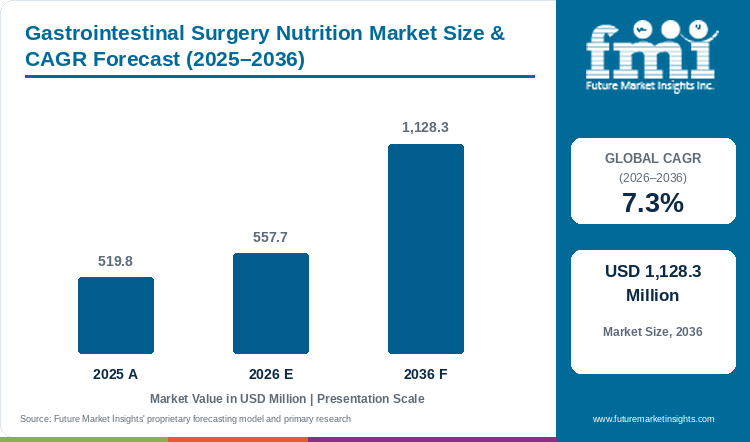
Demand for gastrointestinal surgery nutrition is projected to expand at 7.3% CAGR between 2026 and 2036. Industry value grows from USD 519.8 million in 2025 to USD 557.7 million in 2026 and is projected to reach USD 1,128.3 million by 2036.
Demand for gastrointestinal surgery nutrition is projected to expand at 7.3% CAGR between 2026 and 2036. Industry value grows from USD 519.8 million in 2025 to USD 557.7 million in 2026 and is projected to reach USD 1,128.3 million by 2036. Gastrointestinal surgery nutrition covers products given before surgery, near the first feeding and during the recovery period. The 2025 ESPEN guideline has 44 recommendations and includes early oral feeding and nutrition therapy within surgical care[1]. Due to this, hospitals are using pre-op carbohydrate drinks, oral supplements and enteral formulas at different points of treatment. Apart from that, increasing number of gastrointestinal procedures is creating requirement for measured products having clear dose, timing and tolerance information. Planned use of these products is keeping the demand active in hospital as well as recovery settings.
Regional demand varies as South Korea is projected to grow at 7.8% CAGR, whereas the UK market is forecast at 6.7% CAGR through 2036. South Korea has gained higher adoption of minimally invasive colorectal surgery and maximum procedures are being handled by larger hospitals. The UK, on the other side, has established enhanced-recovery instructions around admission and discharge. In September 2026, Ashford and St. Peter’s Hospitals stated that its colorectal ERAS programme uses high-energy drinks before and soon after surgery, followed by early return to normal diet[13]. Such instructions are creating repeat requirement for prepared drinks. However, medicine use and patient eligibility still decides whether the same product can be used routinely.
Key Takeaways
- Nutrition screening and early oral feeding are increasingly placing nutrition products in scheduled gastrointestinal surgery pathways.
- By product type, pre-op carbohydrate drinks are projected to hold 43.6% share in 2026, owing to scheduled use before selected procedures.
- Colorectal surgery is expected to account for 48.1% in 2026, attributed to wider use of enhanced-recovery pathways.
- Pre-operative use is forecast to hold 50.2% share in 2026 as hospitals assess nutrition risk before surgery.
- South Korea is projected at 7.8% CAGR, whereas the USA is forecast at 7.0% CAGR through 2036.
- Some of the prominent companies are Nestle Health Science, Abbott, Danone Nutricia, Fresenius Kabi, B. Braun, Kate Farms, Medtrition and Enhanced Medical Nutrition.
Analyst Perspective
“Protocol-led nutrition will shift demand toward products with clear timing and tolerance. Suppliers linking hospital use with home recovery will gain stronger repeat demand.”
- Nandini Roy Choudhury, Principal Consultant, Future Market Insights.
How is the gastrointestinal surgery nutrition market segmented?
Gastrointestinal Surgery Nutrition Market is segmented by product type, surgery type, phase, end user, sales channel and region. Pre-op carbohydrate drinks are projected to hold 43.6% by product type, colorectal surgery 48.1% by surgery type and pre-operative use 50.2% by phase in 2026.
By product type: pre-op carbohydrate drinks, immunonutrition formulas, peptide-based post-op feeds, low-residue ONS, and others.
By surgery type: colorectal, bariatric, upper GI, hepatobiliary, and others.
By phase: pre-operative, immediate post-op, and discharge and recovery.
By end user: hospitals, ambulatory surgery centers, homecare, and others.
By sales channel: hospital pharmacy, retail pharmacy, online, institutional tender, and others.
By region: North America, Latin America, Western Europe, Eastern Europe, East Asia, South Asia and Pacific, and Middle East and Africa.
Why do pre-op carbohydrate drinks hold notable product type demand?
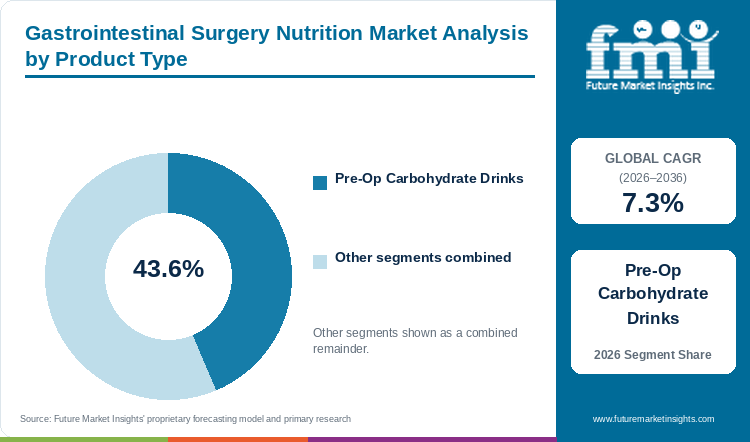
Based on product type, pre-op carbohydrate drinks are projected to account for 43.6% in 2026, owing to scheduled pre-surgery administration.
Pre-op carbohydrate drinks are given before selected elective procedures within the permitted fasting period. These drinks are supplied in measured packs and patients can consume the product without preparation near the procedure. The familiar oral format also makes it easier to include in pre-assessment instructions. Hospitals can fix dose and timing before admission, due to which pre-op carbohydrate drinks are facing higher preference in planned surgery. Wider inclusion in elective pathways will upkeep demand for the product.
- The pre-op carbohydrate drinks segment holds 43.6% share in 2026, as administration timing can be planned before surgery.
- In May 2025, Royal Wolverhampton NHS Trust stated that selected colorectal patients receives two Polycal drinks before surgery and can take the second drink until two hours before admission[11]. Presence of a measured hospital instruction is expected to support controlled use of pre-op carbohydrate drinks.
What supports colorectal surgery within the surgery type category?
By surgery type, colorectal procedures are estimated to hold 48.1% in 2026, supported by established enhanced-recovery pathways.
Colorectal surgery is one of the major application for gastrointestinal surgery nutrition products. The pathway can include nutrition screening, bowel preparation, carbohydrate drinks and early oral feeding. Oral supplements are also used when normal intake remains below patient requirement after the procedure. As one colorectal pathway can use nutrition at more than one stage, suppliers can cater preparation as well as recovery demand. Expansion of enhanced-recovery programmes is creating further growth prospects for this surgery type.
- The colorectal surgery segment holds 48.1% share in 2026, as nutrition products can be used during preparation and recovery.
- The 2025 ERAS colorectal guidance places nutrition screening and early oral intake around elective procedures[2]. Presence of one pathway for preparation and recovery is expected to increase use of oral and enteral nutrition in the colorectal surgery segment.
How does pre-operative use meet changing needs within the phase?
In 2026, pre-operative use is expected to lead phase demand with 50.2% share, enabled by planned risk assessment.
Pre-operative nutrition is selected before surgery when nutrition risk, oral intake and product tolerance can be checked. This stage allows hospitals to use carbohydrate drinks, oral supplements or another suitable product according to the planned procedure. Selected products can also be given before admission, which reduces dependence on ward preparation. Due to controlled timing and early assessment, pre-operative nutrition has become an important phase in gastrointestinal surgery. Growing attention towards nutrition risk will keep this phase ahead over the forecast period.
- The pre-operative segment holds 50.2% share in 2026, because product selection and timing can be completed during pre-assessment.
- Nutricia lists PreOp as a clear carbohydrate drink supplied in a measured format for elective surgical patients[10]. Availability of a procedure-specific product is expected to support the pre-operative nutrition segment.
Why are hospitals selected within the end user category?
By end user, hospitals are forecast to represent 46.6% in 2026, due to clinical selection and formulary control.
Hospitals are the major end users of gastrointestinal surgery nutrition products because screening, product selection and initial administration takes place in the same setting. Dietitians and surgical teams can change products according to intake and tolerance, while pharmacy teams maintains stock for planned admissions. Hospitals also connect initial product use with discharge instructions. Presence of these functions under one setting is driving product adoption among hospitals, especially for scheduled gastrointestinal procedures.
- The hospitals segment holds 46.6% share in 2026, owing to formulary access and clinical review near the procedure.
- In September 2026, Germany recorded 1,807 hospitals, 468,803 beds and 17.7 million inpatient cases[14]. Presence of a large hospital treatment base is expected to support clinical selection and administration of surgery nutrition products.
Which conditions keep hospital pharmacy relevant within sales channel demand?
Hospital pharmacy is likely to capture 46.5% share in 2026, supported by formulary access and scheduled ward supply.
Hospital pharmacies supply gastrointestinal surgery nutrition products against scheduled admissions and ward orders. Batch purchasing provides access to drinks, oral supplements and enteral formulas having different nutrient profiles. The pharmacy can release products near surgery and, depending on local practice, arrange discharge supply as well. Formulary availability therefore keeps hospital pharmacy important for protocol-based nutrition. Growing number of planned orders will increase product movement through the channel.
- The hospital pharmacy segment holds 46.5% share in 2026, due to batch purchasing and controlled inpatient supply.
- In July 2025, Danone completed the majority acquisition of Kate Farms and combined hospital, home, online and retail access for specialized nutrition[5]. Wider channel availability is expected to support hospital pharmacy supply and discharge continuation.
What are the drivers, restraints, and opportunities in the gastrointestinal surgery nutrition market?
In the gastrointestinal surgery nutrition market, the key driver is protocol use, the key restraint is eligibility, and the key opportunity is home continuation.
- Driver: Enhanced-recovery pathways place screening and feeding decisions inside planned surgical workflows.
- Restraint: Delayed gastric emptying and procedure-specific risk can exclude patients from standard intake protocols.
- Opportunity: Connected products and adherence support can extend nutrition from pre-assessment through home recovery.
Protocols Create Defined Use Points
Increasing adoption of enhanced-recovery pathways has brought nutrition decisions closer to the surgical procedure. These programmes places screening, pre-operative intake and early feeding inside one planned workflow. In 2026, the NHS continued to describe enhanced recovery as standard practice for many procedures and linked earlier eating and drinking with shorter recovery time[4]. Hospitals following similar pathways can order nutrition before intake falls instead of adding products after a delay. This movement from delayed feeding towards scheduled use is one of the primary factors driving gastrointestinal surgery nutrition market.
Eligibility Limits Uniform Carbohydrate Loading
Patient eligibility remains a major restraining factor for uniform carbohydrate loading. In January 2025, the UK regulator stated that GLP-1 medicines can delay gastric emptying and requires individual aspiration-risk assessment before anaesthesia[3]. A patient following normal fasting instruction may therefore remain unsuitable for a standard pre-op drink. Diabetes, obstruction and procedure-specific aspiration risk further changes product selection. These conditions restrict one common instruction and may hamper adoption across all gastrointestinal surgery patients.
Connected Recovery Extends Product Use
Home recovery is opening another use point for gastrointestinal surgery nutrition products. Patients having low food intake after discharge may continue oral supplements or recovery formulas outside the hospital. In August 2025, the Canadian Food Innovation Network reported that Enhanced Medical Nutrition combines perioperative products with provider dashboards for adherence and consumption[12]. The programme takes product use from preparation into home follow-up. Suppliers connecting hospital instructions with continued recovery intake are expected to find new growth opportunities.
Which country CAGRs are profiled in the gastrointestinal surgery nutrition market?
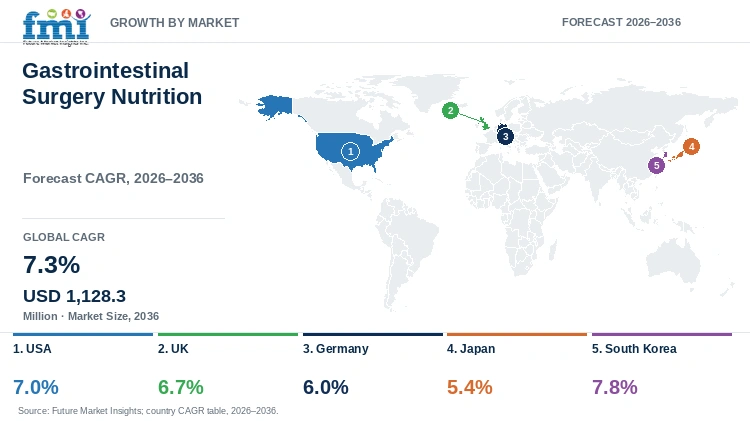
| Country | CAGR |
|---|---|
| USA | 7.0% |
| UK | 6.7% |
| Germany | 6.0% |
| Japan | 5.4% |
| South Korea | 7.8% |
How do country-level CAGRs compare in the gastrointestinal surgery nutrition market?
Country demand for gastrointestinal surgery nutrition changes with procedure volume, recovery practice and availability of products through hospitals.
National guidance supports wider review of nutrition products; however, final dose and timing remains under the control of the treating hospital.
- USA hospital systems use pre-operative preparation and post-operative formulas under hospital order sets.
- UK enhanced-recovery programmes support nutrition before surgery and early eating and drinking after the procedure.
- Germany has uneven nutrition screening between gastrointestinal surgery departments, which creates scope for wider adoption.
- Japan demand is influenced by institution-specific perioperative pathways and local product acceptance.
- South Korea has a national colorectal ERAS guideline covering oral supplements and carbohydrate loading.
Full report country CAGRs cover: North America; Latin America; Western Europe; Eastern Europe; East Asia; South Asia and Pacific; Middle East and Africa.
Country-wise Analysis
- Gastrointestinal surgery nutrition demand in the USA is forecast to rise at 7.0% CAGR through 2036. The country has a large colorectal cancer treatment base, which creates requirement for surgery preparation and nutrition assessment. In June 2026, the CDC reported 155,662 new colorectal cancers in the USA during 2023, while 38.4% were diagnosed at regional stage and 22.5% at distant stage[15]. Hospital order sets can place supplements before surgery and recovery formulas after the procedure. Formulary differences, nevertheless, will keep product use uneven between health systems.
- The UK gastrointestinal surgery nutrition market is anticipated to advance at 6.7% CAGR over the assessment period. Enhanced-recovery programmes in the country uses nourishing drinks before admission and supports early intake after surgery. In June 2025, West Suffolk NHS Foundation Trust issued a colorectal programme that provides four nourishing drinks before admission, a carbohydrate preload on surgery day and four drinks each day after surgery[16]. One defined schedule creates repeated product use around the same procedure. Exclusion criteria and individual instructions may, however, reduce uniform administration.
- The Germany gastrointestinal surgery nutrition market is projected to grow at 6.0% CAGR through 2036. Germany records a large number of intestinal procedures, which gives hospitals frequent points for nutrition screening and feeding. In September 2025, Destatis reported 381,456 other intestinal operations and 213,445 local excision or destruction procedures of the large intestine during 2024[17]. Oral and enteral formulas can be selected according to risk and tolerance around these procedures. Wider screening between surgical departments will create additional scope for nutrition suppliers.
- Japan gastrointestinal surgery nutrition market is estimated to post 5.4% CAGR over the forecast period. Hospitals in Japan uses institution-specific pathways for perioperative preparation and recovery. In August 2026, Japan’s Ministry of Health, Labour and Welfare updated a colorectal robotic-surgery study having a target sample size of 120 patients[18]. Continued evaluation of colorectal procedures keeps feeding and recovery under clinical review. Product acceptance will therefore move through selected hospital pathways instead of one uniform national approach.
- South Korea gastrointestinal surgery nutrition demand is projected to grow at 7.8% CAGR through 2036. The country has gained higher adoption of minimally invasive colorectal surgery and treatment is increasingly concentrated in tertiary hospitals. A nationwide Korean analysis published in March 2025 recorded 109,573 colorectal cancer resections from 2019 to 2023, with minimally invasive surgery reaching 84.7% in 2023 and tertiary general hospitals performing 67.8% of procedures[19]. Concentrated procedure volume makes planned nutrition orders easier to repeat. This gives South Korea a stronger expansion outlook among the profiled countries.
Who are the notable companies in the gastrointestinal surgery nutrition market?
Notable companies include Nestlé Health Science, Abbott, Danone Nutricia, Fresenius Kabi, B. Braun, Kate Farms, Medtrition, and Enhanced Medical Nutrition.
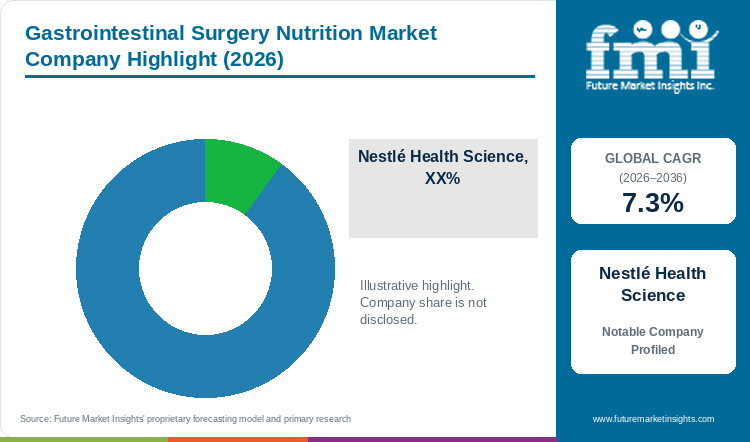
Gastrointestinal surgery nutrition market is moderately fragmented between broad clinical nutrition companies and specialized perioperative programme providers. Nestle Health Science and Abbott offers products used around surgical preparation and recovery. Danone Nutricia, Fresenius Kabi and B. Braun cover wider oral and enteral feeding requirement, whereas Kate Farms and Medtrition focus on peptide and modular formats. Enhanced Medical Nutrition is developing a programme-led route. Companies having hospital supply along with home availability are likely to gain wider customer base.
B. Braun and Kate Farms offer peptide-based formulas for patients requiring tolerance-oriented nutrition, while Medtrition supplies modular protein products. In March 2025, Medtrition launched ProSource Cup and ProSource Cup Plant, with each ready-to-use cup providing 20 grams of protein[7]. Enhanced Medical Nutrition, meanwhile, combines surgical products with adherence support. Product format, tolerance and continuation after discharge are becoming major factors affecting competition.
- Kate Farms provides adult peptide formulas for oral and tube-feeding use[8]. Availability of peptide-based products is expected to support demand from patients requiring tolerance-oriented nutrition.
- B. Braun lists Nutricomp Peptid as a peptide-based enteral formula[9]. The product expands formula selection for clinical feeding.
- Protocol-specific platforms: Nestlé Health Science, Abbott, and Enhanced Medical Nutrition support perioperative products or programmes.
- Institutional nutrition platforms: Danone Nutricia, Fresenius Kabi, and B. Braun supply oral or enteral formulas for clinical settings.
- Specialty formula providers: Kate Farms and Medtrition provide peptide or modular options for selected recovery needs.
Competitive Benchmarking: Gastrointestinal Surgery Nutrition Market
| Company | Protocol Fit | Formula Breadth | Channel Continuity | Geographic Reach |
|---|---|---|---|---|
| Nestlé Health Science | High | Medium | High | High |
| Abbott | High | Medium | High | High |
| Danone Nutricia | Medium | High | High | High |
| Fresenius Kabi | Medium | High | Medium | High |
| B. Braun | Low | High | Medium | High |
| Kate Farms | Low | High | High | Medium |
| Medtrition | Low | Medium | High | Medium |
| Enhanced Medical Nutrition | High | Low | Medium | Medium |
High represents wider documented capability, Medium represents selected evidence and Low represents a limited documented route. The ratings are used for comparison only and does not indicate product quality, revenue or market share.
Key Developments in the Gastrointestinal Surgery Nutrition Market
- In July 2025, Danone completed its majority acquisition of Kate Farms. The combined business links Nutricia and plant-based nutrition through hospital and home channels.
- In March 2025, Ajinomoto invested in Enhanced Medical Nutrition. The investment is expected to support expansion of the ENROUTE surgical nutrition programme in North America.
- In October 2025, Medtrition grouped its modular nutrition products under the NutriConnect portfolio[6]. The development is expected to simplify product selection across recovery nutrition needs.
Key Players in the Gastrointestinal Surgery Nutrition Market
Protocol-Specific Perioperative Nutrition Platforms
- Nestlé Health Science
- Abbott
- Enhanced Medical Nutrition
Hospital Oral and Enteral Nutrition Platforms
- Danone Nutricia
- Fresenius Kabi
- B. Braun
Specialty and Modular Nutrition Providers
- Kate Farms
- Medtrition
Gastrointestinal Surgery Nutrition Market - Report Scope
| Coverage field | Report scope |
|---|---|
| Market breakdown | Product Type; Surgery Type; Phase; End User; Sales Channel; Region |
| Quantitative units | USD million |
| Market definition | Oral and enteral medical nutrition sold for gastrointestinal surgery preparation and recovery; procedure revenue, devices, wellness nutrition, and parenteral nutrition are excluded. |
| Regions covered | North America; Latin America; Western Europe; Eastern Europe; East Asia; South Asia and Pacific; Middle East and Africa |
| Countries covered | USA, UK, Germany, Japan, South Korea, and additional countries in the full report |
| Key companies profiled | Nestlé Health Science, Abbott, Danone Nutricia, Fresenius Kabi, B. Braun, Kate Farms, Medtrition, Enhanced Medical Nutrition |
| Forecast period | 2026 to 2036 |
| Estimate boundary | Segment shares and forecasts are proprietary analytical estimates, not government measurements of global market share. |
Gastrointestinal Surgery Nutrition Market - Research Methodology
| Method | Approach |
|---|---|
| Primary Research | The research study includes primary interviews with manufacturers, distributors, hospital teams, dietitians, end users, procurement teams and industry experts. Interviews covers purchasing decision, product selection, pricing, adoption barriers, patient eligibility and approval requirement. |
| Desk Research | Desk research includes government publications, clinical guidelines, regulatory information, scientific literature, product pages and official company announcements. Sources were checked according to publication date, market relevance and geographic coverage. |
| Market Sizing and Forecasting | Market sizing combines base-year value with historical demand, segment structure, pricing, product adoption, company participation and country conditions. Forecast assumptions considers surgical pathways, nutrition screening, product supply and barriers affecting wider use. |
| Data Validation | Market estimates were checked with public data, company developments, clinical guidance and primary interviews. Products outside the defined market, unsupported claims and overlapping revenue were excluded from the calculation. |
Gastrointestinal Surgery Nutrition Market by Segments
Gastrointestinal Surgery Nutrition Market segmented by Product Type:
- Pre-Op Carbohydrate Drinks
- Immunonutrition Formulas
- Peptide-Based Post-Op Feeds
- Low-Residue ONS
- Others
Gastrointestinal Surgery Nutrition Market segmented by Surgery Type:
- Colorectal
- Bariatric
- Upper GI
- Hepatobiliary
- Others
Gastrointestinal Surgery Nutrition Market segmented by Phase:
- Pre-Operative
- Immediate Post-Op
- Discharge & Recovery
Gastrointestinal Surgery Nutrition Market segmented by End User:
- Hospitals
- Ambulatory Surgery Centers
- Homecare
- Others
Gastrointestinal Surgery Nutrition Market segmented by Sales Channel:
- Hospital Pharmacy
- Retail Pharmacy
- Online
- Institutional Tender
- Others
Gastrointestinal Surgery Nutrition Market by Region
- North America
- United States
- Canada
- Latin America
- Brazil
- Mexico
- Argentina
- Chile
- Western Europe
- Germany
- France
- United Kingdom
- Italy
- Spain
- Benelux
- Nordics
- Eastern Europe
- Poland
- Czech Republic
- Romania
- Hungary
- East Asia
- China
- Japan
- South Korea
- South Asia and Pacific
- India
- ASEAN
- Australia and New Zealand
- Middle East and Africa
- GCC Countries
- South Africa
- Türkiye
- Israel
Research Sources and Bibliography
- [1] Weimann, A., et al. (2025). ESPEN guideline on clinical nutrition in surgery: Update 2025. Clinical Nutrition, 53, 222-261. https://www.espen.org/files/ESPEN-Guidelines/ESPEN-guideline-on-clinical-nutrition-in-surgery-Update-2025.pdf
- [2] Gustafsson, U. O., et al. (2025). Guidelines for perioperative care in elective colorectal surgery: Enhanced Recovery After Surgery Society recommendations 2025. Surgery, 184, Article 109397.
- [3] Medicines and Healthcare products Regulatory Agency. (2025, January 28). GLP-1 and dual GIP/GLP-1 receptor agonists: Potential risk of pulmonary aspiration during general anaesthesia or deep sedation. https://www.gov.uk/drug-safety-update/glp-1-and-dual-gip-slash-glp-1-receptor-agonists-potential-risk-of-pulmonary-aspiration-during-general-anaesthesia-or-deep-sedation
- [4] NHS. (2026). Enhanced recovery.
- [5] Danone. (2025, July 1). Danone completes the acquisition of Kate Farms, enhancing its U.S. specialized nutrition offerings.
- [6] Medtrition. (2025, October). NutriConnect modular nutrition portfolio.
- [7] Medtrition. (2025, March 25). ProSource Cup press release.
- [8] Kate Farms. (2026). Adult peptide nutrition formula.
- [9] B. Braun. (2026). Nutricomp Peptid product information.
- [10] Nutricia. (2026). PreOp product information.
- [11] Royal Wolverhampton NHS Trust. (2025, May). Enhanced Recovery After Surgery programme for colorectal surgery.
- [12] Canadian Food Innovation Network. (2025, August 20). Feeding recovery: How Enhanced Medical Nutrition is redefining patient care.
- [13] Ashford and St. Peter’s Hospitals NHS Foundation Trust. (2026, September 3). Colorectal surgery leaflet: Enhanced recovery after surgery.
- [14] Federal Statistical Office of Germany. (2026, September 10). Hospitals 2025 by ownership and federal states.
- [15] Centers for Disease Control and Prevention. (2026, June 1). U.S. Cancer Statistics colorectal cancer stat bite. https://www.cdc.gov/united-states-cancer-statistics/publications/colorectal-cancer-stat-bite.html
- [16] West Suffolk NHS Foundation Trust. (2025, June). Enhanced recovery programme.
- [17] Federal Statistical Office of Germany. (2025, September 30). The 20 most frequent surgeries of full inpatient hospital patients, 2024. https://www.destatis.de/DE/Themen/Gesellschaft-Umwelt/Gesundheit/Krankenhauser/Tabellen/drg-operationen-insgesamt.html
- [18] Ministry of Health, Labour and Welfare, Japan. (2026, August 12). Randomized controlled trial to evaluate hybrid robot-assisted surgery in colorectal cancer surgery (jRCTs052240215).
- [19] Park, E. J., Lee, H. G., Park, Y. Y., Park, S. J., Lee, K. Y., & Lee, S. H. (2025). Laparoscopic and robotic surgery for colorectal cancer in Korea: A nationwide health insurance database analysis from 2019 to 2023. Journal of Minimally Invasive Surgery, 28(1), 25-35.
This bibliography is provided for reader reference. The full report contains the complete reference list and detailed citations.
This Report Answers
- What is the Gastrointestinal Surgery Nutrition Market size in 2026?
- What value will the market reach by the year 2036?
- Which product type holds notable market share during 2026?
- Which surgery type holds notable market share during 2026?
- Which countries have notable gastrointestinal surgery nutrition growth outlooks?
- Which companies are notable in gastrointestinal surgery nutrition today?
Frequently Asked Questions
How large is the Gastrointestinal Surgery Nutrition Market expected to be in 2026?
Future Market Insights estimates that the gastrointestinal surgery nutrition market will reach USD 557.7 million in 2026. The market is projected to expand further and reach USD 1,128.3 million by 2036.
What CAGR is forecast for the Gastrointestinal Surgery Nutrition Market through 2036?
As per FMI, the gastrointestinal surgery nutrition market is projected to grow at a 7.3% CAGR from 2026 to 2036. Growth is supported by enhanced-recovery pathways placing nutrition inside planned surgical workflows.
Which product type holds a notable gastrointestinal surgery nutrition demand share in 2026?
Future Market Insights projects pre-op carbohydrate drinks to hold 43.6% of product type demand in 2026. The segment benefits from a scheduled administration window before selected elective procedures.
Which surgery type holds a notable gastrointestinal surgery nutrition share in 2026?
FMI finds that colorectal surgery will hold 48.1% of surgery type demand in 2026. Demand is supported by established enhanced-recovery pathways.
Which country has a notable gastrointestinal surgery nutrition expansion outlook during the forecast period?
Future Market Insights predicts South Korea to expand at a 7.8% CAGR during the 2026 to 2036 assessment period. Growth is supported by the country's national colorectal ERAS guideline.
Which companies are active in the Gastrointestinal Surgery Nutrition Market during 2026?
As per FMI analysis, notable companies include Nestlé Health Science, Abbott, Danone Nutricia, Fresenius Kabi, B. Braun, Kate Farms, Medtrition, and Enhanced Medical Nutrition. These companies are active across perioperative programmes, oral and enteral nutrition, peptide formulas, and modular nutrition.
Preview the report firsthand - request a free sample
Get SampleGet the brochure for pricing and purchase details.
Get PDFTable of Content
- Key Takeaways
- Market Size and CAGR
- Top Growth Driver
- Fastest Growing Segment
- Leading Region
- Key Companies
- Emerging Opportunities
- Executive Summary
- Global Market Outlook
- Demand-side Trends
- Supply-side Trends
- Technology Roadmap Analysis
- Analysis and Recommendations
- Analyst Perspective (What is happening? Why now? What should investors know?)
- Key Questions Answered
- How large is the market?
- What is the CAGR?
- What are key trends?
- Which region dominates?
- Who are the leaders?
- Market Overview
- Market Coverage / Taxonomy
- Market Definition / Scope / Limitations
- Research Methodology
- Chapter Orientation
- Analytical Lens and Working Hypotheses
- Market Structure, Signals, and Trend Drivers
- Benchmarking and Cross-market Comparability
- Market Sizing, Forecasting, and Opportunity Mapping
- Research Design and Evidence Framework
- Desk Research Programme (Secondary Evidence)
- Expert Input and Fieldwork (Primary Evidence)
- Tooling, Models, and Reference Databases
- Data Engineering and Model Build
- Quality Assurance and Audit Trail
- Market Background
- Market Dynamics (Drivers, Restraints, Opportunity, Trends)
- Scenario Forecast (Optimistic, Likely, Conservative)
- Impact Analysis
- AI Impact
- Sustainability Impact
- Regulatory Impact
- Technology Impact
- Consumer / Buyer Analysis
- Purchase Drivers
- Adoption Barriers
- Buyer Journey
- Opportunity Map Analysis
- Product Life Cycle Analysis
- Supply Chain Analysis
- Investment Feasibility Matrix
- Value Chain Analysis
- PESTLE and Porter's Analysis
- Regulatory Landscape
- Regional Parent Market Outlook
- Production and Consumption Statistics
- Import and Export Statistics
- Global Market Analysis and Forecast, 2021 to 2036
- Historical Market Size Value (USD Million) Analysis, 2021 to 2025
- Current and Future Market Size Value (USD Million) Projections, 2026 to 2036
- Y-o-Y Growth Trend Analysis
- Absolute $ Opportunity Analysis
- Global Market Pricing Analysis, 2021 to 2036
- Global Market Analysis and Forecast, By Product Type, 2021 to 2036
- Introduction / Key Findings
- Historical Market Size Value (USD Million) Analysis By Product Type, 2021 to 2025
- Current and Future Market Size Value (USD Million) Analysis and Forecast By Product Type, 2026 to 2036
- Pre-Op Carbohydrate Drinks
- Immunonutrition Formulas
- Peptide-Based Post-Op Feeds
- Low-Residue ONS
- Others
- Y-o-Y Growth Trend Analysis By Product Type, 2021 to 2025
- Absolute $ Opportunity Analysis By Product Type, 2026 to 2036
- Global Market Analysis and Forecast, By Surgery Type, 2021 to 2036
- Introduction / Key Findings
- Historical Market Size Value (USD Million) Analysis By Surgery Type, 2021 to 2025
- Current and Future Market Size Value (USD Million) Analysis and Forecast By Surgery Type, 2026 to 2036
- Colorectal
- Bariatric
- Upper GI
- Hepatobiliary
- Others
- Y-o-Y Growth Trend Analysis By Surgery Type, 2021 to 2025
- Absolute $ Opportunity Analysis By Surgery Type, 2026 to 2036
- Global Market Analysis and Forecast, By Phase, 2021 to 2036
- Introduction / Key Findings
- Historical Market Size Value (USD Million) Analysis By Phase, 2021 to 2025
- Current and Future Market Size Value (USD Million) Analysis and Forecast By Phase, 2026 to 2036
- Pre-Operative
- Immediate Post-Op
- Discharge & Recovery
- Y-o-Y Growth Trend Analysis By Phase, 2021 to 2025
- Absolute $ Opportunity Analysis By Phase, 2026 to 2036
- Global Market Analysis and Forecast, By End User, 2021 to 2036
- Introduction / Key Findings
- Historical Market Size Value (USD Million) Analysis By End User, 2021 to 2025
- Current and Future Market Size Value (USD Million) Analysis and Forecast By End User, 2026 to 2036
- Hospitals
- Ambulatory Surgery Centers
- Homecare
- Others
- Y-o-Y Growth Trend Analysis By End User, 2021 to 2025
- Absolute $ Opportunity Analysis By End User, 2026 to 2036
- Global Market Analysis and Forecast, By Sales Channel, 2021 to 2036
- Introduction / Key Findings
- Historical Market Size Value (USD Million) Analysis By Sales Channel, 2021 to 2025
- Current and Future Market Size Value (USD Million) Analysis and Forecast By Sales Channel, 2026 to 2036
- Hospital Pharmacy
- Retail Pharmacy
- Online
- Institutional Tender
- Others
- Y-o-Y Growth Trend Analysis By Sales Channel, 2021 to 2025
- Absolute $ Opportunity Analysis By Sales Channel, 2026 to 2036
- Global Market Analysis and Forecast, By Region, 2021 to 2036
- Introduction
- Historical Market Size Value (USD Million) Analysis By Region, 2021 to 2025
- Current Market Size Value (USD Million) Analysis and Forecast By Region, 2026 to 2036
- North America
- Latin America
- Western Europe
- Eastern Europe
- East Asia
- South Asia and Pacific
- Middle East and Africa
- Market Attractiveness Analysis By Region
- North America Market Analysis and Forecast, By Country, 2021 to 2036
- Historical Market Size Value (USD Million) Trend Analysis By Market Taxonomy, 2021 to 2025
- Market Size Value (USD Million) Forecast By Market Taxonomy, 2026 to 2036
- By Country
- United States
- Canada
- By Product Type
- By Surgery Type
- By Phase
- By End User
- By Sales Channel
- By Country
- Market Attractiveness Analysis
- By Country
- By Product Type
- By Surgery Type
- By Phase
- By End User
- By Sales Channel
- Key Takeaways
- Latin America Market Analysis and Forecast, By Country
- Historical Market Size Value (USD Million) Trend Analysis By Market Taxonomy, 2021 to 2025
- Market Size Value (USD Million) Forecast By Market Taxonomy, 2026 to 2036
- By Country
- Brazil
- Mexico
- Argentina
- Chile
- By Product Type
- By Surgery Type
- By Phase
- By End User
- By Sales Channel
- By Country
- Market Attractiveness Analysis
- By Country
- By Product Type
- By Surgery Type
- By Phase
- By End User
- By Sales Channel
- Key Takeaways
- Western Europe Market Analysis and Forecast, By Country
- Historical Market Size Value (USD Million) Trend Analysis By Market Taxonomy, 2021 to 2025
- Market Size Value (USD Million) Forecast By Market Taxonomy, 2026 to 2036
- By Country
- Germany
- France
- United Kingdom
- Italy
- Spain
- Benelux
- Nordics
- By Product Type
- By Surgery Type
- By Phase
- By End User
- By Sales Channel
- By Country
- Market Attractiveness Analysis
- By Country
- By Product Type
- By Surgery Type
- By Phase
- By End User
- By Sales Channel
- Key Takeaways
- Eastern Europe Market Analysis and Forecast, By Country
- Historical Market Size Value (USD Million) Trend Analysis By Market Taxonomy, 2021 to 2025
- Market Size Value (USD Million) Forecast By Market Taxonomy, 2026 to 2036
- By Country
- Poland
- Czech Republic
- Romania
- Hungary
- By Product Type
- By Surgery Type
- By Phase
- By End User
- By Sales Channel
- By Country
- Market Attractiveness Analysis
- By Country
- By Product Type
- By Surgery Type
- By Phase
- By End User
- By Sales Channel
- Key Takeaways
- East Asia Market Analysis and Forecast, By Country
- Historical Market Size Value (USD Million) Trend Analysis By Market Taxonomy, 2021 to 2025
- Market Size Value (USD Million) Forecast By Market Taxonomy, 2026 to 2036
- By Country
- China
- Japan
- South Korea
- By Product Type
- By Surgery Type
- By Phase
- By End User
- By Sales Channel
- By Country
- Market Attractiveness Analysis
- By Country
- By Product Type
- By Surgery Type
- By Phase
- By End User
- By Sales Channel
- Key Takeaways
- South Asia and Pacific Market Analysis and Forecast, By Country
- Historical Market Size Value (USD Million) Trend Analysis By Market Taxonomy, 2021 to 2025
- Market Size Value (USD Million) Forecast By Market Taxonomy, 2026 to 2036
- By Country
- India
- ASEAN
- Australia and New Zealand
- By Product Type
- By Surgery Type
- By Phase
- By End User
- By Sales Channel
- By Country
- Market Attractiveness Analysis
- By Country
- By Product Type
- By Surgery Type
- By Phase
- By End User
- By Sales Channel
- Key Takeaways
- Middle East and Africa Market Analysis and Forecast, By Country
- Historical Market Size Value (USD Million) Trend Analysis By Market Taxonomy, 2021 to 2025
- Market Size Value (USD Million) Forecast By Market Taxonomy, 2026 to 2036
- By Country
- GCC Countries
- South Africa
- Türkiye
- Israel
- By Product Type
- By Surgery Type
- By Phase
- By End User
- By Sales Channel
- By Country
- Market Attractiveness Analysis
- By Country
- By Product Type
- By Surgery Type
- By Phase
- By End User
- By Sales Channel
- Key Takeaways
- Key Countries Market Analysis
- United States
- Pricing Analysis
- Market Share Analysis, 2025
- By Product Type
- By Surgery Type
- By Phase
- By End User
- By Sales Channel
- Canada
- Pricing Analysis
- Market Share Analysis, 2025
- By Product Type
- By Surgery Type
- By Phase
- By End User
- By Sales Channel
- Mexico
- Pricing Analysis
- Market Share Analysis, 2025
- By Product Type
- By Surgery Type
- By Phase
- By End User
- By Sales Channel
- Brazil
- Pricing Analysis
- Market Share Analysis, 2025
- By Product Type
- By Surgery Type
- By Phase
- By End User
- By Sales Channel
- Chile
- Pricing Analysis
- Market Share Analysis, 2025
- By Product Type
- By Surgery Type
- By Phase
- By End User
- By Sales Channel
- Germany
- Pricing Analysis
- Market Share Analysis, 2025
- By Product Type
- By Surgery Type
- By Phase
- By End User
- By Sales Channel
- United Kingdom
- Pricing Analysis
- Market Share Analysis, 2025
- By Product Type
- By Surgery Type
- By Phase
- By End User
- By Sales Channel
- Italy
- Pricing Analysis
- Market Share Analysis, 2025
- By Product Type
- By Surgery Type
- By Phase
- By End User
- By Sales Channel
- Spain
- Pricing Analysis
- Market Share Analysis, 2025
- By Product Type
- By Surgery Type
- By Phase
- By End User
- By Sales Channel
- France
- Pricing Analysis
- Market Share Analysis, 2025
- By Product Type
- By Surgery Type
- By Phase
- By End User
- By Sales Channel
- India
- Pricing Analysis
- Market Share Analysis, 2025
- By Product Type
- By Surgery Type
- By Phase
- By End User
- By Sales Channel
- ASEAN
- Pricing Analysis
- Market Share Analysis, 2025
- By Product Type
- By Surgery Type
- By Phase
- By End User
- By Sales Channel
- Australia and New Zealand
- Pricing Analysis
- Market Share Analysis, 2025
- By Product Type
- By Surgery Type
- By Phase
- By End User
- By Sales Channel
- China
- Pricing Analysis
- Market Share Analysis, 2025
- By Product Type
- By Surgery Type
- By Phase
- By End User
- By Sales Channel
- Japan
- Pricing Analysis
- Market Share Analysis, 2025
- By Product Type
- By Surgery Type
- By Phase
- By End User
- By Sales Channel
- South Korea
- Pricing Analysis
- Market Share Analysis, 2025
- By Product Type
- By Surgery Type
- By Phase
- By End User
- By Sales Channel
- Poland
- Pricing Analysis
- Market Share Analysis, 2025
- By Product Type
- By Surgery Type
- By Phase
- By End User
- By Sales Channel
- Hungary
- Pricing Analysis
- Market Share Analysis, 2025
- By Product Type
- By Surgery Type
- By Phase
- By End User
- By Sales Channel
- Türkiye
- Pricing Analysis
- Market Share Analysis, 2025
- By Product Type
- By Surgery Type
- By Phase
- By End User
- By Sales Channel
- South Africa
- Pricing Analysis
- Market Share Analysis, 2025
- By Product Type
- By Surgery Type
- By Phase
- By End User
- By Sales Channel
- United States
- Market Structure Analysis
- Competition Dashboard
- Competition Benchmarking
- Market Share Analysis of Top Players
- By Regional
- By Product Type
- By Surgery Type
- By Phase
- By End User
- By Sales Channel
- Emerging Startups
- Innovation Benchmarking
- Competition Analysis
- Competition Deep Dive
- Nestlé Health Science
- Overview
- Product Portfolio
- Profitability by Market Segments
- Sales Footprint
- Strategy Overview
- Marketing Strategy
- Product Strategy
- Channel Strategy
- Abbott
- Danone Nutricia
- Fresenius Kabi
- B. Braun
- Kate Farms
- Medtrition
- Enhanced Medical Nutrition
- Nestlé Health Science
- Case Studies
- Success Stories
- Recent Developments
- Competition Deep Dive
- Assumptions & Acronyms Used


