

- Market Size (2026)
- USD 189.2 Mn
- Forecast (2036)
- USD 542.1 Mn
- CAGR (2026 to 2036)
- 11.1%
How big is Plastic Surgery Recovery Nutrition Market in 2026?
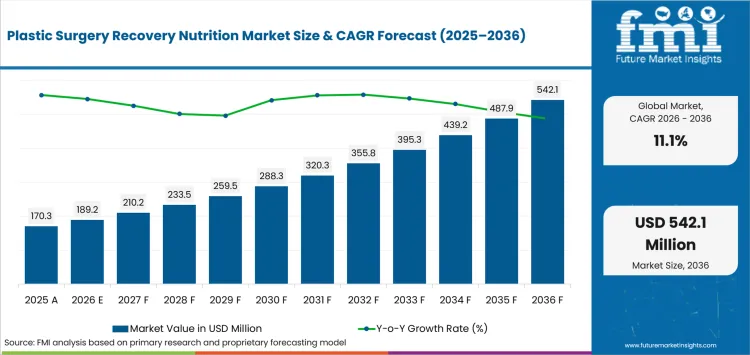
USD 189.2 million in 2026 and USD 542.1 million by 2036 at an 11.1% CAGR.
Demand for plastic surgery recovery nutrition is projected to expand at 11.1% CAGR from 2026 to 2036, lifting value from USD 189.2 million to USD 542.1 million. Scheduled procedures give clinics a fixed date for nutrition screening. A June 2026 plastic-surgery review proposed protein and vitamin support roughly seven to fourteen days before and after surgery. The schedule turns a general supplement purchase into a defined perioperative regimen.
The addressable procedure base is large but only a qualified share converts into recovery nutrition sales. ISAPS reported in June 2025 that plastic surgeons performed more than 17.4 million aesthetic surgical procedures during 2024. Procedure volume gives clinics repeated nutrition-planning opportunities. Conversion still depends on surgeon approval and ingredient timing.
Key Takeaways
- Scheduled procedures give clinics a fixed point to screen nutritional risk and approve recovery nutrition before tissue repair begins.
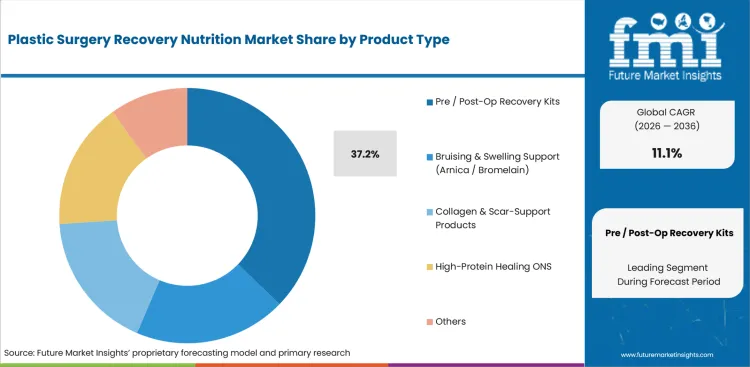
- By product type, the pre - post-op recovery kits segment is estimated to hold 37.2% in 2026 owing to procedure-timed bundle purchasing.
- In 2026, body contouring & liposuction is expected to lead the procedure category with 50.6% share because larger tissue repair raises nutrition-planning needs.
- The pre-operative (1-2 weeks) segment is projected to hold 49.2% share in 2026 owing to scheduled clearance before elective surgery.
- Clinician approval can restrict conversion because supplement interactions or unsupported claims may exclude products from perioperative instructions.
- Some of the key players in this market include VitaMedica, MEND, HealFast, Abbott, Nestle Health Science, Thorne, Danone Nutricia, and Medtrition.
Analyst Perspective
"Plastic surgery recovery nutrition earns value after clinics approve a timed regimen. Strong offers separate pre-op clearance from post-op protein support and simplify home dosing."
- Nandini Roy Choudhury, Principal Consultant, Future Market Insights
How is the plastic surgery recovery nutrition market segmented?
The plastic surgery recovery nutrition market is segmented by product type, procedure, phase, end user, sales channel and region.
Market taxonomy covers product type, procedure, phase, end user, sales channel and region. Product types include pre - post-op recovery kits, bruising & swelling support, collagen & scar-support products, high-protein healing ONS and others. Procedures cover body contouring & liposuction, breast procedures, facial procedures and others. Phase includes pre-operative, 0-4 weeks post-op and scar-maturation use. End users include home - self-care, plastic surgery clinics, med-spas and others. Sales channels include online - DTC, retail pharmacy, supermarkets & hypermarkets, specialty & health stores and other routes.
Why do pre - post-op recovery kits lead the product type category?
Procedure-timed kits draw from broader wound healing nutrition programs but gain value by separating preparation from early recovery. A February 2026 controlled study in abdominoplasty found that early protein supplementation improved wound healing and reduced complications in non-bariatric patients. The finding gives clinics a direct reason to place protein support inside a scheduled recovery plan instead of leaving nutrition as an unrelated purchase.
- By product type, the pre - post-op recovery kits segment is estimated to hold 37.2% in 2026 owing to one schedule covering preparation and early recovery.
- Clinics retain a kit more easily after ingredient review and dosing instructions fit the surgeon's protocol for a scheduled procedure.
Why does body contouring & liposuction lead the procedure category?
Body contouring creates a concentrated nutrition use case because patients may arrive after major weight loss with existing nutrient deficits. ASPS stated in August 2026 that nutrition screening before body contouring can address protein plus vitamin and mineral deficiencies. That requirement raises the value of a pre-surgical assessment before high-protein or micronutrient products enter the recovery plan.
- In 2026, body contouring & liposuction is expected to lead the procedure category with 50.6% share because extensive tissue repair gives clinics a clear nutrition-planning trigger.
- Procedure-specific offers convert more reliably after a clinician documents nutritional risk and matches protein intake to recovery needs.
Why does the pre-operative (1-2 weeks) phase lead the phase category?
The pre-operative window gives clinicians time to identify nutritional risk and stop supplements that conflict with surgery instructions. The September 2025 ESPEN surgical nutrition guideline recommends avoiding long preoperative fasting and starting nutrition therapy once nutritional risk becomes apparent. That timing supports oral clinical nutrition that can be reviewed before the procedure and continued under a defined plan after discharge.
- The pre-operative (1-2 weeks) segment is projected to hold 49.2% share in 2026 owing to a known surgery date that supports planned clearance.
- Clinics standardize the first purchase by pairing a defined start date with ingredient review and explicit stop instructions.
Why does home - self-care lead the end user category?
Home - self-care becomes the operating setting once patients leave the clinic and manage daily clinical nutrition themselves. Nutricia reported in October 2025 that 95% of patients in a four-week study adhered to its high-protein medical nutrition prescription. The result is not plastic-surgery specific but it shows how format and routine fit influence sustained oral nutrition use at home.
- The home - self-care segment is likely to capture 44.2% share in 2026 attributable to repeated dosing outside the procedure setting.
- Clinic instructions need to make dose timing and stop rules clear enough for patients to follow without daily staff supervision.
Why does online - DTC lead the sales channel category?
Online - DTC gives specialist recovery brands room to explain phase timing before a patient reaches checkout. Destatis reported in March 2025 that 21% of Germans aged 16-74 bought medicines or supplements online during 2024. That channel behavior explains why detailed education and home delivery matter for niche collagen supplements and recovery formats. Surgeon clearance still determines whether an online purchase fits the perioperative plan.
- Online - DTC is set to lead the sales channel category with 41.7% share in 2026 due to direct education and home fulfillment.
- Direct sellers need ingredient transparency and timing instructions that let clinics screen a purchase before patients begin the regimen.
What are the drivers, restraints and opportunities in the Plastic Surgery Recovery Nutrition Market?
Scheduled procedures anchor nutrition planning while safety and claim limits constrain unsupervised use. Clinic-linked programs give the clearest route to repeat home consumption.
- Driver: Plastic-surgery pathways increasingly place nutrition screening and protein support inside planned recovery preparation.
- Restraint: Supplement interactions and claim limits can block products from perioperative instructions even after patients show interest.
- Opportunity: Clinic-linked home programs can convert a one-time procedure into a defined period of repeat oral nutrition use.
Scheduled Surgery Brings Nutrition Into Recovery Planning
Elective procedures give clinics a predictable point for nutrition screening and a clear reason to discuss recovery diets before tissue repair begins. ASPS reported in June 2025 that more than 800,000 aesthetic patients used weight-loss medications during 2024. That patient pool matters for liposuction and body-contouring pathways because rapid weight loss can coincide with protein and micronutrient deficits. Recovery nutrition gains relevance after formulations fit the surgeon's screening and timing rules.
Claims and Ingredient Review Can Slow Clinic Approval
Recovery products face a narrow claims boundary because supplement labels cannot imply treatment or guaranteed healing. FDA stated in December 2025 that structure/function claims still require the DSHEA disclaimer and linkage to each applicable claim. That rule keeps vitamin and mineral supplements under close review even after formulation work is complete. Aggressive recovery claims can delay clinic approval or force narrower wording before a product enters written perioperative instructions.
Clinic-Linked Home Programs Extend the Purchase Window
Clinic-linked home programs have a practical distribution advantage because patients already manage daily supplements outside medical facilities. CDC reported in May 2026 that 60.2% of USA adults used at least one dietary supplement during the prior 30 days. Clinics therefore do not need to teach patients how to use an oral medical food format from scratch. The commercial opening lies in making those routines compatible with procedure timing and clinician stop instructions.
Which country CAGRs are profiled in the Plastic Surgery Recovery Nutrition Market?
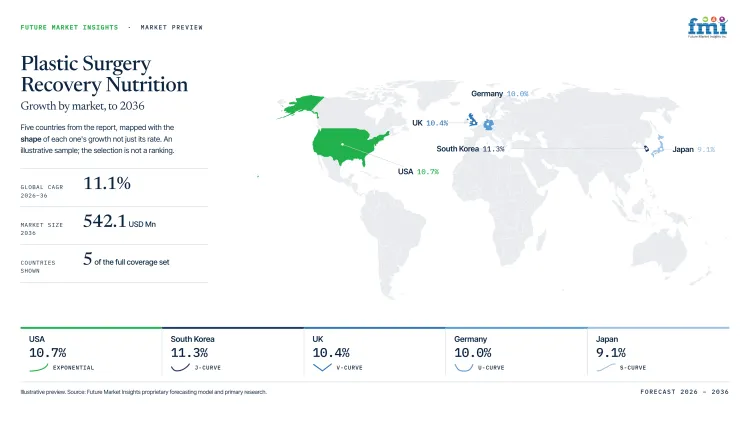
| Country | CAGR |
|---|---|
| South Korea | 11.3% |
| USA | 10.7% |
| UK | 10.4% |
| Germany | 10.0% |
| Japan | 9.1% |
How do country-level CAGRs compare in the Plastic Surgery Recovery Nutrition Market?
The 2.2-point spread separates South Korea from Japan while the USA, UK and Germany form a compact middle group. The ranking reflects different conversion conditions rather than current market size. Medical travel lifts South Korea, USA procedure volume broadens the eligible pool and European claim controls place more work before purchase.
- South Korea concentrates aesthetic medical travel and short outpatient recovery in Seoul.
- USA pairs high procedure activity with nationwide direct-to-home supplement fulfillment.
- UK private clinics operate beside mature pharmacy and online nutrition channels.
- Germany combines supplement access with conservative ingredient-dose expectations during clinical review.
- Japan places more documentation work ahead of functional nutrition claims and launch.
Similar CAGRs therefore produce different launch costs and clinic-conversion routes. The full report provides country-level CAGR analysis across North America, Latin America, Western Europe, Eastern Europe, East Asia, South Asia and Pacific, and the Middle East and Africa.
Country-wise Analysis
- USA plastic-surgery clinics operate through office-based practices and national direct-to-consumer supplement channels. The United States is forecast to grow at 10.7% CAGR over the assessment period, tied to high procedure activity and familiar supplement purchasing. ASPS reported in September 2026 that cosmetic surgical procedures rose 7% during 2025. A broad procedure base gives cosmetic surgery products and recovery nutrition frequent entry points into pre-op instructions. Surgeons still screen ingredients for bleeding and medication risk. National distribution lowers fulfillment friction for home regimens. Clinic acceptance therefore depends on concise ingredient records and phase-specific dosing that staff can review quickly.
- UK recovery nutrition enters through private clinics, pharmacies and online supplement channels under food-law claim controls. Food Standards Agency guidance published in June 2026 tells consumers to use supplements safely and check product information before use. That operating environment raises the value of plain labels and conservative recovery claims. The UK market is anticipated to advance at 10.4% CAGR through 2036, because clinic recommendation can reduce uncertainty around supplement timing. Home delivery remains a practical route for protein supplements after discharge. Unsupported bruising or healing language can narrow how clinics discuss the product with patients during consultations.
- German consumers already buy supplements online but the market places a strong safety filter on micronutrient dose and labeling. BfR proposed in December 2025 a maximum of 100 micrograms of iodine per recommended daily supplement intake for adults and adolescents aged 15 years or older. That ingredient-level guidance makes formulation review important for multi-nutrient recovery kits. Germany is projected to record 10.0% CAGR during the assessment period, reflecting strong supplement access with conservative safety expectations. Pharmacies and digital channels widen reach. Multi-ingredient products still need dose records that let clinics distinguish routine nutrition from ingredients that should be stopped near surgery.
- Japan's functional-food regime places disclosure work upstream of marketing claims and favors products with clear evidence files plus controlled label language. The Consumer Affairs Agency renewed its Foods with Function Claims notification database on April 1, 2025 and issued operator guidance for the revised system. Recovery products using function claims therefore need documentation before commercial messaging can do much work. Plastic surgery recovery nutrition sales in Japan are forecast to expand at 9.1% CAGR by 2036, given the importance of documented function and cautious product selection. The slower rate points to a market where claim preparation and local review can lengthen launch work for imported supplement brands.
- Seoul concentrates plastic-surgery medical travel and gives clinics a dense base of short-stay international patients who often recover outside inpatient settings. Korea's Ministry of Health and Welfare reported in April 2026 that plastic surgery represented 11.2% of treatment visits by international patients during 2025. Home-use nutrition therefore has a clear role after clinic discharge if instructions work for travelers with limited follow-up time. In South Korea, demand is predicted to advance at 11.3% CAGR through 2036, attributable to concentrated aesthetic care and medical travel. The main friction is continuity after departure. Brands with multilingual dosing and straightforward stop rules fit a short outpatient recovery pathway more easily.
Who are the notable companies in the Plastic Surgery Recovery Nutrition Market?
VitaMedica, MEND, HealFast, Abbott, Nestle Health Science, Thorne, Danone Nutricia and Medtrition are the notable companies profiled in this market.
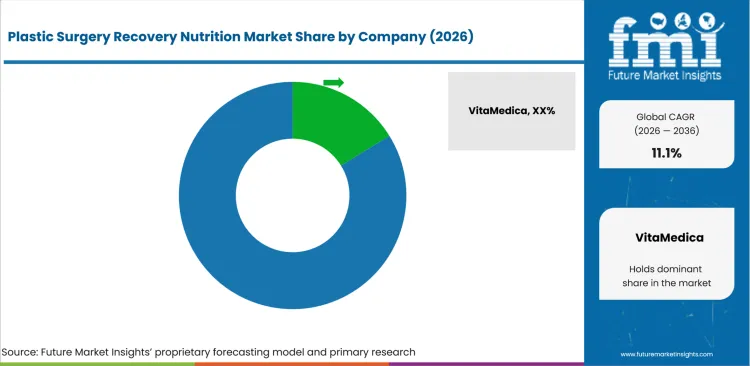
Competition separates into procedure-specific specialists, broad clinical nutrition groups and targeted protein companies. Specialists compete on timing and clinic integration. Larger groups bring research and wider distribution.
- VitaMedica, MEND and HealFast focus most directly on surgery-timed nutrition and patient-facing recovery routines.
- Abbott, Nestle Health Science and Danone Nutricia bring larger clinical nutrition platforms with hospital and home-care reach.
- Thorne and Medtrition compete through targeted nutrient and protein formats that can enter broader recovery regimens.
Competitive Benchmarking: Plastic Surgery Recovery Nutrition Market
| Company | Procedure-Specific Perioperative Protocol | Clinical Nutrition Evidence Depth | Clinic-to-Home Delivery Fit | Geographic Reach |
|---|---|---|---|---|
| VitaMedica | High | Medium | High | United States and direct professional channels |
| MEND | High | High | High | United States clinical and direct channels |
| HealFast | High | Medium | High | United States online and professional channels |
| Abbott | Low | High | Medium | Global |
| Nestle Health Science | Medium | High | High | Global |
| Thorne | Low | Medium | Medium | North America and international channels |
| Danone Nutricia | Low | High | High | Global |
| Medtrition | Medium | High | Medium | North America and international clinical channels |
Scoring basis: High procedure-specific protocol requires pre- and post-operative use or surgical-pathway integration. Medium requires surgical or wound-recovery use and Low identifies broader nutrition activity. High clinical evidence requires regulated medical nutrition. High clinic-to-home fit requires professional access plus home delivery.
Key Developments in the Plastic Surgery Recovery Nutrition Market
- In September 2025, MEND partnered with Jiffy Knee to integrate perioperative nutrition and remote monitoring into a 52-surgeon network. The action places nutrition inside a defined surgical pathway. Plastic-surgery clinics still require ingredient review.
- In July 2025, Danone Nutricia expanded its North American reach after parent company Danone acquired a majority stake in Kate Farms. The combined business widened access through hospitals, homes, online channels and retail. Plastic-surgery use still depends on clinic selection.
- In March 2025, Medtrition launched ProSource Cup and ProSource Cup Plant with 20 grams of protein per cup. The compact formats address limited appetite after surgery. Plastic-surgery placement still requires clinician approval.
Key Players in the Plastic Surgery Recovery Nutrition Market
Procedure-Specific Recovery Protocols
- VitaMedica
- MEND
- HealFast
Clinical Protein and Medical Nutrition Platforms
- Abbott
- Nestle Health Science
- Danone Nutricia
Collagen and Wound-Support Nutrition
- Thorne
- Medtrition
Plastic Surgery Recovery Nutrition Market - Report Scope
| Coverage field | Report scope |
|---|---|
| Market breakdown | By product type, procedure, phase, end user, sales channel and region. |
| Quantitative Units | USD million. |
| Market Definition | Revenue includes nutrition products and packaged perioperative regimens used around plastic surgery. Exclusions include procedure revenue, clinician fees, drugs, compression garments, wound dressings and unrelated general-wellness nutrition. |
| Regions Covered | North America, Latin America, Western Europe, Eastern Europe, East Asia, South Asia and Pacific, and Middle East and Africa. |
| Countries Covered | USA, UK, Germany, Japan, South Korea and 25+ additional countries. |
| Key Companies Profiled | VitaMedica, MEND, HealFast, Abbott, Nestle Health Science, Thorne, Danone Nutricia, Medtrition. |
| Forecast Period | 2026 to 2036. |
| Approach | Primary and secondary research with market triangulation. |
Plastic Surgery Recovery Nutrition Market - Research Methodology
| Method | Approach |
|---|---|
| Primary Research | FMI analysts gathered input from manufacturers, service providers, technology developers, distributors, end users, procurement teams, and subject-matter experts. Interviews examined purchasing decisions, product or service evaluation, adoption barriers, approval requirements, pricing considerations, and expectations for technical or commercial support. Respondents were also asked what evidence is required before a trial, pilot, or initial order develops into regular purchasing. |
| Desk Research | Desk research covered government statistics, regulatory publications, trade data, industry associations, technical literature, standards, company filings, product information, and official corporate announcements. Sources were reviewed for relevance, publication date, geographic coverage, and consistency with the defined market scope. Claims relating to performance, applications, approvals, capacity, investment, and commercial activity were retained only when supported by credible public evidence. |
| Market Sizing and Forecasting | The market model combined the baseline value with historical performance, segment structure, pricing and volume indicators, adoption levels, company participation, and country-level demand conditions. Forecast assumptions considered economic activity, investment trends, regulatory developments, technology adoption, purchasing cycles, supply availability, and barriers to wider market use. Segment and regional estimates were reconciled before the final market total was calculated. |
| Data Validation | Estimates were checked against multiple independent indicators, including public data, company activity, trade patterns, industry developments, and findings from primary interviews. Validation also tested whether products, services, applications, and company revenues fell within the defined market boundaries. Adjacent categories, unsupported claims, overlapping revenues, and activities without direct market relevance were excluded to reduce double counting and maintain consistency across segments and countries. |
Plastic Surgery Recovery Nutrition Market by Segments
Plastic Surgery Recovery Nutrition Market segmented by Product Type:
- Pre - Post-Op Recovery Kits
- Bruising & Swelling Support (Arnica - Bromelain)
- Collagen & Scar-Support Products
- High-Protein Healing ONS
- Others
Plastic Surgery Recovery Nutrition Market segmented by Procedure:
- Body Contouring & Liposuction
- Breast Procedures
- Facial Procedures
- Others
Plastic Surgery Recovery Nutrition Market segmented by Phase:
- Pre-Operative (1-2 Weeks)
- 0-4 Weeks Post-Op
- Scar-Maturation Phase
Plastic Surgery Recovery Nutrition Market segmented by End User:
- Home - Self-Care
- Plastic Surgery Clinics
- Med-Spas
- Others
Plastic Surgery Recovery Nutrition Market segmented by Sales Channel:
- Online - DTC
- Retail Pharmacy
- Supermarkets & Hypermarkets
- Specialty & Health Stores
- Others
Plastic Surgery Recovery Nutrition Market by Region:
- North America
- United States
- Canada
- Latin America
- Brazil
- Mexico
- Argentina
- Chile
- Western Europe
- Germany
- France
- United Kingdom
- Italy
- Spain
- Benelux
- Nordics
- Eastern Europe
- Poland
- Czech Republic
- Romania
- Hungary
- East Asia
- China
- Japan
- South Korea
- South Asia and Pacific
- India
- ASEAN
- Australia and New Zealand
- Middle East and Africa
- GCC Countries
- South Africa
- Türkiye
- Israel
Research Sources and Bibliography
- Sousa Oliveira, L. A., et al. (2026, June 25). Perioperative Protein and Vitamin Supplementation in Plastic Surgery: An Evidence-Based Proposal for an Assessment and Replacement Protocol.
- International Society of Aesthetic Plastic Surgery. (2025, June 19). Global Survey 2024: Full Report and Press Releases.
- Bruno, A., & D'Antimi, A. (2026, February 9). Early Protein Supplementation Enhances Wound Healing and Reduces Complications Following Abdominoplasty: A Controlled Study in Non-bariatric Patients.
- American Society of Plastic Surgeons. (2026, August 26). Nutrition Recommendations Support Healing After Body Contouring Surgery in Patients with Significant Weight Loss.
- Weimann, A., et al. (2025, September 3). ESPEN guideline on clinical nutrition in surgery - Update 2025.
- Nutricia. (2025, October 1). Nutricia’s new savory plant-based medical nutrition proven to improve patient adherence.
- Statistisches Bundesamt. (2025, March 11). 21 % der 16- bis 74-Jährigen kaufen Arzneimittel oder Nahrungsergänzungsmittel online.
- American Society of Plastic Surgeons. (2025, June 25). Interest in Aesthetic Health Remained Consistent Despite Economic Uncertainty in 2024, According to New Report from American Society of Plastic Surgeons.
- USA Food and Drug Administration. (2025, December 11). Letter to the Dietary Supplement Industry on the DSHEA Disclaimer.
- National Center for Health Statistics. (2026, May). Dietary Supplement Use: United States, August 2021-August 2023.
- American Society of Plastic Surgeons. (2026, September 1). Lift Procedures Led Growth as Demand for Restoration Drove Plastic Surgery in 2025, New ASPS Report Reveals.
- Food Standards Agency. (2026, June 25). Food supplements guidance.
- German Federal Institute for Risk Assessment. (2025, December 19). Update (2025): maximum levels proposed for iodine in foods, including food supplements.
- Consumer Affairs Agency, Japan. (2025, April 1).
- Ministry of Health and Welfare, Republic of Korea. (2026, April 24). No. of int’l patients in 2025 sets record for third straight year.
- MEND. (2025, September 11). Mend + Jiffy Knee: A Breakthrough Alliance in Surgical Innovation and Patient Recovery.
- Danone. (2025, July 1). Danone completes the acquisition of Kate Farms, enhancing its USA specialized nutrition offerings.
- Medtrition, Inc. (2025, March 25). Medtrition, Inc. launches the ProSource Cup portfolio.
- MEND. (2025, August 25). Mend and OrthoElite Partner to Redefine Perioperative Care in Arizona.
- Nestlé Health Science. (2025, October 15). Nestlé Health Science and University of California, Davis Innovation Institute for Food & Health Announce Strategic Partnership to Accelerate Innovation in Nutrition and Health Science.
- Abbott. (2026, May 13). Abbott launches Ensure Strength Pro in India to support healthy ageing.
- VitaMedica. (2025, January 7). 7 Post-Surgery Supplements Surgeons Recommend for Faster Recovery.
- HealFast. (2025, April 23). Post-Surgical Healing Tips To Support A Smooth Recovery.
This bibliography is provided for reader reference and is not exhaustive. The full report contains the complete reference list and detailed citations
This Report Answers
- How large is the market through 2036?
- Which conditions support recovery nutrition demand?
- Why do pre - post-op recovery kits lead?
- Why does body contouring & liposuction lead?
- Why does the pre-operative phase lead?
- How do country growth rates differ?
- Which companies serve recovery nutrition needs?
- What limits clinic adoption near surgery?
Frequently Asked Questions
How big is the plastic surgery recovery nutrition market in 2026?
The plastic surgery recovery nutrition market is valued at USD 189.2 million in 2026 and is projected to reach USD 542.1 million by 2036. Scheduled procedures give clinics a defined nutrition-screening point.
What is the CAGR of the plastic surgery recovery nutrition market from 2026 to 2036?
The plastic surgery recovery nutrition market is projected to grow at a CAGR of 11.1% between 2026 and 2036. Growth comes from procedure-linked planning and home use after clinic discharge.
Which product type leads the plastic surgery recovery nutrition market?
The pre - post-op recovery kits segment is expected to hold 37.2% of the plastic surgery recovery nutrition market in 2026, driven by one schedule for preparation and recovery. Clinics can review ingredients before use.
Which procedure leads the plastic surgery recovery nutrition market?
The body contouring & liposuction segment is expected to hold 50.6% of the plastic surgery recovery nutrition market in 2026, attributable to tissue-repair demands after major weight loss. Nutrition screening gives clinics a planning trigger.
Which phase leads the plastic surgery recovery nutrition market?
The pre-operative (1-2 weeks) segment is expected to hold 49.2% of the plastic surgery recovery nutrition market in 2026, supported by a known procedure date. Clinics can screen risk before surgery.
How much value will the plastic surgery recovery nutrition market add between 2026 and 2036?
The plastic surgery recovery nutrition market is expected to add USD 352.9 million between 2026 and 2036. Added value comes from timed perioperative nutrition and repeat home consumption during recovery.
Which countries are projected to record the highest growth in the plastic surgery recovery nutrition market?
South Korea is projected to grow at 11.3% CAGR, followed by USA at 10.7% and UK at 10.4% through 2036. Medical travel, procedure scale and claim controls produce different conversion routes.
Which companies are active in the plastic surgery recovery nutrition market?
Key companies operating in the market include VitaMedica, MEND, HealFast, Abbott, Nestle Health Science, Thorne, Danone Nutricia, and Medtrition. They compete through procedure timing, clinical nutrition depth and clinic-to-home access.
Preview the report firsthand - request a free sample
Get SampleGet the brochure for pricing and purchase details.
Get PDFTable of Content
- Key Takeaways
- Market Size and CAGR
- Top Growth Driver
- Fastest Growing Segment
- Leading Region
- Key Companies
- Emerging Opportunities
- Executive Summary
- Global Market Outlook
- Demand-side Trends
- Supply-side Trends
- Technology Roadmap Analysis
- Analysis and Recommendations
- Analyst Perspective (What is happening? Why now? What should investors know?)
- Key Questions Answered
- How large is the market?
- What is the CAGR?
- What are key trends?
- Which region dominates?
- Who are the leaders?
- Market Overview
- Market Coverage / Taxonomy
- Market Definition / Scope / Limitations
- Research Methodology
- Chapter Orientation
- Analytical Lens and Working Hypotheses
- Market Structure, Signals, and Trend Drivers
- Benchmarking and Cross-market Comparability
- Market Sizing, Forecasting, and Opportunity Mapping
- Research Design and Evidence Framework
- Desk Research Programme (Secondary Evidence)
- Expert Input and Fieldwork (Primary Evidence)
- Tooling, Models, and Reference Databases
- Data Engineering and Model Build
- Quality Assurance and Audit Trail
- Market Background
- Market Dynamics (Drivers, Restraints, Opportunity, Trends)
- Scenario Forecast (Optimistic, Likely, Conservative)
- Impact Analysis
- AI Impact
- Sustainability Impact
- Regulatory Impact
- Technology Impact
- Consumer / Buyer Analysis
- Purchase Drivers
- Adoption Barriers
- Buyer Journey
- Opportunity Map Analysis
- Product Life Cycle Analysis
- Supply Chain Analysis
- Investment Feasibility Matrix
- Value Chain Analysis
- PESTLE and Porter's Analysis
- Regulatory Landscape
- Regional Parent Market Outlook
- Production and Consumption Statistics
- Import and Export Statistics
- Global Market Analysis and Forecast, 2021 to 2036
- Historical Market Size Value (USD Million) Analysis, 2021 to 2025
- Current and Future Market Size Value (USD Million) Projections, 2026 to 2036
- Y-o-Y Growth Trend Analysis
- Absolute $ Opportunity Analysis
- Global Market Pricing Analysis, 2021 to 2036
- Global Market Analysis and Forecast, By Product Type, 2021 to 2036
- Introduction / Key Findings
- Historical Market Size Value (USD Million) Analysis By Product Type, 2021 to 2025
- Current and Future Market Size Value (USD Million) Analysis and Forecast By Product Type, 2026 to 2036
- Pre / Post-Op Recovery Kits
- Bruising & Swelling Support (Arnica / Bromelain)
- Collagen & Scar-Support Products
- High-Protein Healing ONS
- Others
- Pre / Post-Op Recovery Kits
- Y-o-Y Growth Trend Analysis By Product Type, 2021 to 2025
- Absolute $ Opportunity Analysis By Product Type, 2026 to 2036
- Global Market Analysis and Forecast, By Procedure, 2021 to 2036
- Introduction / Key Findings
- Historical Market Size Value (USD Million) Analysis By Procedure, 2021 to 2025
- Current and Future Market Size Value (USD Million) Analysis and Forecast By Procedure, 2026 to 2036
- Body Contouring & Liposuction
- Breast Procedures
- Facial Procedures
- Others
- Body Contouring & Liposuction
- Y-o-Y Growth Trend Analysis By Procedure, 2021 to 2025
- Absolute $ Opportunity Analysis By Procedure, 2026 to 2036
- Global Market Analysis and Forecast, By Phase, 2021 to 2036
- Introduction / Key Findings
- Historical Market Size Value (USD Million) Analysis By Phase, 2021 to 2025
- Current and Future Market Size Value (USD Million) Analysis and Forecast By Phase, 2026 to 2036
- Pre-Operative (1-2 Weeks)
- 0-4 Weeks Post-Op
- Scar-Maturation Phase
- Pre-Operative (1-2 Weeks)
- Y-o-Y Growth Trend Analysis By Phase, 2021 to 2025
- Absolute $ Opportunity Analysis By Phase, 2026 to 2036
- Global Market Analysis and Forecast, By End User, 2021 to 2036
- Introduction / Key Findings
- Historical Market Size Value (USD Million) Analysis By End User, 2021 to 2025
- Current and Future Market Size Value (USD Million) Analysis and Forecast By End User, 2026 to 2036
- Home / Self-Care
- Plastic Surgery Clinics
- Med-Spas
- Others
- Home / Self-Care
- Y-o-Y Growth Trend Analysis By End User, 2021 to 2025
- Absolute $ Opportunity Analysis By End User, 2026 to 2036
- Global Market Analysis and Forecast, By Sales Channel, 2021 to 2036
- Introduction / Key Findings
- Historical Market Size Value (USD Million) Analysis By Sales Channel, 2021 to 2025
- Current and Future Market Size Value (USD Million) Analysis and Forecast By Sales Channel, 2026 to 2036
- Online / DTC
- Retail Pharmacy
- Supermarkets & Hypermarkets
- Specialty & Health Stores
- Others
- Online / DTC
- Y-o-Y Growth Trend Analysis By Sales Channel, 2021 to 2025
- Absolute $ Opportunity Analysis By Sales Channel, 2026 to 2036
- Global Market Analysis and Forecast, By Region, 2021 to 2036
- Introduction
- Historical Market Size Value (USD Million) Analysis By Region, 2021 to 2025
- Current Market Size Value (USD Million) Analysis and Forecast By Region, 2026 to 2036
- North America
- Latin America
- Western Europe
- Eastern Europe
- East Asia
- South Asia and Pacific
- Middle East & Africa
- Market Attractiveness Analysis By Region
- North America Market Analysis and Forecast, By Country, 2021 to 2036
- Historical Market Size Value (USD Million) Trend Analysis By Market Taxonomy, 2021 to 2025
- Market Size Value (USD Million) Forecast By Market Taxonomy, 2026 to 2036
- By Country
- USA
- Canada
- By Product Type
- By Procedure
- By Phase
- By End User
- By Sales Channel
- By Country
- Market Attractiveness Analysis
- By Country
- By Product Type
- By Procedure
- By Phase
- By End User
- By Sales Channel
- Key Takeaways
- Latin America Market Analysis and Forecast, By Country
- Historical Market Size Value (USD Million) Trend Analysis By Market Taxonomy, 2021 to 2025
- Market Size Value (USD Million) Forecast By Market Taxonomy, 2026 to 2036
- By Country
- Brazil
- Mexico
- Chile
- Rest of Latin America
- By Product Type
- By Procedure
- By Phase
- By End User
- By Sales Channel
- By Country
- Market Attractiveness Analysis
- By Country
- By Product Type
- By Procedure
- By Phase
- By End User
- By Sales Channel
- Key Takeaways
- Western Europe Market Analysis and Forecast, By Country
- Historical Market Size Value (USD Million) Trend Analysis By Market Taxonomy, 2021 to 2025
- Market Size Value (USD Million) Forecast By Market Taxonomy, 2026 to 2036
- By Country
- Germany
- UK
- Italy
- Spain
- France
- Nordic
- BENELUX
- Rest of Western Europe
- By Product Type
- By Procedure
- By Phase
- By End User
- By Sales Channel
- By Country
- Market Attractiveness Analysis
- By Country
- By Product Type
- By Procedure
- By Phase
- By End User
- By Sales Channel
- Key Takeaways
- Eastern Europe Market Analysis and Forecast, By Country
- Historical Market Size Value (USD Million) Trend Analysis By Market Taxonomy, 2021 to 2025
- Market Size Value (USD Million) Forecast By Market Taxonomy, 2026 to 2036
- By Country
- Russia
- Poland
- Hungary
- Balkan & Baltic
- Rest of Eastern Europe
- By Product Type
- By Procedure
- By Phase
- By End User
- By Sales Channel
- By Country
- Market Attractiveness Analysis
- By Country
- By Product Type
- By Procedure
- By Phase
- By End User
- By Sales Channel
- Key Takeaways
- East Asia Market Analysis and Forecast, By Country
- Historical Market Size Value (USD Million) Trend Analysis By Market Taxonomy, 2021 to 2025
- Market Size Value (USD Million) Forecast By Market Taxonomy, 2026 to 2036
- By Country
- China
- Japan
- South Korea
- By Product Type
- By Procedure
- By Phase
- By End User
- By Sales Channel
- By Country
- Market Attractiveness Analysis
- By Country
- By Product Type
- By Procedure
- By Phase
- By End User
- By Sales Channel
- Key Takeaways
- South Asia and Pacific Market Analysis and Forecast, By Country
- Historical Market Size Value (USD Million) Trend Analysis By Market Taxonomy, 2021 to 2025
- Market Size Value (USD Million) Forecast By Market Taxonomy, 2026 to 2036
- By Country
- India
- ASEAN
- Australia & New Zealand
- Rest of South Asia and Pacific
- By Product Type
- By Procedure
- By Phase
- By End User
- By Sales Channel
- By Country
- Market Attractiveness Analysis
- By Country
- By Product Type
- By Procedure
- By Phase
- By End User
- By Sales Channel
- Key Takeaways
- Middle East & Africa Market Analysis and Forecast, By Country
- Historical Market Size Value (USD Million) Trend Analysis By Market Taxonomy, 2021 to 2025
- Market Size Value (USD Million) Forecast By Market Taxonomy, 2026 to 2036
- By Country
- Kingdom of Saudi Arabia
- Other GCC Countries
- Türkiye
- South Africa
- Other African Union
- Rest of Middle East & Africa
- By Product Type
- By Procedure
- By Phase
- By End User
- By Sales Channel
- By Country
- Market Attractiveness Analysis
- By Country
- By Product Type
- By Procedure
- By Phase
- By End User
- By Sales Channel
- Key Takeaways
- Key Countries Market Analysis
- USA
- Pricing Analysis
- Market Share Analysis, 2025
- By Product Type
- By Procedure
- By Phase
- By End User
- By Sales Channel
- Canada
- Pricing Analysis
- Market Share Analysis, 2025
- By Product Type
- By Procedure
- By Phase
- By End User
- By Sales Channel
- Mexico
- Pricing Analysis
- Market Share Analysis, 2025
- By Product Type
- By Procedure
- By Phase
- By End User
- By Sales Channel
- Brazil
- Pricing Analysis
- Market Share Analysis, 2025
- By Product Type
- By Procedure
- By Phase
- By End User
- By Sales Channel
- Chile
- Pricing Analysis
- Market Share Analysis, 2025
- By Product Type
- By Procedure
- By Phase
- By End User
- By Sales Channel
- Germany
- Pricing Analysis
- Market Share Analysis, 2025
- By Product Type
- By Procedure
- By Phase
- By End User
- By Sales Channel
- UK
- Pricing Analysis
- Market Share Analysis, 2025
- By Product Type
- By Procedure
- By Phase
- By End User
- By Sales Channel
- Italy
- Pricing Analysis
- Market Share Analysis, 2025
- By Product Type
- By Procedure
- By Phase
- By End User
- By Sales Channel
- Spain
- Pricing Analysis
- Market Share Analysis, 2025
- By Product Type
- By Procedure
- By Phase
- By End User
- By Sales Channel
- France
- Pricing Analysis
- Market Share Analysis, 2025
- By Product Type
- By Procedure
- By Phase
- By End User
- By Sales Channel
- India
- Pricing Analysis
- Market Share Analysis, 2025
- By Product Type
- By Procedure
- By Phase
- By End User
- By Sales Channel
- ASEAN
- Pricing Analysis
- Market Share Analysis, 2025
- By Product Type
- By Procedure
- By Phase
- By End User
- By Sales Channel
- Australia & New Zealand
- Pricing Analysis
- Market Share Analysis, 2025
- By Product Type
- By Procedure
- By Phase
- By End User
- By Sales Channel
- China
- Pricing Analysis
- Market Share Analysis, 2025
- By Product Type
- By Procedure
- By Phase
- By End User
- By Sales Channel
- Japan
- Pricing Analysis
- Market Share Analysis, 2025
- By Product Type
- By Procedure
- By Phase
- By End User
- By Sales Channel
- South Korea
- Pricing Analysis
- Market Share Analysis, 2025
- By Product Type
- By Procedure
- By Phase
- By End User
- By Sales Channel
- Russia
- Pricing Analysis
- Market Share Analysis, 2025
- By Product Type
- By Procedure
- By Phase
- By End User
- By Sales Channel
- Poland
- Pricing Analysis
- Market Share Analysis, 2025
- By Product Type
- By Procedure
- By Phase
- By End User
- By Sales Channel
- Hungary
- Pricing Analysis
- Market Share Analysis, 2025
- By Product Type
- By Procedure
- By Phase
- By End User
- By Sales Channel
- Kingdom of Saudi Arabia
- Pricing Analysis
- Market Share Analysis, 2025
- By Product Type
- By Procedure
- By Phase
- By End User
- By Sales Channel
- Türkiye
- Pricing Analysis
- Market Share Analysis, 2025
- By Product Type
- By Procedure
- By Phase
- By End User
- By Sales Channel
- South Africa
- Pricing Analysis
- Market Share Analysis, 2025
- By Product Type
- By Procedure
- By Phase
- By End User
- By Sales Channel
- USA
- Market Structure Analysis
- Competition Dashboard
- Competition Benchmarking
- Market Share Analysis of Top Players
- By Regional
- By Product Type
- By Procedure
- By Phase
- By End User
- By Sales Channel
- Emerging Startups
- Innovation Benchmarking
- Competition Analysis
- Competition Deep Dive
- VitaMedica
- Overview
- Product Portfolio
- Profitability by Market Segments
- Sales Footprint
- Strategy Overview
- Marketing Strategy
- Product Strategy
- Channel Strategy
- MEND
- HealFast
- Abbott
- Nestle Health Science
- Thorne
- Danone Nutricia
- Medtrition
- VitaMedica
- Case Studies
- Success Stories
- Recent Developments
- Competition Deep Dive
- Assumptions & Acronyms Used


