

- Industry Size (2025)
- USD 3560.7 Mn
- Forecast (2035)
- USD 5015.3 Mn
- CAGR (2025 to 2035)
- 3.5%
Hypo Anti-Allergic Baby Food Market Outlook 2025 to 2035
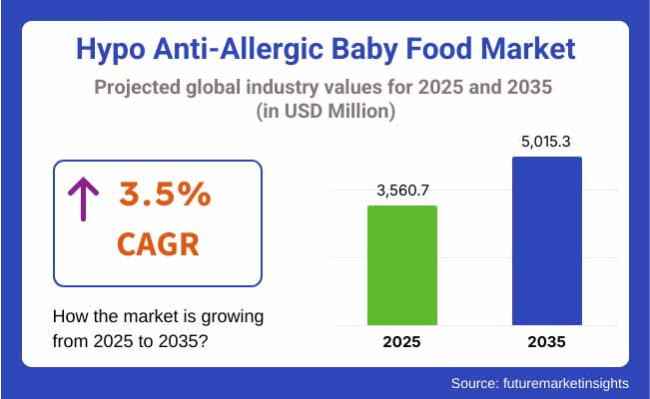
The size of the hypo anti-allergic baby food market was USD 3,244.9 million globally in 2022. Demand value for baby food that is hypoallergenic in 2025 will be USD 3,560.7 million. For the period (2025 to 2035) under forecast, the global sales will rise with a CAGR of 3.5% and thus by 2035 reach a market value of USD 5,015.3 million.
One of the most powerful demand drivers for hypo anti-allergic infant foods is the increasing incidence of food allergy and intolerance among children. Parents are more concerned about allergens in their child's diet, and hence the rate of consumption of foods that avoid common allergens like dairy, soy, nuts, or gluten is on the rise. Specialty infant foods not only are nutritionally adequate, but also assist in better digestion and absorption of nutrients.
Aside from this, increased health-sensitive parenting and greater consciousness towards the contribution made by baby food towards overall wellness for life are propelling innovation in the category. Category commanders such as Nestlé (its Gerber business) and Danone are formulating hypoallergenic mixes and convenient ready-toinput toddler food for allergic infants. Clean label and organic trends are also starting to surface here as parents look for foods which contain no artificial ingredients, preservatives, or GMOs.
Internet stores and novel retail stores are offering hypoallergenic merchandise of a specific kind at modest prices, even to the third world countries. Expert children care and sophisticated health centers in terms of allergy detection in childhood have also been the key source of trust for buyers and drivers for business expansion.
In total, an intersection of expanding allergy sensitivity, food science advances, convenience, and clean-labeling is to keep driving the hypo anti-allergic baby food market forward.
Growing demand for infant gut health and immune system building has encouraged companies to develop new product formulations that contain probiotics, prebiotics, and essential vitamins. In addition, regulatory bodies of various markets are imposing stricter norms for infant food product safety, building consumer confidence and enhancing legitimacy of the market. Brands are responding by labelling allergy-safe certification prominently and citing clinical trials that confirm the safety and efficacy of the products.
Semi-Annual Market Update
Following table is six months base year 2024 variation in CAGR with comparative analysis for current year 2025 international hypo anti-allergic baby food market. It shows variation both in trends as well as in the sense of performance in revenues to enable stakeholders to better visualize year-by-year growth trend.
| Particular | Value CAGR |
|---|---|
| H1 (2024 to 2034) | 3.0% |
| H2 (2024 to 2034) | 3.2% |
| H1 (2025 to 2035) | 3.4% |
| H2 (2025 to 2035) | 3.5% |
During H1 of the decade of 2025 to 2035, the company expands at a CAGR of 3.4%, while during the second half of the decade of 2025 to 2035, the same goes up marginally by 3.5%. During H1 2025 and H2 2035, the CAGR is 40 basis points (BPS) higher, while during the second half, the industry rises by another 10 BPS. This consistent growth trend reflects good consumer demand, favorable regulation, and good product innovation among firms in the market for infant food hypoallergenic.
Market Concentration
Tier 1 has a high-margin competitive segment with leadership in the market and wide global reach. Tier 1 companies have strong brand equity backed by large advertisement, clinical study, and steady new product R&D expenditures unique to allergy-prone infants. Danone (Nutricia) and Nestlé (Gerber) are some of the companies under Tier 1. Nestlé, trading as Gerber, offers an extensive range of hypoallergenic infant foods and allergy-free baby foods retailed globally across channels and online.
Danone, with Aptamil and Nutricia, has strong healthcare alliances and R&D in early-life nutrition to establish a leadership position in the emerging and developed markets. They typically collaborate with pediatric experts and regulatory bodies to make assurances of the safety of their product, thereby increasing consumer trust and brand loyalty.
Tier 2 players are firms with relatively lower revenues compared to Tier 1 giants but high visibility in the market, especially on a regional basis. Tier 2 players cater to specialized segments and fulfill special dietary needs. For instance, HiPP Organic has gained momentum in Europe due to organic as well as allergy-free baby food offered by it, which is renowned for clean labels and green initiatives.
Similarly, Mead Johnson Nutrition with Reckitt distributes hypoallergenic infant formula through Enfamil brand having a strong distribution channel in Asia and North America. Tier 2 players favor product differentiation through organic certification, specialist nutrition, and local branding due to being in close touch with health-conscious parents seeking alternative means of feeding.
Tier 3 includes insurgent players and emerging players expanding in the hypo anti-allergic baby food market. They have restricted distribution but expanding at a fast pace through having innovative business models, online platforms, and social media-based promotion.
Examples include Little Spoon and Yumi in the USA concentrating on fresh allergen-free baby food distributed directly to consumers under subscription models. They appeal to millennial parents seeking convenience, customization, and ingredient knowledge. Tier 3 players have no size but possess urban consumption popularity and are certain to shatter conventions in retailing with innovative and internet-based relationships.
Understanding Shift in Hypo Anti Allergic Baby Food Demand Trends and How Key Brands Are Addressing To This
Clean-Label and Organic Baby Food Demand Hypoallergens
Shift: Parents are more and more concerned about clean-label ingredients in their baby infants, especially food allergy or sensitive babies. This is because there is greater awareness of the potential health effect by ingestion of artificial ingredients, preservatives, and allergenic foods such as dairy, soy, gluten, and nuts.
Clean-label, hypoallergenic infant food with openness, minimized processing, and certified organic supply have been popular in North America and Europe. Ingredient openness that is trustworthy to consumers is what they are asking for increasingly and are choosing products that contain natural preservatives, added sugars, and status of allergens.
Strategic Response: HiPP Organic and Little Spoon have been two market leaders that have reacted by repositioning their portfolios towards allergen-free, organic brands. HiPP introduced an organic infant food line with no cow's milk protein and gluten and open sourced labels.
Gerber (Nestlé) introduced its "Organic for Baby" series of clean-label, hypoallergenic pureed cereals and gained a 5% market share in the USA market. Also, direct-to-consumer brand Yumi is fighting for transparency, with web-based nutrition profiles and sourcing information, and converting millennial parents.
Transmission in Ready-to-Eat Convenient Forms
Shift: Active modern living has brought in demand for effortless, convenient (RTE) hypoallergenic baby food that takes less effort to make. Parents, especially city dwellers, want pre-prepared, simple, go-anywhere feeding that also suits their baby's individual nutritional needs. That is especially needed for coping with food allergies on the go, i.e., on travel or daycare. Shelf-stable hypoallergenic pouches, jars, and snacks are the norm across America in the USA, the UK, and Asia.
Strategic Response: Danone (Nutricia) then expanded its Ready To Eat baby food pouches hypoallergenic portfolio of Aptamil Pepti brand into hypoallergenic foods being made available for cow's milk protein allergy (CMPA). Ready-to-shelf new entry contributed its quota by grabbing 4% European market expansion for the firm.
In the United States, Once Upon a Farm launched new allergen-free RTE baby food combinations in easy-to-use pouches driving 10% subscription sales increase. Plum Organics launched dairy-free and nut-free toddler snack bars to meet growing demand for allergen-free snacks to fuel active lifestyles.
Personalization and Targeted Nutrition Solutions
Shift: One baby food has reached the tipping point for hypoallergenics with parents more and more clamoring for individualized feeding regimens based on the unique allergy, intolerance, and developmental requirements of their infant. With more than ever being reached by advances in the science of the microbiome and food intolerance testing, perfectly balanced diet components are within view, and specialized hypoallergenic infant food formulated to each unique sensitivity is gaining zealous traction.
Strategic Response: Other companies like Tiny Organics and Yumi also jumped on the bandwagon with the launch of personalized meal plans as a strategic response to parent feedback on food intolerance and allergy. Yumi, for instance, is a subscription business founded with parents selecting hypoallergenic food specially prepared with the infant's requirements in mind, which resulted in a 12% increase in customer loyalty in 2024.
Althéra® and Alfamino®, expert infant nutrition formulas designed carefully with the aim of curing individual food allergies and metabolic diseases, launched by Nestlé Health Science supported by pediatric prescription and clinical science, increased medical nutrition sales worldwide by 8%.
Rising Demand for Hypoallergenic Plant Foods
Shift: With the world now opening up to plant-based food, parents are seeking plant-based, hypoallergenic baby foods free from animal allergens like dairy and egg. Plant-based baby food is in greatest demand in countries like North America, Germany, and Australia with vegan and flexitarian diets. Plant-based formula is even becoming the first choice among lactose-intolerant or milk protein allergic babies' parents increasingly.
Strategic Response: Mead Johnson Nutrition (Reckitt) increased its PurAmino soy-free, dairy-free, gluten-free plant-based hypoallergenic formula in the North American and Asian markets, which drove a 7% year-over-year increase in sales. Else Nutrition, plant-based infant nutrition market leader, launched almond, buckwheat, and tapioca hypoallergenic formula with no dairy, soy, country clearance under respective regulations, and registered 15% online sales growth in 2024. Gerber countered with launching new line of plant-based puree food packed with allergen-free superfood such as quinoa, kale, and chia for health-oriented parents.
Greater Focus on Pediatrics-Recommended Formulas and Clinical Experience
Shift: With food allergy, and soy and CMPA allergy in particular, increasing, parents today are turning to pediatrician-recommended clinically tested hypoallergenic baby foods and formulas. Credibility and trust are the buzzwords, and therefore money is being spent on medical research, clinical testing, and joint ventures with doctors to build credibility and trust nervous parents.
Strategic Response: Danone Nutricia deepened its partnership with pediatric societies, particularly in Europe, to launch its amino acid-based and high hydrolysis severe allergy infant formulas. Its clinical trial investment to establish the effectiveness of Neocate's® in alleviating allergies resulted in a 6% increase in prescriptions and hospital partnerships. Nestlé Health Science launched an online professional advisory program, allergy consultation, and product recommendation for food-allergic infants that increased value of interactions and conversions by 9%. UK brand Kendamil also launched pediatrician-approved tips and hypoallergenic infant formula for offering further confidence to first-time mothers.
E-commerce and Direct-to-Consumer (DTC) Channels Size
Shift: Parents' consumption of hypoallergenic infant food has been impacted by online shopping and they have made their selection in the direction of convenience, product options, and availability of specialty offerings from internet-based firms. This was supplemented by the pandemic-induced purchasing behavior of consumers along with the urge for on-the-go subscription towards allergy diets.
Strategic Response: Yumi and Little Spoon adopted the DTC model by offering customized subscription boxes of baby food hypoallergenicity with convenience delivery and allergen online monitoring software. Yumi’s e-commerce strategy, which includes social media engagement and influencer partnerships, drove a 20% increase in annual subscription growth. Gerber expanded its web presence by debuting special hypoallergenic product sets and web subscription offers through its web site, resulting in 15% increased web traffic. HiPP Organic strengthened its web presence on retail giants like Amazon by adding allergen-based product filters, leading to a 10% increase in global online revenues.
Country-wise Insights
The following table shows the estimated growth rates of the top five territories. These are set to exhibit high consumption through 2035.
| Countries | CAGR, 2025 to 2035 |
|---|---|
| USA | 9.3% |
| Germany | 10.4% |
| China | 7.5% |
| Australia | 11.3% |
| India | 8.2% |
Clean Labels, Sustainability, and Innovation Leading USA Market Growth
Increasingly health-conscious parents today opt for low-processed, artificially additive-free hypoallergenic baby food. Clean label dynamics are prompting brands to emphasize open ingredient sourcing and uncomplicated formulations, speaking to parents willing to offer safety and nutrition to fussy babies.
Product innovation through personalized products, i.e., nutrition for development stages, is also fueling demand. Sustainability is also a priority, with green packaging and responsible sourcing becoming increasingly popular with consumers. Compliance with FDA regulations ensures confidence in hypoallergenic products, and online expansion is making them easily available to busy, urban families.
Organic Demand and Technological Advances Drive Expansion in Germany
Organic and allergen-free baby foods in Germany's market are prompted by high demand for organic and allergen-free products. With strict certification, hypoallergenic products with parents' longing for them like Demeter or EU Organic. Cold-pressing and freeze-drying of nutrients are modern technologies that prevent nutrient loss and keep allergy-susceptible babies safe.
Online shops, as well as traditional brick-and-mortar retailers, are expanding the organic baby foods in their offerings. Consumer interest in sustainability has also prompted brands to adopt biodegradable packaging and sustainable sourcing. Germany's severe sensitivity awareness and regulation intensity strengthen trust and consumption of hypoallergenic baby food nationwide.
Food Safety and Urbanization Drive Demand in China
Chinese consumers, with an increasing number of urban residents, look for convenient, safe, and high-quality baby food products. Hypoallergenic infant food satisfies growing concerns regarding food safety, especially among city-dwelling parents who are adamant about demanding strict adherence to health regulations.
Growing disposable income supports more purchases of premium, allergen-free baby food, and greater convenience comes from e-tailers such as JD.com and Tmall. Interventions on the part of government on the areas of food safety and nutrition augment market development. Moreover, heightened infant food allergy awareness has resulted in increased demand for specialty infant foods, with a preference for authentic domestic and foreign brands.
Regulation and Health Consciousness Propel Demand in Australia
Australian parents are increasingly selecting hypoallergenic baby foods that are additive-free, allergen-free, and preservative-free. Manufacturers of certified organic and allergen-free products have high customer confidence. Product quality and safety are regulated by government agencies tightly.
Focus on sustainability is a strong market driver, with biodegradable packaging and clean-label appeals enhancing brand image. Direct-to-consumer sales and e-commerce enable brands to engage with time-strapped urban parents. Social media and influencer marketing are also key channels for educating consumers and selling hypoallergenic baby food well-tuned to local health fashions.
Urbanization and Increasing Incomes Drive India's Ascent
Urbanization and expansion of India's middle-class population, stimulated by income development, are triggering demand for clean, safe, and hypoallergenic forms of baby food. Parents now increasingly look to products that contain no allergens from foods such as gluten, dairy, and soy, particularly in metro areas where food allergy is being increasingly debated.
Demand for ready-to-eat and allergen-free baby food is also triggered due to the rise in working women. Online sites like Amazon India and BigBasket are the impetus behind broadening access. Localized advertising and new product introductions, like using conventional ingredients on hypoallergenic products, are the benefits accruing to brands in this fast-moving and expanding market.
Category-Wise Insights
Liquid Milk Segment Gains Momentum Due to Ease of Digestion and Quick Preparation
| Segment | Value Share (2025) |
|---|---|
| Liquid Milk (By Product Form) | 54.6% |
In the hypo anti-allergic baby food market, liquid milk products are experiencing significant demand growth due to their convenience, digestibility, and ease of preparation. Parents, especially new or working ones, prefer ready-to-feed liquid milk that eliminates the need for complex preparation steps. This is particularly beneficial for babies with allergic sensitivities, where precise measurements and contamination-free preparation are essential.
Liquid hypoallergenic milk often features extensively hydrolyzed proteins or amino acid-based formulations that reduce allergenic potential while ensuring adequate nutrition. Major companies like Abbott, Danone, and Mead Johnson have expanded their liquid milk hypoallergenic product lines to meet this surging demand. They are leveraging innovations in aseptic packaging technologies to offer pre-sterilized bottles, pouches, and single-serving cartons that provide portability and hygiene.
The consistent quality and shelf-stable nature of these products enhance parental confidence and ease of use. In addition to convenience, liquid milk products are being fortified with essential nutrients such as DHA, ARA, iron, and probiotics to support immune development in allergic infants. Retail channels, including supermarkets, pharmacies, and online platforms, have expanded their offerings of liquid hypoallergenic products, contributing to greater accessibility.
The segment's growth is further fueled by heightened awareness about infant allergies and increased medical recommendations for hypoallergenic diets. The ability of liquid milk to meet the dual demands of safety and convenience makes it a dominant segment in the market. With an estimated value share of 54.6% in 2025, liquid hypoallergenic milk is set to remain the preferred choice among parents seeking reliable allergy-free nutrition for their children.
Organic Segment Thrives Amid Clean Label Trends and Rising Health Awareness
| Segment | Value Share (2025) |
|---|---|
| Organic (By Product Origin) | 38.2% |
As consumer preferences shift towards clean-label and health-focused baby food, the organic segment in the hypo anti-allergic baby food market is witnessing robust growth. Organic hypoallergenic baby food products are formulated without synthetic additives, pesticides, antibiotics, or genetically modified organisms (GMOs), making them ideal for infants with allergies or food sensitivities. Health-conscious parents prioritize organic options to minimize potential allergen exposure and provide safe, nutrient-rich nutrition for their babies.
Key players like HiPP, Holle, and Earth’s Best are leading the organic segment, offering a variety of milk powders, liquid milk, and solid foods tailored to allergic infants. These products often carry certifications such as USDA Organic, EU Organic, and other regional labels that reinforce consumer trust and regulatory compliance. Furthermore, brands are investing in sustainable sourcing, eco-friendly packaging, and transparent labeling to attract environmentally conscious buyers.
The organic segment's growth is also driven by rising incidences of food allergies and increased pediatrician recommendations for allergen-free diets. Parents are seeking reassurance in organic ingredients, especially for infants with conditions like cow’s milk protein allergy (CMPA) or lactose intolerance. The integration of organic ingredients with functional benefits, such as prebiotics and probiotics, further enhances the appeal of these products.
Competition Outlook
Abbott Nutrition and Danone S.A. are amongst the leading firms able to expand their share in the market through brand recognition, product development, and innovation. They have managed to increase the preference of health-conscious parents by offering a variety of hypoallergenic baby food products ranging from standard formulas to advanced, specialized nutrition for sensitive infants.
This variety not only expands their consumer base but also helps them stay competitive with other baby food brands. Moreover, new types of packaging, including ready-to-feed formats and sustainable containers, have been continuously explored by these manufacturers to improve product convenience and appeal.
Also, through strategic partnerships and collaborations, the hypoallergenic baby food market offers significant growth opportunities. Partnering with pediatricians, nutritionists, and hospitals has helped these brands improve trust and expand their reach within healthcare circles, ultimately increasing brand visibility and product adoption.
For instance
- Abbott Nutrition has expanded its Similac brand by launching Similac Alimentum, a hypoallergenic formula with extensively hydrolyzed protein, designed for infants with colic symptoms due to protein sensitivity. This innovation caters directly to infants with allergies while reinforcing Abbott’s leadership in pediatric nutrition.
- Danone S.A. has focused on plant-based hypoallergenic formulas under its Nutricia brand, including Neocate, which is tailored for infants with cow’s milk allergy and multiple food protein intolerances. Additionally, Danone has committed to carbon-neutral production practices and sustainable ingredient sourcing, appealing to environmentally conscious consumers and strengthening its position as a responsible and innovative player in the hypoallergenic baby food industry.
Leading Brands
- Nestle
- HiPP Organic
- Danone Nutricia
- Parent's Choice Infant Formula
- Abbott Laboratories
- Mead Johnson Nutrition
- Enfamil USA
- Natures one
- Humana-baby
- Earth's Best
Key Segments of the Report
By Product Form:
As per product form, the industry has been categorized into Liquid Milk and Milk Powder.
By Product Origin:
This segment is further categorized into Organic and Conventional.
By Age of the Child:
This segment is further categorized into Newborn, Baby, and Toddler.
By Distribution Channel:
This segment is further categorized into Hypermarkets / Supermarkets, Convenience Stores, Pharmacies & Drugstores, Specialty Stores, and Online Retail.
By Region:
The market is analyzed across North America, Latin America, Western Europe, Eastern Europe, South Asia & Pacific, East Asia, Central Asia, Balkan and Baltic countries, Russia and Belarus, and the Middle East & Africa.
Frequently Asked Questions
What is the current value of the Hypo Anti-Allergic Baby Food industry?
The global industry is estimated at a value of USD 3,560.7 million in 2025.
Who are the leading manufacturers of Hypo Anti-Allergic Baby Food?
Some of the leaders in this industry include Nestle, HiPP Organic, Danone Nutricia, Parent's Choice Infant Formula, Abbott Laboratories, Mead Johnson Nutrition, Enfamil USA, Natures one; Humana-baby, Earth's Best.
Which region will garner a significant value share by 2025?
The Asia Pacific territory is projected to hold a revenue share of 36.8% over the forecast period.
At what CAGR is the global forecast to grow from 2025 to 2035?
The industry is projected to grow at a forecast CAGR of 3.5% from 2025 to 2035.
Preview the report firsthand - request a free sample
Get SampleGet the brochure for pricing and purchase details.
Get PDFTable of Content
- Executive Summary
- Industry Introduction, including Taxonomy and Market Definition
- Trends and Success Factors, including Macro-economic Factors, Market Dynamics, and Recent Industry Developments
- Global Market Demand Analysis 2020 to 2024 and Forecast 2025 to 2035, including Historical Analysis and Future Projections
- Pricing Analysis
- Global Market Analysis 2020 to 2024 and Forecast 2025 to 2035
- Product Form
- Product Origin
- By Product Form
- Liquid Milk
- Milk Powder
- By Product Origin
- Organic
- Conventional
- By Age of the Child
- Newborn
- Baby
- Toddler
- By Region
- North America
- Latin America
- Western Europe
- Eastern Europe
- East Asia
- South Asia & Pacific
- Central Asia
- Russia and Belarus
- Balkan & Baltic Countries
- Middle East and Africa
- North America Sales Analysis 2020 to 2024 and Forecast 2025 to 2035, by Key Segments and Countries
- Latin America Sales Analysis 2020 to 2024 and Forecast 2025 to 2035, by Key Segments and Countries
- Western Europe Sales Analysis 2020 to 2024 and Forecast 2025 to 2035, by Key Segments and Countries
- Eastern Europe Sales Analysis 2020 to 2024 and Forecast 2025 to 2035, by Key Segments and Countries
- East Asia Sales Analysis 2020 to 2024 and Forecast 2025 to 2035, by Key Segments and Countries
- South Asia & Pacific Sales Analysis 2020 to 2024 and Forecast 2025 to 2035, by Key Segments and Countries
- Central Asia Sales Analysis 2020 to 2024 and Forecast 2025 to 2035, by Key Segments and Countries
- Russia and Belarus Sales Analysis 2020 to 2024 and Forecast 2025 to 2035, by Key Segments and Countries
- Balkan & Baltic Countries Sales Analysis 2020 to 2024 and Forecast 2025 to 2035, by Key Segments and Countries
- Middle East and Africa Sales Analysis 2020 to 2024 and Forecast 2025 to 2035, by Key Segments and Countries
- Sales Forecast to 2035 by Product Form and Product Origin for 30 Countries
- Competitive Assessment, Company Share Analysis by Key Players, and Competition Dashboard
- Company Profile
- Nestle
- HiPP Organic
- Danone Nutricia
- Parent's Choice Infant Formula
- Abbott Laboratories
- Mead Johnson Nutrition
- Enfamil USA
- Natures One
- Humana-baby
- Earth's Best


