

- Market Size (2026)
- USD 623.6 Mn
- Forecast (2036)
- USD 1819.1 Mn
- CAGR (2026 to 2036)
- 11.3%
How big is Prediabetes Nutrition Products Market in 2026?
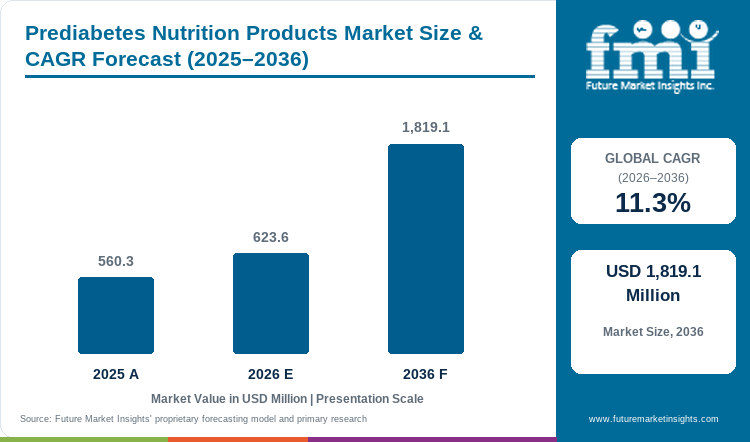
USD 623.6 Million in 2026 and USD 1,819.1 Million by 2036 at an 11.3% CAGR
Sales of prediabetes nutrition products are estimated to grow at 11.3% from USD 623.6 Million in 2026 to USD 1,819.1 Million by 2036, after reaching USD 560.3 Million in 2025. The opportunity comes from a simple problem: people who are told they are at higher risk of diabetes still have to decide what to eat several times a day. Shakes, fiber products, snacks, and other portioned formats can make those decisions easier when they fit naturally into a regular routine.
In some markets, prevention programs create the first point of contact, while in others consumers are more likely to act through digital tools or direct purchases. This is particularly relevant to the continuous glucose monitoring systems market, because better access to food-response information gives some consumers a clearer way to compare what they eat. Even then, repeat purchase comes down to familiar factors such as taste, price, preparation time.
Key Takeaways
- The market is projected to increase from USD 623.6 Million in 2026 to USD 1,819.1 Million by 2036 at an 11.3% CAGR, following a 2025 value of USD 560.3 Million.
- Earlier glucose-risk identification and structured prevention programs create recurring demand for portioned meals and other nutrition formats that simplify everyday dietary change.
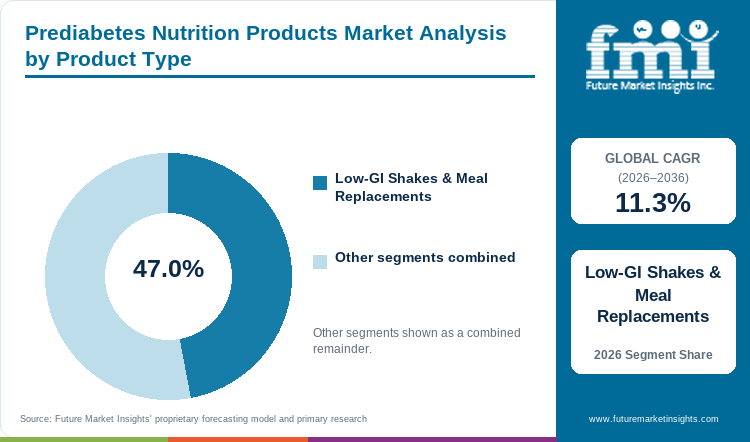
- Low-GI Shakes & Meal Replacements account for 47.0% of Product Type demand, while CGM-Paired Programs hold 47.7% of Consumer Engagement demand in 2026.
- People aged 25-44 Years represent 49.4% of Age Group demand, while Online / DTC accounts for 43.2% of Sales Channel demand in 2026.
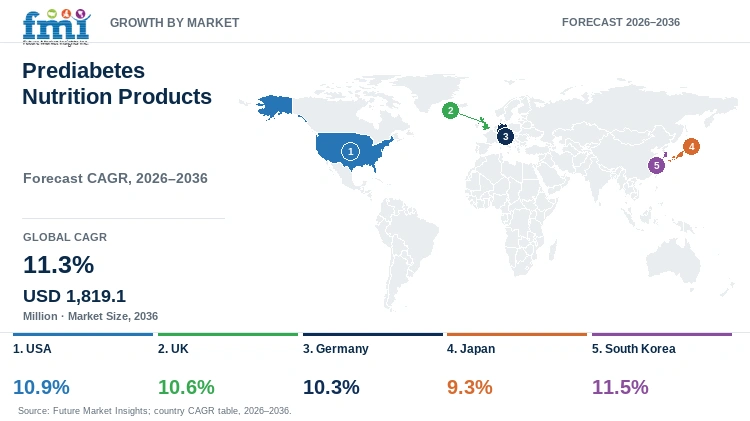
- South Korea is forecast to expand at 11.5% CAGR from 2026 to 2036, compared with 10.9% for USA, 10.6% for UK, 10.3% for Germany, and 9.3% for Japan.
- Claim discipline remains a commercial constraint, while Abbott (Glucerna), Supergut, Pendulum Therapeutics, Nestle Health Science, Metagenics, January AI, Good Measure (General Mills), and Extend Nutrition represent notable companies.
Analyst Perspective
“The revenue bottleneck is adherence rather than risk identification. Screening can create intent in one visit, but nutrition revenue appears only when the product earns a place in an ordinary meal routine. Suppliers that make the serving easy to repeat, keep the claim inside a defensible nutrition boundary, and give the buyer a clear reason to reorder will be better positioned to retain demand through 2036.”
- Anurag Sharma, Principal Consultant, Future Market Insights
How is the prediabetes nutrition products market segmented?
The market is segmented by Product Type, Consumer Engagement, Form, Age Group, Sales Channel, and Region.
The market is analyzed by Product Type including Low-GI Shakes & Meal Replacements, Glucose-Support Supplements, Resistant-Starch & Fiber Products, Low-GI Snacks & Bars, and Others; Consumer Engagement including CGM-Paired Programs, Diabetes-Prevention Program Users, and Self-Directed consumers; Form including Powders, RTD, Bars & Snacks, and Capsules; Age Group including 25-44 Years, 45-64 Years, and 65+ Years; and Sales Channel including Online / DTC, Retail Pharmacy, Supermarkets & Hypermarkets, Specialty & Health Stores, and Others. Meal substitution also intersects with the wider meal replacement products market, although prediabetes-oriented demand is more closely tied to glucose-conscious eating and prevention routines.
Why do Low-GI Shakes & Meal Replacements lead demand within the Product Type category?
Low-GI shakes and meal replacements work because they replace a decision rather than simply adding another product to the diet. A defined serving gives the consumer a clearer idea of portion size and carbohydrate intake at breakfast, lunch, or snack time. That is easier to follow than a product that asks the user to interpret a general ingredient benefit. The same need for portability and portion control also supports demand in the wider meal replacement shakes market.
- Low-GI Shakes & Meal Replacements hold 47.0% of Product Type demand in 2026.
- Their commercial advantage comes from replacing a complete eating occasion rather than adding another step to an already complex nutrition routine.
Why do CGM-Paired Programs lead demand within the Consumer Engagement category?
CGM-paired programs give consumers faster feedback on how different meals affect them. Instead of relying only on a broad idea of healthy eating, users can compare foods and see whether a particular choice fits the routine they are trying to build. January AI expanded its app in July 2025 so users could connect their own CGM and combine sensor readings with logged foods. For nutrition brands, the practical benefit is that a product can be tested as part of a routine the consumer already understands.
- CGM-Paired Programs account for 47.7% of Consumer Engagement demand in 2026.
- Immediate food-response feedback can support trial, but repeat purchase still depends on taste, price, preparation burden, and whether the product fits an ordinary meal pattern.
Why do Powders lead demand within the Form category?
Powders give manufacturers more room to include protein, fiber, resistant starch, or other ingredients in a single serving without the weight and packaging of a ready-to-drink product. They are also flexible for the user, who can mix them into water, coffee, breakfast foods, or smoothies. That makes the format especially useful for fiber-led products and connects it with the broader prebiotic ingredient market.
- Powders hold a 39.9% share of Form demand in 2026.
- Their advantage is strongest where the formulation requires an ingredient load that would be difficult to deliver through a small capsule format.
Why does the 25-44 Years group lead demand within the Age Group category?
Adults aged 25-44 are more likely to encounter prediabetes at a stage when they are still thinking in terms of everyday food choices rather than long-term disease management. They are also comfortable with online shopping, mobile health tools, subscriptions, and portable nutrition. Products perform better in this group when they fit around work, commuting, travel, and quick meals instead of asking consumers to follow a separate medical-style routine.
- People aged 25-44 Years account for 49.4% of Age Group demand in 2026.
- Current screening guidance increases the relevance of glucose-risk conversations across working-age adults, expanding the pool of consumers considering preventive dietary change.
Why does Online / DTC lead demand within the Sales Channel category?
Online / DTC gives brands enough space to explain what a product is for, how to use it, and why someone might reorder it. That matters in a category where a short shelf label may not be enough to explain ingredients, serving patterns, or a subscription offer. Powders and supplements benefit in particular because customers often want more context before buying. This route also overlaps with the wider dietary supplements market, although prediabetes-oriented products face tighter limits on how glucose-related benefits can be described.
- Online / DTC accounts for 43.2% of Sales Channel demand in 2026.
- Direct channels are particularly effective where product education and replenishment need to happen together rather than as separate retail interactions.
What are the drivers, restraints and opportunities in the Prediabetes Nutrition Products Market?
Structured prevention expands recurring nutrition occasions, evidence and claim boundaries can slow conversion, and food-response feedback creates new opportunities for measurable product use.
- Driver: Prediabetes screening and structured prevention programs turn a glucose-risk signal into repeated decisions about meals, snacks, fiber intake, and portion size.
- Restraint: Food, medical nutrition, and supplement propositions operate under different claim and evidence expectations, making overly aggressive glucose or treatment language commercially risky.
- Opportunity: CGM-linked and AI-assisted food feedback can help consumers compare nutrition products within routines they already track.
A prediabetes diagnosis or risk warning does not create revenue on its own. The commercial opportunity starts when that warning leads to repeated choices about breakfast, snacks, portion size, or fiber intake. Structured prevention programs support long-term lifestyle change, but consumers still need practical ways to carry that advice into ordinary meals. Products become useful when they remove some of that daily effort.
Claim boundaries can interrupt conversion after consumer interest appears
Interest can fall apart when the marketing starts to sound stronger than the product itself. A consumer may be willing to try a shake, supplement, or fiber product after being told their glucose is elevated, but confidence can disappear if the wording starts to resemble a treatment claim. Brands therefore need to keep the message closely tied to what the product is designed to do and what its category allows.
Feedback can create a clearer reason to keep or drop a product
Digital glucose feedback can make a nutrition choice easier to judge. A consumer can try a shake, snack, or fiber powder and compare the experience with other meals in the same routine. If it is easy to use and delivers a result the buyer values, repeat purchase becomes more likely. If it tastes poor, costs too much, or is difficult to prepare, the feedback tool does not solve the underlying problem.
Which country CAGRs are profiled in the Prediabetes Nutrition Products Market?
| Country | CAGR |
|---|---|
| USA | 10.9% |
| UK | 10.6% |
| Germany | 10.3% |
| Japan | 9.3% |
| South Korea | 11.5% |
How do country-level CAGRs compare in the Prediabetes Nutrition Products Market?
Forecast growth across the profiled countries ranges from 9.3% in Japan to 11.5% in South Korea between 2026 and 2036. The difference is not just about how many people are interested in healthy eating. What matters is how people enter prevention programs, whether they pay directly for nutrition products, how comfortable they are with digital tracking, and how well products fit local eating habits.
- South Korea is 0.6 percentage points above USA, with digital engagement creating an important bridge between screening and sustained consumer action.
- USA is 0.3 percentage points above UK, although the commercial models differ because the U.S. relies more heavily on self-pay nutrition alongside structured prevention programs.
- UK is 0.3 percentage points above Germany, where evidence-sensitive purchasing can put greater weight on formulation transparency and conservative claims.
- Germany is 1.0 percentage point above Japan, where products have to fit existing meal patterns and portion expectations rather than importing a generic Western meal-replacement model.
Country-wise Analysis
- USA: Demand for Prediabetes Nutrition Products in USA is forecast to rise at 10.9% CAGR from 2026 to 2036. The National Diabetes Prevention Program gives healthcare providers a structured route from risk identification to sustained lifestyle change. The commercial opening sits between advice and everyday execution. Products that replace a difficult meal decision with a simple shake, snack, or fiber step can monetize that gap when recurring out-of-pocket cost remains acceptable.
- UK: Demand for Prediabetes Nutrition Products in UK is forecast to expand at 10.6% CAGR from 2026 to 2036. The Healthier You pathway provides face-to-face, remote, and digital support for eligible people identified at high risk. Branded nutrition therefore competes alongside an established public behavior-change pathway. Convenience, taste, portability, and a clear role within the diet become important reasons to pay when coaching itself may already be available.
- Germany: Demand for Prediabetes Nutrition Products in Germany is forecast to grow at 10.3% CAGR from 2026 to 2036. National diabetes-surveillance work keeps prediabetes within the country's broader risk-reduction agenda. Commercial propositions operate in an environment where evidence quality and ingredient transparency can materially affect acceptance. Clear formulations and restrained glucose-support communication are consequently more useful than broad metabolic promises.
- Japan: Demand for Prediabetes Nutrition Products in Japan is forecast to expand at 9.3% CAGR from 2026 to 2036. Specific Health Checkups and lifestyle guidance create an established prevention route for adults in relevant age groups. Product design has to fit that context. Smaller portions, restrained sweetness, convenient formats, and compatibility with familiar meal patterns are more commercially useful than simply transferring a large Western-style meal replacement into the market.
- South Korea: Demand for Prediabetes Nutrition Products in South Korea is forecast to rise at 11.5% CAGR from 2026 to 2036. National screening infrastructure creates repeated opportunities to identify consumers at elevated metabolic risk, while widespread mobile engagement gives suppliers a practical way to maintain contact after screening. The revenue opportunity lies in sustaining the routine through simple digital education, replenishment, and products that can be incorporated without reorganizing the consumer's entire diet.
Who are the notable companies in the Prediabetes Nutrition Products Market?
Abbott (Glucerna); Supergut; Pendulum Therapeutics; Nestle Health Science; Metagenics; January AI; Good Measure (General Mills); Extend Nutrition
Abbott and Nestle Health Science are closest to established glucose-oriented nutrition. Extend Nutrition focuses on familiar snack and shake occasions. Supergut uses a fiber-led proposition, while Pendulum Therapeutics works through microbiome-focused supplements. Metagenics is more closely tied to practitioner-oriented products. January AI sits in the decision layer, helping users interpret food-response data, while Good Measure brings the idea into packaged snacks.
- Structured glucose nutrition platforms: Abbott (Glucerna), Nestle Health Science, and Extend Nutrition compete through shakes, meal replacements, or snacks that make portioned eating easier to repeat.
- Metabolic fiber and supplement specialists: Supergut, Pendulum Therapeutics, and Metagenics compete through fiber, microbiome, medical-food, or supplement propositions.
- Personalized and consumer-led glucose models: January AI and Good Measure (General Mills) make the glucose-conscious proposition easier to interpret through digital guidance or packaged snacks.
Competitive Benchmarking: Prediabetes Nutrition Products Market
| Company | Glucose-Specific Nutrition Breadth | Personalized Feedback Integration | Professional / Clinical Channel Fit | Geographic Reach |
|---|---|---|---|---|
| Abbott (Glucerna) | High | Low | High | United States and multiple international markets |
| Supergut | High | Low | Medium | United States DTC and national retail |
| Pendulum Therapeutics | Medium | Low | Medium | United States online-first reach |
| Nestle Health Science | High | Low | High | United States and multiple international markets |
| Metagenics | High | Low | High | United States and selected professional channels |
| January AI | Low | High | Medium | App-based consumer reach with United States focus |
| Good Measure (General Mills) | Medium | Low | Unscored | United States grocery and online channels |
| Extend Nutrition | Medium | Low | Medium | United States online and retail channels |
Glucose-Specific Nutrition Breadth reflects how many relevant nutrition or supplement formats a company offers for glucose-oriented use. Personalized Feedback Integration reflects whether food choices are connected with individual glucose or food-response data. Professional / Clinical Channel Fit shows how closely a company works through healthcare-linked or evidence-led routes to market. High indicates broad capability, Medium indicates a narrower but meaningful position, and Low indicates a more limited role. Geographic Reach describes commercial presence and does not indicate market share.
Key Developments in the Prediabetes Nutrition Products Market
- In July 2025, January AI expanded its app so users could connect their own CGM through a Terra-enabled integration. Abbott Libre was supported at launch, linking logged food choices with real-time sensor readings and giving consumers a faster way to compare eating decisions.
- In September 2025, Supergut introduced Foundational Daily Fiber, a powder formulated around multiple prebiotic fiber sources. The format is intended for mixing into common drinks and foods, reinforcing the role of powders in repeatable daily fiber consumption.
- In November 2025, Abbott launched an updated Ensure Diabetes Care formulation in India with a low-glycemic carbohydrate blend together with higher fiber and protein. The development reflects continued investment in glucose-oriented nutrition and portioned meal support.
Key Players in the Prediabetes Nutrition Products Market
Structured Glucose Nutrition Platforms
- Abbott (Glucerna)
- Nestle Health Science
- Extend Nutrition
Metabolic Fiber and Supplement Specialists
- Supergut
- Pendulum Therapeutics
- Metagenics
Personalized and Consumer-Led Glucose Models
- January AI
- Good Measure (General Mills)
Prediabetes Nutrition Products Market - Report Scope
| Coverage field | Report scope |
|---|---|
| Market breakdown | Product Type; Consumer Engagement; Form; Age Group; Sales Channel |
| Quantitative Units | USD Million |
| Market Definition | Revenue includes packaged or formulated nutrition products positioned for glucose-response support or prediabetes risk-management routines within the stated segmentation universe. It excludes CGM hardware, laboratory testing, prescription therapies, standalone coaching fees, and general-wellness nutrition outside the defined proposition. |
| Regions Covered | North America; Latin America; Western Europe; Eastern Europe; East Asia; South Asia and Pacific; Middle East and Africa |
| Countries Covered | USA, UK, Germany, Japan, South Korea, and more than twenty-five additional countries in the full report |
| Key Companies Profiled | Abbott (Glucerna); Supergut; Pendulum Therapeutics; Nestle Health Science; Metagenics; January AI; Good Measure (General Mills); Extend Nutrition |
| Forecast Period | 2026 to 2036 |
| Approach | FMI applies a hybrid bottom-up and top-down sizing approach that reconciles relevant product and channel revenues with engagement pathways, form mix, repeat-purchase behavior, and country adoption conditions. |
Prediabetes Nutrition Products Market - Research Methodology
| Method | Approach |
|---|---|
| Primary Research | Structured discussions with manufacturers, formulators, distributors, retailers, digital-program participants, clinicians, dietitians, and procurement stakeholders are used to assess purchase criteria, channel behavior, product use, price points, and repeat-purchase drivers. |
| Desk Research | Research reviews public-health statistics, clinical guidance, regulatory records, first-party product documentation, company announcements, policy material, and peer-reviewed literature relevant to prediabetes prevention and glucose-response nutrition. |
| Market Sizing and Forecasting | Sizing reconciles relevant product and channel revenues with buyer incidence, engagement pathways, form mix, repeat-purchase behavior, and country adoption conditions across the forecast period. |
| Data Validation | Findings are cross-checked across independent source types while maintaining the defined revenue and product boundary of the market. |
Prediabetes Nutrition Products Market by Segments
Prediabetes Nutrition Products Market segmented by Product Type:
- Low-GI Shakes & Meal Replacements
- Glucose-Support Supplements (Berberine / Chromium)
- Resistant-Starch & Fiber Products
- Low-GI Snacks & Bars
- Others
Prediabetes Nutrition Products Market segmented by Consumer Engagement:
- CGM-Paired Programs
- Diabetes-Prevention Program Users
- Self-Directed
Prediabetes Nutrition Products Market segmented by Form:
- Powders
- RTD
- Bars & Snacks
- Capsules
Prediabetes Nutrition Products Market segmented by Age Group:
- 25-44 Years
- 45-64 Years
- 65+ Years
Prediabetes Nutrition Products Market segmented by Sales Channel:
- Online / DTC
- Retail Pharmacy
- Supermarkets & Hypermarkets
- Specialty & Health Stores
- Others
Prediabetes Nutrition Products Market by Region:
- North America
- United States
- Canada
- Latin America
- Brazil
- Mexico
- Argentina
- Chile
- Western Europe
- Germany
- France
- United Kingdom
- Italy
- Spain
- Benelux
- Nordics
- Eastern Europe
- Poland
- Czech Republic
- Romania
- Hungary
- East Asia
- China
- Japan
- South Korea
- South Asia and Pacific
- India
- ASEAN
- Australia and New Zealand
- Middle East and Africa
- GCC Countries
- South Africa
- Türkiye
- Israel
Research Sources and Bibliography
- Centers for Disease Control and Prevention. (2026, February 17). National Diabetes Prevention Program.
- NHS England. Healthier You NHS Diabetes Prevention Programme.
- Robert Koch Institute. Diabetes Surveillance in Germany: Prediabetes.
- Ministry of Health, Labour and Welfare, Japan. Specific Health Checkups and Specific Health Guidance.
- Ministry of Health, Labour and Welfare, Japan. Specific Health Checkup Examination Items.
- Korea Disease Control and Prevention Agency. (2025, April 28). National Health Screening.
- National Health Insurance Service, Republic of Korea. National Health Screening Participation Statistics.
- January AI. (2025, July 22). New in January: Connect Your Own CGM for Smarter, More Personalized Predictions.
- Supergut. Foundational Daily Fiber Product Information.
- Abbott. Glucerna Nutrition Product Information.
- Abbott India. (2025, November 13). Abbott Launches New and Advanced Ensure Diabetes Care, a Clinically Proven Formula to Help Manage Blood Sugar.
- Extend Nutrition. Product Information and Nutrition FAQs.
This Report Answers
- What is the Prediabetes Nutrition Products Market size in 2026 and what value is forecast for 2036?
- How do screening and structured prevention pathways create demand for glucose-oriented nutrition products?
- Why do Low-GI Shakes & Meal Replacements lead the Product Type category?
- How do CGM-Paired Programs influence product trial and repeat nutrition demand?
- Why do Powders hold the leading position within Form?
- How do growth rates differ across USA, UK, Germany, Japan, and South Korea from 2026 to 2036?
- How do evidence quality and claim boundaries affect foods, medical nutrition, and supplements?
- What should brands and channel executives evaluate before scaling a prediabetes nutrition proposition?
Frequently Asked Questions
What is driving growth in the Prediabetes Nutrition Products Market?
Growth is being supported by earlier identification of glucose risk and wider use of structured prevention programs. The commercial opportunity appears when that interest turns into everyday food choices. Meal replacements, fiber products, snacks, and supplements can fit that need when they are easy to use and make sense within an ordinary diet.
Who are the key players in the Prediabetes Nutrition Products Market?
Companies profiled include Abbott (Glucerna), Supergut, Pendulum Therapeutics, Nestle Health Science, Metagenics, January AI, Good Measure (General Mills), and Extend Nutrition. They operate across different parts of the market, from shakes and snacks to fiber products, supplements, and digital food-response tools.
What notable restraint affects the Prediabetes Nutrition Products Market?
One of the main restraints is the difference between what a food, supplement, or medical nutrition product can reasonably claim. Consumers may lose confidence when marketing language sounds more like treatment than nutrition support. That makes clear positioning and disciplined claims important for long-term sales.
Why should executives track the Prediabetes Nutrition Products Market?
The market sits at the point where prevention advice becomes a consumer purchase. Screening gives people a reason to change, while digital feedback can make food choices easier to compare. The commercial question is whether a product can become part of a repeatable routine rather than a one-time reaction to a health warning.
What should brand and channel executives evaluate in the Prediabetes Nutrition Products Market?
Executives should look at the full consumer experience, not just the formulation. Taste, preparation time, serving size, price, and claim clarity all affect whether people continue using the product. The sales channel also needs to provide enough explanation and make reordering simple.
What limits return on investment in the Prediabetes Nutrition Products Market?
Returns weaken when brands spend heavily to acquire customers who stop using the product after a short period. Poor taste, awkward preparation, weak differentiation, or a price that feels too high for daily use can all reduce retention. This matters even more where consumers can access free or low-cost prevention support elsewhere.
Preview the report firsthand - request a free sample
Get SampleGet the brochure for pricing and purchase details.
Get PDFTable of Content
- Key Takeaways
- Market Size and CAGR
- Top Growth Driver
- Fastest Growing Segment
- Leading Region
- Key Companies
- Emerging Opportunities
- Executive Summary
- Global Market Outlook
- Demand-side Trends
- Supply-side Trends
- Technology Roadmap Analysis
- Analysis and Recommendations
- Analyst Perspective (What is happening? Why now? What should investors know?)
- Key Questions Answered
- How large is the market?
- What is the CAGR?
- What are key trends?
- Which region dominates?
- Who are the leaders?
- Market Overview
- Market Coverage / Taxonomy
- Market Definition / Scope / Limitations
- Research Methodology
- Chapter Orientation
- Analytical Lens and Working Hypotheses
- Market Structure, Signals, and Trend Drivers
- Benchmarking and Cross-market Comparability
- Market Sizing, Forecasting, and Opportunity Mapping
- Research Design and Evidence Framework
- Desk Research Programme (Secondary Evidence)
- Expert Input and Fieldwork (Primary Evidence)
- Tooling, Models, and Reference Databases
- Data Engineering and Model Build
- Quality Assurance and Audit Trail
- Market Background
- Market Dynamics (Drivers, Restraints, Opportunity, Trends)
- Scenario Forecast (Optimistic, Likely, Conservative)
- Impact Analysis
- AI Impact
- Sustainability Impact
- Regulatory Impact
- Technology Impact
- Consumer / Buyer Analysis
- Purchase Drivers
- Adoption Barriers
- Buyer Journey
- Opportunity Map Analysis
- Product Life Cycle Analysis
- Supply Chain Analysis
- Investment Feasibility Matrix
- Value Chain Analysis
- PESTLE and Porter's Analysis
- Regulatory Landscape
- Regional Parent Market Outlook
- Production and Consumption Statistics
- Import and Export Statistics
- Global Market Analysis and Forecast, 2021 to 2036
- Historical Market Size Value (USD Million) Analysis, 2021 to 2025
- Current and Future Market Size Value (USD Million) Projections, 2026 to 2036
- Y-o-Y Growth Trend Analysis
- Absolute $ Opportunity Analysis
- Global Market Pricing Analysis, 2021 to 2036
- Global Market Analysis and Forecast, By Product Type, 2021 to 2036
- Introduction / Key Findings
- Historical Market Size Value (USD Million) Analysis By Product Type, 2021 to 2025
- Current and Future Market Size Value (USD Million) Analysis and Forecast By Product Type, 2026 to 2036
- Low-GI Shakes & Meal Replacements
- Glucose-Support Supplements (Berberine / Chromium)
- Resistant-Starch & Fiber Products
- Low-GI Snacks & Bars
- Others
- Y-o-Y Growth Trend Analysis By Product Type, 2021 to 2025
- Absolute $ Opportunity Analysis By Product Type, 2026 to 2036
- Global Market Analysis and Forecast, By Consumer Engagement, 2021 to 2036
- Introduction / Key Findings
- Historical Market Size Value (USD Million) Analysis By Consumer Engagement, 2021 to 2025
- Current and Future Market Size Value (USD Million) Analysis and Forecast By Consumer Engagement, 2026 to 2036
- CGM-Paired Programs
- Diabetes-Prevention Program Users
- Self-Directed
- Y-o-Y Growth Trend Analysis By Consumer Engagement, 2021 to 2025
- Absolute $ Opportunity Analysis By Consumer Engagement, 2026 to 2036
- Global Market Analysis and Forecast, By Form, 2021 to 2036
- Introduction / Key Findings
- Historical Market Size Value (USD Million) Analysis By Form, 2021 to 2025
- Current and Future Market Size Value (USD Million) Analysis and Forecast By Form, 2026 to 2036
- Powders
- RTD
- Bars & Snacks
- Capsules
- Y-o-Y Growth Trend Analysis By Form, 2021 to 2025
- Absolute $ Opportunity Analysis By Form, 2026 to 2036
- Global Market Analysis and Forecast, By Age Group, 2021 to 2036
- Introduction / Key Findings
- Historical Market Size Value (USD Million) Analysis By Age Group, 2021 to 2025
- Current and Future Market Size Value (USD Million) Analysis and Forecast By Age Group, 2026 to 2036
- 25-44 Years
- 45-64 Years
- 65+ Years
- Y-o-Y Growth Trend Analysis By Age Group, 2021 to 2025
- Absolute $ Opportunity Analysis By Age Group, 2026 to 2036
- Global Market Analysis and Forecast, By Sales Channel, 2021 to 2036
- Introduction / Key Findings
- Historical Market Size Value (USD Million) Analysis By Sales Channel, 2021 to 2025
- Current and Future Market Size Value (USD Million) Analysis and Forecast By Sales Channel, 2026 to 2036
- Online / DTC
- Retail Pharmacy
- Supermarkets & Hypermarkets
- Specialty & Health Stores
- Others
- Y-o-Y Growth Trend Analysis By Sales Channel, 2021 to 2025
- Absolute $ Opportunity Analysis By Sales Channel, 2026 to 2036
- Global Market Analysis and Forecast, By Region, 2021 to 2036
- Introduction
- Historical Market Size Value (USD Million) Analysis By Region, 2021 to 2025
- Current Market Size Value (USD Million) Analysis and Forecast By Region, 2026 to 2036
- North America
- Latin America
- Western Europe
- Eastern Europe
- East Asia
- South Asia and Pacific
- Middle East and Africa
- Market Attractiveness Analysis By Region
- North America Market Analysis and Forecast, By Country, 2021 to 2036
- Historical Market Size Value (USD Million) Trend Analysis By Market Taxonomy, 2021 to 2025
- Market Size Value (USD Million) Forecast By Market Taxonomy, 2026 to 2036
- By Country
- United States
- Canada
- By Product Type
- By Consumer Engagement
- By Form
- By Age Group
- By Sales Channel
- By Country
- Market Attractiveness Analysis
- By Country
- By Product Type
- By Consumer Engagement
- By Form
- By Age Group
- By Sales Channel
- Key Takeaways
- Latin America Market Analysis and Forecast, By Country
- Historical Market Size Value (USD Million) Trend Analysis By Market Taxonomy, 2021 to 2025
- Market Size Value (USD Million) Forecast By Market Taxonomy, 2026 to 2036
- By Country
- Brazil
- Mexico
- Argentina
- Chile
- By Product Type
- By Consumer Engagement
- By Form
- By Age Group
- By Sales Channel
- By Country
- Market Attractiveness Analysis
- By Country
- By Product Type
- By Consumer Engagement
- By Form
- By Age Group
- By Sales Channel
- Key Takeaways
- Western Europe Market Analysis and Forecast, By Country
- Historical Market Size Value (USD Million) Trend Analysis By Market Taxonomy, 2021 to 2025
- Market Size Value (USD Million) Forecast By Market Taxonomy, 2026 to 2036
- By Country
- Germany
- France
- United Kingdom
- Italy
- Spain
- Benelux
- Nordics
- By Product Type
- By Consumer Engagement
- By Form
- By Age Group
- By Sales Channel
- By Country
- Market Attractiveness Analysis
- By Country
- By Product Type
- By Consumer Engagement
- By Form
- By Age Group
- By Sales Channel
- Key Takeaways
- Eastern Europe Market Analysis and Forecast, By Country
- Historical Market Size Value (USD Million) Trend Analysis By Market Taxonomy, 2021 to 2025
- Market Size Value (USD Million) Forecast By Market Taxonomy, 2026 to 2036
- By Country
- Poland
- Czech Republic
- Romania
- Hungary
- By Product Type
- By Consumer Engagement
- By Form
- By Age Group
- By Sales Channel
- By Country
- Market Attractiveness Analysis
- By Country
- By Product Type
- By Consumer Engagement
- By Form
- By Age Group
- By Sales Channel
- Key Takeaways
- East Asia Market Analysis and Forecast, By Country
- Historical Market Size Value (USD Million) Trend Analysis By Market Taxonomy, 2021 to 2025
- Market Size Value (USD Million) Forecast By Market Taxonomy, 2026 to 2036
- By Country
- China
- Japan
- South Korea
- By Product Type
- By Consumer Engagement
- By Form
- By Age Group
- By Sales Channel
- By Country
- Market Attractiveness Analysis
- By Country
- By Product Type
- By Consumer Engagement
- By Form
- By Age Group
- By Sales Channel
- Key Takeaways
- South Asia and Pacific Market Analysis and Forecast, By Country
- Historical Market Size Value (USD Million) Trend Analysis By Market Taxonomy, 2021 to 2025
- Market Size Value (USD Million) Forecast By Market Taxonomy, 2026 to 2036
- By Country
- India
- ASEAN
- Australia and New Zealand
- By Product Type
- By Consumer Engagement
- By Form
- By Age Group
- By Sales Channel
- By Country
- Market Attractiveness Analysis
- By Country
- By Product Type
- By Consumer Engagement
- By Form
- By Age Group
- By Sales Channel
- Key Takeaways
- Middle East and Africa Market Analysis and Forecast, By Country
- Historical Market Size Value (USD Million) Trend Analysis By Market Taxonomy, 2021 to 2025
- Market Size Value (USD Million) Forecast By Market Taxonomy, 2026 to 2036
- By Country
- GCC Countries
- South Africa
- Türkiye
- Israel
- By Product Type
- By Consumer Engagement
- By Form
- By Age Group
- By Sales Channel
- By Country
- Market Attractiveness Analysis
- By Country
- By Product Type
- By Consumer Engagement
- By Form
- By Age Group
- By Sales Channel
- Key Takeaways
- Key Countries Market Analysis
- United States
- Pricing Analysis
- Market Share Analysis, 2025
- By Product Type
- By Consumer Engagement
- By Form
- By Age Group
- By Sales Channel
- Canada
- Pricing Analysis
- Market Share Analysis, 2025
- By Product Type
- By Consumer Engagement
- By Form
- By Age Group
- By Sales Channel
- Mexico
- Pricing Analysis
- Market Share Analysis, 2025
- By Product Type
- By Consumer Engagement
- By Form
- By Age Group
- By Sales Channel
- Brazil
- Pricing Analysis
- Market Share Analysis, 2025
- By Product Type
- By Consumer Engagement
- By Form
- By Age Group
- By Sales Channel
- Chile
- Pricing Analysis
- Market Share Analysis, 2025
- By Product Type
- By Consumer Engagement
- By Form
- By Age Group
- By Sales Channel
- Germany
- Pricing Analysis
- Market Share Analysis, 2025
- By Product Type
- By Consumer Engagement
- By Form
- By Age Group
- By Sales Channel
- United Kingdom
- Pricing Analysis
- Market Share Analysis, 2025
- By Product Type
- By Consumer Engagement
- By Form
- By Age Group
- By Sales Channel
- Italy
- Pricing Analysis
- Market Share Analysis, 2025
- By Product Type
- By Consumer Engagement
- By Form
- By Age Group
- By Sales Channel
- Spain
- Pricing Analysis
- Market Share Analysis, 2025
- By Product Type
- By Consumer Engagement
- By Form
- By Age Group
- By Sales Channel
- France
- Pricing Analysis
- Market Share Analysis, 2025
- By Product Type
- By Consumer Engagement
- By Form
- By Age Group
- By Sales Channel
- India
- Pricing Analysis
- Market Share Analysis, 2025
- By Product Type
- By Consumer Engagement
- By Form
- By Age Group
- By Sales Channel
- ASEAN
- Pricing Analysis
- Market Share Analysis, 2025
- By Product Type
- By Consumer Engagement
- By Form
- By Age Group
- By Sales Channel
- Australia and New Zealand
- Pricing Analysis
- Market Share Analysis, 2025
- By Product Type
- By Consumer Engagement
- By Form
- By Age Group
- By Sales Channel
- China
- Pricing Analysis
- Market Share Analysis, 2025
- By Product Type
- By Consumer Engagement
- By Form
- By Age Group
- By Sales Channel
- Japan
- Pricing Analysis
- Market Share Analysis, 2025
- By Product Type
- By Consumer Engagement
- By Form
- By Age Group
- By Sales Channel
- South Korea
- Pricing Analysis
- Market Share Analysis, 2025
- By Product Type
- By Consumer Engagement
- By Form
- By Age Group
- By Sales Channel
- Poland
- Pricing Analysis
- Market Share Analysis, 2025
- By Product Type
- By Consumer Engagement
- By Form
- By Age Group
- By Sales Channel
- Hungary
- Pricing Analysis
- Market Share Analysis, 2025
- By Product Type
- By Consumer Engagement
- By Form
- By Age Group
- By Sales Channel
- Türkiye
- Pricing Analysis
- Market Share Analysis, 2025
- By Product Type
- By Consumer Engagement
- By Form
- By Age Group
- By Sales Channel
- South Africa
- Pricing Analysis
- Market Share Analysis, 2025
- By Product Type
- By Consumer Engagement
- By Form
- By Age Group
- By Sales Channel
- United States
- Market Structure Analysis
- Competition Dashboard
- Competition Benchmarking
- Market Share Analysis of Top Players
- By Regional
- By Product Type
- By Consumer Engagement
- By Form
- By Age Group
- By Sales Channel
- Emerging Startups
- Innovation Benchmarking
- Competition Analysis
- Competition Deep Dive
- Abbott (Glucerna)
- Overview
- Product Portfolio
- Profitability by Market Segments
- Sales Footprint
- Strategy Overview
- Marketing Strategy
- Product Strategy
- Channel Strategy
- Supergut
- Pendulum Therapeutics
- Nestle Health Science
- Metagenics
- January AI
- Good Measure (General Mills)
- Extend Nutrition
- Abbott (Glucerna)
- Case Studies
- Success Stories
- Recent Developments
- Competition Deep Dive
- Assumptions & Acronyms Used


