

- Market Size (2026)
- USD 152.1 Mn
- Forecast (2036)
- USD 350.2 Mn
- CAGR (2026 to 2036)
- 8.7%
How big is the Cardiorenal Nutrition Products Market in 2026?
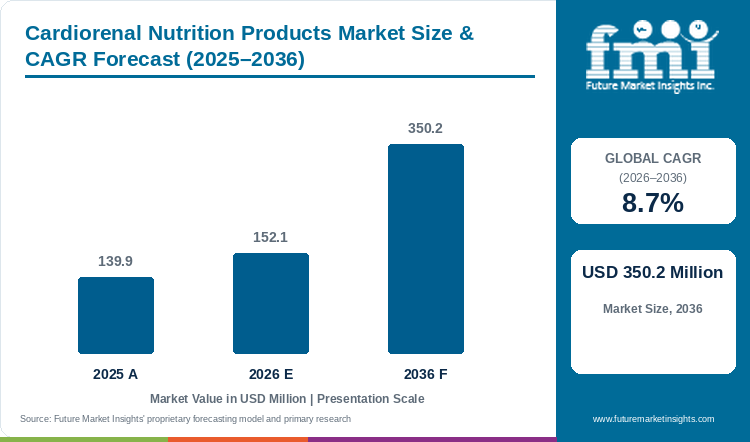
Demand for cardiorenal nutrition products is projected to expand at 8.7% CAGR between 2026 and 2036. Industry value grows from USD 139.9 million in 2025 to USD 152.1 million in 2026 and is projected to reach USD 350.2 million by 2036.
As per updated FMI report, increase in number of patients having kidney dysfunction along with heart complications is creating the need for nutrition products that can provide calories and protein without increasing sodium, potassium and fluid intake. Standard dietary supplements are not always suitable in such cases, as the nutrient requirement and restriction comes together in the same diet plan. This has led to the development and increasing adoption of cardiorenal nutrition products. According to the Centers for Disease Control and Prevention, approximately 35.5 million adults in the U.S. were living with chronic kidney disease in 2026, with cardiovascular complications frequently compounding clinical care [1]. FMI research indicates that actual product use will expand where sodium, potassium, protein and serving volume are clearly documented for clinicians to integrate into the daily diet plan.
Cardiorenal nutrition products demand follows distinct national trajectories, as patient age profiles, diagnostic screening, and clinical care routes differ. South Korea is projected to grow at 8.8% CAGR, owing to increasing CKD surveillance and a large older population coming under medical review. The UK is expected to grow at 8.4% CAGR, supported by integrated cardiovascular-kidney-metabolic care pathways tracked in official health monitoring [3]. Hence, the higher CAGR in these countries reflects expanding clinical identification rather than retail product availability alone, as more patients transition onto structured clinical nutrition pathways.
Key Takeaways
- Clinical overlap between kidney dysfunction and cardiac volume management is increasing the need for compact, disease-specific nutrition.
- Low-sodium low-potassium dual-adapted ONS is projected to account for 47.5% in 2026 because several restrictions are covered through one serving.
- Heart failure with CKD is estimated to hold 47.0% share in 2026 as fluid balance and renal function are reviewed together.
- RTD is expected to lead product form with 41.8% share as a measured serving reduces mixing and preparation variation.
- South Korea is forecast at 8.8% CAGR, followed by the UK at 8.4%, with clinical pathways deciding how quickly demand converts into repeat use.
- Notable companies include Abbott, Fresenius Kabi, Nestle Health Science, Danone Nutricia, Medtrition, Victus, Global Health Products, and B. Braun.
Analyst Perspective
“Compact renal formulas will gain application as fluid limits continue to shape the daily nutrition plan. However, clear sodium, potassium, protein and serving details will decide whether a hospital choice continues after discharge.”
- Anurag Sharma, Principal Consultant, Future Market Insights.
How is the cardiorenal nutrition products market segmented?
The market is studied by product type, syndrome type, product form, end user, sales channel, and region. Dual-adapted ONS, heart failure with CKD, RTD, hospitals, and hospital pharmacy are projected to lead their respective categories in 2026.
By product type: Low-sodium low-potassium dual-adapted ONS, fluid-restricted compact formulas, cardiorenal medical meals, and others.
By syndrome type: Heart failure with CKD, dialysis with cardiac comorbidity, and others.
By product form: RTD, powders, puddings and semi-solids, and others.
By end user: Hospitals, homecare, dialysis centers, long-term care, and others.
By sales channel: Hospital pharmacy, retail pharmacy, online, institutional tender, and others.
By region: North America, Latin America, Western Europe, Eastern Europe, East Asia, South Asia and Pacific, and Middle East and Africa.
Why does dual-adapted ONS hold notable product type demand?
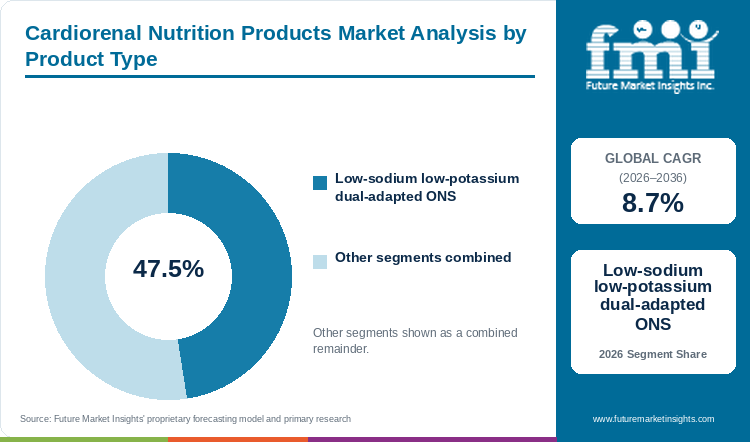
Based on product type, dual-adapted ONS is projected to account for 47.5% in 2026, driven by overlapping electrolyte controls.
Increasing requirement of adding energy and protein under sodium, potassium and fluid restriction is driving the demand for low-sodium low-potassium dual-adapted ONS. In these patients, every restriction cannot be managed separately and use of a general supplement can again require changes in the remaining diet. A dual-adapted formula provides the required nutrients in one documented serving, due to which it becomes easier for the dietitian to calculate its place in the diet plan. As per the analysis from FMI, Abbott adult product reference published in 2025 provides defined renal-focused nutrient values for Nepro [4]. Availability of such product-level data helps position dual-adapted formulations within specialized medical food programs.
- The 47.5% share is connected with handling several prescription limits through one formula.
- A defined nutrient panel reduces the number of changes required when a general supplement does not fit the renal diet.
What supports heart failure with CKD as a syndrome category?
By syndrome type, heart failure with CKD is estimated to hold 47.0% in 2026, owing to linked volume decisions.
Heart failure with CKD patients can face appetite loss, fluid congestion, changing renal function and electrolyte intolerance at the same time. Due to this, nutrition cannot be selected only by looking at protein or calories, and a lower serving volume becomes equally important. This overlapping requirement is expected to support 47.0% share of heart failure with CKD segment in 2026. For instance, in April 2026, Global Health Products introduced LiquaCel TF with 20 g protein in 1.25 oz for fluid-restricted hemodialysis and CHF patients [5]. Such compact products are increasing because a full ONS serving is difficult to adjust where the daily fluid allowance is already limited, contrasting with standard sports nutrition products that lack renal electrolyte adaptations.
- The 47.0% share follows care pathways where kidney function and fluid balance are checked together.
- Lower-volume delivery can support patients whose allowance makes a full ONS serving difficult to place.
How does RTD meet changing product form requirements?
In 2026, RTD is expected to lead product form with 41.8% share, supported by measured portions and simple use.
Ready-to-drink products are gaining preference as they provide a measured serving without adding mixing water. The same portion can be used in hospitals, dialysis centers and at home, which reduces the variation that can take place during preparation. This is important in cardiorenal care because even a small addition of water changes the total fluid taken by the patient. Hence, RTD is expected to account for 41.8% share in 2026. In October 2025, Nestle Health Science communicated that the Novasource Renal vanilla flavor update will retain the nutrition information and product codes [6]. Retaining the prescribed profile while changing the patient experience can support continuation of the same product after discharge.
- RTD is expected at 41.8% as sealed portions are easier to transfer between care settings.
- Stable product codes and nutrition details help the initial clinical choice continue after discharge.
Why do hospitals retain the main end-user position?
By end user, hospitals are forecast to represent 39.7% in 2026, enabled by multidisciplinary assessment before product initiation.
Hospitals are expected to hold 39.7% share in 2026, as initiation of cardiorenal nutrition commonly requires laboratory findings, dietetic assessment, cardiac review and pharmacy availability to be checked together. A product suitable on the basis of calories can still be unsuitable because of sodium, potassium or serving volume. Therefore, hospitals remain the main point where the patient is assessed and a specialized formula is first selected. Multidisciplinary clinical review is moving joined care closer to the community, however, specialist assessment remains important before the same nutrition order is continued through home healthcare products channels.
- Hospitals are forecast at 39.7% because supervised qualification generally occurs before repeat use.
- Laboratory findings and fluid status make specialist assessment more important than ordinary retail availability.
What keeps hospital pharmacy central to the sales channel?
Hospital pharmacy is projected to hold 40.6% share in 2026, attributable to formulary control over specialized nutrition products.
Hospital pharmacy is projected to account for 40.6% share in 2026, as a clinically suitable product also needs formulary listing, pharmacy automation integration, reimbursement and regular stock availability. The recommendation alone will not result in use when the selected SKU is not available through the hospital supply route. The February 2026 NHS Drug Tariff listed renal meal replacement products under nutritional support categories, showing the role of formal listing in practical product access [7]. Retail pharmacy and online sales can increase later, but these channels mainly support continuation when the same product and serving plan is available after discharge.
- Hospital pharmacy is projected at 40.6% because formulary entry converts clinical suitability into actual access.
- Continuity after discharge depends on whether the same product can be reordered outside the hospital.
What are the drivers, restraints, and opportunities in the cardiorenal nutrition products market?
The key driver is the overlap of renal and cardiac nutrition requirements, the key restraint is patient-to-patient variation, and the key opportunity is compact nutrition that adds protein or calories without taking a large fluid allowance.
- Driver: Kidney dysfunction with heart-failure risk increases demand for controlled-volume products with documented electrolyte content.
- Restraint: Sodium, potassium, protein and fluid targets change by disease stage, treatment and current laboratory results.
- Opportunity: Compact complete formulas and modular protein products can raise nutrition intake without replacing the entire diet plan.
Clinical Overlap Expands Product Need
Increasing overlap between kidney dysfunction and heart failure is one of the major factors driving the cardiorenal nutrition products market. In September 2025, the Heart Failure Society of America estimated that 6.7 million adults in the U.S. were living with heart failure, identifying CKD as a key co-occurring risk factor [12]. A larger overlapping patient population increases the number of cases where ordinary ONS has to be reviewed for sodium, potassium and fluid content. As a result, renal-focused products having clear protein, electrolyte and serving information are expected to witness increasing adoption, compared with products carrying only a general nutrition positioning.
Patient Variation Limits Standard Protocols
A key factor restraining standard adoption of cardiorenal nutrition products is the changing requirement from one patient to another. Sodium, potassium, protein and fluid targets are not fixed, as these can change with renal function, congestion, dialysis status and the ongoing treatment. In June 2026, the American Heart Association and partner societies released clinical practice guidelines for cardiovascular-kidney-metabolic syndrome, highlighting that shifting electrolyte and volume imbalances require individualized dietary management rather than uniform protocols [18]. A change in product can again require dietitian assessment and monitoring, which increases the time required for qualification and restricts one common formula from being used across all patients.
Compact Formats Create Practical Openings
Growing demand for adding protein or calories in a smaller fluid volume is creating opportunities for compact complete formulas and modular nutrition products. These products do not always replace the full diet plan, but can change one nutrition variable without taking a large part of the patient’s fluid allowance. For instance, in May 2026, B. Braun documented Nutricomp Drink Renal delivering 2.0 kcal/ml in a volume-restricted profile with tailored sodium and potassium levels for cardiorenal support [10]. Such formats are expected to find increasing application in volume-limited care, provided electrolyte content, route compatibility with enteral nutrition, and reorder availability are also clearly documented.
Which country CAGRs are profiled in the cardiorenal nutrition products market?
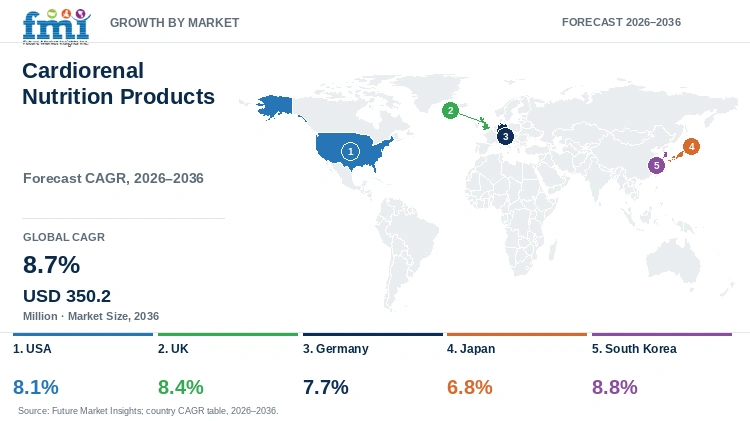
| Country | CAGR |
|---|---|
| USA | 8.1% |
| UK | 8.4% |
| Germany | 7.7% |
| Japan | 6.8% |
| South Korea | 8.8% |
How do country-level outlooks compare in the cardiorenal nutrition products market?
South Korea and the UK are expected to witness comparatively higher growth, however, the underlying factors are different in both countries. South Korea growth is supported by CKD surveillance and a large older risk population, while the UK growth is driven by specialist pathways, formulary access and movement of joined care into community settings. The USA has wider hospital, dialysis, pharmacy and homecare channels. Germany and Japan have established clinical routines, due to which the demand remains stable but switching from an existing formula can take longer. Therefore, country growth is expected to depend on how easily a suitable product can move from assessment to repeat supply.
- USA: Hospital, dialysis, pharmacy and homecare channels support reach, but the same SKU has to remain available after discharge.
- UK: Formulary status and specialist dietetic routes decide whether a formula fitting kidney and heart-failure management can move into regular use.
- Germany: A large treated population supports demand for products with exact nutrient and serving details, although established protocols can slow switching.
- Japan: An older dialysis population supports measured portions and familiar formats, with conservative changes in established nutrition routines.
- South Korea: CKD surveillance and aging-related risk support education and compact formats under clinical control.
Country-wise Analysis
- According to FMI, USA cardiorenal nutrition product demand is expected to expand at 8.1% CAGR through 2036, owing to presence of hospital, dialysis, pharmacy and homecare channels. The U.S. Renal Data System released a quarterly update in September 2026 with end-stage kidney disease data through the first quarter [14]. Availability of national reporting supports planning of nutrition requirements across hospitals and dialysis centers. In patients identified at a later stage, a renal ONS with clearly written sodium, potassium, protein and serving volume can be placed more quickly in the diet plan. However, the growth will also depend on availability of the same SKU after discharge, as discontinuity between hospital and home supply can affect repeat use.
- UK cardiorenal nutrition product demand is expected to expand at 8.4% CAGR through 2036. In July 2026, the UK published a cardiovascular-kidney-metabolic service framework which moves joined care closer to home [13]. This is expected to increase the requirement for nutrition products that can move from specialist assessment into community supply. Renal ONS can gain demand where the formula is matched with laboratory findings and fluid status. However, formulary listing and funded availability will remain the major factors deciding whether the selected product is continued for regular use.
- Germany cardiorenal nutrition product demand is expected to expand at 7.7% CAGR through 2036. The International Society of Nephrology country profile reports treated kidney failure prevalence at 1,114 cases per million people and 8.7 hemodialysis facilities per million [8]. Presence of this treated patient base and specialized dialysis equipment infrastructure supports repeated nutrition assessment. However, established protocols can restrict rapid switching between products. Thus, manufacturers providing exact sodium, potassium, energy density and serving-volume details are expected to have better scope than those depending on broad product claims.
- Japan cardiorenal nutrition product demand is expected to expand at 6.8% CAGR through 2036. Japanese Society for Dialysis Therapy reported 337,414 dialysis patients at the end of 2024, with a mean age of 70.27 years, while heart failure accounted for 19.0% of deaths among dialysis patients [9]. The figures indicate a large older patient pool where renal and cardiac conditions are commonly reviewed together. Measured portions and familiar formats are expected to witness steady demand, however, entry of a new product can remain slow as local documentation and fit with existing nutrition routines is required.
- South Korea cardiorenal nutrition product demand is expected to expand at 8.8% CAGR through 2036. KDCA reported in March 2026 that CKD prevalence reached 6.3% among adults in 2024 and was around 25% among people aged 70 years or older [2]. Increasing CKD prevalence in the older population also raises the number of patients having low appetite, hypertension and cardiac monitoring requirements. This is expected to increase demand for compact ONS and modular protein supplements. However, selection will remain dependent on current renal function and cannot be made only on the basis of a general low-electrolyte claim.
Who are the notable companies in the cardiorenal nutrition products market?
Abbott, Fresenius Kabi, Nestle Health Science, Danone Nutricia, Medtrition, Victus, Global Health Products, and B. Braun are notable companies profiled in this market.
The cardiorenal nutrition products market is moderately fragmented, as complete-formula companies and modular nutrition specialists are serving different requirements of the diet plan. Abbott, Nestle Health Science and Danone Nutricia have wider medical nutrition portfolios, while Fresenius Kabi and B. Braun have stronger institutional and enteral care infrastructure. Medtrition and Global Health Products are focusing on compact and modular delivery, whereas Victus provides renal formula access in selected regional markets. Thus, competition is mainly based on sodium and potassium transparency, protein level, serving volume, hospital access and continuity after discharge, instead of one common product feature.
- Complete renal nutrition platforms: Abbott, Nestle Health Science, and Danone Nutricia.
- Institutional enteral providers: Fresenius Kabi and B. Braun.
- Compact, modular, and regional specialists: Medtrition, Global Health Products, and Victus.
Competitive Benchmarking: Cardiorenal Nutrition Products Market
| Company | Electrolyte and Volume Adaptation | Format Flexibility | Institutional Care Fit | Geographic Reach |
|---|---|---|---|---|
| Abbott | High | High | High | High |
| Fresenius Kabi | High | High | High | High |
| Nestle Health Science | High | Medium | High | High |
| Danone Nutricia | High | Medium | High | High |
| Medtrition | High | High | Medium | Medium |
| Victus | High | Medium | Medium | Medium |
| Global Health Products | Medium | High | Medium | Medium |
| B. Braun | High | Medium | High | High |
Scoring basis: High indicates broader public evidence across the named capability. Medium indicates narrower documented breadth. Ratings explain public capability and do not rank market share or product quality.
Key Developments in the Cardiorenal Nutrition Products Market
- In April 2026, Global Health Products introduced LiquaCel TF with 20 g protein in 1.25 oz for fluid-restricted hemodialysis and CHF patients. The tube-compatible format gives a modular route where a full ONS serving is difficult to fit.
- In October 2025, Nestle Health Science communicated a vanilla flavor update for Novasource Renal while retaining nutrition information and product codes.
- In June 2025, Danone described a masterplan for its Zoetermeer specialized nutrition site, supporting liquid medical nutrition manufacturing flexibility [11].
Key Players in the Cardiorenal Nutrition Products Market
Complete Renal Nutrition Platforms
- Abbott
- Nestle Health Science
- Danone Nutricia
Institutional Enteral Providers
- Fresenius Kabi
- B. Braun
Compact, Modular, and Regional Specialists
- Medtrition
- Global Health Products
- Victus
Cardiorenal Nutrition Products Market - Report Scope
| Coverage field | Report scope |
|---|---|
| Market breakdown | Product type, syndrome type, product form, end user, sales channel, and region. |
| Quantitative units | USD million. |
| Market definition | Revenue from disease-specific medical nutrition products selected where renal impairment overlaps with cardiovascular, fluid, or electrolyte management. Generic adult nutrition, parenteral nutrition, dialysis services, and downstream care revenue are excluded. |
| Regions covered | North America; Latin America; Western Europe; Eastern Europe; East Asia; South Asia and Pacific; Middle East and Africa. |
| Countries covered | USA, UK, Germany, Japan, South Korea, and additional countries in the full report. |
| Key companies profiled | Abbott, Fresenius Kabi, Nestle Health Science, Danone Nutricia, Medtrition, Victus, Global Health Products, and B. Braun. |
| Forecast period | 2026 to 2036. |
| Approach | The FMI report covers product-level demand, clinical pathways, segment structure, channel access, and country adoption conditions. |
Cardiorenal Nutrition Products Market - Research Methodology
| Method | Approach |
|---|---|
| Primary Research | Input was gathered from manufacturers, service providers, distributors, end users, procurement teams and subject-matter experts. Interviews covered product evaluation, purchasing, approval, pricing, barriers and support. |
| Desk Research | Research covered government statistics, professional associations, regulatory publications, technical literature, company filings, product information and official announcements. Sources were checked for date, geography and direct relevance. |
| Market Sizing and Forecasting | The model combined the baseline value with segment structure, historical performance, pricing and volume indicators, company activity, clinical adoption and country demand. |
| Data Validation | Estimates were checked against public data, care patterns, company activity and primary findings. Adjacent products, unsupported claims and overlapping revenue were excluded. |
Segment shares and forecast estimates are FMI proprietary analytical estimates. They are not government statistics or direct measurements of global market share.
Cardiorenal Nutrition Products Market by Segments
Cardiorenal Nutrition Products Market segmented by Product Type:
- Low-sodium low-potassium dual-adapted ONS
- Fluid-restricted compact formulas
- Cardiorenal medical meals
- Others
Cardiorenal Nutrition Products Market segmented by Syndrome Type:
- Heart failure with CKD
- Dialysis with cardiac comorbidity
- Others
Cardiorenal Nutrition Products Market segmented by Product Form:
- RTD
- Powders
- Puddings and semi-solids
- Others
Cardiorenal Nutrition Products Market segmented by End User:
- Hospitals
- Homecare
- Dialysis centers
- Long-term care
- Others
Cardiorenal Nutrition Products Market segmented by Sales Channel:
- Hospital pharmacy
- Retail pharmacy
- Online
- Institutional tender
- Others
Cardiorenal Nutrition Products Market by Region
- North America
- United States
- Canada
- Latin America
- Brazil
- Mexico
- Argentina
- Chile
- Western Europe
- Germany
- France
- United Kingdom
- Italy
- Spain
- Benelux
- Nordics
- Eastern Europe
- Poland
- Czech Republic
- Romania
- Hungary
- East Asia
- China
- Japan
- South Korea
- South Asia and Pacific
- India
- ASEAN
- Australia and New Zealand
- Middle East and Africa
- GCC Countries
- South Africa
- Türkiye
- Israel
Research Sources and Bibliography
- [1] Centers for Disease Control and Prevention. (2026, March 31). Chronic kidney disease in the United States.
- [2] Korea Disease Control and Prevention Agency. (2026, March 12). Trends in the prevalence of chronic kidney disease, 2014-2024.
- [3] Office for Health Improvement and Disparities. (2025, December 2). Cardiovascular disease profiles: short statistical commentary.
- [4] Abbott Nutrition. (2025). Adult product reference: Nepro with CARBSTEADY.
- [5] Global Health Products. (2026, April 21). Introducing LiquaCel TF: A new standard in enteral protein nutrition.
- [6] Nestle Health Science. (2025, October 1). Novasource Renal vanilla flavor update.
- [7] NHS Business Services Authority. (2026, February). Drug Tariff, Part XV: Borderline substances.
- [8] International Society of Nephrology. (2026). Germany kidney care metrics.
- [9] Japanese Society for Dialysis Therapy. (2025). 2024 annual dialysis data report, JSDT Renal Data Registry.
- [10] B. Braun. (2026, May 7). Nutricomp Drink Renal.
- [11] Danone. (2025, June 12). Nutricia Zoetermeer masterplan description.
- [12] Heart Failure Society of America. (2025, September). HF Stats 2025: Heart failure epidemiology and outcomes statistics.
- [13] Department of Health and Social Care. (2026, July 7). Cardiovascular disease modern service framework: a cardiovascular-kidney-metabolic approach.
- [14] National Institute of Diabetes and Digestive and Kidney Diseases. (2026, September 18). USRDS ESRD quarterly update.
- [15] Danone. (2025, July 1). Danone completes the acquisition of Kate Farms.
- [16] Nestle Health Science. (2026, April 1). Nestle Health Science merges with Nestle Nutrition.
- [17] Abbott. (2026, September 23). Abbott and Berry Street partner to expand personalized nutrition support.
- [18] American Heart Association. (2026, June 9). 2026 AHA/ACC/ADA/ASN guideline for cardiovascular-kidney-metabolic syndrome.
This bibliography is provided for reader reference. Inline numbers are placed immediately after the fact or company development they support.
This Report Answers
- What is the Cardiorenal Nutrition Products Market worth during 2026?
- What value is the market projected to reach by 2036?
- Which product type holds notable market share?
- Which syndrome type holds notable market share?
- Which countries have notable growth?
- Which companies are notable in the market today?
Frequently Asked Questions
How large is the Cardiorenal Nutrition Products Market expected to be in 2026?
Future Market Insights estimates that the cardiorenal nutrition products market will reach USD 152.1 million in 2026. The market is projected to expand further and reach USD 350.2 million by 2036.
What CAGR is forecast for the Cardiorenal Nutrition Products Market through 2036?
As per FMI, the cardiorenal nutrition products market is projected to grow at an 8.7% CAGR from 2026 to 2036. Growth is supported by increasing adoption of dual-adapted and volume-controlled formulations in integrated medical care.
Which product type holds a notable cardiorenal nutrition products demand share in 2026?
Future Market Insights projects low-sodium low-potassium dual-adapted ONS to hold 47.5% of product type demand in 2026. The segment benefits from combining multiple dietary restrictions into a single standardized formulation.
Which syndrome type holds a notable cardiorenal nutrition products share in 2026?
FMI finds that heart failure with CKD will hold 47.0% of syndrome type demand in 2026. Demand is supported by clinical pathways that manage cardiac volume status and renal filtration capacity in tandem.
Which country has a notable cardiorenal nutrition products expansion outlook during the forecast period?
Future Market Insights predicts South Korea to expand at an 8.8% CAGR during the 2026 to 2036 assessment period. Growth is supported by proactive CKD screening programs and an expanding older patient base requiring supervised clinical nutrition.
Which companies are active in the Cardiorenal Nutrition Products Market during 2026?
As per FMI analysis, notable companies include Abbott, Fresenius Kabi, Nestle Health Science, Danone Nutricia, Medtrition, Victus, Global Health Products, and B. Braun. These companies are focusing on electrolyte transparency, compact volume formats, and integrated hospital and homecare supply.
Preview the report firsthand - request a free sample
Get SampleGet the brochure for pricing and purchase details.
Get PDFTable of Content
- Key Takeaways
- Market Size and CAGR
- Top Growth Driver
- Fastest Growing Segment
- Leading Region
- Key Companies
- Emerging Opportunities
- Executive Summary
- Global Market Outlook
- Demand-side Trends
- Supply-side Trends
- Technology Roadmap Analysis
- Analysis and Recommendations
- Analyst Perspective (What is happening? Why now? What should investors know?)
- Key Questions Answered
- How large is the market?
- What is the CAGR?
- What are key trends?
- Which region dominates?
- Who are the leaders?
- Market Overview
- Market Coverage / Taxonomy
- Market Definition / Scope / Limitations
- Research Methodology
- Chapter Orientation
- Analytical Lens and Working Hypotheses
- Market Structure, Signals, and Trend Drivers
- Benchmarking and Cross-market Comparability
- Market Sizing, Forecasting, and Opportunity Mapping
- Research Design and Evidence Framework
- Desk Research Programme (Secondary Evidence)
- Expert Input and Fieldwork (Primary Evidence)
- Tooling, Models, and Reference Databases
- Data Engineering and Model Build
- Quality Assurance and Audit Trail
- Market Background
- Market Dynamics (Drivers, Restraints, Opportunity, Trends)
- Scenario Forecast (Optimistic, Likely, Conservative)
- Impact Analysis
- AI Impact
- Sustainability Impact
- Regulatory Impact
- Technology Impact
- Consumer / Buyer Analysis
- Purchase Drivers
- Adoption Barriers
- Buyer Journey
- Opportunity Map Analysis
- Product Life Cycle Analysis
- Supply Chain Analysis
- Investment Feasibility Matrix
- Value Chain Analysis
- PESTLE and Porter's Analysis
- Regulatory Landscape
- Regional Parent Market Outlook
- Production and Consumption Statistics
- Import and Export Statistics
- Global Market Analysis and Forecast, 2021 to 2036
- Historical Market Size Value (USD Million) Analysis, 2021 to 2025
- Current and Future Market Size Value (USD Million) Projections, 2026 to 2036
- Y-o-Y Growth Trend Analysis
- Absolute $ Opportunity Analysis
- Global Market Pricing Analysis, 2021 to 2036
- Global Market Analysis and Forecast, By Product Type, 2021 to 2036
- Introduction / Key Findings
- Historical Market Size Value (USD Million) Analysis By Product Type, 2021 to 2025
- Current and Future Market Size Value (USD Million) Analysis and Forecast By Product Type, 2026 to 2036
- Low-sodium low-potassium dual-adapted ONS
- Fluid-restricted compact formulas
- Cardiorenal medical meals
- Others
- Y-o-Y Growth Trend Analysis By Product Type, 2021 to 2025
- Absolute $ Opportunity Analysis By Product Type, 2026 to 2036
- Global Market Analysis and Forecast, By Syndrome Type, 2021 to 2036
- Introduction / Key Findings
- Historical Market Size Value (USD Million) Analysis By Syndrome Type, 2021 to 2025
- Current and Future Market Size Value (USD Million) Analysis and Forecast By Syndrome Type, 2026 to 2036
- Heart failure with CKD
- Dialysis with cardiac comorbidity
- Others
- Y-o-Y Growth Trend Analysis By Syndrome Type, 2021 to 2025
- Absolute $ Opportunity Analysis By Syndrome Type, 2026 to 2036
- Global Market Analysis and Forecast, By Product Form, 2021 to 2036
- Introduction / Key Findings
- Historical Market Size Value (USD Million) Analysis By Product Form, 2021 to 2025
- Current and Future Market Size Value (USD Million) Analysis and Forecast By Product Form, 2026 to 2036
- RTD
- Powders
- Puddings and semi-solids
- Others
- Y-o-Y Growth Trend Analysis By Product Form, 2021 to 2025
- Absolute $ Opportunity Analysis By Product Form, 2026 to 2036
- Global Market Analysis and Forecast, By End User, 2021 to 2036
- Introduction / Key Findings
- Historical Market Size Value (USD Million) Analysis By End User, 2021 to 2025
- Current and Future Market Size Value (USD Million) Analysis and Forecast By End User, 2026 to 2036
- Hospitals
- Homecare
- Dialysis centers
- Long-term care
- Others
- Y-o-Y Growth Trend Analysis By End User, 2021 to 2025
- Absolute $ Opportunity Analysis By End User, 2026 to 2036
- Global Market Analysis and Forecast, By Sales Channel, 2021 to 2036
- Introduction / Key Findings
- Historical Market Size Value (USD Million) Analysis By Sales Channel, 2021 to 2025
- Current and Future Market Size Value (USD Million) Analysis and Forecast By Sales Channel, 2026 to 2036
- Hospital pharmacy
- Retail pharmacy
- Online
- Institutional tender
- Others
- Y-o-Y Growth Trend Analysis By Sales Channel, 2021 to 2025
- Absolute $ Opportunity Analysis By Sales Channel, 2026 to 2036
- Global Market Analysis and Forecast, By Region, 2021 to 2036
- Introduction
- Historical Market Size Value (USD Million) Analysis By Region, 2021 to 2025
- Current Market Size Value (USD Million) Analysis and Forecast By Region, 2026 to 2036
- North America
- Latin America
- Western Europe
- Eastern Europe
- East Asia
- South Asia and Pacific
- Middle East and Africa
- Market Attractiveness Analysis By Region
- North America Market Analysis and Forecast, By Country, 2021 to 2036
- Historical Market Size Value (USD Million) Trend Analysis By Market Taxonomy, 2021 to 2025
- Market Size Value (USD Million) Forecast By Market Taxonomy, 2026 to 2036
- By Country
- United States
- Canada
- By Product Type
- By Syndrome Type
- By Product Form
- By End User
- By Sales Channel
- By Country
- Market Attractiveness Analysis
- By Country
- By Product Type
- By Syndrome Type
- By Product Form
- By End User
- By Sales Channel
- Key Takeaways
- Latin America Market Analysis and Forecast, By Country
- Historical Market Size Value (USD Million) Trend Analysis By Market Taxonomy, 2021 to 2025
- Market Size Value (USD Million) Forecast By Market Taxonomy, 2026 to 2036
- By Country
- Brazil
- Mexico
- Argentina
- Chile
- By Product Type
- By Syndrome Type
- By Product Form
- By End User
- By Sales Channel
- By Country
- Market Attractiveness Analysis
- By Country
- By Product Type
- By Syndrome Type
- By Product Form
- By End User
- By Sales Channel
- Key Takeaways
- Western Europe Market Analysis and Forecast, By Country
- Historical Market Size Value (USD Million) Trend Analysis By Market Taxonomy, 2021 to 2025
- Market Size Value (USD Million) Forecast By Market Taxonomy, 2026 to 2036
- By Country
- Germany
- France
- United Kingdom
- Italy
- Spain
- Benelux
- Nordics
- By Product Type
- By Syndrome Type
- By Product Form
- By End User
- By Sales Channel
- By Country
- Market Attractiveness Analysis
- By Country
- By Product Type
- By Syndrome Type
- By Product Form
- By End User
- By Sales Channel
- Key Takeaways
- Eastern Europe Market Analysis and Forecast, By Country
- Historical Market Size Value (USD Million) Trend Analysis By Market Taxonomy, 2021 to 2025
- Market Size Value (USD Million) Forecast By Market Taxonomy, 2026 to 2036
- By Country
- Poland
- Czech Republic
- Romania
- Hungary
- By Product Type
- By Syndrome Type
- By Product Form
- By End User
- By Sales Channel
- By Country
- Market Attractiveness Analysis
- By Country
- By Product Type
- By Syndrome Type
- By Product Form
- By End User
- By Sales Channel
- Key Takeaways
- East Asia Market Analysis and Forecast, By Country
- Historical Market Size Value (USD Million) Trend Analysis By Market Taxonomy, 2021 to 2025
- Market Size Value (USD Million) Forecast By Market Taxonomy, 2026 to 2036
- By Country
- China
- Japan
- South Korea
- By Product Type
- By Syndrome Type
- By Product Form
- By End User
- By Sales Channel
- By Country
- Market Attractiveness Analysis
- By Country
- By Product Type
- By Syndrome Type
- By Product Form
- By End User
- By Sales Channel
- Key Takeaways
- South Asia and Pacific Market Analysis and Forecast, By Country
- Historical Market Size Value (USD Million) Trend Analysis By Market Taxonomy, 2021 to 2025
- Market Size Value (USD Million) Forecast By Market Taxonomy, 2026 to 2036
- By Country
- India
- ASEAN
- Australia and New Zealand
- By Product Type
- By Syndrome Type
- By Product Form
- By End User
- By Sales Channel
- By Country
- Market Attractiveness Analysis
- By Country
- By Product Type
- By Syndrome Type
- By Product Form
- By End User
- By Sales Channel
- Key Takeaways
- Middle East and Africa Market Analysis and Forecast, By Country
- Historical Market Size Value (USD Million) Trend Analysis By Market Taxonomy, 2021 to 2025
- Market Size Value (USD Million) Forecast By Market Taxonomy, 2026 to 2036
- By Country
- GCC Countries
- South Africa
- Türkiye
- Israel
- By Product Type
- By Syndrome Type
- By Product Form
- By End User
- By Sales Channel
- By Country
- Market Attractiveness Analysis
- By Country
- By Product Type
- By Syndrome Type
- By Product Form
- By End User
- By Sales Channel
- Key Takeaways
- Key Countries Market Analysis
- United States
- Pricing Analysis
- Market Share Analysis, 2025
- By Product Type
- By Syndrome Type
- By Product Form
- By End User
- By Sales Channel
- Canada
- Pricing Analysis
- Market Share Analysis, 2025
- By Product Type
- By Syndrome Type
- By Product Form
- By End User
- By Sales Channel
- Mexico
- Pricing Analysis
- Market Share Analysis, 2025
- By Product Type
- By Syndrome Type
- By Product Form
- By End User
- By Sales Channel
- Brazil
- Pricing Analysis
- Market Share Analysis, 2025
- By Product Type
- By Syndrome Type
- By Product Form
- By End User
- By Sales Channel
- Chile
- Pricing Analysis
- Market Share Analysis, 2025
- By Product Type
- By Syndrome Type
- By Product Form
- By End User
- By Sales Channel
- Germany
- Pricing Analysis
- Market Share Analysis, 2025
- By Product Type
- By Syndrome Type
- By Product Form
- By End User
- By Sales Channel
- United Kingdom
- Pricing Analysis
- Market Share Analysis, 2025
- By Product Type
- By Syndrome Type
- By Product Form
- By End User
- By Sales Channel
- Italy
- Pricing Analysis
- Market Share Analysis, 2025
- By Product Type
- By Syndrome Type
- By Product Form
- By End User
- By Sales Channel
- Spain
- Pricing Analysis
- Market Share Analysis, 2025
- By Product Type
- By Syndrome Type
- By Product Form
- By End User
- By Sales Channel
- France
- Pricing Analysis
- Market Share Analysis, 2025
- By Product Type
- By Syndrome Type
- By Product Form
- By End User
- By Sales Channel
- India
- Pricing Analysis
- Market Share Analysis, 2025
- By Product Type
- By Syndrome Type
- By Product Form
- By End User
- By Sales Channel
- ASEAN
- Pricing Analysis
- Market Share Analysis, 2025
- By Product Type
- By Syndrome Type
- By Product Form
- By End User
- By Sales Channel
- Australia and New Zealand
- Pricing Analysis
- Market Share Analysis, 2025
- By Product Type
- By Syndrome Type
- By Product Form
- By End User
- By Sales Channel
- China
- Pricing Analysis
- Market Share Analysis, 2025
- By Product Type
- By Syndrome Type
- By Product Form
- By End User
- By Sales Channel
- Japan
- Pricing Analysis
- Market Share Analysis, 2025
- By Product Type
- By Syndrome Type
- By Product Form
- By End User
- By Sales Channel
- South Korea
- Pricing Analysis
- Market Share Analysis, 2025
- By Product Type
- By Syndrome Type
- By Product Form
- By End User
- By Sales Channel
- Poland
- Pricing Analysis
- Market Share Analysis, 2025
- By Product Type
- By Syndrome Type
- By Product Form
- By End User
- By Sales Channel
- Hungary
- Pricing Analysis
- Market Share Analysis, 2025
- By Product Type
- By Syndrome Type
- By Product Form
- By End User
- By Sales Channel
- Türkiye
- Pricing Analysis
- Market Share Analysis, 2025
- By Product Type
- By Syndrome Type
- By Product Form
- By End User
- By Sales Channel
- South Africa
- Pricing Analysis
- Market Share Analysis, 2025
- By Product Type
- By Syndrome Type
- By Product Form
- By End User
- By Sales Channel
- United States
- Market Structure Analysis
- Competition Dashboard
- Competition Benchmarking
- Market Share Analysis of Top Players
- By Regional
- By Product Type
- By Syndrome Type
- By Product Form
- By End User
- By Sales Channel
- Emerging Startups
- Innovation Benchmarking
- Competition Analysis
- Competition Deep Dive
- Abbott
- Overview
- Product Portfolio
- Profitability by Market Segments
- Sales Footprint
- Strategy Overview
- Marketing Strategy
- Product Strategy
- Channel Strategy
- Fresenius Kabi
- Nestle Health Science
- Danone Nutricia
- Medtrition
- Victus
- Global Health Products
- B. Braun
- Abbott
- Case Studies
- Success Stories
- Recent Developments
- Competition Deep Dive
- Assumptions & Acronyms Used


