

- Market Size (2026)
- USD 196.2 Mn
- Forecast (2036)
- USD 460.3 Mn
- CAGR (2026 to 2036)
- 8.9%
How big is the ostomy nutrition products market in 2026?
Sales in the ostomy nutrition products market are projected to grow at 8.9% CAGR through 2036. Market size rises from USD 180.2 million in 2025 to USD 196.2 million in 2026 and is expected to reach USD 460.3 million by 2036.
Requirement for nutrition after ostomy surgery is improving use of ostomy nutrition products. FMI forecasts the market to rise from USD 180.2 million in 2025 to USD 196.2 million in 2026 and reach USD 460.3 million by 2036, exhibiting 8.9% CAGR during 2026 to 2036. Protein-rich nutrition, electrolyte drinks and output-thickening foods are used when meals do not meet recovery needs. St George’s 2026 guidance notes that stoma output exceeding 1 litre daily can lead to dehydration, kidney damage and hospital readmission. [1] Smaller specialized nutrition formats can receive preference where appetite and food tolerance remains limited, which in turn supports repeat purchases.
Hospital-to-home usage differs in South Korea and the USA owing to nutrition access. South Korea is estimated to expand at 9.4% CAGR during 2026 to 2036, compared with 8.6% in the USA. A 2025 study of 998 USA ileostomy patients reported that multidisciplinary monitoring reduced dehydration readmission to 5.4% from 11.5% previously. [10] Medical nutrition eligibility can support continued use in South Korea, while discharge follow-up can influence USA product use. Simple directions and smaller servings are expected by FMI to improve nutrition use after discharge. Hospital-linked availability can develop South Korean prospects, whereas recovery packs can create USA revenue opportunities.
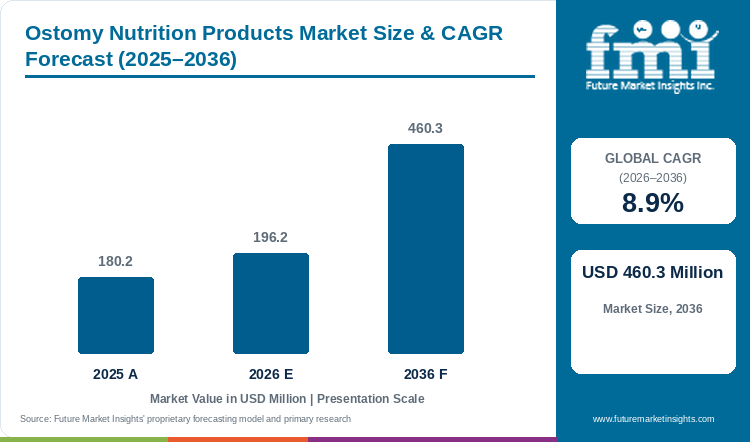
Ostomy Nutrition Products Market Size & CAGR Forecast (2025-2036)
| Year | Basis | Market value (USD million) |
|---|---|---|
| 2025 | Actual | 180.2 |
| 2026 | Estimate | 196.2 |
| 2036 | Forecast | 460.3 |
| CAGR, 2026 to 2036 | 8.9% | |
Source: Future Market Insights proprietary forecasting model and primary research.
Key Takeaways
- Increasing postoperative protein requirement, limited food intake and fluid loss after ileostomy are supporting the demand for ostomy nutrition products.
- Based on product type, low-residue high-protein ONS is projected to account for 39.8% in 2026, supported by concentrated recovery nutrition.
- By stoma type, ileostomy is estimated to hold 52.1% in 2026, owing to its direct hydration and output-management requirements.
- In 2026, early post-op is expected to lead phase with 54.1% share, reflecting structured nutrition decisions after surgery.
- South Korea is projected to post 9.4% CAGR through 2036, while the USA is forecast at 8.6% as access pathways differ.
- Notable companies include Medtrition, Abbott, Danone Nutricia, Nestle Health Science, DripDrop, Victus, Global Health Products, and Fresenius Kabi.
Analyst Perspective
“I see stronger demand for products that address measured protein, fluid and high-output requirements after ostomy surgery. Wider opportunity will come from simple formats that patients can continue at home after receiving hospital guidance.”
- Anurag Sharma, Principal Consultant, Future Market Insights.
How is the ostomy nutrition products market segmented?
Ostomy nutrition products market is segmented by five primary commercial axes and region: product type, stoma type, phase, end user, sales channel, and region. In 2026, low-residue high-protein ONS is projected at 39.8%, ileostomy at 52.1%, early post-op at 54.1%, homecare at 51.2%, and hospital pharmacy at 41.6%.
Ostomy nutrition products market is segmented by product type, stoma type, phase, end user, sales channel and region.
By product type: low-residue high-protein ONS, hydration and electrolyte products, output-thickening foods and fibers, micronutrient support, and others.
By stoma type: ileostomy, colostomy, and urostomy.
By phase: early post-op, adaptation, and long-term living.
By end user: homecare, hospitals and stoma clinics, long-term care, and others.
By sales channel: hospital pharmacy, retail pharmacy, online, institutional tender, and others.
By region: North America, Latin America, Western Europe, Eastern Europe, East Asia, South Asia and Pacific, and Middle East and Africa.
What makes low-residue high-protein ONS central to product type?
Based on product type, low-residue high-protein ONS is projected to account for 39.8% in 2026, supported by concentrated recovery nutrition.
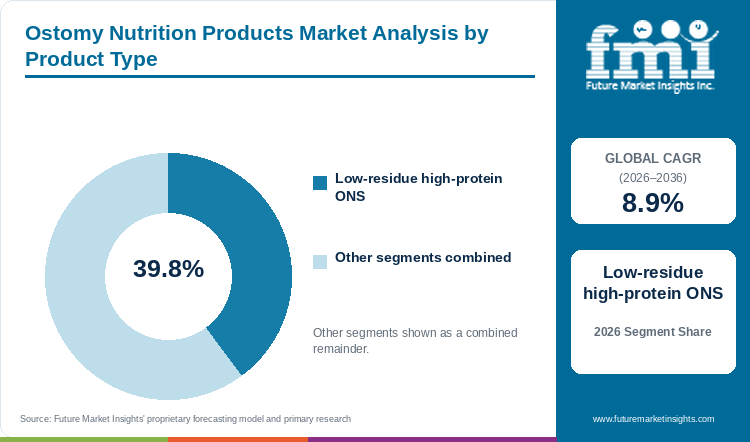
| Product type | Share (2026) |
|---|---|
| Low-residue high-protein ONS | 39.8% |
| Other segments combined | 60.2%* |
| Total | 100.0% |
| Metric | Value |
|---|---|
| Global CAGR (2026-2036) | 8.9% |
| Leading segment | Low-residue high-protein ONS |
Low-residue high-protein ONS is gaining preference as patients may require higher protein while avoiding bulky and high-fiber food after bowel surgery. These products provide protein and calories in a smaller quantity, functioning as concentrated oral clinical nutrition when regular meals are not meeting the recovery requirement. FMI research indicates that due to concentrated caloric and protein density, low-residue formulas can be integrated into recovery routines without overwhelming compromised digestion. Also, smaller serving size makes the product easier to consume where appetite remains poor. This is expected to support adoption during the first weeks after surgery. However, the use can reduce when food tolerance improves and the patient starts taking sufficient nutrition through ordinary meals.
- Low-residue high-protein ONS is projected to hold 39.8% share in 2026, owing to increasing demand for concentrated protein in smaller serving sizes.
- In September 2025, Fresenius Kabi introduced Fresubin PRO COMPACT, offering concentrated protein and high caloric density in a low-volume format for surgical and gastrointestinal recovery.[2]
Why does ileostomy lead the stoma type category?
By stoma type, ileostomy is estimated to hold 52.1% in 2026, reflecting higher fluid loss and necessary electrolyte replacement.
Ileostomy is creating higher requirement for hydration and electrolyte products as the colon is bypassed and less water and salt is absorbed by the body. Patients can face liquid or high stoma output, due to which structured postoperative hydration drinks and foods used for thickening output are adopted more frequently. The output can be measured by patients and stoma teams, and accordingly product use can be increased or reduced on the basis of fluid loss, urine, weight and food tolerance. Colostomy and urostomy patients also use nutrition support, but the requirement for replacing fluid and salt remains more direct in ileostomy.
- Ileostomy is set to hold 52.1% share in 2026, attributable to higher fluid loss and increasing requirement for electrolyte replacement.
- A March 2025 Royal Cornwall guideline defines high-output small-bowel stoma as above 1,250 ml for more than 48 hours and requires strict fluid monitoring.[3]
How does early post-op shape the phase category?
In 2026, early post-op is expected to lead phase with 54.1% share, driven by structured nutrition decisions following surgery.
Early post-op is an important phase as healing, food testing and output monitoring takes place together during the first weeks after surgery. Patients can face lower appetite and can remain uncertain regarding the foods that will be tolerated. This creates requirement for low-residue nutrition, protein supplements and electrolyte products that can be adjusted according to intake and stoma output. Clinical follow-up is also higher in this phase, which keeps product selection connected with the recovery requirement. After adaptation, many patients return towards ordinary diet and the use of specialized products becomes less regular.
- Early post-op is projected to hold 54.1% share in 2026, owing to higher nutrition, hydration and food-tolerance requirements after surgery.
- The 2026 WCET International Ostomy Guideline follows care from pre-admission through discharge and long-term living, reinforcing staged nutrition decisions.[4]
What supports homecare leadership in the end user category?
Homecare is anticipated to contribute 51.2% of end user sales in 2026, owing to continued self-management after hospital discharge.
Most ostomy nutrition products are consumed after the patient returns home, even when the first recommendation is provided by a hospital dietitian or stoma nurse. Preparation and regular use is therefore continued by the patient or caregiver. Products having smaller volume, simple directions and easy availability through pharmacy or home delivery are gaining preference for this reason. Hospitals continue to influence the first product selection, while homecare accounts for repeated usage during recovery and selected long-term enteral nutrition requirements.
- By end user, homecare is estimated to hold 51.2% share in 2026, supported by continued recovery and self-management after hospital discharge.
- NIDDK guidance states that ostomy nurses cover drinking enough liquids, diet, recovery, and complication prevention as patients adjust after surgery.[5]
What drives hospital pharmacy leadership in the sales channel category?
With an estimated 41.6% share in 2026, hospital pharmacy leads sales channel, underpinned by clinical selection during discharge planning.
Hospital pharmacy holds importance as product selection is generally started near surgery, nutrition assessment and discharge planning. Dietitians and stoma teams can identify poor food intake, high output or protein requirement and recommend the suitable product before discharge. Availability through hospital formulary also allows the patient to begin the product during supervised care and understand its preparation, aligning with inpatient clinical nutrition pathways. Repeat purchases can later move towards retail pharmacy and online channels, whereas hospital pharmacy continues to influence the first adoption.
- Hospital pharmacy is likely to capture 41.6% share in 2026, owing to product selection during surgery recovery and discharge planning.
- In December 2025, Abbott expanded its concentrated high-protein medical nutrition portfolio with targeted Ensure formulations designed for clinical and hospital formulary distribution.[6]
What are the drivers, restraints, and opportunities in the ostomy nutrition products market?
In the ostomy nutrition products market, the key driver is postoperative recovery, the key restraint is temporary product use, and the key opportunity is hospital-to-home bundles.
- Driver: Rising requirement for protein, fluid and electrolytes during recovery will continue to support specialized nutrition demand through 2036.
- Restraint: Improving bowel function and reimbursement limits on oral-only products will continue to constrain permanent product adoption through 2036.
- Opportunity: Growing focus on hospital-to-home bundles and standardized discharge guidance are expected to expand commercial use through 2036.
Postoperative Recovery Expands Specialized Nutrition Demand
Rising requirement for protein, fluid and electrolytes during recovery is one of the major factors driving ostomy nutrition products market, where gastrointestinal surgery nutrition requires structured intake monitoring before eating becomes stable. Patients having poor intake or high ileostomy output can require concentrated nutrition and oral rehydration products until eating and hydration becomes stable. A 2026 scoping review identifies dehydration as a leading cause of hospital readmission after ileostomy and links colonic diversion with kidney-injury risk.[7] Food intake, stoma output, urine and body weight can also be monitored by the clinical team. This enables the product to be increased, reduced or stopped according to the patient requirement, which keeps adoption connected with a measured nutrition problem.
Temporary Usage and Coverage Limits Restrain Market Adoption
A key factor restraining ostomy nutrition products market is that every patient does not require specialized nutrition permanently. As bowel function and food tolerance improves, patients can return towards a balanced ordinary diet and reduce the use of specialized formulas, while severe gastrointestinal complications may temporarily necessitate parenteral nutrition intervention. CMS coverage guidance continues to tie Medicare enteral nutrition to defined benefit and medical-necessity requirements, limiting a direct route for many oral-only products.[8] Oral-only nutrition can also remain outside selected reimbursement routes, due to which the patient has to make direct payment. This can restrict repeated purchase even where a product remains useful during recovery.
Hospital-to-Home Bundles Create Structured Recovery Opportunities
Growing focus on hospital-to-home nutrition is creating opportunities for phase-specific ostomy product bundles. A bundle can include smaller serving nutrition, measured electrolyte directions and targeted digestive health supplements used for managing bowel output during early recovery. Hull University Teaching Hospitals stated in January 2025 that high-output stomas may require lower-fiber eating, oral fluid restriction, and dietitian-directed high-calorie and high-protein intake.[9] Clear instructions regarding when to start, adjust and stop the product can make home use easier for the patient. This also supports appropriate adoption as supplementation can be reduced when ordinary food intake becomes sufficient and hydration remains stable.
Which country CAGRs are profiled in the ostomy nutrition products market?
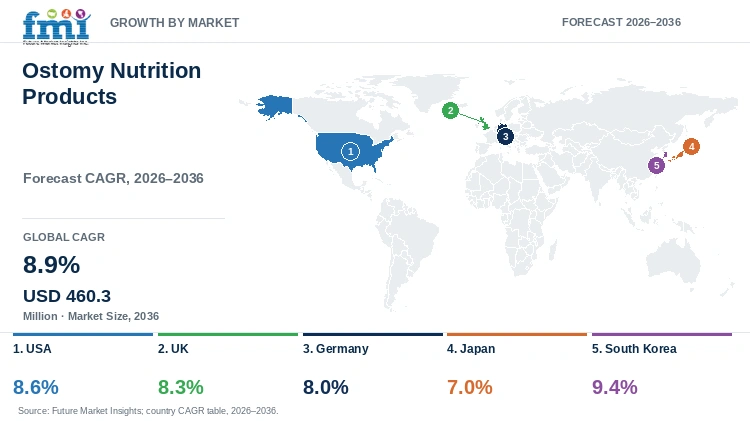
| Country | 2026-2036 CAGR |
|---|---|
| USA | 8.6% |
| UK | 8.3% |
| Germany | 8.0% |
| Japan | 7.0% |
| South Korea | 9.4% |
How do country-level CAGRs compare in the ostomy nutrition products market?
As per the analysis from FMI, country growth rates differ through 2036 because regulatory pathways, clinical adoption models, and reimbursement systems are not uniform across markets. South Korea and the USA lead projected growth above 8.5 per cent, while the UK, Germany, and Japan follow distinct postoperative care structures.
- USA demand expands through hospital-based nutrition screening, outpatient stoma care clinics, and specialized oral supplement retail access.
- The UK relies on structured NHS stoma care pathways and community dietetic formularies supporting post-discharge recovery.
- Germany emphasizes documented medical necessity and clinical indications for specialized enteral formulations across outpatient networks.
- Japan balances supervised inpatient recovery with cultural preferences for gradual reintroduction of traditional home foods.
- South Korea benefits from standardized health insurance assessment rules and hospital-directed postoperative clinical nutrition protocols.
Full report country CAGRs cover: North America; Latin America; Western Europe; Eastern Europe; East Asia; South Asia and Pacific; Middle East and Africa.
Country-wise Analysis
- By 2036, the USA ostomy nutrition products market is forecast to rise at 8.6% CAGR, owing to increasing hospital-based nutrition assessment and home recovery. In August 2025, Memorial Sloan Kettering Cancer Center reported that structured multidisciplinary monitoring reduced post-ileostomy dehydration readmissions to 5.4% compared to 11.5% previously.[10] This structure expands evaluation across outpatient clinics, while post-discharge dietary management often incorporates specialized recovery nutrition to prevent dehydration. However, oral-only products can depend on retail access and patient payment. Smaller packs and clear product directions are expected to support adoption during the short recovery period.
- The UK ostomy nutrition products market is projected to record 8.3% CAGR during the forecast period, supported by NHS stoma care and dietetic pathways. In March 2025, NHS Greater Glasgow and Clyde clinical guidance established protocol criteria requiring structured electrolyte rehydration and nutrition monitoring for high-output stomas exceeding 1,000 ml daily.[11] This measured output creates requirement for electrolyte replacement and nutrition intervention. In addition, local formularies and home supply routes are expected to influence which products remain available after the patient is discharged.
- Germany ostomy nutrition products market is anticipated to grow at 8.0% CAGR through 2036, owing to the importance given to medical requirement and prescribed nutrition. In July 2025, the Federal Joint Committee started a survey of manufacturers and professional societies regarding balanced diets for enteral nutrition.[12] This is expected to keep product formulation, intended medical use and prescriber information important for suppliers. Specialized medical nutrition needs to remain clearly different from ordinary food and convenience beverages for wider adoption.
- Adoption of ostomy nutrition products in Japan is estimated to expand at 7.0% CAGR through 2036, supported by hospital-led recovery and gradual return towards ordinary food. In May 2026, National Cancer Center East Hospital updated postoperative digestive nutrition information with small-volume and protein-containing meal options.[13] FMI data suggests that this structure helps buyers connect packaged medical nutrition with supervised clinical indications rather than convenience dietary use. As a result, packaged nutrition is mainly used along with meals and not as permanent replacement. Products are expected to gain demand when food intake remains inadequate, smaller servings are required or hydration needs measured support.
- South Korea is estimated to register 9.4% CAGR during 2026 to 2036, driven by hospital-led nutrition decisions and documented eligibility for medical nutrition. HIRA standards published in September 2025 continued to define conditions for reimbursed enteral nutrition products.[14] Although these conditions are broader than oral ostomy nutrition, they show the importance of documented nutrition insufficiency. Manufacturers are expected to provide a clear clinical use, supporting product information and an easy route for repeated purchase after discharge.
Who are the notable companies in the ostomy nutrition products market?
Medtrition, Abbott, Danone Nutricia, Nestle Health Science, DripDrop, Victus, Global Health Products, and Fresenius Kabi are notable companies profiled in this market.
Companies operating in ostomy nutrition products market are offering clinical nutrition, concentrated protein, GI management and hydration products for different recovery requirements. In the FMI report, competitive position is connected with hospital formulary access, concentrated protein depth, and ease of continuing product use at home after discharge. Abbott, Danone Nutricia, Nestle Health Science and Fresenius Kabi have wider medical nutrition portfolios and access through hospital channels. Medtrition and Global Health Products focus on bowel-management and concentrated protein formats, while DripDrop and Victus provide hydration and ready-to-drink nutrition products. Hospitals, dietitians and patients select these products on the basis of nutrition requirement, serving volume, tolerance, preparation and availability after discharge.
- Broad medical nutrition leaders: Abbott, Danone Nutricia, Nestle Health Science, and Fresenius Kabi offer comprehensive clinical nutrition portfolios through hospital channels.
- GI and modular nutrition specialists: Medtrition and Global Health Products focus on targeted bowel-output management and concentrated protein formats.
- Oral hydration and specialized RTD providers: DripDrop and Victus supply targeted electrolyte rehydration and specialized ready-to-drink formulations.
Competitive Benchmarking: Ostomy Nutrition Products Market
| Company | Clinical nutrition breadth | GI / output support | Concentrated protein | Hydration formats | Reach |
|---|---|---|---|---|---|
| Medtrition | Medium | High | High | Medium | Medium |
| Abbott | High | Medium | High | Medium | High |
| Danone Nutricia | High | Medium | High | Medium | High |
| Nestle Health Science | High | Medium | High | Medium | High |
| DripDrop | Low | Medium | Low | High | Medium |
| Victus | Medium | Medium | Medium | Medium | Medium |
| Global Health Products | Medium | High | High | Low | Medium |
| Fresenius Kabi | High | Medium | High | Medium | High |
High represents broad public evidence across the stated capability, Medium represents narrower evidence, and Low represents limited documented breadth. These ratings describe public company capability and do not indicate product quality, revenue share or company ranking.
Key Developments in the Ostomy Nutrition Products Market
- In February 2026, Nestle announced the integration of Nutrition and Nestle Health Science into one business, combining commercial, scientific, and manufacturing capabilities.[17]
- In October 2025, Danone Nutricia launched Fortimel PlantBased Protein, adding high-protein and high-energy savory and other formats across more than ten markets.[15]
- In June 2025, Fresenius Kabi expanded its enteral-nutrition research and development center in Gurugram to add laboratories and product-development infrastructure.[18]
- In March 2025, Global Health Products introduced LiquaCel HC, providing 20 g protein and 250 calories in a low-volume serving designed for hospital, clinic, and home use.[16]
Key Players in the Ostomy Nutrition Products Market
Broad medical nutrition suppliers
- Abbott
- Danone Nutricia
- Nestle Health Science
- Fresenius Kabi
GI and modular nutrition specialists
- Medtrition
- Global Health Products
Oral hydration and specialized RTD providers
- DripDrop
- Victus
Ostomy Nutrition Products Market - Report Scope
| Coverage field | Report scope |
|---|---|
| Market breakdown | Product type; stoma type; phase; end user; sales channel; and region. |
| Quantitative units | USD million. |
| Market definition | Packaged oral nutrition products used within ostomy care, including low-residue high-protein ONS, hydration and electrolyte products, output-thickening foods and fibers, and micronutrient support. |
| Exclusions | Ostomy appliances, pharmaceuticals, tube-only enteral products, parenteral nutrition, ordinary foods, and downstream service revenue. |
| Regions covered | North America; Latin America; Western Europe; Eastern Europe; East Asia; South Asia and Pacific; Middle East and Africa. |
| Forecast period | 2026 to 2036. |
Ostomy Nutrition Products Market - Research Methodology
| Method | Approach |
|---|---|
| Primary Research | Analysts gathered input from manufacturers, service providers, technology developers, distributors, end users, procurement teams, and subject-matter experts. Interviews examined purchasing decisions, product evaluation, adoption barriers, approval requirements, pricing, and technical support. |
| Desk Research | Desk research covered government statistics, regulatory publications, trade data, industry associations, technical literature, standards, company filings, product information, and official corporate announcements. Sources were checked for date, geography, and direct market relevance. |
| Market Sizing and Forecasting | The model combined the baseline value with historical performance, segment structure, pricing and volume indicators, adoption levels, company participation, and country demand conditions. Forecast assumptions included regulation, technology use, purchasing cycles, and supply availability. |
| Data Validation | Estimates were checked against public data, company activity, trade patterns, and primary-research findings. Adjacent categories, unsupported claims, overlapping revenue, and activities outside the defined market were excluded. |
Ostomy Nutrition Products Market by Segments
Ostomy Nutrition Products Market segmented by Product Type:
- Low-residue high-protein ONS
- Hydration and electrolyte products
- Output-thickening foods and fibers
- Micronutrient support
- Others
Ostomy Nutrition Products Market segmented by Stoma Type:
- Ileostomy
- Colostomy
- Urostomy
Ostomy Nutrition Products Market segmented by Phase:
- Early post-op
- Adaptation
- Long-term living
Ostomy Nutrition Products Market segmented by End User:
- Homecare
- Hospitals and stoma clinics
- Long-term care
- Others
Ostomy Nutrition Products Market segmented by Sales Channel:
- Hospital pharmacy
- Retail pharmacy
- Online
- Institutional tender
- Others
Ostomy Nutrition Products Market by Region
- North America
- United States
- Canada
- Mexico
- Latin America
- Brazil
- Chile
- Argentina
- Rest of Latin America
- Western Europe
- Germany
- United Kingdom
- France
- Italy
- Spain
- Benelux
- Nordics
- Rest of Western Europe
- Eastern Europe
- Poland
- Russia
- Czech Republic
- Romania
- Hungary
- Rest of Eastern Europe
- East Asia
- China
- Japan
- South Korea
- South Asia and Pacific
- India
- ASEAN
- Australia and New Zealand
- Rest of South Asia and Pacific
- Middle East and Africa
- GCC Countries
- South Africa
- Türkiye
- Rest of Middle East and Africa
Research Sources and Bibliography
- [1] St George’s University Hospitals NHS Foundation Trust. (2026). High Output Stoma Management.
- [2] Fresenius Kabi. (2025, September). Fresubin PRO COMPACT Drink: Concentrated Clinical Nutrition.
- [3] Royal Cornwall Hospitals NHS Trust. (2025, March). Initial Management of a High Output Small Bowel Stoma.
- [4] World Council of Enterostomal Therapists. (2026). WCET International Ostomy Guideline, 3rd edition.
- [5] National Institute of Diabetes and Digestive and Kidney Diseases. (2026). After Ostomy Surgery of the Bowel.
- [6] Abbott. (2025, December 4). Targeted High-Protein Medical Nutrition Formulations for Clinical Care.
- [7] Hoeg, A. J., et al. (2026). Oral rehydration solution for fluid and electrolyte disturbances in patients with an ileostomy. Journal of Parenteral and Enteral Nutrition (JPEN).
- [8] Centers for Medicare & Medicaid Services. (2026). Enteral Nutrition: Local Coverage Determination L38955.
- [9] Hull University Teaching Hospitals NHS Trust. (2025, January 9). Managing a High Output Stoma or Fistula.
- [10] Kong, D., et al. (2025, August 22). Addressing a common complication after ileostomy creation: A multidisciplinary program to decrease readmission for dehydration. Clinics in Surgery, Memorial Sloan Kettering Cancer Center.
- [11] NHS Greater Glasgow and Clyde. (2025, March 7). High Output Stoma Management in Adult Acute Inpatients (Clinical Guideline 1029).
- [12] Gemeinsamer Bundesausschuss. (2025, July 1). Bilanzierte Diäten zur enteralen Ernährung.
- [13] National Cancer Center Japan East Hospital. (2026, May 12). Postoperative digestive nutrition and meal options.
- [14] Health Insurance Review & Assessment Service. (2025, September). Medical Nutrition Reimbursement Standards.
- [15] Danone Nutricia. (2025, October 1). Fortimel PlantBased Protein Launch.
- [16] Global Health Products. (2025, March 20). Introducing LiquaCel HC: Concentrated Protein and Calorie Solution.
- [17] Nestle. (2026, February 19). Full-Year Results 2025 and Strategic Business Integration.
- [18] Fresenius Kabi. (2025, June 26). New Enteral-Nutrition R&D Center Strengthens Global Innovation Network.
This bibliography is provided for reader reference. The full report contains the complete reference list and detailed citations.
This Report Answers
- What is Ostomy Nutrition Products Market worth during 2026?
- What value is Ostomy Nutrition Products Market projected by 2036?
- Which product type holds notable Ostomy Nutrition Products Market share?
- Which stoma type holds notable Ostomy Nutrition Products Market share?
- Which countries have notable Ostomy Nutrition Products Market growth?
- Which companies are notable in Ostomy Nutrition Products Market today?
Frequently Asked Questions
How large is the Ostomy Nutrition Products Market expected to be in 2026?
Future Market Insights estimates that the ostomy nutrition products market will reach USD 196.2 million in 2026. The market is projected to expand further and reach USD 460.3 million by 2036.
What CAGR is forecast for the Ostomy Nutrition Products Market through 2036?
As per FMI, the ostomy nutrition products market is projected to grow at an 8.9% CAGR from 2026 to 2036. Growth is supported by increasing postoperative protein requirements and measurable ileostomy-related hydration risks.
Which product type holds a notable ostomy nutrition products demand share in 2026?
Future Market Insights projects low-residue high-protein ONS to hold 39.8% of product type demand in 2026. The segment benefits from concentrated recovery nutrition when meal volume and dietary fiber tolerance remain limited.
Which stoma type holds a notable ostomy nutrition products share in 2026?
FMI finds that ileostomy will hold 52.1% of stoma type demand in 2026. Demand is supported by direct fluid loss, electrolyte replacement requirements, and active output management.
Which country has a notable ostomy nutrition products expansion outlook during the forecast period?
Future Market Insights predicts South Korea to expand at a 9.4% CAGR during the 2026 to 2036 assessment period. Growth is supported by hospital-led nutrition decisions and documented clinical eligibility for medical nutrition.
Which companies are active in the Ostomy Nutrition Products Market during 2026?
Notable companies active in the ostomy nutrition products market during 2026 include Medtrition, Abbott, Danone Nutricia, Nestle Health Science, DripDrop, Victus, Global Health Products, and Fresenius Kabi. These companies are focusing on specialized GI support, concentrated protein formulations, and hospital-to-home distribution channels.
Preview the report firsthand - request a free sample
Get SampleGet the brochure for pricing and purchase details.
Get PDFTable of Content
- Key Takeaways
- Market Size and CAGR
- Top Growth Driver
- Fastest Growing Segment
- Leading Region
- Key Companies
- Emerging Opportunities
- Executive Summary
- Global Market Outlook
- Demand-side Trends
- Supply-side Trends
- Technology Roadmap Analysis
- Analysis and Recommendations
- Analyst Perspective (What is happening? Why now? What should investors know?)
- Key Questions Answered
- How large is the market?
- What is the CAGR?
- What are key trends?
- Which region dominates?
- Who are the leaders?
- Market Overview
- Market Coverage / Taxonomy
- Market Definition / Scope / Limitations
- Research Methodology
- Chapter Orientation
- Analytical Lens and Working Hypotheses
- Market Structure, Signals, and Trend Drivers
- Benchmarking and Cross-market Comparability
- Market Sizing, Forecasting, and Opportunity Mapping
- Research Design and Evidence Framework
- Desk Research Programme (Secondary Evidence)
- Expert Input and Fieldwork (Primary Evidence)
- Tooling, Models, and Reference Databases
- Data Engineering and Model Build
- Quality Assurance and Audit Trail
- Market Background
- Market Dynamics (Drivers, Restraints, Opportunity, Trends)
- Scenario Forecast (Optimistic, Likely, Conservative)
- Impact Analysis
- AI Impact
- Sustainability Impact
- Regulatory Impact
- Technology Impact
- Consumer / Buyer Analysis
- Purchase Drivers
- Adoption Barriers
- Buyer Journey
- Opportunity Map Analysis
- Product Life Cycle Analysis
- Supply Chain Analysis
- Investment Feasibility Matrix
- Value Chain Analysis
- PESTLE and Porter's Analysis
- Regulatory Landscape
- Regional Parent Market Outlook
- Production and Consumption Statistics
- Import and Export Statistics
- Global Market Analysis and Forecast, 2021 to 2036
- Historical Market Size Value (USD Million) Analysis, 2021 to 2025
- Current and Future Market Size Value (USD Million) Projections, 2026 to 2036
- Y-o-Y Growth Trend Analysis
- Absolute $ Opportunity Analysis
- Global Market Pricing Analysis, 2021 to 2036
- Global Market Analysis and Forecast, By Product Type, 2021 to 2036
- Introduction / Key Findings
- Historical Market Size Value (USD Million) Analysis By Product Type, 2021 to 2025
- Current and Future Market Size Value (USD Million) Analysis and Forecast By Product Type, 2026 to 2036
- Low-residue high-protein ONS
- Hydration and electrolyte products
- Output-thickening foods and fibers
- Micronutrient support
- Others
- Y-o-Y Growth Trend Analysis By Product Type, 2021 to 2025
- Absolute $ Opportunity Analysis By Product Type, 2026 to 2036
- Global Market Analysis and Forecast, By Stoma Type, 2021 to 2036
- Introduction / Key Findings
- Historical Market Size Value (USD Million) Analysis By Stoma Type, 2021 to 2025
- Current and Future Market Size Value (USD Million) Analysis and Forecast By Stoma Type, 2026 to 2036
- Ileostomy
- Colostomy
- Urostomy
- Y-o-Y Growth Trend Analysis By Stoma Type, 2021 to 2025
- Absolute $ Opportunity Analysis By Stoma Type, 2026 to 2036
- Global Market Analysis and Forecast, By Phase, 2021 to 2036
- Introduction / Key Findings
- Historical Market Size Value (USD Million) Analysis By Phase, 2021 to 2025
- Current and Future Market Size Value (USD Million) Analysis and Forecast By Phase, 2026 to 2036
- Early post-op
- Adaptation
- Long-term living
- Y-o-Y Growth Trend Analysis By Phase, 2021 to 2025
- Absolute $ Opportunity Analysis By Phase, 2026 to 2036
- Global Market Analysis and Forecast, By End User, 2021 to 2036
- Introduction / Key Findings
- Historical Market Size Value (USD Million) Analysis By End User, 2021 to 2025
- Current and Future Market Size Value (USD Million) Analysis and Forecast By End User, 2026 to 2036
- Homecare
- Hospitals and stoma clinics
- Long-term care
- Others
- Y-o-Y Growth Trend Analysis By End User, 2021 to 2025
- Absolute $ Opportunity Analysis By End User, 2026 to 2036
- Global Market Analysis and Forecast, By Sales Channel, 2021 to 2036
- Introduction / Key Findings
- Historical Market Size Value (USD Million) Analysis By Sales Channel, 2021 to 2025
- Current and Future Market Size Value (USD Million) Analysis and Forecast By Sales Channel, 2026 to 2036
- Hospital pharmacy
- Retail pharmacy
- Online
- Institutional tender
- Others
- Y-o-Y Growth Trend Analysis By Sales Channel, 2021 to 2025
- Absolute $ Opportunity Analysis By Sales Channel, 2026 to 2036
- Global Market Analysis and Forecast, By Region, 2021 to 2036
- Introduction
- Historical Market Size Value (USD Million) Analysis By Region, 2021 to 2025
- Current Market Size Value (USD Million) Analysis and Forecast By Region, 2026 to 2036
- North America
- Latin America
- Western Europe
- Eastern Europe
- East Asia
- South Asia and Pacific
- Middle East and Africa
- Market Attractiveness Analysis By Region
- North America Market Analysis and Forecast, By Country, 2021 to 2036
- Historical Market Size Value (USD Million) Trend Analysis By Market Taxonomy, 2021 to 2025
- Market Size Value (USD Million) Forecast By Market Taxonomy, 2026 to 2036
- By Country
- United States
- Canada
- Mexico
- By Product Type
- By Stoma Type
- By Phase
- By End User
- By Sales Channel
- By Country
- Market Attractiveness Analysis
- By Country
- By Product Type
- By Stoma Type
- By Phase
- By End User
- By Sales Channel
- Key Takeaways
- Latin America Market Analysis and Forecast, By Country
- Historical Market Size Value (USD Million) Trend Analysis By Market Taxonomy, 2021 to 2025
- Market Size Value (USD Million) Forecast By Market Taxonomy, 2026 to 2036
- By Country
- Brazil
- Chile
- Argentina
- Rest of Latin America
- By Product Type
- By Stoma Type
- By Phase
- By End User
- By Sales Channel
- By Country
- Market Attractiveness Analysis
- By Country
- By Product Type
- By Stoma Type
- By Phase
- By End User
- By Sales Channel
- Key Takeaways
- Western Europe Market Analysis and Forecast, By Country
- Historical Market Size Value (USD Million) Trend Analysis By Market Taxonomy, 2021 to 2025
- Market Size Value (USD Million) Forecast By Market Taxonomy, 2026 to 2036
- By Country
- Germany
- United Kingdom
- France
- Italy
- Spain
- Benelux
- Nordics
- Rest of Western Europe
- By Product Type
- By Stoma Type
- By Phase
- By End User
- By Sales Channel
- By Country
- Market Attractiveness Analysis
- By Country
- By Product Type
- By Stoma Type
- By Phase
- By End User
- By Sales Channel
- Key Takeaways
- Eastern Europe Market Analysis and Forecast, By Country
- Historical Market Size Value (USD Million) Trend Analysis By Market Taxonomy, 2021 to 2025
- Market Size Value (USD Million) Forecast By Market Taxonomy, 2026 to 2036
- By Country
- Poland
- Russia
- Czech Republic
- Romania
- Hungary
- Rest of Eastern Europe
- By Product Type
- By Stoma Type
- By Phase
- By End User
- By Sales Channel
- By Country
- Market Attractiveness Analysis
- By Country
- By Product Type
- By Stoma Type
- By Phase
- By End User
- By Sales Channel
- Key Takeaways
- East Asia Market Analysis and Forecast, By Country
- Historical Market Size Value (USD Million) Trend Analysis By Market Taxonomy, 2021 to 2025
- Market Size Value (USD Million) Forecast By Market Taxonomy, 2026 to 2036
- By Country
- China
- Japan
- South Korea
- By Product Type
- By Stoma Type
- By Phase
- By End User
- By Sales Channel
- By Country
- Market Attractiveness Analysis
- By Country
- By Product Type
- By Stoma Type
- By Phase
- By End User
- By Sales Channel
- Key Takeaways
- South Asia and Pacific Market Analysis and Forecast, By Country
- Historical Market Size Value (USD Million) Trend Analysis By Market Taxonomy, 2021 to 2025
- Market Size Value (USD Million) Forecast By Market Taxonomy, 2026 to 2036
- By Country
- India
- ASEAN
- Australia and New Zealand
- Rest of South Asia and Pacific
- By Product Type
- By Stoma Type
- By Phase
- By End User
- By Sales Channel
- By Country
- Market Attractiveness Analysis
- By Country
- By Product Type
- By Stoma Type
- By Phase
- By End User
- By Sales Channel
- Key Takeaways
- Middle East and Africa Market Analysis and Forecast, By Country
- Historical Market Size Value (USD Million) Trend Analysis By Market Taxonomy, 2021 to 2025
- Market Size Value (USD Million) Forecast By Market Taxonomy, 2026 to 2036
- By Country
- GCC Countries
- South Africa
- Türkiye
- Rest of Middle East and Africa
- By Product Type
- By Stoma Type
- By Phase
- By End User
- By Sales Channel
- By Country
- Market Attractiveness Analysis
- By Country
- By Product Type
- By Stoma Type
- By Phase
- By End User
- By Sales Channel
- Key Takeaways
- Key Countries Market Analysis
- United States
- Pricing Analysis
- Market Share Analysis, 2025
- By Product Type
- By Stoma Type
- By Phase
- By End User
- By Sales Channel
- Canada
- Pricing Analysis
- Market Share Analysis, 2025
- By Product Type
- By Stoma Type
- By Phase
- By End User
- By Sales Channel
- Mexico
- Pricing Analysis
- Market Share Analysis, 2025
- By Product Type
- By Stoma Type
- By Phase
- By End User
- By Sales Channel
- Brazil
- Pricing Analysis
- Market Share Analysis, 2025
- By Product Type
- By Stoma Type
- By Phase
- By End User
- By Sales Channel
- Chile
- Pricing Analysis
- Market Share Analysis, 2025
- By Product Type
- By Stoma Type
- By Phase
- By End User
- By Sales Channel
- Germany
- Pricing Analysis
- Market Share Analysis, 2025
- By Product Type
- By Stoma Type
- By Phase
- By End User
- By Sales Channel
- United Kingdom
- Pricing Analysis
- Market Share Analysis, 2025
- By Product Type
- By Stoma Type
- By Phase
- By End User
- By Sales Channel
- Italy
- Pricing Analysis
- Market Share Analysis, 2025
- By Product Type
- By Stoma Type
- By Phase
- By End User
- By Sales Channel
- Spain
- Pricing Analysis
- Market Share Analysis, 2025
- By Product Type
- By Stoma Type
- By Phase
- By End User
- By Sales Channel
- France
- Pricing Analysis
- Market Share Analysis, 2025
- By Product Type
- By Stoma Type
- By Phase
- By End User
- By Sales Channel
- India
- Pricing Analysis
- Market Share Analysis, 2025
- By Product Type
- By Stoma Type
- By Phase
- By End User
- By Sales Channel
- ASEAN
- Pricing Analysis
- Market Share Analysis, 2025
- By Product Type
- By Stoma Type
- By Phase
- By End User
- By Sales Channel
- Australia and New Zealand
- Pricing Analysis
- Market Share Analysis, 2025
- By Product Type
- By Stoma Type
- By Phase
- By End User
- By Sales Channel
- China
- Pricing Analysis
- Market Share Analysis, 2025
- By Product Type
- By Stoma Type
- By Phase
- By End User
- By Sales Channel
- Japan
- Pricing Analysis
- Market Share Analysis, 2025
- By Product Type
- By Stoma Type
- By Phase
- By End User
- By Sales Channel
- South Korea
- Pricing Analysis
- Market Share Analysis, 2025
- By Product Type
- By Stoma Type
- By Phase
- By End User
- By Sales Channel
- Russia
- Pricing Analysis
- Market Share Analysis, 2025
- By Product Type
- By Stoma Type
- By Phase
- By End User
- By Sales Channel
- Poland
- Pricing Analysis
- Market Share Analysis, 2025
- By Product Type
- By Stoma Type
- By Phase
- By End User
- By Sales Channel
- Hungary
- Pricing Analysis
- Market Share Analysis, 2025
- By Product Type
- By Stoma Type
- By Phase
- By End User
- By Sales Channel
- Türkiye
- Pricing Analysis
- Market Share Analysis, 2025
- By Product Type
- By Stoma Type
- By Phase
- By End User
- By Sales Channel
- South Africa
- Pricing Analysis
- Market Share Analysis, 2025
- By Product Type
- By Stoma Type
- By Phase
- By End User
- By Sales Channel
- United States
- Market Structure Analysis
- Competition Dashboard
- Competition Benchmarking
- Market Share Analysis of Top Players
- By Regional
- By Product Type
- By Stoma Type
- By Phase
- By End User
- By Sales Channel
- Emerging Startups
- Innovation Benchmarking
- Competition Analysis
- Competition Deep Dive
- Medtrition
- Overview
- Product Portfolio
- Profitability by Market Segments
- Sales Footprint
- Strategy Overview
- Marketing Strategy
- Product Strategy
- Channel Strategy
- Abbott
- Danone Nutricia
- Nestle Health Science
- DripDrop
- Victus
- Global Health Products
- Fresenius Kabi
- Medtrition
- Case Studies
- Success Stories
- Recent Developments
- Competition Deep Dive
- Assumptions & Acronyms Used


