

- Market Size (2026)
- USD 131.7 Mn
- Forecast (2036)
- USD 341.5 Mn
- CAGR (2026 to 2036)
- 10.0%
How big is Postoperative Hydration Beverage Market in 2026?
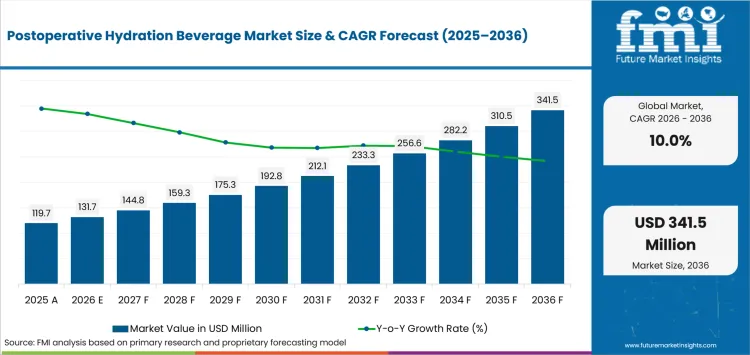
USD 131.7 million in 2026 and USD 341.5 million by 2036 at a 10.0% CAGR.
Demand for postoperative hydration beverages is projected to expand at 10.0% CAGR between 2026 and 2036, increasing valuation from USD 131.7 million in 2026 to USD 341.5 million by 2036. Outpatient and same-day surgery shift routine hydration into written discharge instructions. CMS's August 2026 national OAS CAHPS data show 92% of patients said staff definitely communicated what to expect during and after the procedure. A beverage must fit that communication step to move from general wellness into structured recovery.
Site of care determines how much routine hydration shifts into discharge and home recovery after an eligible procedure. OECD data published in November 2025 show ambulatory surgery accounts for at least 90% of cataract procedures in most reporting countries. Germany remains below that level because payment rules and surgical practice change when postoperative beverages enter the recovery plan.
Key Takeaways
- Earlier discharge moves more routine fluid management into home recovery and increases the value of structured oral hydration.
- By product type, medical-grade ORS is estimated to hold 46.1% in 2026 owing to direct electrolyte-replacement logic.
- Based on indication, general post-surgical hydration is projected to account for 45.8% in 2026 driven by its broad procedure base.
- In 2026, stick packs are expected to lead product form with 41.0% share because single-use doses travel easily with discharged patients.
- Patient-specific fluid limits and hospital review can narrow protocol use even after an oral product fits the recovery plan.
- Some of the key players in this market include DripDrop, Abbott, Nestle Health Science, Danone Nutricia, Liquid I.V. (Unilever), Cure Hydration, Otsuka Pharmaceutical Factory, and Medtrition.
Analyst Perspective
"Postoperative hydration has commercial value when a product fits a written discharge routine and clinicians can distinguish it from ordinary sports hydration. Formulation instructions and take-home usability should be assessed before price because unclear use can block routine protocol placement."
- Nandini Roy Choudhury, Principal Consultant at Future Market Insights, provides the analyst perspective for this market assessment.
How is the postoperative hydration beverage market segmented?
Product Type, Indication, Product Form, End User, Sales Channel and Region.
The postoperative hydration beverage market is segmented by product type, indication, product form, end user, sales channel and region. Product types include medical-grade ORS, low-sugar electrolyte drinks, protein + electrolyte combos and others. Indications include general post-surgical hydration, GI surgery & ostomy, orthopedic & same-day surgery and others. Product forms include stick packs, RTD, tablets and others. End users include homecare, hospitals, ambulatory surgery centers and others. Sales channels include hospital pharmacy, retail pharmacy, online, institutional tender and others.
What makes medical-grade ORS central to the product type category?
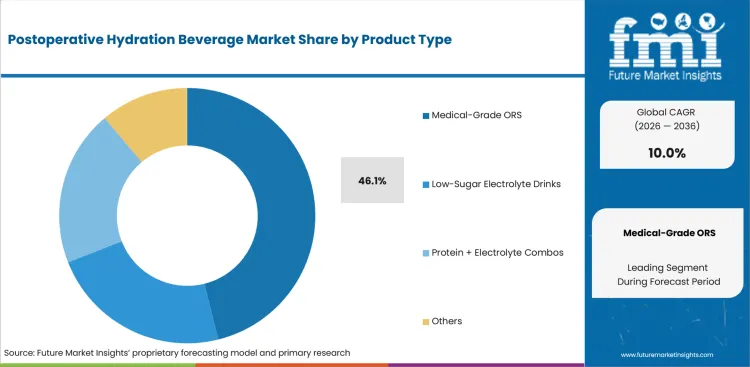
Medical-grade ORS gives clinical teams a recognized electrolyte-replacement reference once oral intake resumes. WHO's September 2025 Model List of Essential Medicines specifies an ORS formulation at 245 mOsm/L. A defined ORS composition lets clinicians assess electrolyte drinks against a recognized rehydration benchmark instead of a general refreshment claim.
- By product type, medical-grade ORS is estimated to hold 46.1% in 2026 owing to formulation logic that maps directly to oral fluid and electrolyte replacement.
- Hospital teams compare electrolyte concentration and dilution instructions with the prescribed postoperative regimen before including a product in discharge materials.
Why does general post-surgical hydration lead the indication category?
General post-surgical hydration covers the widest population once oral intake resumes. Written discharge instructions determine whether oral clinical nutrition and hydration products can fit recovery. A September 2025 American College of Surgeons review recorded 4.8% outpatient IV fluid use among older patients discharged the same day after sleeve gastrectomy. Post-discharge IV fluid use keeps hydration planning tied to a defined clinical pathway instead of a broad wellness message.
- Based on indication, general post-surgical hydration is projected to account for 45.8% in 2026 driven by use after a wider range of procedures than specialist GI or ostomy pathways.
- General post-surgical hydration fits standard discharge instructions while clinicians retain control over volume and composition for higher-risk patients.
How do stick packs support leadership in the product form category?
Stick packs separate each powder dose until use and take less storage space than ready-to-drink bottles. The stick packaging format lets clinical staff pair a single powder unit with a prescribed fluid volume. Postoperative use still depends on the instruction that accompanies the pack. UNICEF's July 2026 ORS update lists sachets designed to make 0.2 L to 1 L of prepared solution.
- In 2026, stick packs are expected to lead the product form category with 41.0% share because single-use powder doses fit discharge bags and later replenishment.
- Ready-to-drink formats remove mixing work but require more storage space while tablets stay compact and use a different dissolution routine.
What supports homecare leadership in the end user category?
Homecare covers the part of recovery that continues after the hospital handoff. NHS England reported in May 2026 that Wrightington's surgical hubs halved length of stay for hip and knee surgery. Faster discharge leaves more routine intake with patients at home. Packaging and instructions in home healthcare must work without clinical equipment.
- The end user category is forecast to be led by homecare at 44.8% share in 2026 due to shorter stays that extend routine hydration beyond the facility.
- Patients or caregivers need directions they can follow without clinical equipment while hospitals specify products for higher-risk cases.
What drives hospital pharmacy leadership in the sales channel category?
Hospital pharmacy can tie the first take-home supply to the discharge order. The first dispensing point can control which product and instructions leave with the patient. The same workflow can carry enteral nutrition or oral hydration if the discharge order includes those products. ASHP reported in September 2025 that one health network raised in-house prescription capture to more than 60%.
- Hospital pharmacy is set to lead the sales channel category with 46.2% share in 2026 due to formulary control and direct access to patients at discharge.
- Retail and online channels become more important after the first supply while institutional tenders matter where centralized contracts determine access.
What are the drivers, restraints and opportunities in the Postoperative Hydration Beverage Market?
Early oral intake and outpatient surgery support demand. Patient-specific fluid limits constrain standardization. Day-case payment rules open a clearer route for discharge-focused formats.
- Driver: Outpatient surgery moves more recovery episodes into settings where patients manage routine hydration after discharge.
- Restraint: Renal or cardiac fluid limits can prevent one electrolyte regimen from fitting every postoperative patient.
- Opportunity: Day-case pathways give hospitals a defined point to dispense oral hydration with written home-use instructions.
Outpatient Procedure Capacity Extends the Oral Recovery Window
CMS said in July 2026 that its proposed 2027 policies would affect about 6,400 ambulatory surgical centers. The proposal also continues the phaseout of inpatient-only procedures. More eligible outpatient episodes move routine fluid management toward discharge, making portable oral hydration relevant when the clinical pathway specifies home use.
Patient-Specific Fluid Limits Narrow Standardization
Postoperative fluid targets vary enough that one formula cannot fit every patient. The National Kidney Foundation noted in March 2025 that some dialysis patients need fluid limits because their kidneys cannot remove enough fluid. Surgical teams need clear composition data and use limits before they adopt one beverage as a broad protocol.
Day-Case Payment Rules Open a Discharge-Kit Route
NHS England's 2026/27 payment guidance introduces new day-case best practice tariffs whose target rates would shift 26,000 overnight admissions into day cases. The tariff gives hospital pharmacies a defined discharge point for oral hydration. A practical model pairs the first supply with procedure-specific instructions and a home replenishment option for hydration supplements.
Which country CAGRs are profiled in the Postoperative Hydration Beverage Market?
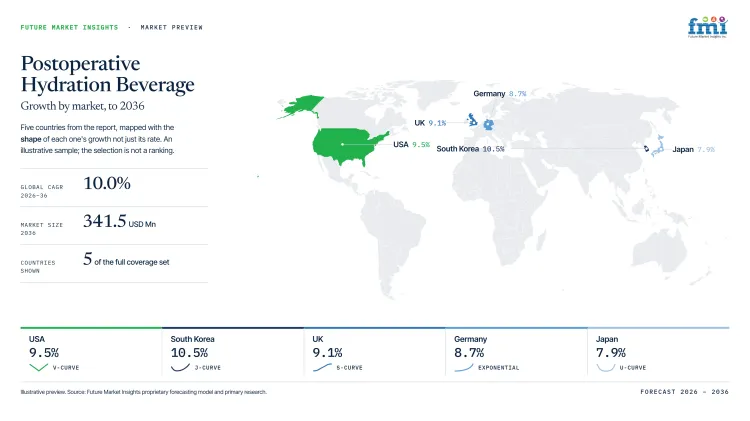
| Country | CAGR |
|---|---|
| South Korea | 10.5% |
| USA | 9.5% |
| UK | 9.1% |
| Germany | 8.7% |
| Japan | 7.9% |
How do country-level CAGRs compare in the Postoperative Hydration Beverage Market?
The 2.6-point range separates a faster South Korea-USA pair from a slower Japan endpoint. UK and Germany form the middle band because each system moves routine recovery away from inpatient beds at a different pace. Current revenue can still differ because procedure volume and access channels are not the same.
- South Korea's dense hospital network can shorten replenishment trips after discharge for patients continuing oral hydration at home.
- USA retail refill options can extend patient access beyond the first hospital supply after discharge.
- UK pharmacy access can support refill demand after a trust selects the initial hydration product.
- Germany's community pharmacies can keep refill access close to discharged patients during routine home recovery.
- Japan's dense retail network can support convenient replenishment after hospital discharge when protocols allow home use.
Similar CAGRs can therefore produce different account structures and refill economics across each profiled country market. The full report provides country-level CAGR analysis across North America, Latin America, Western Europe, Eastern Europe, East Asia, South Asia and Pacific and the Middle East and Africa.
Country-wise Analysis
- South Korea's very large national outpatient care base gives postoperative hydration a broad home-recovery setting after eligible procedures. HIRA recorded more than 1.55 billion outpatient review decisions for 2025 in its 2026 performance data. Postoperative hydration beverage demand in South Korea is forecast to rise at 10.5% CAGR over the forecast period, driven by the scale of outpatient care. Hospital approval is the practical entry gate because discharge instructions determine permitted use and compact sachet packaging suits home continuation. National insurance classification and evidence requirements can delay protocol placement, so companies without hospital nutrition support face a slower account-building process.
- US hospitals and surgery centers already handle a large outpatient procedure base, but individual health systems still control formulary and discharge decisions. Postoperative hydration beverage sales in USA are forecast to expand at 9.5% CAGR by 2036, supported by a wider set of outpatient procedures. CMS finalized removal of 285 mostly musculoskeletal procedures from the inpatient-only list for 2026 and added 289 procedures to the ASC covered list. Ambulatory surgical centers can specify portable oral hydration following clinical and pharmacy review, while regional payer rules still influence routine coverage. Fragmented account structures make contracting and protocol education a recurring cost for brands without established health-system relationships.
- UK purchasing is concentrated inside NHS pathways, so one approved discharge protocol can scale within a trust or surgical hub. NHS England reported in January 2025 that more than 110 elective surgical hubs were operating and called for greater day-case suitability. The UK postoperative hydration beverage sector is projected to record 9.1% CAGR during the assessment period, attributable to shorter elective stays that move routine intake into home recovery. Hydration offers still need a clinical rationale that survives formulary review and local budget scrutiny. Centralized pathways improve repeatability after approval, but unit-cost pressure can limit routine discharge inclusion even where clinical teams support oral hydration.
- German providers are shifting selected procedures into ambulatory care under AOP and Hybrid-DRG payment structures. In Germany, postoperative hydration beverage demand is predicted to advance at 8.7% CAGR through 2036 driven by this site-of-care shift. The Federal Ministry of Health reported in March 2025 that AOP ambulatory operations increased 11.5% during 2024. Hospital pharmacists and physicians still need a documented reason to add oral hydration to recovery protocols despite familiarity with parenteral nutrition. Reimbursement design and product qualification differ between provider types, so the same product needs a different commercial case in both hospital and community settings under different purchasing rules.
- Japanese postoperative purchasing stays closely tied to hospital clinical paths and DPC payment rules that influence length of stay. MHLW reported in July 2025 that about 93% of surveyed DPC hospitals used clinical paths. Adoption of postoperative hydration beverages in Japan is estimated to expand at 7.9% CAGR through 2036, constrained by slower site-of-care migration. Physician instructions remain central at discharge and functional beverages do not replace the evidence required for clinical use even with strong consumer familiarity. DPC incentives keep routine recovery inside hospital-defined schedules longer than in faster outpatient systems, so broad retail refill strategies usually follow hospital protocol acceptance.
Who are the notable companies in the Postoperative Hydration Beverage Market?
DripDrop, Abbott, Nestle Health Science, Danone Nutricia, Liquid I.V. (Unilever), Cure Hydration, Otsuka Pharmaceutical Factory and Medtrition are the notable companies profiled in this market.
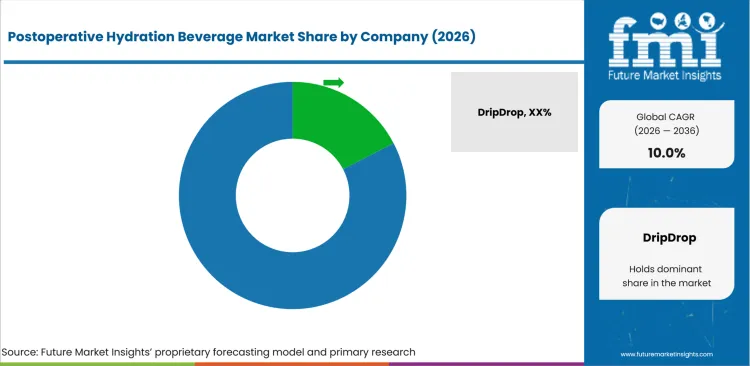
Competition splits between oral rehydration brands and medical nutrition companies with different recovery routes. DripDrop and Cure Hydration sell portable electrolyte mixes while Otsuka Pharmaceutical Factory supplies regulated oral rehydration in Japan. Liquid I.V. under Unilever brings consumer retail scale while Abbott and Nestle Health Science bring medical nutrition channels. Danone Nutricia serves specialized nutrition accounts while Medtrition serves acute and long-term care nutrition.
- DripDrop and Cure Hydration compete on portable electrolyte mixes while Otsuka Pharmaceutical Factory holds a regulated oral rehydration position in Japan.
- Abbott and Nestle Health Science bring international medical nutrition channels while Danone Nutricia serves specialized nutrition accounts.
- Liquid I.V. under Unilever competes in portable consumer hydration while Medtrition serves acute and long-term care nutrition.
Competitive Benchmarking: Postoperative Hydration Beverage Market
| Company | Clinical Rehydration Alignment | Discharge-Ready Formats | Institutional Care Access | Geographic Reach |
|---|---|---|---|---|
| DripDrop | High | High | Medium | United States with selected professional channels |
| Abbott | High | High | High | Global |
| Nestle Health Science | Medium | High | High | Global |
| Danone Nutricia | Medium | High | High | Global |
| Liquid I.V. (Unilever) | Medium | High | Low | Multi-market consumer distribution |
| Cure Hydration | Medium | High | Medium | United States retail and healthcare-partner channels |
| Otsuka Pharmaceutical Factory | High | High | High | Japan |
| Medtrition | Low | Medium | High | United States and international clinical channels |
Scoring basis: High clinical rehydration alignment requires a documented ORS or medically oriented hydration product. Medium covers a relevant electrolyte or medical nutrition route and Low marks adjacent hydration activity. High discharge-ready format requires a portable or ready-to-consume product with clear patient instructions. Medium covers formats needing more preparation and Low marks formats outside direct take-home use. Institutional access is High for documented hospital or national-account reach. Medium reflects narrower healthcare access and Low reflects consumer-led distribution.
Key Developments in the Postoperative Hydration Beverage Market
- In August 2025, Liquid I.V. (Unilever) introduced Energy Multiplier Sugar-Free in single-serve sticks and announced a wider Target rollout for August 31.
- In July 2025, Danone completed its majority acquisition of Kate Farms to expand US specialized nutrition in hospital and home channels.
- In March 2025, Medtrition launched ProSource Cup for acute and long-term care and said national-account plus group-purchasing availability would begin in April.
Key Players in the Postoperative Hydration Beverage Market
Oral Rehydration and Portable Hydration Specialists
- DripDrop
- Liquid I.V.
- Cure Hydration
Medical Nutrition and Institutional Care Platforms
- Abbott
- Nestle Health Science
- Danone Nutricia
Clinical Rehydration and Recovery Nutrition Specialists
- Otsuka Pharmaceutical Factory
- Medtrition
Postoperative Hydration Beverage Market - Report Scope
| Coverage field | Report scope |
|---|---|
| Market breakdown | By product type, indication, product form, end user, sales channel and region. |
| Quantitative Units | Market values are reported in USD million throughout the forecast period. |
| Market Definition | Revenue from postoperative hydration beverages used for oral fluid and electrolyte support during recovery. The scope excludes intravenous fluids, preoperative-only beverages, downstream revenue outside this category and adjacent substitute beverages. |
| Regions Covered | North America; Latin America; Western Europe; Eastern Europe; East Asia; South Asia and Pacific; Middle East and Africa. |
| Countries Covered | South Korea, USA, UK, Germany, Japan, and 20+ countries included in the full report. |
| Key Companies Profiled | DripDrop, Abbott, Nestle Health Science, Danone Nutricia, Liquid I.V. (Unilever), Cure Hydration, Otsuka Pharmaceutical Factory, Medtrition. |
| Forecast Period | The forecast period for this market assessment runs from 2026 through 2036. |
| Approach | The study uses primary and secondary research supported by market triangulation. |
Postoperative Hydration Beverage Market - Research Methodology
| Method | Approach |
|---|---|
| Primary Research | FMI analysts gathered input from manufacturers, service providers, technology developers, distributors, end users, procurement teams, and subject-matter experts. Interviews examined purchasing decisions, product or service evaluation, adoption barriers, approval requirements, pricing considerations, and expectations for technical or commercial support. Respondents were also asked what evidence is required before a trial, pilot, or initial order develops into regular purchasing. |
| Desk Research | Desk research covered government statistics, regulatory publications, trade data, industry associations, technical literature, standards, company filings, product information, and official corporate announcements. Sources were reviewed for relevance, publication date, geographic coverage, and consistency with the defined market scope. Claims relating to performance, applications, approvals, capacity, investment, and commercial activity were retained only when supported by credible public evidence. |
| Market Sizing and Forecasting | The market model combined the baseline value with historical performance, segment structure, pricing and volume indicators, adoption levels, company participation, and country-level demand conditions. Forecast assumptions considered economic activity, investment trends, regulatory developments, technology adoption, purchasing cycles, supply availability, and barriers to wider market use. Segment and regional estimates were reconciled before the final market total was calculated. |
| Data Validation | Estimates were checked against multiple independent indicators, including public data, company activity, trade patterns, industry developments, and findings from primary interviews. Validation also tested whether products, services, applications, and company revenues fell within the defined market boundaries. Adjacent categories, unsupported claims, overlapping revenues, and activities without direct market relevance were excluded to reduce double counting and maintain consistency across segments and countries. |
Postoperative Hydration Beverage Market by Segments
Postoperative Hydration Beverage Market segmented by Product Type:
- Medical-Grade ORS
- Low-Sugar Electrolyte Drinks
- Protein + Electrolyte Combos
- Others
Postoperative Hydration Beverage Market segmented by Indication:
- General Post-Surgical Hydration
- GI Surgery & Ostomy
- Orthopedic & Same-Day Surgery
- Others
Postoperative Hydration Beverage Market segmented by Product Form:
- Stick Packs
- RTD
- Tablets
- Others
Postoperative Hydration Beverage Market segmented by End User:
- Homecare
- Hospitals
- Ambulatory Surgery Centers
- Others
Postoperative Hydration Beverage Market segmented by Sales Channel:
- Hospital Pharmacy
- Retail Pharmacy
- Online
- Institutional Tender
- Others
Postoperative Hydration Beverage Market by Region:
- North America
- United States
- Canada
- Latin America
- Brazil
- Mexico
- Argentina
- Chile
- Western Europe
- Germany
- France
- United Kingdom
- Italy
- Spain
- Benelux
- Nordics
- Eastern Europe
- Poland
- Czech Republic
- Romania
- Hungary
- East Asia
- China
- Japan
- South Korea
- South Asia and Pacific
- India
- ASEAN
- Australia and New Zealand
- Middle East and Africa
- GCC Countries
- South Africa
- Türkiye
- Israel
Research Sources and Bibliography
- Centers for Medicare & Medicaid Services. (2026, August 13). Outpatient and Ambulatory Surgery Consumer Assessment of Healthcare Providers and Systems (OAS CAHPS) survey for ambulatory surgical centers - National.
- OECD. (2025, November 13). Ambulatory surgery: Health at a Glance 2025.
- World Health Organization. (2025, September 5). The selection and use of essential medicines, 2025: WHO Model List of Essential Medicines, 24th list.
- American College of Surgeons. (2025, September 23). Same-Day Discharge After Sleeve Gastrectomy in Older Patients Years Leads to Higher Rates of Dehydration.
- UNICEF Supply Division. (2026, July 6). Market update: Oral rehydration salts (ORS) and zinc.
- NHS England North West. (2026, May 14). North West NHS hails record elective activity as thousands fewer patients wait for treatment.
- Blum, K. (2025, September 9). A Safer Transition from Hospital to Home: Pharmacy Program Helps Discharged Patients with Medications. ASHP.
- Centers for Medicare & Medicaid Services. (2026, July 2). Calendar Year 2027 Hospital Outpatient Prospective Payment System and Ambulatory Surgical Center Proposed Rule.
- National Kidney Foundation. (2025, March 5). Nutrition and home dialysis.
- NHS England. (2026, March 26; updated 2026). 2026/27 NHS Payment Scheme - Annex C: Guidance on best practice tariffs.
- Centers for Medicare & Medicaid Services. (2025, November 21). Calendar Year 2026 Hospital Outpatient Prospective Payment System and Ambulatory Surgical Center Final Rule.
- NHS England. (2025, January 6). Reforming elective care for patients.
- German Federal Ministry of Health. (2025, March 7). Vorläufige Finanzergebnisse der GKV für das Jahr 2024.
- Japan Ministry of Health, Labour and Welfare. (2025, July 3). 2025 meeting minutes of the Inpatient and Outpatient Medical Care Survey and Evaluation Subcommittee.
- Health Insurance Review & Assessment Service. (2026). 심사실적 [Review performance].
- Liquid I.V. (2025, August 25). Hydration Meets Energy: Introducing Energy Multiplier Sugar-Free.
- Danone. (2025, July 1). Danone completes the acquisition of Kate Farms, enhancing its USA specialized nutrition offerings.
- Medtrition, Inc. (2025, March 25). Medtrition, Inc. Launches the ProSource Cup Portfolio.
- DripDrop. (2026). Optimal Hydration for Medical Professionals. Retrieved September 8, 2026.
- Abbott. (2026, June 18). 2025 Global Sustainability Report.
- Nestle. (2026). Full-year results 2025.
- Danone. (2026). 2025 Universal Registration Document.
- Unilever. (2026). Annual Report on Form 20-F 2025.
- Cure Hydration. (2026). Hydration Developed With Doctors. Retrieved September 8, 2026.
- Otsuka Pharmaceutical Factory. (2026). Message from the President. Retrieved September 8, 2026.
- Liquid I.V. (2026, April 21). Say YES to the Flavor of This Summer: Hydration Multiplier Sugar-Free Ring Pop Cherry.
- Nestle Health Science. (2025, October 15). Nestle Health Science and University of California, Davis Innovation Institute for Food & Health Announce Strategic Partnership.
- Liquid I.V. (2026, June 1). Step Into Your Superhero Era This Summer with Liquid I.V. x Spider-Man: Brand New Day.
- Nestle Health Science. (2025, November 3). Nestle Health Science to collaborate with universities in the USA and Australia to further the science of nutrition.
- Consumer Affairs Agency, Government of Japan. (2026, May 27). 許可品一覧(令和8年5月27日更新).
- Otsuka Pharmaceutical Factory. (2025, January 14). Otsuka Pharmaceutical Factory switches 300 mL PET bottles of Oral Rehydration Solution OS-1 Series to 100% recycled PET bottles.
- National Volunteer Fire Council. (2026, June 16). Entry Period Now Open for the 2026 DripDrop Hydration Giveback Campaign. https://www.nvfc.org/entry-period-now-open-for-the-2026-dripdrop-hydration-giveback-campaign/
- Abbott. (2026, January 22). Abbott Reports Fourth-Quarter and Full-Year 2025 Results; Issues 2026 Financial Outlook. https://abbott.mediaroom.com/2026-01-22-Abbott-Reports-Fourth-Quarter-and-Full-Year-2025-Results-Issues-2026-Financial-Outlook
- Cure Hydration. (2026). Store Locator. Retrieved September 8, 2026. https://www.curehydration.com/pages/store-locator
This bibliography is provided for reader reference and is not exhaustive. The full report contains the complete reference list and detailed citations
This Report Answers
- How large is the postoperative hydration beverage market in 2026 and 2036?
- How do outpatient surgery and earlier discharge affect oral hydration demand?
- Why does medical-grade ORS lead the product type category?
- Why does general post-surgical hydration lead by indication?
- How do stick packs fit take-home use?
- Why does homecare hold the leading end user share?
- Why do country growth rates differ?
- Which companies compete in postoperative hydration beverages?
Frequently Asked Questions
How big is the postoperative hydration beverage market in 2026?
The postoperative hydration beverage market is valued at USD 131.7 million in 2026 and is projected to reach USD 341.5 million by 2036. Earlier oral intake and post-discharge recovery support the forecast.
What is the CAGR of the postoperative hydration beverage market from 2026 to 2036?
The postoperative hydration beverage market is projected to grow at a CAGR of 10.0% between 2026 and 2036. Outpatient surgery transfers more routine hydration into discharge and homecare.
Which product type leads the postoperative hydration beverage market?
The medical-grade ORS segment is expected to hold 46.1% of the postoperative hydration beverage market in 2026, attributable to direct electrolyte-replacement logic. Clinicians can compare its formulation with a defined rehydration task.
Which end user leads the postoperative hydration beverage market?
The homecare segment is expected to hold 44.8% of the postoperative hydration beverage market in 2026, supported by shorter stays and same-day procedures. Patients manage more routine fluid intake after discharge.
Which countries are projected to record the highest growth in the postoperative hydration beverage market?
South Korea is projected to grow at 10.5% CAGR, followed by USA at 9.5% and UK at 9.1% through 2036. Faster outpatient transfer and health-system payment rules support the difference.
Which companies are active in the postoperative hydration beverage market?
Key companies operating in the market include DripDrop, Abbott, Nestle Health Science, Danone Nutricia, Liquid I.V. (Unilever), Cure Hydration, Otsuka Pharmaceutical Factory, and Medtrition. Their positions differ by clinical rehydration fit and institutional access.
Preview the report firsthand - request a free sample
Get SampleGet the brochure for pricing and purchase details.
Get PDFTable of Content
- Key Takeaways
- Market Size and CAGR
- Top Growth Driver
- Fastest Growing Segment
- Leading Region
- Key Companies
- Emerging Opportunities
- Executive Summary
- Global Market Outlook
- Demand-side Trends
- Supply-side Trends
- Technology Roadmap Analysis
- Analysis and Recommendations
- Analyst Perspective (What is happening? Why now? What should investors know?)
- Key Questions Answered
- How large is the market?
- What is the CAGR?
- What are key trends?
- Which region dominates?
- Who are the leaders?
- Market Overview
- Market Coverage / Taxonomy
- Market Definition / Scope / Limitations
- Research Methodology
- Chapter Orientation
- Analytical Lens and Working Hypotheses
- Market Structure, Signals, and Trend Drivers
- Benchmarking and Cross-market Comparability
- Market Sizing, Forecasting, and Opportunity Mapping
- Research Design and Evidence Framework
- Desk Research Programme (Secondary Evidence)
- Expert Input and Fieldwork (Primary Evidence)
- Tooling, Models, and Reference Databases
- Data Engineering and Model Build
- Quality Assurance and Audit Trail
- Market Background
- Market Dynamics (Drivers, Restraints, Opportunity, Trends)
- Scenario Forecast (Optimistic, Likely, Conservative)
- Impact Analysis
- AI Impact
- Sustainability Impact
- Regulatory Impact
- Technology Impact
- Consumer / Buyer Analysis
- Purchase Drivers
- Adoption Barriers
- Buyer Journey
- Opportunity Map Analysis
- Product Life Cycle Analysis
- Supply Chain Analysis
- Investment Feasibility Matrix
- Value Chain Analysis
- PESTLE and Porter's Analysis
- Regulatory Landscape
- Regional Parent Market Outlook
- Production and Consumption Statistics
- Import and Export Statistics
- Global Market Analysis and Forecast, 2021 to 2036
- Historical Market Size Value (USD Million) Analysis, 2021 to 2025
- Current and Future Market Size Value (USD Million) Projections, 2026 to 2036
- Y-o-Y Growth Trend Analysis
- Absolute $ Opportunity Analysis
- Global Market Pricing Analysis, 2021 to 2036
- Global Market Analysis and Forecast, By Product Type, 2021 to 2036
- Introduction / Key Findings
- Historical Market Size Value (USD Million) Analysis By Product Type, 2021 to 2025
- Current and Future Market Size Value (USD Million) Analysis and Forecast By Product Type, 2026 to 2036
- Medical-Grade ORS
- Low-Sugar Electrolyte Drinks
- Protein + Electrolyte Combos
- Others
- Medical-Grade ORS
- Y-o-Y Growth Trend Analysis By Product Type, 2021 to 2025
- Absolute $ Opportunity Analysis By Product Type, 2026 to 2036
- Global Market Analysis and Forecast, By Indication, 2021 to 2036
- Introduction / Key Findings
- Historical Market Size Value (USD Million) Analysis By Indication, 2021 to 2025
- Current and Future Market Size Value (USD Million) Analysis and Forecast By Indication, 2026 to 2036
- General Post-Surgical Hydration
- GI Surgery & Ostomy
- Orthopedic & Same-Day Surgery
- Others
- General Post-Surgical Hydration
- Y-o-Y Growth Trend Analysis By Indication, 2021 to 2025
- Absolute $ Opportunity Analysis By Indication, 2026 to 2036
- Global Market Analysis and Forecast, By Product Form, 2021 to 2036
- Introduction / Key Findings
- Historical Market Size Value (USD Million) Analysis By Product Form, 2021 to 2025
- Current and Future Market Size Value (USD Million) Analysis and Forecast By Product Form, 2026 to 2036
- Stick Packs
- RTD
- Tablets
- Others
- Stick Packs
- Y-o-Y Growth Trend Analysis By Product Form, 2021 to 2025
- Absolute $ Opportunity Analysis By Product Form, 2026 to 2036
- Global Market Analysis and Forecast, By End User, 2021 to 2036
- Introduction / Key Findings
- Historical Market Size Value (USD Million) Analysis By End User, 2021 to 2025
- Current and Future Market Size Value (USD Million) Analysis and Forecast By End User, 2026 to 2036
- Homecare
- Hospitals
- Ambulatory Surgery Centers
- Others
- Homecare
- Y-o-Y Growth Trend Analysis By End User, 2021 to 2025
- Absolute $ Opportunity Analysis By End User, 2026 to 2036
- Global Market Analysis and Forecast, By Sales Channel, 2021 to 2036
- Introduction / Key Findings
- Historical Market Size Value (USD Million) Analysis By Sales Channel, 2021 to 2025
- Current and Future Market Size Value (USD Million) Analysis and Forecast By Sales Channel, 2026 to 2036
- Hospital Pharmacy
- Retail Pharmacy
- Online
- Institutional Tender
- Others
- Hospital Pharmacy
- Y-o-Y Growth Trend Analysis By Sales Channel, 2021 to 2025
- Absolute $ Opportunity Analysis By Sales Channel, 2026 to 2036
- Global Market Analysis and Forecast, By Region, 2021 to 2036
- Introduction
- Historical Market Size Value (USD Million) Analysis By Region, 2021 to 2025
- Current Market Size Value (USD Million) Analysis and Forecast By Region, 2026 to 2036
- North America
- Latin America
- Western Europe
- Eastern Europe
- East Asia
- South Asia and Pacific
- Middle East & Africa
- Market Attractiveness Analysis By Region
- North America Market Analysis and Forecast, By Country, 2021 to 2036
- Historical Market Size Value (USD Million) Trend Analysis By Market Taxonomy, 2021 to 2025
- Market Size Value (USD Million) Forecast By Market Taxonomy, 2026 to 2036
- By Country
- USA
- Canada
- By Product Type
- By Indication
- By Product Form
- By End User
- By Sales Channel
- By Country
- Market Attractiveness Analysis
- By Country
- By Product Type
- By Indication
- By Product Form
- By End User
- By Sales Channel
- Key Takeaways
- Latin America Market Analysis and Forecast, By Country
- Historical Market Size Value (USD Million) Trend Analysis By Market Taxonomy, 2021 to 2025
- Market Size Value (USD Million) Forecast By Market Taxonomy, 2026 to 2036
- By Country
- Brazil
- Mexico
- Chile
- Rest of Latin America
- By Product Type
- By Indication
- By Product Form
- By End User
- By Sales Channel
- By Country
- Market Attractiveness Analysis
- By Country
- By Product Type
- By Indication
- By Product Form
- By End User
- By Sales Channel
- Key Takeaways
- Western Europe Market Analysis and Forecast, By Country
- Historical Market Size Value (USD Million) Trend Analysis By Market Taxonomy, 2021 to 2025
- Market Size Value (USD Million) Forecast By Market Taxonomy, 2026 to 2036
- By Country
- Germany
- UK
- Italy
- Spain
- France
- Nordic
- BENELUX
- Rest of Western Europe
- By Product Type
- By Indication
- By Product Form
- By End User
- By Sales Channel
- By Country
- Market Attractiveness Analysis
- By Country
- By Product Type
- By Indication
- By Product Form
- By End User
- By Sales Channel
- Key Takeaways
- Eastern Europe Market Analysis and Forecast, By Country
- Historical Market Size Value (USD Million) Trend Analysis By Market Taxonomy, 2021 to 2025
- Market Size Value (USD Million) Forecast By Market Taxonomy, 2026 to 2036
- By Country
- Russia
- Poland
- Hungary
- Balkan & Baltic
- Rest of Eastern Europe
- By Product Type
- By Indication
- By Product Form
- By End User
- By Sales Channel
- By Country
- Market Attractiveness Analysis
- By Country
- By Product Type
- By Indication
- By Product Form
- By End User
- By Sales Channel
- Key Takeaways
- East Asia Market Analysis and Forecast, By Country
- Historical Market Size Value (USD Million) Trend Analysis By Market Taxonomy, 2021 to 2025
- Market Size Value (USD Million) Forecast By Market Taxonomy, 2026 to 2036
- By Country
- China
- Japan
- South Korea
- By Product Type
- By Indication
- By Product Form
- By End User
- By Sales Channel
- By Country
- Market Attractiveness Analysis
- By Country
- By Product Type
- By Indication
- By Product Form
- By End User
- By Sales Channel
- Key Takeaways
- South Asia and Pacific Market Analysis and Forecast, By Country
- Historical Market Size Value (USD Million) Trend Analysis By Market Taxonomy, 2021 to 2025
- Market Size Value (USD Million) Forecast By Market Taxonomy, 2026 to 2036
- By Country
- India
- ASEAN
- Australia & New Zealand
- Rest of South Asia and Pacific
- By Product Type
- By Indication
- By Product Form
- By End User
- By Sales Channel
- By Country
- Market Attractiveness Analysis
- By Country
- By Product Type
- By Indication
- By Product Form
- By End User
- By Sales Channel
- Key Takeaways
- Middle East & Africa Market Analysis and Forecast, By Country
- Historical Market Size Value (USD Million) Trend Analysis By Market Taxonomy, 2021 to 2025
- Market Size Value (USD Million) Forecast By Market Taxonomy, 2026 to 2036
- By Country
- Kingdom of Saudi Arabia
- Other GCC Countries
- Türkiye
- South Africa
- Other African Union
- Rest of Middle East & Africa
- By Product Type
- By Indication
- By Product Form
- By End User
- By Sales Channel
- By Country
- Market Attractiveness Analysis
- By Country
- By Product Type
- By Indication
- By Product Form
- By End User
- By Sales Channel
- Key Takeaways
- Key Countries Market Analysis
- USA
- Pricing Analysis
- Market Share Analysis, 2025
- By Product Type
- By Indication
- By Product Form
- By End User
- By Sales Channel
- Canada
- Pricing Analysis
- Market Share Analysis, 2025
- By Product Type
- By Indication
- By Product Form
- By End User
- By Sales Channel
- Mexico
- Pricing Analysis
- Market Share Analysis, 2025
- By Product Type
- By Indication
- By Product Form
- By End User
- By Sales Channel
- Brazil
- Pricing Analysis
- Market Share Analysis, 2025
- By Product Type
- By Indication
- By Product Form
- By End User
- By Sales Channel
- Chile
- Pricing Analysis
- Market Share Analysis, 2025
- By Product Type
- By Indication
- By Product Form
- By End User
- By Sales Channel
- Germany
- Pricing Analysis
- Market Share Analysis, 2025
- By Product Type
- By Indication
- By Product Form
- By End User
- By Sales Channel
- UK
- Pricing Analysis
- Market Share Analysis, 2025
- By Product Type
- By Indication
- By Product Form
- By End User
- By Sales Channel
- Italy
- Pricing Analysis
- Market Share Analysis, 2025
- By Product Type
- By Indication
- By Product Form
- By End User
- By Sales Channel
- Spain
- Pricing Analysis
- Market Share Analysis, 2025
- By Product Type
- By Indication
- By Product Form
- By End User
- By Sales Channel
- France
- Pricing Analysis
- Market Share Analysis, 2025
- By Product Type
- By Indication
- By Product Form
- By End User
- By Sales Channel
- India
- Pricing Analysis
- Market Share Analysis, 2025
- By Product Type
- By Indication
- By Product Form
- By End User
- By Sales Channel
- ASEAN
- Pricing Analysis
- Market Share Analysis, 2025
- By Product Type
- By Indication
- By Product Form
- By End User
- By Sales Channel
- Australia & New Zealand
- Pricing Analysis
- Market Share Analysis, 2025
- By Product Type
- By Indication
- By Product Form
- By End User
- By Sales Channel
- China
- Pricing Analysis
- Market Share Analysis, 2025
- By Product Type
- By Indication
- By Product Form
- By End User
- By Sales Channel
- Japan
- Pricing Analysis
- Market Share Analysis, 2025
- By Product Type
- By Indication
- By Product Form
- By End User
- By Sales Channel
- South Korea
- Pricing Analysis
- Market Share Analysis, 2025
- By Product Type
- By Indication
- By Product Form
- By End User
- By Sales Channel
- Russia
- Pricing Analysis
- Market Share Analysis, 2025
- By Product Type
- By Indication
- By Product Form
- By End User
- By Sales Channel
- Poland
- Pricing Analysis
- Market Share Analysis, 2025
- By Product Type
- By Indication
- By Product Form
- By End User
- By Sales Channel
- Hungary
- Pricing Analysis
- Market Share Analysis, 2025
- By Product Type
- By Indication
- By Product Form
- By End User
- By Sales Channel
- Kingdom of Saudi Arabia
- Pricing Analysis
- Market Share Analysis, 2025
- By Product Type
- By Indication
- By Product Form
- By End User
- By Sales Channel
- Türkiye
- Pricing Analysis
- Market Share Analysis, 2025
- By Product Type
- By Indication
- By Product Form
- By End User
- By Sales Channel
- South Africa
- Pricing Analysis
- Market Share Analysis, 2025
- By Product Type
- By Indication
- By Product Form
- By End User
- By Sales Channel
- USA
- Market Structure Analysis
- Competition Dashboard
- Competition Benchmarking
- Market Share Analysis of Top Players
- By Regional
- By Product Type
- By Indication
- By Product Form
- By End User
- By Sales Channel
- Emerging Startups
- Innovation Benchmarking
- Competition Analysis
- Competition Deep Dive
- DripDrop
- Overview
- Product Portfolio
- Profitability by Market Segments
- Sales Footprint
- Strategy Overview
- Marketing Strategy
- Product Strategy
- Channel Strategy
- Abbott
- Nestle Health Science
- Danone Nutricia
- Liquid I.V. (Unilever)
- Cure Hydration
- BevMD
- Medtrition
- DripDrop
- Case Studies
- Success Stories
- Recent Developments
- Competition Deep Dive
- Assumptions & Acronyms Used


