

- Market Size (2026)
- USD 1.8 Bn
- Forecast (2036)
- USD 3.3 Bn
- CAGR (2026 to 2036)
- 6.1%
Macadamia Butter Market Size, Market Forecast and Outlook By FMI
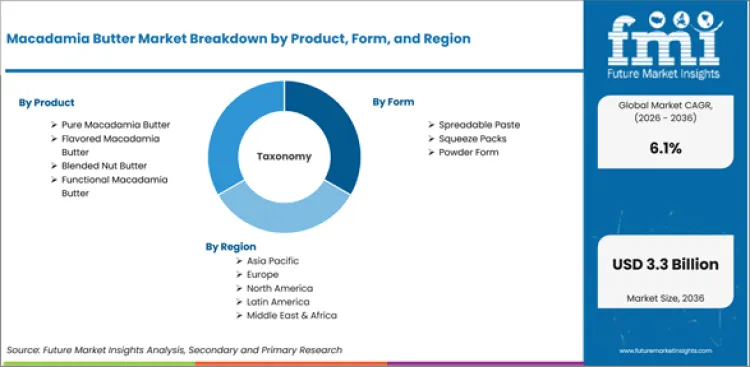
The macadamia butter market was valued at USD 1.7 billion in 2025. The market is set to reach USD 1.8 billion by 2026-end and grow at a CAGR of 6.1% between 2026-2036 to reach USD 3.3 billion by 2036. Pure Macadamia Butter will dominate with a 45.0% share, while Spreadable Paste will lead with a 75.0% share.
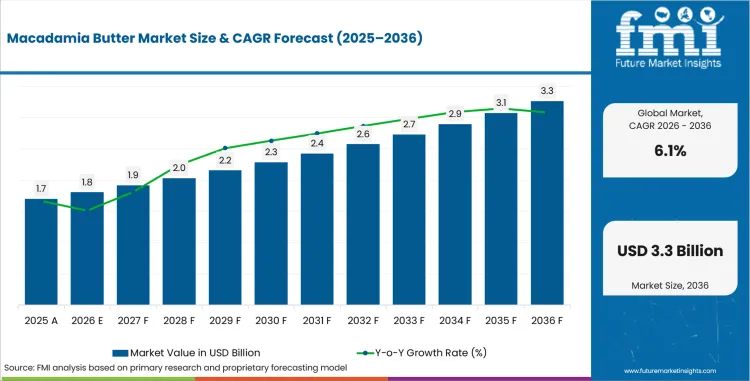
Key Takeaways, Market Size, and Forecast
- 2026 Market Size: USD 1.8 billion
- 2036 Market Size: USD 3.3 billion
- Compound Annual Growth Rate (CAGR): 6.1% from 2026 to 2036
- Absolute $ Opportunity: USD 1.5 billion between 2026 and 2036
- Leading Product Segment: Pure Macadamia Butter
- Pure Macadamia Butter Share in 2026: 45.0%
- Fastest-growing Country: USA
- USA CAGR: 5.9% through 2036
| Parameter | Details |
|---|---|
| Market Size in 2026 (Value) | USD 1.8 billion |
| Market Forecast in 2036 (Value) | USD 3.3 billion |
| CAGR (2026 to 2036) | 6.1% from 2026 to 2036 |
| Years Considered | 2021 to 2036 |
| Base Year | 2025 |
| Forecast Period | 2026 to 2036 |
| Units Considered | Value (USD Billion) |
| Leading Sub-Region | USA |
Summary of the Macadamia Butter Market
- Demand and Growth Drivers
- Consumer demand for premium nut butter alternatives beyond peanut and almond is expected to sustain growth for macadamia butter in health-conscious and gourmet food categories.
- Rich flavor profile and high monounsaturated fat content positioning macadamia butter as a premium health food spread is likely to support higher average selling prices.
- Expanding retail distribution through specialty food stores and online channels is expected to improve consumer access and trial rates.
- Product and Segment View
- Pure macadamia butter is estimated to account for 45.0% of product demand in 2026, with single-ingredient products commanding premium positioning among clean label consumers.
- Spreadable paste form is likely to lead at 75.0%, reflecting consumer preference for ready-to-use spread formats for breakfast and snacking applications.
- Food and beverages applications are expected to account for 80.0% of application demand, with breakfast spreading, baking, and smoothie preparation as primary use occasions.
- Geography and Competitive Outlook
- The USA is likely to lead country level growth at 5.9% through 2036, driven by established premium nut butter retail and consumer willingness to pay for specialty gourmet spread products.
- Western Europe and East Asia are expected to sustain demand through health food retail and growing premium nut product awareness.
- Companies with macadamia sourcing relationships, small-batch manufacturing capability, and specialty retail distribution are likely to capture growing premium nut butter demand.
- Analyst Opinion
- Nandini Roy Choudhury, Principal Consultant at FMI says, 'Brands that can secure consistent macadamia supply while communicating the distinctive flavor and nutritional benefits of macadamia butter to justify premium pricing are positioned to capture growing gourmet and health-conscious consumer demand through 2036.'
- The macadamia butter market is expanding as consumers explore premium nut butter options beyond established peanut and almond categories.
- Adoption is increasing due to macadamia positioning as a heart-healthy fat source with high monounsaturated fatty acid content supporting cardiovascular wellness claims.
- The market is also benefiting from clean label consumer demand for single-ingredient nut butters with minimal processing and no additives.
- Demand is further supported by the distinctive rich, creamy flavor profile of macadamia that differentiates it from other nut butters in taste comparisons.
Macadamia Butter Market Definition
The macadamia butter market includes nut butter products manufactured from macadamia nuts. Products span pure macadamia butter, flavored macadamia butter, and macadamia butter blends in spreadable paste and crunchy formats for household consumption, food service, and food manufacturing applications.
Macadamia Butter Market Inclusions
Market scope encompasses all commercially traded macadamia butter products categorized by product (pure macadamia butter, flavored macadamia butter, macadamia butter blends), form (spreadable paste, crunchy, liquid drizzle), application (food and beverages, personal care, confectionery), end use (household consumers, food service, food manufacturers), nature (natural, organic), and distribution channel (supermarkets and hypermarkets, specialty stores, online retailers, gourmet shops). Revenue scope covers 2026 to 2036.
Macadamia Butter Market Exclusions
The scope does not include whole macadamia nuts sold as snack products, macadamia oil sold as a cooking oil without butter processing, or macadamia-flavored products that do not contain macadamia as the primary ingredient.
Macadamia Butter Market Research Methodology
- Primary Research: FMI analysts conducted interviews with macadamia butter manufacturers, nut sourcing specialists, and specialty food retail buyers across key premium food markets.
- Desk Research: Combined data from premium nut product retail tracking, macadamia trade statistics, and manufacturer production disclosures.
- Market Sizing and Forecasting: Bottom-up aggregation across household, food service, and food manufacturing applications with adoption curves based on premium nut butter penetration.
- Data Validation: Cross-checked quarterly against macadamia trade data, specialty food retail sales, and manufacturer shipment reports.
Why is the Macadamia Butter Market Growing?
- Consumer exploration of premium nut butter alternatives beyond peanut and almond is generating sustained demand for macadamia butter in health-conscious and gourmet food segments.
- Heart-healthy monounsaturated fat positioning and distinctive rich flavor profile create premium pricing support that differentiates macadamia butter from mainstream nut butter alternatives.
- The USA leads country level growth at 5.9% CAGR, driven by established premium nut butter retail infrastructure and consumer willingness to pay for specialty gourmet spread products.
The macadamia butter market is expanding as premium nut butter consumption moves beyond niche gourmet positioning into health food retail. Macadamia butter occupies the premium end of the nut butter category, with pricing typically 3 to 5 times higher than peanut butter due to macadamia nut raw material costs and lower production volumes.
Nutritional positioning on high monounsaturated fatty acid content supports cardiovascular health claims that resonate with health-conscious consumers. The low omega-6 to omega-3 ratio of macadamia oil distinguishes it from other nut butters in nutritional comparison, providing a distinct health positioning.
Macadamia sourcing represents the primary cost and supply chain consideration. Major production regions in Australia, Hawaii, South Africa, and Kenya provide raw material with seasonal harvest patterns and commodity price fluctuations that directly impact manufacturer costs and retail pricing.
Market Segmentation Analysis
- Pure macadamia butter leads at 45.0%, with single-ingredient products commanding the highest premium pricing and strongest clean label appeal.
- Natural products account for 50.0% of nature demand, with minimal processing and no additive formulations aligning with premium health food consumer expectations.
- Household consumers dominate end use at 60.0%, with personal purchase for breakfast, snacking, and cooking as the primary demand occasions.
The macadamia butter market is segmented by product, form, application, end use, nature, and distribution channel. Pure macadamia butter dominates while spreadable paste leads form demand.
Insights into the Pure Macadamia Butter Product Segment
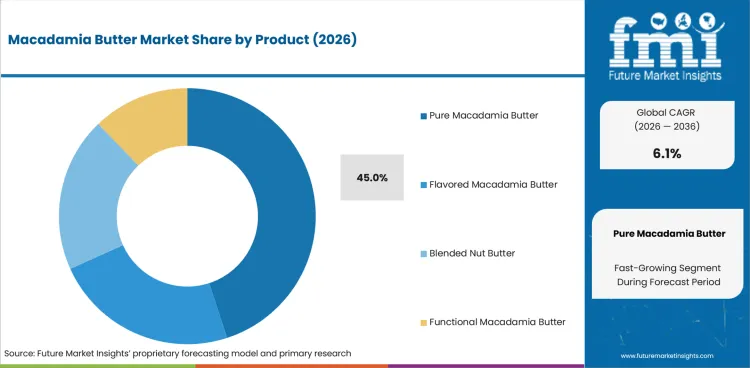
In 2026, pure macadamia butter is estimated to account for 45.0% of total product demand. Single-ingredient macadamia butter with no added oil, salt, or sugar commands the highest pricing and strongest clean label positioning. Stone-ground and small-batch processing methods support artisan product positioning.
Organic pure macadamia butter represents the super-premium tier, with certified organic macadamia sourcing adding further price premium. The combination of organic certification, single-ingredient purity, and artisan production creates the highest-value product positioning in the nut butter category.
Insights into the Food And Beverages Application Segment
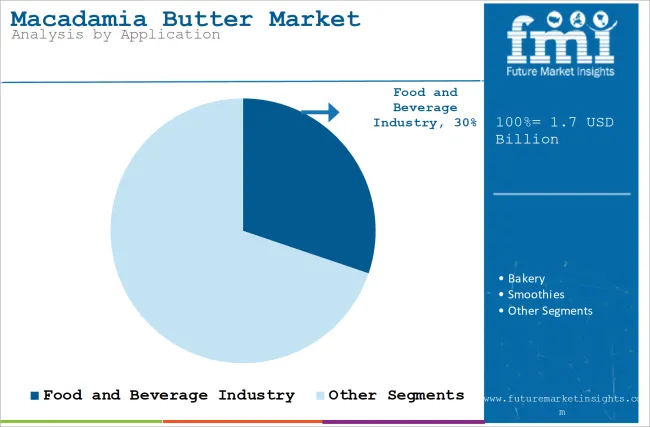
Food and beverages applications are expected to account for 80.0% of application demand in 2026, with breakfast spreading, smoothie preparation, baking, and recipe ingredient use as primary consumption occasions. The rich, creamy texture of macadamia butter enables versatile culinary application across sweet and savory recipes.
Confectionery and bakery applications use macadamia butter as a premium ingredient in cookies, energy balls, and chocolate confectionery. Food service adoption in specialty cafes and restaurants creates demand for macadamia butter as a premium menu ingredient and spread option.
Macadamia Butter Market Drivers, Restraints, and Opportunities
- Consumer demand for premium nut butter alternatives and clean label single-ingredient products sustains growth in macadamia butter across specialty food and health retail channels.
- High macadamia nut commodity costs and limited global production constrain the ability to reduce retail pricing for mass market accessibility.
- Rich flavor and heart-healthy fat positioning differentiate macadamia butter from competing nut butters, supporting premium pricing and loyal consumer base development.
- Online and specialty food retail distribution provides primary consumer access, with mainstream grocery expansion limited by price positioning.
The macadamia butter market continues to grow based on premium nut butter trends, health positioning, and expanding specialty distribution. Raw material costs and premium pricing shape the addressable market.
Premium Nut Butter Category Expansion
Demand is shaped by consumer willingness to explore nut butter options beyond peanut and almond. Macadamia butter benefits from the broader premiumization trend in food purchasing where consumers invest in higher-quality, distinctive-tasting products for daily consumption occasions.
Raw Material Cost and Pricing Constraint
Growth is constrained by the high cost of macadamia nuts, which are among the most expensive tree nuts globally. Limited global production volume and seasonal harvest variability maintain raw material costs that prevent mass market retail pricing.
Nutritional and Flavor Differentiation
Adoption is supported by the distinctive rich, buttery flavor and heart-healthy monounsaturated fat content that create clear differentiation from mainstream nut butter alternatives. Consumers who discover macadamia butter demonstrate strong repeat purchase loyalty.
Distribution Channel Development
Specialty food stores, health food retailers, and online direct-to-consumer channels provide primary distribution. Expansion into mainstream grocery premium sections is gradual, constrained by shelf space allocation decisions that prioritize higher-velocity nut butter products.
Analysis of Macadamia Butter Market By Key Countries
.webp "Top Country Growth Comparison Macadamia Butter Market Cagr (2026 2036)")
| Country | CAGR |
|---|---|
| USA | 5.9% |
| UK | 5.8% |
| China | 4.7% |
| Japan | 4.0% |
| India | 3.5% |
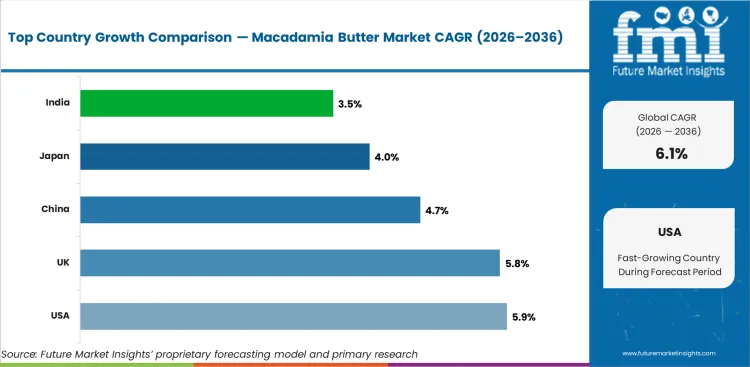
- The USA at 5.9% leads growth, driven by established premium nut butter retail and consumer willingness to pay for specialty gourmet spread products.
- The UK at 5.8% sustains demand through premium food retail channels and growing health-conscious consumer interest in specialty nut products.
- China at 4.7% reflects growing urban premium food consumption and expanding e-commerce distribution for imported specialty nut products.
- Japan at 4.0% shows growth from health-conscious consumer culture and premium food product preference.
The global macadamia butter market is projected to expand at 6.1% CAGR from 2026 to 2036. The study covers more than 30 countries, and the main markets are listed below.
Demand Outlook for Macadamia Butter Market in USA
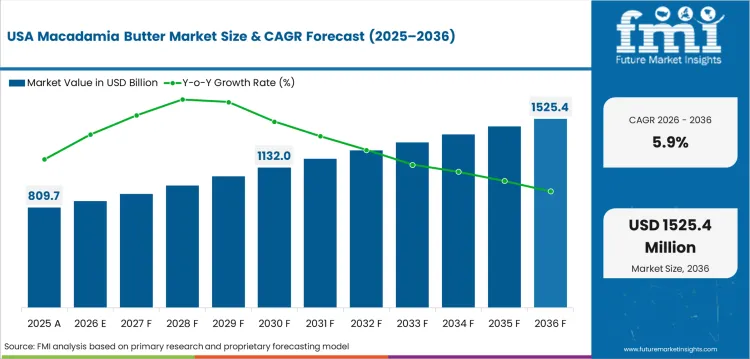
The USA is projected to record a 5.9% CAGR through 2036. Established premium nut butter retail and health food distribution sustain demand for macadamia butter across specialty and natural food store channels.
- Established health food and specialty grocery retailers provide premium shelf positioning for macadamia butter brands.
- Online direct-to-consumer and subscription services enable niche nut butter brands to reach health-conscious consumers nationwide.
- Retailer clean label programs support single-ingredient macadamia butter positioning in premium natural food sections.
Future Outlook for Macadamia Butter Market in UK
The UK is expected to grow at 5.8% through 2036. Premium food retail channels and growing health-conscious consumer interest sustain demand for specialty nut butter products.
- Premium food retailers and health food stores provide distribution for imported and domestic macadamia butter brands.
- Growing consumer interest in heart-healthy fat sources supports nutritional positioning of macadamia butter.
- Post-Brexit food labeling requirements establish product specification and allergen disclosure standards for nut butter products.
Sales Analysis of Macadamia Butter Market in China
China is estimated to grow at 4.7% through 2036. Growing urban premium food consumption and expanding e-commerce distribution for imported specialty products create conditions for macadamia butter market development.
- E-commerce platforms provide distribution for imported premium macadamia butter brands reaching urban health-conscious consumers.
- Growing urban disposable income and premium food product adoption create demand for specialty nut butter products.
- Gift-giving culture supports premium macadamia butter products positioned as luxury food gifts for special occasions.
Opportunity Analysis of Macadamia Butter Market in Japan
Japan is projected to record a 4.0% CAGR through 2036. Health-conscious consumer culture and premium food product preference sustain demand for specialty nut butter products. Quality expectations create high product specification requirements.
- Health-conscious consumer culture supports adoption of macadamia butter positioned as a heart-healthy premium spread.
- Strict food quality standards create product specification requirements that favor established manufacturers with quality assurance processes.
- Premium food retail including department store food halls provides distribution for specialty macadamia butter brands.
In-depth Analysis of Macadamia Butter Market in India
India is expected to grow at 3.5% through 2036. Growing urban premium food adoption and expanding e-commerce distribution create early-stage demand for specialty nut butter products including macadamia variants.
- E-commerce grocery platforms enable distribution of imported premium nut butter brands to urban health-conscious consumers.
- Growing urban middle-class disposable income supports premium food product exploration including specialty nut butters.
- Health awareness around plant-based fats and heart-healthy nutrition supports macadamia butter positioning among wellness-oriented consumers.
Competitive Landscape and Strategic Positioning
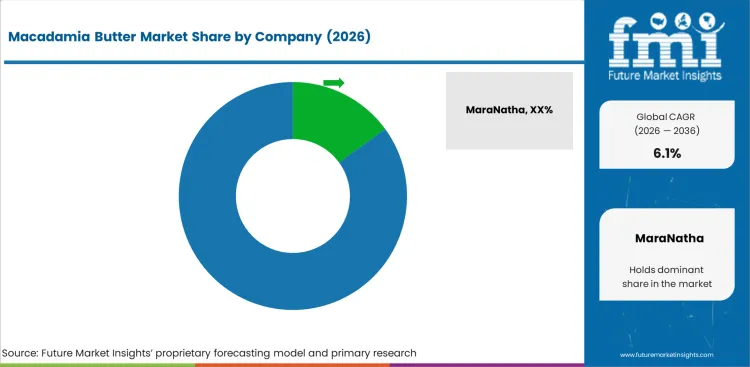
- MaraNatha and Futter's Nut Butters lead in specialty macadamia butter manufacturing with established premium retail distribution and recognized brand positioning.
- Wilderness Poets and Carley's of Cornwall serve premium artisan segments with small-batch, organic macadamia butter products for health food retail.
- Emerging brands including WellBees and Tiny Isle target niche consumer segments through online and specialty distribution channels.
MaraNatha holds a leading position through established nut butter brand recognition and broad natural food retail distribution. Futter's Nut Butters competes on premium macadamia butter expertise with dedicated manufacturing for specialty retail and online channels.
Wilderness Poets serves the organic artisan segment with small-batch processing. Waliz Nuts provides macadamia products from sourced raw materials. Carley's of Cornwall serves the UK market with artisan nut butter manufacturing.
Barriers to entry include macadamia nut sourcing at consistent quality and volume, premium retail channel access, and consumer brand building in a niche category. Strategic priorities include sourcing relationship development, organic certification, and online direct-to-consumer channel expansion.
Key Companies in the Macadamia Butter Market
Key global companies leading the macadamia butter market include:
- MaraNatha (USA), Futter's Nut Butters (South Africa), and Wilderness Poets (USA) maintain established macadamia butter brands with premium retail and online distribution.
- Waliz Nuts (South Africa), Carley's of Cornwall Ltd (UK), and Garden Picks Food Manufacturing LLP (India) serve regional markets with locally sourced and manufactured macadamia butter products.
- WellBees (Turkey) and Tiny Isle (USA) compete in niche premium segments with differentiated macadamia butter products targeting online and specialty retail consumers.
Competitive Benchmarking: Macadamia Butter Market
| Company | Product Range | Sourcing | Distribution | Geo. Reach |
|---|---|---|---|---|
| MaraNatha | High | Diversified | Strong | N. America |
| Futter's Nut Butters | Medium | Integrated | Medium | S. Africa, Export |
| Wilderness Poets | Medium | Organic | Medium | N. America |
| Waliz Nuts | Low | Regional | Medium | S. Africa |
| Carley's of Cornwall | Medium | Sourced | Medium | UK, Europe |
| Garden Picks | Low | Regional | Low | India |
| WellBees | Low | Sourced | Growing | Europe |
| Tiny Isle | Low | Sourced | Growing | N. America |
Source: Future Market Insights competitive analysis, 2026.
Key Developments in Macadamia Butter Market
- In 2025, MaraNatha launched a new organic single-ingredient macadamia butter targeting clean label consumers in North American natural food retail and online channels.
- In 2025, Futter's Nut Butters expanded its macadamia butter distribution into European specialty retail markets through new partnership agreements.
Key Players in the Macadamia Butter Market
Major Global Players
- MaraNatha
- Futter's Nut Butters
- Wilderness Poets
- Waliz Nuts
- Garden Picks Food Manufacturing LLP
Emerging Players/Startups
- Maka Macadamia
- ButtaNutt
- Ecodamia
Report Scope and Coverage
| Parameter | Details |
|---|---|
| Market size by 2036 | USD 3.3 billion |
| Growth rate | 6.1% CAGR (2026 to 2036) |
| Forecast period | 2026 to 2036 |
| Base year value (2025) | USD 1.7 billion |
| Key Segment Covered | Product, Form, Application, End Use, Nature, Distribution Channel |
| Regions covered | North America, Latin America, Western Europe, Eastern Europe, East Asia, South Asia and Pacific, Middle East and Africa |
| Countries covered | USA, South Korea, UK, Japan, China, India, Germany, 30 plus countries |
| Key companies profiled | MaraNatha, Futter's Nut Butters, Wilderness Poets, Waliz Nuts, Garden Picks Food Manufacturing LLP, WellBees, Carley's of Cornwall Ltd, Tiny Isle |
| Approach | Hybrid bottom-up and top-down methodology starting with verified transaction data, projecting adoption velocity across segments and regions. |
Market Segmentation Analysis
Macadamia Butter Market Segmented by Product:
- Pure Macadamia Butter
- Smooth Butter
- Creamy Texture
- Spreadable Form
- Crunchy Butter
- Chunky Texture
- Nut Pieces Added
- Smooth Butter
- Flavored Macadamia Butter
- Chocolate Flavored
- Cocoa Infused
- Sweetened Chocolate
- Honey and Sweet Flavors
- Honey Infused
- Maple Flavored
- Savory Flavors
- Salted Butter
- Spiced Variants
- Chocolate Flavored
- Blended Nut Butter
- Macadamia Almond Butter
- Mixed Nut Spread
- Protein Enriched Blend
- Macadamia Peanut Butter
- Hybrid Nut Spread
- Affordable Blends
- Macadamia Almond Butter
- Functional Macadamia Butter
- Protein Enriched
- High Protein Spread
- Fitness Focused
- Fortified Butter
- Vitamin Enriched
- Omega Enriched
- Protein Enriched
Macadamia Butter Market Segmented by Form:
- Spreadable Paste
- Jar Packaging
- Smooth Consistency
- Squeeze Packs
- Portable Packs
- On the Go Use
- Powder Form
- Defatted Powder
- Ingredient Use
Macadamia Butter Market Segmented by Application:
- Food and Beverages
- Bakery and Confectionery
- Cakes and Cookies
- Dessert Fillings
- Spreads and Toppings
- Bread Spread
- Smoothie Additive
- Snacks
- Energy Snacks
- Protein Snacks
- Bakery and Confectionery
- Nutraceuticals
- Functional Foods
- Health Spreads
- Diet Products
- Functional Foods
- Personal Care
- Cosmetic Use
- Skin Care Products
- Hair Care Products
- Cosmetic Use
Macadamia Butter Market Segmented by End Use:
- Household Consumers
- Direct Consumption
- Daily Use
- Health Focused Diet
- Direct Consumption
- Food Manufacturers
- Processed Food Companies
- Bakery Products
- Packaged Foods
- Processed Food Companies
- Food Service Operators
- Cafes and Restaurants
- Menu Integration
- Dessert Applications
- Cafes and Restaurants
Macadamia Butter Market Segmented by Nature:
- Natural
- Minimally Processed
- Clean Label Products
- No Additives
- Minimally Processed
- Organic
- Certified Organic Butter
- Eco Friendly Production
- Sustainable Sourcing
- Certified Organic Butter
- Conventional
- Standard Nut Butter
- Processed Formulations
- Cost Optimized Products
- Standard Nut Butter
Macadamia Butter Market Segmented by Distribution Channel:
- Supermarkets and Hypermarkets
- Modern Trade
- Large Retail Chains
- Modern Trade
- Convenience Stores
- Local Retail
- Impulse Purchase
- Online Channel
- E-commerce Platforms
- Direct to Consumer
- E-commerce Platforms
- Specialty Stores
- Health Food Stores
- Organic Retail
- Gourmet Stores
- Health Food Stores
Macadamia Butter Market by Region:
- North America
- USA
- Canada
- Mexico
- Latin America
- Brazil
- Chile
- Rest of Latin America
- Western Europe
- Germany
- UK
- Italy
- Spain
- France
- Nordic
- BENELUX
- Rest of Western Europe
- Eastern Europe
- Russia
- Poland
- Hungary
- Balkan & Baltic
- Rest of Eastern Europe
- East Asia
- China
- Japan
- South Korea
- South Asia and Pacific
- India
- ASEAN
- Australia & New Zealand
- Rest of South Asia and Pacific
- Middle East & Africa
- Kingdom of Saudi Arabia
- Other GCC Countries
- Türkiye
- South Africa
- Other African Union
- Rest of Middle East & Africa
Research Sources and Bibliography
- 1. International Nut and Dried Fruit Council. (2025). INC Global Macadamia Market and Trade Report. INC.
- 2. USA Department of Agriculture. (2025). USDA Tree Nut Production and Trade Statistics. USDA.
- 3. Food and Agriculture Organization. (2025). FAO Global Tree Nut Market Report. FAO.
- 4. Australian Macadamia Society. (2025). AMS Australian Macadamia Industry Production Report. AMS.
- 5. Food Standards Agency. (2025). FSA Allergen Labeling Requirements for Nut Products. FSA.
This bibliography is provided for reader reference.
This Report Answers
- Estimating the size of the macadamia butter market and projected revenue from 2026 to 2036.
- Segmentation by product, form, application, end use, nature, and distribution channel.
- Insights about more than 30 markets in the region.
- Analysis of product types including pure macadamia butter, flavored variants, and macadamia butter blends.
- Assessment of the competitive landscape.
- Identifying investment opportunities in premium retail, online distribution, and food service segments.
- Tracking the supply chain from macadamia nut sourcing to premium retail distribution.
- Delivery of data in PDF and Excel formats.
Frequently Asked Questions
How big is the macadamia butter market in 2026?
The global macadamia butter market is estimated to be valued at USD 1.8 billion in 2026.
What will be the size of the macadamia butter market in 2036?
The market size for the macadamia butter market is projected to reach USD 3.3 billion by 2036.
How much will the macadamia butter market growth be between 2026 and 2036?
The macadamia butter market is expected to grow at a 6.1% CAGR between 2026 and 2036.
What are the key products in the macadamia butter market?
The key products in the macadamia butter market are Pure Macadamia Butter, Flavored Macadamia Butter, Blended Nut Butter and Functional Macadamia Butter.
Which form segment is expected to contribute a significant share in the macadamia butter market in 2026?
In terms of form, the spreadable paste segment is expected to command 75.0% share in the macadamia butter market in 2026.
Preview the report firsthand - request a free sample
Get SampleGet the brochure for pricing and purchase details.
Get PDFTable of Content
- Key Takeaways
- Market Size and CAGR
- Top Growth Driver
- Fastest Growing Segment
- Leading Region
- Key Companies
- Emerging Opportunities
- Executive Summary
- Global Market Outlook
- Demand-side Trends
- Supply-side Trends
- Technology Roadmap Analysis
- Analysis and Recommendations
- Analyst Perspective (What is happening? Why now? What should investors know?)
- Key Questions Answered
- How large is the market?
- What is the CAGR?
- What are key trends?
- Which region dominates?
- Who are the leaders?
- Market Overview
- Market Coverage / Taxonomy
- Market Definition / Scope / Limitations
- Research Methodology
- Chapter Orientation
- Analytical Lens and Working Hypotheses
- Market Structure, Signals, and Trend Drivers
- Benchmarking and Cross-market Comparability
- Market Sizing, Forecasting, and Opportunity Mapping
- Research Design and Evidence Framework
- Desk Research Programme (Secondary Evidence)
- Expert Input and Fieldwork (Primary Evidence)
- Tooling, Models, and Reference Databases
- Data Engineering and Model Build
- Quality Assurance and Audit Trail
- Market Background
- Market Dynamics (Drivers, Restraints, Opportunity, Trends)
- Scenario Forecast (Optimistic, Likely, Conservative)
- Impact Analysis
- AI Impact
- Sustainability Impact
- Regulatory Impact
- Technology Impact
- Consumer / Buyer Analysis
- Purchase Drivers
- Adoption Barriers
- Buyer Journey
- Opportunity Map Analysis
- Product Life Cycle Analysis
- Supply Chain Analysis
- Investment Feasibility Matrix
- Value Chain Analysis
- PESTLE and Porter's Analysis
- Regulatory Landscape
- Regional Parent Market Outlook
- Production and Consumption Statistics
- Import and Export Statistics
- Global Market Analysis and Forecast, 2021 to 2036
- Historical Market Size Value (USD Million) Analysis, 2021 to 2025
- Current and Future Market Size Value (USD Million) Projections, 2026 to 2036
- Y-o-Y Growth Trend Analysis
- Absolute $ Opportunity Analysis
- Global Market Pricing Analysis, 2021 to 2036
- Global Market Analysis and Forecast, By Product, 2021 to 2036
- Introduction / Key Findings
- Historical Market Size Value (USD Million) Analysis By Product, 2021 to 2025
- Current and Future Market Size Value (USD Million) Analysis and Forecast By Product, 2026 to 2036
- Pure Macadamia Butter
- Smooth Butter
- Crunchy Butter
- Flavored Macadamia Butter
- Chocolate Flavored
- Honey and Sweet Flavors
- Blended Nut Butter
- Macadamia Almond Butter
- Macadamia Peanut Butter
- Functional Macadamia Butter
- Protein Enriched
- Fortified Butter
- Pure Macadamia Butter
- Y-o-Y Growth Trend Analysis By Product, 2021 to 2025
- Absolute $ Opportunity Analysis By Product, 2026 to 2036
- Global Market Analysis and Forecast, By Form, 2021 to 2036
- Introduction / Key Findings
- Historical Market Size Value (USD Million) Analysis By Form, 2021 to 2025
- Current and Future Market Size Value (USD Million) Analysis and Forecast By Form, 2026 to 2036
- Spreadable Paste
- Jar Packaging
- Smooth Consistency
- Squeeze Packs
- Portable Packs
- On the Go Use
- Powder Form
- Defatted Powder
- Ingredient Use
- Spreadable Paste
- Y-o-Y Growth Trend Analysis By Form, 2021 to 2025
- Absolute $ Opportunity Analysis By Form, 2026 to 2036
- Global Market Analysis and Forecast, By Application, 2021 to 2036
- Introduction / Key Findings
- Historical Market Size Value (USD Million) Analysis By Application, 2021 to 2025
- Current and Future Market Size Value (USD Million) Analysis and Forecast By Application, 2026 to 2036
- Food and Beverages
- Bakery and Confectionery
- Spreads and Toppings
- Snacks
- Nutraceuticals
- Functional Foods
- Personal Care
- Cosmetic Use
- Food and Beverages
- Y-o-Y Growth Trend Analysis By Application, 2021 to 2025
- Absolute $ Opportunity Analysis By Application, 2026 to 2036
- Global Market Analysis and Forecast, By End Use, 2021 to 2036
- Introduction / Key Findings
- Historical Market Size Value (USD Million) Analysis By End Use, 2021 to 2025
- Current and Future Market Size Value (USD Million) Analysis and Forecast By End Use, 2026 to 2036
- Household Consumers
- Direct Consumption
- Food Manufacturers
- Processed Food Companies
- Food Service Operators
- Cafes and Restaurants
- Household Consumers
- Y-o-Y Growth Trend Analysis By End Use, 2021 to 2025
- Absolute $ Opportunity Analysis By End Use, 2026 to 2036
- Global Market Analysis and Forecast, By Nature, 2021 to 2036
- Introduction / Key Findings
- Historical Market Size Value (USD Million) Analysis By Nature, 2021 to 2025
- Current and Future Market Size Value (USD Million) Analysis and Forecast By Nature, 2026 to 2036
- Natural
- Minimally Processed
- Organic
- Certified Organic Butter
- Conventional
- Standard Nut Butter
- Natural
- Y-o-Y Growth Trend Analysis By Nature, 2021 to 2025
- Absolute $ Opportunity Analysis By Nature, 2026 to 2036
- Global Market Analysis and Forecast, By Distribution Channel
- Introduction / Key Findings
- Historical Market Size Value (USD Million) Analysis By Distribution Channel, 2021 to 2025
- Current and Future Market Size Value (USD Million) Analysis and Forecast By Distribution Channel, 2026 to 2036
- Supermarkets and Hypermarkets
- Modern Trade
- Convenience Stores
- Local Retail
- Impulse Purchase
- Online Channel
- E-commerce Platforms
- Specialty Stores
- Health Food Stores
- Supermarkets and Hypermarkets
- Y-o-Y Growth Trend Analysis By Distribution Channel, 2021 to 2025
- Absolute $ Opportunity Analysis By Distribution Channel, 2026 to 2036
- Global Market Analysis and Forecast, By Region, 2021 to 2036
- Introduction
- Historical Market Size Value (USD Million) Analysis By Region, 2021 to 2025
- Current Market Size Value (USD Million) Analysis and Forecast By Region, 2026 to 2036
- North America
- Latin America
- Western Europe
- Eastern Europe
- East Asia
- South Asia and Pacific
- Middle East & Africa
- Market Attractiveness Analysis By Region
- North America Market Analysis and Forecast, By Country, 2021 to 2036
- Historical Market Size Value (USD Million) Trend Analysis By Market Taxonomy, 2021 to 2025
- Market Size Value (USD Million) Forecast By Market Taxonomy, 2026 to 2036
- By Country
- USA
- Canada
- Mexico
- By Product
- By Form
- By Application
- By End Use
- By Nature
- By Distribution Channel
- By Country
- Market Attractiveness Analysis
- By Country
- By Product
- By Form
- By Application
- By End Use
- By Nature
- By Distribution Channel
- Key Takeaways
- Latin America Market Analysis and Forecast, By Country
- Historical Market Size Value (USD Million) Trend Analysis By Market Taxonomy, 2021 to 2025
- Market Size Value (USD Million) Forecast By Market Taxonomy, 2026 to 2036
- By Country
- Brazil
- Chile
- Rest of Latin America
- By Product
- By Form
- By Application
- By End Use
- By Nature
- By Distribution Channel
- By Country
- Market Attractiveness Analysis
- By Country
- By Product
- By Form
- By Application
- By End Use
- By Nature
- By Distribution Channel
- Key Takeaways
- Western Europe Market Analysis and Forecast, By Country
- Historical Market Size Value (USD Million) Trend Analysis By Market Taxonomy, 2021 to 2025
- Market Size Value (USD Million) Forecast By Market Taxonomy, 2026 to 2036
- By Country
- Germany
- UK
- Italy
- Spain
- France
- Nordic
- BENELUX
- Rest of Western Europe
- By Product
- By Form
- By Application
- By End Use
- By Nature
- By Distribution Channel
- By Country
- Market Attractiveness Analysis
- By Country
- By Product
- By Form
- By Application
- By End Use
- By Nature
- By Distribution Channel
- Key Takeaways
- Eastern Europe Market Analysis and Forecast, By Country
- Historical Market Size Value (USD Million) Trend Analysis By Market Taxonomy, 2021 to 2025
- Market Size Value (USD Million) Forecast By Market Taxonomy, 2026 to 2036
- By Country
- Russia
- Poland
- Hungary
- Balkan & Baltic
- Rest of Eastern Europe
- By Product
- By Form
- By Application
- By End Use
- By Nature
- By Distribution Channel
- By Country
- Market Attractiveness Analysis
- By Country
- By Product
- By Form
- By Application
- By End Use
- By Nature
- By Distribution Channel
- Key Takeaways
- East Asia Market Analysis and Forecast, By Country
- Historical Market Size Value (USD Million) Trend Analysis By Market Taxonomy, 2021 to 2025
- Market Size Value (USD Million) Forecast By Market Taxonomy, 2026 to 2036
- By Country
- China
- Japan
- South Korea
- By Product
- By Form
- By Application
- By End Use
- By Nature
- By Distribution Channel
- By Country
- Market Attractiveness Analysis
- By Country
- By Product
- By Form
- By Application
- By End Use
- By Nature
- By Distribution Channel
- Key Takeaways
- South Asia and Pacific Market Analysis and Forecast, By Country
- Historical Market Size Value (USD Million) Trend Analysis By Market Taxonomy, 2021 to 2025
- Market Size Value (USD Million) Forecast By Market Taxonomy, 2026 to 2036
- By Country
- India
- ASEAN
- Australia & New Zealand
- Rest of South Asia and Pacific
- By Product
- By Form
- By Application
- By End Use
- By Nature
- By Distribution Channel
- By Country
- Market Attractiveness Analysis
- By Country
- By Product
- By Form
- By Application
- By End Use
- By Nature
- By Distribution Channel
- Key Takeaways
- Middle East & Africa Market Analysis and Forecast, By Country
- Historical Market Size Value (USD Million) Trend Analysis By Market Taxonomy, 2021 to 2025
- Market Size Value (USD Million) Forecast By Market Taxonomy, 2026 to 2036
- By Country
- Kingdom of Saudi Arabia
- Other GCC Countries
- Türkiye
- South Africa
- Other African Union
- Rest of Middle East & Africa
- By Product
- By Form
- By Application
- By End Use
- By Nature
- By Distribution Channel
- By Country
- Market Attractiveness Analysis
- By Country
- By Product
- By Form
- By Application
- By End Use
- By Nature
- By Distribution Channel
- Key Takeaways
- Key Countries Market Analysis
- USA
- Pricing Analysis
- Market Share Analysis, 2025
- By Product
- By Form
- By Application
- By End Use
- By Nature
- By Distribution Channel
- Canada
- Pricing Analysis
- Market Share Analysis, 2025
- By Product
- By Form
- By Application
- By End Use
- By Nature
- By Distribution Channel
- Mexico
- Pricing Analysis
- Market Share Analysis, 2025
- By Product
- By Form
- By Application
- By End Use
- By Nature
- By Distribution Channel
- Brazil
- Pricing Analysis
- Market Share Analysis, 2025
- By Product
- By Form
- By Application
- By End Use
- By Nature
- By Distribution Channel
- Chile
- Pricing Analysis
- Market Share Analysis, 2025
- By Product
- By Form
- By Application
- By End Use
- By Nature
- By Distribution Channel
- Germany
- Pricing Analysis
- Market Share Analysis, 2025
- By Product
- By Form
- By Application
- By End Use
- By Nature
- By Distribution Channel
- UK
- Pricing Analysis
- Market Share Analysis, 2025
- By Product
- By Form
- By Application
- By End Use
- By Nature
- By Distribution Channel
- Italy
- Pricing Analysis
- Market Share Analysis, 2025
- By Product
- By Form
- By Application
- By End Use
- By Nature
- By Distribution Channel
- Spain
- Pricing Analysis
- Market Share Analysis, 2025
- By Product
- By Form
- By Application
- By End Use
- By Nature
- By Distribution Channel
- France
- Pricing Analysis
- Market Share Analysis, 2025
- By Product
- By Form
- By Application
- By End Use
- By Nature
- By Distribution Channel
- India
- Pricing Analysis
- Market Share Analysis, 2025
- By Product
- By Form
- By Application
- By End Use
- By Nature
- By Distribution Channel
- ASEAN
- Pricing Analysis
- Market Share Analysis, 2025
- By Product
- By Form
- By Application
- By End Use
- By Nature
- By Distribution Channel
- Australia & New Zealand
- Pricing Analysis
- Market Share Analysis, 2025
- By Product
- By Form
- By Application
- By End Use
- By Nature
- By Distribution Channel
- China
- Pricing Analysis
- Market Share Analysis, 2025
- By Product
- By Form
- By Application
- By End Use
- By Nature
- By Distribution Channel
- Japan
- Pricing Analysis
- Market Share Analysis, 2025
- By Product
- By Form
- By Application
- By End Use
- By Nature
- By Distribution Channel
- South Korea
- Pricing Analysis
- Market Share Analysis, 2025
- By Product
- By Form
- By Application
- By End Use
- By Nature
- By Distribution Channel
- Russia
- Pricing Analysis
- Market Share Analysis, 2025
- By Product
- By Form
- By Application
- By End Use
- By Nature
- By Distribution Channel
- Poland
- Pricing Analysis
- Market Share Analysis, 2025
- By Product
- By Form
- By Application
- By End Use
- By Nature
- By Distribution Channel
- Hungary
- Pricing Analysis
- Market Share Analysis, 2025
- By Product
- By Form
- By Application
- By End Use
- By Nature
- By Distribution Channel
- Kingdom of Saudi Arabia
- Pricing Analysis
- Market Share Analysis, 2025
- By Product
- By Form
- By Application
- By End Use
- By Nature
- By Distribution Channel
- Türkiye
- Pricing Analysis
- Market Share Analysis, 2025
- By Product
- By Form
- By Application
- By End Use
- By Nature
- By Distribution Channel
- South Africa
- Pricing Analysis
- Market Share Analysis, 2025
- By Product
- By Form
- By Application
- By End Use
- By Nature
- By Distribution Channel
- USA
- Market Structure Analysis
- Competition Dashboard
- Competition Benchmarking
- Market Share Analysis of Top Players
- By Regional
- By Product
- By Form
- By Application
- By End Use
- By Nature
- By Distribution Channel
- Emerging Startups
- Innovation Benchmarking
- Competition Analysis
- Competition Deep Dive
- MaraNatha
- Overview
- Product Portfolio
- Profitability by Market Segments (Product/Region/Sales Channel)
- Sales Footprint
- Strategy Overview
- Marketing Strategy
- Product Strategy
- Channel Strategy
- Futter’s Nut Butters
- Wilderness Poets
- Waliz Nuts
- Garden Picks Food Manufacturing LLP
- WellBees
- Carley’s of Cornwall Ltd
- Tiny Isle
- Torere Macadamias
- Artisana Organic Foods
- Dairy Farmers of America
- MaraNatha
- Case Studies
- Success Stories
- Recent Developments
- Competition Deep Dive
- Assumptions & Acronyms Used


