

- Market Size (2026)
- USD 4.9 Bn
- Forecast (2036)
- USD 9.3 Bn
- CAGR (2026 to 2036)
- 6.6%
How big is Magnesium Oxide Market in 2026?
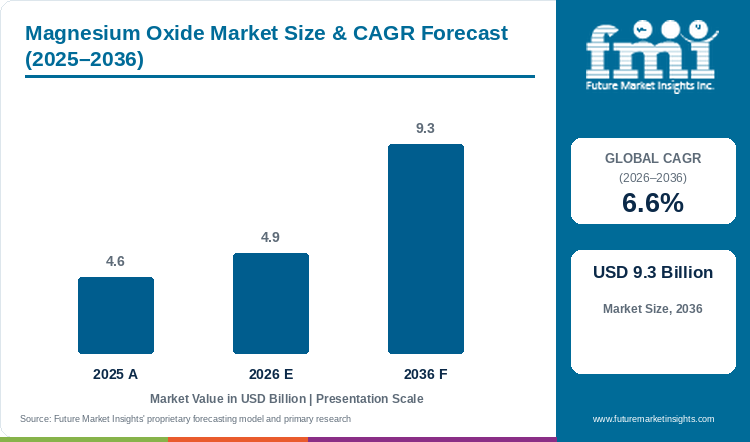
The magnesium oxide market is estimated at USD 4.6 billion in 2025 and is likely to reach USD 4.9 billion in 2026. Sales are projected to grow at a 6.6% CAGR to USD 9.3 billion by 2036.
Demand for magnesium oxide in 2025 is estimated around USD 4.6 billion and is expected at USD 4.9 billion in 2026 and USD 9.3 billion by 2036 on a forecast 6.6% CAGR. Through 2036, the dominant trend will be a move of new sales toward high-purity magnesia for drug, food and specialty uses, as refractory volume follows a flat steel cycle. ICL reported that specialty minerals sales rose in April to June 2026 on higher demand for specialty magnesia in pharma and food applications.[1] High-purity grades carry higher prices per tonne than refractory magnesia, so a modest gain in tonnes adds a larger amount of sales. The FMI outlook gives refractory-grade producers a clear first move, adding calcining and purification lines for food and pharmaceutical grades, since buyers of those grades sign longer supply contracts and switch suppliers less often.
Key Market Trends & Insights
- Dense dead burned grain for steel linings is expected to be 53.5% of 2026 product type sales, with caustic calcined magnesia at an estimated 32%.
- Refractories are projected to account for 61.4% of the application split in 2026. RHI Magnesita said Steel Europe and Steel India were profitable again in H1 2026.[2]
- Technical grade is estimated to hold 82% of purity-level sales in 2026, and high-purity magnesia accounts for about 18%. ICL linked higher specialty minerals sales in Q2 2026 to pharma and food demand for specialty magnesia.[1]
- Powder is likely to carry 48% of 2026 form sales, granules an estimated 30% and sintered blocks near 22%.
Regional Highlights
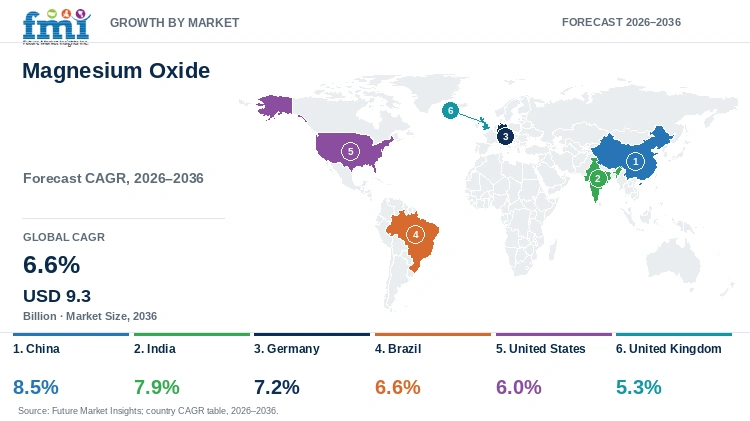
- China leads the six countries in FMI's model, with an 8.5% CAGR between 2026 and 2036 on specialty and chemical grades.
- Steel expansion keeps India second at 7.9%, and Germany also runs ahead of the market at 7.2%. Brazil matches the 6.6% global pace. The United States follows on 6%, and the United Kingdom, on 5.3%, has the smallest gain of the six.
- worldsteel forecast in October 2026 that steel demand in India will rise 7.9% to 172.4 Mt in 2026.[3]
Market Size & Forecast
Table 1: Market Size and Forecast for the Magnesium Oxide Market (USD billion and percentage), 2025 to 2036
| Metric | Value |
|---|---|
| 2025 Market Size | USD 4.6 billion |
| Estimated Market Size in 2026 | USD 4.9 billion |
| Projected Market Size by 2036 | USD 9.3 billion |
| CAGR, 2026 to 2036 | 6.6% |
| Added Revenue, 2026 to 2036 | USD 4.4 billion |
| Market Expansion Multiple | 1.9x |
Refractory relining schedules at steel plants set the timing of most magnesia orders. worldsteel forecast global steel demand essentially unchanged in 2026 at 1,722 Mt and 1.7% growth to 1,752 Mt in 2027.[3] World crude steel output was 144.2 Mt in August 2026, down 1.2% from August 2025.[4] Steel plants also charge burnt lime with magnesia, and the calcium oxide market is projected to rise at a CAGR of 5.3%, slower than magnesia. FMI's numbers point to USD 4.4 billion of extra sales over the decade, close to doubling the market from the 2026 level. The chief risk lies in weak industrial demand, and Imerys reported in July 2026 that sales to the refractory and construction markets remained flat.[5]
Steel Cycles, Refractory Recycling and Consolidation
Refractory makers are recovering spent linings to cut purchases of new magnesia. RHI Magnesita and Khemka Refractories completed a joint venture and launched MINPRO in August 2026, a refractory recycling business based in Odisha.[6] First-half 2026 adjusted EBITA at RHI Magnesita rose 17% to EUR 165 million, with a 10.3% margin.[2] Recycled grain from spent bricks will replace part of the dead burned magnesia bought by large refractory plants.
Refractory suppliers are also consolidating, which concentrates magnesia buying in fewer hands. RHI Magnesita announced possible offer discussions with Vesuvius plc on 29 September 2026, covering a possible recommended cash and share offer.[7] Imerys reported 2025 revenue of EUR 1,128 million in Solutions for Refractory, Abrasives and Construction, down 2.1% like-for-like.[8] A larger combined refractory group would buy magnesia in bigger contracts and press raw material suppliers on price.
Table 2: Steel, Refractory and Specialty Indicators for the Magnesium Oxide Market (values, dates and growth), 2025 to 2026
| Indicator | Data Point | Relevance | Source |
|---|---|---|---|
| Global steel demand, 2026 forecast | 1,722 Mt; essentially unchanged | Refractory magnesia volume stays flat. | [3] |
| World crude steel output, August 2026 | 144.2 Mt; down 1.2% | Furnace relining follows output. | [4] |
| RHI Magnesita adjusted EBITA, H1 2026 | EUR 165 million; up 17% | Refractory pricing is recovering. | [2] |
| RHI Magnesita and Khemka MINPRO, August 2026 | Refractory recycling joint venture | Recycled grain replaces part of new magnesia. | [6] |
| ICL specialty minerals, Q2 2026 | Higher demand for specialty magnesia | Pharma and food grades are gaining. | [1] |
| Imerys refractory and construction sales, H1 2026 | Flat | Industrial demand is weak. | [5] |
Analyst Perspective
“I would steer magnesia capacity toward high-purity and specialty grades through 2036, because steel output alone will not fill new kilns. Drug, food and water treatment buyers pay more per tonne and stay with a qualified supplier for years, and producers who certify those grades early will hold the better margins.”
- Nikhil Kaitwade, Principal Consultant, Future Market Insights.
How is the magnesium oxide market segmented?
The market is segmented into product type, application, purity level, form, and region. Dead burned magnesium oxide is expected to lead product type sales with 53.5% share in 2026, and refractories are projected to lead applications with 61.4%.
By product type: dead burned magnesium oxide, caustic calcined magnesia, and fused magnesium oxide.
By application: refractories, agrochemical, construction, chemical, rubber processing, pharmaceutical, and others.
By purity level: technical grade and high purity magnesium oxide.
By form: powder, granules, and sintered blocks.
By region: North America, Latin America, Western Europe, Eastern Europe, East Asia, South Asia and Pacific, and Middle East and Africa.
Why does dead burned magnesium oxide lead product type sales?
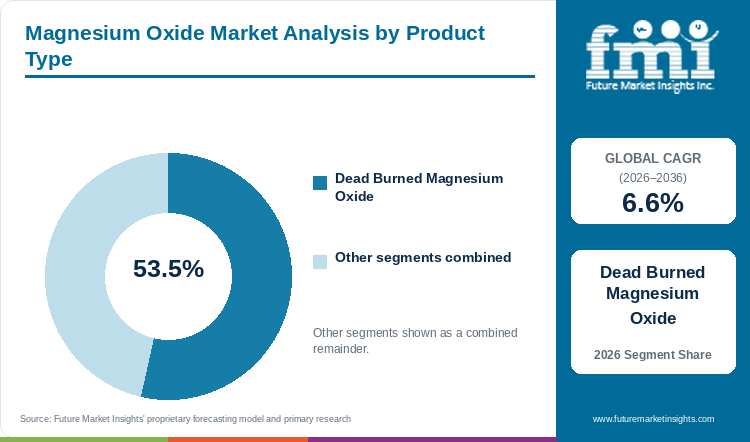
Dead burned magnesium oxide is expected to lead product type sales with 53.5% share in 2026, with caustic calcined magnesia at an estimated 32% and fused magnesium oxide at about 14.5%.
Table 3: Product Type Share for the Magnesium Oxide Market (percentage share), 2026
| Product Type | Estimated Share (2026) |
|---|---|
| Dead Burned Magnesium Oxide | 53.5% |
| Caustic Calcined Magnesia | 32% |
| Fused Magnesium Oxide | 14.5% |
| Total | 100.0% |
Table 4: Product Type Leadership and Market Growth for the Magnesium Oxide Market (segment and CAGR percentage), 2026 to 2036
| Metric | Value |
|---|---|
| Global CAGR (2026 to 2036) | 6.6% |
| Leading Segment | Dead Burned Magnesium Oxide |
Dead burned magnesium oxide is expected to lead with 53.5% share in 2026, because steel linings need dense grain. Magnesia-carbon bricks and gunning mixes for steel converters and ladles need a dense, low-reactivity grain fired above 1,500°C. Caustic calcined magnesia, an estimated 32%, is fired at lower temperatures and stays reactive, so fertilizer, feed, water treatment and chemical buyers choose the reactive grade. Fused magnesium oxide, about 14.5%, comes from electric arc furnaces and sells at the highest price per tonne to makers of heating elements and premium bricks, which keeps tonnage small. World crude steel output was 144.2 Mt in August 2026.[4] A steel plant relining a converter will order dead burned grain by the shipload, and a chemical buyer will order caustic calcined magnesia by the bag.
- High purity and low iron grades form the dead burned group.
- In August 2026, RHI Magnesita and Khemka Refractories launched MINPRO to recover and reuse spent refractory materials.[6]
Why do refractories lead magnesium oxide sales by application?
Refractories are projected to lead application sales with 61.4% share in 2026, with agrochemical uses at an estimated 10%.
Table 5: Application Share for the Magnesium Oxide Market (percentage share), 2026
| Application | Estimated Share (2026) |
|---|---|
| Refractories | 61.4% |
| Agrochemical | 10% |
| Chemical | 8.5% |
| Construction | 8% |
| Pharmaceutical | 4.6% |
| Rubber Processing | 4% |
| Others | 3.5% |
| Total | 100.0% |
Every steel converter, ladle and cement kiln is lined with magnesia bricks that wear out and are replaced, so refractories are projected to lead with 61.4% share in 2026. Agrochemical uses, an estimated 10%, cover magnesium fertilizers and soil conditioners bought by season. Chemical uses, about 8.5%, include magnesium compounds and water treatment, and the water and wastewater treatment chemicals market has a forecast 4.6% CAGR. Construction, near 8%, buys magnesia for boards and cement additives, with the construction chemicals market expected to increase at a 5.2% CAGR, and pharmaceutical, rubber processing and other uses, around 4.6%, 4% and 3.5%, buy small lots of high-purity or reactive grades. Cement and Non-Ferrous Metals improved slightly at RHI Magnesita over January to June 2026.[2] A steel plant buys magnesia every relining cycle, which keeps refractories far ahead of the seasonal farm and building orders.
- Converters, ladles, electric arc furnaces and copper smelters wear through magnesia linings fastest.
- Lower shipments of Industrial Projects for glass weakened RHI Magnesita Industrial results in H1 2026.[2]
What keeps technical grade ahead by purity level?
Technical grade is estimated to lead purity-level sales with 82% share in 2026, against about 18% for high-purity magnesium oxide.
Table 6: Purity Level Share for the Magnesium Oxide Market (percentage share), 2026
| Purity Level | Estimated Share (2026) |
|---|---|
| Technical Grade | 82% |
| High Purity Magnesium Oxide | 18% |
| Total | 100.0% |
Refractory, fertilizer and construction buyers accept a few percent of impurities, and technical grade is estimated to lead with 82% share in 2026. High-purity magnesium oxide, about 18%, meets food and pharmaceutical standards for antacids, supplements and food additives and sells at a higher price per tonne. Supplement makers also use magnesium salts, and the high purity magnesium citrate market is on a likely 5.5% CAGR. ICL saw specialty magnesia demand from pharma and food customers increase over the June quarter.[1] Bulk buyers will stay with technical grade, and drug and food makers will pay for certified purity.
- Food grade and pharmaceutical grade form the high-purity group.
- Industrial Products sales at ICL rose 30% in Q2 2026, to USD 414 million.[1]
Which form leads magnesium oxide sales?
Powder is likely to lead form sales with 48% share in 2026, with granules at an estimated 30% and sintered blocks at about 22%.
Table 7: Form Share for the Magnesium Oxide Market (percentage share), 2026
| Form | Estimated Share (2026) |
|---|---|
| Powder | 48% |
| Granules | 30% |
| Sintered Blocks | 22% |
| Total | 100.0% |
Powder will lead with 48% share in 2026, as chemical, drug, rubber and gunning-mix users blend fine magnesia into other materials. Granules, an estimated 30%, suit fertilizer spreading and refractory grain sizing. Sintered blocks, about 22%, go into bricks and furnace linings that need shaped, dense material. Imerys reported in February 2026 that refractory demand lagged on weak industrial activity in Europe and Asia.[8] Mixed-use buyers will keep ordering powder, and brick plants will take granules and sintered shapes.
- Fine powder and coarse powder make up the powder group.
- In February 2026, Imerys said markets were showing no significant improvement in early 2026.[8]
What are the drivers, restraints, and opportunities in the magnesium oxide market?
Steel furnace relining keeps refractory magnesia in steady use, and high-purity grades for drugs and food gain buyers. Flat steel demand and energy-heavy kilns squeeze producer margins.
- Driver: Steel converters and ladles wear through magnesia linings on a fixed cycle, so every relining brings a new refractory order.
- Restraint: Flat steel output and high kiln energy costs limit refractory volume and squeeze margins for magnesia producers.
- Opportunity: Drug, food and water treatment buyers need certified high-purity magnesia, which gives producers a higher-priced outlet beyond steel.
Steel Relining Keeps Refractory Magnesia in Use
Refractory demand moves with furnace hours, so steel output sets the base volume for dead burned magnesia. Indian crude steel output rose 4.6% to 14.8 Mt in August 2026, worldsteel reported.[4] RHI Magnesita said Steel North America improved further in H1 2026.[2] Steel plants adding furnace hours will reline converters and ladles more often and buy more refractory magnesia.
Flat Steel Demand Squeezes Refractory Volume
Flat steel demand, kiln energy costs and pressure from large refractory buyers weigh on producers, FMI's model shows. worldsteel forecast that steel demand in China will fall 2% in 2026.[3] Imerys reported flat sales to refractory and construction markets for January to June 2026.[5] Producers relying on steel-grade magnesia will face weak pricing until steel demand recovers in 2027.
High-Purity Grades Open Drug, Food and Water Uses
High-purity grades sold outside steel will supply the next round of growth. Pharma and food buyers raised specialty magnesia orders at ICL in mid-2026.[1] The magnesium hydroxide market is projected near a 6.2% CAGR, and water treatment plants and flame retardant makers will buy both reactive magnesia and hydroxide. Producers with food and pharmaceutical certification will sell more tonnes at higher prices.
Which country CAGRs are profiled in the magnesium oxide market?
Table 8: Country CAGR Comparison for the Magnesium Oxide Market (CAGR percentage), 2026 to 2036
| Country | CAGR (2026 to 2036) |
|---|---|
| China | 8.5% |
| India | 7.9% |
| Germany | 7.2% |
| Brazil | 6.6% |
| United States | 6% |
| United Kingdom | 5.3% |
How do country-level CAGRs compare in the magnesium oxide market?
worldsteel expects Indian steel demand to grow 7.9% to 172.4 Mt in 2026, the fastest among major markets.[3] FMI places China, India and Germany ahead of the market, on 8.5%, 7.9% and 7.2% in that order. Brazil is expected to keep pace with the 6.6% market, and the United States, on 6%, and the United Kingdom, on 5.3%, fall short of the 6.6% rate for the market as a whole. Magnesia mining and specialty grades in China, steel expansion in India, refractory and chemical plants in Germany, steel output in Brazil, a steady US steel base and a small British steel sector set the gaps.
- Chinese producers mine and calcine most of the magnesite used at home for refractories, farming and chemicals.
- New steel capacity and refractory recycling drive orders in India.
- German refractory and chemical plants buy dead burned and caustic calcined grades.
- Brazilian steel output fell 6.2% in August 2026.
- Steel demand in the United States is forecast to rise 2% in 2026.
- The United Kingdom has a small steel base and the slowest profiled growth.
Full report country CAGRs cover: Steel and refractory buyers in China and India support the two fastest rates, and Germany is the third country above the 6.6% global CAGR. Brazil matches the global figure, the United States and the United Kingdom grow more slowly, and Eastern Europe and Middle East and Africa appear in regional tables.
Country-wise Analysis
China Magnesium Oxide Market Outlook (2026 to 2036)
China produced 74.6 Mt of crude steel in August 2026, down 3.7%.[4] worldsteel forecast steel demand in China down 2% in 2026 and 1% in 2027.[3] The FMI outlook still gives China an 8.5% CAGR, first among the countries covered, as Chinese producers sell more caustic calcined and high-purity magnesia into fertilizer and chemical plants.
Key takeaway: Specialty and chemical grades keep China at the top of the country list, despite weaker steel output.
India Magnesium Oxide Market Outlook (2026 to 2036)
Indian steel and refractory plants are likely to drive a 7.9% CAGR for the country. worldsteel forecast Indian steel demand up 7.9% in 2026 and 8% to 186.2 Mt in 2027.[3] RHI Magnesita said Steel India was profitable again by mid-2026, and MINPRO in Odisha will recycle spent refractories.[2][6] New furnaces in India will buy both fresh and recycled magnesia.
Key takeaway: Steel expansion puts India second at 7.9%.
Germany Magnesium Oxide Market Outlook (2026 to 2036)
Germany produced 2.6 Mt of crude steel in August 2026, up 1.7%.[4] German refractory, chemical and construction board plants buy dead burned and caustic calcined magnesia. In FMI's projection, Germany is likely to grow at a 7.2% CAGR, 0.6 points faster than the market.
Key takeaway: Refractory and chemical plants keep German demand ahead of the market.
Brazil Magnesium Oxide Market Outlook (2026 to 2036)
Brazil is likely to match the market, with a CAGR of 6.6%. Brazilian crude steel output fell 6.2% to 2.7 Mt in August 2026.[4] Fertilizer and soil conditioner use on farms will offset part of the weaker steel volume.
Key takeaway: Farm uses balance soft steel output and hold Brazil at 6.6%.
United States Magnesium Oxide Market Outlook (2026 to 2036)
worldsteel forecast apparent steel use in the United States up 2% in 2026 and about 1.5% in 2027.[3] US crude steel output was an estimated 7.3 Mt in August 2026, up 3%.[4] Demand in the United States is predicted to increase at a 6% CAGR, as electric arc furnace plants and water treatment buyers keep orders steady.
Key takeaway: A steady steel base keeps the United States at 6%, below the global rate.
United Kingdom Magnesium Oxide Market Outlook (2026 to 2036)
Possible offer discussions between RHI Magnesita and Vesuvius plc were announced in September 2026.[7] British refractory and chemical buyers order magnesia in small volumes for a limited steel base. British demand carries an expected 5.3% CAGR in the FMI numbers, the slowest of the six.
Key takeaway: A small steel sector leaves British demand at the bottom of the table.
Who are the notable companies in the magnesium oxide market?
RHI Magnesita, Martin Marietta Materials, UBE Corporation, Kumaş Manyezit, Grecian Magnesite, ICL Group and Xinyang Mineral Group are the profiled companies.
Steel plants and refractory makers choose magnesia suppliers on grain density, chemistry and delivered cost per tonne. RHI Magnesita earned EUR 165 million of adjusted EBITA in the six months to June 2026.[2] ICL grew group sales by about 17% in Q2 2026, to USD 2,135 million.[1] Martin Marietta Materials, UBE Corporation, Kumaş Manyezit, Grecian Magnesite and Xinyang Mineral Group complete the profiled group.
- Integrated refractory producer: RHI Magnesita.
- Specialty and chemical magnesia producers: Martin Marietta Materials, UBE Corporation and ICL Group.
- Mediterranean magnesite miners: Kumaş Manyezit and Grecian Magnesite.
- Asian mineral producer: Xinyang Mineral Group.
Competitive Benchmarking: Magnesium Oxide Market
Table 9: Competitive Benchmarking for the Magnesium Oxide Market (qualitative documentation ratings), 2026
| Company | Refractory Grades | Specialty Grades | Recycling | Recency |
|---|---|---|---|---|
| RHI Magnesita | High | Low | High | High |
| ICL Group | Low | High | Low | High |
| Martin Marietta Materials | Low | Medium | Low | Low |
| UBE Corporation | Medium | Medium | Low | Low |
| Kumaş Manyezit | Medium | Low | Low | Low |
Each rating reflects how much dated material the company has published, and none of the ratings measures sales.
Key Developments in the Magnesium Oxide Market
- On 12 October 2026, worldsteel forecast global steel demand at 1,722 Mt for 2026.[3]
- On 29 September 2026, RHI Magnesita announced possible offer discussions with Vesuvius plc.[7]
- On 24 September 2026, worldsteel reported August 2026 crude steel output of 144.2 Mt.[4]
- In early August 2026, ICL reported higher demand for specialty magnesia in pharma and food.[1]
- On 4 August 2026, RHI Magnesita and Khemka Refractories launched MINPRO.[6]
- On 31 July 2026, RHI Magnesita reported first-half adjusted EBITA up 17%.[2]
- On 29 July 2026, Imerys reported flat sales to refractory and construction markets.[5]
- On 19 February 2026, Imerys reported 2025 revenue of EUR 3,384 million.[8]
Key Players in the Magnesium Oxide Market
Integrated Refractory Producer
- RHI Magnesita
Specialty and Chemical Magnesia Producers
- Martin Marietta Materials
- UBE Corporation
- ICL Group
Mediterranean Magnesite Miners
- Kumaş Manyezit
- Grecian Magnesite
Asian Mineral Producer
- Xinyang Mineral Group
Magnesium Oxide Market - Report Scope
Table 10: Report Scope for the Magnesium Oxide Market (coverage fields and definitions), 2026 to 2036
| Coverage field | Report scope |
|---|---|
| Market breakdown | Product type; application; purity level; form; region |
| Quantitative units | USD billion |
| Market definition | Dead burned, caustic calcined and fused magnesium oxide in technical and high-purity grades, sold as powder, granules and sintered blocks. |
| Regions covered | North America; Latin America; Western Europe; Eastern Europe; East Asia; South Asia and Pacific; Middle East and Africa |
| Countries covered | United States; Canada; Brazil; Mexico; Argentina; Chile; Germany; France; United Kingdom; Italy; Spain; Benelux; Nordics; Poland; Czech Republic; Romania; Hungary; China; Japan; South Korea; India; ASEAN; Australia and New Zealand; GCC Countries; South Africa; Türkiye; Israel |
| Key companies profiled | RHI Magnesita, Martin Marietta Materials, UBE Corporation, Kumaş Manyezit, Grecian Magnesite, ICL Group, Xinyang Mineral Group |
| Forecast period | 2026 to 2036 |
Magnesium Oxide Market - Research Methodology
Table 11: Research Methodology for the Magnesium Oxide Market (research methods and approach), 2026 edition
| Method | Approach |
|---|---|
| Data Sources | Steel association releases, refractory and mineral company results and joint venture releases from May 2025 onward. |
| Desk Research | Desk research covers steel output, refractory demand, recycling, consolidation and specialty magnesia. |
| Market Sizing and Forecasting | Sizing starts from the 2025 base of USD 4.6 billion and the 6.6% CAGR from 2026 to 2036. |
| Data Validation | Output figures, results and deal dates were matched to the association or company that issued them. |
Magnesium Oxide Market by Segments
Magnesium Oxide Market segmented by Product Type:
- Dead Burned Magnesium Oxide
- Caustic Calcined Magnesia
- Fused Magnesium Oxide
Magnesium Oxide Market segmented by Application:
- Refractories
- Agrochemical
- Construction
- Chemical
- Rubber Processing
- Pharmaceutical
- Others
Magnesium Oxide Market segmented by Purity Level:
- High Purity Magnesium Oxide
- Technical Grade
Magnesium Oxide Market segmented by Form:
- Powder
- Granules
- Sintered Blocks
Magnesium Oxide Market by Region
- North America
- United States
- Canada
- Latin America
- Brazil
- Mexico
- Argentina
- Chile
- Western Europe
- Germany
- France
- United Kingdom
- Italy
- Spain
- Benelux
- Nordics
- Eastern Europe
- Poland
- Czech Republic
- Romania
- Hungary
- East Asia
- China
- Japan
- South Korea
- South Asia and Pacific
- India
- ASEAN
- Australia and New Zealand
- Middle East and Africa
- GCC Countries
- South Africa
- Türkiye
- Israel
Research Sources and Bibliography
- [1] ICL Group (Business Wire). (2026, August 4). ICL Reports Second Quarter 2026 Results. https://www.businesswire.com/news/home/20260804292091/en/
- [2] RHI Magnesita. (2026, July 31). 2026 Half Year Results. https://www.rhimagnesita.com/2026-half-year-results/
- [3] World Steel Association. (2026, October 12). worldsteel Short Range Outlook October 2026. https://worldsteel.org/media/press-releases/2026/worldsteel-short-range-outlook-october-2026/
- [4] World Steel Association. (2026, September 24). August 2026 crude steel production. https://worldsteel.org/media/press-releases/2026/august-2026-crude-steel-production/
- [5] Imerys. (2026, July 29). Press release, H1 2026 results. https://www.webdisclosure.com/press-release/imerys-press-release-h1-results-29-july-2026-uLzzS5SYqyg
- [6] RHI Magnesita. (2026, August 4). RHI Magnesita and Khemka Refractories launch MINPRO following completion of joint venture. https://www.rhimagnesita.com/rhi-magnesita-and-khemka-refractories-launch-minpro-following-completion-of-joint-venture/
- [7] RHI Magnesita. (2026, September 29). RHI Magnesita notes possible offer discussions with Vesuvius plc. https://www.rhimagnesita.com/rhi-magnesita-notes-possible-offer-discussions-with-vesuvius-plc/
- [8] Imerys. (2026, February 19). Imerys meets FY 2025 guidance and targets structural cost savings of €50-60m. https://echanges.dila.gouv.fr/OPENDATA/AMF/ECO/2026/02/FCECO080994_20260219.pdf
This bibliography is provided for reader reference. The full report contains the complete reference list and detailed citations.
This Report Answers
- How big is the magnesium oxide market during 2026?
- What market size is projected by 2036?
- Which product type holds notable share?
- Which application holds notable share?
- Which countries have notable growth?
- Which companies are notable in the market?
Frequently Asked Questions
How large is the magnesium oxide market expected in 2026?
For 2026, sales are estimated at USD 4.9 billion, up from USD 4.6 billion in 2025. The FMI projection for 2036 is USD 9.3 billion.
What CAGR is projected for the magnesium oxide market through 2036?
The forecast CAGR is 6.6% from 2026 to 2036. Steel furnace relining and high-purity grades for drugs and food support that rate.
Which product type holds a notable market share in 2026?
Leading product type sales in 2026 go to dead burned magnesium oxide, expected at 53.5% share. Caustic calcined magnesia follows at an estimated 32%.
Which application holds a notable market share in 2026?
Refractories hold the lead in applications, projected at 61.4% share in 2026. Agrochemical uses are next at an estimated 10%.
Which country has a notable expansion outlook through 2036?
In the FMI outlook, China grows fastest at an 8.5% CAGR from 2026 to 2036. India follows at 7.9%, and the United Kingdom is lowest at 5.3%.
Who are the key companies in the magnesium oxide market?
The profiled companies are RHI Magnesita, Martin Marietta Materials, UBE Corporation, Kumaş Manyezit, Grecian Magnesite, ICL Group and Xinyang Mineral Group. RHI Magnesita is in possible offer discussions with Vesuvius plc.
Preview the report firsthand - request a free sample
Get SampleGet the brochure for pricing and purchase details.
Get PDFTable of Content
- Key Takeaways
- Market Size and CAGR
- Top Growth Driver
- Fastest Growing Segment
- Leading Region
- Key Companies
- Emerging Opportunities
- Executive Summary
- Global Market Outlook
- Demand-side Trends
- Supply-side Trends
- Technology Roadmap Analysis
- Analysis and Recommendations
- Analyst Perspective (What is happening? Why now? What should investors know?)
- Key Questions Answered
- How large is the market?
- What is the CAGR?
- What are key trends?
- Which region dominates?
- Who are the leaders?
- Market Overview
- Market Coverage / Taxonomy
- Market Definition / Scope / Limitations
- Research Methodology
- Chapter Orientation
- Analytical Lens and Working Hypotheses
- Market Structure, Signals, and Trend Drivers
- Benchmarking and Cross-market Comparability
- Market Sizing, Forecasting, and Opportunity Mapping
- Research Design and Evidence Framework
- Desk Research Programme (Secondary Evidence)
- Expert Input and Fieldwork (Primary Evidence)
- Tooling, Models, and Reference Databases
- Data Engineering and Model Build
- Quality Assurance and Audit Trail
- Market Background
- Market Dynamics (Drivers, Restraints, Opportunity, Trends)
- Scenario Forecast (Optimistic, Likely, Conservative)
- Impact Analysis
- AI Impact
- Sustainability Impact
- Regulatory Impact
- Technology Impact
- Consumer / Buyer Analysis
- Purchase Drivers
- Adoption Barriers
- Buyer Journey
- Opportunity Map Analysis
- Product Life Cycle Analysis
- Supply Chain Analysis
- Investment Feasibility Matrix
- Value Chain Analysis
- PESTLE and Porter's Analysis
- Regulatory Landscape
- Regional Parent Market Outlook
- Production and Consumption Statistics
- Import and Export Statistics
- Global Market Analysis and Forecast, 2021 to 2036
- Historical Market Size Value (USD Billion) Analysis, 2021 to 2025
- Current and Future Market Size Value (USD Billion) Projections, 2026 to 2036
- Y-o-Y Growth Trend Analysis
- Absolute $ Opportunity Analysis
- Global Market Pricing Analysis, 2021 to 2036
- Global Market Analysis and Forecast, By Product Type, 2021 to 2036
- Introduction / Key Findings
- Historical Market Size Value (USD Billion) Analysis By Product Type, 2021 to 2025
- Current and Future Market Size Value (USD Billion) Analysis and Forecast By Product Type, 2026 to 2036
- Dead Burned Magnesium Oxide
- Caustic Calcined Magnesia
- Fused Magnesium Oxide
- Y-o-Y Growth Trend Analysis By Product Type, 2021 to 2025
- Absolute $ Opportunity Analysis By Product Type, 2026 to 2036
- Global Market Analysis and Forecast, By Application, 2021 to 2036
- Introduction / Key Findings
- Historical Market Size Value (USD Billion) Analysis By Application, 2021 to 2025
- Current and Future Market Size Value (USD Billion) Analysis and Forecast By Application, 2026 to 2036
- Refractories
- Agrochemical
- Construction
- Chemical
- Rubber Processing
- Pharmaceutical
- Others
- Y-o-Y Growth Trend Analysis By Application, 2021 to 2025
- Absolute $ Opportunity Analysis By Application, 2026 to 2036
- Global Market Analysis and Forecast, By Purity Level, 2021 to 2036
- Introduction / Key Findings
- Historical Market Size Value (USD Billion) Analysis By Purity Level, 2021 to 2025
- Current and Future Market Size Value (USD Billion) Analysis and Forecast By Purity Level, 2026 to 2036
- High Purity Magnesium Oxide
- Technical Grade
- Y-o-Y Growth Trend Analysis By Purity Level, 2021 to 2025
- Absolute $ Opportunity Analysis By Purity Level, 2026 to 2036
- Global Market Analysis and Forecast, By Form, 2021 to 2036
- Introduction / Key Findings
- Historical Market Size Value (USD Billion) Analysis By Form, 2021 to 2025
- Current and Future Market Size Value (USD Billion) Analysis and Forecast By Form, 2026 to 2036
- Powder
- Granules
- Sintered Blocks
- Y-o-Y Growth Trend Analysis By Form, 2021 to 2025
- Absolute $ Opportunity Analysis By Form, 2026 to 2036
- Global Market Analysis and Forecast, By Region, 2021 to 2036
- Introduction
- Historical Market Size Value (USD Billion) Analysis By Region, 2021 to 2025
- Current Market Size Value (USD Billion) Analysis and Forecast By Region, 2026 to 2036
- North America
- Latin America
- Western Europe
- Eastern Europe
- East Asia
- South Asia and Pacific
- Middle East and Africa
- Market Attractiveness Analysis By Region
- North America Market Analysis and Forecast, By Country, 2021 to 2036
- Historical Market Size Value (USD Billion) Trend Analysis By Market Taxonomy, 2021 to 2025
- Market Size Value (USD Billion) Forecast By Market Taxonomy, 2026 to 2036
- By Country
- United States
- Canada
- By Product Type
- By Application
- By Purity Level
- By Form
- By Country
- Market Attractiveness Analysis
- By Country
- By Product Type
- By Application
- By Purity Level
- By Form
- Key Takeaways
- Latin America Market Analysis and Forecast, By Country
- Historical Market Size Value (USD Billion) Trend Analysis By Market Taxonomy, 2021 to 2025
- Market Size Value (USD Billion) Forecast By Market Taxonomy, 2026 to 2036
- By Country
- Brazil
- Mexico
- Argentina
- Chile
- By Product Type
- By Application
- By Purity Level
- By Form
- By Country
- Market Attractiveness Analysis
- By Country
- By Product Type
- By Application
- By Purity Level
- By Form
- Key Takeaways
- Western Europe Market Analysis and Forecast, By Country
- Historical Market Size Value (USD Billion) Trend Analysis By Market Taxonomy, 2021 to 2025
- Market Size Value (USD Billion) Forecast By Market Taxonomy, 2026 to 2036
- By Country
- Germany
- France
- United Kingdom
- Italy
- Spain
- Benelux
- Nordics
- By Product Type
- By Application
- By Purity Level
- By Form
- By Country
- Market Attractiveness Analysis
- By Country
- By Product Type
- By Application
- By Purity Level
- By Form
- Key Takeaways
- Eastern Europe Market Analysis and Forecast, By Country
- Historical Market Size Value (USD Billion) Trend Analysis By Market Taxonomy, 2021 to 2025
- Market Size Value (USD Billion) Forecast By Market Taxonomy, 2026 to 2036
- By Country
- Poland
- Czech Republic
- Romania
- Hungary
- By Product Type
- By Application
- By Purity Level
- By Form
- By Country
- Market Attractiveness Analysis
- By Country
- By Product Type
- By Application
- By Purity Level
- By Form
- Key Takeaways
- East Asia Market Analysis and Forecast, By Country
- Historical Market Size Value (USD Billion) Trend Analysis By Market Taxonomy, 2021 to 2025
- Market Size Value (USD Billion) Forecast By Market Taxonomy, 2026 to 2036
- By Country
- China
- Japan
- South Korea
- By Product Type
- By Application
- By Purity Level
- By Form
- By Country
- Market Attractiveness Analysis
- By Country
- By Product Type
- By Application
- By Purity Level
- By Form
- Key Takeaways
- South Asia and Pacific Market Analysis and Forecast, By Country
- Historical Market Size Value (USD Billion) Trend Analysis By Market Taxonomy, 2021 to 2025
- Market Size Value (USD Billion) Forecast By Market Taxonomy, 2026 to 2036
- By Country
- India
- ASEAN
- Australia and New Zealand
- By Product Type
- By Application
- By Purity Level
- By Form
- By Country
- Market Attractiveness Analysis
- By Country
- By Product Type
- By Application
- By Purity Level
- By Form
- Key Takeaways
- Middle East and Africa Market Analysis and Forecast, By Country
- Historical Market Size Value (USD Billion) Trend Analysis By Market Taxonomy, 2021 to 2025
- Market Size Value (USD Billion) Forecast By Market Taxonomy, 2026 to 2036
- By Country
- GCC Countries
- South Africa
- Türkiye
- Israel
- By Product Type
- By Application
- By Purity Level
- By Form
- By Country
- Market Attractiveness Analysis
- By Country
- By Product Type
- By Application
- By Purity Level
- By Form
- Key Takeaways
- Key Countries Market Analysis
- United States
- Pricing Analysis
- Market Share Analysis, 2025
- By Product Type
- By Application
- By Purity Level
- By Form
- Canada
- Pricing Analysis
- Market Share Analysis, 2025
- By Product Type
- By Application
- By Purity Level
- By Form
- Mexico
- Pricing Analysis
- Market Share Analysis, 2025
- By Product Type
- By Application
- By Purity Level
- By Form
- Brazil
- Pricing Analysis
- Market Share Analysis, 2025
- By Product Type
- By Application
- By Purity Level
- By Form
- Chile
- Pricing Analysis
- Market Share Analysis, 2025
- By Product Type
- By Application
- By Purity Level
- By Form
- Germany
- Pricing Analysis
- Market Share Analysis, 2025
- By Product Type
- By Application
- By Purity Level
- By Form
- United Kingdom
- Pricing Analysis
- Market Share Analysis, 2025
- By Product Type
- By Application
- By Purity Level
- By Form
- Italy
- Pricing Analysis
- Market Share Analysis, 2025
- By Product Type
- By Application
- By Purity Level
- By Form
- Spain
- Pricing Analysis
- Market Share Analysis, 2025
- By Product Type
- By Application
- By Purity Level
- By Form
- France
- Pricing Analysis
- Market Share Analysis, 2025
- By Product Type
- By Application
- By Purity Level
- By Form
- India
- Pricing Analysis
- Market Share Analysis, 2025
- By Product Type
- By Application
- By Purity Level
- By Form
- ASEAN
- Pricing Analysis
- Market Share Analysis, 2025
- By Product Type
- By Application
- By Purity Level
- By Form
- Australia and New Zealand
- Pricing Analysis
- Market Share Analysis, 2025
- By Product Type
- By Application
- By Purity Level
- By Form
- China
- Pricing Analysis
- Market Share Analysis, 2025
- By Product Type
- By Application
- By Purity Level
- By Form
- Japan
- Pricing Analysis
- Market Share Analysis, 2025
- By Product Type
- By Application
- By Purity Level
- By Form
- South Korea
- Pricing Analysis
- Market Share Analysis, 2025
- By Product Type
- By Application
- By Purity Level
- By Form
- Poland
- Pricing Analysis
- Market Share Analysis, 2025
- By Product Type
- By Application
- By Purity Level
- By Form
- Hungary
- Pricing Analysis
- Market Share Analysis, 2025
- By Product Type
- By Application
- By Purity Level
- By Form
- Türkiye
- Pricing Analysis
- Market Share Analysis, 2025
- By Product Type
- By Application
- By Purity Level
- By Form
- South Africa
- Pricing Analysis
- Market Share Analysis, 2025
- By Product Type
- By Application
- By Purity Level
- By Form
- United States
- Market Structure Analysis
- Competition Dashboard
- Competition Benchmarking
- Market Share Analysis of Top Players
- By Regional
- By Product Type
- By Application
- By Purity Level
- By Form
- Emerging Startups
- Innovation Benchmarking
- Competition Analysis
- Competition Deep Dive
- RHI Magnesita
- Overview
- Product Portfolio
- Profitability by Market Segments
- Sales Footprint
- Strategy Overview
- Marketing Strategy
- Product Strategy
- Channel Strategy
- ICL Group
- Martin Marietta Materials
- UBE Corporation
- Kumaş Manyezit
- Grecian Magnesite
- Xinyang Mineral Group
- RHI Magnesita
- Case Studies
- Success Stories
- Recent Developments
- Competition Deep Dive
- Assumptions & Acronyms Used


